


IEC 60512-11-14:1996
(Main)Electromechanical components for electronic equipment - Basic testing procedures and measuring methods - Part 11: Climatic tests - Section 14: Test 11p: Flowing single gas corrosion test
General Information
- Abstract
- Status
- Published
- Publication Date
- 24-Oct-1996
- Technical Committee
- SC 48B - Electrical connectors
- Current Stage
- DELPUB - Deleted Publication
- Start Date
- 24-Jul-2003
- Completion Date
- 28-Aug-2026
Buy Documents
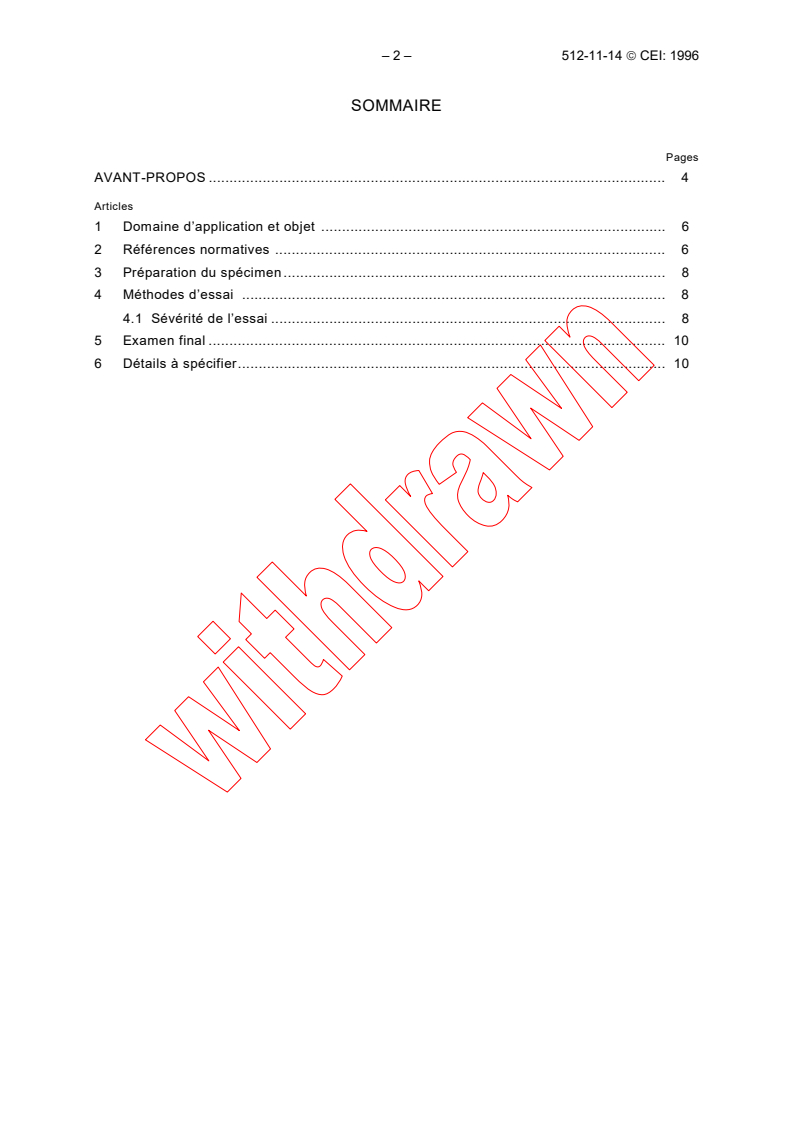
IEC 60512-11-14:1996 - Electromechanical components for electronic equipment - Basic testing procedures and measuring methods - Part 11: Climatic tests - Section 14: Test 11p: Flowing single gas corrosion test Released:10/25/1996
Overview
IEC 60512-11-14:1996 specifies the standardized procedures for conducting the "Flowing Single Gas Corrosion Test" on electromechanical components used in electronic equipment. This international standard, developed by the IEC, is part of a wider series addressing climatic testing requirements. The primary objective of this standard is to assess the effects of controlled corrosion induced by exposure to specific polluting gases, thereby helping manufacturers and engineers evaluate component reliability and performance in industrial atmospheres.
The test methods defined in IEC 60512-11-14 are relevant when required by a detail specification and are applicable to components under the scope of IEC technical committee 48. This ensures that components meet stringent quality requirements for use in environments with corrosive gases, significantly supporting product development, quality control, and compliance initiatives.
Key Topics
- Test Scope: Focuses on electromechanical components for electronic equipment that are subject to industrial atmospheric conditions.
- Standard Test Methods: Establishes procedures to evaluate the effects of corrosion caused by specified concentrations of polluting gases, such as sulphur dioxide and hydrogen sulphide, following referenced IEC test methods.
- Specimen Preparation:
- Mounting and wiring of specimens must adhere to detail specifications.
- Pre-operation or manipulation of specimens may be required, based on the relevant specification.
- Specific test conditions-such as mated/unmated or operated/non-operated-are clearly defined.
- Test Severity Parameters:
- Type and concentration of polluting gas
- Temperature and relative humidity
- Duration of exposure (commonly set at 4, 10, or 21 days)
- Post-Test Evaluation:
- Includes visual examination, contact resistance, insulation resistance, voltage proof testing, and mechanical operating tests as referenced from related IEC standards.
- Specification Details: Guidance on preparation, required measurements, severity details, and any deviations from the standard approach.
Applications
IEC 60512-11-14:1996 is widely used in the electronics industry for the qualification and validation of connectors and other electromechanical components that are exposed to potentially corrosive industrial environments. Typical applications and benefits include:
- Product Qualification: Manufacturers use this standard to ensure their components are resilient to corrosive gases, enhancing product reliability and reducing field failures.
- Quality Control: Laboratory and production testing in accordance with IEC 60512-11-14 supports consistent product quality by simulating real-world environmental stresses.
- Compliance and Procurement: Meeting the requirements of this standard can be a prerequisite for tenders, contracts, or certifications especially in telecom, industrial automation, transportation, and related electronic sectors.
- Research and Development: Enables engineers and designers to evaluate new materials, coatings, or component designs under controlled corrosive environments before market introduction.
- Lifecycle Testing: Supports predictive maintenance and failure analysis strategies by providing standardized test data on corrosion resistance.
Related Standards
IEC 60512-11-14 makes use of and refers to several other key standards relevant for comprehensive component testing:
- IEC 68-2-42 - Environmental testing: Sulphur dioxide test for contacts and connections
- IEC 68-2-43 - Environmental testing: Hydrogen sulphide test for contacts and connections
- IEC 68-2-49 - Environmental testing: Guidance for sulphur dioxide test
- IEC 512-2 - General examination, electrical continuity, and resistance tests
- IEC 512-7 - Mechanical operating and sealing tests
- IEC 721-3-3 - Classification of environmental conditions, stationary use in weatherprotected locations
By adhering to IEC 60512-11-14:1996 and its related standards, organizations ensure robust performance and compliance for electromechanical components in critical electronic applications.
Relations
- Effective Date
- 05-Sep-2023
Buy Documents
IEC 60512-11-14:1996 - Electromechanical components for electronic equipment - Basic testing procedures and measuring methods - Part 11: Climatic tests - Section 14: Test 11p: Flowing single gas corrosion test Released:10/25/1996
Frequently Asked Questions
IEC 60512-11-14:1996 is a standard published by the International Electrotechnical Commission (IEC). Its full title is "Electromechanical components for electronic equipment - Basic testing procedures and measuring methods - Part 11: Climatic tests - Section 14: Test 11p: Flowing single gas corrosion test". This standard covers: Electromechanical components for electronic equipment - Basic testing procedures and measuring methods - Part 11: Climatic tests - Section 14: Test 11p: Flowing single gas corrosion test
Electromechanical components for electronic equipment - Basic testing procedures and measuring methods - Part 11: Climatic tests - Section 14: Test 11p: Flowing single gas corrosion test
IEC 60512-11-14:1996 is classified under the following ICS (International Classification for Standards) categories: 31.220.01 - Electromechanical components in general. The ICS classification helps identify the subject area and facilitates finding related standards.
IEC 60512-11-14:1996 has the following relationships with other standards: It is inter standard links to IEC 60512-11-14:2003. Understanding these relationships helps ensure you are using the most current and applicable version of the standard.
IEC 60512-11-14:1996 is available in PDF format for immediate download after purchase. The document can be added to your cart and obtained through the secure checkout process. Digital delivery ensures instant access to the complete standard document.
Standards Content (Sample)
NORME
CEI
INTERNATIONALE
IEC
512-11-14
INTERNATIONAL
Première édition
STANDARD
First edition
1996-10
Composants électromécaniques pour
équipements électroniques – Procédures
d’essai de base et méthodes de mesure –
Partie 11:
Essais climatiques –
Section 14: Essai 11p – Essai de corrosion
dans le flux d’un gaz
Electromechanical components for
electronic equipment – Basic testing
procedures and measuring methods –
Part 11:
Climatic tests –
Section 14: Test 11p – Flowing single
gas corrosion test
Numéro de référence
Reference number
CEI/IEC 512-11-14: 1996
Validité de la présente publication Validity of this publication
Le contenu technique des publications de la CEI est cons- The technical content of IEC publications is kept under
tamment revu par la CEI afin qu'il reflète l'état actuel de constant review by the IEC, thus ensuring that the content
la technique. reflects current technology.
Des renseignements relatifs à la date de reconfirmation de Information relating to the date of the reconfirmation of the
la publication sont disponibles auprès du Bureau Central de publication is available from the IEC Central Office.
la CEI.
Les renseignements relatifs à ces révisions, à l'établis- Information on the revision work, the issue of revised
sement des éditions révisées et aux amendements peuvent editions and amendments may be obtained from IEC
être obtenus auprès des Comités nationaux de la CEI et National Committees and from the following IEC
dans les documents ci-dessous: sources:
• Bulletin de la CEI • IEC Bulletin
• Annuaire de la CEI • IEC Yearbook
Publié annuellement Published yearly
• Catalogue des publications de la CEI • Catalogue of IEC publications
Publié annuellement et mis à jour régulièrement Published yearly with regular updates
Terminologie Terminology
En ce qui concerne la terminologie générale, le lecteur se For general terminology, readers are referred to IEC 50:
reportera à la CEI 50: Vocabulaire Electrotechnique Inter- International Electrotechnical Vocabulary (IEV), which is
national (VEI), qui se présente sous forme de chapitres issued in the form of separate chapters each dealing
séparés traitant chacun d'un sujet défini. Des détails with a specific field. Full details of the IEV will be
complets sur le VEI peuvent être obtenus sur demande. supplied on request. See also the IEC Multilingual
Voir également le dictionnaire multilingue de la CEI. Dictionary.
Les termes et définitions figurant dans la présente publi- The terms and definitions contained in the present publi-
cation ont été soit tirés du VEI, soit spécifiquement cation have either been taken from the IEV or have been
approuvés aux fins de cette publication. specifically approved for the purpose of this publication.
Symboles graphiques et littéraux Graphical and letter symbols
Pour les symboles graphiques, les symboles littéraux et les For graphical symbols, and letter symbols and signs
signes d'usage général approuvés par la CEI, le lecteur approved by the IEC for general use, readers are referred to
consultera: publications:
– la CEI 27: Symboles littéraux à utiliser en – IEC 27: Letter symbols to be used in electrical
électro-technique; technology;
– la CEI 417: Symboles graphiques utilisables – IEC 417: Graphical symbols for use on
sur le matériel. Index, relevé et compilation des equipment. Index, survey and compilation of the
feuilles individuelles; single sheets;
– la CEI 617: Symboles graphiques pour schémas; – IEC 617: Graphical symbols for diagrams;
et pour les appareils électromédicaux, and for medical electrical equipment,
– la CEI 878: Symboles graphiques pour – IEC 878: Graphical symbols for electromedical
équipements électriques en pratique médicale. equipment in medical practice.
Les symboles et signes contenus dans la présente publi- The symbols and signs contained in the present publication
cation ont été soit tirés de la CEI 27, de la CEI 417, de la have either been taken from IEC 27, IEC 417, IEC 617
CEI 617 et/ou de la CEI 878, soit spécifiquement approuvés and/or IEC 878, or have been specifically approved for the
aux fins de cette publication. purpose of this publication.
Publications de la CEI établies par le IEC publications prepared by the same
même comité d'études technical committee
L'attention du lecteur est attirée sur les listes figurant à la fin The attention of readers is drawn to the end pages of this
de cette publication, qui énumèrent les publications de la publication which list the IEC publications issued by the
CEI préparées par le comité d'études qui a établi la technical committee which has prepared the present
présente publication. publication.
NORME
CEI
INTERNATIONALE
IEC
512-11-14
INTERNATIONAL
Première édition
STANDARD
First edition
1996-10
Composants électromécaniques pour
équipements électroniques – Procédures
d’essai de base et méthodes de mesure –
Partie 11:
Essais climatiques –
Section 14: Essai 11p – Essai de corrosion
dans le flux d’un gaz
Electromechanical components for
electronic equipment – Basic testing
procedures and measuring methods –
Part 11:
Climatic tests –
Section 14: Test 11p – Flowing single
gas corrosion test
CEI 1996 Droits de reproduction réservés Copyright - all rights reserved
Aucune partie de cette publication ne peut être reproduite ni No part of this publication may be reproduced or utilized
utilisée sous quelque forme que ce soit et par aucun procédé, in any form or by any means, electronic or mechanical,
électronique ou mécanique, y compris la photocopie et les including photocopying and microfilm, without permission
microfilms, sans l'accord écrit de l'éditeur. in writing from the publisher
Bureau central de la Commission Electrotechnique Internationale 3, rue de Varembé Genève Suisse
CODE PRIX
Commission Electrotechnique Internationale
F
International Electrotechnical Commission PRICE CODE
Pour prix, voir catalogue en vigueur
For price, see current catalogue
– 2 – 512-11-14 CEI: 1996
SOMMAIRE
Pages
AVANT-PROPOS . 4
Articles
1 Domaine d’application et objet . 6
2 Références normatives . 6
3 Préparation du spécimen . 8
4 Méthodes d’essai . 8
4.1 Sévérité de l’essai . 8
5 Examen final . 10
6 Détails à spécifier. 10
512-11-14 IEC: 1996 – 3 –
CONTENTS
Page
FOREWORD . 5
Clause
1 Scope and object. 7
2 Normative references . 7
3 Preparation of the specimen . 9
4 Test methods . 9
4.1 Severity of the test. 9
5 Final examination . 11
6 Details to be specified . 11
– 4 – 512-11-14 CEI: 1996
COMMISSION ÉLECTROTECHNIQUE INTERNATIONALE
––––––––
COMPOSANTS ÉLECTROMÉCANIQUES POUR ÉQUIPEMENTS
ÉLECTRONIQUES – PROCÉDURES D’ESSAI DE BASE
ET MÉTHODES DE MESURE –
Partie 11: Essais climatiques –
Section 14: Essai 11p – Essai de corrosion dans le flux d’un gaz
AVANT-PROPOS
1) La CEI (Commission Electrotechnique Internationale) est une organisation mondiale de normalisation composée
de l'ensemble des comités électrotechniques nationaux (Comités nationaux de la CEI). La CEI a pour objet de
favoriser la coopération internationale pour toutes les questions de normalisation dans les domaines de
l'électricité et de l'électronique. A cet effet, la CEI, entre autres activités, publie des Normes Internationales.
Leur élaboration est confiée à des comités d'études, aux travaux desquels tout Comité national intéressé par le
sujet traité peut participer. Les organisations internationales, gouvernementales et non gouvernementales, en
liaison avec la CEI, participent également aux travaux. La CEI collabore étroitement avec l'Organisation
Internationale de Normalisation (ISO), selon des conditions fixées par accord entre les deux organisations.
2) Les décisions ou accords officiels de la CEI concernant les questions techniques, représentent, dans la mesure
du possible un accord international sur les sujets étudiés, étant donné que les Comités nationaux intéressés
sont représentés dans chaque comité d’études.
3) Les documents produits se présentent sous la forme de recommandations internationales. Ils sont publiés
comme normes, rapports techniques ou guides et agréés comme tels par les Comités nationaux.
4) Dans le but d'encourager l'unification internationale, les Comités nationaux de la CEI s'engagent à appliquer de
façon transparente, dans toute la mesure possible, les Normes internationales de la CEI dans leurs normes
nationales et régionales. Toute divergence entre la norme CEI et la norme nationale ou régionale
correspondante doit être indiquée en termes clairs dans cette dernière.
5) La CEI n’a fixé aucune procédure concernant le marquage comme indication d’approbation et sa responsabilité
n’est pas engagée quand un matériel est déclaré conforme à l’une de ses normes.
6) L’attention est attirée sur le fait que certains des éléments de la présente Norme internationale peuvent faire
l’objet de droits de propriété intellectuelle ou de droits analogues. La CEI ne saurait être tenue pour
responsable de ne pas avoir identifié de tels droits de propriété et de ne pas avoir signalé leur existence.
La Norme internationale CEI 512-11-14 a été établie par le sous-comité 48B: Connecteurs, du
comité d'études 48 de la CEI: Composants électromécaniques et structures mécaniques pour
équipements électroniques.
Cette norme doit être utilisée conjointement avec la CEI 512-1.
La norme complète comprendra d’autres essais selon le plan d’ensemble donné dans l’annexe
A de la CEI 512-1. Ces essais additionnels paraîtront au fur et à mesure de leur mise au point.
Il est prévu que cette norme complète remplacera les essais de la CEI 130-1.
Le texte de cette norme est issu des documents suivants:
FDIS Rapport de vote
48B/494/FDIS 48B/543/RVD
Le rapport de vote indiqué dans le tableau ci-dessus donne toute information sur le vote ayant
abouti à l'approbation de cette norme.
512-11-14 IEC: 1996 – 5 –
INTERNATIONAL ELECTROTECHNICAL COMMISSION
––––––––
ELECTROMECHANICAL COMPONENTS FOR
ELECTRONIC EQUIPMENT – BASIC TESTING PROCEDURES
AND MEASURING METHODS –
Part 11: Climatic tests –
Section 14: Test 11p – Flowing single gas corrosion test
FOREWORD
1) The IEC (International Electrotechnical Commission) is a worldwide organization for standardization comprising
all national electrotechnical committees (IEC National Committees). The object of the IEC is to promote
international co-operation on all questions concerning standardization in the electrical and electronic fields. To
this end and in addition to other activities, the IEC publishes International Standards. Their preparation is
entrusted to technical committees; any IEC National Committee interested in the subject dealt with may
participate in this preparatory work. International, governmental and non-governmental organizations liaising
with the IEC also participate in this preparation. The IEC collaborates closely with the International Organization
for Standardization (ISO) in accordance with conditions determined by agreement between the two
organizations.
2) The formal decisions or agreements of the IEC on technical matters express, as nearly as possible, an
international consensus of opinion on the relevant subjects since each technical committee has representation
from all interested National Committees.
3) The documents produced have the form of recommendations for international use and are published in the form
of standards, technical reports or guides and they are accepted by the National Committees in that sense.
4) In order to promote international unification, IEC National Committees undertake to apply IEC International
Standards transparently to the maximum extent possible in their national and regional standards. Any
divergence between the IEC Standard and the corresponding national or regional standard shall be clearly
indicated in the latter.
5) The IEC provides no marking procedure to indicate its approval and cannot be rendered responsible for any
equipment declared to be in conformity with one of its standards.
6) Attention is drawn to the possibility that some of the elements of this International Standard may be the subject
of patent rights. The IEC shall not be held responsible for identifying any or all such patent rights.
International Standard IEC 512-11-14 has been prepared by subcommittee 48B: Connectors, of
IEC technical committee 48: Electromechanical components and mechanical structures for
electronic equipment.
This standard should be used in conjunction with IEC 512-1.
The complete standard will include other tests according to the general plan given in Appendix A
of IEC 512-1. These additional tests will be issued as they become available.
It is intended that this complete standard will supersede the tests in IEC 130-1.
The text of this standard is based on the following documents:
FDIS Report on voting
48B/494/FDIS 48B/543/RVD
Full information on the voting for the approval of this standard can be found in the report on
voting indicated in the above table.
– 6 – 512-11-14 CEI: 1996
COMPOSANTS ÉLECTROMÉCANIQUES POUR ÉQUIPEMENTS
ÉLECTRONIQUES – PROCÉDURES D’ESSAI DE BASE
ET MÉTHODES DE MESURE –
Partie 11: Essais climatiques –
Section 14: Essai 11p – Essai de corrosion dans le flux d’un gaz
1 Domaine d’application et objet
La présente section de la CEI 512-11 est utilisée, lorsque la spécification particulière le
prescrit, pour essayer les composants électromécaniques du domaine d’application du comité
d’études 48 de la CEI. Cet essai peut aussi être effectué sur des dispositifs similaires
lorsqu’une spécification particulière le prescrit.
L’objet de cet essai est de définir des méthodes d’essai normalisées pour évaluer les effets
d’une corrosion contrôlée en atmosphère industrielle, à une concentration spécifiée de gaz
polluants. Cet essai n’est pas destiné à être suivi par des essais électriques. Cependant,
lorsque la spécification particulière le prescrit, cet essai peut être suivi par l’essai 1a (examen
visuel), l’essai 2a (résistance de contact – méthode au niveau des millivolts), l’essai 2b
(résistance de contact – méthode du courant spécifié), l’essai 2c (variation de la résistance de
contact), l’essai 3a (résistance d’isolement), l’essai 4a (tension de tenue), tels que définis dans
la CEI 512-2, et dans des conditions d’essai électriques et physiques définies.
2 Références normatives
Les documents normatifs suivants contiennent des dispositions qui, par la suite de la référence
qui y est faite, constituent des dispositions valables pour la présente section de la CEI 512-11.
Au moment de la publication, les éditions indiquées étaient en vigueur. Tout document normatif
est sujet à révision et les parties prenantes aux accords fondés sur la présente section de la
CEI 512-11 sont invitées à rechercher la possibilité d'appliquer les éditions les plus récentes
des documents normatifs indiqués ci-après. Les membres de la CEI et de l'ISO possèdent le
registre des Normes internationales en vigueur.
CEI 68-2-42: 1982, Essais d’environnement – Partie 2: Essais – Essai Kc: Essai à l’anhydride
sulfureux pour contacts et connexions
CEI 68-2-43: 1976, Essais d’environnement – Partie 2: Essais – Essai Kd: Essai à l’hydrogène
sulfuré pour contacts et connexions
CEI 68-2-49: 1983, Essais d’environnement – Partie 2: Essais – Guide pour l’essai Kc: Essai à
l’anhydride sulfureux pour contacts et connexions
CEI 512-2: 1985, Composants électromécaniques pour équipements électroniques; procédures
d’essai de base et méthodes de mesure – Partie 2: Examen général, essais de continuité
électrique et de résistance de contact, essais d’isolement et essais de contrainte diélectrique
CEI 512-7: 1993, Composants électromécaniques pour équipements électroniques; procédures
d’essai de base et méthodes de mesure – Partie 7: Essais de fonctionnement mécanique et
essais d’étanchéité
CEI 721-3-3: 1994, Classification des conditions d’environnement – Partie 3: Classification des
groupements des agents d’environnement et de leurs sévérités – Section 3: Utilisation à poste
fixe, protégé contre les intempéries
512-11-14 IEC: 1996 – 7 –
ELECTROMECHANICAL COMPONENTS FOR
ELECTRONIC EQUIPMENT – BASIC TESTING PROCEDURES
AND MEASURING METHODS –
Part 11: Climatic tests –
Section 14: Test 11p – Flowing single gas corrosion test
1 Scope and object
This section of IEC 512-11, when required by the detail specification, is used for testing
electromechanical components within the scope of IEC technical committee 48. This test may
also be used for similar components when specified in a detail specification.
The object of this test is to define standard test methods to assess the effects of a controlled
corrosion in industrial atmospheres, in specified concentration of polluting gas(es). It is not
intended to be followed by electrical tests. However, when required by the detail specification,
this test may be followed by test 1a (visual examination), test 2a (contact resistance – millivolt
level method), test 2b (contact resistance – specified test current method) or test 2c (contact
resistance variation), test 3a (insulation resistance), test 4a (voltage proof), as described in
IEC 512-2 and under defined physical and electrical test conditions.
2 Normative references
The following normative documents contain provisions which, through reference in this text,
constitute provisions of this section of IEC 512-11. At the time of publication, the editions
indicated were valid. All normative documents are subject to revision, and parties to
agreements based on this section of IEC 512-11 are encouraged to investigate the possibility
of applying the most recent editions of the normative documents indicated below. Members of
IEC and ISO maintain registers of currently valid International Standards.
IEC 68-2-42: 1982, Environmental testing – Part 2: Tests – Test Kc: Sulphur dioxide test for
contacts and connections
IEC 68-2-43: 1976, Environmental testing – Part 2: Tests – Test Kd: Hydrogen sulphide test for
contacts and connections
IEC 68-2-49: 1983, Environmental testing – Part 2: Tests – Guidance to Test Kc: Sulphur
dioxide test for contacts and connections
IEC 512-2: 1985, Electromechanical components for electronic equipment; basic testing
procedures and measuring methods – Part 2: General examination, electrical continuity and
contact resistance tests, insulation tests and voltage stress tests
IEC 512-7: 1993, Electromechanical components for electronic equipment; basic testing
procedures and measuring methods – Part 7: Mechanical operating tests and sealing tests
IEC 721-3-3: 1994, Classification of environmental conditions – Part 3: Classification of groups
of environmental parameters and their severities – Section 3: Stationary use at
weatherprotected locations
– 8 – 512-11-14 CEI: 1996
3 Préparation du spécimen
Le spécimen doit être monté et câblé conformément à la spécification particulière.
Quand la spécification particulière le requiert, le spécimen doit être manoeuvré le nombre de
fois spécifié avant l’essai.
Pour chaque essai, la spécification particulière doit préciser l’état et la sévérité pour le
composant, par exemple s’il est accouplé où désaccouplé, actionné ou non.
NOTE – Lorsqu’il y a plusieurs spécimens, il est recommandé de diviser les spécimens en deux groupes pour
différentes conditions.
4 Méthodes d’essai
Cet essai doit être effectué conformément à la:
– CEI 68-2-42 Essai Kc: Essai à l’anhydride sulfureux pour contacts et connexions;
– CEI 68-2-43 Essai Kd: Essai à l’hydrogène sulfuré pour contacts et connexions;
– CEI 68-2-49 Guide pour l’essai Kc: Essai à l’anhydride sulfureux pour contacts et
connexions.
4.1 Sévérité de l’essai
La sévérité de l’essai, qui doit être donnée dans la spécification applicable, est définie par:
– le type et la concentration du ou des gaz polluants;
– la température;
– l’humidité relative;
– la durée de l’exposition.
Tableau 1 – Méthodes proposées
Méthode Gaz polluant 1) 2)
Sévérité 1 Sévérité 2
ASO 1 max 10 max (antérieurement: Kc)
BH S 0,1 max 1 max (antérieurement: Kd)
NOTES
–6
1 Toutes les valeurs sont en 10 vol/vol [parties par million].
2 Pour toutes les méthodes: température: (25 ou 30 ± 1) °C;
humidité relative: (75 ± 3) %;
durée: 4, 10 ou 21 jours.
3 Comme la nature de l’agressivité est différente entre les méthodes A et B, aucune comparaison
entre ces deux méthodes ne doit être faite.
4 A l’avenir, d’autres méthodes pourront être ajoutées après qu’une expérience suffisante aura
été acquise.
5 La condensation sur les spécimens et sur l’équipement d’essai doit être évitée.
1) CEI 721-3-3 classe 3C1
2) CEI 721-3-3 classe 3C2
512-11-14 IEC: 1996 – 9 –
3 Preparation of the specimen
The specimen shall be prepared and mounted in accordance with the detail specification.
When required by the detail specification, the specimen shall be operated the number of times
specified prior to the test.
For each test carried out, the detail specification shall specify the condition and the severity of
the component, for example operated or non-operated, mated or unmated.
NOTE – In case of several specimens, it is recommended to divide the specimens in two groups with different
conditions.
4 Test methods
The test shall be carried out in accordance with:
– IEC 68-2-42 Test Kc: Sulphur dioxide test for contacts and connections;
– IEC 68-2-43 Test Kd: Hydrogen sulphide test for contacts and connections;
– IEC 68-2-49 Guidance to test Kc: Sulphur dioxide test for contacts and connections.
4.1 Severity of the test
The test severity, to be given in the relevant specification, is defined by:
– type and concentration of polluting gas;
– temperature;
– relative humidity;
– duration of exposure.
Table 1 – Methods proposed
1) 2)
Method Polluting gas
Severity 1 Severity 2
ASO 1 max 10 max (previous test: Kc)
BH S 0,1 max 1 max (previous test: Kd)
NOTES
-6
1 All values in 10 vol/vol [parts per million].
2 For all methods: temperature: (25 or 30 ± 1) °C;
relative humidity: (75 ± 3) %;
duration: 4, 10, or 21 days.
3 Since the nature of aggressivity is different with methods A and B, no comparison between
these methods shall be made.
4 Other methods may be added in the future after sufficient experience has been gained.
5 Condensation on the specimens and on the test equipment shall be avoided.
1) IEC 721-3-3 class 3C1
2) IEC 721-3-3 class 3C2
– 10 – 512-11-14 CEI: 1996
5 Examen final
A la fin de l’essai ci-dessus, les spécimens doivent être examinés en accord avec les essais
suivants:
– examen visuel (essai 1a de la CEI 512-2 [CEI 512-1-1]*);
– résistance de contact (essai 2a ou essai 2b de la CEI 512-2 [CEI 512-2-1 ou CEI 512-2-2]*);
– résistance d’isolement (essai 3a de la CEI 512-2 [CEI 512-3-1]*);
*
– tension de tenue (essai 4a de la CEI 512-2 [CEI 512-4-1] );
– essais de fonctionnement mécanique de la CEI 512-7, en accordant une attention
particulière aux points suivants:
a) craquage;
b) délamination;
c) piqûres sur les surfaces de métal exposées.
6 Détails à spécifier
Lorsque cet essai est requis par la spécification particulière, les détails suivants doivent être
spécifiés:
a) méthode de préparation, de montage et de positionnement des spécimens;
b) préconditionnement des spécimens (si requis);
c) sévérité, type, concentration et température du gaz polluant;
d) mesures initiales;
e) exigences;
f) durée de l’exposition;
g) mesures finales;
h) toute dérogation à la méthode d’essai normalisée.
–––––––––––
––––––––––
*
Numéro de publication de la future édition.
512-11-14 IEC: 1996 – 11 –
5 Final examination
Upon completion of the above test, the specimens shall be examined in accordance with the
following tests, if applicable:
– visual examination (test 1a of IEC 512-2 [IEC 512-1-1]*);
– contact resistance (test 2a or test 2b of IEC 512-2 [IEC 512-2-1 or IEC 512-2-2]*);
– insulation resistance (test 3a of IEC 512-2 [IEC 512-3-1]*);
*
– voltage proof (test 4a of IEC 512-2 [IEC 512-4-1] );
– and with the mechanical operating tests of IEC 512-7, with particular attention to the
following details:
a) cracking;
b) delamination;
c) pitting of exposed metal surfaces.
6 Details to be specified
When this test is required by the detail specification, the following details shall be specified:
a) method of preparation and mounting of the specimens;
b) preconditioning of the specimens (if required);
c) severity, type, concentration and temperature of polluting gas;
d) initial measurements;
e) requirements;
f) duration of exposure;
g) final measurements;
h) any deviation from the standard test method.
__________
––––––––––
*
Publication number of the planned future edition.
Standards Survey
We at the IEC want to know how our standards are used once they are published.
The answers to this survey will help us to improve IEC standards and standard related
information to meet your future needs
Would you please take a minute to answer the survey on the other side and mail or fax to:
Customer Service Centre (CSC)
International Electrotechnical Commission
3, rue de Varembé
Case postale 131
1211 Geneva 20
Switzerland
or
Fax to: CSC at +41 22 919 03 00
Thank you for your contribution to the standards making process.
Nicht frankieren
Ne pas affranchir
A Prioritaire
Non affrancare
No stamp required
RÉPONSE PAYÉE
SUISSE
Customer Service Centre (CSC)
International Electrotechnical Commission
3, rue de Varembé
Case postale 131
1211 GENEVA 20
Switzerland
1. 7. 13.
No. of IEC standard: Please rate the standard in the following If you said yes to 12 then how many
areas as (1) bad, (2) below average, volumes:
(3) average, (4) above average,
.......................................................
(5) exceptional, (0) not applicable:
................................................
clearly written
2.
14.
logically arranged
Tell us why you have the standard.
Which standards organizations
(check many as apply). I am:
information given by tables
published the standards in your
library (e.g. ISO, DIN, ANSI, BSI,
the buyer
illustrations
etc.):
the user
technical information
a librarian
8. .
a researcher
I would like to know how I can legally
15.
reproduce this standard for:
an engineer
My organization supports the
internal use
a safety expert standards-making process (check as
many as apply):
sales information
involved in testing
product demonstration
with a government agency
buying standards
other.
in industry
using standards
other. 9.
membership in standards
organization
In what medium of standard does your
3.
organization maintain most of its
serving on standards
standards (check one):
development committee
This standard was purchased from?
paper
other.
.......................................................
microfilm/microfiche
16.
mag tapes
My organization uses (check one)
4.
CD-ROM
This standard will be used
French text only
floppy disk
(check as many as apply):
English text only
on line
for reference
Both English/French text
in a standards library
9A.
17.
to develop a new product
If your organization currently maintains
part or all of its standards collection in
Other comments:
to write specifications
electronic media please indicate the
to use in a tender format(s):
........................................................
for educational purposes raster image
........................................................
for a lawsuit
full text
for quality assessment
10.
........................................................
for certification
In what medium does your organization
intend to maintain its standards collection
........................................................
for general information
in the future (check all that apply):
for design purposes
paper
........................................................
for testing
microfilm/microfiche
other.
........................................................
mag tape
CD-ROM
5. 18.
floppy disk
This standard will be used in conjunction
Please give us information about you
with (check as many as apply): and your company
on line
IEC
10A.
name: .
ISO
For electronic media which format will be
corporate chosen (check one)
job title:.
other (published by. ) raster image
company: .
full text
other (published by. )
other (published by. )
11.
address:.
My organization is in the following sector
6.
(e.g. engineering, manufacturing) .
This standard meets my needs
...............................................
(check one)
........................................................
12.
not at all
........................................................
Does your organization have a standards
almost
library:
fairly well
No. employees at your location:.
yes
ex
...