


IEC 61158-5-9:2014
(Main)Industrial communication networks - Fieldbus specifications - Part 5-9: Application layer service definition - Type 9 elements
Industrial communication networks - Fieldbus specifications - Part 5-9: Application layer service definition - Type 9 elements
IEC 61158-5-9:2014 defines the services provided to the FAL user at the boundary between the user and the application layer of the fieldbus reference model, and Systems Management at the boundary between the application layer and Systems Management of the fieldbus reference model. This standard specifies the structure and services of the IEC fieldbus application layer, in conformance with the OSI Basic Reference Model (ISO/IEC 7498-1) and the OSI application layer structure (ISO/IEC 9545). This second edition cancels and replaces the first edition published in 2007 and constitutes a technical revision. The main changes are: Correct download state machine event service.
Réseaux de communication industriels - Spécifications des bus de terrain - Partie 5-9: Définition des services de la couche application - Eléments de type 9
L'IEC 61158-5-9:2014 défini les services mis en place pour l'utilisateur de FAL, à la frontière entre l'utilisateur et la couche application du modèle de référence de bus de terrain; et la Gestion des systèmes, à la frontière entre la couche application et la Gestion des systèmes selon le modèle de référence de bus de terrain. La présente norme spécifie la structure et les services de la couche application de bus de terrain IEC, en conformité avec le modèle de référence de base de l'OSI (ISO/CEI 7498-1) et la structure de la couche application de l'OSI (ISO/CEI 9545). Cette deuxième édition annule et remplace la première édition parue en 2007. Elle constitue une révision technique. Cette édition inclut les modifications suivantes: Correction des services d'événements du diagramme d'états de téléchargement descendant.
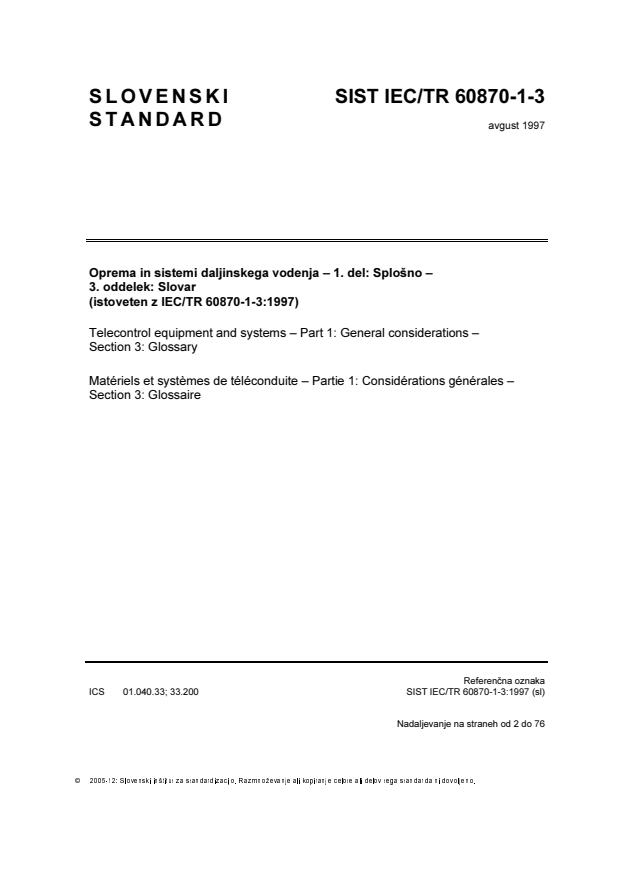
Oprema in sistemi daljinskega vodenja - 1. del: Splošno - 3. oddelek: Slovar (IEC/TR 60870-1-3:1997)
General Information
Relations
Standards Content (Sample)
IEC 61158-5-9 ®
Edition 2.0 2014-08
INTERNATIONAL
STANDARD
NORME
INTERNATIONALE
Industrial communication networks – Fieldbus specifications –
Part 5-9: Application layer service definition – Type 9 elements
Réseaux de communication industriels – Spécifications des bus de terrain –
Partie 5-9: Définition des services de la couche application – Eléments de type 9
All rights reserved. Unless otherwise specified, no part of this publication may be reproduced or utilized in any form
or by any means, electronic or mechanical, including photocopying and microfilm, without permission in writing from
either IEC or IEC's member National Committee in the country of the requester. If you have any questions about IEC
copyright or have an enquiry about obtaining additional rights to this publication, please contact the address below or
your local IEC member National Committee for further information.
Droits de reproduction réservés. Sauf indication contraire, aucune partie de cette publication ne peut être reproduite
ni utilisée sous quelque forme que ce soit et par aucun procédé, électronique ou mécanique, y compris la photocopie
et les microfilms, sans l'accord écrit de l'IEC ou du Comité national de l'IEC du pays du demandeur. Si vous avez des
questions sur le copyright de l'IEC ou si vous désirez obtenir des droits supplémentaires sur cette publication, utilisez
les coordonnées ci-après ou contactez le Comité national de l'IEC de votre pays de résidence.
IEC Central Office Tel.: +41 22 919 02 11
3, rue de Varembé Fax: +41 22 919 03 00
CH-1211 Geneva 20 info@iec.ch
Switzerland www.iec.ch
About the IEC
The International Electrotechnical Commission (IEC) is the leading global organization that prepares and publishes
International Standards for all electrical, electronic and related technologies.
About IEC publications
The technical content of IEC publications is kept under constant review by the IEC. Please make sure that you have the
latest edition, a corrigenda or an amendment might have been published.
IEC Catalogue - webstore.iec.ch/catalogue Electropedia - www.electropedia.org
The stand-alone application for consulting the entire The world's leading online dictionary of electronic and
bibliographical information on IEC International Standards, electrical terms containing more than 30 000 terms and
Technical Specifications, Technical Reports and other definitions in English and French, with equivalent terms in 14
documents. Available for PC, Mac OS, Android Tablets and additional languages. Also known as the International
iPad. Electrotechnical Vocabulary (IEV) online.
IEC publications search - www.iec.ch/searchpub IEC Glossary - std.iec.ch/glossary
The advanced search enables to find IEC publications by a More than 55 000 electrotechnical terminology entries in
variety of criteria (reference number, text, technical English and French extracted from the Terms and Definitions
committee,…). It also gives information on projects, replaced clause of IEC publications issued since 2002. Some entries
and withdrawn publications. have been collected from earlier publications of IEC TC 37,
77, 86 and CISPR.
IEC Just Published - webstore.iec.ch/justpublished
Stay up to date on all new IEC publications. Just Published IEC Customer Service Centre - webstore.iec.ch/csc
details all new publications released. Available online and If you wish to give us your feedback on this publication or
also once a month by email. need further assistance, please contact the Customer Service
Centre: csc@iec.ch.
A propos de l'IEC
La Commission Electrotechnique Internationale (IEC) est la première organisation mondiale qui élabore et publie des
Normes internationales pour tout ce qui a trait à l'électricité, à l'électronique et aux technologies apparentées.
A propos des publications IEC
Le contenu technique des publications IEC est constamment revu. Veuillez vous assurer que vous possédez l’édition la
plus récente, un corrigendum ou amendement peut avoir été publié.
Catalogue IEC - webstore.iec.ch/catalogue Electropedia - www.electropedia.org
Application autonome pour consulter tous les renseignements
Le premier dictionnaire en ligne de termes électroniques et
bibliographiques sur les Normes internationales,
électriques. Il contient plus de 30 000 termes et définitions en
Spécifications techniques, Rapports techniques et autres
anglais et en français, ainsi que les termes équivalents dans
documents de l'IEC. Disponible pour PC, Mac OS, tablettes
14 langues additionnelles. Egalement appelé Vocabulaire
Android et iPad.
Electrotechnique International (IEV) en ligne.
Recherche de publications IEC - www.iec.ch/searchpub
Glossaire IEC - std.iec.ch/glossary
Plus de 55 000 entrées terminologiques électrotechniques, en
La recherche avancée permet de trouver des publications IEC
en utilisant différents critères (numéro de référence, texte, anglais et en français, extraites des articles Termes et
comité d’études,…). Elle donne aussi des informations sur les Définitions des publications IEC parues depuis 2002. Plus
projets et les publications remplacées ou retirées. certaines entrées antérieures extraites des publications des
CE 37, 77, 86 et CISPR de l'IEC.
IEC Just Published - webstore.iec.ch/justpublished
Service Clients - webstore.iec.ch/csc
Restez informé sur les nouvelles publications IEC. Just
Published détaille les nouvelles publications parues. Si vous désirez nous donner des commentaires sur cette
Disponible en ligne et aussi une fois par mois par email. publication ou si vous avez des questions contactez-nous:
csc@iec.ch.
IEC 61158-5-9 ®
Edition 2.0 2014-08
INTERNATIONAL
STANDARD
NORME
INTERNATIONALE
Industrial communication networks – Fieldbus specifications –
Part 5-9: Application layer service definition – Type 9 elements
Réseaux de communication industriels – Spécifications des bus de terrain –
Partie 5-9: Définition des services de la couche application – Eléments de type 9
INTERNATIONAL
ELECTROTECHNICAL
COMMISSION
COMMISSION
ELECTROTECHNIQUE
PRICE CODE
INTERNATIONALE
CODE PRIX XF
ICS 25.040.40; 35.100.70; 35.110 ISBN 978-2-8322-1735-1
– 2 – IEC 61158-5-9:2014 © IEC 2014
CONTENTS
FOREWORD . 5
INTRODUCTION . 7
1 Scope . 8
1.1 General . 8
1.2 Specifications . 9
1.3 Conformance . 9
2 Normative references . 9
3 Terms, definitions, symbols, abbreviations and conventions . 10
3.1 ISO/IEC 7498-1 terms . 10
3.2 ISO/IEC 8822 terms . 10
3.3 ISO/IEC 9545 terms . 10
3.4 ISO/IEC 8824-1 terms . 10
3.5 IEC 61158-1 terms . 10
3.6 Type 9 fieldbus application-layer specific definitions. 14
3.7 Abbreviations and symbols . 14
3.8 Conventions . 15
4 Concepts . 18
5 Data type ASE . 18
5.1 Overview . 18
5.2 Formal definition of data type objects . 21
5.3 FAL defined data types . 22
5.4 Data type ASE service specification . 25
5.5 Summary of data types . 25
6 Communication model specification . 26
6.1 Concepts . 26
6.2 Common parameters . 26
6.3 ASEs . 26
6.4 ARs . 115
6.5 Summary of classes . 118
6.6 Permitted services by AREP role . 119
Bibliography . 121
Figure 1 – Data type class hierarchy . 19
Figure 2 – VFD model . 27
Figure 3 – Abstract model of an automation system (VFD) . 27
Figure 4 – Source OD/remote OD . 33
Figure 5 – Put OD state machine . 46
Figure 6 – Transaction object state machine . 52
Figure 7 – Context test of two features-supported with different bitstring length . 60
Figure 8 – Overview of event . 80
Figure 9 – Event state machine . 85
Figure 10 – Domain genericdownload/download state machine (server) . 100
Figure 11 – Domain upload state machine (server) . 102
Figure 12 – State diagram. 113
Table 1 – Data type summary . 26
Table 2 – Logical status . 28
Table 3 – Status . 29
Table 4 – Unsolicited status . 30
Table 5 – Identify . 31
Table 6 – Structure of the object dictionary . 34
Table 7 – Structure of the static list of types . 34
Table 8 – Structure of the static object dictionary . 34
Table 9 – Structure of the dynamic list of variable lists . 35
Table 10 – Structure of the dynamic list of program invocations . 35
Table 11 – Empty object dictionary . 39
Table 12 – Get OD service parameters . 42
Table 13 – Initiate put OD service parameters . 44
Table 14 – Put OD service parameters . 45
Table 15 – Terminate put OD service parameters . 46
Table 16 – Put OD state transitions . 48
Table 17 – Attribute FMS features supported . 50
Table 18 – Transaction object state transitions . 53
Table 19 – Initiate service parameters . 54
Table 20 – Failure reasons . 55
Table 21 – Abort service parameters . 56
Table 22 – User abort reasons . 57
Table 23 – APO ASE abort reasons . 57
Table 24 – Reject service parameters . 58
Table 25 – Reject APDU reasons . 58
Table 26 – Compatibility of the local context to the remote context . 59
Table 27 – Unconfirmed send service parameters . 62
Table 28 – Confirmed send service parameters . 63
Table 29 – AR-Abort service parameters . 64
Table 30 – Compel service parameters . 64
Table 31 – Get buffered message service parameters. 65
Table 32 – AR-Status service parameters . 66
Table 33 – Simple variable access group membership . 68
Table 34 – Simple variable access rights membership . 68
Table 35 – Array variable access group membership . 70
Table 36 – Array variable access rights membership . 70
Table 37 – Variable list access group membership . 72
Table 38 – Variable list access rights membership . 72
Table 39 – Read service parameters . 75
Table 40 – Write service parameters . 76
Table 41 – Information report service parameters . 77
Table 42 – Define variable list service parameters . 78
– 4 – IEC 61158-5-9:2014 © IEC 2014
Table 43 – Delete variable list service parameters . 79
Table 44 – Event access group membership . 81
Table 45 – Event access rights membership . 81
Table 46 – Event notification service parameters . 82
Table 47 – Acknowledge event notification service parameters . 83
Table 48 – Alter event condition monitoring service parameters . 84
Table 49 – Event state transitions . 85
Table 50 – Domain access group membership . 87
Table 51 – Domain access rights membership . 87
Table 52 – GenericInitiateDownloadSequence . 89
Table 53 – GenericDownloadSegment . 90
Table 54 – GenericTerminateDownloadSequence . 91
Table 55 – InitiateDownloadSequence . 92
Table 56 – DownloadSegment . 93
Table 57 – TerminateDownloadSequence . 94
Table 58 – RequestDomainDownload . 95
Table 59 – InitiateUploadSequence . 96
Table 60 – UploadSegment . 97
Table 61 – TerminateUploadSequence . 98
Table 62 – RequestDomainUpload . 99
Table 63 – Domain genericDownload/download state machine (server) . 100
Table 64 – Domain upload state machine (server) . 102
Table 65 – Program invocation access group membership . 104
Table 66 – Program invocation access group membership . 104
Table 67 – Create program invocation service parameters . 106
Table 68 – Delete program invocation service parameters . 107
Table 69 – Start service parameters . 108
Table 70 – Stop service parameters . 109
Table 71 – Resume service parameters . 110
Table 72 – Reset service parameters . 111
Table 73 – Kill service parameters . 112
Table 74 – Program invocation state machine . 114
Table 75 – Class summary . 119
Table 76 – Services by AREP role . 119
INTERNATIONAL ELECTROTECHNICAL COMMISSION
____________
INDUSTRIAL COMMUNICATION NETWORKS –
FIELDBUS SPECIFICATIONS –
Part 5-9: Application layer service definition –
Type 9 elements
FOREWORD
1) The International Electrotechnical Commission (IEC) is a worldwide organization for standardization comprising
all national electrotechnical committees (IEC National Committees). The object of IEC is to promote
international co-operation on all questions concerning standardization in the electrical and electronic fields. To
this end and in addition to other activities, IEC publishes International Standards, Technical Specifications,
Technical Reports, Publicly Available Specifications (PAS) and Guides (hereafter referred to as “IEC
Publication(s)”). Their preparation is entrusted to technical committees; any IEC National Committee interested
in the subject dealt with may participate in this preparatory work. International, governmental and non-
governmental organizations liaising with the IEC also participate in this preparation. IEC collaborates closely
with the International Organization for Standardization (ISO) in accordance with conditions determined by
agreement between the two organizations.
2) The formal decisions or agreements of IEC on technical matters express, as nearly as possible, an international
consensus of opinion on the relevant subjects since each technical committee has representation from all
interested IEC National Committees.
3) IEC Publications have the form of recommendations for international use and are accepted by IEC National
Committees in that sense. While all reasonable efforts are made to ensure that the technical content of IEC
Publications is accurate, IEC cannot be held responsible for the way in which they are used or for any
misinterpretation by any end user.
4) In order to promote international uniformity, IEC National Committees undertake to apply IEC Publications
transparently to the maximum extent possible in their national and regional publications. Any divergence
between any IEC Publication and the corresponding national or regional publication shall be clearly indicated in
the latter.
5) IEC itself does not provide any attestation of conformity. Independent certification bodies provide conformity
assessment services and, in some areas, access to IEC marks of conformity. IEC is not responsible for any
services carried out by independent certification bodies.
6) All users should ensure that they have the latest edition of this publication.
7) No liability shall attach to IEC or its directors, employees, servants or agents including individual experts and
members of its technical committees and IEC National Committees for any personal injury, property damage or
other damage of any nature whatsoever, whether direct or indirect, or for costs (including legal fees) and
expenses arising out of the publication, use of, or reliance upon, this IEC Publication or any other IEC
Publications.
8) Attention is drawn to the Normative references cited in this publication. Use of the referenced publications is
indispensable for the correct application of this publication.
9) Attention is drawn to the possibility that some of the elements of this IEC Publication may be the subject of
patent rights. IEC shall not be held responsible for identifying any or all such patent rights.
Attention is drawn to the fact that the use of the associated protocol type is restricted by its
intellectual-property-right holders. In all cases, the commitment to limited release of
intellectual-property-rights made by the holders of those rights permits a layer protocol type to
be used with other layer protocols of the same type, or in other type combinations explicitly
authorized by its intellectual-property-right holders.
NOTE Combinations of protocol types are specified in IEC 61784-1 and IEC 61784-2.
International Standard IEC 61158-5-9 has been prepared by subcommittee 65C: Industrial
networks, of IEC technical committee 65: Industrial-process measurement, control and
automation.
This second edition cancels and replaces the first edition published in 2007. This edition
constitutes a technical revision. The main change with respect to the previous edition is listed
below:
– 6 – IEC 61158-5-9:2014 © IEC 2014
• Correct download state machine event service
The text of this standard is based on the following documents:
FDIS Report on voting
65C/763/FDIS 65C/773/RVD
Full information on the voting for the approval of this standard can be found in the report on
voting indicated in the above table.
This publication has been drafted in accordance with ISO/IEC Directives, Part 2.
A list of all the parts of the IEC 61158 series, under the general title Industrial communication
networks – Fieldbus specifications, can be found on the IEC web site.
The committee has decided that the contents of this publication will remain unchanged until
the stability date indicated on the IEC web site under http://webstore.iec.ch in the data related
to the specific publication. At this date, the publication will be:
• reconfirmed;
• withdrawn;
• replaced by a revised edition, or
• amended.
INTRODUCTION
This part of IEC 61158 is one of a series produced to facilitate the interconnection of
automation system components. It is related to other standards in the set as defined by the
“three-layer” fieldbus reference model described in IEC 61158-1.
The application service is provided by the application protocol making use of the services
available from the data-link or other immediately lower layer. This standard defines the
application service characteristics that fieldbus applications and/or system management may
exploit.
Throughout the set of fieldbus standards, the term “service” refers to the abstract capability
provided by one layer of the OSI Basic Reference Model to the layer immediately above.
Thus, the application layer service defined in this standard is a conceptual architectural
service, independent of administrative and implementation divisions.
– 8 – IEC 61158-5-9:2014 © IEC 2014
INDUSTRIAL COMMUNICATION NETWORKS –
FIELDBUS SPECIFICATIONS –
Part 5-9: Application layer service definition –
Type 9 elements
1 Scope
1.1 General
The fieldbus Application Layer (FAL) provides user programs with a means to access the
fieldbus communication environment. In this respect, the FAL can be viewed as a “window
between corresponding application programs.”
This standard provides common elements for basic time-critical and non-time-critical
messaging communications between application programs in an automation environment and
material specific to Type 9 fieldbus. The term “time-critical” is used to represent the presence
of a time-window, within which one or more specified actions are required to be completed
with some defined level of certainty. Failure to complete specified actions within the time
window risks failure of the applications requesting the actions, with attendant risk to
equipment, plant and possibly human life.
This standard defines in an abstract way the externally visible service provided by the
different Types of the fieldbus Application Layer in terms of
a) an abstract model for defining application resources (objects) capable of being
manipulated by users via the use of the FAL service,
b) the primitive actions and events of the service;
c) the parameters associated with each primitive action and event, and the form which they
take; and
d) the interrelationship between these actions and events, and their valid sequences.
The purpose of this standard is to define the services provided to
1) the FAL user at the boundary between the user and the Application Layer of the Fieldbus
Reference Model, and
2) Systems Management at the boundary between the Application Layer and Systems
Management of the Fieldbus Reference Model.
This standard specifies the structure and services of the IEC fieldbus Application Layer, in
conformance with the OSI Basic Reference Model (ISO/IEC 7498-1) and the OSI Application
Layer Structure (ISO/IEC 9545).
FAL services and protocols are provided by FAL application-entities (AE) contained within the
application processes. The FAL AE is composed of a set of object-oriented Application
Service Elements (ASEs) and a Layer Management Entity (LME) that manages the AE. The
ASEs provide communication services that operate on a set of related application process
object (APO) classes. One of the FAL ASEs is a management ASE that provides a common
set of services for the management of the instances of FAL classes.
Although these services specify, from the perspective of applications, how request and
responses are issued and delivered, they do not include a specification of what the requesting
and responding applications are to do with them. That is, the behavioral aspects of the
applications are not specified; only a definition of what requests and responses they can
send/receive is specified. This permits greater flexibility to the FAL users in standardizing
such object behavior. In addition to these services, some supporting services are also defined
in this standard to provide access to the FAL to control certain aspects of its operation.
1.2 Specifications
The principal objective of this standard is to specify the characteristics of conceptual
application layer services suitable for time-critical communications, and thus supplement the
OSI Basic Reference Model in guiding the development of application layer protocols for time-
critical communications.
A secondary objective is to provide migration paths from previously-existing industrial
communications protocols. It is this latter objective which gives rise to the diversity of services
standardized as the various types of IEC 61158.
This specification may be used as the basis for formal application programming interfaces.
Nevertheless, it is not a formal programming interface, and any such interface will need to
address implementation issues not covered by this specification, including
a) the sizes and octet ordering of various multi-octet service parameters, and
b) the correlation of paired request and confirm, or indication and response, primitives.
1.3 Conformance
This standard does not specify individual implementations or products, nor does it constrain
the implementations of application layer entities within industrial automation systems.
There is no conformance of equipment to this application layer service definition standard.
Instead, conformance is achieved through implementation of conforming application layer
protocols that fulfill the Type 9 application layer services as defined in this standard.
2 Normative references
The following documents, in whole or in part, are normatively referenced in this document and
are indispensable for its application. For dated references, only the edition cited applies. For
undated references, the latest edition of the referenced document (including any
amendments) applies.
NOTE All parts of the IEC 61158 series, as well as IEC 61784-1 and IEC 61784-2 are maintained simultaneously.
Cross-references to these documents within the text therefore refer to the editions as dated in this list of normative
references.
IEC 61158-1:2014, Industrial communication networks – Fieldbus specifications – Part 1:
Overview and guidance for the IEC 61158 and IEC 61784 series
ISO/IEC 646, Information technology – ISO 7-bit coded character set for information
interchange
ISO/IEC 7498-1, Information technology – Open Systems Interconnection – Basic Reference
Model – Part 1: The Basic Model
ISO/IEC 8822, Information technology – Open Systems Interconnection – Presentation
service definition
ISO/IEC 8824-1, Information Technology – Abstract Syntax Notation One (ASN-1):
Specification of basic notation
– 10 – IEC 61158-5-9:2014 © IEC 2014
ISO/IEC 9545, Information technology – Open Systems Interconnection – Application Layer
structure
ISO/IEC 10731, Information technology – Open Systems Interconnection – Basic Reference
Model – Conventions for the definition of OSI services
ISO/IEC/IEEE 60559, Information technology – Microprocessor Systems – Floating-Point
arithmetic
3 Terms, definitions, symbols, abbreviations and conventions
For the purposes of this document, the following terms, definitions, symbols, abbreviations
and conventions as defined in these publications apply.
3.1 ISO/IEC 7498-1 terms
a) application entity
b) application process
c) application protocol data unit
d) application service element
e) application entity invocation
f) application process invocation
g) application transaction
h) real open system
i) transfer syntax
3.2 ISO/IEC 8822 terms
a) abstract syntax
b) presentation context
3.3 ISO/IEC 9545 terms
a) application-association
b) application-context
c) application context name
d) application-entity-invocation
e) application-entity-type
f) application-process-invocation
g) application-process-type
h) application-service-element
i) application control service element
3.4 ISO/IEC 8824-1 terms
a) object identifier
b) type
3.5 IEC 61158-1 terms
For the purposes of the present document, the following IEC 61158-1 terms apply.
3.5.1
application
function or data structure for which data is consumed or produced
3.5.2
application layer interoperability
capability of application entities to perform coordinated and cooperative operations using the
services of the FAL
3.5.3
application object
object class that manages and provides the run time exchange of messages across the
network and within the network device
Note 1 to entry: Multiple types of application object classes may be defined.
3.5.4
application process
part of a distributed application on a network, which is located on one device and
unambiguously addressed
3.5.5
application process identifier
component that distinguishes multiple application processes used in a device
3.5.6
application process object
component of an application process that is identifiable and accessible through an FAL
application relationship
Note 1 to entry: Application process object definitions are composed of a set of values for the attributes of their
class (see the definition for Application Process Object Class Definition). Application process object definitions
may be accessed remotely using the services of the FAL Object Management ASE. FAL Object Management
services can be used to load or update object definitions, to read object definitions, and to dynamically create and
delete application objects and their corresponding definitions.
3.5.7
application process object class
class of application process objects defined in terms of the set of their network-accessible
attributes and services
3.5.8
application relationship
cooperative association between two or more application-entity-invocations for the purpose of
exchange of information and coordination of their joint operation
Note 1 to entry: This relationship is activated either by the exchange of application-protocol-data-units or as a
result of preconfiguration activities.
3.5.9
application relationship application service element
application-service-element that provides the exclusive means for establishing and
terminating all application relationships
3.5.10
application relationship endpoint
context and behavior of an application relationship as seen and maintained by one of the
application processes involved in the application relationship
Note 1 to entry: Each application process involved in the application relationship maintains its own application
relationship endpoint.
– 12 – IEC 61158-5-9:2014 © IEC 2014
3.5.11
attribute
description of an externally visible characteristic or feature of an object
Note 1 to entry: The attributes of an object contain information about variable portions of an object. Typically,
they provide status information or govern the operation of an object. Attributes may also affect the behaviour of an
object. Attributes are divided into class attributes and instance attributes.
3.5.12
behaviour
indication of how the object responds to particular events
Note 1 to entry: Its description includes the relationship between attribute values and services.
3.5.13
class
set of objects, all of which represent the same kind of system component
Note 1 to entry: A class is a generalisation of the object; a template for defining variables and methods. All
objects in a class are identical in form and behaviour, but usually contain different data in their attributes.
3.5.14
class attributes
attribute that is shared by all objects within the same class
3.5.15
class code
unique identifier assigned to each object class
3.5.16
class specific service
service defined by a particular object class to perform a required function which is not
performed by a common service
Note 1 to entry: A class specific object is unique to the object class which defines it.
3.5.17
client
(a) object which uses the services of another (server) object to perform a task
(b) initiator of a message to which a server reacts, such as the role of an AR endpoint in
which it issues confirmed service request APDUs to a single AR endpoint acting as a server
3.5.18
conveyance path
unidirectional flow of APDUs across an application relationship
3.5.19
cyclic
events which repeat in a regular and repetitive manner
3.5.20
dedicated AR
AR used directly by the FAL User
Note 1 to entry: On Dedicated ARs, only the FAL Header and the user data are transferred.
3.5.21
device
physical hardware connection to the link
Note 1 to entry: A device may contain more than one node.
3.5.22
device profile
collection of device dependent information and functionality providing consistency between
similar devices of the same device type
3.5.23
dynamic AR
AR that requires the use of the AR establishment procedures to place it into an established
state
3.5.24
endpoint
one of the communicating entities involved in a connection
3.5.25
error
discrepancy between a computed, observed or measured value or condition and the specified
or theoretically correct value or condition
3.5.26
error class
general grouping for error definitions
Note 1 to entry: Error codes for specific errors are defined within an error class.
3.5.27
error code
identification of a specific type of error within an error class
3.5.28
FAL subnet
networks composed of one or more data link segments
Note 1 to entry: They are permitted to contain bridges, but not routers. FAL subnets are identified by a subset of
the network address.
3.5.29
logical device
FAL class that abstracts a software component or a firmware component as an autonomous
self-contained facility of an automation device
3.5.30
management information
network-accessible information that supports managing the operation of the fieldbus system,
including the application layer
Note 1 to entry: Managing includes functions such as controlling, monitoring, and diagnosing.
3.5.31
network
series of nodes connected by some type of communication medium
Note 1 to entry: The connection paths between any pair of nodes can include repeaters, routers and gateways.
3.5.32
peer
role of an AR endpoint in which it is capable of acting as both client and server
– 14 – IEC 61158-5-9:2014 © IEC 2014
3.5.33
pre-defined AR endpoint
AR endpoint that is defined locally within a device without use of the create service
Note 1 to entry: Pre-defined ARs that are not pre-established are established before being used.
3.5.34
pre-established AR endpoint
AR endpoint that is placed in an established state during configuration of the AEs that control
its endpoints
3.5.35
publisher
role of an AR endpoint in which it transmits APDUs onto the fieldbus for consumption by one
or more subscribers
Note 1 to entry: The publisher may not be aware of the identity or the number of subscribers and it may publish its
APDUs using a dedicated AR. Two types of publishers are defined by this standard, Pull Publishers and Push
Publishers, each of which is defined separately.
3.5.36
server
a) role of an AREP in which it returns a confirmed service response APDU to the client that
initiated the request
b) object which provides services to another (client) object
3.5.37
service
operation or function than an object and/or object class performs upon request from another
object and/or object class
Note 1 to entry: A set of common services is defined and provisions for the definition of object-specific services
are provided. Object-specific services are those which are defined by a particular object class to perform a
required function which is not performed by a common service.
3.5.38
subscriber
role of an AREP in which it receives APDUs produced by a publisher
Note 1 to entry: Two types of subscribers are defined by this standard, pull subscribers and push subscribers,
each of which is defined separately.
3.6 Type 9 fieldbus application-layer specific definitions
There are no additional terms defined.
3.7 Abbreviations and symbols
AE Application Entity
AL Application Layer
ALME Application Layer Management Entity
ALP Application Layer Protocol
APO Application Object
AP Application Process
APDU Application Protocol Data Unit
API Application Process Identifier
AR Application Relationship
AREP Application Relationship End Point
ASCII American Standard Code for Information Interchange
ASE Application Service Element
Cnf Confirmation
DL- (as a prefix) Data Link-
DLC Data Link Connection
DLCEP Data Link Connection End Point
DLL Data Link Layer
DLM Data Link-management
DLSAP Data Link Service Access Point
DLSDU DL-service-data-unit
FAL Fieldbus Application Layer
ID Identifier
IEC International Electrotechnical Commission
Ind Indication
LME Layer Management Entity
OSI Open Systems Interconnect
QoS Quality of Service
Req Request
Rsp Response
SAP Service Access Point
SDU Service Data Unit
SMIB System Management Information Base
SMK System Management Kern
...
SLOVENSKI STANDARD
01-avgust-1997
Oprema in sistemi daljinskega vodenja - 1. del: Splošno - 3. oddelek: Slovar
(IEC/TR 60870-1-3:1997)
Telecontrol equipment and systems - Part 1: General considerations - Section 3:
Glossary
Matériels et systèmes de téléconduite - Partie 1: Considérations générales - Section 3:
Glossaire
Ta slovenski standard je istoveten z: IEC/TR 60870-1-3
ICS:
01.040.33 Telekomunikacije. Avdio in Telecommunications. Audio
video tehnika (Slovarji) and video engineering
(Vocabularies)
33.200 Daljinsko krmiljenje, daljinske Telecontrol. Telemetering
meritve (telemetrija)
2003-01.Slovenski inštitut za standardizacijo. Razmnoževanje celote ali delov tega standarda ni dovoljeno.
RAPPORT
CEI
TECHNIQUE – TYPE 3
IEC
60870-1-3
TECHNICAL
Deuxième édition
REPORT – TYPE 3
Second edition
1997-04
Matériels et systèmes de téléconduite –
Partie 1:
Considérations générales –
Section 3: Glossaire
Telecontrol equipment and systems –
Part 1:
General considerations –
Section 3: Glossary
IEC 1997 Droits de reproduction réservés Copyright - all rights reserved
Aucune partie de cette publication ne peut être reproduite ni utilisée No part of this publication may be reproduced or utilized in
sous quelque forme que ce soit et par aucun procédé, électronique any form or by any means, electronic or mechanical, including
ou mécanique, y compris la photocopie et les microfilms, sans photocopying and microfilm, without permission in writing from
l'accord écrit de l'éditeur. the publisher.
International Electrotechnical Commission 3, rue de Varembé Geneva, Switzerland
Telefax: +41 22 919 0300 e-mail: inmail@iec.ch IEC web site http: //www.iec.ch
CODE PRIX
Commission Electrotechnique Internationale
PRICE CODE W
International Electrotechnical Commission
Pour prix, voir catalogue en vigueur
For price, see current catalogue
60870-1-3 © IEC: 1997 – 3 –
CONTENTS
Page
FOREWORD . 5
INTRODUCTION . 9
Clause
1 Scope and object . 11
2 Reference documents . 11
3 Definitions. 15 to 75
60870-1-3 © IEC: 1997 – 5 –
INTERNATIONAL ELECTROTECHNICAL COMMISSION
––––––––
TELECONTROL EQUIPMENT AND SYSTEMS –
Part 1: General considerations –
Section 3: Glossary
FOREWORD
1) The IEC (International Electrotechnical Commission) is a worldwide organization for standardization comprising
all national electrotechnical committees (IEC National Committees). The object of the IEC is to promote
international co-operation on all questions concerning standardization in the electrical and electronic fields. To
this end and in addition to other activities, the IEC publishes International Standards. Their preparation is
entrusted to technical committees; any IEC National Committee interested in the subject dealt with may
participate in this preparatory work. International, governmental and non-governmental organizations liaising
with the IEC also participate in this preparation. The IEC collaborates closely with the International Organization
for Standardization (ISO) in accordance with conditions determined by agreement between the two
organizations.
2) The formal decisions or agreements of the IEC on technical matters express, as nearly as possible, an
international consensus of opinion on the relevant subjects since each technical committee has representation
from all interested National Committees.
3) The documents produced have the form of recommendations for international use and are published in the form
of standards, technical reports or guides and they are accepted by the National Committees in that sense.
4) In order to promote international unification, IEC National Committees undertake to apply IEC International
Standards transparently to the maximum extent possible in their national and regional standards. Any
divergence between the IEC Standard and the corresponding national or regional standard shall be clearly
indicated in the latter.
5) The IEC provides no marking procedure to indicate its approval and cannot be rendered responsible for any
equipment declared to be in conformity with one of its standards.
6) Attention is drawn to the possibility that some of the elements of this International Standard may be the subject
of patent rights. The IEC shall not be held responsible for identifying any or all such patent rights.
The main task of IEC technical committees is to prepare International Standards. In
exceptional circumstances, a technical committee may propose the publication of a technical
report of one of the following types:
• type 1, when the required support cannot be obtained for the publication of an
International Standard, despite repeated efforts;
• type 2, when the subject is still under technical development or where for any other
reason there is the future but no immediate possibility of an agreement on an International
Standard;
• type 3, when a technical committee has collected data of a different kind from that
which is normally published as an International Standard, for example "state of the art".
Technical reports of types 1 and 2 are subject to review within three years of publication to
decide whether they can be transformed into International Standards. Technical reports of
type 3 do not necessarily have to be reviewed until the data they provide are considered to be
no longer valid or useful.
60870-1-3 © IEC: 1997 – 7 –
IEC 60870-1-3, which is a technical report of type 3, has been prepared by IEC technical
committee 57: Power system control and associated communications.
This second edition cancels and replaces the first edition published in 1990 and constitutes a
technical revision.
The text of this technical report is based on the following documents:
Committee draft Report on voting
57(Sec)171 57/297/RVC
Full information on the voting for the approval of this technical report can be found in the report
on voting indicated in the above table.
60870-1-3 © IEC: 1997 – 9 –
INTRODUCTION
Standards and reports on telecontrol equipment and systems produced during the last few
years by IEC technical committee 57 in different documents of series IEC 60870-5 and
IEC 60870-6 use a certain number of terms with specific meanings in telecontrol applications
that are not yet defined in IEC 60050(371): International Electrotechnical Vocabulary (IEV) –
Chapter 371: Telecontrol (1984). In most of the documents of the 60870 series, glossaries
related to the particular document already exist. Nevertheless, the collection of relevant terms
in this document is useful for the reader of the above-mentioned documents.
This section of IEC 60870-1 presents in alphabetic order these terms and their definitions. It
also presents a comprehensive means of referring to terms with particular meaning in
telecontrol systems and equipment that should also be used in future telecontrol
documentation.
60870-1-3 © IEC: 1997 – 11 –
TELECONTROL EQUIPMENT AND SYSTEMS –
Part 1: General considerations –
Section 3: Glossary
1 Scope and object
This technical report applies to telecontrol equipment and systems with coded bit serial data
transmission for monitoring and control of geographically widespread processes.
This section of IEC 60870-1 covers those terms which are specifically relevant to telecontrol
techniques as well as other terms which are necessary for the understanding of telecontrol
standards.
This report also gives, where applicable, references to other dictionaries of electrical and
electronic terms.
Terms which are considered to be well known by readers of telecontrol standards are not
included in this report. This applies particularly in the field of communications where such
terms as, for example, "information" and "bit" are commonplace and well understood.
2 Reference documents
The following standards contain provisions which, through reference in this text, constitute
provisions of this section of the IEC 60870 series. At the time of publication, the editions of the
reference documents indicated were valid. All standards are subject to revision, so readers are
encouraged to investigate the possibility of applying the most recent editions of the standards
indicated below. Members of IEC and ISO maintain registers of currently valid International
Standards.
IEC 60050(191): 1990, International Electrotechnical Vocabulary (IEV) – Chapter 191:
Dependability and quality of service
IEC 60050(351): 1997, International Electrotechnical Vocabulary (IEV) – Chapter 351:
Automatic control
IEC 60050(371): 1984, International Electrotechnical Vocabulary (IEV) – Chapter 371:
Telecontrol
IEC 60050(721): 1992, International Electrotechnical Vocabulary (IEV) – Chapter 721:
Telegraphy, facsimile and data communication
IEC 60870-1-4: 1994, Telecontrol equipment and systems – Part 1: General considerations –
Section 4: Basic aspects of telecontrol data transmission and organization of standards
IEC 60870-5 and IEC 60870-6
IEC 60870-2-1: 1995, Telecontrol equipment and systems – Part 2: Operating conditions –
Section 1: Power supply and electromagnetic compatibility
IEC 60870-5-3: 1992, Telecontrol equipment and systems – Part 5: Transmission protocols –
Section 3: General structure of application data
60870-1-3 © IEC: 1997 – 13 –
IEC 60870-5-4: 1993, Telecontrol equipment and systems – Part 5: Transmission protocols –
Section 4: Definition and coding of application information elements
IEC 60870-5-5: 1995, Telecontrol equipment and systems – Part 5: Transmission protocols –
Section 5: Basic application functions
IEC 60870-5-101: 1995, Telecontrol equipment and systems – Part 5: Transmission protocols –
Section 101: Companion standard for basic telecontrol tasks
IEC 60870-6-501: 1995, Telecontrol equipment and systems – Part 6: Telecontrol protocols
compatible with ISO standards and ITU-T recommendations – Section 501: TASE.1 Service
definitions
IEC 60870-6-502: 1995, Telecontrol equipment and systems – Part 6: Telecontrol protocols
compatible with ISO standards and ITU-T recommendations – Section 502: TASE.1 Protocol
definitions
ISO/IEC 2382-9: 1995, Information technology – Vocabulary – Part 9: Data communication
ISO/IEC 3309: 1993, Information technology – Telecommunications and information exchange
between systems – High-level data link control (HDLC) procedures – Frame structure
ISO/IEC 4335: 1993, Information technology – Telecommunications and information exchange
between systems – High-level data link control (HDLC) procedures – Elements of procedures
ISO 7498-1: 1994, Information technology – Open Systems Interconnection – Basic Reference
Model: The Basic Model
ISO 7498-2: 1989, Information processing systems – Open Systems Interconnection – Basic
Reference Model – Part 2: Security Architecture
ISO 8326: 1987, Information processing systems – Open Systems Interconnection – Basic
connection oriented session service definition
ISO TR 8509: 1987, Information processing systems – Open Systems Interconnection –
Service conventions
ISO 8648: 1988, Information processing systems – Open Systems Interconnection – Internal
organization of the Network Layer
ISO/IEC 8824: 1990, Information technology – Open Systems Interconnection – Specification
of Abstract Syntax Notation One (ASN.1)
ISO/IEC 9545: 1994, Information technology – Open Systems Interconnection – Application
Layer structure
ISO/IEC 9646-1: 1994, Information technology – Open Systems Interconnection – Conformance
testing methodology and framework – Part 1: General concepts
ISO/IEC TR 10000-1: 1995, Information technology – Framework and taxonomy of International
Standarized Profiles – Part 1: General principles and documentation
ISO/IEC TR 10000-2: 1995, Information technology – Framework and taxonomy of International
Standarized Profiles – Part 2: Principles and Taxonomy for OSI Profiles
ITU-T X.15: 1984, Definition of terms concerning public data networks
60870-1-3 © IEC: 1997 – 15 –
3 Definitions
absolute chronology; time tagging: Method of transmission of changes-of-state so that
transmitted information is accompanied by data giving the registered time at which the change
occurred, within the time resolution. [IEV 371-05-02]
acknowledgement: See positive acknowledgement; negative acknowledgement
acquisition time: Minimum time for correct detection and processing of a change-of-state.
address: Part of a message identifying the source or its destination.
adjusting command: Command used to change the state of operational equipment having
more than two states. [IEV 371-03-10]
alarm: Information for attracting attention to some abnormal state.
NOTE – A transition from a normal into an abnormal state causes a visual and/or audible warning which has to
be acknowledged. A transition from an abnormal into a normal state usually causes a change of indication and,
in some applications, also causes a visual and/or audible warning which has to be acknowledged.
analogue signal: Signal in the form of a continuously variable value.
application association: Co-operative relationship between two application-service-object-
invocations which govern their bilateral use of the Presentation Service for communication of
information and co-ordination of their joint operation. [ISO/IEC 9545]
application entity (AE): Aspects of an application-process pertinent to Open Systems
Interconnection (OSI). [ISO 7498]
application functions: Functions covering the special needs of the process to which a
telecontrol or SCADA system is applied.
The application functions are divided into basic functions and extended processing functions.
application functions (in the sense of the basic reference model): Part of application-
processes which performs the remote communications procedures between application-
processes. [ISO 7498]
application-process: Element within a real open system which performs the information pro-
cessing for a particular application. [ISO 7498]
application profile: Profile defining the use of protocol standards from Open Systems
Interconnection (OSI) layers 5 to 7, to provide for the structured transfer of information
between systems.
application service element: That part of an application-entity which provides an Open
Systems Interconnection (OSI) environment capability, using underlying services when
appropriate. [ISO 7498]
60870-1-3 © IEC: 1997 – 17 –
association control service element: Application service element that provides the exclusive
means for establishing and terminating all application-associations. [ISO/IEC 9545]
asynchronous telecontrol transmission: See start-stop telecontrol transmission.
asynchronous transmission: Data transmission in which the time of occurrence of the start of
each character or block of characters is arbitrary; once started, the time of occurrence of each
signal representing a bit within the character or block, has the same relationship to significant
instants of a fixed time base. [ISO 2382-9]
automatic generation control (AGC): See load-frequency control.
auxiliary information: Information used in order to control the operation of a telecontrol
system.
availability: Ability of a unit or system to perform its required function at any given moment.
average transfer time: Average of the transfer time for every case of input of the primary
signal with respect to the telecontrol system. [IEV 371-08-18]
balanced circuit; balanced line; balanced signal pair: Transmission line consisting of two
conductors in the presence of ground, capable of being operated in such a way that, when the
voltages of the two conductors at all transverse planes are equal in magnitude and opposite in
polarity with respect to ground, the currents in the two conductors are equal in magnitude and
opposite in direction.
balanced transmission: Transmission method by which either Data Terminal Equipment (DTE)
of two connected stations may initiate a message transmission at any time. [IEC 60870-1-4]
barrier device: Device for galvanic isolation of telecontrol equipment and the operational
equipment (e.g. a relay, optocoupler or transformer).
base standard: Approved international standard, technical report or ITU-T Recommendation
which is used in the definition of a Profile. [ISO/IEC TR 10000-1]
basic application function (in telecontrol): Transmission procedure that performs a
supervisory or control function that is generally used in telecontrol systems. [IEC 60870-5-5]
Examples: command transmission, event transmission, cyclic transmission, etc.
basic functions: Functions dealing with all types of individual information from and to the
operational equipment and the operator.
basic reference model: See open system interconnection
baud (Bd): Unit of modulation rate or unit of transfer rate of signal elements of constant
duration in a discretely timed or digital signal; the number of baud is equal to the reciprocal of
the duration in seconds of the shortest signal element or of the unit interval in such a signal.
[IEV 721-03-27]
NOTE – For example, if the duration of the unit interval is 20 ms, the modulation rate is 50 Bd.
60870-1-3 © IEC: 1997 – 19 –
binary state information: Monitored information of the status of operational equipment which
is characterized by one of two states, for example on/off. [IEV 371-02-03]
bit erasure probability: Probability that a received signal variable used to represent the value
of a bit exceeds specified limits of tolerated signal quality.
bit erasure rate: Ratio of the number of bits received with signals exceeding specified limits of
tolerated signal quality to the total number of bits sent.
bit error probability: Probability that a received bit will be inverted with respect to the
corresponding bit sent. [IEV 371-08-02]
bit error rate: Ratio of the number of bits received inverted to the total number of bits sent.
[IEV 371-08-01]
bit oriented data transmission: See code transparent data transmission
bit oriented code: See transparent code
bit rate: Speed at which bits are transmitted, usually expressed in bits per second (bits/s).
block: Sequence of bits transmitted as a unit, generally subdivided into fields for conveying
information bits and error check bits.
block code: Sequence of information bits completed by bits used for error detection or error
correction.
block error probability: Probability that a block will be incorrectly received. [IEV 371-08-04]
block error rate: Ratio of the number of blocks incorrectly received to the total number of
blocks sent. [IEV 371-08-03]
blocked: When the value of the information object is blocked for transmission, the value
remains in the state that was acquired before it was blocked. Blocking and deblocking may be
initiated e.g. by a local lock or a local automation cause.
blocked spontaneous data transfer: Similar to "spontaneous data transfer", but the initiating
application process waits a certain time for more spontaneous data before transmission to
allow a more efficient data transfer in the case of bursts of spontaneous data.
blocking: Function performed by an (N)-entity to map multiple (N)-service-data-units into one
(N)-protocol-data-unit. [ISO 7498]
Bose Chaudhuri Hocquenghem-code (BCH-code): Cyclic code that can be defined by a
generator polynomial; every code word is a multiple of that polynomial.
breaking capability: Current that a device is capable of breaking at a stated recovery voltage
under prescribed conditions of use and behaviour.
bridge: Relay node of a data network in which transmission paths with different protocol
definitions of the physical layer are interconnected.
60870-1-3 © IEC: 1997 – 21 –
broadcast command: Command which is addressed to operational equipment at several or all
outstations of a telecontrol network. [IEV 371-03-16]
brouter: Relay node of a data network which performs both the functionality of a bridge and of
a router with one single unit. Used to interconnect data networks to create a single logical
network.
byte: Ordered set of a specified number of binary digits operated upon as an entity. [IEV 721-02-11]
NOTE – The word "byte" without qualification may be used as a synonym for octet.
call control procedure: Implementation of a set of protocols necessary to establish and
release a call. [ISO 2382-9]
call establishment: Sequence of events for the establishment of a data connection. [ITU-T X.15]
call release: Sequence of events for the release of a data connection. [IEC 60870-1-4]
calling: Process of transmitting selection signals in order to establish a connection between
data stations. [ISO 2382-9]
centralized absolute chronology: Transmission of changes-of-state information with absolute
chronology from different locations containing synchronized clocks. [IEV 371-05-04]
NOTE – The resulting accuracy specification considers separating capability, absolute chronology and clock
synchronization errors.
change-of-state announcement: Announcement of a demand for the transmission of event
information. [IEV 371-04-03]
channel: Single path for transmitting electric signals, usually in distinction from other parallel
paths.
NOTE – The word "path" is to be interpreted in a broad sense to include separation by frequency division or
time division. The term "channel" may signify either a one-way path, providing transmission in one direction
only, or a two-way path, providing transmission in two directions.
channel selecting telecontrol system; common diagram telecontrol system: Telecontrol
system in which the control centre or master station selects any one of a number of outstations
by switching the receiver and, if necessary, the command sender from one circuit to another.
[IEV 371-07-10]
check command: Command for the purpose of ensuring that the telecontrol equipment is
functioning correctly. [IEV 371-04-08]
check sequence; check sum: Part of a message used for error checking or error correcting
purposes.
ciphertext: Data product through the use of encipherment (encryption). The semantic content
of the resulting data is not available without the knowledge of the encipherment used.
circuit switched data network (CSDN); circuit switched network: Arrangement of dedicated
(time-division or space-division) switching facilities to provide telecommunication service based
on circuit switching methods. These could be a circuit switched data network or switched
telephone network. [IEC 60870-1-4]
60870-1-3 © IEC: 1997 – 23 –
circuit switched public data network (CSPDN): Circuit switched network established and
operated by public services for the utilization of public users.
circuit switching: Process that, on demand, connects two or more data terminal equipment
and permits the exclusive use of a data circuit between them until the connection is released.
[ISO 2382-9]
closed user group: Group of specified users of a data network that permits communication
among them and precludes communication with all other users of the service or services.
[ISO 2382-9]
NOTE – A user may belong to more than one closed user group.
code: Specified relation between two sets of characters.
code transparent data transmission; bit oriented data transmission: Data transmission
method that does not depend on bit sequence structures used by the data source.
code-independent data communication: Mode of data communication that uses a character-
oriented protocol that does not depend on the character set or code used by the data source.
[ISO 2382-9]
code-transparent data communication: Mode of data communication that uses a bit-oriented
protocol that does not depend on the bit sequence structure used by the data source.
[ISO 2382-9]
combined station: In high level data link control (HDLC), part of a data station that supports
the combined control functions of the data link and that generates commands and responses
for transmission and interprets received commands and responses. [ISO 2382-9]
NOTE – Specific responsibilities assigned to a combined station include initialization of control signal
interchange, organization of data flow, interpretation of received commands and generation of appropriate
responses and actions regarding error control and error recovery functions at the data link level.
command: Information used to cause a change of state of operational equipment. [IEV 371-03-01]
command direction: Direction from the controlling location to the controlled process. This is
normally the direction from the master station to the outstation.
common alarm: Combination of all individual alarms into one alarm. [IEV 371-02-14]
common diagram telecontrol system: See channel selecting telecontrol system
common mode voltage: Mean of the voltages appearing between each conductor and a
specified reference, usually earth or frame. [IEC 60870-1-2]
companion standard: Companion standard adds semantics to the definitions of the basic
standard or a function profile. This may be expressed by defining particular uses for
information objects or by defining additional information objects, service procedures and
parameters of the basic standard. [IEC 60870-5-5 and IEC 60870-5-101]
NOTE – Companion standards do not alter the standards to which they refer, but make explicit the relationship
between those used together for a specific domain of application.
composite configuration: See hybrid configuration
60870-1-3 © IEC: 1997 – 25 –
compound data field (CP): Sequence of data fields with successive bit allocations that forms
an information element. [IEC 60870-5-5]
concentrator station: Station in a hierarchical telecontrol network where monitored information
from outstations is concentrated for transmission to the master station and where the
command information from a master station is distributed to the outstations. [IEV 371-06-02]
concrete syntax: Those aspects of the rules used in the formal specification of data which
embody a specific representation of that data. [ISO 7498]
confirm (primitive): Representation of an interaction in which a service-provider indicates, at
a particular service-access-point, completion of some procedure previously invoked, at that
service-access-point, by an interaction represented by a request primitive. [ISO TR 8509]
conformance testing: Tests to determine whether an implementation of a protocol conforms
with specified capabilities and options, and whether it satisfies specific static and dynamic
conformance requirements (see static conformance requirements, dynamic conformance
requirements).
(N)-connection: Association established by the (N)-layer between two or more (N+1) entities
for the transfer of data. [ISO 7498]
(N)-connection-endpoint: Terminator at one end of an (N)-connection within an (N)-service-
access-point. [ISO 7498]
(N)-connection-endpoint-identifier: Identifier of an (N)-connection-endpoint which can be
used to identify the corresponding (N)-connection at an (N)-service-access-point. [ISO 7498]
connection-mode (CO): Connection-mode in which data are transmitted after the
establishment of a communication path. [IEC 60870-6-2]
NOTE – The connection-mode provides a context within which successive data units are related, making it
possible to maintain sequence and provide flow-control.
connection-mode network service (CO-NS): Service providing a connection-oriented service
for the transfer of transport-protocol-data-units between network-service-access-points
supported by the network layer.
connection-mode transport service (CO-TS): Service providing a connection-oriented
service for the transfer of session-protocol-data-units between transport-service-access-points
supported by the transport layer.
connectionless-mode (CL): Mode in which data are transmitted in a single self-contained
entity containing sufficient information to be routed to the destination without the need for call
establishment and without requiring any kind of network acknowledgement or return packet.
[IEC 60870-6-2]
connectionless-mode network service (CL-NS): Service providing a connectionless-mode
service for the transfer of transport-protocol-data-units between network-service-access-points
supported by the network layer.
connectionless-mode transport service (CL-TS): Service providing a connectionless-mode
service for the transfer of session-protocol-data-units between transport service-access-points
supported by the transport layer.
60870-1-3 © IEC: 1997 – 27 –
control: Purposeful action on or in a system to meet specified objectives. [IEV 351-01-04]
NOTE – Control may include monitoring and safeguarding in addition to the control action itself.
control centre: Location where a master station is located. [IEV 371-06-13]
control direction: Direction of transmission from a controlling station to a controlled station.
[IEC 60870-5-5 and IEC 60870-5-101]
control discrepancy switch; control discrepancy key: Discrepancy switch or key with
additional command functions.
NOTE – The switch is usually of the self-return type. The command function is activated by moving the switch
into an unstable position.
control lines: All lines at an interface used for control, signalling and measurement purposes.
control-field: Data field in a protocol data unit that contains information on the functional use
of the data unit.
controlled station: See outstation RTU
controlling station: See master station
counted measurand; metered measurand; metered reading: Process variable which is
measured by totalizing increments.
counter pulse; meter pulse: Pulse representing one incremental unit.
chronological transmission of change-of-state information: See transmission of change-
of-state information chronologically
cross-talk: Phenomenon in which a signal transmitted on one circuit or channel of a
transmission system creates an undesired effect on another circuit of channel.
cycle time: Time interval between consecutive appearances of any information that is
transmitted periodically. [IEV 371-08-19]
cyclic transmission: Transmission method in which the message sources are scanned and
messages are transmitted cyclically according to a definite sequence. [IEV 371-07-01]
data circuit: Pair of associated transmit and receive channels that provides a means of two-
way data communication. [ISO 2382-9]
NOTES
1 Between data switching exchanges, the data circuit may or may not include data circuit-terminating
equipment (DCE), depending on the type of interface used at the data switching exchange.
2 Between a data station and a data switching exchange or data concentrator, the data circuit includes the
data circuit-terminating equipment at the data station end, and may include equipment similar to a DCE at the
data switching exchange or data concentrator location.
60870-1-3 © IEC: 1997 – 29 –
data circuit terminating equipment (DCE); line coupler: Interfacing equipment sometimes
required to couple the DTE (data terminal equipment) with a transmission circuit or channel.
data consistency: Measure of conformity of information on variables at different locations in
different instants.
data integrity: Ability of a communication system to deliver data from its originator to its
destination with an acceptable residual error rate.
data lifetime control: See messages lifetime control
data network: Arrangement of data circuits and switching facilities for establishing
connections between data terminal equipment. [ISO 2382-9]
data security: Procedures and actions designed to prevent the unauthorized disclosure,
transfer, modification or destruction, whether accidental or intentional, of data.
data size: Field length of a specified data type in bits. [IEC 60870-5-4]
data terminal equipment (DTE): Functional unit of a data station that serves as a data source
or a data sink and provides for the data communication control function to be performed in
accordance with a protocol.
data transfer phase: That phase of a call during which user data may be transferred between
data terminal equipment that are interconnected via the network. [ISO 2382-9]
data transfer rate: Average number of bits, characters or blocks per unit time passing
between corresponding equipment in a data transmission system. [ISO 2382-9]
data transfer time: Time that elapses between the initial offering of a unit of user data to a
network by transmitting data terminal equipment and the complete delivery of that to receiving
data terminal equipment.
data transmission channel: Means of one-way transmission. [ISO 2382-9]
NOTE – A channel may be provided, for example, by frequency or time division multiplexing.
data transport functions; data transport services: All functions involved in the management
of information transfer between stations.
decision feedback, transmission with: See transmission with decision feedback.
data type : Defined method of data presentation. For example: data type INTEGER for whole
numbers or data type OCTET STRING for an assembly of octets. [IEC 60870-5-4]
data unit: Information entity that has a common cause of transmission. [IEC 60870-5-3]
60870-1-3 © IEC: 1997 – 31 –
data unit type: Information field in the beginning of an application data unit that identifies the
type and the length of data unit, and implicitly or explicitly specifies the structure of the
application data unit and the structure, type and number of information objects. [IEC 60870-5-3]
(N)-data-source: (N)-entity that sends (N-1)-service-data-units on an (N-1)-connection.
[ISO 7498]
datagram: In packet switching, self-contained packet, independent of other packets that
carries information sufficient for routing from the originating data terminal equipment (DTE) to
the destination DTE, without relying on earlier exchanges between the DTEs and the network.
[ISO 2382-9]
datagram service: Service that routes a datagram to the destination identified in its address
field without reference by the network to any other datagram. [ISO 2382-9]
NOTE – Datagrams may be delivered to the destination in a different order from that in which they were entered
in the network.
deblocking: Function performed by an (N)-entity to identify multiple (N)-service data-units
which are contained in one (N)-protocol-data-unit. It is the reverse function of blocking.
[ISO 7498]
decode: Reversing of coding to obtain original information.
decryption, decipherment: Reversal of a corresponding reverse encipherment. [ISO 7498-2]
dedicated circuit: Direct non-switched circuit (modified only by the network management).
demultiplexing (in OSI sense): Function performed by an (N)-entity which identifies (N)-
protocol-data-units for more than one (N)-connection within (N-1)-service-data-units received
on a single (N-1)-connection. It is the reverse function of the multiplexing function performed
by the (N)-entity sending the (N-1)-service-data-unit. [ISO 7498]
differential mode voltage: Voltage between two active conductors.
differential phase-shift keying (DPSK): Method of modulation employed for digital
transmission. In DPSK, each signal element is a change in the phase of the carrier with respect
to its previous phase angle.
digital data circuit: Circuit provided through a circuit switched data network (CSDN) or
through a concatenation of circuit switched data networks (CSDN), and may be switched or
permanent.
NOTE – Some ISDNs or pre-ISDNs provide circuit switched services through an X.21 interface. Those services
are equivalent to those provided by a CSDN.
digital measured value: Digital representation of a measured value.
digital pulse duration modulation (DPDM): Modulation method in which the binary signal
elements "0" and "1" are represented by pulses or pulse intervals of different duration.
[IEV 371-07-11]
NOTE – The ratio between the long and the short signal element duration, which depends on requirements of
reliability and speed of the message transmission, is not necessarily an integer.
60870-1-3 © IEC: 1997 – 33 –
discrepancy switch: Switch with optical position indication used to display two distinct states
of operational equipment.
discrimination: See separating capability
dispatching centre; load dispatching centre: Centre for the control of an operational
network for generation and/or distribution of electrical energy.
double command: Pair of commands each of which is used to cause operational equipment to
change to one of two determined states. [IEV 371-03-03]
double-point information: Monitored information represented by two bits characterizing two
determined states and two indeterminate states of operational equipment. [IEV 371-02-08]
Example: 10, 01 represent determined states
00, 11 represent indeterminate states
down time: Time interval during which an item is in a down state. [IEV 191-09-08]
duplex transmission; duplex traffic: Data transmission in both directions at the same time.
[ISO 2382-9]
dynamic conformance requirements: One of the requirements that specify what observable
behaviour is permitted by the relevant OSI International Standard(s) or ITU-T Recommendations
in instances of communication. [ISO/IEC 9646-1]
echo principle: See transmission with information feedback
electric power systems messaging (EPSM): Method to exchange telecontrol data within
electric power control systems.
encryption; encipherment: Cryptographic transformation of data to produce ciphertext.
[ISO 7498-2]
end system: Term taken from the OSI reference model terminology and used to refer to the
functionality of the communicating system in an abstract form, independent of the physical
realization. An end system in real world terminology may, therefore, as an example, be either a
simple self-contained system or a group of interconnected main frame computers acting as a
whole. All end systems contain a transport layer entity function.
enhanced performance architecture (EPA): Protocol reference model that provides,
compared with the full seven-layer architecture according to the Basic Reference Model
(ISO 7498) a three-layer architecture for obtaining faster response times for time critical
information, but with service limitations. [IEC 60870-5-5]
envelope: Group of binary digits formed by an n-bit byte augmented by a number of additional
bits which are required for the operation of the data network. [IEV 721-19-25]
EPA: See enhanced performance architecture
60870-1-3 © IEC: 1997 – 35 –
EPSM: See electric power systems messaging
equipment failure information: Information indicating failure of telecontrol equipment.
[IEV 371-04-10]
error burst: Limited sequence of bits in which the bit error rate is significantly higher than the
average bit error rate
error control: That part of a protocol controlling the detection, and possibly the corrections, of
errors. [ISO 2382-9]
error detecting code: Code which conforms to specific rules of construction so that, if errors
occur and the received message does not conform to the rules of construction, the presence of
errors is detected.
event information: Monitored information on the change of state of operational equipment.
[IEV 371-02-04]
expedited (N)-service-data-unit; (N)-expedited-data-unit: Small (N)-service-data-unit whose
transfer is expedited. The (N)-layer ensures that an expedited-data-unit will not be delivered
after any subsequent service-data-unit or an expedited unit sent on that connection. [ISO 7498]
extended processing function: Extended processing functions are derived from a set of basic
functions by means of operational processing functions (e.g. performed by the central
processing unit of the telecontrol system or by separate computer systems).
fast select: Option of a virtual call facility that allows the inclusion of data in call set-up and
call clearing packets. [ISO 2382-9]
fault state range: Range of anomalous operating conditions which may cause malfunctions of
the equipment.
faulty state information: Monitored information characterizing an indeterminate state of
operational equipment, which state lasts longer than a specified time. [IEV 371-02-10]
field element: Set of bits that represents a single data type.
fleeting information; transient information: Monitored information on a condition that may
persist for a time which is so short that reliable detection and transmission requires storage in
the input facility of the telecontrol equipment. [IEV 371-02-11]
flow control (in the communication sense): In data communication, control of the data
transfer rate. [IEC 60870-5] resp. [ITU-T X.15]
flow control (in the OSI sense): Function which controls the data flow of interface-data-units
between a (N)-entity and a (N-1) adjacent layer or of protocol-data-units between peer
(N)-entities. [ISO 7498]
frame: Sequence of bits containing information, control and check fields, and having a reliable
means of indicating the start and end, for example by frame delimiting characters possibly in
conjunction with a length field.
frame delimiter: Combination of signal elements used to identify the beginning or the
termination of a frame.
60870-1-3 © IEC: 1997 – 37 –
frame format: Specification of encoding rules that define the transmission of data frames.
frame synchronization: Method to achieve correct recognition of the beginning and the end of
a frame in receiving stations.
frame transmission efficiency: Ratio of correctly transferred user data bits to the total
number of bits in a frame.
frequency shift keying (FSK); frequency shift modulation: That form of frequency
modulation in which the modulating signal shifts the output frequency between predetermined
values, and the output wave has no phase discontinuity.
front-end processor: Processor which buffers and processes data entering or leaving a
station.
function command: Command which initiates the operation of an automatic sequencing
device in order to achieve the required function. [IEV 371-03-18]
Example: The command to change busbars for a feeder.
functional profile (FP): Definition of the specifically tailored sets and subsets of base stan-
dards, required by individual areas of application.
NOTE – Functional profiles do not alter the standards to which they refer, but make explicit the relationships
among those used together for a specific domain of activity.
gateway: Relay node of a data network in which transmission paths with different protocol
definitions of all seven protocol layers are interconnected by protocol conversion.
general interrogation command: An interrogation command requesting all outstations to
transmit all their monitored information to their control centre. [IEV 371-04-05]
group: Set of named data objects of same type, implicitly numbered by their indexes.
[IEC 60870-6-501]
group (of profiles): Set of profiles that are compatible, in the sense that a system
implementing one profile from a group can interwork, according to OSI, with another system
implementing a different profile from the same group, in terms of the operation of the protoc
...
6/29(16.,6,67,(&7567$1'$5'DYJXVW2SUHPDLQVLVWHPLGDOMLQVNHJDYRGHQMD±GHO6SORãQR±RGGHOHN6ORYDULVWRYHWHQ],(&757HOHFRQWUROHTXLSPHQWDQGV\VWHPV±3DUW*HQHUDOFRQVLGHUDWLRQV±6HFWLRQ*ORVVDU\0DWpULHOVHWV\VWqPHVGHWpOpFRQGXLWH±3DUWLH&RQVLGpUDWLRQVJpQpUDOHV±6HFWLRQ*ORVVDLUH5HIHUHQþQDR]QDND,&66,67,(&75VO1DGDOMHYDQMHQDVWUDQHKRGGR !"! #$%&'()* $)
+" $)# ) ,! -.!"!/! $%
6,67,(&751$&,21$/1,892'7HKQLþQRSRURþLOR6,67,(&75VO2SUHPDLQVLVWHPLGDOMLQVNHJDYRGHQMD±GHO6SORãQR±RGGHOHN6ORYDULPDVWDWXVVORYHQVNHJDWHKQLþQHJDSRURþLODLQMHLVWRYHWQR]PHGQDURGQLPWHKQLþQLPSRURþLORP,(&75HQ7HOHFRQWUROHTXLSPHQWDQGV\VWHPV±3DUW*HQHUDOFRQVLGHUDWLRQV±6HFWLRQ*ORVVDU\1$&,21$/1,35('*29250HGQDURGQRWHKQLþQRSRURþLOR,(&75MHSULSUDYLOWHKQLþQLRGERU0HGQDURGQHHOHNWURWHKQLãNHNRPLVLMH,(&7&9RGHQMHLQWHOHNRPXQLNDFLMHYHQHUJHWLNL6ORYHQVNRWHKQLþQRSRURþLOR6,67,(&75MHSUHYRGPHGQDURGQHJDWHKQLþQHJDSRURþLOD,(&759SULPHUXVSRUDJOHGHEHVHGLODVORYHQVNHJDSUHYRGDYWHPWHKQLþQHPSRURþLOXMHRGORþLOQRL]YLUQRPHGQDURGQRWHKQLþQRSRURþLORYDQJOHãNHPMH]LNX6ORYHQVNRL]GDMRWHKQLþQHJDSRURþLODMHSULSUDYLOWHKQLþQLRGERU6,677&97(9RGHQMHLQWHOHNRPXQLNDFLMHYHQHUJHWLNL2GORþLWHY]DSULY]HPWHJDPHGQDURGQHJDWHKQLþQHJDSRURþLODMHDYJXVWDVSUHMHOWHKQLþQLRGERU6,677&97(9RGHQMHLQWHOHNRPXQLNDFLMHYHQHUJHWLNL26129$=$,='$-267$1'$5'$±3ULY]HPWHKQLþQHJDSRURþLOD,(&752320%$±1DFLRQDOQLXYRGLQQDFLRQDOQLSUHGJRYRUQLVWDVHVWDYQLGHOVWDQGDUGD
6,67,(&759HOMDYQRVWWHSXEOLNDFLMH,(&VWDOQRSUHJOHGXMHWHKQLþQRYVHELQRSXEOLNDFLM,(&NDU]DJRWDYOMDGDYVHELQDRGUDåD]DGQMHVWDQMHWHKQLNH,QIRUPDFLMHRGDWXPXSRWUGLWYHSXEOLNDFLMHVRQDYROMRSULFHQWUDOQHPXUDGX,(&,QIRUPDFLMHRGHOXUHYL]LMHLQL]GDMLSUHJOHGDQLK]ELUNWHUGRSROQLWYHVRQDYROMRSULQDFLRQDOQLKNRPLWHMLK,(&LQYQDVOHGQMLKYLULK,(&x,(&%XOOHWLQx,(&
6,67,(&759VHELQD6WUDQ3UHGJRYRU8YRG2EVHJLQSUHGPHWVWDQGDUGD=YH]D]GUXJLPLVWDQGDUGL'HILQLFLMH'RGDWHN1$$EHFHGQLVH]QDPVORYHQVNLKLQDQJOHãNLKL]UD]RY$EHFHGQLVH]QDPDQJOHãNLKLQVORYHQVNLKL]UD]RY3XEOLNDFLMH,(&NLMLKMHSULSUDYLOWHKQLþQLRGERU0HGQDURGQHHOHNWURWHKQLãNHNRPLVLMH,(&7&9RGHQMHLQWHOHNRPXQLNDFLMHYHQHUJHWLNL
6,67,(&7535('*2925,(&0HGQDURGQDHOHNWURWHKQLãNDNRPLVLMDMHVYHWRYQDRUJDQL]DFLMD]DVWDQGDUGL]DFLMRNL]GUXåXMHYVHQDFLRQDOQHHOHNWURWHKQLþQHNRPLWHMHQDFLRQDOQLNRPLWHML,(&&LOM,(&MHSRVSHãHYDWLPHGQDURGQRVRGHORYDQMHYYVHKYSUDãDQMLKVWDQGDUGL]DFLMHVSRGURþMDHOHNWURWHKQLNHLQHOHNWURQLNH9WDQDPHQSROHJGUXJLKDNWLYQRVWLL]GDMDWXGLPHGQDURGQHVWDQGDUGH,(&=DQMLKRYRSULSUDYRVRRGJRYRUQLWHKQLþQLRGERUL7&9VDNQDFLRQDOQLNRPLWH,(&NLJD]DQLPDREUDYQDYDQDWHPDODKNRVRGHOXMHYWHPSULSUDYOMDOQHPGHOX3UDYWDNRODKNRYSULSUDYLVRGHOXMHMRPHGQDURGQHRUJDQL]DFLMHWHUYODGQHLQQHYODGQHXVWDQRYHNLVRSRYH]DQH],(&,(&GHOXMHYWHVQLSRYH]DYL]PHGQDURGQRRUJDQL]DFLMR]DVWDQGDUGL]DFLMR,62VNODGQRVSRJRMLGRORþHQLPLYVRJODVMXPHGREHPDRUJDQL]DFLMDPD8UDGQHRGORþLWYHDOLVSRUD]XPL,(&RWHKQLþQLKYSUDãDQMLKSULSUDYOMHQLYWHKQLþQLKRGERULKNMHUVRSULVRWQLYVLQDFLRQDOQLNRPLWHMLNLMLKWHPD]DQLPDL]UDåDMRNROLNRUMHPRJRþHPHGQDURGQRVRJODVMHRREUDYQDYDQLWHPL,]GHODQLGRNXPHQWLLPDMRREOLNRSULSRURþLOLQVR]DPHGQDURGQRXSRUDERREMDYOMHQLYREOLNLVWDQGDUGRYWHKQLþQLKSRURþLODOLYRGLOLQMLKNRWWDNãQHVSUHMPHMRQDFLRQDOQLNRPLWHML'DELVHSRVSHãHYDORPHGQDURGQRSRHQRWHQMHVRQDFLRQDOQLNRPLWHML,(&YVYRMLKQDFLRQDOQLKLQUHJLRQDOQLKVWDQGDUGLKGROåQLþLPSUHJOHGQHMHXSRUDEOMDWLPHGQDURGQHVWDQGDUGH9VDNRRGVWRSDQMHPHGVWDQGDUGRP,(&LQXVWUH]QLPQDFLRQDOQLPDOLUHJLRQDOQLPVWDQGDUGRPMHWUHEDYVOHGQMHPMDVQRR]QDþLWL,(&QHSUHGSLVXMHQREHQHJDSRVWRSNDR]QDþHYDQMDNLELND]DOQDQMHJRYRSRWUGLWHYLQQHPRUHELWLRGJRYRUHQ]DNDWHURNROLRSUHPRNLELELODGHNODULUDQDNRWVNODGQD]HQLPRGQMHJRYLKVWDQGDUGRY2SR]RULWLMHWUHEDQDPRåQRVWGDVRODKNRQHNDWHULHOHPHQWLWHJDPHGQDURGQHJDVWDQGDUGDSUHGPHWSDWHQWQLKSUDYLF,(&QHSUHY]HPDRGJRYRUQRVWL]DSUHSR]QDYDQMHNDWHUHNROLDOLYHþWDNLKDYWRUVNLKSUDYLF*ODYQDQDORJDWHKQLþQLKRGERURY,(&MHSULSUDYDPHGQDURGQLKVWDQGDUGRY9L]MHPQLKRNROLãþLQDKODKNRWHKQLþQLRGERUSUHGODJDL]GDMRWHKQLþQHVSHFLILNDFLMHxWLSNDGDUNOMXEYHþNUDWQLPSRVNXVRPQLPRJRþHSULGRELWL]DKWHYDQHSRGSRUH]DL]GDMRPHGQDURGQHJDVWDQGDUGDxWLSNDGDUMHWHPDãHSUHGPHWWHKQLþQHJDUD]YRMDDOLMH]DUDGLGUXJLKUD]ORJRYYHUMHWQRGDERVRJODVMH]DPHGQDURGQLVWDQGDUGPRJRþHSULGRELWLYSULKRGQRVWLQHSDVHGDMxWLSNDGDUMHWHKQLþQLRGERU]EUDOUD]QHSRGDWNHRSRGURþMXGHODQDSULPHUªVWDQMHWHKQLNH©NLVRGUXJDþHODKNRL]GDQLWXGLNRWPHGQDURGQLVWDQGDUG7HKQLþQDSRURþLODWLSRYLQVHSUHJOHGXMHMRQDWULOHWDGDVHRGORþLDOLVHODKNRSUHREOLNXMHMRYPHGQDURGQLVWDQGDUG7HKQLþQLKSRURþLOWLSDQLWUHEDSUHJOHGRYDWLGRNOHUVHQHXJRWRYLGDVR]DMHWLSRGDWNLQHYHOMDYQLLQQHXSRUDEQL7DGUXJDL]GDMDUD]YHOMDYOMDLQQDGRPHãþDSUYRL]GDMRL]OHWDLQSUHGVWDYOMDQMHQRWHKQLþQRUHYL]LMR%HVHGLORWHJDWHKQLþQHJDSRURþLODWHPHOMLQDQDVOHGQMLKGRNXPHQWLK2VQXWHNWHKQLþQHJDRGERUD3RURþLORRJODVRYDQMX6HF59&RSROQDLQIRUPDFLMDRJODVRYDQMX]DSRWUGLWHYWHJDWHKQLþQHJDSRURþLODVHODKNRGRELL]SRURþLODRJODVRYDQMXQDYHGHQHPY]JRUQMLWDEHOL
6,67,(&75892'9VWDQGDUGLKLQSRURþLOLKQDSRGURþMXRSUHPHLQVLVWHPRYGDOMLQVNHJDYRGHQMDNLMLKMHWHKQLþQLRGERU,(&L]GHODOY]DGQMLKQHNDMOHWLKYREOLNLUD]OLþQLKGRNXPHQWRYVHULM,(&LQ,(&MHGRORþHQRãWHYLORL]UD]RYVSRVHEQLPSRPHQRP]DXSRUDERSULGDOMLQVNHPYRGHQMXNLãHQLVRRSUHGHOMHQLY,(&0HGQDURGQLHOHNWURWHKQLãNLVORYDU,(9±SRJODYMH'DOMLQVNRYRGHQMH6ORYDUMLYH]DQLQDSRVDPH]QHGRNXPHQWHL]VHULMHYHþLQRPDåHREVWDMDMR.OMXEWHPXMH]ELUNDXVWUH]QLKL]UD]RYYWHPGRNXPHQWXXSRUDEQD]DEUDOFD]JRUDMRPHQMHQLKGRNXPHQWRY9WHPRGGHONXVWDQGDUGD,(&VRSRDEHFHGQHPUHGXUD]YUãþHQLL]UD]LLQQMLKRYHGHILQLFLMH-HWXGLREVHåQRVUHGVWYR]DVNOLFHYDQMHQDL]UD]HSRVHEQHJDSRPHQDVSRGURþMDRSUHPHLQVLVWHPRYGDOMLQVNHJDYRGHQMDNLQDMELMLKSRQRYHPXSRUDEOMDOLYGRNXPHQWDFLMLQDSRGURþMXGDOMLQVNHJDYRGHQMD
6,67,(&752SUHPDLQVLVWHPLGDOMLQVNHJDYRGHQMD±GHO6SORãQR±RGGHOHN6ORYDU2EVHJLQSUHGPHWVWDQGDUGD2EUDYQDYDQRWHKQLþQRSRURþLORYHOMD]DRSUHPRLQVLVWHPHGDOMLQVNHJDYRGHQMD]ELWQRNRGLUDQLPVHULMVNLPSRGDWNRYQLPSUHQRVRP]DQDG]RULQYRGHQMH]HPOMHSLVQRUD]ãLUMHQLKSURFHVRY7DRGGHOHN,(&REVHJDWLVWHL]UD]HNLVHSRMDYOMDMRãHSRVHEHMSULWHKQLNDKGDOMLQVNHJDYRGHQMDWHUL]UD]HSRWUHEQH]DUD]XPHYDQMHVWDQGDUGRYQDSRGURþMXGDOMLQVNHJDYRGHQMD9SRURþLOXVRGDQHSRYH]DYH]GUXJLPLVORYDUMLVSRGURþMDHOHNWURWHKQLNHLQHOHNWURQLNHNMHUMHWRXSRUDEQR3RURþLORQHYVHEXMHL]UD]RY]DNDWHUHYHOMDPQHQMHGDMLKEUDOHFVWDQGDUGRYVSRGURþMDGDOMLQVNHJDYRGHQMDGREURSR]QD7RãHSRVHEHMYHOMD]DSRGURþMHNRPXQLNDFLMNMHUVRL]UD]LQSUªLQIRUPDFLMD©DOLªELW©YVDNGDQMLLQGREURUD]XPOMLYL=YH]D]GUXJLPLVWDQGDUGL6SRGDMQDYHGHQLVWDQGDUGLYVHEXMHMRGRORþLODNLVVNOLFHYDQMHPYWHPEHVHGLOXWYRULMRGRORþLODWXGL]DWDRGGHOHNVWDQGDUGRYVHULMH,(&2EL]GDMLVRELOLQDYHGHQLVWDQGDUGLYHOMDYQL9VLVWDQGDUGLVHSUHJOHGXMHMR]DWRQDMEUDOFLXSRUDEOMDMRQDMQRYHMãRL]GDMRVSRGDMQDYHGHQLKVWDQGDUGRYýODQL,(&LQ,62YRGLMRVH]QDPHWUHQXWQRYHOMDYQLKPHGQDURGQLKVWDQGDUGRY,(&,QWHUQDWLRQDO(OHFWURWHFKQLFDO9RFDEXODU\,(9±&KDSWHU'HSHQGDELOLW\DQGTXDOLW\RIVHUYLFH,(&,QWHUQDWLRQDO(OHFWURWHFKQLFDO9RFDEXODU\,(9±&KDSWHU$XWRPDWLFFRQWURO,(&,QWHUQDWLRQDO(OHFWURWHFKQLFDO9RFDEXODU\O(9±&KDSWHU7HOHFRQWURO,(&,QWHUQDWLRQDO(OHFWURWHFKQLFDO9RFDEXODU\,(9±&KDSWHU7HOHJUDSK\IDFVLPLOHDQGGDWDFRPPXQLFDWLRQ,(&7HOHFRQWUROHTXLSPHQWDQGV\VWHPV±3DUW*HQHUDOFRQVLGHUDWLRQV±6HFWLRQ%DVLFDVSHFWVRIWHOHFRQWUROGDWDWUDQVPLVVLRQDQGRUJDQL]DWLRQRIVWDQGDUGV,(&DQG,(&,(&7HOHFRQWUROHTXLSPHQWDQGV\VWHPV±3DUW2SHUDWLQJFRQGLWLRQV±6HFWLRQ3RZHUVXSSO\DQGHOHFWURPDJQHWLFFRPSDWLELOLW\,(&7HOHFRQWUROHTXLSPHQWDQGV\VWHPV±3DUW7UDQVPLVVLRQSURWRFROV±6HFWLRQ*HQHUDOVWUXFWXUHRIDSSOLFDWLRQGDWD,(&7HOHFRQWUROHTXLSPHQWDQGV\VWHPV±3DUW7UDQVPLVVLRQSURWRFROV±6HFWLRQ'HILQLWLRQDQGFRGLQJRIDSSOLFDWLRQLQIRUPDWLRQHOHPHQWV,(&7HOHFRQWUROHTXLSPHQWDQGV\VWHPV±3DUW7UDQVPLVVLRQSURWRFROV±6HFWLRQ%DVLFDSSOLFDWLRQIXQFWLRQV,(&7HOHFRQWUROHTXLSPHQWDQGV\VWHPV±3DUW7UDQVPLVVLRQSURWRFROV±6HFWLRQ&RPSDQLRQVWDQGDUGIRUEDVLFWHOHFRQWUROWDVNV,(&7HOHFRQWUROHTXLSPHQWDQGV\VWHPV±3DUW7HOHFRQWUROSURWRFROVFRPSDWLEOHZLWK,62VWDQGDUGVDQG,787UHFRPPHQGDWLRQV±6HFWLRQ7$6(6HUYLFHGHILQLWLRQV
6,67,(&75,(&7HOHFRQWUROHTXLSPHQWDQGV\VWHPV±3DUW7HOHFRQWUROSURWRFROVFRPSDWLEOHZLWK,62VWDQGDUGVDQG,787UHFRPPHQGDWLRQV±6HFWLRQ7$6(3URWRFROGHILQLWLRQV,62,(&,QIRUPDWLRQWHFKQRORJ\±9RFDEXODU\±3DUW'DWDFRPPXQLFDWLRQ,62,(&,QIRUPDWLRQWHFKQRORJ\±7HOHFRPPXQLFDWLRQVDQGLQIRUPDWLRQH[FKDQJHEHWZHHQV\VWHPV±+LJKOHYH,GDWDOLQNFRQWURO+'/&SURFHGXUHV±)UDPHVWUXFWXUH,62,(&,QIRUPDWLRQWHFKQRORJ\±7HOHFRPPXQLFDWLRQVDQGLQIRUPDWLRQH[FKDQJHEHWZHHQV\VWHPV±+LJKOHYHOGDWDOLQNFRQWURO+'/&SURFHGXUHV±(OHPHQWVRISURFHGXUHV,62,QIRUPDWLRQWHFKQRORJ\±2SHQ6\VWHPV,QWHUFRQQHFWLRQ±%DVLF5HIHUHQFH0RGHO7KH%DVLF0RGHO,62,QIRUPDWLRQSURFHVVLQJV\VWHPV±2SHQ6\VWHPV,QWHUFRQQHFWLRQ±%DVLF5HIHUHQFH0RGHO±3DUW6HFXULW\$UFKLWHFWXUH,62,QIRUPDWLRQSURFHVVLQJV\VWHPV2SHQ6\VWHPV,QWHUFRQQHFWLRQ±%DVLFFRQQHFWLRQRULHQWHGVHVVLRQVHUYLFHGHILQLWLRQ,6275,QIRUPDWLRQSURFHVVLQJV\VWHPV±2SHQ6\VWHPV,QWHUFRQQHFWLRQ6HUYLFHFRQYHQWLRQV,62,QIRUPDWLRQSURFHVVLQJV\VWHPV±2SHQ6\VWHPV,QWHUFRQQHFWLRQ±,QWHUQDORUJDQL]DWLRQRIWKH1HWZRUN/D\HU,62,(&,QIRUPDWLRQWHFKQRORJ\±2SHQ6\VWHPV,QWHUFRQQHFWLRQ±6SHFLILFDWLRQRI$EVWUDFW6\QWD[1RWDWLRQ2QH$61,62,(&,QIRUPDWLRQWHFKQRORJ\±2SHQ6\VWHPV,QWHUFRQQHFWLRQ±$SSOLFDWLRQ/D\HUVWUXFWXUH,62,(&,QIRUPDWLRQWHFKQRORJ\±2SHQ6\VWHPV,QWHUFRQQHFWLRQ±&RQIRUPDQFHWHVWLQJPHWKRGRORJ\DQGIUDPHZRUN±3DUW*HQHUDOFRQFHSWV,62,(&75,QIRUPDWLRQWHFKQRORJ\±)UDPHZRUNDQGWD[RQRP\RI,QWHUQDWLRQDO6WDQGDUL]HG3URIL,HV±3DUW*HQHUD,SULQFLSOHVDQGGRFXPHQWDWLRQ,62,(&75,QIRUPDWLRQWHFKQRORJ\±)UDPHZRUNDQGWD[RQRP\RI,QWHUQDWLRQDO6WDQGDUL]HG3URIL,HV±3DUW3ULQFLSOHVDQG7D[RQRP\IRU26,3URIL,HV,787;'HILQLWLRQRIWHUPVFRQFHUQLQJSXEOLFGDWDQHWZRUNV
6,67,(&75'HILQLFLMH,]UD]YVORYHQãþLQL,]UD]YDQJOHãþLQL'HILQLFLMDYVORYHQãþLQL±DEVROXWQDNURQRORJLMD±DEVROXWHFKURQRORJ\WLPHWDJJLQJ3UHQRVLQIRUPDFLMHRVSUHPHPELVWDQMDSULNDWHUHPVHSUHQHVHQLLQIRUPDFLMLGRGDSRGDWHNRWRþQHPþDVXQDVWDQNDVSUHPHPEHYPHMDKþDVRYQHUD]ORþOMLYRVWL>,(9@±SRWUGLWHY±DFNQRZOHGJHPHQW*OHMSR]LWLYQRDOLQHJDWLYQRSRWUGLWHY±þDV]DMHPD±DFTXLVLWLRQWLPH1DMNUDMãLþDVSRWUHEHQ]DSUDYLOQRRGNULWMHLQREGHODYRVSUHPHPEHVWDQMD±QDVORY±DGGUHVV'HOVSRURþLODNLRGNULMHQMHJRYL]YRUDOLFLOM±QDVWDYLWYHQLXND]±DGMXVWLQJFRPPDQG8ND]NLSRY]URþLVSUHPHPERYHþSRORåDMQLKHOHPHQWRYHOHNWURHQHUJHWVNHJDVLVWHPD>,(9@±DODUP±DODUP,QIRUPDFLMDNLRSR]DUMDQDQHQRUPDOQRVWDQMH0213054768/91;:<=>@?BACED>':F7G'HD :FNG'HD>POQG'DRTJAULJA?D>E>CJA:>KF7GCL>JV@D>W>KS@>C>':AH>X;YA'IKGZR<[Q:<'\@GWS@>Q:?AQA];1;:<=>@?^ACWD ':F7G'HD ':F7G'HD>ZOQG'DR<`S@>'DGLG@?A'S@>LCJ:>KV@AJO@SK:[SK:AYGCGX'LaD <'YGQ<:A=SK:AFN<:A=BS@GbQc ?AdLJA?D>e>CJA:>JF7GbCL>JV@D>e>KS@>C>':AH>XfYAgIKGPRQ:?AQA]±DQDORJQLVLJQDO±DQDORJXHVLJQDO6LJQDOYREOLNL]YH]QRVSUHPHQOMLYHYUHGQRVWL±DSOLNDFLMVND]GUXåLWHY±DSSOLFDWLRQDVVRFLDWLRQ6RGHORYDQMHGYHKSR]LYQLKDSOLNDFLMVNRVWRULWYHQLKREMHNWRYNLRPRJRþDRERMHVWUDQVNRXSRUDERSUHGVWDYLWYHQHVWRULWYH]DL]PHQMDYRSRGDWNRYLQNRRUGLQDFLMRQMXQHJDVNXSQHJDGHORYDQMD>,62,(&@±DSOLNDFLMVNDHQWLWHWD±DSSOLFDWLRQHQWLW\$(9LGLNLDSOLNDFLMVNHJDSURFHVDY]YH]L]PHGVHERMQLPSRYH]RYDQMHPRGSUWLKVLVWHPRY26,>,62@±DSOLNDFLMVNHIXQNFLMH±DSSOLFDWLRQIXQFWLRQV)XQNFLMHSURFHVDSRWUHEQH]DQMHJRYRXSRUDERYVLVWHPXGDOMLQVNHJDYRGHQMDDOLVLVWHPX6&$'$SOLNDFLMVNHIXQNFLMHVHGHOLMRQDRVQRYQHLQUD]ãLUMHQHSURFHVQHIXQNFLMH±DSOLNDFLMVNHIXQNFLMHSULRVQRYQHPUHIHUHQþQHPPRGHOX±DSSOLFDWLRQIXQFWLRQVLQWKHVHQVHRIWKHEDVLFUHIHUHQFHPRGHO'HODSOLNDFLMVNLKSURFHVRYNLL]YDMDGDOMLQVNRNRPXQLNDFLMRPHGDSOLNDFLMVNLPLSURFHVL>,62@±DSOLNDFLMVNLSURFHV±DSSOLFDWLRQSURFHVV(OHPHQWYUHDOQHPRGSUWHPVLVWHPXNLREGHOXMHLQIRUPDFLMH]DGRORþHQRDSOLNDFLMR>,62@±DSOLNDFLMVNLSURILO±DSSOLFDWLRQSURILOH3URILONLGRORþDXSRUDERSURWRNROQLKVWDQGDUGRYSRYH]RYDQMDRGSUWLKVLVWHPRY26,SODVWLRGGRNL]DJRWDYOMDMRVWUXNWXULUDQSUHQRVLQIRUPDFLMPHGVLVWHPL
6,67,(&75,]UD]YVORYHQãþLQL,]UD]YDQJOHãþLQL'HILQLFLMDYVORYHQãþLQL±DSOLNDFLMVNLVWRULWYHQLHOHPHQW±DSSOLFDWLRQVHUYLFHHOHPHQW'HODSOLNDFLMVNHHQWLWHWHNL]DJRWDYOMDGHORYDQMHSRYH]RYDQMDRGSUWLKVLVWHPRY26,LQSRSRWUHELXSRUDEOMDVWRULWYHQLåMLKSODVWL>,62@±VWRULWYHQLHOHPHQW]DNUPLOMHQMH]GUXåLWYH±DVVRFLDWLRQFRQWUROVHUYLFHHOHPHQW$SOLNDFLMVNLVWRULWYHQLHOHPHQWNL]DJRWDYOMDSRVHEQDVUHGVWYD]DY]SRVWDYLWHYLQSUHNLQLWHYYVHKDSOLNDFLMVNLK]GUXåLWHY>,62,(&@±DVLQKURQLSUHQRVSULGDOMLQVNHPYRGHQMX±DV\QFKURQRXVWHOHFRQWUROWUDQVPLVVLRQ*OHMVWDUWVWRSSUHQRVSULGDOMLQVNHPYRGHQMX±DVLQKURQLSUHQRV±DV\QFKURQRXVWUDQVPLVVLRQ3RGDWNRYQLSUHQRVVSROMXEQLPþDVRPQDVWRSDSRVDPH]QHJD]QDNDDOL]QDNRYQHJDEORNDNRVHSUHQRV]DþQHMHQDVWRSYVDNHJDVLJQDODNLSUHGVWDYOMDQHNELW]QRWUDM]QDNDDOL]QDNRYQHJDEORNDþDVRYQRXVNODMHQ>,62@±DYWRPDWVNRYRGHQMHSURL]YRGQMH±DXWRPDWLFJHQHUDWLRQFRQWURO$*&*OHMUHJXODFLMRIUHNYHQFHLQPRþL±SRPRåQDLQIRUPDFLMD±DX[LOLDU\LQIRUPDWLRQ,QIRUPDFLMDNLVHXSRUDEOMD]DXSUDYOMDQMHREUDWRYDQMDVLVWHPDGDOMLQVNHJDYRGHQMD±UD]SRORåOMLYRVW±DYDLODELOLW\=PRåQRVWQDSUDYHDOLVLVWHPDGDYSROMXEQHPWUHQXWNXRSUDYOMDVYRMR]DKWHYDQRIXQNFLMR±SRYSUHþQLSUHQRVQLþDV±DYHUDJHWUDQVIHUWLPH3RYSUHþHQþDVSRWUHEHQ]DSUHQRVSROMXEQHSRMDYLWYHSUYRWQHJDVLJQDODJOHGHQDVLVWHPGDOMLQVNHJDYRGHQMD>,(9@±VLPHWULþQLWRNRNURJVLPHWULþQLYRGVLPHWULþQLVLJQDOQLSDU±EDODQFHGFLUFXLWEDODQFHGOLQHEDODQFHGVLJQDOSDLU3UHQRVQLYRGVHVWDYOMHQL]GYHKYRGQLNRYRESULVRWQRVWL]HPOMHVSRVREHQREUDWRYDWLWDNRGDVWDWRNRYDYYRGQLNLKYSULPHUXNRVWDQMXQLDPSOLWXGLQDSHWRVWLHQDNLQDYVHKSUHþQLKUDYQLQDKLQQDVSURWQLSRSRODULWHWLJOHGHQD]HPOMRHQDNDSRYHOLNRVWLLQQDVSURWQDSRVPHUL±XUDYQRWHåHQLSUHQRV±EDODQFHGWUDQVPLVVLRQ3UHQRVQDPHWRGDSULNDWHULODKNRHQDDOLGUXJDSRGDWNRYQDWHUPLQDOVNDRSUHPD'7(GYHKPHGVHERMQRSRYH]DQLKSRVWDMVSURåLSUHQRVVSRURþLODYSROMXEQHPWUHQXWNX>,(&@±]DSRUQDQDSUDYD±EDUULHUGHYLFH1DSUDYDNLRPRJRþDJDOYDQVNRORþLWHYRSUHPHGDOMLQVNHJDYRGHQMDRGREUDWRYDOQHRSUHPHQSUUHOHRSWLþQLVSRMQLNDOLWUDQVIRUPDWRU±RVQRYQLVWDQGDUG±EDVHVWDQGDUG2GREUHQPHGQDURGQLVWDQGDUGWHKQLþQRSRURþLORDOLSULSRURþLOR,787NLVHXSRUDEOMDYGHILQLFLMLSURILOD>,62,(&75@±RVQRYQDDSOLNDFLMVNDIXQNFLMDYGDOMLQVNHPYRGHQMX±EDVLFDSSOLFDWLRQIXQFWLRQLQWHOHFRQWURO3RVWRSHNSUHQRVDVNDWHULPVHL]YDMDQDG]RUQDIXQNFLMDDOLIXQNFLMDYRGHQMDLQVHYVLVWHPLKGDOMLQVNHJDYRGHQMDSRJRVWRXSRUDEOMD>,(&@1;i)j47k;i)j91l:<'D >O2cYG C G'X SJ:<'D >Od?J>IK>?KYG'XmAYHAVD@ASJ:<'D >O2AQ?]
6,67,(&75,]UD]YVORYHQãþLQL,]UD]YDQJOHãþLQL'HILQLFLMDYVORYHQãþLQL±RVQRYQHIXQNFLMH±EDVLFIXQFWLRQV)XQNFLMHNLLPDMRRSUDYND]YVHPLYUVWDPLLQIRUPDFLMPHGREUDWRYDOQRRSUHPRLQRSHUDWHUMHP±RVQRYQLUHIHUHQþQLPRGHOSRYH]RYDQMHRGSUWLKVLVWHPRY±EDVLFUHIHUHQFHPRGHO1DPHQPHGQDURGQHJDVWDQGDUGQHJDUHIHUHQþQHJDPRGHODSRYH]RYDQMDRGSUWLKVLVWHPRYMH]DJRWRYLWLVNXSQRRVQRYR]DNRRUGLQDFLMRUD]YRMDVWDQGDUGRYQDSRGURþMXSRYH]RYDQMDVLVWHPRYLQKNUDWLRPRJRþLWLSULND]REVWRMHþLKVWDQGDUGRY]YLGLNDVSORãQHJDUHIHUHQþQHJDPRGHOD,]UD]SRYH]RYDQMHRGSUWLKVLVWHPRY26,R]QDþXMHVWDQGDUGH]DL]PHQMDYRLQIRUPDFLMPHGVLVWHPLNLVRGUXJGUXJHPXQDPHQRPDªRGSUWL©]DUDGLY]DMHPQHUDEHXSRUDEQLKVWDQGDUGRY'HMVWYRGDMHVLVWHPRGSUWQHSRPHQLQREHQHSRVHEQHXSRUDEHVLVWHPRYWHKQRORJLMHDOLVUHGVWHYSRYH]RYDQMDDPSDNVHQDQDãDQDPHGVHERMQRSUL]QDYDQMHLQSRGSRURXSRUDEQLKVWDQGDUGRY±EDXG±EDXG%G(QRWDPRGXODFLMVNHKLWURVWLDOLHQRWDSUHQRVQHKLWURVWLVLJQDOQLKHOHPHQWRYNRQVWDQWQHGROåLQHþDVRYQRGLVNUHWQLKDOLGLJLWDOQLKVLJQDORYãWHYLOREDXGRYMHHQDNRREUDWQLYUHGQRVWLWUDMDQMDQDMNUDMãHJDVLJQDOQHJDHOHPHQWDDOLRVQRYQHJDLQWHUYDODYVLJQDOXYVHNXQGDK>,(9@0213054768/9nUSK:]oSK:A@?K>'HTJADJAQ:GRG'DRG[ADQ<:LG'HGZQ<_pKq7F2O2R@?cJHGJmARO@YG[=JAQ:>@OQrqs6t?o]±LQIRUPDFLMDRELQDUQHPVWDQMX±ELQDU\VWDWHLQIRUPDWLRQ1DG]RUQDLQIRUPDFLMDRHQHPRGGYHKPRåQLKVWDQMHOHPHQWRYHOHNWURHQHUJHWVNHJDVLVWHPDQSUYNOMXþHQRL]NOMXþHQR>,(9@±YHUMHWQRVWEULVDQMDELWD±ELWHUDVXUHSUREDELOLW\9HUMHWQRVWGDERVSUHPHQOMLYNDVSUHMHWHJDVLJQDODNLSRPHQLYUHGQRVWQHNHJDELWDSUHVHJODGRORþHQHPHMHGRSXVWQHNDNRYRVWLVLJQDOD±VWRSQMDEULVDQMDELWRY±ELWHUDVXUHUDWH5D]PHUMHPHGãWHYLORPELWRYNDWHULKVLJQDOLVRPHGVSUHMHPRPSUHVHJOLGRORþHQHPHMHGRSXVWQHJDRGVWRSDQMDNDNRYRVWLVLJQDODLQFHORWQLPãWHYLORPRGGDQLKELWRY±YHUMHWQRVWELWQHQDSDNH±ELWHUURUSUREDELOLW\9HUMHWQRVWGDERVSUHMHWLELWQDSDþHQJOHGHQDRGGDQLELW>,(9@±VWRSQMDELWQHQDSDNH±ELWHUURUUDWH5D]PHUMHPHGãWHYLORPQDSDþQRVSUHMHWLKELWRYLQãWHYLORPYVHKRGGDQLKELWRY>,(9@±ELWQLSUHQRVSRGDWNRY±ELWRULHQWHGGDWDWUDQVPLVVLRQ*OHMNRGQRWUDQVSDUHQWQLSUHQRVSRGDWNRY±ELWQLNRG±ELWRULHQWHGFRGH*OHMWUDQVSDUHQWQLNRG±ELWQDKLWURVW±ELWUDWH+LWURVWSUHQRVDELWRYSRQDYDGLL]UDåHQDYELWLKQDVHNXQGRELWV±EORN±EORFN=DSRUHGMHELWRYSUHQHVHQLKNRWHQRWDQDYDGQRUD]GHOMHQDQDSROMD]DSUHQRVLQIRUPDFLMVNLKELWRYLQELWRY]D]D]QDYDQMHQDSDN
6,67,(&75,]UD]YVORYHQãþLQL,]UD]YDQJOHãþLQL'HILQLFLMDYVORYHQãþLQL±EORNRYQLNRG±EORFNFRGH=DSRUHGMHLQIRUPDFLMVNLKELWRYGRSROQMHQLK]ELWL]D]D]QDYDQMHDOLRGSUDYOMDQMHQDSDN±YHUMHWQRVWEORNRYQHQDSDNH±EORFNHUURUSUREDELOLW\9HUMHWQRVWGDEREORNQHSUDYLOQRVSUHMHW>,(9@±VWRSQMDEORNRYQHQDSDNH±EORFNHUURUUDWH5D]PHUMHPHGãWHYLORPQDSDþQRVSUHMHWLKEORNRYLQãWHYLORPYVHKRGGDQLKEORNRY>,(9@±EORNLUDQ±EORFNHG.RMHYUHGQRVWLQIRUPDFLMVNHJDREMHNWDEORNLUDQD]DSUHQRVRVWDQHYUHGQRVWNLMHYHOMDODSUHGEORNDGR%ORNLUDQMHLQGHEORNLUDQMHODKNRVSURåLQSUORNDOQD]DSRUDDOLY]URNYORNDOQLDYWRPDWL]DFLML±EORNRYQLVSRQWDQLSUHQRVSRGDWNRY±EORFNHGVSRQWDQHRXVGDWDWUDQVIHU3RGREHQMHVSRQWDQHPXSUHQRVXSRGDWNRYYHQGDUWXLQLFLDFLMVNLDSOLNDFLMVNLSURFHVGRORþHQþDVSRþDNDQDYHþMRNROLþLQRVSRQWDQLKSRGDWNRYSUHGHQVSURåLSUHQRVVþLPHURPRJRþLXþLQNRYLWHMãLSUHQRVSRGDWNRYYSULPHUXUDIDORYVSRQWDQLKSRGDWNRY±WYRUMHQMHEORNRYEORNDQMH±EORFNLQJ)XQNFLMDNLMRQDSODVWL1L]YDMDHQWLWHWD]DSUHVOLNDYRPQRåLFHVWRULWYHQLKSRGDWNRYQLKHQRWSODVWL1YSRVDPH]QRSURWRNROQRSRGDWNRYQRHQRWRSODVWL1>,62@±NRG%&+%RVH&KDXGKXUL+RFTXHQJKHP±%RVH&KDXGKXUL+RFTXHQJKHPFRGH%&+FRGH&LNOLþQLNRGGRORþHQVSURGXNFLMVNLPSROLQRPRPYVDNDNRGQDEHVHGDMHYHþNUDWQLNWHJDSROLQRPD±L]NORSQD]PRJOMLYRVW±EUHDNLQJFDSDELOLW\EUHDNLQJFDSDFLW\7RNNLJDQDSUDYDODKNRSUHNLQHSULGDQLSRYUDWQLQDSHWRVWLLQSUHGSLVDQLKSRJRMLKXSRUDEHLQREQDãDQMD±PRVW±EULGJH3RVUHGRYDOQRYR]OLãþHYSRGDWNRYQHPRPUHåMXNLPHGVHERMSRYH]XMHSUHQRVQHSRWL]UD]OLþQLPLSURWRNROLIL]LþQLKSODVWL±VSORãQLXND]±EURDGFDVWFRPPDQG8ND]NLMHQDVORYOMHQQDHOHPHQWHHOHNWURHQHUJHWVNHJDVLVWHPDYYHþDOLYVHKSRVWDMDKRPUHåMDGDOMLQVNHJDYRGHQMD>,(9@±XVPHUMDOQLPRVW±EURXWHU3RVUHGRYDOQRYR]OLãþHYSRGDWNRYQHPRPUHåMXNLYHQLHQRWL]GUXåXMHODVWQRVWLPRVWDLQXVPHUMDOQLND8SRUDEOMDVH]DPHGVHERMQRSRYH]DYRSRGDWNRYQLKPUHåVþLPHUVHWYRULHQRWQRORJLþQRRPUHåMH±]ORJ±E\WH8UHMHQQL]GRORþHQHJDãWHYLODELQDUQLKGLJLWRYNLGHOXMHMRNRWHQWLWHWD>,(9@0213054768/96t@I'vEO CJDGJV\@ec@S@>':GK\KHRGBY>QsOJAD>'DJAFxCG>KYQ<@Q]±SRVWRSHNNUPLOMHQMDNOLFD±FDOOFRQWUROSURFHGXUH8SRUDEDYUVWHSURWRNRORYSRWUHEQLK]DY]SRVWDYLWHYLQVSURVWLWHY]YH]H>,62@±Y]SRVWDYLWHYNOLFD±FDOOHVWDEOLVKPHQW=DSRUHGMHGRJRGNRY]DY]SRVWDYLWHYSRGDWNRYQH]YH]H>,787;@
6,67,(&75,]UD]YVORYHQãþLQL,]UD]YDQJOHãþLQL'HILQLFLMDYVORYHQãþLQL±VSURVWLWHYNOLFD±FDOOUHOHDVH=DSRUHGMHGRJRGNRY]DVSURVWLWHYSRGDWNRYQH]YH]H>,(&@±NOLFDQMH±FDOOLQJ3URFHVSUHQRVDL]ELUDOQLKVLJQDORYQDPHQMHQLK]DY]SRVWDYLWHY]YH]HPHGSRGDWNRYQLPLSRVWDMDPL>,62@±FHQWUDOL]LUDQDDEVROXWQDNURQRORJLMD±FHQWUDOL]HGDEVROXWHFKURQRORJ\3UHQRVLQIRUPDFLMRVSUHPHPEDKVWDQM]UD]OLþQLKPHVWSULNDWHUHPVHDEVROXWQDNURQRORJLMDGRELVVLQKURQL]DFLMRXU>,(9@0213054768/9y3G'=Q<@LG'DGzQ>JV@D>OQ{FN>':G|c@S@>@}Q<@LGQA~O@S@>@O>K\KD>OQV GO>LJD LG'DRGXGK\O>KHcQD>7Y:>'D>'H>@IAR>fADgOJADJ=J:>'DJACGJm@AROY<€DGKS@GKY<]±QDMDYDVSUHPHPEHVWDQMD±FKDQJHRIVWDWHDQQRXQFHPHQW3ULJODVLWHY]DKWHYH]DSUHQRVLQIRUPDFLMHRVSUHPHPELVWDQMD>,(9@±NDQDO±FKDQQHO3RW]DSUHQDãDQMHHOHNWULþQLKVLJQDORYNLMHSRQDYDGLORþHQDRGGUXJLKY]SRUHGQLKSRWL0213054768/96tQv7R<`FfA}JHRJFNK\ O @V<@LG'DR‚:<'YL LJDJA5?JƒS@>JFN@?AOJA@OFN<:D>„S@>QX`YA_>JF7>@IK>@V G„SK:@OOGJF7>…L@?AO@A?@L>@OFN<:D>fS@>QX YA>JFN>@IK>JV GfSK:OgL2>K\<=gOFN<:<=J]±VLVWHPGDOMLQVNHJDYRGHQMD]L]ELURNDQDOD±FKDQQHOVHOHFWLQJWHOHFRQWUROV\VWHPFRPPRQGLDJUDPWHOHFRQWUROV\VWHP6LVWHPGDOMLQVNHJDYRGHQMDSULNDWHUHPFHQWHUYRGHQMDODKNRL]ELUDNDWHURNROLNRQþQRSRVWDMRVSUHNODSOMDQMHPVSUHMHPQLNDLQSRSRWUHELWXGLRGGDMQLNDXND]RY]HQHJDNDQDODQDGUXJHJD>,(9@±SUHYHULWYHQLXND]±FKHFNFRPPDQG8ND]NL]DKWHYDSUHYHULWHYSUDYLOQHJDGHORYDQMDQDSUDYHGDOMLQVNHJDYRGHQMD>,(9@±SUHYHULWYHQDVHNYHQFDSUHYHULWYHQDYVRWD±FKHFNVHTXHQFHFKHFNVXP'HOVSRURþLODNLVHXSRUDEOMD]DSUHYHUMDQMHDOLSRSUDYOMDQMHQDSDN±ãLIULUDQREHVHGLOR±FLSKHUWH[W3RGDWNLNRWUH]XOWDWãLIULUDQMDHQNULSFLMH9VHELQVNHJDSRPHQDãLIULUDQLKSRGDWNRYQLPRJRþHXJRWRYLWLEUH]SR]QDYDQMDãLIULUQHPHWRGH±YRGRYQRNRPXWLUDQRSRGDWNRYQRRPUHåMHYRGRYQRNRPXWLUDQRRPUHåMH±FLUFXLWVZLWFKHGGDWDQHWZRUN&6'1FLUFXLWVZLWFKHGQHWZRUN1DþLQXUHGLWYHQDPHQVNLKþDVRYQRDOLSURVWRUVNRGHOLWYHQLKNRPXWDFLMVNLKQDSUDYVNDWHULPMH]DJRWRYOMHQRGHORYDQMHWHOHNRPXQLNDFLMVNLKVWRULWHYSRPHWRGLYRGRYQHNRPXWDFLMH7RMHODKNRYRGRYQRNRPXWLUDQRSRGDWNRYQRRPUHåMHDOLNRPXWLUDQRWHOHIRQVNRRPUHåMH>,(&@±YRGRYQRNRPXWLUDQRMDYQRSRGDWNRYQRRPUHåMH±FLUFXLWVZLWFKHGSXEOLFGDWDQHWZRUN&63'19RGRYQRNRPXWLUDQRRPUHåMHNLMHY]SRVWDYOMHQRLQREUDWXMHYRNYLUXMDYQLKVOXåE]DMDYQRXSRUDER
6,67,(&75,]UD]YVORYHQãþLQL,]UD]YDQJOHãþLQL'HILQLFLMDYVORYHQãþLQL±YRGRYQDNRPXWDFLMD±FLUFXLWVZLWFKLQJ3URFHVNLQD]DKWHYRSRYHåHGYDDOLYHþWHUPLQDORYNDWHULPGRGHOLL]NOMXþQRSUDYLFRXSRUDEHSRGDWNRYQHJDYRGDGRNOHUSRYH]DYDQLVSURãþHQD>,62@±]DSUWDXSRUDEQLãNDVNXSLQD±FORVHGXVHUJURXS6NXSLQDGRORþHQLKXSRUDEQLNRYSRGDWNRYQHJDRPUHåMDNLGRYROMXMHQMLKRYRPHGVHERMQRNRPXQLNDFLMRLQRQHPRJRþDNRPXQLNDFLMR]YVHPLGUXJLPLXSRUDEQLNLVWRULWYHDOLVWRULWHY>,62@0213054768/9†US@>':GK\KDJAY2HG'=@Y>7SK:AS@G@?KG2L ,62@±NRGQRWUDQVSDUHQWQDSRGDWNRYQDNRPXQLNDFLMD±FRGHWUDQVSDUHQWGDWDFRPPXQLFDWLRQ9UVWDSRGDWNRYQHNRPXQLNDFLMHNLXSRUDEOMDELWQLSURWRNRO6OHGQMLQLRGYLVHQRGVWUXNWXUHELWQHJD]DSRUHGMDNLJDXSRUDEOMDSRGDWNRYQLYLU>,62@±NRPELQLUDQDSRVWDMD±FRPELQHGVWDWLRQ'HOSRGDWNRYQHSRVWDMHSULYLVRNRQLYRMVNHPNUPLOMHQMXSRGDWNRYQLKSRYH]DYNLSRGSLUDNRPELQLUDQHNUPLOQHIXQNFLMHSRGDWNRYQLKSRYH]DYJHQHULUDXND]HLQRG]LYH]DSUHQRVWHULQWHUSUHWLUDSUHMHWHXND]HLQRG]LYH>,62@0213054768/9‡3>JFf\KADJA:G'DGˆS@>@OQGRGZR<‰S@>O <'\?JIK>L>':DG[CG`O@SK:>TG'DR<^AC@FNLKX„>':IKG'DJACJA:G'DR<‹SK:<@Q>KYGŒS@>@?KGQY>LKXSK:<@LGRG'DRLŽADƒQL>':R@?@CJAL>LŽADGKYQALJD>@OQAsC G>K\ LJHG@?K>LG'DRKY:<@LG'DRbDG'S@GKYG'=PDGS@>@?KGQY>LJD L <@C>LG'HD <'FBDJAL>RcK]±XND]NRPDQGD±FRPPDQG,QIRUPDFLMDNLSRY]URþLVSUHPHPERVWDQMDHOHPHQWRYHOHNWURÜHQHUJHWVNHJDVLVWHPD>,(9@±XND]QDVPHUNRPDQGQDVPHU±FRPPDQGGLUHFWLRQ6PHURGNUPLOQHORNDFLMHGRNUPLOMHQHJDSURFHVD3RQDYDGLMHWRVPHURGJODYQHSRVWDMHSURWLNRQþQLSRVWDML±]GUXåHQLDODUP±FRPPRQDODUP=GUXåLWHYYVHKSRVDPLþQLKDODUPRYYHQDODUP>,(9@
6,67,(&75,]UD]YVORYHQãþLQL,]UD]YDQJOHãþLQL'HILQLFLMDYVORYHQãþLQL±VLVWHPGDOMLQVNHJDYRGHQMD]L]ELURNDQDOD±FRPPRQGLDJUDPWHOHFRQWUROV\VWHP*OHMVLVWHPGDOMLQVNHJDYRGHQMD]L]ELURNDQDODFKDQQHOVHOHFWLQJWHOHFRQWUROV\VWHP±QDSHWRVWVNXSQHJDQDþLQD±FRPPRQPRGHYROWDJH3RYSUHþQDQDSHWRVWNLVHSRMDYOMDPHGSRVDPH]QLPLYRGQLNLLQVSHFLILFLUDQRUHIHUHQFRNLMHSRQDYDGL]HPOMDDOLRJURGMH>,(&@±VSUHPOMHYDOQLVWDQGDUG±FRPSDQLRQVWDQGDUG6SUHPOMHYDOQLVWDQGDUGSRGUREQHMHREUDYQDYDGHILQLFLMHRVQRYQLKVWDQGDUGRYDOLQHNHJDIXQNFLRQDOQHJDSURILOD9QMHPVHQDMGHMRGHILQLFLMHSRVHEQHXSRUDEHLQIRUPDFLMVNLKREMHNWRYGHILQLFLMHGRGDWQLKLQIRUPDFLMVNLKREMHNWRYVWRULWYHQLKSRVWRSNRYLQSDUDPHWURYRVQRYQLKVWDQGDUGRY>,(&LQ,(&@0213054768/9-SK:hOQG'D ?KG':?K>LKXfDGeYGQ<:X'Q@?JGRGR>a>@?D>@O <`FN':GK\KHRGR>sDGN?K>'H>JV@?:>JVRcK]±PHãDQDNRQILJXUDFLMD±FRPSRVLWHFRQILJXUDWLRQ*OHMPHãDQDNRQILJXUDFLMDK\EULGFRQILJXUDWLRQ±VHVWDYOMHQRSRGDWNRYQRSROMH±FRPSRXQGGDWDILHOG&3=DSRUHGMHSRGDWNRYQLKSROM]]DSRYUVWQRUD]YUãþHQLPLELWLNLWYRULMRLQIRUPDFLMVNLHOHPHQW>,(&@±YR]OLãþQDSRVWDMD]ELUQDSRVWDMD±FRQFHQWUDWRUVWDWLRQ3RVWDMDYKLHUDUKLMLRPUHåMDGDOMLQVNHJDYRGHQMDNMHUVH]ELUDMRQDG]RURYDQHLQIRUPDFLMHL]NRQþQLKSRVWDMGDVHSUHQDãDMRYFHQWHUYRGHQMDLQRGNRGHUVHUD]GHOMXMHMRXND]LNRQþQLPSRVWDMDP>,(9@±NRQNUHWQDVLQWDNVD±FRQFUHWHV\QWD[3RJOHGLQDSUDYLODXSRUDEOMHQDSULIRUPDOQLVSHFLILNDFLMLSRGDWNRYNLREVHJDMRSRVHEQRVWLQMLKRYHSUHGVWDYLWYH>,62@±SRWUGLWLSULPLWLY±FRQILUPSULPLWLYH3RPHQLPHGVHERMQRXþLQNRYDQMHSULNDWHUHPL]YDMDOHFVWRULWYHSUHNRVWRULWYHQHGRVWRSRYQHWRþNHQD]QDQLGRNRQþDQMHQHNDWHULKSRVWRSNRYNLVRELOLSUHGKRGQRSR]YDQLSUHNRSULPLWLYD]DKWHYHQDLVWLVWRULWYHQLGRVWRSRYQLWRþNL>,6275@±SUHVNXãDQMHVNODGQRVWL±FRQIRUPDQFHWHVWLQJ3UHVNXVL]DXJRWDYOMDQMHDOLL]YHGEDSURWRNRODXVWUH]DVSHFLILFLUDQL]PRJOMLYRVWLLQPRåQRVWLPWHUDOLL]SROQMXMHVSHFLILFLUDQH]DKWHYH]DVWDWLþQRLQGLQDPLþQRVNODGQRVWJOHM]DKWHYH]DVWDWLþQRLQGLQDPLþQRVNODGQRVW±]YH]DQDSODVWL1±1FRQQHFWLRQ=YH]DNLMRSODVW1Y]SRVWDYL]DSUHQRVSRGDWNRYPHGGYHPDDOLYHþHQWLWHWDPLSODVWL1>,62@±NRQþQDWRþND]YH]HQDSODVWL1±1FRQQHFWLRQHQGSRLQW(QRVWUDQVNLNRQHF]YH]HQDSODVWL1]QRWUDMVWRULWYHQHGRVWRSRYQHWRþNHSODVWL1>,62@±LGHQWLILNDWRUNRQþQHWRþNH]YH]HQDSODVWL1±1FRQQHFWLRQHQGSRLQWLGHQWLILHU,GHQWLILNDWRUNRQþQHWRþNH]YH]HQDSODVWL1VHXSRUDEOMD]DSUHSR]QDYDQMHSULPHUQH]YH]HSODVWL1QDVWRULWYHQLGRVWRSRYQLWRþNLSODVWL1>,62@
6,67,(&75,]UD]YVORYHQãþLQL,]UD]YDQJOHãþLQL'HILQLFLMDYVORYHQãþLQL±SRYH]DYQLQDþLQ±FRQQHFWLRQPRGH&21DþLQSRYH]DYHSULNDWHULVHSRGDWNLSUHQDãDMRSRSUHGKRGQLY]SRVWDYLWYLSUHQRVQHSRWL>,(&@0213054768/913>L <@CG‘oDJAKDGJV@AD7CG@IK>QGLJHRG_S@>L <@C@GL>XJL€YGQ<:A O>sCGKS@>LJ:OQDJAJS@>@?KGQY AS@>L <@CG'DJAX[>KF7>@IK>@V GŽ>'=J:G'DJAQ<@LŽDRA=>L ':QGLJHRGY:FsAHRL JYG]±SRYH]DYQDRPUHåQDVWRULWHY±FRQQHFWLRQPRGHQHWZRUNVHUYLFH&2166WRULWHYNLRPRJRþDSRYH]DYQLQDþLQSUHQRVDWUDQVSRUWQLKVWRULWYHQLKSRGDWNRYQLKHQRWPHGRPUHåQLPLVWRULWYHQLPLGRVWRSRYQLPLWRþNDPLNLMLKSRGSLUDRPUHåQDSODVW±SRYH]DYQDWUDQVSRUWQDVWRULWHY±FRQQHFWLRQPRGHWUDQVSRUWVHUYLFH&2766WRULWHYNLRPRJRþDSRYH]DYQLQDþLQSUHQRVDVHMQLKVWRULWYHQLKSRGDWNRYQLKHQRWPHGWUDQVSRUWQLPLVWRULWYHQLPLGRVWRSRYQLPLWRþNDPLNLMLKSRGSLUDWUDQVSRUWQDSODVW±QHSRYH]DYQLQDþLQ±FRQQHFWLRQOHVVPRGH&/1DþLQSULNDWHUHPVHSRGDWNLSUHQHVHMRYORþHQLKLQGLYLGXDOQLKHQWLWHWDKLQYVHEXMHMRGRYROMLQIRUPDFLMGDVHODKNRXVPHULMRGRFLOMDEUH]SRVHEQLKNOLFHY]DY]SRVWDYOMDQMH]YH]HLQEUH]]DKWHYSRNDNUãQHPNROLSRWUMHYDQMXDOLSRYUDWQHPSRãLOMDQMXSDNHWRY>,(&@±QHSRYH]DYQDRPUHåQDVWRULWHY±FRQQHFWLRQOHVVPRGHQHWZRUNVHUYLFH&/166WRULWHYNLRPRJRþDQHSRYH]DYQLQDþLQSUHQRVDWUDQVSRUWQLKVWRULWYHQLKSRGDWNRYQLKHQRWPHGRPUHåQLPLVWRULWYHQLPLGRVWRSRYQLPLWRþNDPLNLMLKSRGSLUDRPUHåQDSODVW±QHSRYH]DYQDWUDQVSRUWQDVWRULWHY±FRQQHFWLRQOHVVPRGHWUDQVSRUWVHUYLFH&/766WRULWHYNLRPRJRþDQHSRYH]DYQLQDþLQSUHQRVDVHMQLKVWRULWYHQLKSRGDWNRYQLKHQRWPHGWUDQVSRUWQLPLVWRULWYHQLPLGRVWRSRYQLPLWRþNDPLNLMLKSRGSLUDWUDQVSRUWQDSODVW±YRGHQMH±FRQWURO1DPHQVNRYSOLYDQMHQDVLVWHPDOLGHORYDQMHYQMHP]DGRVHJDQMHVSHFLILFLUDQLKFLOMHY>,(9@0213054768/9“U>@?J7S@>'HLG'DR,(9@±NUPLOQDVPHU±FRQWUROGLUHFWLRQ6PHUSUHQRVDRGFHQWUDYRGHQMDSURWLNUPLOMHQLSRVWDML>,(&LQ,(&@±NRPDQGQRSRWUGLOQRVWLNDOR±FRQWUROGLVFUHSDQF\VZLWFKFRQWUROGLVFUHSDQF\NH\6WLNDORDOLWLSND]GRGDWQLPLNRPDQGQLPLIXQNFLMDPL]DSRWUHEHNUPLOMHQMD0213054768/93QAYG'H>€O <[S@>'DGLG@?A@OGJF7>@?JaS>LJ:D @?A}V@DJAKS@>'H>TGR]t†UYGCJD G‚cJD@Ym@ARG2O JFEOQAYG'HG2L7D <@OQGK\KAHD>sH]±NUPLOQLYRGL±FRQWUROOLQHV9VLYRGLQDYPHVQLNXQDPHQMHQLYRGHQMXVLJQDOL]LUDQMXLQPHULWYDP
6,67,(&75,]UD]YVORYHQãþLQL,]UD]YDQJOHãþLQL'HILQLFLMDYVORYHQãþLQL±NUPLOQRSROMH±FRQWUROILHOG3RGDWNRYQRSROMHYSURWRNROQLSRGDWNRYQLHQRWLNLYVHEXMHLQIRUPDFLMHRIXQNFLRQDOQLXSRUDELSRGDWNRYQHHQRWH±NRQþQDSRVWDMD±FRQWUROOHGVWDWLRQ*OHMNRQþQRSRVWDMRRXWVWDWLRQ578±FHQWHUYRGHQMDJODYQDSRVWDMD±FRQWUROOLQJVWDWLRQ*OHMFHQWHUYRGHQMDJODYQDSRVWDMDPDVWHUVWDWLRQ±ãWHWDPHUMHQDYHOLþLQD±FRXQWHGPHDVXUDQGPHWHUHGPHDVXUDQGPHWHUHGUHDGLQJ3URFHVQDVSUHPHQOMLYNDNLVHPHULVVHãWHYNRPLQNUHPHQWRY±ãWHYQLLPSXO]±FRXQWHUSXOVHPHWHUSXOVH,PSXO]NLSRPHQLHQRLQNUHPHQWQRHQRWR(OHNWULþQLLPSXO]YãWHYFXHOHNWULþQHHQHUJLMHNRWRVQRYQDPHULOQDHQRWD±NURQRORãNLSUHQRVLQIRUPDFLMRVSUHPHPEDKVWDQMD±FKURQRORJLFDOWUDQVPLVVLRQRIFKDQJHRIVWDWHLQIRUPDWLRQ*OHMNURQRORãNLSUHQRVLQIRUPDFLMRVSUHPHPEDKVWDQMDWUDQVPLVVLRQRIFKDQJHRIVWDWHLQIRUPDWLRQFKURQRORJLFDOO\±SUHVOXK±FURVVWDON3RMDYSULNDWHUHPSUHQDãDQLVLJQDOL]QHNHJDWRNRNURJDDOLNDQDODSUHQRVQHJDVLVWHPDXVWYDUMDQHåHOHQHXþLQNHYGUXJHPWRNRNURJXDOLNDQDOX±FLNHOQLþDVWUDMDQMHFLNOD±F\FOHWLPHF\FOLFWLPHýDVRYQLLQWHUYDOPHG]DSRUHGQLPLSRMDYOMDQMLNDWHUHNROLLQIRUPDFLMHNLVHSUHQDãDSHULRGLþQR>,(9@±FLNOLþQLSUHQRV±F\FOLFWUDQVPLVVLRQ3UHQRVSULNDWHUHPVHLQIRUPDFLMHSHULRGLþQRSUHY]HPDMRLQSUHQDãDMRYGRORþHQHP]DSRUHGMX>,(9@±SRGDWNRYQLYRG±GDWDFLUFXLW3DUVSULGUXåHQLPDRGGDMQLPLQVSUHMHPQLPNDQDORPNLRPRJRþDGYRVPHUQRSRGDWNRYQRNRPXQLFLUDQMH>,62@0213054768”@9•45@?KGQY>LJDJAFfA-Y>JFfcQG@m@AROYAFsAlm–S@>@?KGQY>LJDJA3L>?L O <'\KcRKSK:<'FN@?KGQY>LJDJA=5L>@?K>LKXJYG': R<>@?@LJAOJD>s>@?fLJ:OQ':GK\KHRG€S@>@?KGQY>LJDG€Y>JFscQG@m@AROYGm@?KGQY>LJDJAL>@?sFN@?KGQY>LJD>fS@>@OQGR>sADNS@>@?KGQY>LJD>fY>JFscQGJmARO@Y>mWG'HA'L>CJHA} V@D>ˆS@>@OQGR>[L O @?KGQY>LJD <‰S@>@OQGR˜>KSK:™S@>@?KGQY>LJDJA=~L>@?K>LKXhDG˜OQ:G'DJAMS@>@?KGQY>LJDJFscQG@m@AROYCJHA} V@D <€S@>@OQGR2L O <'\KcRKSK:'XS@>@?K>K\KD>2Q<:FsADG'HOYA>KSK:@?KG QY>LJDJA=gL>@?K>LK]±WHUPLQDOVNDRSUHPDSRGDWNRYQLKYRGRYYRGRYQLVSRMQLN±GDWDFLUFXLWWHUPLQDWLQJHTXLSPHQW'&(±OLQHFRXSOHU9PHVQLãNDRSUHPDNLMHSRQHNRGSRWUHEQD]DVSRMLWHYSRGDWNRYQHWHUPLQDOVNHRSUHPH'7(VSUHQRVQLPYRGRPDOLNDQDORP
6,67,(&75,]UD]YVORYHQãþLQL,]UD]YDQJOHãþLQL'HILQLFLMDYVORYHQãþLQL±NRQVLVWHQWQRVWSRGDWNRY±GDWDFRQVLVWHQF\0HULORXVNODMHQRVWLPHGSRGDWNLRVSUHPHQOMLYNDK]DMHWLPLQDUD]OLþQLKORNDFLMDKYUD]OLþQLKWUHQXWNLK±FHORYLWRVWSRGDWNRY±GDWDLQWHJULW\=PRåQRVWNRPXQLNDFLMVNHJDVLVWHPDGDGRVWDYLSRGDWNHRGYLUDGRFLOMDVVSUHMHPOMLYRVWRSQMRSUHRVWDOLKQDSDN±QDG]RUåLYOMHQMVNHGREHSRGDWNRY±GDWDOLIHWLPHFRQWURO*OHMQDG]RUåLYOMHQMVNHGREHVSRURþLO±SRGDWNRYQRRPUHåMH±GDWDQHWZRUN8UHGLWHYSRGDWNRYQLKYRGRYLQNRPXWDFLMVNLKQDSUDY]DY]SRVWDYOMDQMH]YH]PHGSRGDWNRYQRWHUPLQDOVNRRSUHPR>,62@±YDUQRVWSRGDWNRY±GDWDVHFXULW\3RVWRSNLLQXNUHSL]DSUHSUHþHYDQMHQHSRREODãþHQHJDUD]NULYDQMDSUHQDãDQMDVSUHPLQMDQMDDOLXQLþHYDQMDSRGDWNRYERGLVLQDNOMXþQRDOLQDPHUQR±YHOLNRVWSRGDWNRY±GDWDVL]H'ROåLQDSROMDVSHFLILFLUDQHJDWLSDSRGDWNRYYELWLK>,(&@±SRGDWNRYQDWHUPLQDOVNDRSUHPD'7(±GDWDWHUPLQDOHTXLSPHQW'7()XQNFLMVNDHQRWDSRGDWNRYQHSRVWDMHNLVHXSRUDEOMDNRWSRGDWNRYQLYLUDOLSRGDWNRYQLSRQRULQ]DJRWDYOMDGDSRGDWNRYQDNRPXQLNDFLMDSRWHNDYVNODGXVSURWRNRORP±ID]DSUHQRVDSRGDWNRY±GDWDWUDQVIHUSKDVH)D]DNOLFDYNDWHULMHPRJRþSUHQRVXSRUDEQLãNLKSRGDWNRYPHGSRGDWNRYQRWHUPLQDOVNRRSUHPRSRYH]DQRPHGVHERM]RPUHåMHP>,62@±KLWURVWSUHQRVDSRGDWNRY±GDWDWUDQVIHUUDWH3RYSUHþQRãWHYLORELWRY]QDNRYDOLEORNRYQDþDVRYQRHQRWRNLVHL]PHQMXMHMRPHGXVWUH]QRRSUHPRYVLVWHPX]DSUHQRVSRGDWNRY>,62@±þDVSUHQRVDSRGDWNRY±GDWDWUDQVIHUWLPHýDVNLSUHWHþHRGWUHQXWNDNRRGGDMQDSRGDWNRYQDWHUPLQDOVNDRSUHPDSRQXGLQHNRHQRWRXSRUDEQLãNLKSRGDWNRYRPUHåMXGRWUHQXWNDNRMLKVSUHMHPQDSRGDWNRYQDWHUPLQDOVNDRSUHPDVSUHMPHYFHORWL±NDQDO]DSRGDWNRYQLSUHQRV±GDWDWUDQVPLVVLRQFKDQQHO6UHGVWYRHQRVPHUQHJDSUHQRVD>,62@0213054768/9‡3G'DG'HO Q>LJA D@SK:]O‚:LJDJAFbFscJHQASKHJFs]±IXQNFLMH]DSUHQRVSRGDWNRYVWRULWYH]DSUHQRVSRGDWNRY±GDWDWUDQVSRUWIXQFWLRQVGDWDWUDQVSRUWVHUYLFHV9VHIXQNFLMH]DXSUDYOMDQMHSUHQRVDLQIRUPDFLMPHGSRVWDMDPL±SUHQRVVSRWUGLWYLMRVSUHMHPD±GHFLVLRQIHHGEDFNWUDQVPLVVLRQZLWK*OHMSUHQRVVSRWUGLWYLMRVSUHMHPDWUDQVPLVVLRQZLWKGHFLVLRQIHHGEDFN
6,67,(&75,]UD]YVORYHQãþLQL,]UD]YDQJOHãþLQL'HILQLFLMDYVORYHQãþLQL±SRGDWNRYQLWLS±GDWDW\SH'RJRYRUMHQLQDþLQSUHGVWDYLWYHSRGDWNRYQSUSRGDWNRYQLWLS,17(*(5]DFHODãWHYLODDOLWLS2&7(7675,1*]DQL]RNWHWRY>,(&@±SRGDWNRYQDHQRWD±GDWDXQLW,QIRUPDFLMVNDHQWLWHWDVVNXSQLPY]URNRP]DSUHQRV>,(&@±WLSSRGDWNRYQHHQRWH±GDWDXQLWW\SH,QIRUPDFLMVNRSROMHQD]DþHWNXDSOLNDFLMVNHSRGDWNRYQHHQRWHNLSUHSR]QDWLSLQGROåLQRSRGDWNRYQHHQRWHWHULPSOLFLWQRDOLHNVSOLFLWQRVSHFLILFLUD]JUDGERDSOLNDFLMVNHSRGDWNRYQHHQRWHWHUVWUXNWXURWLSLQãWHYLORLQIRUPDFLMVNLKREMHNWRY>,(&@±SRGDWNRYQLYLUSODVWL1±1GDWDVRXUFH(QWLWHWDQDSODVWL1NLRGGDMDVWRULWYHQHSRGDWNRYQHHQRWHSODVWL1SR]YH]LSODVWL1>,62@±GDWDJUDP±GDWDJUDP3ULSDNHWQLNRPXWDFLMLJUH]DVDPRVWRMQLSDNHWQHRGYLVHQRGGUXJLKSDNHWRY9VHEXMHLQIRUPDFLMHNL]DGRVWXMHMR]DXVPHUMDQMHRGL]YRUQHSRGDWNRYQHWHUPLQDOVNHRSUHPHGRFLOMQHSRGDWNRYQHWHUPLQDOVNHRSUHPHQHGDELVH]DQDãDOLQDSUHGKRGQRL]PHQMDYRPHGSRGDWNRYQRWHUPLQDOVNRRSUHPRLQRPUHåMHP>,62@±GDWDJUDPVNDVWRULWHY±GDWDJUDPVHUYLFH6WRULWHYNLXVPHUMDGDWDJUDPNFLOMXQDYHGHQHPXYQMHJRYHPQDVORYQHPSROMXEUH]UHIHUHQþQHRPUHåQHSRYH]DYHGRNDWHUHJDNROLGUXJHJDGDWDJUDPD>,62@0213054768/9š-GQG@I:GKFsAtHG'=Y>ˆSK:AO@SˆDG`m@AHRlLa?:c IKGJV@D <'F›LJ:OQD QUO >L OQ>KSKAHAL2>JFs:<@TR,62@±GHNRGLUDQMHRGNRGLUDQMH±GHFRGH3RVWRSHNNLMHQDVSURWHQNRGLUDQMXLQVNDWHULPVHSULGHGRL]YRUQHREOLNHLQIRUPDFLM±GHãLIULUDQMH±GHFU\SWLRQGHFLSKHUPHQW3RVWRSHNQDVSURWHQãLIULUDQMX>,62@±QDPHQVNLYRG±GHGLFDWHGFLUFXLW'LUHNWQLQHNRPXWLUDQLYRGQMHJRYHODVWQRVWLVSUHPLQMDVDPRVLVWHP]DXSUDYOMDQMHRPUHåMD±GHPXOWLSOHNVLUDQMHSUL26,±GHPXOWLSOH[LQJLQ26,VHQVH)XQNFLMDHQWLWHWHSODVWL1NLPHGVWRULWYHQLPLHOHPHQWLSRVDPH]QH]YH]HSODVWL1SUHSR]QDYDSURWRNROQHSRGDWNRYQHHQRWH]DYHþ]YH]SODVWL1*UH]DQDVSURWMHPXOWLSOHNVLUDQMDNMHUHQWLWHWDSODVWL1SRãLOMDVWRULWYHQHSRGDWNRYQHHQRWHSUHNRSODVWL1>,62@±SUHþQDQDSHWRVW±GLIIHUHQWLDOPRGHYROWDJH1DSHWRVWPHGGYHPDDNWLYQLPDYRGQLNRPD±PRGXODFLMD]GLIHUHQþQLPID]QLPSRPLNDQMHP±GLIIHUHQWLDOSKDVHVKLIWNH\LQJ'36.1DþLQPRGXODFLMHNLVHXSRUDEOMD]DGLJLWDOQLSUHQRV3ULWHPSRVDPH]QLVLJQDOQLHOHPHQWSRPHQLVSUHPHPERID]HQRVLOFDJOHGHQDQMHJRYSUHGKRGQLID]QLNRW
6,67,(&75,]UD]YVORYHQãþLQL,]UD]YDQJOHãþLQL'HILQLFLMDYVORYHQãþLQL±GLJLWDOQLSRGDWNRYQLYRG±GLJLWDOGDWDFLUFXLW9RGSULYRGRYQRNRPXWLUDQHPSRGDWNRYQHPRPUHåMXDOLYHþPHGVHERMSRYH]DQLKYRGRYQRNRPXWLUDQLKSRGDWNRYQLKRPUHåMLKODKNRMHNRPXWLUDQDOLWUDMHQ0213054768/9n;<'YGQ<:Gˆ>KFs:<@TRG–jUšnhG'HAt>KFs:@?DG–jUšn)X3CG@IK>QGLJHRGR>OQ>':AQL @?K>LJD KFscQA:G'DRGaSK:<'Y>€LFN':AQL LJ:':AQLGJF€XwYARA=™CG@IK>QGLJHRGŸL>@?K>LJD> Y>JFscQA:GKD>S@>@?KGQY>LJD>7>JFs:<@TR,(9@0213054768/9i-GC@FN<:R<_FN'HIJ@?@LJAOJD>[>@?aCG'=Q<@L€CG'D @OQAoADa=JAQ:>@OQASK:@OG_O@S@>':>JVAHX3DJAoDJcRD >m2}Q<@LJAH>']±SRWUGLOQRVWLNDOR±GLVFUHSDQF\VZLWFK6WLNDOR]RSWLþQRLQGLNDFLMRSRORåDMD]DSULND]RYDQMHGYHKUD]OLþQLKVWDQMREUDWRYDOQHRSUHPH±UD]ORþHYDOQD]PRJOMLYRVW±GLVFULPLQDWLRQ*OHMORþHYDOQR]PRJOMLYRVW±GLVSHþHUVNLFHQWHU±GLVSDWFKLQJFHQWUHORDGGLVSDWFKLQJFHQWUH&HQWHUYRGHQMDREUDWRYDQMDRPUHåMD]DSURL]YRGQMRR]LURPDGLVWULEXFLMRHOHNWULþQHHQHUJLMH±GYRMQLXND]±GRXEOHFRPPDQG3DUXND]RYNDWHULKYVDNSRY]URþLSUHKRGHOHPHQWRYHOHNWURHQHUJHWVNHJDVLVWHPDYHQRRGGYHKGRORþHQLKVWDQM>,(9@±GYRELWQDLQIRUPDFLMD±GRXEOHSRLQWLQIRUPDWLRQ1DG]RUQDLQIRUPDFLMDNL]GYHPDELWRPDSUHGVWDYOMDGYHGRORþHQLLQGYHQHGRORþHQLVWDQMLHOHPHQWRYHOHNWURHQHUJHWVNHJDVLVWHPD>,(9@1;i)j47k;i)9”qXqo”SK:'H>@V'H>@V,(9@±GXSOHNVQLSUHQRVGXSOHNVQLSURPHW±GXSOH[WUDQVPLVVLRQGXSOH[WUDIILF3RGDWNRYQLSUHQRVNLSRWHNDVRþDVQRYREHVPHUL>,62@±]DKWHYH]DGLQDPLþQRVNODGQRVW±G\QDPLFFRQIRUPDQFHUHTXLUHPHQWV6NXSHN]DKWHYNLGRORþDMRNDWHUHSRPHPEQHMãHODVWQRVWLGRYROMXMHXVWUH]QLPHGQDURGQLVWDQGDUG26,DOLSULSRURþLOD,787YSRVDPH]QLKSULPHULKNRPXQLNDFLMH>,62,(&@±SUHQRVVSRYUDWQRLQIRUPDFLMR±HFKRSULQFLSOH*OHMSUHQRVVSRYUDWQRLQIRUPDFLMRWUDQVPLVVLRQZLWKLQIRUPDWLRQIHHGEDFN
6,67,(&75,]UD]YVORYHQãþLQL,]UD]YDQJOHãþLQL'HILQLFLMDYVORYHQãþLQL±VSRURþDQMHYHOHNWURHQHUJHWVNLKVLVWHPLK±HOHFWULFSRZHUV\VWHPVPHVVDJLQJ(3600HWRGDL]PHQMDYHSRGDWNRY]DGDOMLQVNRYRGHQMHYVLVWHPLK]DYRGHQMHHOHNWURHQHUJHWVNLKVLVWHPRY±ãLIULUDQMH±HQFU\SWLRQHQFLSKHUPHQW.ULSWRJUDIVNDWUDQVIRUPDFLMDSRGDWNRYL]NDWHUHVHGRELãLIULUDQREHVHGLOR>,62@±NRQþQLVLVWHP±HQGV\VWHP,]UD]L]KDMDL]WHUPLQRORJLMHUHIHUHQþQHJDPRGHOD26,LQVHXSRUDEOMDSULRSUHGHOMHYDQMXIXQNFLRQDOQRVWLNRPXQLNDFLMVNHJDVLVWHPDYDEVWUDNWQLREOLNLQHRGYLVQLRGIL]LþQHUHDOL]DFLMH.RQþQLVLVWHPMHYYVDNGDQMHPSRJRYRUXODKNRQSUSUHSURVWVDPRVWRMHQVLVWHPDOLVNXSLQDPHGVHERMSRYH]DQLKYHþMLKUDþXQDOQLNRYNLGHOXMHMRNRWFHORWD9VLNRQþQLVLVWHPLYVHEXMHMRHQWLWHWRIXQNFLMHWUDQVSRUWQHSODVWL±DUKLWHNWXUD]L]EROMãDQR]PRJOMLYRVWMR±HQKDQFHGSHUIRUPDQFHDUFKLWHFWXUH(3$3URWRNROQLUHIHUHQþQLPRGHONLYSULPHUMDYLVSRSROQRVHGHPSODVWQRDUKLWHNWXURRVQRYQHJDUHIHUHQþQHJDPRGHOD]DJRWDYOMDWULSODVWQRDUKLWHNWXURVNDWHURVHGRVHåHMRKLWUHMãLRG]LYQLþDVLSULþDVRYQRNULWLþQLKLQIRUPDFLMDKYHQGDUSRQXMDPDQMVWRULWHY>,(&@±RYRMQLFD±HQYHORSH6NXSLQDELQDUQLKãWHYLONLMHVHVWDYOMHQDL]QELWQHJD]ORJDLQGRGDWQLKELWRYSRWUHEQLK]DGHORYDQMHSRGDWNRYQHJDRPUHåMD>,(9@±DUKLWHNWXUD]L]EROMãDQR]PRJOMLYRVWMR±(3$*OHMDUKLWHNWXUR]L]EROMãDQR]PRJOMLYRVWMRHQKDQFHGSHUIRUPDQFHDUFKLWHFWXUH(3$±VSRURþDQMHYHOHNWURHQHUJHWVNLKVLVWHPLK±(360*OHMVSRURþDQMHYHOHNWURHQHUJHWVNLKVLVWHPLKHOHFWULFSRZHUV\VWHPVPHVVDJLQJ±LQIRUPDFLMDRRGSRYHGLRSUHPH±HTXLSPHQWIDLOXUHLQIRUPDWLRQ,QIRUPDFLMDRRGSRYHGLL]SDGXQDSUDYH]DGDOMLQVNRYRGHQMH>,(9@±UDIDOQDSDN±HUURUEXUVW2PHMHQR]DSRUHGMHELWRYSULNDWHULKMHVWRSQMDELWQHQDSDNHRSD]QRYHþMDRGSRYSUHþQHVWRSQMHELWQHQDSDNH±REYODGRYDQMHQDSDN±HUURUFRQWURO'HOSURWRNRODNLREYODGXMHRGNULYDQMHLQþHMHPRJRþHWXGLSRSUDYOMDQMHQDSDN>,62@±NRG]DRGNULYDQMHQDSDN±HUURUGHWHFWLQJFRGH.RGNLXVWUH]DSRVHEQLPSUDYLORPJUDGQMHLQYSULPHUXNRVHSRMDYLMRQDSDNHLQVSUHMHWRVSRURþLORQHXVWUH]DSUDYLORPJUDGQMHRGNULMHSULVRWQRVWQDSDN±LQIRUPDFLMDRGRJRGNX±HYHQWLQIRUPDWLRQ1DG]RUQDLQIRUPDFLMDRVSUHPHPELVWDQMDHOHPHQWRYHOHNWURHQHUJHWVNHJDVLVWHPD>,(9@
6,67,(&75,]UD]YVORYHQãþLQL,]UD]YDQJOHãþLQL'HILQLFLMDYVORYHQãþLQL±SRVSHãHQDVWRULWYHQDSRGDWNRYQDHQRWDSODVWL1SRVSHãHQDSRGDWNRYQDHQRWDSODVWL1±H[SHGLWHG1VHUYLFHGDWDXQLW1H[SHGLWHGGDWDXQLW0DMKQDVWRULWYHQDSRGDWNRYQDHQRWDSODVWL1VSRVSHãHQLPSUHQRVRP3ODVW1]DJRWDYOMDGDSRVSHãHQDSRGDWNRYQDHQRWDQHERGRVWDYOMHQDSR]QHMHNRWVWRULWYHQHSRGDWNRYQHHQRWHNLMLVOHGLMRDOLGUXJHSRVSHãHQHHQRWHSRVODQHQDLVWL]YH]L>,62@±UD]ãLUMHQDSURFHVQDIXQNFLMD±H[WHQGHGSURFHVVLQJIXQFWLRQ5D]ãLUMHQHSURFHVQHIXQNFLMHVHGRELMRL]QL]DRVQRYQLKIXQNFLMVSRPRþMRREUDWRYDOQLKSURFHVQLKIXQNFLMNLVHL]YDMDMRQSUQDFHQWUDOQLSURFHVQLHQRWLVLVWHPDGDOMLQVNHJDYRGHQMDDOLQDORþHQLKUDþXQDOQLãNLKVLVWHPLK±KLWUDL]ELUDVPHUL±IDVWVHOHFW2SFLMDSULSRPRþND]DYLUWXDOQLNOLFNLRPRJRþDYNOMXþLWHYSRGDWNRYYSDNHWH]DY]SRVWDYLWHYNOLFDLQSDNHWH]DQMHJRYRVSURVWLWHY>,62@±REPRþMHRNYDUQLKVWDQM±IDXOWVWDWHUDQJH2EPRþMHQHSUDYLKREUDWRYDOQLKUD]PHUNLODKNRSRY]URþLMRQDSDþQRGHORYDQMHRSUHPH±LQIRUPDFLMDRQHQRUPDOQHPVWDQMX±IDXOWVWDWHLQIRUPDWLRQ1DG]RUQDLQIRUPDFLMDNLSUHGVWDYOMDQHGRORþHQRVWDQMHHOHPHQWRYHOHNWURHQHUJHWVNHJDVLVWHPDNDGDUOHWRWUDMDGOMHRGGRORþHQHJDþDVD>,(9@±HOHPHQWSROMD±ILHOGHOHPHQW1L]ELWRYNLGRORþDSRVDPH]QLSRGDWNRYQLWLS±NUDWNRWUDMQDLQIRUPDFLMDSUHKRGQDLQIRUPDFLMD±IOHHWLQJLQIRUPDWLRQWUDQVLHQWLQIRUPDWLRQ1DG]RUQDLQIRUPDFLMDRVWDQMXNLODKNRWUDMDWDNRNUDWNRGDVLMRPRUDQDSUDYD]DGDOMLQVNRYRGHQMH]DSRPQLWLGDMR]DQHVOMLYR]D]QDLQSUHQHVH>,(9@±NUPLOMHQMHSUHWRND±IORZFRQWUROLQWKHFRPPXQLFDWLRQVHQVH9SRGDWNRYQLNRPXQLNDFLMLSRPHQLNUPLOMHQMHSRGDWNRYQHSUHQRVQHKLWURVWL>,(&@UHVS>,787;@±NUPLOMHQMHSUHWRNDSUL26,±IORZFRQWUROLQWKH26,VHQVH)XQNFLMDNLNUPLOLSUHWRNSRGDWNRYSUHNYPHVQLãNLKSRGDWNRYQLKHQRWPHGHQWLWHWRSODWL1LQVRVHGQMRSODVWMR1DOLSUHNSURWRNROQLKSRGDWNRYQLKHQRWPHGVROHåQLPLHQWLWHWDPLSODVWL1>,62@±EORN±IUDPH=DSRUHGMHELWRYNLYVHEXMHLQIRUPDFLMHWHUNUPLOQDLQSUHYHULWYHQDSROMDWHUXSRUDEOMD]DQHVOMLYQDþLQR]QDþHYDQMD]DþHWNDLQNRQFDQSU]]QDNL]DUD]PHMHYDQMHEORNRYSRPRåQRVWLWXGLYSRYH]DYLVSROMHPGROåLQHEORND±UD]PHMLOQLNEORND±IUDPHGHOLPLWHU.RPELQDFLMDVLJQDOQLKHOHPHQWRYXSRUDEOMHQLK]DLGHQWLILNDFLMR]DþHWNDDOLNRQFDEORND±IRUPDWEORND±IUDPHIRUPDW6SHFLILNDFLMDNRGLUQLKSUDYLONLGRORþDMRSUHQRVSRGDWNRYQLKRNYLUMHY±VLQKURQL]DFLMDEORNRY±IUDPHV\QFKURQL]DWLRQ0HWRGDVNDWHURVHYVSUHMHPQLKSRVWDMDKGRVHåHSUDYLOQRSUHSR]QDYDQMH]DþHWNDLQNRQFDEORNRY
6,67,(&75,]UD]YVORYHQãþLQL,]UD]YDQJOHãþLQL'HILQLFLMDYVORYHQãþLQL±XþLQNRYLWRVWSUHQRVD]EORNL±IUDPHWUDQVPLVVLRQHIILFLHQF\'HOHåSUDYLOQRSUHQHVHQLKXSRUDEQLãNLKSRGDWNRYQLKELWRYYFHORWQHPãWHYLOXELWRYYEORNX±PRGXODFLMDVIUHNYHQþQLPSRPLNDQMHP±IUHTXHQF\VKLIWNH\LQJ)6.IUHTXHQF\VKLIWPRGXODWLRQ2EOLNDIUHNYHQþQHPRGXODFLMHSULNDWHULPRGXOLUQLVLJQDOSUHPLNDL]KRGQRIUHNYHQFR]QRWUDMYQDSUHMGRORþHQLKYUHGQRVWLLQMHSULWHPID]DL]KRGQHJDVLJQDOD]YH]QD±þHOQLSURFHVRU±IURQWHQGSURFHVVRU3URFHVRUNLVKUDQMXMHLQREGHOXMHSRGDWNHNLYVWRSDMRYSRVWDMRR]LURPDL]VWRSDMRL]QMH±VSURåLOQLXND]±IXQFWLRQFRPPDQG8ND]NLVSURåLGHORYDQMHDYWRPDWLþQHVHNYHQþQHQDSUDYH]DGRVHJ]DKWHYDQHIXQNFLMH>,(9@1;i)j47k;i)9c@YGCgCG7FN2C@\KA:G'HYd?KG'HRD>L>@?JG]±IXQNFLMVNLSURILO±IXQFWLRQDOSURILOH)3'HILQLFLMDSRVHEHMSULNURMHQLKVNXSLQDOLSRGVNXSLQRVQRYQLKVWDQGDUGRY]DSRWUHEHSRVDPH]QLKXSRUDEQLãNLKSRGURþLM0213054768/9¡ocJD@YmAROYASK:>‚AHAoD <[O@SK:_OQG'D ?KG':?K>LKXlDG`YGQ<:<[O <ˆDG'DG@}GR>'XQ@?KGRGR>s>@?D>O <€FN':GK\KHRGR>DGN?K>'H>JV@?:>JVRcK]±SUHKRGSURWRNROQLSUHYDMDOQLN±JDWHZD\3RVUHGRYDOQRYR]OLãþHSRGDWNRYQHJDRPUHåMDNLVSURWRNROQRSUHWYRUERPHGVHERMQRSRYH]XMHSUHQRVQHSRWL]UD]OLþQLPLGHILQLFLMDPLSURWRNRORYL]YVHKVHGPLKSURWRNROQLKSODVWL±VSORãQLSRYSUDãHYDOQLXND]±JHQHUDOLQWHUURJDWLRQFRPPDQG3RYSUDãHYDOQLXND]NLRGYVHKSRVWDM]DKWHYDSUHQRVYVHKQDG]RURYDQLKLQIRUPDFLMYQMLKRYFHQWHUYRGHQMD>,(9@±VNXSLQD±JURXS1L]SRLPHQRYDQLKSRGDWNRYQLKREMHNWRYLVWHJDWLSDLPSOLFLWQRRãWHYLOþHQLK]QMLKRYLPLLQGHNVL>,(&@±VNXSLQDSURILORY±JURXSRISURILOHV1L]]GUXåOMLYLKSURILORYGDODKNRVLVWHPNLXSRUDELQHNSURILOL]VNXSLQHGHOXMHY]DMHPQR]GUXJLPVLVWHPRPNLMHXSRUDELOGUXJDþHQSURILOL]LVWHVNXSLQHSRGSRJRMLREUDWRYDQMDSURWRNRORYVSHFLILFLUDQLKYWHKSURILOLK>,62,(&75@±VNXSLQVNLDODUP±JURXSDODUP=GUXåLWHYYHþSRVDPLþQLKDODUPRYYHQDODUP>,(9@±VNXSLQVNLXND]±JURXSFRPPDQG8ND]NLMHQDVORYOMHQQDYHþHOHPHQWRYHOHNWURHQHUJHWVNHJDVLVWHPDYHQLSRVWDML>,(9@±VNXSLQVNDGHILQLFLMD±JURXSGHILQLWLRQ(QRWQDGHILQLFLMDSRGDWNRYQLKREMHNWRY]QRWUDMGRORþHQHVNXSLQH>,(&@±VNXSLQVNLGHVNULSWRU±JURXSGHVFULSWRU1L]]QDþLOQLKEHVHGNLRSLVXMHMRODVWQRVWLQHNHVNXSLQH>,(&@
6,67,(&75,]UD]YVORYHQãþLQL,]UD]YDQJOHãþLQL'HILQLFLMDYVORYHQãþLQL±DWULEXWLVNXSLQVNHJDGHVNULSWRUMD±JURXSGHVFULSWRUDWWULEXWHV3DUDPHWULNLRSLVXMHMRSRVHEQHODVWQRVWLQHNHVNXSLQH>,(&@±XSUDYOMDQMHVNXSLQ±JURXSPDQDJHPHQW7YRUEDVNXSLQQMLKRYRVSUHPLQMDQMHVSRPRþMRGHVNULSWRUMHYVNXSLQHLQEULVDQMH>,(&@±ãWHYLONDVNXSLQH±JURXSQXPEHU(QRWQLLGHQWLILNDWRUSRVDPH]QHVNXSLQH>,(&@±VNXSLQDLQIRUPDFLMVNLKHOHPHQWRY±JURXSRILQIRUPDWLRQHOHPHQWV.RPELQDFLMDL]EUDQLKLQIRUPDFLMVNLKHOHPHQWRY±VNXSLQDLQIRUPDFLMVNLKREMHNWRY±JURXSRILQIRUPDWLRQREMHFWV,]ERUVNXSQLKQDVORYRYDOLLQIRUPDFLMVNLKQDVORYRYNLYHOMDMRL]NOMXþQRYQHNHPVLVWHPX>,(&@±WLSVNXSLQH±JURXSW\SH2SLVWLSDREMHNWRYNLQDVWRSDMRYVNXSLQL>,(&@±SROGXSOHNVQLSUHQRVSROGXSOHNVQLSURPHW±KDOIGXSOH[WUDQVPLVVLRQKDOIGXSOH[WUDIILF3RGDWNRYQLSUHQRVNLSRWHNDYREHKVPHUHKYHQGDUVRþDVQROHYHQRVPHU>,62@±+DPPLQJRYDUD]GDOMD±+DPPLQJGLVWDQFHâWHYLORELQDUQLKPHVWSULNDWHULKVHUD]OLNXMHWDGYHHQDNRGROJLEHVHGL±SURWRNROLYLVRNRQLYRMVNHJDNUPLOMHQMDSRGDWNRYQLKSRYH]DY±KLJKOHYHOGDWDOLQNFRQWUROSURWRFROV+'/&3UHQRVQLSURWRNROSULNDWHUHPMHVWUXNWXUDRNYLUMDGRORþHQDVSURWRNRORPSRYH]RYDOQHSODVWLYVWDQGDUGX,62±PHãDQDNRQILJXUDFLMD±K\EULGFRQILJXUDWLRQFRPSRVLWHFRQILJXUDWLRQ.RPELQDFLMDUD]OLþQLKNRQILJXUDFLMGDOMLQVNHJDYRGHQMDQSU]YH]GDVWDNRQILJXUDFLMDLQYRGRYQDNRQILJXUDFLMD>,(9@±VWDQMHQHGHORYDQMDWRNRNURJD±LGOHFLUFXLWFRQGLWLRQV=QDþLOQRVWDQMHWRNRNURJDSULY]SRVWDYOMHQL]YH]LNRQDQMHPQLSUHQRVD>,(9@±PLURYQRVWDQMH±LGOHVWDWH3ULNOMXþHQDHQWLWHWDNLþDNDQDGRKRGQLGRJRGHN>,(&@±L]MDYDRVNODGQRVWLL]YHGEH±LPSOHPHQWDWLRQFRQIRUPDQFHVWDWHPHQW,&6,]MDYDGREDYLWHOMDGDMHVLVWHPYVNODGX]PHGQDURGQLPVWDQGDUGQLPSURILORP,63YNDWHULQDYDMDYJUDMHQHVSRVREQRVWLLQ]PRJOMLYRVWLVLVWHPDLQYVHL]ELUQH]PRJOMLYRVWLNLVRELOHL]SXãþHQH>,62,(&75@
6,67,(&75,]UD]YVORYHQãþLQL,]UD]YDQJOHãþLQL'HILQLFLMDYVORYHQãþLQL±LQNUHPHQWQLXND]±LQFUHPHQWDOFRPPDQG*OHMNRUDþQLUHJXODFLMVNLXND]±LQIRUPDFLMDRSULUDVWNX±LQFUHPHQWDOLQIRUPDWLRQ1DG]RUQDLQIRUPDFLMDRVSUHPHPELYUHGQRVWL]DHQRDOLYHþHQRW>,(9@0213054768/9“UV GOJA=7R_LZaOFN<:XlD@SK:]3SK:AK}Q<@QRcJ]“P?:c IA=SK:AFN<:A=R<¢O@SK:£?@L>@OFN<:DGXD@SK:]…L ¤?JfAQ?]±LQGLNDFLMDSULPLWLY±LQGLFDWLRQSULPLWLYH3ULND]PHGVHERMQHJDVRGHORYDQMDSULNDWHUHPL]YDMDOHFVWRULWYHERGLVLDQD]QDQLGDMHQDODVWQRSREXGRVSURåLOQHNSRVWRSHNERGLVLEQD]QDQLGDMHSRVWRSHNVSURåLOXSRUDEQLNVWRULWYHQDLVWROHåQLVWRULWYHQLGRVWRSRYQLWRþNL>,6275@±LQIRUPDFLMVND]PRJOMLYRVWLQIRUPDFLMVNDNDSDFLWHWD±LQIRUPDWLRQFDSDFLW\.ROLþLQDUD]OLþQLKLQIRUPDFLMYVLVWHPXGDOMLQVNHJDYRGHQMDNLVHODKNRREGHOXMHMRYFHQWUXYRGHQMDDOLJODYQLSRVWDMLLQYNRQþQLSRVWDML>,(9@0213054768”@9¥jD‚>':F7G@m@ARO@YG`CF7>@IHRAL>@OQO <^S@>@IJ>@OQ>^ACJ:GTGWO[}Q<@LJAH>JFcYGC>LˆAD[OY>'HAV@AD>_DG@?@C>':DJA=€AD‚>':F7GJm@ARX'Y ARA=gR<_F7>@IK>JVK\?JLJDJAQA§¨]0213054768Wpo9¥jD‚>':F7G@m@ARO@Y>~CF7>@IHRAL>OQwDGKSK:GL©?KG'HRAD O@Y@?J@?J@OQGRAO NS@>':GC ?J'D V@DJA=NS@>OQGR]±LQIRUPDFLMVNLHOHPHQW±LQIRUPDWLRQHOHPHQW-DVQRRSUHGHOMHQDVSUHPHQOML
...
Questions, Comments and Discussion
Ask us and Technical Secretary will try to provide an answer. You can facilitate discussion about the standard in here.
Loading comments...