


IEC TR 61850-7-6:2024
(Main)Communication networks and systems for power utility automation - Part 7-6: Guideline for definition of Basic Application Profiles (BAPs) using IEC 61850
General Information
- Abstract
IEC TR 61850-7-6:2024, which is a Technical Report, is focused on building application / function profiles and specifies a methodology to define Basic Application Profiles (BAPs), in textual documents (edition 1, 2019) or in a machine processable SCL format (current edition). These Basic Application Profiles provide a framework for interoperable interaction within or between typical substation automation functions. BAPs are intended to define a subset of features of IEC 61850 in order to facilitate interoperability in a modular way in practical applications.
It is the intention of this document to provide a common and generic way to describe the functional behavior of a specific application function in the domain of power utility automation systems as a common denominator of various possible interpretations/implementations of using IEC 61850.
The guidelines in this document are based on the functional definitions of:
• IEC 61850-5, Communication requirements for functions and device models, which gives a comprehensive overview of all application functions needed in a state-of-the-art substation automation implementation.
• IEC TR 61850-7-500, Basic information and communication structure – Use of logical nodes for modelling application functions and related concepts and guidelines for substations, which illustrates and explains application functions for the substation/protection domain of Logical Nodes in modelling simple and complex functions, to improve common understanding in modelling and data exchange, and finally to lead to interoperable implementations.
• IEC TR 61850-90-3, Using IEC 61850 for condition monitoring diagnosis and analysis, which gives use cases and data modelling for condition monitoring diagnosis and analysis functions for substation and power grid facilities.
• IEC TR 61850-90-30, IEC 61850 Function Modelling in SCL, which describes extensions of the SCL Substation/Process Section allowing to create a comprehensive, IED and hardware independent specification of an IEC 61850 based power system.
This document does not describe the applications and respective implementation requirements; the focus is on their typical information exchange including data and communication services and engineering conventions.
This second edition cancels and replaces the first edition published in 2019. This edition constitutes a technical revision.
This edition includes the following significant technical changes with respect to the previous edition:
a) New Clause 5 added to describe the way to express Basic Application Profile in SCL files;
b) New Annex F and Annex G added to list specific use cases and roles of the Concept Definition Tool.
- Status
- Published
- Publication Date
- 05-Dec-2024
- Technical Committee
- TC 57 - Power systems management and associated information exchange
- Drafting Committee
- WG 10 - TC 57/WG 10
- Current Stage
- PPUB - Publication issued
- Start Date
- 06-Dec-2024
- Completion Date
- 29-Nov-2024
Buy Documents
iectr61850-7-6{ed2.0}en - IEC TR 61850-7-6:2024 - Communication networks and systems for power utility automation - Part 7-6: Guideline for definition of Basic Application Profiles (BAPs) using IEC 61850 Released:6. 12. 2024
Overview
IEC TR 61850-7-6:2024 - "Guideline for definition of Basic Application Profiles (BAPs) using IEC 61850" is a Technical Report that defines a methodology to create Basic Application Profiles (BAPs) for power utility automation. The second edition updates the 2019 release and introduces a machine-processable representation of BAPs in SCL (Substation Configuration Language), guidance on expressing BAPs in SCL files (new Clause 5), and new annexes describing use cases and the Concept Definition Tool (CDT) roles. The report focuses on specifying typical information exchange (data, communication services, engineering conventions) to enable modular, interoperable implementations of IEC 61850 application functions - not on device-level implementation requirements.
Key Topics and Requirements
- BAP methodology and profiling concept: How to define a subset of IEC 61850 features to describe application behavior consistently across implementations.
- Machine-processable BAPs in SCL: Templates, .ASD file structure, SCL extensions, UUID traceability, validation and instantiation processes for engineering tools.
- Interoperability artifacts: Definitions of Basic Application Interoperability Profiles (BAIOPs), allocation roles, functional variants, variable and behavior references to ensure consistent interactions between IEDs and functions.
- Engineering process guidance: Rules for creating, managing and editing BAP templates, addressing namespace conflicts, and requirements for conformance checking of files.
- Examples and use cases: Informative annexes provide BAP examples such as reverse blocking (distributed automation), condition monitoring for on-load tap changers, and line distance protection - covering logical architecture, data models, communication services and performance requirements.
- Traceability & tool support: Introduction of the Concept Definition Tool (CDT) and requirements for tools to manage templates, instances and namespace issues.
Practical Applications and Who Uses It
This Technical Report is intended for:
- Utility engineers and substation automation architects who need standardized application profiles for system design and commissioning.
- IED vendors and software tool vendors implementing IEC 61850 capabilities and SCL support.
- Systems integrators and testing laboratories building interoperable solutions or specifying acceptance tests.
- Project managers and standards specialists aligning engineering processes with IEC 61850-based interoperability requirements.
Practical uses include defining reusable application templates for protection, control, and condition monitoring functions, automating engineering workflows through SCL templates, and reducing integration risk by providing a common, machine-readable description of function behavior.
Related Standards
- IEC 61850-5 - Communication requirements for functions and device models (functional definitions).
- IEC TR 61850-7-500 - Use of logical nodes for substation functions.
- IEC TR 61850-90-3 - Condition monitoring modeling and use cases.
- IEC TR 61850-90-30 - Function modelling in SCL and Substation/Process extensions.
Keywords: IEC TR 61850-7-6:2024, IEC 61850, Basic Application Profiles, BAP, SCL, substation automation, interoperability, BAIOP, Concept Definition Tool.
Relations
- Effective Date
- 05-Sep-2023
Buy Documents
iectr61850-7-6{ed2.0}en - IEC TR 61850-7-6:2024 - Communication networks and systems for power utility automation - Part 7-6: Guideline for definition of Basic Application Profiles (BAPs) using IEC 61850 Released:6. 12. 2024
Get Certified
Connect with accredited certification bodies for this standard

ANCE
Mexican certification and testing association.

Intertek Slovenia
Intertek testing, inspection, and certification services in Slovenia.

LNE (Laboratoire National de Métrologie et d'Essais)
French national laboratory for metrology and testing.
Sponsored listings
Frequently Asked Questions
IEC TR 61850-7-6:2024 is a technical report published by the International Electrotechnical Commission (IEC). Its full title is "Communication networks and systems for power utility automation - Part 7-6: Guideline for definition of Basic Application Profiles (BAPs) using IEC 61850". This standard covers: IEC TR 61850-7-6:2024, which is a Technical Report, is focused on building application / function profiles and specifies a methodology to define Basic Application Profiles (BAPs), in textual documents (edition 1, 2019) or in a machine processable SCL format (current edition). These Basic Application Profiles provide a framework for interoperable interaction within or between typical substation automation functions. BAPs are intended to define a subset of features of IEC 61850 in order to facilitate interoperability in a modular way in practical applications. It is the intention of this document to provide a common and generic way to describe the functional behavior of a specific application function in the domain of power utility automation systems as a common denominator of various possible interpretations/implementations of using IEC 61850. The guidelines in this document are based on the functional definitions of: • IEC 61850-5, Communication requirements for functions and device models, which gives a comprehensive overview of all application functions needed in a state-of-the-art substation automation implementation. • IEC TR 61850-7-500, Basic information and communication structure – Use of logical nodes for modelling application functions and related concepts and guidelines for substations, which illustrates and explains application functions for the substation/protection domain of Logical Nodes in modelling simple and complex functions, to improve common understanding in modelling and data exchange, and finally to lead to interoperable implementations. • IEC TR 61850-90-3, Using IEC 61850 for condition monitoring diagnosis and analysis, which gives use cases and data modelling for condition monitoring diagnosis and analysis functions for substation and power grid facilities. • IEC TR 61850-90-30, IEC 61850 Function Modelling in SCL, which describes extensions of the SCL Substation/Process Section allowing to create a comprehensive, IED and hardware independent specification of an IEC 61850 based power system. This document does not describe the applications and respective implementation requirements; the focus is on their typical information exchange including data and communication services and engineering conventions. This second edition cancels and replaces the first edition published in 2019. This edition constitutes a technical revision. This edition includes the following significant technical changes with respect to the previous edition: a) New Clause 5 added to describe the way to express Basic Application Profile in SCL files; b) New Annex F and Annex G added to list specific use cases and roles of the Concept Definition Tool.
IEC TR 61850-7-6:2024, which is a Technical Report, is focused on building application / function profiles and specifies a methodology to define Basic Application Profiles (BAPs), in textual documents (edition 1, 2019) or in a machine processable SCL format (current edition). These Basic Application Profiles provide a framework for interoperable interaction within or between typical substation automation functions. BAPs are intended to define a subset of features of IEC 61850 in order to facilitate interoperability in a modular way in practical applications. It is the intention of this document to provide a common and generic way to describe the functional behavior of a specific application function in the domain of power utility automation systems as a common denominator of various possible interpretations/implementations of using IEC 61850. The guidelines in this document are based on the functional definitions of: • IEC 61850-5, Communication requirements for functions and device models, which gives a comprehensive overview of all application functions needed in a state-of-the-art substation automation implementation. • IEC TR 61850-7-500, Basic information and communication structure – Use of logical nodes for modelling application functions and related concepts and guidelines for substations, which illustrates and explains application functions for the substation/protection domain of Logical Nodes in modelling simple and complex functions, to improve common understanding in modelling and data exchange, and finally to lead to interoperable implementations. • IEC TR 61850-90-3, Using IEC 61850 for condition monitoring diagnosis and analysis, which gives use cases and data modelling for condition monitoring diagnosis and analysis functions for substation and power grid facilities. • IEC TR 61850-90-30, IEC 61850 Function Modelling in SCL, which describes extensions of the SCL Substation/Process Section allowing to create a comprehensive, IED and hardware independent specification of an IEC 61850 based power system. This document does not describe the applications and respective implementation requirements; the focus is on their typical information exchange including data and communication services and engineering conventions. This second edition cancels and replaces the first edition published in 2019. This edition constitutes a technical revision. This edition includes the following significant technical changes with respect to the previous edition: a) New Clause 5 added to describe the way to express Basic Application Profile in SCL files; b) New Annex F and Annex G added to list specific use cases and roles of the Concept Definition Tool.
IEC TR 61850-7-6:2024 is classified under the following ICS (International Classification for Standards) categories: 33.200 - Telecontrol. Telemetering. The ICS classification helps identify the subject area and facilitates finding related standards.
IEC TR 61850-7-6:2024 has the following relationships with other standards: It is inter standard links to IEC TR 61850-7-6:2019. Understanding these relationships helps ensure you are using the most current and applicable version of the standard.
IEC TR 61850-7-6:2024 is available in PDF format for immediate download after purchase. The document can be added to your cart and obtained through the secure checkout process. Digital delivery ensures instant access to the complete standard document.
Standards Content (Sample)
IEC TR 61850-7-6 ®
Edition 2.0 2024-12
TECHNICAL
REPORT
colour
inside
Communication networks and systems for power utility automation –
Part 7-6: Guideline for definition of Basic Application Profiles (BAPs) using
IEC 61850
All rights reserved. Unless otherwise specified, no part of this publication may be reproduced or utilized in any form
or by any means, electronic or mechanical, including photocopying and microfilm, without permission in writing from
either IEC or IEC's member National Committee in the country of the requester. If you have any questions about IEC
copyright or have an enquiry about obtaining additional rights to this publication, please contact the address below or
your local IEC member National Committee for further information.
IEC Secretariat Tel.: +41 22 919 02 11
3, rue de Varembé info@iec.ch
CH-1211 Geneva 20 www.iec.ch
Switzerland
About the IEC
The International Electrotechnical Commission (IEC) is the leading global organization that prepares and publishes
International Standards for all electrical, electronic and related technologies.
About IEC publications
The technical content of IEC publications is kept under constant review by the IEC. Please make sure that you have the
latest edition, a corrigendum or an amendment might have been published.
IEC publications search - webstore.iec.ch/advsearchform IEC Products & Services Portal - products.iec.ch
The advanced search enables to find IEC publications by a Discover our powerful search engine and read freely all the
variety of criteria (reference number, text, technical publications previews, graphical symbols and the glossary.
committee, …). It also gives information on projects, replaced With a subscription you will always have access to up to date
and withdrawn publications. content tailored to your needs.
IEC Just Published - webstore.iec.ch/justpublished
Electropedia - www.electropedia.org
Stay up to date on all new IEC publications. Just Published
The world's leading online dictionary on electrotechnology,
details all new publications released. Available online and once
containing more than 22 500 terminological entries in English
a month by email.
and French, with equivalent terms in 25 additional languages.
Also known as the International Electrotechnical Vocabulary
IEC Customer Service Centre - webstore.iec.ch/csc
(IEV) online.
If you wish to give us your feedback on this publication or need
further assistance, please contact the Customer Service
Centre: sales@iec.ch.
IEC TR 61850-7-6 ®
Edition 2.0 2024-12
TECHNICAL
REPORT
colour
inside
Communication networks and systems for power utility automation –
Part 7-6: Guideline for definition of Basic Application Profiles (BAPs) using
IEC 61850
INTERNATIONAL
ELECTROTECHNICAL
COMMISSION
ICS 33.200 ISBN 978-2-8327-0059-4
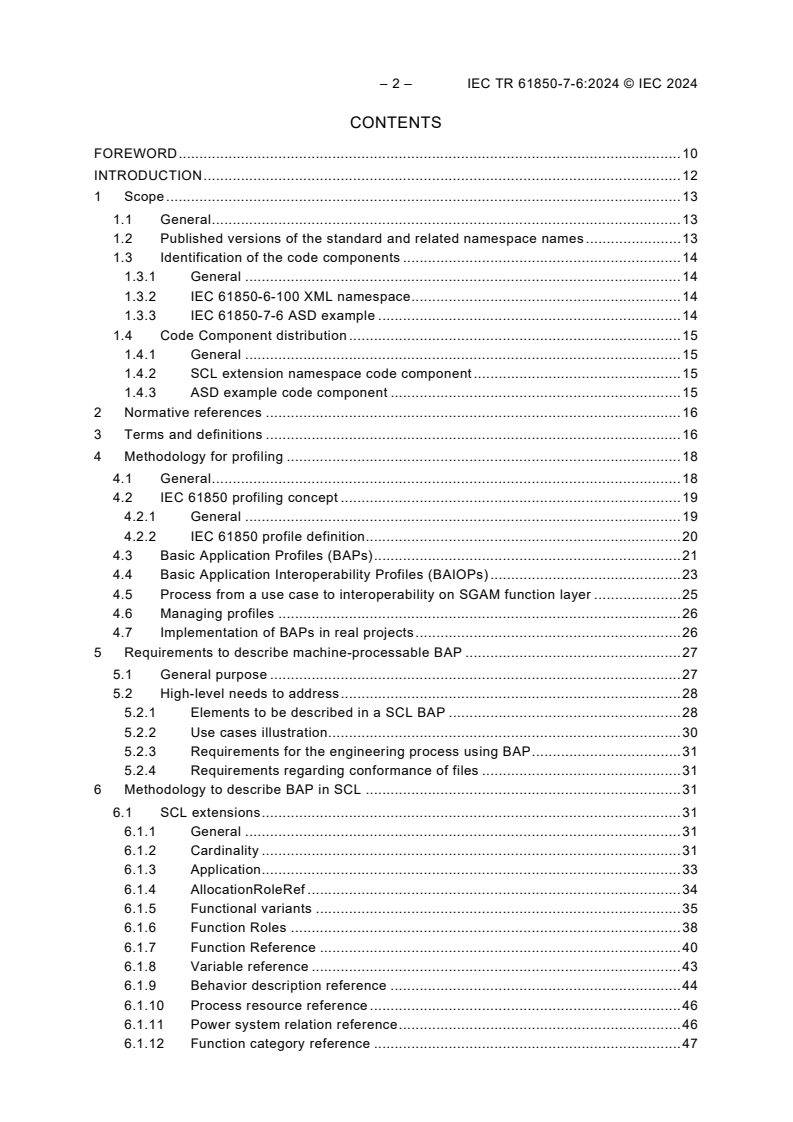
– 2 – IEC TR 61850-7-6:2024 © IEC 2024
CONTENTS
FOREWORD . 10
INTRODUCTION . 12
1 Scope . 13
1.1 General . 13
1.2 Published versions of the standard and related namespace names . 13
1.3 Identification of the code components . 14
1.3.1 General . 14
1.3.2 IEC 61850-6-100 XML namespace . 14
1.3.3 IEC 61850-7-6 ASD example . 14
1.4 Code Component distribution . 15
1.4.1 General . 15
1.4.2 SCL extension namespace code component . 15
1.4.3 ASD example code component . 15
2 Normative references . 16
3 Terms and definitions . 16
4 Methodology for profiling . 18
4.1 General . 18
4.2 IEC 61850 profiling concept . 19
4.2.1 General . 19
4.2.2 IEC 61850 profile definition . 20
4.3 Basic Application Profiles (BAPs) . 21
4.4 Basic Application Interoperability Profiles (BAIOPs) . 23
4.5 Process from a use case to interoperability on SGAM function layer . 25
4.6 Managing profiles . 26
4.7 Implementation of BAPs in real projects . 26
5 Requirements to describe machine-processable BAP . 27
5.1 General purpose . 27
5.2 High-level needs to address . 28
5.2.1 Elements to be described in a SCL BAP . 28
5.2.2 Use cases illustration. 30
5.2.3 Requirements for the engineering process using BAP . 31
5.2.4 Requirements regarding conformance of files . 31
6 Methodology to describe BAP in SCL . 31
6.1 SCL extensions . 31
6.1.1 General . 31
6.1.2 Cardinality . 31
6.1.3 Application . 33
6.1.4 AllocationRoleRef . 34
6.1.5 Functional variants . 35
6.1.6 Function Roles . 38
6.1.7 Function Reference . 40
6.1.8 Variable reference . 43
6.1.9 Behavior description reference . 44
6.1.10 Process resource reference . 46
6.1.11 Power system relation reference . 46
6.1.12 Function category reference . 47
6.1.13 Interaction between the different elements of a BAP template. 48
6.2 Engineering process . 48
6.2.1 Introducing the .ASD file extension . 48
6.2.2 Structure of an ASD . 48
6.2.3 BAP templates: process and tools . 49
6.2.4 Instantiating a BAP application template . 52
6.2.5 Actions to perform during the instantiation process . 52
6.2.6 Validation of a machine processable BAP . 55
6.2.7 Requirements for CDT to deal with namespace conflicts between
templates and instances . 56
6.2.8 Use of SCL UUID elements for traceability. 56
6.2.9 Editing an existing system with new or modified applications . 57
Annex A (informative) Example for BAP of distributed automation function "reverse
blocking" using BAP template . 59
A.1 Functional description . 59
A.2 Description of use case and associated roles/actors . 61
A.2.1 List of roles / actors . 61
A.2.2 Use case . 61
A.2.3 Sequence diagram of typical interactions . 62
A.3 Logical architecture . 63
A.4 Example of SCL BAP representation . 63
A.5 Allocation variants (conditional) . 65
A.6 Functional variants . 65
A.6.1 Core functional variants . 65
A.6.2 Noncore functional variants . 65
A.7 Performance requirements . 65
A.7.1 Functional related . 65
A.7.2 Service related . 66
A.8 Description of data model per actor . 66
A.8.1 General . 66
A.8.2 PTOC for blocked function (infeed bay) . 66
A.8.3 PTOC for blocking function 1 to n (outflow bay(s)) . 68
A.8.4 Monitoring . 69
A.9 Communication services . 69
A.10 Device related requirements (conditional) – Test behavior . 70
A.11 Naming rules . 70
A.12 Capabilities for testing . 70
Annex B (informative) Example for BAP of "condition monitoring diagnosis functions of
on-load tap changer" using BAP template . 71
B.1 Functional description . 71
B.2 Description of use case and associated roles/actors . 73
B.2.1 List of roles / actors . 73
B.2.2 Use case . 74
B.2.3 Sequence diagram of typical interactions . 75
B.3 Logical Architecture . 78
B.3.1 Overview . 78
B.3.2 Monitoring operation property . 79
B.3.3 Monitoring operation counts . 79
B.3.4 Monitoring contact abrasion . 80
– 4 – IEC TR 61850-7-6:2024 © IEC 2024
B.3.5 Monitoring LTC oil temperature and flow . 80
B.3.6 Monitoring operation of oil filter unit . 81
B.4 Allocation variants (conditional) . 81
B.5 Functional variants . 81
B.6 Performance requirements . 81
B.6.1 Functional related . 81
B.6.2 Service related . 81
B.7 Description of data model per actor . 82
B.7.1 General . 82
B.7.2 SLTC . 82
B.7.3 YLTC . 85
B.7.4 TTRQ . 85
B.7.5 TCTR . 86
B.7.6 SIML . 86
B.7.7 TTMP . 87
B.7.8 KFIL . 87
B.8 Communication services . 87
B.9 Device related requirements (conditional) . 87
B.10 Naming rules . 87
B.11 Capabilities for testing . 87
Annex C (informative) Example for BAP of protection function "line distance
protection" using BAP template . 88
C.1 Functional description . 88
C.2 Description of use case and associated roles/actors . 88
C.2.1 List of roles / actors . 88
C.2.2 Use case . 89
C.2.3 Sequence diagram of typical interactions . 90
C.3 Logical architecture . 91
C.4 Allocation variants (conditional) . 91
C.5 Functional variants . 91
C.5.1 Core functional variants . 91
C.5.2 Noncore functional variants (different features for testing) . 92
C.6 SCL BAP representation . 92
C.7 Performance requirements . 93
C.7.1 Functional related . 93
C.7.2 Service related . 93
C.8 Description of data model per actor . 94
C.9 Communication services . 96
C.9.1 General . 96
C.9.2 Variant FA: . 96
C.9.3 Variant FB: . 97
C.10 Device related requirements (conditional) – Degraded operation behavior . 97
C.11 Naming rules . 98
C.12 Capabilites for testing . 98
Annex D (informative) Example of BAIOP for BAP reverse blocking (without process bus) . 99
D.1 General . 99
D.2 Test description . 99
D.2.1 General . 99
D.2.2 Normal sequence of reverse blocking . 100
D.2.3 Functional description of test environment . 101
D.2.4 Test reverse blocking – role blocking (without output to process) . 102
D.2.5 Test reverse blocking – role blocked . 104
Annex E (informative) Example of BAIOP for BAP of "condition monitoring diagnosis
functions of on-load tap changer" . 107
E.1 General . 107
E.2 Test description . 107
E.2.1 Overview . 107
E.2.2 Sequence of monitoring the motor drive current value . 108
Annex F (informative) Examples using SCL elements related to BAP . 110
F.1 General prerequisites for use case understanding. 110
F.2 BAP1: Creating dataflow between two BAP instances with the use of
ProcessResource . 110
F.2.1 Use case scope . 110
F.2.2 Use case implementation . 110
F.3 BAP2: Using PowerSystemRelation to link functions and applications to
conducting equipments . 113
F.3.1 Use case scope . 113
F.3.2 Usecase Implementation. 115
F.4 BAP3: Extending an existing substation with a new bay, integrating the new
bay in the existing interlocking schema . 116
F.4.1 Use case scope . 116
F.4.2 Use case implementation . 118
F.5 FV1: Circuit Breaker (CB) application single/three pole operated, with or
without auto reclosing command input . 120
F.5.1 Use case scope . 120
F.5.2 Use case implementation . 121
F.5.3 Defining and implementing functional variant actions . 125
F.5.4 Automate the selection of the Functional Variant . 128
F.6 FV2 SF6 variant of the CB application. 129
F.6.1 Use case scope . 129
F.6.2 Use case implementation . 129
F.7 AR1: Definition of allocation roles to define physical allocation possibilities . 131
F.7.1 Use case scope . 131
F.7.2 Use case implementation . 132
F.8 AR2: Editing of allocation roles with functional variants . 133
F.8.1 Use case scope . 133
F.8.2 Use case implementation . 133
F.9 VE1: use of a variable element to edit datamodel naming elements . 134
F.9.1 General . 134
F.9.2 Use case scope . 134
F.10 VE2: use of a variable element to edit common setting values (DirMod on
multiple PTOC instances) . 136
F.11 CA1: use of cardinality to instantiate function roles (busbar protection
application) . 138
F.11.1 Use case scope . 138
F.11.2 Use case implementation . 139
F.12 BD1: Textual behavior descriptions . 140
F.13 BD2: Graphical behavior descriptions . 141
F.14 BD3: IEC61131 format behavior descriptions . 141
– 6 – IEC TR 61850-7-6:2024 © IEC 2024
F.15 ASD file example . 142
Annex G (informative) Concept Definition Tool (CDT) role description . 143
Bibliography . 144
Figure 1 – Stakeholders collaborate in user groups to create a common IOP profile . 19
Figure 2 – Framework for profiling IEC 61850 . 20
Figure 3 – Aggregating BAPs . 23
Figure 4 – Framework for testing a profile . 24
Figure 5 – Relation between BAP and SGAM interoperability . 25
Figure 6 – Device features covered by profiles depending on compatibility levels . 26
Figure 7 – BAPs and BAIOPs as building blocks for user/project specific
implementation and testing . 27
Figure 9 – Example of behavior description for distance protection BAP . 29
Figure 10 – Interaction in a BAP template . 48
Figure 11 – Structure of an ASD file . 49
Figure 12 – Extracting an .ASD from an .SSD or .SCD . 50
Figure 13 – creation and instantiation of an .ASD in a .SSD . 51
Figure 14 – instantiation of an .ASD in an .SCD . 51
Figure 15 – Selecting variants during .SSD instantiation . 53
Figure 16 – Function C shared by Applications X and Y . 53
Figure 17 – Overcurrent protection BAP template . 54
Figure 18 – differential protection BAP template . 54
Figure 19 – Merging of BAP template . 54
Figure 20 – Edition workflow of an existing system . 57
Figure A.1 – Behavior in the event of faults on an outflow bay . 59
Figure A.2 – Behavior in the event of busbar faults . 60
Figure A.3 – List of roles / actors reverse blocking . 61
Figure A.4 – Use case reverse blocking . 61
Figure A.5 – Sequence diagram reverse blocking . 62
Figure A.6 – Logical architecture reverse blocking . 63
Figure A.7 – SCL representation of BAP . 64
Figure B.1 – Structure of LTC . 71
Figure B.2 – Overview of system configuration of LTC condition monitoring . 72
Figure B.3 – Typical system configuration of LTC condition monitoring system . 72
Figure B.4 – Use cases . 74
Figure B.5 – Sequence diagram for monitoring operation property . 75
Figure B.6 – Sequence diagram for monitoring operation counts . 76
Figure B.7 – Sequence diagram for monitoring contact abrasion . 76
Figure B.8 – Sequence diagram for monitoring oil temperature and flow . 77
Figure B.9 – Sequence diagram for monitoring operation of oil filter unit . 77
Figure B.10 – Logical architecture. 78
Figure B.11 – Logical architecture for monitoring operation property . 79
Figure B.12 – Logical architecture for monitoring operation counts . 79
Figure B.13 – Logical architecture for monitoring contact abrasion. 80
Figure B.14 – Logical architecture for monitoring LTC oil temperature and flow . 80
Figure B.15 – Logical architecture for monitoring operation of oil filter unit. 81
Figure C.1 – Use case distance protection . 89
Figure C.2 – Sequence diagram distance protection . 90
Figure C.3 – Logical architecture distance protection . 91
Figure C.4 – SCL BAP for distance protection . 93
Figure D.1 – Normal sequence of application function reverse blocking . 100
Figure D.2 – Functional test environment . 102
Figure D.3 – Test of role "blocking" . 102
Figure D.4 – Test of role "blocked" . 104
Figure E.1 – Sequence of monitoring the motor drive current value . 108
Figure F.1 – Use case applications . 110
Figure F.2 – Structure of SCL BAP for the use case applications . 112
Figure F.3 – SSD template representing the use case applications . 113
Figure F.4 – Illustration of ASD using PowerSystemRelation . 114
Figure F.5 – Circuit breaker BAP template . 115
Figure F.6 – Single Line Diagram of the extended substation . 116
Figure F.7 – Interlocking schema of the coupling bay . 116
Figure F.8 – Interlocking dataflow in the substation . 117
Figure F.9 – Specific dataflow between one bay and the coupling bay . 117
Figure F.10 – SCC illustration with engineering rights of the IEDs . 118
Figure F.11 – Use of ProcessResource to create the dataflow of the new bay . 119
Figure F.12 – Single pole CB with auto reclosing . 120
Figure F.13 – Three pole CB with auto reclosing . 120
Figure F.14 – Single pole CB without auto recloser . 121
Figure F.15 – Three pole CB without auto recloser . 121
Figure F.16 – Possibilities of creating Functional Variants . 122
Figure F.17 – Option 1 actions . 123
Figure F.18 – Option 2 . 124
Figure F.19 – Option 3 . 125
Figure F.20 – Actions associated to functional variants . 126
Figure F.21 – Structure of the application . 127
Figure F.22 – Creation and instantiation of an .ASD in a .SSD . 128
Figure F.23 – instantiation of an .ASD in an .SCD . 128
Figure F.24 – FunctionalVariantGroup example . 129
Figure F.25 – FunctionalVariantGroup example . 130
Figure F.26 – SCL structure with FunctionalVariantGroup . 131
Figure F.27 – Allocation Variant use case . 132
Figure F.28 – SCL structure for allocation variants . 132
Figure F.29 – Description of the use case application . 133
Figure F.30 – SCL structure of the application . 134
Figure F.31 – Description of the application for variable element use case . 135
Figure F.32 – Variable element prefix modification . 136
– 8 – IEC TR 61850-7-6:2024 © IEC 2024
Figure F.33 – Description of a second application for variable element use case . 137
Figure F.34 – Variable element Direction modification . 137
Figure F.35 – Description of the application for cardinality use case . 138
Figure F.36 – BAP structure for cardinality use case . 139
Figure F.37 – SCL structure for cardinality use case . 140
Figure F.38 – Graphical representation of the SCL content . 140
Figure F.39 – Graphical behavior description of the overcurrent application . 141
Figure F.40 – IEC 61131 format behavior description of the overcurrent application . 142
Table 1 – Reference between published versions of the standard and related
namespace name . 14
Table 2 – Attributes of the IEC 61850-6-100:2019C1 XML namespace . 14
Table 3 – Attributes of the IEC 61850-7-6 ASD example . 15
Table 4 – Attributes for cardinality and selector . 33
Table 5 – Attributes of the Application element . 34
Table 6 – Attributes of the AllocationRoleRef element . 35
Table 7 – Attributes of the FunctionalVariant and FunctionalSubVariant elements . 36
Table 8 – Attributes of the FunctionalVariantGroup element . 37
Table 9 – Attributes of the FunctionalVariantRef element . 38
Table 10 – Attributes of the FunctionRole element . 39
Table 11 – Attributes of the FunctionRoleContent element . 40
Table 12 – Attributes of the FunctionRef element . 41
Table 13 – Attributes of the SignalRole element . 42
Table 14 – Attributes of the LNodeInputRef element . 43
Table 15 – Attributes of the LNodeOutputRef element . 43
Table 16 – Attributes of the LNodeDataRef element . 43
Table 17 – Attributes of the VariableRef element . 44
Table 18 – Attributes of the BehaviorDescriptionRef element . 45
Table 19 – Attributes of the InputVarRef and OutputVarRef element . 45
Table 20 – Attributes of the ProcessResourceRef element . 46
Table 21 – Attributes of the PowerSystemRelationRef element . 47
Table 22 – Attributes of the FunctionCategoryRef element . 48
Table A.1 – Selection of data attributes for PTOC of actor blocked . 66
Table A.2 – Selection of data attributes for PTOC of actor blocking . 68
Table A.3 – Selection of data attributes of PTOC for monitoring . 69
Table B.1 – List of actors . 73
Table B.2 – Selection of data attributes of SLTC . 82
Table B.3 – Selection of data attributes of YLTC . 85
Table B.4 – Selection of data attributes of TTRQ . 85
Table B.5 – Selection of data attributes of TCTR . 86
Table B.6 – Selection of data attributes of SIML. 86
Table B.7 – Selection of data attributes of TTMP . 87
Table B.8 – Selection of data attributes of KFIL . 87
Table C.1 – Description of data model . 94
Table C.2 – Services for variant FA . 96
Table C.3 – Services for variant FB . 97
Table C.4 – Degraded operation behaviors . 98
Table D.1 – Description of normal operation of application function reverse blocking . 100
Table D.2 – Description of sequence for test of role "blocking" . 103
Table D.3 – Description of sequence for test of role "blocked" . 105
Table E.1 – Description of the sequence of monitoring the motor drive current value . 109
– 10 – IEC TR 61850-7-6:2024 © IEC 2024
INTERNATIONAL ELECTROTECHNICAL COMMISSION
____________
COMMUNICATION NETWORKS AND SYSTEMS
FOR POWER UTILITY AUTOMATION –
Part 7-6: Guideline for definition of
Basic Application Profiles (BAPs) using IEC 61850
FOREWORD
1) The International Electrotechnical Commission (IEC) is a worldwide organization for standardization comprising
all national electrotechnical committees (IEC National Committees). The object of IEC is to promote international
co-operation on all questions concerning standardization in the electrical and electronic fields. To this end and
in addition to other activities, IEC publishes International Standards, Technical Specifications, Technical Reports,
Publicly Available Specifications (PAS) and Guides (hereafter referred to as "IEC Publication(s)"). Their
preparation is entrusted to technical committees; any IEC National Committee interested in the subject dealt with
may participate in this preparatory work. International, governmental and non-governmental organizations liaising
with the IEC also participate in this preparation. IEC collaborates closely with the International Organization for
Standardization (ISO) in accordance with conditions determined by agreement between the two organizations.
2) The formal decisions or agreements of IEC on technical matters express, as nearly as possible, an international
consensus of opinion on the relevant subjects since each technical committee has representation from all
interested IEC National Committees.
3) IEC Publications have the form of recommendations for international use and are accepted by IEC National
Committees in that sense. While all reasonable efforts are made to ensure that the technical content of IEC
Publications is accurate, IEC cannot be held responsible for the way in which they are used or for any
misinterpretation by any end user.
4) In order to promote international uniformity, IEC National Committees undertake to apply IEC Publications
transparently to the maximum extent possible in their national and regional publications. Any divergence between
any IEC Publication and the corresponding national or regional publication shall be clearly indicated in the latter.
5) IEC itself does not provide any attestation of conformity. Independent certification bodies provide conformity
assessment services and, in some areas, access to IEC marks of conformity. IEC is not responsible for any
services carried out by independent certification bodies.
6) All users should ensure that they have the latest edition of this publication.
7) No liability shall attach to IEC or its directors, employees, servants or agents including individual experts and
members of its technical committee
...