


IEC 61970-457:2024
(Main)Energy management system application program interface (EMS-API) - Part 457: Dynamics profile
General Information
- Abstract
IEC 61970-457:2024 specifies a standard interface for exchanging dynamic model information needed to support the analysis of the steady state stability (small-signal stability) and/or transient stability of a power system or parts of it. The schema(s) for expressing the dynamic model information are derived directly from the CIM, more specifically from IEC 61970-302.
The scope of this document includes only the dynamic model information that needs to be exchanged as part of a dynamic study, namely the type, description and parameters of each control equipment associated with a piece of power system equipment included in the steady state solution of a complete power system network model. Therefore, this profile is dependent upon other standard profiles for the equipment as specified in IEC 61970-452: CIM static transmission network model profiles, the topology, the steady state hypothesis and the steady state solution (as specified in IEC 61970-456: Solved power system state profiles) of the power system, which bounds the scope of the exchange. The profile information described by this document needs to be exchanged in conjunction with IEC 61970-452 and IEC 61970-456 profiles’ information to support the data requirements of transient analysis tools. IEC 61970-456 provides a detailed description of how different profile standards can be combined to form various types of power system network model exchanges.
This document supports the exchange of the following types of dynamic models:
• standard models: a simplified approach to exchange, where models are contained in predefined libraries of classes interconnected in a standard manner that represent dynamic behaviour of elements of the power system. The exchange only indicates the name of the model along with the attributes needed to describe its behaviour.
• proprietary user-defined models: an exchange that would provide users the ability to exchange the parameters of a model representing a vendor or user proprietary device where an explicit description of the model is not described in this document. The connections between the proprietary models and standard models are the same as described for the standard models exchange. Recipient of the data exchange will need to contact the sender for the behavioural details of the model.
This document builds on IEC 61970-302, CIM for dynamics which defines the descriptions of the standard dynamic models, their function block diagrams, and how they are interconnected and associated with the static network model. This type of model information is assumed to be pre-stored by all software applications hence it is not necessary to be exchanged in real-time or as part of a dynamics model exchange.
This second edition cancels and replaces the first edition published in 2021. This edition constitutes a technical revision.
This edition includes the following significant technical changes with respect to the previous edition:
a) The majority of issues detected in IEC 61970-302:2018 and fixed in IEC 61970-302:2022 led to update of this document;
b) IEEE 421.5-2016 on Excitation systems is fully covered;
c) IEEE turbine report from 2013 was considered and as a result a number of gas, steam and hydro turbines/governors are added;
d) IEC 61400-27-1:2020 on wind turbines is fully incorporated;
e) WECC Inverter-Based Resource (IBR) models, Hybrid STATCOM models and storage models are added;
f) The user defined models approach was enhanced in IEC 61970-302:2022 adding a model which enables modelling of a detailed dynamic model. This results in the creation of two additional profiles in this document. These are the Detailed Model Configuration profile and Detailed Model Parameterisation profile;
g) A model to enable exchange of simulation results was added in IEC 61970-302:2022. This results in the creation of two additional profiles in this document. These are the Simulation Settings profile and Simulation Results profile;
h) The work on the
- Status
- Published
- Publication Date
- 08-Feb-2024
- Technical Committee
- TC 57 - Power systems management and associated information exchange
- Drafting Committee
- WG 13 - TC 57/WG 13
- Current Stage
- PPUB - Publication issued
- Start Date
- 09-Feb-2024
- Completion Date
- 19-Jan-2024
Overview
IEC 61970-457:2024 is an international standard developed by the International Electrotechnical Commission (IEC) that specifies a standardized interface for exchanging dynamic model information relevant to power system stability analysis. This edition updates and replaces the 2021 version, incorporating advances in dynamic modeling and expanding to cover new equipment types and models. It builds upon the Common Information Model (CIM) described in IEC 61970-302, focusing particularly on dynamics required for steady-state stability (small-signal) and transient stability analyses of power systems.
The standard defines the Dynamics Profile within the Energy Management System Application Program Interface (EMS-API) framework to enable consistent, interoperable data exchange among power system analysis tools, operators, and equipment vendors.
Key Topics
Scope of Dynamic Model Exchange
IEC 61970-457:2024 targets dynamic model information necessary for transient and steady-state stability studies, including types, descriptions, and parameters of control equipment linked to power system components. It complements static network models and steady-state solutions specified in IEC 61970-452 and IEC 61970-456.Model Types Supported
- Standard Models: Utilizes predefined dynamic model libraries with standardized class representations for power system components. Only model names and parameters are exchanged, assuming behavioral logic is pre-stored in software applications.
- Proprietary/User-Defined Models: Enables exchange of parameters for vendor-specific or user-defined models without explicit behavioral descriptions, requiring direct communication between sender and recipient for full interpretation.
Expanded Coverage of Dynamic Elements
The 2024 edition incorporates additional dynamic models reflecting modern power system components:- IEEE 421.5-2016 excitation systems
- Gas, steam, and hydro turbines/governors per IEEE 2013 turbine report
- IEC 61400-27-1:2020 compliant wind turbine models
- WECC inverter-based resource (IBR) models, hybrid STATCOMs, and storage systems
New Profiles Introduced
- Detailed Model Configuration and Parameterisation Profiles: For more detailed and complex dynamic model exchange.
- Simulation Settings and Results Profiles: Enhances capabilities for exchanging simulation scenarios and outcomes.
Integration with CIM Standards
The standard utilizes CIM classes and structures from IEC 61970-302 to define dynamic behavior and interconnections, ensuring consistency and compatibility with established power system modeling frameworks.
Applications
Power System Stability Analysis
Facilitates the exchange of dynamic data among utilities, transmission system operators, software vendors, and consulting engineers for small-signal and transient stability assessments. Enables enhanced coordination in contingency and disturbance studies.Interoperability of EMS and Simulation Tools
Supports seamless integration and data sharing between Energy Management Systems (EMS), dynamic simulation software, and control platforms, improving accuracy and efficiency in operational planning and real-time decision-making.Vendor Model Exchange and Validation
Allows utility and vendor collaboration in exchanging proprietary dynamic models while maintaining confidentiality of proprietary algorithm details, enabling validation and interoperability testing.Support for Renewable and Emerging Technologies
Incorporates dynamic models for wind power plants, inverter-based resources, hybrid compensation devices, and energy storage systems essential for modern grid stability analyses.
Related Standards
IEC 61970-302: CIM for Dynamics
Defines the Common Information Model entities and relationships specifically for dynamic models in power systems, serving as the basis for data representation in IEC 61970-457.IEC 61970-452: CIM Static Transmission Network Model Profiles
Specifies static transmission network models required for representing the network topology and equipment included in dynamic studies.IEC 61970-456: Solved Power System State Profiles
Details the steady-state solution and topology profiles needed to bound the dynamic model information exchange.IEEE Standards
- IEEE 421.5-2016: Excitation system models standard, fully integrated in this edition of IEC 61970-457.
- IEEE turbine reports guiding representation of turbine-governors and mechanical dynamics.
IEC 61400-27-1:2020
Defines wind turbine models incorporated into this standard’s dynamic profiles to address renewable integration.
Keywords: IEC 61970-457, EMS-API, Dynamics profile, power system stability, transient stability, small-signal stability, dynamic model exchange, Common Information Model CIM, dynamic simulation, renewable integration, inverter-based resources, excitation systems, turbine governors, wind turbine models, energy management systems, transient analysis tools.
Relations
- Effective Date
- 05-Sep-2023
Get Certified
Connect with accredited certification bodies for this standard

ANCE
Mexican certification and testing association.

Intertek Slovenia
Intertek testing, inspection, and certification services in Slovenia.

LNE (Laboratoire National de Métrologie et d'Essais)
French national laboratory for metrology and testing.
Sponsored listings
Frequently Asked Questions
IEC 61970-457:2024 is a standard published by the International Electrotechnical Commission (IEC). Its full title is "Energy management system application program interface (EMS-API) - Part 457: Dynamics profile". This standard covers: IEC 61970-457:2024 specifies a standard interface for exchanging dynamic model information needed to support the analysis of the steady state stability (small-signal stability) and/or transient stability of a power system or parts of it. The schema(s) for expressing the dynamic model information are derived directly from the CIM, more specifically from IEC 61970-302. The scope of this document includes only the dynamic model information that needs to be exchanged as part of a dynamic study, namely the type, description and parameters of each control equipment associated with a piece of power system equipment included in the steady state solution of a complete power system network model. Therefore, this profile is dependent upon other standard profiles for the equipment as specified in IEC 61970-452: CIM static transmission network model profiles, the topology, the steady state hypothesis and the steady state solution (as specified in IEC 61970-456: Solved power system state profiles) of the power system, which bounds the scope of the exchange. The profile information described by this document needs to be exchanged in conjunction with IEC 61970-452 and IEC 61970-456 profiles’ information to support the data requirements of transient analysis tools. IEC 61970-456 provides a detailed description of how different profile standards can be combined to form various types of power system network model exchanges. This document supports the exchange of the following types of dynamic models: • standard models: a simplified approach to exchange, where models are contained in predefined libraries of classes interconnected in a standard manner that represent dynamic behaviour of elements of the power system. The exchange only indicates the name of the model along with the attributes needed to describe its behaviour. • proprietary user-defined models: an exchange that would provide users the ability to exchange the parameters of a model representing a vendor or user proprietary device where an explicit description of the model is not described in this document. The connections between the proprietary models and standard models are the same as described for the standard models exchange. Recipient of the data exchange will need to contact the sender for the behavioural details of the model. This document builds on IEC 61970-302, CIM for dynamics which defines the descriptions of the standard dynamic models, their function block diagrams, and how they are interconnected and associated with the static network model. This type of model information is assumed to be pre-stored by all software applications hence it is not necessary to be exchanged in real-time or as part of a dynamics model exchange. This second edition cancels and replaces the first edition published in 2021. This edition constitutes a technical revision. This edition includes the following significant technical changes with respect to the previous edition: a) The majority of issues detected in IEC 61970-302:2018 and fixed in IEC 61970-302:2022 led to update of this document; b) IEEE 421.5-2016 on Excitation systems is fully covered; c) IEEE turbine report from 2013 was considered and as a result a number of gas, steam and hydro turbines/governors are added; d) IEC 61400-27-1:2020 on wind turbines is fully incorporated; e) WECC Inverter-Based Resource (IBR) models, Hybrid STATCOM models and storage models are added; f) The user defined models approach was enhanced in IEC 61970-302:2022 adding a model which enables modelling of a detailed dynamic model. This results in the creation of two additional profiles in this document. These are the Detailed Model Configuration profile and Detailed Model Parameterisation profile; g) A model to enable exchange of simulation results was added in IEC 61970-302:2022. This results in the creation of two additional profiles in this document. These are the Simulation Settings profile and Simulation Results profile; h) The work on the
IEC 61970-457:2024 specifies a standard interface for exchanging dynamic model information needed to support the analysis of the steady state stability (small-signal stability) and/or transient stability of a power system or parts of it. The schema(s) for expressing the dynamic model information are derived directly from the CIM, more specifically from IEC 61970-302. The scope of this document includes only the dynamic model information that needs to be exchanged as part of a dynamic study, namely the type, description and parameters of each control equipment associated with a piece of power system equipment included in the steady state solution of a complete power system network model. Therefore, this profile is dependent upon other standard profiles for the equipment as specified in IEC 61970-452: CIM static transmission network model profiles, the topology, the steady state hypothesis and the steady state solution (as specified in IEC 61970-456: Solved power system state profiles) of the power system, which bounds the scope of the exchange. The profile information described by this document needs to be exchanged in conjunction with IEC 61970-452 and IEC 61970-456 profiles’ information to support the data requirements of transient analysis tools. IEC 61970-456 provides a detailed description of how different profile standards can be combined to form various types of power system network model exchanges. This document supports the exchange of the following types of dynamic models: • standard models: a simplified approach to exchange, where models are contained in predefined libraries of classes interconnected in a standard manner that represent dynamic behaviour of elements of the power system. The exchange only indicates the name of the model along with the attributes needed to describe its behaviour. • proprietary user-defined models: an exchange that would provide users the ability to exchange the parameters of a model representing a vendor or user proprietary device where an explicit description of the model is not described in this document. The connections between the proprietary models and standard models are the same as described for the standard models exchange. Recipient of the data exchange will need to contact the sender for the behavioural details of the model. This document builds on IEC 61970-302, CIM for dynamics which defines the descriptions of the standard dynamic models, their function block diagrams, and how they are interconnected and associated with the static network model. This type of model information is assumed to be pre-stored by all software applications hence it is not necessary to be exchanged in real-time or as part of a dynamics model exchange. This second edition cancels and replaces the first edition published in 2021. This edition constitutes a technical revision. This edition includes the following significant technical changes with respect to the previous edition: a) The majority of issues detected in IEC 61970-302:2018 and fixed in IEC 61970-302:2022 led to update of this document; b) IEEE 421.5-2016 on Excitation systems is fully covered; c) IEEE turbine report from 2013 was considered and as a result a number of gas, steam and hydro turbines/governors are added; d) IEC 61400-27-1:2020 on wind turbines is fully incorporated; e) WECC Inverter-Based Resource (IBR) models, Hybrid STATCOM models and storage models are added; f) The user defined models approach was enhanced in IEC 61970-302:2022 adding a model which enables modelling of a detailed dynamic model. This results in the creation of two additional profiles in this document. These are the Detailed Model Configuration profile and Detailed Model Parameterisation profile; g) A model to enable exchange of simulation results was added in IEC 61970-302:2022. This results in the creation of two additional profiles in this document. These are the Simulation Settings profile and Simulation Results profile; h) The work on the
IEC 61970-457:2024 is classified under the following ICS (International Classification for Standards) categories: 33.200 - Telecontrol. Telemetering. The ICS classification helps identify the subject area and facilitates finding related standards.
IEC 61970-457:2024 has the following relationships with other standards: It is inter standard links to IEC 61970-457:2021. Understanding these relationships helps ensure you are using the most current and applicable version of the standard.
IEC 61970-457:2024 is available in PDF format for immediate download after purchase. The document can be added to your cart and obtained through the secure checkout process. Digital delivery ensures instant access to the complete standard document.
Standards Content (Sample)
IEC 61970-457 ®
Edition 2.0 2024-02
INTERNATIONAL
STANDARD
NORME
INTERNATIONALE
colour
inside
Energy management system application program interface (EMS-API) –
Part 457: Dynamics profile
Interface de programmation d’application pour système de gestion d’énergie
(EMS-API) –
Partie 457: Profil de régimes dynamiques
All rights reserved. Unless otherwise specified, no part of this publication may be reproduced or utilized in any form
or by any means, electronic or mechanical, including photocopying and microfilm, without permission in writing from
either IEC or IEC's member National Committee in the country of the requester. If you have any questions about IEC
copyright or have an enquiry about obtaining additional rights to this publication, please contact the address below or
your local IEC member National Committee for further information.
Droits de reproduction réservés. Sauf indication contraire, aucune partie de cette publication ne peut être reproduite ni
utilisée sous quelque forme que ce soit et par aucun procédé, électronique ou mécanique, y compris la photocopie et
les microfilms, sans l'accord écrit de l'IEC ou du Comité national de l'IEC du pays du demandeur. Si vous avez des
questions sur le copyright de l'IEC ou si vous désirez obtenir des droits supplémentaires sur cette publication, utilisez
les coordonnées ci-après ou contactez le Comité national de l'IEC de votre pays de résidence.
IEC Secretariat Tel.: +41 22 919 02 11
3, rue de Varembé info@iec.ch
CH-1211 Geneva 20 www.iec.ch
Switzerland
About the IEC
The International Electrotechnical Commission (IEC) is the leading global organization that prepares and publishes
International Standards for all electrical, electronic and related technologies.
About IEC publications
The technical content of IEC publications is kept under constant review by the IEC. Please make sure that you have the
latest edition, a corrigendum or an amendment might have been published.
IEC publications search - webstore.iec.ch/advsearchform IEC Products & Services Portal - products.iec.ch
The advanced search enables to find IEC publications by a Discover our powerful search engine and read freely all the
variety of criteria (reference number, text, technical publications previews, graphical symbols and the glossary.
committee, …). It also gives information on projects, replaced With a subscription you will always have access to up to date
and withdrawn publications. content tailored to your needs.
IEC Just Published - webstore.iec.ch/justpublished
Electropedia - www.electropedia.org
Stay up to date on all new IEC publications. Just Published
The world's leading online dictionary on electrotechnology,
details all new publications released. Available online and once
containing more than 22 500 terminological entries in English
a month by email.
and French, with equivalent terms in 25 additional languages.
Also known as the International Electrotechnical Vocabulary
IEC Customer Service Centre - webstore.iec.ch/csc
(IEV) online.
If you wish to give us your feedback on this publication or need
further assistance, please contact the Customer Service
Centre: sales@iec.ch.
A propos de l'IEC
La Commission Electrotechnique Internationale (IEC) est la première organisation mondiale qui élabore et publie des
Normes internationales pour tout ce qui a trait à l'électricité, à l'électronique et aux technologies apparentées.
A propos des publications IEC
Le contenu technique des publications IEC est constamment revu. Veuillez vous assurer que vous possédez l’édition la
plus récente, un corrigendum ou amendement peut avoir été publié.
Recherche de publications IEC - IEC Products & Services Portal - products.iec.ch
webstore.iec.ch/advsearchform Découvrez notre puissant moteur de recherche et consultez
La recherche avancée permet de trouver des publications IEC gratuitement tous les aperçus des publications, symboles
en utilisant différents critères (numéro de référence, texte, graphiques et le glossaire. Avec un abonnement, vous aurez
comité d’études, …). Elle donne aussi des informations sur les toujours accès à un contenu à jour adapté à vos besoins.
projets et les publications remplacées ou retirées.
Electropedia - www.electropedia.org
IEC Just Published - webstore.iec.ch/justpublished
Le premier dictionnaire d'électrotechnologie en ligne au monde,
Restez informé sur les nouvelles publications IEC. Just
avec plus de 22 500 articles terminologiques en anglais et en
Published détaille les nouvelles publications parues.
français, ainsi que les termes équivalents dans 25 langues
Disponible en ligne et une fois par mois par email.
additionnelles. Egalement appelé Vocabulaire
Electrotechnique International (IEV) en ligne.
Service Clients - webstore.iec.ch/csc
Si vous désirez nous donner des commentaires sur cette
publication ou si vous avez des questions contactez-nous:
sales@iec.ch.
IEC 61970-457 ®
Edition 2.0 2024-02
INTERNATIONAL
STANDARD
NORME
INTERNATIONALE
colour
inside
Energy management system application program interface (EMS-API) –
Part 457: Dynamics profile
Interface de programmation d’application pour système de gestion d’énergie
(EMS-API) –
Partie 457: Profil de régimes dynamiques
INTERNATIONAL
ELECTROTECHNICAL
COMMISSION
COMMISSION
ELECTROTECHNIQUE
INTERNATIONALE
ICS 33.200 ISBN 978-2-8322-5588-9
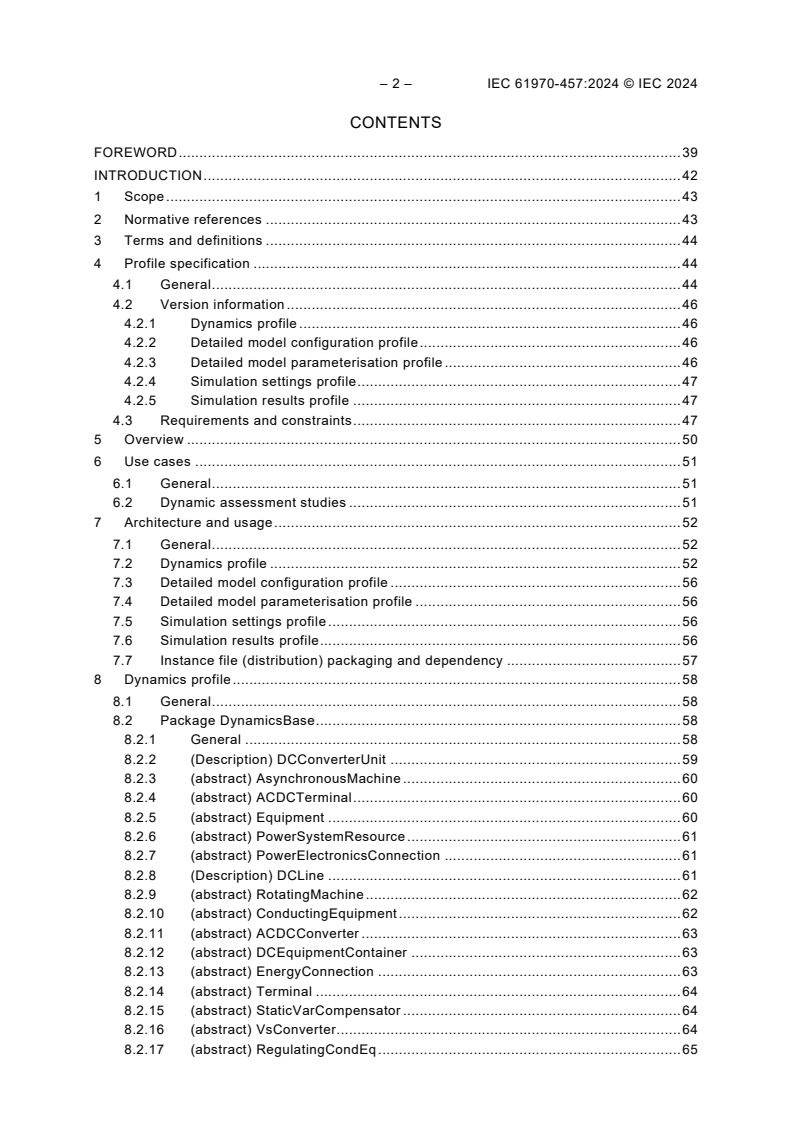
– 2 – IEC 61970-457:2024 © IEC 2024
CONTENTS
FOREWORD . 39
INTRODUCTION . 42
1 Scope . 43
2 Normative references . 43
3 Terms and definitions . 44
4 Profile specification . 44
4.1 General . 44
4.2 Version information . 46
4.2.1 Dynamics profile . 46
4.2.2 Detailed model configuration profile . 46
4.2.3 Detailed model parameterisation profile . 46
4.2.4 Simulation settings profile . 47
4.2.5 Simulation results profile . 47
4.3 Requirements and constraints . 47
5 Overview . 50
6 Use cases . 51
6.1 General . 51
6.2 Dynamic assessment studies . 51
7 Architecture and usage . 52
7.1 General . 52
7.2 Dynamics profile . 52
7.3 Detailed model configuration profile . 56
7.4 Detailed model parameterisation profile . 56
7.5 Simulation settings profile . 56
7.6 Simulation results profile . 56
7.7 Instance file (distribution) packaging and dependency . 57
8 Dynamics profile . 58
8.1 General . 58
8.2 Package DynamicsBase . 58
8.2.1 General . 58
8.2.2 (Description) DCConverterUnit . 59
8.2.3 (abstract) AsynchronousMachine . 60
8.2.4 (abstract) ACDCTerminal . 60
8.2.5 (abstract) Equipment . 60
8.2.6 (abstract) PowerSystemResource . 61
8.2.7 (abstract) PowerElectronicsConnection . 61
8.2.8 (Description) DCLine . 61
8.2.9 (abstract) RotatingMachine . 62
8.2.10 (abstract) ConductingEquipment . 62
8.2.11 (abstract) ACDCConverter . 63
8.2.12 (abstract) DCEquipmentContainer . 63
8.2.13 (abstract) EnergyConnection . 63
8.2.14 (abstract) Terminal . 64
8.2.15 (abstract) StaticVarCompensator . 64
8.2.16 (abstract) VsConverter . 64
8.2.17 (abstract) RegulatingCondEq . 65
8.2.18 (abstract) IdentifiedObject root class . 65
8.2.19 (abstract) ConnectivityNodeContainer . 66
8.2.20 (abstract) ProtectionEquipment . 66
8.2.21 (abstract) EquipmentContainer . 66
8.2.22 (abstract) ShuntCompensator . 67
8.2.23 (abstract) SynchronousMachine . 67
8.2.24 (abstract) CsConverter . 67
8.2.25 (Description) EnergyConsumer . 68
8.3 Package StandardInterconnections . 69
8.3.1 General . 69
8.3.2 RemoteInputSignal . 77
8.3.3 Package WindModels . 78
8.4 Package StandardModels . 85
8.4.1 General . 85
8.4.2 (abstract) DynamicsFunctionBlock . 86
8.4.3 (abstract) RotatingMachineDynamics . 86
8.4.4 Package SynchronousMachineDynamics . 87
8.4.5 Package AsynchronousMachineDynamics . 115
8.4.6 Package TurbineGovernorDynamics . 123
8.4.7 Package TurbineLoadControllerDynamics . 245
8.4.8 Package MechanicalLoadDynamics . 249
8.4.9 Package ExcitationSystemDynamics. 252
8.4.10 Package OverexcitationLimiterDynamics . 388
8.4.11 Package UnderexcitationLimiterDynamics . 402
8.4.12 Package PowerSystemStabilizerDynamics. 414
8.4.13 Package DiscontinuousExcitationControlDynamics . 458
8.4.14 Package PFVArControllerType1Dynamics . 463
8.4.15 Package PFVArControllerType2Dynamics . 467
8.4.16 Package VoltageAdjusterDynamics . 473
8.4.17 Package VoltageCompensatorDynamics . 476
8.4.18 Package WindDynamics . 481
8.4.19 Package WindDynamicsEd2 . 512
8.4.20 Package LoadDynamics. 547
8.4.21 Package HVDCDynamics . 565
8.4.22 Package RelayDynamics . 567
8.4.23 Package StaticVarCompensatorDynamics . 571
8.4.24 Package StatorCurrentLimiterDynamics . 584
8.4.25 Package ShuntCompensatorDynamics . 589
8.4.26 Package StatcomDynamics . 591
8.4.27 Package WECCDynamics . 594
8.4.28 Package IEEE1547Dynamics . 634
8.5 Package UserDefinedModels . 648
8.5.1 General . 648
8.5.2 CSCUserDefined . 649
8.5.3 SVCUserDefined . 650
8.5.4 StatcomUserDefined . 651
8.5.5 VSCUserDefined . 651
8.5.6 WindPlantUserDefined . 652
8.5.7 WindType1or2UserDefined . 653
– 4 – IEC 61970-457:2024 © IEC 2024
8.5.8 WindType3or4UserDefined . 653
8.5.9 SynchronousMachineUserDefined . 654
8.5.10 AsynchronousMachineUserDefined . 655
8.5.11 TurbineGovernorUserDefined . 656
8.5.12 TurbineLoadControllerUserDefined . 657
8.5.13 MechanicalLoadUserDefined . 658
8.5.14 ExcitationSystemUserDefined . 658
8.5.15 OverexcitationLimiterUserDefined . 659
8.5.16 UnderexcitationLimiterUserDefined . 660
8.5.17 PowerSystemStabilizerUserDefined . 660
8.5.18 DiscontinuousExcitationControlUserDefined . 661
8.5.19 PFVArControllerType1UserDefined . 662
8.5.20 VoltageAdjusterUserDefined . 662
8.5.21 PFVArControllerType2UserDefined . 663
8.5.22 VoltageCompensatorUserDefined . 664
8.5.23 StatorCurrentLimiterUserDefined . 664
8.5.24 ShuntCompensatorUserDefined . 665
8.5.25 LoadUserDefined . 666
8.5.26 HVDCInterconnectionUserDefined . 666
8.5.27 RelayUserDefined . 667
8.5.28 ProprietaryParameterDynamics root class . 667
8.6 Package DynamicsDatatypes . 669
8.6.1 General . 669
8.6.2 CurrentFlow datatype . 671
8.6.3 PerCent datatype . 672
8.6.4 ReactivePower datatype . 672
8.6.5 Susceptance datatype . 672
8.6.6 Voltage datatype. 672
8.6.7 ActivePower datatype . 673
8.6.8 AngleDegrees datatype . 673
8.6.9 ApparentPower datatype. 673
8.6.10 Area datatype . 674
8.6.11 Frequency datatype . 674
8.6.12 Length datatype . 674
8.6.13 PU datatype . 674
8.6.14 Seconds datatype . 675
8.6.15 Temperature datatype. 675
8.6.16 VolumeFlowRate datatype . 675
8.6.17 DateTime primitive . 676
8.6.18 Float primitive . 676
8.6.19 Boolean primitive . 676
8.6.20 Date primitive . 676
8.6.21 Integer primitive . 676
8.6.22 String primitive . 676
8.6.23 UnitSymbol enumeration . 676
8.6.24 UnitMultiplier enumeration . 681
8.6.25 SinglePhaseKind enumeration . 682
8.6.26 OverExcitationLimiterInputKind enumeration. 683
8.6.27 InputsST4CKind enumeration . 683
8.6.28 InputsST6CKind enumeration . 683
8.6.29 InputsST7CKind enumeration . 684
8.6.30 VoelInputKind enumeration . 684
8.6.31 VsclInputKind enumeration . 684
8.6.32 VsInputKind enumeration . 684
8.6.33 VuelInputKind enumeration . 685
8.6.34 DroopSignalFeedbackKind enumeration . 685
8.6.35 ExcIEEEST1AUELselectorKind enumeration. 685
8.6.36 ExcREXSFeedbackSignalKind enumeration . 686
8.6.37 ExcST6BOELselectorKind enumeration . 686
8.6.38 ExcST7BOELselectorKind enumeration . 686
8.6.39 ExcST7BUELselectorKind enumeration . 687
8.6.40 FrancisGovernorControlKind enumeration . 687
8.6.41 GenericNonLinearLoadModelKind enumeration . 688
8.6.42 GovHydro4ModelKind enumeration . 688
8.6.43 IfdBaseKind enumeration . 688
8.6.44 InputSignalKind enumeration . 688
8.6.45 RemoteSignalKind enumeration . 689
8.6.46 RotorKind enumeration . 690
8.6.47 StaticLoadModelKind enumeration . 690
8.6.48 SynchronousMachineModelKind enumeration . 690
8.6.49 WindLookupTableFunctionKind enumeration . 691
8.6.50 WindPlantQcontrolModeKind enumeration . 693
8.6.51 WindQcontrolModeKind enumeration . 693
8.6.52 WindUVRTQcontrolModeKind enumeration . 693
8.6.53 WindPlantQcontrolModeKind2 enumeration . 694
8.6.54 WindLookupTableFunctionKind2 enumeration . 694
8.6.55 WindFRTQcontrolModeKind enumeration . 695
8.6.56 WindQcontrolModeKind2 enumeration . 696
9 Detailed Model Configuration Profile . 696
9.1 General . 696
9.2 DetailedModelTypeDynamics . 697
9.3 (abstract) DetailedModelDescriptor . 698
9.4 DetailedModelDescriptorArtifact . 698
9.5 DetailedModelDocumentationArtifact. 699
9.6 (abstract) DynamicsFunctionBlock . 699
9.7 FunctionDescriptor . 700
9.8 (abstract) IdentifiedObject root class . 700
9.9 InputOutputDescriptor . 701
9.10 LimiterDescriptor. 701
9.11 OperatorDescriptor . 702
9.12 ParameterDescriptor . 703
9.13 SignalDescriptor . 703
9.14 LogicalKind enumeration . 704
9.15 EquationLanguageKind enumeration . 704
9.16 OperatorDescriptorKind enumeration . 705
9.17 ConstraintKind enumeration . 705
9.18 ParameterKind enumeration . 705
9.19 XSDDatatypeKind enumeration . 706
– 6 – IEC 61970-457:2024 © IEC 2024
9.20 Integer primitive . 706
9.21 Float primitive . 707
9.22 DateTime primitive . 707
9.23 Date primitive. 707
9.24 String primitive . 707
9.25 Boolean primitive . 707
10 Detailed Model Parameterisation Profile . 707
10.1 General . 707
10.2 Boolean primitive . 708
10.3 (abstract) DetailedModelTypeDynamics . 708
10.4 (abstract) DetailedModelDescriptor . 709
10.5 (abstract) ACDCTerminal root class . 709
10.6 (abstract) IdentifiedObject root class . 709
10.7 ParameterValue root class . 709
10.8 (abstract) PowerSystemResource . 710
10.9 String primitive . 710
10.10 (abstract) DynamicsFunctionBlock . 710
10.11 (abstract) Equipment . 711
10.12 (abstract) ParameterDescriptor . 711
10.13 (Description) SignalDescriptor root class . 711
10.14 DetailedModelDynamics . 712
11 Simulation Settings Profile . 712
11.1 General . 712
11.2 (abstract) ACLineSegment root class . 715
11.3 (abstract) Terminal . 716
11.4 (abstract) Equipment root class . 716
11.5 EquipmentFault . 716
11.6 (abstract) Fault . 717
11.7 FaultCauseType . 718
11.8 LineFault . 718
11.9 (abstract) ACDCTerminal . 719
11.10 ClearSimulationEvent. 719
11.11 (abstract) DetailedModelDescriptor . 719
11.12 (abstract) DynamicsFunctionBlock . 720
11.13 (abstract) IdentifiedObject root class . 720
11.14 ParameterEvent . 721
11.15 PowerFlowSettings . 722
11.16 SignalConfiguration . 724
11.17 (abstract) SignalDescriptor . 724
11.18 SignalRecorder . 724
11.19 SimulationEvents . 725
11.20 SimulationSettings . 725
11.21 FaultImpedance compound . 726
11.22 UnitSymbol enumeration . 727
11.23 UnitMultiplier enumeration . 732
11.24 PhaseCode enumeration . 733
11.25 PhaseConnectedFaultKind enumeration . 734
11.26 ParameterChangeKind enumeration . 734
11.27 PowerFlowAlgorithmKind enumeration . 735
11.28 PowerShiftKind enumeration . 735
11.29 SlackDistributionKind enumeration . 735
11.30 SignalKind enumeration . 736
11.31 Length datatype . 736
11.32 PU datatype . 736
11.33 Reactance datatype . 737
11.34 AngleDegrees datatype . 737
11.35 ActivePower datatype . 737
11.36 ReactivePower datatype . 738
11.37 Seconds datatype . 738
11.38 Resistance datatype . 738
11.39 Float primitive . 738
11.40 Boolean primitive . 738
11.41 DateTime primitive . 739
11.42 Date primitive. 739
11.43 Duration primitive . 739
11.44 Integer primitive . 739
11.45 String primitive . 739
12 Simulation Results Profile . 739
12.1 General . 739
12.2 (abstract) Curve . 740
12.3 CurveData root class . 741
12.4 (abstract) IdentifiedObject root class . 741
12.5 (abstract) SignalConfiguration . 742
12.6 (abstract) SignalRecorder . 742
12.7 (abstract) SimulationEvents . 742
12.8 SimulationResult . 742
12.9 SimulationResultCharacteristic . 743
12.10 (abstract) SimulationSettings . 744
12.11 CurveStyle enumeration . 744
12.12 UnitMultiplier enumeration . 744
12.13 UnitSymbol enumeration . 745
12.14 Float primitive . 751
12.15 String primitive . 751
12.16 IRI primitive . 751
Annex A (normative) Implementation clarifications related to the models inherited from
RotatingMachineDynamics class . 752
Annex B (informative) Examples using IEC 61970-552 serialisation (instance data,
i.e.,non executable code, not a code component) . 754
B.1 Overview. 754
B.2 Standard models . 754
B.3 User-defined models . 760
B.4 Detailed model configuration . 767
B.5 Detailed model parameterisation . 771
B.6 Simulation settings . 772
B.7 Simulation results . 775
Bibliography . 777
Figure 1 – Interconnection diagram for a synchronous machine . 53
– 8 – IEC 61970-457:2024 © IEC 2024
Figure 2 – Standard connections for a synchronous machine . 54
Figure 3 – SynchronousMachineDynamics association . 55
Figure 4 – Profile relationships . 55
Figure 5 – Instance file dependency . 57
Figure 6 – Class diagram DynamicsBase::DynamicsBase . 59
Figure 7 – StandardInterconnectionSynchronousMachine . 69
Figure 8 – StandardInterconnectionSynchronousGeneratorCrossCompound . 70
Figure 9 – StandardInterconnectionAsynchronousMachine . 71
Figure 10 – StandardInterconnectionSingleLoad . 72
Figure 11 – Class diagram StandardInterconnections::
StandardSynchronousMachineInterconnection . 73
Figure 12 – Class diagram StandardInterconnections::
StandardAsynchronousMachineInterconnection . 74
Figure 13 – Class diagram StandardInterconnections::StandardLoadInterconnection . 75
Figure 14 – Class diagram StandardInterconnections::StandardHVDCInterconnection . 76
Figure 15 – Class diagram StandardInterconnections::
StandardStaticVarCompensatorInterconnection . 76
Figure 16 – Class diagram StandardInterconnections::
StandardShuntCompensatorInterconnection . 77
Figure 17 – StandardInterconnectionWindTurbineType1Aand1B . 79
Figure 18 – StandardInterconnectionWindTurbineType2 . 80
Figure 19 – StandardInterconnectionWindTurbineType3 . 81
Figure 20 – StandardInterconnectionWindTurbineType4Aand4B . 82
Figure 21 – Class diagram WindModels::StandardWindType1and2Interconnection . 83
Figure 22 – Class diagram WindModels::StandardWindType3and4Interconnection . 84
Figure 23 – Class diagram SynchronousMachineDynamics::
SynchronousMachineDynamics . 88
Figure 24 – SynchronousGeneratorInterconnectionAndVariables . 89
Figure 25 – SynchronousMotorInterconnectionAndVariables . 90
Figure 26 – SynchronousMachineSaturationParameters . 91
Figure 27 – SynchronousGeneratorMechanicalEquation . 92
Figure 28 – SynchronousMotorMechanicalEquation . 93
Figure 29 – SynchronousGeneratorPhasor . 94
Figure 30 – SynchronousMotorPhasor . 95
Figure 31 – Simplified . 96
Figure 32 – SubtransientRoundRotor . 100
Figure 33 – SubtransientSalientPole . 101
Figure 34 – SubtransientTypeF . 102
Figure 35 – SubtransientTypeJ . 103
Figure 36 – SubtransientRoundRotorSimplified . 104
Figure 37 – SubtransientSalientPoleSimplified . 106
Figure 38 – SubtransientRoundRotorSimplifiedDirectAxis . 108
Figure 39 – SubtransientSal
...