


IEC 62196-1:2025
(Main)Plugs, socket-outlets, vehicle connectors and vehicle inlets - Conductive charging of electric vehicles - Part 1: General requirements
General Information
- Abstract
IEC 62196-1:2025 is applicable to EV plugs, EV socket-outlets, vehicle connectors, vehicle inlets, herein referred to as "accessories", and to cable assemblies for electric vehicles (EV) intended for use in conductive charging systems which incorporate control means, with a rated operating voltage not exceeding
- 690 V AC 50 Hz to 60 Hz, at a rated current not exceeding 250 A, and
- 1 500 V DC at a rated current not exceeding 800 A.
This fifth edition cancels and replaces the fourth edition published in 2022. This edition constitutes a technical revision.
This edition includes the following significant technical changes with respect to the previous edition:
a) addition of new tests for latching devices and retaining means;
b) inclusion of type 4 accessories.
- Status
- Published
- Publication Date
- 24-Nov-2025
- Technical Committee
- SC 23H - Plugs, Socket-outlets and Couplers for industrial and similar applications, and for Electric Vehicles
- Drafting Committee
- MT 8 - TC 23/SC 23H/MT 8
- Current Stage
- PPUB - Publication issued
- Start Date
- 25-Nov-2025
- Completion Date
- 28-Nov-2025
Buy Documents
IEC 62196-1:2025 - Plugs, socket-outlets, vehicle connectors and vehicle inlets - Conductive charging of electric vehicles - Part 1: General requirements Released:11/25/2025
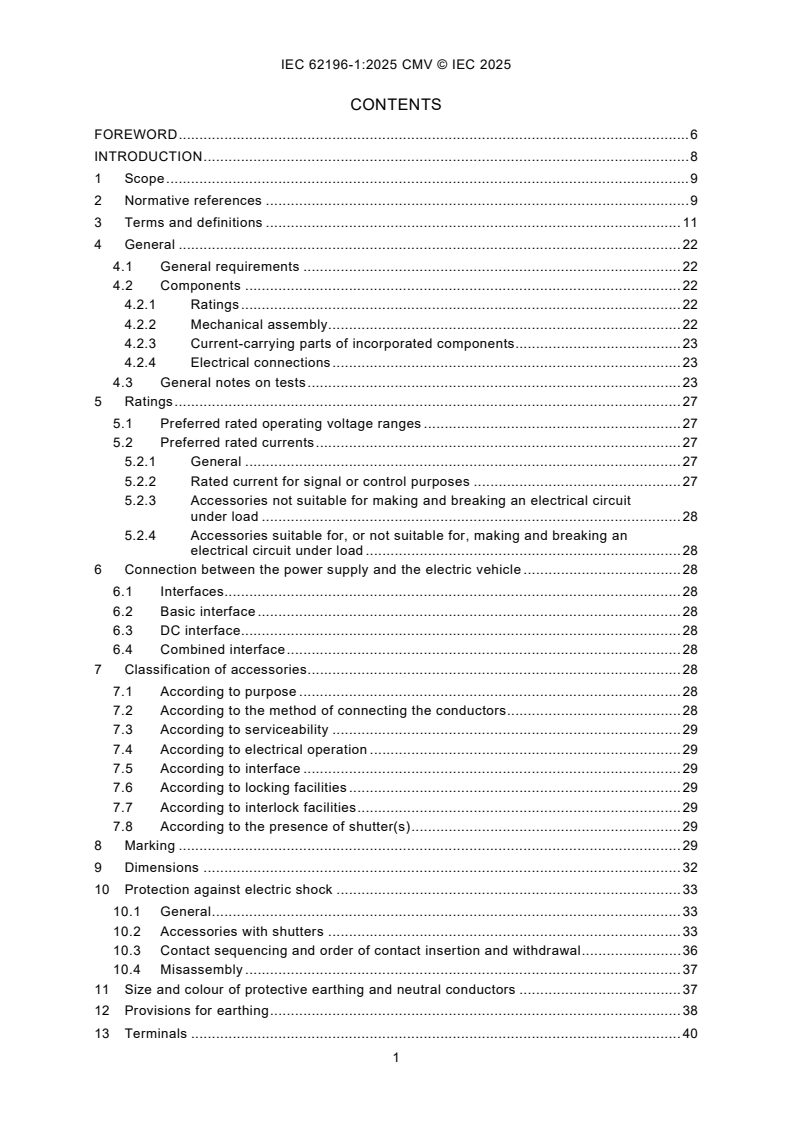
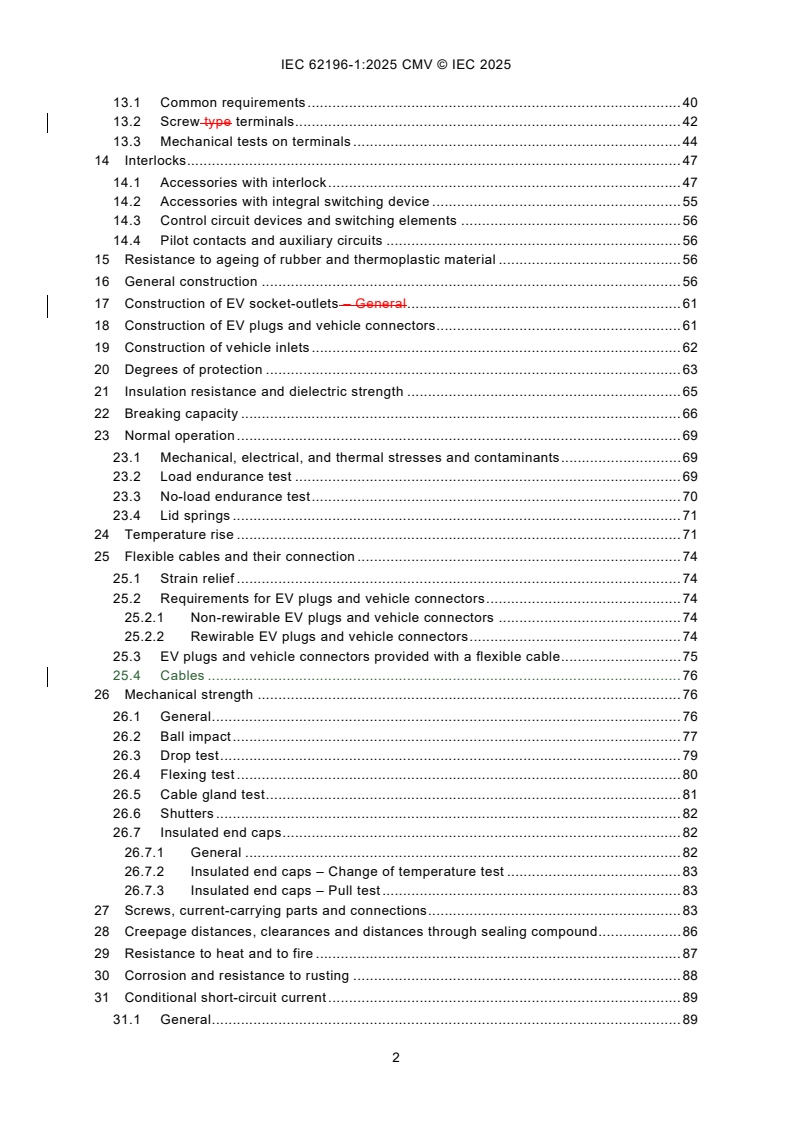
REDLINE IEC 62196-1:2025 CMV - Plugs, socket-outlets, vehicle connectors and vehicle inlets - Conductive charging of electric vehicles - Part 1: General requirements/25/2025
IEC 62196-1:2025 - Fiches, socles de prise de courant, prises mobiles de véhicule et socles de connecteurs de véhicule - Charge conductive des véhicules électriques - Partie 1: Exigences générales Released:11/25/2025
IEC 62196-1:2025 - Plugs, socket-outlets, vehicle connectors and vehicle inlets - Conductive charging of electric vehicles - Part 1: General requirements Released:11/25/2025
Overview
IEC 62196-1:2025 - Part 1 of the IEC 62196 series - defines general requirements for plugs, socket‑outlets, vehicle connectors and vehicle inlets used for conductive charging of electric vehicles (EVs). This fifth edition replaces the 2022 edition and covers accessories and cable assemblies that incorporate control means with rated operating voltages and currents not exceeding:
- 690 V AC (50–60 Hz) at up to 250 A; and
- 1 500 V DC at up to 800 A.
Significant updates in this edition include new tests for latching devices and retaining means and the inclusion of type 4 accessories.
Key Topics and Technical Requirements
IEC 62196-1:2025 sets out comprehensive requirements that manufacturers, test labs and designers rely on:
- Ratings and preferred operating ranges (voltage, current, signal/control circuits)
- Interfaces and classification of accessories by purpose, electrical operation, locking/interlock facilities and shutters
- Mechanical and electrical construction: terminals, strain relief, cable glands and overall assembly
- Protection against electric shock and contact sequencing (order of contact insertion/withdrawal)
- Insulation resistance, dielectric strength and breaking capacity
- Thermal performance (temperature rise, thermal cycling) and contact endurance
- Mechanical strength tests: drop, impact, flexing, vehicle drive-over and misalignment tests
- Environmental durability: humidity exposure, corrosion resistance, resistance to heat and fire
- Electromagnetic compatibility (EMC), conditional short‑circuit current requirements and marking/labeling
- New test coverage for latching/retaining devices and requirements for type 4 accessories
- Annexes include standard test gauge sheets and guidance for accessories connected directly to printed circuit boards (PCBs)
Practical Applications - Who Uses This Standard
IEC 62196-1:2025 is essential for:
- EV charging hardware manufacturers producing plugs, sockets, vehicle connectors, inlets and cable assemblies
- Charging station designers and system integrators ensuring safe, interoperable conductive charging interfaces
- Test laboratories and certification bodies conducting conformity and type testing
- Regulators, procurement teams and fleet operators specifying product compliance and safety
- Electrical and product design engineers responsible for connector mechanical/electrical compliance
Using this standard supports product safety, interoperability and regulatory compliance in EV infrastructure and helps reduce field failures and safety risks associated with conductive charging.
Related Standards
IEC 62196‑1 is the general‑requirements part of the IEC 62196 series. Other parts of the series address specific connector types, dimensional and interoperability aspects and test procedures relevant to conductive charging systems.
Relations
- Effective Date
- 05-Sep-2023
Buy Documents
IEC 62196-1:2025 - Plugs, socket-outlets, vehicle connectors and vehicle inlets - Conductive charging of electric vehicles - Part 1: General requirements Released:11/25/2025
REDLINE IEC 62196-1:2025 CMV - Plugs, socket-outlets, vehicle connectors and vehicle inlets - Conductive charging of electric vehicles - Part 1: General requirements/25/2025
IEC 62196-1:2025 - Fiches, socles de prise de courant, prises mobiles de véhicule et socles de connecteurs de véhicule - Charge conductive des véhicules électriques - Partie 1: Exigences générales Released:11/25/2025
IEC 62196-1:2025 - Plugs, socket-outlets, vehicle connectors and vehicle inlets - Conductive charging of electric vehicles - Part 1: General requirements Released:11/25/2025
Get Certified
Connect with accredited certification bodies for this standard

TÜV Rheinland
TÜV Rheinland is a leading international provider of technical services.

TÜV SÜD
TÜV SÜD is a trusted partner of choice for safety, security and sustainability solutions.

DEKRA Certification Inc.
DEKRA US certification services.
Sponsored listings
Frequently Asked Questions
IEC 62196-1:2025 is a standard published by the International Electrotechnical Commission (IEC). Its full title is "Plugs, socket-outlets, vehicle connectors and vehicle inlets - Conductive charging of electric vehicles - Part 1: General requirements". This standard covers: IEC 62196-1:2025 is applicable to EV plugs, EV socket-outlets, vehicle connectors, vehicle inlets, herein referred to as "accessories", and to cable assemblies for electric vehicles (EV) intended for use in conductive charging systems which incorporate control means, with a rated operating voltage not exceeding - 690 V AC 50 Hz to 60 Hz, at a rated current not exceeding 250 A, and - 1 500 V DC at a rated current not exceeding 800 A. This fifth edition cancels and replaces the fourth edition published in 2022. This edition constitutes a technical revision. This edition includes the following significant technical changes with respect to the previous edition: a) addition of new tests for latching devices and retaining means; b) inclusion of type 4 accessories.
IEC 62196-1:2025 is applicable to EV plugs, EV socket-outlets, vehicle connectors, vehicle inlets, herein referred to as "accessories", and to cable assemblies for electric vehicles (EV) intended for use in conductive charging systems which incorporate control means, with a rated operating voltage not exceeding - 690 V AC 50 Hz to 60 Hz, at a rated current not exceeding 250 A, and - 1 500 V DC at a rated current not exceeding 800 A. This fifth edition cancels and replaces the fourth edition published in 2022. This edition constitutes a technical revision. This edition includes the following significant technical changes with respect to the previous edition: a) addition of new tests for latching devices and retaining means; b) inclusion of type 4 accessories.
IEC 62196-1:2025 is classified under the following ICS (International Classification for Standards) categories: 29.120.30 - Plugs, socket-outlets, couplers; 43.120 - Electric road vehicles. The ICS classification helps identify the subject area and facilitates finding related standards.
IEC 62196-1:2025 has the following relationships with other standards: It is inter standard links to IEC 62196-1:2022. Understanding these relationships helps ensure you are using the most current and applicable version of the standard.
IEC 62196-1:2025 is available in PDF format for immediate download after purchase. The document can be added to your cart and obtained through the secure checkout process. Digital delivery ensures instant access to the complete standard document.
Standards Content (Sample)
IEC 62196-1 ®
Edition 5.0 2025-11
INTERNATIONAL
STANDARD
Plugs, socket-outlets, vehicle connectors and vehicle inlets - Conductive
charging of electric vehicles -
Part 1: General requirements
ICS 29.120.30; 43.120 ISBN 978-2-8327-0825-5
All rights reserved. Unless otherwise specified, no part of this publication may be reproduced or utilized in any form or
by any means, electronic or mechanical, including photocopying and microfilm, without permission in writing from either
IEC or IEC's member National Committee in the country of the requester. If you have any questions about IEC copyright
or have an enquiry about obtaining additional rights to this publication, please contact the address below or your local
IEC member National Committee for further information.
IEC Secretariat Tel.: +41 22 919 02 11
3, rue de Varembé info@iec.ch
CH-1211 Geneva 20 www.iec.ch
Switzerland
About the IEC
The International Electrotechnical Commission (IEC) is the leading global organization that prepares and publishes
International Standards for all electrical, electronic and related technologies.
About IEC publications
The technical content of IEC publications is kept under constant review by the IEC. Please make sure that you have the
latest edition, a corrigendum or an amendment might have been published.
IEC publications search - IEC Products & Services Portal - products.iec.ch
webstore.iec.ch/advsearchform Discover our powerful search engine and read freely all the
The advanced search enables to find IEC publications by a publications previews, graphical symbols and the glossary.
variety of criteria (reference number, text, technical With a subscription you will always have access to up to date
committee, …). It also gives information on projects, content tailored to your needs.
replaced and withdrawn publications.
Electropedia - www.electropedia.org
The world's leading online dictionary on electrotechnology,
IEC Just Published - webstore.iec.ch/justpublished
Stay up to date on all new IEC publications. Just Published containing more than 22 500 terminological entries in English
details all new publications released. Available online and and French, with equivalent terms in 25 additional languages.
once a month by email. Also known as the International Electrotechnical Vocabulary
(IEV) online.
IEC Customer Service Centre - webstore.iec.ch/csc
If you wish to give us your feedback on this publication or
need further assistance, please contact the Customer
Service Centre: sales@iec.ch.
CONTENTS
FOREWORD . 6
INTRODUCTION . 8
1 Scope . 9
2 Normative references . 9
3 Terms and definitions . 11
4 General . 22
4.1 General requirements . 22
4.2 Components . 22
4.2.1 Ratings . 22
4.2.2 Mechanical assembly. 22
4.2.3 Current-carrying parts of incorporated components. 22
4.2.4 Electrical connections . 23
4.3 General notes on tests . 23
5 Ratings . 26
5.1 Preferred rated operating voltage ranges . 26
5.2 Preferred rated currents . 27
5.2.1 General . 27
5.2.2 Rated current for signal or control purposes . 27
5.2.3 Accessories not suitable for making and breaking an electrical circuit
under load . 27
5.2.4 Accessories suitable for, or not suitable for, making and breaking an
electrical circuit under load . 27
6 Connection between the power supply and the electric vehicle . 28
6.1 Interfaces. 28
6.2 Basic interface . 28
6.3 DC interface. 28
6.4 Combined interface . 28
7 Classification of accessories. 28
7.1 According to purpose . 28
7.2 According to the method of connecting the conductors . 28
7.3 According to serviceability . 28
7.4 According to electrical operation . 28
7.5 According to interface . 28
7.6 According to locking facilities . 29
7.7 According to interlock facilities . 29
7.8 According to the presence of shutter(s) . 29
8 Marking . 29
9 Dimensions . 32
10 Protection against electric shock . 32
10.1 General . 32
10.2 Accessories with shutters . 33
10.3 Contact sequencing and order of contact insertion and withdrawal . 36
10.4 Misassembly . 37
11 Size and colour of protective earthing and neutral conductors . 37
12 Provisions for earthing . 38
13 Terminals . 40
13.1 Common requirements . 40
13.2 Screw terminals . 42
13.3 Mechanical tests on terminals . 44
14 Interlocks. 47
14.1 Accessories with interlock . 47
14.2 Accessories with integral switching device . 55
14.3 Control circuit devices and switching elements . 55
14.4 Pilot contacts and auxiliary circuits . 55
15 Resistance to ageing of rubber and thermoplastic material . 55
16 General construction . 56
17 Construction of EV socket-outlets . 59
18 Construction of EV plugs and vehicle connectors . 60
19 Construction of vehicle inlets . 61
20 Degrees of protection . 61
21 Insulation resistance and dielectric strength . 64
22 Breaking capacity . 65
23 Normal operation . 68
23.1 Mechanical, electrical, and thermal stresses and contaminants . 68
23.2 Load endurance test . 68
23.3 No-load endurance test . 69
23.4 Lid springs . 70
24 Temperature rise . 70
25 Flexible cables and their connection . 72
25.1 Strain relief . 72
25.2 Requirements for EV plugs and vehicle connectors . 73
25.2.1 Non-rewirable EV plugs and vehicle connectors . 73
25.2.2 Rewirable EV plugs and vehicle connectors . 73
25.3 EV plugs and vehicle connectors provided with a flexible cable . 73
25.4 Cables . 75
26 Mechanical strength . 75
26.1 General . 75
26.2 Ball impact . 76
26.3 Drop test . 78
26.4 Flexing test . 79
26.5 Cable gland test . 80
26.6 Shutters . 81
26.7 Insulated end caps . 81
26.7.1 General . 81
26.7.2 Insulated end caps – Change of temperature test . 82
26.7.3 Insulated end caps – Pull test . 82
27 Screws, current-carrying parts and connections . 82
28 Creepage distances, clearances and distances through sealing compound . 85
29 Resistance to heat and to fire . 86
30 Corrosion and resistance to rusting . 87
31 Conditional short-circuit current . 88
31.1 General . 88
31.2 Ratings and test conditions . 88
31.3 Test circuit . 89
31.4 Calibration . 93
31.5 Test procedure. 93
31.6 Behaviour of the equipment under test . 93
31.7 Acceptance conditions . 93
32 Electromagnetic compatibility . 93
32.1 Immunity . 93
32.2 Emission . 93
33 Vehicle drive over . 93
34 Thermal cycling . 94
34.1 General . 94
34.2 Initial temperature rise test . 94
34.3 Thermal cycling test . 95
34.4 Final temperature rise test . 95
35 Humidity exposure . 95
35.1 General . 95
35.2 Initial temperature rise test . 95
35.3 Humidity test . 95
35.4 Final temperature rise test . 96
36 Misalignment . 96
36.1 General . 96
36.2 Samples . 96
36.3 Misalignment test . 97
37 Contact endurance test . 99
37.1 Equipment . 99
37.2 Test sequence . 99
37.3 Compliance . 101
Annex A (normative) Standard sheets for test gauges in 14.1.9 . 102
Annex B (informative) EV accessories directly connected to printed circuit boards
(PCBs) . 106
B.1 General . 106
B.2 Terminals . 106
B.2.1 General . 106
B.2.2 Accessories intended to be directly connected to PCBs . 106
B.3 Temperature rise . 107
Bibliography . 108
Figure 1 – Diagram showing the use of the accessories . 12
Figure 2 – Lug terminals . 16
Figure 3 – Mantle terminals . 16
Figure 4 – Pillar terminals . 17
Figure 5 – Saddle terminals . 19
Figure 6 – Screw terminals . 19
Figure 7 – Stud terminals . 20
Figure 8 – Test piston . 31
Figure 9 – Gauge "A" for checking shutters . 34
Figure 10 – Gauge "B" for checking shutters . 35
Figure 11 – Gauges for testing insertability of round unprepared conductors having the
maximum specified cross-section . 43
Figure 12 – Equipment test arrangement . 45
Figure 13 – Apparatus for checking the withdrawal force . 50
Figure 14 – Verification of the latching device . 51
Figure 15 – Apparatus for checking the maximum force (F2) exerted by the retaining
means. 52
Figure 16 – Test gauge "vehicle inlet" and test arrangement in mated position for
checking retaining means zone . 54
Figure 17 – Example of an apparatus for checking the proper functioning of the
latching device . 54
Figure 18 – Nomenclature for a mounted vehicle inlet . 62
Figure 19 – Circuit diagrams for breaking capacity and normal operation tests . 67
Figure 20 – Example of points of measurement for DUT containing pin contacts . 72
Figure 21 – Apparatus for testing the cable anchorage . 74
Figure 22 – Ball impact test . 76
Figure 23 – Arrangement for mechanical strength test for EV plugs and vehicle
connectors . 78
Figure 24 – Apparatus for flexing test . 80
Figure 25 – Diagram of the test circuit for the verification of short-circuit current
withstand of two-pole equipment on a single-phase AC or DC . 90
Figure 26 – Diagram of the test circuit for the verification of short-circuit current
withstand of three-pole equipment . 91
Figure 27 – Diagram of the test circuit for the verification of short-circuit current
withstand of four-pole equipment . 92
Figure 28 – Overview of the mechanical load test . 97
Figure 29 – Application of external mechanical load (mounted according to Figure 28) . 98
Figure 30 – Temperature rise criteria under external mechanical load . 98
Figure 31 – Forced-air circulating oven . 99
Figure 32 – Thermal cycling . 100
Figure 33 – Pass/fail based on temperature rise criteria . 101
Table 1 – Test sequence A . 24
Table 2 – Parallel testing . 26
Table 3 – Size for conductors . 37
Table 4 – Short-time test currents . 39
Table 5 – Values for flexing under mechanical load test . 46
Table 6 – Value for terminal pull test . 47
Table 7 – Interlock testing . 48
Table 8 – Withdrawal force with respect to ratings . 51
Table 9 – External force values for tests . 55
Table 10 – Cable length used to determine pull force on retaining means . 57
Table 11 – Test voltage for dielectric strength test . 65
Table 12 – Breaking capacity . 66
Table 13 – Normal operation . 68
Table 14 – Test current and nominal cross-sectional areas of copper conductors for
temperature rise test . 71
Table 15 – Pull force and torque test values for cable anchorage. 75
Table 16 – Summary of mechanical tests . 76
Table 17 – Impact energy for ball impact test . 77
Table 18 – Mechanical load flexing test . 79
Table 19 – Torque test values for glands . 81
Table 20 – Pulling force on insulated end caps . 82
Table 21 – Tightening torque for verification of mechanical strength of screw-type
terminals . 83
Table B.1 – Standards for connecting methods . 106
INTERNATIONAL ELECTROTECHNICAL COMMISSION
____________
Plugs, socket-outlets, vehicle connectors and vehicle inlets -
Conductive charging of electric vehicles -
Part 1: General requirements
FOREWORD
1) The International Electrotechnical Commission (IEC) is a worldwide organization for standardization comprising
all national electrotechnical committees (IEC National Committees). The object of IEC is to promote international
co-operation on all questions concerning standardization in the electrical and electronic fields. To this end and
in addition to other activities, IEC publishes International Standards, Technical Specifications, Technical Reports,
Publicly Available Specifications (PAS) and Guides (hereafter referred to as "IEC Publication(s)"). Their
preparation is entrusted to technical committees; any IEC National Committee interested in the subject dealt with
may participate in this preparatory work. International, governmental and non-governmental organizations liaising
with the IEC also participate in this preparation. IEC collaborates closely with the International Organization for
Standardization (ISO) in accordance with conditions determined by agreement between the two organizations.
2) The formal decisions or agreements of IEC on technical matters express, as nearly as possible, an international
consensus of opinion on the relevant subjects since each technical committee has representation from all
interested IEC National Committees.
3) IEC Publications have the form of recommendations for international use and are accepted by IEC National
Committees in that sense. While all reasonable efforts are made to ensure that the technical content of IEC
Publications is accurate, IEC cannot be held responsible for the way in which they are used or for any
misinterpretation by any end user.
4) In order to promote international uniformity, IEC National Committees undertake to apply IEC Publications
transparently to the maximum extent possible in their national and regional publications. Any divergence between
any IEC Publication and the corresponding national or regional publication shall be clearly indicated in the latter.
5) IEC itself does not provide any attestation of conformity. Independent certification bodies provide conformity
assessment services and, in some areas, access to IEC marks of conformity. IEC is not responsible for any
services carried out by independent certification bodies.
6) All users should ensure that they have the latest edition of this publication.
7) No liability shall attach to IEC or its directors, employees, servants or agents including individual experts and
members of its technical committees and IEC National Committees for any personal injury, property damage or
other damage of any nature whatsoever, whether direct or indirect, or for costs (including legal fees) and
expenses arising out of the publication, use of, or reliance upon, this IEC Publication or any other IEC
Publications.
8) Attention is drawn to the Normative references cited in this publication. Use of the referenced publications is
indispensable for the correct application of this publication.
9) IEC draws attention to the possibility that the implementation of this document may involve the use of (a)
patent(s). IEC takes no position concerning the evidence, validity or applicability of any claimed patent rights in
respect thereof. As of the date of publication of this document, IEC had not received notice of (a) patent(s), which
may be required to implement this document. However, implementers are cautioned that this may not represent
the latest information, which may be obtained from the patent database available at https://patents.iec.ch. IEC
shall not be held responsible for identifying any or all such patent rights.
IEC 62196-1 has been prepared by IEC subcommittee 23H: Plugs, socket-outlets and couplers
for industrial and similar applications, and for electric vehicles, of IEC technical committee 23:
Electrical accessories. It is an International Standard.
This fifth edition cancels and replaces the fourth edition published in 2022. This edition
constitutes a technical revision.
This edition includes the following significant technical changes with respect to the previous
edition:
a) addition of new tests for latching devices and retaining means;
b) inclusion of type 4 accessories.
The text of this International Standard is based on the following documents:
Draft Report on voting
23H/579/FDIS 23H/586/RVD
Full information on the voting for its approval can be found in the report on voting indicated in
the above table.
The language used for the development of this International Standard is English.
This document was drafted in accordance with ISO/IEC Directives, Part 2, and developed in
accordance with ISO/IEC Directives, Part 1 and ISO/IEC Directives, IEC Supplement, available
at www.iec.ch/members_experts/refdocs. The main document types developed by IEC are
described in greater detail at www.iec.ch/standardsdev/publications.
Subsequent parts of IEC 62196 deal with the requirements of particular types of accessories.
The clauses of those particular requirements supplement or modify the corresponding clauses
in this document.
In this document, the following print types are used:
– requirements proper: in roman type;
– test specifications: in italic type;
– notes: in smaller roman type.
A list of all parts in the IEC 62196 series, published under the general title Plugs, socket-outlets,
vehicle connectors and vehicle inlets - Conductive charging of electric vehicles, can be found
on the IEC website.
The committee has decided that the contents of this document will remain unchanged until the
stability date indicated on the IEC website under webstore.iec.ch in the data related to the
specific document. At this date, the document will be
– reconfirmed,
– withdrawn, or
– revised.
INTRODUCTION
The IEC 61851 series specifies requirements for electric vehicle (EV) conductive charging
systems.
The IEC 62196 series specifies the requirements for plugs, socket-outlets, vehicle connectors,
vehicle inlets and cable assemblies as described in the IEC 61851 series and in IEC 62752.
In some situations, a cable assembly is used to directly connect an electric vehicle to a standard
socket-outlet connected to a supply network (mains or electrical grid). In other situations, the
electric vehicle is connected to a supply network through EV supply equipment that incorporates
control and communication circuits. The IEC 62196 series covers the mechanical, electrical and
performance requirements for
– vehicle connectors and vehicle inlets for the direct connection between an electric vehicle
and a standard socket-outlet, and
– EV plugs, EV socket-outlets, vehicle connectors and vehicle inlets for the connection
between the EV supply equipment and the electric vehicle.
The IEC 62196 series consists of the following parts:
– IEC 62196-1: General requirements, comprising clauses of a general character;
– IEC 62196-2: Dimensional compatibility requirements for AC pin and contact-tube
accessories;
– IEC 62196-3: Dimensional compatibility requirements for DC and AC/DC pin and contact-
tube vehicle couplers;
– IEC TS 62196-4: Dimensional compatibility and interchangeability requirements for DC pin
and contact-tube accessories for class II or class III applications;
– IEC 62196-6: Dimensional compatibility requirements for DC pin and contact-tube vehicle
couplers intended to be used for DC EV supply equipment where protection relies on
electrical separation.
– IEC TS 62196-7 : Vehicle adapter.
____________
Under preparation. Stage at the time of publication: IEC TS/ADTS 62196-7:2025.
1 Scope
This part of IEC 62196 is applicable to EV plugs, EV socket-outlets, vehicle connectors, vehicle
inlets, herein referred to as "accessories", and to cable assemblies for electric vehicles (EV)
intended for use in conductive charging systems which incorporate control means, with a rated
operating voltage not exceeding
– 690 V AC 50 Hz to 60 Hz, at a rated current not exceeding 250 A, and
– 1 500 V DC at a rated current not exceeding 800 A.
These accessories and cable assemblies are intended to be installed by instructed persons
(IEV 195-04-02) or skilled persons (IEV 195-04-01) only.
These accessories and cable assemblies are intended to be used for circuits specified in the
IEC 61851 series, which operate at different voltages and frequencies, and which can include
extra-low voltage circuits, such as control and communication circuits.
These accessories and cable assemblies are anticipated to be used at an ambient temperature
between −30 °C and +40 °C.
NOTE 1 In some countries, other requirements can apply.
NOTE 2 In the following country, −40 °C applies: SE.
NOTE 3 The manufacturer can enlarge the temperature range on the condition that the specified range information
is provided.
These accessories are intended to be connected only to cables with copper or copper-alloy
conductors.
The accessories covered by this document are intended for use in electric vehicle supply
equipment in accordance with IEC 61851 (all parts).
This document does not apply to standard plugs and standard socket-outlets used for mode 1
and mode 2 according to IEC 61851-1:2017, 6.2.
NOTE 4 In the following countries, mode 1 is not allowed: UK, US, CA, SG.
2 Normative references
The following documents are referred to in the text in such a way that some or all of their content
constitutes requirements of this document. For dated references, only the edition cited applies.
For undated references, the latest edition of the referenced document (including any
amendments) applies.
IEC 60068-2-14, Environmental testing - Part 2-14: Tests - Test N: Change of temperature
IEC 60068-2-20, Environmental testing - Part 2-20: Tests - Test Ta and Tb: Test methods for
solderability and resistance to soldering heat of devices with leads
IEC 60068-2-30, Environmental testing - Part 2-30: Tests - Test Db: Damp heat, cyclic
(12 h + 12 h cycle)
IEC 60112, Method for the determination of the proof and the comparative tracking indices of
solid insulating materials
IEC 60227 (all parts), Polyvinyl chloride insulated cables of rated voltages up to and including
450/750 V
IEC 60228:2023, Conductors of insulated cables
IEC 60245-4, Rubber insulated cables - Rated voltages up to and including 450/750 V - Part 4:
Cords and flexible cables
IEC 60269-1, Low-voltage fuses - Part 1: General requirements
IEC 60269-2, Low-voltage fuses - Part 2: Supplementary requirements for fuses for use by
authorized persons (fuses mainly for industrial application) - Examples of standardized systems
of fuses A to K
IEC 60309-4:2021, Plugs, fixed or portable socket-outlets and appliance inlets for industrial
purposes - Part 4: Switched socket-outlets with or without interlock
IEC 60352-5, Solderless connections - Part 5: Press-in connections - General requirements,
test methods and practical guidance
IEC 60417, Graphical symbols for use on equipment, available at http://www.graphical-
symbols.info/equipment
IEC 60529:1989, Degrees of protection provided by enclosures (IP code)
IEC 60529:1989/AMD1:1999
IEC 60529:1989/AMD2:2013
IEC 60664-1:2020, Insulation coordination for equipment within low-voltage supply systems -
Part 1: Principles, requirements and tests
IEC 60664-3, Insulation coordination for equipment within low-voltage systems - Part 3: Use of
coating, potting or moulding for protection against pollution
IEC 60695-2-11, Fire hazard testing - Part 2-11: Glowing/hot-wire based test methods -
Glow-wire flammability test method for end products (GWEPT)
IEC 60695-10-2, Fire hazard testing - Part 10-2: Abnormal heat - Ball pressure test method
IEC 60947-3, Low-voltage switchgear and controlgear - Part 3: Switches, disconnectors, switch-
disconnectors and fuse-combination units
IEC 60947-5-1, Low-voltage switchgear and controlgear - Part 5-1: Control circuit devices and
switching elements - Electromechanical control circuit devices
IEC 61032:1997, Protection of persons and equipment by enclosures - Probes for verification
IEC 61058-1:2016, Switches for appliances - Part 1: General requirements
IEC 61851-1:2017, Electric vehicle conductive charging system - Part 1: General requirements
IEC 61851-23:2023, Electric vehicle conductive charging system - Part 23: DC electric vehicle
supply equipment
IEC 62196-2:2025, Plugs, socket-outlets, vehicle connectors and vehicle inlets - Conductive
charging of electric vehicles - Part 2: Dimensional compatibility requirements for AC pin and
contact-tube accessories
IEC 62196-3:—, Plugs, socket-outlets, vehicle connectors and vehicle inlets - Conductive
charging of electric vehicles - Part 3: Dimensional compatibility requirements for DC and AC/DC
pin and contact-tube vehicle couplers
IEC 62752, In-cable control and protection device (IC-CPD) for mode 2 charging of electric road
vehicles
ISO 12103-1, Road vehicles - Test contaminants for filter evaluation - Part 1: Arizona test dust
ISO 4521:2008, Metallic and other inorganic coatings - Electrodeposited silver and silver alloy
coatings for engineering purposes - Specification and test methods
ISO 5474 (all parts), Electrically propelled road vehicles - Functional and safety requirements
for power transfer between vehicle and external electric circuit
3 Terms and definitions
For the purposes of this document, the following terms and definitions apply.
ISO and IEC maintain terminological databases for use in standardization at the following
addresses:
– IEC Electropedia: available at http://www.electropedia.org/
– ISO Online browsing platform: available at http://www.iso.org/obp
NOTE The application of accessories is shown in Figure 1.
____________
Under preparation. Stage at the time of publication: IEC/AFDIS 62196-3:2025.
Key
1 in-cable control and protective device (IC-CPD)
A standard socket-outlet or EV socket-outlet
B standard plug or EV plug
C vehicle connector
D vehicle inlet
Figure 1 – Diagram showing the use of the accessories
3.1
accessory
EV plug, EV socket-outlet, vehicle connector or vehicle inlet, with cable (forming a cable
assembly) or without cable, for use in conductive charging systems for electric vehicles
3.2
auxiliary power
external electrical energy power supply used for purposes other than charging of the electric
vehicle propulsion battery
Note 1 to entry: In French, the resulting assembly when a plug is inserted into a socket-outlet is called "prise de
courant".
3.3
cable assembly
assembly consisting of a flexible cable or cord fitted with a standard plug or EV plug and/or a
vehicle connector, which is used to establish the connection between the EV and the supply
network or an EV charging station
Note 1 to entry: A cable assembly can be detachable or be a part of the EV or of the EV charging station.
Note 2 to entry: A cable assembly can include one or more cables, with or without a fixed jacket, which can be in a
flexible tube, conduit or wire way.
[SOURCE: IEC 61851-1:2017, 3.5.2, modified – "plug" has been replaced with "standard plug
or EV plug".]
3.4
cap
part separated or attached, which may be used to provide the degree of protection of an EV
plug or vehicle inlet, when it is not engaged with an EV socket-outlet or a vehicle connector
3.5
clamping unit
part of a terminal necessary for the clamping and the electrical connection of the conductor
3.6
compatibility
compatible
ability of accessories to couple with their counterpart and be functional
Note 1 to entry: Non-compatible accessories can physically couple with their counterpart, but not be functional.
3.7
conditional short-circuit current
prospective current that an accessory, protected by a specified short-circuit protective device,
can withstand satisfactorily for the total operating time of that device under specified conditions
of use and behaviour
[SOURCE: IEC 60050-441:1984, 441-17-20, modified – The concept of current-limiting device
has been broadened into a short-circuit protective device, the function of which is not only to
limit the current.]
3.8
conductive part
part that can carry electric current
[SOURCE: IEC 60050-195:2021, 195-01-06]
3.9
connection
single conductive path
3.10
cord extension set
assembly consisting of a flexible cable or cord fitted with an EV plug that is intended to mate
with a vehicle connector as covered by the IEC 62196 series
3.11
control circuit device
electrical device intended for the controlling, signalling, interlocking, etc. of switchgear and
controlgear
Note 1 to entry: See IEC 60947-1:2020, 3.4.16.
[SOURCE: IEC 60309-4:2021, 3.406]
3.12
cover
means of providing a degree of protection for an accessory when it is not engaged with its
counterpart
Note 1 to entry: A cover can be used as the retaining means or as part of the retaining means.
Note 2 to entry: Caps, lids, shutters and similar devices can perform the function of a cover.
3.13
double insulation
insulation comprising both basic insulation and supplementary insulation
[SOURCE IEC 60050-195:2021, 195-06-0
...
IEC 62196-1 ®
Edition 5.0 2025-11
INTERNATIONAL
STANDARD
COMMENTED VERSION
Plugs, socket-outlets, vehicle connectors and vehicle inlets - Conductive
charging of electric vehicles -
Part 1: General requirements
ICS 29.120.30; 43.120 ISBN 978-2-8327-0904-7
All rights reserved. Unless otherwise specified, no part of this publication may be reproduced or utilized in any form or
by any means, electronic or mechanical, including photocopying and microfilm, without permission in writing from either
IEC or IEC's member National Committee in the country of the requester. If you have any questions about IEC copyright
or have an enquiry about obtaining additional rights to this publication, please contact the address below or your local
IEC member National Committee for further information.
IEC Secretariat Tel.: +41 22 919 02 11
3, rue de Varembé info@iec.ch
CH-1211 Geneva 20 www.iec.ch
Switzerland
About the IEC
The International Electrotechnical Commission (IEC) is the leading global organization that prepares and publishes
International Standards for all electrical, electronic and related technologies.
About IEC publications
The technical content of IEC publications is kept under constant review by the IEC. Please make sure that you have the
latest edition, a corrigendum or an amendment might have been published.
IEC publications search - IEC Products & Services Portal - products.iec.ch
webstore.iec.ch/advsearchform Discover our powerful search engine and read freely all the
The advanced search enables to find IEC publications by a publications previews, graphical symbols and the glossary.
variety of criteria (reference number, text, technical With a subscription you will always have access to up to date
committee, …). It also gives information on projects, content tailored to your needs.
replaced and withdrawn publications.
Electropedia - www.electropedia.org
The world's leading online dictionary on electrotechnology,
IEC Just Published - webstore.iec.ch/justpublished
Stay up to date on all new IEC publications. Just Published containing more than 22 500 terminological entries in English
details all new publications released. Available online and and French, with equivalent terms in 25 additional languages.
once a month by email. Also known as the International Electrotechnical Vocabulary
(IEV) online.
IEC Customer Service Centre - webstore.iec.ch/csc
If you wish to give us your feedback on this publication or
need further assistance, please contact the Customer
Service Centre: sales@iec.ch.
CONTENTS
FOREWORD . 6
INTRODUCTION . 8
1 Scope . 9
2 Normative references . 9
3 Terms and definitions . 11
4 General . 22
4.1 General requirements . 22
4.2 Components . 22
4.2.1 Ratings . 22
4.2.2 Mechanical assembly. 22
4.2.3 Current-carrying parts of incorporated components. 23
4.2.4 Electrical connections . 23
4.3 General notes on tests . 23
5 Ratings . 27
5.1 Preferred rated operating voltage ranges . 27
5.2 Preferred rated currents . 27
5.2.1 General . 27
5.2.2 Rated current for signal or control purposes . 27
5.2.3 Accessories not suitable for making and breaking an electrical circuit
under load . 28
5.2.4 Accessories suitable for, or not suitable for, making and breaking an
electrical circuit under load . 28
6 Connection between the power supply and the electric vehicle . 28
6.1 Interfaces. 28
6.2 Basic interface . 28
6.3 DC interface. 28
6.4 Combined interface . 28
7 Classification of accessories. 28
7.1 According to purpose . 28
7.2 According to the method of connecting the conductors . 28
7.3 According to serviceability . 29
7.4 According to electrical operation . 29
7.5 According to interface . 29
7.6 According to locking facilities . 29
7.7 According to interlock facilities . 29
7.8 According to the presence of shutter(s) . 29
8 Marking . 29
9 Dimensions . 32
10 Protection against electric shock . 33
10.1 General . 33
10.2 Accessories with shutters . 33
10.3 Contact sequencing and order of contact insertion and withdrawal . 36
10.4 Misassembly . 37
11 Size and colour of protective earthing and neutral conductors . 37
12 Provisions for earthing . 38
13 Terminals . 40
13.1 Common requirements . 40
13.2 Screw type terminals . 42
13.3 Mechanical tests on terminals . 44
14 Interlocks. 47
14.1 Accessories with interlock . 47
14.2 Accessories with integral switching device . 55
14.3 Control circuit devices and switching elements . 56
14.4 Pilot contacts and auxiliary circuits . 56
15 Resistance to ageing of rubber and thermoplastic material . 56
16 General construction . 56
17 Construction of EV socket-outlets – General . 61
18 Construction of EV plugs and vehicle connectors . 61
19 Construction of vehicle inlets . 62
20 Degrees of protection . 63
21 Insulation resistance and dielectric strength . 65
22 Breaking capacity . 66
23 Normal operation . 69
23.1 Mechanical, electrical, and thermal stresses and contaminants . 69
23.2 Load endurance test . 69
23.3 No-load endurance test . 70
23.4 Lid springs . 71
24 Temperature rise . 71
25 Flexible cables and their connection . 74
25.1 Strain relief . 74
25.2 Requirements for EV plugs and vehicle connectors . 74
25.2.1 Non-rewirable EV plugs and vehicle connectors . 74
25.2.2 Rewirable EV plugs and vehicle connectors . 74
25.3 EV plugs and vehicle connectors provided with a flexible cable . 75
25.4 Cables . 76
26 Mechanical strength . 76
26.1 General . 76
26.2 Ball impact . 77
26.3 Drop test . 79
26.4 Flexing test . 80
26.5 Cable gland test . 81
26.6 Shutters . 82
26.7 Insulated end caps . 82
26.7.1 General . 82
26.7.2 Insulated end caps – Change of temperature test . 83
26.7.3 Insulated end caps – Pull test . 83
27 Screws, current-carrying parts and connections . 83
28 Creepage distances, clearances and distances through sealing compound . 86
29 Resistance to heat and to fire . 87
30 Corrosion and resistance to rusting . 88
31 Conditional short-circuit current . 89
31.1 General . 89
31.2 Ratings and test conditions . 89
31.3 Test circuit . 90
31.4 Calibration . 94
31.5 Test procedure. 94
31.6 Behaviour of the equipment under test . 94
31.7 Acceptance conditions . 94
32 Electromagnetic compatibility . 94
32.1 Immunity . 94
32.2 Emission . 94
33 Vehicle drive over . 94
34 Thermal cycling . 95
34.1 General . 95
34.2 Initial temperature rise test . 95
34.3 Thermal cycling test . 96
34.4 Final temperature rise test . 96
35 Humidity exposure . 96
35.1 General . 96
35.2 Initial temperature rise test . 96
35.3 Humidity test . 96
35.4 Final temperature rise test . 97
36 Misalignment . 97
36.1 General . 97
36.2 Samples . 97
36.3 Misalignment test . 98
37 Contact endurance test . 100
37.1 Equipment . 100
37.2 Test sequence . 101
37.3 Compliance . 102
Annex A (normative) Standard sheets for test gauges in 14.1.9 . 104
Annex B (informative) EV accessories directly connected to printed circuit boards
(PCBs) . 108
B.1 General . 108
B.2 Terminals . 108
B.2.1 General . 108
B.2.2 Accessories intended to be directly connected to PCBs . 108
B.3 Temperature rise . 109
Bibliography . 110
List of comments. 113
Figure 1 – Diagram showing the use of the accessories . 12
Figure 2 – Lug terminals . 16
Figure 3 – Mantle terminals . 16
Figure 4 – Pillar terminals . 17
Figure 5 – Saddle terminals . 19
Figure 6 – Screw terminals . 19
Figure 7 – Stud terminals . 20
Figure 8 – Test piston . 32
Figure 9 – Gauge "A" for checking shutters . 34
Figure 10 – Gauge "B" for checking shutters . 35
Figure 11 – Gauges for testing insertability of round unprepared conductors having the
maximum specified cross-section . 43
Figure 12 – Equipment test arrangement . 45
Figure 13 – Apparatus for checking the withdrawal force . 50
Figure 14 – Verification of the latching device . 51
Figure 15 – Apparatus for checking the maximum force (F2) exerted by the retaining
means. 53
Figure 16 – Test gauge "vehicle inlet" and test arrangement in mated position for
checking retaining means zone . 54
Figure 17 – Example of an apparatus for checking the proper functioning of the
latching device . 55
Figure 18 – Nomenclature for a mounted vehicle inlet . 64
Figure 19 – Circuit diagrams for breaking capacity and normal operation tests . 68
Figure 20 – Example of points of measurement for DUT containing pin contacts . 73
Figure 21 – Apparatus for testing the cable anchorage . 75
Figure 22 – Ball impact test . 77
Figure 23 – Arrangement for mechanical strength test for EV plugs and vehicle
connectors . 79
Figure 24 – Apparatus for flexing test . 81
Figure 25 – Diagram of the test circuit for the verification of short-circuit current
withstand of two-pole equipment on a single-phase AC or DC . 91
Figure 26 – Diagram of the test circuit for the verification of short-circuit current
withstand of three-pole equipment . 92
Figure 27 – Diagram of the test circuit for the verification of short-circuit current
withstand of four-pole equipment . 93
Figure 28 – Overview of the mechanical load test . 98
Figure 29 – Application of external mechanical load (mounted according to Figure 28) . 99
Figure 30 – Temperature rise criteria under external mechanical load . 100
Figure 31 – Forced-air circulating oven . 101
Figure 32 – Thermal cycling . 102
Figure 33 – Pass/fail based on temperature rise criteria . 103
Table 1 – Test sequence A . 25
Table 2 – Parallel testing . 26
Table 3 – Size for conductors . 37
Table 4 – Short-time test currents . 39
Table 5 – Values for flexing under mechanical load test . 46
Table 6 – Value for terminal pull test . 47
Table 7 – Interlock testing . 48
Table 8 – Withdrawal force with respect to ratings . 51
Table 9 – External force values for tests . 55
Table 10 – Cable length used to determine pull force on retaining means . 58
Table 11 – Test voltage for dielectric strength test . 66
Table 12 – Breaking capacity . 67
Table 13 – Normal operation . 69
Table 14 – Test current and nominal cross-sectional areas of copper conductors for
temperature rise test . 72
Table 15 – Pull force and torque test values for cable anchorage. 76
Table 16 – Summary of mechanical tests . 77
Table 17 – Impact energy for ball impact test . 78
Table 18 – Mechanical load flexing test . 80
Table 19 – Torque test values for glands . 82
Table 20 – Pulling force on insulated end caps . 83
Table 21 – Tightening torque for verification of mechanical strength of screw-type
terminals . 84
Table B.1 – Standards for connecting methods . 108
INTERNATIONAL ELECTROTECHNICAL COMMISSION
____________
Plugs, socket-outlets, vehicle connectors and vehicle inlets -
Conductive charging of electric vehicles -
Part 1: General requirements
FOREWORD
1) The International Electrotechnical Commission (IEC) is a worldwide organization for standardization comprising
all national electrotechnical committees (IEC National Committees). The object of IEC is to promote international
co-operation on all questions concerning standardization in the electrical and electronic fields. To this end and
in addition to other activities, IEC publishes International Standards, Technical Specifications, Technical Reports,
Publicly Available Specifications (PAS) and Guides (hereafter referred to as "IEC Publication(s)"). Their
preparation is entrusted to technical committees; any IEC National Committee interested in the subject dealt with
may participate in this preparatory work. International, governmental and non-governmental organizations liaising
with the IEC also participate in this preparation. IEC collaborates closely with the International Organization for
Standardization (ISO) in accordance with conditions determined by agreement between the two organizations.
2) The formal decisions or agreements of IEC on technical matters express, as nearly as possible, an international
consensus of opinion on the relevant subjects since each technical committee has representation from all
interested IEC National Committees.
3) IEC Publications have the form of recommendations for international use and are accepted by IEC National
Committees in that sense. While all reasonable efforts are made to ensure that the technical content of IEC
Publications is accurate, IEC cannot be held responsible for the way in which they are used or for any
misinterpretation by any end user.
4) In order to promote international uniformity, IEC National Committees undertake to apply IEC Publications
transparently to the maximum extent possible in their national and regional publications. Any divergence between
any IEC Publication and the corresponding national or regional publication shall be clearly indicated in the latter.
5) IEC itself does not provide any attestation of conformity. Independent certification bodies provide conformity
assessment services and, in some areas, access to IEC marks of conformity. IEC is not responsible for any
services carried out by independent certification bodies.
6) All users should ensure that they have the latest edition of this publication.
7) No liability shall attach to IEC or its directors, employees, servants or agents including individual experts and
members of its technical committees and IEC National Committees for any personal injury, property damage or
other damage of any nature whatsoever, whether direct or indirect, or for costs (including legal fees) and
expenses arising out of the publication, use of, or reliance upon, this IEC Publication or any other IEC
Publications.
8) Attention is drawn to the Normative references cited in this publication. Use of the referenced publications is
indispensable for the correct application of this publication.
9) IEC draws attention to the possibility that the implementation of this document may involve the use of (a)
patent(s). IEC takes no position concerning the evidence, validity or applicability of any claimed patent rights in
respect thereof. As of the date of publication of this document, IEC had not received notice of (a) patent(s), which
may be required to implement this document. However, implementers are cautioned that this may not represent
the latest information, which may be obtained from the patent database available at https://patents.iec.ch. IEC
shall not be held responsible for identifying any or all such patent rights.
This commented version (CMV) of the official standard IEC 62196-1:2025 edition 5.0 allows the
user to identify the changes made to the previous IEC 62196-1:2022 edition 4.0. Furthermore,
comments from IEC SC 23H experts are provided to explain the reasons of the most relevant
changes, or to clarify any part of the content.
A vertical bar appears in the margin wherever a change has been made. Additions are in green
text, deletions are in strikethrough red text. Experts' comments are identified by a blue-
background number. Mouse over a number to display a pop-up note with the comment.
This publication contains the CMV and the official standard. The full list of comments is available
at the end of the CMV.
IEC 62196-1 has been prepared by IEC subcommittee 23H: Plugs, socket-outlets and couplers
for industrial and similar applications, and for electric vehicles, of IEC technical committee 23:
Electrical accessories. It is an International Standard.
This fifth edition cancels and replaces the fourth edition published in 2022. This edition
constitutes a technical revision.
This edition includes the following significant technical changes with respect to the previous
edition:
a) addition of new tests for latching devices and retaining means;
b) inclusion of type 4 accessories.
The text of this International Standard is based on the following documents:
Draft Report on voting
23H/579/FDIS 23H/586/RVD
Full information on the voting for its approval can be found in the report on voting indicated in
the above table.
The language used for the development of this International Standard is English.
This document was drafted in accordance with ISO/IEC Directives, Part 2, and developed in
accordance with ISO/IEC Directives, Part 1 and ISO/IEC Directives, IEC Supplement, available
at www.iec.ch/members_experts/refdocs. The main document types developed by IEC are
described in greater detail at www.iec.ch/standardsdev/publications.
Subsequent parts of IEC 62196 deal with the requirements of particular types of accessories.
The clauses of those particular requirements supplement or modify the corresponding clauses
in this document.
In this document, the following print types are used:
– requirements proper: in roman type;
– test specifications: in italic type;
– notes: in smaller roman type.
A list of all parts in the IEC 62196 series, published under the general title Plugs, socket-outlets,
vehicle connectors and vehicle inlets - Conductive charging of electric vehicles, can be found
on the IEC website.
The committee has decided that the contents of this document will remain unchanged until the
stability date indicated on the IEC website under webstore.iec.ch in the data related to the
specific document. At this date, the document will be
– reconfirmed,
– withdrawn, or
– revised.
INTRODUCTION
The IEC 61851 series specifies requirements for electric vehicle (EV) conductive charging
systems.
The IEC 62196 series specifies the requirements for plugs, socket-outlets, vehicle connectors,
vehicle inlets and cable assemblies as described in the IEC 61851 series and in IEC 62752.
Some charging can be achieved by direct connection from an electric vehicle to standard
socket-outlets connected to a supply network (mains or electrical grid).
Some modes of charging require a dedicated supply and charging equipment incorporating
control and communication circuits.
IEC 62196 (all parts) covers the mechanical, electrical and performance requirements for plugs,
socket-outlets, vehicle connectors and vehicle inlets for the connection between the EV supply
equipment and the electric vehicle.
In some situations, a cable assembly is used to directly connect an electric vehicle to a standard
socket-outlet connected to a supply network (mains or electrical grid). In other situations, the
electric vehicle is connected to a supply network through EV supply equipment that incorporates
control and communication circuits. The IEC 62196 series covers the mechanical, electrical and
performance requirements for
– vehicle connectors and vehicle inlets for the direct connection between an electric vehicle
and a standard socket-outlet, and
– EV plugs, EV socket-outlets, vehicle connectors and vehicle inlets for the connection
between the EV supply equipment and the electric vehicle.
The IEC 62196 series consists of the following parts:
– IEC 62196-1: General requirements, comprising clauses of a general character;
– IEC 62196-2: Dimensional compatibility and interchangeability requirements for AC pin and
contact-tube accessories;
– IEC 62196-3: Dimensional compatibility and interchangeability requirements for DC and
AC/DC pin and contact-tube vehicle couplers;
– Part 3-1: Vehicle connector, vehicle inlet and cable assembly intended to be used with a
thermal management system for DC charging.
– IEC TS 62196-4 : Dimensional compatibility and interchangeability requirements for DC pin
and contact-tube accessories for class II or class III applications;
– IEC 62196-6: Dimensional compatibility and interchangeability requirements for DC pin and
contact-tube vehicle couplers intended to be used for applications using a system of
protective DC EV supply equipment where protection relies on electrical separation.
– IEC TS 62196-7 : Vehicle adapter.
____________
Pending publication.
Under preparation. Stage at the time of publication: IEC TS/ADTS 62196-7:2025.
1 Scope
This part of IEC 62196 is applicable to EV plugs, EV socket-outlets, vehicle connectors, vehicle
inlets, herein referred to as "accessories", and to cable assemblies for electric vehicles (EV)
intended for use in conductive charging systems which incorporate control means, with a rated
operating voltage not exceeding
– 690 V AC 50 Hz to 60 Hz, at a rated current not exceeding 250 A, and
– 1 500 V DC at a rated current not exceeding 800 A.
These accessories and cable assemblies are intended to be installed by instructed persons
(IEV 195-04-02) or skilled persons (IEV 195-04-01) only.
These accessories and cable assemblies are intended to be used for circuits specified in the
IEC 61851 series, which operate at different voltages and frequencies, and which can include
extra-low voltage circuits, such as control and communication signals circuits.
These accessories and cable assemblies are intended anticipated to be used at an ambient
temperature between −30 °C and +40 °C.
NOTE 1 In some countries, other requirements can apply.
NOTE 2 In the following country, −3540 °C applies: SE.
NOTE 3 The manufacturer can enlarge the temperature range on the condition that the specified range information
is provided.
These accessories are intended to be connected only to cables with copper or copper-alloy
conductors.
The accessories covered by this document are intended for use in electric vehicle supply
equipment in accordance with IEC 61851 (all parts). 1
This document does not apply to standard plugs and standard socket-outlets used for mode 1
and mode 2 according to IEC 61851-1:2017, 6.2.
NOTE 4 In the following countries, mode 1 is not allowed: UK, US, CA, SG.
2 Normative references
The following documents are referred to in the text in such a way that some or all of their content
constitutes requirements of this document. For dated references, only the edition cited applies.
For undated references, the latest edition of the referenced document (including any
amendments) applies.
IEC 60068-2-14, Environmental testing - Part 2-14: Tests - Test N: Change of temperature
IEC 60068-2-20, Environmental testing - Part 2-20: Tests - Test Ta and Tb: Test methods for
solderability and resistance to soldering heat of devices with leads
IEC 60068-2-30, Environmental testing - Part 2-30: Tests - Test Db: Damp heat, cyclic
(12 h + 12 h cycle)
IEC 60112, Method for the determination of the proof and the comparative tracking indices of
solid insulating materials
IEC 60227 (all parts), Polyvinyl chloride insulated cables of rated voltages up to and including
450/750 V
IEC 60228:20042023, Conductors of insulated cables
IEC 60245-4, Rubber insulated cables - Rated voltages up to and including 450/750 V - Part 4:
Cords and flexible cables
IEC 60269-1, Low-voltage fuses - Part 1: General requirements
IEC 60269-2, Low-voltage fuses - Part 2: Supplementary requirements for fuses for use by
authorized persons (fuses mainly for industrial application) - Examples of standardized systems
of fuses A to K
IEC 60309-4:2021, Plugs, fixed or portable socket-outlets and appliance inlets for industrial
purposes - Part 4: Switched socket-outlets with or without interlock
IEC 60352-5, Solderless connections - Part 5: Press-in connections - General requirements,
test methods and practical guidance
IEC 60417, Graphical symbols for use on equipment, available at http://www.graphical-
symbols.info/equipment
IEC 60529:1989, Degrees of protection provided by enclosures (IP code)
IEC 60529:1989/AMD1:1999
IEC 60529:1989/AMD2:2013
IEC 60664-1:2020, Insulation coordination for equipment within low-voltage supply systems -
Part 1: Principles, requirements and tests
IEC 60664-3, Insulation coordination for equipment within low-voltage systems - Part 3: Use of
coating, potting or moulding for protection against pollution
IEC 60695-2-11, Fire hazard testing - Part 2-11: Glowing/hot-wire based test methods -
Glow-wire flammability test method for end products (GWEPT)
IEC 60695-10-2, Fire hazard testing - Part 10-2: Abnormal heat - Ball pressure test method
IEC 60947-3:2020, Low-voltage switchgear and controlgear - Part 3: Switches, disconnectors,
switch-disconnectors and fuse-combination units
IEC 60947-5-1, Low-voltage switchgear and controlgear - Part 5-1: Control circuit devices and
switching elements - Electromechanical control circuit devices
IEC 61032:1997, Protection of persons and equipment by enclosures - Probes for verification
IEC 61058-1:2016, Switches for appliances - Part 1: General requirements
IEC 61851-1:2017, Electric vehicle conductive charging system - Part 1: General requirements
IEC 61851-23:— 2023, Electric vehicle conductive charging system - Part 23: DC electric
vehicle supply equipment
____________
Second edition under preparation. Stage at the time of publication: IEC PRVC 61851-23:2022.
IEC 62196-2:20222025, Plugs, socket-outlets, vehicle connectors and vehicle inlets -
Conductive charging of electric vehicles - Part 2: Dimensional compatibility requirements for
AC pin and contact-tube accessories
IEC 62196-3:2022—, Plugs, socket-outlets, vehicle connectors and vehicle inlets - Conductive
charging of electric vehicles - Part 3: Dimensional compatibility requirements for DC and AC/DC
pin and contact-tube vehicle couplers
IEC 62752, In-cable control and protection device (IC-CPD) for mode 2 charging of electric road
vehicles
ISO 1456, Metallic and other inorganic coatings – Electrodeposited coatings of nickel, nickel
plus chromium, copper plus nickel and of copper plus nickel plus chromium
ISO 2081, Metallic and other inorganic coatings – Electroplated coatings of zinc with
supplementary treatments on iron or steel
ISO 2093, Electroplated coatings of tin – Specification and test methods
ISO 12103-1, Road vehicles - Test contaminants for filter evaluation - Part 1: Arizona test dust
ISO 4521:2008, Metallic and other inorganic coatings - Electrodeposited silver and silver alloy
coatings for engineering purposes - Specification and test methods
ISO 5474 (all parts), Electrically propelled road vehicles - Functional and safety requirements
for power transfer between vehicle and external electric circuit
3 Terms and definitions
For the purposes of this document, the following terms and definitions apply.
ISO and IEC maintain terminological databases for use in standardization at the following
addresses:
– IEC Electropedia: available at http://www.electropedia.org/
– ISO Online browsing platform: available at http://www.iso.org/obp
NOTE 1 Where the terms "voltage" and "curren"t are used, they imply root mean square (RMS) values, unless
otherwise specified.
NOTE 2 The application of accessories is shown in Figure 1.
____________
Under preparation. Stage at the time of publication: IEC/AFDIS 62196-3:2025.
Key
1 in-cable control and protective device (IC-CPD)
A standard socket-outlet or EV socket-outlet
B standard plug or EV plug
C vehicle connector
D vehicle inlet
Figure 1 – Diagram showing the use of the accessories
3.1
accessory
EV plug, EV socket-outlet, vehicle connector or vehicle inlet, with cable (forming a cable
assembly) or without cable, for use in conductive charging systems for electric vehicles
3.2
auxiliary power
external electrical energy provision from an external source power supply used for purposes
other than charging of the electric vehicle propulsion battery
Note 1 to entry: In French, the resulting assembly when a plug is inserted into a socket-outlet is called "prise de
courant".
3.3
cable assembly
assembly consisting of a flexible cable or cord fitted with a standard plug or EV plug and/or a
vehicle connector, which is used to establish the connection between the EV and the supply
network or an EV charging station
Note 1 to entry: A cable assembly can be detachable or be a part of the EV or of the EV charging station.
Note 2 to entry: A cable assembly can include one or mor
...
IEC 62196-1 ®
Edition 5.0 2025-11
NORME
INTERNATIONALE
Fiches, socles de prise de courant, prises mobiles de véhicule et socles de
connecteurs de véhicule - Charge conductive des véhicules électriques -
Partie 1: Exigences générales
ICS 29.120.30; 43.120 ISBN 978-2-8327-0825-5
Droits de reproduction réservés. Sauf indication contraire, aucune partie de cette publication ne peut être reproduite ni
utilisée sous quelque forme que ce soit et par aucun procédé, électronique ou mécanique, y compris la photocopie et
les microfilms, sans l'accord écrit de l'IEC ou du Comité national de l'IEC du pays du demandeur. Si vous avez des
questions sur le copyright de l'IEC ou si vous désirez obtenir des droits supplémentaires sur cette publication, utilisez
les coordonnées ci-après ou contactez le Comité national de l'IEC de votre pays de résidence.
IEC Secretariat Tel.: +41 22 919 02 11
3, rue de Varembé info@iec.ch
CH-1211 Geneva 20 www.iec.ch
Switzerland
A propos de l'IEC
La Commission Electrotechnique Internationale (IEC) est la première organisation mondiale qui élabore et publie des
Normes internationales pour tout ce qui a trait à l'électricité, à l'électronique et aux technologies apparentées.
A propos des publications IEC
Le contenu technique des publications IEC est constamment revu. Veuillez vous assurer que vous possédez l’édition la
plus récente, un corrigendum ou amendement peut avoir été publié.
Recherche de publications IEC - IEC Products & Services Portal - products.iec.ch
webstore.iec.ch/advsearchform Découvrez notre puissant moteur de recherche et consultez
La recherche avancée permet de trouver des publications gratuitement tous les aperçus des publications, symboles
IEC en utilisant différents critères (numéro de référence, graphiques et le glossaire. Avec un abonnement, vous aurez
texte, comité d’études, …). Elle donne aussi des toujours accès à un contenu à jour adapté à vos besoins.
informations sur les projets et les publications remplacées
ou retirées. Electropedia - www.electropedia.org
Le premier dictionnaire d'électrotechnologie en ligne au
IEC Just Published - webstore.iec.ch/justpublished monde, avec plus de 22 500 articles terminologiques en
Restez informé sur les nouvelles publications IEC. Just anglais et en français, ainsi que les termes équivalents
dans 25 langues additionnelles. Egalement appelé
Published détaille les nouvelles publications parues.
Disponible en ligne et une fois par mois par email. Vocabulaire Electrotechnique International (IEV) en ligne.
Service Clients - webstore.iec.ch/csc
Si vous désirez nous donner des commentaires sur cette
publication ou si vous avez des questions contactez-
nous: sales@iec.ch.
SOMMAIRE
AVANT-PROPOS . 6
INTRODUCTION . 8
1 Domaine d'application . 9
2 Références normatives . 9
3 Termes et définitions . 11
4 Généralités . 22
4.1 Exigences générales . 22
4.2 Composants . 22
4.2.1 Caractéristiques assignées . 22
4.2.2 Assemblage mécanique . 23
4.2.3 Parties transportant le courant des composants intégrés . 23
4.2.4 Raccordements électriques . 23
4.3 Notes générales sur les essais . 23
5 Caractéristiques assignées . 27
5.1 Plages des tensions d'emploi assignées préférentielles . 27
5.2 Courants assignés préférentiels . 27
5.2.1 Généralités . 27
5.2.2 Courant assigné pour le signal ou les fonctions de contrôle . 27
5.2.3 Appareils non aptes à la fermeture et à la coupure d'un circuit
électrique en charge . 28
5.2.4 Appareils aptes ou non aptes à la fermeture et à la coupure d'un circuit
électrique en charge . 28
6 Connexion entre l'alimentation électrique et le véhicule électrique . 28
6.1 Interfaces. 28
6.2 Interface de base . 28
6.3 Interface en courant continu . 28
6.4 Interface combinée . 28
7 Classification des appareils . 28
7.1 Selon le besoin . 28
7.2 Selon la méthode de raccordement des conducteurs . 29
7.3 Selon la réparabilité . 29
7.4 Selon les manœuvres d'un point de vue électrique . 29
7.5 Selon l'interface . 29
7.6 Selon les dispositifs de blocage . 29
7.7 Selon les dispositifs de verrouillage . 29
7.8 Selon la présence d'obturateur(s) . 29
8 Marquage . 29
9 Dimensions . 32
10 Protection contre les chocs électriques . 33
10.1 Généralités . 33
10.2 Appareils avec obturateurs . 34
10.3 Séquencement des contacts et ordre d'insertion et de retrait des contacts . 36
10.4 Montage incorrect . 37
11 Section et couleur des conducteurs de mise à la terre de protection et de neutre . 37
12 Dispositions en vue de la mise à la terre . 38
13 Bornes . 40
13.1 Exigences communes . 40
13.2 Bornes à vis . 43
13.3 Essais mécaniques sur les bornes . 45
14 Dispositifs de verrouillage. 48
14.1 Appareils avec dispositif de verrouillage . 48
14.2 Appareils avec dispositif de coupure incorporé . 56
14.3 Dispositifs pour circuit de commande et éléments de commutation . 56
14.4 Contacts pilotes et circuits auxiliaires . 56
15 Résistance au vieillissement du caoutchouc et des matériaux thermoplastiques . 57
16 Construction générale . 57
17 Construction des socles de prise de courant VE . 61
18 Construction des fiches VE et des prises mobiles de véhicule . 61
19 Construction des socles de connecteurs de véhicule . 62
20 Degrés de protection . 63
21 Résistance d'isolement et rigidité diélectrique . 65
22 Pouvoir de coupure . 67
23 Fonctionnement normal . 70
23.1 Contraintes mécaniques, électriques et thermiques et contaminants . 70
23.2 Essai d'endurance avec charge. 70
23.3 Essai d'endurance sans charge. 71
23.4 Ressorts des capots . 72
24 Échauffement . 72
25 Câbles souples et leur raccordement . 75
25.1 Arrêt de traction . 75
25.2 Exigences pour fiches VE et prises mobiles de véhicule . 75
25.2.1 Fiches VE et prises mobiles de véhicule non démontables . 75
25.2.2 Fiches VE et prises mobiles de véhicule démontables . 75
25.3 Fiches VE et prises mobiles de véhicule équipées d'un câble souple . 76
25.4 Câbles . 77
26 Résistance mécanique. 78
26.1 Généralités . 78
26.2 Choc de bille . 78
26.3 Essai de chute . 80
26.4 Essai de flexion . 81
26.5 Essai de presse-étoupe . 83
26.6 Obturateurs. 84
26.7 Embouts isolants . 84
26.7.1 Généralités . 84
26.7.2 Embouts isolants – Essai de variation de température . 85
26.7.3 Embouts isolants – Essai de traction . 85
27 Vis, parties parcourues par un courant et connexions . 85
28 Lignes de fuite, distances d'isolement dans l'air et distances à travers le matériau
d'étanchéité . 88
29 Résistance à la chaleur et au feu . 90
30 Corrosion et résistance à la rouille . 91
31 Courant de court-circuit conditionnel . 92
31.1 Généralités . 92
31.2 Caractéristiques assignées et conditions d'essai . 92
31.3 Circuit d'essai . 93
31.4 Étalonnage . 97
31.5 Procédure d'essai . 97
31.6 Comportement du matériel en essai . 97
31.7 Conditions d'acceptation . 97
32 Compatibilité électromagnétique . 97
32.1 Immunité . 97
32.2 Émission . 97
33 Écrasement par un véhicule . 97
34 Cyclage thermique . 98
34.1 Généralités . 98
34.2 Essai d'échauffement initial . 98
34.3 Essai de cyclage thermique . 99
34.4 Essai d'échauffement final . 99
35 Exposition à l'humidité . 99
35.1 Généralités . 99
35.2 Essai d'échauffement initial . 99
35.3 Essai d'humidité . 99
35.4 Essai d'échauffement final . 100
36 Désalignement . 100
36.1 Généralités . 100
36.2 Échantillons . 100
36.3 Essai de désalignement . 101
37 Essai d'endurance des contacts. 103
37.1 Matériel . 103
37.2 Séquence d'essais . 103
37.3 Conformité . 105
Annexe A (normative) Feuilles de normes pour les calibres d'essai du 14.1.9 . 107
Annexe B (informative) Appareils VE directement connectés à des cartes de circuits
imprimés . 111
B.1 Généralités . 111
B.2 Bornes . 111
B.2.1 Généralités . 111
B.2.2 Appareils destinés à être directement connectés à des cartes de
circuits imprimés . 111
B.3 Échauffement . 112
Bibliographie . 113
Figure 1 – Schéma représentant l'utilisation des appareils . 12
Figure 2 – Borne pour cosses et barrettes . 16
Figure 3 – Bornes à capot taraudé . 16
Figure 4 – Bornes à trou . 17
Figure 5 – Bornes à plaquette . 19
Figure 6 – Bornes à vis . 19
Figure 7 – Bornes à goujon fileté . 20
Figure 8 – Piston d'essai . 32
Figure 9 – Calibre "A" de vérification des obturateurs . 34
Figure 10 – Calibre "B" de vérification des obturateurs . 35
Figure 11 – Calibres pour soumettre à l'essai la capacité d'insertion des conducteurs
circulaires sans préparation ayant la section maximale spécifiée . 44
Figure 12 – Montage d'essai pour l'équipement . 46
Figure 13 – Appareil pour la vérification de la force d'extraction . 51
Figure 14 – Vérification du dispositif d'accrochage . 52
Figure 15 – Appareillage pour la vérification de la force maximale (F2) exercée par le
dispositif de retenue . 53
Figure 16 – Calibre du socle de connecteur de véhicule pour l'essai et montage d'essai
en position accouplée pour la vérification de la zone du dispositif de retenue . 55
Figure 17 – Exemple d'appareillage pour la vérification du bon fonctionnement du
dispositif d'accrochage. 55
Figure 18 – Nomenclature pour un socle de connecteur de véhicule monté. 64
Figure 19 – Schémas de circuit pour la vérification du pouvoir de coupure et du
fonctionnement normal . 69
Figure 20 – Exemple de points de mesure pour les dispositifs en essai (DUT)
comportant des broches . 74
Figure 21 – Appareillage pour la vérification du serre-câble . 76
Figure 22 – Essai de choc de bille . 79
Figure 23 – Montage de l'essai de résistance mécanique des fiches VE et des prises
mobiles de véhicule . 81
Figure 24 – Appareillage d'essai de flexion . 83
Figure 25 – Schéma du circuit d'essai pour la vérification de la tenue au courant de
court-circuit d'un matériel bipolaire en courant alternatif ou en courant continu
monophasé . 94
Figure 26 – Schéma du circuit d'essai pour la vérification de la tenue au courant de
court-circuit d'un matériel tripolaire . 95
Figure 27 – Schéma du circuit d'essai pour la vérification de la tenue au courant de
court-circuit d'un matériel tétrapolaire . 96
Figure 28 – Vue d'ensemble de l'essai de charge mécanique . 101
Figure 29 – Application d'une charge mécanique externe (montée conformément à
la Figure 28) . 102
Figure 30 – Critères d'échauffement sous charge mécanique externe . 102
Figure 31 – Four à circulation d'air forcée . 103
Figure 32 – Cyclage thermique . 105
Figure 33 – Critères de réussite/échec en fonction de l'échauffement . 106
Tableau 1 – Séquence d'essais A . 25
Tableau 2 – Essais parallèles . 26
Tableau 3 – Taille des conducteurs. 37
Tableau 4 – Courants d'essai brefs . 39
Tableau 5 – Valeurs pour l'essai de flexion sous charge . 47
Tableau 6 – Valeurs pour l'essai de traction appliqué aux bornes . 48
Tableau 7 – Essais de verrouillage . 49
Tableau 8 – Force d'extraction en fonction des caractéristiques assignées . 52
Tableau 9 – Valeurs de force externe pour les essais . 56
Tableau 10 – Longueur de câble utilisée pour déterminer la force de traction sur le
dispositif de retenue . 59
Tableau 11 – Tension d'essai pour l'essai de rigidité diélectrique . 66
Tableau 12 – Pouvoir de coupure . 68
Tableau 13 – Fonctionnement normal . 70
Tableau 14 – Courant d'essai et section nominale des conducteurs en cuivre pour
l'essai d'échauffement . 73
Tableau 15 – Valeurs d'essai de la force de traction et du couple pour un serre-câble . 77
Tableau 16 – Récapitulatif des essais mécaniques . 78
Tableau 17 – Énergie de choc pour l'essai de choc de bille . 79
Tableau 18 – Essai de flexion sous charge . 82
Tableau 19 – Valeurs du couple d'essai pour les presse-étoupes . 84
Tableau 20 – Force de traction sur les embouts isolants . 85
Tableau 21 – Couple de serrage pour la vérification de la résistance mécanique des
bornes à vis . 86
Tableau B.1 – Norme pour les méthodes de connexion . 111
COMMISSION ÉLECTROTECHNIQUE INTERNATIONALE
____________
Fiches, socles de prise de courant, prises mobiles de véhicule
et socles de connecteurs de véhicule -
Charge conductive des véhicules électriques -
Partie 1: Exigences générales
AVANT-PROPOS
1) La Commission Électrotechnique Internationale (IEC) est une organisation mondiale de normalisation composée
de l'ensemble des comités électrotechniques nationaux (Comités nationaux de l'IEC). L'IEC a pour objet de
favoriser la coopération internationale pour toutes les questions de normalisation dans les domaines de
l'électricité et de l'électronique. À cet effet, l'IEC – entre autres activités – publie des Normes internationales,
des Spécifications techniques, des Rapports techniques, des Spécifications accessibles au public (PAS) et des
Guides (ci-après dénommés "Publication(s) de l'IEC"). Leur élaboration est confiée à des comités d'études, aux
travaux desquels tout Comité national intéressé par le sujet traité peut participer. Les organisations
internationales, gouvernementales et non gouvernementales, en liaison avec l'IEC, participent également aux
travaux. L'IEC collabore étroitement avec l'Organisation Internationale de Normalisation (ISO), selon des
conditions fixées par accord entre les deux organisations.
2) Les décisions ou accords officiels de l'IEC concernant les questions techniques représentent, dans la mesure du
possible, un accord international sur les sujets étudiés, étant donné que les Comités nationaux de l'IEC intéressés
sont représentés dans chaque comité d'études.
3) Les Publications de l'IEC se présentent sous la forme de recommandations internationales et sont agréées
comme telles par les Comités nationaux de l'IEC. Tous les efforts raisonnables sont entrepris afin que l'IEC
s'assure de l'exactitude du contenu technique de ses publications; l'IEC ne peut pas être tenue responsable de
l'éventuelle mauvaise utilisation ou interprétation qui en est faite par un quelconque utilisateur final.
4) Dans le but d'encourager l'uniformité internationale, les Comités nationaux de l'IEC s'engagent, dans toute la
mesure possible, à appliquer de façon transparente les Publications de l'IEC dans leurs publications nationales
et régionales. Toutes divergences entre toutes Publications de l'IEC et toutes publications nationales ou
régionales correspondantes doivent être indiquées en termes clairs dans ces dernières.
5) L'IEC elle-même ne fournit aucune attestation de conformité. Des organismes de certification indépendants
fournissent des services d'évaluation de conformité et, dans certains secteurs, accèdent aux marques de
conformité de l'IEC. L'IEC n'est responsable d'aucun des services effectués par les organismes de certification
indépendants.
6) Tous les utilisateurs doivent s'assurer qu'ils sont en possession de la dernière édition de cette publication.
7) Aucune responsabilité ne doit être imputée à l'IEC, à ses administrateurs, employés, auxiliaires ou mandataires,
y compris ses experts particuliers et les membres de ses comités d'études et des Comités nationaux de l'IEC,
pour tout préjudice causé en cas de dommages corporels et matériels, ou de tout autre dommage de quelque
nature que ce soit, directe ou indirecte, ou pour supporter les coûts (y compris les frais de justice) et les dépenses
découlant de la publication ou de l'utilisation de cette Publication de l'IEC ou de toute autre Publication de l'IEC,
ou au crédit qui lui est accordé.
8) L'attention est attirée sur les références normatives citées dans cette publication. L'utilisation de publications
référencées est obligatoire pour une application correcte de la présente publication.
9) L'IEC attire l'attention sur le fait que la mise en application du présent document peut entraîner l'utilisation d'un
ou de plusieurs brevets. L'IEC ne saurait être tenue pour responsable de ne pas avoir identifié de tels droits de
brevets. À la date de publication du présent document, l'IEC n'avait pas reçu notification qu'un ou plusieurs
brevets pouvaient être nécessaires à sa mise en application. Toutefois, il y a lieu d'avertir les responsables de
la mise en application du présent document que des informations plus récentes sont susceptibles de figurer dans
la base de données de brevets, disponible à l'adresse https://patents.iec.ch. L'IEC ne saurait être tenue pour
responsable de ne pas avoir identifié de tels droits de brevets.
L'IEC 62196-1 a été établie par le sous-comité 23H: Prises de courant pour usages industriels
et analogues, et pour Véhicules Électriques, du comité d'études 23 de l'IEC: Petit appareillage.
Il s'agit d'une Norme internationale.
Cette cinquième édition annule et remplace la quatrième édition parue en 2022. Cette édition
constitue une révision technique.
Cette édition inclut les modifications techniques majeures suivantes par rapport à l'édition
précédente:
a) ajout de nouveaux essais pour les dispositifs d'accrochage et de retenue;
b) inclusion d'appareils de type 4.
Le texte de cette Norme internationale est issu des documents suivants:
Projet Rapport de vote
23H/579/FDIS 23H/586/RVD
Le rapport de vote indiqué dans le tableau ci-dessus donne toute information sur le vote ayant
abouti à son approbation.
La langue employée pour l'élaboration de cette Norme internationale est l'anglais.
La version française de la norme n’a pas été soumise au vote.
Ce document a été rédigé selon les Directives ISO/IEC, Partie 2, il a été développé selon les
Directives ISO/IEC, Partie 1 et les Directives ISO/IEC, Supplément IEC, disponibles sous
www.iec.ch/members_experts/refdocs. Les principaux types de documents développés par
l'IEC sont décrits plus en détail sous www.iec.ch/standardsdev/publications.
Les parties suivantes de l'IEC 62196 traitent des exigences de types particuliers d'appareils.
Les articles qui spécifient ces exigences particulières complètent ou modifient les articles
correspondants dans le présent document.
Dans le présent document, les caractères d'imprimerie suivants sont utilisés:
– exigences proprement dites: caractères romains;
– modalités d'essais: caractères italiques;
– notes: petits caractères romains.
Une liste de toutes les parties de la série IEC 62196, publiées sous le titre général Fiches,
socles de prise de courant, prises mobiles de véhicule et socles de connecteurs de véhicule -
Charge conductive des véhicules électriques, se trouve sur le site web de l'IEC.
Le comité a décidé que le contenu de ce document ne sera pas modifié avant la date de stabilité
indiquée sur le site web de l'IEC sous webstore.iec.ch dans les données relatives au document
recherché. À cette date, le document sera
– reconduit,
– supprimé, ou
– révisé.
INTRODUCTION
La série IEC 61851 spécifie les exigences relatives aux systèmes de charge conductive pour
véhicules électriques (VE).
La série IEC 62196 spécifie les exigences relatives aux fiches, socles de prise de courant,
prises mobiles de véhicule, socles de connecteurs de véhicule et câbles de charge, qui sont
décrits dans la série IEC 61851 et dans l'IEC 62752.
Dans certaines situations, un câble de charge est utilisé pour raccorder directement un véhicule
électrique à un socle de prise de courant normalisé raccordé à un réseau d'alimentation
(secteur ou réseau électrique). Dans d'autres situations, le véhicule électrique est raccordé à
un réseau d'alimentation par l'intermédiaire d'un système d'alimentation pour VE qui comporte
des circuits de commande et de communication. La série IEC 62196 couvre les exigences
mécaniques, électriques et de performance relatives
– aux prises mobiles de véhicule et socles de connecteurs de véhicule pour la connexion
directe entre un véhicule électrique et un socle de prise de courant normalisé, et
– aux fiches VE, socles de prise de courant VE, prises mobiles de véhicule et socles de
connecteurs de véhicule pour la connexion entre le système d'alimentation pour VE et le
véhicule électrique.
La série IEC 62196 comprend les parties suivantes:
– IEC 62196-1: Exigences générales, qui comprend les articles de caractère général;
– IEC 62196-2: Exigences dimensionnelles de compatibilité pour les appareils à broches et
alvéoles pour courant alternatif;
– IEC 62196-3: Exigences dimensionnelles de compatibilité pour les prises de courant de
véhicule à broches et alvéoles pour courant continu et pour courants alternatif et continu;
– IEC TS 62196-4: Exigences dimensionnelles de compatibilité et d'interchangeabilité pour
les appareils à broches et alvéoles en courant continu pour les applications de classe II ou
de classe III;
– IEC 62196-6: Exigences dimensionnelles de compatibilité pour les prises de courant de
véhicules à broches et alvéoles à courant continu pour système d'alimentation pour
véhicules électriques en courant continu lorsque la protection est réalisée par séparation
électrique;
– IEC TS 62196-7 : Adaptateur pour véhicule.
____________
En cours d'élaboration. Stade au moment de la publication: IEC TS/ADTS 62196-7:2025.
1 Domaine d'application
La présente partie de l'IEC 62196 s'applique aux fiches VE, socles de prise de courant VE,
prises mobiles de véhicule, socles de connecteurs de véhicule, ci-après dénommés "appareils",
et aux câbles de charge pour véhicules électriques (VE) destinés à être utilisés dans les
systèmes de charge conductive qui intègrent un dispositif de commande, avec une tension
d'emploi assignée qui ne dépasse pas
– 690 V 50 Hz à 60 Hz, à un courant alternatif assigné qui ne dépasse pas 250 A, et
– 1 500 V, à un courant continu assigné qui ne dépasse pas 800 A.
Ces appareils et câbles de charge sont prévus pour être installés exclusivement par des
personnes averties (IEV 195-04-02) ou des personnes qualifiées (IEV 195-04-01).
Ces appareils et câbles de charge sont prévus pour être utilisés dans les circuits spécifiés dans
la série IEC 61851, qui fonctionnent à différentes tensions et fréquences, et qui peuvent inclure
des circuits très basse tension, par exemple des circuits de commande et de communication.
Ces appareils et câbles de charge sont destinés à une utilisation à une température ambiante
comprise entre −30 °C et +40 °C.
NOTE 1 Dans certains pays, d'autres exigences peuvent s'appliquer.
NOTE 2 Dans le pays suivant, la température de −40 °C s'applique: SE.
NOTE 3 Le fabricant peut élargir la plage de températures à condition de fournir des informations sur la plage
spécifiée.
Ces appareils sont destinés à être connectés uniquement à des câbles qui présentent des
conducteurs en cuivre ou en alliage de cuivre.
Les appareils couverts par le présent document sont destinés à une utilisation dans un système
d'alimentation pour VE conformément à l'IEC 61851 (toutes les parties).
Le présent document ne s'applique pas aux fiches normalisées et socles de prise de courant
normalisés utilisés pour les modes 1 et 2 conformément à l'IEC 61851-1:2017, 6.2.
NOTE 4 Dans les pays suivants, le mode 1 n'est pas admis: UK, US, CA, SG.
2 Références normatives
Les documents suivants sont cités dans le texte de sorte qu'ils constituent, pour tout ou partie
de leur contenu, des exigences du présent document. Pour les références datées, seule
l'édition citée s'applique. Pour les références non datées, la dernière édition du document de
référence s'applique (y compris les éventuels amendements).
IEC 60068-2-14, Essais d'environnement - Partie 2-14: Essais - Essai N: Variation de
température
IEC 60068-2-20, Essais d'environnement - Partie 2-20: Essais - Essais Ta et Tb: Méthodes
d'essai de la brasabilité et de la résistance à la chaleur de brasage des dispositifs à broches
IEC 60068-2-30, Essais d'environnement - Partie 2-30: Essais - Essai Db: Essai cyclique de
chaleur humide (cycle de 12 h + 12 h)
IEC 60112, Méthode de détermination des indices de résistance et de tenue au cheminement
des matériaux isolants solides
IEC 60227 (toutes les parties), Conducteurs et câbles isolés au polychlorure de vinyle, de
tension assignée au plus égale à 450/750 V
IEC 60228:2023, Âmes des câbles isolés
IEC 60245-4, Conducteurs et câbles isolés au caoutchouc - Tension assignée au plus égale à
450/750 V - Partie 4: Câbles souples
IEC 60269-1, Fusibles basse tension - Partie 1: Exigences générales
IEC 60269-2, Fusibles basse tension - Partie 2: Exigences supplémentaires pour les fusibles
destinés à être utilisés par des personnes habilitées (fusibles pour usages essentiellement
industriels) - Exemples de systèmes de fusibles normalisés A à K
IEC 60309-4:2021, Fiches, socles fixes de prise de courant, prises mobiles et socles de
connecteur pour usages industriels - Partie 4: Socles de prise de courant avec interrupteur,
avec ou sans dispositif de verrouillage
IEC 60352-5, Connexions sans soudure - Partie 5: Connexions insérées à force - Exigences
générales, méthodes d'essai et guide pratique
IEC 60417, Symboles graphiques utilisables sur le matériel, disponible à l'adresse
http://www.graphical-symbols.info/equipment
IEC 60529:1989, Degrés de protection procurés par les enveloppes (Code IP)
IEC 60529:1989/AMD1:1999
IEC 60529:1989/AMD2:2013
IEC 60664-1:2020, Coordination de l'isolement des matériels dans les réseaux d'énergie
électrique à basse tension - Partie 1: Principes, exigences et essais
IEC 60664-3, Coordination de l'isolement des matériels dans les systèmes (réseaux) à basse
tension - Partie 3: Utilisation de revêtement, d'empotage ou de moulage pour la protection
contre la pollution
IEC 60695-2-11, Essais relatifs aux risques du feu - Partie 2-11: Essais au fil
incandescent/chauffant - Méthode d'essai d'inflammabilité pour produits finis (GWEPT)
IEC 60695-10-2, Essais relatifs aux risques du feu - Partie 10-2: Chaleurs anormales - Essai à
la bille
IEC 60947-3, Appareillage à basse tension - Partie 3: Interrupteurs, sectionneurs,
interrupteurs-sectionneurs et combinés-fusibles
IEC 60947-5-1, Appareillage à basse tension - Partie 5-1: Appareils et éléments de
commutation pour circuits de commande - Appareils électromécaniques pour circuits de
commande
IEC 61032:1997, Protection des personnes et des matériels par les enveloppes - Calibres
d'essai pour la vérification
IEC 61058-1:2016, Interrupteurs pour appareils - Partie 1: Exigences générales
IEC 61851-1:2017, Système de charge conductive pour véhicules électriques -
Partie 1: Exigences générales
IEC 61851-23:2023, Système de charge par conduction pour véhicules électriques -
Partie 23: Système d'alimentation en courant continu pour véhicules électriques
IEC 62196-2:2025, Fiches, socles de prise de courant, prises mobiles de véhicule et socles de
connecteurs de véhicule - Charge conductive des véhicules électriques - Partie 2: Exigences
dimensionnelles de compatibilité pour les appareils à broches et alvéoles pour courant alternatif
IEC 62196-3:—, Fiches, socles de prise de courant, prises mobiles de véhicule et socles de
connecteurs de véhicule - Charge conductive des véhicules électriques - Partie 3: Exigences
dimensionnelles de compatibilité pour les prises de courant de véhicule à broches et alvéoles
pour courant continu et pour courants alternatif
IEC 62752, Dispositif de contrôle et de protection intégré au câble (IC-CPD) pour la charge en
mode 2 des véhicules électriques
ISO 12103-1, Véhicules routiers - Poussière pour l'essai des filtres - Partie 1: Poussière d'essai
d'Arizona
ISO 4521:2008, Revêtements métalliques et autres revêtements inorganiques - Dépôts
électrolytiques d'argent et d'alliages d'argent pour applications industrielles - Spécifications et
méthodes d'essai
ISO 5474 (toutes les parties), Véhicules routiers à propulsion électrique - Exigences
fonctionnelles et exigences de sécurité pour le transfert de puissance entre le véhicule et le
circuit électrique externe
3 Termes et définitions
Pour les besoins du présent document, les termes et définitions suivants s'appliquent.
L'ISO et l'IEC tiennent à jour des bases de données terminologiques destinées à être utilisées
en normalisation, consultables aux adresses suivantes:
– IEC Electropedia: disponible à l'adresse http://www.electropedia.org/
– ISO Online browsing platform: disponible à l'adresse http://www.iso.org/obp
NOTE L'utilisation des appareils est représentée à la Figure 1.
____________
En préparation. Stade au moment de la publication: IEC/AFDIS 62196-3:2025.
Légende
1 appareil de contrôle et de protection intégré au câble de charge (IC-CPD)
A socle de prise de courant normalisé ou socle de prise de courant VE
B fiche normalisée ou fiche VE
C prise mobile de véhicule
D socle de connecteur de véhicule
Figure 1 – Schéma représentant l'utilisation des appareils
3.1
appareil
fiche VE, socle de prise de courant VE, prise mobile de véhicule ou socle de connecteur de
véhicule, avec câble (formant un câble de charge) ou sans câble, destinés à être utilisés dans
des systèmes de charge conductive pour véhicules électriques
3.2
alimentation auxiliaire
alimentation électrique externe utilisée à des fins autres que la charge de la batterie de
...
IEC 62196-1 ®
Edition 5.0 2025-11
INTERNATIONAL
STANDARD
NORME
INTERNATIONALE
Plugs, socket-outlets, vehicle connectors and vehicle inlets - Conductive
charging of electric vehicles -
Part 1: General requirements
Fiches, socles de prise de courant, prises mobiles de véhicule et socles de
connecteurs de véhicule - Charge conductive des véhicules électriques -
Partie 1: Exigences générales
ICS 29.120.30, 43.120 ISBN 978-2-8327-0825-5
All rights reserved. Unless otherwise specified, no part of this publication may be reproduced or utilized in any form or
by any means, electronic or mechanical, including photocopying and microfilm, without permission in writing from either
IEC or IEC's member National Committee in the country of the requester. If you have any questions about IEC copyright
or have an enquiry about obtaining additional rights to this publication, please contact the address below or your local
IEC member National Committee for further information.
Droits de reproduction réservés. Sauf indication contraire, aucune partie de cette publication ne peut être reproduite ni
utilisée sous quelque forme que ce soit et par aucun procédé, électronique ou mécanique, y compris la photocopie et
les microfilms, sans l'accord écrit de l'IEC ou du Comité national de l'IEC du pays du demandeur. Si vous avez des
questions sur le copyright de l'IEC ou si vous désirez obtenir des droits supplémentaires sur cette publication, utilisez
les coordonnées ci-après ou contactez le Comité national de l'IEC de votre pays de résidence.
IEC Secretariat Tel.: +41 22 919 02 11
3, rue de Varembé info@iec.ch
CH-1211 Geneva 20 www.iec.ch
Switzerland
About the IEC
The International Electrotechnical Commission (IEC) is the leading global organization that prepares and publishes
International Standards for all electrical, electronic and related technologies.
About IEC publications
The technical content of IEC publications is kept under constant review by the IEC. Please make sure that you have the
latest edition, a corrigendum or an amendment might have been published.
IEC publications search - IEC Products & Services Portal - products.iec.ch
webstore.iec.ch/advsearchform Discover our powerful search engine and read freely all the
The advanced search enables to find IEC publications by a publications previews, graphical symbols and the glossary.
variety of criteria (reference number, text, technical With a subscription you will always have access to up to date
committee, …). It also gives information on projects, content tailored to your needs.
replaced and withdrawn publications.
Electropedia - www.electropedia.org
IEC Just Published - webstore.iec.ch/justpublished The world's leading online dictionary on electrotechnology,
Stay up to date on all new IEC publications. Just Published containing more than 22 500 terminological entries in English
details all new publications released. Available online and and French, with equivalent terms in 25 additional languages.
once a month by email. Also known as the International Electrotechnical Vocabulary
(IEV) online.
IEC Customer Service Centre - webstore.iec.ch/csc
If you wish to give us your feedback on this publication or
need further assistance, please contact the Customer
Service Centre: sales@iec.ch.
A propos de l'IEC
La Commission Electrotechnique Internationale (IEC) est la première organisation mondiale qui élabore et publie des
Normes internationales pour tout ce qui a trait à l'électricité, à l'électronique et aux technologies apparentées.
A propos des publications IEC
Le contenu technique des publications IEC est constamment revu. Veuillez vous assurer que vous possédez l’édition la
plus récente, un corrigendum ou amendement peut avoir été publié.
Recherche de publications IEC - IEC Products & Services Portal - products.iec.ch
webstore.iec.ch/advsearchform Découvrez notre puissant moteur de recherche et consultez
La recherche avancée permet de trouver des publications gratuitement tous les aperçus des publications, symboles
IEC en utilisant différents critères (numéro de référence, graphiques et le glossaire. Avec un abonnement, vous aurez
texte, comité d’études, …). Elle donne aussi des toujours accès à un contenu à jour adapté à vos besoins.
informations sur les projets et les publications remplacées
ou retirées. Electropedia - www.electropedia.org
Le premier dictionnaire d'électrotechnologie en ligne au
IEC Just Published - webstore.iec.ch/justpublished monde, avec plus de 22 500 articles terminologiques en
Restez informé sur les nouvelles publications IEC. Just anglais et en français, ainsi que les termes équivalents
Published détaille les nouvelles publications parues. dans 25 langues additionnelles. Egalement appelé
Disponible en ligne et une fois par mois par email. Vocabulaire Electrotechnique International (IEV) en ligne.
Service Clients - webstore.iec.ch/csc
Si vous désirez nous donner des commentaires sur cette
publication ou si vous avez des questions contactez-
nous: sales@iec.ch.
CONTENTS
FOREWORD . 6
INTRODUCTION . 8
1 Scope . 9
2 Normative references . 9
3 Terms and definitions . 11
4 General . 22
4.1 General requirements . 22
4.2 Components . 22
4.2.1 Ratings . 22
4.2.2 Mechanical assembly. 22
4.2.3 Current-carrying parts of incorporated components. 22
4.2.4 Electrical connections . 23
4.3 General notes on tests . 23
5 Ratings . 26
5.1 Preferred rated operating voltage ranges . 26
5.2 Preferred rated currents . 27
5.2.1 General . 27
5.2.2 Rated current for signal or control purposes . 27
5.2.3 Accessories not suitable for making and breaking an electrical circuit
under load . 27
5.2.4 Accessories suitable for, or not suitable for, making and breaking an
electrical circuit under load . 27
6 Connection between the power supply and the electric vehicle . 28
6.1 Interfaces. 28
6.2 Basic interface . 28
6.3 DC interface. 28
6.4 Combined interface . 28
7 Classification of accessories. 28
7.1 According to purpose . 28
7.2 According to the method of connecting the conductors . 28
7.3 According to serviceability . 28
7.4 According to electrical operation . 28
7.5 According to interface . 28
7.6 According to locking facilities . 29
7.7 According to interlock facilities . 29
7.8 According to the presence of shutter(s) . 29
8 Marking . 29
9 Dimensions . 32
10 Protection against electric shock . 32
10.1 General . 32
10.2 Accessories with shutters . 33
10.3 Contact sequencing and order of contact insertion and withdrawal . 36
10.4 Misassembly . 37
11 Size and colour of protective earthing and neutral conductors . 37
12 Provisions for earthing . 38
13 Terminals . 40
13.1 Common requirements . 40
13.2 Screw terminals . 42
13.3 Mechanical tests on terminals . 44
14 Interlocks. 47
14.1 Accessories with interlock . 47
14.2 Accessories with integral switching device . 55
14.3 Control circuit devices and switching elements . 55
14.4 Pilot contacts and auxiliary circuits . 55
15 Resistance to ageing of rubber and thermoplastic material . 55
16 General construction . 56
17 Construction of EV socket-outlets . 59
18 Construction of EV plugs and vehicle connectors . 60
19 Construction of vehicle inlets . 61
20 Degrees of protection . 61
21 Insulation resistance and dielectric strength . 64
22 Breaking capacity . 65
23 Normal operation . 68
23.1 Mechanical, electrical, and thermal stresses and contaminants . 68
23.2 Load endurance test . 68
23.3 No-load endurance test . 69
23.4 Lid springs . 70
24 Temperature rise . 70
25 Flexible cables and their connection . 72
25.1 Strain relief . 72
25.2 Requirements for EV plugs and vehicle connectors . 73
25.2.1 Non-rewirable EV plugs and vehicle connectors . 73
25.2.2 Rewirable EV plugs and vehicle connectors . 73
25.3 EV plugs and vehicle connectors provided with a flexible cable . 73
25.4 Cables . 75
26 Mechanical strength . 75
26.1 General . 75
26.2 Ball impact . 76
26.3 Drop test . 78
26.4 Flexing test . 79
26.5 Cable gland test . 80
26.6 Shutters . 81
26.7 Insulated end caps . 81
26.7.1 General . 81
26.7.2 Insulated end caps – Change of temperature test . 82
26.7.3 Insulated end caps – Pull test . 82
27 Screws, current-carrying parts and connections . 82
28 Creepage distances, clearances and distances through sealing compound . 85
29 Resistance to heat and to fire . 86
30 Corrosion and resistance to rusting . 87
31 Conditional short-circuit current . 88
31.1 General . 88
31.2 Ratings and test conditions . 88
31.3 Test circuit . 89
31.4 Calibration . 93
31.5 Test procedure. 93
31.6 Behaviour of the equipment under test . 93
31.7 Acceptance conditions . 93
32 Electromagnetic compatibility . 93
32.1 Immunity . 93
32.2 Emission . 93
33 Vehicle drive over . 93
34 Thermal cycling . 94
34.1 General . 94
34.2 Initial temperature rise test . 94
34.3 Thermal cycling test . 95
34.4 Final temperature rise test . 95
35 Humidity exposure . 95
35.1 General . 95
35.2 Initial temperature rise test . 95
35.3 Humidity test . 95
35.4 Final temperature rise test . 96
36 Misalignment . 96
36.1 General . 96
36.2 Samples . 96
36.3 Misalignment test . 97
37 Contact endurance test . 99
37.1 Equipment . 99
37.2 Test sequence . 99
37.3 Compliance . 101
Annex A (normative) Standard sheets for test gauges in 14.1.9 . 102
Annex B (informative) EV accessories directly connected to printed circuit boards
(PCBs) . 106
B.1 General . 106
B.2 Terminals . 106
B.2.1 General . 106
B.2.2 Accessories intended to be directly connected to PCBs . 106
B.3 Temperature rise . 107
Bibliography . 108
Figure 1 – Diagram showing the use of the accessories . 12
Figure 2 – Lug terminals . 16
Figure 3 – Mantle terminals . 16
Figure 4 – Pillar terminals . 17
Figure 5 – Saddle terminals . 19
Figure 6 – Screw terminals . 19
Figure 7 – Stud terminals . 20
Figure 8 – Test piston . 31
Figure 9 – Gauge "A" for checking shutters . 34
Figure 10 – Gauge "B" for checking shutters . 35
Figure 11 – Gauges for testing insertability of round unprepared conductors having the
maximum specified cross-section . 43
Figure 12 – Equipment test arrangement . 45
Figure 13 – Apparatus for checking the withdrawal force . 50
Figure 14 – Verification of the latching device . 51
Figure 15 – Apparatus for checking the maximum force (F2) exerted by the retaining
means. 52
Figure 16 – Test gauge "vehicle inlet" and test arrangement in mated position for
checking retaining means zone . 54
Figure 17 – Example of an apparatus for checking the proper functioning of the
latching device . 54
Figure 18 – Nomenclature for a mounted vehicle inlet . 62
Figure 19 – Circuit diagrams for breaking capacity and normal operation tests . 67
Figure 20 – Example of points of measurement for DUT containing pin contacts . 72
Figure 21 – Apparatus for testing the cable anchorage . 74
Figure 22 – Ball impact test . 76
Figure 23 – Arrangement for mechanical strength test for EV plugs and vehicle
connectors . 78
Figure 24 – Apparatus for flexing test . 80
Figure 25 – Diagram of the test circuit for the verification of short-circuit current
withstand of two-pole equipment on a single-phase AC or DC . 90
Figure 26 – Diagram of the test circuit for the verification of short-circuit current
withstand of three-pole equipment . 91
Figure 27 – Diagram of the test circuit for the verification of short-circuit current
withstand of four-pole equipment . 92
Figure 28 – Overview of the mechanical load test . 97
Figure 29 – Application of external mechanical load (mounted according to Figure 28) . 98
Figure 30 – Temperature rise criteria under external mechanical load . 98
Figure 31 – Forced-air circulating oven . 99
Figure 32 – Thermal cycling . 100
Figure 33 – Pass/fail based on temperature rise criteria . 101
Table 1 – Test sequence A . 24
Table 2 – Parallel testing . 26
Table 3 – Size for conductors . 37
Table 4 – Short-time test currents . 39
Table 5 – Values for flexing under mechanical load test . 46
Table 6 – Value for terminal pull test . 47
Table 7 – Interlock testing . 48
Table 8 – Withdrawal force with respect to ratings . 51
Table 9 – External force values for tests . 55
Table 10 – Cable length used to determine pull force on retaining means . 57
Table 11 – Test voltage for dielectric strength test . 65
Table 12 – Breaking capacity . 66
Table 13 – Normal operation . 68
Table 14 – Test current and nominal cross-sectional areas of copper conductors for
temperature rise test . 71
Table 15 – Pull force and torque test values for cable anchorage. 75
Table 16 – Summary of mechanical tests . 76
Table 17 – Impact energy for ball impact test . 77
Table 18 – Mechanical load flexing test . 79
Table 19 – Torque test values for glands . 81
Table 20 – Pulling force on insulated end caps . 82
Table 21 – Tightening torque for verification of mechanical strength of screw-type
terminals . 83
Table B.1 – Standards for connecting methods . 106
INTERNATIONAL ELECTROTECHNICAL COMMISSION
____________
Plugs, socket-outlets, vehicle connectors and vehicle inlets -
Conductive charging of electric vehicles -
Part 1: General requirements
FOREWORD
1) The International Electrotechnical Commission (IEC) is a worldwide organization for standardization comprising
all national electrotechnical committees (IEC National Committees). The object of IEC is to promote international
co-operation on all questions concerning standardization in the electrical and electronic fields. To this end and
in addition to other activities, IEC publishes International Standards, Technical Specifications, Technical Reports,
Publicly Available Specifications (PAS) and Guides (hereafter referred to as "IEC Publication(s)"). Their
preparation is entrusted to technical committees; any IEC National Committee interested in the subject dealt with
may participate in this preparatory work. International, governmental and non-governmental organizations liaising
with the IEC also participate in this preparation. IEC collaborates closely with the International Organization for
Standardization (ISO) in accordance with conditions determined by agreement between the two organizations.
2) The formal decisions or agreements of IEC on technical matters express, as nearly as possible, an international
consensus of opinion on the relevant subjects since each technical committee has representation from all
interested IEC National Committees.
3) IEC Publications have the form of recommendations for international use and are accepted by IEC National
Committees in that sense. While all reasonable efforts are made to ensure that the technical content of IEC
Publications is accurate, IEC cannot be held responsible for the way in which they are used or for any
misinterpretation by any end user.
4) In order to promote international uniformity, IEC National Committees undertake to apply IEC Publications
transparently to the maximum extent possible in their national and regional publications. Any divergence between
any IEC Publication and the corresponding national or regional publication shall be clearly indicated in the latter.
5) IEC itself does not provide any attestation of conformity. Independent certification bodies provide conformity
assessment services and, in some areas, access to IEC marks of conformity. IEC is not responsible for any
services carried out by independent certification bodies.
6) All users should ensure that they have the latest edition of this publication.
7) No liability shall attach to IEC or its directors, employees, servants or agents including individual experts and
members of its technical committees and IEC National Committees for any personal injury, property damage or
other damage of any nature whatsoever, whether direct or indirect, or for costs (including legal fees) and
expenses arising out of the publication, use of, or reliance upon, this IEC Publication or any other IEC
Publications.
8) Attention is drawn to the Normative references cited in this publication. Use of the referenced publications is
indispensable for the correct application of this publication.
9) IEC draws attention to the possibility that the implementation of this document may involve the use of (a)
patent(s). IEC takes no position concerning the evidence, validity or applicability of any claimed patent rights in
respect thereof. As of the date of publication of this document, IEC had not received notice of (a) patent(s), which
may be required to implement this document. However, implementers are cautioned that this may not represent
the latest information, which may be obtained from the patent database available at https://patents.iec.ch. IEC
shall not be held responsible for identifying any or all such patent rights.
IEC 62196-1 has been prepared by IEC subcommittee 23H: Plugs, socket-outlets and couplers
for industrial and similar applications, and for electric vehicles, of IEC technical committee 23:
Electrical accessories. It is an International Standard.
This fifth edition cancels and replaces the fourth edition published in 2022. This edition
constitutes a technical revision.
This edition includes the following significant technical changes with respect to the previous
edition:
a) addition of new tests for latching devices and retaining means;
b) inclusion of type 4 accessories.
The text of this International Standard is based on the following documents:
Draft Report on voting
23H/579/FDIS 23H/586/RVD
Full information on the voting for its approval can be found in the report on voting indicated in
the above table.
The language used for the development of this International Standard is English.
This document was drafted in accordance with ISO/IEC Directives, Part 2, and developed in
accordance with ISO/IEC Directives, Part 1 and ISO/IEC Directives, IEC Supplement, available
at www.iec.ch/members_experts/refdocs. The main document types developed by IEC are
described in greater detail at www.iec.ch/standardsdev/publications.
Subsequent parts of IEC 62196 deal with the requirements of particular types of accessories.
The clauses of those particular requirements supplement or modify the corresponding clauses
in this document.
In this document, the following print types are used:
– requirements proper: in roman type;
– test specifications: in italic type;
– notes: in smaller roman type.
A list of all parts in the IEC 62196 series, published under the general title Plugs, socket-outlets,
vehicle connectors and vehicle inlets - Conductive charging of electric vehicles, can be found
on the IEC website.
The committee has decided that the contents of this document will remain unchanged until the
stability date indicated on the IEC website under webstore.iec.ch in the data related to the
specific document. At this date, the document will be
– reconfirmed,
– withdrawn, or
– revised.
INTRODUCTION
The IEC 61851 series specifies requirements for electric vehicle (EV) conductive charging
systems.
The IEC 62196 series specifies the requirements for plugs, socket-outlets, vehicle connectors,
vehicle inlets and cable assemblies as described in the IEC 61851 series and in IEC 62752.
In some situations, a cable assembly is used to directly connect an electric vehicle to a standard
socket-outlet connected to a supply network (mains or electrical grid). In other situations, the
electric vehicle is connected to a supply network through EV supply equipment that incorporates
control and communication circuits. The IEC 62196 series covers the mechanical, electrical and
performance requirements for
– vehicle connectors and vehicle inlets for the direct connection between an electric vehicle
and a standard socket-outlet, and
– EV plugs, EV socket-outlets, vehicle connectors and vehicle inlets for the connection
between the EV supply equipment and the electric vehicle.
The IEC 62196 series consists of the following parts:
– IEC 62196-1: General requirements, comprising clauses of a general character;
– IEC 62196-2: Dimensional compatibility requirements for AC pin and contact-tube
accessories;
– IEC 62196-3: Dimensional compatibility requirements for DC and AC/DC pin and contact-
tube vehicle couplers;
– IEC TS 62196-4: Dimensional compatibility and interchangeability requirements for DC pin
and contact-tube accessories for class II or class III applications;
– IEC 62196-6: Dimensional compatibility requirements for DC pin and contact-tube vehicle
couplers intended to be used for DC EV supply equipment where protection relies on
electrical separation.
– IEC TS 62196-7 : Vehicle adapter.
____________
Under preparation. Stage at the time of publication: IEC TS/ADTS 62196-7:2025.
1 Scope
This part of IEC 62196 is applicable to EV plugs, EV socket-outlets, vehicle connectors, vehicle
inlets, herein referred to as "accessories", and to cable assemblies for electric vehicles (EV)
intended for use in conductive charging systems which incorporate control means, with a rated
operating voltage not exceeding
– 690 V AC 50 Hz to 60 Hz, at a rated current not exceeding 250 A, and
– 1 500 V DC at a rated current not exceeding 800 A.
These accessories and cable assemblies are intended to be installed by instructed persons
(IEV 195-04-02) or skilled persons (IEV 195-04-01) only.
These accessories and cable assemblies are intended to be used for circuits specified in the
IEC 61851 series, which operate at different voltages and frequencies, and which can include
extra-low voltage circuits, such as control and communication circuits.
These accessories and cable assemblies are anticipated to be used at an ambient temperature
between −30 °C and +40 °C.
NOTE 1 In some countries, other requirements can apply.
NOTE 2 In the following country, −40 °C applies: SE.
NOTE 3 The manufacturer can enlarge the temperature range on the condition that the specified range information
is provided.
These accessories are intended to be connected only to cables with copper or copper-alloy
conductors.
The accessories covered by this document are intended for use in electric vehicle supply
equipment in accordance with IEC 61851 (all parts).
This document does not apply to standard plugs and standard socket-outlets used for mode 1
and mode 2 according to IEC 61851-1:2017, 6.2.
NOTE 4 In the following countries, mode 1 is not allowed: UK, US, CA, SG.
2 Normative references
The following documents are referred to in the text in such a way that some or all of their content
constitutes requirements of this document. For dated references, only the edition cited applies.
For undated references, the latest edition of the referenced document (including any
amendments) applies.
IEC 60068-2-14, Environmental testing - Part 2-14: Tests - Test N: Change of temperature
IEC 60068-2-20, Environmental testing - Part 2-20: Tests - Test Ta and Tb: Test methods for
solderability and resistance to soldering heat of devices with leads
IEC 60068-2-30, Environmental testing - Part 2-30: Tests - Test Db: Damp heat, cyclic
(12 h + 12 h cycle)
IEC 60112, Method for the determination of the proof and the comparative tracking indices of
solid insulating materials
IEC 60227 (all parts), Polyvinyl chloride insulated cables of rated voltages up to and including
450/750 V
IEC 60228:2023, Conductors of insulated cables
IEC 60245-4, Rubber insulated cables - Rated voltages up to and including 450/750 V - Part 4:
Cords and flexible cables
IEC 60269-1, Low-voltage fuses - Part 1: General requirements
IEC 60269-2, Low-voltage fuses - Part 2: Supplementary requirements for fuses for use by
authorized persons (fuses mainly for industrial application) - Examples of standardized systems
of fuses A to K
IEC 60309-4:2021, Plugs, fixed or portable socket-outlets and appliance inlets for industrial
purposes - Part 4: Switched socket-outlets with or without interlock
IEC 60352-5, Solderless connections - Part 5: Press-in connections - General requirements,
test methods and practical guidance
IEC 60417, Graphical symbols for use on equipment, available at http://www.graphical-
symbols.info/equipment
IEC 60529:1989, Degrees of protection provided by enclosures (IP code)
IEC 60529:1989/AMD1:1999
IEC 60529:1989/AMD2:2013
IEC 60664-1:2020, Insulation coordination for equipment within low-voltage supply systems -
Part 1: Principles, requirements and tests
IEC 60664-3, Insulation coordination for equipment within low-voltage systems - Part 3: Use of
coating, potting or moulding for protection against pollution
IEC 60695-2-11, Fire hazard testing - Part 2-11: Glowing/hot-wire based test methods -
Glow-wire flammability test method for end products (GWEPT)
IEC 60695-10-2, Fire hazard testing - Part 10-2: Abnormal heat - Ball pressure test method
IEC 60947-3, Low-voltage switchgear and controlgear - Part 3: Switches, disconnectors, switch-
disconnectors and fuse-combination units
IEC 60947-5-1, Low-voltage switchgear and controlgear - Part 5-1: Control circuit devices and
switching elements - Electromechanical control circuit devices
IEC 61032:1997, Protection of persons and equipment by enclosures - Probes for verification
IEC 61058-1:2016, Switches for appliances - Part 1: General requirements
IEC 61851-1:2017, Electric vehicle conductive charging system - Part 1: General requirements
IEC 61851-23:2023, Electric vehicle conductive charging system - Part 23: DC electric vehicle
supply equipment
IEC 62196-2:2025, Plugs, socket-outlets, vehicle connectors and vehicle inlets - Conductive
charging of electric vehicles - Part 2: Dimensional compatibility requirements for AC pin and
contact-tube accessories
IEC 62196-3:—, Plugs, socket-outlets, vehicle connectors and vehicle inlets - Conductive
charging of electric vehicles - Part 3: Dimensional compatibility requirements for DC and AC/DC
pin and contact-tube vehicle couplers
IEC 62752, In-cable control and protection device (IC-CPD) for mode 2 charging of electric road
vehicles
ISO 12103-1, Road vehicles - Test contaminants for filter evaluation - Part 1: Arizona test dust
ISO 4521:2008, Metallic and other inorganic coatings - Electrodeposited silver and silver alloy
coatings for engineering purposes - Specification and test methods
ISO 5474 (all parts), Electrically propelled road vehicles - Functional and safety requirements
for power transfer between vehicle and external electric circuit
3 Terms and definitions
For the purposes of this document, the following terms and definitions apply.
ISO and IEC maintain terminological databases for use in standardization at the following
addresses:
– IEC Electropedia: available at http://www.electropedia.org/
– ISO Online browsing platform: available at http://www.iso.org/obp
NOTE The application of accessories is shown in Figure 1.
____________
Under preparation. Stage at the time of publication: IEC/AFDIS 62196-3:2025.
Key
1 in-cable control and protective device (IC-CPD)
A standard socket-outlet or EV socket-outlet
B standard plug or EV plug
C vehicle connector
D vehicle inlet
Figure 1 – Diagram showing the use of the accessories
3.1
accessory
EV plug, EV socket-outlet, vehicle connector or vehicle inlet, with cable (forming a cable
assembly) or without cable, for use in conductive charging systems for electric vehicles
3.2
auxiliary power
external electrical energy power supply used for purposes other than charging of the electric
vehicle propulsion battery
Note 1 to entry: In French, the resulting assembly when a plug is inserted into a socket-outlet is called "prise de
courant".
3.3
cable assembly
assembly consisting of a flexible cable or cord fitted with a standard plug or EV plug and/or a
vehicle connector, which is used to establish
...