


IEC 61243-1:1993/COR1:1999
(Corrigendum)Corrigendum 1 - Live working - Voltage detectors - Part 1: Capacitive type to be used for voltages exceeding 1 kV a.c.
General Information
- Abstract
Applies to portable voltage detectors with or without built-in power sources, to be used on electrical systems for voltages of 1 kV to 420 kV a.c. and frequencies from 15 Hz to 60 Hz. For the time being, it has been identified that : - For voltage levels up to 52 kV, the actual standard can be used in its entirety ; - For voltage levels above 52 kV, electric testing procedures are questionable from the point of view of their representativity and feasibility. For voltage detectors for use above 52 kV, manufacturers and customers should agree alternative electrical test arrangements, for example, electrical tests based on former national standards, until the publication of the second edition of this standard.
- Status
- Published
- Publication Date
- 22-Jul-1999
- Technical Committee
- TC 78 - Live working
- Current Stage
- DELPUB - Deleted Publication
- Start Date
- 28-Oct-2003
- Completion Date
- 28-Aug-2026


Relations
- Effective Date
- 05-Sep-2023
- Effective Date
- 05-Sep-2023
Get Certified
Connect with accredited certification bodies for this standard

IMQ S.p.A. (Certification)
Italian electrical product certification.

SLG Prüf- und Zertifizierungs GmbH
German testing and certification body.

UL Solutions
Global safety science company with testing, inspection and certification.
Sponsored listings
Frequently Asked Questions
IEC 61243-1:1993/COR1:1999 is a standard published by the International Electrotechnical Commission (IEC). Its full title is "Corrigendum 1 - Live working - Voltage detectors - Part 1: Capacitive type to be used for voltages exceeding 1 kV a.c.". This standard covers: Applies to portable voltage detectors with or without built-in power sources, to be used on electrical systems for voltages of 1 kV to 420 kV a.c. and frequencies from 15 Hz to 60 Hz. For the time being, it has been identified that : - For voltage levels up to 52 kV, the actual standard can be used in its entirety ; - For voltage levels above 52 kV, electric testing procedures are questionable from the point of view of their representativity and feasibility. For voltage detectors for use above 52 kV, manufacturers and customers should agree alternative electrical test arrangements, for example, electrical tests based on former national standards, until the publication of the second edition of this standard.
Applies to portable voltage detectors with or without built-in power sources, to be used on electrical systems for voltages of 1 kV to 420 kV a.c. and frequencies from 15 Hz to 60 Hz. For the time being, it has been identified that : - For voltage levels up to 52 kV, the actual standard can be used in its entirety ; - For voltage levels above 52 kV, electric testing procedures are questionable from the point of view of their representativity and feasibility. For voltage detectors for use above 52 kV, manufacturers and customers should agree alternative electrical test arrangements, for example, electrical tests based on former national standards, until the publication of the second edition of this standard.
IEC 61243-1:1993/COR1:1999 is classified under the following ICS (International Classification for Standards) categories: 13.260 - Protection against electric shock. Live working; 29.240.20 - Power transmission and distribution lines; 29.260.99 - Other electrical equipment for working in special conditions. The ICS classification helps identify the subject area and facilitates finding related standards.
IEC 61243-1:1993/COR1:1999 has the following relationships with other standards: It is inter standard links to IEC 61243-1:1993/COR2:2000, IEC 61243-1:2003. Understanding these relationships helps ensure you are using the most current and applicable version of the standard.
IEC 61243-1:1993/COR1:1999 is available in PDF format for immediate download after purchase. The document can be added to your cart and obtained through the secure checkout process. Digital delivery ensures instant access to the complete standard document.
Standards Content (Sample)
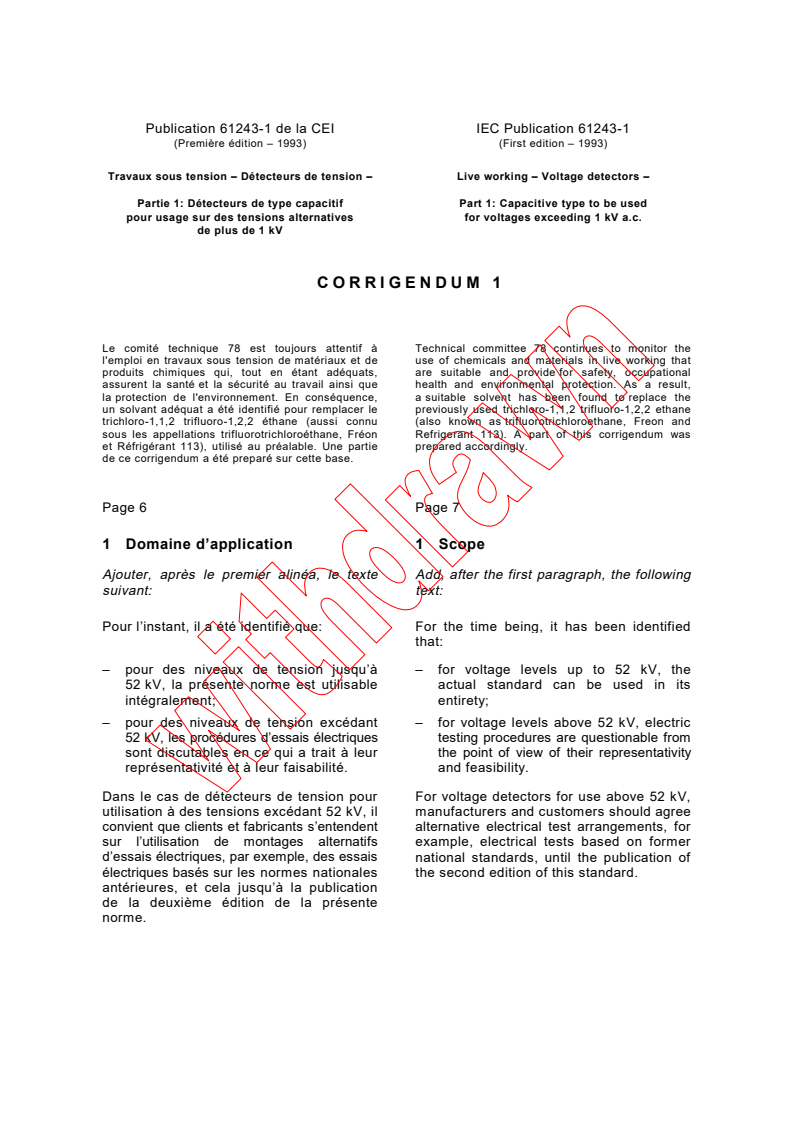
Publication 61243-1 de la CEI IEC Publication 61243-1
(Première édition – 1993) (First edition – 1993)
Travaux sous tension – Détecteurs de tension – Live working – Voltage detectors –
Partie 1: Détecteurs de type capacitif Part 1: Capacitive type to be used
pour usage sur des tensions alternatives for voltages exceeding 1 kV a.c.
de plus de 1 kV
CORRIGENDUM 1
Le comité technique 78 est toujours attentif à Technical committee 78 continues to monitor the
l'emploi en travaux sous tension de matériaux et de use of chemicals and materials in live working that
produits chimiques qui, tout en étant adéquats, are suitable and provide for safety, occupational
assurent la santé et la sécurité au travail ainsi que health and environmental protection. As a result,
la protection de l'environnement. En conséquence, a suitable solvent has been found to replace the
un solvant adéquat a été identifié pour remplacer le previously used trichloro-1,1,2 trifluoro-1,2,2 ethane
trichloro-1,1,2 trifluoro-1,2,2 éthane (aussi connu (also known as trifluorotrichloroethane, Freon and
sous les appellations trifluorotrichloroéthane, Fréon Refrigerant 113). A part of this corrigendum was
et Réfrigérant 113), utilisé au préalable. Une partie prepared accordingly.
de ce corrigendum a été preparé sur cette base.
Page 6 Page 7
1 Domaine d’application 1 Scope
Ajouter, après le premier alinéa, le texte Add, after the first paragraph, the following
suivant: text:
Pour l’instant, il a été identifié que: For the time being, it has been identified
that:
– pour des niveaux de tension jusqu’à –for voltage levels up to 52 kV, the
52 kV, la présente norme est utilisable actual standard can be used in its
intégralement; entirety;
– pour des niveaux de tension excédant – for voltage levels above 52 kV, electric
52 kV, les procédures d’essais électriques testing procedures are questionable from
sont discutables en ce qui a trait à leur the point of view of their representativi
...