


IEC 62255-3:2005
(Main)Multicore and symmetrical pair/quad cables for broadband digital communications (high bit rate digital access telecommunication networks) - Outside plant cables - Part 3: Filled cables - Sectional specification
General Information
- Abstract
is applicable to filled cables having a metallic screen over the cable core, a polyethylene jacket, copper conductors, and solid or cellular insulation. These cables are typically available in 6 to 300 pair.
- Status
- Published
- Publication Date
- 22-Jun-2005
- Technical Committee
- SC 46C - Wires and symmetric cables
- Drafting Committee
- MT 1 - TC 46/SC 46C/MT 1
- Current Stage
- PPUB - Publication issued
- Start Date
- 23-Jun-2005
- Completion Date
- 31-Aug-2005
Buy Documents
IEC 62255-3:2005 - Multicore and symmetrical pair/quad cables for broadband digital communications (high bit rate digital access telecommunication networks) - Outside plant cables - Part 3: Filled cables - Sectional specification Released:6/23/2005
IEC 62255-3:2005 - Multicore and symmetrical pair/quad cables for broadband digital communications (high bit rate digital access telecommunication networks) - Outside plant cables - Part 3: Filled cables - Sectional specification Released:6/23/2005
Overview
IEC 62255-3:2005 is the sectional specification for filled multicore and symmetrical pair/quad outside plant cables used in broadband digital communications (high bit rate digital access telecommunication networks). It applies to filled cables with a metallic screen over the core, polyethylene jacket, copper conductors, and solid or cellular polyolefin insulation. Typical constructions cover 6 to 300 pairs and are classified by maximum reference frequency (30, 60 or 100 MHz). These outside plant cables are suitable for direct burial, duct installation, or aerial deployment (lashed or self-supporting).
Key topics and requirements
- Conductor
- Solid annealed copper, diameter 0.5–0.9 mm.
- Factory joints permitted; joint breaking strength ≥ 90% of unjointed conductor.
- Insulation
- Polyolefin-based; solid or cellular types permitted, with possible multi-layer skins.
- Thickness must ensure the finished cable meets specified performance and termination needs.
- Filling and flooding compounds
- Core and sheath interfaces must use water‑blocking materials (examples: polyethylene-modified petroleum jelly, thixotropic gels, superabsorbent polymers, extended thermoplastic rubber).
- Compounds must be compatible with other cable components.
- Screening / Armour
- Single aluminium tape (plastic-coated on at least one side) or dual tape system (aluminium tape + steel armour); minimum tape thickness 0.15 mm.
- Sheath
- Polyethylene (LLDPE, MDPE, HDPE) with (2.5 ± 0.5) % carbon black by weight; black outer sheath required.
- Identification & accessories
- Colour coding per IEC 60304 guidance; optional rip‑cord must be non‑hygroscopic/non‑wicking.
- Performance categories
- Standard includes electrical, transmission, mechanical/dimensional, and environmental requirements (see IEC 62255-1 for generic test methods and performance limits).
Applications and users
- Designed for outside plant telecommunication deployments: feeder and distribution cables for high-bit-rate access networks.
- Typical users:
- Cable manufacturers and product engineers (design & compliance)
- Network planners and specifiers (procurement and selection)
- Installation contractors (direct burial, duct, aerial)
- Test laboratories and quality assurance teams
- Regulators and standards bodies
Related standards
- IEC 62255-1 – Generic specification (referenced for tests and definitions)
- IEC 62255-3-1 – Blank detail specification for filled cables
- IEC 60304 – Standard colours for insulation
- IEC 60708-1 – Polyolefin insulated cables with moisture barrier sheath
Keywords: IEC 62255-3, filled cables, multicore cables, outside plant cables, broadband digital communications, high bit rate networks, water-blocking, polyethylene jacket, metallic screen, telecommunication cables.
Buy Documents
IEC 62255-3:2005 - Multicore and symmetrical pair/quad cables for broadband digital communications (high bit rate digital access telecommunication networks) - Outside plant cables - Part 3: Filled cables - Sectional specification Released:6/23/2005
IEC 62255-3:2005 - Multicore and symmetrical pair/quad cables for broadband digital communications (high bit rate digital access telecommunication networks) - Outside plant cables - Part 3: Filled cables - Sectional specification Released:6/23/2005
Get Certified
Connect with accredited certification bodies for this standard

ANCE
Mexican certification and testing association.

Intertek Slovenia
Intertek testing, inspection, and certification services in Slovenia.

LNE (Laboratoire National de Métrologie et d'Essais)
French national laboratory for metrology and testing.
Sponsored listings
Frequently Asked Questions
IEC 62255-3:2005 is a standard published by the International Electrotechnical Commission (IEC). Its full title is "Multicore and symmetrical pair/quad cables for broadband digital communications (high bit rate digital access telecommunication networks) - Outside plant cables - Part 3: Filled cables - Sectional specification". This standard covers: is applicable to filled cables having a metallic screen over the cable core, a polyethylene jacket, copper conductors, and solid or cellular insulation. These cables are typically available in 6 to 300 pair.
is applicable to filled cables having a metallic screen over the cable core, a polyethylene jacket, copper conductors, and solid or cellular insulation. These cables are typically available in 6 to 300 pair.
IEC 62255-3:2005 is classified under the following ICS (International Classification for Standards) categories: 33.120.20 - Wires and symmetrical cables. The ICS classification helps identify the subject area and facilitates finding related standards.
IEC 62255-3:2005 is available in PDF format for immediate download after purchase. The document can be added to your cart and obtained through the secure checkout process. Digital delivery ensures instant access to the complete standard document.
Standards Content (Sample)
INTERNATIONAL IEC
STANDARD 62255-3
First edition
2005-06
Multicore and symmetrical pair/quad cables
for broadband digital communications
(high bit rate digital access telecommunication
networks) – Outside plant cables –
Part 3:
Filled cables – Sectional specification
Reference number
Publication numbering
As from 1 January 1997 all IEC publications are issued with a designation in the
60000 series. For example, IEC 34-1 is now referred to as IEC 60034-1.
Consolidated editions
The IEC is now publishing consolidated versions of its publications. For example,
edition numbers 1.0, 1.1 and 1.2 refer, respectively, to the base publication, the
base publication incorporating amendment 1 and the base publication incorporating
amendments 1 and 2.
Further information on IEC publications
The technical content of IEC publications is kept under constant review by the IEC,
thus ensuring that the content reflects current technology. Information relating to
this publication, including its validity, is available in the IEC Catalogue of
publications (see below) in addition to new editions, amendments and corrigenda.
Information on the subjects under consideration and work in progress undertaken
by the technical committee which has prepared this publication, as well as the list
of publications issued, is also available from the following:
• IEC Web Site (www.iec.ch)
• Catalogue of IEC publications
The on-line catalogue on the IEC web site (www.iec.ch/searchpub) enables you to
search by a variety of criteria including text searches, technical committees
and date of publication. On-line information is also available on recently issued
publications, withdrawn and replaced publications, as well as corrigenda.
• IEC Just Published
This summary of recently issued publications (www.iec.ch/online_news/ justpub)
is also available by email. Please contact the Customer Service Centre (see
below) for further information.
• Customer Service Centre
If you have any questions regarding this publication or need further assistance,
please contact the Customer Service Centre:
Email: custserv@iec.ch
Tel: +41 22 919 02 11
Fax: +41 22 919 03 00
INTERNATIONAL IEC
STANDARD 62255-3
First edition
2005-06
Multicore and symmetrical pair/quad cables
for broadband digital communications
(high bit rate digital access telecommunication
networks) – Outside plant cables –
Part 3:
Filled cables – Sectional specification
IEC 2005 Copyright - all rights reserved
No part of this publication may be reproduced or utilized in any form or by any means, electronic or
mechanical, including photocopying and microfilm, without permission in writing from the publisher.
International Electrotechnical Commission, 3, rue de Varembé, PO Box 131, CH-1211 Geneva 20, Switzerland
Telephone: +41 22 919 02 11 Telefax: +41 22 919 03 00 E-mail: inmail@iec.ch Web: www.iec.ch
PRICE CODE
Commission Electrotechnique Internationale P
International Electrotechnical Commission
МеждународнаяЭлектротехническаяКомиссия
For price, see current catalogue
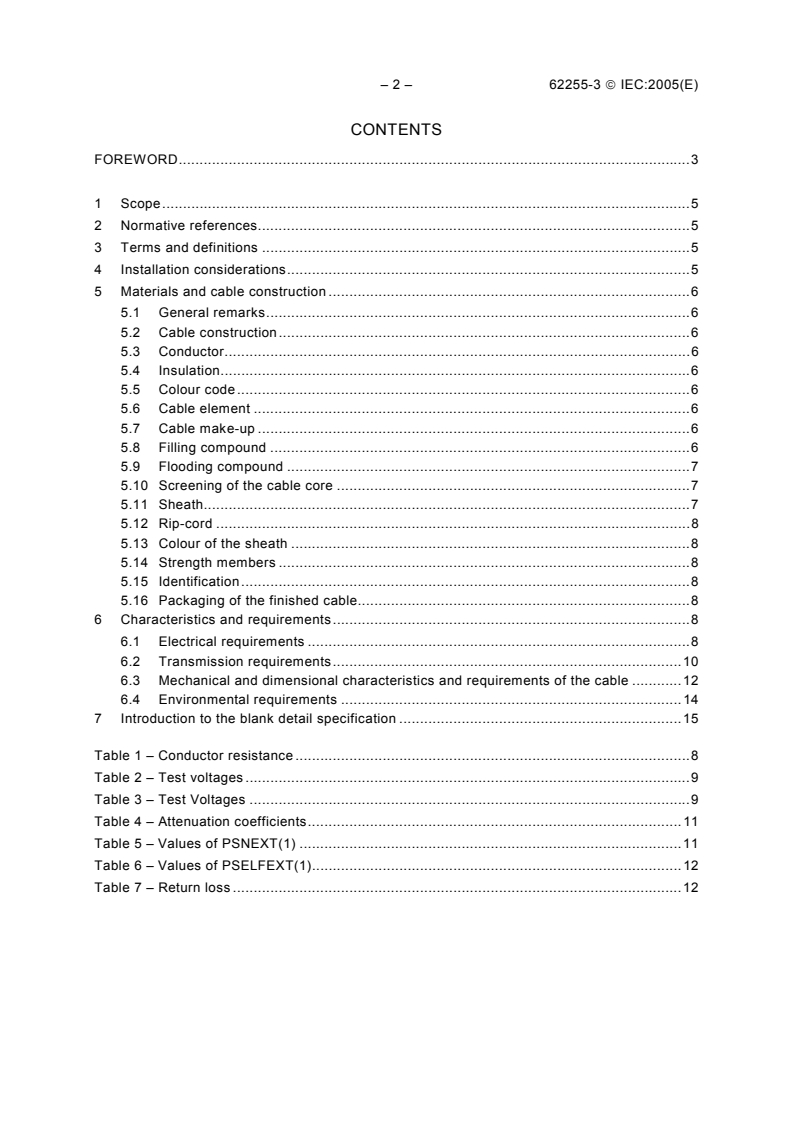
– 2 – 62255-3 IEC:2005(E)
CONTENTS
FOREWORD.3
Scope.5
2 Normative references.5
3 Terms and definitions .5
4 Installation considerations.5
5 Materials and cable construction .6
5.1 General remarks.6
5.2 Cable construction.6
5.3 Conductor.6
5.4 Insulation.6
5.5 Colour code.6
5.6 Cable element .6
5.7 Cable make-up .6
5.8 Filling compound .6
5.9 Flooding compound .7
5.10 Screening of the cable core .7
5.11 Sheath.7
5.12 Rip-cord .8
5.13 Colour of the sheath .8
5.14 Strength members .8
5.15 Identification.8
5.16 Packaging of the finished cable.8
6 Characteristics and requirements.8
6.1 Electrical requirements .8
6.2 Transmission requirements.10
6.3 Mechanical and dimensional characteristics and requirements of the cable .12
6.4 Environmental requirements .14
7 Introduction to the blank detail specification .15
Table 1 – Conductor resistance .8
Table 2 – Test voltages .9
Table 3 – Test Voltages .9
Table 4 – Attenuation coefficients.11
Table 5 – Values of PSNEXT(1) .11
Table 6 – Values of PSELFEXT(1).12
Table 7 – Return loss .12
62255-3 IEC:2005(E) – 3 –
INTERNATIONAL ELECTROTECHNICAL COMMISSION
____________
MULTICORE AND SYMMETRICAL PAIR/QUAD CABLES
FOR BROADBAND DIGITAL COMMUNICATIONS
(HIGH BIT RATE DIGITAL ACCESS TELECOMMUNICATION
NETWORKS) – OUTSIDE PLANT CABLES –
Part 3: Filled cables – Sectional specification
FOREWORD
1) The International Electrotechnical Commission (IEC) is a worldwide organization for standardization comprising all
national electrotechnical committees (IEC National Committees). The object of IEC is to promote international co-
operation on all questions concerning standardization in the electrical and electronic fields. To this end and in
addition to other activities, IEC publishes International Standards, Technical Specifications, Technical Reports,
Publicly Available Specifications (PAS) and Guides (hereafter referred to as “IEC Publication(s)”). Their preparation is
entrusted to technical committees; any IEC National Committee interested in the subject dealt with may participate in
this preparatory work. International, governmental and non-governmental organizations liaising with the IEC also
participate in this preparation. IEC collaborates closely with the International Organization for Standardization (ISO) in
accordance with conditions determined by agreement between the two organizations.
2) The formal decisions or agreements of IEC on technical matters express, as nearly as possible, an international
consensus of opinion on the relevant subjects since each technical committee has representation from all interested
IEC National Committees.
3) IEC Publications have the form of recommendations for international use and are accepted by IEC National
Committees in that sense. While all reasonable efforts are made to ensure that the technical content of IEC
Publications is accurate, IEC cannot be held responsible for the way in which they are used or for any
misinterpretation by any end user.
4) In order to promote international uniformity, IEC National Committees undertake to apply IEC Publications
transparently to the maximum extent possible in their national and regional publications. Any divergence between any
IEC Publication and the corresponding national or regional publication shall be clearly indicated in the latter.
5) IEC provides no marking procedure to indicate its approval and cannot be rendered responsible for any equipment
declared to be in conformity with an IEC Publication.
6) All users should ensure that they have the latest edition of this publication.
7) No liability shall attach to IEC or its directors, employees, servants or agents including individual experts and
members of its technical committees and IEC National Committees for any personal injury, property damage or other
damage of any nature whatsoever, whether direct or indirect, or for costs (including legal fees) and expenses arising
out of the publication, use of, or reliance upon, this IEC Publication or any other IEC Publications.
8) Attention is drawn to the Normative references cited in this publication. Use of the referenced publications is
indispensable for the correct application of this publication.
9) Attention is drawn to the possibility that some of the elements of this IEC Publication may be the subject of patent
rights. IEC shall not be held responsible for identifying any or all such patent rights.
International Standard IEC 62255-3 has been prepared by subcommittee 46C: Wires and
symmetric cables, of IEC technical committee 46: Cables, wires, waveguides, r.f. connectors, r.f.
and microwave passive components and accessories.
The text of this standard is based on the following documents:
FDIS Report on voting
46C/716/FDIS 46C/731/RVD
Full information on the voting for the approval of this standard can be found in the report on voting
indicated in the above table.
This standard is to be read in conjunction with IEC 62255-1.
This publication has been drafted in accordance with the ISO/IEC Directives, Part 2.
– 4 – 62255-3 IEC:2005(E)
IEC 62255 consists of the following parts, under the general title Multicore and symmetrical
pair/quad cables for broadband digital communications (high bit rate digital access
telecommunications networks) – Outside plant cables:
Part 1: Generic specification
Part 2: Unfilled cables – Sectional specification
Part 2-1: Unfilled cables – Blank detail specification
Part 3: Filled cables – Sectional specification
Part 3-1: Filled cables – Blank detail specification
Part 4: Aerial drop cables – Sectional specification
Part 4-1: Aerial drop cables – Blank detail specification
Part 5: Filled drop cables – Sectional specification
Part 5-1: Filled drop cables – Blank detail specification
The committee has decided that the contents of this publication will remain unchanged until the
maintenance result date indicated on the IEC web site under "http://webstore.iec.ch" in the data
related to the specific publication. At this date, the publication will be
• reconfirmed;
• withdrawn;
• replaced by a revised edition, or
• amended.
A bilingual version of this publication may be issued at a later date.
62255-3 IEC:2005(E) – 5 –
MULTICORE AND SYMMETRICAL PAIR/QUAD CABLES
FOR BROADBAND DIGITAL COMMUNICATIONS
(HIGH BIT RATE DIGITAL ACCESS TELECOMMUNICATION
NETWORKS) – OUTSIDE PLANT CABLES –
Part 3: Filled cables – Sectional specification
1 Scope
This sectional specification relates to IEC 62255-1.
This standard is applicable to filled cables having a metallic screen over the cable core, a
polyethylene jacket, copper conductors, and solid or cellular insulation. These cables are typically
available in 6 to 300 pair.
These cables are suitable for direct burial, installation into ducts, or installed aerially by lashing to
a support strand. They may also be self-supporting by incorporation of an integral suspension
strand.
The cables covered by this specification are differentiated by bandwidth and are classified by
having a maximum reference frequency of 30 MHz, 60 MHz, or 100 MHz.
2 Normative references
The following referenced documents are indispensable for the application of this document. For
dated references, only the edition cited applies. For undated references, the latest edition of the
referenced document (including any amendments) applies.
IEC 60304, Standard colours for insulation for low-frequency cables and wires
IEC 60708-1, Low-frequency cables with polyolefin insulation and moisture barrier polyolefin
sheath – Part 1: General design details and requirements
IEC 62255-1, Multicore and symmetrical pair/quad cables for broadband digital communications
(high bit rate digital access telecommunication networks) – Outside plant cables – Part 1: Generic
specification
IEC 62255-3-1, Multicore and symmetrical pair/quad cables for broadband digital communications
(high bit rate digital access telecommunication networks) – Outside plant cables – Part 3-1: Filled
cables – Blank detail specification
3 Terms and definitions
For the purposes of this document, the definitions given in IEC 62255-1 shall apply.
4 Installation considerations
See Clause 4 of IEC 62255-1.
– 6 – 62255-3 IEC:2005(E)
5 Materials and cable construction
5.1 General remarks
The choice of materials and cable construction shall be suitable for the intended application and
method of installation of the cable.
5.2 Cable construction
The cable construction shall be in accordance with the materials, dimensions, and assembly
details given in the relevant detail specification.
5.3 Conductor
The conductor shall be a solid annealed copper conductor having a diameter between 0,5 mm and
0,9 mm. Factory joints are permitted. The breaking strength of a joint shall not be less than 90 %
of that of an unjointed conductor.
5.4 Insulation
The conductor shall be insulated with a suitable polyolefin material.
The type of the conductor insulation shall be solid or cellular or any combination thereof. The
insulation may be made with or without a solid dielectric skin. The skin material may be different
than the base material. Other multi-layer systems may be used.
The insulation shall be continuous and shall have a thickness such that the finished cable meets
the specified requirements.
Joints in the insulated conductor are allowed. Joints shall be free from lumps and reinsulated with
a non-hygroscopic dielectric material.
The nominal thickness shall be compatible with the method of conductor termination.
5.5 Colour code
The colour code of the insulation is not specified but shall be indicated in the relevant detail
specification. The colours shall be readily identifiable and shall correspond reasonably with the
standard colours shown in IEC 60304.
5.6 Cable element
The cable element shall be a twisted pair or quad.
5.7 Cable make-up
The cable elements shall be formed into a number of sub-units or units that can be stranded into a
circular core so as to provide the required number of pairs.
The core of the cable may be wrapped with a protective layer(s) of a non-hygroscopic material.
5.8 Filling compound
The core of the cable shall be filled with a suitable water-blocking material. Examples of suitable
materials are:
– polyethylene modified petroleum jelly;
– extended thermoplastic rubber;
62255-3 IEC:2005(E) – 7 –
– absorbent thixotropic gel;
– superabsorbent polymers with or without a carrier.
The materia
...
IEC 62255-3
Edition 1.0 2005-06
INTERNATIONAL
STANDARD
NORME
INTERNATIONALE
Multicore and symmetrical pair/quad cables for broadband digital
communications (high bit rate digital access telecommunication networks) –
Outside plant cables –
Part 3: Filled cables – Sectional specification
Câbles multiconducteurs à paires symétriques et quartes pour transmissions
numériques large bande (réseau d’accès télécommunications numériques à haut
débit) – Câbles pour installations extérieures –
Partie 3: Câbles remplis – Spécification intermédiaire
All rights reserved. Unless otherwise specified, no part of this publication may be reproduced or utilized in any form or by
any means, electronic or mechanical, including photocopying and microfilm, without permission in writing from either IEC or
IEC's member National Committee in the country of the requester.
If you have any questions about IEC copyright or have an enquiry about obtaining additional rights to this publication,
please contact the address below or your local IEC member National Committee for further information.
Droits de reproduction réservés. Sauf indication contraire, aucune partie de cette publication ne peut être reproduite
ni utilisée sous quelque forme que ce soit et par aucun procédé, électronique ou mécanique, y compris la photocopie
et les microfilms, sans l'accord écrit de la CEI ou du Comité national de la CEI du pays du demandeur.
Si vous avez des questions sur le copyright de la CEI ou si vous désirez obtenir des droits supplémentaires sur cette
publication, utilisez les coordonnées ci-après ou contactez le Comité national de la CEI de votre pays de résidence.
IEC Central Office
3, rue de Varembé
CH-1211 Geneva 20
Switzerland
Email: inmail@iec.ch
Web: www.iec.ch
About the IEC
The International Electrotechnical Commission (IEC) is the leading global organization that prepares and publishes
International Standards for all electrical, electronic and related technologies.
About IEC publications
The technical content of IEC publications is kept under constant review by the IEC. Please make sure that you have the
latest edition, a corrigenda or an amendment might have been published.
ƒ Catalogue of IEC publications: www.iec.ch/searchpub
The IEC on-line Catalogue enables you to search by a variety of criteria (reference number, text, technical committee,…).
It also gives information on projects, withdrawn and replaced publications.
ƒ IEC Just Published: www.iec.ch/online_news/justpub
Stay up to date on all new IEC publications. Just Published details twice a month all new publications released. Available
on-line and also by email.
ƒ Electropedia: www.electropedia.org
The world's leading online dictionary of electronic and electrical terms containing more than 20 000 terms and definitions
in English and French, with equivalent terms in additional languages. Also known as the International Electrotechnical
Vocabulary online.
ƒ Customer Service Centre: www.iec.ch/webstore/custserv
If you wish to give us your feedback on this publication or need further assistance, please visit the Customer Service
Centre FAQ or contact us:
Email: csc@iec.ch
Tel.: +41 22 919 02 11
Fax: +41 22 919 03 00
A propos de la CEI
La Commission Electrotechnique Internationale (CEI) est la première organisation mondiale qui élabore et publie des
normes internationales pour tout ce qui a trait à l'électricité, à l'électronique et aux technologies apparentées.
A propos des publications CEI
Le contenu technique des publications de la CEI est constamment revu. Veuillez vous assurer que vous possédez
l’édition la plus récente, un corrigendum ou amendement peut avoir été publié.
ƒ Catalogue des publications de la CEI: www.iec.ch/searchpub/cur_fut-f.htm
Le Catalogue en-ligne de la CEI vous permet d’effectuer des recherches en utilisant différents critères (numéro de référence,
texte, comité d’études,…). Il donne aussi des informations sur les projets et les publications retirées ou remplacées.
ƒ Just Published CEI: www.iec.ch/online_news/justpub
Restez informé sur les nouvelles publications de la CEI. Just Published détaille deux fois par mois les nouvelles
publications parues. Disponible en-ligne et aussi par email.
ƒ Electropedia: www.electropedia.org
Le premier dictionnaire en ligne au monde de termes électroniques et électriques. Il contient plus de 20 000 termes et
définitions en anglais et en français, ainsi que les termes équivalents dans les langues additionnelles. Egalement appelé
Vocabulaire Electrotechnique International en ligne.
ƒ Service Clients: www.iec.ch/webstore/custserv/custserv_entry-f.htm
Si vous désirez nous donner des commentaires sur cette publication ou si vous avez des questions, visitez le FAQ du
Service clients ou contactez-nous:
Email: csc@iec.ch
Tél.: +41 22 919 02 11
Fax: +41 22 919 03 00
IEC 62255-3
Edition 1.0 2005-06
INTERNATIONAL
STANDARD
NORME
INTERNATIONALE
Multicore and symmetrical pair/quad cables for broadband digital
communications (high bit rate digital access telecommunication networks) –
Outside plant cables –
Part 3: Filled cables – Sectional specification
Câbles multiconducteurs à paires symétriques et quartes pour transmissions
numériques large bande (réseau d’accès télécommunications numériques à
haut débit) – Câbles pour installations extérieures –
Partie 3: Câbles remplis – Spécification intermédiaire
INTERNATIONAL
ELECTROTECHNICAL
COMMISSION
COMMISSION
ELECTROTECHNIQUE
PRICE CODE
INTERNATIONALE
Q
CODE PRIX
ICS 33.120.20 ISBN 2-8318-8433-0
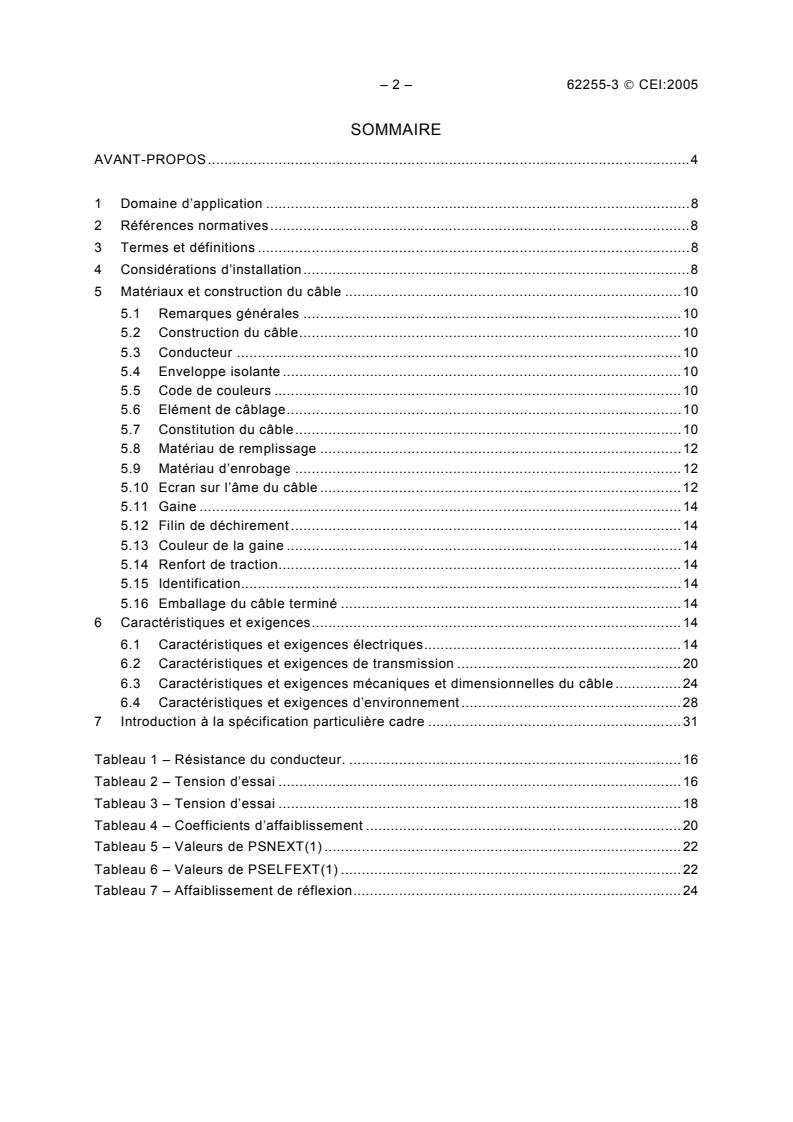
– 2 – 62255-3 © CEI:2005
SOMMAIRE
AVANT-PROPOS.4
1 Domaine d’application .8
2 Références normatives.8
3 Termes et définitions .8
4 Considérations d’installation.8
5 Matériaux et construction du câble .10
5.1 Remarques générales .10
5.2 Construction du câble.10
5.3 Conducteur .10
5.4 Enveloppe isolante .10
5.5 Code de couleurs .10
5.6 Elément de câblage.10
5.7 Constitution du câble.10
5.8 Matériau de remplissage .12
5.9 Matériau d’enrobage .12
5.10 Ecran sur l’âme du câble .12
5.11 Gaine .14
5.12 Filin de déchirement .14
5.13 Couleur de la gaine .14
5.14 Renfort de traction.14
5.15 Identification.14
5.16 Emballage du câble terminé .14
6 Caractéristiques et exigences.14
6.1 Caractéristiques et exigences électriques.14
6.2 Caractéristiques et exigences de transmission .20
6.3 Caractéristiques et exigences mécaniques et dimensionnelles du câble .24
6.4 Caractéristiques et exigences d’environnement .28
7 Introduction à la spécification particulière cadre .31
Tableau 1 – Résistance du conducteur. .16
Tableau 2 – Tension d’essai .16
Tableau 3 – Tension d’essai .18
Tableau 4 – Coefficients d’affaiblissement .20
Tableau 5 – Valeurs de PSNEXT(1) .22
Tableau 6 – Valeurs de PSELFEXT(1) .22
Tableau 7 – Affaiblissement de réflexion.24
62255-3 © IEC:2005 – 3 –
CONTENTS
FOREWORD.5
1 Scope.9
2 Normative references .9
3 Terms and definitions .9
4 Installation considerations .9
5 Materials and cable construction .11
5.1 General remarks.11
5.2 Cable construction .11
5.3 Conductor .11
5.4 Insulation .11
5.5 Colour code.11
5.6 Cable element .11
5.7 Cable make-up .11
5.8 Filling compound .13
5.9 Flooding compound .13
5.10 Screening of the cable core.13
5.11 Sheath .15
5.12 Rip-cord .15
5.13 Colour of the sheath .15
5.14 Strength members .15
5.15 Identification.15
5.16 Packaging of the finished cable .15
6 Characteristics and requirements .15
6.1 Electrical characteristics and requirements.15
6.2 Transmission characteristics and requirements .21
6.3 Mechanical and dimensional characteristics and requirements of the cable .25
6.4 Environmental characteristics and requirements.29
7 Introduction to the blank detail specification .32
Table 1 – Conductor resistance .17
Table 2 – Test voltages.17
Table 3 – Test Voltages .19
Table 4 – Attenuation coefficients .21
Table 5 – Values of PSNEXT(1).23
Table 6 – Values of PSELFEXT(1) .23
Table 7 – Return loss.25
– 4 – 62255-3 © CEI:2005
COMMISSION ÉLECTROTECHNIQUE INTERNATIONALE
____________
CÂBLES MULTICONDUCTEURS À PAIRES SYMÉTRIQUES ET QUARTES
POUR TRANSMISSIONS NUMÉRIQUES LARGE BANDE (RÉSEAU D’ACCÈS
TÉLÉCOMMUNICATION NUMÉRIQUE À HAUT DÉBIT) –
CÂBLES POUR INSTALLATIONS EXTÉRIEURES –
Partie 3: Câbles remplis – Spécification intermédiaire
AVANT-PROPOS
1) La Commission Electrotechnique Internationale (CEI) est une organisation mondiale de normalisation
composée de l'ensemble des comités électrotechniques nationaux (Comités nationaux de la CEI). La CEI a
pour objet de favoriser la coopération internationale pour toutes les questions de normalisation dans les
domaines de l'électricité et de l'électronique. A cet effet, la CEI – entre autres activités – publie des Normes
internationales, des Spécifications techniques, des Rapports techniques, des Spécifications accessibles au
public (PAS) et des Guides (ci-après dénommés "Publication(s) de la CEI"). Leur élaboration est confiée à des
comités d'études, aux travaux desquels tout Comité national intéressé par le sujet traité peut participer. Les
organisations internationales, gouvernementales et non gouvernementales, en liaison avec la CEI, participent
également aux travaux. La CEI collabore étroitement avec l'Organisation Internationale de Normalisation (ISO),
selon des conditions fixées par accord entre les deux organisations.
2) Les décisions ou accords officiels de la CEI concernant les questions techniques représentent, dans la mesure
du possible, un accord international sur les sujets étudiés, étant donné que les Comités nationaux de la CEI
intéressés sont représentés dans chaque comité d’études.
3) Les Publications de la CEI se présentent sous la forme de recommandations internationales et sont agréées
comme telles par les Comités nationaux de la CEI. Tous les efforts raisonnables sont entrepris afin que la CEI
s'assure de l'exactitude du contenu technique de ses publications; la CEI ne peut pas être tenue responsable
de l'éventuelle mauvaise utilisation ou interprétation qui en est faite par un quelconque utilisateur final.
4) Dans le but d'encourager l'uniformité internationale, les Comités nationaux de la CEI s'engagent, dans toute la
mesure possible, à appliquer de façon transparente les Publications de la CEI dans leurs publications
nationales et régionales. Toutes divergences entre toutes Publications de la CEI et toutes publications
nationales ou régionales correspondantes doivent être indiquées en termes clairs dans ces dernières.
5) La CEI n’a prévu aucune procédure de marquage valant indication d’approbation et n'engage pas sa
responsabilité pour les équipements déclarés conformes à une de ses Publications.
6) Tous les utilisateurs doivent s'assurer qu'ils sont en possession de la dernière édition de cette publication.
7) Aucune responsabilité ne doit être imputée à la CEI, à ses administrateurs, employés, auxiliaires ou
mandataires, y compris ses experts particuliers et les membres de ses comités d'études et des Comités
nationaux de la CEI, pour tout préjudice causé en cas de dommages corporels et matériels, ou de tout autre
dommage de quelque nature que ce soit, directe ou indirecte, ou pour supporter les coûts (y compris les frais
de justice) et les dépenses découlant de la publication ou de l'utilisation de cette Publication de la CEI ou de
toute autre Publication de la CEI, ou au crédit qui lui est accordé.
8) L'attention est attirée sur les références normatives citées dans cette publication. L'utilisation de publications
référencées est obligatoire pour une application correcte de la présente publication.
9) L’attention est attirée sur le fait que certains des éléments de la présente Publication de la CEI peuvent faire
l’objet de droits de propriété intellectuelle ou de droits analogues. La CEI ne saurait être tenue pour
responsable de ne pas avoir identifié de tels droits de propriété et de ne pas avoir signalé leur existence.
La Norme internationale CEI 62255-3 a été préparée par le sous-comité 46C: Fils et câbles
symétriques, du comité d'étude 46 de la CEI: Câbles, fils, guides d’ondes, connecteurs et
accessoires pour communication et signalisation.
Cette version bilingue, publiée en 2006-01, correspond à la version anglaise.
Cette norme doit être utilisée conjointement avec la CEI 62255-1.
Le texte anglais de cette norme est issu des documents 46C/716/FDIS et 46C/731/RVD.
Le rapport de vote 46C/731/RVD donne toute information sur le vote ayant abouti à
l'approbation de cette norme.
62255-3 © IEC:2005 – 5 –
INTERNATIONAL ELECTROTECHNICAL COMMISSION
____________
MULTICORE AND SYMMETRICAL PAIR/QUAD CABLES
FOR BROADBAND DIGITAL COMMUNICATIONS
(HIGH BIT RATE DIGITAL ACCESS TELECOMMUNICATION
NETWORKS) – OUTSIDE PLANT CABLES –
Part 3: Filled cables – Sectional specification
FOREWORD
1) The International Electrotechnical Commission (IEC) is a worldwide organization for standardization comprising
all national electrotechnical committees (IEC National Committees). The object of IEC is to promote
international co-operation on all questions concerning standardization in the electrical and electronic fields. To
this end and in addition to other activities, IEC publishes International Standards, Technical Specifications,
Technical Reports, Publicly Available Specifications (PAS) and Guides (hereafter referred to as “IEC
Publication(s)”). Their preparation is entrusted to technical committees; any IEC National Committee interested
in the subject dealt with may participate in this preparatory work. International, governmental and non-
governmental organizations liaising with the IEC also participate in this preparation. IEC collaborates closely
with the International Organization for Standardization (ISO) in accordance with conditions determined by
agreement between the two organizations.
2) The formal decisions or agreements of IEC on technical matters express, as nearly as possible, an international
consensus of opinion on the relevant subjects since each technical committee has representation from all
interested IEC National Committees.
3) IEC Publications have the form of recommendations for international use and are accepted by IEC National
Committees in that sense. While all reasonable efforts are made to ensure that the technical content of IEC
Publications is accurate, IEC cannot be held responsible for the way in which they are used or for any
misinterpretation by any end user.
4) In order to promote international uniformity, IEC National Committees undertake to apply IEC Publications
transparently to the maximum extent possible in their national and regional publications. Any divergence
between any IEC Publication and the corresponding national or regional publication shall be clearly indicated in
the latter.
5) IEC provides no marking procedure to indicate its approval and cannot be rendered responsible for any
equipment declared to be in conformity with an IEC Publication.
6) All users should ensure that they have the latest edition of this publication.
7) No liability shall attach to IEC or its directors, employees, servants or agents including individual experts and
members of its technical committees and IEC National Committees for any personal injury, property damage or
other damage of any nature whatsoever, whether direct or indirect, or for costs (including legal fees) and
expenses arising out of the publication, use of, or reliance upon, this IEC Publication or any other IEC
Publications.
8) Attention is drawn to the Normative references cited in this publication. Use of the referenced publications is
indispensable for the correct application of this publication.
9) Attention is drawn to the possibility that some of the elements of this IEC Publication may be the subject of
patent rights. IEC shall not be held responsible for identifying any or all such patent rights.
International Standard IEC 62255-3 has been prepared by subcommittee 46C: Wires and
symmetric cables, of IEC technical committee 46: Cables, wires, waveguides, r.f. connectors,
r.f. and microwave passive components and accessories.
This bilingual version, published in 2006-01, corresponds to the English version.
The text of this standard is based on the following documents:
FDIS Report on voting
46C/716/FDIS 46C/731/RVD
Full information on the voting for the approval of this standard can be found in the report on
voting indicated in the above table.
This standard is to be read in conjunction with IEC 62255-1.
– 6 – 62255-3 © CEI:2005
La version française de cette norme n'a pas été soumise au vote.
NOTE Par rapport à la version anglaise publiée, le paragraphe 6.3.13 a été mis à jour eu égard à la révision de la
CEI 60708:2005.
Cette publication a été rédigée en conformité avec les Directives ISO/CEI, Partie 2.
La CEI 62255 se compose des parties suivantes, sous le titre général Câbles multi-
conducteurs à paires symétriques et quartes pour transmissions numériques large bande
(réseau d’accès télécommunication numérique à haut débit) – Câbles pour installations
extérieures:
Partie 1: Spécification générique
Partie 2: Câbles non remplis – Spécification intermédiaire
Partie 2-1: Câbles non remplis – Spécification particulière cadre
Partie 3: Câbles remplis – Spécification intermédiaire
Partie 3-1: Câbles remplis – Spécification particulière cadre
Partie 4: Câbles de branchement aériens – Spécification intermédiaire
Partie 4-1: Câbles de branchement aériens – Spécification particulière cadre
Partie 5: Câbles de branchement remplis – Spécification intermédiaire
Partie 5-1: Câbles de branchement remplis – Spécification particulière cadre
Le comité a décidé que le contenu de cette publication ne sera pas modifié avant la date de
maintenance indiquée sur le site web de la CEI sous «http://webstore.iec.ch» dans les
données relatives à la publication recherchée. A cette date, la publication sera
• reconduite;
• supprimée;
• remplacée par une édition révisée, ou
• amendée.
62255-3 © IEC:2005 – 7 –
The French version of this standard has not been voted upon.
NOTE With respect to the already published English version, subclause 6.3.13 has been updated to reflect the
revision of IEC 60708:2005.
This publication has been drafted in accordance with the ISO/IEC Directives, Part 2.
IEC 62255 consists of the following parts, under the general title Multicore and symmetrical
pair/quad cables for broadband digital communications (high bit rate digital access telecom-
munications networks) – Outside plant cables:
Part 1: Generic specification
Part 2: Unfilled cables – Sectional specification
Part 2-1: Unfilled cables – Blank detail specification
Part 3: Filled cables – Sectional specification
Part 3-1: Filled cables – Blank detail specification
Part 4: Aerial drop cables – Sectional specification
Part 4-1: Aerial drop cables – Blank detail specification
Part 5: Filled drop cables – Sectional specification
Part 5-1: Filled drop cables – Blank detail specification
The committee has decided that the contents of this publication will remain unchanged until
the maintenance result date indicated on the IEC web site under "http://webstore.iec.ch" in
the data related to the specific publication. At this date, the publication will be
• reconfirmed;
• withdrawn;
• replaced by a revised edition, or
• amended.
– 8 – 62255-3 © CEI:2005
CÂBLES MULTICONDUCTEURS À PAIRES SYMÉTRIQUES ET QUARTES
POUR TRANSMISSIONS NUMÉRIQUES LARGE BANDE (RÉSEAU D’ACCÈS
TÉLÉCOMMUNICATION NUMÉRIQUE À HAUT DÉBIT) –
CÂBLES POUR INSTALLATIONS EXTÉRIEURES –
Partie 3: Câbles remplis – Spécification intermédiaire
1 Domaine d’application
Cette spécification intermédiaire se rapporte à la CEI 62255-1.
Cette norme est applicable à des câbles remplis ayant un écran métallique sur l’âme du
câble, une gaine polyéthylène, des conducteurs cuivre et une enveloppe isolante massive ou
cellulaire. Ces câbles sont disponibles typiquement de 6 à 300 paires.
Ces câbles sont appropriés pour pose en pleine terre, installation en conduits, ou en aérien
ligaturés sur porteur séparé. Ils peuvent aussi être autoporteurs avec porteur incorporé.
Les câbles couverts par cette spécification se différencient par la bande passante et sont
classifiés suivant une fréquence de référence maximale de 30 MHz, 60 MHz, ou 100 MHz.
2 Références normatives
Les documents de référence suivants sont indispensables pour l'application du présent
document. Pour les références datées, seule l'édition citée s'applique. Pour les références
non datées, la dernière édition du document de référence s'applique (y compris les éventuels
amendements).
CEI 60304, Couleurs de référence de l'enveloppe isolante pour câbles et fils pour basses
fréquences
CEI 62255-1:2003, Câbles multiconducteurs à paires symétriques et quartes pour
transmissions numériques large bande (réseau d’accès télécommunication numérique à haut
débit) – Câbles pour installations extérieures – Partie 1: Spécification générique
CEI 62255-3-1, Câbles multiconducteurs à paires symétriques et quartes pour transmissions
numériques large bande (réseau d’accès télécommunication numérique à haut débit) –
Câbles pour installations extérieures – Partie 3-1: Câbles remplis – Spécification particulière
cadre
3 Termes et définitions
Pour les besoins de ce document, les termes et définitions données dans la CEI 62255-1
s’appliquent.
4 Considérations d’installation
Voir l'Article 4 de la CEI 62255-1.
62255-3 © IEC:2005 – 9 –
MULTICORE AND SYMMETRICAL PAIR/QUAD CABLES
FOR BROADBAND DIGITAL COMMUNICATIONS
(HIGH BIT RATE DIGITAL ACCESS TELECOMMUNICATION
NETWORKS) – OUTSIDE PLANT CABLES –
Part 3: Filled cables – Sectional specification
1 Scope
This sectional specification relates to IEC 62255-1.
This standard is applicable to filled cables having a metallic screen over the cable core, a
polyethylene jacket, copper conductors, and solid or cellular insulation. These cables are
typically available in 6 to 300 pair.
These cables are suitable for direct burial, installation into ducts, or installed aerially by
lashing to a support strand. They may also be self-supporting by incorporation of an integral
suspension strand.
The cables covered by this specification are differentiated by bandwidth and are classified by
having a maximum reference frequency of 30 MHz, 60 MHz, or 100 MHz.
2 Normative references
The following referenced documents are indispensable for the application of this document.
For dated references, only the edition cited applies. For undated references, the latest edition
of the referenced document (including any amendments) applies.
IEC 60304, Standard colours for insulation for low-frequency cables and wires
IEC 62255-1:2003, Multicore and symmetrical pair/quad cables for broadband digital
communications (high bit rate digital access telecommunication networks) – Outside plant
cables – Part 1: Generic specification
IEC 62255-3-1, Multicore and symmetrical pair/quad cables for broadband digital
communications (high bit rate digital access telecommunication networks) – Outside plant
cables – Part 3-1: Filled cables – Blank detail specification
3 Terms and definitions
For the purposes of this document, the definitions given in IEC 62255-1 shall apply.
4 Installation considerations
See Clause 4 of IEC 62255-1.
– 10 – 62255-3 © CEI:2005
5 Matériaux et construction du câble
5.1 Remarques générales
Le choix des matériaux et la construction des câbles doivent convenir à l'application d'usage
et à la méthode d'installation du câble.
5.2 Construction du câble
La construction des câbles doit être conforme aux détails concernant les matériaux, les
dimensions et l’assemblage donnés dans la spécification particulière applicable.
5.3 Conducteur
Le conducteur doit être en cuivre recuit massif et doit avoir un diamètre compris entre 0,5 mm
et 0,9 mm. Des soudures en usine sont permises. La résistance à la rupture d’une soudure ne
doit pas être inférieure à 90 % de la résistance à la rupture d’un conducteur sans soudure.
5.4 Enveloppe isolante
Le conducteur doit être isolé avec un matériau polyoléfine adapté.
Le type d’enveloppe isolante du conducteur doit être soit massive soit cellulaire ou toute
combinaison des deux. L’enveloppe isolante peut comporter ou non une peau diélectrique
massive. Le matériau pour la peau peut être différent du matériau de base. D’autres systèmes
d’enveloppe isolante multicouches peuvent être utilisés.
L'enveloppe isolante doit être continue et doit avoir une épaisseur telle que le câble terminé
satisfasse aux exigences.
Des soudures sur conducteurs isolés sont permises. Elles doivent être exemptes de
grosseurs et être réisolées avec un matériau diélectrique non hygroscopique.
L'épaisseur nominale de l'enveloppe doit être compatible avec la méthode de raccordement
des conducteurs.
5.5 Code de couleurs
Le code de couleurs de l'enveloppe isolante n'est pas spécifié mais doit être indiqué dans la
spécification particulière applicable. Les couleurs doivent être facilement identifiables et
doivent correspondre raisonnablement aux couleurs standard de la CEI 60304.
5.6 Elément de câblage
L'élément de câblage doit être une paire torsadée ou une quarte.
5.7 Constitution du câble
Les éléments de câblage doivent être assemblés à partir de torons et faisceaux pour former
une âme circulaire de manière à obtenir le nombre prescrit de paires.
L'âme du câble peut être enveloppée avec une ou des couches de protection en matériau non
hygroscopique.
62255-3 © IEC:2005 – 11 –
5 Materials and cable construction
5.1 General remarks
The choice of materials and cable construction shall be suitable for the intended application
and method of installation of the cable.
5.2 Cable construction
The cable construction shall be in accordance with the materials, dimensions, and assembly
details given in the relevant detail specification.
5.3 Conductor
The conductor shall be a solid annealed copper conductor having a diameter between 0,5 mm
and 0,9 mm. Factory joints are permitted. The breaking strength of a joint shall not be less
than 90 % of that of an unjointed conductor.
5.4 Insulation
The conductor shall be insulated with a suitable polyolefin material.
The type of the conductor insulation shall be solid or cellular or any combination thereof. The
insulation may be made with or without a solid dielectric skin. The skin material may be
different than the base material. Other multi-layer systems may be used.
The insulation shall be continuous and shall have a thickness such that the finished cable
meets the specified requirements.
Joints in the insulated conductor are allowed. Joints shall be free from lumps and reinsulated
with a non-hygroscopic dielectric material.
The nominal thickness shall be compatible with the method of conductor termination.
5.5 Colour code
The colour code of the insulation is not specified but shall be indicated in the relevant detail
specification. The colours shall be readily identifiable and shall correspond reasonably with
the standard colours shown in IEC 60304.
5.6 Cable element
The cable element shall be a twisted pair or quad.
5.7 Cable make-up
The cable elements shall be formed into a number of sub-units or units that can be stranded
into a circular core so as to provide the required number of pairs.
The core of the cable may be wrapped with a protective layer(s) of a non-hygroscopic
material.
– 12 – 62255-3 © CEI:2005
5.8 Matériau de remplissage
L‘ âme du câble doit être remplie avec un matériau bloqueur d’eau approprié.
Exemples de matériaux appropriés:
– gelée de pétrole avec cire de polyéthylène;
– caoutchouc thermoplastique expansé;
– gel thixotropique absorbant;
– polymères super absorbants (SAP) avec ou sans support.
Le matériau utilisé doit être compatible avec tous les composants du câble avec lesquels il
entre en contact.
Le type de matériau doit être indiqué dans la spécification particulière applicable.
5.9 Matériau d’enrobage
Les interfaces de la gaine doivent être remplis avec un matériau bloqueur d’eau approprié.
Exemples de matériaux appropriés:
– gelée de pétrole avec cire de polyéthylène;
– gel thixotropique absorbant;
– polymères super absorbants (SAP) avec ou sans support;
– polypropylène atactique.
Le matériau utilisé doit être compatible avec tous les composants du câble avec lesquels il
entre en contact.
Le type de matériau doit être indiqué dans la spécification particulière applicable.
5.10 Ecran sur l’âme du câble
L’écran sur l’âme du câble doit être réalisé soit avec un seul ruban métallique, soit avec un
système à deux rubans métalliques.
5.10.1 Système à ruban métallique simple
Le ruban métallique simple doit comporter un écran aluminium revêtu sur au moins une face
d’un matériau plastique. L’épaisseur minimale de l’aluminium ne doit pas être inférieure à
0,15 mm.
L’aluminium peut être appliqué lisse ou ondulé. Le ruban doit être posé à recouvrement. S’il
est appliqué lisse, le ruban doit coller à la gaine et sur lui-même au recouvrement.
5.10.2 Système à deux rubans métalliques
Le système à deux rubans métalliques doit comporter un écran aluminium, avec ou sans
revêtement plastique, et une armure acier. L’armure acier peut être nue, galvanisée ou
revêtue sur les deux faces avec un matériau plastique. L’épaisseur minimale du ruban
aluminium et du ruban acier ne doit pas être inférieure à 0,15 mm.
L’aluminium et l’acier doivent tous les deux être ondulés. L’aluminium peut être posé à
recouvrement. L’acier doit être posé à recouvrement.
62255-3 © IEC:2005 – 13 –
5.8 Filling compound
The core of the cable shall be filled with a suitable water-blocking material. Examples of
suitable materials are:
– polyethylene modified petroleum jelly;
– extended thermoplastic rubber;
– absorbent thixotropic gel;
– superabsorbent polymers with or without a carrier.
The material used shall be compatible with the cable components with which it is in contact.
The type of material shall be indicated in the relevant detail specification.
5.9 Flooding compound
The sheath interfaces shall be filled with a suitable water-blocking material. Examples of
suitable materials are:
– polyethylene modified petroleum jelly;
– absorbent thixotropic gel;
– superabsorbent polymers with or without a carrier;
– atactic polypropylene.
The material used shall be compatible with the cable components with which it is in contact.
The type of material shall be indicated in the relevant detail specification.
5.10 Screening of the cable core
The core of the cable shall be screened with either a single metal tape or a dual metal tape
system.
5.10.1 Single tape system
The single metal tape shall consist of an aluminium screen coated on at least one side with a
plastic material. The minimum thickness of the aluminium shall not be less than 0,15 mm.
The aluminium may be applied flat or corrugated. The edges of the tape shall overlap. If
applied flat, the tape shall bond to the jacket and to itself at the overlap.
5.10.2 Dual tape system
The dual metal tape system shall consist of an aluminium screen, with or without a plastic
coating, and a steel armour. The steel armour may be bare, galvanized, or coated on both
sides with a plastic material. The minimum thickness of the aluminium tape and of the steel
tape shall not be less than 0,15 mm.
Both the aluminium and steel shall be corrugated. The edges of the aluminium may overlap.
The steel shall overlap.
– 14 – 62255-3 © CEI:2005
5.11 Gaine
La gaine doit être constituée d’un matériau polyéthylène adapté appliqué sur l’écran ou
l’armure. A titre d'exemple:
– polyéthylène basse densité linéaire;
– polyéthylène moyenne densité;
– polyéthylène haute densité.
Le polyéthylène doit contenir (2,5 ± 0,5 ) % en masse de noir de carbone.
5.12 Filin de déchirement
Un filin de déchirement peut être prévu. S'il est présent, le filin de déchirement doit être non
hygroscopique et ne pas se comporter comme une mèche.
5.13 Couleur de la gaine
La gaine doit être de couleur noire.
5.14 Renfort de traction
Pour les câbles aériens comportant un porteur incorporé, la gaine doit être constituée de
l’âme du câble, du ou des rubans métalliques et d’un porteur acier intégrés dans une même
extrusion pour former une structure de type en 8. Les dimensions et la charge à la rupture
minimale du câblé doivent être indiquées dans la spécification particulière applicable.
L’épissurage sur le câblé n’est pas permis.
5.15 Identification
La gaine extérieure de chaque longueur de câble doit être marquée durablement avec les
informations suivantes.
– Nom du fabricant ou marque.
– Année de fabrication.
– Contenance en paires.
– Diamètre du conducteur.
– Marquage séquentiel de la longueur en mètres.
5.16 Emballage du câble terminé
La méthode d’emballage n’est pas spécifiée mais peut être indiquée dans la spécification
particulière applicable.
6 Caractéristiques et exigences
Cet article liste les caractéristiques et les exigences minimales d’un câble conforme à cette
spécification. Les méthodes d’essai doivent être conformes à l’Article 6 de la CEI 62255-1.
Une spécification particulière peut être préparée pour identifier un produit spécifique et ses
aptitudes de fonctionnement (voir Article 7).
6.1 Caractéristiques et exigences électriques
Sauf spécification contraire, les essais doivent être effectués sur une longueur de câble d’au
moins 100 m.
62255-3 © IEC:2005 – 15 –
5.11 Sheath
The sheath shall consist of a suitable polyethylene material applied over the screen or
armour. Examples of suitable polyethylenes are:
– linear low density polyethylene;
– medium density polyethylene;
– high density polyethylene.
The polyethylene shall contain (2,5 ± 0,5) % by weight carbon black.
5.12 Rip-cord
A rip-cord may be provided. When present, the rip-cord shall be non-hygroscopic and non-
wicking.
5.13 Colour of the sheath
The sheath shall be black.
5.14 Strength members
For aerial cables containing an integral suspension strand, the sheath shall consist of the
cable core, metal tape(s), and a steel support messenger jacketed in an integral extrusion to
form a figure 8. The dimensions and the minimum breaking strength of the strand shall be
indicated in the relevant detail specification. Splicing of the strand is not permitted.
5.15 Identification
The outer sheath of each length of cable shall be durably marked with the following
information.
– Manufacturer’s name or trademark.
– Year of manufacture.
– Pair count.
– Conductor diameter.
– Sequential length markings in metres.
5.16 Packaging of the finished cable
The method of packaging is not specified but may be specified in the relevant detail
specification.
6 Characteristics and requirements
This clause lists the characteristics and minimum requirements of a cable complying with this
specification. Test methods shall be in accordance with Clause 6 of IEC 62255-1. A detail
specification may be prepared to identify a specific product and its performance capabilities
(see Clause 7).
6.1 Electrical characteristics and requirements
The tests shall be carried out on a cable length of not less than 100 m, unless otherwise
specified.
– 16 – 62255-3 © CEI:2005
6.1.1 Résistance du conducteur
La résistance électrique de chaque conducteur lorsque mesurée à, ou corrigée à, la
température de 20 °C ne doit pas dépasser les valeurs données dans le Tableau 1.
Tableau 1 – Résistance du conducteur
Diamètre du conducteur Résistance à 20 °C
mm Ω/km
0,5 95,9
0,6 66,6
0,65 56,3
0,8 36,8
0,9 29,4
6.1.2 Déséquilibre de résistance
Le déséquilibre de résistance d’une paire ne doit pas dépasser 2,0 %.
6.1.3 Rigidité diélectrique
L’isolation entre chaque conducteur et tous les autres conducteurs dans le câble terminé et
entre tous les conducteurs et l’écran doit supporter un essai de rigidité diélectrique. Deux
options sont données suivant le niveau exigé pour les aptitudes de tenue en tension. L’option
à utiliser doit être indiquée dans la spécification particulière applicable.
6.1.3.1 Rigidité diélectrique sous tension élevée
L’isolation entre chaque conducteur et tous les autres conducteurs dans le câble terminé doit
supporter les tensions en courant continu données dans le Tableau 2, lorsqu'elles sont
appliquées pendant 3 s.
Tableau 2 – Tension d’essai
Tension d’essai en c.c.
Diamètre du conducteur
V
mm
Isolation massive Isolation cellulaire
0,5 4 000 3 000
0,6 4 500 3 300
0,65 5 000 3 600
0,8 6 000 4 000
0,9 7 000 4 500
NOTE Un essai en courant alternatif peut être effectué à la valeur de V 2 , tension en c.c. divisée par 2 .
dc
Les matériaux diélectriques entre tous les conducteurs et l’écran aluminium doivent supporter
15 000 V c.c. quand l’isolation est massive et 10 000 V c.c. quand l’isolation est cellulaire.
La durée d’essai doit être de 3 s.
62255-3 © IEC:2005 – 17 –
6.1.1 Conductor resistance
The electrical resistance of any conductor when measured at or corrected
...