


IEC 60092-354:2014
(Main)Electrical installations in ships - Part 354: Single- and three-core power cables with extruded solid insulation for rated voltages 6 kV (Um = 7,2 kV) up to 30 kV (Um = 36 kV)
General Information
- Abstract
IEC 60092-354:2014 is applicable to shipboard and offshore power cables with extruded solid insulation, conductor and core screening, having a voltage rating of one of the following:
3,6/6 (7,2) kV, 6/10 (12) kV, 8,7/15 (17,5) kV, 12/20 (24) kV, 18/30 (36) kV. The cables are intended for fixed installations. The object of this standard is:
- to standardize cables whose safety and reliability are ensured when they are installed in accordance with the requirements of IEC 60092-352 or IEC 61892-4;
- to lay down standard manufacturing requirements and characteristics of such cables directly or indirectly bearing on safety;
- to specify test methods for checking conformity with those requirements.
This edition includes the following significant technical changes with respect to the previous edition:
a) Modification of construction requirements in line with IEC 60092-350. There has been some redistribution of test methods between IEC 60092-350 and this new standard to remove all tests carried out on complete cables.
b) Requirements for enhanced cold properties, oil resistance and resistance to drilling fluids have been aligned to IEC 60092-350.
- Status
- Published
- Publication Date
- 24-Aug-2014
- Technical Committee
- SC 18A - Electric cables for ships and mobile and fixed offshore units
- Drafting Committee
- MT 2 - TC 18/SC 18A/MT 2
- Current Stage
- DELPUB - Deleted Publication
- Start Date
- 06-Feb-2020
- Completion Date
- 30-Apr-2018
Buy Documents
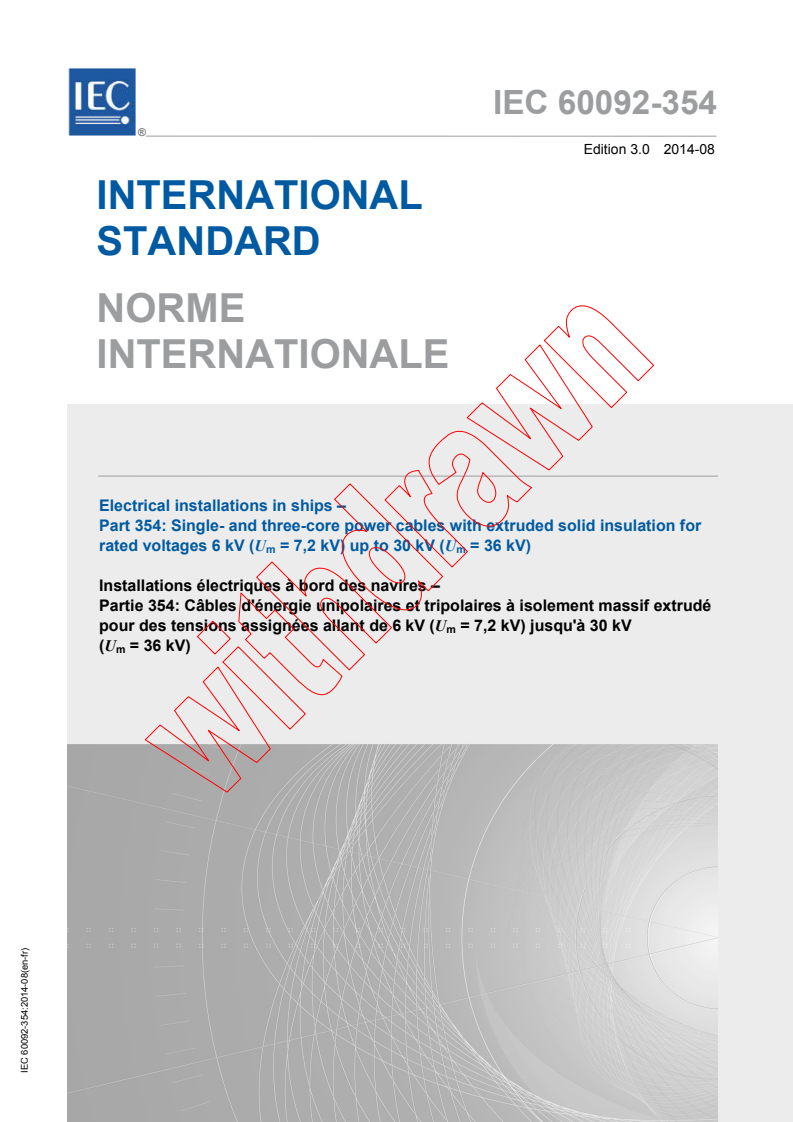
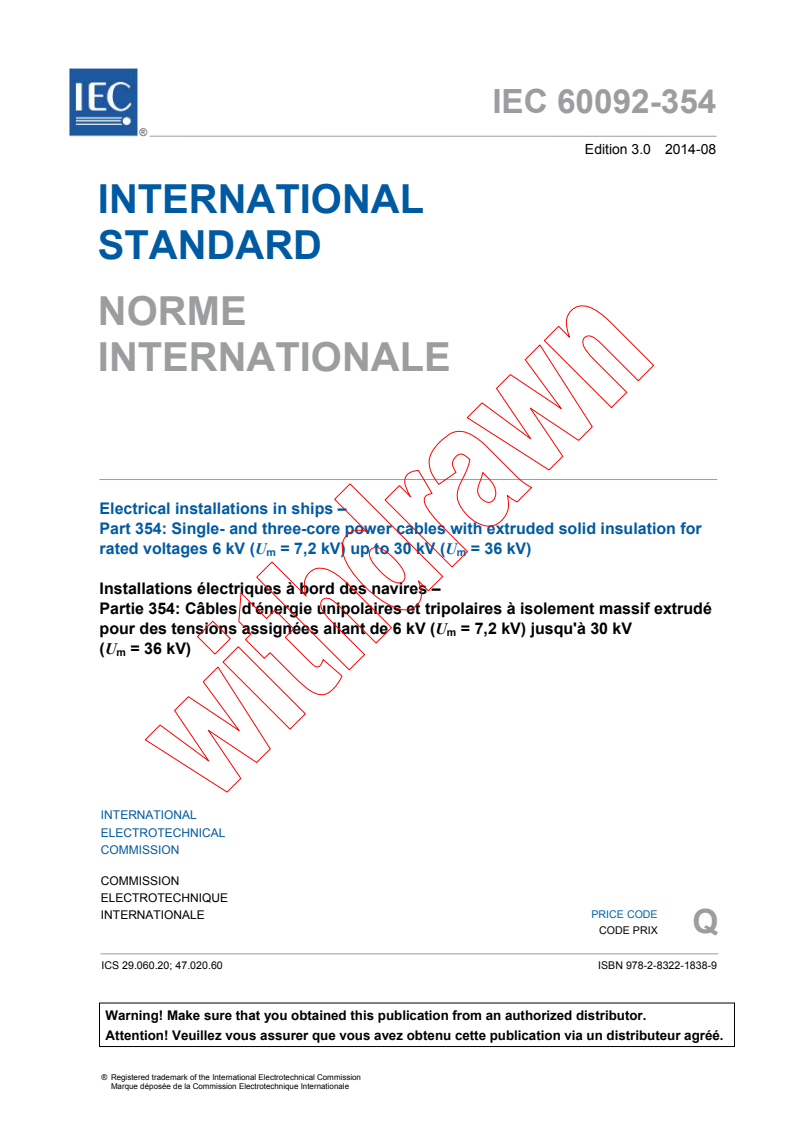
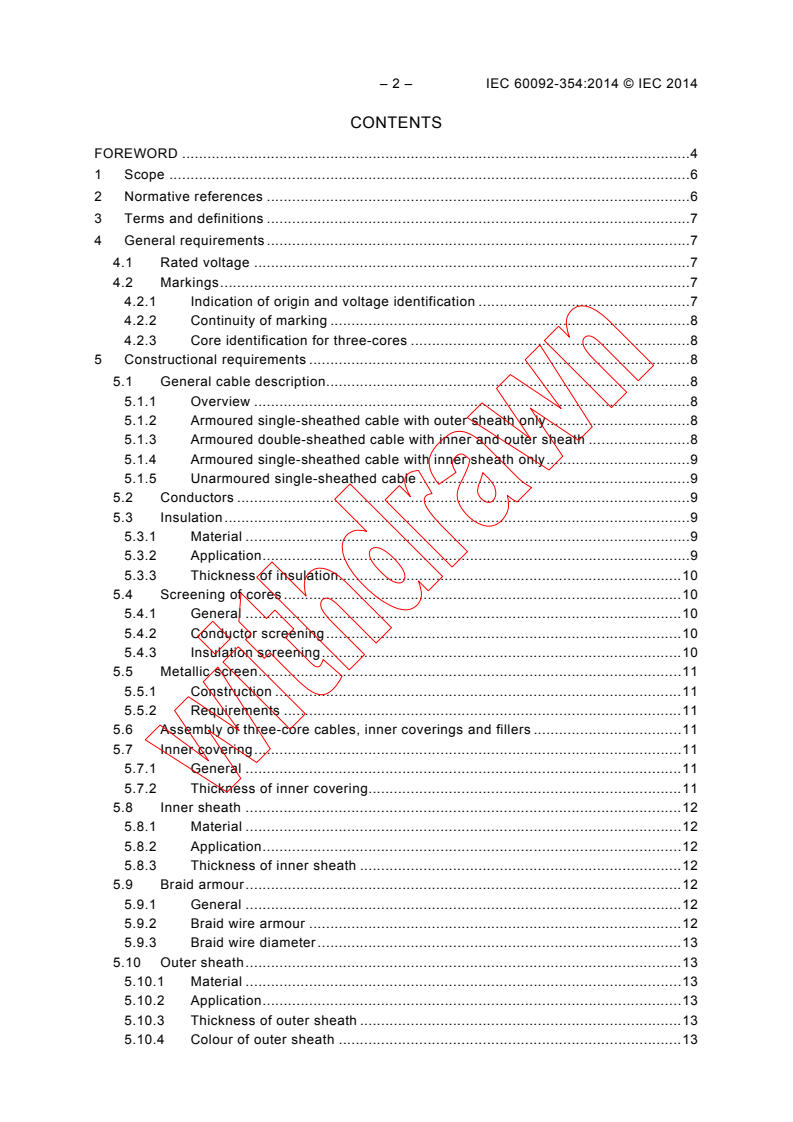
IEC 60092-354:2014 - Electrical installations in ships - Part 354: Single- and three-core power cables with extruded solid insulation for rated voltages 6 kV (U<sub>m</sub> = 7,2 kV) up to 30 kV (U<sub>m</sub> = 36 kV) Released:8/25/2014
Overview
IEC 60092-354:2014 is an international standard published by the International Electrotechnical Commission (IEC) that governs the specifications for single- and three-core power cables used in electrical installations on ships and offshore units. This part of IEC 60092 specifies requirements for power cables with extruded solid insulation rated for voltages from 6 kV (U_m = 7.2 kV) up to 30 kV (U_m = 36 kV). It applies to fixed cable installations onboard ships and offshore platforms, aiming to standardize the cables’ design, construction, and testing to ensure safety, reliability, and industry-wide conformity.
This third edition (2014) updates the previous 2003 version, aligning construction requirements and test methods with those of IEC 60092-350. Enhancements include improved resistance to cold, oil, and drilling fluids-critical for offshore and marine environments.
Key Topics
Scope and Application
Covers single- and three-core power cables with extruded solid insulation and screening, used in shipboard and offshore fixed electrical installations. Voltage ratings addressed in the standard include:- 3.6/6 (7.2) kV
- 6/10 (12) kV
- 8.7/15 (17.5) kV
- 12/20 (24) kV
- 18/30 (36) kV
Construction Requirements
Specifies cable design covering:- Conductor type and dimensions
- Insulation materials and thickness
- Core screening and conductor screening techniques
- Metallic screens and armoring options (braid or wire)
- Inner covering, inner sheath, and outer sheath materials
- Markings for voltage rating, origin, and core identification
Safety and Performance Characteristics
Ensures cables meet safety criteria for marine environments such as:- Resistance to cold temperatures
- Oil and drilling fluid resistance
- Mechanical robustness for fixed installations onboard ships and offshore units
Testing Procedures
Defines standards for routine, type, and acceptance tests:- Electrical tests for insulation and screening integrity
- Mechanical and environmental resistance tests
- Special tests for halogen-free and low smoke cables where applicable
Applications
IEC 60092-354:2014 cables are specifically engineered for use in:
Marine Electrical Installations
Power distribution on board ships, including cargo vessels, passenger ships, and naval ships, ensuring compliance with maritime safety and performance standards.Offshore Fixed Installations
Electrical power cabling for offshore oil rigs, platforms, and fixed maritime structures, where environmental and operational conditions demand enhanced cable durability and resistance.Fixed Power Systems
Installation in permanent or semi-permanent shipboard electrical systems requiring high-voltage cables with reliable insulation and screening properties.
The standard supports operators and manufacturers in delivering cables that provide reliable power transmission under demanding marine and offshore environmental conditions while maintaining safety and regulatory compliance.
Related Standards
IEC 60092-354:2014 should be considered alongside complementary IEC standards including:
IEC 60092-350
General construction requirements for shipboard cables, which align test methods and properties particularly related to cable materials and environmental resistance.IEC 60092-352
Covers shipboard cables with extruded insulation for rated voltages up to 6 kV, complementing the higher voltage scope of IEC 60092-354.IEC 61892-4
Pertains to mobile and fixed offshore units wiring, ensuring that cable installations meet the comprehensive offshore electrical safety requirements.Other Parts of IEC 60092 Series
Address various aspects of shipboard electrical installations, such as instrumentation cables, control cables, and power distribution systems.
Adhering to these interconnected standards ensures comprehensive coverage of electrical cable design, installation, and testing best practices for marine and offshore power systems.
Keywords: IEC 60092-354, shipboard power cables, offshore power cables, extruded solid insulation, marine electrical installations, high-voltage cables, cable testing, electrical installations in ships, IEC marine cable standards, fixed cable installations, cable armoring, cable insulation, electrical safety marine, offshore electrical standards.
Relations
- Effective Date
- 05-Sep-2023
- Effective Date
- 05-Sep-2023
Buy Documents
IEC 60092-354:2014 - Electrical installations in ships - Part 354: Single- and three-core power cables with extruded solid insulation for rated voltages 6 kV (U<sub>m</sub> = 7,2 kV) up to 30 kV (U<sub>m</sub> = 36 kV) Released:8/25/2014
Get Certified
Connect with accredited certification bodies for this standard

DNV
DNV is an independent assurance and risk management provider.

Lloyd's Register
Lloyd's Register is a global professional services organisation specialising in engineering and technology.

FSC International
Forest Stewardship Council certification.
Sponsored listings
Frequently Asked Questions
IEC 60092-354:2014 is a standard published by the International Electrotechnical Commission (IEC). Its full title is "Electrical installations in ships - Part 354: Single- and three-core power cables with extruded solid insulation for rated voltages 6 kV (U<sub>m</sub> = 7,2 kV) up to 30 kV (U<sub>m</sub> = 36 kV)". This standard covers: IEC 60092-354:2014 is applicable to shipboard and offshore power cables with extruded solid insulation, conductor and core screening, having a voltage rating of one of the following: 3,6/6 (7,2) kV, 6/10 (12) kV, 8,7/15 (17,5) kV, 12/20 (24) kV, 18/30 (36) kV. The cables are intended for fixed installations. The object of this standard is: - to standardize cables whose safety and reliability are ensured when they are installed in accordance with the requirements of IEC 60092-352 or IEC 61892-4; - to lay down standard manufacturing requirements and characteristics of such cables directly or indirectly bearing on safety; - to specify test methods for checking conformity with those requirements. This edition includes the following significant technical changes with respect to the previous edition: a) Modification of construction requirements in line with IEC 60092-350. There has been some redistribution of test methods between IEC 60092-350 and this new standard to remove all tests carried out on complete cables. b) Requirements for enhanced cold properties, oil resistance and resistance to drilling fluids have been aligned to IEC 60092-350.
IEC 60092-354:2014 is applicable to shipboard and offshore power cables with extruded solid insulation, conductor and core screening, having a voltage rating of one of the following: 3,6/6 (7,2) kV, 6/10 (12) kV, 8,7/15 (17,5) kV, 12/20 (24) kV, 18/30 (36) kV. The cables are intended for fixed installations. The object of this standard is: - to standardize cables whose safety and reliability are ensured when they are installed in accordance with the requirements of IEC 60092-352 or IEC 61892-4; - to lay down standard manufacturing requirements and characteristics of such cables directly or indirectly bearing on safety; - to specify test methods for checking conformity with those requirements. This edition includes the following significant technical changes with respect to the previous edition: a) Modification of construction requirements in line with IEC 60092-350. There has been some redistribution of test methods between IEC 60092-350 and this new standard to remove all tests carried out on complete cables. b) Requirements for enhanced cold properties, oil resistance and resistance to drilling fluids have been aligned to IEC 60092-350.
IEC 60092-354:2014 is classified under the following ICS (International Classification for Standards) categories: 29.060.20 - Cables; 47.020.60 - Electrical equipment of ships and of marine structures. The ICS classification helps identify the subject area and facilitates finding related standards.
IEC 60092-354:2014 has the following relationships with other standards: It is inter standard links to IEC 60092-354:2020, IEC 60092-354:2003. Understanding these relationships helps ensure you are using the most current and applicable version of the standard.
IEC 60092-354:2014 is available in PDF format for immediate download after purchase. The document can be added to your cart and obtained through the secure checkout process. Digital delivery ensures instant access to the complete standard document.
Standards Content (Sample)
IEC 60092-354 ®
Edition 3.0 2014-08
INTERNATIONAL
STANDARD
NORME
INTERNATIONALE
Electrical installations in ships –
Part 354: Single- and three-core power cables with extruded solid insulation for
rated voltages 6 kV (U = 7,2 kV) up to 30 kV (U = 36 kV)
m m
Installations électriques à bord des navires –
Partie 354: Câbles d'énergie unipolaires et tripolaires à isolement massif extrudé
pour des tensions assignées allant de 6 kV (U = 7,2 kV) jusqu'à 30 kV
m
(U = 36 kV)
m
All rights reserved. Unless otherwise specified, no part of this publication may be reproduced or utilized in any form
or by any means, electronic or mechanical, including photocopying and microfilm, without permission in writing from
either IEC or IEC's member National Committee in the country of the requester. If you have any questions about IEC
copyright or have an enquiry about obtaining additional rights to this publication, please contact the address below or
your local IEC member National Committee for further information.
Droits de reproduction réservés. Sauf indication contraire, aucune partie de cette publication ne peut être reproduite
ni utilisée sous quelque forme que ce soit et par aucun procédé, électronique ou mécanique, y compris la photocopie
et les microfilms, sans l'accord écrit de l'IEC ou du Comité national de l'IEC du pays du demandeur. Si vous avez des
questions sur le copyright de l'IEC ou si vous désirez obtenir des droits supplémentaires sur cette publication, utilisez
les coordonnées ci-après ou contactez le Comité national de l'IEC de votre pays de résidence.
IEC Central Office Tel.: +41 22 919 02 11
3, rue de Varembé Fax: +41 22 919 03 00
CH-1211 Geneva 20 info@iec.ch
Switzerland www.iec.ch
About the IEC
The International Electrotechnical Commission (IEC) is the leading global organization that prepares and publishes
International Standards for all electrical, electronic and related technologies.
About IEC publications
The technical content of IEC publications is kept under constant review by the IEC. Please make sure that you have the
latest edition, a corrigenda or an amendment might have been published.
IEC Catalogue - webstore.iec.ch/catalogue Electropedia - www.electropedia.org
The stand-alone application for consulting the entire The world's leading online dictionary of electronic and
bibliographical information on IEC International Standards, electrical terms containing more than 30 000 terms and
Technical Specifications, Technical Reports and other definitions in English and French, with equivalent terms in 14
documents. Available for PC, Mac OS, Android Tablets and additional languages. Also known as the International
iPad. Electrotechnical Vocabulary (IEV) online.
IEC publications search - www.iec.ch/searchpub IEC Glossary - std.iec.ch/glossary
The advanced search enables to find IEC publications by a More than 55 000 electrotechnical terminology entries in
variety of criteria (reference number, text, technical English and French extracted from the Terms and Definitions
committee,…). It also gives information on projects, replaced clause of IEC publications issued since 2002. Some entries
and withdrawn publications. have been collected from earlier publications of IEC TC 37,
77, 86 and CISPR.
IEC Just Published - webstore.iec.ch/justpublished
Stay up to date on all new IEC publications. Just Published IEC Customer Service Centre - webstore.iec.ch/csc
details all new publications released. Available online and If you wish to give us your feedback on this publication or
also once a month by email. need further assistance, please contact the Customer Service
Centre: csc@iec.ch.
A propos de l'IEC
La Commission Electrotechnique Internationale (IEC) est la première organisation mondiale qui élabore et publie des
Normes internationales pour tout ce qui a trait à l'électricité, à l'électronique et aux technologies apparentées.
A propos des publications IEC
Le contenu technique des publications IEC est constamment revu. Veuillez vous assurer que vous possédez l’édition la
plus récente, un corrigendum ou amendement peut avoir été publié.
Catalogue IEC - webstore.iec.ch/catalogue Electropedia - www.electropedia.org
Application autonome pour consulter tous les renseignements
Le premier dictionnaire en ligne de termes électroniques et
bibliographiques sur les Normes internationales,
électriques. Il contient plus de 30 000 termes et définitions en
Spécifications techniques, Rapports techniques et autres
anglais et en français, ainsi que les termes équivalents dans
documents de l'IEC. Disponible pour PC, Mac OS, tablettes
14 langues additionnelles. Egalement appelé Vocabulaire
Android et iPad.
Electrotechnique International (IEV) en ligne.
Recherche de publications IEC - www.iec.ch/searchpub
Glossaire IEC - std.iec.ch/glossary
La recherche avancée permet de trouver des publications IEC Plus de 55 000 entrées terminologiques électrotechniques, en
en utilisant différents critères (numéro de référence, texte, anglais et en français, extraites des articles Termes et
comité d’études,…). Elle donne aussi des informations sur les Définitions des publications IEC parues depuis 2002. Plus
projets et les publications remplacées ou retirées. certaines entrées antérieures extraites des publications des
CE 37, 77, 86 et CISPR de l'IEC.
IEC Just Published - webstore.iec.ch/justpublished
Service Clients - webstore.iec.ch/csc
Restez informé sur les nouvelles publications IEC. Just
Published détaille les nouvelles publications parues. Si vous désirez nous donner des commentaires sur cette
Disponible en ligne et aussi une fois par mois par email. publication ou si vous avez des questions contactez-nous:
csc@iec.ch.
IEC 60092-354 ®
Edition 3.0 2014-08
INTERNATIONAL
STANDARD
NORME
INTERNATIONALE
Electrical installations in ships –
Part 354: Single- and three-core power cables with extruded solid insulation for
rated voltages 6 kV (U = 7,2 kV) up to 30 kV (U = 36 kV)
m m
Installations électriques à bord des navires –
Partie 354: Câbles d'énergie unipolaires et tripolaires à isolement massif extrudé
pour des tensions assignées allant de 6 kV (U = 7,2 kV) jusqu'à 30 kV
m
(U = 36 kV)
m
INTERNATIONAL
ELECTROTECHNICAL
COMMISSION
COMMISSION
ELECTROTECHNIQUE
PRICE CODE
INTERNATIONALE
Q
CODE PRIX
ICS 29.060.20; 47.020.60 ISBN 978-2-8322-1838-9
– 2 – IEC 60092-354:2014 © IEC 2014
CONTENTS
FOREWORD .4
1 Scope .6
2 Normative references .6
3 Terms and definitions .7
4 General requirements .7
4.1 Rated voltage .7
4.2 Markings .7
4.2.1 Indication of origin and voltage identification .7
4.2.2 Continuity of marking .8
4.2.3 Core identification for three-cores .8
5 Constructional requirements .8
5.1 General cable description .8
5.1.1 Overview .8
5.1.2 Armoured single-sheathed cable with outer sheath only .8
5.1.3 Armoured double-sheathed cable with inner and outer sheath .8
5.1.4 Armoured single-sheathed cable with inner sheath only .9
5.1.5 Unarmoured single-sheathed cable .9
5.2 Conductors .9
5.3 Insulation .9
5.3.1 Material .9
5.3.2 Application .9
5.3.3 Thickness of insulation . 10
5.4 Screening of cores . 10
5.4.1 General . 10
5.4.2 Conductor screening . 10
5.4.3 Insulation screening . 10
5.5 Metallic screen . 11
5.5.1 Construction . 11
5.5.2 Requirements . 11
5.6 Assembly of three-core cables, inner coverings and fillers . 11
5.7 Inner covering . 11
5.7.1 General . 11
5.7.2 Thickness of inner covering . 11
5.8 Inner sheath . 12
5.8.1 Material . 12
5.8.2 Application . 12
5.8.3 Thickness of inner sheath . 12
5.9 Braid armour . 12
5.9.1 General . 12
5.9.2 Braid wire armour . 12
5.9.3 Braid wire diameter . 13
5.10 Outer sheath . 13
5.10.1 Material . 13
5.10.2 Application . 13
5.10.3 Thickness of outer sheath . 13
5.10.4 Colour of outer sheath . 13
6 Tests – Methods and requirements . 13
Annex A (informative) Electrical tests after installation . 17
Table 1 – Insulation thickness . 10
Table 2 – Thickness of inner covering . 11
Table 3 – Tests applicable to all cables (1 of 2) . 14
Table 4 – Additional tests for halogen-free cables . 15
Table 5 – Additional test for low smoke cables . 16
Table 6 – Additional tests when required . 16
– 4 – IEC 60092-354:2014 © IEC 2014
INTERNATIONAL ELECTROTECHNICAL COMMISSION
____________
ELECTRICAL INSTALLATIONS IN SHIPS –
Part 354: Single- and three-core power cables
with extruded solid insulation for rated voltages 6 kV
(U = 7,2 kV) up to 30 kV (U = 36 kV)
m m
FOREWORD
1) The International Electrotechnical Commission (IEC) is a worldwide organization for standardization comprising
all national electrotechnical committees (IEC National Committees). The object of IEC is to promote
international co-operation on all questions concerning standardization in the electrical and electronic fields. To
this end and in addition to other activities, IEC publishes International Standards, Technical Specifications,
Technical Reports, Publicly Available Specifications (PAS) and Guides (hereafter referred to as “IEC
Publication(s)”). Their preparation is entrusted to technical committees; any IEC National Committee interested
in the subject dealt with may participate in this preparatory work. International, governmental and non-
governmental organizations liaising with the IEC also participate in this preparation. IEC collaborates closely
with the International Organization for Standardization (ISO) in accordance with conditions determined by
agreement between the two organizations.
2) The formal decisions or agreements of IEC on technical matters express, as nearly as possible, an
international consensus of opinion on the relevant subjects since each technical committee has representation
from all interested IEC National Committees.
3) IEC Publications have the form of recommendations for international use and are accepted by IEC National
Committees in that sense. While all reasonable efforts are made to ensure that the technical content of IEC
Publications is accurate, IEC cannot be held responsible for the way in which they are used or for any
misinterpretation by any end user.
4) In order to promote international uniformity, IEC National Committees undertake to apply IEC Publications
transparently to the maximum extent possible in their national and regional publications. Any divergence
between any IEC Publication and the corresponding national or regional publication shall be clearly indicated in
the latter.
5) IEC itself does not provide any attestation of conformity. Independent certification bodies provide conformity
assessment services and, in some areas, access to IEC marks of conformity. IEC is not responsible for any
services carried out by independent certification bodies.
6) All users should ensure that they have the latest edition of this publication.
7) No liability shall attach to IEC or its directors, employees, servants or agents including individual experts and
members of its technical committees and IEC National Committees for any personal injury, property damage or
other damage of any nature whatsoever, whether direct or indirect, or for costs (including legal fees) and
expenses arising out of the publication, use of, or reliance upon, this IEC Publication or any other IEC
Publications.
8) Attention is drawn to the Normative references cited in this publication. Use of the referenced publications is
indispensable for the correct application of this publication.
9) Attention is drawn to the possibility that some of the elements of this IEC Publication may be the subject of
patent rights. IEC shall not be held responsible for identifying any or all such patent rights.
International Standard IEC 60092-354 has been prepared by subcommittee 18A: Electric
cables for ships and mobile and fixed offshore units, of IEC technical committee 18: Electrical
installations of ships and of mobile and fixed offshore units.
This third edition cancels and replaces the second edition published in 2003. This edition
constitutes a technical revision with respect to the previous edition.
This edition includes the following significant technical changes with respect to the previous
edition:
a) Modification of construction requirements in line with IEC 60092-350. There has been
some redistribution of test methods between IEC 60092-350 and this new standard to
remove all tests carried out on complete cables.
b) Requirements for enhanced cold properties, oil resistance and resistance to drilling fluids
have been aligned to IEC 60092-350.
The text of this standard is based on the following documents:
FDIS Report on voting
18A/377/FDIS 18A/380/RVD
Full information on the voting for the approval of this standard can be found in the report on
voting indicated in the above table.
This publication has been drafted in accordance with the ISO/IEC Directives, Part 2.
The list of all the parts of the IEC 60092 series, under the general title Electrical installations
in ships, can be found on the IEC website.
The committee has decided that the contents of this publication will remain unchanged until
the stability date indicated on the IEC web site under "http://webstore.iec.ch" in the data
related to the specific publication. At this date, the publication will be
• reconfirmed,
• withdrawn,
• replaced by a revised edition, or
• amended.
– 6 – IEC 60092-354:2014 © IEC 2014
ELECTRICAL INSTALLATIONS IN SHIPS –
Part 354: Single- and three-core power cables
with extruded solid insulation for rated voltages 6 kV
(U = 7,2 kV) up to 30 kV (U = 36 kV)
m m
1 Scope
This part of IEC 60092 is applicable to shipboard and offshore power cables with extruded
solid insulation, conductor and core screening, having a voltage rating of one of the following:
3,6/6 (7,2) kV, 6/10 (12) kV, 8,7/15 (17,5) kV, 12/20 (24) kV, 18/30 (36) kV.
NOTE 1 Subclause 4.1 gives more details.
The cables are intended for fixed installations.
The various types of power cables are given in 5.1. The constructional requirements and test
methods are aligned with those indicated in IEC 60092-350, unless otherwise specified in this
standard.
The object of this standard is:
– to standardize cables whose safety and reliability are ensured when they are installed in
accordance with the requirements of IEC 60092-352 or IEC 61892-4;
– to lay down standard manufacturing requirements and characteristics of such cables
directly or indirectly bearing on safety;
– to specify test methods for checking conformity with those requirements.
NOTE 2 Only radial field cables are covered.
2 Normative references
The following documents, in whole or in part, are normatively referenced in this document
and are indispensable for its application. For dated references, only the edition cited applies.
For undated references, the latest edition of the referenced document (including any
amendments) applies.
IEC 60038, IEC standard voltages
IEC 60092-350:2014, Electrical installations in ships – Part 350: General construction and
test methods of power, control and instrumentation cables for shipboard and offshore
applications
IEC 60092-360, Electrical installations in ships – Part 360: Insulating and sheathing materials
for shipboard and offshore units, power, control, instrumentation and telecommunication
cables
IEC 60228, Conductors of insulated cables
IEC 60332-1-2, Tests on electric and optical fibre cables under fire conditions – Part 1-2:
Test for vertical flame propagation for a single insulated wire or cable – Procedure for 1 kW
pre-mixed flame
IEC 60332-3-22, Tests on electric cables under fire conditions – Part 3-22: Test for vertical
flame spread of vertically-mounted bunched wires or cables – Category A
IEC 60684-2, Flexible insulating sleeving – Part 2: Methods of test
IEC 60754-1, Test on gases evolved during combustion of materials from cables – Part 1:
Determination of the halogen acid gas content
IEC 60754-2, Test on gases evolved during combustion of materials from cables – Part 2:
Determination of acidity (by pH measurement) and conductivity
IEC 60885-2, Electrical test methods for electric cables – Part 2: Partial discharge tests
IEC 61034-1, Measurement of smoke density of cables burning under defined conditions –
Part 1: Test apparatus
IEC 61034-2, Measurement of smoke density of cables burning under defined conditions –
Part 2: Test procedure and requirements
3 Terms and definitions
For the purpose of this document, the terms and definitions given in IEC 60092-350 apply.
4 General requirements
4.1 Rated voltage
The standard method of designating the rated voltages of cables covered by this standard
shall take the form
U /U (U )
o m
where
U is the rated power-frequency voltage between phase conductor and earth or metallic
o
screen, for which the cable is designed;
U is the rated power-frequency voltage between phase conductors for which the cable is
designed;
U is the maximum value of the highest system voltage for which the equipment (including
m
cable) may be used (see IEC 60038).
All voltages are given as r.m.s. values.
The standard rated voltages U /U (U ) of the cables considered in this standard
o m
are: 3,6/6 (7,2) kV, 6/10 (12) kV, 8,7/15 (17,5) kV, 12/20 (24) kV, and 18/30 (36) kV.
4.2 Markings
4.2.1 Indication of origin and voltage identification
Cables shall comply with 4.1.3 of IEC 60092-350:2014 with respect to:
a) indication of origin;
b) rated voltage and cable construction (number of cores and cross-sectional area of the
construction);
– 8 – IEC 60092-354:2014 © IEC 2014
c) continuity of marking;
d) durability/legibility.
4.2.2 Continuity of marking
The marking is deemed to be continuous if the distance between the end of any marking and
the beginning of the next does not exceed:
a) 550 mm if the marking is on the outer surface of the cable;
b) 275 mm in all other cases.
4.2.3 Core identification for three-cores
Cores of cables shall be provided with a suitable method of identification. Each core shall be
easily distinguishable from the other cores in the cable.
5 Constructional requirements
5.1 General cable description
5.1.1 Overview
Shipboard and offshore cables for fixed installations shall be single or multi-core cables
generally constructed as follows.
5.1.2 Armoured single-sheathed cable with outer sheath only
The armoured single-sheathed cables having only an outer sheath are constructed as
follows:
• copper conductor, see 5.2;
• conductor semi-conducting screen, see 5.4.2;
• insulation, see 5.3;
• insulation screening, see 5.4.3;
• cabling (for three-core cables), see 5.6;
• inner covering, see 5.7;
• braid armour, see 5.9;
• outer sheath applied as either one or two layer systems, see 5.10.
5.1.3 Armoured double-sheathed cable with inner and outer sheath
The armoured double-sheathed cables having both an inner and an outer sheath are
constructed as follows:
• copper conductor, see 5.2;
• conductor semi-conducting screen, see 5.4.2;
• insulation, see 5.3;
• insulation screening, see 5.4.3;
• cabling (for three-core cables), see 5.6;
• inner sheath, see 5.8;
• braid armour, see 5.9;
• outer sheath applied as either one or two layer systems, see 5.10.
The use of a thermoplastic inner sheath (ST 2 or SHF 1) is not recommended if the outer
sheath consists of an elastomeric cross-linked material.
5.1.4 Armoured single-sheathed cable with inner sheath only
The armoured single-sheathed cables having only an inner sheath are constructed as follows:
• copper conductor, see 5.2;
• conductor semi-conducting screen, see 5.4.2;
• insulation, see 5.3;
• insulation screening, see 5.4.3;
• inner sheath, see 5.8;
• braid armour, see 5.9.
The cables for installation in spaces where corrosion can occur, for example weather decks,
wet locations, battery compartments, refrigeration rooms, etc., should have an outer sheath
over the braid, if any, unless the braid itself is corrosion-resistant.
5.1.5 Unarmoured single-sheathed cable
The unarmoured single-sheathed cables are constructed as follows:
• copper conductor, see 5.2;
• conductor semi-conducting screen, see 5.4.2;
• insulation, see 5.3;
• insulation screening, see 5.4.3;
• cabling (for three-core cables), see 5.6;
• inner covering (optional), see 5.7;
• outer sheath applied as either one or two layer systems, see 5.10.
5.2 Conductors
Material, metal coating, class and form of the conductors shall be in accordance with
IEC 60092-350. The form of the conductor shall be round circular stranded, non-compacted
or compacted, in accordance with Class 2 of IEC 60228. To aid installation a conductor of
Class 5 may be used. Cables with such Class 5 conductors should not be regarded as
suitable for repeated flexing in service.
2 2
The minimum cross-sectional area shall be 10 mm for 3,6/6 (7,2) kV cables, 16 mm for
2 2
6/10 (12) kV cables, 25 mm for 8,7/15 (17,5) kV cables, 35 mm for 12/20 (24) kV cables
and 50 mm for 18/30 (36)kV cables.
5.3 Insulation
5.3.1 Material
The insulation system shall be EPR, HEPR or XLPE compounds as defined in IEC 60092-
360.
5.3.2 Application
The application shall be as detailed in 4.3.2 of IEC 60092-350:2014.
– 10 – IEC 60092-354:2014 © IEC 2014
5.3.3 Thickness of insulation
The thickness of the insulation shall be as specified in Table 1 and meet the requirements of
4.3.3 of IEC 60092-350:2014 so that:
a) the thickness at any point may be less than the specified value provided the difference
does not exceed 0,1 mm + 10 % of the specified value;
b) the thickness of the semi-conducting screen on the conductor, or over the insulation shall
not be included in the thickness of insulation.
Table 1 – Insulation thickness
Nominal cross Nominal thickness of insulation at rated voltage U /U (U )
o m
sectional
3,6/6 (7,2) kV 6/10 (12) kV 8,7/15 (17,5) kV 12/20 (24) kV 18/30 (36) kV
area of conductor
mm mm mm mm mm mm
10 2,5 - - - -
16 2,5 3,4 - - -
25 2,5 3,4 4,5 - -
35 2,5 3,4 4,5 5,5 -
50 to 185 2,5 3,4 4,5 5,5 8,0
240 2,6 3,4 4,5 5,5 8,0
300 2,8 3,4 4,5 5,5 8,0
400 3,0 3,4 4,5 5,5 8,0
500 to 630 3,2 3,4 4,5 5,5 8,0
Any conductor cross-section smaller than those given in this table is not recommended. However, if a smaller
cross-section is needed, either the diameter of the conductor shall be increased by a conductor screen (see
5.4.2), or the insulation thickness shall be increased in order to limit, at the values calculated with the smallest
conductor size given in this table, the maximum electrical stresses applied to the insulation under test voltage.
5.4 Screening of cores
5.4.1 General
Screening of individual cores in single- or three-core cables shall consist of a conductor
screen and an insulation screen.
5.4.2 Conductor screening
The conductor screen shall be non-metallic and shall consist of an extruded semi-conducting
compound, which may be applied on top of a semi-conducting tape. The extruded semi-
conducting compound shall be firmly bonded to the insulation.
5.4.3 Insulation screening
The insulation screening is designed as follows.
a) The insulation screen shall consist of a non-metallic semi-conducting layer in combination
with a metallic layer.
b) The non-metallic layer shall be extruded directly upon the insulation of each core and
consist of either a bonded or strippable semi-conducting compound.
NOTE A layer of semi-conducting tape can then be applied over the individual cores.
c) The metallic layer shall be applied over the individual cores and shall comply with the
requirements of 5.5.
5.5 Metallic screen
5.5.1 Construction
The metallic screen shall consist of one or more tapes, or a braid, or a concentric layer of
wires, or a combination of tape(s) and wires.
If a metallic braid screen is applied, the fictitious diameter over the screen is given by:
Dc + 5 dw, in mm
where
Dc is the fictitious diameter of core;
dw is the nominal diameter of the braid wire.
5.5.2 Requirements
The dimensional, physical and electrical requirements of the metallic screen shall be
determined taking into account any other requirements (e.g. national or approval authority
regulations and standards), including the value of the current to be carried in case of fault.
5.6 Assembly of three-core cables, inner coverings and fillers
Cores of a three-core cable shall be laid up, and the interstices filled if necessary with fillers,
inner covering or inner sheath (outer sheath in the case of unarmoured cables) according to
4.5 of IEC 60092-350:2014.
5.7 Inner covering
5.7.1 General
The inner covering shall be extruded. The relevant material and characteristics shall be in
accordance with extruded inner coverings in 4.6 of IEC 60092-350:2014.
5.7.2 Thickness of inner covering
The values of the (approximate) thickness of extruded inner covering for the calculation of
fictitious diameters are given in Table 2.
Table 2 – Thickness of inner covering
Fictitious diameter over laid up cores Thickness of extruded
inner covering
Above Up to and including (approximate value)
mm mm mm
– 25 1,0
25 35 1,2
35 45 1,4
45 60 1,6
60 80 1,8
80 – 2,0
NOTE For the calculation of fictitious diameter, see Annexes A and C of IEC 60092-350:2014.
– 12 – IEC 60092-354:2014 © IEC 2014
5.8 Inner sheath
5.8.1 Material
The inner sheath shall be selected from one listed in IEC 60092-360. The compound selected
shall be compatible with the cable components with which it is in contact and compatible with
the operating temperature of the cable.
5.8.2 Application
The application shall be as detailed in 4.7.2 of IEC 60092-350:2014.
5.8.3 Thickness of inner sheath
The thickness of the inner sheath is given as a function of the internal diameter of the sheath
under consideration, the fictitious diameter being calculated by the method in Annexes A and
C of IEC 60092-350:2014.
For armoured cable as per 5.1, the formula is:
t = (0,04 D + 0,8) mm, with a minimum thickness of 1,0 mm for construction 5.1.3 and 1,4
mm for construction 5.1.4
where
D is the fictitious diameter under the inner sheath.
The thickness at any point shall satisfy the prescriptions given in 4.7.3 of
IEC 60092-350:2014.
5.9 Braid armour
5.9.1 General
The armour type covered by this standard is braid armour, see 5.9.2.
The materials and the constructional requirements of the armours shall be those given in 4.8
of IEC 60092-350:2014. When choosing the material of the armour, special consideration
shall be given to the possibility of corrosion.
The armour of single-core cables for use on a.c. circuits shall consist of non-magnetic
material. In special cases, for instance when the cables are used on d.c. circuits, magnetic
materials can also be used.
The armour shall be applied in such a way that it shall not adhere to the inner sheath, nor to
the outer sheath, nor the inner covering.
The nominal diameters of round armour wires shall be not less than the values given in the
following subclauses.
5.9.2 Braid wire armour
The braid wire armours are defined as follows.
a) The coverage density of the braid shall be in accordance with IEC 60092-350.
b) The fictitious diameter under the braid is calculated by the method given in Annex A and
C of IEC 60092-350:2014.
5.9.3 Braid wire diameter
Irrespective of the metal used, the nominal diameter of the braid wire shall be:
– 0,3 mm, as a minimum, for cables having fictitious diameter under the braid, less than or
equal to 30 mm;
– 0,4 mm, as a minimum, for cables having fictitious cable diameter under the braid, larger
than 30 mm.
5.10 Outer sheath
5.10.1 Material
The outer sheath shall be selected from one listed in IEC 60092-360. The compound selected
shall be compatible with the cable components with which it is in contact and compatible with
the operating temperature of the cable.
5.10.2 Application
The application shall be as detailed in 4.9.2 IEC 60092-350:2014.
5.10.3 Thickness of outer sheath
The thickness of outer sheath is given as a function of the internal diameter of the sheath
under consideration, the fictitious diameter being calculated by the method in Annexes A and
C IEC 60092-350:2014.
The formula is as follows.
a) For armoured single-sheathed cables as per 5.1.2 or unarmoured single-sheathed cables
as per 5.1.5:
t = (0,04 D + 0,8) mm with a minimum thickness of 1,0 mm;
where D is the fictitious diameter under the sheath.
b) For armoured double-sheathed cables as 5.1.3:
t = (0,025 D + 0,6) mm, with a minimum thickness of 0,8 mm.
The thickness at any point shall satisfy the prescriptions given in 4.9.3 of IEC 60092-
350:2014.
5.10.4 Colour of outer sheath
The outer sheath shall be coloured red, unless otherwise specified by the purchaser at the
time of ordering.
6 Tests – Methods and requirements
The tests shall be carried out according to Tables 3 to 6 where applicable. For the purposes
of this document, the definitions given in IEC 60092-350 for routine test, sample test and type
test apply.
– 14 – IEC 60092-354:2014 © IEC 2014
Table 3 – Tests applicable to all cables (1 of 2)
Test Applicability – All Status Method – Clause Requirement – As in
types of cable number given in IEC 60092-350
unless otherwise IEC 60092-350:2014 unless otherwise
stated stated
Measurement of Routine 5.2.2 IEC 60228
electrical resistance
of conductors
Voltage test Routine 5.2.3 -
Voltage test on Armoured cables Routine 5.2.3 -
sheath
Insulation Type 7.2 -
resistance test
Partial discharge Routine 7.7.3 IEC 60885-2
test
High voltage Type 7.7
sequence test
Conductor Sample and type 6.4 -
examination
Check of cable Sample and type
dimensions
Thickness of 6.5 and 8.1 -
insulation
Thickness of non 6.6 and 8.2 -
metallic sheaths
Dimensions of braid IEC 60092-354, 5.9.2
armour and 5.9.3
External diameter 6.7 -
Hot set test EPR, HEPR, XLPE, Sample 6.8 IEC 60092-360
insulation and SE,
SH and SHF2
sheath
Coverage density of Braid armoured Type 4.8.2
braid cables
Insulation Type 7.2.2 IEC 60092-360
resistance
measurement at
maximum rated
temperature
Increase in a.c. Type 7.3 IEC 60092-360
capacitance after
immersion in water
High-voltage test Type 7.7.9
for 4 h
Mechanical Type 8.4 IEC 60092-360
properties of
insulation before
and after ageing
Mechanical Type 8.5 IEC 60092-360
properties of sheath
before and after
ageing
Table 3 (2 of 2)
Test Applicability – All Status Method – Clause Requirement – As in
types of cable number given in IEC 60092-350
unless otherwise IEC 60092-350:2014 unless otherwise
stated stated
Additional ageing Type 8.6 IEC 60092-360
compatibility test
Loss of mass test PVC ST2 sheath Type 8.7 IEC 60092-360
Behaviour at high PVC ST2 and SHF1 Type 8.8 IEC 60092-360
temperature sheaths
Behaviour at low PVC ST2, SHF1 Type 8.9 IEC 60092-360
temperatures and SHF2 sheaths
Test for coating of Type 8.11
copper wires
Galvanizing test Type 8.12
Resistance to PVC ST2 and SHF1 Type 8.13 IEC 60092-360
cracking heat shock sheaths
Ozone resistance Insulations and Type 8.14 IEC 60092-360
sheaths
Hot oil immersion SE1, SH and SHF2 Type 8.15.1 IEC 60092-360
sheaths
Flame-spread tests: Type 8.17.1 IEC 60332-1-2 and
IEC 60332-1-2 and IEC 60332-3-22 in
8.17.2
IEC 60332-3-22 which case cables
shall be installed in
touching
configuration on the
front of the ladder.
Determination of HEPR insulation Type 8.18 IEC 60092-360
hardness
Determination of HEPR insulation Type 8.19 IEC 60092-360
modulus of
elasticity
Durability of Type 8.20 The marking shall
marking remain legible
following the test as
given in 8.20 of
IEC 60092-350:2014
Table 4 – Additional tests for halogen-free cables
Test Applicability – All Status Method – Clause Requirement – As
types of cable number given in in IEC 60092-350
unless otherwise IEC 60092-350:2014 unless otherwise
stated stated
Acid gas emission Halogen free cables Type 8.17.4 IEC 60754-1
pH and conductivity Halogen free cables Type 8.17.5 IEC 60754-2
Fluorine content Halogen free cables Type 8.17.6 IEC 60684-2
test
– 16 – IEC 60092-354:2014 © IEC 2014
Table 5 – Additional test for low smoke cables
Test Applicability – All Status Method – Clause Requirement – As
types of cable number given in in IEC 60092-350
unless otherwise IEC 60092-350:2014 unless otherwise
stated stated
Smoke density test Type 8.17.3 The test is
satisfactory for the
for cables insulated
and sheathed with finished cables if
halogen-free the levels of light
materials, when transmittance
tested according to exceeds 60 %
IEC 61034-1 and throughout the test
IEC 61034-2
NOTE The smoke density test is in general applicable to halogen free cables. See also Table 4.
Table 6 – Additional tests when required
Test Applicability – All Status Method – Clause Requirement – As
types of cable number given in in IEC 60092-350
unless otherwise IEC 60092-350:2014 unless otherwise
stated stated
Special test for low When required Type 8.10
temperature
behaviour
Enhanced hot oil When required Type 8.15.2 IEC 60092-360
immersion
Drilling fluid test When required Type 8.16 IEC 60092-360
Annex A
(informative)
Electrical tests after installation
By agreement between the purchaser and the contractor, an a.c. voltage test in accordance
with IEC 60060-3 and with item a) or b) or c) as below may be used:
a) test for 15 min with the phase-to-phase voltage U at a frequency between 20 Hz to
300 Hz shall be applied between the conductor and the metal screen/sheath;
b) test for 24 h with the normal rated voltage U of the system;
o
c) test for 15 min with 3 U rated voltage at a frequency of 0,1 Hz shall be applied between
o
the conductor and the metal screen/sheath.
NOTE During the AC test a dissipation factor and/or partial discharge can be monitored.
For installations which have been in use, lower voltages and/or shorter durations may be
used. Values should be negotiated, taking into account the age, environment, history of
breakdowns and the purpose of carrying out the test.
_____________
– 18 – IEC 60092-354:2014 © IEC 2014
SOMMAIRE
AVANT-PROPOS . 20
1 Domaine d'application . 22
2 Références normatives . 22
3 Termes et définitions . 23
4 Exigences générales. 23
4.1 Tension assignée . 23
4.2 Marquage . 24
4.2.1 Marque d'origine et indication de tension . 24
4.2.2 Continuité du marquage . 24
4.2.3 Repérage des conducteurs pour les câbles tripolaires . 24
5 Exigences de construction . 24
5.1 Description générale des câbles . 24
5.1.1 Vue d'ensemble . 24
5.1.2 Câble armé à une seule gaine, extérieure uniquement . 24
5.1.3 Câble armé à deux gaines, intérieure et extérieure . 24
5.1.4 Câble armé à une seule gaine, intérieure uniquement . 25
5.1.5 Câble non armé à une seule gaine . 25
5.2 Âmes conductrices . 25
5.3 Isolation . 26
5.3.1 Matériau . 26
5.3.2 Application . 26
5.3.3 Épaisseur de l'isolant . 26
5.4 Blindage des conducteurs . 26
5.4.1 Généralités . 26
5.4.2 Écran sur âme conductrice . 26
5.4.3 Écran sur enveloppe isolante . 27
5.5 Écran métallique . 27
5.5.1 Construction . 27
5.5.2 Exigences . 27
5.
...