


IEC TR 62746-2:2015
(Main)Systems interface between customer energy management system and the power management system - Part 2: Use cases and requirements
General Information
- Abstract
IEC TR 62746-2:2015(EN) describes the main pillars of interoperability to assist different Technical Committees in defining their interfaces and messages covering the whole chain between a smart grid and smart home/building/industrial area. The main topics covered by this technical report are: architecture model from a logical point of view; set of user stories describing a number of situations related to energy flexibility and demand side management; set of use cases based on the user stories and architecture; details of the communication; identified in the use cases, by describing the requirements for messages and information to be exchanged.
- Status
- Published
- Publication Date
- 21-Apr-2015
- Technical Committee
- TC 57 - Power systems management and associated information exchange
- Drafting Committee
- WG 21 - TC 57/WG 21
Overview
IEC TR 62746-2:2015 defines use cases and requirements for the systems interface between a Customer Energy Management System (CEM/CEMS) and the Power Management System (PMS) of the grid. Part 2 of the IEC TR 62746 series focuses on interoperability pillars that help technical committees, utilities and vendors specify interfaces and messages covering the chain between a smart grid and smart homes, buildings and industrial areas. The report describes a logical architecture model, user stories, detailed use cases and the communication and message requirements identified in those use cases.
Key topics and technical requirements
- Architecture model (logical): common functional architecture and interface mapping for consistent CEM ↔ PMS integration. References Smart Grid Coordination Group models (SG‑CG).
- Smart Grid Connection Point (SG CP): definition, scope and functional requirements for the interface at the premises boundary.
- User stories and use cases: an extensive catalogue (e.g., flexible start appliances, EV charging, battery aggregation, tariff synchronization, DER integration, disaster/emergency scenarios) used to derive requirements.
- Communication requirements: messaging flows, sequence diagrams and requirements for reliable exchange between actors.
- Information and message requirements: identified data elements and message types required for demand response, energy flexibility, price signals, power/temperature profiles, load/generation management and status/comfort information.
- Profiles and templates: power profiles, price profiles, load/generation and temperature profiles used to standardize exchanged information.
- Interoperability requirements: functional and messaging requirements to enable neutral interfaces and multi‑vendor systems.
Practical applications
IEC TR 62746-2:2015 is practical for:
- Designing and specifying CEM ↔ PMS interfaces for utilities, DER aggregators and grid operators.
- Developing interoperable CEM, smart appliances, EMS and building energy management solutions.
- Defining message requirements for demand response (DR), energy flexibility services and tariff‑based control.
- Creating test scenarios and validation plans based on the provided use cases and sequence diagrams.
- Informing procurement, RFPs and system integration projects that require standardized information exchange.
Who should use this standard
- Standards developers and technical committees
- Grid operators, DSOs and utilities
- CEM/EMS vendors, appliance manufacturers and software architects
- System integrators, DER aggregators and building/facility managers
- Test houses and certification bodies working on smart grid interoperability
Related references
- Part of the IEC 62746 TR series (this is Part 2) and references Smart Grid Coordination Group architecture material (SG‑CG / M490) to align functional models and interface mapping.
Keywords: IEC TR 62746-2:2015, systems interface, customer energy management system, power management system, smart grid, use cases, interoperability, SG CP, demand side management, energy flexibility.
Relations
- Effective Date
- 05-Sep-2023
Get Certified
Connect with accredited certification bodies for this standard

ANCE
Mexican certification and testing association.

Intertek Slovenia
Intertek testing, inspection, and certification services in Slovenia.

LNE (Laboratoire National de Métrologie et d'Essais)
French national laboratory for metrology and testing.
Sponsored listings
Frequently Asked Questions
IEC TR 62746-2:2015 is a technical report published by the International Electrotechnical Commission (IEC). Its full title is "Systems interface between customer energy management system and the power management system - Part 2: Use cases and requirements". This standard covers: IEC TR 62746-2:2015(EN) describes the main pillars of interoperability to assist different Technical Committees in defining their interfaces and messages covering the whole chain between a smart grid and smart home/building/industrial area. The main topics covered by this technical report are: architecture model from a logical point of view; set of user stories describing a number of situations related to energy flexibility and demand side management; set of use cases based on the user stories and architecture; details of the communication; identified in the use cases, by describing the requirements for messages and information to be exchanged.
IEC TR 62746-2:2015(EN) describes the main pillars of interoperability to assist different Technical Committees in defining their interfaces and messages covering the whole chain between a smart grid and smart home/building/industrial area. The main topics covered by this technical report are: architecture model from a logical point of view; set of user stories describing a number of situations related to energy flexibility and demand side management; set of use cases based on the user stories and architecture; details of the communication; identified in the use cases, by describing the requirements for messages and information to be exchanged.
IEC TR 62746-2:2015 is classified under the following ICS (International Classification for Standards) categories: 33.200 - Telecontrol. Telemetering. The ICS classification helps identify the subject area and facilitates finding related standards.
IEC TR 62746-2:2015 has the following relationships with other standards: It is inter standard links to IEC TR 62746-2:2025. Understanding these relationships helps ensure you are using the most current and applicable version of the standard.
IEC TR 62746-2:2015 is available in PDF format for immediate download after purchase. The document can be added to your cart and obtained through the secure checkout process. Digital delivery ensures instant access to the complete standard document.
Standards Content (Sample)
IEC TR 62746-2 ®
Edition 1.0 2015-04
TECHNICAL
REPORT
colour
inside
Systems interface between customer energy management system and the power
management system –
Part 2: Use cases and requirements
All rights reserved. Unless otherwise specified, no part of this publication may be reproduced or utilized in any form
or by any means, electronic or mechanical, including photocopying and microfilm, without permission in writing from
either IEC or IEC's member National Committee in the country of the requester. If you have any questions about IEC
copyright or have an enquiry about obtaining additional rights to this publication, please contact the address below or
your local IEC member National Committee for further information.
IEC Central Office Tel.: +41 22 919 02 11
3, rue de Varembé Fax: +41 22 919 03 00
CH-1211 Geneva 20 info@iec.ch
Switzerland www.iec.ch
About the IEC
The International Electrotechnical Commission (IEC) is the leading global organization that prepares and publishes
International Standards for all electrical, electronic and related technologies.
About IEC publications
The technical content of IEC publications is kept under constant review by the IEC. Please make sure that you have the
latest edition, a corrigenda or an amendment might have been published.
IEC Catalogue - webstore.iec.ch/catalogue Electropedia - www.electropedia.org
The stand-alone application for consulting the entire The world's leading online dictionary of electronic and
bibliographical information on IEC International Standards, electrical terms containing more than 30 000 terms and
Technical Specifications, Technical Reports and other definitions in English and French, with equivalent terms in 15
documents. Available for PC, Mac OS, Android Tablets and additional languages. Also known as the International
iPad. Electrotechnical Vocabulary (IEV) online.
IEC publications search - www.iec.ch/searchpub IEC Glossary - std.iec.ch/glossary
The advanced search enables to find IEC publications by a More than 60 000 electrotechnical terminology entries in
variety of criteria (reference number, text, technical English and French extracted from the Terms and Definitions
committee,…). It also gives information on projects, replaced clause of IEC publications issued since 2002. Some entries
and withdrawn publications. have been collected from earlier publications of IEC TC 37,
77, 86 and CISPR.
IEC Just Published - webstore.iec.ch/justpublished
Stay up to date on all new IEC publications. Just Published IEC Customer Service Centre - webstore.iec.ch/csc
details all new publications released. Available online and If you wish to give us your feedback on this publication or
also once a month by email. need further assistance, please contact the Customer Service
Centre: csc@iec.ch.
IEC TR 62746-2 ®
Edition 1.0 2015-04
TECHNICAL
REPORT
colour
inside
Systems interface between customer energy management system and the power
management system –
Part 2: Use cases and requirements
INTERNATIONAL
ELECTROTECHNICAL
COMMISSION
ICS 33.200 ISBN 978-2-8322-2631-5
– 2 – IEC TR 62746-2:2015 © IEC 2015
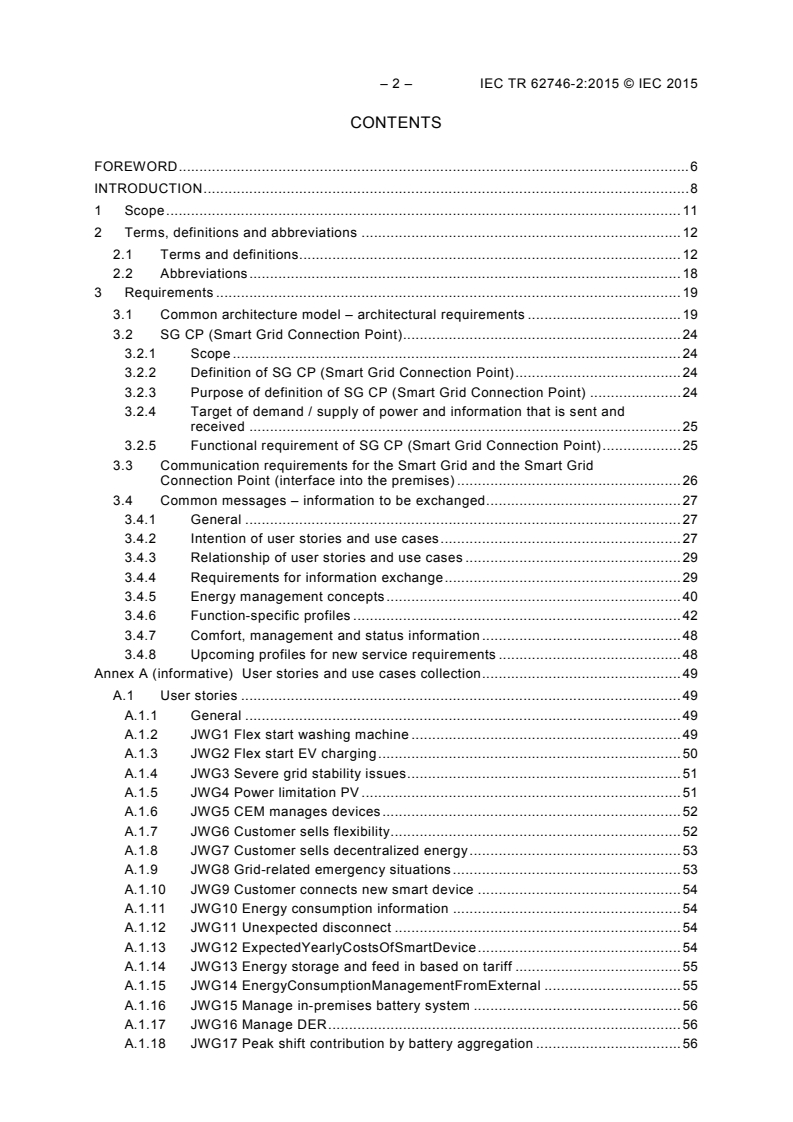
CONTENTS
FOREWORD . 6
INTRODUCTION . 8
1 Scope . 11
2 Terms, definitions and abbreviations . 12
2.1 Terms and definitions. 12
2.2 Abbreviations . 18
3 Requirements . 19
3.1 Common architecture model – architectural requirements . 19
3.2 SG CP (Smart Grid Connection Point) . 24
3.2.1 Scope . 24
3.2.2 Definition of SG CP (Smart Grid Connection Point) . 24
3.2.3 Purpose of definition of SG CP (Smart Grid Connection Point) . 24
3.2.4 Target of demand / supply of power and information that is sent and
received . 25
3.2.5 Functional requirement of SG CP (Smart Grid Connection Point) . 25
3.3 Communication requirements for the Smart Grid and the Smart Grid
Connection Point (interface into the premises) . 26
3.4 Common messages – information to be exchanged . 27
3.4.1 General . 27
3.4.2 Intention of user stories and use cases . 27
3.4.3 Relationship of user stories and use cases . 29
3.4.4 Requirements for information exchange . 29
3.4.5 Energy management concepts . 40
3.4.6 Function-specific profiles . 42
3.4.7 Comfort, management and status information . 48
3.4.8 Upcoming profiles for new service requirements . 48
Annex A (informative) User stories and use cases collection . 49
A.1 User stories . 49
A.1.1 General . 49
A.1.2 JWG1 Flex start washing machine . 49
A.1.3 JWG2 Flex start EV charging . 50
A.1.4 JWG3 Severe grid stability issues . 51
A.1.5 JWG4 Power limitation PV . 51
A.1.6 JWG5 CEM manages devices . 52
A.1.7 JWG6 Customer sells flexibility . 52
A.1.8 JWG7 Customer sells decentralized energy . 53
A.1.9 JWG8 Grid-related emergency situations . 53
A.1.10 JWG9 Customer connects new smart device . 54
A.1.11 JWG10 Energy consumption information . 54
A.1.12 JWG11 Unexpected disconnect . 54
A.1.13 JWG12 ExpectedYearlyCostsOfSmartDevice . 54
A.1.14 JWG13 Energy storage and feed in based on tariff . 55
A.1.15 JWG14 EnergyConsumptionManagementFromExternal . 55
A.1.16 JWG15 Manage in-premises battery system . 56
A.1.17 JWG16 Manage DER . 56
A.1.18 JWG17 Peak shift contribution by battery aggregation . 56
A.1.19 JWG18 Control appliances based on price information . 57
A.1.20 JWG19 Control appliances based on energy savings signal . 57
A.1.21 JWG20 Control appliances before power cut . 58
A.1.22 JWG21 Control appliances in case of natural disaster . 58
A.1.23 JWG22 Bilateral DR-negawatt . 59
A.1.24 JWG23 User story lighting . 60
A.1.25 JWG24 Energy market flexibility management . 60
A.1.26 Japanese building scenarios on energy management . 62
A.2 User stories and use case mapping table . 65
A.3 Use case descriptions . 70
A.3.1 Overview . 70
A.3.2 High level use case (JWG1100) Flexible start of a smart device (SD) . 71
A.3.3 Specialized use case (JWG1101) SD informs CEM about flexible start . 77
A.3.4 Specialized use case (JWG-SPUC1102) CEM informs SD about starting
time . 83
A.3.5 Specialized use case (JWG1103) CEM informs SD about slot shift . 88
A.3.6 Specialized use case (JWG1110) Control of Smart home appliances
based on price information by time slot . 93
A.3.7 High level use case (JWG1111) fuel cell operation with fixed tariff
profile . 100
A.3.8 High level use case (JWG112x) manage mixed energy system like heat
pumps with pv, storage battery . 107
A.3.9 High level use case (JWG113x) log mixed energy system events of heat
pumps with pv, storage battery . 115
A.3.10 High level use case (JWG120x) Provide local power managing
capabilities . 123
A.3.11 High level use case (JWG121x) Provide local power managing
capabilities . 130
A.3.12 High level use case (JWG2000) Demand Supply Adjustment . 137
A.3.13 High level use case (JWG2001) Cascaded CEM . 147
A.3.14 High level use case (JWG2002) District Energy Management . 154
A.3.15 High level use case (JWG2010) Information exchange on distributed
power systems with RES . 163
A.3.16 High level use case (JWG202x) Peak Shift Contribution by Battery
Aggregation . 171
A.3.17 High level use case (JWG2041) Power Adjustment Normal Conditions . 200
A.3.18 High level use case (JWG2042) Energy accommodation for buildings
under disaster conditions . 207
A.3.19 High level use case (JWG211x, based on WGSP211x) Tariff-
Consumption information exchange . 214
A.3.20 High level use case (WGSP 211x) Exchanging information on
consumption, price device status, and warnings with external actors and
within the home . 236
A.3.21 High level use case (JWG212x, based on WGSP212x) Direct load-
generation management (international) . 261
A.3.22 High level use case (WGSP2120) Direct load / generation management
(European) . 281
A.3.23 high level use case (WGSP2140) Tariff synchronization . 299
A.3.24 High level use case (JWG30xx) Energy Flexibility Management . 311
A.3.25 Specialized use case (JWG3101) Energy production/storage integration . 332
A.3.26 Specialized use case (JWG3102) Power loss notification and analysis . 339
– 4 – IEC TR 62746-2:2015 © IEC 2015
A.3.27 Specialized use case (JWG3103) Historical data visualization (external
data processing and storage) . 345
Bibliography . 350
Figure 1 – Examples of demand response capabilities . 10
Figure 2 – Smart environment as of today . 11
Figure 3 – Requirements for interoperability. 12
Figure 4 – External actor definition . 15
Figure 5 – Internal actor definition . 15
Figure 6 – Smart Grid Coordination Group Functional Architecture Model (Smart Grid
Coordination Group Sustainable Process (EU M490)) [9] . 19
Figure 7 – Interfaces in the Functional Architecture Model . 20
Figure 8 – Neutral interfaces . 21
Figure 9 – Mapping I/F structure . 21
Figure 10 – Example of a mapping of messages . 22
Figure 11 – Different CEM configurations see SG-CG/M490 [5] to [9] . 22
Figure 12 – Physical combinations . 23
Figure 13 – Examples of CEM architecture . 23
Figure 14 – “Group of domains” and “Functional Architecture Model” . 24
Figure 15 – Smart Grid Connection Point SG CP . 26
Figure 16 – SG CP (in the case of interruption of electrical power supply from energy
supplier) . 26
Figure 17 – User stories and use cases process . 28
Figure 18 – Relationship user stories and use cases . 29
Figure 19 – Examples of information to be exchanged . 30
Figure 20 – Sequence Diagram Flexible Start . 31
Figure 21 – Sequence diagram price and environmental information . 31
Figure 22 – Sequence diagram starting time . 32
Figure 23 – Traffic Light Concept . 41
Figure 24 – Structure of a power profile . 43
Figure 25 – Consumption and generation . 44
Figure 26 – Structure of an easy power profile . 44
Figure 27 – Structure of a price profile . 46
Figure 28 – Structure of a load / generation management profile . 47
Figure 29 – Structure of a temperature profile . 48
Figure A.1 – Kinds of user stories . 49
Figure A.2 – Use case and requirements process . 70
Figure A.3 – Smart Grid Coordination Group Architecture Model [9] . 70
Figure A.4 – SG CG Architecture Model [9] . 73
Figure A.5 – Sequence diagram . 79
Figure A.6 – SG CG Architecture Model [9] . 79
Figure A.7 – Sequence diagram . 84
Figure A.8 – SG CG Architecture Model [9] . 85
Figure A.9 – SG CG Architecture Model [9] . 89
Figure A.10 – Sequence diagram . 95
Figure A.11 – SG CG Architecture Model [9] . 95
Figure A.12 – SG CG Architecture Model [9] . 103
Figure A.13 – Sequence Diagram . 111
Figure A.14 – SG CG Architecture Model [9] . 111
Figure A.15 – Sequence diagram . 119
Figure A.16 – SG CG Architecture Model [9] . 120
Figure A.17 – Sequence diagram . 126
Figure A.18 – SG CG Architecture Model [9] . 127
Figure A.19 – Sequence diagram . 133
Figure A.20 – SG CG Architecture Model [9] . 133
Figure A.21 – Sequence diagram . 141
Figure A.22 – Sequence diagram . 149
Figure A.23 – Sequence diagram . 157
Figure A.24 – Sequence diagram . 166
Figure A.25 – Use case diagram . 181
Figure A.26 – Sequence diagram . 202
Figure A.27 – Sequence diagram . 209
Figure A.28 – Sequence diagram . 221
Figure A.29 – SG CG Architecture Model [9] . 222
Figure A.30 – Sequence diagram . 266
Figure A.31 – SG CG Architecture Model [9] . 267
Figure A.32 – SG CG Architecture Model [9] . 284
Figure A.33 – Sequence diagram . 289
Figure A.34 – Sequence diagram . 294
Figure A.35 – Sequence diagram . 296
Figure A.36 – SG CG Architecture Model [9] . 302
Figure A.37 – Sequence diagram . 306
Figure A.38 – Sequence diagram . 308
Figure A.39 – Sequence diagram . 309
Figure A.40 – Sequence diagram . 310
Table 1 – Information requirements collection . 32
Table 2 – Information requirements “Energy Profile” . 45
Table 3 – Information requirements “Price and Environment Profile” . 46
Table 4 – Information requirements “Direct Load / Generation Management Profile” . 47
Table 5 – Information requirements “Temperature Profile” . 48
Table A.1 – User stories – Use case mapping table . 66
– 6 – IEC TR 62746-2:2015 © IEC 2015
INTERNATIONAL ELECTROTECHNICAL COMMISSION
____________
SYSTEMS INTERFACE BETWEEN CUSTOMER ENERGY
MANAGEMENT SYSTEM AND THE POWER MANAGEMENT SYSTEM –
Part 2: Use cases and requirements
FOREWORD
1) The International Electrotechnical Commission (IEC) is a worldwide organization for standardization comprising
all national electrotechnical committees (IEC National Committees). The object of IEC is to promote
international co-operation on all questions concerning standardization in the electrical and electronic fields. To
this end and in addition to other activities, IEC publishes International Standards, Technical Specifications,
Technical Reports, Publicly Available Specifications (PAS) and Guides (hereafter referred to as “IEC
Publication(s)”). Their preparation is entrusted to technical committees; any IEC National Committee interested
in the subject dealt with may participate in this preparatory work. International, governmental and non-
governmental organizations liaising with the IEC also participate in this preparation. IEC collaborates closely
with the International Organization for Standardization (ISO) in accordance with conditions determined by
agreement between the two organizations.
2) The formal decisions or agreements of IEC on technical matters express, as nearly as possible, an international
consensus of opinion on the relevant subjects since each technical committee has representation from all
interested IEC National Committees.
3) IEC Publications have the form of recommendations for international use and are accepted by IEC National
Committees in that sense. While all reasonable efforts are made to ensure that the technical content of IEC
Publications is accurate, IEC cannot be held responsible for the way in which they are used or for any
misinterpretation by any end user.
4) In order to promote international uniformity, IEC National Committees undertake to apply IEC Publications
transparently to the maximum extent possible in their national and regional publications. Any divergence
between any IEC Publication and the corresponding national or regional publication shall be clearly indicated in
the latter.
5) IEC itself does not provide any attestation of conformity. Independent certification bodies provide conformity
assessment services and, in some areas, access to IEC marks of conformity. IEC is not responsible for any
services carried out by independent certification bodies.
6) All users should ensure that they have the latest edition of this publication.
7) No liability shall attach to IEC or its directors, employees, servants or agents including individual experts and
members of its technical committees and IEC National Committees for any personal injury, property damage or
other damage of any nature whatsoever, whether direct or indirect, or for costs (including legal fees) and
expenses arising out of the publication, use of, or reliance upon, this IEC Publication or any other IEC
Publications.
8) Attention is drawn to the Normative references cited in this publication. Use of the referenced publications is
indispensable for the correct application of this publication.
9) Attention is drawn to the possibility that some of the elements of this IEC Publication may be the subject of
patent rights. IEC shall not be held responsible for identifying any or all such patent rights.
The main task of IEC technical committees is to prepare International Standards. However, a
technical committee may propose the publication of a technical report when it has collected
data of a different kind from that which is normally published as an International Standard, for
example "state of the art".
IEC TR 62746-2, which is a technical report, has been prepared by IEC technical
committee 57: Power systems management and associated information exchange.
The text of this technical report is based on the following documents:
Enquiry draft Report on voting
57/1492/DTR 57/1546/RVC
Full information on the voting for the approval of this technical report can be found in the
report on voting indicated in the above table.
This publication has been drafted in accordance with the ISO/IEC Directives, Part 2.
A list of all parts in the IEC 62746 series, published under the general title Systems interface
between customer energy management system and the power management system, can be
found on the IEC website.
The committee has decided that the contents of this publication will remain unchanged until
the stability date indicated on the IEC web site under "http://webstore.iec.ch" in the data
related to the specific publication. At this date, the publication will be
• reconfirmed,
• withdrawn,
• replaced by a revised edition, or
• amended.
A bilingual version of this publication may be issued at a later date.
IMPORTANT – The 'colour inside' logo on the cover page of this publication indicates
that it contains colours which are considered to be useful for the correct
understanding of its contents. Users should therefore print this document using a
colour printer.
– 8 – IEC TR 62746-2:2015 © IEC 2015
INTRODUCTION
Intelligent, integrated energy systems for smart environments
NOTE This Introduction is an extract from the “Demand – Response – White Paper, Siemens AG, 2010 [1] .
In 2007, the number of people living in conurbations around the world surpassed that of those
living in rural areas. Today, large cities worldwide account for 75 per cent of energy demand,
and generate a large percentage of total carbon dioxide emissions. For this reason, a number
of cities and metropolitan areas have set themselves ambitious goals towards reducing
emissions by increasing the efficiency of their infrastructures. These goals aim to have a
positive impact on the environment, while continuing to enhance the quality of life of growing
urban populations.
The transition to a new “electrical era” in which electricity is becoming the preferred energy
source for most everyday applications is currently taking place. This is governed by three key
factors: demographic change, scarcity of resources, and climate change. In the meantime,
two development trends are of particular interest:
• the demand for electricity is continuing to grow
• the energy system is subject to dramatic changes
The experienced changes to the energy system might vary, based on whether they are
nationally or cross-nationally observed. Some of the changes are caused by electricity
production and fluctuating power supply sources.
Until recently, load dictated production, a method which influenced how interconnected power
systems were designed. Power generation was centralized, controllable, and above all,
reliable. The load was statistically predictable, and energy flow was unidirectional, that is from
producer to consumer.
These aspects of power generation are changing. Firstly, the rising percentage of fluctuating
production within the energy mix brought about by renewables reduces the level of power
generation control available. Secondly, the energy flow is no longer unidirectionally sent from
producer to consumer; now the consumer is slowly turning into a “prosumer,” a term which
denotes a person who produces and consumes energy. More and more consumers are
installing their own renewable energy products to increase energy efficiency. These
prosumers are cogenerating heat and power with their own solar panels or microCHPs, for
example. This trend is set to continue, as government bodies continue to provide incentives to
domestic users to become “prosumers” as part of their increased energy efficiency policies.
Managing reactive power in relation with power system voltage control will become more
important in situation and regions where distributed generation and power storage is or will
become a substantial part of the total power demand of that region. The total power demand
in the region will be generated partly by the central power stations that are connected to the
transmission system and the power generated locally by generators and storage facilities
connected to the distribution networks in that region. It will not be sufficient to switch
distributed generators and/or storage facilities of premises off during emergency situations in
the power system. In future it will be thinkable and it already happens that in certain regions
distributed generation and storage will support power system restoration in emergency
situations in the network. Voltage and frequency will not only be controlled by central power
stations and dispatch centers a more advanced control will be needed, supported by
appropriate energy market arrangements (contracts and transparent arrangements between
different parties involved).
___________
Numbers in square brackets refer to the Bibliography.
Ultimately, the way of the future will have to be that, up to a certain extent, the load follows
the energy availability.
The way in which loads (being demand or local generation) at the consumer side can be
managed, is through the mechanisms of Demand Response and Demand Side Management.
When referring to Demand Response and Demand Side Management, within this technical
report the following definition of EURELECTRIC [2] in its paper “EURELECTRIC Views on
Demand-Side Participation” is used:
• "Demand Side Management (DSM) or Load Management has been used in the (mainly
still vertically integrated as opposed to unbundled) power industry over the last thirty
years with the aim “to reduce energy consumption and improve overall electricity
usage efficiency through the implementation of policies and methods that control
electricity demand. Demand Side Management (DSM) is usually a task for power
companies / utilities to reduce or remove peak load, hence defer the installations of
new capacities and distribution facilities. The commonly used methods by utilities for
demand side management are: combination of high efficiency generation units, peak-
load shaving, load shifting, and operating practices facilitating efficient usage of
electricity, etc.” Demand Side Management (DSM) is therefore characterized by a ‘top-
down’ approach: the utility decides to implement measures on the demand side to
increase its efficiency.
• Demand Response (DR), on the contrary, implies a ‘bottom-up’ approach: the
customer becomes active in managing his/her consumption – in order to achieve
efficiency gains and by this means monetary/economic benefits. Demand Response
(DR) can be defined as “the changes in electric usage by end-use customers from their
normal consumption patterns in response to changes in the price of electricity over
time. Further, DR can be also defined as the incentive payments designed to induce
lower electricity use at times of high wholesale market prices or when system reliability
is jeopardized. DR includes all intentional modifications to consumption patterns of
electricity of end use customers that are intended to alter the timing, level of
instantaneous demand, or the total electricity consumption”. DR aims to reduce
electricity consumption in times of high energy cost or network constraints by allowing
customers to respond to price or quantity signals."
The intent of demand response and demand side management programs is to motivate end
users to make changes in electric use, lowering consumption when prices spike or when grid
reliability may be jeopardized. These concepts refer to all functions and processes applied to
influence the behaviour of energy consumption or local production. This leads to a more
efficient energy supply which allows the consumer to benefit from reduced overall energy
costs.
In this context, the report focuses on the signals exchanged between the grid and the
premise, which may go from simple signalling to integrated load management.
Since many components must be integrated to interface within a demand response solution, a
suitable communication infrastructure is of paramount importance.
There is a variety of equipment connected to the grid, which may be included in a demand
response solution. Such devices can act as an energy source or load. Some devices can act
as both an energy source and a load alternately, depending on the operation mode selected.
In response to load peaks or shortages, selected generation sources can be switched on,
loads switched off, and storages discharged. In addition, loads with buffer or storage capacity
can be switched on to make use of preferred energy generation when available.
As shown in the examples in Figure 1, some device types provide storage or buffer capability
for energy. A storage device can give back the energy in the same type as it was filled. An
example of this is a battery. A buffer device, however, can store energy only in a converted
form, in the way that a boiler stores energy by heating up water; it is only capable of load-
– 10 – IEC TR 62746-2:2015 © IEC 2015
shifting. Devices capable of storage, however, can be utilized fully for energy balancing within
the electrical grid.
IEC
Source: Siemens AG [1]
Figure 1 – Examples of demand response capabilities
SYSTEMS INTERFACE BETWEEN CUSTOMER ENERGY
MANAGEMENT SYSTEM AND THE POWER MANAGEMENT SYSTEM –
Part 2: Use cases and requirements
1 Scope
The success of the Smart Grid and Smart Home/Building/Industrial approach is very much
related to interoperability, which means that Smart Grid and all smart devices in a
Home/Building/Industrial environment have a common understanding of messages and data in
a defined interoperability area (in a broader perspective, it does not matter if it as an energy
related message, a management message or an informative message).
In contradiction, today’s premises are covered by different networks and stand alone devices
(see Figure 2).
IEC
Figure 2 – Smart environment as of today
The scope of this technical report is to describe the main pillars of interoperability to assist
different Technical Committees in defining their interfaces and messages covering the whole
chain between a Smart Grid and Smart Home/Building/Industrial area (see Figure 3).
– 12 – IEC TR 62746-2:2015 © IEC 2015
IEC
Figure 3 – Requirements for interoperability
The main topics of this technical report are:
• To describe an architecture model from a logical point of view;
• To describe a set of user stories that describe a number of situations related to energy
flexibility and demand side management as well as an outline of potential upcoming Smart
Building and Smart Home scenarios. The set of user stories does not have the ambition to
list all home and building (energy) management possibilities, but is meant as a set of
examples that are used as input in use cases and to check that the set of use cases is
complete;
• To describe a set of use cases based on the user stories and architecture. The use cases
describe scenarios in which the communication between elements of the architecture are
identified;
• To further detail the communication, identified in the use cases, by describing the
requirements for messages and information to be exchanged.
This technical report can also be used as a blue print for further smart home solutions like
remote control, remote monitoring, ambient assistant living and so forth.
2 Terms, definitions and abbreviations
For the purposes of this document, the following terms, definitions and abbreviations apply.
2.1 Terms and definitions
2.1.1
use case
2.1.1.1
use case
class specification of a sequence of actions, including variants, that a system (or other entity)
can perform, interacting with actors of the system
[SOURCE: IEC 62559:2008, IEC 62390:2005]
2.1.1.2
use case
description of the possible sequences of interactions between the system under discussion
and its external actors, related to a particular goal
Note 1 to entry: A use case is the description of one or several functions performed by the respective actors.
[SOURCE: Alistair Cockburn, Writing effective use cases]
[SOURCE: SG-CG/M490/E_Smart Grid Use Case Management Process:2012 [9]]
2.1.2
use case template
form which allows the structured description of a use case in predefined fields
[SOURCE: SG-CG/M490/E_Smart Grid Use Case Management Process:2012 [9]]
2.1.3
cluster
group of use cases with a similar background or belonging to one system or one conceptual
description
[SOURCE: SG-CG/M490/E_Smart Grid Use Case Management Process:2012 [9]]
2.1.4
high level use case
use case which describes a general requirement, idea or concept independently from a
specific technical realization like an architectural solution
[SOURCE: SG-CG/M490/E_Smart Grid Use Case Management Process:2012 [9]]
2.1.5
primary use case
use cases which describe in detail the functionality of (a part of) a business process
Note 1 to entry: Primary use cases can be related to a primary goal or function which can be mapped to one
architectural solution.
[SOURCE: SG-CG/M490/E_Smart Grid Use Case Management Process:2012 [9]]
2.1.6
secondary use case
elementary use case which may be used by several other primary use cases
EXAMPLE Communication functions.
[SOURCE: SG-CG/M490/E_Smart Grid Use Case Management Process:2012 [9]]
2.1.7
generic use case
use case which is broadly accepted for standardization, usually collecting and harmonizing
different real use cases without being based on a project or technological specific solution
[SOURCE: SG-CG/M490/E_Smart Grid Use Case Management Process:2012 [9]]
2.1.8
specialized use case
use case which is using specific technological solutions / implementations
– 14 – IEC TR 62746-2:2015 © IEC 2015
EXAMPLE Use case with a specific interface protocol.
[SOURCE: SG-CG/M490/E_Smart Grid Use Case Management Process:2012 [9]]
2.1.9
individual use case
use case which is used specific for a project or within a company / organization
[SOURCE: SG-CG/M490/E_Smart Grid Use Case Management Process:2012 [9]]
2.1.10
scenario
possible sequence of interactions
Note 1 to entry: Scenario is used in the use case template defining one of several possible routes in the detailed
description of sequences.
[SOURCE: SG-CG/M490/E_Smart Grid Use Case Management Process:2012 [9]]
2.1.11
activity step
the one elementary step within a scenario representing the most granular description level of
interactions in the use case
[SOURCE: SG-CG/M490/E_Smart Grid Use Case Management Process:2012 [9]]
2.1.12
repository
place where information like use cases can be stored (Use Case Management Repository)
[SOURCE: SG-CG/M490/E_Smart Grid Use Case Management Process:2012 [9]]
2.1.13
Use Case Management Repository
database for editing, maintenance and administration of use cases which are based on a
given use cases template
Note 1 to entry: The UCMR is designed as collaborative platform for standardization committees, inter
alia equipped with export functionalities as UML model or text template.
[SOURCE: SG-CG/M490/E_Smart Grid Use Case Management Process:2012 [9]]
2.1.14
actor
entity that communicates and interacts
Note 1 to entry: These actors can include people, software applications, systems, databases, and even the power
system itself.
Note 2 to entry: In the actor list the ENTSO-E role model, generic actors and technical system actors are
considered.
[SOURCE: SG-CG/M490/E_Smart Grid Use Case Management Process:2012 [9]]
2.1.15
actor [external]
entity having behavior and interacting with the system under discussion (system as ‘black
box’) to achieve a specific goal (see Figure 4)
[SOURCE: SG-CG/M490/E_Smart Grid Use Case Management Process:2012 [9]]
IEC
Figure 4 – External actor definition
2.1.16
actor [internal]
entity acting within the system under discussion (actor within the system; system as ‘white
box’) to achieve a specific goal (see Figure 5)
[SOURCE: SG-CG/M490/E_Smart Grid Use Case Management Process:2012 [9]]
IEC
Figure 5 – Internal actor definition
2.1.17
role
2.1.17.1
role
role played by an actor in interaction with the system under discussion
Note 1 to entry: Legally or generically defined external actors may be named and identified by their roles.
2.1.17.2
role
external intended behavior of a party
EXAMPLES A legally defined market participant (e.g. grid operator, customer), a generic role which represents a
bundle of possible roles (e.g. flexibility operator) or an artificially defined body needed
...