


ISO TS 81001-2-1:2025
(Main)Health software and health IT systems safety, effectiveness and security - Part 2-1: Coordination - Guidance for the use of assurance cases for safety and security
General Information
- Abstract
This document establishes requirements and gives guidance on assurance case framework for healthcare delivery organizations (HDOs) and for health software and medical device manufacturers (MDMs) and can be used to support the communication and information transfer between all parties. An assurance case can be used to communicate information and knowledge about different risks to other roles.
This document establishes:
- an assurance case framework for HDOs and health software and MDMs for identifying, developing, interpreting, updating and maintaining assurance cases.
- one of the possible means to bridge the gap between manufacturers and HDOs in providing adequate information to support the HDOs risk management of IT-networks;
- best practice by leveraging ISO/IEC/IEEE 15026-2 and other standards to identify key considerations and for the structure and contents of an assurance case, e.g. iterative and continuous approaches;
- example structure, method and format to improve the consistency and comparability of assurance cases.
This document is applicable to all parties involved in the health software and health IT systems life cycle, including:
a) organizations, health informatics professionals and clinical leaders specifying, acquiring, designing, developing, integrating, implementing and operating health software and health IT systems, for example health software developers and MDMs, system integrators, system administrators (including cloud and other IT service providers);
b) healthcare service delivery organizations, healthcare providers and others who use health software and health IT systems in providing health services;
c) governments, health system funders, monitoring agencies, professional organizations and customers seeking confidence in an organization’s ability to consistently provide safe, effective and secure health software, health IT systems and services;
d) organizations and interested parties seeking to improve communication in managing safety, effectiveness and security risks through a common understanding of the concepts and terminology used in safety, effectiveness and security management;
e) providers of training, assessment or advice in safety, effectiveness and security risk management for health software and health IT systems;
f) developers of related safety, effectiveness and security standards.
This document is for use by organizations and people who build, acquire, operate, maintain, use or decommission health software and health IT systems (including medical devices). It is applicable to all organizations involved, regardless of size, complexity or business model.
- Status
- Published
- Publication Date
- 09-Jan-2025
- Technical Committee
- SC 62A - Common aspects of medical equipment, software, and systems
- Drafting Committee
- JWG 7 - TC 62/SC 62A/JWG 7
- Current Stage
- PPUB - Publication issued
- Start Date
- 16-Jan-2025
- Completion Date
- 27-Feb-2025
Buy Documents

ISO TS 81001-2-1:2025 - Health software and health IT systems safety, effectiveness and security - Part 2-1: Coordination - Guidance for the use of assurance cases for safety and security Released:1/10/2025
Overview
ISO TS 81001-2-1:2025 - "Health software and health IT systems safety, effectiveness and security – Part 2-1: Coordination – Guidance for the use of assurance cases for safety and security," issued jointly by the International Organization for Standardization (ISO) and the International Electrotechnical Commission (IEC), provides comprehensive guidance on developing assurance cases for safety and security in health software and health IT systems. This technical specification is designed for healthcare delivery organizations (HDOs), medical device manufacturers (MDMs), and all involved stakeholders in the health IT lifecycle, including system integrators, IT administrators, clinical leaders, regulators, and others.
The document defines an assurance case framework to systematically identify, develop, interpret, update, and maintain assurance cases. Assurance cases enable effective risk communication, help bridge information gaps between manufacturers and HDOs, and support best practices for risk management and regulatory compliance. By leveraging globally recognized approaches and standards, such as ISO/IEC/IEEE 15026-2, this specification promotes the consistent, structured, and transparent handling of safety, security, and effectiveness in health IT systems.
Key Topics
- Assurance Case Framework: Requirements and guidance for structuring assurance cases, including goals, arguments, evidence, solutions, justifications, assumptions, and context.
- Roles and Responsibilities: Application for diverse stakeholders, such as health software developers, integrators, system administrators (including cloud-based providers), healthcare organizations, regulators, and assessors.
- Communication and Information Transfer: Methods for clear, predictable, and formalized risk communication and information exchange throughout the health IT system lifecycle.
- Iterative and Continuous Improvement: Encouragement of updating and refining assurance cases over time to reflect product changes and evolving risks.
- Example Structures and Notation: Use of recognized patterns (such as Goal Structuring Notation - GSN) to support coherence and comparability in assurance case development.
- Integration with Existing Standards: Alignment with ISO/IEC/IEEE 15026-2 and related health IT and medical device standards for streamlined compliance and harmonized terminology.
Applications
The practical applications of ISO TS 81001-2-1 extend across various use cases in digital health:
- Product Development and Lifecycle Management: Enables manufacturers and developers to document and communicate the safety and security arguments for health software and medical devices from initial design through deployment and decommissioning.
- Regulatory Compliance: Assists organizations in demonstrating conformity with requirements such as IEC 80001-1 for effective risk management, supporting regulatory submissions with well-organized evidence.
- Risk Management: Improves the quality and clarity of risk assessments, allowing stakeholders to identify gaps and weaknesses early, and strengthen assurance before clinical deployment or major system modifications.
- Cross-Organizational Collaboration: Provides a common language and framework, ensuring all parties-manufacturers, HDOs, service providers, and auditors-can collaborate efficiently when managing shared risks in health IT ecosystems.
- Continuous Improvement: Supports iterative updates and enhancements of assurance cases as systems evolve, ensuring that safety, effectiveness, and security remain current and proportionate to risk profiles.
- Stakeholder Assurance: Offers credible, evidence-based arguments to healthcare providers, funders, and customers, fostering trust in the safety and security of deployed health IT systems.
Related Standards
Implementing ISO TS 81001-2-1 is most effective when combined with related standards, including:
- ISO 81001-1:2021: Principles and concepts for health software and health IT systems safety, effectiveness, and security.
- IEC 80001-1: Risk management for IT-networks incorporating medical devices, providing foundational requirements for risk management in connected health environments.
- ISO/IEC/IEEE 15026-2: Assurance case concepts, terminology, and structure applicable across industries.
- ISO 13485: Medical devices quality management systems requirements.
- ISO/IEC 27001: Information security management systems relevant for protecting health IT environments.
By adopting ISO TS 81001-2-1, healthcare organizations and manufacturers can achieve a harmonized, transparent, and robust approach to managing and communicating safety, security, and effectiveness risks throughout the lifecycle of health IT systems and medical devices. This supports regulatory confidence, fosters cross-stakeholder collaboration, and ensures improved outcomes in digital health innovations.
Buy Documents
ISO TS 81001-2-1:2025 - Health software and health IT systems safety, effectiveness and security - Part 2-1: Coordination - Guidance for the use of assurance cases for safety and security Released:1/10/2025
Get Certified
Connect with accredited certification bodies for this standard

BSI Group
BSI (British Standards Institution) is the business standards company that helps organizations make excellence a habit.

NYCE
Mexican standards and certification body.
Sponsored listings
Frequently Asked Questions
ISO TS 81001-2-1:2025 is a technical specification published by the International Electrotechnical Commission (IEC). Its full title is "Health software and health IT systems safety, effectiveness and security - Part 2-1: Coordination - Guidance for the use of assurance cases for safety and security". This standard covers: This document establishes requirements and gives guidance on assurance case framework for healthcare delivery organizations (HDOs) and for health software and medical device manufacturers (MDMs) and can be used to support the communication and information transfer between all parties. An assurance case can be used to communicate information and knowledge about different risks to other roles. This document establishes: - an assurance case framework for HDOs and health software and MDMs for identifying, developing, interpreting, updating and maintaining assurance cases. - one of the possible means to bridge the gap between manufacturers and HDOs in providing adequate information to support the HDOs risk management of IT-networks; - best practice by leveraging ISO/IEC/IEEE 15026-2 and other standards to identify key considerations and for the structure and contents of an assurance case, e.g. iterative and continuous approaches; - example structure, method and format to improve the consistency and comparability of assurance cases. This document is applicable to all parties involved in the health software and health IT systems life cycle, including: a) organizations, health informatics professionals and clinical leaders specifying, acquiring, designing, developing, integrating, implementing and operating health software and health IT systems, for example health software developers and MDMs, system integrators, system administrators (including cloud and other IT service providers); b) healthcare service delivery organizations, healthcare providers and others who use health software and health IT systems in providing health services; c) governments, health system funders, monitoring agencies, professional organizations and customers seeking confidence in an organization’s ability to consistently provide safe, effective and secure health software, health IT systems and services; d) organizations and interested parties seeking to improve communication in managing safety, effectiveness and security risks through a common understanding of the concepts and terminology used in safety, effectiveness and security management; e) providers of training, assessment or advice in safety, effectiveness and security risk management for health software and health IT systems; f) developers of related safety, effectiveness and security standards. This document is for use by organizations and people who build, acquire, operate, maintain, use or decommission health software and health IT systems (including medical devices). It is applicable to all organizations involved, regardless of size, complexity or business model.
This document establishes requirements and gives guidance on assurance case framework for healthcare delivery organizations (HDOs) and for health software and medical device manufacturers (MDMs) and can be used to support the communication and information transfer between all parties. An assurance case can be used to communicate information and knowledge about different risks to other roles. This document establishes: - an assurance case framework for HDOs and health software and MDMs for identifying, developing, interpreting, updating and maintaining assurance cases. - one of the possible means to bridge the gap between manufacturers and HDOs in providing adequate information to support the HDOs risk management of IT-networks; - best practice by leveraging ISO/IEC/IEEE 15026-2 and other standards to identify key considerations and for the structure and contents of an assurance case, e.g. iterative and continuous approaches; - example structure, method and format to improve the consistency and comparability of assurance cases. This document is applicable to all parties involved in the health software and health IT systems life cycle, including: a) organizations, health informatics professionals and clinical leaders specifying, acquiring, designing, developing, integrating, implementing and operating health software and health IT systems, for example health software developers and MDMs, system integrators, system administrators (including cloud and other IT service providers); b) healthcare service delivery organizations, healthcare providers and others who use health software and health IT systems in providing health services; c) governments, health system funders, monitoring agencies, professional organizations and customers seeking confidence in an organization’s ability to consistently provide safe, effective and secure health software, health IT systems and services; d) organizations and interested parties seeking to improve communication in managing safety, effectiveness and security risks through a common understanding of the concepts and terminology used in safety, effectiveness and security management; e) providers of training, assessment or advice in safety, effectiveness and security risk management for health software and health IT systems; f) developers of related safety, effectiveness and security standards. This document is for use by organizations and people who build, acquire, operate, maintain, use or decommission health software and health IT systems (including medical devices). It is applicable to all organizations involved, regardless of size, complexity or business model.
ISO TS 81001-2-1:2025 is classified under the following ICS (International Classification for Standards) categories: 35.240.80 - IT applications in health care technology. The ICS classification helps identify the subject area and facilitates finding related standards.
ISO TS 81001-2-1:2025 is available in PDF format for immediate download after purchase. The document can be added to your cart and obtained through the secure checkout process. Digital delivery ensures instant access to the complete standard document.
Standards Content (Sample)
Technical
Specification
ISO/TS 81001-2-1
First edition
Health software and health IT
2025-01
systems safety, effectiveness and
security —
Part 2-1:
Coordination — Guidance and
requirements for the use of
assurance cases for safety and
security
Sécurité, efficacité et sûreté des logiciels de santé et des systèmes
TI de santé —
Partie 2-1: Coordination — Orientations et exigences relatives à
l'utilisation des dossiers d'assurance en matière de sûreté et de
sécurité
Reference number
ISO/TS 81001-2-1:2025(en) © ISO 2025
ISO/TS 81001-2-1:2025(en)
© ISO 2025
All rights reserved. Unless otherwise specified, or required in the context of its implementation, no part of this publication may
be reproduced or utilized otherwise in any form or by any means, electronic or mechanical, including photocopying, or posting on
the internet or an intranet, without prior written permission. Permission can be requested from either ISO at the address below
or ISO’s member body in the country of the requester.
ISO copyright office
CP 401 • Ch. de Blandonnet 8
CH-1214 Vernier, Geneva
Phone: +41 22 749 01 11
Email: copyright@iso.org
Website: www.iso.org
Published in Switzerland
ii
ISO/TS 81001-2-1:2025(en)
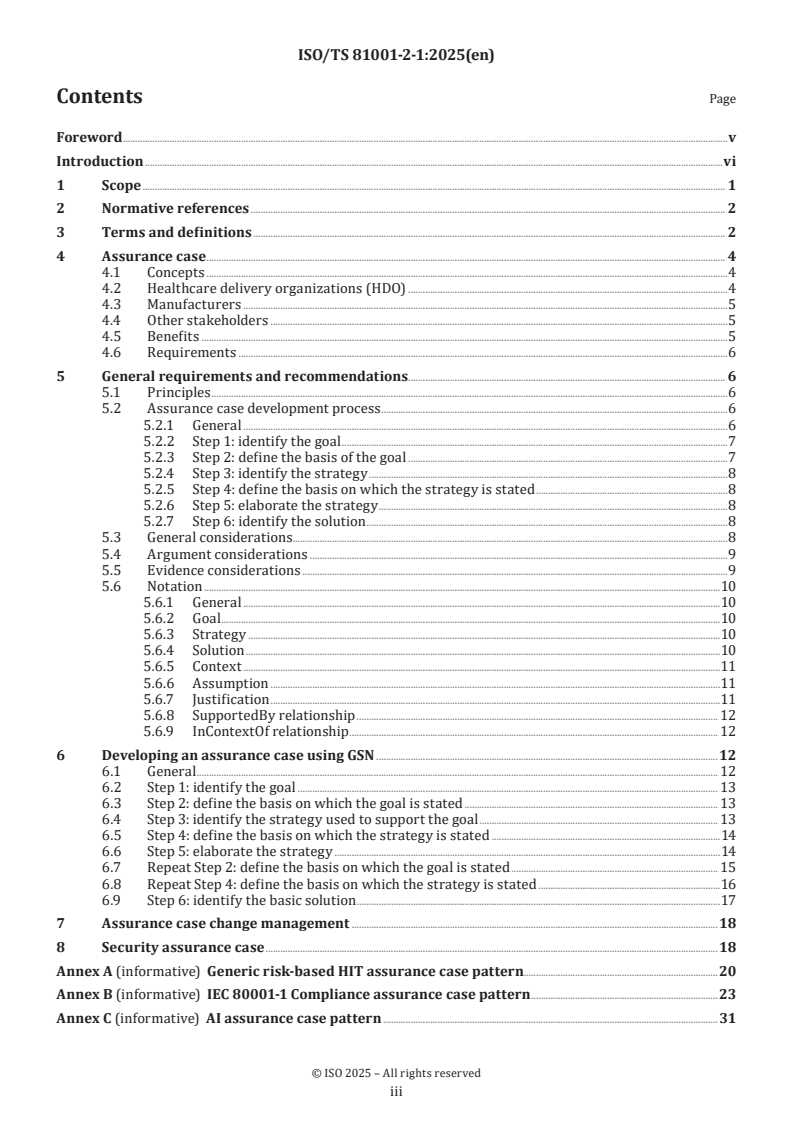
Contents Page
Foreword .v
Introduction .vi
1 Scope . 1
2 Normative references . 2
3 Terms and definitions . 2
4 Assurance case . 4
4.1 Concepts .4
4.2 Healthcare delivery organizations (HDO) .4
4.3 Manufacturers .5
4.4 Other stakeholders .5
4.5 Benefits .5
4.6 Requirements .6
5 General requirements and recommendations. 6
5.1 Principles .6
5.2 Assurance case development process .6
5.2.1 General .6
5.2.2 Step 1: identify the goal .7
5.2.3 Step 2: define the basis of the goal .7
5.2.4 Step 3: identify the strategy .8
5.2.5 Step 4: define the basis on which the strategy is stated .8
5.2.6 Step 5: elaborate the strategy .8
5.2.7 Step 6: identify the solution .8
5.3 General considerations.8
5.4 Argument considerations .9
5.5 Evidence considerations .9
5.6 Notation .10
5.6.1 General .10
5.6.2 Goal .10
5.6.3 Strategy .10
5.6.4 Solution .10
5.6.5 Context .11
5.6.6 Assumption .11
5.6.7 Justification .11
5.6.8 SupportedBy relationship . 12
5.6.9 InContextOf relationship . 12
6 Developing an assurance case using GSN .12
6.1 General . 12
6.2 Step 1: identify the goal . 13
6.3 Step 2: define the basis on which the goal is stated . 13
6.4 Step 3: identify the strategy used to support the goal . 13
6.5 Step 4: define the basis on which the strategy is stated .14
6.6 Step 5: elaborate the strategy .14
6.7 Repeat Step 2: define the basis on which the goal is stated . 15
6.8 Repeat Step 4: define the basis on which the strategy is stated .16
6.9 Step 6: identify the basic solution .17
7 Assurance case change management .18
8 Security assurance case .18
Annex A (informative) Generic risk-based HIT assurance case pattern.20
Annex B (informative) IEC 80001-1 Compliance assurance case pattern .23
Annex C (informative) AI assurance case pattern .31
iii
ISO/TS 81001-2-1:2025(en)
Annex D (informative) Security assurance case pattern.43
Annex E (informative) Assurance notation cross reference .44
Annex F (informative) Summary of assurance case requirements relative to organizations .45
Bibliography .46
iv
ISO/TS 81001-2-1:2025(en)
Foreword
ISO (the International Organization for Standardization) and IEC (the International Electrotechnical
Commission) form the specialized system for worldwide standardization. National bodies that are
members of ISO or IEC participate in the development of International Standards through technical
committees established by the respective organization to deal with particular fields of technical activity.
ISO and IEC technical committees collaborate in fields of mutual interest. Other international organizations,
governmental and non-governmental, in liaison with ISO and IEC, also take part in the work.
The procedures used to develop this document and those intended for its further maintenance are described
in the ISO/IEC Directives, Part 1. In particular, the different approval criteria needed for the different types
of document should be noted. This document was drafted in accordance with the editorial rules of the ISO/
IEC Directives, Part 2 (see www.iso.org/directives or www.iec.ch/members_experts/refdocs).
ISO and IEC draw attention to the possibility that the implementation of this document may involve the
use of (a) patent(s). ISO and IEC take no position concerning the evidence, validity or applicability of any
claimed patent rights in respect thereof. As of the date of publication of this document, ISO and IEC had not
received notice of (a) patent(s) which may be required to implement this document. However, implementers
are cautioned that this may not represent the latest information, which may be obtained from the patent
database available at www.iso.org/patents and https://patents.iec.ch. ISO and IEC shall not be held
responsible for identifying any or all such patent rights.
Any trade name used in this document is information given for the convenience of users and does not
constitute an endorsement.
For an explanation of the voluntary nature of standards, the meaning of ISO specific terms and expressions
related to conformity assessment, as well as information about ISO's adherence to the World Trade
Organization (WTO) principles in the Technical Barriers to Trade (TBT) see www.iso.org/iso/foreword.html.
In the IEC, see www.iec.ch/understanding-standards.
This document was prepared jointly by Technical Committee ISO/TC 215, Health informatics, and Technical
Committee IEC/TC 62, Medical equipment, software, and systems, Subcommittee SC A, Common aspects of
medical equipment, software, and systems.
A list of all parts in the ISO/IEC 81001 series can be found on the ISO and IEC websites.
Any feedback or questions on this document should be directed to the user’s national standards
body. A complete listing of these bodies can be found at www.iso.org/members.html and
www.iec.ch/national-committees.
v
ISO/TS 81001-2-1:2025(en)
Introduction
ISO 81001-1 provides the principles, concepts, terms and definitions for health software and health IT
systems, and the key properties of safety, effectiveness and security, across the full life cycle. ISO 81001-1
and all parts of the ISO/IEC 81001 series documents are applicable to stakeholders such as health software
manufacturers (including medical device manufacturers) and healthcare delivery organizations (HDOs).
This document provides guidance in developing comprehensible and compelling assurance cases in support
of safe, secure and effective deployment of health software and health IT systems.
While the benefits of digital health support are widely accepted, the potential for inadvertent and adverse
impacts on safety, effectiveness and security caused by health software and health IT systems is also
becoming more apparent. Today’s sophisticated health software and health IT systems provide advanced
levels of decision support and integrate patient data from multiple sources across organizational lines,
and across the continuum of care. This creates benefits to the patient and healthcare system, but it also
increases the likelihood of software-induced adverse events causing harm to both patients and healthcare
organizations. Design flaws, coding errors, security vulnerabilities, incorrect implementation or
configuration, data integrity issues, faults in decision support tools, poor alignment with clinical workflows
and improper maintenance and use of health software and health IT systems are examples of events with
the potential to cause harm. Managing safety, effectiveness and security for health software and health IT
systems (including medical devices), requires a comprehensive and coordinated approach to optimizing
these three properties.
As health software and health IT systems move through their life cycle stages, multiple organizations are
involved. As described in ISO 81001-1, these organizations need to communicate and share information to
properly assess and manage the safety, effectiveness, and security in carrying out their respective roles. It is
important that this transfer of knowledge and information is sufficiently formalized and predictable so that
different stakeholders can communicate and manage these risks in a timely and effective way across life
cycle stages and between roles.
Assurance cases are therefore useful tools for communicating risk across the life cycle of health IT systems,
given the rigour that is required within, and the inter-dependence of, the different organizations involved at
the various life cycle steps. Manufacturers can utilize an assurance case to communicate the risks associated
with their products to an HDO. HDOs can build upon the information the manufacturer has provided and
develop their assurance case as the product is integrated, configured, and implemented for use within their
particular sociotechnical ecosystem context. In this way, assurance cases provide a continuous thread for all
roles involved during the life cycle in managing the collective risks of all the components across the health
IT infrastructure, including the health software, medical devices and other health IT systems that make
up these complex sociotechnical ecosystems. Additionally, assurance case reports can be generated for
the purpose of communicating risks from one stakeholder to another as ownership of a health IT systems
changes.
IEC 80001-1 provides the roles, responsibilities, and activities necessary for effective risk management to
minimize the impact or likelihood of such events and establishes the concept of an assurance case as the
principal artefact to demonstrate that the application of risk management has been effective before, during
and after the implementation of a health IT system within a health IT infrastructure. The assurance case is
the principal mechanism for demonstrating compliance with IEC 80001-1.
Additionally, an assurance case can demonstrate confidence in the safety and security properties of a system
throughout its lifecycle and a means for demonstrating the relationship, correlation and improved analysis
of safety, security, and effectiveness.
The purpose of this document is to:
— provide guidance to those organisations that are responsible for addressing the requirements of IEC 80001-1
and illustrate how those requirements can be demonstrated through the use of an assurance case;
— provide guidance to illustrate to organisations how the concept of an assurance case can be used to
facilitate effective dialogue and management of health software (including medical devices) and health
IT system safety and security risks across organisational boundaries and between all stakeholders.
vi
ISO/TS 81001-2-1:2025(en)
NOTE The 6-step method that is presented in 5.2 is reproduced from original work published in ‘The Six-Step
Method for Developing Goal Structures’ in Reference [9]. The material is reproduced here with the permission of the
original author, who retains rights to the material.
vii
Technical Specification ISO/TS 81001-2-1:2025(en)
Health software and health IT systems safety, effectiveness
and security —
Part 2-1:
Coordination — Guidance and requirements for the use of
assurance cases for safety and security
1 Scope
This document establishes requirements and gives guidance on assurance case framework for healthcare
delivery organizations (HDOs) and for health software and medical device manufacturers (MDMs) and can
be used to support the communication and information transfer between all parties. An assurance case can
be used to communicate information and knowledge about different risks to other roles.
This document establishes:
— an assurance case framework for HDOs and health software and MDMs for identifying, developing,
interpreting, updating and maintaining assurance cases.
— one of the possible means to bridge the gap between manufacturers and HDOs in providing adequate
information to support the HDOs risk management of IT-networks;
— best practice by leveraging ISO/IEC/IEEE 15026-2 and other standards to identify key considerations
and for the structure and contents of an assurance case, e.g. iterative and continuous approaches;
— example structure, method and format to improve the consistency and comparability of assurance cases.
This document is applicable to all parties involved in the health software and health IT systems life cycle,
including:
a) organizations, health informatics professionals and clinical leaders specifying, acquiring, designing,
developing, integrating, implementing and operating health software and health IT systems, for example
health software developers and MDMs, system integrators, system administrators (including cloud and
other IT service providers);
b) healthcare service delivery organizations, healthcare providers and others who use health software
and health IT systems in providing health services;
c) governments, health system funders, monitoring agencies, professional organizations and customers
seeking confidence in an organization’s ability to consistently provide safe, effective and secure health
software, health IT systems and services;
d) organizations and interested parties seeking to improve communication in managing safety,
effectiveness and security risks through a common understanding of the concepts and terminology
used in safety, effectiveness and security management;
e) providers of training, assessment or advice in safety, effectiveness and security risk management for
health software and health IT systems;
f) developers of related safety, effectiveness and security standards.
This document is for use by organizations and people who build, acquire, operate, maintain, use or
decommission health software and health IT systems (including medical devices). It is applicable to all
organizations involved, regardless of size, complexity or business model.
ISO/TS 81001-2-1:2025(en)
2 Normative references
The following documents are referred to in the text in such a way that some or all of their content constitutes
requirements of this document. For dated references, only the edition cited applies. For undated references,
the latest edition of the referenced document (including any amendments) applies.
ISO 81001-1:2021, Health software and health IT systems safety, effectiveness and security — Part 1: Principles
and concepts
3 Terms and definitions
For the purposes of this document, the terms and definitions given in ISO 81001-1:2021 and the following apply.
ISO and IEC maintain terminology databases for use in standardization at the following addresses:
— ISO Online browsing platform: available at https:// www .iso .org/ obp
— IEC Electropedia: available at https:// www .electropedia .org/
3.1
assumption
intentionally unsubstantiated statement
Note 1 to entry: An assumption is used in the reasoning of a goal.
Note 2 to entry: Adapted from Reference [10].
3.2
assurance
grounds for justified confidence that a goal has been or will be achieved
[SOURCE: ISO/IEC/IEEE 15026-1:2019, 3.1.1, modified — “claim” was replaced by “goal”.]
3.3
argument
connected series of goals intended to establish an overall goal
Note 1 to entry: Adapted from Reference [10].
3.4
confidence
proposition being asserted by the author that is a true or false statement
Note 1 to entry: Adapted from Reference [10].
3.5
goal
true-false statement about the limitations on the values of an unambiguously defined property − called the
claim's property − and limitations on the uncertainty of the property’s values falling within these limitations
during the claim's duration of applicability under stated conditions
Note 1 to entry: Uncertainties may also be associated with the duration of applicability and the stated conditions.
Note 2 to entry: A claim potentially contains the following:
— property of the system-of-interest;
— limitations on the value of the property associated with the claim (e.g. on its range);
— limitations on the uncertainty of the property value meeting its limitations;
— limitations on duration of claim's applicability;
— duration-related uncertainty;
ISO/TS 81001-2-1:2025(en)
— limitations on conditions associated with the claim; and
— condition-related uncertainty.
Note 3 to entry: The term “limitations” is used to fit the many situations that can exist. Values can be a single value or
multiple single values, a range of values or multiple ranges of values, and can be multi-dimensional. The boundaries
of these limitations are sometimes not sharp, e.g. they can involve probability distributions and can be incremental.
Note 4 to entry: The term ‘claim’ is sometimes used as a synonym for ‘goal’.
[SOURCE: ISO/IEC/IEEE 15026-1:2019, 3.1.4, modified — The preferred term “claim ” was changed to “goal”;
Note 4 to entry was added.]
3.6
context
reference to the system documentation towards an assertion regarding capabilities and properties external
to the system
Note 1 to entry: A context can be justified by the intended use and notably the intended operational environment of
the respective system.
Note 2 to entry: A context can be used in the reasoning of a strategy.
Note 3 to entry: Adapted from Reference [16].
3.7
evidence
directly measurable characteristics of a process and/or product that represent objective, demonstrable
proof that a specific activity satisfied a specific requirement
[SOURCE: ISO/IEC 21827:2008, 3.19]
3.8
justification
type of claim which is raised as part of an assurance case and which is not further refined
3.9
solution
reference to an artefact that points to a technical implementation
Note 1 to entry: A solution can be used in the reasoning of a strategy.
3.10
strategy
argument demonstrating plausibility of one (or multiple) goal(s) based on related support in a context, based
on assumptions and using evidence, justifications and solutions and other sub goals (which can then not be
supported by that strategy instance to ensure cycle-free reasoning)
3.11
responsibility agreement
document(s) that together fully define the responsibilities of all stakeholders
Note 1 to entry: This agreement can be a legal document, e.g. a contract.
[SOURCE: ISO 81001-1:2021, 3.1.9]
3.12
security control
management, operational and technical controls (i.e. safeguards or countermeasures) prescribed for an
information system to protect the confidentiality, integrity, and availability of the system and its information
[SOURCE: ISO 12812-1:2017, 3.54]
ISO/TS 81001-2-1:2025(en)
3.13
security pattern
means of documenting and reusing successful argument structures
Note 1 to entry: Adapted from Reference [15].
4 Assurance case
4.1 Concepts
Assurance that a health IT system achieves certain objectives is particularly important when the system
and its interaction with the environment are complex and evolving. Assurance cases establish goal(s) that
relate to selected properties of the health IT system and argue for the truth of those goals(s).
Assurance cases are generally developed to support goals in areas such as safety, reliability, maintainability,
human factors, operability, and security. Whilst this document focuses on safety and security, assurance
case methods are applicable to any property of a system. These assurance cases are often called by more
specific names, e.g. safety case or dependability case. ISO/IEC/IEEE 15026-1 provides concepts, terminology,
background and a list of standards related to assurance cases.
An assurance case is a structured, solution-based argument used to demonstrate confidence that a system
holds a particular critical property.
An argument is a connected, hierarchical series of goals intended to establish an overall goal. The argument
in an assurance case shows how a high-level goal is supported by a number of sub goals, which, in turn are
supported by detailed presentation of a solution(s). It is the combination of goals and solution that provide
confidence in the overall high-level goal made for the characteristic of the system.
A solution which is defined as scientific fact, or empirical outcome, provides a basis that demonstrates that
the goal has been achieved. An argument without a solution is unfounded whilst a solution presented out of
the context of an argument is unexplained.
Presenting the argument and solution in a structured way reduces the likelihood of uncertainty and allows
for a better analysis of the achievement of the set of objectives (the goals).
Additional assurance case concepts such as assumptions, justifications and context enable other factors and
considerations to be expressed which will support the interpretation and the validity of the assurance case.
4.2 Healthcare delivery organizations (HDO)
An assurance case can be established for any element of a health IT system, the health IT system itself and
the entire health IT infrastructure, addressing any network component, e.g. the radiology network, network
communication components, medical devices, accessories and even components of devices.
HDOs can use the assurance case, as outlined in this document, to form part of a broader assurance case
addressing additional critical properties such as safety, reliability, maintainability, etc.
HDO’s can use this document for one or more of the following:
a) support the understanding and communication of safety and security risks associated with components
of the health IT system that are provided by third party organizations;
b) assess and manage safety and security risks associated with the deployment and use of health IT
systems and health IT infrastructures in their own organizations;
c) demonstrate their own conformity with IEC 80001-1 and ISO 81001-1.
ISO/TS 81001-2-1:2025(en)
4.3 Manufacturers
An assurance case is an important tool for providing HDOs with the appropriate level of information about
the safety and security characteristics of a manufacturer’s product(s) to support the HDOs’ risk management
of their health IT systems (that can incorporate health software products including medical devices), which
are being implemented in the HDOs’ health IT infrastructure.
This document also provides guidance to manufacturers in developing a security case to demonstrate
1)
confidence in the achievement of IEC/TS 81001-2-2 .
An assurance case can be treated as a ‘living artefact’ which begins at the outset of the system/software
development lifecycle (SDLC) and is continuously developed and updated during design, production and
operation of the manufacturer’s product(s).
The assurance case may act as a supporting document to the manufacturer disclosure statement for medical
device security (MDS2).
4.4 Other stakeholders
Stakeholders (involved in conformity assessment, certification, regulation, acquisition or audit) can evaluate
the assurance case to determine the extent of achievement of the top-level goal (e.g. that the health IT product
is safe or secure) and whether this achievement is demonstrated within the allowable uncertainty or risk
and any related consequences. The results regarding the top-level goal and its support along with related
uncertainties and consequences constitute a basis for rationally managing risk and aiding in decision making.
This document is also for use by organizations who build, acquire, operate, maintain, use or decommission
health software and health IT systems (including medical devices), as well as by those creating standards
addressing safety, effectiveness and security of health IT systems. It is applicable to all organizations
involved, regardless of their size, complexity, or business model.
The quality of artefacts gathered and documented during the development of the assurance case should
be agreed to and documented as part of a responsibility agreement between the relevant stakeholders (as
currently practised by security assurance cases). This document will provide guidance and methodology,
using specific notations, to support, develop and interpret assurance cases in a systematic manner.
4.5 Benefits
The assurance case has been commonly applied to the safety domain, specifically addressing safety concerns
for systems, however the use of an assurance case has expanded and nowadays addresses other critical
properties such as dependability, reliability, and security across a range of safety critical domains such as
automotive, railway, defence and aviation. An assurance case is called a safety case when used to argue the
safety of a system. Similarly, they are referred to as assurance cases and dependability cases when arguing
respectively.
A significant benefit of an assurance case is that it provides a mechanism to facilitate effective communication
of the particular characteristics of a product between stakeholders. The rationale, the justification for the
relevance of the rationale and its supporting confirmatory evidence can be presented and appraised in a
systematic way.
As a manufacturer, an assurance case can be used to establish confidence that the requirements of a standard
have been satisfied. An argument reflecting the architecture of a standard can guide a manufacturer in
generating and collating supporting evidence; gaps or weaknesses in the evidence will become apparent.
If a manufacturer incorporates a third-party product in their own product, an assurance case can be used
to communicate third party assurance requirements and also to collate and integrate assurance evidence
associated with the third party product into the manufacturer’s product assurance case.
1) Under preparation. Stage at the time of publication: IEC/CD TS 81001-2-2.
ISO/TS 81001-2-1:2025(en)
The concept of an assurance case model or pattern encourages soundness and completeness as it can
introduce efficiency and improve the assurance culture within an organization by providing a framework
that supports consistency in the assurance process.
The impact of changes or modifications to a product can be more readily assessed if there is an assurance
case established for the product. For example, if software changes are proposed to a functional module, the
need for and significance of supporting test evidence required to maintain the integrity of that function will
be apparent. This contributes to pro-active risk management.
The philosophy of an assurance case provides flexibility to enable the rigour of the assurance case and its
supporting evidence base to be proportionate to the risk profile of the product. Justifications or assumptions
can be presented to explain why an element of an assurance argument or evidence is not required given the
assessed risk profile.
Managing the assurance case as a living artefact provides on-going visibility of assurance maturity and
an opportunity to influence its development and final sufficiency. Contradictions in the argument or gaps
in the evidence will be revealed sooner in the lifecycle with greater opportunity for correction. The cost
of corrective change to a product is proportionate to the phase at which the correction is made, i.e. it is
cheaper to correct requirement deficiencies before product design then it is correct them post product
implementation.
4.6 Requirements
The following requirements apply when an organization develops an assurance case:
— Goals: The organization shall define one or more goal(s) to express the assurance claim that is being
made as part of a new assurance case.
— Justification: The organization shall justify the rationale for the definition of the top-level goal.
— Argument: The organization shall express arguments that logically link the defined goal(s) to the
solutions.
— Solutions: The organization shall provide a body of evidence that demonstrates that the goal(s) has been
satisfied.
5 General requirements and recommendations
5.1 Principles
The principal objective of an assurance case is to present a well-organised and reasoned proposition, based
on objective evidence, that a system is acceptably safe and secure in a given context.
The development of an assurance case is an iterative process and is aligned and integrated within the
system development and deployment lifecycle. Formalisation of an assurance case occurs at key lifecycle
milestones and supports stakeholder decision making, for example at the point of clinical deployment or
system modification.
5.2 Assurance case development process
5.2.1 General
An assurance case can be developed following many different approaches; it is not the purpose of this
document to prescribe a specific approach. However, the process for developing safety cases as published in
[10]
Reference [9] and as incorporated into the [SCSC-141C] Goal Structuring Notation Community Standard
has been adopted. This approach, referred to as the “6-step method” is presented in Figure 1 and described
in 5.2.2 to 5.2.7.
ISO/TS 81001-2-1:2025(en)
Figure 1 — 6-step method
5.2.2 Step 1: identify the goal
Step 1 establishes the top-level goal of the assurance case that the remainder of the assurance argument
supports and substantiates. In establishing the top-goal, the author of the assurance case should consider
the intended purpose and recipient of the assurance case and ensure that the top-goal is expressed at an
appropriate level of abstraction. For example, the top-goal of an assurance case developed by a medical device
manufacturer to support the regulatory compliance of the product could be expressed at a lower level of
detail to that of a top-goal associated with demonstrating the safety of health IT infrastructure that includes
that product. In the first case, the purpose would relate to satisfying regulatory requirements, and the
recipient could be a regulatory body. Assumptions could be declared regarding deployment context but not
necessarily argued or evidenced. In the second case, the purpose would relate to organizational deployment
of the product as part of a broader health IT infrastructure, and the recipient could be the organization’s
top management. There would be less opportunity to make assumptions regarding deployment context; the
assurance case would be expected to demonstrate the sufficiency of such.
5.2.3 Step 2: define the basis of the goal
Step 2 establishes the context in which the truth of the goal is to be demonstrated. It is not credible to make a
goal that a property holds in all scenarios. The basis of a goal should be clearly and unambiguously explained
such that the recipient of the assurance case has sufficient understanding to draw an opinion on the truth of
the goal.
Three general themes shall be presented:
— information that defines the system to which the assurance case applies, e.g. technical specification;
— information that defines the environment in which the system is used and how it is used, e.g. care process
definition;
— information that supplements the assurance argument, e.g. terms and definitions.
ISO/TS 81001-2-1:2025(en)
5.2.4 Step 3: identify the strategy
Step 3 establishes the approach through which the goal is substantiated. The strategy should be expressed
as a statement that convinces the recipient that the goal it supports is true. Generally, a strategy will
decompose a parent-goal into a number of sub goals which in turn are easier to evidence as being true. The
strategy should explain the logic which relates the proposition made in the parent-goal with those made in
the supporting sub goals.
5.2.5 Step 4: define the basis on which the strategy is stated
Step 4 is similar to Step 2 in that it establishes the context in which the truth of the strategy is to be
demonstrated. This can extend to include the rationale as to why the particular strategy was chosen and how
it supports the decomposition of the parent-goal into sub goals. Goal structuring notation (GSN) elements of
context, assumption and justification can be used to achieve this.
5.2.6 Step 5: elaborate the strategy
Step 5 is essentially a repeat of Steps 1 and is repeated until a solution(s) can be presented that substantiates
the related goal. It should be noted that each branch of the assurance argument does not need to be developed
to the same level of decomposition.
5.2.7 Step 6: identify the solution
Step 6 identifies evidence that demonstrates that its related goal has been substantiated. A goal can be
resolved by one or more solutions, but care is needed to ensure that the understanding of how the solutions
support the goal is not lost or confused. Similarly, it is permissible for one solution to substantiate more than
one goal, but care is needed to explain the rationale.
The solution should be expressed in sufficient specificity so that it is clear how it supports the goal. For
example, referencing a specific test result rather than the overarching test report. Solutions may take the
form of a published scientific fact, established state-of-the-art or an empirical outcome regarding a capability
or property of the product.
5.3 General considerations
A developed and established assurance case should have the following characteristics.
— Accessible: the assurance case shall be accessible by all stakeholders and as such their needs should be
considered. The assurance case should be produced and maintained in a format that doesn’t introduce
limitations and consideration should be given to the unnecessary inclusion of proprietary information
that can introduce restrictions on its circulation.
— Affordable: the cost of developing and producing an assurance case shall be balanced against the benefits
of doing so. The risk profile associated with the product can have a bearing on this and influence the
breath of the argument and the depth of the evidence.
— Auditable: the assurance case can be influenced by judgements made by personnel that contribute to
its development and review. The rationale for and the evidence supporting such judgements should
be presented within the scope of the assurance case such that they can be fully understood by other
stakeholders. This is also an important consideration in the context of future-proofing an assurance
case; updates and amendments may be made by personnel who did not contribute to its original creation.
— Clear: the assurance case shall be comprehensible to its intended recipients and as such consideration
should be given to the style in which it is presented. Communicating complex technical arguments
can be challenging, but assurance cases shall express all the necessary information as simply and as
unambiguously as possible.
— Complete: a principal objective of an assurance case is to demonstrate that all reasonably foreseeable
vulnerabilities associated with a product have been identified and that the risk associated with these
vulnerabilities has been managed to a level that can be tolerated by the
...