


IEC 61606-2:2003
(Main)Audio and audiovisual equipment - Digital audio parts - Basic measurement methods of audio characteristics - Part 2: Consumer use
General Information
- Abstract
deals with the basic measurement methods of the audio charac-teristics of the digital audio part of audio and audiovisual equipment for consumer use. The common measuring conditions and methods are described in IEC 61606-1. Specific conditions and methods of measurement for consumer equipment are given in this standard
- Status
- Published
- Publication Date
- 09-Oct-2003
- Technical Committee
- TC 100 - Audio, video and multimedia systems and equipment
- Current Stage
- DELPUB - Deleted Publication
- Start Date
- 09-Jul-2009
- Completion Date
- 28-Aug-2026
Overview
IEC 61606-2:2003 is an International Electrotechnical Commission (IEC) standard that specifies the basic measurement methods for assessing the audio characteristics of the digital audio parts of audio and audiovisual equipment intended for consumer use. This part focuses on standardized procedures to ensure reliable and consistent measurement results when evaluating the performance of consumer digital audio equipment, such as home audio systems and multimedia devices. While general measurement conditions and methods are described in IEC 61606-1, Part 2 expands on the specific conditions and detailed methodologies tailored for consumer applications. By adhering to these guidelines, manufacturers, test laboratories, and other stakeholders can objectively compare product performance and maintain high-quality audio output in consumer devices.
Key Topics
IEC 61606-2:2003 covers a variety of essential measurement methods and performance aspects for digital audio performance in consumer equipment:
- Definitions and Rated Values:
- Provides terminology, definitions, and specifications relevant for digital audio parts in consumer devices.
- Measuring Conditions:
- Standardizes environmental, power, and signal conditions for consistent audio measurements.
- Input/Output Characteristics:
- Procedures to assess maximum output amplitude and gain differences between channels.
- Frequency Characteristics:
- Detailed frequency response and group delay measurement methods for both digital-in/analogue-out and analogue-in/digital-out scenarios.
- Noise Characteristics:
- Standardized techniques to evaluate signal-to-noise ratio, dynamic range, out-of-band noise ratio, and channel separation to quantify clarity and isolation.
- Distortion Metrics:
- Methods to measure level non-linearity, distortion, and intermodulation in consumer digital audio outputs.
- Calibration and Tracking:
- Calibration of analogue-to-digital and digital-to-analogue conversion levels, along with tracking error assessment, ensure accurate, repeatable tests.
Applications
Adoption of IEC 61606-2:2003 is valuable for various stakeholders in the consumer audio and audiovisual sector:
- Manufacturers:
- Use the standard for quality control, ensuring their digital audio products meet internationally recognized thresholds for performance.
- Testing and Certification Bodies:
- Rely on these methods for independent performance verification of consumer digital audio devices such as AV receivers, CD players, and digital recorders.
- Product Development Engineers:
- Employ the prescribed measurement techniques to benchmark designs and optimize product performance.
- Retailers and Buyers:
- Benefit indirectly through consistent product labeling and performance claims, supporting informed purchasing decisions.
By following IEC 61606-2 guidelines, stakeholders ensure comparable measurement results, facilitate product interoperability, and boost consumer confidence by maintaining a uniform baseline for digital audio quality in home entertainment products.
Related Standards
IEC 61606-2 is part of a series addressing digital audio measurement across different user segments. Related standards include:
- IEC 61606-1: General measurement methods for digital audio parts in audio and audiovisual equipment.
- IEC 60268-2: Sound system equipment - General terms and calculation methods.
- IEC 60958: Series on the digital audio interface, relevant for transmission of digital audio data.
- IEC 61883-6: Consumer digital interfaces for audio and music data transmission.
- IEC 61938: Interconnections and matching values for analogue audio and video signals.
Together, these international standards provide a comprehensive framework for the measurement, evaluation, and interoperability of digital and analogue audio equipment in both consumer and professional environments.
Keywords: IEC 61606-2, digital audio measurement, consumer audio equipment, audio characteristics, distortion measurement, noise performance, frequency response, international audio standards, audiovisual equipment testing, signal-to-noise ratio, channel separation.
Relations
- Effective Date
- 05-Sep-2023
- Effective Date
- 05-Sep-2023
Get Certified
Connect with accredited certification bodies for this standard

ANCE
Mexican certification and testing association.

Intertek Slovenia
Intertek testing, inspection, and certification services in Slovenia.

LNE (Laboratoire National de Métrologie et d'Essais)
French national laboratory for metrology and testing.
Sponsored listings
Frequently Asked Questions
IEC 61606-2:2003 is a standard published by the International Electrotechnical Commission (IEC). Its full title is "Audio and audiovisual equipment - Digital audio parts - Basic measurement methods of audio characteristics - Part 2: Consumer use". This standard covers: deals with the basic measurement methods of the audio charac-teristics of the digital audio part of audio and audiovisual equipment for consumer use. The common measuring conditions and methods are described in IEC 61606-1. Specific conditions and methods of measurement for consumer equipment are given in this standard
deals with the basic measurement methods of the audio charac-teristics of the digital audio part of audio and audiovisual equipment for consumer use. The common measuring conditions and methods are described in IEC 61606-1. Specific conditions and methods of measurement for consumer equipment are given in this standard
IEC 61606-2:2003 is classified under the following ICS (International Classification for Standards) categories: 33.160.01 - Audio, video and audiovisual systems in general. The ICS classification helps identify the subject area and facilitates finding related standards.
IEC 61606-2:2003 has the following relationships with other standards: It is inter standard links to IEC 61606:1997, IEC 61606-2:2009. Understanding these relationships helps ensure you are using the most current and applicable version of the standard.
IEC 61606-2:2003 is available in PDF format for immediate download after purchase. The document can be added to your cart and obtained through the secure checkout process. Digital delivery ensures instant access to the complete standard document.
Standards Content (Sample)
INTERNATIONAL IEC
STANDARD
61606-2
First edition
2003-10
Audio and audiovisual equipment –
Digital audio parts – Basic measurement
methods of audio characteristics –
Part 2:
Consumer use
Reference number
Publication numbering
As from 1 January 1997 all IEC publications are issued with a designation in the
60000 series. For example, IEC 34-1 is now referred to as IEC 60034-1.
Consolidated editions
The IEC is now publishing consolidated versions of its publications. For example,
edition numbers 1.0, 1.1 and 1.2 refer, respectively, to the base publication, the
base publication incorporating amendment 1 and the base publication incorporating
amendments 1 and 2.
Further information on IEC publications
The technical content of IEC publications is kept under constant review by the IEC,
thus ensuring that the content reflects current technology. Information relating to
this publication, including its validity, is available in the IEC Catalogue of
publications (see below) in addition to new editions, amendments and corrigenda.
Information on the subjects under consideration and work in progress undertaken
by the technical committee which has prepared this publication, as well as the list
of publications issued, is also available from the following:
• IEC Web Site (www.iec.ch)
• Catalogue of IEC publications
The on-line catalogue on the IEC web site (http://www.iec.ch/searchpub/cur_fut.htm)
enables you to search by a variety of criteria including text searches, technical
committees and date of publication. On-line information is also available on
recently issued publications, withdrawn and replaced publications, as well as
corrigenda.
• IEC Just Published
This summary of recently issued publications (http://www.iec.ch/online_news/
justpub/jp_entry.htm) is also available by email. Please contact the Customer
Service Centre (see below) for further information.
• Customer Service Centre
If you have any questions regarding this publication or need further assistance,
please contact the Customer Service Centre:
Email: custserv@iec.ch
Tel: +41 22 919 02 11
Fax: +41 22 919 03 00
INTERNATIONAL IEC
STANDARD
61606-2
First edition
2003-10
Audio and audiovisual equipment –
Digital audio parts – Basic measurement
methods of audio characteristics –
Part 2:
Consumer use
IEC 2003 Copyright - all rights reserved
No part of this publication may be reproduced or utilized in any form or by any means, electronic or
mechanical, including photocopying and microfilm, without permission in writing from the publisher.
International Electrotechnical Commission, 3, rue de Varembé, PO Box 131, CH-1211 Geneva 20, Switzerland
Telephone: +41 22 919 02 11 Telefax: +41 22 919 03 00 E-mail: inmail@iec.ch Web: www.iec.ch
PRICE CODE
Commission Electrotechnique Internationale
V
International Electrotechnical Commission
Международная Электротехническая Комиссия
For price, see current catalogue
– 2 – 61606-2 IEC:2003(E)
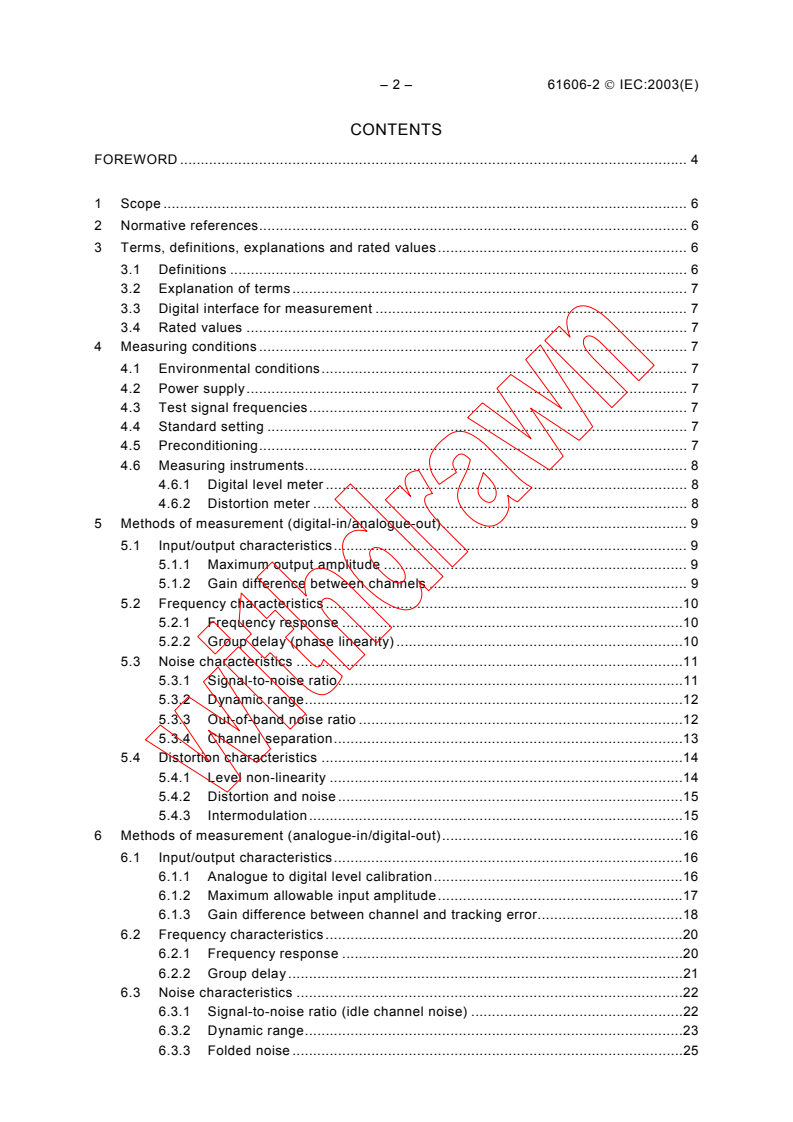
CONTENTS
FOREWORD . 4
1 Scope . 6
2 Normative references. 6
3 Terms, definitions, explanations and rated values. 6
3.1 Definitions . 6
3.2 Explanation of terms. 7
3.3 Digital interface for measurement . 7
3.4 Rated values . 7
4 Measuring conditions . 7
4.1 Environmental conditions. 7
4.2 Power supply. 7
4.3 Test signal frequencies. 7
4.4 Standard setting . 7
4.5 Preconditioning. 7
4.6 Measuring instruments. 8
4.6.1 Digital level meter . 8
4.6.2 Distortion meter . 8
5 Methods of measurement (digital-in/analogue-out). 9
5.1 Input/output characteristics. 9
5.1.1 Maximum output amplitude . 9
5.1.2 Gain difference between channels . 9
5.2 Frequency characteristics .10
5.2.1 Frequency response .10
5.2.2 Group delay (phase linearity) .10
5.3 Noise characteristics .11
5.3.1 Signal-to-noise ratio.11
5.3.2 Dynamic range.12
5.3.3 Out-of-band noise ratio .12
5.3.4 Channel separation.13
5.4 Distortion characteristics .14
5.4.1 Level non-linearity .14
5.4.2 Distortion and noise .15
5.4.3 Intermodulation.15
6 Methods of measurement (analogue-in/digital-out).16
6.1 Input/output characteristics.16
6.1.1 Analogue to digital level calibration.16
6.1.2 Maximum allowable input amplitude.17
6.1.3 Gain difference between channel and tracking error.18
6.2 Frequency characteristics .20
6.2.1 Frequency response .20
6.2.2 Group delay .21
6.3 Noise characteristics .22
6.3.1 Signal-to-noise ratio (idle channel noise) .22
6.3.2 Dynamic range.23
6.3.3 Folded noise .25
61606-2 IEC:2003(E) – 3 –
6.3.4 Cross-talk .26
6.3.5 Channel separation.28
6.4 Distortion characteristics .30
6.4.1 Level non-linearity .30
6.4.2 Distortion and noise .31
6.4.3 Intermodulation.32
Table 1 – Levels for measurement .14
Table 2 – Upper limited measuring frequency.26
– 4 – 61606-2 IEC:2003(E)
INTERNATIONAL ELECTROTECHNICAL COMMISSION
____________
AUDIO AND AUDIOVISUAL EQUIPMENT – DIGITAL AUDIO PARTS –
BASIC MEASUREMENT METHODS OF AUDIO CHARACTERISTICS –
Part 2: Consumer use
FOREWORD
1) The International Electrotechnical Commission (IEC) is a worldwide organization for standardization comprising
all national electrotechnical committees (IEC National Committees). The object of IEC is to promote
international co-operation on all questions concerning standardization in the electrical and electronic fields. To
this end and in addition to other activities, IEC publishes International Standards, Technical Specifications,
Technical Reports, Publicly Available Specifications (PAS) and Guides (hereafter referred to as “IEC
Publication(s)”). Their preparation is entrusted to technical committees; any IEC National Committee interested
in the subject dealt with may participate in this preparatory work. International, governmental and non-
governmental organizations liaising with the IEC also participate in this preparation. IEC collaborates closely
with the International Organization for Standardization (ISO) in accordance with conditions determined by
agreement between the two organizations.
2) The formal decisions or agreements of IEC on technical matters express, as nearly as possible, an international
consensus of opinion on the relevant subjects since each technical committee has representation from all
interested IEC National Committees.
3) IEC Publications have the form of recommendations for international use and are accepted by IEC National
Committees in that sense. While all reasonable efforts are made to ensure that the technical content of IEC
Publications is accurate, IEC cannot be held responsible for the way in which they are used or for any
misinterpretation by any end user.
4) In order to promote international uniformity, IEC National Committees undertake to apply IEC Publications
transparently to the maximum extent possible in their national and regional publications. Any divergence
between any IEC Publication and the corresponding national or regional publication shall be clearly indicated in
the latter.
5) IEC provides no marking procedure to indicate its approval and cannot be rendered responsible for any
equipment declared to be in conformity with an IEC Publication.
6) All users should ensure that they have the latest edition of this publication.
7) No liability shall attach to IEC or its directors, employees, servants or agents including individual experts and
members of its technical committees and IEC National Committees for any personal injury, property damage or
other damage of any nature whatsoever, whether direct or indirect, or for costs (including legal fees) and
expenses arising out of the publication, use of, or reliance upon, this IEC Publication or any other IEC
Publications.
8) Attention is drawn to the Normative references cited in this publication. Use of the referenced publications is
indispensable for the correct application of this publication.
9) Attention is drawn to the possibility that some of the elements of this IEC Publication may be the subject of
patent rights. IEC shall not be held responsible for identifying any or all such patent rights.
International Standard IEC 61606-2 has been prepared by IEC technical committee 100:
Audio, video and multimedia systems and equipment.
IEC 61606-1 and this standard cancel and replace IEC 61606 (1997). This first edition of
IEC 61606-2 constitutes a technical revision.
The text of this standard is based on the following documents:
FDIS Report on voting
100/695/FDIS 100/716/RVD
Full information on the voting for the approval of this standard can be found in the report on
voting indicated in the above table.
This publication has been drafted in accordance with the ISO/IEC Directives, Part 2.
61606-2 IEC:2003(E) – 5 –
IEC 61606 consists of the following parts under the general title Audio and audiovisual
equipment – Digital audio parts – Basic measurement methods of audio characteristics:
Part 1: General
Part 2: Consumer use
Part 3: Professional use
The committee has decided that the contents of this publication will remain unchanged until
2006. At this date, the publication will be
• reconfirmed;
• withdrawn;
• replaced by a revised edition, or
• amended.
A bilingual edition may be issued at a later date.
———————
Under consideration.
– 6 – 61606-2 IEC:2003(E)
AUDIO AND AUDIOVISUAL EQUIPMENT – DIGITAL AUDIO PARTS –
BASIC MEASUREMENT METHODS OF AUDIO CHARACTERISTICS –
Part 2: Consumer use
1 Scope
This part of IEC 61606 deals with the basic measurement methods of the audio charac-
teristics of the digital audio part of audio and audiovisual equipment for consumer use. The
common measuring conditions and methods are described in IEC 61606-1. Specific conditions
and methods of measurement for consumer equipment are given in this standard.
2 Normative references
The following referenced documents are indispensable for the application of this document.
For dated references, only the edition cited applies. For undated references, the latest edition
of the referenced document (including any amendments) applies.
IEC 61606-1, Audio and audiovisual equipment – Digital audio parts – Basic measurement
methods of audio characteristics – Part 1: General
IEC 60268-2, Sound system equipment – Part 2: Explanation of general terms and calculation
methods
IEC 60958 (all parts), Digital audio interface
IEC 61883-6, Consumer audio/video equipment – Digital interface – Part 6: Audio and music
data transmission protocol
IEC 61938, Audio, video and audiovisual systems – Interconnections and matching values –
Preferred matching values of analogue signals
3 Terms, definitions, explanations and rated values
3.1 Definitions
For the purposes of this part of IEC 61606, the terms and definitions given in IEC 61606-1 as
well as the following apply.
3.1.1
analogue full-scale amplitude
the nominal signal level of an EUT corresponding to the digital full-scale level
NOTE In order to accommodate the EUT in an audio system, it is recommended that the analogue full scale
amplitude has the value defined in IEC 61938. In the case of general purpose audio for consumer equipment, the
amplitude is 2 V r.m.s.
3.1.2
normal measuring level
analogue signal level equal to –20 dB of analogue full-scale amplitude
61606-2 IEC:2003(E) – 7 –
3.1.3
normal source impedance
the value defined in IEC 61938, or in the case of general purpose audio for consumer
equipment, 2,2 kΩ
3.1.4
normal load impedance
the value defined in IEC 61938, or in the case of general purpose audio for consumer
equipment, 22 kΩ
3.2 Explanation of terms
See 3.2 of IEC 61606-1
3.3 Digital interface for measurement
This standard can be applied to IEC 60958 or IEC 61883-6.
Other interfaces having the same specification as in 3.1 of IEC 61606-1 may also be used.
3.4 Rated values
For a full explanation of these terms, see IEC 60268-2. The following are rated conditions for
digital audio equipment which should be specified by the manufacturer:
• rated supply voltage;
• rated supply frequency;
• rated pre-emphasis and de-emphasis characteristics;
• rated digital input word length;
• rated sampling frequencies.
4 Measuring conditions
The measuring conditions applied in this part are the same as those given in IEC 61606-1,
together with those given below.
4.1 Environmental conditions
As in IEC 61606-1.
4.2 Power supply
As in IEC 61606-1.
4.3 Test signal frequencies
As in IEC 61606-1.
4.4 Standard setting
As in IEC 61606-1.
4.5 Preconditioning
As in IEC 61606-1.
– 8 – 61606-2 IEC:2003(E)
4.6 Measuring instruments
All specifications given in IEC 61606-1 are applicable, together with those given below.
4.6.1 Digital level meter
The r.m.s. signal level, V is calculated from the digital data within the in-band frequency
total
range.
One method of calculation is as follows:
When the frequency components are calculated by the FFT method, the signal level is
calculated as follows. All of the frequency components which are within the in-band frequency
range are calculated using the following equation:
2 2 2 2 1/2
V = (V +V + V + … V )
total f1 f2 f3 fn
The signal level S in dB is calculated from the following equation:
FS
S dB = 20 log (V /V )
FS 10 total full
where V is the r.m.s. value of the full-scale amplitude of a 1 kHz signal.
full
The number of data points for the FFT calculation is greater than the value of fs. The window
used for the measurement shall be the minimum window having the following parameters:
W(t) = 1/L [a + a cos(2πt/L) + a cos(4πt/L) + a cos(6πt/L)]
0 1 2 3
where
L is the number of data points.
a = 0,363 491 2
a = 0,489 268 2
a = 0,136 508 8
a = 0,010 731 8
t ≤ L/2
NOTE If the signal level is calculated directly using digital data, it should be filtered to the in-band frequency
range before the calculation.
4.6.2 Distortion meter
Calculate the ratio of the total signal output to the noise and distortion component.
NOTE One measurement method is as follows.
The r.m.s. signal level, V is calculated from the resultant in-band frequency components of
total
the fast Fourier Transformation (FFT) of the processed input signal:
2 2 2 2 1/2
V = (V + V + V + … V )
total f1 f2 f32 fn
V , is obtained by the FFT for frequency ranges from 4 Hz to f , which is 1/1,5 of the
N L
measuring frequency and f which is 1,5 times the measuring frequency to the upper limit
H
frequency f , V is derived from the following equation:
MAX N
61606-2 IEC:2003(E) – 9 –
2 2 2 2 2 2 2 1/2
V = ((V + V + V + … V ) + ( V + V + V ))
N f1 f2 f3 fL fH fH+1 fMAX
The total distortion D is obtained from the equation:
D% = V / V × 100
N total
The conditions for the measurement are the same as those for the digital level meter.
5 Methods of measurement (digital-in/analogue-out)
The methods of measurement described in the following subclauses apply to the equipment
where the input signal is a digital audio signal and the output signal is an analogue signal. All
the specifications described in IEC 61606-1 which correspond to this standard are applied to
these subclauses.
These subclauses specify the details of measurement methods for consumer use equipment.
If the EUT provides two or more channels, all channels should be measured in the same way.
The word length and sampling frequency shall be stated in the expression of the results of the
measurement.
5.1 Input/output characteristics
5.1.1 Maximum output amplitude
5.1.1.1 Input signal
Frequency: 997 Hz
Signal level: full-scale level.
5.1.1.2 Procedures
Set the EUT to the standard setting specified in 4.4.
Apply the input signal to the EUT.
Adjust the level control and measure the maximum output voltage which does not show
clipping and has total distortion of less than 1 %.
5.1.2 Gain difference between channels
5.1.2.1 Method of measurement
Connect the EUT and measured equipment as in Figure 1.
Digital signal In-band level
Narrow band-pass filter
EUT
generator meter
IEC 2407/03
Figure 1 – Connection diagram of equipments
5.1.2.1.1 Input signal
Frequency: 997 Hz.
Signal level: normal measuring level (–20 dB ).
FS
– 10 – 61606-2 IEC:2003(E)
5.1.2.1.2 Procedure
a) Set the EUT to the standard settings specified in 4.4.
b) Adjust the gain control (if any) to the maximum position. Apply the same input signal to all
channels to be measured, either simultaneously or in turn.
c) Measure the output level of each channel.
d) The gain difference between the channels is expressed in dB.
5.2 Frequency characteristics
5.2.1 Frequency response
5.2.1.1 Method of measurement
Connect the EUT and measured equipment as in Figure 2.
In-band level
Digital signal
EUT
meter
generator
IEC 2408/03
Figure 2 – Connection diagram of equipments
5.2.1.1.1 Input signal
a) Reference signal
Frequency: 997 Hz.
Signal level: normal measuring level (–20 dB ).
FS
b) Test signal
Frequency: in the case of the discrete frequency method see IEC 61606-1, Table 1.
In the case of the sweep frequency method see IEC 61606-1, Table 2.
Signal level: normal measuring level (–20 dB ).
FS
5.2.1.1.2 Procedure
a) Set the EUT to the standard settings specified in 4.4.
b) Apply a reference signal to the EUT and measure the output signal with the r.m.s. level
meter.
c) Repeat the same measurement as in b) for the test signals. Calculate the voltage ratio
between measurement b) and c) in dB.
d) The results are presented in a table or graphically.
5.2.2 Group delay (phase linearity)
5.2.2.1 Method of measurement
Connect the EUT and measured equipment as in Figure 3.
Analogue delay
Digital signal
EUT
time meter
generator
IEC 2409/03
Figure 3 – Connection diagram of equipments
61606-2 IEC:2003(E) – 11 –
5.2.2.1.1 Input signal
The signal generator for group delay measurement (described in IEC 61606-1, 4.6.1.3.1) shall
be used.
5.2.2.1.2 Procedure
a) Set the EUT to the standard settings specified in 4.4.
b) Apply the input signal to the EUT.
c) Analyze the output waveform from the EUT using FFT equipment to obtain the phase φ
R
(degree) of the 1 kHz signal and calculate the delay time τ from the following equation:
R
τ =(–φ /360) × (1/997)
R R
d) Repeat analyzing the testing frequency to obtain the phase φ and the delay time τ from
C C
the following equation.
τ = (–φ /360) × (1/f)
C C
°
If the phase wraps in excess of 360 , the reading shall be adjusted before computing the
above equation.
e) The group delay difference(τ ) and phase linearity (φ ) at the measured frequency can
RC RC
be obtained from following equations.
τ = τ τ
RC R – C
φ = τ × 360 × f
RC RC
5.3 Noise characteristics
5.3.1 Signal-to-noise ratio
5.3.1.1 Method of measurement
Connect the EUT and measured equipment as in Figure 4.
Digital signal
Weighting In-band level
EUT Low-pass filter
generator
filter meter
IEC 2410/03
Figure 4 – Connection diagram of equipment
5.3.1.1.1 Input signal
Signal (A): Signal level = Full-scale level.
Frequency = 997 Hz.
Signal (B): Digital zero.
5.3.1.1.2 Procedure
a) Set the EUT to the standard settings specified in 4.4.
b) Apply the signal (A) to the EUT and note the reading of the meter as A dB .
FS
c) Apply the signal (B) to the EUT and note the meter reading B dB .
FS
d) The signal-to-noise ratio SN in dB is obtained from the equation: SN = (A – B).
– 12 – 61606-2 IEC:2003(E)
5.3.2 Dynamic range
5.3.2.1 Method of measurement
Connect the EUT and measured equipment as in Figure 5.
Digital signal
Weighting Analogue
Voltage
EUT
generator Low-pass filter
distortion meter
filter
amplifier
IEC 2411/03
Figure 5 – Connection diagram of equipment
NOTE If the analogue distortion meter has sufficient amplification for the measurement, the voltage amplifier may
not be needed.
5.3.2.1.1 Input signal
Frequency: 997 Hz.
Signal level: –60 dB .
FS
5.3.2.1.2 Procedure
a) Set the EUT to the standard settings specified in 4.4.
b) Apply the input signal to the EUT.
c) Read the noise and distortion N(%), using the analogue distortion meter.
d) Repeat for each sampling frequency, if required.
e) The dynamic range(D dB) is calculated from the following equation:
D dB = 20 lg (N/100) + 60
5.3.3 Out-of-band noise ratio
5.3.3.1 Method of measurement
Connect the EUT and measured equipment as in Figure 6.
In-band
Low-pass filter
level meter
Digital signal
EUT
generator
Out-of band
Out-of band
band pass filter
level meter
Analogue spectrum
analyzer
IEC 2412/03
Figure 6 – Connection diagram of equipment
61606-2 IEC:2003(E) – 13 –
5.3.3.1.1 Input signal
Frequency: 997 Hz, 10 007 Hz, 14 501 Hz, 19 997 Hz and the upper band-edge frequency.
Signal level: full-scale level (0 dB ).
FS
5.3.3.1.2 Procedure
a) Set the EUT to the standard settings specified in 4.4.
b) Apply the input signal to the EUT.
c) Read the indication of the in-band level meter as A dB .
FS
d) Read the indication of the out-of-band level meter as B dB .
FS
e) The out-of-band noise ratio is obtained from the equation:
Out-of-band noise ratio = (B – A) dB.
5.3.4 Channel separation
5.3.4.1 Method of measurement
Connect the EUT and measured equipment as in Figure 7.
In-band level
Digital signal Narrow-band
EUT
meter
generator band-pass filter
Spectrum analyzer
IEC 2413/03
Figure 7 – Connection diagram of equipment
5.3.4.1.1 Input signal
Frequency: 997 Hz and other frequencies in IEC 61606-1, Table 1, if necessary.
Signal level: full-scale level.
5.3.4.1.2 Procedure
a) Set the EUT to the standard settings specified in 4.4.
b) Apply the input signal at 997 Hz to all channels which are bound in a single stereo source.
c) Adjust the balance control of the EUT so as to obtain equal output levels. If the output
levels cannot be adjusted, correct the measured values by the level difference.
d) Measure the level of the output signal as A dB .
FS
e) Apply digital zero to the input of the selected channel and apply the same signal applied in
item c) to the input of the other channel.
f) Measure the level of the output signal of the selected channel generated by the leakage
from unwanted channels as B dB. Repeat the same measurement for other frequencies if
needed.
g) Channel separation is obtained from the equation: channel separation = (A – B) dB.
h) Change the selected channel and repeat steps e) to g).
– 14 – 61606-2 IEC:2003(E)
5.4 Distortion characteristics
5.4.1 Level non-linearity
5.4.1.1 Measuring methods
Connect the EUT and measured equipment as in Figure 8.
Digital signal In-band level
Narrow-band
EUT
generator meter
band-pass filter
IEC 2414/03
Figure 8 – Connection diagram of equipment
5.4.1.1.1 Input signal
Frequency: 997 Hz.
Signal level: given in Table 1.
Table 1 – Levels for measurement
Nominal level
dB
FS
–0 –82
–6 –89
–12 –100
–20 –108
–30 –113
–40 –120
–50 –132
–60 –137
–70
NOTE For 16 bit systems, use the signal level from the Table 1 that are less than 100 dB .
FS
When a 20 bit system is measured, –80 dB or –90 dB may be used instead of –82 dB
FS FS FS
or –89 dB .
FS
When a 24 bit system is measured, –80 dB and –90 dB and –110 dB may be used
FS FS FS
instead of –82 dB or –89 dB or 113 dB .
FS FS FS
5.4.1.1.2 Procedure
a) Set the EUT to the standard settin
...