


IEC 63382-1:2025
(Main)Management of distributed energy storage systems based on electrically chargeable vehicle batteries - Part 1: Use cases and architectures
General Information
- Abstract
IEC 63382-1:2025 series specifies the management of distributed energy storage systems, composed of electrically chargeable vehicle batteries (ECV-DESS), which are handled by an aggregator/flexibility operator (FO) to provide energy flexibility services to grid operators.
IEC 63382-1:2025 describes the technical characteristics and architectures of ECV-DESS, including:
– EV charging stations configurations, comprising several AC-EVSEs and/or DC-EVSEs;
– individual EVs connected to grid via an EVSE and managed by an aggregator/FO.
The focus of this document is on the interface between the FO and the FCSBE and the data exchange at this interface, necessary to perform energy flexibility services (FS).
The data exchange between FO and FCSBE typically includes:
– flexibility service request and response;
– flexibility services parameters;
– EV charging station configuration and technical capabilities;
– credentials check of parties involved in the flexibility service;
– FS execution related notifications;
– event log, detailed service record, proof of work.
The exchange of credentials has the purpose to identify, authenticate and authorize the actors involved in the flexibility service transaction, to check the validity of a FS contract and to verify the technical capabilities of the system EV + CS, and conformity to applicable technical standards to provide the requested flexibility service.
This document also describes the technical requirements of ECV-DESS, the use cases, the information exchange between the EV charging station operator (CSO) and the aggregator/FO, including both technical and business data.
It covers many aspects associated to the operation of ECV-DESS, including:
– privacy issues consequent to GDPR application (general data protection regulation);
– cybersecurity issues;
– grid code requirements, as set in national guidelines, to include ancillary services, mandatory functions and remunerated services;
– grid functions associated to V2G operation, including new services, as fast frequency response;
– authentication/authorization/transactions relative to charging sessions, including roaming, pricing and metering information;
– management of energy transfers and reporting, including information interchange, related to power/energy exchange, contractual data, metering data;
– demand response, as smart charging (V1G).
It makes a distinction between mandatory grid functions and market driven services, taking into account the functions which are embedded in the FW control of DER smart inverters.
This document deals with use cases, requirements and architectures of the ECV-DESSs with the associated EV charging stations.
Some classes of energy flexibility services (FS) have been identified and illustrated in dedicated use cases:
– following a dynamic setpoint from FO;
– automatic execution of a droop curve provided by FO, according to local measurements of frequency, voltage and power;
– demand response tasks, stimulated by price signals from FO;
– fast frequency response.
Furthermore, some other more specific flexibility service use cases include:
– V2G for tertiary control with reserve market;
– V2H with dynamic pricing linked to the wholesale market price;
– distribution grid congestion by EV charging and discharging.
FS are performed under flexibility service contracts (FSC) which can be stipulated between:
– FO and EV owner (EVU or EV fleet manager);
– FO and CSP;
– FO and CSO.
Any flexibility service is requested by the aggregator/FO with a flexibility service request (FSR) communicated through the FCSBE interface to the available resources.
The actors EVU, CSO, CSP have always the right to choose opt-in or opt-out options in case of a FSR, unless it is mandatory for safety or grid stability reasons.
A use case shows how to discover flexibility service contract (FSC) holders.
This document describes many use cases, some of them are dedicated to special applications such as
- Status
- Published
- Publication Date
- 24-Nov-2025
- Technical Committee
- TC 69 - Electrical power/energy transfer systems for electrically propelled road vehicles and industrial trucks
- Drafting Committee
- JWG 15 - TC 69/JWG 15
- Current Stage
- PPUB - Publication issued
- Start Date
- 25-Nov-2025
- Completion Date
- 07-Nov-2025
Buy Documents
IEC 63382-1:2025 - Management of distributed energy storage systems based on electrically chargeable vehicle batteries - Part 1: Use cases and architectures Released:11/25/2025
IEC 63382-1:2025 - Gestion des systemes de stockage d’énergie décentralisés installés sur les batteries de véhicules électriques rechargeables - Partie 1: Cas d’utilisation et architectures Released:11/25/2025
IEC 63382-1:2025 - Management of distributed energy storage systems based on electrically chargeable vehicle batteries - Part 1: Use cases and architectures Released:11/25/2025
Overview - What IEC 63382-1:2025 covers
IEC 63382-1:2025 (Part 1) defines use cases and architectures for the management of distributed energy storage systems composed of electrically chargeable vehicle batteries (ECV-DESS). The standard focuses on systems managed by an aggregator / flexibility operator (FO) to deliver energy flexibility services to grid operators. It addresses technical characteristics of ECV‑DESS, EV charging station (EVCS) configurations (multiple AC- and/or DC‑EVSEs, single EVSE), and the FO ↔ FCSBE interface and data exchange required to request, execute and record flexibility services.
Key topics and technical requirements
- Use cases and architectures: Comprehensive scenarios including setpoint following, droop control, demand response (smart charging / V1G), fast frequency response and V2G/V2H applications (e.g., tertiary reserve, dynamic pricing, congestion management).
- Interface & data exchange: Data elements exchanged at the FO–FCSBE interface such as flexibility service requests/responses, FS parameters, EVCS configuration and capabilities, execution notifications, event logs, proof of work and detailed service records.
- Credentials & transactions: Authentication, identification and authorization of actors; verification of FSC (flexibility service contract) validity; conformity checks of EV + charging station capabilities. Opt‑in/opt‑out rules for EV owners, CSOs and CSPs (except where safety or grid stability mandates apply).
- Functional and technical requirements: Information model principles and compatibility mapping, message transport and payload encoding, transport/physical layer considerations.
- Operational aspects: Management of energy transfers, metering and reporting, pricing/transactions, roaming and session authentication/authorization.
- Security & privacy: Cybersecurity measures and privacy protections including GDPR‑related considerations for personal data.
- Regulatory & grid code alignment: Recognition of mandatory grid functions vs. market‑driven services; alignment with national grid codes and ancillary service requirements.
Practical applications & who uses it
- Aggregators / flexibility operators (FO) implementing large‑scale ECV‑DESS orchestration.
- EV charging station operators (CSO), charging service providers (CSP) and fleet managers integrating flexibility services.
- Grid operators and system planners procuring ancillary services and congestion management from EV assets.
- Manufacturers, system integrators and software vendors designing EVSE, back‑end systems and communication interfaces.
- Regulators and utilities referencing standardized requirements for V2G/V1G deployments, cybersecurity and data privacy.
Related standards and implementation notes
IEC 63382-1 is the first part of a series addressing ECV‑DESS management. Implementers should also consider applicable national grid codes, data protection laws (e.g., GDPR) and complementary IEC/ISO standards for EV charging, DER control and cybersecurity when designing compliant solutions.
Keywords: IEC 63382-1, distributed energy storage, electric vehicle batteries, flexibility services, EV charging station, V2G, V1G, aggregator, cybersecurity, GDPR, grid code.
Buy Documents
IEC 63382-1:2025 - Management of distributed energy storage systems based on electrically chargeable vehicle batteries - Part 1: Use cases and architectures Released:11/25/2025
IEC 63382-1:2025 - Gestion des systemes de stockage d’énergie décentralisés installés sur les batteries de véhicules électriques rechargeables - Partie 1: Cas d’utilisation et architectures Released:11/25/2025
IEC 63382-1:2025 - Management of distributed energy storage systems based on electrically chargeable vehicle batteries - Part 1: Use cases and architectures Released:11/25/2025
Get Certified
Connect with accredited certification bodies for this standard

TÜV Rheinland
TÜV Rheinland is a leading international provider of technical services.

TÜV SÜD
TÜV SÜD is a trusted partner of choice for safety, security and sustainability solutions.

DEKRA Certification Inc.
DEKRA US certification services.
Sponsored listings
Frequently Asked Questions
IEC 63382-1:2025 is a standard published by the International Electrotechnical Commission (IEC). Its full title is "Management of distributed energy storage systems based on electrically chargeable vehicle batteries - Part 1: Use cases and architectures". This standard covers: IEC 63382-1:2025 series specifies the management of distributed energy storage systems, composed of electrically chargeable vehicle batteries (ECV-DESS), which are handled by an aggregator/flexibility operator (FO) to provide energy flexibility services to grid operators. IEC 63382-1:2025 describes the technical characteristics and architectures of ECV-DESS, including: – EV charging stations configurations, comprising several AC-EVSEs and/or DC-EVSEs; – individual EVs connected to grid via an EVSE and managed by an aggregator/FO. The focus of this document is on the interface between the FO and the FCSBE and the data exchange at this interface, necessary to perform energy flexibility services (FS). The data exchange between FO and FCSBE typically includes: – flexibility service request and response; – flexibility services parameters; – EV charging station configuration and technical capabilities; – credentials check of parties involved in the flexibility service; – FS execution related notifications; – event log, detailed service record, proof of work. The exchange of credentials has the purpose to identify, authenticate and authorize the actors involved in the flexibility service transaction, to check the validity of a FS contract and to verify the technical capabilities of the system EV + CS, and conformity to applicable technical standards to provide the requested flexibility service. This document also describes the technical requirements of ECV-DESS, the use cases, the information exchange between the EV charging station operator (CSO) and the aggregator/FO, including both technical and business data. It covers many aspects associated to the operation of ECV-DESS, including: – privacy issues consequent to GDPR application (general data protection regulation); – cybersecurity issues; – grid code requirements, as set in national guidelines, to include ancillary services, mandatory functions and remunerated services; – grid functions associated to V2G operation, including new services, as fast frequency response; – authentication/authorization/transactions relative to charging sessions, including roaming, pricing and metering information; – management of energy transfers and reporting, including information interchange, related to power/energy exchange, contractual data, metering data; – demand response, as smart charging (V1G). It makes a distinction between mandatory grid functions and market driven services, taking into account the functions which are embedded in the FW control of DER smart inverters. This document deals with use cases, requirements and architectures of the ECV-DESSs with the associated EV charging stations. Some classes of energy flexibility services (FS) have been identified and illustrated in dedicated use cases: – following a dynamic setpoint from FO; – automatic execution of a droop curve provided by FO, according to local measurements of frequency, voltage and power; – demand response tasks, stimulated by price signals from FO; – fast frequency response. Furthermore, some other more specific flexibility service use cases include: – V2G for tertiary control with reserve market; – V2H with dynamic pricing linked to the wholesale market price; – distribution grid congestion by EV charging and discharging. FS are performed under flexibility service contracts (FSC) which can be stipulated between: – FO and EV owner (EVU or EV fleet manager); – FO and CSP; – FO and CSO. Any flexibility service is requested by the aggregator/FO with a flexibility service request (FSR) communicated through the FCSBE interface to the available resources. The actors EVU, CSO, CSP have always the right to choose opt-in or opt-out options in case of a FSR, unless it is mandatory for safety or grid stability reasons. A use case shows how to discover flexibility service contract (FSC) holders. This document describes many use cases, some of them are dedicated to special applications such as
IEC 63382-1:2025 series specifies the management of distributed energy storage systems, composed of electrically chargeable vehicle batteries (ECV-DESS), which are handled by an aggregator/flexibility operator (FO) to provide energy flexibility services to grid operators. IEC 63382-1:2025 describes the technical characteristics and architectures of ECV-DESS, including: – EV charging stations configurations, comprising several AC-EVSEs and/or DC-EVSEs; – individual EVs connected to grid via an EVSE and managed by an aggregator/FO. The focus of this document is on the interface between the FO and the FCSBE and the data exchange at this interface, necessary to perform energy flexibility services (FS). The data exchange between FO and FCSBE typically includes: – flexibility service request and response; – flexibility services parameters; – EV charging station configuration and technical capabilities; – credentials check of parties involved in the flexibility service; – FS execution related notifications; – event log, detailed service record, proof of work. The exchange of credentials has the purpose to identify, authenticate and authorize the actors involved in the flexibility service transaction, to check the validity of a FS contract and to verify the technical capabilities of the system EV + CS, and conformity to applicable technical standards to provide the requested flexibility service. This document also describes the technical requirements of ECV-DESS, the use cases, the information exchange between the EV charging station operator (CSO) and the aggregator/FO, including both technical and business data. It covers many aspects associated to the operation of ECV-DESS, including: – privacy issues consequent to GDPR application (general data protection regulation); – cybersecurity issues; – grid code requirements, as set in national guidelines, to include ancillary services, mandatory functions and remunerated services; – grid functions associated to V2G operation, including new services, as fast frequency response; – authentication/authorization/transactions relative to charging sessions, including roaming, pricing and metering information; – management of energy transfers and reporting, including information interchange, related to power/energy exchange, contractual data, metering data; – demand response, as smart charging (V1G). It makes a distinction between mandatory grid functions and market driven services, taking into account the functions which are embedded in the FW control of DER smart inverters. This document deals with use cases, requirements and architectures of the ECV-DESSs with the associated EV charging stations. Some classes of energy flexibility services (FS) have been identified and illustrated in dedicated use cases: – following a dynamic setpoint from FO; – automatic execution of a droop curve provided by FO, according to local measurements of frequency, voltage and power; – demand response tasks, stimulated by price signals from FO; – fast frequency response. Furthermore, some other more specific flexibility service use cases include: – V2G for tertiary control with reserve market; – V2H with dynamic pricing linked to the wholesale market price; – distribution grid congestion by EV charging and discharging. FS are performed under flexibility service contracts (FSC) which can be stipulated between: – FO and EV owner (EVU or EV fleet manager); – FO and CSP; – FO and CSO. Any flexibility service is requested by the aggregator/FO with a flexibility service request (FSR) communicated through the FCSBE interface to the available resources. The actors EVU, CSO, CSP have always the right to choose opt-in or opt-out options in case of a FSR, unless it is mandatory for safety or grid stability reasons. A use case shows how to discover flexibility service contract (FSC) holders. This document describes many use cases, some of them are dedicated to special applications such as
IEC 63382-1:2025 is classified under the following ICS (International Classification for Standards) categories: 29.240 - Power transmission and distribution networks; 33.200 - Telecontrol. Telemetering; 43.120 - Electric road vehicles. The ICS classification helps identify the subject area and facilitates finding related standards.
IEC 63382-1:2025 is available in PDF format for immediate download after purchase. The document can be added to your cart and obtained through the secure checkout process. Digital delivery ensures instant access to the complete standard document.
Standards Content (Sample)
IEC 63382-1 ®
Edition 1.0 2025-11
INTERNATIONAL
STANDARD
Management of distributed energy storage systems based on electrically
chargeable vehicle batteries -
Part 1: Use cases and architectures
ICS 29.240; 33.200; 43.120 ISBN 978-2-8327-0786-9
All rights reserved. Unless otherwise specified, no part of this publication may be reproduced or utilized in any form or
by any means, electronic or mechanical, including photocopying and microfilm, without permission in writing from either
IEC or IEC's member National Committee in the country of the requester. If you have any questions about IEC copyright
or have an enquiry about obtaining additional rights to this publication, please contact the address below or your local
IEC member National Committee for further information.
IEC Secretariat Tel.: +41 22 919 02 11
3, rue de Varembé info@iec.ch
CH-1211 Geneva 20 www.iec.ch
Switzerland
About the IEC
The International Electrotechnical Commission (IEC) is the leading global organization that prepares and publishes
International Standards for all electrical, electronic and related technologies.
About IEC publications
The technical content of IEC publications is kept under constant review by the IEC. Please make sure that you have the
latest edition, a corrigendum or an amendment might have been published.
IEC publications search - IEC Products & Services Portal - products.iec.ch
webstore.iec.ch/advsearchform Discover our powerful search engine and read freely all the
The advanced search enables to find IEC publications by a
publications previews, graphical symbols and the glossary.
variety of criteria (reference number, text, technical With a subscription you will always have access to up to date
committee, …). It also gives information on projects, content tailored to your needs.
replaced and withdrawn publications.
Electropedia - www.electropedia.org
IEC Just Published - webstore.iec.ch/justpublished The world's leading online dictionary on electrotechnology,
Stay up to date on all new IEC publications. Just Published containing more than 22 500 terminological entries in English
details all new publications released. Available online and and French, with equivalent terms in 25 additional languages.
once a month by email. Also known as the International Electrotechnical Vocabulary
(IEV) online.
IEC Customer Service Centre - webstore.iec.ch/csc
If you wish to give us your feedback on this publication or
need further assistance, please contact the Customer
Service Centre: sales@iec.ch.
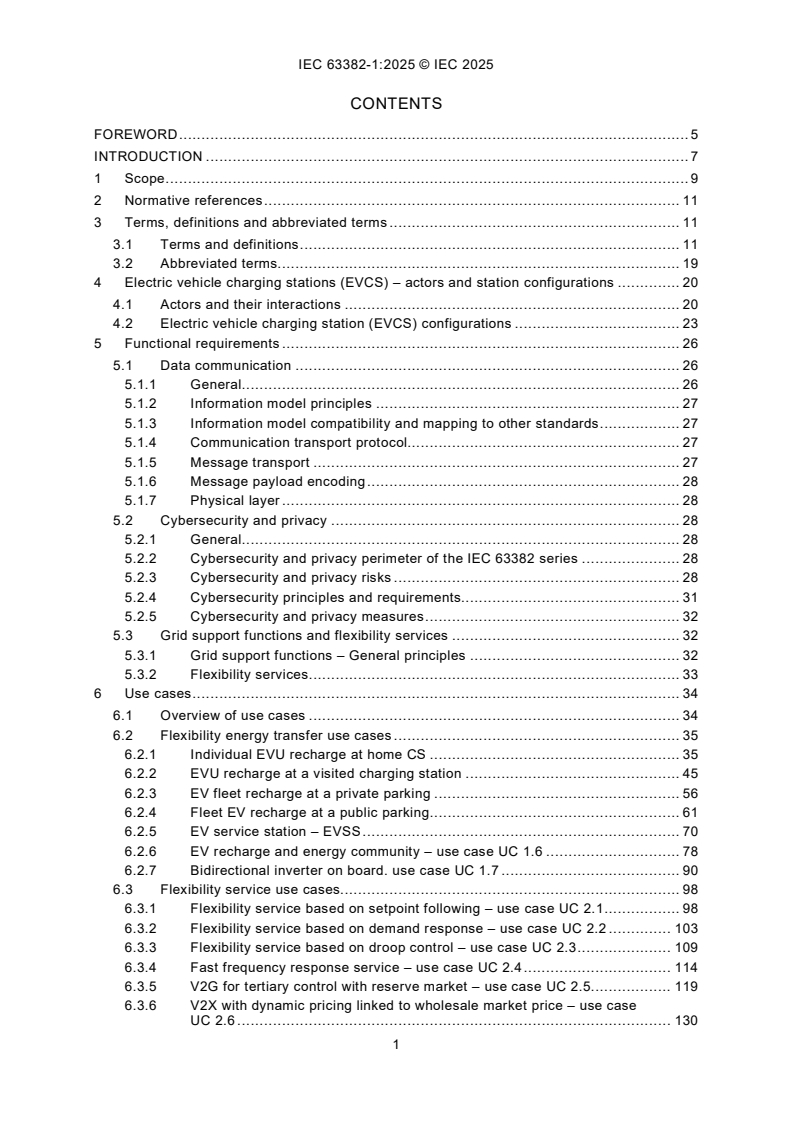
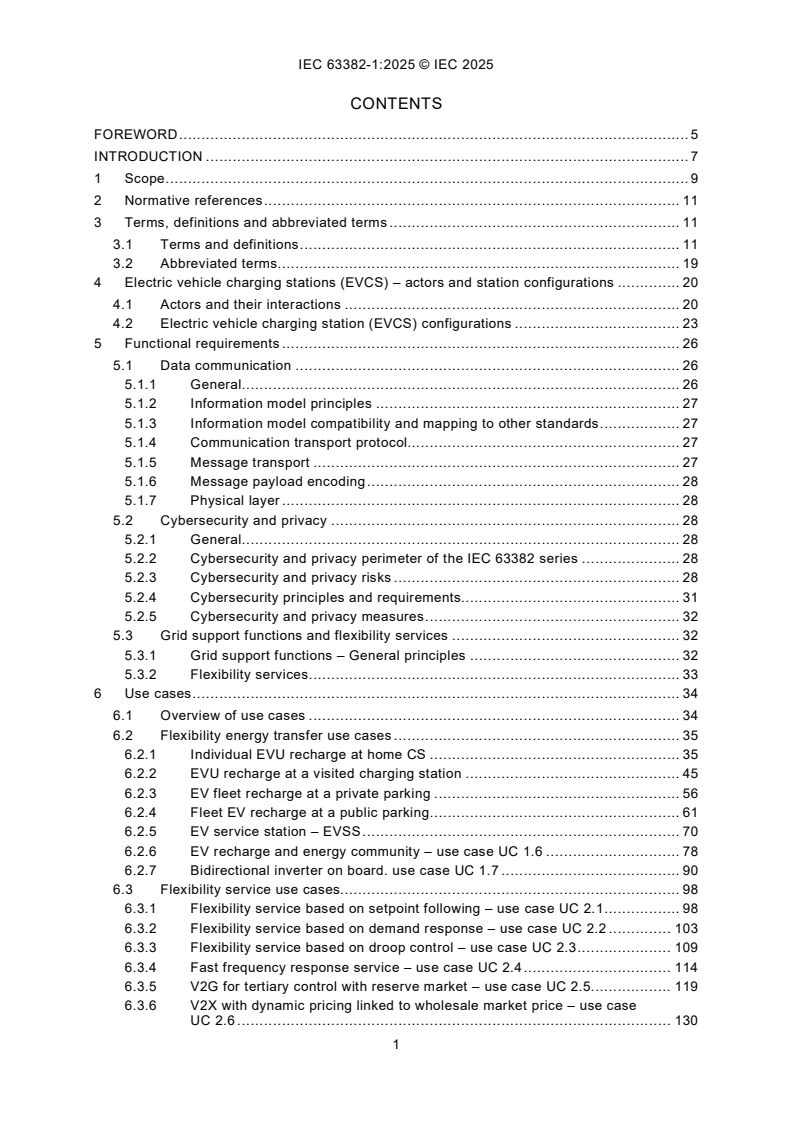
CONTENTS
FOREWORD . 5
INTRODUCTION . 7
1 Scope . 9
2 Normative references . 11
3 Terms, definitions and abbreviated terms . 11
3.1 Terms and definitions . 11
3.2 Abbreviated terms. 19
4 Electric vehicle charging stations (EVCS) – actors and station configurations . 20
4.1 Actors and their interactions . 20
4.2 Electric vehicle charging station (EVCS) configurations . 23
5 Functional requirements . 26
5.1 Data communication . 26
5.1.1 General. 26
5.1.2 Information model principles . 27
5.1.3 Information model compatibility and mapping to other standards . 27
5.1.4 Communication transport protocol. 27
5.1.5 Message transport . 27
5.1.6 Message payload encoding . 28
5.1.7 Physical layer . 28
5.2 Cybersecurity and privacy . 28
5.2.1 General. 28
5.2.2 Cybersecurity and privacy perimeter of the IEC 63382 series . 28
5.2.3 Cybersecurity and privacy risks . 28
5.2.4 Cybersecurity principles and requirements. 31
5.2.5 Cybersecurity and privacy measures . 32
5.3 Grid support functions and flexibility services . 32
5.3.1 Grid support functions – General principles . 32
5.3.2 Flexibility services . 33
6 Use cases . 34
6.1 Overview of use cases . 34
6.2 Flexibility energy transfer use cases . 35
6.2.1 Individual EVU recharge at home CS . 35
6.2.2 EVU recharge at a visited charging station . 45
6.2.3 EV fleet recharge at a private parking . 56
6.2.4 Fleet EV recharge at a public parking . 61
6.2.5 EV service station – EVSS . 70
6.2.6 EV recharge and energy community – use case UC 1.6 . 78
6.2.7 Bidirectional inverter on board. use case UC 1.7 . 90
6.3 Flexibility service use cases. 98
6.3.1 Flexibility service based on setpoint following – use case UC 2.1 . 98
6.3.2 Flexibility service based on demand response – use case UC 2.2 . 103
6.3.3 Flexibility service based on droop control – use case UC 2.3 . 109
6.3.4 Fast frequency response service – use case UC 2.4 . 114
6.3.5 V2G for tertiary control with reserve market – use case UC 2.5. 119
6.3.6 V2X with dynamic pricing linked to wholesale market price – use case
UC 2.6 . 130
6.3.7 Distribution grid congestion management by EV charging and
discharging – Use case UC 2.7 . 140
6.4 Management of FO interface . 151
6.4.1 Enrolment of CSO/CSP by flexibility operator – use case UC 3.1 . 151
6.4.2 Credentials handling – use case UC 3.2 . 155
6.4.3 Management of flexibility service contracts – use case UC 3.3. 159
6.4.4 Proof of flexibility service – use case UC 3.4 . 163
6.4.5 Discover flexibility service contract holders – use case UC 3.5 . 168
6.4.6 flexibility service Phone App – use case UC 3.6 . 172
Annex A (informative) Energy flexibility service use cases and DER operational
functions . 177
Annex B (informative) Supplementary information from Japanese energy markets . 186
B.1 UC 2.5: V2G for tertiary control with reserve market . 186
B.2 UC 2.6: V2X with dynamic pricing linked to the wholesale market . 188
B.3 UC 2.7: Distribution grid congestion management by EV charging and
discharging . 191
Annex C (informative) Energy flexibility services . 193
Bibliography . 195
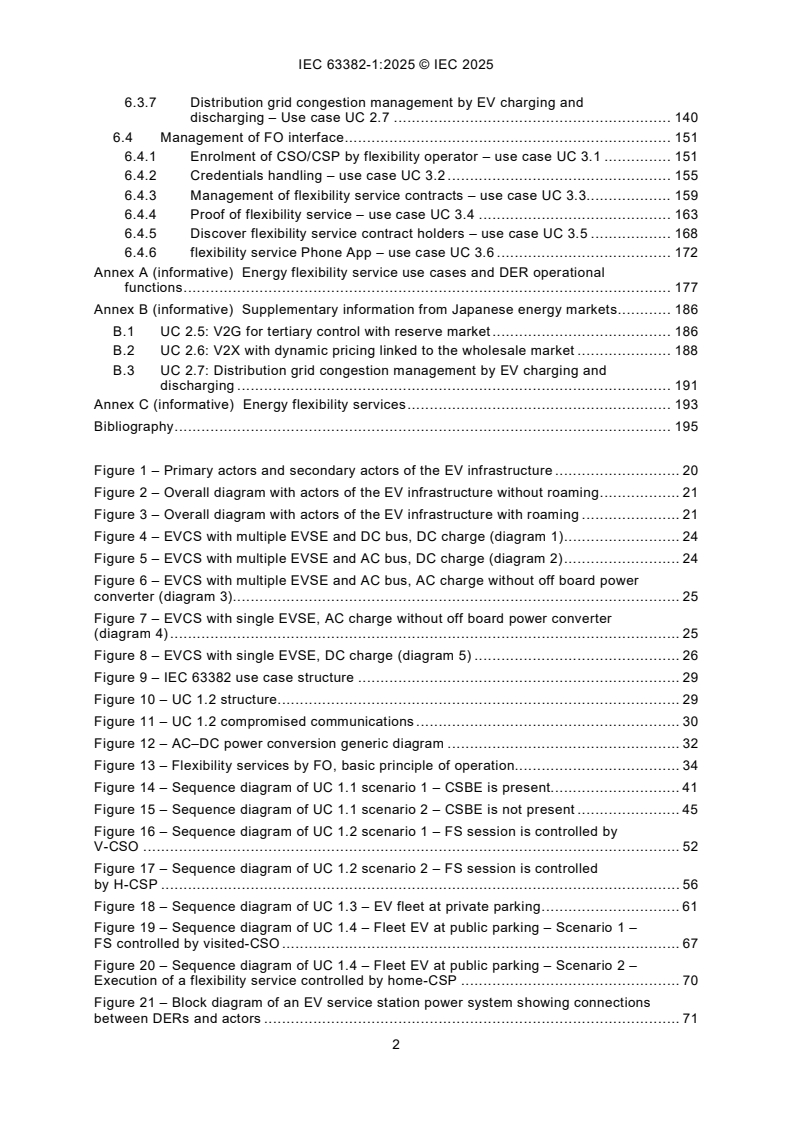
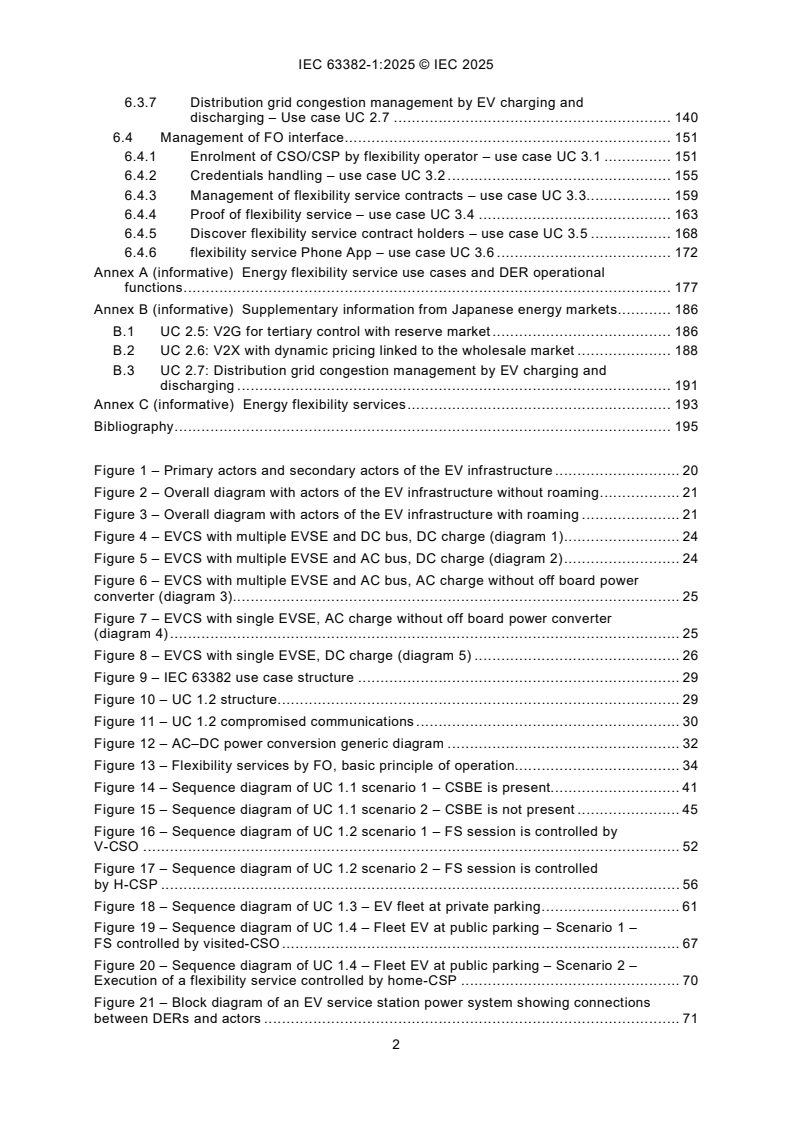
Figure 1 – Primary actors and secondary actors of the EV infrastructure . 20
Figure 2 – Overall diagram with actors of the EV infrastructure without roaming . 21
Figure 3 – Overall diagram with actors of the EV infrastructure with roaming . 21
Figure 4 – EVCS with multiple EVSE and DC bus, DC charge (diagram 1) . 24
Figure 5 – EVCS with multiple EVSE and AC bus, DC charge (diagram 2) . 24
Figure 6 – EVCS with multiple EVSE and AC bus, AC charge without off board power
converter (diagram 3). 25
Figure 7 – EVCS with single EVSE, AC charge without off board power converter
(diagram 4) . 25
Figure 8 – EVCS with single EVSE, DC charge (diagram 5) . 26
Figure 9 – IEC 63382 use case structure . 29
Figure 10 – UC 1.2 structure . 29
Figure 11 – UC 1.2 compromised communications . 30
Figure 12 – AC–DC power conversion generic diagram . 32
Figure 13 – Flexibility services by FO, basic principle of operation. 34
Figure 14 – Sequence diagram of UC 1.1 scenario 1 – CSBE is present. 41
Figure 15 – Sequence diagram of UC 1.1 scenario 2 – CSBE is not present . 45
Figure 16 – Sequence diagram of UC 1.2 scenario 1 – FS session is controlled by
V-CSO . 52
Figure 17 – Sequence diagram of UC 1.2 scenario 2 – FS session is controlled
by H-CSP . 56
Figure 18 – Sequence diagram of UC 1.3 – EV fleet at private parking . 61
Figure 19 – Sequence diagram of UC 1.4 – Fleet EV at public parking – Scenario 1 –
FS controlled by visited-CSO . 67
Figure 20 – Sequence diagram of UC 1.4 – Fleet EV at public parking – Scenario 2 –
Execution of a flexibility service controlled by home-CSP . 70
Figure 21 – Block diagram of an EV service station power system showing connections
between DERs and actors . 71
Figure 22 – Sequence diagram of UC 1.5 – EV service station . 77
Figure 23 – Block diagram of a prosumer power system showing connections between
DERs and actors . 79
Figure 24 – Sequence diagram of UC1.6 Scenario 1 – Operation of EC in on grid mode . 86
Figure 25 – Sequence diagram of UC1.6 Scenario 2 – Operation of EC in off grid mode . 90
Figure 26 – Block diagram of bidirectional inverter onboard . 91
Figure 27 – Sequence diagram of UC 1.7 – Bidirectional inverter onboard . 97
Figure 28 – Flow chart of use case UC 2.1 . 102
Figure 29 – Sequence diagram of UC 2.1 – flexibility service based on setpoint
following . 103
Figure 30 – Sequence diagram of UC 2.2 – flexibility service based on demand
response . 109
Figure 31 – Sequence diagram of UC 2.3 – flexibility service based on droop control . 114
Figure 32 – Interaction of actors in UC 2.4 . 114
Figure 33 – Sequence diagram of UC 2.4 – Fast frequency response service . 119
Figure 34 – Use case diagram . 122
Figure 35 – Sequence diagram of UC 2.5 – V2G for tertiary control with reserve market . 129
Figure 36 – Use case diagram . 133
Figure 37 – Sequence diagram of UC 2.6 – V2X with dynamic pricing linked to
wholesale market price . 140
Figure 38 – Use case diagram . 143
Figure 39 – Sequence diagram of UC 2.7 – Distribution grid congestion management
by EV charging and discharging . 150
Figure 40 – Sequence diagram of UC 3.1 – Enrolment of CSO/CSP by flexibility
operator . 155
Figure 41 – Sequence diagram of UC 3.2 – credentials handling . 159
Figure 42 – Sequence diagram of UC 3.3 – Management of flexibility service contracts . 163
Figure 43 – Sequence diagram of UC 3.4 – Proof of flexibility service . 168
Figure 44 – Sequence diagram of UC 3.5 – Discover flexibility service contract holders . 172
Figure 45 – Sequence diagram of UC 3.6 – flexibility service phone APP . 176
Figure B.1 – Tertiary control execution . 186
Figure B.2 – "V2G for tertiary control with reserve market" System Configuration . 187
Figure B.3 – Tertiary control result example . 187
Figure B.4 – "V2G for tertiary control with reserve market" System Architecture model . 188
Figure B.5 – System configuration of "V2X with dynamic pricing" . 189
Figure B.6 – Shift of charging time by applying dynamic pricing . 189
Figure B.7 – Induction of EV charging/discharging by electricity price . 190
Figure B.8 – "V2H with dynamic pricing" system architecture model . 190
Figure B.9 – System configuration of "distribution grid congestion management by EV
charging and discharging" . 191
Figure B.10 – Example of "distribution grid congestion management by EV charging" . 191
Figure B.11 – "Distribution grid congestion management by EV charging and
discharging" system architecture model . 192
Table 1 – List of actors of use cases . 22
Table 2 – EVCS Configurations . 23
Table 3 – Application of SGAM within IEC the 63382 series . 27
Table 4 – Information model mapping or compatibility . 27
Table 5 – Business parameters . 31
Table 6 – List of use cases and use case groups . 35
Table 7 – Additional actors in the UC 2.5 . 122
Table 8 – Additional actors in the UC 2.6 . 134
Table 9 – Additional actors in the UC 2.7 . 143
Table A.1 – DER functions, roles and information exchanges. flexibility services that
can be requested by FO to EVCS . 178
INTERNATIONAL ELECTROTECHNICAL COMMISSION
____________
Management of distributed energy storage systems
based on electrically chargeable vehicle batteries -
Part 1: Use cases and architectures
FOREWORD
1) The International Electrotechnical Commission (IEC) is a worldwide organization for standardization comprising
all national electrotechnical committees (IEC National Committees). The object of IEC is to promote international
co-operation on all questions concerning standardization in the electrical and electronic fields. To this end and
in addition to other activities, IEC publishes International Standards, Technical Specifications, Technical Reports,
Publicly Available Specifications (PAS) and Guides (hereafter referred to as "IEC Publication(s)"). Their
preparation is entrusted to technical committees; any IEC National Committee interested in the subject dealt with
may participate in this preparatory work. International, governmental and non-governmental organizations liaising
with the IEC also participate in this preparation. IEC collaborates closely with the International Organization for
Standardization (ISO) in accordance with conditions determined by agreement between the two organizations.
2) The formal decisions or agreements of IEC on technical matters express, as nearly as possible, an international
consensus of opinion on the relevant subjects since each technical committee has representation from all
interested IEC National Committees.
3) IEC Publications have the form of recommendations for international use and are accepted by IEC National
Committees in that sense. While all reasonable efforts are made to ensure that the technical content of IEC
Publications is accurate, IEC cannot be held responsible for the way in which they are used or for any
misinterpretation by any end user.
4) In order to promote international uniformity, IEC National Committees undertake to apply IEC Publications
transparently to the maximum extent possible in their national and regional publications. Any divergence between
any IEC Publication and the corresponding national or regional publication shall be clearly indicated in the latter.
5) IEC itself does not provide any attestation of conformity. Independent certification bodies provide conformity
assessment services and, in some areas, access to IEC marks of conformity. IEC is not responsible for any
services carried out by independent certification bodies.
6) All users should ensure that they have the latest edition of this publication.
7) No liability shall attach to IEC or its directors, employees, servants or agents including individual experts and
members of its technical committees and IEC National Committees for any personal injury, property damage or
other damage of any nature whatsoever, whether direct or indirect, or for costs (including legal fees) and
expenses arising out of the publication, use of, or reliance upon, this IEC Publication or any other IEC
Publications.
8) Attention is drawn to the Normative references cited in this publication. Use of the referenced publications is
indispensable for the correct application of this publication.
9) IEC draws attention to the possibility that the implementation of this document may involve the use of (a)
patent(s). IEC takes no position concerning the evidence, validity or applicability of any claimed patent rights in
respect thereof. As of the date of publication of this document, IEC had not received notice of (a) patent(s), which
may be required to implement this document. However, implementers are cautioned that this may not represent
the latest information, which may be obtained from the patent database available at https://patents.iec.ch. IEC
shall not be held responsible for identifying any or all such patent rights.
IEC 63382-1 has been prepared by IEC technical committee 69: Electrical power/energy
transfer systems for electrically propelled road vehicles and industrial trucks. It is an
International Standard.
The text of this International Standard is based on the following documents:
Draft Report on voting
69/1073/FDIS 69/1093/RVD
Full information on the voting for its approval can be found in the report on voting indicated in
the above table.
The language used for the development of this International Standard is English.
This document was drafted in accordance with ISO/IEC Directives, Part 2, and developed in
accordance with ISO/IEC Directives, Part 1 and ISO/IEC Directives, IEC Supplement, available
at www.iec.ch/members_experts/refdocs. The main document types developed by IEC are
described in greater detail at www.iec.ch/publications.
A list of all parts in the IEC 63382 series, published under the general title Management of
distributed energy storage systems based on electrically chargeable vehicle batteries, can be
found on the IEC website.
The committee has decided that the contents of this document will remain unchanged until the
stability date indicated on the IEC website under webstore.iec.ch in the data related to the
specific document. At this date, the document will be
– reconfirmed,
– withdrawn, or
– revised.
INTRODUCTION
The high share of renewable energy sources (RES) connected to the grid, because of their
intermittent and not-programmable nature, imposes a change in the management of the
electrical network.
The replacement of conventional generators with the RES static power converters reduces the
total rotating inertia connected to grid.
An increasing number of distributed energy resources (DERs), consisting in small generators,
energy storage systems and controllable loads, is connected to the distribution networks, which
become "active", that is, capable not only of absorbing energy from the transmission network,
but also of supplying energy in the opposite direction.
The transition to an "All Electric Society", which involves the use of electric energy in the
transportation (e-mobility) and in the building heating and conditioning systems (heat pumps),
increases the demand of electricity and imposes additional stress on the existing electrical
power systems.
Power unbalances, network congestions and voltage fluctuations may happen more frequently.
A more suitable way to manage the electrical network and to dispatch the energy resources is
unavoidable to meet these changes.
The energy flexibility, which is the ability to adjust power generation and/or demand, represents
a solution and it is applicable to DERs.
The growth of electric vehicle (EV) circulation, associated with the expansion of the EV charging
infrastructure and the advent of smart charging (V1G) and vehicle to grid (V2G) technologies
are creating a large number of DERs in the mobility sector.
In fact, the pair EVSE-EV can be considered as a DER, since it can operate as a generator in
V2G mode and as a controllable load in smart charging (V1G). Furthermore, the EV battery is
a mobile energy storage system.
Distributed energy storage systems (DESS), based on electrically chargeable vehicle batteries
(ECV-DESS), can be created by aggregating several EVs connected to the charging
infrastructure and acting as DERs.
The ECV-DESS may provide energy flexibility services contributing to an improvement of the
stable and reliable operation of the electrical network. See Annex C.
The power balancing will result from the coordinated efforts of conventional power systems in
combination with the EV charging infrastructure, other DERs, microgrids and virtual power
plants (VPPs), which may include DESS.
The energy flexibility services are aimed at achieving:
– power balancing;
– network congestion management;
– voltage control.
The specific nature of EV, which is mobile and capable to connect to the charging infrastructure
in different locations, with different charging modes, sets new requirements on the control and
communication interfaces.
The EV charging Stations may have different configurations and modes of operations.
They can operate by AC or DC charge, they can charge and discharge, with mono or
bidirectional power transfer between EV and EVSE.
They can be composed by one or more EVSEs in one EV-charging station. In presence of
multiple EVSEs, they can be arranged in AC or DC bus configurations.
Finally, the bidirectional inverter can be installed on-board of vehicle or off-board.
Appropriate standards are essential to manage the complexity of these systems.
These standards will sustain the growth of EV circulation, rule the V1G and V2G services,
support the aggregation of multiple EV DERs, define how to specify the requirements between
the aggregator /flexibility operator (FO) and the EV charging station operators.
NOTE Aggregator and flexibility operator have the same meaning in the context of this document.
The presence in the e-mobility market of products and services offered by several vendors calls
for interoperability and interchangeability between solutions provided by different suppliers.
Furthermore, the standards have to meet the requirements of cybersecurity and privacy for a
proper operation of ECV DESSs.
The IEC 63382 series is intended to cover all these aspects and to fills gaps in existing
standards concerning communication between the aggregator/FO and the EV charging station
backend system.
It is aimed at completing the communication and control chain which connect the EV with the
charging infrastructure (EVSE and charging stations) and with the aggregator/FO at an upper
hierarchical level. In this respect it represents a complement of the standardization work made
on ISO 15118 series and IEC 63110 series.
The IEC 63382 series consists of three parts, each dedicated to a specific subject:
IEC 63382-1 is dedicated to EV charging station configurations, communication architecture,
requirements, both functional and non-functional, use cases, with actors, roles and domains
descriptions. Reference is made to CENELEC's SGAM (Smart Grid Architecture Model) and to
UML model.
IEC 63382-2 is dedicated to communication protocol specifications. It includes layered model
according to OSI model from ISO, list of requirements, data models, object model, messages
and message formats, datatypes, message sequences, and security aspects.
IEC 63382-3 is dedicated to conformance testing. The tests will cover the interface between
Aggregator/FO and the CS Backend system.
It includes test setup, test suite, test cases designed to verify behaviour of system with respect
to specifications and requirements.
The IEC 63382 series is intended to be used by the many stakeholders of ECV-DESS:
Aggregators/FO, e-mobility service providers, car makers, utilities (e.g. energy supplier
(reseller), transmission grid operator (TSO), distribution grid operator (DSO), measuring point
operator), EV users, EV charging station operators and owners, manufacturers and maintainers
of interfacing products, technology providers (HW, SW, certification testing), software
developers and system engineers.
1 Scope
The IEC 63382 series specifies the management of distributed energy storage systems,
composed of electrically chargeable vehicle batteries (ECV-DESS), which are handled by an
aggregator/flexibility operator (FO) to provide energy flexibility services to grid operators.
Aggregator and flexibility operator have the same meaning in the context of this document and
represent the entity which aggregates a number of other network users (e.g. energy consumers,
prosumers, DERs) bundling energy consumption or generation assets into manageable sizes
for the energy system.
The aggregator/FO communicates with the charging station (CS) backend system, which is
typically the system platform (HW, SW and HMI) of either a charging station operator (CSO), or
a charging service provider (CSP).
The purpose of the data exchange is to perform flexibility services, and it takes place between
the aggregator/FO and a dedicated interface located in the CS backend system, which has
been defined FCSBE, flexibility port at the charging station backend.
This part of IEC 63382 describes the technical characteristics and architectures of ECV-DESS,
including:
– EV charging stations configurations, comprising several AC-EVSEs and/or DC-EVSEs;
– individual EVs connected to grid via an EVSE and managed by an aggregator/FO.
The focus of this document is on the interface between the FO and the FCSBE and the data
exchange at this interface, necessary to perform energy flexibility services (FS).
The FO/aggregator converts grid services and/or grid support functions requested by the grid
operators (DSOs or TSOs) into multiple flexibility services to be provided by a number of CSs,
utilizing their own optimization and resource allocation algorithms.
Communication between FO and grid operators (DSO, TSO), optimization algorithms adopted
by FO, flexibility service bidding procedures are out of scope of this document.
The data exchange between FO and FCSBE typically includes:
– flexibility service request and response;
– flexibility services parameters;
– EV charging station configuration and technical capabilities;
– credentials check of parties involved in the flexibility service;
– FS execution related notifications;
– event log, detailed service record, proof of work.
The exchange of credentials has the purpose to identify, authenticate and authorize the actors
involved in the flexibility service transaction, to check the validity of a FS contract and to verify
the technical capabilities of the system EV + CS, and conformity to applicable technical
standards to provide the requested flexibility service.
This document also describes the technical requirements of ECV-DESS, the use cases, the
information exchange between the EV charging station operator (CSO) and the aggregator/FO,
including both technical and business data.
It covers many aspects associated to the operation of ECV-DESS, including:
– privacy issues consequent to GDPR application (general data protection regulation);
– cybersecurity issues;
– grid code requirements, as set in national guidelines, to include ancillary services,
mandatory functions and remunerated services;
– grid functions associated to V2G operation, including new services, as fast frequency
response;
– authentication/authorization/transactions relative to charging sessions, including roaming,
pricing and metering information;
– management of energy transfers and reporting, including information interchange, related
to power/energy exchange, contractual data, metering data;
– demand response, as smart charging (V1G).
It makes a distinction between mandatory grid functions and market driven services, taking into
account the functions which are embedded in the FW control of DER smart inverters.
This document deals with use cases, requirements and architectures of the ECV-DESSs with
the associated EV charging stations.
Some classes of energy flexibility services (FS) have been identified and illustrated in dedicated
use cases:
– following a dynamic setpoint from FO;
– automatic execution of a droop curve provided by FO, according to local measurements of
frequency, voltage and power;
– demand response tasks, stimulated by price signals from FO;
– fast frequency response.
Furthermore, some other more specific flexibility service use cases include:
– V2G for tertiary control with reserve market;
– V2H with dynamic pricing linked to the wholesale market price;
– distribution grid congestion by EV charging and discharging.
FS are performed under flexibility service contracts (FSC) which can be stipulated between:
– FO and EV owner (EVU or EV fleet manager);
– FO and CSP;
– FO and CSO.
Any flexibility service is requested by the aggregator/FO with a flexibility service request (FSR)
communicated through the FCSBE interface to the available resources.
The actors EVU, CSO, CSP have always the right to choose opt-in or opt-out options in case
of a FSR, unless it is mandatory for safety or grid stability reasons.
A use case shows how to discover flexibility service contract (FSC) holders.
This document describes many use cases, some of them are dedicated to special applications
such as as: EV service station, energy community, fast frequency response, EV fleet, onboard
bidirectional inverter, mobile app.
2 Normative references
The following documents are referred to in the text in such a way that some or all of their content
constitutes requirements of this document. For dated references, only the edition cited applies.
For undated references, the latest edition of the referenced document (including any
amendments) applies.
IEC 62351-3, Power systems management and associated information exchange - Data and
communications security - Part 3: Communication network and system security - Profiles
including TCP/IP
IEC 62351-9, Power systems management and associated information exchange - Data and
communications security - Part 9: Cyber security key management for power system equipment
ISO 15118 (all parts), Road vehicles - Vehicle to grid communication interface
3 Terms, definitions and abbreviated terms
3.1 Terms and definitions
3.1.1
AC charge
electric vehicle charging mode carried out by EVSE supplying AC current to the EV, which is
then converted into DC current by an on-board charger to be fed to the EV battery
Note 1 to entry: It can also involve a bidirectional power transfer, with energy transfer from the EV battery
discharging into the AC power system.
3.1.2
actor
entity that communicates and interacts
Note 1 to entry: These actors can include people, software applications, systems, databases, and even the power
system itself.
Note 2 to entry: In IEC SRD 62913 this term includes the concepts of Business Role and System Role involved in
use cases.
[SOURCE: IEC 62559-2:2015, 3.2, modified – Note 2 to entry has been added.]
3.1.3
aggregator
party who contracts with a number of other network users (e.g. energy consumers) in order to
combine the effect of smaller loads or distributed energy resources for actions such as demand
response or for ancillary services
Note 1 to entry: Aggregator and flexibility operator have the same meaning in the context of this document.
[SOURCE: IEC 60050-617:2017, 617-02-18, modified – Note 1 to entry has been added.]
3.1.4
ancillary services
services necessary for the operation of an electric power system provided by the system
operator or by power system users
Note 1 to entry: System ancillary services may include the participation in frequency regulation, reactive power
regulation, active power reserve, etc.
[SOURCE: IEC 60050-617:2009, 617-03-09]
3.1.5
authentication
process of verifying the identity of the subject as what it claims to be
[SOURCE: IEC 63119-2:2022, 3.21]
3.1.6
authorization
process of granting subject access to particular resources or services
[SOURCE: IEC 63119-2:2022, 3.22]
3.1.7
balancing provider
party contractually responsible for the observed differences between electricity supplied and
electricity consumed, within a defined area
[SOURCE: IEC 60050-617:2009, 617-02-13, modified – The term “balancing coordinator” has
been removed.]
3.1.8
bidirectional converter
AC-DC power converter capable of converting and transferring power in both directions
Note 1 to entry: From AC to DC, it can act as a battery charger, from DC to AC, it can operate as an inverter and
inject power into the grid.
3.1.9
bidirectional power transfer
capability to transfer energy in both directions, forward for charging a vehicle, reverse for
discharging the vehicle
3.1.10
charging station backend
CSBE
computer system part of the EV charging infrastructure, responsible of remote management of
EVCS, capable of storing, processing and transferring data
Note 1 to entry: CSBE corresponds to the system platform of a CSO or CSP and normally it includes a CSMS, a
FCSBE interface and a roaming end point.
3.1.11
credential
physical or digital asset that carries the roaming service user's identity or contract ID, which is
used for authentication and security purposes
EXAMPLES
- static or dynamic QR code;
- username/password;
- RFID card;
- digital certificate transferred through the plug and charge process.
[SOURCE: IEC 63119-1:2019, 3.9]
3.1.12
home charging service provider
entity which has a contract with the EV user and can authorize an energy transfer session to
another CSP/CSO
[SOURCE: IEC 63119-2:2022, 3.11, modified – The terms “home-CSP”, “home e-mobility
service provider” and “home-EMSP” have been removed.]
3.1.13
visited charging station operator
CSP/CSO that the EV user visits for getting energy transfer service, which is not the EV user's
home-CSP
[SOURCE: IEC 63119-2:2022, 3.11, modified – The term “visited-CSO” has been removed.]
3.1.14
charging station
CS
physical equipment consisting of one or more CSCs and one or more EV supply equipment
managing the energy transfer to and from EVs
[SOURCE: IEC 63110-1:2022, 3.1.10]
3.1.15
charging station controller
CSC
sub-system responsible for managing one or more EV supply equipment
[SOURCE: IEC 63110-1:2022, 3.1.11, modified – In the definition, “system” is replaced with
“sub-system” and the note to entry has been removed.]
3.1.16
charging station management system
CSMS
system responsible for managing charging infrastructures
Note 1 to entry: CSMS can be local, cloud based or both.
[SOURCE: IEC 63110-1:2022, 3.1.8, modified – Note 1 to entry has been modified and Note 2
to entry has been removed.]
3.1.17
charging station operator
CSO
party responsible for the provisioning and operation of a charging infrastructure (including
charging sites) and managing electricity to provide requested energy transfer services
[SOURCE: IEC 63110-1:2022, 3.1.9]
3.1.18
service provider
entity which provides EV service to users, such as charging service provider (CSP) and
charging station operators (CSO)
[SOURCE: IEC 63119-2:2022, 3.9]
3.1.19
charging service provider
CSP
role that manages and authenticates EV user's credentials and provides the billing and other
value-added services to the customer
Note 1 to entry: A CSP is a specialized type of e-mobility service provider (EMSP)
[SOURCE: IEC 63110-1:2022, 3.1.5, modified – Note 1 to entry has been added.]
3.1.20
customer energy manager
CEM
internal automation function for optimizing the energy consumption or production within the
premises according to the preferences of the customer using internal flexibilities and typically
based on external information received through the Smart Grid Connection Point and possibly
other data sources
[SOURCE: IEC 63110-1:2022, 3.1.4, modified – Note 1 to entry has been removed.]
3.1.21
DC charge
EV charging mode carried out by EVSE supplying DC current to the EV, which is then fed
directly to the EV battery
Note 1 to entry: The DC current is provided by an off-board charger. It can involve also a bidirectional power
transfer, to allow EV battery discharging
3.1.22
demand response
DR
action resulting from management of the electricity demand in response to supply conditions
[SOURCE: IEC 60050-617:2011, 617-04-16]
3.1.23
distributed energy resources
DER
generators (with their auxiliaries, protection and connection equipment), including loads having
a generating mode (such as electrical energy storage systems), connected to a low-voltage or
a medium-voltage network
[SOURCE: IEC 60050-617:2017, 617-04-20]
3.1.24
distribution system operator
DSO
party operating a distribution system
[SOURCE: IEC 60050-617:2009, 617-02-10, modified – The terms "distribution network
operator" and "distributor" have been deleted.]
3.1.25
e-mobility service provider
EMSP
party responsible for providing high-value service related to the use of an EV (renting an EV,
reservation of parking service, navigation services, energy services, which include charging
station provider in relation with CSO…)
Note 1 to entry: A CSP is a specialized type of EMSP.
[SOURCE: IEC 63119-1:2019, 3.6, modified – Note 1 to entry has been replaced by a new
note.]
3.1.26
electric vehicle supply equipment
EVSE
equipment or a combination of equipment, providing dedicated functions to supply electric
energy from a fixed electrical installation or supply network to an EV for the purpose of charging
and discharging
[SOURCE: IEC 63110-1:2022, 3.1.20]
3.1.27
electric vehicle user
EVU
person or legal entity using the vehicle and providing information about its necessities
Note 1 to entry: This definition has been adapted from the one in IEC SRD 62913-2-4:2019, Table 3.
[SOURCE: IEC 63110-1:2022, 3.1.21]
3.1.28
energy transfer plan
ETP
forecast of future energy transfer activities with associated uncertainties, flexibility options and
limits over time
Note 1 to entry: The energy transfer plan is able to support all different charging techniques (ISO 15118 series
schedule and dynamic modes, CHAdeMO, etc.).
[SOURCE: IEC 63110-1:2022, 3.1.24]
3.1.29
electrical energy management system
EMS
system op
...
IEC 63382-1 ®
Edition 1.0 2025-11
NORME
INTERNATIONALE
Gestion des systèmes de stockage d’énergie décentralisés installés sur les
batteries de véhicules électriques rechargeables -
Partie 1: Cas d’utilisation et architectures
ICS 29.240; 33.200; 43.120 ISBN 978-2-8327-0786-9
Droits de reproduction réservés. Sauf indication contraire, aucune partie de cette publication ne peut être reproduite ni
utilisée sous quelque forme que ce soit et par aucun procédé, électronique ou mécanique, y compris la photocopie et
les microfilms, sans l'accord écrit de l'IEC ou du Comité national de l'IEC du pays du demandeur. Si vous avez des
questions sur le copyright de l'IEC ou si vous désirez obtenir des droits supplémentaires sur cette publication, utilisez
les coordonnées ci-après ou contactez le Comité national de l'IEC de votre pays de résidence.
IEC Secretariat Tel.: +41 22 919 02 11
3, rue de Varembé info@iec.ch
CH-1211 Geneva 20 www.iec.ch
Switzerland
A propos de l'IEC
La Commission Electrotechnique Internationale (IEC) est la première organisation mondiale qui élabore et publie des
Normes internationales pour tout ce qui a trait à l'électricité, à l'électronique et aux technologies apparentées.
A propos des publications IEC
Le contenu technique des publications IEC est constamment revu. Veuillez vous assurer que vous possédez l’édition la
plus récente, un corrigendum ou amendement peut avoir été publié.
Recherche de publications IEC - IEC Products & Services Portal - products.iec.ch
webstore.iec.ch/advsearchform Découvrez notre puissant moteur de recherche et consultez
La recherche avancée permet de trouver des publications gratuitement tous les aperçus des publications, symboles
IEC en utilisant différents critères (numéro de référence, graphiques et le glossaire. Avec un abonnement, vous aurez
texte, comité d’études, …). Elle donne aussi des toujours accès à un contenu à jour adapté à vos besoins.
informations sur les projets et les publications remplacées
ou retirées. Electropedia - www.electropedia.org
Le premier dictionnaire d'électrotechnologie en ligne au
IEC Just Published - webstore.iec.ch/justpublished monde, avec plus de 22 500 articles terminologiques en
Restez informé sur les nouvelles publications IEC. Just anglais et en français, ainsi que les termes équivalents
Published détaille les nouvelles publications parues. dans 25 langues additionnelles. Egalement appelé
Disponible en ligne et une fois par mois par email. Vocabulaire Electrotechnique International (IEV) en ligne.
Service Clients - webstore.iec.ch/csc
Si vous désirez nous donner des commentaires sur cette
publication ou si vous avez des questions contactez-
nous: sales@iec.ch.
SOMMAIRE
AVANT-PROPOS . 5
INTRODUCTION . 7
1 Domaine d’application . 10
2 Références normatives . 12
3 Termes, définitions et abréviations . 12
3.1 Termes et définitions. 12
3.2 Abréviations . 21
4 Bornes de charge pour véhicules électriques (EVCS) – Acteurs et configurations
des bornes . 22
4.1 Les acteurs et leurs interactions . 22
4.2 Configurations des bornes de charge pour véhicules électriques (EVCS). 27
5 Exigences fonctionnelles . 31
5.1 Communication de données . 31
5.1.1 Généralités . 31
5.1.2 Principes du modèle d’information . 31
5.1.3 Compatibilité des modèles d’information et mapping avec d’autres
normes . 31
5.1.4 Protocole de transport de communication . 32
5.1.5 Transport de messages . 32
5.1.6 Encodage de la charge utile de message. 32
5.1.7 Couche physique . 32
5.2 Cybersécurité et confidentialité . 32
5.2.1 Généralités . 32
5.2.2 Périmètre de cybersécurité et de confidentialité de la série IEC 63382 . 32
5.2.3 Risques de cybersécurité et de confidentialité . 33
5.2.4 Principes de cybersécurité et exigences associées . 36
5.2.5 Mesures de cybersécurité et de confidentialité . 37
5.3 Fonctions de support réseau et services de flexibilité . 37
5.3.1 Fonctions de support réseau – Principes généraux . 37
5.3.2 Services de flexibilité . 38
6 Cas d’utilisation . 39
6.1 Vue d’ensemble des cas d’utilisation . 39
6.2 Cas d’utilisation du transfert d’énergie de flexibilité . 41
6.2.1 Recharge par un UVE sur une CS domestique . 41
6.2.2 Recharge par l’UVE sur une borne de charge sollicitée . 52
6.2.3 Recharge d’une flotte de VE dans un parking privé . 63
6.2.4 Recharge d’une flotte de VE sur un parking public . 69
6.2.5 Station-service avec borne de charge . 80
6.2.6 Recharge de VE et communauté énergétique – Cas d’utilisation UC 1.6 . 88
6.2.7 Inverseur bidirectionnel embarqué – Cas d’utilisation UC 1.7. 101
6.3 Cas d’utilisation du service de flexibilité . 109
6.3.1 Service de flexibilité basé sur le suivi d’un point de consigne – Cas
d’utilisation UC 2.1 . 109
6.3.2 Service de flexibilité basé sur la gestion de la demande – Cas
d’utilisation UC 2.2 . 116
6.3.3 Service de flexibilité basé sur une commande de statisme — Cas
d’utilisation UC 2.3 . 122
6.3.4 Service de réponse rapide en fréquence – Cas d’utilisation UC 2.4 . 128
6.3.5 V2G pour contrôle tertiaire avec marché de réserve – Cas d’utilisation
UC 2.5 . 133
6.3.6 V2X avec tarification dynamique liée au prix du marché de gros – Cas
d’utilisation UC 2.6 . 144
6.3.7 Gestion de la congestion du réseau de distribution par charge et
décharge des VE – Cas d’utilisation UC 2.7 . 155
6.4 Gestion de l’interface avec l’OF. 166
6.4.1 Inscription du CSO/CSP par l’opérateur de flexibilité – Cas d’utilisation
UC 3.1 . 166
6.4.2 Gestion des identifiants – Cas d’utilisation UC 3.2 . 170
6.4.3 Gestion des contrats de service de flexibilité – Cas d’utilisation UC 3.3 . 174
6.4.4 Preuve de service de flexibilité – Cas d’utilisation UC 3.4 . 178
6.4.5 Découvrir les titulaires de contrats de service de flexibilité – Cas
d’utilisation UC 3.5 . 183
6.4.6 Appli mobile de service de flexibilité – Cas d’utilisation UC 3.6 . 188
Annexe A (informative) Cas d’utilisation du service de flexibilité énergétique et
fonctions opérationnelles DER . 194
Annexe B (informative) Informations supplémentaires concernant les marchés de
l’énergie japonais . 205
B.1 UC 2.5: V2G pour contrôle tertiaire avec marché de réserve . 205
B.2 UC 2.6: V2X avec tarification dynamique liée au marché de gros . 207
B.3 UC 2.7: Gestion de la congestion du réseau de distribution par charge et
décharge des VE . 210
Annexe C (informative) Services de flexibilité énergétique . 212
Bibliographie . 214
Figure 1 – Acteurs principaux et acteurs secondaires de l’infrastructure VE . 23
Figure 2 – Schéma d’ensemble avec les acteurs de l’infrastructure VE sans itinérance . 24
Figure 3 – Schéma d’ensemble avec les acteurs de l’infrastructure VE avec itinérance . 24
Figure 4 – EVCS avec plusieurs SAVE, un bus en courant continu et une charge en
courant continu (schéma 1) . 28
Figure 5 – EVCS avec plusieurs SAVE, un bus en courant alternatif et une charge en
courant continu (schéma 2) . 29
Figure 6 — EVCS avec plusieurs SAVE, un bus en courant alternatif et une charge en
courant alternatif, sans convertisseur de puissance externe (schéma 3) . 29
Figure 7 — EVCS avec un seul SAVE, une charge en courant alternatif, sans
convertisseur de puissance externe (schéma 4) . 30
Figure 8 — EVCS avec un seul SAVE et une charge en courant continu (schéma 5) . 30
Figure 9 – Structure des cas d’utilisation de l’IEC 63382 . 33
Figure 10 – Structure de l’UC 1.2 . 34
Figure 11 – Communications compromises dans le cadre de l’UC 1.2 . 35
Figure 12 – Schéma générique de la conversion de puissance courant alternatif-
courant continu . 38
Figure 13 – Services de flexibilité fournis par l’OF — Principe de fonctionnement
de base . 39
Figure 14 – Diagramme de séquence du cas d’utilisation 1.1, scénario 1 – CSBE
présent . 47
Figure 15 – Diagramme de séquence du cas d’utilisation 1.1, scénario 2 –
CSBE non présent . 52
Figure 16 – Diagramme de séquence du cas d’utilisation 1.2, scénario 1 – La session
FS est contrôlée par le CSO sollicité . 59
Figure 17 – Diagramme de séquence du cas d’utilisation 1.2, scénario 2 — La session
FS est contrôlée par le CSP contractuel. 63
Figure 18 – Diagramme de séquence du cas d’utilisation 1.3 – Flotte de VE sur
un parking privé . 69
Figure 19 – Diagramme de séquence du cas d’utilisation 1.4 – Flotte de VE sur un
parking public – Scénario 1 – FS contrôlé par le CSO sollicité. 76
Figure 20 – Diagramme de séquence du cas d’utilisation 1.4 – Flotte de VE sur un
parking public – Scénario 2 – Exécution d’un service de flexibilité contrôlée par le CSP
contractuel . 80
Figure 21 – Schéma de principe du réseau d’énergie d’une station-service avec borne
de charge montrant les connexions entre les DER et les acteurs . 81
Figure 22 – Diagramme de séquence du cas d’utilisation 1.5 – Station-service avec
borne de charge . 87
Figure 23 – Schéma de principe du réseau d’énergie d’un prosommateur montrant les
connexions entre les DER et les acteurs . 89
Figure 24 – Diagramme de séquence du cas d’utilisation 1.6, scénario 1 –
Fonctionnement de la CE en mode réseau . 96
Figure 25 – Diagramme de séquence du cas d’utilisation 1.6, scénario 2 –
Fonctionnement de la CE en mode hors réseau . 101
Figure 26 – Schéma de principe de l’onduleur bidirectionnel embarqué . 102
Figure 27 – Diagramme de séquence du cas d’utilisation UC 1.7 – Onduleur
bidirectionnel embarqué . 109
Figure 28 – Organigramme du cas d’utilisation 2.1 . 115
Figure 29 – Diagramme de séquence du cas d’utilisation 2.1 – Service de flexibilité
basé sur le suivi de point de consigne . 116
Figure 30 – Diagramme de séquence du cas d’utilisation 2.2 – Service de flexibilité
basé sur la gestion de la demande . 122
Figure 31 – Diagramme de séquence du cas d’utilisation 2.3 – Service de flexibilité
basé sur la commande de statisme. 128
Figure 32 – Interaction des acteurs dans le cas d’utilisation 2.4 . 129
Figure 33 – Diagramme de séquence du cas d’utilisation 2.4 – Service de réponse
rapide en fréquence . 133
Figure 34 – Schéma du cas d’utilisation . 136
Figure 35 – Diagramme de séquence du cas d’utilisation 2.5 – V2G pour contrôle
tertiaire avec marché de réserve . 143
Figure 36 – Schéma du cas d’utilisation . 148
Figure 37 – Diagramme de séquence du cas d’utilisation 2.6 – V2X avec tarification
dynamique liée au prix de marché de gros . 155
Figure 38 – Schéma du cas d’utilisation . 158
Figure 39 – Diagramme de séquence du cas d’utilisation 2.7 – Gestion de la
congestion du réseau de distribution par charge et décharge des VE . 165
Figure 40 – Diagramme de séquence du cas d’utilisation 3.1 — Inscription du
CSO/CSP par l’opérateur de flexibilité . 170
Figure 41 – Diagramme de séquence du cas d’utilisation 3.2 — Gestion des
identifiants . 174
Figure 42 – Diagramme de séquence du cas d’utilisation 3.3 — Gestion des contrats
de service de flexibilité. 178
Figure 43 – Diagramme de séquence du cas d’utilisation 3.4 – Preuve de service
de flexibilité . 183
Figure 44 – Diagramme de séquence du cas d’utilisation 3.5 — Découvrir les titulaires
de contrats de service de flexibilité . 188
Figure 45 – Diagramme de séquence du cas d’utilisation 3.6 — Appli mobile de service
de flexibilité . 193
Figure B.1 – Exécution du contrôle tertiaire . 205
Figure B.2 – Configuration du système "V2G pour contrôle tertiaire avec marché
de réserve" . 206
Figure B.3 – Exemple de résultat du contrôle tertiaire . 206
Figure B.4 – Modèle d’architecture du système "V2G pour contrôle tertiaire avec
marché de réserve" . 207
Figure B.5 – Configuration du système "V2X avec tarification dynamique" . 208
Figure B.6 – Décalage de l’heure de charge par application de la tarification
dynamique . 208
Figure B.7 – Détermination de la charge/décharge des VE en fonction du prix de
l’électricité . 209
Figure B.8 – Modèle d’architecture du système "V2H avec tarification dynamique" . 209
Figure B.9 – Configuration du système de "gestion de la congestion du réseau de
distribution par charge et décharge des VE" . 210
Figure B.10 – Exemple de "gestion de la congestion du réseau de distribution par
charge et décharge des VE" . 210
Figure B.11 – Modèle d’architecture du système de "gestion de la congestion du
réseau de distribution par charge et décharge des VE" . 211
Tableau 1 – Liste des acteurs selon les cas d’utilisation . 25
Tableau 2 – Configurations des EVCS . 26
Tableau 3 — Application du SGAM dans le cadre de la série IEC 63382 . 31
Tableau 4 — Mapping ou compatibilité des modèles d’information . 32
Tableau 5 – Paramètres métier . 36
Tableau 6 – Liste des cas d’utilisation et groupes de cas d’utilisation. 40
Tableau 7 – Acteurs supplémentaires du cas d’utilisation 2.5 . 137
Tableau 8 – Acteurs supplémentaires du cas d’utilisation 2.6 . 149
Tableau 9 – Acteurs supplémentaires du cas d’utilisation 2.7 . 158
Tableau A.1 – Fonctions, rôles et échanges d’informations DER, services de flexibilité
pouvant être demandés par OF à EVCS. 195
COMMISSION ÉLECTROTECHNIQUE INTERNATIONALE
____________
Gestion des systèmes de stockage d’énergie décentralisés installés sur
les batteries de véhicules électriques rechargeables -
Partie 1: Cas d’utilisation et architectures
AVANT-PROPOS
1) La Commission Électrotechnique Internationale (IEC) est une organisation mondiale de normalisation composée
de l’ensemble des comités électrotechniques nationaux (Comités nationaux de l’IEC). L’IEC a pour objet de
favoriser la coopération internationale pour toutes les questions de normalisation dans les domaines de
l’électricité et de l’électronique. À cet effet, l’IEC – entre autres activités – publie des Normes internationales,
des Spécifications techniques, des Rapports techniques, des Spécifications accessibles au public (PAS) et des
Guides (ci-après dénommés "Publication(s) de l’IEC"). Leur élaboration est confiée à des comités d’études, aux
travaux desquels tout Comité national intéressé par le sujet traité peut participer. Les organisations
internationales, gouvernementales et non gouvernementales, en liaison avec l’IEC, participent également aux
travaux. L’IEC collabore étroitement avec l’Organisation Internationale de Normalisation (ISO), selon des
conditions fixées par accord entre les deux organisations.
2) Les décisions ou accords officiels de l’IEC concernant les questions techniques représentent, dans la mesure du
possible, un accord international sur les sujets étudiés, étant donné que les Comités nationaux de l’IEC intéressés
sont représentés dans chaque comité d’études.
3) Les Publications de l’IEC se présentent sous la forme de recommandations internationales et sont agréées
comme telles par les Comités nationaux de l’IEC. Tous les efforts raisonnables sont entrepris afin que l’IEC
s’assure de l’exactitude du contenu technique de ses publications; l’IEC ne peut pas être tenue responsable de
l’éventuelle mauvaise utilisation ou interprétation qui en est faite par un quelconque utilisateur final.
4) Dans le but d’encourager l’uniformité internationale, les Comités nationaux de l’IEC s’engagent, dans toute la
mesure possible, à appliquer de façon transparente les Publications de l’IEC dans leurs publications nationales
et régionales. Toutes divergences entre toutes Publications de l’IEC et toutes publications nationales ou
régionales correspondantes doivent être indiquées en termes clairs dans ces dernières.
5) L’IEC elle-même ne fournit aucune attestation de conformité. Des organismes de certification indépendants
fournissent des services d’évaluation de conformité et, dans certains secteurs, accèdent aux marques de
conformité de l’IEC. L’IEC n’est responsable d’aucun des services effectués par les organismes de certification
indépendants.
6) Tous les utilisateurs doivent s’assurer qu’ils sont en possession de la dernière édition de cette publication.
7) Aucune responsabilité ne doit être imputée à l’IEC, à ses administrateurs, employés, auxiliaires ou mandataires,
y compris ses experts particuliers et les membres de ses comités d’études et des Comités nationaux de l’IEC,
pour tout préjudice causé en cas de dommages corporels et matériels, ou de tout autre dommage de quelque
nature que ce soit, directe ou indirecte, ou pour supporter les coûts (y compris les frais de justice) et les dépenses
découlant de la publication ou de l’utilisation de cette Publication de l’IEC ou de toute autre Publication de l’IEC,
ou au crédit qui lui est accordé.
8) L’attention est attirée sur les références normatives citées dans cette publication. L’utilisation de publications
référencées est obligatoire pour une application correcte de la présente publication.
9) L’IEC attire l’attention sur le fait que la mise en application du présent document peut entraîner l’utilisation d’un
ou de plusieurs brevets. L’IEC ne prend pas position quant à la preuve, à la validité et à l’applicabilité de tout
droit de propriété revendiqué à cet égard. À la date de publication du présent document, l’IEC [avait/n’avait pas]
reçu notification qu’un ou plusieurs brevets pouvaient être nécessaires à sa mise en application. Toutefois, il y a
lieu d’avertir les responsables de la mise en application du présent document que des informations plus récentes
sont susceptibles de figurer dans la base de données de brevets, disponible à l’adresse https://patents.iec.ch.
L’IEC ne saurait être tenue pour responsable de ne pas avoir identifié de tels droits de brevet.
L’IEC 63382-1 a été établie par le comité d’études 69 de l’IEC: Véhicules électriques destinés
à circuler sur la voie publique et chariots de manutention électriques. Il s’agit d’une Norme
internationale.
Le texte de cette Norme internationale est issu des documents suivants:
Projet Rapport de vote
69/1073/FDIS 69/1093/RVD
Le rapport de vote indiqué dans le tableau ci-dessus donne toute information sur le vote ayant
abouti à son approbation.
La langue employée pour l’élaboration de cette Norme internationale est l’anglais.
La version française de la norme n’a pas été soumise au vote.
Ce document a été rédigé selon les Directives ISO/IEC, Partie 2, il a été développé selon les
Directives ISO/IEC, Partie 1 et les Directives ISO/IEC, Supplément IEC, disponibles sous
www.iec.ch/members_experts/refdocs. Les principaux types de documents développés par
l’IEC sont décrits plus en détail sous www.iec.ch/publications.
Une liste de toutes les parties de la série IEC 63382, publiées sous le titre général Gestion des
systèmes de stockage d’énergie décentralisés installés sur les batteries de véhicules
électriques rechargeables, se trouve sur le site web de l’IEC.
Le comité a décidé que le contenu de ce document ne sera pas modifié avant la date de stabilité
indiquée sur le site Web de l’IEC sous webstore.iec.ch dans les données relatives au document
recherché. À cette date, le document sera
– reconduit,
– supprimé, ou
– révisé.
INTRODUCTION
La part élevée des sources d’énergie renouvelable (RES) raccordées au réseau impose, du fait
de leur nature intermittente et non programmable, une évolution dans la gestion du réseau
électrique.
Le remplacement des générateurs conventionnels par des convertisseurs de puissance statique
de RES réduit l’inertie de rotation totale raccordée au réseau.
Un nombre croissant de ressources énergétiques décentralisées (DER), constituées de petits
générateurs, de systèmes de stockage d'énergie et de charges contrôlables, est raccordé aux
réseaux de distribution qui deviennent "actifs", c'est-à-dire capables non seulement d'absorber
l'énergie du réseau de transport, mais aussi de fournir de l'énergie dans le sens inverse.
La transition vers une "société entièrement électrique", qui implique l'utilisation de l'énergie
électrique dans les transports (e-mobilité) et dans les systèmes de chauffage et de climatisation
des bâtiments (pompes à chaleur), augmente la demande d'électricité et impose des contraintes
supplémentaires aux réseaux d’énergie électrique existants.
Des déséquilibres de puissance, des surcharges de réseau et des fluctuations de tension
peuvent se produire plus fréquemment.
Il est indispensable de trouver une méthode plus adaptée pour gérer le réseau électrique et
répartir les ressources énergétiques afin de faire face à ces changements.
La flexibilité énergétique, qui est la capacité d’ajuster la production et/ou la demande d’énergie,
constitue une solution et est applicable aux DER.
La croissance de la circulation des véhicules électriques (VE), associée à l’expansion de
l’infrastructure de recharge des VE et à l’avènement des technologies de charge intelligente
(V1G) et de liaison véhicule-réseau électrique (V2G), crée un grand nombre de DER dans le
secteur de la mobilité.
En fait, la paire SAVE-VE peut être considérée comme une DER car elle peut fonctionner
comme un générateur en mode V2G et comme une charge contrôlable en charge intelligente
(V1G). En outre, la batterie du VE est un système mobile de stockage d’énergie.
Des systèmes de stockage d’énergie décentralisés (DESS), installés sur les batteries de
véhicules électriques rechargeables (ECV-DESS), peuvent être créés en regroupant plusieurs
VE connectés à l’infrastructure de recharge et faisant office de DER.
L’ECV-DESS peut fournir des services de flexibilité énergétique contribuant à améliorer le
fonctionnement stable et fiable du réseau électrique. Voir l’Annexe C.
L’équilibrage de puissance résulte des efforts coordonnés des réseaux d’énergie
conventionnels en combinaison avec l’infrastructure de recharge pour VE, les autres DER, les
microréseaux et les centrales électriques virtuelles, qui peuvent inclure les DESS.
Les services de flexibilité énergétique visent à permettre:
– l’équilibrage de la puissance;
– la gestion de la congestion du réseau;
– la commande de la tension.
La nature spécifique d’un VE, qui est mobile et capable de se connecter à l’infrastructure de
recharge à différents endroits, avec différents modes de recharge, définit de nouvelles
exigences en matière d’interfaces de contrôle et de communication.
Les bornes de charge pour VE peuvent avoir des configurations et modes de fonctionnement
différents.
Elles peuvent fonctionner en charge en courant alternatif ou continu et elles peuvent charger
et décharger, avec un transfert d’énergie unidirectionnel ou bidirectionnel entre le VE et le
système d’alimentation pour véhicule électrique (SAVE).
Une seule borne de charge pour VE peut comprendre un ou plusieurs SAVE. En présence de
plusieurs SAVE, ceux-ci peuvent être disposés dans des configurations de bus en courant
alternatif ou continu.
Enfin, l’onduleur bidirectionnel peut être installé à bord en dehors du véhicule.
Des normes appropriées sont essentielles pour gérer la complexité de ces systèmes.
Ces normes visent à soutenir la croissance de la circulation des VE, régir les services V1G et
V2G, prendre en charge l’agrégation de plusieurs DER de VE, définir comment spécifier les
exigences entre un agrégateur/opérateur de flexibilité (OF) et les opérateurs de service de
charge pour VE.
NOTE Les termes "agrégateur" et "opérateur de flexibilité" ont la même signification dans le contexte du présent
document.
La présence dans le marché de l’e-mobilité des produits et services proposés par plusieurs
fournisseurs nécessite une interopérabilité et une interchangeabilité entre les solutions fournies
par les différents fournisseurs.
En outre, les normes doivent satisfaire aux exigences de cybersécurité et de confidentialité
pour le bon fonctionnement des ECV-DESS.
La série IEC 63382 est destinée à couvrir tous ces aspects et à combler les lacunes des normes
existantes concernant la communication entre l’agrégateur/OF et le serveur de borne de charge
pour VE.
Elle vise à compléter la chaîne de communication et de contrôle qui relie le VE à l’infrastructure
de recharge (SAVE et bornes de charge) et à l’agrégateur/OF à un niveau hiérarchique
supérieur. À cet égard, elle constitue un complément du travail de normalisation effectué sur la
série ISO 15118 et la série IEC 63110.
La série IEC 63382 se compose de trois parties, chacune étant consacrée à un sujet spécifique:
L’IEC 63382-1 est consacrée aux configurations des bornes de charge pour VE, à l’architecture
de communication, aux exigences fonctionnelles et non fonctionnelles, aux cas d’utilisation,
avec les descriptions des acteurs, des rôles et des domaines. Il est fait référence au modèle
d’architecture de réseau intelligent SGAM du CENELEC et au modèle UML.
L'IEC 63382-2 est consacrée aux spécifications de protocoles de communication. Elle
comprend un modèle à plusieurs couches conformément au modèle OSI de l’ISO, une liste
d’exigences, des modèles de données, un modèle d’objet, des messages et formats de
messages, des types de données, des séquences de messages et des aspects de sécurité.
L’IEC 63382-3 est consacrée aux essais de conformité. Les essais couvrent l’interface entre
l’agrégateur/OF et le serveur de borne de charge.
Elle comprend le montage d’essai, la suite d’essais et les cas d’essai conçus pour vérifier le
comportement du système par rapport aux spécifications et aux exigences.
La série IEC 63382 est destinée à être utilisée par les nombreuses parties prenantes de
l’ECV-DESS:
agrégateurs/OF, prestataires de services d’e-mobilité, constructeurs automobiles, régies
d’électricité (par exemple fournisseur d’énergie (revendeur), opérateur de réseau de transport
(TSO), opérateur de réseau de distribution (DSO), opérateur de points de mesure), utilisateurs
de VE, opérateurs et propriétaires de bornes de charge pour VE, fabricants et mainteneurs de
produits d’interface, fournisseurs de technologies (matériels, logiciels, essais de certification),
développeurs de logiciels et ingénieurs système.
1 Domaine d’application
La série IEC 63382 spécifie la gestion des systèmes de stockage d’énergie décentralisés,
composés de batteries de véhicules électriques rechargeables (ECV-DESS), qui sont gérés par
un agrégateur/opérateur de flexibilité (OF) pour fournir des services de flexibilité énergétique
aux opérateurs de réseau.
Les termes "agrégateur" et "opérateur de flexibilité" ont la même signification dans le contexte
du présent document et représentent l’entité qui agrège un certain nombre d’autres utilisateurs
du réseau (par exemple des consommateurs d’énergie, prosommateurs, DER) en regroupant
des actifs de production ou de consommation d’énergie afin d’obtenir des tailles gérables au
niveau du système énergétique.
L’agrégateur/OF communique avec le serveur de borne de charge, qui est généralement la
plateforme du système (matériels, logiciels et HMI) d’un opérateur de service de charge (CSO)
ou d’un prestataire de service de charge (CSP).
L’échange de données a pour objectif de fournir des services de flexibilité et il a lieu entre
l’agrégateur/OF et une interface réservée située dans le serveur de borne de charge, qui a
été définie comme un port de flexibilité FCSBE sur le serveur de borne de charge.
La présente partie de l’IEC 63382 décrit les caractéristiques techniques et les architectures de
l’ECV-DESS, notamment:
– les configurations des bornes de charge pour VE, composées de plusieurs SAVE à courant
alternatif et/ou continu;
– les VE individuels connectés au réseau électrique par l’intermédiaire d’un SAVE et gérés
par un agrégateur/OF.
Le présent document se concentre sur l’interface entre l’OF et le FCSBE ainsi que sur l’échange
de données au niveau de cette interface, nécessaire pour la fourniture des services de flexibilité
(FS) énergétique.
L’OF/agrégateur convertit les services de réseau électrique et/ou les fonctions de support
réseau demandés par les gestionnaires de réseau (DSO ou TSO) en plusieurs services de
flexibilité à fournir par un certain nombre de CS, en utilisant leurs propres algorithmes
d’optimisation et d’allocation de ressources.
La communication entre l’OF et les opérateurs de réseau (DSO, TSO), les algorithmes
d’optimisation adoptés par l’OF et les procédures d’appel d’offres pour des services de flexibilité
ne sont pas traités dans le présent document.
L’échange de données entre l’OF et le FCSBE comprend généralement:
– la demande et la réponse de service de flexibilité;
– les paramètres des services de flexibilité;
– la configuration et les capacités techniques des bornes de charge pour VE;
– le contrôle des identifiants des parties impliquées dans le service de flexibilité;
– les notifications associées à l’exécution du FS;
– le journal d’événements, le relevé de service détaillé et la preuve de travail.
L’échange d’identifiants a pour objectif d’identifier, d’authentifier et d’autoriser les acteurs
impliqués dans la transaction du service de flexibilité, de contrôler la validité d’un contrat de
FS et de vérifier les capacités techniques du système EV + CS, et la conformité aux normes
techniques applicables pour fournir le service de flexibilité demandé.
Le présent document décrit également les exigences techniques de l’ECV-DESS, les cas
d’utilisation, l’échange d’informations entre l’opérateur de bornes de charge pour VE (CSO) et
l’agrégateur/OF, y compris les données techniques et commerciales.
Il couvre de nombreux aspects associés au fonctionnement de l’ECV-DESS, notamment:
– les problèmes de confidentialité consécutifs à l’application du Règlement général sur la
protection des données (RGPD);
– les questions de cybersécurité;
– les exigences des codes de réseau, telles que définies dans les lignes directrices
nationales, pour inclure les services système, les fonctions obligatoires et les services
rémunérés;
– les fonctions de réseau associées au fonctionnement V2G, y compris les nouveaux services,
comme la réponse rapide en fréquence;
– l’authentification/l’autorisation/les transactions relatives aux sessions de charge, y compris
les informations d’itinérance, de tarification et de comptage;
– la gestion des transferts d’énergie et des rapports, y compris l’échange d’informations, liés
à l’échange d’énergie/de puissance, aux données contractuelles, aux données de
comptage;
– la gestion de la demande, comme la charge intelligente (V1G).
Le présent document établit une distinction entre les fonctions de réseau obligatoires et les
services axés sur le marché, en tenant compte des fonctions intégrées dans la commande du
micrologiciel des onduleurs intelligents DER.
Le présent document couvre les cas d’utilisation, les exigences et les architectures des
ECV-DESS avec les bornes de charge pour VE associées.
Plusieurs classes de services de flexibilité (FS) énergétique ont été identifiées et expliquées
dans des cas d’utilisation spécifiques:
– le suivi d’un point de consigne dynamique fourni par un OF;
– l’exécution automatique d’une courbe de statisme fournie par l’OF, en fonction de mesures
locales de fréquence, tension et puissance;
– les tâches de gestion de la demande, stimulées par les signaux de prix de l’OF;
– la réponse rapide en fréquence.
En outre, plusieurs autres cas plus spécifiques d’utilisation du service de flexibilité concernent:
– V2G pour contrôle tertiaire avec marché de réserve;
– V2H avec tarification dynamique liée au prix du marché de gros;
– gestion de la congestion du réseau de distribution par charge et décharge des VE.
Les FS sont fournis dans le cadre de contrats de service de flexibilité (FSC) qui peuvent être
stipulés entre:
– OF et propriétaire de VE (UVE ou gestionnaire de flotte de VE);
– OF et CSP;
– OF et CSO.
Tout service de flexibilité est demandé par l’agrégateur/OF avec une demande de service de
flexibilité (FSR) communiquée par l’intermédiaire de l’interface du FCSBE aux ressources
disponibles.
Les acteurs UVE, CSO, CSP ont toujours le droit d’accepter ou de refuser en cas de FSR, sauf
si une option est obligatoire pour des raisons de sécurité ou de stabilité du réseau.
Un cas d’utilisation indique la façon de découvrir les titulaires de contrats de service de
flexibilité (FSC).
Le présent document décrit de nombreux cas d’utilisation, dont certains sont consacrés à des
applications spéciales telles que: station-service avec borne de charge, communauté
énergétique, réponse rapide en fréquence, flotte de VE, onduleur bidirectionnel embarqué, appli
mobile.
2 Références normatives
Les documents suivants sont cités dans le texte de sorte qu’ils constituent, pour tout ou partie
de leur contenu, des exigences du présent document. Pour les références datées, seule
l’édition citée s’applique. Pour les références non datées, la dernière édition du document de
référence s’applique (y compris les éventuels amendements).
IEC 62351-3, Gestion des systèmes de puissance et échanges d’informations associés -
Sécurité des communications et des données - Partie 3 : Sécurité des réseaux et des systèmes
de communication - Profils comprenant TCP/IP
IEC 62351-9, Gestion des systèmes de puissance et échanges d’informations associés -
Sécurité des communications et des données - Partie 9 : Gestion de clé de cybersécurité des
équipements de système de puissance
ISO 15118 (toutes les parties), Véhicules routiers - Interface de communication entre véhicule
et réseau électrique
3 Termes, définitions et abréviations
3.1 Termes et définitions
3.1.1
charge en courant alternatif
mode de charge pour véhicule électrique effectué par le SAVE fournissant du courant alternatif
au VE, qui est ensuite converti en courant continu par un chargeur embarqué pour alimenter la
batterie du VE
Note 1 à l’article: Elle peut également impliquer un transfert d’énergie bidirectionnel, avec un transfert d’énergie
par décharge de la batterie du VE dans le réseau d’énergie à courant alternatif.
3.1.2
acteur
entité qui communique et interagit
Note 1 à l’article: Ces acteurs peuvent inclure les personnes, applications logicielles, systèmes, bases de données,
voire le système d’alimentation lui-même.
Note 2 à l’article: Dans l’IEC SRD 62913, ce terme inclut les concepts de rôle métier et de rôle du système impliqués
dans les cas d’utilisation.
[SOURCE: IEC 62559-2:2015, 3.2, modifié – La Note 2 à l’article a été ajoutée.]
3.1.3
agrégateur
partie qui contracte avec un certain nombre d’autres utilisateurs du réseau (par exemple
consommateurs d’énergie), afin de combiner l’effet de charges plus faibles ou de ressources
énergétiques décentralisées pour des actions comme la gestion de la demande ou pour les
services système
Note 1 à l’article: Les termes "agrégateur" et "opérateur de flexibilité" ont la même signification dans le contexte
du présent document.
[SOURCE: IEC 60050-617:2017, 617-02-18, modifié – La Note 1 à l’article a été ajoutée.]
3.1.4
services système
services nécessaires pour l’exploitation d’un réseau d’énergie électrique fournis par l’opérateur
du réseau ou par des utilisateurs du réseau d’énergie
Note 1 à l’article: Les services système peuvent inclure la participation à la régulation de fréquence, à la régulation
de puissance réactive, à la réserve de puissance active, etc.
[SOURCE: IEC 60050-617:2009, 617-03-09]
3.1.5
authentification
...
IEC 63382-1 ®
Edition 1.0 2025-11
INTERNATIONAL
STANDARD
NORME
INTERNATIONALE
Management of distributed energy storage systems based on electrically
chargeable vehicle batteries -
Part 1: Use cases and architectures
Gestion des systèmes de stockage d’énergie décentralisés installés sur les
batteries de véhicules électriques rechargeables -
Partie 1: Cas d’utilisation et architectures
ICS 29.240, 33.200, 43.120 ISBN 978-2-8327-0786-9
All rights reserved. Unless otherwise specified, no part of this publication may be reproduced or utilized in any form or
by any means, electronic or mechanical, including photocopying and microfilm, without permission in writing from either
IEC or IEC's member National Committee in the country of the requester. If you have any questions about IEC copyright
or have an enquiry about obtaining additional rights to this publication, please contact the address below or your local
IEC member National Committee for further information.
Droits de reproduction réservés. Sauf indication contraire, aucune partie de cette publication ne peut être reproduite ni
utilisée sous quelque forme que ce soit et par aucun procédé, électronique ou mécanique, y compris la photocopie et
les microfilms, sans l'accord écrit de l'IEC ou du Comité national de l'IEC du pays du demandeur. Si vous avez des
questions sur le copyright de l'IEC ou si vous désirez obtenir des droits supplémentaires sur cette publication, utilisez
les coordonnées ci-après ou contactez le Comité national de l'IEC de votre pays de résidence.
IEC Secretariat Tel.: +41 22 919 02 11
3, rue de Varembé info@iec.ch
CH-1211 Geneva 20 www.iec.ch
Switzerland
About the IEC
The International Electrotechnical Commission (IEC) is the leading global organization that prepares and publishes
International Standards for all electrical, electronic and related technologies.
About IEC publications
The technical content of IEC publications is kept under constant review by the IEC. Please make sure that you have the
latest edition, a corrigendum or an amendment might have been published.
IEC publications search - IEC Products & Services Portal - products.iec.ch
webstore.iec.ch/advsearchform Discover our powerful search engine and read freely all the
The advanced search enables to find IEC publications by a publications previews, graphical symbols and the glossary.
variety of criteria (reference number, text, technical With a subscription you will always have access to up to date
committee, …). It also gives information on projects, content tailored to your needs.
replaced and withdrawn publications.
Electropedia - www.electropedia.org
IEC Just Published - webstore.iec.ch/justpublished The world's leading online dictionary on electrotechnology,
Stay up to date on all new IEC publications. Just Published containing more than 22 500 terminological entries in English
details all new publications released. Available online and and French, with equivalent terms in 25 additional languages.
once a month by email. Also known as the International Electrotechnical Vocabulary
(IEV) online.
IEC Customer Service Centre - webstore.iec.ch/csc
If you wish to give us your feedback on this publication or
need further assistance, please contact the Customer
Service Centre: sales@iec.ch.
A propos de l'IEC
La Commission Electrotechnique Internationale (IEC) est la première organisation mondiale qui élabore et publie des
Normes internationales pour tout ce qui a trait à l'électricité, à l'électronique et aux technologies apparentées.
A propos des publications IEC
Le contenu technique des publications IEC est constamment revu. Veuillez vous assurer que vous possédez l’édition la
plus récente, un corrigendum ou amendement peut avoir été publié.
Recherche de publications IEC - IEC Products & Services Portal - products.iec.ch
webstore.iec.ch/advsearchform Découvrez notre puissant moteur de recherche et consultez
La recherche avancée permet de trouver des publications gratuitement tous les aperçus des publications, symboles
IEC en utilisant différents critères (numéro de référence, graphiques et le glossaire. Avec un abonnement, vous aurez
texte, comité d’études, …). Elle donne aussi des toujours accès à un contenu à jour adapté à vos besoins.
informations sur les projets et les publications remplacées
ou retirées. Electropedia - www.electropedia.org
Le premier dictionnaire d'électrotechnologie en ligne au
IEC Just Published - webstore.iec.ch/justpublished monde, avec plus de 22 500 articles terminologiques en
Restez informé sur les nouvelles publications IEC. Just anglais et en français, ainsi que les termes équivalents
Published détaille les nouvelles publications parues. dans 25 langues additionnelles. Egalement appelé
Disponible en ligne et une fois par mois par email. Vocabulaire Electrotechnique International (IEV) en ligne.
Service Clients - webstore.iec.ch/csc
Si vous désirez nous donner des commentaires sur cette
publication ou si vous avez des questions contactez-
nous: sales@iec.ch.
CONTENTS
FOREWORD . 5
INTRODUCTION . 7
1 Scope . 9
2 Normative references . 11
3 Terms, definitions and abbreviated terms . 11
3.1 Terms and definitions . 11
3.2 Abbreviated terms. 19
4 Electric vehicle charging stations (EVCS) – actors and station configurations . 20
4.1 Actors and their interactions . 20
4.2 Electric vehicle charging station (EVCS) configurations . 23
5 Functional requirements . 26
5.1 Data communication . 26
5.1.1 General. 26
5.1.2 Information model principles . 27
5.1.3 Information model compatibility and mapping to other standards . 27
5.1.4 Communication transport protocol. 27
5.1.5 Message transport . 27
5.1.6 Message payload encoding . 28
5.1.7 Physical layer . 28
5.2 Cybersecurity and privacy . 28
5.2.1 General. 28
5.2.2 Cybersecurity and privacy perimeter of the IEC 63382 series . 28
5.2.3 Cybersecurity and privacy risks . 28
5.2.4 Cybersecurity principles and requirements. 31
5.2.5 Cybersecurity and privacy measures . 32
5.3 Grid support functions and flexibility services . 32
5.3.1 Grid support functions – General principles . 32
5.3.2 Flexibility services . 33
6 Use cases . 34
6.1 Overview of use cases . 34
6.2 Flexibility energy transfer use cases . 35
6.2.1 Individual EVU recharge at home CS . 35
6.2.2 EVU recharge at a visited charging station . 45
6.2.3 EV fleet recharge at a private parking . 56
6.2.4 Fleet EV recharge at a public parking . 61
6.2.5 EV service station – EVSS . 70
6.2.6 EV recharge and energy community – use case UC 1.6 . 78
6.2.7 Bidirectional inverter on board. use case UC 1.7 . 90
6.3 Flexibility service use cases. 98
6.3.1 Flexibility service based on setpoint following – use case UC 2.1 . 98
6.3.2 Flexibility service based on demand response – use case UC 2.2 . 103
6.3.3 Flexibility service based on droop control – use case UC 2.3 . 109
6.3.4 Fast frequency response service – use case UC 2.4 . 114
6.3.5 V2G for tertiary control with reserve market – use case UC 2.5. 119
6.3.6 V2X with dynamic pricing linked to wholesale market price – use case
UC 2.6 . 130
6.3.7 Distribution grid congestion management by EV charging and
discharging – Use case UC 2.7 . 140
6.4 Management of FO interface . 151
6.4.1 Enrolment of CSO/CSP by flexibility operator – use case UC 3.1 . 151
6.4.2 Credentials handling – use case UC 3.2 . 155
6.4.3 Management of flexibility service contracts – use case UC 3.3. 159
6.4.4 Proof of flexibility service – use case UC 3.4 . 163
6.4.5 Discover flexibility service contract holders – use case UC 3.5 . 168
6.4.6 flexibility service Phone App – use case UC 3.6 . 172
Annex A (informative) Energy flexibility service use cases and DER operational
functions . 177
Annex B (informative) Supplementary information from Japanese energy markets . 186
B.1 UC 2.5: V2G for tertiary control with reserve market . 186
B.2 UC 2.6: V2X with dynamic pricing linked to the wholesale market . 188
B.3 UC 2.7: Distribution grid congestion management by EV charging and
discharging . 191
Annex C (informative) Energy flexibility services . 193
Bibliography . 195
Figure 1 – Primary actors and secondary actors of the EV infrastructure . 20
Figure 2 – Overall diagram with actors of the EV infrastructure without roaming . 21
Figure 3 – Overall diagram with actors of the EV infrastructure with roaming . 21
Figure 4 – EVCS with multiple EVSE and DC bus, DC charge (diagram 1) . 24
Figure 5 – EVCS with multiple EVSE and AC bus, DC charge (diagram 2) . 24
Figure 6 – EVCS with multiple EVSE and AC bus, AC charge without off board power
converter (diagram 3). 25
Figure 7 – EVCS with single EVSE, AC charge without off board power converter
(diagram 4) . 25
Figure 8 – EVCS with single EVSE, DC charge (diagram 5) . 26
Figure 9 – IEC 63382 use case structure . 29
Figure 10 – UC 1.2 structure . 29
Figure 11 – UC 1.2 compromised communications . 30
Figure 12 – AC–DC power conversion generic diagram . 32
Figure 13 – Flexibility services by FO, basic principle of operation. 34
Figure 14 – Sequence diagram of UC 1.1 scenario 1 – CSBE is present. 41
Figure 15 – Sequence diagram of UC 1.1 scenario 2 – CSBE is not present . 45
Figure 16 – Sequence diagram of UC 1.2 scenario 1 – FS session is controlled by
V-CSO . 52
Figure 17 – Sequence diagram of UC 1.2 scenario 2 – FS session is controlled
by H-CSP . 56
Figure 18 – Sequence diagram of UC 1.3 – EV fleet at private parking . 61
Figure 19 – Sequence diagram of UC 1.4 – Fleet EV at public parking – Scenario 1 –
FS controlled by visited-CSO . 67
Figure 20 – Sequence diagram of UC 1.4 – Fleet EV at public parking – Scenario 2 –
Execution of a flexibility service controlled by home-CSP . 70
Figure 21 – Block diagram of an EV service station power system showing connections
between DERs and actors . 71
Figure 22 – Sequence diagram of UC 1.5 – EV service station . 77
Figure 23 – Block diagram of a prosumer power system showing connections between
DERs and actors . 79
Figure 24 – Sequence diagram of UC1.6 Scenario 1 – Operation of EC in on grid mode . 86
Figure 25 – Sequence diagram of UC1.6 Scenario 2 – Operation of EC in off grid mode . 90
Figure 26 – Block diagram of bidirectional inverter onboard . 91
Figure 27 – Sequence diagram of UC 1.7 – Bidirectional inverter onboard . 97
Figure 28 – Flow chart of use case UC 2.1 . 102
Figure 29 – Sequence diagram of UC 2.1 – flexibility service based on setpoint
following . 103
Figure 30 – Sequence diagram of UC 2.2 – flexibility service based on demand
response . 109
Figure 31 – Sequence diagram of UC 2.3 – flexibility service based on droop control . 114
Figure 32 – Interaction of actors in UC 2.4 . 114
Figure 33 – Sequence diagram of UC 2.4 – Fast frequency response service . 119
Figure 34 – Use case diagram . 122
Figure 35 – Sequence diagram of UC 2.5 – V2G for tertiary control with reserve market . 129
Figure 36 – Use case diagram . 133
Figure 37 – Sequence diagram of UC 2.6 – V2X with dynamic pricing linked to
wholesale market price . 140
Figure 38 – Use case diagram . 143
Figure 39 – Sequence diagram of UC 2.7 – Distribution grid congestion management
by EV charging and discharging . 150
Figure 40 – Sequence diagram of UC 3.1 – Enrolment of CSO/CSP by flexibility
operator . 155
Figure 41 – Sequence diagram of UC 3.2 – credentials handling . 159
Figure 42 – Sequence diagram of UC 3.3 – Management of flexibility service contracts . 163
Figure 43 – Sequence diagram of UC 3.4 – Proof of flexibility service . 168
Figure 44 – Sequence diagram of UC 3.5 – Discover flexibility service contract holders . 172
Figure 45 – Sequence diagram of UC 3.6 – flexibility service phone APP . 176
Figure B.1 – Tertiary control execution . 186
Figure B.2 – "V2G for tertiary control with reserve market" System Configuration . 187
Figure B.3 – Tertiary control result example . 187
Figure B.4 – "V2G for tertiary control with reserve market" System Architecture model . 188
Figure B.5 – System configuration of "V2X with dynamic pricing" . 189
Figure B.6 – Shift of charging time by applying dynamic pricing . 189
Figure B.7 – Induction of EV charging/discharging by electricity price . 190
Figure B.8 – "V2H with dynamic pricing" system architecture model . 190
Figure B.9 – System configuration of "distribution grid congestion management by EV
charging and discharging" . 191
Figure B.10 – Example of "distribution grid congestion management by EV charging" . 191
Figure B.11 – "Distribution grid congestion management by EV charging and
discharging" system architecture model . 192
Table 1 – List of actors of use cases . 22
Table 2 – EVCS Configurations . 23
Table 3 – Application of SGAM within IEC the 63382 series . 27
Table 4 – Information model mapping or compatibility . 27
Table 5 – Business parameters . 31
Table 6 – List of use cases and use case groups . 35
Table 7 – Additional actors in the UC 2.5 . 122
Table 8 – Additional actors in the UC 2.6 . 134
Table 9 – Additional actors in the UC 2.7 . 143
Table A.1 – DER functions, roles and information exchanges. flexibility services that
can be requested by FO to EVCS . 178
INTERNATIONAL ELECTROTECHNICAL COMMISSION
____________
Management of distributed energy storage systems
based on electrically chargeable vehicle batteries -
Part 1: Use cases and architectures
FOREWORD
1) The International Electrotechnical Commission (IEC) is a worldwide organization for standardization comprising
all national electrotechnical committees (IEC National Committees). The object of IEC is to promote international
co-operation on all questions concerning standardization in the electrical and electronic fields. To this end and
in addition to other activities, IEC publishes International Standards, Technical Specifications, Technical Reports,
Publicly Available Specifications (PAS) and Guides (hereafter referred to as "IEC Publication(s)"). Their
preparation is entrusted to technical committees; any IEC National Committee interested in the subject dealt with
may participate in this preparatory work. International, governmental and non-governmental organizations liaising
with the IEC also participate in this preparation. IEC collaborates closely with the International Organization for
Standardization (ISO) in accordance with conditions determined by agreement between the two organizations.
2) The formal decisions or agreements of IEC on technical matters express, as nearly as possible, an international
consensus of opinion on the relevant subjects since each technical committee has representation from all
interested IEC National Committees.
3) IEC Publications have the form of recommendations for international use and are accepted by IEC National
Committees in that sense. While all reasonable efforts are made to ensure that the technical content of IEC
Publications is accurate, IEC cannot be held responsible for the way in which they are used or for any
misinterpretation by any end user.
4) In order to promote international uniformity, IEC National Committees undertake to apply IEC Publications
transparently to the maximum extent possible in their national and regional publications. Any divergence between
any IEC Publication and the corresponding national or regional publication shall be clearly indicated in the latter.
5) IEC itself does not provide any attestation of conformity. Independent certification bodies provide conformity
assessment services and, in some areas, access to IEC marks of conformity. IEC is not responsible for any
services carried out by independent certification bodies.
6) All users should ensure that they have the latest edition of this publication.
7) No liability shall attach to IEC or its directors, employees, servants or agents including individual experts and
members of its technical committees and IEC National Committees for any personal injury, property damage or
other damage of any nature whatsoever, whether direct or indirect, or for costs (including legal fees) and
expenses arising out of the publication, use of, or reliance upon, this IEC Publication or any other IEC
Publications.
8) Attention is drawn to the Normative references cited in this publication. Use of the referenced publications is
indispensable for the correct application of this publication.
9) IEC draws attention to the possibility that the implementation of this document may involve the use of (a)
patent(s). IEC takes no position concerning the evidence, validity or applicability of any claimed patent rights in
respect thereof. As of the date of publication of this document, IEC had not received notice of (a) patent(s), which
may be required to implement this document. However, implementers are cautioned that this may not represent
the latest information, which may be obtained from the patent database available at https://patents.iec.ch. IEC
shall not be held responsible for identifying any or all such patent rights.
IEC 63382-1 has been prepared by IEC technical committee 69: Electrical power/energy
transfer systems for electrically propelled road vehicles and industrial trucks. It is an
International Standard.
The text of this International Standard is based on the following documents:
Draft Report on voting
69/1073/FDIS 69/1093/RVD
Full information on the voting for its approval can be found in the report on voting indicated in
the above table.
The language used for the development of this International Standard is English.
This document was drafted in accordance with ISO/IEC Directives, Part 2, and developed in
accordance with ISO/IEC Directives, Part 1 and ISO/IEC Directives, IEC Supplement, available
at www.iec.ch/members_experts/refdocs. The main document types developed by IEC are
described in greater detail at www.iec.ch/publications.
A list of all parts in the IEC 63382 series, published under the general title Management of
distributed energy storage systems based on electrically chargeable vehicle batteries, can be
found on the IEC website.
The committee has decided that the contents of this document will remain unchanged until the
stability date indicated on the IEC website under webstore.iec.ch in the data related to the
specific document. At this date, the document will be
– reconfirmed,
– withdrawn, or
– revised.
INTRODUCTION
The high share of renewable energy sources (RES) connected to the grid, because of their
intermittent and not-programmable nature, imposes a change in the management of the
electrical network.
The replacement of conventional generators with the RES static power converters reduces the
total rotating inertia connected to grid.
An increasing number of distributed energy resources (DERs), consisting in small generators,
energy storage systems and controllable loads, is connected to the distribution networks, which
become "active", that is, capable not only of absorbing energy from the transmission network,
but also of supplying energy in the opposite direction.
The transition to an "All Electric Society", which involves the use of electric energy in the
transportation (e-mobility) and in the building heating and conditioning systems (heat pumps),
increases the demand of electricity and imposes additional stress on the existing electrical
power systems.
Power unbalances, network congestions and voltage fluctuations may happen more frequently.
A more suitable way to manage the electrical network and to dispatch the energy resources is
unavoidable to meet these changes.
The energy flexibility, which is the ability to adjust power generation and/or demand, represents
a solution and it is applicable to DERs.
The growth of electric vehicle (EV) circulation, associated with the expansion of the EV charging
infrastructure and the advent of smart charging (V1G) and vehicle to grid (V2G) technologies
are creating a large number of DERs in the mobility sector.
In fact, the pair EVSE-EV can be considered as a DER, since it can operate as a generator in
V2G mode and as a controllable load in smart charging (V1G). Furthermore, the EV battery is
a mobile energy storage system.
Distributed energy storage systems (DESS), based on electrically chargeable vehicle batteries
(ECV-DESS), can be created by aggregating several EVs connected to the charging
infrastructure and acting as DERs.
The ECV-DESS may provide energy flexibility services contributing to an improvement of the
stable and reliable operation of the electrical network. See Annex C.
The power balancing will result from the coordinated efforts of conventional power systems in
combination with the EV charging infrastructure, other DERs, microgrids and virtual power
plants (VPPs), which may include DESS.
The energy flexibility services are aimed at achieving:
– power balancing;
– network congestion management;
– voltage control.
The specific nature of EV, which is mobile and capable to connect to the charging infrastructure
in different locations, with different charging modes, sets new requirements on the control and
communication interfaces.
The EV charging Stations may have different configurations and modes of operations.
They can operate by AC or DC charge, they can charge and discharge, with mono or
bidirectional power transfer between EV and EVSE.
They can be composed by one or more EVSEs in one EV-charging station. In presence of
multiple EVSEs, they can be arranged in AC or DC bus configurations.
Finally, the bidirectional inverter can be installed on-board of vehicle or off-board.
Appropriate standards are essential to manage the complexity of these systems.
These standards will sustain the growth of EV circulation, rule the V1G and V2G services,
support the aggregation of multiple EV DERs, define how to specify the requirements between
the aggregator /flexibility operator (FO) and the EV charging station operators.
NOTE Aggregator and flexibility operator have the same meaning in the context of this document.
The presence in the e-mobility market of products and services offered by several vendors calls
for interoperability and interchangeability between solutions provided by different suppliers.
Furthermore, the standards have to meet the requirements of cybersecurity and privacy for a
proper operation of ECV DESSs.
The IEC 63382 series is intended to cover all these aspects and to fills gaps in existing
standards concerning communication between the aggregator/FO and the EV charging station
backend system.
It is aimed at completing the communication and control chain which connect the EV with the
charging infrastructure (EVSE and charging stations) and with the aggregator/FO at an upper
hierarchical level. In this respect it represents a complement of the standardization work made
on ISO 15118 series and IEC 63110 series.
The IEC 63382 series consists of three parts, each dedicated to a specific subject:
IEC 63382-1 is dedicated to EV charging station configurations, communication architecture,
requirements, both functional and non-functional, use cases, with actors, roles and domains
descriptions. Reference is made to CENELEC's SGAM (Smart Grid Architecture Model) and to
UML model.
IEC 63382-2 is dedicated to communication protocol specifications. It includes layered model
according to OSI model from ISO, list of requirements, data models, object model, messages
and message formats, datatypes, message sequences, and security aspects.
IEC 63382-3 is dedicated to conformance testing. The tests will cover the interface between
Aggregator/FO and the CS Backend system.
It includes test setup, test suite, test cases designed to verify behaviour of system with respect
to specifications and requirements.
The IEC 63382 series is intended to be used by the many stakeholders of ECV-DESS:
Aggregators/FO, e-mobility service providers, car makers, utilities (e.g. energy supplier
(reseller), transmission grid operator (TSO), distribution grid operator (DSO), measuring point
operator), EV users, EV charging station operators and owners, manufacturers and maintainers
of interfacing products, technology providers (HW, SW, certification testing), software
developers and system engineers.
1 Scope
The IEC 63382 series specifies the management of distributed energy storage systems,
composed of electrically chargeable vehicle batteries (ECV-DESS), which are handled by an
aggregator/flexibility operator (FO) to provide energy flexibility services to grid operators.
Aggregator and flexibility operator have the same meaning in the context of this document and
represent the entity which aggregates a number of other network users (e.g. energy consumers,
prosumers, DERs) bundling energy consumption or generation assets into manageable sizes
for the energy system.
The aggregator/FO communicates with the charging station (CS) backend system, which is
typically the system platform (HW, SW and HMI) of either a charging station operator (CSO), or
a charging service provider (CSP).
The purpose of the data exchange is to perform flexibility services, and it takes place between
the aggregator/FO and a dedicated interface located in the CS backend system, which has
been defined FCSBE, flexibility port at the charging station backend.
This part of IEC 63382 describes the technical characteristics and architectures of ECV-DESS,
including:
– EV charging stations configurations, comprising several AC-EVSEs and/or DC-EVSEs;
– individual EVs connected to grid via an EVSE and managed by an aggregator/FO.
The focus of this document is on the interface between the FO and the FCSBE and the data
exchange at this interface, necessary to perform energy flexibility services (FS).
The FO/aggregator converts grid services and/or grid support functions requested by the grid
operators (DSOs or TSOs) into multiple flexibility services to be provided by a number of CSs,
utilizing their own optimization and resource allocation algorithms.
Communication between FO and grid operators (DSO, TSO), optimization algorithms adopted
by FO, flexibility service bidding procedures are out of scope of this document.
The data exchange between FO and FCSBE typically includes:
– flexibility service request and response;
– flexibility services parameters;
– EV charging station configuration and technical capabilities;
– credentials check of parties involved in the flexibility service;
– FS execution related notifications;
– event log, detailed service record, proof of work.
The exchange of credentials has the purpose to identify, authenticate and authorize the actors
involved in the flexibility service transaction, to check the validity of a FS contract and to verify
the technical capabilities of the system EV + CS, and conformity to applicable technical
standards to provide the requested flexibility service.
This document also describes the technical requirements of ECV-DESS, the use cases, the
information exchange between the EV charging station operator (CSO) and the aggregator/FO,
including both technical and business data.
It covers many aspects associated to the operation of ECV-DESS, including:
– privacy issues consequent to GDPR application (general data protection regulation);
– cybersecurity issues;
– grid code requirements, as set in national guidelines, to include ancillary services,
mandatory functions and remunerated services;
– grid functions associated to V2G operation, including new services, as fast frequency
response;
– authentication/authorization/transactions relative to charging sessions, including roaming,
pricing and metering information;
– management of energy transfers and reporting, including information interchange, related
to power/energy exchange, contractual data, metering data;
– demand response, as smart charging (V1G).
It makes a distinction between mandatory grid functions and market driven services, taking into
account the functions which are embedded in the FW control of DER smart inverters.
This document deals with use cases, requirements and architectures of the ECV-DESSs with
the associated EV charging stations.
Some classes of energy flexibility services (FS) have been identified and illustrated in dedicated
use cases:
– following a dynamic setpoint from FO;
– automatic execution of a droop curve provided by FO, according to local measurements of
frequency, voltage and power;
– demand response tasks, stimulated by price signals from FO;
– fast frequency response.
Furthermore, some other more specific flexibility service use cases include:
– V2G for tertiary control with reserve market;
– V2H with dynamic pricing linked to the wholesale market price;
– distribution grid congestion by EV charging and discharging.
FS are performed under flexibility service contracts (FSC) which can be stipulated between:
– FO and EV owner (EVU or EV fleet manager);
– FO and CSP;
– FO and CSO.
Any flexibility service is requested by the aggregator/FO with a flexibility service request (FSR)
communicated through the FCSBE interface to the available resources.
The actors EVU, CSO, CSP have always the right to choose opt-in or opt-out options in case
of a FSR, unless it is mandatory for safety or grid stability reasons.
A use case shows how to discover flexibility service contract (FSC) holders.
This document describes many use cases, some of them are dedicated to special applications
such as as: EV service station, energy community, fast frequency response, EV fleet, onboard
bidirectional inverter, mobile app.
2 Normative references
The following documents are referred to in the text in such a way that some or all of their content
constitutes requirements of this document. For dated references, only the edition cited applies.
For undated references, the latest edition of the referenced document (including any
amendments) applies.
IEC 62351-3, Power systems management and associated information exchange - Data and
communications security - Part 3: Communication network and system security - Profiles
including TCP/IP
IEC 62351-9, Power systems management and associated information exchange - Data and
communications security - Part 9: Cyber security key management for power system equipment
ISO 15118 (all parts), Road vehicles - Vehicle to grid communication interface
3 Terms, definitions and abbreviated terms
3.1 Terms and definitions
3.1.1
AC charge
electric vehicle charging mode carried out by EVSE supplying AC current to the EV, which is
then converted into DC current by an on-board charger to be fed to the EV battery
Note 1 to entry: It can also involve a bidirectional power transfer, with energy transfer from the EV battery
discharging into the AC power system.
3.1.2
actor
entity that communicates and interacts
Note 1 to entry: These actors can include people, software applications, systems, databases, and even the power
system itself.
Note 2 to entry: In IEC SRD 62913 this term includes the concepts of Business Role and System Role involved in
use cases.
[SOURCE: IEC 62559-2:2015, 3.2, modified – Note 2 to entry has been added.]
3.1.3
aggregator
party who contracts with a number of other network users (e.g. energy consumers) in order to
combine the effect of smaller loads or distributed energy resources for actions such as demand
response or for ancillary services
Note 1 to entry: Aggregator and flexibility operator have the same meaning in the context of this document.
[SOURCE: IEC 60050-617:2017, 617-02-18, modified – Note 1 to entry has been added.]
3.1.4
ancillary services
services necessary for the operation of an electric power system provided by the system
operator or by power system users
Note 1 to entry: System ancillary services may include the participation in frequency regulation, reactive power
regulation, active power reserve, etc.
[SOURCE: IEC 60050-617:2009, 617-03-09]
3.1.5
authentication
process of verifying the identity of the subject as what it claims to be
[SOURCE: IEC 63119-2:2022, 3.21]
3.1.6
authorization
process of granting subject access to particular resources or services
[SOURCE: IEC 63119-2:2022, 3.22]
3.1.7
balancing provider
party contractually responsible for the observed differences between electricity supplied and
electricity consumed, within a defined area
[SOURCE: IEC 60050-617:2009, 617-02-13, modified – The term “balancing coordinator” has
been removed.]
3.1.8
bidirectional converter
AC-DC power converter capable of converting and transferring power in both directions
Note 1 to entry: From AC to DC, it can act as a battery charger, from DC to AC, it can operate as an inverter and
inject power into the grid.
3.1.9
bidirectional power transfer
capability to transfer energy in both directions, forward for charging a vehicle, reverse for
discharging the vehicle
3.1.10
charging station backend
CSBE
computer system part of the EV charging infrastructure, responsible of remote management of
EVCS, capable of storing, processing and transferring data
Note 1 to entry: CSBE corresponds to the system platform of a CSO or CSP and normally it includes a CSMS, a
FCSBE interface and a roaming end point.
3.1.11
credential
physical or digital asset that carries the roaming service user's identity or contract ID, which is
used for authentication and security purposes
EXAMPLES
- static or dynamic QR code;
- username/password;
- RFID card;
- digital certificate transferred through the plug and charge process.
[SOURCE: IEC 63119-1:2019, 3.9]
3.1.12
home charging service provider
entity which has a contract with the EV user and can authorize an energy transfer session to
another CSP/CSO
[SOURCE: IEC 63119-2:2022, 3.11, modified – The terms “home-CSP”, “home e-mobility
service provider” and “home-EMSP” have been removed.]
3.1.13
visited charging station operator
CSP/CSO that the EV user visits for getting energy transfer service, which is not the EV user's
home-CSP
[SOURCE: IEC 63119-2:2022, 3.11, modified – The term “visited-CSO” has been removed.]
3.1.14
charging station
CS
physical equipment consisting of one or more CSCs and one or more EV supply equipment
managing the energy transfer to and from EVs
[SOURCE: IEC 63110-1:2022, 3.1.10]
3.1.15
charging station controller
CSC
sub-system responsible for managing one or more EV supply equipment
[SOURCE: IEC 63110-1:2022, 3.1.11, modified – In the definition, “system” is replaced with
“sub-system” and the note to entry has been removed.]
3.1.16
charging station management system
CSMS
system responsible for managing charging infrastructures
Note 1 to entry: CSMS can be local, cloud based or both.
[SOURCE: IEC 63110-1:2022, 3.1.8, modified – Note 1 to entry has been modified and Note 2
to entry has been removed.]
3.1.17
charging station operator
CSO
party responsible for the provisioning and operation of a charging infrastructure (including
charging sites) and managing electricity to provide requested energy transfer services
[SOURCE: IEC 63110-1:2022, 3.1.9]
3.1.18
service provider
entity which provides EV service to users, such as charging service provider (CSP) and
charging station operators (CSO)
[SOURCE: IEC 63119-2:2022, 3.9]
3.1.19
charging service provider
CSP
role that manages and authenticates EV user's credentials and provides the billing and other
value-added services to the customer
Note 1 to entry: A CSP is a specialized type of e-mobility service provider (EMSP)
[SOURCE: IEC 63110-1:2022, 3.1.5, modified – Note 1 to entry has been added.]
3.1.20
customer energy manager
CEM
internal automation function for optimizing the energy consumption or production within the
premises according to the preferences of the customer using internal flexibilities and typically
based on ext
...