


IEC TR 63082-1:2020
(Main)Intelligent device management - Part 1: Concepts and terminology
General Information
- Abstract
IEC TR 63082-1:2020(E) describes concepts and terminology necessary to understand and communicate effectively about Intelligent device management (IDM). This document explains the relationship between IDM and other existing asset management standards.
Additionally, this document provides activity structures and concepts associated with IDM programs. This document also introduces the concept of IDM programs for coordination of multiple stakeholders.
- Status
- Replaced
- Publication Date
- 17-Feb-2020
- Technical Committee
- SC 65E - Devices and integration in enterprise systems
- Drafting Committee
- WG 10 - TC 65/SC 65E/WG 10
- Current Stage
- DELPUB - Deleted Publication
- Start Date
- 26-Sep-2025
- Completion Date
- 28-Aug-2026
Overview
IEC TR 63082-1:2020, "Intelligent device management – Part 1: Concepts and terminology", is an IEC Technical Report that defines the foundational concepts and common terminology for Intelligent Device Management (IDM). The document explains how IDM relates to existing asset management practices and standards, and introduces activity structures and program-level concepts for coordinating multiple stakeholders involved in device lifecycle, configuration and maintenance.
Key topics and technical scope
The report focuses on conceptual guidance rather than prescriptive technical requirements. Major topics covered include:
- Terms and definitions for IDM and related concepts to ensure consistent communication across organizations.
- Structure of IDM: organizational models, IDM program documents, work processes, procedures and tasks.
- Lifecycles: device technology lifecycle, device lifecycle, facility lifecycle and IDM program lifecycle, including timing and relationships between them.
- Maintenance processes: run-to-failure, condition-based diagnostics, automated fault handling, scheduled inspection/testing, and selection factors such as criticality and failure consequences.
- Notification management: notification types, sources, delivery mechanisms (alerts, process value status, operation modes) and recommended actions (real‑time automated, operator responses, semi‑real‑time and planned responses).
- Configuration management: device templates, toolkits, bulk and individual device configuration, and maintenance of configuration data.
- Diagrams and annexes: UML/class and activity diagrams, swimlane charts, criticality ranking examples and summary tables supporting implementation planning.
Practical applications
This report provides the conceptual foundation for implementing IDM across industries that rely on intelligent field and control devices, such as:
- Utilities (power generation, transmission, distribution)
- Process industries (oil & gas, chemical, manufacturing)
- Building automation and smart infrastructure
- Vendors of intelligent devices, system integrators and software providers
Use cases include establishing an IDM program, defining common terms for cross‑organizational projects, designing maintenance strategies, configuring large fleets of intelligent devices, and planning notification/alert handling and lifecycle coordination.
Who should use this standard
- Asset managers and maintenance engineers defining device strategies
- Operations and engineering managers coordinating multi‑stakeholder IDM programs
- System integrators, device manufacturers and software vendors aligning product data models and workflows
- Standards developers and consultants seeking harmonized terminology for IDM
Related standards
IEC TR 63082-1 positions IDM in the broader context of asset management and references other IEC publications and vocabularies to align terminology. It is intended as conceptual guidance to complement normative asset management and device-specific standards published by the IEC.
Relations
- Effective Date
- 26-Oct-2025
Get Certified
Connect with accredited certification bodies for this standard

DVS-ZERT GmbH
German welding certification society.
CARES (UK Certification Authority for Reinforcing Steels)
UK certification for reinforcing steels and construction.
EWF/IIW (European/International Welding Federation)
International welding personnel certification.
Sponsored listings
Frequently Asked Questions
IEC TR 63082-1:2020 is a technical report published by the International Electrotechnical Commission (IEC). Its full title is "Intelligent device management - Part 1: Concepts and terminology". This standard covers: IEC TR 63082-1:2020(E) describes concepts and terminology necessary to understand and communicate effectively about Intelligent device management (IDM). This document explains the relationship between IDM and other existing asset management standards. Additionally, this document provides activity structures and concepts associated with IDM programs. This document also introduces the concept of IDM programs for coordination of multiple stakeholders.
IEC TR 63082-1:2020(E) describes concepts and terminology necessary to understand and communicate effectively about Intelligent device management (IDM). This document explains the relationship between IDM and other existing asset management standards. Additionally, this document provides activity structures and concepts associated with IDM programs. This document also introduces the concept of IDM programs for coordination of multiple stakeholders.
IEC TR 63082-1:2020 is classified under the following ICS (International Classification for Standards) categories: 25.040.40 - Industrial process measurement and control. The ICS classification helps identify the subject area and facilitates finding related standards.
IEC TR 63082-1:2020 has the following relationships with other standards: It is inter standard links to IEC 63082-1:2025. Understanding these relationships helps ensure you are using the most current and applicable version of the standard.
IEC TR 63082-1:2020 is available in PDF format for immediate download after purchase. The document can be added to your cart and obtained through the secure checkout process. Digital delivery ensures instant access to the complete standard document.
Standards Content (Sample)
IEC TR 63082-1 ®
Edition 1.0 2020-02
TECHNICAL
REPORT
colour
inside
Intelligent device management –
Part 1: Concepts and terminology
All rights reserved. Unless otherwise specified, no part of this publication may be reproduced or utilized in any form
or by any means, electronic or mechanical, including photocopying and microfilm, without permission in writing from
either IEC or IEC's member National Committee in the country of the requester. If you have any questions about IEC
copyright or have an enquiry about obtaining additional rights to this publication, please contact the address below or
your local IEC member National Committee for further information.
IEC Central Office Tel.: +41 22 919 02 11
3, rue de Varembé info@iec.ch
CH-1211 Geneva 20 www.iec.ch
Switzerland
About the IEC
The International Electrotechnical Commission (IEC) is the leading global organization that prepares and publishes
International Standards for all electrical, electronic and related technologies.
About IEC publications
The technical content of IEC publications is kept under constant review by the IEC. Please make sure that you have the
latest edition, a corrigendum or an amendment might have been published.
IEC publications search - webstore.iec.ch/advsearchform Electropedia - www.electropedia.org
The advanced search enables to find IEC publications by a The world's leading online dictionary on electrotechnology,
variety of criteria (reference number, text, technical containing more than 22 000 terminological entries in English
committee,…). It also gives information on projects, replaced and French, with equivalent terms in 16 additional languages.
and withdrawn publications. Also known as the International Electrotechnical Vocabulary
(IEV) online.
IEC Just Published - webstore.iec.ch/justpublished
Stay up to date on all new IEC publications. Just Published IEC Glossary - std.iec.ch/glossary
details all new publications released. Available online and once 67 000 electrotechnical terminology entries in English and
a month by email. French extracted from the Terms and Definitions clause of IEC
publications issued since 2002. Some entries have been
IEC Customer Service Centre - webstore.iec.ch/csc collected from earlier publications of IEC TC 37, 77, 86 and
If you wish to give us your feedback on this publication or need CISPR.
further assistance, please contact the Customer Service
Centre: sales@iec.ch.
IEC TR 63082-1 ®
Edition 1.0 2020-02
TECHNICAL
REPORT
colour
inside
Intelligent device management –
Part 1: Concepts and terminology
INTERNATIONAL
ELECTROTECHNICAL
COMMISSION
ICS 25.040.40 ISBN 978-2-8322-7855-0
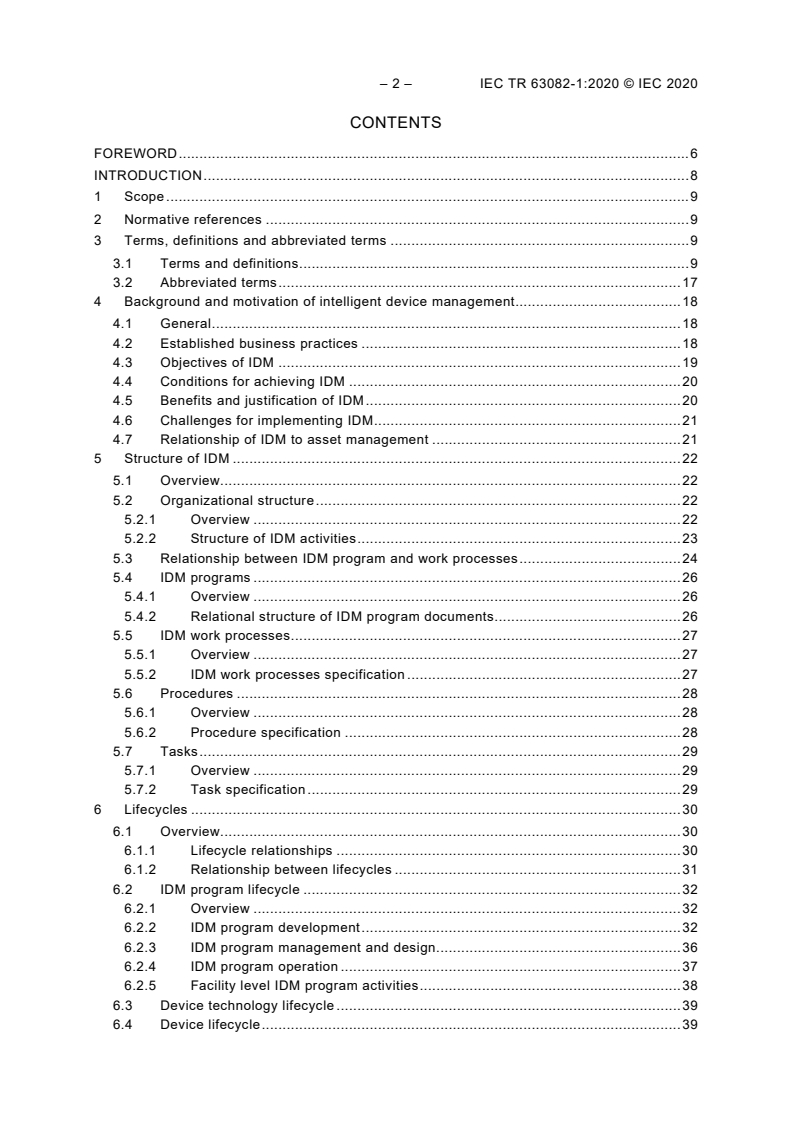
– 2 – IEC TR 63082-1:2020 © IEC 2020
CONTENTS
FOREWORD . 6
INTRODUCTION . 8
1 Scope . 9
2 Normative references . 9
3 Terms, definitions and abbreviated terms . 9
3.1 Terms and definitions . 9
3.2 Abbreviated terms . 17
4 Background and motivation of intelligent device management. 18
4.1 General . 18
4.2 Established business practices . 18
4.3 Objectives of IDM . 19
4.4 Conditions for achieving IDM . 20
4.5 Benefits and justification of IDM . 20
4.6 Challenges for implementing IDM . 21
4.7 Relationship of IDM to asset management . 21
5 Structure of IDM . 22
5.1 Overview. 22
5.2 Organizational structure . 22
5.2.1 Overview . 22
5.2.2 Structure of IDM activities . 23
5.3 Relationship between IDM program and work processes . 24
5.4 IDM programs . 26
5.4.1 Overview . 26
5.4.2 Relational structure of IDM program documents. 26
5.5 IDM work processes . 27
5.5.1 Overview . 27
5.5.2 IDM work processes specification . 27
5.6 Procedures . 28
5.6.1 Overview . 28
5.6.2 Procedure specification . 28
5.7 Tasks . 29
5.7.1 Overview . 29
5.7.2 Task specification . 29
6 Lifecycles . 30
6.1 Overview. 30
6.1.1 Lifecycle relationships . 30
6.1.2 Relationship between lifecycles . 31
6.2 IDM program lifecycle . 32
6.2.1 Overview . 32
6.2.2 IDM program development . 32
6.2.3 IDM program management and design. 36
6.2.4 IDM program operation . 37
6.2.5 Facility level IDM program activities . 38
6.3 Device technology lifecycle . 39
6.4 Device lifecycle . 39
6.5 Facility lifecycle . 41
6.5.1 General . 41
6.5.2 Scope development . 42
6.5.3 Design and engineering . 45
6.5.4 Construction and commissioning . 47
6.5.5 Operation and maintenance . 49
6.5.6 Turnaround . 51
6.5.7 Decommissioning . 53
7 Maintenance processes . 54
7.1 Overview. 54
7.2 Types and relationship of maintenance processes . 55
7.2.1 General . 55
7.2.2 Run to failure . 56
7.2.3 Diagnostic or condition based maintenance . 57
7.2.4 Automated fault handling . 58
7.2.5 Scheduled inspection and testing . 58
7.3 Other aspects of maintenance . 59
7.3.1 Use of maintenance history . 59
7.3.2 Root cause analysis. 59
7.3.3 Effects of maintenance processes . 60
7.4 Relationship of problem detection methods and maintenance strategies . 60
7.4.1 Problem detection optimization . 60
7.4.2 States and transitions . 61
7.5 Factors for selection of maintenance process . 62
7.5.1 IDM criticality determination . 62
7.5.2 Failure consequences . 63
7.5.3 Types of fault . 63
8 IDM notification management and utilization . 64
8.1 Notification management . 64
8.2 Notification from intelligent device. 64
8.2.1 Overview . 64
8.2.2 Notification type . 65
8.2.3 Notification sources . 66
8.3 Notification delivery mechanism . 66
8.3.1 Overview . 66
8.3.2 Device alert . 67
8.3.3 Process value (PV) status . 67
8.3.4 Operation (control) mode . 67
8.4 Action responding to notification . 68
8.4.1 Overview . 68
8.4.2 Real time automated responses . 68
8.4.3 Real time operator responses . 68
8.4.4 Semi real time responses . 69
8.4.5 Longer term planned responses . 69
9 Configuration management . 70
9.1 Overview. 70
9.2 Device templates for device configuration . 70
9.3 Toolkits . 71
– 4 – IEC TR 63082-1:2020 © IEC 2020
9.4 Configuring intelligent devices . 71
9.4.1 Overview . 71
9.4.2 Bulk building . 71
9.4.3 Individual building . 72
9.5 Maintenance of device configuration data . 72
Annex A (informative) Standard diagrams used in IEC 63082 (all parts) . 73
A.1 Overview. 73
A.2 Class diagram . 73
A.3 Activity diagram (swimlanes) . 75
A.3.1 Overview . 75
A.3.2 Activity diagram . 75
A.3.3 Swimlane chart . 77
Annex B (informative) Equivalent UML diagrams for Figures 1, 3, 4, 5, 6, 7, 8 . 79
Annex C (informative) Summary of IDM objectives and associated work processes . 83
Annex D (informative) Example of criticality ranking . 84
D.1 Overview. 84
D.2 Definitions. 84
D.3 Criticality ranking . 85
Bibliography . 90
Figure 1 – IDM and intelligent device in the context of asset management . 22
Figure 2 – Positioning of IDM program . 23
Figure 3 – Structure of IDM activities . 24
Figure 4 – Structure of IDM program . 25
Figure 5 – Structure of IDM program for an enterprise . 27
Figure 6 – IDM work process . 28
Figure 7 – Procedure . 29
Figure 8 – Task . 30
Figure 9 – Timing relationship between lifecycles . 31
Figure 10 – IDM program lifecycle phases . 33
Figure 11 – IDM program functional structure . 36
Figure 12 – Timing relationship between IDM device lifecycles . 40
Figure 13 – Facility lifecycle phases for IDM . 42
Figure 14 – Criticality usage in a facility . 45
Figure 15 – Turnaround process . 52
Figure 16 – Overview of maintenance process . 56
Figure 17 – State diagram for IDM . 61
Figure 18 – State diagram for IDM diagnostics based maintenance processes . 62
Figure 19 – Notifications routing for IDM . 67
Figure 20 – Relationship between real time, semi real time, and planned activities . 68
Figure A.1 – Position of class diagram and activity diagram in UML . 73
Figure A.2 – Example of class diagram . 75
Figure A.3 – Example of activity diagram . 77
Figure A.4 – Example of swimlane chart . 78
Figure B.1 – IDM and intelligent device in the context of asset management . 79
Figure B.2 – Structure of IDM activities . 79
Figure B.3 – Structure of IDM program . 80
Figure B.4 – Structure of IDM program and the enterprise . 80
Figure B.5 – IDM work process . 81
Figure B.6 – Procedure . 81
Figure B.7 – Task . 82
Table 1 – IDM documents . 25
Table 2 – Benefits of IDM related to device supply chain management . 41
Table 3 – Verification and testing of configuration . 47
Table 4 – Failure consequence for non-SIS devices . 60
Table 5 – Notification type . 64
Table 6 – IDM benefits from real time automated responses . 68
Table 7 – IDM benefits from real time operator responses . 69
Table 8 – IDM benefits from semi real time responses . 69
Table 9 – IDM benefits from longer term planned responses . 70
Table A.1 – Notation of UML class diagram . 74
Table A.2 – Model elements of activity diagram . 76
Table C.1 – Severity categories . 83
Table D.1 – Severity categories . 86
Table D.2 – Probability levels . 87
Table D.3 – Risk assessment matrix – Modified/industry normal . 88
– 6 – IEC TR 63082-1:2020 © IEC 2020
INTERNATIONAL ELECTROTECHNICAL COMMISSION
____________
INTELLIGENT DEVICE MANAGEMENT –
Part 1: Concepts and terminology
FOREWORD
1) The International Electrotechnical Commission (IEC) is a worldwide organization for standardization comprising
all national electrotechnical committees (IEC National Committees). The object of IEC is to promote international
co-operation on all questions concerning standardization in the electrical and electronic fields. To this end and
in addition to other activities, IEC publishes International Standards, Technical Specifications, Technical Reports,
Publicly Available Specifications (PAS) and Guides (hereafter referred to as “IEC Publication(s)”). Their
preparation is entrusted to technical committees; any IEC National Committee interested in the subject dealt with
may participate in this preparatory work. International, governmental and non-governmental organizations liaising
with the IEC also participate in this preparation. IEC collaborates closely with the International Organization for
Standardization (ISO) in accordance with conditions determined by agreement between the two organizations.
2) The formal decisions or agreements of IEC on technical matters express, as nearly as possible, an international
consensus of opinion on the relevant subjects since each technical committee has representation from all
interested IEC National Committees.
3) IEC Publications have the form of recommendations for international use and are accepted by IEC National
Committees in that sense. While all reasonable efforts are made to ensure that the technical content of IEC
Publications is accurate, IEC cannot be held responsible for the way in which they are used or for any
misinterpretation by any end user.
4) In order to promote international uniformity, IEC National Committees undertake to apply IEC Publications
transparently to the maximum extent possible in their national and regional publications. Any divergence between
any IEC Publication and the corresponding national or regional publication shall be clearly indicated in the latter.
5) IEC itself does not provide any attestation of conformity. Independent certification bodies provide conformity
assessment services and, in some areas, access to IEC marks of conformity. IEC is not responsible for any
services carried out by independent certification bodies.
6) All users should ensure that they have the latest edition of this publication.
7) No liability shall attach to IEC or its directors, employees, servants or agents including individual experts and
members of its technical committees and IEC National Committees for any personal injury, property damage or
other damage of any nature whatsoever, whether direct or indirect, or for costs (including legal fees) and
expenses arising out of the publication, use of, or reliance upon, this IEC Publication or any other IEC Publications.
8) Attention is drawn to the Normative references cited in this publication. Use of the referenced publications is
indispensable for the correct application of this publication.
9) Attention is drawn to the possibility that some of the elements of this IEC Publication may be the subject of patent
rights. IEC shall not be held responsible for identifying any or all such patent rights.
The main task of IEC technical committees is to prepare International Standards. However, a
technical committee may propose the publication of a Technical Report when it has collected
data of a different kind from that which is normally published as an International Standard, for
example "state of the art".
IEC TR 63082-1, which is a Technical Report, has been prepared by subcommittee 65E:
Devices and integration in enterprise systems, of IEC technical committee 65: Industrial-
process measurement, control and automation.
The text of this Technical Report is based on the following documents:
Draft TR Report on voting
65E/653/DTR 65E/677/RVDTR
Full information on the voting for the approval of this Technical Report can be found in the
report on voting indicated in the above table.
This document has been drafted in accordance with the ISO/IEC Directives, Part 2.
A list of all parts in the IEC 63082 series, published under the general title Intelligent device
management, can be found on the IEC website.
The committee has decided that the contents of this document will remain unchanged until the
stability date indicated on the IEC website under "http://webstore.iec.ch" in the data related to
the specific document. At this date, the document will be
• reconfirmed,
• withdrawn,
• replaced by a revised edition, or
• amended.
IMPORTANT – The 'colour inside' logo on the cover page of this publication indicates
that it contains colours which are considered to be useful for the correct understanding
of its contents. Users should therefore print this document using a colour printer.
– 8 – IEC TR 63082-1:2020 © IEC 2020
INTRODUCTION
The purpose of the IEC 63082 series is to define an environment that enables the effective use
of industrial intelligent devices (IID). The documents provide common concepts, terminology,
and management activities.
Intelligent device management (IDM) represents activities for managing intelligent devices
through the facility lifecycle and does not imply a particular asset management tool or set of
those tools. Hardware and software tools are necessary to support work processes and
procedures, but specification of the tools is not a part of the IEC 63082 series. IDM can be one
of many enterprise programs. IDM activities optimize the value from intelligent devices and
supports the concepts of integration of data from the production level with business systems.
IDM is consistent with smart manufacturing initiatives.
The IEC 63082 series is not intended to replace or contradict other standards, for example
IEC 61511 (all parts) for safety instrumented systems and IEC 62443 (all parts) for
cybersecurity.
While the work processes and implementation practices specified in the IEC 63082 series might
be used for non-automation equipment with some diagnostic capability, the IEC 63082 series
does not cover these equipment types.
The IEC 63082 series will consist of the following parts:
• IEC TR 63082-1: Concepts and terminology (informative);
• IEC 63082-2: Work process requirements (normative).
IEC 63082-1 describes intelligent device management concepts and terminology necessary for
in-depth understanding and effective communication. It gives the basic concepts of how
intelligent devices can be managed and an overview of how this device management works
throughout the facility lifecycle. IEC 63082-1 provides basic knowledge to understand the
concepts of intelligent device management necessary to implement an IDM program.
IEC 63082-2 will provide normative requirements for IDM.
INTELLIGENT DEVICE MANAGEMENT –
Part 1: Concepts and terminology
1 Scope
This part of IEC 63082 describes concepts and terminology necessary to understand and
communicate effectively about IDM. This document explains the relationship between IDM and
other existing asset management standards.
Additionally, this document provides activity structures and concepts associated with IDM
programs. This document also introduces the concept of IDM programs for coordination of
multiple stakeholders.
2 Normative references
There are no normative references in this document.
3 Terms, definitions and abbreviated terms
3.1 Terms and definitions
For the purposes of this document, the following terms and definitions apply.
ISO and IEC maintain terminological databases for use in standardization at the following
addresses:
• IEC Electropedia: available at http://www.electropedia.org/
• ISO Online browsing platform: available at http://www.iso.org/obp
3.1.1
activity
set of actions that consume time and resources and whose performance is necessary to achieve,
or contribute to, the realization of one or more objectives
Note 1 to entry: Includes work processes, procedures, and tasks.
[SOURCE: ISO/IEC TR 24766:2009, 3.1, modified – "outcomes" was replaced with "objectives"
and the note has been added.]
3.1.2
alarm
notification to the operator of an equipment malfunction, process deviation, or abnormal
condition requiring a unique, timely, and documented (predetermined) response from the
operator
[SOURCE: IEC 62682:2014, 3.1.7, modified – "an audible and/or visible means of indicating"
was replaced with "notification", "timely response" was replaced with "unique, timely, and
documented (predetermined) response from the operator".]
– 10 – IEC TR 63082-1:2020 © IEC 2020
3.1.3
alarm management
work processes and practices for determining, documenting, designing, operating, monitoring,
and maintaining alarm systems
[SOURCE: IEC 62682:2014, 3.1.17, modified — "collection of" was replaced with "work".]
3.1.4
alert
notification to a responsible person of an abnormal condition that can require action with a time
tolerance much longer than for alarms
Note 1 to entry: A “responsible person” can include: operators, maintenance personnel, or engineering personnel.
3.1.5
apparatus
device or assembly of devices which can be used as an independent unit for specific functions
EXAMPLE Intelligent measuring and control devices, inspection and testing devices, host systems.
[SOURCE: IEC 60050-151:2001,151-11-22, modified — the example was added.]
3.1.6
asset management
coordinated activities of an organization to ensure the intended capability of assets is available
Note 1 to entry: The capability of an asset is dynamic and asset management will respond to satisfy changing
objectives.
[SOURCE: ISO 55000:2014, 3.3.1, modified – "to realize value from assets" was replaced with
"to ensure the intended capability of assets is available"; the notes were replaced with a new
note to entry.]
3.1.7
calibration
procedure of checking or adjusting (by comparison with a reference standard) the accuracy of
a measuring instrument
[SOURCE: ISO 15378:2017, 3.3.2, modified – "process" was replaced with "procedure" and the
note was deleted.]
3.1.8
commissioning
procedure prior, or related, to the handing over of a product ready for putting into service,
including final acceptance testing, the handing over of all documentation relevant to the use of
the product and, if necessary, instructing personnel
[SOURCE: IEC 82079-1:2012, 3.3, modified – "procedures" was replaced with "procedure".]
3.1.9
configuration database
structured collection of parameter settings for intelligent devices
3.1.10
corrective action
action to eliminate the cause of a non-fulfilment of a requirement and to prevent recurrence
[SOURCE: ISO 55000:2014, 3.4.1, modified – "nonconformity" was replaced with "non-
fulfilment of a requirement" and the note was deleted.]
3.1.11
covert fault
fault in relation to hardware and software, undetected by the diagnostics, proof tests, operator
intervention (for example physical inspection and manual tests), or through normal operation
Note 1 to entry: These are sometimes called latent faults or unknown faults.
[SOURCE: IEC 61508-4:2010, 3.8.9, modified – "fault" and "and software" were added,
"diagnostic tests" was replaced with "diagnostics"; the example was deleted and the Note 1 to
entry was added.]
3.1.12
criticality
degree of risk represented by a specified set of levels
3.1.13
device
independent physical entity capable of performing one or more specified functions in a particular
context and delimited by its interfaces
[SOURCE: IEC 61499-1:2012, 3.29]
3.1.14
device configuration
procedure that loads parameters into an intelligent device to define its function
3.1.15
device lifecycle
period of time over which a device with a specific model code is developed, brought to the
market and eventually removed from the market
3.1.16
device template
set of predefined parameters which characterize a specific device release for a particular type
of application
Note 1 to entry: Device templates are normally prepared by the device supplier.
3.1.17
diagnostics
automated function which detects faults, malfunctions, deviations, and/or variations of hardware
or software
Note 1 to entry: Diagnostics can be initiated manually for off-line diagnostics.
Note 2 to entry: Diagnostic is used as an adjective and as a generic word.
3.1.18
enterprise
group of organizations sharing a set of goals and objectives to offer products or services or
both
[SOURCE: ISO 14258:1998, 2.1.1]
– 12 – IEC TR 63082-1:2020 © IEC 2020
3.1.19
equipment
single apparatus or set of devices or apparatuses, or the set of main devices of an installation,
or all devices necessary to perform a specific task
EXAMPLE Intelligent measuring and control devices, inspection and testing devices, and host systems.
[SOURCE: IEC 60050-151:2001, 151-11-25, modified — the note has been deleted and the
example added.]
3.1.20
facility
physical entity that is built, constructed, installed or established to perform some particular
function or to serve or facilitate some particular end
EXAMPLE Plant, factory, mill, site, or similar production location.
[SOURCE: IEC TR 62066:2002, 3.6, modified — the examples are listed separately.]
3.1.21
facility implementation project
set of activities to put into practice before the facility starts or continues its intended service
3.1.22
failure
loss of the ability to perform as required
Note 1 to entry: A failure of an item is an event that results in a fault of that item.
Note 2 to entry: Qualifiers, such as catastrophic, critical, major, minor, marginal and insignificant, can be used to
categorise failures according to the severity of consequences, the choice and definitions of severity criteria
depending upon the field of application.
Note 3 to entry: Failure could lead to loss of a single function of an item (e.g. secondary function such as diagnostics)
not impacting the primary function of the item.
Note 4 to entry: In this definition “an item" refers to "a device".
[SOURCE: IEC 60050-192:2015, 192-03-01, modified – Note 3 to entry was replaced with a
new Note 3 and Note 4 to entry was added.]
3.1.23
fault
inability to perform as required, due to an internal state
Note 1 to entry: A fault of an item results from a failure, either of the item itself, or from a deficiency in an earlier
stage of the lifecycle, such as specification, design, manufacture or maintenance.
Note 2 to entry: Qualifiers, such as specification, design, manufacture, maintenance or misuse, can be used to
indicate the cause of the fault.
Note 3 to entry: In this definition “an item" refers to "a device".
[SOURCE: IEC 60050-192:2015, 192-04-01, modified – Note 3 to entry was replaced with a
new Note 3 and Note 4 was deleted.]
3.1.24
host system
functions or tools that digitally communicate with intelligent devices
Note 1 to entry: Includes automated fault handling, management of notifications, and configuration management of
intelligent devices.
Note 2 to entry: Functions and tools can be provided on one or more platforms.
3.1.25
incipient fault
imperfection in the state or condition of a device so that a degraded performance or critical
failure might eventually be the expected result if corrective action(s) is (are) not taken
[SOURCE: ISO 14224:2016, 3.40, modified – in the term, "failure" was replaced with "fault"; in
the definition, "an item" was replaced with "a device", "or critical failure might (or might not)"
was replaced with "performance or critical failure might" and "actions are" was replaced with
"action(s) is (are)".]
3.1.26
industrial automation control system
IACS
collection of personnel, hardware, software, procedures and policies involved in the operation
of the industrial process and that can affect or influence its safe, secure and reliable operation
Note 1 to entry: These systems include but are not limited to: a) industrial control systems, including distributed
control systems (DCSs), programmable logic controllers (PLCs), remote terminal units (RTUs), intelligent electronic
devices, supervisory control and data acquisition (SCADA), networked electronic sensing and control, and monitoring
and diagnostic systems. (In this context, process control systems include basic process control system and safety-
instrumented system (SIS) functions, whether they are physically separate or integrated.); b) associated information
systems such as advanced or multivariable control, online optimizers, dedicated equipment monitors, graphical
interfaces, process historians, manufacturing execution systems, and plant information management systems; c)
associated internal, human, network, or machine interfaces used to provide control, safety, and manufacturing
operations functionality to continuous, batch, discrete, and other processes.
Note 2 to entry: The IACS may include components that are not installed at the asset owner’s site.
Note 3 to entry: Examples of IACSs include Distributed Control Systems (DCS) and Supervisory Control and Data
Acquisition (SCADA) systems. IEC 62443-2-4 also defines the proper noun “Solution” to mean the specific instance
of the control system product and possibly additional components that are designed into the IACS. The Automation
Solution, therefore, differs from the control system since it represents a specific implementation (design and
configuration) of the control system hardware and software components for a specific asset owner.
[SOURCE: IEC 62443-2-4:2015, 3.1.8, modified – Note 1 to entry has been added.]
3.1.27
infrastructure
basic physical and organizational structures needed for the operation of an enterprise
3.1.28
inspection
action comprising careful scrutiny of a device and its immediate environment in order to arrive
at a reliable conclusion as to the condition of a device
[SOURCE: IEC 60050-426:2008, 416-14-02, modified – "an item" was replaced with "a device"
and "carried out either without dismantling, or with the addition of partial dismantling as required,
supplemented by means such as measurement," was replaced with "and its immediate
environment".]
3.1.29
installation
one apparatus or a set of devices and/or apparatuses associated in a given location to fulfil
specified purposes, including all means for their satisfactory operation
[SOURCE: IEC 60050-151:2001, 151-11-26]
– 14 – IEC TR 63082-1:2020 © IEC 2020
3.1.30
intelligent device
industrial intelligent device
IID
configurable device having digital communication with supplemental functions such as
diagnostics (3.1.17) in addition to its basic purpose
EXAMPLE 1 Process connected devices, which are in level 1 of the IEC 62264-1 functional hierarchy, such as
smart instruments, valves and actuators, analysers, custody transfer meters, electrical breakers, and transformers.
EXAMPLE 2 Control devices, which are in level 2 of the IEC 62264-1 functional hierarchy, such as PLCs, data
acquisition subsystems, and dedicated HMI devices.
EXAMPLE 3 Other devices such as RTUs, managed industrial network routers, converters and gateways.
3.1.31
intelligent device management
IDM
formal coordinated business objectives, organizations, work processes, and resources to
realize value from intelligent devices
Note 1 to entry: The IDM program is used to achieve setup (provisioning, engineering, configuration and calibration),
optimization, diagnostics, maintenance and disposal of intelligent devices over the facility lifecycle based on asset
management.
Note 2 to entry: IDM can be applied to multiple facilities of an enterprise or a facility of an enterprise.
3.1.32
intelligent device management program
IDM program
set of coordinated policies, strategies, activities, resources, and organization to achieve IDM
objectives
Note 1 to entry: The IDM program is a type of enterprise program.
3.1.33
lifecycle
finite set of generic phases and steps which a system will go through over its entire life history
[SOURCE: ISO 15704:2000, 3.11, modified – “may" was replaced with "will".]
3.1.34
maintenance
activity including supervisory actions, intended to retain an item in, or restore it to, a state in
which it can perform a required function
[SOURCE: ISO 14224:2016: 3.49, modified – "combination of all technical and management
actions" was replaced with "activity including supervisory actions" and "as required" with "a
required function"; the note was deleted.]
3.1.35
management of change
process of controlling and documenting any change in a system to maintain the proper operation
of the equipment under control
[SOURCE: IEC 62443-2-1:2010, 3.1.8, modified – "change management" was replaced with
"management of change".]
3.1.36
management program
activity that manages a group of related projects and/or work processes in a way that provides
benefits and control not available by managing each activity individually and independently
3.1.37
normal operation
operation of apparatus conforming electrically and mechanically within a design specification
and used within the limits specified by the apparatus manufacturer
[SOURCE: IEC 60050-426:2008, 426-04-10, modified – "with its" was replaced with "within a"
and "apparatus" was added.]
3.1.38
notification
means of co
...