


IEC 62899-302-3:2021
(Main)Printed electronics - Part 302-3: Equipment - Inkjet - Imaging-based measurement of drop direction
General Information
- Abstract
IEC 62899-302-3:2021(E) specifies in-flight imaging methods for the measurement of the direction of ink drops jetted from inkjet print-heads using drop watchers. It does not apply to holographic or other interference techniques, or to any method assessing deposited ink drops. It is specific to drop-on-demand type inkjet print-heads (used in printed electronics equipment).
- Status
- Published
- Publication Date
- 20-Jan-2021
- Technical Committee
- TC 119 - Printed Electronics
- Drafting Committee
- WG 3 - TC 119/WG 3
- Current Stage
- PPUB - Publication issued
- Start Date
- 21-Jan-2021
- Completion Date
- 12-Feb-2021



Overview
IEC 62899-302-3:2021 - "Printed electronics - Part 302-3: Equipment - Inkjet - Imaging-based measurement of drop direction" specifies in-flight, imaging-based methods for measuring the direction of ink drops jetted from drop-on-demand inkjet print-heads used in printed electronics. The standard describes how to use optical drop watchers (single, double or strobe flash) to determine both 2-D projected angles and full 3-D trajectory angles of jetted drops. It explicitly excludes holographic/interference techniques and any methods that assess deposited (post-impact) drops.
Key technical topics and requirements
- Measurement scope:
- Applies only to in-flight imaging of drops from drop-on-demand print-heads (printed electronics equipment).
- Does not cover holographic/interference methods or deposited-drop assessments.
- Measurement methods:
- Six defined methods: projected-angle measurement using one drop watcher (methods 1–3: double flash, single flash, strobe) and trajectory-angle measurement using two drop watchers (methods 4–6).
- Annex A contains measurement formulae, schematics and image-recording guidance for each method.
- Instrumentation and calibration:
- All trajectory measurement equipment must have a carefully calibrated geometry.
- Image plane alignment: the imaging plane must be aligned precisely orthogonal to the inkjet nozzle plane before measurements.
- Reporting and reproducibility:
- Measurement processes require reporting of conditions (see Clause A.3) and explicit statement of geometry, reference directions and delays used.
- Normative reference:
- Refers to IEC 62899-302-1 for related imaging-based jetting-speed measurement methods.
Practical applications and who uses this standard
- Printed electronics equipment manufacturers: validate print-head performance, ensure accurate drop placement and consistent jetting direction.
- Print-head and ink developers: quantify angular spread under specific ink and waveform conditions to optimize formulation and drive signals.
- Equipment integrators and contract manufacturers: assess whether drop trajectories risk bridging adjacent conductive features (affecting yield and electrical performance).
- Metrology and quality labs: implement standardized in-flight imaging test procedures for QA, acceptance testing and comparative benchmarking.
- R&D teams designing high-resolution printed circuits, sensors or displays where precise drop placement is critical.
Related standards
- IEC 62899-302-1 - Printed electronics - Equipment - Inkjet - Imaging based measurement of jetting speed (normative reference).
- Other parts of the IEC 62899 series cover broader printed-electronics metrology topics (see IEC webstore for the series index).
Keywords: IEC 62899-302-3, printed electronics, inkjet, drop direction, drop watcher, in-flight imaging, drop-on-demand, projected angle, trajectory angles, measurement standard.
Get Certified
Connect with accredited certification bodies for this standard

IMP NDT d.o.o.
Non-destructive testing services. Radiography, ultrasonic, magnetic particle, penetrant, visual inspection.
Inštitut za kovinske materiale in tehnologije
Institute of Metals and Technology. Materials testing, metallurgical analysis, NDT.
Q Techna d.o.o.
NDT and quality assurance specialist. 30+ years experience. NDT personnel certification per ISO 9712, nuclear and thermal power plant inspections, QA/
Sponsored listings
Frequently Asked Questions
IEC 62899-302-3:2021 is a standard published by the International Electrotechnical Commission (IEC). Its full title is "Printed electronics - Part 302-3: Equipment - Inkjet - Imaging-based measurement of drop direction". This standard covers: IEC 62899-302-3:2021(E) specifies in-flight imaging methods for the measurement of the direction of ink drops jetted from inkjet print-heads using drop watchers. It does not apply to holographic or other interference techniques, or to any method assessing deposited ink drops. It is specific to drop-on-demand type inkjet print-heads (used in printed electronics equipment).
IEC 62899-302-3:2021(E) specifies in-flight imaging methods for the measurement of the direction of ink drops jetted from inkjet print-heads using drop watchers. It does not apply to holographic or other interference techniques, or to any method assessing deposited ink drops. It is specific to drop-on-demand type inkjet print-heads (used in printed electronics equipment).
IEC 62899-302-3:2021 is classified under the following ICS (International Classification for Standards) categories: 19.080 - Electrical and electronic testing; 37.100.10 - Reproduction equipment. The ICS classification helps identify the subject area and facilitates finding related standards.
IEC 62899-302-3:2021 is available in PDF format for immediate download after purchase. The document can be added to your cart and obtained through the secure checkout process. Digital delivery ensures instant access to the complete standard document.
Standards Content (Sample)
IEC 62899-302-3 ®
Edition 1.0 2021-01
INTERNATIONAL
STANDARD
colour
inside
Printed electronics –
Part 302-3: Equipment – Inkjet – Imaging-based measurement of drop direction
All rights reserved. Unless otherwise specified, no part of this publication may be reproduced or utilized in any form
or by any means, electronic or mechanical, including photocopying and microfilm, without permission in writing from
either IEC or IEC's member National Committee in the country of the requester. If you have any questions about IEC
copyright or have an enquiry about obtaining additional rights to this publication, please contact the address below or
your local IEC member National Committee for further information.
IEC Central Office Tel.: +41 22 919 02 11
3, rue de Varembé info@iec.ch
CH-1211 Geneva 20 www.iec.ch
Switzerland
About the IEC
The International Electrotechnical Commission (IEC) is the leading global organization that prepares and publishes
International Standards for all electrical, electronic and related technologies.
About IEC publications
The technical content of IEC publications is kept under constant review by the IEC. Please make sure that you have the
latest edition, a corrigendum or an amendment might have been published.
IEC publications search - webstore.iec.ch/advsearchform IEC online collection - oc.iec.ch
The advanced search enables to find IEC publications by a Discover our powerful search engine and read freely all the
variety of criteria (reference number, text, technical publications previews. With a subscription you will always
committee, …). It also gives information on projects, replaced have access to up to date content tailored to your needs.
and withdrawn publications.
Electropedia - www.electropedia.org
IEC Just Published - webstore.iec.ch/justpublished
The world's leading online dictionary on electrotechnology,
Stay up to date on all new IEC publications. Just Published
containing more than 22 000 terminological entries in English
details all new publications released. Available online and
and French, with equivalent terms in 18 additional languages.
once a month by email.
Also known as the International Electrotechnical Vocabulary
(IEV) online.
IEC Customer Service Centre - webstore.iec.ch/csc
If you wish to give us your feedback on this publication or
need further assistance, please contact the Customer Service
Centre: sales@iec.ch.
IEC 62899-302-3 ®
Edition 1.0 2021-01
INTERNATIONAL
STANDARD
colour
inside
Printed electronics –
Part 302-3: Equipment – Inkjet – Imaging-based measurement of drop direction
INTERNATIONAL
ELECTROTECHNICAL
COMMISSION
ICS 19.080; 37.100.10 ISBN 978-2-8322-9286-0
– 2 – IEC 62899-302-3:2021 © IEC 2021
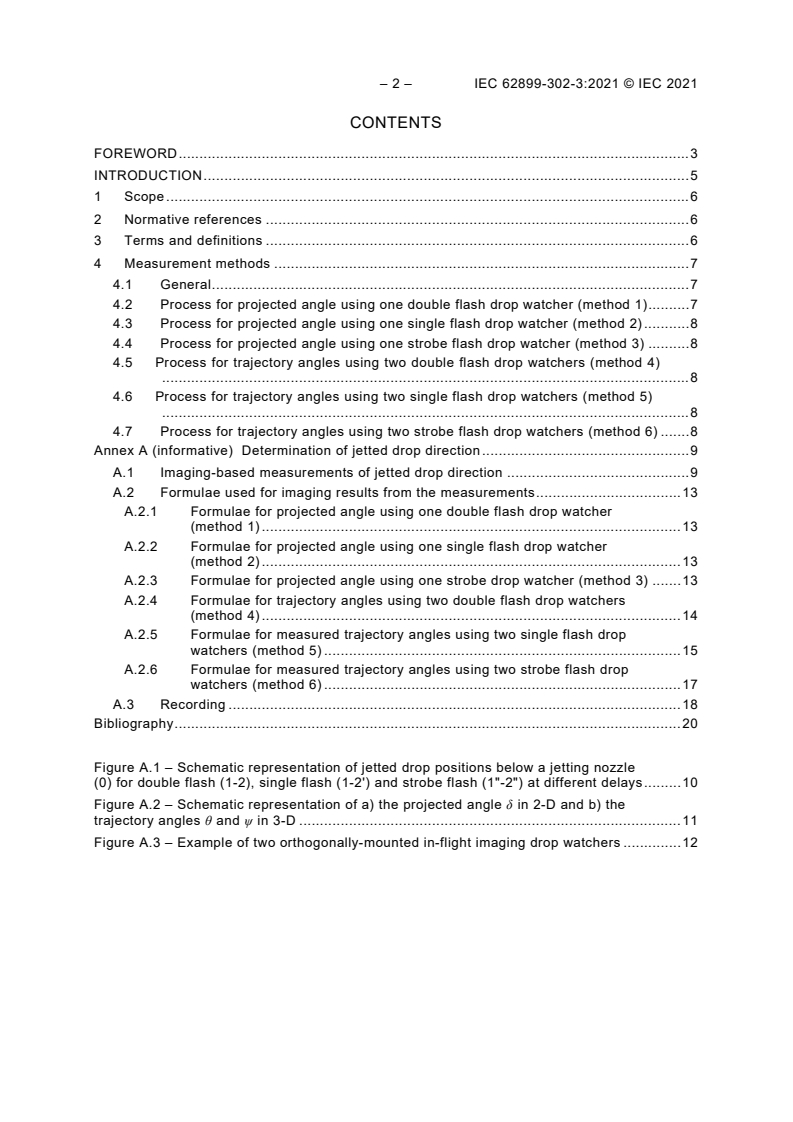
CONTENTS
FOREWORD . 3
INTRODUCTION . 5
1 Scope . 6
2 Normative references . 6
3 Terms and definitions . 6
4 Measurement methods . 7
4.1 General . 7
4.2 Process for projected angle using one double flash drop watcher (method 1) . 7
4.3 Process for projected angle using one single flash drop watcher (method 2) . 8
4.4 Process for projected angle using one strobe flash drop watcher (method 3) . 8
4.5 Process for trajectory angles using two double flash drop watchers (method 4)
............................................................................................................................... 8
4.6 Process for trajectory angles using two single flash drop watchers (method 5)
............................................................................................................................... 8
4.7 Process for trajectory angles using two strobe flash drop watchers (method 6) . 8
Annex A (informative) Determination of jetted drop direction . 9
A.1 Imaging-based measurements of jetted drop direction . 9
A.2 Formulae used for imaging results from the measurements . 13
A.2.1 Formulae for projected angle using one double flash drop watcher
(method 1) . 13
A.2.2 Formulae for projected angle using one single flash drop watcher
(method 2) . 13
A.2.3 Formulae for projected angle using one strobe drop watcher (method 3) . 13
A.2.4 Formulae for trajectory angles using two double flash drop watchers
(method 4) . 14
A.2.5 Formulae for measured trajectory angles using two single flash drop
watchers (method 5) . 15
A.2.6 Formulae for measured trajectory angles using two strobe flash drop
watchers (method 6) . 17
A.3 Recording . 18
Bibliography . 20
Figure A.1 – Schematic representation of jetted drop positions below a jetting nozzle
(0) for double flash (1-2), single flash (1-2ʹ) and strobe flash (1ʺ-2ʺ) at different delays . 10
Figure A.2 – Schematic representation of a) the projected angle δ in 2-D and b) the
trajectory angles θ and ψ in 3-D . 11
Figure A.3 – Example of two orthogonally-mounted in-flight imaging drop watchers . 12
INTERNATIONAL ELECTROTECHNICAL COMMISSION
____________
PRINTED ELECTRONICS –
Part 302-3: Equipment – Inkjet –
Imaging-based measurement of drop direction
FOREWORD
1) The International Electrotechnical Commission (IEC) is a worldwide organization for standardization comprising
all national electrotechnical committees (IEC National Committees). The object of IEC is to promote
international co-operation on all questions concerning standardization in the electrical and electronic fields. To
this end and in addition to other activities, IEC publishes International Standards, Technical Specifications,
Technical Reports, Publicly Available Specifications (PAS) and Guides (hereafter referred to as “IEC
Publication(s)”). Their preparation is entrusted to technical committees; any IEC National Committee interested
in the subject dealt with may participate in this preparatory work. International, governmental and non-
governmental organizations liaising with the IEC also participate in this preparation. IEC collaborates closely
with the International Organization for Standardization (ISO) in accordance with conditions determined by
agreement between the two organizations.
2) The formal decisions or agreements of IEC on technical matters express, as nearly as possible, an international
consensus of opinion on the relevant subjects since each technical committee has representation from all
interested IEC National Committees.
3) IEC Publications have the form of recommendations for international use and are accepted by IEC National
Committees in that sense. While all reasonable efforts are made to ensure that the technical content of IEC
Publications is accurate, IEC cannot be held responsible for the way in which they are used or for any
misinterpretation by any end user.
4) In order to promote international uniformity, IEC National Committees undertake to apply IEC Publications
transparently to the maximum extent possible in their national and regional publications. Any divergence
between any IEC Publication and the corresponding national or regional publication shall be clearly indicated in
the latter.
5) IEC itself does not provide any attestation of conformity. Independent certification bodies provide conformity
assessment services and, in some areas, access to IEC marks of conformity. IEC is not responsible for any
services carried out by independent certification bodies.
6) All users should ensure that they have the latest edition of this publication.
7) No liability shall attach to IEC or its directors, employees, servants or agents including individual experts and
members of its technical committees and IEC National Committees for any personal injury, property damage or
other damage of any nature whatsoever, whether direct or indirect, or for costs (including legal fees) and
expenses arising out of the publication, use of, or reliance upon, this IEC Publication or any other IEC
Publications.
8) Attention is drawn to the Normative references cited in this publication. Use of the referenced publications is
indispensable for the correct application of this publication.
9) Attention is drawn to the possibility that some of the elements of this IEC Publication may be the subject of
patent rights. IEC shall not be held responsible for identifying any or all such patent rights.
International Standard IEC 62899-302-3 has been prepared by IEC technical committee 119:
Printed Electronics.
The text of this International Standard is based on the following documents:
FDIS Report on voting
119/332/FDIS 119/344/RVD
Full information on the voting for the approval of this International Standard can be found in
the report on voting indicated in the above table.
This document has been drafted in accordance with the ISO/IEC Directives, Part 2.
– 4 – IEC 62899-302-3:2021 © IEC 2021
A list of all parts in the IEC 62899 series, published under the general title Printed electronics,
can be found on the IEC website.
The committee has decided that the contents of this document will remain unchanged until the
stability date indicated on the IEC website under "http://webstore.iec.ch" in the data related to
the specific document. At this date, the document will be
• reconfirmed,
• withdrawn,
• replaced by a revised edition, or
• amended.
IMPORTANT – The 'colour inside' logo on the cover page of this publication indicates that it
contains colours which are considered to be useful for the correct understanding of its
contents. Users should therefore print this document using a colour printer.
INTRODUCTION
Establishing the jetted drop direction under specific operating conditions of inks and inkjet
print-heads is significant for accurate drop placement during the manufacture of printed
electronics. Manufacturers that include such print-heads in their equipment should know the
angular spread of ink drop directions because this influences the achievable spatial resolution
of the printed material, and in particular whether any neighbouring conducting tracks could be
connected by stray materials, which would affect the printed electronics' product performance.
This document defines the methods for in-flight imaging measurement of jetted drop direction
from drop-on-demand type inkjet print-heads to be used in printed electronics equipment.
– 6 – IEC 62899-302-3:2021 © IEC 2021
PRINTED ELECTRONICS –
Part 302-3: Equipment – Inkjet –
Imaging-based measurement of drop direction
1 Scope
This part of IEC 62899 specifies in-flight imaging methods for the measurement of the
direction of ink drops jetted from inkjet print-heads using drop watchers. It does not apply to
holographic or other interference techniques, or to any method assessing deposited ink drops.
It is specific to drop-on-demand type inkjet print-heads (used in printed electronics
equipment).
2 Normative references
The following documents are referred to in the text in such a way that some or all of their
content constitutes requirements of this document. For dated references, only the edition
cited applies. For undated references, the latest edition of the referenced document (including
any amendments) applies.
IEC 62899-302-1, Printed electronics – Equipment – Inkjet – Imaging based measurement of
jetting speed
3 Terms and definitions
For the purposes of this document, the terms and definitions given in IEC 62899-302-1 and
the following apply.
ISO and IEC maintain terminological databases for use in standardization at the following
addresses:
• IEC Electropedia: available at http://www.electropedia.org/
• ISO Online browsing platform: available at http://www.iso.org/obp
3.1
inkjet nozzle plane
flat outer surface of the inkjet print-head nozzle plate
Note 1 to entry: The inkjet nozzle plane is defined for a drop-on-demand multi-nozzle print-head, or as otherwise
specified by the print-head manufacturer or inkjet equipment integrator and stated in the measurement results.
3.2
nozzle row direction
line in the inkjet nozzle plane passing through a row of nozzle exit centres
Note 1 to entry: Typically along the length of the inkjet nozzle plane, or as otherwise specified by the print-head
manufacturer or inkjet equipment integrator and stated in the measurement results.
3.3
reference direction
normal angle (90°) to the inkjet nozzle plate
Note 1 to entry: Or as otherwise specified by the print-head manufacturer or inkjet equipment integrator and
stated in the measurement results.
3.4
measurement region
3-D space closest to the inkjet nozzle plane used for imaging of the jetted drops
3.5
drop trajectory
direction of drop travel in 3-D in the measurement region
Note 1 to entry: It can be measured with two drop watchers mounted with a wide angle between them
simultaneously imaging jetted drops.
3.6
trajectory angles, pl.
two orthogonal angles necessary to define the drop trajectory
Note 1 to entry: The polar angle is relative to the reference direction; the azimuthal angle is relative to a specific
direction within the nozzle plane, often assumed to be the nozzle row direction.
3.7
projected angle
angle of the drop trajectory in the 2-D image plane of a single drop watcher
Note 1 to entry: The projected angle does not correspond to the polar angle of the drop trajectory unless the
azimuthal angle is 0° or 180°.
3.8
reference speed
speed of the drop along the reference direction
3.9
projected speed
speed of the drop along the projected angle
3.10
absolute speed
speed of the drop along the drop trajectory
4 Measurement methods
4.1 General
The jetted drop direction shall be determined by using one of the following methods, unless
there is an agreement between the user and the supplier. In that case the method is fully
reported with the measurement results.
All equipment engaged in the trajectory measurement shall have a carefully calibrated
geometry.
The image plane shall be aligned in a precisely orthogonal direction to the inkjet nozzle plane
before the start of the measurement.
4.2 Process for projected angle using one double flash drop watcher (method 1)
1) Establish reliable jetting from the nozzle under study in the image measurement region.
2) Record the images and analyse the drop image position changes for the chosen double
flash delay.
3) Report the projected angle, using the formula provided in A.2.1.
4) Report the conditions as indicated in Clause A.3.
– 8 – IEC 62899-302-3:2021 © IEC 2021
4.3 Process for projected angle using one single flash drop watcher (method 2)
1) Establish reliable jetting from the nozzle under study in the image measurement region.
2) Record a single flash image of a jetted drop and of the nozzle under study and analyse the
drop and nozzle exit image positions. Alternatively, record two single flash images of two
separate drops jetted at different times from the nozzle under study, and analyse the
single flash drop image positions.
3) Report the projected angle, using the appropriate formula specified in A.2.2.
4) Report the conditions as indicated in Clause A.3.
4.4 Process for projected angle using one strobe flash drop watcher (method 3)
1) Establish reliable jetting from the nozzle under study in the image measurement region.
2) Record a strobe flash image, at a chosen flash delay time, of the nozzle under study and
the superposed drops, and analyse the image positions of the nozzle exit centre and the
superposed drops. Alternatively, record two strobe flash images, at two different delay
times, of two separate drops from the same nozzle, and analyse the change of the single
flash image positions.
3) Report the projected angle, using the appropriate formula specified in A.2.3.
4) Report the conditions as indicated in Clause A.3.
4.5 Process for trajectory angles using two double flash drop watchers (method 4)
1) Establish reliable jetting from the nozzle under study in the image measurement region,
with the image planes of the two double flash drop watchers having a wide angle between
them aligned with a common axis along the reference direction.
2) Record double flash images of the same drop in each drop watcher for the chosen double
flash delay times and analyse the drop image positions in each double flash drop watcher.
3) Report the trajectory angles, using the appropriate formula specified in A.2.4.
4) Report the conditions as indicated in Clause A.3.
4.6 Process for trajectory angles using two single flash drop watchers (method 5)
1) Establish reliable jetting from the nozzle under study in the image measurement region,
with the image planes of the two single flash drop watchers having a wide angle between
them aligned with a common axis along the reference direction.
2) Record single flash images of the same drop and nozzle exit at a chosen delay time in
each drop watcher and analyse the image positions of the drop and nozzle exit centre in
each single flash drop watcher. Alternatively, record images, at chosen delay times in
each single flash drop watcher, of separate drops jetted from the nozzle under study, and
analyse the single flash drop image positions in each drop watcher.
3) Report the trajectory angles, using the appropriate formula specified in A.2.5.
4) Report the conditions as indicated in Clause A.3.
4.7 Process for trajectory angles using two strobe flash drop watchers (method 6)
1) Establish reliable jetting from the nozzle under study in the image measurement region,
with the image planes of the two strobe flash drop watchers having a wide angle between
them aligned with a common axis along the reference direction.
2) Record strobe flash images of the superposed drops and nozzle under study at a chosen
strobe flash delay time and analyse the image positions of the nozzle exit centre and
superposed drops in each strobe flash drop watcher. Alternatively, record strobe flash
images, at two different delay times, of separate drops jetted from the nozzle under study,
and analyse the superposed drop image positions in each strobe flash drop watcher.
3) Report the trajectory angles, using the appropriate formula specified in A.2.6.
4) Report the conditions as indicated in Clause A.3.
Annexe A
(informative)
Determination of jetted drop direction
A.1 Imaging-based measurements of jetted drop direction
The jetted drop direction should be determined from drop image position measurements for at
least two different points in three-dimensional space. While IEC 62899-302-1 determines 2-D
components of drop velocity it does not explicitly consider imaging-based measurement of the
spatial components necessary to specify the jetted drop direction (or velocity) in 3-D space.
This document also uses just two different points to define the jetted drop direction, by
assuming a straight-line motion and the absence of electrical and gravitational effects on
jetted drops. All the drop watcher types are assumed to provide a flat 2-D image plane in this
document, with the camera image plane aligned orthogonally to the inkjet nozzle plane. This
alignment can be checked using reliably jetted drops with different delays spanning the region
of interest in the camera image plane. Drop trajectories for drop-on-demand printed ink drops
studied using multiple flashes, high-speed photography and orthogonally mounted drop
watchers showed straight line motion holds in the absence of sideways aerodynamic and
significant electric field effects. The effects of gravity as compared with air drag forces acting
on near-vertically jetted drop-on-demand inkjet drops are usually negligible.
In-flight imaging measurement methods are not based on the final printed drop position or any
other print quality (PQ) assessment methods applied to inkjet-printed electronics products. By
contrast, the measurement of printed drop positions on a fixed substrate defines final 3-D
locations at the expense of accurate knowledge of in-flight drop directions, and importantly
does not accurately determine the drop trajectory close to the nozzles, i.e. where jetted drops
are fully formed and furthest from their final printed positions.
Drop watchers provide the direct means of observing the region of interest for free-flying
jetted drops, although practical considerations can prevent the imaging of the nozzle exit. The
extent of the region of interest will depend upon these practical limits and the flash delay
times chosen, together with drop speed and the drop formation process, which in turn depend
on the ink properties and the particular inkjet print-head technology. Drop travel (throw)
distances from the jetting nozzle to the printed substrates are typically less than 1 mm;
completion of the drop formation process to give near-spherical droplets can require 100 µm
travel from the nozzle. The region of interest for the measurement of jetted drop direction
would be around 100 µm to 300 µm from the nozzle, but not near a substrate.
In-flight determination of the jetted drop direction relies on double flash drop watchers or
single flash drop watchers or strobe flash drop watchers taking one or more images of a
single drop or of different drops (and possibly the nozzle exit). Only methods such as that
using two double flash drop watchers can provide a direct measurement of the drop trajectory
for a single drop. Single flash drop watchers provide a projected angle based on image
positions for different drops (or possibly one and the nozzle exit), at two different single flash
delays. Strobe flash drop watchers provide an inherently representative average measured
image position for a number of superposed drops and a projected angle based on inherently
representative average measured image positions for two sets of superposed drops (or
possibly one set and the nozzle exit) at different strobe flash delays. This hierarchy of
methods should be associated with increasing uncertainties in the quoted projected angle and
in the quoted trajectory angles. The method used should always be reported, whether based
on this document or under an alternative user-supplier agreement.
– 10 – IEC 62899-302-3:2021 © IEC 2021
Figure A.1 depicts the positions (1 and 2) of a jetted drop at two different locations (hence the
flash delay times) in the region of interest near the inkjet nozzle 0 for the double flash
measurement method; positions (1 and 2’) of different jetted drops at two different locations
(and flash delay times) in the region of interest near the inkjet nozzle 0 for
...