


IEC 60364-5-52:2001
(Main)Electrical installations of buildings - Part 5-52: Selection and erection of electrical equipment - Wiring systems
General Information
- Abstract
Deals with the selection and erection of wiring systems.
- Status
- Published
- Publication Date
- 19-Aug-2001
- Technical Committee
- TC 64 - Electrical installations and protection against electric shock
- Current Stage
- DELPUB - Deleted Publication
- Start Date
- 20-Oct-2009
- Completion Date
- 28-Aug-2026
Buy Documents
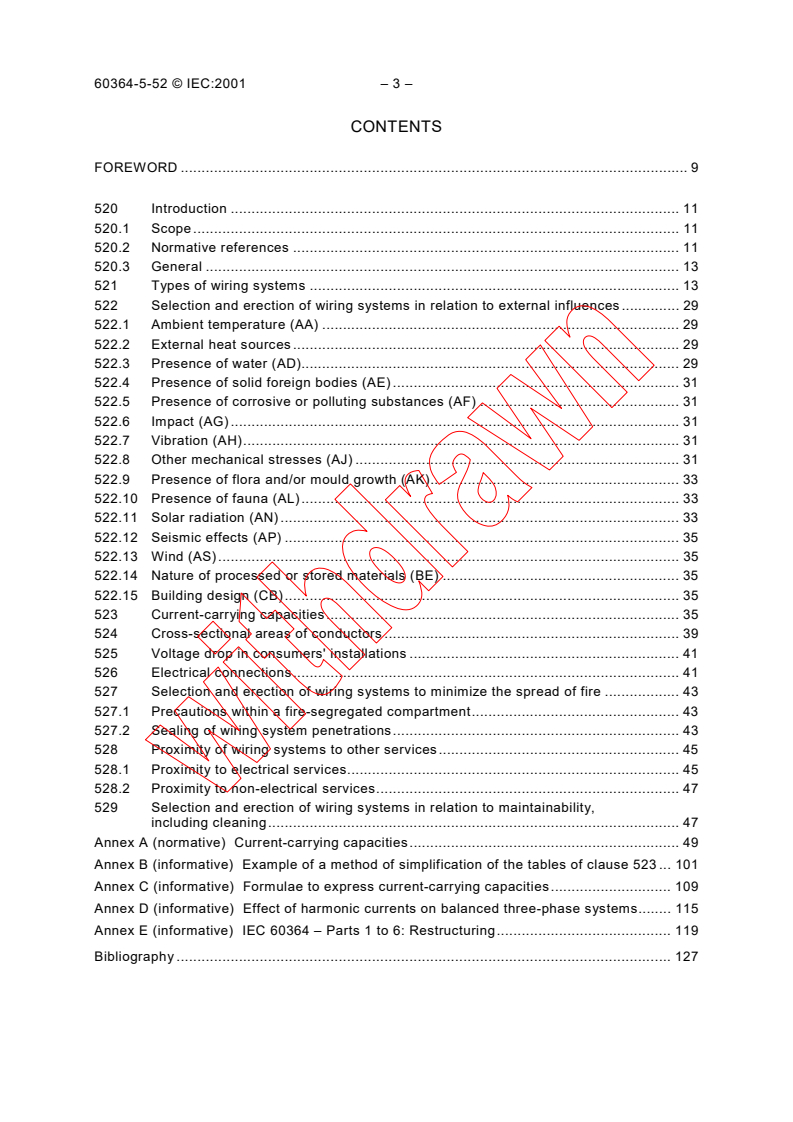
IEC 60364-5-52:2001 - Electrical installations of buildings - Part 5-52: Selection and erection of electrical equipment - Wiring systems Released:8/20/2001
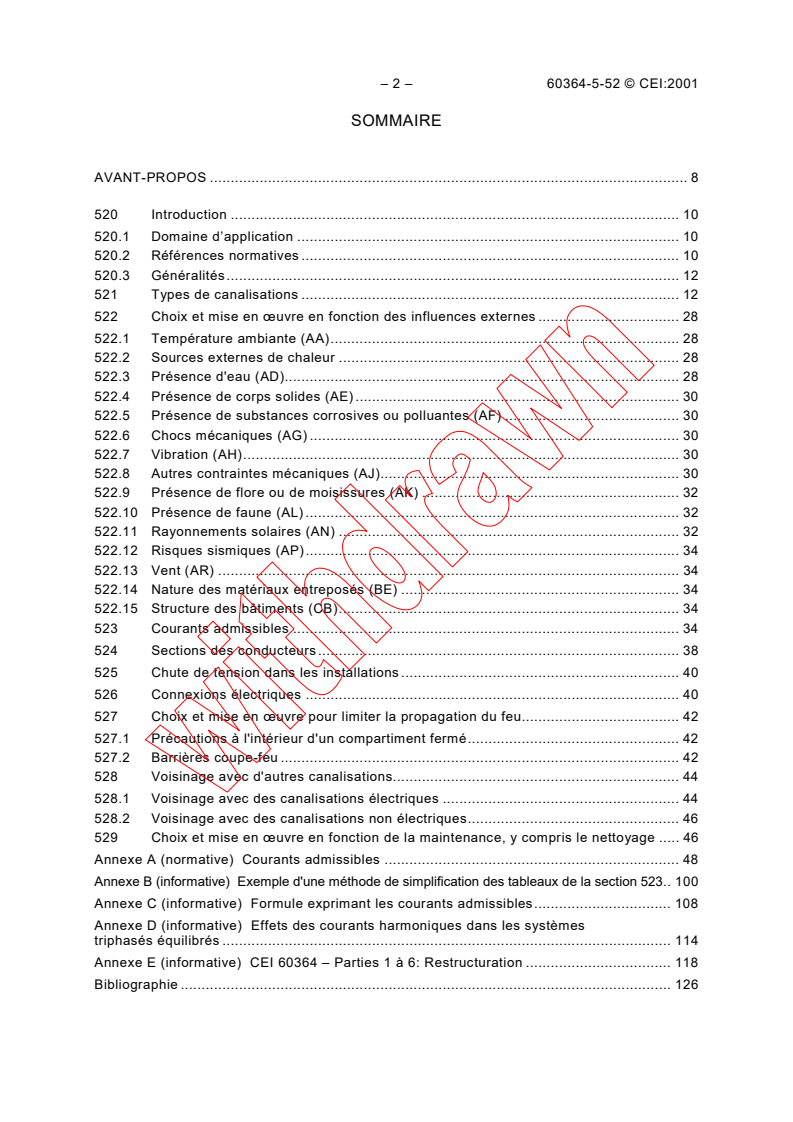
IEC 60364-5-52:2001 - Installations électriques des bâtiments - Partie 5-52: Choix et mise en oeuvre des matériels électriques - Canalisations Released:8/20/2001

IEC 60364-5-52:2001 - Electrical installations of buildings - Part 5-52: Selection and erection of electrical equipment - Wiring systems Released:8/20/2001
Overview
IEC 60364-5-52:2001 - Electrical installations of buildings - Part 5-52: Selection and erection of electrical equipment - Wiring systems - provides guidance for the selection and erection of wiring systems in buildings. It is part of the IEC 60364 series and addresses how wiring systems should be chosen, installed and protected in relation to electrical safety, performance and external influences. Annex A is normative (current‑carrying capacities); Annexes B–E are informative.
Key topics and requirements
- Types of wiring systems: guidance for selecting appropriate wiring constructions and installation methods for different building uses.
- External influences: selection and erection considerations related to ambient temperature, water, dust, corrosive substances, mechanical impact, vibration, fauna/flora, solar radiation, seismic effects and wind.
- Current‑carrying capacities: tables and reference methods for determining conductor ratings and installation-dependent derating factors (normative Annex A and supporting tables).
- Cross‑sectional areas and conductor sizing: principles and tabulated minima for conductor cross sections considering thermal limits and mechanical constraints.
- Voltage drop: requirements to limit voltage drop in consumer installations to ensure correct operation of electrical equipment.
- Electrical connections and jointing: good-practice rules for safe and reliable terminations and joints.
- Fire safety and fire spread minimization: measures for wiring selection and installation to reduce fire initiation and spread, including sealing of penetrations and compartmentation.
- Proximity and coordination with other services: rules for routing wiring near other electrical and non‑electrical services to avoid interference, heat transfer or mechanical damage.
- Maintainability and cleaning: considerations for access, inspection, cleaning and replacement of wiring systems.
Practical applications
IEC 60364-5-52 is used to:
- Size and select cables and insulation systems for building electrical installations.
- Choose installation methods (trunking, conduit, buried ducts, free air, etc.) that match environmental and mechanical conditions.
- Determine derating and grouping factors when multiple circuits share routes.
- Define measures to reduce fire risk from wiring and to seal service penetrations.
- Establish installation practices that ease inspection, maintenance and safe operation.
Who should use this standard
- Electrical designers and engineers
- Installers and contractors
- Electrical inspectors and authorities having jurisdiction
- Facility managers and maintenance teams
- Standards developers and compliance officers
Related standards
- Other parts of the IEC 60364 series (Parts 1–6) for broader rules on electrical installations of buildings.
- National and regional wiring regulations and codes, which often adopt or reference IEC guidance for local implementation.
Keywords: IEC 60364-5-52:2001, wiring systems, electrical installations of buildings, current‑carrying capacities, conductor sizing, voltage drop, selection and erection.
Relations
- Effective Date
- 05-Sep-2023
- Effective Date
- 25-Aug-2026
- Effective Date
- 10-Feb-2026
- Effective Date
- 10-Feb-2026
- Effective Date
- 10-Feb-2026
- Referred By
EN 61439-1:2009 - Low-voltage switchgear and controlgear assemblies - Part 1: General rules - Effective Date
- 10-Feb-2026
- Effective Date
- 10-Feb-2026
- Effective Date
- 10-Feb-2026
- Effective Date
- 10-Feb-2026
- Effective Date
- 10-Feb-2026
- Effective Date
- 05-Sep-2023
- Effective Date
- 05-Sep-2023
- Effective Date
- 05-Sep-2023
Buy Documents
IEC 60364-5-52:2001 - Electrical installations of buildings - Part 5-52: Selection and erection of electrical equipment - Wiring systems Released:8/20/2001
IEC 60364-5-52:2001 - Installations électriques des bâtiments - Partie 5-52: Choix et mise en oeuvre des matériels électriques - Canalisations Released:8/20/2001
IEC 60364-5-52:2001 - Electrical installations of buildings - Part 5-52: Selection and erection of electrical equipment - Wiring systems Released:8/20/2001
Get Certified
Connect with accredited certification bodies for this standard

DIBt (Deutsches Institut für Bautechnik)
German Institute for Building Technology.
DIN CERTCO
DIN Group product certification.

Kiwa BDA Testing
Building and construction product certification.
Sponsored listings
Frequently Asked Questions
IEC 60364-5-52:2001 is a standard published by the International Electrotechnical Commission (IEC). Its full title is "Electrical installations of buildings - Part 5-52: Selection and erection of electrical equipment - Wiring systems". This standard covers: Deals with the selection and erection of wiring systems.
Deals with the selection and erection of wiring systems.
IEC 60364-5-52:2001 is classified under the following ICS (International Classification for Standards) categories: 13.260 - Protection against electric shock. Live working; 91.140.50 - Electricity supply systems. The ICS classification helps identify the subject area and facilitates finding related standards.
IEC 60364-5-52:2001 has the following relationships with other standards: It is inter standard links to IEC 60364-5-523:1999, EN 15194:2009+A1:2011, EN 61009-1:2012, EN 60204-32:2008, HD 60364-4-43:2010, EN 61439-1:2009, EN 60204-1:2006, EN 61537:2007, EN 60269-1:2007, EN 60269-1:1998/A1:2005, IEC 60364-5-52:2009, IEC 60364-5-52:1993/AMD1:1997, IEC 60364-5-52:1993. Understanding these relationships helps ensure you are using the most current and applicable version of the standard.
IEC 60364-5-52:2001 is available in PDF format for immediate download after purchase. The document can be added to your cart and obtained through the secure checkout process. Digital delivery ensures instant access to the complete standard document.
Standards Content (Sample)
INTERNATIONAL IEC
STANDARD
60364-5-52
Second edition
2001-08
Electrical installations of buildings –
Part 5-52:
Selection and erection of electrical equipment –
Wiring systems
This English-language version is derived from the original
bilingual publication by leaving out all French-language
pages. Missing page numbers correspond to the French-
language pages.
Reference number
Publication numbering
As from 1 January 1997 all IEC publications are issued with a designation in the
60000 series. For example, IEC 34-1 is now referred to as IEC 60034-1.
Consolidated editions
The IEC is now publishing consolidated versions of its publications. For example,
edition numbers 1.0, 1.1 and 1.2 refer, respectively, to the base publication, the base
publication incorporating amendment 1 and the base publication incorporating
amendments 1 and 2.
Further information on IEC publications
The technical content of IEC publications is kept under constant review by the IEC,
thus ensuring that the content reflects current technology. Information relating to this
publication, including its validity, is available in the IEC Catalogue of publications
(see below) in addition to new editions, amendments and corrigenda. Information on
the subjects under consideration and work in progress undertaken by the technical
committee which has prepared this publication, as well as the list of publications
issued, is also available from the following:
• IEC Web Site (www.iec.ch)
• Catalogue of IEC publications
The on-line catalogue on the IEC web site (www.iec.ch/searchpub) enables you to
search by a variety of criteria including text searches, technical committees and
date of publication. On-line information is also available on recently issued
publications, withdrawn and replaced publications, as well as corrigenda.
• IEC Just Published
This summary of recently issued publications (www.iec.ch/online_news/ justpub) is
also available by email. Please contact the Customer Service Centre (see below)
for further information.
• Customer Service Centre
If you have any questions regarding this publication or need further assistance,
please contact the Customer Service Centre:
Email: custserv@iec.ch
Tel: +41 22 919 02 11
Fax: +41 22 919 03 00
INTERNATIONAL IEC
STANDARD
60364-5-52
Second edition
2001-08
Electrical installations of buildings –
Part 5-52:
Selection and erection of electrical equipment –
Wiring systems
IEC 2001 Copyright - all rights reserved
No part of this publication may be reproduced or utilized in any form or by any means, electronic or mechanical,
including photocopying and microfilm, without permission in writing from the publisher.
International Electrotechnical Commission, 3, rue de Varembé, PO Box 131, CH-1211 Geneva 20, Switzerland
Telephone: +41 22 919 02 11 Telefax: +41 22 919 03 00 E-mail: inmail@iec.ch Web: www.iec.ch
PRICE CODE
XB
Commission Electrotechnique Internationale
International Electrotechnical Commission
Международная Электротехническая Комиссия
For price, see current catalogue
60364-5-52 © IEC:2001 – 3 –
CONTENTS
FOREWORD . 9
520 Introduction . 11
520.1 Scope. 11
520.2 Normative references . 11
520.3 General . 13
521 Types of wiring systems . 13
522 Selection and erection of wiring systems in relation to external influences . 29
522.1 Ambient temperature (AA) . 29
522.2 External heat sources . 29
522.3 Presence of water (AD). 29
522.4 Presence of solid foreign bodies (AE) . 31
522.5 Presence of corrosive or polluting substances (AF) . 31
522.6 Impact (AG) . 31
522.7 Vibration (AH). 31
522.8 Other mechanical stresses (AJ) . 31
522.9 Presence of flora and/or mould growth (AK). 33
522.10 Presence of fauna (AL). 33
522.11 Solar radiation (AN) . 33
522.12 Seismic effects (AP) . 35
522.13 Wind (AS). 35
522.14 Nature of processed or stored materials (BE) . 35
522.15 Building design (CB). 35
523 Current-carrying capacities. 35
524 Cross-sectional areas of conductors . 39
525 Voltage drop in consumers' installations . 41
526 Electrical connections. 41
527 Selection and erection of wiring systems to minimize the spread of fire . 43
527.1 Precautions within a fire-segregated compartment. 43
527.2 Sealing of wiring system penetrations. 43
528 Proximity of wiring systems to other services. 45
528.1 Proximity to electrical services. 45
528.2 Proximity to non-electrical services. 47
529 Selection and erection of wiring systems in relation to maintainability,
including cleaning. 47
Annex A (normative) Current-carrying capacities. 49
Annex B (informative) Example of a method of simplification of the tables of clause 523 . 101
Annex C (informative) Formulae to express current-carrying capacities. 109
Annex D (informative) Effect of harmonic currents on balanced three-phase systems. 115
Annex E (informative) IEC 60364 – Parts 1 to 6: Restructuring. 119
Bibliography . 127
60364-5-52 © IEC:2001 – 5 –
Table 52-1 (52F) – Selection of wiring systems . 15
Table 52-2 (52G) – Erection of wiring systems . 15
Table 52-3 (52H) – Examples of methods of installation providing instructions for obtaining
current-carrying capacity . 17
Table 52-4 (52-A) – Maximum operating temperatures for types of insulation . 35
Table 52-5 (52J) – Minimum cross-sectional area of conductors . 41
Table A.52-1 (52-B1) – Schedule of reference methods of installation which form the basis
of the tabulated current-carrying capacities . 59
Table A.52-2 (52-C1) – Current-carrying capacities in amperes for methods of installation
in table A.52-1 (52-B1) – PVC insulation/two loaded conductors/copper or aluminium –
Conductor temperature: 70 °C/Ambient temperature: 30 °C in air, 20 °C in ground. 63
Table A.52-3 (52-C2) – Current-carrying capacities in amperes for methods of installation
in table A.52-1 (52-B1) – XLPE or EPR insulation/two loaded conductors/copper or
aluminium – Conductor temperature: 90 °C/Ambient temperature: 30 °C in air, 20 °C
in ground. 65
Table A.52-4 (52-C3) – Current-carrying capacities in amperes for methods of installation
in table A.52-1 (52-B1) – PVC insulation/three loaded conductors/copper or aluminium –
Conductor temperature: 70 °C/Ambient temperature: 30 °C in air, 20 °C in ground. 67
Table A.52-5 (52-C4) – Current-carrying capacities in amperes for methods of installation
in table A.52-1 (52-B1) – XLPE or EPR insulation/three loaded conductors/copper or
aluminium – Conductor temperature: 90 °C/Ambient temperature: 30 °C in air, 20 °C
in ground. 69
Table A.52-6 (52-C5) – Current-carrying capacities in amperes for installation method C
of table A.52-1 (52-B1) – Mineral insulation/copper conductors and sheath – PVC covered
or bare exposed to touch (see note 2) Metallic sheath temperature: 70 °C/Reference
ambient temperature: 30 °C. 71
Table A.52-7 (52-C6) – Current-carrying capacities in amperes for installation method C
of table A.52-1 (52-B1) – Mineral insulation/copper conductors and sheath – Bare cable
not exposed to touch and not in contact with combustible material Metallic sheath
temperature: 105 °C/Reference ambient temperature: 30 °C . 73
Table A.52-8 (52-C7) – Current-carrying capacities in amperes for installation methods E,
F and G of table A.52-1 (52-B1) – Mineral insulation/Copper conductors and sheath/PVC
covered or bare exposed to touch (see note 2) Metallic sheath temperature:
70 °C/Reference ambient temperature: 30 °C . 75
Table A.52-9 (52-C8) – Current-carrying capacities in amperes for installation methods E,
F and G of table A.52-1 (52-B1) – Mineral insulation/Copper conductors and sheath/ Bare
cable not exposed to touch (see note 2) Metallic sheath temperature: 105 °C/Reference
ambient temperature: 30 °C. 77
Table A.52-10 (52-C9) – Current-carrying capacities in amperes for installation methods E,
F and G of table A.52-1 (52-B1) – PVC insulation/Copper conductors Conductor
temperature: 70 °C/Reference ambient temperature: 30 °C . 79
Table A.52-11 (52-C10) – Current-carrying capacities in amperes for installation
methods E, F and G of table A.52-1 (52-B1) – PVC insulation/Aluminium conductors
Conductor temperature: 70 °C/Reference ambient temperature: 30 °C . 81
Table A.52-12 (52-C11) – Current-carrying capacities in amperes for installation
methods E, F and G of table A.52-1 (52-B1) – XLPE or EPR insulation/Copper
conductors – Conductor temperature: 90 °C/Reference ambient temperature: 30 °C . 83
Table A.52-13 (52-C12) – Current-carrying capacities in amperes for installation
methods E, F and G of table A.52-1 (52-B1) – XLPE or EPR insulation/Aluminium
conductors Conductor temperature: 90 °C/Reference ambient temperature: 30 °C . 85
Table A.52-14 (52-D1) – Correction factor for ambient air temperatures other than 30 °C
to be applied to the current-carrying capacities for cables in the air. 87
60364-5-52 © IEC:2001 – 7 –
Table A.52-15 (52-D2) – Correction factors for ambient ground temperatures other than
20 °C to be applied to the current-carrying capacities for cables in ducts in the ground . 89
Table A.52-16 (52-D3) – Correction factors for cables in buried ducts for soil thermal
resistivities other than 2,5 K´m/W to be applied to the current-carrying capacities for
reference method D.89
Table A.52-17 (52-E1) – Reduction factors for groups of more than one circuit or of more
than one multi-core cable to be used with current carrying capacities of tables A.52-2
(52-C1) to A.52-13 (52-C12). 91
Table A.52-18 (52-E2) – Reduction factors for more than one circuit, cables laid directly
in the ground – Installation method D in tables A.52-2 (52-C1) to A.52-5 (52-C4) –
Single-core or multi-core cables . 93
Table A.52-19 (52-E3) – Reduction factors for more than one circuit, cables laid in
ducts in the ground – Installation method D in tables A.52-2 (52-C1) to A.52-5 (52-C4). 95
Table A.52-20 (52-E4) – Reduction factors for group of more than one multi-core cable to
be applied to reference ratings for multi-core cables in free air – Method of installation E
in tables A.52-8 (52-C7) to A.52-13 (52-C12) . 97
Table A.52-21 (52-E5) – Reduction factors for groups of more than one circuit of single-
core cables (note 2) to be applied to reference rating for one circuit of single-core cables
in free air – Method of installation F in tables A.52-8 (52-C7) to A.52-13) (52-C12) . 99
Table B.52-1 (A.52-1) – Current-carrying capacity in amperes. 103
Table B.52-2 (A.52-2) – Current-carrying capacities (in amperes). 105
Table B.52-3 (A.52-3) – Reduction factors for groups of several circuits or of several
multi-core cables (to be used with current-carrying capacities of table B.52-1) (A.52-1). 107
Table C.52-1 (B.52-1) – Table of coefficients and exponents. 111
Table D.52-1 (C.52-1) – Reduction factors for harmonic currents in four-core and
five-core cables. 117
Table E.1 – Relationship between re-structured and original parts . 119
Table E.2 – Relationship between new and old clause numbering . 123
60364-5-52 © IEC:2001 – 9 –
INTERNATIONAL ELECTROTECHNICAL COMMISSION
–––––––––
ELECTRICAL INSTALLATIONS OF BUILDINGS –
Part 5-52: Selection and erection of electrical equipment –
Wiring systems
FOREWORD
1) The IEC (International Electrotechnical Commission) is a worldwide organization for standardization comprising
all national electrotechnical committees (IEC National Committees). The object of the IEC is to promote
international co-operation on all questions concerning standardization in the electrical and electronic fields. To
this end and in addition to other activities, the IEC publishes International Standards. Their preparation is
entrusted to technical committees; any IEC National Committee interested in the subject dealt with may
participate in this preparatory work. International, governmental and non-governmental organizations liaising
with the IEC also participate in this preparation. The IEC collaborates closely with the International
Organization for Standardization (ISO) in accordance with conditions determined by agreement between the
two organizations.
2) The formal decisions or agreements of the IEC on technical matters express, as nearly as possible, an
international consensus of opinion on the relevant subjects since each technical committee has representation
from all interested National Committees.
3) The documents produced have the form of recommendations for international use and are published in the form
of standards, technical specifications, technical reports or guides and they are accepted by the National
Committees in that sense.
4) In order to promote international unification, IEC National Committees undertake to apply IEC International
Standards transparently to the maximum extent possible in their national and regional standards. Any
divergence between the IEC Standard and the corresponding national or regional standard shall be clearly
indicated in the latter.
5) The IEC provides no marking procedure to indicate its approval and cannot be rendered responsible for any
equipment declared to be in conformity with one of its standards.
6) Attention is drawn to the possibility that some of the elements of this International Standard may be the subject
of patent rights. The IEC shall not be held responsible for identifying any or all such patent rights.
International Standard IEC 60364-5-52 has been prepared by IEC technical committee 64:
Electrical installations and protection against electric shock.
The IEC 60364 series (parts 1 to 6), is currently being restructured, without any technical
changes, into a more simple form (see annex E).
According to a unanimous decision by the Committee of Action (CA/1720/RV (2000-03-21)),
the restructured parts of IEC 60364 have not been submitted to National Committees for
approval.
The text of this second edition of IEC 60364-5-52 is compiled from and replaces
– part 5-52, first edition (1993) and its amendment 1 (1997);
– part 5-523, second edition (1999).
This publication has been drafted, as close as possible, in accordance with the
ISO/IEC Directives, Part 3.
Annex A forms an integral part of this standard.
Annexes B, C, D and E are for information only.
The committee has decided that the contents of this publication will remain unchanged
until 2005. At this date, the publication will be
reconfirmed;
withdrawn;
replaced by a revised edition, or
amended.
60364-5-52 © IEC:2001 – 11 –
ELECTRICAL INSTALLATIONS OF BUILDINGS –
Part 5-52: Selection and erection of electrical equipment –
Wiring systems
520 Introduction
520.1 Scope
Part 5-52 of IEC 60364 deals with the selection and erection of wiring systems.
NOTE This standard also applies in general to protective conductors, while IEC 60364-5-54 contains further
requirements for those conductors.
520.2 Normative references
The following normative documents contain provisions which, through reference in this text,
constitute provisions of this part of IEC 60364. For dated references, subsequent amend-
ments to, or revisions of, any of these publications do not apply. However, parties to
agreements based on this part of IEC 60364 are encouraged to investigate the possibility of
applying the most recent editions of the normative documents indicated below. For undated
references, the latest edition of the normative document referred to applies. Members of IEC
and ISO maintain registers of currently valid International Standards.
IEC 60228: 1978, Conductors of insulated cables
IEC 60287-1-1:1994, Electric cables – Calculation of the current rating – Part 1: Current rating
equations (100 % load factor) and calculation of losses – Section 1: General
IEC 60287-2-1:1994, Electric cables – Calculation of the current rating – Part 2: Thermal
resistance – Section 1: Calculation of thermal resistance
IEC 60287-3-1:1995, Electric cables – Calculation of the current rating – Part 3: Sections on
1)
operating conditions – Section 1: Reference operating conditions and selection of cable type
IEC 60332-1:1993, Tests on electric cables under fire conditions – Part 1: Test on a single
vertical insulated wire or cable
IEC 60332-3-24:2000, Tests on electric cables under fire conditions – Part 3-24: Test for
vertical flame spread of vertically-mounted bunched wire or cables – Category C
IEC 60439-2:2000, Low-voltage switchgear and controlgear assemblies – Part 2: Particular
requirements for busbar trunking systems (busways)
2)
IEC 60529:1989, Degrees of protection provided by enclosures (IP Code)
IEC 60614 (all parts), Specification for conduits for electrical installations
IEC 61200-52:1993, Electrical installation guide – Part 52: Selection and erection of electrical
equipment – Wiring systems
ISO 834 (all parts) Fire-resistance tests – Elements of building construction
________
1)
A consoldated edition 1.1 exists (1999) that includes IEC 60287-3-1 (1995) and its amendment 1 (1999).
2)
A consoldated edition 2.1 exists (2001) that includes IEC 60529 (1989) and its amendment 1 (1999).
60364-5-52 © IEC:2001 – 13 –
520.3 General
Consideration shall be given to the application of the fundamental principles of IEC 60364-1
as it applies to cables and conductors, to their termination and/or jointing, to their associated
supports or suspensions and their enclosures or methods of protection against external
influences.
521 Types of wiring systems
521.1 The method of installation of a wiring system in relation to the type of conductor or
cable used shall be in accordance with table 52-1, provided the external influences are
covered by the requirements of the relevant product standards.
521.2 The method of installation of a wiring system in relation to the situation concerned
shall be in accordance with table 52-2.
521.3 Examples of wiring systems together with reference to the appropriate table of current-
carrying capacity are shown in table 52-3.
NOTE 1 Other types of wiring systems, not covered in this standard, may be used provided they comply with the
general rules of this standard.
NOTE 2 Table 52-3 gives the reference method of installation where it is considered that the same current-
carrying capacities can safely be used. It is not implied that all these items are necessarily recognized in national
rules of all countries.
521.4 Busbar trunking systems
Busbar trunking systems shall comply with IEC 60439-2 and shall be installed in accordance
with the manufacturer's instructions. The installation shall be in accordance with the
requirements of clauses 522 (with the exception of 522.1.1, 522.3.3, 522.8.7, 522.8.8
and 522.8.9), 525, 526, 527 and 528.
521.5 AC circuits
Conductors of a.c. circuits installed in ferromagnetic enclosures shall be arranged so that all
conductors of each circuit are contained in the same enclosure.
NOTE If this condition is not fulfilled, overheating and excessive voltage drop may occur due to inductive effects.
60364-5-52 © IEC:2001 – 15 –
Table 52-1 (52F) – Selection of wiring systems
Method of installation
Conduc tors and Cable
cables trunking
Cable ladder
(including
Without Clipped Cable Cable tray On in- Support
Conduit skirting
fixings direct ducting Cable sulators wire
trunking,
brackets
flush floor
trunking)
Bare conductors –– – – – – + –
Insulated –– ++ + – + –
conductors
Sheathed Multi- ++ + + + + 0 +
cables core
(including
Single 0+ + + + + 0 +
armoured
-core
and
mineral
insulated)
+ Permitted.
– Not permitted.
0 Not applicable, or not normally used in practice.
Table 52-2 (52G) – Erection of wiring systems
Method of installation
Cable
trunking
(including Cable ladder,
Situations
Without With Cable On Support
Conduit skirting cable tray, cable
fixings fixings ducting insulators wire
trunking, brackets
flush floor
trunking)
Building voids 40, 46, 0 15,16, – 43 30, 31, 32, 33, 34 ––
15, 16 41,42
Cable channel 56 56 54, 55 0 44, 45 30, 31, 32, 33, 34 ––
Buried in 72, 73 0 70, 71 – 70, 71 0 ––
ground
Embedded in 57, 58 3 1, 2, 59, 50, 51, 52, 44, 45 0 ––
structure 60 53
Surface – 20, 21, 4, 5 6, 7, 8, 9, 6, 7, 8, 30, 31, 32, 33, 34 36 –
mounted 22, 23 12, 13, 14 9
Overhead –– 0 10, 11 – 30, 31, 32, 33, 34 36 35
Immersed 80 80 0 – 00 ––
The number in each box indicates the item number in table 52-3.
– Not permitted.
0 Not applicable or not normally used in practice.
60364-5-52 © IEC:2001 – 17 –
Table 52-3 (52H) – Examples of methods of installation providing instructions for obtaining
current-carrying capacity
NOTE The illustrations are not intended to depict actual product or installation practices but are indicative of the
method described.
Reference method of
installation to be used to
Item
Methods of installation Description obtain current-carrying
No.
capacity
(see annex A)
Insulated conductors or single-core
Room
Room
1 cables in conduit in a thermally A1
a
insulated wall
Room Multi-core cables in conduit in a
Room
2 A2
a
thermally insulated wall
Room
Room Multi-core cable direct in a thermally
3 A1
a
insulated wall
Insulated conductors or single-core
cables in conduit on a wooden, or
4 B1
masonry wall or spaced less than
0,3 × conduit diameter from it
Multi-core cable in conduit on a
wooden, or masonry wall or spaced
5 B2
less than 0,3 × conduit diameter
from it
Insulated conductors or single-core
cables in cable trunking on a
wooden wall
B1
b
– run horizontally
b, c
– run vertically
Multi-core cable in cable trunking on
a wooden wall
d
b Under consideration
– run horizontally
b, c
– run vertically
a 2
The inner skin of the wall has a thermal conductance of not less than 10 W/m ´K.
b
Values given for installation methods B1 and B2 in annex A are for a single circuit. Where there is more than
one circuit in the trunking the group reduction factor given in table A.52-17 is applicable, irrespective of the
presence of an internal barrier or partition.
c
Care shall be taken where the cable runs vertically and ventilation is restricted. The ambient temperature at
the top of the vertical section can be increased considerably. The matter is under consideration.
d
Values for reference method B2 may be used.
60364-5-52 © IEC:2001 – 19 –
Table 52-3 (continued)
Reference method of
installation to be used to
Item
Methods of installation Description obtain current-carrying
No.
capacity
(see annex A)
Insulated conductors or single-core
B1
a
cable in suspended cable trunking
Multi-core cable in suspended cable
B2
a
trunking
10 11
Insulated conductors or single-core
12 A1
b
cable run in mouldings
Insulated conductors or single-core
B1
cables in skirting trunking
TV TV
ISDN ISDN
Multi-core cable in skirting trunking B2
13 14
Insulated conductors in conduit or
single-core or multi-core cable in
15 A1
c
architrave
Insulated conductors in conduit or
16 single-core or multi-core cable in A1
c
window frames
Single-core or multi-core cables:
20 C
– fixed on, or spaced less than 0,3 ×
cable diameter from a wooden wall
C, with item 3 of
21 – fixed directly under a wooden ceiling
table A.52-17
22 – spaced from a ceiling Under consideration
a
Values given for installation methods B1 and B2 in annex A are for a single circuit. Where there is more than
one circuit in the trunking the group reduction factor given in table A.52-17 is applicable, irrespective of the
presence of an internal barrier or partition.
b
The thermal resistivity of the enclosure is assumed to be poor because of the material of construction and
possible air spaces. Where the construction is thermally equivalent to methods of installation 6 or 7, reference
method B1 may be used.
c
The thermal resistivity of the enclosure is assumed to be poor because of the material of construction and
possible air spaces. Where the construction is thermally equivalent to methods of installation 6, 7, 8, or 9,
reference methods B1 or B2 may be used.
60364-5-52 © IEC:2001 – 21 –
Table 52-3 (continued)
Reference method of
Item Methods of installation Description installation to be used to
No. obtain current-carrying
capacity
(see annex A)
> < > 0,3 D
e
≥0,3 D
e
c
30 C with item 2
On unperforated tray
a
of table A.52-17
> < ≥0,3 D
> 0,3 De
e
> < > 0,3 D
e
≥0,3 D
e
c
31 E or F with item 4
On perforated tray
a, b
of table A.52-17
> < ≥0,3 D
> 0,3 De
e
> 0,3 D
> <
e
≥0,3
D
e
c
32 E or F
On brackets or on a wire mesh
> 0,3 D
≥0,3 De
> < e
33 Spaced more than 0,3 times E or F
cable diameter from a wall with item 4 or 5
of table A.52-17
a, b
or method G
34 On ladder E or F
35 Single-core or multi-core cable E or F
suspended from or incorporating
a support wire
36 Bare or insulated conductors on G
insulators
a
For certain applications it may be more appropriate to use specific factors, for example tables A.52-20 and
A.52-21 (see A.52.4.2 of annex A).
b
Care shall be taken where the cable runs vertically and ventilation is restricted. The ambient temperature at the
top of the vertical section can be increased considerably. The matter is under consideration.
c
D = the external diameter of a multi-core cable:
e
– 2,2 x the cable diameter when three single core cables are bound in trefoil, or
– 3 x the cable diameter when three single core cables are laid in flat formation.
60364-5-52 © IEC:2001 – 23 –
Table 52-3 (continued)
Item No. Methods of installation Description Reference method of
installation to be used to
obtain current-carrying
capacity
(see annex A)
40 Single-core or multi-core cable in a 1,5 D ≤ V < 20 D
e e
a, 2
building void
B2
V
V
D
D e
e
V ≥ 20 D
e
B1
Single-core or multi-core cable in conduit
d
in a building void
Under consideration
Insulated conductors in cable ducting
1,5 D ≤ V < 20 D
e e
a, c, d
in a building void
24 V
V B2
D
e
D
e
V ≥ 20 D
e
B1
Single-core or multi-core cable in cable Under consideration
d
ducting in a building void
VV
D
e
D
e
Insulated conductors in cable ducting in 1,5 D ≤ V < 5 D
e e
masonry having a thermal resistivity not
B2
a, b, d
V
V greater than 2 K´m/W
5 D ≤ V < 50 D
e e
B1
Single-core or multi-core cable in cable Under consideration
ducting in masonry having a thermal
d
resistivity not greater than 2 K´m/W
Single-core or multi-core cable:
1,5 D ≤ V < 5 D
e e
– in a ceiling void
V
B2
V a, b
– in a suspended floor
D
D
ee
5 D ≤ V < 50 D
e e
B1
Insulated conductors or single-core
B1
50 cable in flush cable trunking in the floor
Multi-core cable in flush cable trunking
B2
51 in the floor
a
V = the smaller dimension or diameter of a masonry duct or void, or the vertical depth of a rectangular duct,
floor or ceiling void.
b
D = the external diameter of a multi-core cable:
e
– 2,2 × the cable diameter when three single core cables are bound in trefoil, or
– 3 × the cable diameter when three single core cables are laid in flat formation.
c
D = external diameter of conduit or vertical depth of cable ducting.
e
d
Care shall be taken where the cable runs vertically and ventilation is restricted. The ambient temperature at the
top of the vertical section can be increased considerably. The matter is under consideration.
60364-5-52 © IEC:2001 – 25 –
Table 52-3 (continued)
Reference method of
installation to be used to
Item
Methods of installation Description obtain current-carrying
No.
capacity
(see annex A)
Insulated conductors or single-core
B1
TV TV
cables in embedded trunking
ISDN ISDN
Multi-core cable in embedded trunking B2
52 53
1,5 D ≤ V < 20 D
e e
Insulated conductors or single-core
V
V
cables in conduit in an unventilated
B2
D
D e
e
cable channel run horizontally or
V ≥ 20 D
e
a, b
vertically
B1
Insulated conductors in conduit in
55 an open or ventilated cable channel B1
c, d
in the floor
Sheathed single-core or multi-core
56 cable in an open or ventilated cable B1
d
channel run horizontally or vertically
Single-core or multi-core cable direct in
masonry having a thermal resistivity
not greater than 2 K´m/W
57 C
Without added mechanical
e, f
protection
Single-core or multi-core cable direct in
masonry having a thermal resistivity
58 C
not greater than 2 K´m/W
e, f
With added mechanical protection
a
De = external diameter of conduit
V = internal depth of the channel
The depth of the channel is more important than the width.
b
Care shall be taken where the cable runs vertically and ventilation is restricted. The ambient temperature at the
top of the vertical section can be increased considerably. The matter is under consideration.
c
For multi-core cable installed in method 55, use ratings for reference method B2.
d
It is recommended that these methods of installation are used only in areas where access is restricted to
authorised persons so that the reduction in current carrying capacity and the fire hazard due to the accumulation
of debris can be prevented.
e 2
For cables having conductors not greater than 16 mm , the current-carrying capacity may be higher.
f
Thermal resistivity of masonry is not greater than 2 K´m/W.
60364-5-52 © IEC:2001 – 27 –
Table 52-3 (continued)
Reference method of
installation to be used to
Item
Methods of installation Description obtain current-carrying
No.
capacity
(see annex A)
Insulated conductors or single-core
59 B1
a
Cables in conduit in masonry
a
60 Multi-core cables in conduit in masonry B2
Multi-core cable in conduit or in cable
70 D
ducting in the ground
Single-core cable in conduit or in cable
71 D
ducting in the ground
Sheathed single-core or multi-core cables
D
direct in the ground
– without added mechanical protection
(see note)
Sheathed single-core or multi-core cables
73 D
direct in the ground
– with added mechanical protection
(see note)
Sheathed single-core or multi-core cables
80 Under consideration
immersed in water
NOTE The inclusion of directly buried cables in this item is satisfactory when the soil thermal resistivity is of
the order of 2,5 K´m/W. For lower soil resistivities, the current-carrying capacity for directly buried cables is
appreciably higher than for cables in ducts.
a
Thermal resistivity of masonry is not greater than 2 K´m/W.
60364-5-52 © IEC:2001 – 29 –
521.6 Conduits and trunking systems
Several circuits are allowed in the same conduit or trunking provided all conductors are
insulated for the highest nominal voltage present.
522 Selection and erection of wiring systems in relation to external influences
NOTE The external influences categorized in table 51A of IEC 60364-5-51 which are of significance to wiring
systems are included in this clause.
522.1 Ambient temperature (AA)
522.1.1 Wiring systems shall be selected and erected so as to be suitable for the highest
local ambient temperature and to ensure that the limiting temperature indicated in table 54-4
will not be exceeded.
522.1.2 Wiring system components including cables and wiring accessories shall only be
installed or handled at temperatures within the limits stated in the relevant product
specification or as given by the manufacturers.
522.2 External heat sources
522.2.1 In order to avoid the effects of heat from external sources, one of the following
methods or an equally effective method shall be used to protect wiring systems:
– shielding;
– placing sufficiently far from the source of heat;
– selecting a system with due regard for the additional temperature rise which may occur;
– local reinforcement or substitution of insulating material.
NOTE Heat from external sources may be radiated, convected or conducted, e.g.
– from hot water systems,
– from plant appliances and luminaires,
– from manufacturing process,
– through heat conducting materials,
– from solar gain of the wiring system or its surrounding medium.
522.3 Presence of water (AD)
522.3.1 Wiring systems shall be selected and erected so that no damage is caused by the
ingress of water. The completed wiring system shall comply with the IP degree of protection
relevant to the particular location.
NOTE In general, the sheaths and insulation of cables for fixed installations may be regarded, when intact, as
proof against penetration by moisture. Special considerations apply to cables liable to frequent splashing,
immersion or submersion.
522.3.2 Where water may collect or condensation may form in wiring systems, provision shall
be made for its escape.
522.3.3 Where wiring systems may be subjected to waves (AD6), protection against mecha-
nical damage shall be afforded by one or more of the methods of 522.6, 522.7 and 522.8.
60364-5-52 © IEC:2001 – 31 –
522.4 Presence of solid foreign bodies (AE)
522.4.1 Wiring systems shall be selected and erected so as to minimize the danger arising
from the ingress of solid foreign bodies. The completed wiring system shall comply with the IP
degree of protection relevant to the particular location.
522.4.2 In a location where dust in significant quantity is present (AE4), additional precautions
shall be taken to prevent the accumulation of dust or other substances in quantities which
could adversely affect the heat dissipation from the wiring system.
NOTE A wiring system which facilitates the removal of dust may be necessary (see clause 529).
522.5 Presence of corrosive or polluting substances (AF)
522.5.1 Where the presence of corrosive or polluting substances, including water, is likely to
give rise to corrosion or deterioration, parts of the wiring system likely to be affected shall be
suitably protected or manufactured from a material resistant to such substances.
NOTE Suitable protection for application during erection may include protective tapes, paints or grease.
522.5.2 Dissimilar metals liable to initiate electrolytic action shall not be placed in contact with
each other, unless special arrangements are made to avoid the consequences of such
contacts.
522.5.3 Materials liable to cause mutual or individual deterioration or hazardous degradation
shall not be placed in contact with each other.
522.6 Impact (AG)
522.6.1 Wiring systems shall be selected and erected so as to minimize the damage arising
from mechanical stress, e.g. by impact, penetration or compression.
522.6.2 In fixed installations where impacts of medium severity (AG2) or high severity (AG3)
can occur protection shall be afforded by:
– the mechanical characteristics of the wiring system; or
– the location selected; or
– the provision of additional local or general mechanical protection; or
– by any combination of the above.
522.7 Vibration (AH)
522.7.1 Wiring systems supported by or fixed to structures of equipment subject to vibration
of medium severity (AH2) or high severity (AH3) shall be suitable for such conditions,
particularly where cables and cable connections are concerned.
NOTE Special attention should be paid to connections to vibrating equipment. Local measures may be adopted
such as flexible wiring systems.
522.7.2 Fixed installation of suspended current-using equipment, e.g. luminaires, shall be
connected by cable with flexible core. Where no vibration nor movement can be expected,
cable with non-flexible core may be used
522.8 Other mechanical stresses (AJ)
522.8.1 Wiring systems shall be selected and erected so as to prevent during installation,
use or maintenance, damage to the sheath and insulation of cables and insulated conductors
and their terminations.
60364-5-52 © IEC:2001 – 33 –
522.8.2 (522.8.1.1) When buried in the structure, conduits or cable ducting systems shall be
completely erected for each circuit before any insulated conductor or cable is drawn in.
522.8.3 (522.8.1.2) The radius of every bend in a wiring system shall be such that
conductors or cables shall not suffer damage.
522.8.4 (522.8.1.3) Where the conductors or cables are not supported continuously due to
the method of the installation, they shall be supported by suitable means at appropriate
intervals in such a manner that the conductors or cables do not suffer damage by their own
weight.
522.8.5 (522.8.1.4) Where a permanent tensile stress is applied to the wiring system (e.g.
by its own weight in vertical runs) a suitable type of cable or conductor with appropriate cross-
sectional areas and method of mounting shall be selected in such a manner that the
conductors or cables do not suffer damage by their own weight.
522.8.6 (522.8.1.5) Wiring systems intended for the drawing in or out of conductors or
cables shall have adequate means of access to allow this operation.
522.8.7 (522.8.1.6) Wiring systems buried in floors shall be sufficiently protected to prevent
damage caused by the intended use of the floor.
522.8.8 (522.8.1.7) Wiring systems which are rigidly fixed and buried in the walls shall be
run horizontally or vertically or parallel to the room edges.
Wiring systems concealed in the structure but not fixed may follow the shortest practical
route.
522.8.9 (522.8.1.8) Flexible wiring systems shall be installed so that excessive tensile
stress to the conductors and connections is avoided.
522.9 Presence of flora and/or mould growth (AK)
522.9.1 Where the conditions experienced or expected constitute a hazard (AK2), the wiring
system shall be selected accordingly or special protective measures shall be adopted.
NOTE An installation method which facilitates the removal of such growths may be necessary (see clause 529).
522.10 Presence of fauna (AL)
522.10.1 Where conditions experienced or expected constitute a hazard (AL2) the wiring
system shall be selected accordingly or special protective measures shall be adopted,
for example, by:
– the mechanical characteristics of the wiring system; or
– the location selected; or
– the provision of additional local or general mechanical protection; or
– by any combination of the above.
522.11 Solar radiation (AN)
522.11.1 Where significant solar radiation (AN2) is experienced or expected, a wiring system
suitable for the conditions shall be selected and erected or adequate shielding shall be
provided.
NOTE See also 522.2.1 dealing with temperature rise.
60364-5-52 © IEC:2001 – 35 –
522.12 Seismic effects (AP)
522.12.1 The wiring system shall be selected and erected with due regard to the seismic
hazards of the location of the installation.
522.12.2 Where the seismic hazards experienced are low severity (AP2) or higher, particular
attention shall be paid to the following:
– the fixing of wiring systems to the building structure;
– the connections between the fixed wiring and all items of essential equipment, e.g. safety
services, shall be selected for their flexible quality.
522.13 Wind (AR)
522.13.1 See 522.7, Vibration (AH), and 522.8, Other mechanical stresses (AJ).
522.14 Nature of processed or stored materials (BE)
522.14.1 See 527, Selection and erection of wi
...
NORME CEI
INTERNATIONALE
60364-5-52
Deuxième édition
2001-08
Installations électriques des bâtiments –
Partie 5-52:
Choix et mise en œuvre des matériels électriques –
Canalisations
Cette version française découle de la publication d’origine
bilingue dont les pages anglaises ont été supprimées.
Les numéros de page manquants sont ceux des pages
supprimées.
Numéro de référence
CEI 60364-5-52:2001(F)
Numérotation des publications
Depuis le 1er janvier 1997, les publications de la CEI sont numérotées à partir de
60000. Ainsi, la CEI 34-1 devient la CEI 60034-1.
Editions consolidées
Les versions consolidées de certaines publications de la CEI incorporant les
amendements sont disponibles. Par exemple, les numéros d’édition 1.0, 1.1 et 1.2
indiquent respectivement la publication de base, la publication de base incorporant
l’amendement 1, et la publication de base incorporant les amendements 1 et 2
Informations supplémentaires sur les publications de la CEI
Le contenu technique des publications de la CEI est constamment revu par la CEI
afin qu'il reflète l'état actuel de la technique. Des renseignements relatifs à cette
publication, y compris sa validité, sont disponibles dans le Catalogue des
publications de la CEI (voir ci-dessous) en plus des nouvelles éditions, amende-
ments et corrigenda. Des informations sur les sujets à l’étude et l’avancement des
travaux entrepris par le comité d’études qui a élaboré cette publication, ainsi que la
liste des publications parues, sont également disponibles par l’intermédiaire de:
• Site web de la CEI (www.iec.ch)
• Catalogue des publications de la CEI
Le catalogue en ligne sur le site web de la CEI (www.iec.ch/searchpub) vous permet
de faire des recherches en utilisant de nombreux critères, comprenant des
recherches textuelles, par comité d’études ou date de publication. Des informations
en ligne sont également disponibles sur les nouvelles publications, les publications
remplacées ou retirées, ainsi que sur les corrigenda.
• IEC Just Published
Ce résumé des dernières publications parues (www.iec.ch/online_news/justpub)
est aussi disponible par courrier électronique. Veuillez prendre contact avec le
Service client (voir ci-dessous) pour plus d’informations.
• Service clients
Si vous avez des questions au sujet de cette publication ou avez besoin de
renseignements supplémentaires, prenez contact avec le Service clients:
Email: custserv@iec.ch
Tél: +41 22 919 02 11
Fax: +41 22 919 03 00
NORME CEI
INTERNATIONALE
60364-5-52
Deuxième édition
2001-08
Installations électriques des bâtiments –
Partie 5-52:
Choix et mise en œuvre des matériels électriques –
Canalisations
IEC 2001 Droits de reproduction réservés
Aucune partie de cette publication ne peut être reproduite ni utilisée sous quelque forme que ce soit et par aucun
procédé, électronique ou mécanique, y compris la photocopie et les microfilms, sans l'accord écrit de l'éditeur.
International Electrotechnical Commission, 3, rue de Varembé, PO Box 131, CH-1211 Geneva 20, Switzerland
Telephone: +41 22 919 02 11 Telefax: +41 22 919 03 00 E-mail: inmail@iec.ch Web: www.iec.ch
CODE PRIX
XB
Commission Electrotechnique Internationale
International Electrotechnical Commission
Международная Электротехническая Комиссия
Pour prix, voir catalogue en vigueur
– 2 – 60364-5-52 © CEI:2001
SOMMAIRE
AVANT-PROPOS . 8
520 Introduction . 10
520.1 Domaine d’application.10
520.2 Références normatives.10
520.3 Généralités.12
521 Types de canalisations.12
522 Choix et mise en œuvre en fonction des influences externes . 28
522.1 Température ambiante (AA).28
522.2 Sources externes de chaleur . 28
522.3 Présence d'eau (AD).28
522.4 Présence de corps solides (AE) . 30
522.5 Présence de substances corrosives ou polluantes (AF) . 30
522.6 Chocs mécaniques (AG) . 30
522.7 Vibration (AH).30
522.8 Autres contraintes mécaniques (AJ). 30
522.9 Présence de flore ou de moisissures (AK) . 32
522.10 Présence de faune (AL) . 32
522.11 Rayonnements solaires (AN) . 32
522.12 Risques sismiques (AP).34
522.13 Vent (AR). 34
522.14 Nature des matériaux entreposés (BE) . 34
522.15 Structure des bâtiments (CB). 34
523 Courants admissibles.34
524 Sections des conducteurs. 38
525 Chute de tension dans les installations . 40
526 Connexions électriques . 40
527 Choix et mise en œuvre pour limiter la propagation du feu. 42
527.1 Précautions à l'intérieur d'un compartiment fermé. 42
527.2 Barrières coupe-feu.42
528 Voisinage avec d'autres canalisations. 44
528.1 Voisinage avec des canalisations électriques . 44
528.2 Voisinage avec des canalisations non électriques. 46
529 Choix et mise en œuvre en fonction de la maintenance, y compris le nettoyage . 46
Annexe A (normative) Courants admissibles . 48
Annexe B (informative) Exemple d'une méthode de simplification des tableaux de la section 523. 100
Annexe C (informative) Formule exprimant les courants admissibles. 108
Annexe D (informative) Effets des courants harmoniques dans les systèmes
triphasés équilibrés . 114
Annexe E (informative) CEI 60364 – Parties 1 à 6: Restructuration . 118
Bibliographie . 126
– 4 – 60364-5-52 © CEI:2001
Tableau 52-1 (52F) – Choix des canalisations . 14
Tableau 52-2 (52G) – Mise en oeuvre des canalisations . 14
Tableau 52-3 (52H) – Exemples de modes de pose permettant le calcul des courants
admissibles .16
Tableau 52-4 (52-A) – Températures maximales de fonctionnement selon les types d'isolation . 34
Tableau 52-5 (52-J) – Section minimale des conducteurs . 40
Tableau A.52-1(52-B1) – Modes de pose de référence pour le calcul des courants admissibles . 58
Tableau A.52-2 (52-C1) – Courants admissibles, en ampères, pour les méthodes
du tableau A.52-1 (52-B1) – Câbles isolés au PVC, deux conducteurs chargés, cuivre ou
aluminium Température de l'âme: 70 °C. Température ambiante: 30 °C dans l'air, 20 °C
dans le sol.62
Tableau A.52-3 (52-C2) – Courants admissibles, en ampères, pour les méthodes
du tableau A.52-1 (52-B1) – Câbles isolés au PR/EPR, deux conducteurs chargés, cuivre
ou aluminium – Température de l'âme: 90 °C. Température ambiante: 30 °C dans l'air,
20 °C dans le sol .64
Tableau A.52-4 (52-C3) – Courants admissibles, en ampères, pour les méthodes
du tableau A.52-1(52-B1) – Câbles isolés au PVC, trois conducteurs chargés, cuivre ou
aluminium Température de l'âme: 70 °C. Température ambiante: 30 °C dans l'air, 20 °C
dans le sol.66
Tableau A.52-5 (52-C4) – Courants admissibles, en ampères, pour les méthodes
du tableau A.52-1(52-B1) – Câbles isolés au PR/EPR, trois conducteurs chargés, cuivre
ou aluminium Température de l'âme: 90 °C. Température ambiante: 30 °C dans l'air,
20 °C dans le sol .68
Tableau A.52-6 (52-C5) – Courants admissibles, en ampères, pour la méthode de
référence C du tableau A.52-1 (52-B1) – Isolation minérale, conducteurs et gaine
en cuivre – Gaine en PVC ou câble nu et accessible (voir note 2) Température de
la gaine métallique: 70 °C. Température ambiante de référence: 30 °C .70
Tableau A.52-7 (52-C6) – Courants admissibles, en ampères, pour la méthode
de référence C du tableau A.52-1(52-B1) – Isolation minérale, conducteurs et gaine
en cuivre. Câble nu, inaccessible et non en contact avec des matériaux combustibles
Température de la gaine métallique: 105 °C. Température ambiante de référence: 30 °C .72
Tableau A.52-8 (52-C7) – Courants admissibles, en ampères, pour les méthodes
de référence E, F et G du tableau A.52-1 (52-B1) – Isolation minérale, conducteurs
et gaine en cuivre Gaine en PVC ou câble nu et accessible (voir note 2) Température
de la gaine métallique: 70 °C. Température ambiante de référence: 30 °C .74
Tableau A.52-9 (52-C8)– Courants admissibles, en ampères, pour les méthodes
de référence E, F et G du tableau A.52-1 (52-B1) – Isolation minérale, conducteurs et
gaine en cuivre Câble nu et inaccessible. Température de la gaine métallique: 105 °C.
Température ambiante de référence: 30 °C .76
Tableau A.52-10 (52-C9) – Courants admissibles, en ampères, pour les méthodes de
référence E, F et G du tableau A.52-1(52-B1) – Isolation PVC, conducteurs en cuivre
Température de l'âme: 70 °C. Température ambiante de référence: 30 °C.78
Tableau A.52-11 (52-C10) – Courants admissibles, en ampères, pour les méthodes de
référence E, F et G du tableau A.52-1(52-B1) Isolation PVC, conducteurs en aluminium
Température de l'âme: 70 °C. Température ambiante de référence: 30 °C.80
Tableau A.52-12 (52-C11) – Courants admissibles, en ampères, pour les méthodes de
référence E, F et G du tableau A.52-1(52-B1) – Isolation PR/EPR, conducteurs en cuivre.
Température de l'âme: 90 °C Température ambiante de référence: 30 °C.82
Tableau A.52-13 (52-C12) – Courants admissibles, en ampères, pour les méthodes
de référence E, F et G du tableau A.52-1 (52-B1) – Isolation PR/EPR, conducteurs
en aluminium. Température de l'âme: 90 °C Température ambiante de référence: 30 °C .84
Tableau A.52-14 (52-D1) – Facteurs de correction pour des températures ambiantes
différentes de 30 °C à appliquer aux valeurs des courants admissibles pour des câbles
à l'air libre .86
– 6 – 60364-5-52 © CEI:2001
Tableau A.52-15 (52-D2) – Facteurs de correction pour des températures ambiantes
du sol différentes de 20 °C à appliquer aux valeurs des courants admissibles pour
des câbles dans des conduits enterrés .88
Tableau A.52-16 (52-D3)– Facteurs de correction pour des câbles dans des conduits
dans des sols de résistivité différente de 2,5 K´m/W à appliquer aux valeurs des courants
admissibles pour la méthode de référence D . 88
Tableau A.52-17 (52-E1) – Facteurs de correction pour groupement de plusieurs circuits
ou de plusieurs câbles multiconducteurs à appliquer aux valeurs des courants admissibles
des tableaux A.52-2 (52-C1) à A.52-12 (52-C12) .90
Tableau A.52-18 (52-E2) – Facteurs de correction de groupement de plusieurs circuits,
câbles directement enterrés – (Mode de pose D des tableaux A.52-2(52-C1) à A.52-5
(52-C4) – Câbles monoconducteurs ou multiconducteurs). 92
Tableau A.52-19 (52-E3) – Facteurs de correction de groupement de plusieurs circuits,
câbles posés dans des conduits enterrés – Mode de pose D des tableaux A.52-2
(52-C1) à A.52-5 (52-C4) .94
Tableau A.52-20 (52-E4) – Facteurs de correction de groupement pour plusieurs câbles
multiconducteurs à appliquer aux valeurs pour câbles multiconducteurs posés à l'air libre –
Mode de pose E des tableaux A.52-8 (52-C7) à A.52-13 (52-C12).96
Tableau A.52-21 (52-E5)– Facteurs de correction de groupement pour plusieurs câbles
multiconducteurs (note 2) à appliquer aux valeurs pour câbles monoconducteurs posés
à l'air libre – Mode de pose F des tableaux A.52-8 (52-C7) à A.52-13(52-C12) .98
Tableau B.52-1 (A.52-1) – Intensités admissibles en ampères .102
Tableau B.52-2 (A.52-2) – Courants admissibles, en ampères .104
Tableau B.52-3 (A.52-3) – Facteurs de correction de groupement de plusieurs circuits ou
de plusieurs câbles multiconducteurs (à utiliser avec les valeurs de courants admissibles
du tableau B.52-1) (A.52-1).106
Tableau C.52-1 (B.52-1) – Tableau des coefficients et des exposants .110
Tableau D.52-1 (C.52-1) – Facteurs de réduction pour les courants harmoniques dans
les câbles à quatre et cinq conducteurs.116
Tableau E.1 – Relations entre les parties structurées et les parties originales .118
Tableau E.2 – Relations entre les numérotations anciennes et nouvelles .122
– 8 – 60364-5-52 © CEI:2001
COMMISSION ÉLECTROTECHNIQUE INTERNATIONALE
–––––––––
INSTALLATIONS ÉLECTRIQUES DES BÂTIMENTS –
Partie 5-52: Choix et mise en œuvre des matériels électriques –
Canalisations
AVANT-PROPOS
1) La CEI (Commission Électrotechnique Internationale) est une organisation mondiale de normalisation
composée de l'ensemble des comités électrotechniques nationaux (Comités nationaux de la CEI). La CEI a
pour objet de favoriser la coopération internationale pour toutes les questions de normalisation dans les
domaines de l'électricité et de l'électronique. A cet effet, la CEI, entre autres activités, publie des Normes
internationales. Leur élaboration est confiée à des comités d'études, aux travaux desquels tout Comité national
intéressé par le sujet traité peut participer. Les organisations internationales, gouvernementales et non
gouvernementales, en liaison avec la CEI, participent également aux travaux. La CEI collabore étroitement
avec l'Organisation Internationale de Normalisation (ISO), selon des conditions fixées par accord entre les
deux organisations.
2) Les décisions ou accords officiels de la CEI concernant les questions techniques représentent, dans la mesure
du possible, un accord international sur les sujets étudiés, étant donné que les Comités nationaux intéressés
sont représentés dans chaque comité d’études.
3) Les documents produits se présentent sous la forme de recommandations internationales. Ils sont publiés
comme normes, spécifications techniques, rapports techniques ou guides et agréés comme tels par les
Comités nationaux.
4) Dans le but d'encourager l'unification internationale, les Comités nationaux de la CEI s'engagent à appliquer de
façon transparente, dans toute la mesure possible, les Normes internationales de la CEI dans leurs normes
nationales et régionales. Toute divergence entre la norme de la CEI et la norme nationale ou régionale
correspondante doit être indiquée en termes clairs dans cette dernière.
5) La CEI n’a fixé aucune procédure concernant le marquage comme indication d’approbation et sa responsabilité
n’est pas engagée quand un matériel est déclaré conforme à l’une de ses normes.
6) L’attention est attirée sur le fait que certains des éléments de la présente Norme internationale peuvent faire
l’objet de droits de propriété intellectuelle ou de droits analogues. La CEI ne saurait être tenue pour
responsable de ne pas avoir identifié de tels droits de propriété et de ne pas avoir signalé leur existence.
La Norme internationale CEI 60364-5-52 a été établie par le comité d'études 64 de la CEI:
Installations électriques et protection contre les chocs électriques.
La série des normes CEI 60364 (parties 1 à 6) est actuellement en restructuration, sans
changements techniques, sous une forme simple (voir annexe E).
Sur la décision unanime du Comité d'action (CA/1720/RV (2000-03-21)), les parties de la
CEI 60364 établies selon la nouvelle structure, n'ont pas été soumises aux Comités nationaux
pour approbation.
Le texte de la présente deuxième édition de la CEI 60364-5-52 est le résultat d'une
compilation de, et remplace
– la partie 5-52, première édition (1993), et son amendement 1 (1997);
– la partie 5-523, seconde édition (1999).
La présente publication a été élaborée, autant que possible, conformément aux Directives
ISO/CEI partie 3.
L’annexe A fait partie intégrante de cette norme.
Les annexes B, C, D et E sont données uniquement à titre d'information.
Le comité a décidé que le contenu de cette publication ne sera pas modifié avant 2005.
A cette date, la publication sera
reconduite;
supprimée;
remplacée par une édition révisée, ou
amendée.
– 10 – 60364-5-52 © CEI:2001
INSTALLATIONS ÉLECTRIQUES DES BÂTIMENTS –
Partie 5-52: Choix et mise en œuvre des matériels électriques –
Canalisations
520 Introduction
520.1 Domaine d’application
La présente partie de la CEI 60364 traite du choix et de la mise en œuvre des canalisations.
NOTE En général, la présente norme s'applique également aux conducteurs de protection, mais la CEI 60364-5-
54 contient d'autres prescriptions pour ce conducteur.
520.2 Références normatives
Les documents normatifs suivants contiennent des dispositions qui, par suite de la référence
qui y est faite, constituent des dispositions valables pour la présente partie de la CEI 60364.
Au moment de la publication, les éditions indiquées étaient en vigueur. Tout document
normatif est sujet à révision et les parties prenantes aux accords fondés sur la présente partie
de la CEI 60364 sont invitées à rechercher la possibilité d'appliquer les éditions les plus
récentes des documents normatifs indiqués ci-après. Les membres de la CEI et de l'ISO
possèdent le registre des Normes internationales en vigueur.
CEI 60228:1978, Ames des câbles isolés
CEI 60287-1-1:1994, Câbles électriques – Calcul du courant admissible – Partie 1: Equations
de l'intensité du courant admissible (facteur de charge 100 %) – Section 1: Généralités
CEI 60287-2-1:1994, Câbles électriques – Calcul du courant admissible – Partie 2:
Résistance thermique – Section 1: Calcul de la résistance thermique
CEI 60287-3-1:1995, Câbles électriques – Calcul du courant admissible – Partie 3: Sections
concernant les conditions de fonctionnement – Section 1: Conditions de fonctionnement de
1)
référence et sélection du type de câble
CEI 60332-1:1993, Essais des câbles électriques soumis au feu – Première partie: Essai
effectué sur un câble vertical
CEI 60332-3-24:2000, Essais des câbles électriques soumis au feu – Partie 3-24: Essai de
propagation verticale de la flamme des fils ou câbles en nappes en position verticale –
Catégorie C
CEI 60439-2:2000, Ensembles d'appareillage à basse tension – Partie 2: Règles parti-
culières pour les canalisations préfabriquées
2)
CEI 60529:1989, Degrés de protection procurés par les enveloppes (Code IP)
CEI 60614 (toutes les parties), Spécification pour les conduits pour installations électriques
CEI 61200-52:1993, Guide pour les installations électriques – Partie 52: Choix et mise en
œuvre des matériels électriques – Canalisations
ISO 834 (toutes les parties), Essais de résistance au feu – Eléments de construction
________
1)
Il existe une édition consolidée 1.1 (1999) qui inclut la CEI 60287-3-1 (1995) et son amendement 1 (1999).
2)
Il existe une édition consolidée 2.1 (2001) qui inclut la CEI 60529 (1989) et son amendement 1 (1999).
– 12 – 60364-5-52 © CEI:2001
520.3 Généralités
Le choix et la mise en œuvre des canalisations doivent tenir compte des principes
fondamentaux de la CEI 60364-1 applicables aux conducteurs et aux câbles, à leurs
connexions et à leurs extrémités, à leurs supports et leurs enveloppes ou aux méthodes de
protection contre les influences externes.
521 Types de canalisations
521.1 Les modes de pose des canalisations en fonction des types de conducteurs ou de
câbles doivent être conformes au tableau 52-1 à condition que les influences externes fassent
l'objet de prescriptions des normes de produits correspondantes.
521.2 Les modes de pose des canalisations en fonction des situations doivent être
conformes au tableau 52-2.
521.3 Des exemples de canalisations ainsi que les références appropriées pour le tableau
de courant admissible sont présentés dans le tableau 52-3.
NOTE 1 D'autres types de canalisations, non décrits dans cette norme, peuvent être utilisés à condition de
satisfaire aux prescriptions générales de la présente norme.
NOTE 2 Le tableau 52-3 donne les méthodes de référence d’une installation où le même courant admissible peut
être utilisé de manière sûre. Toutes ces méthodes ne sont pas nécessairement reconnues par tous les règlements
nationaux.
521.4 Canalisations préfabriquées
Les canalisations préfabriquées doivent être conformes à la CEI 60439-2 et mises en œuvre
suivant les instructions du constructeur. Leur installation doit satisfaire aux prescriptions des
articles 522 (à l'exception de 522.1.1, 522.3.3, 522.8.7, 522.8.8 et 522.8.9), 525, 526, 527
et 528.
521.5 Circuit en courant alternatif
Les conducteurs de circuits en courant alternatif disposés dans des enveloppes en matériau
ferromagnétique doivent être installés de telle manière que tous les conducteurs de chaque
circuit se trouvent dans la même enveloppe.
NOTE Si cette condition n'est pas remplie, des suréchauffements et des chutes de tension excessives peuvent se
produire en raison de phénomènes d'induction.
– 14 – 60364-5-52 © CEI:2001
Tableau 52-1 (52F) – Choix des canalisations
Mode de pose
Goulottes Echelles,
Conducteur (y compris chemin de
et câbles Sans Fixation Conduits plinthes Conduits câbles, Sur Câble
fixation directe et profilés profilés tablettes, isolateurs porteur
au niveau corbeaux
du sol)
Conducteurs nus –– – – – – + –
Conducteurs isolés –– ++ + – + –
Câbles Multi- ++ + + + + 0 +
sous gaine conducteur
(y compris
câbles
armés et
conducteurs Mono- 0+ + + + + 0 +
à isolant conducteur
minéral)
+ Admis.
– Non admis.
0 Non applicable, ou non utilisé en pratique.
Tableau 52-2 (52G) – Mise en oeuvre des canalisations
Mode de pose
Goulottes Echelles,
(y compris chemin de
Situations Sans fixation Fixation Conduits plinthes Conduits câbles, Sur Câble
directe et profilés profilés tablettes, isolateurs porteur
au niveau corbeaux
du sol)
Vides 40, 46, 0 15, 16, – 43 30, 31, 32, 33, ––
de construction 15, 16 41, 42 34
Caniveaux 56 56 54, 55 0 44, 45 30, 31, 32, 33, ––
Enterrés 72, 73 0 70, 71 – 70, 71 0 ––
Encastrés dans 57, 58 3 1, 2, 59, 50, 51, 44, 45 0 ––
les structures 60 52, 53
Apparent – 20, 4, 5 6, 7, 8, 6, 7, 8, 30, 31, 32, 33, 36 –
21, 9, 12, 9 34
22, 23 13, 14
Aérien –– 0 10, 11 – 30, 31, 32, 33, 36 35
Immergé 80 80 0 – 00 ––
L'indication d'un numéro dans une case indique le numéro de référence du mode de pose correspondant du tableau 52-3.
– Non admis.
0 Non applicable, ou non utilisé en pratique.
– 16 – 60364-5-52 © CEI:2001
Tableau 52-3 (52H) – Exemples de modes de pose permettant le calcul
des courants admissibles
NOTE Les figures ne sont pas destinées à représenter des produits réels ou des pratiques d'installation mais sont
indicatives des méthodes décrites.
Référence mode de pose
Point à utiliser pour les
Mode de pose Description
n° courants admissibles
(voir annexe A)
1 Conducteurs isolés ou câbles mono- A1
conducteurs dans des conduits
Pièce
encastrés dans des parois thermi-
a
quement isolantes
2 Câbles multiconducteurs dans des A2
conduits encastrés dans une paroi
Pièce
a
thermiquement isolante
3 Câbles multiconducteurs encastrés A1
directement dans une paroi
Pièce
a
isolante
4 Conducteurs isolés ou câbles B1
monoconducteurs dans des
conduits sur une paroi en bois
ou en maçonnerie espacés d'une
distance inférieure à 0,3 fois le
diamètre du conduit
5 Câbles multiconducteurs dans des B2
conduits sur une paroi en bois
ou en maçonnerie espacés d'une
distance inférieure à 0,3 fois le
diamètre du conduit
6 Conducteurs isolés ou câbles B1
monoconducteurs dans des
goulottes fixées sur une paroi en
bois:
b
– en parcours horizontal
b c
– en parcours vertical
d
Câble multiconducteur dans des
A l'étude
goulottes fixées sur une paroi en
8 bois:
b
– en parcours horizontal
b c
– en parcours vertical
a
La résistivité thermique de la maçonnerie n'est pas supérieure à 10 W/m ´K.
b
Les valeurs données pour les méthodes B1 et B2 à l'annexe A sont valables pour un seul circuit. Dans le cas
de plusieurs circuits, les facteurs de correction du tableau A.52-17 sont applicables, même si des cloisons ou
séparations sont prévues.
c
L'attention doit se porter sur des parcours verticaux et dans des conditions limitées de ventilation. La tempé-
rature ambiante au sommet du parcours vertical risque d'être considérablement augmentée. Ce sujet est à
l'étude.
d
Les valeurs de la méthode de référence B2 peuvent être utilisées.
– 18 – 60364-5-52 © CEI:2001
Tableau 52-3 (suite)
Référence mode de
pose à utiliser pour les
Point Mode de pose Description
courants admissibles
n°
(voir annexe A)
10 B1
Conducteurs isolés dans des
a
goulottes suspendues
B2
Câble multiconducteur dans des
11 a
goulottes suspendues
10 11
12 Conducteurs isolés ou câbles A1
b
monoconducteurs dans des moulures
13 Conducteurs isolés ou câbles B1
monoconducteurs dans des
TV TV
plinthes rainurées
ISDN ISDN
Câble multiconducteur dans des B2
plinthes rainurées
13 14
15 Conducteurs isolés dans des conduits A1
ou câbles mono ou multiconducteurs
a
dans des chambranles
16 Conducteurs isolés dans des conduits A1
ou câbles mono ou multiconducteurs
a
dans des huisseries de fenêtres
20 C
Câbles mono ou multiconducteurs:
– fixés sur une paroi en bois ou
espacés de moins de 0,3 fois le
diamètre du câble
C, avec point 3 du
21 – fixés directement sous un plafond
tableau A.52-17
en bois
22 – espacés du plafond A l'étude
a
Les valeurs données pour les méthodes B1 et B2 à l'annexe A so.t valables pour un seul circuit. Dans le cas de
plusieurs circuits, les facteurs de correction du tableau A-52-17 sont applicables, même si des cloisons ou
séparations sont prévues.
b
La conductibilité thermique de l'enveloppe est supposée faible en raison du matériau de construction et des
espaces possibles dans l'air. Lorsque la construction est thermiquement équivalente aux méthodes
d'installation 6 ou 7, la méthode de référence B1 peut être utilisée.
c
La conductibilité thermique de l'enveloppe est supposée faible en raison du matériau de construction et des
espaces possibles dans l'air. Lorsque la construction est thermiquement équivalente aux méthodes
d'installation 6, 7, 8 ou 9, les méthodes de référence B1 ou B2 peuvent être utilisées.
– 20 – 60364-5-52 © CEI:2001
Tableau 52-3 (suite)
Référence mode de pose
Point Mode de pose Description à utiliser pour les
n° courants admissibles
(voir annexe A)
> < > 0,3 D
e
≥0,3 D
e
30 Sur des chemins de câbles non C avec point 2
c a
perforés du tableau A.52-17
> < ≥0,3 D
> 0,3 D e
e
> < > 0,3 D
e
≥0,3 D
e
c
31 E ou F avec point 4
Sur des chemins de câbles perforés
a, b
du tableau A.52-17
≥0,3 D
> < > 0,3 D
e
e
> < > 0,3 D
e
≥0,3 D
e
c
32 E ou F
Sur des corbeaux ou grillages
> 0,3 D
≥0,3 D
> < e
e
33 Espacés de la paroi de plus de E ou F
0,3 fois le diamètre du câble avec point 4 ou 5
du tableau A.52-17
a, b
ou méthode G
34 Sur échelles à câbles E ou F
35 Câble mono ou multiconducteur E ou F
suspendu à un câble porteur ou
autoporteur
36 Conducteurs nus ou isolés sur G
isolateurs
a
Pour certaines applications, il peut être plus approprié d'utiliser des facteurs spécifiques, par exemple,
tableaux A.52-20 et A.52-21 (voir A.52-42 de l'annexe A).
b
L'attention doit se porter sur des parcours verticaux et dans des conditions limitées de ventilation. La température
ambiante au sommet du parcours vertical risque d'être considérablement augmentée. Ce sujet est à l'étude.
c
D est le diamètre extérieur d'un câble multiconducteur:
e
– 2,2 fois le diamètre d'un câble lorsque 3 câbles monoconducteurs sont disposés en trèfle, ou
– 3 fois le diamètre d'un câble lorsque 3 câbles monoconducteurs sont posés côte à côte.
– 22 – 60364-5-52 © CEI:2001
Tableau 52-3 (suite)
Référence mode de pose
à utiliser pour les
Point Mode de pose Description
courants admissibles
n°
(voir annexe A)
Câble mono ou multiconducteurs dans
1,5 D ≤ V < 20 D
e e
a b
,
des vides de construction
B2
V
V
D
De
e
V D
≥ 20
e
B1
Câbles mono ou multiconducteurs dans A l'étude
des conduits dans des vides de
d
construction
Conducteurs isolés dans des conduits 1,5 D ≤ V < 20 D
e e
a,
profilés dans des vides de construction
24 V
V B2
D
c, d
D e
e
V ≥ 20 D
e
B1
Câbles mono ou multiconducteurs dans A l'étude
des conduits profilés dans des vides de
V
V
d
D
D e
e construction
Conducteurs isolés dans des conduits
1,5 D ≤ V < 5 D
e e
profilés noyés dans la construction de
B2
V
résistivité thermique non supérieure
V
a, b, d
5 D ≤ V < 50 D
à 2 K´m/W e e
B1
Câbles mono ou multiconducteurs dans A l'étude
des conduits profilés noyés dans la
construction de résistivité thermique non
supérieure à 2 K´m/W
Câbles mono ou multiconducteurs: 1,5 D ≤ V < 5 D
e e
46 – dans des vides de plafonds
V
B2
V
a, b
– dans des plafonds suspendus
D
D
e
e
5 D ≤ V < 50 D
e e
B1
Conducteurs isolés ou câble
50 monoconducteur dans des goulottes
B1
encastrées dans des planchers
Câble multiconducteur dans des B2
51 goulottes encastrées dans des
planchers
a
V est la plus petite dimension ou diamètre d'un conduit maçonné ou d'un vide, ou la dimension verticale d'un
bloc alvéolé, d'un vide de plafond ou de plancher.
b
D est le diamètre extérieur d'un câble multiconducteur:
e
– 2,2 fois le diamètre d'un câble lorsque 3 câbles monoconducteurs sont disposés en trèfle, ou
– 3 fois le diamètre d'un câble lorsque 3 câbles monoconducteurs sont posés côte à côte.
c
D est le diamètre extérieur du conduit ou la hauteur verticale du conduit profilé.
e
d
L'attention doit se porter sur des parcours verticaux et dans des conditions limitées de ventilation. La tempé-
rature ambiante au sommet du parcours vertical risque d'être considérablement augmentée. Ce sujet est à
l'étude.
– 24 – 60364-5-52 © CEI:2001
Tableau 52-3 (suite)
Référence mode de pose à
utiliser pour les courants
Point Mode de pose Description
admissibles
n°
(voir annexe A)
52 Conducteurs isolés ou câbles B1
monoconducteurs dans des
TV TV
conduits profilés encastrés
ISDN
ISDN
Câble multiconducteur dans des
B2
conduits profilés encastrés
52 53
Conducteurs isolés ou câbles D V D
1,5 ≤ < 20
e e
monoconducteurs dans des
V
V
B2
D
D e
conduits, dans des caniveaux non
e
V ≥ 20 D
ventilés, en parcours horizontal ou
e
a, b
vertical
B1
Conducteurs isolés dans des B1
conduits, dans des caniveaux
ouverts ou ventilés dans le
c, d
plancher
Câbles gainés mono ou B1
multiconducteurs dans des
caniveaux ouverts ou ventilés en
d
parcours horizontal ou vertical
Câbles mono ou multiconducteurs C
encastrés directement dans des
parois en maçonnerie de résistivité
inférieure à 2 K´m/W
Sans protection mécanique
e,f
complémentaire
Câbles mono ou multiconducteurs C
encastrés directement dans des
parois en maçonnerie de résistivité
inférieure à 2 K´m/W
Avec protection mécanique
e,f
complémentaire
a
D est le diamètre extérieur du conduit.
e
V est la hauteur intérieure de passage des conduits.
La hauteur du caniveau est plus importante que la largeur.
b
L'attention doit se porter sur des parcours verticaux et dans des conditions limitées de ventilation. La tempé-
rature ambiante au sommet du parcours vertical risque d'être considérablement augmentée. Ce sujet est à
l'étude.
c
Pour les câbles multiconducteurs installés selon le mode de pose 55, utiliser la méthode de référence B2.
d
Il est recommandé de limiter l'emploi de ces modes de pose aux emplacements dont l'accès est permis seule-
ment aux personnes autorisées et où il est possible d'éviter une réduction des courants admissibles et les risques dus
à l'accumulation de débris.
e 2
Pour des câbles comportant des conducteurs de section inférieure à 16 mm , le courant admissible peut être supérieur.
f
La résistivité thermique de la maçonnerie n'est pas supérieure à 2 K´m/W.
– 26 – 60364-5-52 © CEI:2001
Tableau 52-3 (suite)
Référence mode de pose
à utiliser pour les
Point Mode de pose Description
courants admissibles
n°
(voir annexe A)
Conducteurs isolés ou câbles B1
monoconducteurs dans des conduits
a
encastrés dans une paroi maçonnée
Câbles multiconducteurs dans des B2
conduits encastrés dans une paroi
a
maçonnée
Câble multiconducteur dans des D
conduits ou dans des conduits profilés
enterrés
Câbles monoconducteurs dans des D
conduits ou dans des conduits profilés
enterrés
Câbles gainés mono ou D
multiconducteurs enterrés:
– sans protection mécanique
complémentaire (voir note)
Câbles gainés mono ou D
multiconducteurs enterrés:
– avec protection mécanique
complémentaire (voir note)
Câbles mono ou multiconducteurs A l'étude
gainés immergés dans l'eau
NOTE La pose de câbles directement enterrés est satisfaisante si la résistivité thermique du sol est de l'ordre de
2,5 K´m/W. Pour des résistivités plus faibles, le courant admissible dans des câbles directement enterrés est
beaucoup plus élevé que celui pour des câbles dans des fourreaux.
a
La résistivité thermique de la maçonnerie n'est pas supérieure à 2 K´m/W.
– 28 – 60364-5-52 © CEI:2001
521.6 Pose en conduits et goulottes
Plusieurs circuits peuvent emprunter le même conduit ou la même goulotte si tous les
conducteurs sont isolés pour la tension nominale présente la plus élevée.
522 Choix et mise en œuvre en fonction des influences externes
NOTE Seules les influences externes, contenues dans le tableau 51A de la CEI 60364-5-51, auxquelles les
canalisations sont sensibles, sont mentionnées dans cet article.
522.1 Température ambiante (AA)
522.1.1 Les canalisations doivent être choisies et mises en œuvre de manière à être
adaptées à la température ambiante locale la plus élevée et de garantir que la température
limite indiquée dans le tableau 54-4 ne soit pas dépassée.
522.1.2 Les éléments des canalisations, y compris les câbles et leurs accessoires, doivent
être mis en œuvre ou manipulés seulement dans les limites de température fixées par les
normes de produit correspondantes ou indiquées par les constructeurs.
522.2 Sources externes de chaleur
522.2.1 Afin d'éviter les effets de la chaleur émise par des sources externes, l'une des
méthodes suivantes ou tout autre méthode aussi efficace doit être utilisée pour protéger les
canalisations:
–écran de protection;
–éloignement suffisant des sources de chaleur;
– choix d'une canalisation en tenant compte des échauffements supplémentaires qui
peuvent se produire;
– renforcement local ou remplacement du matériau isolant.
NOTE La chaleur émise par des sources extérieures peut être transmise par rayonnement, par convection ou par
conduction, provenant:
– de réseaux de distribution d'eau chaude;
– d'installation d'appareils et luminaires;
– de procédés de fabrication;
– de la transmission de la chaleur par des matériaux conducteurs;
– de la récupération de la chaleur solaire de la canalisation ou du milieu environnant.
522.3 Présence d'eau (AD)
522.3.1 Les canalisations doivent être choisies et mises en œuvre de telle sorte qu'aucun
dommage ne soit causé par la pénétration de l'eau. La canalisation doit satisfaire, après
assemblage, au degré de protection IP correspondant à l'emplacement considéré.
NOTE En général, les gaines et enveloppes isolantes des câbles pour installation fixe peuvent être considérées,
lorsqu'elles ne sont pas endommagées, comme protégées contre la pénétration de l'humidité. Des précautions
particulières sont nécessaires pour les câbles soumis à de fréquents arrosages, à des immersions ou des
submersions.
522.3.2 Lorsque l'eau peut s'accumuler ou se condenser dans les canalisations, des
dispositions doivent être prises pour assurer son évacuation.
522.3.3 Lorsque des canalisations peuvent être soumises à des vagues (AD6), une protec-
tion contre les dommages mécaniques doit être réalisée par l'une ou plusieurs des méthodes
des articles 522.6, 522.7 et 522.8.
– 30 – 60364-5-52 © CEI:2001
522.4 Présence de corps solides (AE)
522.4.1 Les canalisations doivent être choisies et mises en œuvre de manière à limiter les
dangers provenant de la pénétration de corps solides. La canalisation doit satisfaire, après
assemblage, au degré de protection IP correspondant à l'emplacement considéré.
522.4.2 Dans les emplacements où des quantités importantes de poussière sont présentes
(AE4), des précautions supplémentaires doivent être prises pour empêcher l'accumulation de
poussières ou d'autres substances en quantités telles qu'elles pourraient affecter la
dissipation de la chaleur des canalisations.
NOTE Un mode de pose qui facilite l'enlèvement de la poussière peut être nécessaire (voir article 529).
522.5 Présence de substances corrosives ou polluantes (AF)
522.5.1 Lorsque la présence de substances corrosives ou polluantes, y compris l'eau, est
susceptible de provoquer des corrosions ou des dégradations, les parties des canalisations
qui sont susceptibles d'être endommagées doivent être convenablement protégées ou
fabriquées en un matériau résistant à ce produit.
NOTE Des rubans appropriés, des peintures ou des graisses peuvent constituer des méthodes appropriées
assurant une protection complémentaire lors de la mise en œuvre.
522.5.2 Des métaux différents pouvant former des couples électrolytiques ne doivent pas
être placés en contact les uns avec les autres, à moins que des dispositions particulières ne
soient prises pour éviter les conséquences de tels contacts.
522.5.3 Des matériaux pouvant provoquer des détériorations mutuelles ou individuelles ou
des dégradations dangereuses ne doivent pas être mis en contact.
522.6 Chocs mécaniques (AG)
522.6.1 Les canalisations doivent être choisies et mises en œuvre de manière à limiter les dom-
mages provenant de contraintes mécaniques telles que chocs, pénétration ou compression.
522.6.2 Dans les installations fixes où des chocs moyens (AG2) ou importants (AG3)
peuvent se produire, la protection doit être assurée par l'un des moyens suivants:
– les caractéristiques mécaniques des canalisations;
– l'emplacement choisi;
– la disposition d'une protection mécanique complémentaire, locale ou générale;
– par leur combinaison.
522.7 Vibration (AH)
522.7.1 Les canalisations supportées par ou fixées sur des structures ou des matériels
soumis à des vibrations moyennes (AH2) ou importantes (AH3) doivent être appropriées à ces
conditions, notamment en ce qui concerne les câbles et les connexions.
NOTE Il convient de porter une attention particulière aux connexions à des matériels vibratoires. Des mesures
locales peuvent être adoptées, telles que des câbles souples.
522.7.2 L’installation fixe de matériels électriques suspendus tels que les luminaires doit
être réalisée en câbles à âme souple. Lorsque ni des vibrations, ni des mouvements ne sont
susceptibles de se produire, des câbles à âme rigide peuvent être utilisés.
522.8 Autres contraintes mécaniques (AJ)
522.8.1 Les canalisations doivent être choisies et mises en œuvre de manière à empêcher,
pendant la mise en œuvre, l'utilisation et la maintenance, tout dommage aux gaines et à
l'isolation des conducteurs isolés et des câbles et à leurs extrémités.
– 32 – 60364-5-52 © CEI:2001
522.8.2 (522.8.1.1) Les conduits et les conduits profilés encastrés dans les parois doivent
être complètement mis en œuvre pour chaque circuit avant le tirage des conducteurs ou des
câbles.
522.8.3 (522.8.1.2) Le rayon de courbure d'une canalisation doit être tel que des conduc-
teurs et câbles ne soient pas endommagés.
522.8.4 (522.8.1.3) Lorsque les conducteurs et câbles ne sont pas supportés sur toute leur
longueur par des supports ou en raison de leur mode de pose, ils doivent être supportés par
des moyens appropriés à des intervalles suffisants de telle manière que les conducteurs et
les câbles ne soient pas endommagés par leur propre poids.
522.8.5 (522.8.1.4) Lorsque les canalisations sont soumises à une tracti
...
IEC 60364-5-52
Edition 2.0 2001-08
INTERNATIONAL
STANDARD
NORME
INTERNATIONALE
Electrical installations of buildings –
Part 5-52: Selection and erection of electrical equipment – Wiring systems
Installations électriques des bâtiments –
Partie 5-52: Choix et mise en œuvre des matériels électriques – Canalisations
All rights reserved. Unless otherwise specified, no part of this publication may be reproduced or utilized in any form or by
any means, electronic or mechanical, including photocopying and microfilm, without permission in writing from either IEC or
IEC's member National Committee in the country of the requester.
If you have any questions about IEC copyright or have an enquiry about obtaining additional rights to this publication,
please contact the address below or your local IEC member National Committee for further information.
Droits de reproduction réservés. Sauf indication contraire, aucune partie de cette publication ne peut être reproduite
ni utilisée sous quelque forme que ce soit et par aucun procédé, électronique ou mécanique, y compris la photocopie
et les microfilms, sans l'accord écrit de la CEI ou du Comité national de la CEI du pays du demandeur.
Si vous avez des questions sur le copyright de la CEI ou si vous désirez obtenir des droits supplémentaires sur cette
publication, utilisez les coordonnées ci-après ou contactez le Comité national de la CEI de votre pays de résidence.
IEC Central Office
3, rue de Varembé
CH-1211 Geneva 20
Switzerland
Email: inmail@iec.ch
Web: www.iec.ch
About the IEC
The International Electrotechnical Commission (IEC) is the leading global organization that prepares and publishes
International Standards for all electrical, electronic and related technologies.
About IEC publications
The technical content of IEC publications is kept under constant review by the IEC. Please make sure that you have the
latest edition, a corrigenda or an amendment might have been published.
ƒ Catalogue of IEC publications: www.iec.ch/searchpub
The IEC on-line Catalogue enables you to search by a variety of criteria (reference number, text, technical committee,…).
It also gives information on projects, withdrawn and replaced publications.
ƒ IEC Just Published: www.iec.ch/online_news/justpub
Stay up to date on all new IEC publications. Just Published details twice a month all new publications released. Available
on-line and also by email.
ƒ Electropedia: www.electropedia.org
The world's leading online dictionary of electronic and electrical terms containing more than 20 000 terms and definitions
in English and French, with equivalent terms in additional languages. Also known as the International Electrotechnical
Vocabulary online.
ƒ Customer Service Centre: www.iec.ch/webstore/custserv
If you wish to give us your feedback on this publication or need further assistance, please visit the Customer Service
Centre FAQ or contact us:
Email: csc@iec.ch
Tel.: +41 22 919 02 11
Fax: +41 22 919 03 00
A propos de la CEI
La Commission Electrotechnique Internationale (CEI) est la première organisation mondiale qui élabore et publie des
normes internationales pour tout ce qui a trait à l'électricité, à l'électronique et aux technologies apparentées.
A propos des publications CEI
Le contenu technique des publications de la CEI est constamment revu. Veuillez vous assurer que vous possédez
l’édition la plus récente, un corrigendum ou amendement peut avoir été publié.
ƒ Catalogue des publications de la CEI: www.iec.ch/searchpub/cur_fut-f.htm
Le Catalogue en-ligne de la CEI vous permet d’effectuer des recherches en utilisant différents critères (numéro de référence,
texte, comité d’études,…). Il donne aussi des informations sur les projets et les publications retirées ou remplacées.
ƒ Just Published CEI: www.iec.ch/online_news/justpub
Restez informé sur les nouvelles publications de la CEI. Just Published détaille deux fois par mois les nouvelles
publications parues. Disponible en-ligne et aussi par email.
ƒ Electropedia: www.electropedia.org
Le premier dictionnaire en ligne au monde de termes électroniques et électriques. Il contient plus de 20 000 termes et
définitions en anglais et en français, ainsi que les termes équivalents dans les langues additionnelles. Egalement appelé
Vocabulaire Electrotechnique International en ligne.
ƒ Service Clients: www.iec.ch/webstore/custserv/custserv_entry-f.htm
Si vous désirez nous donner des commentaires sur cette publication ou si vous avez des questions, visitez le FAQ du
Service clients ou contactez-nous:
Email: csc@iec.ch
Tél.: +41 22 919 02 11
Fax: +41 22 919 03 00
IEC 60364-5-52
Edition 2.0 2001-08
INTERNATIONAL
STANDARD
NORME
INTERNATIONALE
Electrical installations of buildings –
Part 5-52: Selection and erection of electrical equipment – Wiring systems
Installations électriques des bâtiments –
Partie 5-52: Choix et mise en œuvre des matériels électriques – Canalisations
INTERNATIONAL
ELECTROTECHNICAL
COMMISSION
COMMISSION
ELECTROTECHNIQUE
PRICE CODE
INTERNATIONALE
XB
CODE PRIX
ICS 13.260; 91.140.50 ISBN 2-8318-5879-8
– 2 – 60364-5-52 © IEC:2001
CONTENTS
FOREWORD.5
520 Introduction.6
520.1 Scope.6
520.2 Normative references.6
520.3 General.13
521 Types of wiring systems .13
522 Selection and erection of wiring systems in relation to external influences .15
522.1 Ambient temperature (AA).15
522.2 External heat sources.15
522.3 Presence of water (AD) .15
522.4 Presence of solid foreign bodies (AE) .16
522.5 Presence of corrosive or polluting substances (AF).16
522.6 Impact (AG).16
522.7 Vibration (AH).16
522.8 Other mechanical stresses (AJ).16
522.9 Presence of flora and/or mould growth (AK) .17
522.10 Presence of fauna (AL) .17
522.11 Solar radiation (AN) .17
522.12 Seismic effects (AP).18
522.13 Wind (AS) .18
522.14 Nature of processed or stored materials (BE) .18
522.15 Building design (CB) .18
523 Current-carrying capacities.18
524 Cross-sectional areas of conductors.39
525 Voltage drop in consumers' installations.21
526 Electrical connections.21
527 Selection and erection of wiring systems to minimize the spread of fire.22
527.1 Precautions within a fire-segregated compartment .22
527.2 Sealing of wiring system penetrations .22
528 Proximity of wiring systems to other services .23
528.1 Proximity to electrical services .23
528.2 Proximity to non-electrical services .24
529 Selection and erection of wiring systems in relation to maintainability,
including cleaning .24
Annex A (normative) Current-carrying capacities .25
Annex B (informative) Example of a method of simplification of the tables of clause 523.51
Annex C (informative) Formulae to express current-carrying capacities .55
Annex D (informative) Effect of harmonic currents on balanced three-phase systems .58
Annex E (informative) IEC 60364 – Parts 1 to 6: Restructuring .60
Bibliography.64
60364-5-52 © IEC:2001 – 3 –
Table 52-1 (52F) – Selection of wiring systems.8
Table 52-2 (52G) – Erection of wiring systems.8
Table 52-3 (52H) – Examples of methods of installation providing instructions for obtaining
current-carrying capacity .9
Table 52-4 (52-A) – Maximum operating temperatures for types of insulation.18
Table 52-5 (52J) – Minimum cross-sectional area of conductors .21
Table A.52-1 (52-B1) – Schedule of reference methods of installation which form the basis
of the tabulated current-carrying capacities.30
Table A.52-2 (52-C1) – Current-carrying capacities in amperes for methods of installation
in table A.52-1 (52-B1) – PVC insulation/two loaded conductors/copper or aluminium –
Conductor temperature: 70 °C/Ambient temperature: 30 °C in air, 20 °C in ground .32
Table A.52-3 (52-C2) – Current-carrying capacities in amperes for methods of installation
in table A.52-1 (52-B1) – XLPE or EPR insulation/two loaded conductors/copper or
aluminium – Conductor temperature: 90 °C/Ambient temperature: 30 °C in air, 20 °C
in ground .33
Table A.52-4 (52-C3) – Current-carrying capacities in amperes for methods of installation
in table A.52-1 (52-B1) – PVC insulation/three loaded conductors/copper or aluminium –
Conductor temperature: 70 °C/Ambient temperature: 30 °C in air, 20 °C in ground .34
Table A.52-5 (52-C4) – Current-carrying capacities in amperes for methods of installation
in table A.52-1 (52-B1) – XLPE or EPR insulation/three loaded conductors/copper or
aluminium – Conductor temperature: 90 °C/Ambient temperature: 30 °C in air, 20 °C
in ground .35
Table A.52-6 (52-C5) – Current-carrying capacities in amperes for installation method C
of table A.52-1 (52-B1) – Mineral insulation/copper conductors and sheath – PVC covered
or bare exposed to touch (see note 2) Metallic sheath temperature: 70 °C/Reference
ambient temperature: 30 °C .36
Table A.52-7 (52-C6) – Current-carrying capacities in amperes for installation method C
of table A.52-1 (52-B1) – Mineral insulation/copper conductors and sheath – Bare cable
not exposed to touch and not in contact with combustible material Metallic sheath
temperature: 105 °C/Reference ambient temperature: 30 °C.37
Table A.52-8 (52-C7) – Current-carrying capacities in amperes for installation methods E,
F and G of table A.52-1 (52-B1) – Mineral insulation/Copper conductors and sheath/PVC
covered or bare exposed to touch (see note 2) Metallic sheath temperature:
70 °C/Reference ambient temperature: 30 °C .38
Table A.52-9 (52-C8) – Current-carrying capacities in amperes for installation methods E,
F and G of table A.52-1 (52-B1) – Mineral insulation/Copper conductors and sheath/ Bare
cable not exposed to touch (see note 2) Metallic sheath temperature: 105 °C/Reference
ambient temperature: 30 °C .39
Table A.52-10 (52-C9) – Current-carrying capacities in amperes for installation methods E,
F and G of table A.52-1 (52-B1) – PVC insulation/Copper conductors Conductor
temperature: 70 °C/Reference ambient temperature: 30 °C.40
Table A.52-11 (52-C10) – Current-carrying capacities in amperes for installation
methods E, F and G of table A.52-1 (52-B1) – PVC insulation/Aluminium conductors
Conductor temperature: 70 °C/Reference ambient temperature: 30 °C.41
Table A.52-12 (52-C11) – Current-carrying capacities in amperes for installation
methods E, F and G of table A.52-1 (52-B1) – XLPE or EPR insulation/Copper
conductors – Conductor temperature: 90 °C/Reference ambient temperature: 30 °C.42
Table A.52-13 (52-C12) – Current-carrying capacities in amperes for installation
methods E, F and G of table A.52-1 (52-B1) – XLPE or EPR insulation/Aluminium
conductors Conductor temperature: 90 °C/Reference ambient temperature: 30 °C.43
Table A.52-14 (52-D1) – Correction factor for ambient air temperatures other than 30 °C
to be applied to the current-carrying capacities for cables in the air .44
– 4 – 60364-5-52 © IEC:2001
Table A.52-15 (52-D2) – Correction factors for ambient ground temperatures other than
20 °C to be applied to the current-carrying capacities for cables in ducts in the ground.45
Table A.52-16 (52-D3) – Correction factors for cables in buried ducts for soil thermal
resistivities other than 2,5 K·m/W to be applied to the current-carrying capacities for
reference method D .45
Table A.52-17 (52-E1) – Reduction factors for groups of more than one circuit or of more
than one multi-core cable to be used with current carrying capacities of tables A.52-2
(52-C1) to A.52-13 (52-C12) .46
Table A.52-18 (52-E2) – Reduction factors for more than one circuit, cables laid directly
in the ground – Installation method D in tables A.52-2 (52-C1) to A.52-5 (52-C4) –
Single-core or multi-core cables.47
Table A.52-19 (52-E3) – Reduction factors for more than one circuit, cables laid in
ducts in the ground – Installation method D in tables A.52-2 (52-C1) to A.52-5 (52-C4) .48
Table A.52-20 (52-E4) – Reduction factors for group of more than one multi-core cable to
be applied to reference ratings for multi-core cables in free air – Method of installation E
in tables A.52-8 (52-C7) to A.52-13 (52-C12) .49
Table A.52-21 (52-E5) – Reduction factors for groups of more than one circuit of single-
core cables (note 2) to be applied to reference rating for one circuit of single-core cables
in free air – Method of installation F in tables A.52-8 (52-C7) to A.52-13) (52-C12).50
Table B.52-1 (A.52-1) – Current-carrying capacity in amperes .52
Table B.52-2 (A.52-2) – Current-carrying capacities (in amperes) .53
Table B.52-3 (A.52-3) – Reduction factors for groups of several circuits or of several
multi-core cables (to be used with current-carrying capacities of table B.52-1) (A.52-1) .54
Table C.52-1 (B.52-1) – Table of coefficients and exponents .56
Table D.52-1 (C.52-1) – Reduction factors for harmonic currents in four-core and
five-core cables .59
Table E.1 – Relationship between re-structured and original parts .60
Table E.2 – Relationship between new and old clause numbering.62
60364-5-52 © IEC:2001 – 5 –
INTERNATIONAL ELECTROTECHNICAL COMMISSION
–––––––––
ELECTRICAL INSTALLATIONS OF BUILDINGS –
Part 5-52: Selection and erection of electrical equipment –
Wiring systems
FOREWORD
1) The IEC (International Electrotechnical Commission) is a worldwide organization for standardization comprising
all national electrotechnical committees (IEC National Committees). The object of the IEC is to promote
international co-operation on all questions concerning standardization in the electrical and electronic fields. To
this end and in addition to other activities, the IEC publishes International Standards. Their preparation is
entrusted to technical committees; any IEC National Committee interested in the subject dealt with may
participate in this preparatory work. International, governmental and non-governmental organizations liaising
with the IEC also participate in this preparation. The IEC collaborates closely with the International
Organization for Standardization (ISO) in accordance with conditions determined by agreement between the
two organizations.
2) The formal decisions or agreements of the IEC on technical matters express, as nearly as possible, an
international consensus of opinion on the relevant subjects since each technical committee has representation
from all interested National Committees.
3) The documents produced have the form of recommendations for international use and are published in the form
of standards, technical specifications, technical reports or guides and they are accepted by the National
Committees in that sense.
4) In order to promote international unification, IEC National Committees undertake to apply IEC International
Standards transparently to the maximum extent possible in their national and regional standards. Any
divergence between the IEC Standard and the corresponding national or regional standard shall be clearly
indicated in the latter.
5) The IEC provides no marking procedure to indicate its approval and cannot be rendered responsible for any
equipment declared to be in conformity with one of its standards.
6) Attention is drawn to the possibility that some of the elements of this International Standard may be the subject
of patent rights. The IEC shall not be held responsible for identifying any or all such patent rights.
International Standard IEC 60364-5-52 has been prepared by IEC technical committee 64:
Electrical installations and protection against electric shock.
The IEC 60364 series (parts 1 to 6), is currently being restructured, without any technical
changes, into a more simple form (see annex E).
According to a unanimous decision by the Committee of Action (CA/1720/RV (2000-03-21)),
the restructured parts of IEC 60364 have not been submitted to National Committees for
approval.
The text of this second edition of IEC 60364-5-52 is compiled from and replaces
– part 5-52, first edition (1993) and its amendment 1 (1997);
– part 5-523, second edition (1999).
This publication has been drafted, as close as possible, in accordance with the
ISO/IEC Directives, Part 3.
Annex A forms an integral part of this standard.
Annexes B, C, D and E are for information only.
The committee has decided that the contents of this publication will remain unchanged
until 2005. At this date, the publication will be
• reconfirmed;
• withdrawn;
• replaced by a revised edition, or
• amended.
– 6 – 60364-5-52 © IEC:2001
ELECTRICAL INSTALLATIONS OF BUILDINGS –
Part 5-52: Selection and erection of electrical equipment –
Wiring systems
520 Introduction
520.1 Scope
Part 5-52 of IEC 60364 deals with the selection and erection of wiring systems.
NOTE This standard also applies in general to protective conductors, while IEC 60364-5-54 contains further
requirements for those conductors.
520.2 Normative references
The following normative documents contain provisions which, through reference in this text,
constitute provisions of this part of IEC 60364. For dated references, subsequent amend-
ments to, or revisions of, any of these publications do not apply. However, parties to
agreements based on this part of IEC 60364 are encouraged to investigate the possibility of
applying the most recent editions of the normative documents indicated below. For undated
references, the latest edition of the normative document referred to applies. Members of IEC
and ISO maintain registers of currently valid International Standards.
IEC 60228: 1978, Conductors of insulated cables
IEC 60287-1-1:1994, Electric cables – Calculation of the current rating – Part 1: Current rating
equations (100 % load factor) and calculation of losses – Section 1: General
IEC 60287-2-1:1994, Electric cables – Calculation of the current rating – Part 2: Thermal
resistance – Section 1: Calculation of thermal resistance
IEC 60287-3-1:1995, Electric cables – Calculation of the current rating – Part 3: Sections on
1)
operating conditions – Section 1: Reference operating conditions and selection of cable type
IEC 60332-1:1993, Tests on electric cables under fire conditions – Part 1: Test on a single
vertical insulated wire or cable
IEC 60332-3-24:2000, Tests on electric cables under fire conditions – Part 3-24: Test for
vertical flame spread of vertically-mounted bunched wire or cables – Category C
IEC 60439-2:2000, Low-voltage switchgear and controlgear assemblies – Part 2: Particular
requirements for busbar trunking systems (busways)
2)
IEC 60529:1989, Degrees of protection provided by enclosures (IP Code)
IEC 60614 (all parts), Specification for conduits for electrical installations
IEC 61200-52:1993, Electrical installation guide – Part 52: Selection and erection of electrical
equipment – Wiring systems
ISO 834 (all parts) Fire-resistance tests – Elements of building construction
________
1)
A consoldated edition 1.1 exists (1999) that includes IEC 60287-3-1 (1995) and its amendment 1 (1999).
2)
A consoldated edition 2.1 exists (2001) that includes IEC 60529 (1989) and its amendment 1 (1999).
60364-5-52 © IEC:2001 – 7 –
520.3 General
Consideration shall be given to the application of the fundamental principles of IEC 60364-1
as it applies to cables and conductors, to their termination and/or jointing, to their associated
supports or suspensions and their enclosures or methods of protection against external
influences.
521 Types of wiring systems
521.1 The method of installation of a wiring system in relation to the type of conductor or
cable used shall be in accordance with table 52-1, provided the external influences are
covered by the requirements of the relevant product standards.
521.2 The method of installation of a wiring system in relation to the situation concerned
shall be in accordance with table 52-2.
521.3 Examples of wiring systems together with reference to the appropriate table of current-
carrying capacity are shown in table 52-3.
NOTE 1 Other types of wiring systems, not covered in this standard, may be used provided they comply with the
general rules of this standard.
NOTE 2 Table 52-3 gives the reference method of installation where it is considered that the same current-
carrying capacities can safely be used. It is not implied that all these items are necessarily recognized in national
rules of all countries.
521.4 Busbar trunking systems
Busbar trunking systems shall comply with IEC 60439-2 and shall be installed in accordance
with the manufacturer's instructions. The installation shall be in accordance with the
requirements of clauses 522 (with the exception of 522.1.1, 522.3.3, 522.8.7, 522.8.8
and 522.8.9), 525, 526, 527 and 528.
521.5 AC circuits
Conductors of a.c. circuits installed in ferromagnetic enclosures shall be arranged so that all
conductors of each circuit are contained in the same enclosure.
NOTE If this condition is not fulfilled, overheating and excessive voltage drop may occur due to inductive effects.
– 8 – 60364-5-52 © IEC:2001
Table 52-1 (52F) – Selection of wiring systems
Method of installation
Conduc tors and Cable
cables trunking
Cable ladder
(including
Without Clipped Cable Cable tray On in- Support
Conduit skirting
sulators wire
fixings direct ducting Cable
trunking,
brackets
flush floor
trunking)
Bare conductors – – – – – – + –
Insulated – – + + + – + –
conductors
Sheathed Multi- + + + + + + 0 +
cables core
(including
Single 0 + + + + + 0 +
armoured
-core
and
mineral
insulated)
+ Permitted.
– Not permitted.
0 Not applicable, or not normally used in practice.
Table 52-2 (52G) – Erection of wiring systems
Method of installation
Cable
trunking
Cable ladder,
Situations (including
Without With Cable On Support
Conduit skirting cable tray, cable
fixings fixings ducting insulators wire
trunking, brackets
flush floor
trunking)
Building voids 40, 46, 0 15,16, – 43 30, 31, 32, 33, 34 – –
15, 16 41,42
Cable channel 56 56 54, 55 0 44, 45 30, 31, 32, 33, 34 – –
Buried in 72, 73 0 70, 71 – 70, 71 0 – –
ground
Embedded in 57, 58 3 1, 2, 59, 50, 51, 52, 44, 45 0 – –
structure 60 53
Surface – 20, 21, 4, 5 6, 7, 8, 9, 6, 7, 8, 30, 31, 32, 33, 34 36 –
mounted 22, 23 12, 13, 14 9
Overhead – – 0 10, 11 – 30, 31, 32, 33, 34 36 35
Immersed 80 80 0 – 0 0 – –
The number in each box indicates the item number in table 52-3.
– Not permitted.
0 Not applicable or not normally used in practice.
60364-5-52 © IEC:2001 – 9 –
Table 52-3 (52H) – Examples of methods of installation providing instructions for obtaining
current-carrying capacity
NOTE The illustrations are not intended to depict actual product or installation practices but are indicative of the
method described.
Reference method of
installation to be used to
Item
Methods of installation Description obtain current-carrying
No.
capacity
(see annex A)
Insulated conductors or single-core
Room
Room
1 cables in conduit in a thermally A1
a
insulated wall
Room Multi-core cables in conduit in a
Room
2 A2
a
thermally insulated wall
Room
Room Multi-core cable direct in a thermally
3 A1
a
insulated wall
Insulated conductors or single-core
cables in conduit on a wooden, or
4 B1
masonry wall or spaced less than
0,3 × conduit diameter from it
Multi-core cable in conduit on a
wooden, or masonry wall or spaced
5 B2
less than 0,3 × conduit diameter
from it
Insulated conductors or single-core
cables in cable trunking on a
wooden wall
B1
b
– run horizontally
b, c
– run vertically
6 7
Multi-core cable in cable trunking on
a wooden wall
d
Under consideration
b
– run horizontally
b, c
– run vertically
8 9
a 2
The inner skin of the wall has a thermal conductance of not less than 10 W/m ·K.
b
Values given for installation methods B1 and B2 in annex A are for a single circuit. Where there is more than
one circuit in the trunking the group reduction factor given in table A.52-17 is applicable, irrespective of the
presence of an internal barrier or partition.
c
Care shall be taken where the cable runs vertically and ventilation is restricted. The ambient temperature at
the top of the vertical section can be increased considerably. The matter is under consideration.
d
Values for reference method B2 may be used.
– 10 – 60364-5-52 © IEC:2001
Table 52-3 (continued)
Reference method of
installation to be used to
Item
Methods of installation Description obtain current-carrying
No.
capacity
(see annex A)
Insulated conductors or single-core B1
a
cable in suspended cable trunking
Multi-core cable in suspended cable
11 B2
a
trunking
10 11
Insulated conductors or single-core
12 A1
b
cable run in mouldings
Insulated conductors or single-core
B1
cables in skirting trunking
TV TV
ISDN ISDN
Multi-core cable in skirting trunking B2
13 14
Insulated conductors in conduit or
15 single-core or multi-core cable in A1
c
architrave
Insulated conductors in conduit or
16 single-core or multi-core cable in A1
c
window frames
Single-core or multi-core cables:
20 C
– fixed on, or spaced less than 0,3 ×
cable diameter from a wooden wall
C, with item 3 of
21 – fixed directly under a wooden ceiling
table A.52-17
22 – spaced from a ceiling Under consideration
a
Values given for installation methods B1 and B2 in annex A are for a single circuit. Where there is more than
one circuit in the trunking the group reduction factor given in table A.52-17 is applicable, irrespective of the
presence of an internal barrier or partition.
b
The thermal resistivity of the enclosure is assumed to be poor because of the material of construction and
possible air spaces. Where the construction is thermally equivalent to methods of installation 6 or 7, reference
method B1 may be used.
c
The thermal resistivity of the enclosure is assumed to be poor because of the material of construction and
possible air spaces. Where the construction is thermally equivalent to methods of installation 6, 7, 8, or 9,
reference methods B1 or B2 may be used.
60364-5-52 © IEC:2001 – 11 –
Table 52-3 (continued)
Reference method of
Item Methods of installation Description installation to be used to
No. obtain current-carrying
capacity
(see annex A)
> < > 0,3 D
e
≥0,3 D
e
c
30 C with item 2
On unperforated tray
a
of table A.52-17
> < ≥0,3 D
> 0,3 D e
e
> < > 0,3 D
e
≥0,3 D
e
c
31 E or F with item 4
On perforated tray
a, b
of table A.52-17
≥0,3 D
> < > 0,3 D e
e
> 0,3 D
> <
e
≥0,3 D
e
c
32 E or F
On brackets or on a wire mesh
> 0,3 D
≥0,3 De
> < e
33 Spaced more than 0,3 times E or F
cable diameter from a wall with item 4 or 5
of table A.52-17
a, b
or method G
34 On ladder E or F
35 Single-core or multi-core cable E or F
suspended from or incorporating
a support wire
36 Bare or insulated conductors on G
insulators
a
For certain applications it may be more appropriate to use specific factors, for example tables A.52-20 and
A.52-21 (see A.52.4.2 of annex A).
b
Care shall be taken where the cable runs vertically and ventilation is restricted. The ambient temperature at the
top of the vertical section can be increased considerably. The matter is under consideration.
c
D = the external diameter of a multi-core cable:
e
– 2,2 x the cable diameter when three single core cables are bound in trefoil, or
– 3 x the cable diameter when three single core cables are laid in flat formation.
– 12 – 60364-5-52 © IEC:2001
Table 52-3 (continued)
Item No. Methods of installation Description Reference method of
installation to be used to
obtain current-carrying
capacity
(see annex A)
40 Single-core or multi-core cable in a
1,5 D ≤ V < 20 D
e e
a, 2
building void
B2
V
V
D
D e
e
V ≥ 20 D
e
B1
Single-core or multi-core cable in conduit
d
in a building void
Under consideration
Insulated conductors in cable ducting
1,5 D ≤ V < 20 D
e e
a, c, d
in a building void
24 V
V B2
D
e
D
e
V ≥ 20 D
e
B1
Single-core or multi-core cable in cable Under consideration
d
ducting in a building void
VV
D
e
D
e
Insulated conductors in cable ducting in 1,5 D ≤ V < 5 D
e e
masonry having a thermal resistivity not
B2
a, b, d
V
V greater than 2 K·m/W
5 D ≤ V < 50 D
e e
B1
Single-core or multi-core cable in cable Under consideration
ducting in masonry having a thermal
d
resistivity not greater than 2 K·m/W
Single-core or multi-core cable:
1,5 D ≤ V < 5 D
e e
– in a ceiling void
V
B2
V a, b
– in a suspended floor
D
D
ee
5 D ≤ V < 50 D
e e
B1
Insulated conductors or single-core
B1
50 cable in flush cable trunking in the floor
Multi-core cable in flush cable trunking B2
51 in the floor
a
V = the smaller dimension or diameter of a masonry duct or void, or the vertical depth of a rectangular duct,
floor or ceiling void.
b
D = the external diameter of a multi-core cable:
e
– 2,2 × the cable diameter when three single core cables are bound in trefoil, or
– 3 × the cable diameter when three single core cables are laid in flat formation.
c
D = external diameter of conduit or vertical depth of cable ducting.
e
d
Care shall be taken where the cable runs vertically and ventilation is restricted. The ambient temperature at the
top of the vertical section can be increased considerably. The matter is under consideration.
60364-5-52 © IEC:2001 – 13 –
Table 52-3 (continued)
Reference method of
installation to be used to
Item
Methods of installation Description obtain current-carrying
No.
capacity
(see annex A)
Insulated conductors or single-core
TV TV B1
cables in embedded trunking
ISDN ISDN
Multi-core cable in embedded trunking B2
52 53
1,5 D ≤ V < 20 D
e e
Insulated conductors or single-core
V
V
cables in conduit in an unventilated
B2
D
D e
e
cable channel run horizontally or
V ≥ 20 D
e
a, b
vertically
B1
Insulated conductors in conduit in
55 an open or ventilated cable channel B1
c, d
in the floor
Sheathed single-core or multi-core
56 cable in an open or ventilated cable B1
d
channel run horizontally or vertically
Single-core or multi-core cable direct in
masonry having a thermal resistivity
not greater than 2 K·m/W
57 C
Without added mechanical
e, f
protection
Single-core or multi-core cable direct in
masonry having a thermal resistivity
58 C
not greater than 2 K·m/W
e, f
With added mechanical protection
a
De = external diameter of conduit
V = internal depth of the channel
The depth of the channel is more important than the width.
b
Care shall be taken where the cable runs vertically and ventilation is restricted. The ambient temperature at the
top of the vertical section can be increased considerably. The matter is under consideration.
c
For multi-core cable installed in method 55, use ratings for reference method B2.
d
It is recommended that these methods of installation are used only in areas where access is restricted to
authorised persons so that the reduction in current carrying capacity and the fire hazard due to the accumulation
of debris can be prevented.
e 2
For cables having conductors not greater than 16 mm , the current-carrying capacity may be higher.
f
Thermal resistivity of masonry is not greater than 2 K·m/W.
– 14 – 60364-5-52 © IEC:2001
Table 52-3 (continued)
Reference method of
installation to be used to
Item
Methods of installation Description obtain current-carrying
No.
capacity
(see annex A)
Insulated conductors or single-core
59 B1
a
Cables in conduit in masonry
a
60 Multi-core cables in conduit in masonry B2
Multi-core cable in conduit or in cable
70 D
ducting in the ground
Single-core cable in conduit or in cable
71 D
ducting in the ground
Sheathed single-core or multi-core cables
D
direct in the ground
– without added mechanical protection
(see note)
Sheathed single-core or multi-core cables
73 D
direct in the ground
– with added mechanical protection
(see note)
Sheathed single-core or multi-core cables
80 Under consideration
immersed in water
NOTE The inclusion of directly buried cables in this item is satisfactory when the soil thermal resistivity is of
the order of 2,5 K·m/W. For lower soil resistivities, the current-carrying capacity for directly buried cables is
appreciably higher than for cables in ducts.
a
Thermal resistivity of masonry is not greater than 2 K·m/W.
60364-5-52 © IEC:2001 – 15 –
521.6 Conduits and trunking systems
Several circuits are allowed in the same conduit or trunking provided all conductors are
insulated for the highest nominal voltage present.
522 Selection and erection of wiring systems in relation to external influences
NOTE The external influences categorized in table 51A of IEC 60364-5-51 which are of significance to wiring
systems are included in this clause.
522.1 Ambient temperature (AA)
522.1.1 Wiring systems shall be selected and erected so as to be suitable for the highest
local ambient temperature and to ensure that the limiting temperature indicated in table 54-4
will not be exceeded.
522.1.2 Wiring system components including cables and wiring accessories shall only be
installed or handled at temperatures within the limits stated in the relevant product
specification or as given by the manufacturers.
522.2 External heat sources
522.2.1 In order to avoid the effects of heat from external sources, one of the following
methods or an equally effective method shall be used to protect wiring systems:
– shielding;
– placing sufficiently far from the source of heat;
– selecting a system with due regard for the additional temperature rise which may occur;
– local reinforcement or substitution of insulating material.
NOTE Heat from external sources may be radiated, convected or conducted, e.g.
– from hot water systems,
– from plant appliances and luminaires,
– from manufacturing process,
– through heat conducting materials,
– from solar gain of the wiring system or its surrounding medium.
522.3 Presence of water (AD)
522.3.1 Wiring systems shall be selected and erected so that no damage is caused by the
ingress of water. The completed wiring system shall comply with the IP degree of protection
relevant to the particular location.
NOTE In general, the sheaths and insulation of cables for fixed installations may be regarded, when intact, as
proof against penetration by moisture. Special considerations apply to cables liable to frequent splashing,
immersion or submersion.
522.3.2 Where water may collect or condensation may form in wiring systems, provision shall
be made for its escape.
522.3.3 Where wiring systems may be subjected to waves (AD6), protection against mecha-
nical damage shall be afforded by one or more of the methods of 522.6, 522.7 and 522.8.
– 16 – 60364-5-52 © IEC:2001
522.4 Presence of solid foreign bodies (AE)
522.4.1 Wiring systems shall be selected and erected so as to minimize the danger arising
from the ingress of solid foreign bodies. The completed wiring system shall comply with the IP
degree of protection relevant to the particular location.
522.4.2 In a location where dust in significant quantity is present (AE4), additional precautions
shall be taken to prevent the accumulation of dust or other substances in quantities which
could adversely affect the heat dissipation from the wiring system.
NOTE A wiring system which facilitates the removal of dust may be necessary (see clause 529).
522.5 Presence of corrosive or polluting substances (AF)
522.5.1 Where the presence of corrosive or polluting substances, including water, is likely to
give rise to corrosion or deterioration, parts of the wiring system likely to be affected shall be
suitably protected or manufactured from a material resistant to such substances.
NOTE Suitable protection for application during erection may include protective tapes, paints or grease.
522.5.2 Dissimilar metals liable to initiate electrolytic action shall not be placed in contact with
each other, unless special arrangements are made to avoid the consequences of such
contacts.
522.5.3 Materials liable to cause mutual or individual deterioration or hazardous degradation
shall not be placed in contact with each other.
522.6 Impact (AG)
522.6.1 Wiring systems shall be selected and erected so as to minimize the damage arising
from mechanical stress, e.g. by impact, penetration or compression.
522.6.2 In fixed installations where impacts of medium severity (AG2) or high severity (AG3)
can occur protection shall be afforded by:
– the mechanical characteristics of the wiring system; or
– the location selected; or
– the provision of additional local or general mechanical protection; or
– by any combination of the above.
522.7 Vibration (AH)
522.7.1 Wiring systems supported by or fixed to structures of equipment subject to vibration
of medium severity (AH2) or high severity (AH3) shall be suitable for such conditions,
particularly where cables and cable connections are concerned.
NOTE Special attention should be paid to connections to vibrating equipment. Local measures may be adopted
such as flexible wiring systems.
522.7.2 Fixed installation of suspended current-using equipment, e.g. luminaires, shall be
connected by cable with flexible core. Where no vibration nor movement can be expected,
cable with non-flexible core may be used
522.8 Other mechanical stresses (AJ)
522.8.1 Wiring systems shall be selected and erected so as to prevent during installation,
use or maintenance, damage to the sheath and insulation of cables and insulated conductors
and their terminations.
60364-5-52 © IEC:2001 – 17 –
522.8.2 (522.8.1.1) When buried in the structure, conduits or cable ducting systems shall be
completely erected for each circuit before any insulated conductor or cable is drawn in.
522.8.3 (522.8.1.2) The radius of every bend in a wiring system shall be such that
conductors or cables shall not suffer
...