


IEC 61084-2-4:2017
(Main)Cable trunking systems and cable ducting systems for electrical installations - Part 2-4: Particular requirements - Service poles and service posts
General Information
- Abstract
IEC 61084-2-4:2017 specifies requirements and tests for cable trunking systems (CTS) and cable ducting systems (CDS) intended for the accommodation, and where necessary for the electrically protective separation, of insulated conductors, cables and possibly other electrical equipment in electrical and/or communication systems installations. The maximum voltage of these installations is 1 000 V AC and 1 500 V DC.
Service poles and service posts are intended to be mounted in free space and in contact with mounting surface(s) only at one or two ends, where the word “mounted” means fixed or placed on the floor with a weighted base or linked to a mounting surface through a flexible component.
NOTE Service poles and service posts can also be part of a CTS/CDS intended for wall or ceiling mounting covered by IEC 61084-2-1 or floor mounting covered by IEC 61084-2-2 and are then also tested according to said parts, as appropriate.
This international standard does not apply to conduit systems, cable tray systems, cable ladder systems, powertrack systems or equipment covered by other standards.
This second edition cancels and replaces the first edition published in 1996. This edition constitutes a technical revision.
This edition includes the following significant technical changes with respect to the previous edition:
- classification;
- construction;
- mechanical and electrical properties.
This International Standard is to be used in conjunction with IEC 61084-1:2017.
- Status
- Published
- Publication Date
- 06-Mar-2024
- Technical Committee
- SC 23A - Cable management systems
- Drafting Committee
- MT 5 - TC 23/SC 23A/MT 5
- Current Stage
- PPUB - Publication issued
- Start Date
- 22-Mar-2017
- Completion Date
- 07-Apr-2017
Buy Documents
IEC 61084-2-4:2017 - Cable trunking systems and cable ducting systems for electrical installations - Part 2-4: Particular requirements - Service poles and service posts Released:3/22/2017
IEC 61084-2-4:2017+AMD1:2024 CSV - Cable trunking systems and cable ducting systems for electrical installations - Part 2-4: Particular requirements - Service poles and service posts Released:3/7/2024
Overview
IEC 61084-2-4:2017 is an internationally recognized standard published by the International Electrotechnical Commission (IEC). It outlines the specific requirements and testing methods for cable trunking systems (CTS) and cable ducting systems (CDS), focusing particularly on service poles and service posts. These systems are designed for the accommodation and, where necessary, the electrical protection and separation of insulated conductors, cables, and other electrical equipment in electrical and/or communication system installations. The standard applies to systems operating at a maximum of 1,000 V AC and 1,500 V DC.
Service poles and service posts covered by this standard are intended for installation in free space, typically making contact with the mounting surface at one or two ends. They can be fixed, placed on the floor with a weighted base, or connected to a mounting surface with a flexible component. This edition supersedes the previous 1996 version and introduces significant updates in classification, construction, and mechanical and electrical properties.
Key Topics
- Scope and Limitations: Applies to cable trunking and ducting systems for electrical and communication installations. Excludes conduit systems, cable trays, ladders, and similar equipment covered by other standards.
- Classification Updates: Enhanced categorization based on floor treatment, resistance to vertical loads, and optional resistance to large surface area loads.
- Construction Requirements:
- Addressing sharp edges and means for protective separation.
- Requirements for product stability, water ingress protection for wet-treated floors, and strain relief for likely-to-be-moved units.
- Mechanical and Electrical Properties: Details impact resistance, load-bearing capabilities, and general durability criteria for service poles and posts.
- Testing Methods: Specifies type tests for compliance, including specific impact, vertical load, and water ingress tests tailored for the product type and intended environment.
Applications
Service poles and service posts designed according to IEC 61084-2-4 are widely used in:
- Commercial buildings: For structured and safe cable distribution in open-plan offices, conference rooms, and collaborative spaces where flexible access to power and data is required.
- Educational institutions: In classrooms and laboratories where freestanding or semi-mobile access to electrical and communication outlets is needed.
- Healthcare environments: Where the safe, reliable separation and accessibility of cables are critical.
- Exhibition halls and retail spaces: For temporary or reconfigurable installations needing compliant, safe cable management.
These products can be integrated within broader CTS or CDS systems mounted on floors, walls, or ceilings, while maintaining compliance with relevant parts of the IEC 61084 series. Depending on their design, service poles and service posts may provide protection against mechanical stress, water ingress in wet cleaning scenarios, and ensure safe separation of electrical conductors.
Related Standards
- IEC 61084-1:2017: General requirements for cable trunking and cable ducting systems.
- IEC 61084-2-1:2017: Particular requirements for systems intended for wall and ceiling mounting.
- IEC 61084-2-2:2017: Particular requirements for systems intended for mounting underfloor, flushfloor, or on-floor.
- IEC 60228:2004: Conductors of insulated cables.
- ISO 535:2023: Determination of water absorptiveness.
- ISO 536:2019: Determination of grammage for paper and board relevant to testing materials.
- IEC 60068-2-75:2014: Hammer test for mechanical strength assessment.
These related IEC and ISO standards provide a comprehensive framework for the testing, classification, and safe installation of cable trunking and ducting systems, ensuring safety and reliability in a range of building and infrastructure environments.
IEC 61084-2-4:2017 is essential for manufacturers, specifiers, and installers seeking compliance, enhanced safety, and best practice cable management solutions. Adopting this standard ensures reliable and flexible infrastructure for both power and data distribution in modern electrical installations.
Relations
- Effective Date
- 05-Sep-2023
Buy Documents
IEC 61084-2-4:2017 - Cable trunking systems and cable ducting systems for electrical installations - Part 2-4: Particular requirements - Service poles and service posts Released:3/22/2017
IEC 61084-2-4:2017+AMD1:2024 CSV - Cable trunking systems and cable ducting systems for electrical installations - Part 2-4: Particular requirements - Service poles and service posts Released:3/7/2024
Get Certified
Connect with accredited certification bodies for this standard

IMQ S.p.A. (Certification)
Italian electrical product certification.

SLG Prüf- und Zertifizierungs GmbH
German testing and certification body.

UL Solutions
Global safety science company with testing, inspection and certification.
Sponsored listings
Frequently Asked Questions
IEC 61084-2-4:2017 is a standard published by the International Electrotechnical Commission (IEC). Its full title is "Cable trunking systems and cable ducting systems for electrical installations - Part 2-4: Particular requirements - Service poles and service posts". This standard covers: IEC 61084-2-4:2017 specifies requirements and tests for cable trunking systems (CTS) and cable ducting systems (CDS) intended for the accommodation, and where necessary for the electrically protective separation, of insulated conductors, cables and possibly other electrical equipment in electrical and/or communication systems installations. The maximum voltage of these installations is 1 000 V AC and 1 500 V DC. Service poles and service posts are intended to be mounted in free space and in contact with mounting surface(s) only at one or two ends, where the word “mounted” means fixed or placed on the floor with a weighted base or linked to a mounting surface through a flexible component. NOTE Service poles and service posts can also be part of a CTS/CDS intended for wall or ceiling mounting covered by IEC 61084-2-1 or floor mounting covered by IEC 61084-2-2 and are then also tested according to said parts, as appropriate. This international standard does not apply to conduit systems, cable tray systems, cable ladder systems, powertrack systems or equipment covered by other standards. This second edition cancels and replaces the first edition published in 1996. This edition constitutes a technical revision. This edition includes the following significant technical changes with respect to the previous edition: - classification; - construction; - mechanical and electrical properties. This International Standard is to be used in conjunction with IEC 61084-1:2017.
IEC 61084-2-4:2017 specifies requirements and tests for cable trunking systems (CTS) and cable ducting systems (CDS) intended for the accommodation, and where necessary for the electrically protective separation, of insulated conductors, cables and possibly other electrical equipment in electrical and/or communication systems installations. The maximum voltage of these installations is 1 000 V AC and 1 500 V DC. Service poles and service posts are intended to be mounted in free space and in contact with mounting surface(s) only at one or two ends, where the word “mounted” means fixed or placed on the floor with a weighted base or linked to a mounting surface through a flexible component. NOTE Service poles and service posts can also be part of a CTS/CDS intended for wall or ceiling mounting covered by IEC 61084-2-1 or floor mounting covered by IEC 61084-2-2 and are then also tested according to said parts, as appropriate. This international standard does not apply to conduit systems, cable tray systems, cable ladder systems, powertrack systems or equipment covered by other standards. This second edition cancels and replaces the first edition published in 1996. This edition constitutes a technical revision. This edition includes the following significant technical changes with respect to the previous edition: - classification; - construction; - mechanical and electrical properties. This International Standard is to be used in conjunction with IEC 61084-1:2017.
IEC 61084-2-4:2017 is classified under the following ICS (International Classification for Standards) categories: 29.060.01 - Electrical wires and cables in general; 29.120.10 - Conduits for electrical purposes. The ICS classification helps identify the subject area and facilitates finding related standards.
IEC 61084-2-4:2017 has the following relationships with other standards: It is inter standard links to IEC 61084-2-4:2017/AMD1:2024. Understanding these relationships helps ensure you are using the most current and applicable version of the standard.
IEC 61084-2-4:2017 is available in PDF format for immediate download after purchase. The document can be added to your cart and obtained through the secure checkout process. Digital delivery ensures instant access to the complete standard document.
Standards Content (Sample)
IEC 61084-2-4 ®
Edition 2.0 2017-03
INTERNATIONAL
STANDARD
NORME
INTERNATIONALE
colour
inside
Cable trunking systems and cable ducting systems for electrical installations –
Part 2-4: Particular requirements – Service poles and service posts
Systèmes de goulottes et systèmes de conduits-profilés pour installations
électriques –
Partie 2-4: Exigences particulières – Colonnes et colonnettes
All rights reserved. Unless otherwise specified, no part of this publication may be reproduced or utilized in any form
or by any means, electronic or mechanical, including photocopying and microfilm, without permission in writing from
either IEC or IEC's member National Committee in the country of the requester. If you have any questions about IEC
copyright or have an enquiry about obtaining additional rights to this publication, please contact the address below or
your local IEC member National Committee for further information.
Droits de reproduction réservés. Sauf indication contraire, aucune partie de cette publication ne peut être reproduite
ni utilisée sous quelque forme que ce soit et par aucun procédé, électronique ou mécanique, y compris la photocopie
et les microfilms, sans l'accord écrit de l'IEC ou du Comité national de l'IEC du pays du demandeur. Si vous avez des
questions sur le copyright de l'IEC ou si vous désirez obtenir des droits supplémentaires sur cette publication, utilisez
les coordonnées ci-après ou contactez le Comité national de l'IEC de votre pays de résidence.
IEC Central Office Tel.: +41 22 919 02 11
3, rue de Varembé Fax: +41 22 919 03 00
CH-1211 Geneva 20 info@iec.ch
Switzerland www.iec.ch
About the IEC
The International Electrotechnical Commission (IEC) is the leading global organization that prepares and publishes
International Standards for all electrical, electronic and related technologies.
About IEC publications
The technical content of IEC publications is kept under constant review by the IEC. Please make sure that you have the
latest edition, a corrigenda or an amendment might have been published.
IEC Catalogue - webstore.iec.ch/catalogue Electropedia - www.electropedia.org
The stand-alone application for consulting the entire The world's leading online dictionary of electronic and
bibliographical information on IEC International Standards, electrical terms containing 20 000 terms and definitions in
Technical Specifications, Technical Reports and other English and French, with equivalent terms in 16 additional
documents. Available for PC, Mac OS, Android Tablets and languages. Also known as the International Electrotechnical
iPad. Vocabulary (IEV) online.
IEC publications search - www.iec.ch/searchpub IEC Glossary - std.iec.ch/glossary
The advanced search enables to find IEC publications by a 65 000 electrotechnical terminology entries in English and
variety of criteria (reference number, text, technical French extracted from the Terms and Definitions clause of
committee,…). It also gives information on projects, replaced IEC publications issued since 2002. Some entries have been
and withdrawn publications. collected from earlier publications of IEC TC 37, 77, 86 and
CISPR.
IEC Just Published - webstore.iec.ch/justpublished
Stay up to date on all new IEC publications. Just Published IEC Customer Service Centre - webstore.iec.ch/csc
details all new publications released. Available online and If you wish to give us your feedback on this publication or
also once a month by email. need further assistance, please contact the Customer Service
Centre: csc@iec.ch.
A propos de l'IEC
La Commission Electrotechnique Internationale (IEC) est la première organisation mondiale qui élabore et publie des
Normes internationales pour tout ce qui a trait à l'électricité, à l'électronique et aux technologies apparentées.
A propos des publications IEC
Le contenu technique des publications IEC est constamment revu. Veuillez vous assurer que vous possédez l’édition la
plus récente, un corrigendum ou amendement peut avoir été publié.
Catalogue IEC - webstore.iec.ch/catalogue Electropedia - www.electropedia.org
Application autonome pour consulter tous les renseignements
Le premier dictionnaire en ligne de termes électroniques et
bibliographiques sur les Normes internationales,
électriques. Il contient 20 000 termes et définitions en anglais
Spécifications techniques, Rapports techniques et autres
et en français, ainsi que les termes équivalents dans 16
documents de l'IEC. Disponible pour PC, Mac OS, tablettes
langues additionnelles. Egalement appelé Vocabulaire
Android et iPad.
Electrotechnique International (IEV) en ligne.
Recherche de publications IEC - www.iec.ch/searchpub
Glossaire IEC - std.iec.ch/glossary
65 000 entrées terminologiques électrotechniques, en anglais
La recherche avancée permet de trouver des publications IEC
en utilisant différents critères (numéro de référence, texte, et en français, extraites des articles Termes et Définitions des
comité d’études,…). Elle donne aussi des informations sur les publications IEC parues depuis 2002. Plus certaines entrées
projets et les publications remplacées ou retirées. antérieures extraites des publications des CE 37, 77, 86 et
CISPR de l'IEC.
IEC Just Published - webstore.iec.ch/justpublished
Service Clients - webstore.iec.ch/csc
Restez informé sur les nouvelles publications IEC. Just
Published détaille les nouvelles publications parues. Si vous désirez nous donner des commentaires sur cette
Disponible en ligne et aussi une fois par mois par email. publication ou si vous avez des questions contactez-nous:
csc@iec.ch.
IEC 61084-2-4 ®
Edition 2.0 2017-03
INTERNATIONAL
STANDARD
NORME
INTERNATIONALE
colour
inside
Cable trunking systems and cable ducting systems for electrical installations –
Part 2-4: Particular requirements – Service poles and service posts
Systèmes de goulottes et systèmes de conduits-profilés pour installations
électriques –
Partie 2-4: Exigences particulières – Colonnes et colonnettes
INTERNATIONAL
ELECTROTECHNICAL
COMMISSION
COMMISSION
ELECTROTECHNIQUE
INTERNATIONALE
ICS 29.060.01; 29.120.10 ISBN 978-2-8322-4123-3
– 2 – IEC 61084-2-4:2017 © IEC 2017
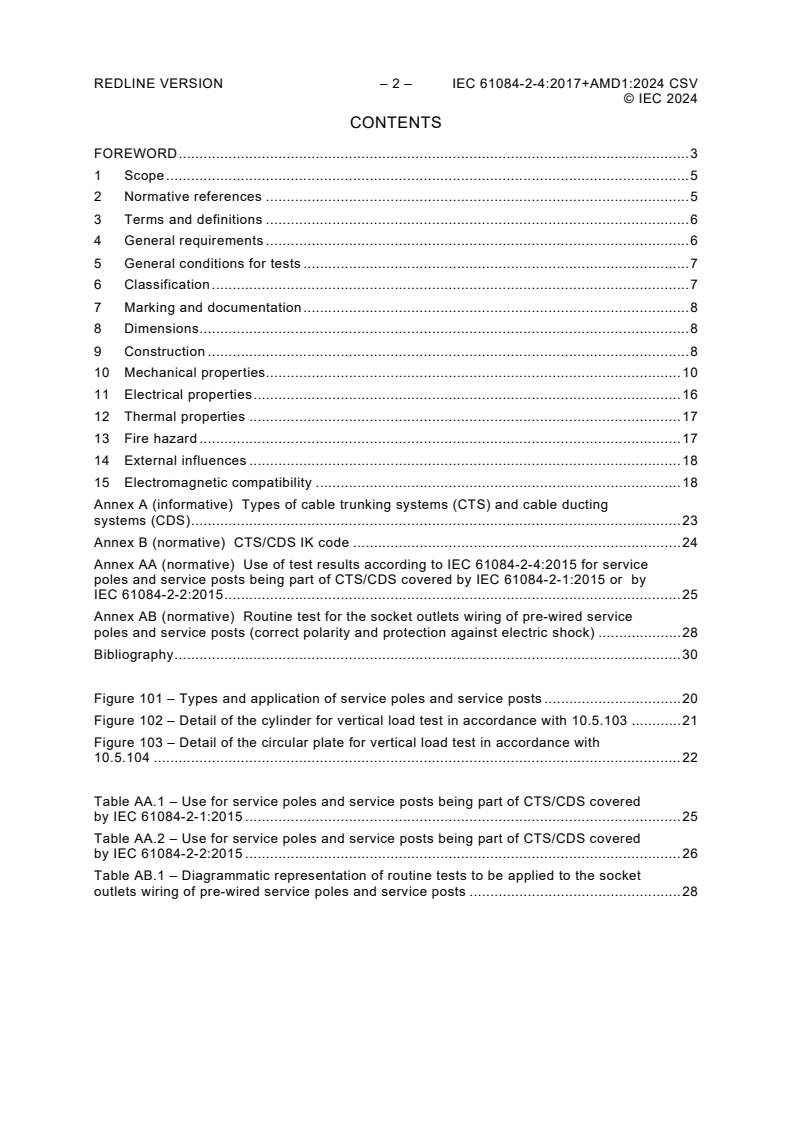
CONTENTS
FOREWORD . 3
1 Scope . 5
2 Normative references . 5
3 Terms and definitions . 6
4 General requirements . 6
5 General conditions for tests . 7
6 Classification . 7
7 Marking and documentation . 8
8 Dimensions. 8
9 Construction . 8
10 Mechanical properties. 10
11 Electrical properties . 16
12 Thermal properties . 17
13 Fire hazard . 17
14 External influences . 18
15 Electromagnetic compatibility . 18
Annex A (informative) Types of cable trunking systems (CTS) and cable ducting
systems (CDS) . 23
Annex B (normative) CTS/CDS IK code . 24
Annex AA (normative) Use of test results according to IEC 61084-2-4:2015 for service
poles and service posts being part of CTS/CDS covered by IEC 61084-2-1:2015 or by
IEC 61084-2-2:2015 . 25
Annex AB (normative) Routine test for the socket outlets wiring of pre-wired service
poles and service posts (correct polarity and protection against electric shock) . 28
Bibliography . 30
Figure 101 – Types and application of service poles and service posts . 20
Figure 102 – Detail of the cylinder for vertical load test in accordance with 10.5.103 . 21
Figure 103 – Detail of the circular plate for vertical load test in accordance with
10.5.104 . 22
Table AA.1 – Use for service poles and service posts being part of CTS/CDS covered
by IEC 61084-2-1:2015 . 25
Table AA.2 – Use for service poles and service posts being part of CTS/CDS covered
by IEC 61084-2-2:2015 . 26
Table AB.1 – Diagrammatic representation of routine tests to be applied to the socket
outlets wiring of pre-wired service poles and service posts . 28
INTERNATIONAL ELECTROTECHNICAL COMMISSION
____________
CABLE TRUNKING SYSTEMS AND CABLE DUCTING
SYSTEMS FOR ELECTRICAL INSTALLATIONS –
Part 2-4: Particular requirements – Service poles and service posts
FOREWORD
1) The International Electrotechnical Commission (IEC) is a worldwide organization for standardization comprising
all national electrotechnical committees (IEC National Committees). The object of IEC is to promote
international co-operation on all questions concerning standardization in the electrical and electronic fields. To
this end and in addition to other activities, IEC publishes International Standards, Technical Specifications,
Technical Reports, Publicly Available Specifications (PAS) and Guides (hereafter referred to as “IEC
Publication(s)”). Their preparation is entrusted to technical committees; any IEC National Committee interested
in the subject dealt with may participate in this preparatory work. International, governmental and non-
governmental organizations liaising with the IEC also participate in this preparation. IEC collaborates closely
with the International Organization for Standardization (ISO) in accordance with conditions determined by
agreement between the two organizations.
2) The formal decisions or agreements of IEC on technical matters express, as nearly as possible, an international
consensus of opinion on the relevant subjects since each technical committee has representation from all
interested IEC National Committees.
3) IEC Publications have the form of recommendations for international use and are accepted by IEC National
Committees in that sense. While all reasonable efforts are made to ensure that the technical content of IEC
Publications is accurate, IEC cannot be held responsible for the way in which they are used or for any
misinterpretation by any end user.
4) In order to promote international uniformity, IEC National Committees undertake to apply IEC Publications
transparently to the maximum extent possible in their national and regional publications. Any divergence
between any IEC Publication and the corresponding national or regional publication shall be clearly indicated in
the latter.
5) IEC itself does not provide any attestation of conformity. Independent certification bodies provide conformity
assessment services and, in some areas, access to IEC marks of conformity. IEC is not responsible for any
services carried out by independent certification bodies.
6) All users should ensure that they have the latest edition of this publication.
7) No liability shall attach to IEC or its directors, employees, servants or agents including individual experts and
members of its technical committees and IEC National Committees for any personal injury, property damage or
other damage of any nature whatsoever, whether direct or indirect, or for costs (including legal fees) and
expenses arising out of the publication, use of, or reliance upon, this IEC Publication or any other IEC
Publications.
8) Attention is drawn to the Normative references cited in this publication. Use of the referenced publications is
indispensable for the correct application of this publication.
9) Attention is drawn to the possibility that some of the elements of this IEC Publication may be the subject of
patent rights. IEC shall not be held responsible for identifying any or all such patent rights.
International Standard IEC 61084-2-4 has been prepared by subcommittee 23A: Cable
management systems, of IEC technical committee 23: Electrical accessories.
This second edition cancels and replaces the first edition published in 1996. This edition
constitutes a technical revision.
This edition includes the following significant technical changes with respect to the previous
edition:
• classification;
• construction;
• mechanical and electrical properties.
– 4 – IEC 61084-2-4:2017 © IEC 2017
The text of this standard is based on the following documents:
FDIS Report on voting
23A/830/FDIS 23A/837/RVD
Full information on the voting for the approval of this standard can be found in the report on
voting indicated in the above table.
This publication has been drafted in accordance with the ISO/IEC Directives, Part 2.
This International Standard is to be used in conjunction with IEC 61084-1:2017.
This part of the IEC 61084 series supplements or modifies the corresponding clauses of
IEC 61084-1:2017 as follows:
• where no particular clause or subclause of IEC 61084-1 is mentioned, the corresponding
clause or subclause of IEC 61084-1 applies as far as is reasonable;
• where “addition” or “replacement” is stated, the relevant text of IEC 61084-1 is to be
adapted accordingly;
• subclauses, figures and tables which are additional to those in IEC 61084-1 are numbered
starting from 101.
In this standard, the following print types are used:
• requirements and definitions: roman type;
• compliance statements: italic type.
A list of all parts in the IEC 61084 series, published under the general title Cable trunking and
cable ducting systems for electrical installations, can be found on the IEC website.
The committee has decided that the contents of this publication will remain unchanged until
the stability date indicated on the IEC website under "http://webstore.iec.ch" in the data
related to the specific publication. At this date, the publication will be
• reconfirmed,
• withdrawn,
• replaced by a revised edition, or
• amended.
IMPORTANT – The 'colour inside' logo on the cover page of this publication indicates
that it contains colours which are considered to be useful for the correct
understanding of its contents. Users should therefore print this document using a
colour printer.
CABLE TRUNKING SYSTEMS AND CABLE DUCTING
SYSTEMS FOR ELECTRICAL INSTALLATIONS –
Part 2-4: Particular requirements – Service poles and service posts
1 Scope
This part of the IEC 61084 series specifies requirements and tests for cable trunking systems
(CTS) and cable ducting systems (CDS) intended for the accommodation, and where
necessary for the electrically protective separation, of insulated conductors, cables and
possibly other electrical equipment in electrical and/or communication systems installations.
The maximum voltage of these installations is 1 000 V AC and 1 500 V DC
Service poles and service posts are intended to be mounted in free space and in contact with
mounting surface(s) only at one or two ends, where the word “mounted” means fixed or
placed on the floor with a weighted base or linked to a mounting surface through a flexible
component.
NOTE Service poles and service posts can also be part of a CTS/CDS intended for wall or ceiling mounting
covered by IEC 61084-2-1 or floor mounting covered by IEC 61084-2-2 and are then also tested according to said
parts, as appropriate.
This international standard does not apply to conduit systems, cable tray systems, cable
ladder systems, powertrack systems or equipment covered by other standards.
2 Normative references
This clause of Part 1 is applicable, except as follows:
Addition:
IEC 60068-2-75:2014, Environmental testing – Part 2-75: Tests – Test Eh: Hammer tests
IEC 60228:2004, Conductors of insulated cables
IEC 61084-1:2017, Cable trunking systems and cable ducting systems for electrical
installations – Part 1: General requirements
IEC 61084-2-1:2017, Cable trunking and cable ducting systems for electrical installations –
Part 2-1: Particular requirements – Cable trunking systems and cable ducting systems
intended for mounting on walls and ceilings
IEC 61084-2-2:2017, Cable trunking systems and cable ducting systems for electrical
installations – Part 2-2: Particular requirements – Cable trunking systems and cable ducting
systems intended for mounting underfloor, flushfloor, or onfloor
ISO 535:2014, Paper and board – Determination of water absorptiveness – Cobb method
ISO 536:2012, Paper and board – Determination of grammage
ISO 9328-7:2011, Steel flat products for pressure purposes – Technical delivery conditions –
Part 7: Stainless steels
– 6 – IEC 61084-2-4:2017 © IEC 2017
3 Terms and definitions
This clause of Part 1 is applicable, except as follows:
Addition:
3.101
service pole
CTS/CDS intended to be mounted in free space and in contact with mounting surfaces only at
two ends
Note 1 to entry: Service pole can be part of a CTS/CDS intended for wall, ceiling or floor mounting. See
Figure 101.
Note 2 to entry: The word “mounted” means fixed or placed on the floor with a weighted base or linked to a
mounting surface through a flexible component.
3.102
service post
CTS/CDS intended to be mounted in free space and in contact with mounting surface only at
one end
Note 1 to entry: Service post can be part of a CTS/CDS intended for wall, ceiling or floor mounting. See
Figure 101.
Note 2 to entry: The word “mounted” means fixed or placed on the floor with a weighted base or linked to a
mounting surface through a flexible component.
3.103
pre-equipped service pole/service post
service pole/service post already assembled by the manufacturer or responsible vendor with
one or more electrical accessories and/or communication components
3.104
pre-wired service pole/service post
service pole/service post already assembled by the manufacturer or responsible vendor, wired
by means of insulated conductors and/or cables connecting one or more electrical
accessories and/or communication components
3.105
modular service pole/service post
service pole/service post which includes the assembly of two or more modules allowing to
increase the height or width or depth of the product
3.106
rated current
value of the current assigned to a pre-wired and/or pre-equipped service pole/service post by
the manufacturer and to which operation and performances characteristics are referred
3.107
rated voltage
value of the voltage assigned to a pre-wired and/or pre-equipped service pole/service post by
the manufacturer and to which operation and performances characteristics are referred
4 General requirements
This clause of Part 1 is applicable.
5 General conditions for tests
This clause of Part 1 is applicable, except as follows:
5.1 Replacement:
5.1 Unless otherwise specified, tests according to this standard are type tests.
Additional subclause:
5.101 Unless otherwise specified in the relevant test, service poles/service posts are tested
on the longest version declared by the manufacturer, and service poles/service posts which
differ only by being shorter than one which complies with the requirements for a given test are
deemed to comply with the requirements for the same test.
6 Classification
This clause of Part 1 is applicable except as follows:
6.4.1 Flame propagating CTS/CDS
This subclause of Part 1 is not applicable.
Additional subclauses:
6.101 According to floor treatment for service poles/service posts placed on the floor
6.101.1 Service poles/service posts for dry-treatment of floor
6.101.2 Service poles/service posts for wet-treatment of floor
6.102 According to resistance to vertical load applied through small surface area
6.102.1 CTS/CDS for 500 N
6.102.2 CTS/CDS for 750 N
6.102.3 CTS/CDS for 1 000 N
6.102.4 CTS/CDS for 1 500 N
6.102.5 CTS/CDS for 2 000 N
6.102.6 CTS/CDS for 2 500 N
6.102.7 CTS/CDS for 3 000 N
6.103 Optional classification according to resistance to vertical load applied through
large surface area
6.103.1 CTS/CDS for 2 000 N
6.103.2 CTS/CDS for 3 000 N
6.103.3 CTS/CDS for 5 000 N
6.103.4 CTS/CDS for 10 000 N
6.103.5 CTS/CDS for 15 000 N
– 8 – IEC 61084-2-4:2017 © IEC 2017
7 Marking and documentation
This clause of Part 1 is applicable except as follows:
7.3 Add the following three last bullet points:
• for modular service poles/service posts, the constraints concerning the number or
configuration of assembled modules;
• whether non-vertical mounting is allowed;
• whether the flexible component, if any, linking to the mounting surface is not part of the
enclosure.
8 Dimensions
This clause of Part 1 is applicable except as follows:
Replacement:
There are no dimensional requirements.
9 Construction
This clause of Part 1 is applicable except as follows:
9.1 Sharp edges
Replacement of the second paragraph by:
Compliance is checked by inspection using one sample, if necessary after cutting the samples
apart.
Replacement of the fourth paragraph by:
Compliance is checked by inspection using one sample.
9.3 Means for protective separation and/or retention
Replacement of the second paragraph by:
Compliance is checked by the tests of 10.3 and 10.5.
Additional subclauses:
9.101 Service poles/service posts which are likely to be moved during use shall be provided
with means to relieve conductors from strain in terminals or terminations.
NOTE A service pole with a weighted base is an example of service pole likely to be moved during use. A
clamped service pole is not considered likely to be moved during use.
When a cable anchorage is used, compliance is checked by inspection and by the test of
9.11.
Other means are checked by the following test.
After installation according to the manufacturer’s instructions, a pull force of 100 N ± 2 N is
applied to the means in the most unfavourable direction for 60 s ± 5 s.
During the application of the force, there shall be no stress on insulated conductors.
9.102 Areas of service poles/service posts shall have adequate resistance to vertical load
when both the following conditions are fulfilled.
• These areas are reasonably subjected to vertical load during installation and/or
application. Some areas of service poles or service posts are considered not to be
subjected to vertical load due to their dimensions or shape or height at least 100 mm
above the floor.
• Damage to these areas would impair mechanical or electrical safety.
Compliance is checked by the test of 10.5.103 and, when a resistance to vertical load through
large surface area is declared, by the test of 10.5.104.
9.103 Insulated conductors and/or cables used to connect electrical accessories and/or
communication components in pre-wired service poles/service posts shall be selected in
accordance with the rated voltage of the connected equipment and, in case of electrical
accessories, its rated current.
Compliance is checked by inspection.
9.104 Service poles/service posts placed on the floor declared according to 6.101.2 shall
avoid water coming into contact with insulated conductors and live parts during wet-treatment
of floor by one or a combination of the following methods:
– method 1: ensuring by design that water does not come into contact with insulated
conductors and live parts when the water level is 10 mm above the upper level of the floor
covering;
– method 2: providing manufacturer's instructions which require that insulated conductors
and live parts are positioned not less than 10 mm above the upper level of the floor
covering;
– method 3: providing appropriate sealing.
For method 1, compliance is checked by measurement. For method 2, compliance is checked
by inspection. For method 3, compliance is checked by the following test.
The test is made using the lower part of the service pole/service post fixed on a plywood
board 16 mm thick, with a 50 mm minimum spacing between the sample and the edge of the
support.
Ingress of water is detected by the use of dry absorbent paper positioned between the
plywood board and the sample. The absorbent paper is placed only in areas intended to
accommodate insulated conductors or live parts.
The absorbent paper has a water absorptive height longitudinal of 75 mm per 10 min
according to ISO 535 and a basis weight of 250 g per m according to ISO 536.
−1
The sample is placed carefully into a tray containing water to simulate a mm height of
water on the floor.
NOTE For easy detection of water absorption, coloured water can be used.
After 15 s ± 1 s the sample is removed carefully from the tray and the exterior of the sample is
immediately wiped.
– 10 – IEC 61084-2-4:2017 © IEC 2017
The service pole/service post is removed from the plywood board.
The absorbent paper shall show no trace of water absorption.
10 Mechanical properties
This clause of Part 1 is applicable except as follows:
10.2 Cable support test
This subclause of Part 1 is not applicable.
10.3 Impact test
10.3.2 Impact test for installation and application
This subclause of Part 1 is applicable except as follows:
Replacement of the first paragraph by:
The test is carried out with the impact test values declared according to Table 6.
Additional subclauses:
10.3.2.101 The resistance to impact is checked on service poles/service posts including a
flexible component, if any, used to link the service pole/service post to the mounting surface if
the flexible component provides a safety function.
NOTE 1 Examples of safety function are retaining the service pole/service post or relieving conductors from strain
or providing an enclosure.
The test is carried out on an assembly consisting
– for a service pole/service post not longer than 1 000 mm: of a complete service
pole/service post;
NOTE 2 The length to be considered does not take into account the flexible component if any.
– for a service pole/service post longer than 1 000 mm: of one or more sections
1 000 mm ± 5 mm long to simulate the various characteristics (function, design,
material, …) within the service pole/service post.
For service poles/service posts which differ only in length the test is carried out on the
shortest and the longest ones. Other service poles/service posts within the range are deemed
to comply with the requirements for this test.
For a service pole intended for vertical mounting, the test is carried out only on parts of the
service pole which will be lower than 1 500 mm above the floor when installed in accordance
with manufacturer’s instructions.
The assembly includes system components, if any, to simulate normal use.
Before the test, non-metallic system components and composite system components are aged
at the temperature declared according to Table 3 with a tolerance of ±2 °C for 168 h ± 4 h
continuously.
The test is carried out with the impact test values declared according to Table 6.
The impact test apparatus according to Clause 4 of IEC 60068-2-75:2014, is mounted on a
solid wall or structure providing sufficient support.
For service poles, the assembly is placed horizontally in the impact test apparatus. In order to
prevent any movement of the ends, the assembly is secured at both ends. This method of
securing should not introduce a compressive force in the longitudinal axis of the assembly
which would not exist in normal application. Between both ends, the assembly is not
supported and is free to move in the impact direction.
Service posts are tested in their normal mounting position. The assembly is secured at the
appropriate end to prevent any movement of this end without any additional support. Products
intended to be mounted vertically are tested vertically whenever possible, otherwise they are
tested horizontally.
No impact is applied to knockouts, membranes and the like.
When the assembly consists of a section, no impact is applied within 50 mm of any open end
of the assembly.
NOTE 3 When another system component has been included at an end of the assembly to prevent movement,
this end is still considered open.
Compliance is checked according to 10.3.2.104 after carrying out the test of:
– 10.3.2.102 for service poles/service posts with declared minimum installation and
application temperature of +5 °C or higher;
– 10.3.2.103 for service poles/service posts with declared minimum installation and
application temperature lower than +5 °C.
10.3.2.102 The test is carried out at an ambient temperature of 20 °C ± 5 °C. The hammer is
allowed to fall so that an impact is applied as far as possible perpendicular to the accessible
region of the assembly likely to be the weakest.
10.3.2.103 The assemblies are placed in a cabinet at the temperature declared according to
Table 2 with a tolerance of ±2 °C.
After 2 h, each assembly is, in turn, removed from the cabinet and immediately placed in
position in the impact test apparatus.
At 12 s ± 2 s after the removal of the assembly from the cabinet, the hammer is allowed to fall
so that an impact is applied as far as possible perpendicular to the accessible region of the
assembly likely to be the weakest. Compliance with impact applied before 10 s provides also
compliance with this test of the standard.
Instead of placing the assemblies in a cabinet and applying the impact at 12 s ± 2 s after the
removal of the assembly from the cabinet, it is allowed to apply the impact in a climatic
chamber at the temperature declared according to Table 2 with a tolerance of ±2 °C on
assemblies placed at this temperature for 2 h. Compliance in the climatic chamber is
sufficient. In case of failure in the climatic chamber, compliance using the cabinet provides
compliance with the standard.
10.3.2.104 After the test,
– the assembly shall show no cracks or similar damage visible to normal or corrected vision
without magnification, and
– the assembly shall remain intact
such that safety is not impaired.
– 12 – IEC 61084-2-4:2017 © IEC 2017
In case of doubt, the test of 14.1.3 is carried out on the impacted assemblies, with the
exception of the open ends, to check that the declared degree of protection against access to
hazardous parts is maintained. The declared degree of protection against access to
hazardous parts is either the additional letter directly declared by the manufacturer according
to 6.7.3, if any, or the degree of protection against access to hazardous parts indirectly
declared by the manufacturer according to 6.7.1.
NOTE Any cracks in internal dividers which are not likely to impair electrical safety or use are ignored. Electrical
safety can be impaired when the impact creates a sharp edge on a partition which can possibly damage insulated
conductors or cables (see 9.1).
10.4 Linear deflection test
This test is only applicable to service poles/service posts intended to be mounted in a non-
vertical position.
Compliance is checked by the following test.
The test is carried out on a complete service pole/service post mounted horizontally. If no
manufacturer's instructions for the orientation of the service pole/service post are provided,
the test is carried out in the most unfavourable orientation.
The test sample is subjected to an evenly distributed load of 1,0 g/mm per metre length of
the declared usable area for cables.
The load consists of copper cables complying with class 5, Table 3 of IEC 60228:2004 or
flexible insulated conductors or cables of similar mass per meter which are placed in the
sample.
nominal cross section are placed in the samples so that approximately
Cables of 25 mm
50 % of the load is achieved.
Cables of 2,5 mm nominal cross section are placed on top of the larger cables to achieve the
total load within a tolerance of ±100 g.
To allow for settlement of the sample, a pre-load of approximately 10 % of the load is applied
and removed after approximately 5 min. The measurement apparatus is then calibrated to
zero.
+ 5
After 1 h min, with the load still applied, the deflection is measured,
– for service poles on the lower surface, at mid length and in the middle of the width, and
– for service posts on the lower surface, at the free end and in the middle of the width.
The deflection shall not exceed,
– for service poles, 1 % of the length of the service pole, and
– for service posts, 5 % of the length of the service post.
Access covers of the service pole/service post and cable separators shall remain adequately
fixed so as to fulfil their intended function, and electrical safety shall not be impaired.
In case of doubt, the test of 14.1.3 is carried out on the loaded test sample to check that the
declared degree of protection against access to hazardous parts is maintained. The declared
degree of protection against access to hazardous parts is either the additional letter directly
declared by the manufacturer according 6.7.3, if any, or the degree of protection against
access to hazardous parts indirectly declared by the manufacturer according 6.7.1.
10.5 External load test
Additional subclauses:
10.5.101 Horizontal load test for service poles not likely to be moved during use
NOTE A clamped service pole is considered not likely to be moved during use. A service pole with a weighted
base is an example of service pole likely to be moved during use.
The test is carried out on a complete service pole mounted between two rigid parallel
surfaces.
For service poles which differ only in length, the test is carried out on the shortest and the
longest ones. Other service poles within the range are deemed to comply with the
requirements for this test.
The service pole is mounted according to the manufacturer’s instruction.
For service poles intended to be clamped between floor and ceiling:
– unless otherwise specified in the manufacturer’s instructions, the test surfaces are of
stainless steel X5CrNi18-9, with a thickness of at least 2 mm according to ISO 9328-7,
and a surface quality of 2B, mounted on a rigid base, for example concrete;
– after mounting, the distance between floor and ceiling is increased by 5 mm ± 1 mm
without any further clamping of the service pole.
A push force of 400 N ± 20 N is applied perpendicular to the longitudinal axis of the sample in
the most unfavourable position and direction.
The force is applied for 60 s ± 5 s on a surface measuring approximately 80 mm × 80 mm
using an intermediate rigid element. If it is not possible to apply the force on an
80 mm × 80 mm surface using a square intermediate element, one of appropriate shape with
approximately the same projective area is used.
During the test, mechanical and electrical safety shall not be impaired.
After the test, the service pole shall remain in place and electrical safety shall not be
impaired. In particular, access covers, cable separators, cable retainers and the like shall
remain adequately fixed so as to fulfil their intended function.
Immediately after this test, the service pole is subjected to a torque of 10 Nm ± 1 Nm around
its longitudinal axis for 60 s ± 5 s.
During the test, mechanical and electrical safety shall not be impaired.
After the test, the service pole shall remain in place and electrical safety shall not be
impaired. In particular, access covers, cable separators, cable retainers and the like shall
remain adequately fixed so as to fulfil their intended function.
Each time there is doubt about possible impairment of electrical safety, the test of 14.1.3 is
carried out on the samples to check that the declared degree of protection against access to
hazardous parts is maintained. The declared degree of protection against access to
hazardous parts is either the additional letter directly declared by the manufacturer according
to 6.7.3, if any, or the degree of protection against access to hazardous parts indirectly
declared by the manufacturer according to 6.7.1.
The above test is repeated in the opposite rotation direction.
– 14 – IEC 61084-2-4:2017 © IEC 2017
During these tests, the testing devices should be so applied that they do not prevent any
cover from being detached.
10.5.102 Horizontal load test for service poles likely to be moved during use and for
service posts
The test is carried out on a complete service pole/service post mounted as declared by the
manufacturer.
For service poles/service posts which differ only in length, the test is carried out on the
shortest and the longest ones. Other service poles/service posts within the range are deemed
to comply with the requirements for this test.
A push force of 100 N ± 5 N is applied perpendicular to the longitudinal axis of the sample in
the most unfavourable position and direction.
The force is applied for 60 s ± 5 s on a surface measuring approximately 80 mm × 80 mm
using an intermediate rigid element. If it is not possible to apply the force on an
80 mm × 80 mm surface using a square intermediate element, one of appropriate shape with
approximately the same projective area is used.
During the test, mechanical and electrical safety shall not be impaired.
After the test electrical safety shall not be impaired. In particular, access covers, cable
separators, cable retainers and the like shall remain adequately fixed so as to fulfil their
intended function.
Service posts not likely to be moved during use shall remain in place.
Immediately after this test, service posts not likely to be moved during use are subjected to a
torque of 5 Nm ± 0,5 Nm around their longitudinal axis for 60 s ± 5 s.
During the test mechanical and electrical safety shall not be impaired.
After the test, the service post not likely to be moved shall remain in place, and electrical
safety shall not be impaired. In particular, access covers, cable separators, cable retainers
and the like shall remain adequately fixed so as to fulfil their intended function.
Each time there is doubt about possible impairment of electrical safety, the test of 14.1.3 is
carried out on the samples to check that the declared degree of protection against access to
hazardous parts is maintained. The declared degree of protection against access to
hazardous parts is either the additional letter directly declared by the manufacturer according
to 6.7.3, if any, or the degree of protection against access to hazardous parts indirectly
declared by the manufacturer according to 6.7.1.
The above test is repeated in the opposite rotation direction.
During these tests, the testing devices should be so applied that they do not prevent any
cover from being detached.
10.5.103 Vertical load test for application – Force applied through small surface area
The test is carried out only on one complete service pole/service post using the shortest
version declared by the manufacturer. Service poles/service posts which differ only by being
longer are deemed to comply with the requirements for this test.
The sample is mounted on a horizontal rigid smooth support such as a plywood board 16 mm
thick, with a 50 mm minimum spacing between the assembly and the edge of the support.
Before the test, non-metallic system components and composite system components are aged
at the temperature declared according to Table 3 with a tolerance of ±2 °C for (168 ± 4) h
continuously.
The surface of the sample which can be exposed to traffic is loaded with the force declared
according to 6.102.
A vertical force is applied using a steel cylinder of 13,3 mm ± 0,1 mm diameter with an edge
radius of approximately 1 mm providing a contact surface of approximately 1 cm with a
minimum length of 30 mm (see Figure 102).
The cylinder is placed in the area which is reasonably considered to be subjected to vertical
load, in the region likely to be the most unfavourable one.
The force is gradually increased up to the value declared according to 6.102 with a tolerance
+ 4
% over 15 s ± 5 s and maintained for 60 s ± 1 s.
During the test, mechanical and electrical safety shall not be impaired.
After the test, electrical safety shall not be impaired. In particular, access covers, cable
separators, cable retainers and the like shall remain adequately fixed so as to fulfil their
intended function.
In case of doubt, the test of 14.1.3 is carried out on the sample to check that the declared
degree of protection against access to hazardous parts is maintained. The declared degree of
protection against access to hazardous parts is either the additional letter directly declared by
the manufacturer according 6.7.3, if any, or the degree of protection against access to
hazardous parts indirectly declared by the manufacturer according 6.7.1.
10.5.104 Vertical load test for application – Force applied through large surface area
The test is carried out only on one complete service pole/service post using the shortest
version declared by the manufacturer. Service poles/service posts which differ only by being
longer are deemed to comply with the requirements for this test.
The sample is mounted on a horizontal rigid smooth support such as a plywood board 16 mm
thick, with a 50 mm minimum spacing betw
...
IEC 61084-2-4 ®
Edition 2.1 2024-03
CONSOLIDATED VERSION
INTERNATIONAL
STANDARD
NORME
INTERNATIONALE
colour
inside
Cable trunking systems and cable ducting systems for electrical installations –
Part 2-4: Particular requirements – Service poles and service posts
Systèmes de goulottes et systèmes de conduits-profilés pour installations
électriques –
Partie 2-4 : Exigences particulières – Colonnes et colonnettes
All rights reserved. Unless otherwise specified, no part of this publication may be reproduced or utilized in any form
or by any means, electronic or mechanical, including photocopying and microfilm, without permission in writing from
either IEC or IEC's member National Committee in the country of the requester. If you have any questions about IEC
copyright or have an enquiry about obtaining additional rights to this publication, please contact the address below or
your local IEC member National Committee for further information.
Droits de reproduction réservés. Sauf indication contraire, aucune partie de cette publication ne peut être reproduite ni
utilisée sous quelque forme que ce soit et par aucun procédé, électronique ou mécanique, y compris la photocopie et
les microfilms, sans l'accord écrit de l'IEC ou du Comité national de l'IEC du pays du demandeur. Si vous avez des
questions sur le copyright de l'IEC ou si vous désirez obtenir des droits supplémentaires sur cette publication, utilisez
les coordonnées ci-après ou contactez le Comité national de l'IEC de votre pays de résidence.
IEC Secretariat Tel.: +41 22 919 02 11
3, rue de Varembé info@iec.ch
CH-1211 Geneva 20 www.iec.ch
Switzerland
About the IEC
The International Electrotechnical Commission (IEC) is the leading global organization that prepares and publishes
International Standards for all electrical, electronic and related technologies.
About IEC publications
The technical content of IEC publications is kept under constant review by the IEC. Please make sure that you have the
latest edition, a corrigendum or an amendment might have been published.
IEC publications search - webstore.iec.ch/advsearchform IEC Products & Services Portal - products.iec.ch
The advanced search enables to find IEC publications by a Discover our powerful search engine and read freely all the
variety of criteria (reference number, text, technical publications previews, graphical symbols and the glossary.
committee, …). It also gives information on projects, replaced With a subscription you will always have access to up to date
and withdrawn publications. content tailored to your needs.
IEC Just Published - webstore.iec.ch/justpublished
Electropedia - www.electropedia.org
Stay up to date on all new IEC publications. Just Published
The world's leading online dictionary on electrotechnology,
details all new publications released. Available online and once
containing more than 22 500 terminological entries in English
a month by email.
and French, with equivalent terms in 25 additional languages.
Also known as the International Electrotechnical Vocabulary
IEC Customer Service Centre - webstore.iec.ch/csc
(IEV) online.
If you wish to give us your feedback on this publication or need
further assistance, please contact the Customer Service
Centre: sales@iec.ch.
A propos de l'IEC
La Commission Electrotechnique Internationale (IEC) est la première organisation mondiale qui élabore et publie des
Normes internationales pour tout ce qui a trait à l'électricité, à l'électronique et aux technologies apparentées.
A propos des publications IEC
Le contenu technique des publications IEC est constamment revu. Veuillez vous assurer que vous possédez l’édition la
plus récente, un corrigendum ou amendement peut avoir été publié.
Recherche de publications IEC - Découvrez notre puissant moteur de recherche et consultez
webstore.iec.ch/advsearchform gratuitement tous les aperçus des publications, symboles
La recherche avancée permet de trouver des publications IEC graphiques et le glossaire. Avec un abonnement, vous aurez
en utilisant différents critères (numéro de référence, texte, toujours accès à un contenu à jour adapté à vos besoins.
comité d’études, …). Elle donne aussi des informations sur les
projets et les publications remplacées ou retirées. Electropedia - www.electropedia.org
Le premier dictionnaire d'électrotechnologie en ligne au monde,
IEC Just Published - webstore.iec.ch/justpublished
avec plus de 22 500 articles terminologiques en anglais et en
Restez informé sur les nouvelles publications IEC. Just
français, ainsi que les termes équivalents dans 25 langues
Published détaille les nouvelles publications parues.
additionnelles. Egalement appelé Vocabulaire
Disponible en ligne et une fois par mois par email.
Electrotechnique International (IEV) en ligne.
Service Clients - webstore.iec.ch/csc
Si vous désirez nous donner des commentaires sur cette
publication ou si vous avez des questions contactez-nous:
sales@iec.ch.
IEC Products & Services Portal - products.iec.ch
IEC 61084-2-4 ®
Edition 2.1 2024-03
CONSOLIDATED VERSION
INTERNATIONAL
STANDARD
NORME
INTERNATIONALE
colour
inside
Cable trunking systems and cable ducting systems for electrical installations –
Part 2-4: Particular requirements – Service poles and service posts
Systèmes de goulottes et systèmes de conduits-profilés pour installations
électriques –
Partie 2-4 : Exigences particulières – Colonnes et colonnettes
INTERNATIONAL
ELECTROTECHNICAL
COMMISSION
COMMISSION
ELECTROTECHNIQUE
INTERNATIONALE
ICS 29.060.01, 29.120.10 ISBN 978-2-8322-8504-6
REDLINE VERSION – 2 – IEC 61084-2-4:2017+AMD1:2024 CSV
© IEC 2024
CONTENTS
FOREWORD . 3
1 Scope . 5
2 Normative references . 5
3 Terms and definitions . 6
4 General requirements . 6
5 General conditions for tests . 7
6 Classification . 7
7 Marking and documentation . 8
8 Dimensions. 8
9 Construction . 8
10 Mechanical properties. 10
11 Electrical properties . 16
12 Thermal properties . 17
13 Fire hazard . 17
14 External influences . 18
15 Electromagnetic compatibility . 18
Annex A (informative) Types of cable trunking systems (CTS) and cable ducting
systems (CDS) . 23
Annex B (normative) CTS/CDS IK code . 24
Annex AA (normative) Use of test results according to IEC 61084-2-4:2015 for service
poles and service posts being part of CTS/CDS covered by IEC 61084-2-1:2015 or by
IEC 61084-2-2:2015 . 25
Annex AB (normative) Routine test for the socket outlets wiring of pre-wired service
poles and service posts (correct polarity and protection against electric shock) . 28
Bibliography . 30
Figure 101 – Types and application of service poles and service posts . 20
Figure 102 – Detail of the cylinder for vertical load test in accordance with 10.5.103 . 21
Figure 103 – Detail of the circular plate for vertical load test in accordance with
10.5.104 . 22
Table AA.1 – Use for service poles and service posts being part of CTS/CDS covered
by IEC 61084-2-1:2015 . 25
Table AA.2 – Use for service poles and service posts being part of CTS/CDS covered
by IEC 61084-2-2:2015 . 26
Table AB.1 – Diagrammatic representation of routine tests to be applied to the socket
outlets wiring of pre-wired service poles and service posts . 28
© IEC 2024
INTERNATIONAL ELECTROTECHNICAL COMMISSION
____________
CABLE TRUNKING SYSTEMS AND CABLE DUCTING
SYSTEMS FOR ELECTRICAL INSTALLATIONS –
Part 2-4: Particular requirements – Service poles and service posts
FOREWORD
1) The International Electrotechnical Commission (IEC) is a worldwide organization for standardization comprising
all national electrotechnical committees (IEC National Committees). The object of IEC is to promote
international co-operation on all questions concerning standardization in the electrical and electronic fields. To
this end and in addition to other activities, IEC publishes International Standards, Technical Specifications,
Technical Reports, Publicly Available Specifications (PAS) and Guides (hereafter referred to as "IEC
Publication(s)"). Their preparation is entrusted to technical committees; any IEC National Committee interested
in the subject dealt with may participate in this preparatory work. International, governmental and non-
governmental organizations liaising with the IEC also participate in this preparation. IEC collaborates closely
with the International Organization for Standardization (ISO) in accordance with conditions determined by
agreement between the two organizations.
2) The formal decisions or agreements of IEC on technical matters express, as nearly as possible, an international
consensus of opinion on the relevant subjects since each technical committee has representation from all
interested IEC National Committees.
3) IEC Publications have the form of recommendations for international use and are accepted by IEC National
Committees in that sense. While all reasonable efforts are made to ensure that the technical content of IEC
Publications is accurate, IEC cannot be held responsible for the way in which they are used or for any
misinterpretation by any end user.
4) In order to promote international uniformity, IEC National Committees undertake to apply IEC Publications
transparently to the maximum extent possible in their national and regional publications. Any divergence
between any IEC Publication and the corresponding national or regional publication shall be clearly indicated in
the latter.
5) IEC itself does not provide any attestation of conformity. Independent certification bodies provide conformity
assessment services and, in some areas, access to IEC marks of conformity. IEC is not responsible for any
services carried out by independent certification bodies.
6) All users should ensure that they have the latest edition of this publication.
7) No liability shall attach to IEC or its directors, employees, servants or agents including individual experts and
members of its technical committees and IEC National Committees for any personal injury, property damage or
other damage of any nature whatsoever, whether direct or indirect, or for costs (including legal fees) and
expenses arising out of the publication, use of, or reliance upon, this IEC Publication or any other IEC
Publications.
8) Attention is drawn to the Normative references cited in this publication. Use of the referenced publications is
indispensable for the correct application of this publication.
9) IEC draws attention to the possibility that the implementation of this document may involve the use of (a)
patent(s). IEC takes no position concerning the evidence, validity or applicability of any claimed patent rights in
respect thereof. As of the date of publication of this document, IEC had not received notice of (a) patent(s),
which may be required to implement this document. However, implementers are cautioned that this may not
represent the latest information, which may be obtained from the patent database available at
https://patents.iec.ch. IEC shall not be held responsible for identifying any or all such patent rights.
This consolidated version of the official IEC Standard and its amendment has been
prepared for user convenience.
IEC 61084-2-4 edition 2.1 contains the second edition (2017-03) [documents
23A/830/FDIS and 23A/837/RVD] and its amendment 1 (2024-03) [documents
23A/1062/FDIS and 23A/1070/RVD].
In this Redline version, a vertical line in the margin shows where the technical content
is modified by amendment 1. Additions are in green text, deletions are in strikethrough
red text. A separate Final version with all changes accepted is available in this
publication.
REDLINE VERSION – 4 – IEC 61084-2-4:2017+AMD1:2024 CSV
© IEC 2024
International Standard IEC 61084-2-4 has been prepared by subcommittee 23A: Cable
management systems, of IEC technical committee 23: Electrical accessories.
This second constitutes a technical revision.
This edition includes the following significant technical changes with respect to the previous
edition:
• classification;
• construction;
• mechanical and electrical properties.
This publication has been drafted in accordance with the ISO/IEC Directives, Part 2.
This International Standard is to be used in conjunction with IEC 61084-1:2017.
This part of the IEC 61084 series supplements or modifies the corresponding clauses of
IEC 61084-1:2017 as follows:
• where no particular clause or subclause of IEC 61084-1 is mentioned, the corresponding
clause or subclause of IEC 61084-1 applies as far as is reasonable;
• where “addition” or “replacement” is stated, the relevant text of IEC 61084-1 is to be
adapted accordingly;
• subclauses, figures and tables which are additional to those in IEC 61084-1 are numbered
starting from 101.
In this standard, the following print types are used:
• requirements and definitions: roman type;
• compliance statements: italic type.
A list of all parts in the IEC 61084 series, published under the general title Cable trunking and
cable ducting systems for electrical installations, can be found on the IEC website.
The committee has decided that the contents of this document and its amendment will remain
unchanged until the stability date indicated on the IEC website under webstore.iec.ch in the
data related to the specific document. At this date, the document will be
• reconfirmed,
• withdrawn, or
• revised.
IMPORTANT – The 'colour inside' logo on the cover page of this publication indicates
that it contains colours which are considered to be useful for the correct
understanding of its contents. Users should therefore print this document using a
colour printer.
© IEC 2024
CABLE TRUNKING SYSTEMS AND CABLE DUCTING
SYSTEMS FOR ELECTRICAL INSTALLATIONS –
Part 2-4: Particular requirements – Service poles and service posts
1 Scope
This part of the IEC 61084 series specifies requirements and tests for cable trunking systems
(CTS) and cable ducting systems (CDS) intended for the accommodation, and where
necessary for the electrically protective separation, of insulated conductors, cables and
possibly other electrical equipment in electrical and/or communication systems installations.
The maximum voltage of these installations is 1 000 V AC and 1 500 V DC
Service poles and service posts are intended to be mounted in free space and in contact with
mounting surface(s) only at one or two ends, where the word “mounted” means fixed or
placed on the floor with a weighted base or linked to a mounting surface through a flexible
component.
NOTE Service poles and service posts can also be part of a CTS/CDS intended for wall or ceiling mounting
covered by IEC 61084-2-1 or floor mounting covered by IEC 61084-2-2 and are then also tested according to said
parts, as appropriate.
This international standard does not apply to conduit systems, cable tray systems, cable
ladder systems, powertrack systems or equipment covered by other standards.
2 Normative references
This clause of Part 1 is applicable, except as follows:
Addition:
IEC 60068-2-75:2014, Environmental testing – Part 2-75: Tests – Test Eh: Hammer tests
IEC 60228:2004, Conductors of insulated cables
IEC 61084-1:2017, Cable trunking systems and cable ducting systems for electrical
installations – Part 1: General requirements
IEC 61084-2-1:2017, Cable trunking and cable ducting systems for electrical installations –
Part 2-1: Particular requirements – Cable trunking systems and cable ducting systems
intended for mounting on walls and ceilings
IEC 61084-2-2:2017, Cable trunking systems and cable ducting systems for electrical
installations – Part 2-2: Particular requirements – Cable trunking systems and cable ducting
systems intended for mounting underfloor, flushfloor, or onfloor
ISO 535:20142023, Paper and board – Determination of water absorptiveness – Cobb method
ISO 536:20122019, Paper and board – Determination of grammage
ISO 9328-7:2011, Steel flat products for pressure purposes – Technical delivery conditions –
Part 7: Stainless steels
REDLINE VERSION – 6 – IEC 61084-2-4:2017+AMD1:2024 CSV
© IEC 2024
3 Terms and definitions
This clause of Part 1 is applicable, except as follows:
Addition:
3.101
service pole
CTS/CDS intended to be mounted in free space and in contact with mounting surfaces only at
two ends
Note 1 to entry: Service pole can be part of a CTS/CDS intended for wall, ceiling or floor mounting. See
Figure 101.
Note 2 to entry: The word “mounted” means fixed or placed on the floor with a weighted base or linked to a
mounting surface through a flexible component.
3.102
service post
CTS/CDS intended to be mounted in free space and in contact with mounting surface only at
one end
Note 1 to entry: Service post can be part of a CTS/CDS intended for wall, ceiling or floor mounting. See
Figure 101.
Note 2 to entry: The word “mounted” means fixed or placed on the floor with a weighted base or linked to a
mounting surface through a flexible component.
3.103
pre-equipped service pole/service post
service pole/service post already assembled by the manufacturer or responsible vendor with
one or more electrical accessories and/or communication components
3.104
pre-wired service pole/service post
service pole/service post already assembled by the manufacturer or responsible vendor, wired
by means of insulated conductors and/or cables connecting one or more electrical
accessories and/or communication components
3.105
modular service pole/service post
service pole/service post which includes the assembly of two or more modules allowing to
increase the height or width or depth of the product
3.106
rated current
value of the current assigned to a pre-wired and/or pre-equipped service pole/service post by
the manufacturer and to which operation and performances characteristics are referred
3.107
rated voltage
value of the voltage assigned to a pre-wired and/or pre-equipped service pole/service post by
the manufacturer and to which operation and performances characteristics are referred
4 General requirements
This clause of Part 1 is applicable.
© IEC 2024
5 General conditions for tests
This clause of Part 1 is applicable, except as follows:
5.1 Replacement:
5.1 Unless otherwise specified, tests according to this standard are type tests.
Additional subclause:
5.101 Unless otherwise specified in the relevant test, service poles/service posts are tested
on the longest version declared by the manufacturer, and service poles/service posts which
differ only by being shorter than one which complies with the requirements for a given test are
deemed to comply with the requirements for the same test.
6 Classification
This clause of Part 1 is applicable except as follows:
6.4.1 Flame propagating CTS/CDS
This subclause of Part 1 is not applicable.
Additional subclauses:
6.101 According to floor treatment for service poles/service posts placed on the floor
6.101.1 Service poles/service posts for dry-treatment of floor
6.101.2 Service poles/service posts for wet-treatment of floor
6.102 According to resistance to vertical load applied through small surface area
6.102.1 CTS/CDS for 500 N
6.102.2 CTS/CDS for 750 N
6.102.3 CTS/CDS for 1 000 N
6.102.4 CTS/CDS for 1 500 N
6.102.5 CTS/CDS for 2 000 N
6.102.6 CTS/CDS for 2 500 N
6.102.7 CTS/CDS for 3 000 N
6.103 Optional classification according to resistance to vertical load applied through
large surface area
6.103.1 CTS/CDS for 2 000 N
6.103.2 CTS/CDS for 3 000 N
6.103.3 CTS/CDS for 5 000 N
6.103.4 CTS/CDS for 10 000 N
6.103.5 CTS/CDS for 15 000 N
REDLINE VERSION – 8 – IEC 61084-2-4:2017+AMD1:2024 CSV
© IEC 2024
7 Marking and documentation
This clause of Part 1 is applicable except as follows:
7.3 Add the following three last bullet points:
• for modular service poles/service posts, the constraints concerning the number or
configuration of assembled modules;
• whether non-vertical mounting is allowed;
• whether the flexible component, if any, linking to the mounting surface is not part of the
enclosure.
8 Dimensions
This clause of Part 1 is applicable except as follows:
Replacement:
There are no dimensional requirements.
9 Construction
This clause of Part 1 is applicable except as follows:
9.1 Sharp edges
Replacement of the second paragraph by:
Compliance is checked by inspection using one sample, if necessary after cutting the samples
apart.
Replacement of the fourth paragraph by:
Compliance is checked by inspection using one sample.
9.3 Means for protective separation and/or retention
Replacement of the second paragraph by:
Compliance is checked by the tests of 10.3 and 10.5.
Additional subclauses:
9.101 Service poles/service posts which are likely to be moved during use shall be provided
with means to relieve conductors from strain in terminals or terminations.
NOTE A service pole with a weighted base is an example of service pole likely to be moved during use. A
clamped service pole is not considered likely to be moved during use.
When a cable anchorage is used, compliance is checked by inspection and by the test of
9.11.
Other means are checked by the following test.
© IEC 2024
After installation according to the manufacturer’s instructions, a pull force of 100 N ± 2 N is
applied to the means in the most unfavourable direction for 60 s ± 5 s.
During the application of the force, there shall be no stress on insulated conductors.
9.102 Areas of service poles/service posts shall have adequate resistance to vertical load
when both the following conditions are fulfilled.
• These areas are reasonably subjected to vertical load during installation and/or
application. Some areas of service poles or service posts are considered not to be
subjected to vertical load due to their dimensions or shape or height at least 100 mm
above the floor.
• Damage to these areas would impair mechanical or electrical safety.
Compliance is checked by the test of 10.5.103 and, when a resistance to vertical load through
large surface area is declared, by the test of 10.5.104.
9.103 Insulated conductors and/or cables used to connect electrical accessories and/or
communication components in pre-wired service poles/service posts shall be selected in
accordance with the rated voltage of the connected equipment and, in case of electrical
accessories, its rated current.
Compliance is checked by inspection.
9.104 Service poles/service posts placed on the floor declared according to 6.101.2 shall
avoid water coming into contact with insulated conductors and live parts during wet-treatment
of floor by one or a combination of the following methods:
– method 1: ensuring by design that water does not come into contact with insulated
conductors and live parts when the water level is 10 mm above the upper level of the floor
covering;
– method 2: providing manufacturer's instructions which require that insulated conductors
and live parts are positioned not less than 10 mm above the upper level of the floor
covering;
– method 3: providing appropriate sealing.
For method 1, compliance is checked by measurement. For method 2, compliance is checked
by inspection. For method 3, compliance is checked by the following test.
The test is made using the lower part of the service pole/service post fixed on a plywood
board 16 mm thick, with a 50 mm minimum spacing between the sample and the edge of the
support.
Ingress of water is detected by the use of dry absorbent paper positioned between the
plywood board and the sample. The absorbent paper is placed only in areas intended to
accommodate insulated conductors or live parts.
The absorbent paper has a water absorptive height longitudinal of 75 mm per 10 min
according to ISO 535:2023 and a basis weight of 250 g per m according to ISO 536:2019.
−1
The sample is placed carefully into a tray containing water to simulate a mm height of
water on the floor.
NOTE For easy detection of water absorption, coloured water can be used.
After 15 s ± 1 s the sample is removed carefully from the tray and the exterior of the sample is
immediately wiped.
REDLINE VERSION – 10 – IEC 61084-2-4:2017+AMD1:2024 CSV
© IEC 2024
The service pole/service post is removed from the plywood board.
The absorbent paper shall show no trace of water absorption.
10 Mechanical properties
This clause of Part 1 is applicable except as follows:
10.2 Cable support test
This subclause of Part 1 is not applicable.
10.3 Impact test
10.3.2 Impact test for installation and application
This subclause of Part 1 is applicable except as follows:
Replacement of the first paragraph by:
The test is carried out with the impact test values declared according to Table 6.
Additional subclauses:
10.3.2.101 The resistance to impact is checked on service poles/service posts including a
flexible component, if any, used to link the service pole/service post to the mounting surface if
the flexible component provides a safety function.
NOTE 1 Examples of safety function are retaining the service pole/service post or relieving conductors from strain
or providing an enclosure.
The test is carried out on an assembly consisting
– for a service pole/service post not longer than 1 000 mm: of a complete service
pole/service post;
NOTE 2 The length to be considered does not take into account the flexible component if any.
– for a service pole/service post longer than 1 000 mm: of one or more sections
1 000 mm ± 5 mm long to simulate the various characteristics (function, design,
material, …) within the service pole/service post.
For service poles/service posts which differ only in length the test is carried out on the
shortest and the longest ones. Other service poles/service posts within the range are deemed
to comply with the requirements for this test.
For a service pole intended for vertical mounting, the test is carried out only on parts of the
service pole which will be lower than 1 500 mm above the floor when installed in accordance
with manufacturer’s instructions.
The assembly includes system components, if any, to simulate normal use.
Before the test, non-metallic system components and composite system components are aged
at the temperature declared according to Table 3 with a tolerance of ±2 °C for 168 h ± 4 h
continuously.
The test is carried out with the impact test values declared according to Table 6.
© IEC 2024
The impact test apparatus according to Clause 4 of IEC 60068-2-75:2014, is mounted on a
solid wall or structure providing sufficient support.
For service poles, the assembly is placed horizontally in the impact test apparatus. In order to
prevent any movement of the ends, the assembly is secured at both ends. This method of
securing should not introduce a compressive force in the longitudinal axis of the assembly
which would not exist in normal application. Between both ends, the assembly is not
supported and is free to move in the impact direction.
Service posts are tested in their normal mounting position. The assembly is secured at the
appropriate end to prevent any movement of this end without any additional support. Products
intended to be mounted vertically are tested vertically whenever possible, otherwise they are
tested horizontally.
No impact is applied to knockouts, membranes and the like.
When the assembly consists of a section, no impact is applied within 50 mm of any open end
of the assembly.
NOTE 3 When another system component has been included at an end of the assembly to prevent movement,
this end is still considered open.
Compliance is checked according to 10.3.2.104 after carrying out the test of:
– 10.3.2.102 for service poles/service posts with declared minimum installation and
application temperature of +5 °C or higher;
– 10.3.2.103 for service poles/service posts with declared minimum installation and
application temperature lower than +5 °C.
10.3.2.102 The test is carried out at an ambient temperature of 20 °C ± 5 °C. The hammer is
allowed to fall so that an impact is applied as far as possible perpendicular to the accessible
region of the assembly likely to be the weakest.
10.3.2.103 The assemblies are placed in a cabinet at the temperature declared according to
Table 2 with a tolerance of ±2 °C.
After 2 h, each assembly is, in turn, removed from the cabinet and immediately placed in
position in the impact test apparatus.
At 12 s ± 2 s after the removal of the assembly from the cabinet, the hammer is allowed to fall
so that an impact is applied as far as possible perpendicular to the accessible region of the
assembly likely to be the weakest. Compliance with impact applied before 10 s provides also
compliance with this test of the standard.
Instead of placing the assemblies in a cabinet and applying the impact at 12 s ± 2 s after the
removal of the assembly from the cabinet, it is allowed to apply the impact in a climatic
chamber at the temperature declared according to Table 2 with a tolerance of ±2 °C on
assemblies placed at this temperature for 2 h. Compliance in the climatic chamber is
sufficient. In case of failure in the climatic chamber, compliance using the cabinet provides
compliance with the standard.
10.3.2.104 After the test,
– the assembly shall show no cracks or similar damage visible to normal or corrected vision
without magnification, and
– the assembly shall remain intact
such that safety is not impaired.
REDLINE VERSION – 12 – IEC 61084-2-4:2017+AMD1:2024 CSV
© IEC 2024
In case of doubt, the test of 14.1.3 is carried out on the impacted assemblies, with the
exception of the open ends, to check that the declared degree of protection against access to
hazardous parts is maintained. The declared degree of protection against access to
hazardous parts is either the additional letter directly declared by the manufacturer according
to 6.7.3, if any, or the degree of protection against access to hazardous parts indirectly
declared by the manufacturer according to 6.7.1.
The assembly is opened to check that any internal cracks do not impair electrical safety.
NOTE Any cracks in internal dividers which are not likely to impair electrical safety or use are ignored. Electrical
safety can be impaired when the impact creates a sharp edge on a partition which can possibly damage insulated
conductors or cables (see 9.1).
10.4 Linear deflection test
This test is only applicable to service poles/service posts intended to be mounted in a non-
vertical position.
Compliance is checked by the following test.
The test is carried out on a complete service pole/service post mounted horizontally. If no
manufacturer's instructions for the orientation of the service pole/service post are provided,
the test is carried out in the most unfavourable orientation.
The test sample is subjected to an evenly distributed load of 1,0 g/mm per metre length of
the declared usable area for cables.
The load consists of copper cables complying with class 5, Table 3 – class 5 of
IEC 60228:2004 or flexible insulated conductors or cables of similar mass per meter which are
placed in the sample.
Cables of 25 mm nominal cross section are placed in the samples so that approximately
50 % of the load is achieved.
Cables of 2,5 mm nominal cross section are placed on top of the larger cables to achieve the
total load within a tolerance of ±100 g.
To allow for settlement of the sample, a pre-load of approximately 10 % of the load is applied
and removed after approximately 5 min. The measurement apparatus is then calibrated to
zero.
+ 5
After 1 h min, with the load still applied, the deflection is measured,
– for service poles on the lower surface, at mid length and in the middle of the width, and
– for service posts on the lower surface, at the free end and in the middle of the width.
The deflection shall not exceed,
– for service poles, 1 % of the length of the service pole, and
– for service posts, 5 % of the length of the service post.
Access covers of the service pole/service post and cable separators shall remain adequately
fixed so as to fulfil their intended function, and electrical safety shall not be impaired.
In case of doubt, the test of 14.1.3 is carried out on the loaded test sample to check that the
declared degree of protection against access to hazardous parts is maintained. The declared
degree of protection against access to hazardous parts is either the additional letter directly
© IEC 2024
declared by the manufacturer according 6.7.3, if any, or the degree of protection against
access to hazardous parts indirectly declared by the manufacturer according 6.7.1.
10.5 External load test
Additional subclauses:
10.5.101 Horizontal load test for service poles not likely to be moved during use
NOTE A clamped service pole is considered not likely to be moved during use. A service pole with a weighted
base is an example of service pole likely to be moved during use.
The test is carried out on a complete service pole mounted between two rigid parallel
surfaces.
For service poles which differ only in length, the test is carried out on the shortest and the
longest ones. Other service poles within the range are deemed to comply with the
requirements for this test.
The service pole is mounted according to the manufacturer’s instruction.
For service poles intended to be clamped between floor and ceiling:
– unless otherwise specified in the manufacturer’s instructions, the test surfaces are of
stainless steel X5CrNi18-9, with a thickness of at least 2 mm according to ISO 9328-7,
and a surface quality of 2B, mounted on a rigid base, for example concrete;
– after mounting, the distance between floor and ceiling is increased by 5 mm ± 1 mm
without any further clamping of the service pole.
A push force of 400 N ± 20 N is applied perpendicular to the longitudinal axis of the sample in
the most unfavourable position and direction.
The force is applied for 60 s ± 5 s on a surface measuring approximately 80 mm × 80 mm
using an intermediate rigid element. If it is not possible to apply the force on an
80 mm × 80 mm surface using a square intermediate element, one of appropriate shape with
approximately the same projective area is used.
During the test, mechanical and electrical safety shall not be impaired.
After the test, the service pole shall remain in place and electrical safety shall not be
impaired. In particular, access covers, cable separators, cable retainers and the like shall
remain adequately fixed so as to fulfil their intended function.
Immediately after this test, the service pole is subjected to a torque of 10 Nm ± 1 Nm around
its longitudinal axis for 60 s ± 5 s.
During the test, mechanical and electrical safety shall not be impaired.
After the test, the service pole shall remain in place and electrical safety shall not be
impaired. In particular, access covers, cable separators, cable retainers and the like shall
remain adequately fixed so as to fulfil their intended function.
Each time there is doubt about possible impairment of electrical safety, the test of 14.1.3 is
carried out on the samples to check that the declared degree of protection against access to
hazardous parts is maintained. The declared degree of protection against access to
hazardous parts is either the additional letter directly declared by the manufacturer according
to 6.7.3, if any, or the degree of protection against access to hazardous parts indirectly
declared by the manufacturer according to 6.7.1.
REDLINE VERSION – 14 – IEC 61084-2-4:2017+AMD1:2024 CSV
© IEC 2024
The above test is repeated in the opposite rotation direction.
During these tests, the testing devices should be so applied that they do not prevent any
cover from being detached.
10.5.102 Horizontal load test for service poles likely to be moved during use and for
service posts
The test is carried out on a complete service pole/service post mounted as declared by the
manufacturer.
For service poles/service posts which differ only in length, the test is carried out on the
shortest and the longest ones. Other service poles/service posts within the range are deemed
to comply with the requirements for this test.
A push force of 100 N ± 5 N is applied perpendicular to the longitudinal axis of the sample in
the most unfavourable position and direction.
The force is applied for 60 s ± 5 s on a surface measuring approximately 80 mm × 80 mm
using an intermediate rigid element. If it is not possible to apply the force on an
80 mm × 80 mm surface using a square intermediate element, one of appropriate shape with
approximately the same projective area is used.
During the test, mechanical and electrical safety shall not be impaired.
After the test electrical safety shall not be impaired. In particular, access covers, cable
separators, cable retainers and the like shall remain adequately fixed so as to fulfil their
intended function.
Service posts not likely to be moved during use shall remain in place.
Immediately after this test, service posts not likely to be moved during use are subjected to a
torque of 5 Nm ± 0,5 Nm around their longitudinal axis for 60 s ± 5 s.
During the test mechanical and electrical safety shall not be impaired.
After the test, the service post not likely to be moved shall remain in place, and electrical
safety shall not be impaired. In particular, access covers, cable separators, cable retainers
and the like shall remain adequately fixed so as to fulfil their intended function.
Each time there is doubt about possible impairment of electrical safety, the test of 14.1.3 is
carried out on the samples to check that the declared degree of protection against access to
hazardous parts is maintained. The declared degree of protection against access to
hazardous parts is either the additional letter directly declared by the manufacturer according
to 6.7.3, if any, or the degree of protection against access to hazardous parts indirectly
declared by the manufacturer according to 6.7.1.
The above test is repeated in the opposite rotation direction.
During these tests, the testing devices should be so applied that they do not prevent any
cover from being detached.
10.5.103 Vertical load test for application – Force applied through small surface area
The test is carried out only on one complete service pole/service post using the shortest
version declared by the manufacturer. Service poles/service posts which differ only by being
longer are deemed to comply with the requirements for this test.
© IEC 2024
The sample is mounted on a horizontal rigid smooth support such as a plywood board 16 mm
thick, with a 50 mm minimum spacing between the assembly and the edge of the support.
Before the test, non-metallic system components and composite system components are aged
at the temperature declared according to Table 3 with a tolerance of ±2 °C for (168 ± 4) h
continuously.
The surface of the sample which can be exposed to traffic is loaded with the force declared
according to 6.102.
A vertical force is applied using a steel cylinder of 13,3 mm ± 0,1 mm diameter with an edge
with a
radius of approximately 1 mm providing a contact surface of approximately 1 cm
minimum length of 30 mm (see Figure 102).
The cylinder is placed in the area which is reasonably considered to be subjected to vertical
load, in the region likely to be the most unfavourable one.
The force is gradually increased up to the value declared according to 6.102 with a tolerance
+ 4
% over 15 s ± 5 s and maintained for 60 s ± 1 s.
During the test, mechanical and electrical safety shall not be impaired.
After the test, electrical safety shall not be impaired. In particular, access covers, cable
separators, cable retainers and the like shall remain adequately fixed so as to fulfil their
intended function.
In case of doubt, the test of 14.1.3 is carried out on the sample to check that the declared
degree of protection against access to hazardous parts is maintained. The declared degree of
protection against access to hazardous parts is either the additional letter directly declared by
the manufacturer according 6.7.3, if any, or the degree of protection against access to
hazardous par
...