


IEC 61158-2:2010
(Main)Industrial communication networks - Fieldbus specifications - Part 2: Physical layer specification and service definition
General Information
- Abstract
IEC 61158-2:2010 specifies the requirements for fieldbus component parts. It also specifies the media and network configuration requirements necessary to ensure agreed levels of:
a) data integrity before data-link layer error checking;
b) interoperability between devices at the physical layer. The fieldbus physical layer conforms to layer 1 of the OSI 7-layer model as defined by ISO 7498 with the exception that, for some types, frame delimiters are in the physical layer while for other types they are in the data-link layer. This fifth edition cancels and replaces the fourth edition published in 2007 and constitutes a technical revision. This edition includes the following significant technical changes with respect to the previous edition:
- for Type 18, Table 157 reduced tolerance to 5 %;
- for Type 18, in 32.5.3.1 removed minimum cable length;
- for Type 18, in 32.5.4. and R.2.2 cable reference removed;
- for Type 18, Table 160 and 161 terminating resistor value changed to 680 Ω. This bilingual version published in 2011-12, corresponds to the English version published in 2010-07.
- Status
- Published
- Publication Date
- 21-Jul-2010
- Technical Committee
- SC 65C - Industrial networks
- Drafting Committee
- WG 9 - TC 65/SC 65C/WG 9
- Current Stage
- DELPUB - Deleted Publication
- Start Date
- 17-Jul-2014
- Completion Date
- 28-Aug-2026
Buy Documents

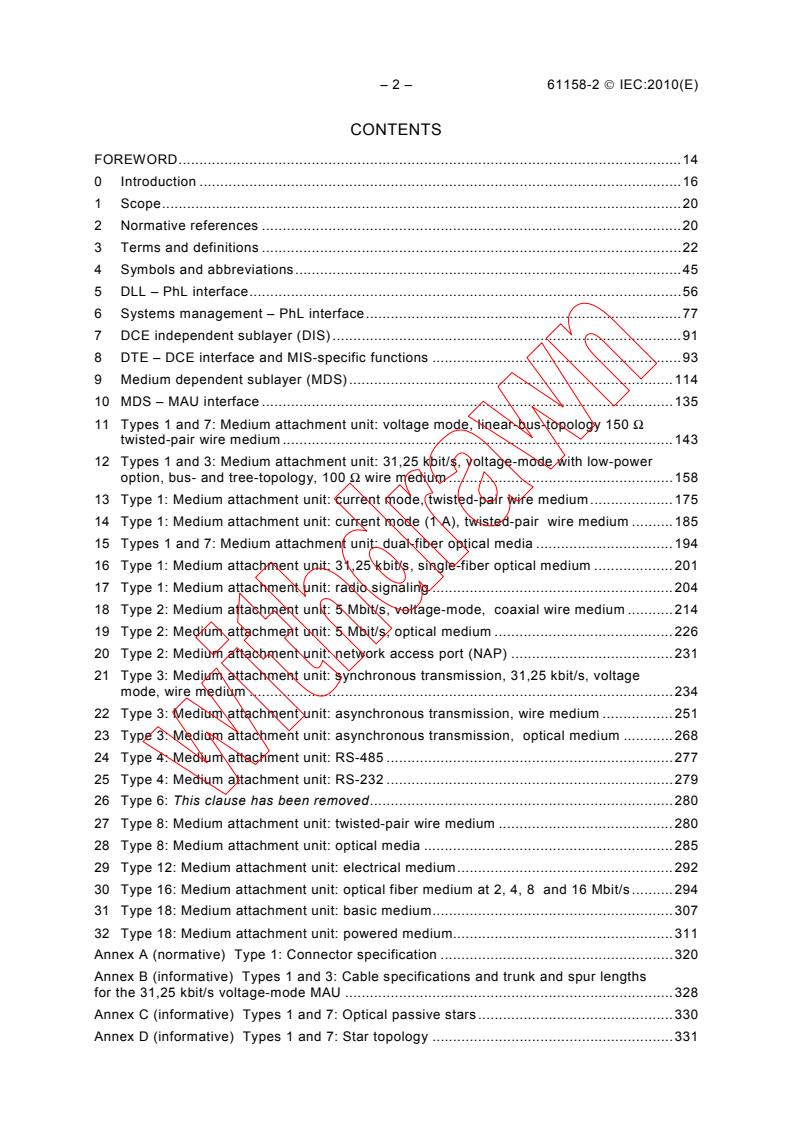
IEC 61158-2:2010 - Industrial communication networks - Fieldbus specifications - Part 2: Physical layer specification and service definition Released:7/22/2010

IEC 61158-2:2010 - Industrial communication networks - Fieldbus specifications - Part 2: Physical layer specification and service definition Released:7/22/2010
Overview
IEC 61158-2:2010 is the fifth edition of the internationally recognized standard that specifies the physical layer requirements for industrial communication networks using fieldbus technology. Developed by the International Electrotechnical Commission (IEC), this standard defines the physical layer specification and service definition for fieldbus systems, which are widely employed for reliable control and data exchange between devices in industrial automation environments. IEC 61158-2 ensures data integrity at the hardware transmission level and supports interoperability among devices from different manufacturers by providing a uniform set of guidelines for fieldbus component parts, media, and network configurations.
Key Topics
- Physical Layer (OSI Layer 1): The standard defines the characteristics and requirements for the physical layer, following the OSI 7-layer model as per ISO 7498. It covers transmission media, signal encoding, connectors, and electrical/optical parameters.
- Media Types and Topologies: IEC 61158-2 addresses a broad range of physical media, including twisted-pair, coaxial, and optical fiber, as well as wired and wireless (radio) communication, and various network topologies like bus, star, and tree.
- Component and Interface Specifications: The document details requirements for fieldbus interfaces, connectors, cable types, terminal resistors, and media attachment units to ensure interoperability and reliability.
- Data Integrity and Interoperability: Key aspects include mechanisms for data integrity prior to data-link layer error checking and the physical layer’s role in overall fieldbus system interoperability.
- Technical Revisions: The 2010 edition incorporates several updates, especially for Type 18 physical layer implementations, addressing tolerance reductions, removal of specific cable length minimums, updates to reference materials, and adjustments to resistor values to reflect industry advancements.
Applications
IEC 61158-2:2010 is critical for:
- Industrial Automation: Ensuring consistent and reliable communication between controllers, sensors, and actuators on the factory floor.
- Process Industries: Supporting standardized physical connections in sectors such as oil & gas, pharmaceuticals, chemicals, and energy production.
- Integration of Multi-Vendor Systems: Enabling devices from multiple suppliers to communicate over shared fieldbus networks, reducing downtime and supporting scalable automation solutions.
- System Design & Maintenance: Providing reference specifications for engineers when designing new installations, upgrading existing systems, or troubleshooting network physical layer issues.
- Compliance & Certification: Facilitating device certification and approval processes, ensuring products meet global industrial communication requirements.
Related Standards
Organizations implementing IEC 61158-2:2010 should be aware of these related standards:
- IEC 61158 Series: The broader IEC 61158 family covers additional aspects like data-link, application, and management layers for fieldbus systems.
- ISO 7498: Reference model for OSI, providing the foundational 7-layer structure for network protocols.
- IEC 61784 Series: Profiles for fieldbus specifications, offering further guidance on application-specific requirements for different industrial sectors.
- EN 50170: European standard for open fieldbus systems.
- IEC 61076 & IEC 60947: Standards for industrial connectors and switchgear used within fieldbus wiring.
IEC 61158-2:2010 is essential for engineers, integrators, and manufacturers seeking robust fieldbus physical layer solutions, supporting interoperability, and facilitating reliable industrial communication network deployment. For up-to-date and in-depth technical details, always refer to the latest official IEC publication.
Relations
- Effective Date
- 05-Sep-2023
- Effective Date
- 05-Sep-2023
Buy Documents
IEC 61158-2:2010 - Industrial communication networks - Fieldbus specifications - Part 2: Physical layer specification and service definition Released:7/22/2010
IEC 61158-2:2010 - Industrial communication networks - Fieldbus specifications - Part 2: Physical layer specification and service definition Released:7/22/2010
Get Certified
Connect with accredited certification bodies for this standard

BSI Group
BSI (British Standards Institution) is the business standards company that helps organizations make excellence a habit.

DVS-ZERT GmbH
German welding certification society.
CARES (UK Certification Authority for Reinforcing Steels)
UK certification for reinforcing steels and construction.
Sponsored listings
Frequently Asked Questions
IEC 61158-2:2010 is a standard published by the International Electrotechnical Commission (IEC). Its full title is "Industrial communication networks - Fieldbus specifications - Part 2: Physical layer specification and service definition". This standard covers: IEC 61158-2:2010 specifies the requirements for fieldbus component parts. It also specifies the media and network configuration requirements necessary to ensure agreed levels of: a) data integrity before data-link layer error checking; b) interoperability between devices at the physical layer. The fieldbus physical layer conforms to layer 1 of the OSI 7-layer model as defined by ISO 7498 with the exception that, for some types, frame delimiters are in the physical layer while for other types they are in the data-link layer. This fifth edition cancels and replaces the fourth edition published in 2007 and constitutes a technical revision. This edition includes the following significant technical changes with respect to the previous edition: - for Type 18, Table 157 reduced tolerance to 5 %; - for Type 18, in 32.5.3.1 removed minimum cable length; - for Type 18, in 32.5.4. and R.2.2 cable reference removed; - for Type 18, Table 160 and 161 terminating resistor value changed to 680 Ω. This bilingual version published in 2011-12, corresponds to the English version published in 2010-07.
IEC 61158-2:2010 specifies the requirements for fieldbus component parts. It also specifies the media and network configuration requirements necessary to ensure agreed levels of: a) data integrity before data-link layer error checking; b) interoperability between devices at the physical layer. The fieldbus physical layer conforms to layer 1 of the OSI 7-layer model as defined by ISO 7498 with the exception that, for some types, frame delimiters are in the physical layer while for other types they are in the data-link layer. This fifth edition cancels and replaces the fourth edition published in 2007 and constitutes a technical revision. This edition includes the following significant technical changes with respect to the previous edition: - for Type 18, Table 157 reduced tolerance to 5 %; - for Type 18, in 32.5.3.1 removed minimum cable length; - for Type 18, in 32.5.4. and R.2.2 cable reference removed; - for Type 18, Table 160 and 161 terminating resistor value changed to 680 Ω. This bilingual version published in 2011-12, corresponds to the English version published in 2010-07.
IEC 61158-2:2010 is classified under the following ICS (International Classification for Standards) categories: 25.040.40 - Industrial process measurement and control; 35.100.20 - Data link layer; 35.240.50 - IT applications in industry. The ICS classification helps identify the subject area and facilitates finding related standards.
IEC 61158-2:2010 has the following relationships with other standards: It is inter standard links to IEC 61158-2:2007, IEC 61158-2:2014. Understanding these relationships helps ensure you are using the most current and applicable version of the standard.
IEC 61158-2:2010 is available in PDF format for immediate download after purchase. The document can be added to your cart and obtained through the secure checkout process. Digital delivery ensures instant access to the complete standard document.
Standards Content (Sample)
IEC 61158-2 ®
Edition 5.0 2010-07
INTERNATIONAL
STANDARD
colour
inside
Industrial communication networks – Fieldbus specifications –
Part 2: Physical layer specification and service definition
All rights reserved. Unless otherwise specified, no part of this publication may be reproduced or utilized in any form
or by any means, electronic or mechanical, including photocopying and microfilm, without permission in writing from
either IEC or IEC's member National Committee in the country of the requester.
If you have any questions about IEC copyright or have an enquiry about obtaining additional rights to this publication,
please contact the address below or your local IEC member National Committee for further information.
IEC Central Office
3, rue de Varembé
CH-1211 Geneva 20
Switzerland
Email: inmail@iec.ch
Web: www.iec.ch
About the IEC
The International Electrotechnical Commission (IEC) is the leading global organization that prepares and publishes
International Standards for all electrical, electronic and related technologies.
About IEC publications
The technical content of IEC publications is kept under constant review by the IEC. Please make sure that you have the
latest edition, a corrigenda or an amendment might have been published.
ƒ Catalogue of IEC publications: www.iec.ch/searchpub
The IEC on-line Catalogue enables you to search by a variety of criteria (reference number, text, technical committee,…).
It also gives information on projects, withdrawn and replaced publications.
ƒ IEC Just Published: www.iec.ch/online_news/justpub
Stay up to date on all new IEC publications. Just Published details twice a month all new publications released. Available
on-line and also by email.
ƒ Electropedia: www.electropedia.org
The world's leading online dictionary of electronic and electrical terms containing more than 20 000 terms and definitions
in English and French, with equivalent terms in additional languages. Also known as the International Electrotechnical
Vocabulary online.
ƒ Customer Service Centre: www.iec.ch/webstore/custserv
If you wish to give us your feedback on this publication or need further assistance, please visit the Customer Service
Centre FAQ or contact us:
Email: csc@iec.ch
Tel.: +41 22 919 02 11
Fax: +41 22 919 03 00
IEC 61158-2 ®
Edition 5.0 2010-07
INTERNATIONAL
STANDARD
colour
inside
Industrial communication networks – Fieldbus specifications –
Part 2: Physical layer specification and service definition
INTERNATIONAL
ELECTROTECHNICAL
COMMISSION
PRICE CODE
XH
ICS, 25.040, 35.100, 35.240.50 ISBN 978-2-88912-051-2
– 2 – 61158-2 © IEC:2010(E)
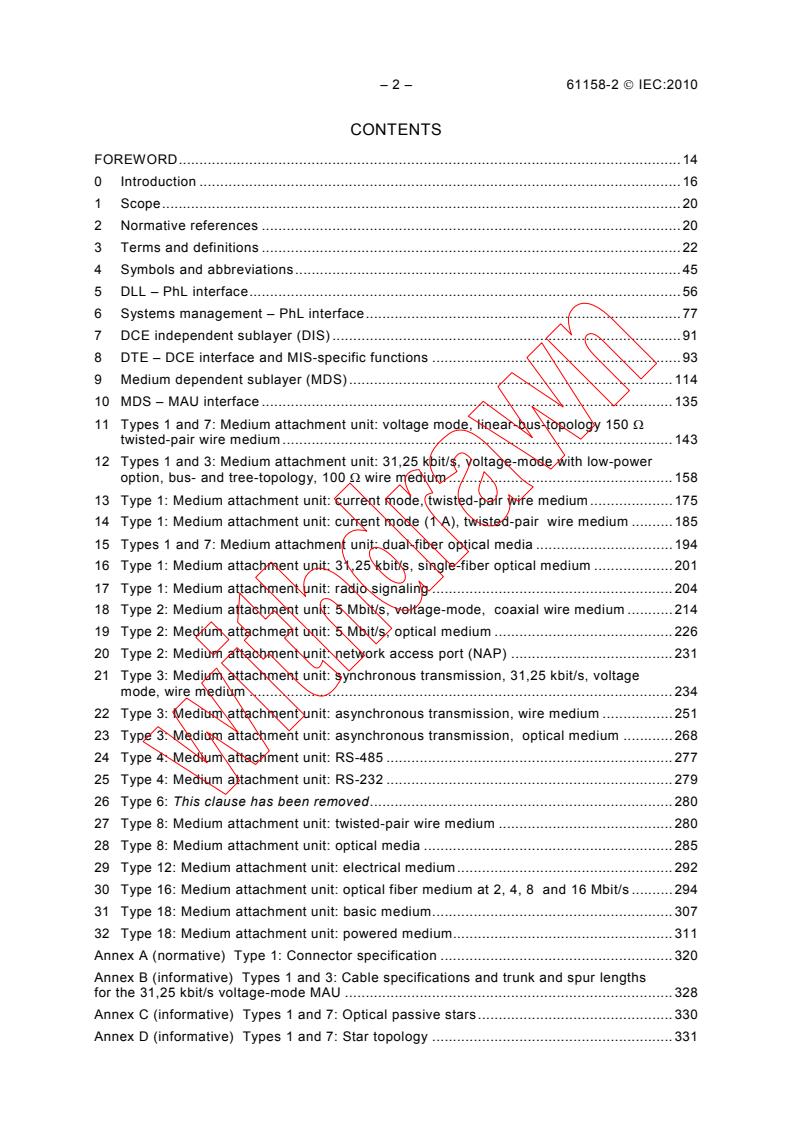
CONTENTS
FOREWORD.14
0 Introduction .16
1 Scope.20
2 Normative references .20
3 Terms and definitions .22
4 Symbols and abbreviations.45
5 DLL – PhL interface.56
6 Systems management – PhL interface.77
7 DCE independent sublayer (DIS) .91
8 DTE – DCE interface and MIS-specific functions .93
9 Medium dependent sublayer (MDS) .114
10 MDS – MAU interface .135
11 Types 1 and 7: Medium attachment unit: voltage mode, linear-bus-topology 150 Ω
twisted-pair wire medium .143
12 Types 1 and 3: Medium attachment unit: 31,25 kbit/s, voltage-mode with low-power
option, bus- and tree-topology, 100 Ω wire medium .158
13 Type 1: Medium attachment unit: current mode, twisted-pair wire medium. 175
14 Type 1: Medium attachment unit: current mode (1 A), twisted-pair wire medium .185
15 Types 1 and 7: Medium attachment unit: dual-fiber optical media . 194
16 Type 1: Medium attachment unit: 31,25 kbit/s, single-fiber optical medium . 201
17 Type 1: Medium attachment unit: radio signaling .204
18 Type 2: Medium attachment unit: 5 Mbit/s, voltage-mode, coaxial wire medium . 214
19 Type 2: Medium attachment unit: 5 Mbit/s, optical medium . 226
20 Type 2: Medium attachment unit: network access port (NAP) . 231
21 Type 3: Medium attachment unit: synchronous transmission, 31,25 kbit/s, voltage
mode, wire medium .234
22 Type 3: Medium attachment unit: asynchronous transmission, wire medium . 251
23 Type 3: Medium attachment unit: asynchronous transmission, optical medium .268
24 Type 4: Medium attachment unit: RS-485 .277
25 Type 4: Medium attachment unit: RS-232 .279
26 Type 6: This clause has been removed.280
27 Type 8: Medium attachment unit: twisted-pair wire medium . 280
28 Type 8: Medium attachment unit: optical media .285
29 Type 12: Medium attachment unit: electrical medium. 292
30 Type 16: Medium attachment unit: optical fiber medium at 2, 4, 8 and 16 Mbit/s .294
31 Type 18: Medium attachment unit: basic medium.307
32 Type 18: Medium attachment unit: powered medium.311
Annex A (normative) Type 1: Connector specification .320
Annex B (informative) Types 1 and 3: Cable specifications and trunk and spur lengths
for the 31,25 kbit/s voltage-mode MAU .328
Annex C (informative) Types 1 and 7: Optical passive stars. 330
Annex D (informative) Types 1 and 7: Star topology .331
61158-2 © IEC:2010(E) – 3 –
Annex E (informative) Type 1: Alternate fibers .335
Annex F (normative) Type 2: Connector specification . 336
Annex G (normative) Type 2: Repeater machine sublayers (RM, RRM) and redundant
PhLs .339
Annex H (informative) Type 2: Reference design examples.350
Annex I (normative) Type 3: Connector specification.356
Annex J (normative) Type 3: Redundancy of PhL and medium. 363
Annex K (normative) Type 3: Optical network topology .364
Annex L (informative) Type 3: Reference design examples for asynchronous
transmission, wire medium, intrinsically safe.373
Annex M (normative) Type 8: Connector specification.375
Annex N (normative) Type 16: Connector specification . 380
Annex O (normative) Type 16: Optical network topology . 381
Annex P (informative) Type 16: Reference design example. 386
Annex Q (normative) Type 18: Connector specification . 390
Annex R (normative) Type 18: Media cable specifications. 395
Bibliography.399
Figure 1 – General model of physical layer .17
Figure 2 – Mapping between data units across the DLL – PhL interface.57
Figure 3 – Data service for asynchronous transmission.62
Figure 4 – Interactions for a data sequence of a master: identification cycle .67
Figure 5 – Interactions for a data sequence of a master: data cycle .68
Figure 6 – Interactions for a data sequence of a slave: identification cycle.69
Figure 7 – Interactions for a data sequence of a slave: data cycle .70
Figure 8 – Interactions for a check sequence of a master .71
Figure 9 – Interactions for a check sequence of a slave.72
Figure 10 – Reset, Set-value, Get-value .81
Figure 11 – Event service .81
Figure 12 – Interface between PhL and PNM1 in the layer model.86
Figure 13 – Reset, Set-value, Get-value PhL services .87
Figure 14 – Event PhL service .87
Figure 15 – Allocation of the interface number .88
Figure 16 – Configuration of a master .92
Figure 17 – Configuration of a slave with an alternative type of transmission .93
Figure 18 – Configuration of a bus coupler with an alternative type of transmission .93
Figure 19 – DTE/DCE sequencing machines.98
Figure 20 – State transitions with the ID cycle request service. 107
Figure 21 – MIS-MDS interface: identification cycle request service. 108
Figure 22 – MIS-MDS interface: identification cycle request service. 109
Figure 23 – State transitions with the data cycle request service . 109
Figure 24 – MIS-MDS interface: data cycle request service . 110
Figure 25 – State transitions with the data sequence classification service .110
Figure 26 – Protocol machine for the message transmission service. 111
– 4 – 61158-2 © IEC:2010(E)
Figure 27 – Protocol machine for the data sequence identification service . 112
Figure 28 – Protocol machine for the message receipt service. 113
Figure 29 – Protocol data unit (PhPDU) .114
Figure 30 – PhSDU encoding and decoding .115
Figure 31 – Manchester encoding rules .115
Figure 32 – Preamble and delimiters.117
Figure 33 – Manchester coded symbols .118
Figure 34 – PhPDU format, half duplex .119
Figure 35 – PhPDU format, full duplex .121
Figure 36 – Data sequence PhPDU.125
Figure 37 – Structure of the header in a data sequence PhPDU. 125
Figure 38 – Check sequence PhPDU .126
Figure 39 – Structure of a headers in a check sequence PhPDU. 126
Figure 40 – Structure of the status PhPDU.127
Figure 41 – Structure of the header in a status PhPDU . 127
Figure 42 – Structure of the medium activity status PhPDU .128
Figure 43 – Structure of the header in a medium activity status PhPDU . 128
Figure 44 – Reset PhPDU.129
Figure 45 – Configuration of a master .130
Figure 46 – Configuration of a slave .130
Figure 47 – Configuration of a bus coupler.130
Figure 48 – Protocol data unit .131
Figure 49 – PhSDU encoding and decoding .131
Figure 50 – Manchester encoding rules .131
Figure 51 – Example of an NRZI-coded signal .134
Figure 52 – Fill signal .134
Figure 53 – Jitter tolerance .141
Figure 54 – Transmit circuit test configuration.147
Figure 55 – Output waveform.148
Figure 56 – Transmitted and received bit cell jitter (zero crossing point deviation) . 149
Figure 57 – Signal polarity .150
Figure 58 – Receiver sensitivity and noise rejection.151
Figure 59 – Power supply ripple and noise.154
Figure 60 – Fieldbus coupler.156
Figure 61 – Transition from receiving to transmitting.163
Figure 62 – Power supply ripple and noise.167
Figure 63 – Test circuit for single-output power supplies.168
Figure 64 – Test circuit for power distribution through an IS barrier .169
Figure 65 – Test circuit for multiple output supplies with signal coupling .170
Figure 66 – Fieldbus coupler.172
Figure 67 – Protection resistors .172
Figure 68 – Test configuration for current-mode MAU .178
Figure 69 – Transmitted and received bit cell jitter (zero crossing point deviation) . 179
61158-2 © IEC:2010(E) – 5 –
Figure 70 – Noise test circuit for current-mode MAU .181
Figure 71 – Transmitted and received bit cell jitter (zero crossing point deviation) . 189
Figure 72 – Power supply harmonic distortion and noise.192
Figure 73 – Optical wave shape template.197
Figure 74 – Cellular radio topology and reuse of frequencies .208
Figure 75 – Radio segment between wired segments topology . 209
Figure 76 – Mixed wired and radio medium fieldbus topology.210
Figure 77 – Components of 5 Mbit/s, voltage-mode, coaxial wire PhL variant. 215
Figure 78 – Coaxial wire MAU block diagram .215
Figure 79 – Coaxial wire MAU transmitter .216
Figure 80 – Coaxial wire MAU receiver operation.217
Figure 81 – Coaxial wire MAU transmit mask .218
Figure 82 – Coaxial wire MAU receive mask .219
Figure 83 – Transformer symbol .220
Figure 84 – 5 Mbit/s, voltage-mode, coaxial wire topology example . 222
Figure 85 – Coaxial wire medium topology limits.223
Figure 86 – Coaxial wire medium tap electrical characteristics. 224
Figure 87 – MAU block diagram 5 Mbit/s, optical fiber medium . 227
Figure 88 – NAP reference model .231
Figure 89 – Example of transient and permanent nodes. 232
Figure 90 – NAP transceiver .233
Figure 91 – NAP cable.234
Figure 92 – Circuit diagram of the principle of measuring impedance. 239
Figure 93 – Definition of CMRR .240
Figure 94 – Block circuit diagram of the principle of measuring CMRR. 240
Figure 95 – Power supply ripple and noise.243
Figure 96 – Output characteristic curve of a power supply of the category EEx ib . 250
Figure 97 – Output characteristic curve of a power supply of the category EEx ia . 250
Figure 98 – Repeater in linear bus topology.253
Figure 99 – Repeater in tree topology .253
Figure 100 – Example for a connector with integrated inductance . 255
Figure 101 – Interconnecting wiring .255
Figure 102 – Bus terminator.256
Figure 103 – Linear structure of an intrinsically safe segment . 258
Figure 104 – Topology example extended by repeaters .259
Figure 105 – Bus terminator.261
Figure 106 – Waveform of the differential voltage .262
Figure 107 – Test set-up for the measurement of the idle level for devices with an
integrated termination resistor .264
Figure 108 – Test set-up for the measurement of the idle level for devices with a
connectable termination resistor . 264
Figure 109 – Test set-up for measurement of the transmission levels . 265
Figure 110 – Test set-up for the measurement of the receiving levels . 265
Figure 111 – Fieldbus model for intrinsic safety .266
– 6 – 61158-2 © IEC:2010(E)
Figure 112 – Communication device model for intrinsic safety . 266
Figure 113 – Connection to the optical network.269
Figure 114 – Principle structure of optical networking . 270
Figure 115 – Definition of the standard optical link. 270
Figure 116 – Signal template for the optical transmitter .275
Figure 117 – Recommended interface circuit .279
Figure 118 – MAU of an outgoing interface .280
Figure 119 – MAU of an incoming interface.281
Figure 120 – Remote bus link .281
Figure 121 – Interface to the transmission medium .282
Figure 122 – Wiring .285
Figure 123 – Terminal resistor network .285
Figure 124 – Fiber optic remote bus cable .286
Figure 125 – Optical fiber remote bus link.286
Figure 126 – Optical wave shape template optical MAU .288
Figure 127 – Optical transmission line .294
Figure 128 – Optical signal envelope .296
Figure 129 – Display of jitter (J ).297
noise
Figure 130 – Input-output performance of a slave .299
Figure 131 – Functions of a master connection .302
Figure 132 – Valid transmitting signals during the transition from fill signal to telegram
delimiters.304
Figure 133 – Valid transmitting signals during the transition from telegram delimiter to
fill signal .305
Figure 134 – Functions of a slave connection .306
Figure 135 – Network with two slaves .307
Figure 136 – Minimum interconnecting wiring.308
Figure 137 – Dedicated cable topology .309
Figure 138 – T-branch topology .309
Figure 139 – Communication element isolation .311
Figure 140 – Communication element and I/O isolation.311
Figure 141 – Minimum interconnecting wiring.312
Figure 142 – Flat cable topology.313
Figure 143 – Dedicated cable topology .313
Figure 144 – T-branch topology .313
Figure 145 – Type 18-PhL-P power distribution.316
Figure 146 – Type 18-PhL-P power distribution.316
Figure 147 – Type 18-PhL-P power supply filtering and protection . 318
Figure 148 – Communication element isolation .318
Figure 149 – Communication element and i/o isolation . 318
Figure 150 – PhL-P power supply circuit .319
Figure A.1 – Internal fieldbus connector.320
Figure A.2 – Contact designations for the external connector for harsh industrial
environments .322
61158-2 © IEC:2010(E) – 7 –
Figure A.3 – External fieldbus connector keyways, keys, and bayonet pins and grooves.322
Figure A.4 – External fieldbus connector intermateability dimensions. 323
Figure A.5 – External fieldbus connector contact arrangement. 324
Figure A.6 – Contact designations for the external connector for typical industrial
environments .325
Figure A.7 – External fixed (device) side connector for typical industrial environments:
dimensions .325
Figure A.8 – External free (cable) side connector for typical industrial environments:
dimensions .326
Figure A.9 – Optical connector for typical industrial environments (FC connector) . 326
Figure A.10 – Optical connector for typical industrial environments (ST connector).327
Figure C.1 – Example of an optical passive reflective star . 330
Figure C.2 – Example of an optical passive transmitive star. 330
Figure D.1 – Example of star topology with 31,25 kbit/s, single fiber mode, optical MAU.331
Figure D.2 – Multi-star topology with an optical MAU .331
Figure D.3 – Example of mixture between wire and optical media for a 31,25 kbit/s bit
rate .333
Figure D.4 – Example of mixture between wire and optical media . 334
Figure F.1 – Pin connector for short range optical medium.337
Figure F.2 – Crimp ring for short range optical medium.337
Figure G.1 – PhL repeater device reference model .339
Figure G.2 – Reference model for redundancy.342
Figure G.3 – Block diagram showing redundant coaxial medium and NAP . 343
Figure G.4 – Block diagram showing ring repeaters .344
Figure G.5 – Segmentation query .345
Figure G.6 – Segmentation response.345
Figure G.7 – Main switch state machine.347
Figure G.8 – Port 1 sees network activity first .348
Figure G.9 – Port 2 sees network activity first .349
Figure H.1 – Coaxial wire MAU RXDATA detector .351
Figure H.2 – Coaxial wire MAU RXCARRIER detection.352
Figure H.3 – Redundant coaxial wire MAU transceiver.352
Figure H.4 – Single channel coaxial wire MAU transceiver .353
Figure H.5 – Coaxial wire medium tap.354
Figure H.6 – Non-isolated NAP transceiver .355
Figure H.7 – Isolated NAP transceiver .355
Figure I.1 – Schematic of the station coupler .356
Figure I.2 – Pin assignment of the male and female connectors IEC 60947-5-2
(A coding) .357
Figure I.3 – Connector pinout, front view of male and back view of female respectively . 358
Figure I.4 – Connector pinout, front view of female M12 connector .360
Figure I.5 – Connector pinout, front view of male M12 connector .360
Figure I.6 – M12 Tee .361
Figure I.7 – M12 Bus termination .362
Figure J.1 – Redundancy of PhL MAU and Medium .363
– 8 – 61158-2 © IEC:2010(E)
Figure K.1 – Optical MAU in a network with echo.364
Figure K.2 – Optical MAU in a network without echo .365
Figure K.3 – Optical MAU with echo via internal electrical feedback of the receive
signal.365
Figure K.4 – Optical MAU without echo function.365
Figure K.5 – Optical network with star topology .366
Figure K.6 – Optical network with ring topology .367
Figure K.7 – Optical network with bus topology.367
Figure K.8 – Tree structure built from a combination of star structures. 368
Figure K.9 – Application example for an ANSI TIA/EIA-485-A / fiber optic converter . 368
Figure L.1 – Bus termination integrated in the communication device . 373
Figure L.2 – Bus termination in the connector .374
Figure L.3 – External bus termination.374
Figure M.1 – Outgoing interface 9-position female subminiature D connector at the
device.375
Figure M.2 – Incoming interface 9-position male subminiature D connector at the
device.375
Figure M.3 – Terminal connector at the device. 375
Figure M.4 – Ferrule of an optical F-SMA connector for polymer optical fiber
(980/1 000 μm) .376
Figure M.5 – Type 8 fiber optic hybrid connector housing .377
Figure M.6 – Type 8 fiber optic hybrid connector assignment . 378
Figure O.1 – Topology .381
Figure O.2 – Structure of a single-core cable (example).384
Figure O.3 – Optical power levels .385
Figure P.1 – Example of an implemented DPLL . 387
Figure P.2 – DPLL status diagram .388
Figure P.3 – DPLL timing .388
Figure Q.1 – PhL-P device connector r-a .390
Figure Q.2 – PhL-P device connector straight .391
Figure Q.3 – PhL-P flat cable connector and terminal cover – body and connector .391
Figure Q.4 – PhL-P flat cable connector and terminal cover – terminal cover .392
Figure Q.5 – Type 18-PhL-P round cable connector body .392
Figure Q.6 – Type 18-PhL-P round cable connector terminal cover.393
Figure Q.7 – Type 18-PhL-P round cable alternate connector and body. 393
Figure Q.8 – Type 18-PhL-P round cable alternate connector terminal cover .394
Figure R.1 – PhL-B cable cross section twisted drain.395
Figure R.2 – PhL-B cable cross section non-twisted drain.396
Figure R.3 – PhL-P flat cable cross section - with key.397
Figure R.4 – PhL-P flat cable cross section - without key.397
Figure R.5 – PhL-P flat cable polarity marking .397
Figure R.6 – Round cable – preferred; cross section.398
Figure R.7 – Round cable – alternate; cross-section .398
61158-2 © IEC:2010(E) – 9 –
Table 1 – Data encoding rules .60
Table 2 – Ph-STATUS indication truth table .61
Table 3 – Jabber indications .61
Table 4 – Parameter names and values for Ph-SET-VALUE request .78
Table 5 – Parameter names for Ph-EVENT indication.79
Table 6 – Summary of Ph-management services and primitives .80
Table 7 – Reset primitives and parameters .81
Table 8 – Values of PhM-Status for the Reset service.81
Table 9 – Set value primitives and parameters.82
Table 10 – Mandatory PhE-variables .82
Table 11 – Permissible values of PhE-variables.83
Table 12 – Values of PhM-Status for the set-value service.83
Table 13 – Get value primitives and parameters .83
Table 14 – Current values of PhE-variables .84
Table 15 – Values of PhM-Status for the get value service.84
Table 16 – Event primitive and parameters .84
Table 17 – New values of PhE-variables .85
Table 18 – Parameter names and values for management .85
Table 19 – PH-RESET .87
Table 20 – Ph-SET-VALUE .87
Table 21 – PhL variables .88
Table 22 – Ph-GET-VALUE .89
Table 23 – Ph-EVENT .90
Table 24 – PhL events .90
Table 25 – Parameter names and values for Ph-SET-VALUE request.91
Table 26 – Signals at DTE – DCE interface.95
Table 27 – Signal levels for an exposed DTE – DCE interface .96
Table 28 – MDS bus reset .106
Table 29 – Signals at the MIS-MDS interface.106
Table 30 – Manchester encoding rules.115
Table 31 – MDS timing characteristics .118
Table 32 – MDS data encoding rules .118
Table 33 – SL bit and TxSL signal assignment.125
Table 34 – SL bit and RxSL signal assignment .125
Table 35 – SL bit and TxSL signal assignment.126
Table 36 – SL bit and RxSL signal assignment .127
Table 37 – SL bit and TxSL signal assignment.127
Table 38 – SL bit and RxSL signal assignment .127
Table 39 – Coding and decoding rules .128
Table 40 – Decoding rules for the idle states .129
Table 41 – Coding rules for the reset PhPDU.129
Table 42 – Decoding rules of the reset PhPDU .129
Table 43 – Manchester encoding rules.132
– 10 – 61158-2 © IEC:2010(E)
Table 44 – Minimum services at MDS – MAU interface . 135
Table 45 – Signal levels for an exposed MDS – MAU interface . 136
Table 46 – MDS-MAU interface definitions: 5 Mbit/s, voltage-mode, coaxial wire . 137
Table 47 – MDS-MAU interface 5 Mbit/s, optical fiber medium . 138
Table 48 – Services of the MDS-MAU interface.140
Table 49 – Minimum services at MAU interface.142
Table 50 – Signal levels for an exposed MAU interface. 142
Table 51 – Bit-rate-dependent quantities of voltage-mode networks.143
Table 52 – MAU transmit level specification summary.146
Table 53 – MAU transmit timing specification summary for 31,25 kbit/s operation .146
Table 54 – MAU transmit timing specification summary for ≥ 1 Mbit/s operation.
...
IEC 61158-2 ®
Edition 5.0 2010-07
INTERNATIONAL
STANDARD
NORME
INTERNATIONALE
colour
inside
Industrial communication networks – Fieldbus specifications –
Part 2: Physical layer specification and service definition
Réseaux de communication industriels – Spécifications des bus de terrain –
Partie 2: Spécification de couche physique et définition des services
All rights reserved. Unless otherwise specified, no part of this publication may be reproduced or utilized in any form or by
any means, electronic or mechanical, including photocopying and microfilm, without permission in writing from either IEC or
IEC's member National Committee in the country of the requester.
If you have any questions about IEC copyright or have an enquiry about obtaining additional rights to this publication,
please contact the address below or your local IEC member National Committee for further information.
Droits de reproduction réservés. Sauf indication contraire, aucune partie de cette publication ne peut être reproduite
ni utilisée sous quelque forme que ce soit et par aucun procédé, électronique ou mécanique, y compris la photocopie
et les microfilms, sans l'accord écrit de la CEI ou du Comité national de la CEI du pays du demandeur.
Si vous avez des questions sur le copyright de la CEI ou si vous désirez obtenir des droits supplémentaires sur cette
publication, utilisez les coordonnées ci-après ou contactez le Comité national de la CEI de votre pays de résidence.
IEC Central Office
3, rue de Varembé
CH-1211 Geneva 20
Switzerland
Email: inmail@iec.ch
Web: www.iec.ch
About the IEC
The International Electrotechnical Commission (IEC) is the leading global organization that prepares and publishes
International Standards for all electrical, electronic and related technologies.
About IEC publications
The technical content of IEC publications is kept under constant review by the IEC. Please make sure that you have the
latest edition, a corrigenda or an amendment might have been published.
Catalogue of IEC publications: www.iec.ch/searchpub
The IEC on-line Catalogue enables you to search by a variety of criteria (reference number, text, technical committee,…).
It also gives information on projects, withdrawn and replaced publications.
IEC Just Published: www.iec.ch/online_news/justpub
Stay up to date on all new IEC publications. Just Published details twice a month all new publications released. Available
on-line and also by email.
Electropedia: www.electropedia.org
The world's leading online dictionary of electronic and electrical terms containing more than 20 000 terms and definitions
in English and French, with equivalent terms in additional languages. Also known as the International Electrotechnical
Vocabulary online.
Customer Service Centre: www.iec.ch/webstore/custserv
If you wish to give us your feedback on this publication or need further assistance, please visit the Customer Service
Centre FAQ or contact us:
Email: csc@iec.ch
Tel.: +41 22 919 02 11
Fax: +41 22 919 03 00
A propos de la CEI
La Commission Electrotechnique Internationale (CEI) est la première organisation mondiale qui élabore et publie des
normes internationales pour tout ce qui a trait à l'électricité, à l'électronique et aux technologies apparentées.
A propos des publications CEI
Le contenu technique des publications de la CEI est constamment revu. Veuillez vous assurer que vous possédez
l’édition la plus récente, un corrigendum ou amendement peut avoir été publié.
Catalogue des publications de la CEI: www.iec.ch/searchpub/cur_fut-f.htm
Le Catalogue en-ligne de la CEI vous permet d’effectuer des recherches en utilisant différents critères (numéro de référence,
texte, comité d’études,…). Il donne aussi des informations sur les projets et les publications retirées ou remplacées.
Just Published CEI: www.iec.ch/online_news/justpub
Restez informé sur les nouvelles publications de la CEI. Just Published détaille deux fois par mois les nouvelles
publications parues. Disponible en-ligne et aussi par email.
Electropedia: www.electropedia.org
Le premier dictionnaire en ligne au monde de termes électroniques et électriques. Il contient plus de 20 000 termes et
définitions en anglais et en français, ainsi que les termes équivalents dans les langues additionnelles. Egalement appelé
Vocabulaire Electrotechnique International en ligne.
Service Clients: www.iec.ch/webstore/custserv/custserv_entry-f.htm
Si vous désirez nous donner des commentaires sur cette publication ou si vous avez des questions, visitez le FAQ du
Service clients ou contactez-nous:
Email: csc@iec.ch
Tél.: +41 22 919 02 11
Fax: +41 22 919 03 00
IEC 61158-2 ®
Edition 5.0 2010-07
INTERNATIONAL
STANDARD
NORME
INTERNATIONALE
colour
inside
Industrial communication networks – Fieldbus specifications –
Part 2: Physical layer specification and service definition
Réseaux de communication industriels – Spécifications des bus de terrain –
Partie 2: Spécification de couche physique et définition des services
INTERNATIONAL
ELECTROTECHNICAL
COMMISSION
COMMISSION
ELECTROTECHNIQUE
PRICE CODE
INTERNATIONALE
XH
CODE PRIX
ICS 25.040; 35.100; 35.240.50 ISBN 978-2-88912-805-1
– 2 – 61158-2 IEC:2010
CONTENTS
FOREWORD . 14
0 Introduction . 16
1 Scope . 20
2 Normative references . 20
3 Terms and definitions . 22
4 Symbols and abbreviations . 45
5 DLL – PhL interface . 56
6 Systems management – PhL interface . 77
7 DCE independent sublayer (DIS) . 91
8 DTE – DCE interface and MIS-specific functions . 93
9 Medium dependent sublayer (MDS) . 114
10 MDS – MAU interface . 135
11 Types 1 and 7: Medium attachment unit: voltage mode, linear-bus-topology 150 Ω
twisted-pair wire medium . 143
12 Types 1 and 3: Medium attachment unit: 31,25 kbit/s, voltage-mode with low-power
option, bus- and tree-topology, 100 Ω wire medium . 158
13 Type 1: Medium attachment unit: current mode, twisted-pair wire medium . 175
14 Type 1: Medium attachment unit: current mode (1 A), twisted-pair wire medium . 185
15 Types 1 and 7: Medium attachment unit: dual-fiber optical media . 194
16 Type 1: Medium attachment unit: 31,25 kbit/s, single-fiber optical medium . 201
17 Type 1: Medium attachment unit: radio signaling . 204
18 Type 2: Medium attachment unit: 5 Mbit/s, voltage-mode, coaxial wire medium . 214
19 Type 2: Medium attachment unit: 5 Mbit/s, optical medium . 226
20 Type 2: Medium attachment unit: network access port (NAP) . 231
21 Type 3: Medium attachment unit: synchronous transmission, 31,25 kbit/s, voltage
mode, wire medium . 234
22 Type 3: Medium attachment unit: asynchronous transmission, wire medium . 251
23 Type 3: Medium attachment unit: asynchronous transmission, optical medium . 268
24 Type 4: Medium attachment unit: RS-485 . 277
25 Type 4: Medium attachment unit: RS-232 . 279
26 Type 6: This clause has been removed . 280
27 Type 8: Medium attachment unit: twisted-pair wire medium . 280
28 Type 8: Medium attachment unit: optical media . 285
29 Type 12: Medium attachment unit: electrical medium . 292
30 Type 16: Medium attachment unit: optical fiber medium at 2, 4, 8 and 16 Mbit/s . 294
31 Type 18: Medium attachment unit: basic medium . 307
32 Type 18: Medium attachment unit: powered medium. 311
Annex A (normative) Type 1: Connector specification . 320
Annex B (informative) Types 1 and 3: Cable specifications and trunk and spur lengths
for the 31,25 kbit/s voltage-mode MAU . 328
Annex C (informative) Types 1 and 7: Optical passive stars . 330
Annex D (informative) Types 1 and 7: Star topology . 331
61158-2 IEC:2010 – 3 –
Annex E (informative) Type 1: Alternate fibers . 335
Annex F (normative) Type 2: Connector specification . 336
Annex G (normative) Type 2: Repeater machine sublayers (RM, RRM) and redundant
PhLs . 339
Annex H (informative) Type 2: Reference design examples. 350
Annex I (normative) Type 3: Connector specification. 356
Annex J (normative) Type 3: Redundancy of PhL and medium . 363
Annex K (normative) Type 3: Optical network topology . 364
Annex L (informative) Type 3: Reference design examples for asynchronous
transmission, wire medium, intrinsically safe . 373
Annex M (normative) Type 8: Connector specification . 375
Annex N (normative) Type 16: Connector specification . 380
Annex O (normative) Type 16: Optical network topology . 381
Annex P (informative) Type 16: Reference design example . 386
Annex Q (normative) Type 18: Connector specification . 390
Annex R (normative) Type 18: Media cable specifications . 395
Bibliography . 399
Figure 1 – General model of physical layer . 17
Figure 2 – Mapping between data units across the DLL – PhL interface . 57
Figure 3 – Data service for asynchronous transmission. 62
Figure 4 – Interactions for a data sequence of a master: identification cycle . 67
Figure 5 – Interactions for a data sequence of a master: data cycle . 68
Figure 6 – Interactions for a data sequence of a slave: identification cycle. 69
Figure 7 – Interactions for a data sequence of a slave: data cycle . 70
Figure 8 – Interactions for a check sequence of a master . 71
Figure 9 – Interactions for a check sequence of a slave . 72
Figure 10 – Reset, Set-value, Get-value . 81
Figure 11 – Event service . 81
Figure 12 – Interface between PhL and PNM1 in the layer model . 86
Figure 13 – Reset, Set-value, Get-value PhL services . 87
Figure 14 – Event PhL service . 87
Figure 15 – Allocation of the interface number . 88
Figure 16 – Configuration of a master . 92
Figure 17 – Configuration of a slave with an alternative type of transmission . 93
Figure 18 – Configuration of a bus coupler with an alternative type of transmission . 93
Figure 19 – DTE/DCE sequencing machines . 98
Figure 20 – State transitions with the ID cycle request service . 107
Figure 21 – MIS-MDS interface: identification cycle request service . 108
Figure 22 – MIS-MDS interface: identification cycle request service . 109
Figure 23 – State transitions with the data cycle request service . 109
Figure 24 – MIS-MDS interface: data cycle request service . 110
Figure 25 – State transitions with the data sequence classification service . 110
Figure 26 – Protocol machine for the message transmission service . 111
– 4 – 61158-2 IEC:2010
Figure 27 – Protocol machine for the data sequence identification service . 112
Figure 28 – Protocol machine for the message receipt service . 113
Figure 29 – Protocol data unit (PhPDU) . 114
Figure 30 – PhSDU encoding and decoding . 115
Figure 31 – Manchester encoding rules . 115
Figure 32 – Preamble and delimiters . 117
Figure 33 – Manchester coded symbols . 118
Figure 34 – PhPDU format, half duplex . 119
Figure 35 – PhPDU format, full duplex . 121
Figure 36 – Data sequence PhPDU . 125
Figure 37 – Structure of the header in a data sequence PhPDU . 125
Figure 38 – Check sequence PhPDU . 126
Figure 39 – Structure of a headers in a check sequence PhPDU . 126
Figure 40 – Structure of the status PhPDU. 127
Figure 41 – Structure of the header in a status PhPDU . 127
Figure 42 – Structure of the medium activity status PhPDU . 128
Figure 43 – Structure of the header in a medium activity status PhPDU . 128
Figure 44 – Reset PhPDU . 129
Figure 45 – Configuration of a master . 130
Figure 46 – Configuration of a slave . 130
Figure 47 – Configuration of a bus coupler. 130
Figure 48 – Protocol data unit . 131
Figure 49 – PhSDU encoding and decoding . 131
Figure 50 – Manchester encoding rules . 131
Figure 51 – Example of an NRZI-coded signal . 134
Figure 52 – Fill signal . 134
Figure 53 – Jitter tolerance . 141
Figure 54 – Transmit circuit test configuration . 147
Figure 55 – Output waveform . 148
Figure 56 – Transmitted and received bit cell jitter (zero crossing point deviation) . 149
Figure 57 – Signal polarity . 150
Figure 58 – Receiver sensitivity and noise rejection . 151
Figure 59 – Power supply ripple and noise . 154
Figure 60 – Fieldbus coupler . 156
Figure 61 – Transition from receiving to transmitting . 163
Figure 62 – Power supply ripple and noise . 167
Figure 63 – Test circuit for single-output power supplies . 168
Figure 64 – Test circuit for power distribution through an IS barrier . 169
Figure 65 – Test circuit for multiple output supplies with signal coupling . 170
Figure 66 – Fieldbus coupler . 172
Figure 67 – Protection resistors . 172
Figure 68 – Test configuration for current-mode MAU . 178
Figure 69 – Transmitted and received bit cell jitter (zero crossing point deviation) . 179
61158-2 IEC:2010 – 5 –
Figure 70 – Noise test circuit for current-mode MAU . 181
Figure 71 – Transmitted and received bit cell jitter (zero crossing point deviation) . 189
Figure 72 – Power supply harmonic distortion and noise . 192
Figure 73 – Optical wave shape template. 197
Figure 74 – Cellular radio topology and reuse of frequencies . 208
Figure 75 – Radio segment between wired segments topology . 209
Figure 76 – Mixed wired and radio medium fieldbus topology . 210
Figure 77 – Components of 5 Mbit/s, voltage-mode, coaxial wire PhL variant. 215
Figure 78 – Coaxial wire MAU block diagram . 215
Figure 79 – Coaxial wire MAU transmitter . 216
Figure 80 – Coaxial wire MAU receiver operation . 217
Figure 81 – Coaxial wire MAU transmit mask . 218
Figure 82 – Coaxial wire MAU receive mask . 219
Figure 83 – Transformer symbol . 220
Figure 84 – 5 Mbit/s, voltage-mode, coaxial wire topology example . 222
Figure 85 – Coaxial wire medium topology limits . 223
Figure 86 – Coaxial wire medium tap electrical characteristics . 224
Figure 87 – MAU block diagram 5 Mbit/s, optical fiber medium . 227
Figure 88 – NAP reference model . 231
Figure 89 – Example of transient and permanent nodes . 232
Figure 90 – NAP transceiver . 233
Figure 91 – NAP cable . 234
Figure 92 – Circuit diagram of the principle of measuring impedance . 239
Figure 93 – Definition of CMRR . 240
Figure 94 – Block circuit diagram of the principle of measuring CMRR . 240
Figure 95 – Power supply ripple and noise . 243
Figure 96 – Output characteristic curve of a power supply of the category EEx ib . 250
Figure 97 – Output characteristic curve of a power supply of the category EEx ia . 250
Figure 98 – Repeater in linear bus topology . 253
Figure 99 – Repeater in tree topology . 253
Figure 100 – Example for a connector with integrated inductance . 255
Figure 101 – Interconnecting wiring . 255
Figure 102 – Bus terminator . 256
Figure 103 – Linear structure of an intrinsically safe segment . 258
Figure 104 – Topology example extended by repeaters . 259
Figure 105 – Bus terminator . 261
Figure 106 – Waveform of the differential voltage . 262
Figure 107 – Test set-up for the measurement of the idle level for devices with an
integrated termination resistor . 264
Figure 108 – Test set-up for the measurement of the idle level for devices with a
connectable termination resistor . 264
Figure 109 – Test set-up for measurement of the transmission levels . 265
Figure 110 – Test set-up for the measurement of the receiving levels . 265
Figure 111 – Fieldbus model for intrinsic safety . 266
– 6 – 61158-2 IEC:2010
Figure 112 – Communication device model for intrinsic safety . 266
Figure 113 – Connection to the optical network . 269
Figure 114 – Principle structure of optical networking . 270
Figure 115 – Definition of the standard optical link . 270
Figure 116 – Signal template for the optical transmitter . 275
Figure 117 – Recommended interface circuit . 279
Figure 118 – MAU of an outgoing interface . 280
Figure 119 – MAU of an incoming interface . 281
Figure 120 – Remote bus link . 281
Figure 121 – Interface to the transmission medium . 282
Figure 122 – Wiring . 285
Figure 123 – Terminal resistor network . 285
Figure 124 – Fiber optic remote bus cable . 286
Figure 125 – Optical fiber remote bus link . 286
Figure 126 – Optical wave shape template optical MAU . 288
Figure 127 – Optical transmission line . 294
Figure 128 – Optical signal envelope . 296
Figure 129 – Display of jitter (J ) . 297
noise
Figure 130 – Input-output performance of a slave . 299
Figure 131 – Functions of a master connection . 302
Figure 132 – Valid transmitting signals during the transition from fill signal to telegram
delimiters . 304
Figure 133 – Valid transmitting signals during the transition from telegram delimiter to
fill signal . 305
Figure 134 – Functions of a slave connection . 306
Figure 135 – Network with two slaves . 307
Figure 136 – Minimum interconnecting wiring. 308
Figure 137 – Dedicated cable topology . 309
Figure 138 – T-branch topology . 309
Figure 139 – Communication element isolation . 311
Figure 140 – Communication element and I/O isolation . 311
Figure 141 – Minimum interconnecting wiring. 312
Figure 142 – Flat cable topology . 313
Figure 143 – Dedicated cable topology . 313
Figure 144 – T-branch topology . 313
Figure 145 – Type 18-PhL-P power distribution . 316
Figure 146 – Type 18-PhL-P power distribution . 316
Figure 147 – Type 18-PhL-P power supply filtering and protection . 318
Figure 148 – Communication element isolation . 318
Figure 149 – Communication element and i/o isolation . 318
Figure 150 – PhL-P power supply circuit . 319
Figure A.1 – Internal fieldbus connector . 320
Figure A.2 – Contact designations for the external connector for harsh industrial
environments . 322
61158-2 IEC:2010 – 7 –
Figure A.3 – External fieldbus connector keyways, keys, and bayonet pins and grooves . 322
Figure A.4 – External fieldbus connector intermateability dimensions. 323
Figure A.5 – External fieldbus connector contact arrangement . 324
Figure A.6 – Contact designations for the external connector for typical industrial
environments . 325
Figure A.7 – External fixed (device) side connector for typical industrial environments:
dimensions . 325
Figure A.8 – External free (cable) side connector for typical industrial environments:
dimensions . 326
Figure A.9 – Optical connector for typical industrial environments (FC connector) . 326
Figure A.10 – Optical connector for typical industrial environments (ST connector) . 327
Figure C.1 – Example of an optical passive reflective star . 330
Figure C.2 – Example of an optical passive transmitive star . 330
Figure D.1 – Example of star topology with 31,25 kbit/s, single fiber mode, optical MAU . 331
Figure D.2 – Multi-star topology with an optical MAU . 331
Figure D.3 – Example of mixture between wire and optical media for a 31,25 kbit/s bit
rate . 333
Figure D.4 – Example of mixture between wire and optical media . 334
Figure F.1 – Pin connector for short range optical medium . 337
Figure F.2 – Crimp ring for short range optical medium . 337
Figure G.1 – PhL repeater device reference model . 339
Figure G.2 – Reference model for redundancy . 342
Figure G.3 – Block diagram showing redundant coaxial medium and NAP . 343
Figure G.4 – Block diagram showing ring repeaters . 344
Figure G.5 – Segmentation query . 345
Figure G.6 – Segmentation response . 345
Figure G.7 – Main switch state machine . 347
Figure G.8 – Port 1 sees network activity first . 348
Figure G.9 – Port 2 sees network activity first . 349
Figure H.1 – Coaxial wire MAU RXDATA detector . 351
Figure H.2 – Coaxial wire MAU RXCARRIER detection . 352
Figure H.3 – Redundant coaxial wire MAU transceiver . 352
Figure H.4 – Single channel coaxial wire MAU transceiver . 353
Figure H.5 – Coaxial wire medium tap . 354
Figure H.6 – Non-isolated NAP transceiver . 355
Figure H.7 – Isolated NAP transceiver . 355
Figure I.1 – Schematic of the station coupler . 356
Figure I.2 – Pin assignment of the male and female connectors IEC 60947-5-2
(A coding) . 357
Figure I.3 – Connector pinout, front view of male and back view of female respectively . 358
Figure I.4 – Connector pinout, front view of female M12 connector . 360
Figure I.5 – Connector pinout, front view of male M12 connector . 360
Figure I.6 – M12 Tee . 361
Figure I.7 – M12 Bus termination . 362
Figure J.1 – Redundancy of PhL MAU and Medium . 363
– 8 – 61158-2 IEC:2010
Figure K.1 – Optical MAU in a network with echo . 364
Figure K.2 – Optical MAU in a network without echo . 365
Figure K.3 – Optical MAU with echo via internal electrical feedback of the receive
signal . 365
Figure K.4 – Optical MAU without echo function . 365
Figure K.5 – Optical network with star topology . 366
Figure K.6 – Optical network with ring topology . 367
Figure K.7 – Optical network with bus topology . 367
Figure K.8 – Tree structure built from a combination of star structures . 368
Figure K.9 – Application example for an ANSI TIA/EIA-485-A / fiber optic converter . 368
Figure L.1 – Bus termination integrated in the communication device . 373
Figure L.2 – Bus termination in the connector . 374
Figure L.3 – External bus termination. 374
Figure M.1 – Outgoing interface 9-position female subminiature D connector at the
device . 375
Figure M.2 – Incoming interface 9-position male subminiature D connector at the
device . 375
Figure M.3 – Terminal connector at the device . 375
Figure M.4 – Ferrule of an optical F-SMA connector for polymer optical fiber
(980/1 000 µm) . 376
Figure M.5 – Type 8 fiber optic hybrid connector housing . 377
Figure M.6 – Type 8 fiber optic hybrid connector assignment . 378
Figure O.1 – Topology . 381
Figure O.2 – Structure of a single-core cable (example) . 384
Figure O.3 – Optical power levels . 385
Figure P.1 – Example of an implemented DPLL . 387
Figure P.2 – DPLL status diagram . 388
Figure P.3 – DPLL timing . 388
Figure Q.1 – PhL-P device connector r-a . 390
Figure Q.2 – PhL-P device connector straight . 391
Figure Q.3 – PhL-P flat cable connector and terminal cover – body and connector . 391
Figure Q.4 – PhL-P flat cable connector and terminal cover – terminal cover . 392
Figure Q.5 – Type 18-PhL-P round cable connector body . 392
Figure Q.6 – Type 18-PhL-P round cable connector terminal cover . 393
Figure Q.7 – Type 18-PhL-P round cable alternate connector and body . 393
Figure Q.8 – Type 18-PhL-P round cable alternate connector terminal cover . 394
Figure R.1 – PhL-B cable cross section twisted drain . 395
Figure R.2 – PhL-B cable cross section non-twisted drain . 396
Figure R.3 – PhL-P flat cable cross section - with key . 397
Figure R.4 – PhL-P flat cable cross section - without key . 397
Figure R.5 – PhL-P flat cable polarity marking . 397
Figure R.6 – Round cable – preferred; cross section . 398
Figure R.7 – Round cable – alternate; cross-section . 398
61158-2 IEC:2010 – 9 –
Table 1 – Data encoding rules . 60
Table 2 – Ph-STATUS indication truth table . 61
Table 3 – Jabber indications . 61
Table 4 – Parameter names and values for Ph-SET-VALUE request . 78
Table 5 – Parameter names for Ph-EVENT indication . 79
Table 6 – Summary of Ph-management services and primitives . 80
Table 7 – Reset primitives and parameters . 81
Table 8 – Values of PhM-Status for the Reset service . 81
Table 9 – Set value primitives and parameters . 82
Table 10 – Mandatory PhE-variables . 82
Table 11 – Permissible values of PhE-variables . 83
Table 12 – Values of PhM-Status for the set-value service . 83
Table 13 – Get value primitives and parameters . 83
Table 14 – Current values of PhE-variables . 84
Table 15 – Values of PhM-Status for the get value service . 84
Table 16 – Event primitive and parameters . 84
Table 17 – New values of PhE-variables . 85
Table 18 – Parameter names and values for management . 85
Table 19 – PH-RESET . 87
Table 20 – Ph-SET-VALUE . 87
Table 21 – PhL variables . 88
Table 22 – Ph-GET-VALUE . 89
Table 23 – Ph-EVENT . 90
Table 24 – PhL events . 90
Table 25 – Parameter names and values for Ph-SET-VALUE request. 91
Table 26 – Signals at DTE – DCE interface . 95
Table 27 – Signal levels for an exposed DTE – DCE interface . 96
Table 28 – MDS bus reset . 106
Table 29 – Signals at the MIS-MD
...