


IEC 61534-1:2011
(Main)Powertrack systems - Part 1: General requirements
General Information
- Abstract
IEC 61534-1:2011 specifies general requirements and tests for powertrack (PT) systems with a rated voltage not exceeding 277 V a.c. single phase, or 480 V a.c. two or three phase 50 Hz/60 Hz with a rated current not exceeding 63 A. These systems are used for distributing electricity in household, commercial and industrial premises. This second edition cancels and replaces the first edition published in 2003 and constitutes a technical revision. The main changes from the previous edition are as follows:
- updated normative references (Clause 2);
- changes to the number of samples to be tested (Subclause 5.3);
- inclusion of a short circuit test (New Clause 18);
- changes to external influences (Clause 21). The contents of the corrigendum apply to the French version only.
- Status
- Published
- Publication Date
- 02-Jul-2020
- Technical Committee
- SC 23A - Cable management systems
- Drafting Committee
- MT 15 - TC 23/SC 23A/MT 15
- Current Stage
- PPUB - Publication issued
- Start Date
- 18-May-2011
- Completion Date
- 15-May-2011
Buy Documents

IEC 61534-1:2011+AMD1:2014 CSV - Powertrack systems - Part 1: General requirements Released:6/30/2014
IEC 61534-1:2011 - Powertrack systems - Part 1: General requirements Released:5/18/2011

IEC 61534-1:2011+AMD1:2014+AMD2:2020 CSV - Powertrack systems - Part 1: General requirements Released:7/3/2020
Overview
IEC 61534-1:2011 defines the general requirements and testing procedures for powertrack (PT) systems designed to distribute electricity in residential, commercial, and industrial buildings. These PT systems operate at rated voltages up to 277 V a.c. single phase or 480 V a.c. two or three phase (50 Hz/60 Hz) with a rated current limit of 63 A. This second edition, updated in 2011 with amendments in 2014 and 2020, replaces the initial 2003 version and includes critical technical revisions such as updated normative references, modified sample test quantities, introduction of a short circuit test, and revised external influence criteria.
This international standard ensures safe and reliable design, construction, performance, and testing of powertrack systems, harmonizing safety and operational criteria globally for manufacturers, engineers, and regulatory bodies.
Key Topics
Scope and Ratings
Specifies applicable voltage and current ratings, covering a broad range of low voltage PT systems used in diverse electrical distribution scenarios.Design and Construction Requirements
Details on clearances, creepage distances, insulation types (basic, functional, supplementary, reinforced), and mechanical strength tests ensure PT systems meet robustness and safety criteria.Electrical Safety and Protection
Emphasizes protection against electric shock, earthing provisions, insulation resistance, dielectric strength tests, and accessibility restrictions for live parts.Testing Protocols
Covers essential test methods including insulation resistance, dielectric strength, temperature rise, mechanical impact, static load, corrosion resistance, flame and fire hazard assessments, and newly introduced short circuit withstand testing.Marking and Documentation
Requirements for visible and durable markings along with comprehensive documentation to support installation, operation, and maintenance.Electromagnetic Compatibility (EMC)
Immunity to disturbances and emission limits are specified to reduce interference with and from other electrical devices in buildings.External Influences
Evaluations of corrosion resistance, ingress protection, and environmental factors to ensure PT systems maintain performance in varied installation environments.
Applications
IEC 61534-1:2011 benefits multiple sectors where powertrack systems play a critical role in electrical distribution:
Household Electrical Installations
Ensures safe distribution and connection solutions for home lighting and appliances with compliance to voltage and current limits.Commercial Buildings
Supports safe and reliable power distribution for office complexes, retail centers, and hospitality venues with varying electrical load demands.Industrial Premises
Facilitates robust and durable powertrack systems capable of withstanding industrial environmental conditions, ensuring continuous power supply and equipment safety.Modular and Flexible Power Distribution
Enables installation of configurable PT systems useful in exhibition centers, laboratories, and workshops requiring adaptable power delivery.
Related Standards
IEC 61534 Series
Subsequent parts address specific components or applications related to powertrack systems, enhancing compliance and safety guidance.IEC 60664
Deals with insulation coordination including clearances and creepage distances, complementing IEC 61534-1 requirements.IEC 60364
Electrical installation standards providing overarching principles for low voltage electrical distribution systems in buildings.IEC 61000 Series
Covers electromagnetic compatibility aspects relevant to immunity and emissions testing embedded within IEC 61534-1.
Adherence to IEC 61534-1 ensures PT systems meet stringent international safety, durability, and performance standards, helping manufacturers design compliant products and assisting specifiers in selecting trusted power distribution solutions for residential, commercial, and industrial electrical installations.
Relations
- Amended By
IEC 61534-1:2011/AMD1:2014 - Amendment 1 - Powertrack systems - Part 1: General requirements - Effective Date
- 05-Sep-2023
- Amended By
IEC 61534-1:2011/AMD2:2020 - Amendment 2 - Powertrack systems - Part 1: General requirements - Effective Date
- 05-Sep-2023
- Corrected By
IEC 61534-1:2011/COR1:2013 - Corrigendum 1 - Powertrack systems - Part 1: General requirements - Effective Date
- 05-Sep-2023
- Effective Date
- 05-Sep-2023
Buy Documents
IEC 61534-1:2011+AMD1:2014 CSV - Powertrack systems - Part 1: General requirements Released:6/30/2014
IEC 61534-1:2011 - Powertrack systems - Part 1: General requirements Released:5/18/2011
IEC 61534-1:2011+AMD1:2014+AMD2:2020 CSV - Powertrack systems - Part 1: General requirements Released:7/3/2020
Get Certified
Connect with accredited certification bodies for this standard

IMQ S.p.A. (Certification)
Italian electrical product certification.

SLG Prüf- und Zertifizierungs GmbH
German testing and certification body.

UL Solutions
Global safety science company with testing, inspection and certification.
Sponsored listings
Frequently Asked Questions
IEC 61534-1:2011 is a standard published by the International Electrotechnical Commission (IEC). Its full title is "Powertrack systems - Part 1: General requirements". This standard covers: IEC 61534-1:2011 specifies general requirements and tests for powertrack (PT) systems with a rated voltage not exceeding 277 V a.c. single phase, or 480 V a.c. two or three phase 50 Hz/60 Hz with a rated current not exceeding 63 A. These systems are used for distributing electricity in household, commercial and industrial premises. This second edition cancels and replaces the first edition published in 2003 and constitutes a technical revision. The main changes from the previous edition are as follows: - updated normative references (Clause 2); - changes to the number of samples to be tested (Subclause 5.3); - inclusion of a short circuit test (New Clause 18); - changes to external influences (Clause 21). The contents of the corrigendum apply to the French version only.
IEC 61534-1:2011 specifies general requirements and tests for powertrack (PT) systems with a rated voltage not exceeding 277 V a.c. single phase, or 480 V a.c. two or three phase 50 Hz/60 Hz with a rated current not exceeding 63 A. These systems are used for distributing electricity in household, commercial and industrial premises. This second edition cancels and replaces the first edition published in 2003 and constitutes a technical revision. The main changes from the previous edition are as follows: - updated normative references (Clause 2); - changes to the number of samples to be tested (Subclause 5.3); - inclusion of a short circuit test (New Clause 18); - changes to external influences (Clause 21). The contents of the corrigendum apply to the French version only.
IEC 61534-1:2011 is classified under the following ICS (International Classification for Standards) categories: 29.060.10 - Wires; 29.120.10 - Conduits for electrical purposes. The ICS classification helps identify the subject area and facilitates finding related standards.
IEC 61534-1:2011 has the following relationships with other standards: It is inter standard links to IEC 61534-1:2011/AMD1:2014, IEC 61534-1:2011/AMD2:2020, IEC 61534-1:2011/COR1:2013, IEC 61534-1:2003. Understanding these relationships helps ensure you are using the most current and applicable version of the standard.
IEC 61534-1:2011 is available in PDF format for immediate download after purchase. The document can be added to your cart and obtained through the secure checkout process. Digital delivery ensures instant access to the complete standard document.
Standards Content (Sample)
IEC 61534-1 ®
Edition 2.1 2014-06
CONSOLIDATED
VERSION
VERSION
CONSOLIDÉE
colour
inside
Powertrack systems –
Part 1: General requirements
Systèmes de conducteurs préfabriqués –
Partie 1: Exigences générales
All rights reserved. Unless otherwise specified, no part of this publication may be reproduced or utilized in any form
or by any means, electronic or mechanical, including photocopying and microfilm, without permission in writing from
either IEC or IEC's member National Committee in the country of the requester. If you have any questions about IEC
copyright or have an enquiry about obtaining additional rights to this publication, please contact the address below or
your local IEC member National Committee for further information.
Droits de reproduction réservés. Sauf indication contraire, aucune partie de cette publication ne peut être reproduite
ni utilisée sous quelque forme que ce soit et par aucun procédé, électronique ou mécanique, y compris la photocopie
et les microfilms, sans l'accord écrit de l'IEC ou du Comité national de l'IEC du pays du demandeur. Si vous avez des
questions sur le copyright de l'IEC ou si vous désirez obtenir des droits supplémentaires sur cette publication, utilisez
les coordonnées ci-après ou contactez le Comité national de l'IEC de votre pays de résidence.
IEC Central Office Tel.: +41 22 919 02 11
3, rue de Varembé Fax: +41 22 919 03 00
CH-1211 Geneva 20 info@iec.ch
Switzerland www.iec.ch
About the IEC
The International Electrotechnical Commission (IEC) is the leading global organization that prepares and publishes
International Standards for all electrical, electronic and related technologies.
About IEC publications
The technical content of IEC publications is kept under constant review by the IEC. Please make sure that you have the
latest edition, a corrigenda or an amendment might have been published.
IEC Catalogue - webstore.iec.ch/catalogue Electropedia - www.electropedia.org
The stand-alone application for consulting the entire The world's leading online dictionary of electronic and
bibliographical information on IEC International Standards, electrical terms containing more than 30 000 terms and
Technical Specifications, Technical Reports and other definitions in English and French, with equivalent terms in 14
documents. Available for PC, Mac OS, Android Tablets and additional languages. Also known as the International
iPad. Electrotechnical Vocabulary (IEV) online.
IEC publications search - www.iec.ch/searchpub IEC Glossary - std.iec.ch/glossary
The advanced search enables to find IEC publications by a More than 55 000 electrotechnical terminology entries in
variety of criteria (reference number, text, technical English and French extracted from the Terms and Definitions
committee,…). It also gives information on projects, replaced clause of IEC publications issued since 2002. Some entries
and withdrawn publications. have been collected from earlier publications of IEC TC 37,
77, 86 and CISPR.
IEC Just Published - webstore.iec.ch/justpublished
Stay up to date on all new IEC publications. Just Published IEC Customer Service Centre - webstore.iec.ch/csc
details all new publications released. Available online and If you wish to give us your feedback on this publication or
also once a month by email. need further assistance, please contact the Customer Service
Centre: csc@iec.ch.
A propos de l'IEC
La Commission Electrotechnique Internationale (IEC) est la première organisation mondiale qui élabore et publie des
Normes internationales pour tout ce qui a trait à l'électricité, à l'électronique et aux technologies apparentées.
A propos des publications IEC
Le contenu technique des publications IEC est constamment revu. Veuillez vous assurer que vous possédez l’édition la
plus récente, un corrigendum ou amendement peut avoir été publié.
Catalogue IEC - webstore.iec.ch/catalogue Electropedia - www.electropedia.org
Application autonome pour consulter tous les renseignements
Le premier dictionnaire en ligne de termes électroniques et
bibliographiques sur les Normes internationales,
électriques. Il contient plus de 30 000 termes et définitions en
Spécifications techniques, Rapports techniques et autres
anglais et en français, ainsi que les termes équivalents dans
documents de l'IEC. Disponible pour PC, Mac OS, tablettes
14 langues additionnelles. Egalement appelé Vocabulaire
Android et iPad.
Electrotechnique International (IEV) en ligne.
Recherche de publications IEC - www.iec.ch/searchpub
Glossaire IEC - std.iec.ch/glossary
Plus de 55 000 entrées terminologiques électrotechniques, en
La recherche avancée permet de trouver des publications IEC
en utilisant différents critères (numéro de référence, texte, anglais et en français, extraites des articles Termes et
comité d’études,…). Elle donne aussi des informations sur les Définitions des publications IEC parues depuis 2002. Plus
projets et les publications remplacées ou retirées. certaines entrées antérieures extraites des publications des
CE 37, 77, 86 et CISPR de l'IEC.
IEC Just Published - webstore.iec.ch/justpublished
Service Clients - webstore.iec.ch/csc
Restez informé sur les nouvelles publications IEC. Just
Published détaille les nouvelles publications parues. Si vous désirez nous donner des commentaires sur cette
Disponible en ligne et aussi une fois par mois par email. publication ou si vous avez des questions contactez-nous:
csc@iec.ch.
IEC 61534-1 ®
Edition 2.1 2014-06
CONSOLIDATED
VERSION
VERSION
CONSOLIDÉE
colour
inside
Powertrack systems –
Part 1: General requirements
Systèmes de conducteurs préfabriqués –
Partie 1: Exigences générales
INTERNATIONAL
ELECTROTECHNICAL
COMMISSION
COMMISSION
ELECTROTECHNIQUE
INTERNATIONALE
ICS 29.060.10; 29.120.10 ISBN 978-2-8322-1681-1
IEC 61534-1 ®
Edition 2.1 2014-06
REDLINE VERSION
VERSION REDLINE
colour
inside
Powertrack systems –
Part 1: General requirements
Systèmes de conducteurs préfabriqués –
Partie 1: Exigences générales
– 2 – IEC 61534-1:2011
+AMD1:2014 CSV © IEC 2014
CONTENTS
FOREWORD . 5
INTRODUCTION . 7
1 Scope . 8
2 Normative references . 8
3 Terms and definitions . 10
4 General requirements . 15
5 General notes on tests . 15
6 Ratings . 16
7 Classification . 16
8 Marking and documentation . 17
9 Construction . 20
10 Clearances, creepage distances and solid insulation . 23
10.1 General . 23
10.2 Clearances . 23
10.2.1 General . 23
10.2.2 Clearances for basic insulation . 24
10.2.3 Clearances for functional insulation . 24
10.2.4 Clearances for supplementary insulation . 24
10.2.5 Clearances for reinforced insulation . 25
10.3 Creepage distances. 25
10.3.1 General . 25
10.3.2 Creepage distances for basic insulation . 26
10.3.3 Creepage distances for functional insulation . 27
10.3.4 Creepage distances for supplementary insulation . 27
10.3.5 Creepage distances for reinforced insulation . 27
10.4 Solid insulation . 27
11 Protection against electric shock . 27
11.1 Access to live parts . 27
11.2 Provision for earthing . 28
11.3 Effectiveness of protective circuit continuity . 28
12 Terminals and terminations . 29
13 Screws, current carrying parts and connections . 31
14 Mechanical strength . 34
14.1 General . 34
14.2 Impact test . 34
14.3 Static load test . 34
15 Insulation resistance test and dielectric strength test . 35
15.1 General . 35
15.2 Humidity treatment . 36
15.3 Insulation resistance test . 36
15.3.1 General . 36
15.3.2 Test for functional insulation . 36
15.3.3 Test for basic insulation, supplementary insulation and reinforced
insulation . 36
15.4 Dielectric strength test . 37
+AMD1:2014 CSV © IEC 2014
16 Normal operation . 37
17 Temperature rise . 38
18 Short-circuit protection and short-circuit withstand strength . 41
18.1 General . 41
18.2 Information concerning short-circuit rating . 41
18.3 Short circuit current values . 42
18.3.1 Relationship between peak current and short-circuit current . 42
18.3.2 Value and duration of the short-circuit current . 42
18.4 Verification of short-circuit withstand strength . 42
18.4.1 Test arrangement . 42
18.4.2 Test conditions – General . 42
18.4.3 Testing of the PT system . 43
19 Resistance to heat . 45
20 Fire hazard . 46
20.1 Flammability . 46
20.2 Flame spread . 47
21 External influences . 48
21.1 Resistance to corrosion . 48
21.1.1 General . 48
21.1.2 Corrosion test for dry non-aggressive environments . 48
21.1.3 Corrosion test for powertrack in contact with wet screed material . 48
21.2 Degrees of protection provided by enclosures . 48
21.2.1 General . 48
21.2.2 Protection against ingress of solid foreign objects . 49
21.2.3 Protection against ingress of water . 49
22 Electromagnetic compatibility . 49
22.1 Immunity . 49
22.2 Emission . 49
Annex A (normative) Measurement of clearances and creepage distances . 56
Annex B (normative) Proof tracking test . 61
Annex C (normative) Relationship between rated impulse withstand voltage, rated
voltage and overvoltage category III . 62
Annex D (normative) Pollution degree . 63
Annex E (informative) Diagram for the dimensioning of clearances and creepage
distances . 64
Annex F (normative) Impulse voltage test . 65
Annex G (normative) Routine test . 66
Annex H (normative) Additional test requirements for PT systems already complying
with IEC 61534-1: 2003 . 67
Bibliography . 68
Figure 1 – Pull apparatus for testing the cord anchorage . 50
Figure 2 – Torque apparatus for testing the cord anchorage . 51
Figure 3 – Arrangement for flame test . 52
Figure 4 – Enclosure for flame test . 53
Figure 5 – Static load test for a length . 54
– 4 – IEC 61534-1:2011
+AMD1:2014 CSV © IEC 2014
Figure 6 – Static load test for a joint . 54
Figure 7 – Short-circuit test arrangement . 55
Table 1 – Pull and torque values for tests on cord anchorages . 22
Table 2 – Minimum clearances for basic insulation . 25
Table 3 – Minimum creepage distances for basic insulation . 26
Table 4 – Minimum connecting capacity of terminals . 30
Table 5 – Torque values for screws . 32
Table 6 – Minimum insulation resistance . 36
Table 7 – Dielectric strength . 37
Table 8 – Temperature rise values . 40
Table 9 – Cross-sectional areas of rigid test conductors (solid or stranded) . 40
Table 10 – Cross-sectional areas of flexible test conductors . 41
Table 11 – Standard values for the factor n. 42
Table 12 – Test temperatures for the glow wire test . 47
Table A.1 – Minimum values of width X . 56
Table C.1 – Rated impulse withstand voltage for PT systems energised directly from
the low voltage mains . 62
Table F.1 – Test voltages for verifying clearances at sea level . 65
+AMD1:2014 CSV © IEC 2014
INTERNATIONAL ELECTROTECHNICAL COMMISSION
____________
POWERTRACK SYSTEMS –
Part 1: General requirements
FOREWORD
1) The International Electrotechnical Commission (IEC) is a worldwide organization for standardization comprising
all national electrotechnical committees (IEC National Committees). The object of IEC is to promote
international co-operation on all questions concerning standardization in the electrical and electronic fields. To
this end and in addition to other activities, IEC publishes International Standards, Technical Specifications,
Technical Reports, Publicly Available Specifications (PAS) and Guides (hereafter referred to as “IEC
Publication(s)”). Their preparation is entrusted to technical committees; any IEC National Committee interested
in the subject dealt with may participate in this preparatory work. International, governmental and non-
governmental organizations liaising with the IEC also participate in this preparation. IEC collaborates closely
with the International Organization for Standardization (ISO) in accordance with conditions determined by
agreement between the two organizations.
2) The formal decisions or agreements of IEC on technical matters express, as nearly as possible, an international
consensus of opinion on the relevant subjects since each technical committee has representation from all
interested IEC National Committees.
3) IEC Publications have the form of recommendations for international use and are accepted by IEC National
Committees in that sense. While all reasonable efforts are made to ensure that the technical content of IEC
Publications is accurate, IEC cannot be held responsible for the way in which they are used or for any
misinterpretation by any end user.
4) In order to promote international uniformity, IEC National Committees undertake to apply IEC Publications
transparently to the maximum extent possible in their national and regional publications. Any divergence
between any IEC Publication and the corresponding national or regional publication shall be clearly indicated in
the latter.
5) IEC itself does not provide any attestation of conformity. Independent certification bodies provide conformity
assessment services and, in some areas, access to IEC marks of conformity. IEC is not responsible for any
services carried out by independent certification bodies.
6) All users should ensure that they have the latest edition of this publication.
7) No liability shall attach to IEC or its directors, employees, servants or agents including individual experts and
members of its technical committees and IEC National Committees for any personal injury, property damage or
other damage of any nature whatsoever, whether direct or indirect, or for costs (including legal fees) and
expenses arising out of the publication, use of, or reliance upon, this IEC Publication or any other IEC
Publications.
8) Attention is drawn to the Normative references cited in this publication. Use of the referenced publications is
indispensable for the correct application of this publication.
9) Attention is drawn to the possibility that some of the elements of this IEC Publication may be the subject of
patent rights. IEC shall not be held responsible for identifying any or all such patent rights.
This Consolidated version of IEC 61534-1 bears the edition number 2.1. It consists of
the second edition (2011-05) [documents 23A/630/FDIS and 23A/631/RVD] and its
amendment 1 (2014-06) [documents 23A/700A/FDIS and 23A/706/RVD]. The technical
content is identical to the base edition and its amendment.
In this Redline version, a vertical line in the margin shows where the technical content
is modified by amendment 1. Additions and deletions are displayed in red, with
deletions being struck through. A separate Final version with all changes accepted is
available in this publication.
This publication has been prepared for user convenience.
– 6 – IEC 61534-1:2011
+AMD1:2014 CSV © IEC 2014
International Standard IEC 61534-1 has been prepared by subcommittee 23A: Cable
management systems, of IEC technical committee 23: Electrical accessories.
The main changes from the previous edition are as follows:
• updated normative references (Clause 2);
• changes to the number of samples to be tested (Subclause 5.3);
• inclusion of a short circuit test (New Clause 18);
• changes to external influences (Clause 21).
This publication has been drafted in accordance with the ISO/IEC Directives, Part 2.
A list of all the parts in the IEC 61534 series, under the general title Powertrack systems, can
be found on the IEC website.
The following difference exists in the countries indicated below:
– Table 4, first column, first line: the 10 A rated terminal should be capable of clamping 1
mm as a minimum (UK);
– Australia has specific wiring rules covering socket-outlets to be switched. In Australia,
AS/NZS 3000 contains requirements for switching devices to be used in Australian and
New Zealand electrical installations;
– 9.5: in Australia, fuses and fuse-links are not to be used.
The committee has decided that the contents of the base publication and its amendment will
remain unchanged until the stability date indicated on the IEC web site under
"http://webstore.iec.ch" in the data related to the specific publication. At this date, the
publication will be
• reconfirmed,
• withdrawn,
• replaced by a revised edition, or
• amended.
The contents of the corrigendum of June 2013 apply to the French version only.
IMPORTANT – The “colour inside” logo on the cover page of this publication indicates
that it contains colours which are considered to be useful for the correct understanding
of its contents. Users should therefore print this publication using a colour printer.
+AMD1:2014 CSV © IEC 2014
INTRODUCTION
Particular requirements for specific types of powertrack systems will be specified in the
relevant parts 2 of IEC 61534.
For a specific type of powertrack system the requirements of Part 1 of the standard are to be
considered, together with the particular requirements of the appropriate Part 2, which will
supplement or modify some of the corresponding clauses in Part 1 to provide the complete
requirements for that type of system.
Part 1 shall apply unless supplemented or modified by an appropriate Part 2.
– 8 – IEC 61534-1:2011
+AMD1:2014 CSV © IEC 2014
POWERTRACK SYSTEMS –
Part 1: General requirements
1 Scope
1.1 This part of IEC 61534 specifies general requirements and tests for powertrack (PT)
systems with a rated voltage not exceeding 277 V a.c. single phase, or 480 V a.c. two or three
phase 50 Hz/ or 60 Hz with a rated current not exceeding 63 A. These systems are used for
distributing electricity in household, commercial and industrial premises.
1.2 Powertrack systems, according to this standard, are intended for use under the following
conditions:
– an ambient temperature in the range –5 °C to + 40 °C, the average value over a 24 h
period not exceeding 35 °C;
– a situation not subject to a source of heat likely to raise temperatures above the limits
specified above;
– an altitude not exceeding 2000 m above sea level;
– an atmosphere not subject to excessive pollution by smoke, chemical fumes, prolonged
periods of high humidity or other abnormal conditions.
In locations where special conditions prevail, as in ships, vehicles and the like and in
hazardous locations, for instance, where explosions are liable to occur, special constructions
may be necessary.
This standard does not apply to
– cable trunking systems and cable ducting systems covered by IEC 61084 [8] ;
– busbar trunking systems covered by IEC 60439-2 [5];
– electrical supply track systems for luminaires covered by IEC 60570 [6].
2 Normative references
The following referenced documents are indispensable for the application of this document.
For dated references, only the edition cited applies. For undated references, the latest edition
of the referenced document (including any amendments) applies.
IEC 60038:2009, IEC standard voltages
IEC 60060-1:2010, High-voltage test techniques − Part 1: General definitions and test
requirements
IEC 60068-2-52, Environmental testing − Part 2-52: Tests - Test Kb: Salt mist, cyclic (sodium,
chloride solution)
IEC 60068-2-75, Environmental testing − Part 2-75: Tests – Test Eh: Hammer tests
___________
Figures in square brackets refer to the bibliography.
+AMD1:2014 CSV © IEC 2014
IEC 60112:2003, Method for the determination of the proof and the comparative tracking
indices of solid insulating materials
IEC 60127-1:2006, Miniature fuses – Part 1: Definitions for miniature fuses and general
requirements for miniature fuse-links
IEC 60269-1:2006, Low-voltage fuses – Part 1: General requirements
IEC 60417, Graphical symbols for use on equipment
IEC 60529:1989, Degrees of protection provided by enclosures (IP code)
IEC 60695-2-11:2000, Fire hazard testing − Part 2-11: Glowing/hot-wire based test methods-
Glow-wire flammability test methods for end-products
IEC 60695-11-2:2003, Fire hazard testing – Part 11-2: Test flames – 1 kW nominal pre-mixed
flame – Apparatus, confirmatory test arrangement and guidance
IEC 60695-10-2:2003, Fire hazard testing – Part 10-2: Abnormal heat – Ball pressure test
IEC 60884-1:2002, Plugs and socket outlets for household and similar purposes – Part 1:
General requirements
Amendment 1 (2006)
IEC 60998-1:2002, Connecting devices for low-voltage circuits for household and similar
purposes – Part 1: General requirements
IEC 60998-2-3:2002, Connecting devices for low-voltage circuits for household and similar
purposes – Part 2-3: Particular requirements for connecting devices as separate entities with
insulation piercing clamping units
IEC 60999-1:1999, Connecting devices – Electrical copper conductors - Safety requirements
for screw-type and screwless-type clamping units – Part 1: General requirements and
2 2
particular requirements for clamping units for conductors from 0,2 mm up to 35 mm
(included)
IEC 60999-2:2003, Connecting devices – Electrical copper conductors – Safety requirements
for screw-type and screwless-type clamping units – Part 2: Particular requirements for
2 2
clamping units for conductors above 35 mm up to 300 mm (included)
IEC 61032:1997, Protection of persons and equipment by enclosures – Probes for verification
IEC 61210:2010, Connecting devices – Flat quick-connect terminations for electrical copper
conductors – Safety requirements
ISO 1456:2009, Metallic and other inorganic coatings – Electrodeposited coatings of nickel,
nickel plus chromium, copper plus nickel and of copper plus nickel plus chromium
ISO 2081:2008, Metallic and other inorganic coatings – Electroplated coatings of zinc with
supplementary treatments on iron or steel
ISO 2093:1986, Electroplated coatings of tin – Specification and test methods
___________
There exists a consolidated edition 2.1 (2001) that includes IEC 60529 (1989) and its Amendment 1 (1999).
There exists a consolidated edition 3.1 (2006) that includes IEC 60884-1 (2002) and its Amendment 1 (2006).
– 10 – IEC 61534-1:2011
+AMD1:2014 CSV © IEC 2014
3 Terms and definitions
For the purposes of this document, the following terms and definitions apply.
3.1
powertrack system
PT system
assembly of system components including a powertrack by which accessories may be
connected to an electrical supply at one or more points (pre-determined or otherwise) along
the powertrack
3.2
system component
part specifically designed for the PT system which may or may not incorporate an accessory
3.3
powertrack
system component which is a generally linear assembly of spaced and supported busbars
providing electrical connection of accessories
NOTE A powertrack may also provide mechanical support for accessories.
3.4
busbar
main current carrying conductor(s) to which for example one or more tap-off units,
accessories or electrical system components may be connected
3.5
accessory
electrical device complying with its own standard and associated with or incorporated in the
PT system
3.6
rewireable accessory
accessory so constructed that a cable can be fitted or replaced using a tool
3.7
non-rewirable system component
system component so constructed that it forms a complete unit with the cable after connection
and assembly by the manufacturer of the system component
3.8
connector
device which provides the electrical connection and possibly the mechanical connection of
powertracks
3.9
supply connector
device enabling the supply wiring to be connected to the powertrack
3.10
live parts
conductor or conductive part intended to be energized in normal operation, including a neutral
conductor, but by convention not a PEN conductor
[IEC 60050-195:1998, 195-02-19, modified] [2]
+AMD1:2014 CSV © IEC 2014
3.11
rated voltage, rated current
value assigned to a PT system by the manufacturer and to which operation and performance
characteristics are referred
3.12
clamping unit
part(s) of a terminal necessary for the mechanical clamping and the electrical connection of
the conductor(s) including the parts which are necessary to ensure the correct contact
pressure
3.13
termination
part of a PT system to which a conductor(s) is attached providing a non-reusable connection
3.14
terminal
part of the PT system composed of one or more clamping unit(s) to which a conductor(s) is
attached providing a reusable connection
3.15
insulation piercing connecting device
IPCD
connecting device for the connection and possible disconnection of one conductor or the
interconnection of two or more conductors, the connection being made by piercing, boring
through, cutting through, removing, displacing or making ineffective in some other manner the
insulation of the conductor(s) without previous stripping
NOTE The removal of the sheath of the cable, if necessary, is not considered as a previous stripping.
3.16
flat quick-connect termination
electrical connection consisting of a male tab and a female connector which can be inserted
and withdrawn with or without the use of a tool
3.17
plug
accessory intended for connection to a flexible cable intended for frequent manual
engagement with a socket outlet
3.18
socket-outlet
accessory having a set of contacts designed to engage with the pins of a corresponding plug
and which may have terminals or terminations for the connection of conductors
3.19
fuse-link
part of the fuse including the fuse-element(s) and intended to be replaced after the fuse has
operated
3.20
type test
test of one or more PT systems made to a certain design to show that design meets certain
specifications
[IEC 60050-151:2001, 151-16-16, modified] [1]
– 12 – IEC 61534-1:2011
+AMD1:2014 CSV © IEC 2014
3.21
routine test
test to which each PT system is subjected during or after manufacture to ascertain whether it
complies with the relevant requirements of this standard
[IEC 60050-151:2001, 151-16-17, modified]
NOTE The routine test is specified in Annex G.
3.22
dummy track
device for maintaining visual appearance and mechanical integrity which may be with or
without current carrying parts
3.23
tap-off unit
system component intended for infrequent manual engagement with the busbars directly or
indirectly via a tap-off outlet
3.24
tap-off outlet
aperture into which the tap-off unit engages
3.25
clearance
shortest distance in air between two conductive parts
3.26
creepage distance
shortest distance along the surface of the insulating material between two conductive parts
[IEC 60050-151:2001, 151-15-50]
3.27
overvoltage
voltage having a peak value exceeding the corresponding peak value of maximum steady-
state voltage at normal operating conditions
3.28
transient overvoltage
short duration overvoltage of a few milliseconds or less, oscillatory or non-oscillatory, usually
highly damped
[IEC 60050-604:1987, 604-03-13]
3.29
overvoltage category
numeral defining a transient overvoltage condition
3.30
rated impulse withstand voltage
highest peak value of impulse voltage of prescribed form and polarity assigned by the
manufacturer and which does not cause breakdown of insulation under specified conditions
3.31
rated insulation voltage
r.m.s. withstand voltage value assigned by the manufacturer to the PT system or to a part of
it, characterising the specified (long term) withstand capability of its insulation
+AMD1:2014 CSV © IEC 2014
3.32
basic protection
protection against electric shock under fault-free conditions
[IEC 60050-195:1998, 195-06-01]
3.33
fault protection
protection against electric shock under single fault conditions (for example, failure of basic
insulation)
[IEC 60050-195:1998, 195-06-02, modified]
3.34
functional insulation
insulation between live parts which is necessary only for the proper functioning of the PT
system
[IEC 60050-195:1998, 195-02-41, modified]
3.35
basic insulation
insulation of live parts which provides basic protection against electric shock
[IEC 60050-195:1998, 195-06-06, modified]
3.36
supplementary insulation
independent insulation as applied as fault protection in addition to basic insulation in order to
provide protection against electric shock in the event of a failure of basic insulation (fault
protection)
[IEC 60050-195:1998, 195-06-07, modified]
3.37
double insulation
insulation comprising both basic insulation and supplementary insulation
[IEC 60050-195:1998, 195-06-08]
3.38
reinforced insulation
insulation of live parts which provides a degree of protection against electric shock equivalent
to double insulation
[IEC 60050-195:1998, 195-06-09]
3.39
solid insulation
insulation material, not gaseous or liquid, interposed between two conductive parts
3.40
pollution
contamination by foreign matter, solid, liquid, or gaseous that can result in a reduction of
electric surface resistivity
3.41
pollution degree
numeral characterising the expected pollution of the micro-environment
– 14 – IEC 61534-1:2011
+AMD1:2014 CSV © IEC 2014
3.42
micro-environment
immediate environment of the insulation which particularly influences the dimensioning of
creepage distances
3.43
macro-environment
environment of the room or other location in which the equipment is installed or used
3.44
ordinary person
person who is neither a skilled person nor an instructed person
[IEC 60050-195:1998, 195-04-03]
3.45
(electrically) skilled person
person with relevant education and experience to enable him or her to avoid dangers and to
prevent risks which electricity may create
[IEC 60050-195:1998, 195-04-01, modified]
3.46
(electrically) instructed person
person adequately advised or supervised by skilled persons to enable him or her to avoid
dangers and to prevent risks which electricity may create
[IEC 60050-195:1998, 195-04-02, modified]
3.47
entry membrane
component or an integral part of a PT system used to protect the cable and which may be
used to support the cable, conduit or ducting or trunking at the point of entry
NOTE It may also provide ingress protection.
3.48
special purpose tool
tool which is unlikely to be readily available in a normal household, for example, a key for a
three-angle headed screw
3.49
exposed-conductive-parts
conductive part of equipment which can be touched and which is not normally live, but which
can become live when basic insulation fails
[IEC 60050-195:1998, 195-06-10]
NOTE A conductive part of electrical equipment which can only become live through contact with an exposed–
conductive-part which has become live is not considered to be an exposed-conductive-part itself.
3.50
hazardous-live-part
live part which, under certain conditions can give a harmful electric shock
3.51
rated conditional short-circuit current (I ) of a circuit of a PT system
cc
value of prospective short-circuit current, declared by the PT system manufacturer, that can
be withstood for the total operating time (clearing time) of the short-circuit protective device
(SCPD) under specified conditions
+AMD1:2014 CSV © IEC 2014
NOTE 1 The test conditions are specified in 18.2 and 18.4.
NOTE 2 For a.c., the rated conditional short-circuit current is expressed by the r.m.s. value of the a.c. component.
NOTE 3 The short-circuit protective device may either form an integral part of the PT system or be a separate
unit.
3.52
short time withstand current
I
cw
the current that a circuit or a switching device in the closed position can carry during a
specified short time under prescribed conditions of use and behaviour
[CEI 60050-441:1984, 441-17-17]
3.53
noiseless (clean) earth
combined protective and functional earth conductor in which the level of conducted or induced
interference from external sources does not produce an unacceptable incidence of
malfunction in the data processing or similar equipment to which it is connected. The
susceptibility in terms of amplitude/frequency characteristics varies depending on the type of
equipment.
3.54
dry-treatment of floor
process for cleaning and/or care by which the floor is treated without liquids or with only a
small quantity of liquid such that no pools or soaking of the floor covering occurs
EXAMPLE Sweeping with a broom or carpet-sweeper, vacuum cleaning, brushing, cleaning with a dry cleaning
powder, dry shampoo treatment, wet shampooing of carpets, treatment with cleaning litter (liquid chemical cleaning
agent on a solid material used as carrier, e.g. soaked sawdust, damp cloth, etc.).
3.55
wet-treatment of floor
process for cleaning and/or care by which the floor is treated with liquid agents such that
pools of liquid, or soaking of the floor covering for a brief period of time, cannot be excluded
EXAMPLE Wet scrubbing, manual or mechanical wiping.
4 General requirements
4.1 PT systems shall be so designed and constructed that in normal use their performance is
reliable and without unreasonable hazard to the user or the surroundings.
4.2 Compliance is checked by all relevant tests according to this standard and the
appropriate part 2.
4.3 Accessories associated with or incorporated in a system component shall and need only
comply with the relevant standard for that accessory if any.
5 General notes on tests
5.1 Tests according to this standard are type tests.
5.2 Unless otherwise specified in this standard, the samples shall be tested as delivered
under normal or simulated conditions of use, at an ambient temperature of (20 ± 5) °C. The
samples used for the tests shall be representative of normal production in respect of all
details which may affect the test results. Unless otherwise specified, samples shall be
assembled and mounted in accordance with the manufacturer’s instructions. Samples of non-
– 16 – IEC 61534-1:2011
+AMD1:2014 CSV © IEC 2014
rewireable system components shall be supplied with an appropriate flexible cable which shall
be at least 1 m long.
5.3 Thirteen samples shall be subjected to inspection and tests in the following order of
clauses.
Number of Clause number
samples
b b
3 8 9 10 (15) 11 14 (10/ 11.1/ 11.3/15.3)
a b
1 14.1 (10/ 11.1/ 11.3/15.3)
b
3 12 13 16 17 21 (15.4)
d c b e b
1 18 (11.3.1,15.4) ; ([10.2, 10.3, 16.3] )
3 19
1 20.1
1 20.2
a
For the cold test.
b
The clauses in parenthesis indicate tests that are referenced from the preceding main test clause.
c
The short circuit tests shall be performed on a new sample.
d
The tests may be carried out on one samp
...
IEC 61534-1 ®
Edition 2.0 2011-05
INTERNATIONAL
STANDARD
NORME
INTERNATIONALE
Powertrack systems –
Part 1: General requirements
Systèmes de conducteurs préfabriqués –
Partie 1: Exigences générales
All rights reserved. Unless otherwise specified, no part of this publication may be reproduced or utilized in any form or by
any means, electronic or mechanical, including photocopying and microfilm, without permission in writing from either IEC or
IEC's member National Committee in the country of the requester.
If you have any questions about IEC copyright or have an enquiry about obtaining additional rights to this publication,
please contact the address below or your local IEC member National Committee for further information.
Droits de reproduction réservés. Sauf indication contraire, aucune partie de cette publication ne peut être reproduite
ni utilisée sous quelque forme que ce soit et par aucun procédé, électronique ou mécanique, y compris la photocopie
et les microfilms, sans l'accord écrit de la CEI ou du Comité national de la CEI du pays du demandeur.
Si vous avez des questions sur le copyright de la CEI ou si vous désirez obtenir des droits supplémentaires sur cette
publication, utilisez les coordonnées ci-après ou contactez le Comité national de la CEI de votre pays de résidence.
IEC Central Office
3, rue de Varembé
CH-1211 Geneva 20
Switzerland
Email: inmail@iec.ch
Web: www.iec.ch
About the IEC
The International Electrotechnical Commission (IEC) is the leading global organization that prepares and publishes
International Standards for all electrical, electronic and related technologies.
About IEC publications
The technical content of IEC publications is kept under constant review by the IEC. Please make sure that you have the
latest edition, a corrigenda or an amendment might have been published.
Catalogue of IEC publications: www.iec.ch/searchpub
The IEC on-line Catalogue enables you to search by a variety of criteria (reference number, text, technical committee,…).
It also gives information on projects, withdrawn and replaced publications.
IEC Just Published: www.iec.ch/online_news/justpub
Stay up to date on all new IEC publications. Just Published details twice a month all new publications released. Available
on-line and also by email.
Electropedia: www.electropedia.org
The world's leading online dictionary of electronic and electrical terms containing more than 20 000 terms and definitions
in English and French, with equivalent terms in additional languages. Also known as the International Electrotechnical
Vocabulary online.
Customer Service Centre: www.iec.ch/webstore/custserv
If you wish to give us your feedback on this publication or need further assistance, please visit the Customer Service
Centre FAQ or contact us:
Email: csc@iec.ch
Tel.: +41 22 919 02 11
Fax: +41 22 919 03 00
A propos de la CEI
La Commission Electrotechnique Internationale (CEI) est la première organisation mondiale qui élabore et publie des
normes internationales pour tout ce qui a trait à l'électricité, à l'électronique et aux technologies apparentées.
A propos des publications CEI
Le contenu technique des publications de la CEI est constamment revu. Veuillez vous assurer que vous possédez
l’édition la plus récente, un corrigendum ou amendement peut avoir été publié.
Catalogue des publications de la CEI: www.iec.ch/searchpub/cur_fut-f.htm
Le Catalogue en-ligne de la CEI vous permet d’effectuer des recherches en utilisant différents critères (numéro de référence,
texte, comité d’études,…). Il donne aussi des informations sur les projets et les publications retirées ou remplacées.
Just Published CEI: www.iec.ch/online_news/justpub
Restez informé sur les nouvelles publications de la CEI. Just Published détaille deux fois par mois les nouvelles
publications parues. Disponible en-ligne et aussi par email.
Electropedia: www.electropedia.org
Le premier dictionnaire en ligne au monde de termes électroniques et électriques. Il contient plus de 20 000 termes et
définitions en anglais et en français, ainsi que les termes équivalents dans les langues additionnelles. Egalement appelé
Vocabulaire Electrotechnique International en ligne.
Service Clients: www.iec.ch/webstore/custserv/custserv_entry-f.htm
Si vous désirez nous donner des commentaires sur cette publication ou si vous avez des questions, visitez le FAQ du
Service clients ou contactez-nous:
Email: csc@iec.ch
Tél.: +41 22 919 02 11
Fax: +41 22 919 03 00
IEC 61534-1 ®
Edition 2.0 2011-05
INTERNATIONAL
STANDARD
NORME
INTERNATIONALE
Powertrack systems –
Part 1: General requirements
Systèmes de conducteurs préfabriqués –
Partie 1: Exigences générales
INTERNATIONAL
ELECTROTECHNICAL
COMMISSION
COMMISSION
ELECTROTECHNIQUE
PRICE CODE
INTERNATIONALE
CODE PRIX XB
ICS 29.060.10; 29.120.10 ISBN 978-2-88912-504-3
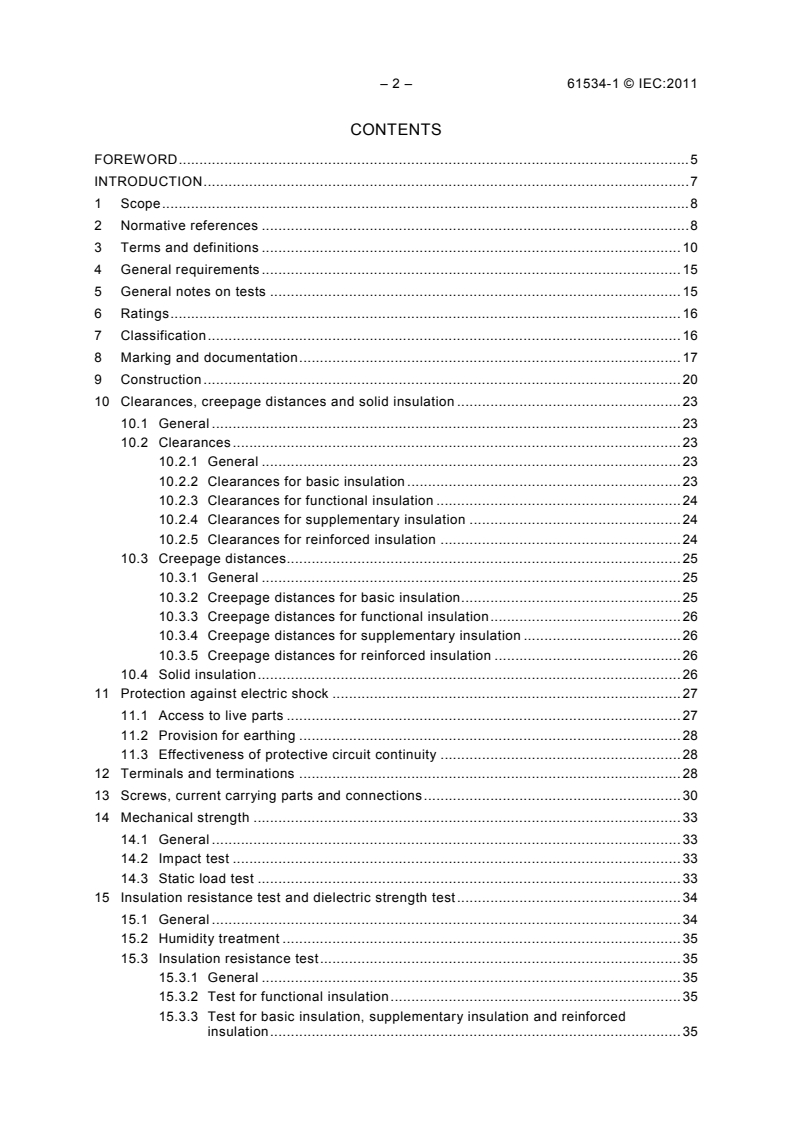
– 2 – 61534-1 © IEC:2011
CONTENTS
FOREWORD . 5
INTRODUCTION . 7
1 Scope . 8
2 Normative references . 8
3 Terms and definitions . 10
4 General requirements . 15
5 General notes on tests . 15
6 Ratings . 16
7 Classification . 16
8 Marking and documentation . 17
9 Construction . 20
10 Clearances, creepage distances and solid insulation . 23
10.1 General . 23
10.2 Clearances . 23
10.2.1 General . 23
10.2.2 Clearances for basic insulation . 23
10.2.3 Clearances for functional insulation . 24
10.2.4 Clearances for supplementary insulation . 24
10.2.5 Clearances for reinforced insulation . 24
10.3 Creepage distances. 25
10.3.1 General . 25
10.3.2 Creepage distances for basic insulation . 25
10.3.3 Creepage distances for functional insulation . 26
10.3.4 Creepage distances for supplementary insulation . 26
10.3.5 Creepage distances for reinforced insulation . 26
10.4 Solid insulation . 26
11 Protection against electric shock . 27
11.1 Access to live parts . 27
11.2 Provision for earthing . 28
11.3 Effectiveness of protective circuit continuity . 28
12 Terminals and terminations . 28
13 Screws, current carrying parts and connections . 30
14 Mechanical strength . 33
14.1 General . 33
14.2 Impact test . 33
14.3 Static load test . 33
15 Insulation resistance test and dielectric strength test . 34
15.1 General . 34
15.2 Humidity treatment . 35
15.3 Insulation resistance test . 35
15.3.1 General . 35
15.3.2 Test for functional insulation . 35
15.3.3 Test for basic insulation, supplementary insulation and reinforced
insulation . 35
61534-1 © IEC:2011 – 3 –
15.4 Dielectric strength test . 36
16 Normal operation . 36
17 Temperature rise . 37
18 Short-circuit protection and short-circuit withstand strength . 40
18.1 General . 40
18.2 Information concerning short-circuit rating . 40
18.3 Short circuit current values . 41
18.3.1 Relationship between peak current and short-circuit current . 41
18.3.2 Value and duration of the short-circuit current . 41
18.4 Verification of short-circuit withstand strength . 41
18.4.1 Test arrangement . 41
18.4.2 Test conditions – General . 41
18.4.3 Testing of the PT system . 42
19 Resistance to heat . 44
20 Fire hazard . 45
20.1 Flammability . 45
20.2 Flame spread . 46
21 External influences . 47
21.1 Resistance to corrosion . 47
21.1.1 General . 47
21.1.2 Corrosion test for dry non-aggressive environments . 47
21.1.3 Corrosion test for powertrack in contact with wet screed material . 47
21.2 Degrees of protection provided by enclosures . 47
21.2.1 General . 47
21.2.2 Protection against ingress of solid foreign objects . 48
21.2.3 Protection against ingress of water . 48
22 Electromagnetic compatibility . 48
22.1 Immunity . 48
22.2 Emission . 48
Annex A (normative) Measurement of clearances and creepage distances . 55
Annex B (normative) Proof tracking test . 60
Annex C (normative) Relationship between rated impulse withstand voltage, rated
voltage and overvoltage category III . 61
Annex D (normative) Pollution degree . 62
Annex E (informative) Diagram for the dimensioning of clearances and creepage
distances . 63
Annex F (normative) Impulse voltage test . 64
Annex G (normative) Routine test . 65
Annex H (normative) Additional test requirements for PT systems already complying
with IEC 61534-1: 2003 . 66
Bibliography . 67
Figure 1 – Pull apparatus for testing the cord anchorage . 49
Figure 2 – Torque apparatus for testing the cord anchorage . 50
Figure 3 – Arrangement for flame test . 51
Figure 4 – Enclosure for flame test . 52
– 4 – 61534-1 © IEC:2011
Figure 5 – Static load test for a length . 53
Figure 6 – Static load test for a joint . 53
Figure 7 – Short-circuit test arrangement . 54
Table 1 – Pull and torque values for tests on cord anchorages . 22
Table 2 – Minimum clearances for basic insulation . 24
Table 3 – Minimum creepage distances for basic insulation . 26
Table 4 – Minimum connecting capacity of terminals . 29
Table 5 – Torque values for screws . 31
Table 6 – Minimum insulation resistance . 35
Table 7 – Dielectric strength . 36
Table 8 – Temperature rise values . 39
Table 9 – Cross-sectional areas of rigid test conductors (solid or stranded) . 39
Table 10 – Cross-sectional areas of flexible test conductors . 40
Table 11 – Standard values for the factor n. 41
Table 12 – Test temperatures for the glow wire test . 46
Table A.1 – Minimum values of width X . 55
Table C.1 – Rated impulse withstand voltage for PT systems energised directly from
the low voltage mains . 61
Table F.1 – Test voltages for verifying clearances at sea level . 64
61534-1 © IEC:2011 – 5 –
INTERNATIONAL ELECTROTECHNICAL COMMISSION
____________
POWERTRACK SYSTEMS –
Part 1: General requirements
FOREWORD
1) The International Electrotechnical Commission (IEC) is a worldwide organization for standardization comprising
all national electrotechnical committees (IEC National Committees). The object of IEC is to promote
international co-operation on all questions concerning standardization in the electrical and electronic fields. To
this end and in addition to other activities, IEC publishes International Standards, Technical Specifications,
Technical Reports, Publicly Available Specifications (PAS) and Guides (hereafter referred to as “IEC
Publication(s)”). Their preparation is entrusted to technical committees; any IEC National Committee interested
in the subject dealt with may participate in this preparatory work. International, governmental and non-
governmental organizations liaising with the IEC also participate in this preparation. IEC collaborates closely
with the International Organization for Standardization (ISO) in accordance with conditions determined by
agreement between the two organizations.
2) The formal decisions or agreements of IEC on technical matters express, as nearly as possible, an international
consensus of opinion on the relevant subjects since each technical committee has representation from all
interested IEC National Committees.
3) IEC Publications have the form of recommendations for international use and are accepted by IEC National
Committees in that sense. While all reasonable efforts are made to ensure that the technical content of IEC
Publications is accurate, IEC cannot be held responsible for the way in which they are used or for any
misinterpretation by any end user.
4) In order to promote international uniformity, IEC National Committees undertake to apply IEC Publications
transparently to the maximum extent possible in their national and regional publications. Any divergence
between any IEC Publication and the corresponding national or regional publication shall be clearly indicated in
the latter.
5) IEC itself does not provide any attestation of conformity. Independent certification bodies provide conformity
assessment services and, in some areas, access to IEC marks of conformity. IEC is not responsible for any
services carried out by independent certification bodies.
6) All users should ensure that they have the latest edition of this publication.
7) No liability shall attach to IEC or its directors, employees, servants or agents including individual experts and
members of its technical committees and IEC National Committees for any personal injury, property damage or
other damage of any nature whatsoever, whether direct or indirect, or for costs (including legal fees) and
expenses arising out of the publication, use of, or reliance upon, this IEC Publication or any other IEC
Publications.
8) Attention is drawn to the Normative references cited in this publication. Use of the referenced publications is
indispensable for the correct application of this publication.
9) Attention is drawn to the possibility that some of the elements of this IEC Publication may be the subject of
patent rights. IEC shall not be held responsible for identifying any or all such patent rights.
International Standard IEC 61534-1 has been prepared by subcommittee 23A: Cable
management systems, of IEC technical committee 23: Electrical accessories.
This second edition cancels and replaces the first edition published in 2003 and constitutes a
technical revision. The main changes from the previous edition are as follows:
• updated normative references (Clause 2);
• changes to the number of samples to be tested (Subclause 5.3);
• inclusion of a short circuit test (New Clause 18);
• changes to external influences (Clause 21).
– 6 – 61534-1 © IEC:2011
The text of this standard is based on the following documents:
FDIS Report on voting
23A/630/FDIS 23A/631/RVD
Full information on the voting for the approval of this standard can be found in the report on
voting indicated in the above table.
This publication has been drafted in accordance with the ISO/IEC Directives, Part 2.
A list of all the parts in the IEC 61534 series, under the general title Powertrack systems, can
be found on the IEC website.
The following difference exists in the countries indicated below:
– Table 4, first column, first line: the 10 A rated terminal should be capable of clamping 1
mm as a minimum (UK);
– Australia has specific wiring rules covering socket-outlets to be switched. In Australia,
AS/NZS 3000 contains requirements for switching devices to be used in Australian and
New Zealand electrical installations;
– 9.5: in Australia, fuses and fuse-links are not to be used.
The committee has decided that the contents of this publication will remain unchanged until
the stability date indicated on the IEC web site under "http://webstore.iec.ch" in the data
related to the specific publication. At this date, the publication will be
• reconfirmed,
• withdrawn,
• replaced by a revised edition, or
• amended.
The contents of the corrigendum of June 2013 apply to the French version only.
61534-1 © IEC:2011 – 7 –
INTRODUCTION
Particular requirements for specific types of powertrack systems will be specified in the
relevant parts 2 of IEC 61534.
For a specific type of powertrack system the requirements of Part 1 of the standard are to be
considered, together with the particular requirements of the appropriate Part 2, which will
supplement or modify some of the corresponding clauses in Part 1 to provide the complete
requirements for that type of system.
Part 1 shall apply unless supplemented or modified by an appropriate Part 2.
– 8 – 61534-1 © IEC:2011
POWERTRACK SYSTEMS –
Part 1: General requirements
1 Scope
1.1 This part of IEC 61534 specifies general requirements and tests for powertrack (PT)
systems with a rated voltage not exceeding 277 V a.c. single phase, or 480 V a.c. two or three
phase 50 Hz/60 Hz with a rated current not exceeding 63 A. These systems are used for
distributing electricity in household, commercial and industrial premises.
1.2 Powertrack systems, according to this standard, are intended for use under the following
conditions:
– an ambient temperature in the range –5 °C to + 40 °C, the average value over a 24 h
period not exceeding 35 °C;
– a situation not subject to a source of heat likely to raise temperatures above the limits
specified above;
– an altitude not exceeding 2000 m above sea level;
– an atmosphere not subject to excessive pollution by smoke, chemical fumes, prolonged
periods of high humidity or other abnormal conditions.
In locations where special conditions prevail, as in ships, vehicles and the like and in
hazardous locations, for instance, where explosions are liable to occur, special constructions
may be necessary.
This standard does not apply to
– cable trunking systems and cable ducting systems covered by IEC 61084 [8] ;
– busbar trunking systems covered by IEC 60439-2 [5];
– electrical supply track systems for luminaires covered by IEC 60570 [6].
2 Normative references
The following referenced documents are indispensable for the application of this document.
For dated references, only the edition cited applies. For undated references, the latest edition
of the referenced document (including any amendments) applies.
IEC 60038:2009, IEC standard voltages
IEC 60060-1:2010, High-voltage test techniques − Part 1: General definitions and test
requirements
IEC 60068-2-52, Environmental testing − Part 2-52: Tests - Test Kb: Salt mist, cyclic (sodium,
chloride solution)
IEC 60068-2-75, Environmental testing − Part 2-75: Tests – Test Eh: Hammer tests
___________
Figures in square brackets refer to the bibliography.
61534-1 © IEC:2011 – 9 –
IEC 60112:2003, Method for the determination of the proof and the comparative tracking
indices of solid insulating materials
IEC 60127-1:2006, Miniature fuses – Part 1: Definitions for miniature fuses and general
requirements for miniature fuse-links
IEC 60269-1:2006, Low-voltage fuses – Part 1: General requirements
IEC 60417, Graphical symbols for use on equipment
IEC 60529:1989, Degrees of protection provided by enclosures (IP code)
IEC 60695-2-11:2000, Fire hazard testing − Part 2-11: Glowing/hot-wire based test methods-
Glow-wire flammability test methods for end-products
IEC 60695-11-2:2003, Fire hazard testing – Part 11-2: Test flames – 1 kW nominal pre-mixed
flame – Apparatus, confirmatory test arrangement and guidance
IEC 60695-10-2:2003, Fire hazard testing – Part 10-2: Abnormal heat – Ball pressure test
IEC 60884-1:2002, Plugs and socket outlets for household and similar purposes – Part 1:
General requirements
Amendment 1 (2006)
IEC 60998-1:2002, Connecting devices for low-voltage circuits for household and similar
purposes – Part 1: General requirements
IEC 60998-2-3:2002, Connecting devices for low-voltage circuits for household and similar
purposes – Part 2-3: Particular requirements for connecting devices as separate entities with
insulation piercing clamping units
IEC 60999-1:1999, Connecting devices – Electrical copper conductors - Safety requirements
for screw-type and screwless-type clamping units – Part 1: General requirements and
2 2
particular requirements for clamping units for conductors from 0,2 mm up to 35 mm
(included)
IEC 60999-2:2003, Connecting devices – Electrical copper conductors – Safety requirements
for screw-type and screwless-type clamping units – Part 2: Particular requirements for
2 2
clamping units for conductors above 35 mm up to 300 mm (included)
IEC 61032:1997, Protection of persons and equipment by enclosures – Probes for verification
IEC 61210:2010, Connecting devices – Flat quick-connect terminations for electrical copper
conductors – Safety requirements
ISO 1456:2009, Metallic and other inorganic coatings – Electrodeposited coatings of nickel,
nickel plus chromium, copper plus nickel and of copper plus nickel plus chromium
ISO 2081:2008, Metallic and other inorganic coatings – Electroplated coatings of zinc with
supplementary treatments on iron or steel
ISO 2093:1986, Electroplated coatings of tin – Specification and test methods
___________
There exists a consolidated edition 2.1 (2001) that includes IEC 60529 (1989) and its Amendment 1 (1999).
There exists a consolidated edition 3.1 (2006) that includes IEC 60884-1 (2002) and its Amendment 1 (2006).
– 10 – 61534-1 © IEC:2011
3 Terms and definitions
For the purposes of this document, the following terms and definitions apply.
3.1
powertrack system
PT system
assembly of system components including a powertrack by which accessories may be
connected to an electrical supply at one or more points (pre-determined or otherwise) along
the powertrack
3.2
system component
part specifically designed for the PT system which may or may not incorporate an accessory
3.3
powertrack
system component which is a generally linear assembly of spaced and supported busbars
providing electrical connection of accessories
NOTE A powertrack may also provide mechanical support for accessories.
3.4
busbar
main current carrying conductor(s) to which for example one or more tap-off units,
accessories or electrical system components may be connected
3.5
accessory
electrical device complying with its own standard and associated with or incorporated in the
PT system
3.6
rewireable accessory
accessory so constructed that a cable can be fitted or replaced using a tool
3.7
non-rewirable system component
system component so constructed that it forms a complete unit with the cable after connection
and assembly by the manufacturer of the system component
3.8
connector
device which provides the electrical connection and possibly the mechanical connection of
powertracks
3.9
supply connector
device enabling the supply wiring to be connected to the powertrack
3.10
live parts
conductor or conductive part intended to be energized in normal operation, including a neutral
conductor, but by convention not a PEN conductor
[IEC 60050-195:1998, 195-02-19, modified] [2]
61534-1 © IEC:2011 – 11 –
3.11
rated voltage, rated current
value assigned to a PT system by the manufacturer and to which operation and performance
characteristics are referred
3.12
clamping unit
part(s) of a terminal necessary for the mechanical clamping and the electrical connection of
the conductor(s) including the parts which are necessary to ensure the correct contact
pressure
3.13
termination
part of a PT system to which a conductor(s) is attached providing a non-reusable connection
3.14
terminal
part of the PT system composed of one or more clamping unit(s) to which a conductor(s) is
attached providing a reusable connection
3.15
insulation piercing connecting device
IPCD
connecting device for the connection and possible disconnection of one conductor or the
interconnection of two or more conductors, the connection being made by piercing, boring
through, cutting through, removing, displacing or making ineffective in some other manner the
insulation of the conductor(s) without previous stripping
NOTE The removal of the sheath of the cable, if necessary, is not considered as a previous stripping.
3.16
flat quick-connect termination
electrical connection consisting of a male tab and a female connector which can be inserted
and withdrawn with or without the use of a tool
3.17
plug
accessory intended for connection to a flexible cable intended for frequent manual
engagement with a socket outlet
3.18
socket-outlet
accessory having a set of contacts designed to engage with the pins of a corresponding plug
and which may have terminals or terminations for the connection of conductors
3.19
fuse-link
part of the fuse including the fuse-element(s) and intended to be replaced after the fuse has
operated
3.20
type test
test of one or more PT systems made to a certain design to show that design meets certain
specifications
[IEC 60050-151:2001, 151-16-16, modified] [1]
– 12 – 61534-1 © IEC:2011
3.21
routine test
test to which each PT system is subjected during or after manufacture to ascertain whether it
complies with the relevant requirements of this standard
[IEC 60050-151:2001, 151-16-17, modified]
NOTE The routine test is specified in Annex G.
3.22
dummy track
device for maintaining visual appearance and mechanical integrity which may be with or
without current carrying parts
3.23
tap-off unit
system component intended for infrequent manual engagement with the busbars directly or
indirectly via a tap-off outlet
3.24
tap-off outlet
aperture into which the tap-off unit engages
3.25
clearance
shortest distance in air between two conductive parts
3.26
creepage distance
shortest distance along the surface of the insulating material between two conductive parts
[IEC 60050-151:2001, 151-15-50]
3.27
overvoltage
voltage having a peak value exceeding the corresponding peak value of maximum steady-
state voltage at normal operating conditions
3.28
transient overvoltage
short duration overvoltage of a few milliseconds or less, oscillatory or non-oscillatory, usually
highly damped
[IEC 60050-604:1987, 604-03-13]
3.29
overvoltage category
numeral defining a transient overvoltage condition
3.30
rated impulse withstand voltage
highest peak value of impulse voltage of prescribed form and polarity assigned by the
manufacturer and which does not cause breakdown of insulation under specified conditions
3.31
rated insulation voltage
r.m.s. withstand voltage value assigned by the manufacturer to the PT system or to a part of
it, characterising the specified (long term) withstand capability of its insulation
61534-1 © IEC:2011 – 13 –
3.32
basic protection
protection against electric shock under fault-free conditions
[IEC 60050-195:1998, 195-06-01]
3.33
fault protection
protection against electric shock under single fault conditions (for example, failure of basic
insulation)
[IEC 60050-195:1998, 195-06-02, modified]
3.34
functional insulation
insulation between live parts which is necessary only for the proper functioning of the PT
system
[IEC 60050-195:1998, 195-02-41, modified]
3.35
basic insulation
insulation of live parts which provides basic protection against electric shock
[IEC 60050-195:1998, 195-06-06, modified]
3.36
supplementary insulation
independent insulation as applied as fault protection in addition to basic insulation in order to
provide protection against electric shock in the event of a failure of basic insulation (fault
protection)
[IEC 60050-195:1998, 195-06-07, modified]
3.37
double insulation
insulation comprising both basic insulation and supplementary insulation
[IEC 60050-195:1998, 195-06-08]
3.38
reinforced insulation
insulation of live parts which provides a degree of protection against electric shock equivalent
to double insulation
[IEC 60050-195:1998, 195-06-09]
3.39
solid insulation
insulation material, not gaseous or liquid, interposed between two conductive parts
3.40
pollution
contamination by foreign matter, solid, liquid, or gaseous that can result in a reduction of
electric surface resistivity
3.41
pollution degree
numeral characterising the expected pollution of the micro-environment
– 14 – 61534-1 © IEC:2011
3.42
micro-environment
immediate environment of the insulation which particularly influences the dimensioning of
creepage distances
3.43
macro-environment
environment of the room or other location in which the equipment is installed or used
3.44
ordinary person
person who is neither a skilled person nor an instructed person
[IEC 60050-195:1998, 195-04-03]
3.45
(electrically) skilled person
person with relevant education and experience to enable him or her to avoid dangers and to
prevent risks which electricity may create
[IEC 60050-195:1998, 195-04-01, modified]
3.46
(electrically) instructed person
person adequately advised or supervised by skilled persons to enable him or her to avoid
dangers and to prevent risks which electricity may create
[IEC 60050-195:1998, 195-04-02, modified]
3.47
entry membrane
component or an integral part of a PT system used to protect the cable and which may be
used to support the cable, conduit or ducting or trunking at the point of entry
NOTE It may also provide ingress protection.
3.48
special purpose tool
tool which is unlikely to be readily available in a normal household, for example, a key for a
three-angle headed screw
3.49
exposed-conductive-parts
conductive part of equipment which can be touched and which is not normally live, but which
can become live when basic insulation fails
[IEC 60050-195:1998, 195-06-10]
NOTE A conductive part of electrical equipment which can only become live through contact with an exposed–
conductive-part which has become live is not considered to be an exposed-conductive-part itself.
3.50
hazardous-live-part
live part which, under certain conditions can give a harmful electric shock
3.51
rated conditional short-circuit current (I ) of a circuit of a PT system
cc
value of prospective short-circuit current, declared by the PT system manufacturer, that can
be withstood for the total operating time (clearing time) of the short-circuit protective device
(SCPD) under specified conditions
61534-1 © IEC:2011 – 15 –
NOTE 1 The test conditions are specified in 18.2 and 18.4.
NOTE 2 For a.c., the rated conditional short-circuit current is expressed by the r.m.s. value of the a.c. component.
NOTE 3 The short-circuit protective device may either form an integral part of the PT system or be a separate
unit.
3.52
short time withstand current
I
cw
the current that a circuit or a switching device in the closed position can carry during a
specified short time under prescribed conditions of use and behaviour
[CEI 60050-441:1984, 441-17-17]
3.53
noiseless (clean) earth
combined protective and functional earth conductor in which the level of conducted or induced
interference from external sources does not produce an unacceptable incidence of
malfunction in the data processing or similar equipment to which it is connected. The
susceptibility in terms of amplitude/frequency characteristics varies depending on the type of
equipment.
4 General requirements
4.1 PT systems shall be so designed and constructed that in normal use their performance is
reliable and without unreasonable hazard to the user or the surroundings.
4.2 Compliance is checked by all relevant tests according to this standard and the
appropriate part 2.
4.3 Accessories associated with or incorporated in a system component shall and need only
comply with the relevant standard for that accessory if any.
5 General notes on tests
5.1 Tests according to this standard are type tests.
5.2 Unless otherwise specified in this standard, the samples shall be tested as delivered
under normal or simulated conditions of use, at an ambient temperature of (20 ± 5) °C. The
samples used for the tests shall be representative of normal production in respect of all
details which may affect the test results. Unless otherwise specified, samples shall be
assembled and mounted in accordance with the manufacturer’s instructions. Samples of non-
rewireable system components shall be supplied with an appropriate flexible cable which shall
be at least 1 m long.
5.3 Thirteen samples shall be subjected to inspection and tests in the following order of
clauses.
– 16 – 61534-1 © IEC:2011
Number of Clause number
samples
b b
3 8 9 10 (15) 11 14 (10/ 11.1/ 11.3/15.3)
a b
1 14.1 (10/ 11.1/ 11.3/15.3)
b
3 12 13 16 17 21 (15.4)
d c b e b
1 18 (11.3.1,15.4) ; ([10.2, 10.3, 16.3] )
3 19
1 20.1
1 20.2
a
For the cold test.
b
The clauses in parenthesis indicate tests that are referenced from the preceding main test clause.
c
The short circuit tests shall be performed on a new sample.
d
The tests may be carried out on one sample or each test may be carried out on a new sample at the
manufacturer’s discretion.
e
Tests required only in case of doubt.
Unless otherwise specified, a sample means an individual component, a powertrack not less
than 1 m in length, or a combination typifying the system as a whole.
5.4 Unless otherwise specified, three samples shall be subjected to the tests. The
requirements are satisfied if all samples meet the test requirements. If any of the samples
fails to satisfy the test requirements due to an assembly or manufacturing fault then that test
and any preceding test which may have influenced the results shall be repeated and any
subsequent tests in the sequence shall be applied to another full set of samples. All of the
new set of samples shall comply with the requirements.
6 Ratings
PT systems shall have
– a rated voltage not exceeding 480 V a.c., and
– a rated current not exceeding 63 A.
7 Classification
PT systems and/or system components shall be classified as follows:
7.1 According to resistance to impact for installation and application.
7.1.1 PT system for light impact: 1 J
7.1.2 PT system for medium impact: 2 J
7.1.3 PT system for heavy impact: 5 J
61534-1 © IEC:2011 – 17 –
7.1.4 PT system for very heavy impact: 20 J
7.2 According to whether the tap-off units are intended to be connected and disconnected
with the system energised and/or their load connected.
7.2.1 Tap-off units not intended to be connected or disconnected when the system is
energised.
7.2.2 Tap-off units intended to be connected or disconnected when the system is energised
but without a load connected.
7.2.2.1 By ordinary person, skilled person or instructed person.
7.2.2.2 By skilled person or instructed person.
7.2.3 Tap-off units intended to be connected or disconnected when the system is energised
and with a load connected.
7.3 According to degrees of protection provided by enclosures according to IEC 60529.
7.3.1 According to protection against ingress of solid foreign objects.
7.3.2 According to protection against ingress of water.
7.4 According to degree of pollution
7.4.1 Pollution degree 1
7.4.2 Pollution degree 2
7.4.3 Pollution degree 3
NOTE 1 Details for the pollution degrees are given in Annex D.
NOTE 2 A PT system suitable for use in a particular situation may be used in a less polluted situation.
7.5 According to the rated impulse withstand voltage:
330 V, 500 V, 1 500 V, 2 500 V, 4000 V.
NOTE The relationship between rated impulse withstand voltage, rated voltage and overvoltage category is given
in Annex C.
8 Marking and documentation
8.1 Each system component shall be marked with
a) the name or trademark of the manufacturer or responsible vendor;
b) product identification which may comprise, for example, a colour, a catalogue number, a
symbol.
In the case where the PT system is supplied as an assembly then only the assembly need be
marked, and this shall not be on easily removable parts.
Where it is not possible to mark a component due to its size, then it will be sufficient to mark
the smallest package unit according to 8.1.
– 18 – 61534-1 © IEC:2011
Compliance is checked by inspection.
8.2 In addition to 8.1 the powertra
...
IEC 61534-1 ®
Edition 2.2 2020-07
CONSOLIDATED VERSION
INTERNATIONAL
STANDARD
NORME
INTERNATIONALE
colour
inside
Powertrack systems –
Part 1: General requirements
Systèmes de conducteurs préfabriqués –
Partie 1: Exigences générales
All rights reserved. Unless otherwise specified, no part of this publication may be reproduced or utilized in any form
or by any means, electronic or mechanical, including photocopying and microfilm, without permission in writing from
either IEC or IEC's member National Committee in the country of the requester. If you have any questions about IEC
copyright or have an enquiry about obtaining additional rights to this publication, please contact the address below or
your local IEC member National Committee for further information.
Droits de reproduction réservés. Sauf indication contraire, aucune partie de cette publication ne peut être reproduite
ni utilisée sous quelque forme que ce soit et par aucun procédé, électronique ou mécanique, y compris la photocopie
et les microfilms, sans l'accord écrit de l'IEC ou du Comité national de l'IEC du pays du demandeur. Si vous avez des
questions sur le copyright de l'IEC ou si vous désirez obtenir des droits supplémentaires sur cette publication, utilisez
les coordonnées ci-après ou contactez le Comité national de l'IEC de votre pays de résidence.
IEC Central Office Tel.: +41 22 919 02 11
3, rue de Varembé info@iec.ch
CH-1211 Geneva 20 www.iec.ch
Switzerland
About the IEC
The International Electrotechnical Commission (IEC) is the leading global organization that prepares and publishes
International Standards for all electrical, electronic and related technologies.
About IEC publications
The technical content of IEC publications is kept under constant review by the IEC. Please make sure that you have the
latest edition, a corrigendum or an amendment might have been published.
IEC publications search - webstore.iec.ch/advsearchform Electropedia - www.electropedia.org
The advanced search enables to find IEC publications by a The world's leading online dictionary on electrotechnology,
variety of criteria (reference number, text, technical containing more than 22 000 terminological entries in English
committee,…). It also gives information on projects, replaced and French, with equivalent terms in 16 additional languages.
and withdrawn publications. Also known as the International Electrotechnical Vocabulary
(IEV) online.
IEC Just Published - webstore.iec.ch/justpublished
Stay up to date on all new IEC publications. Just Published IEC Glossary - std.iec.ch/glossary
details all new publications released. Available online and 67 000 electrotechnical terminology entries in English and
once a month by email. French extracted from the Terms and definitions clause of
IEC publications issued between 2002 and 2015. Some
IEC Customer Service Centre - webstore.iec.ch/csc entries have been collected from earlier publications of IEC
If you wish to give us your feedback on this publication or TC 37, 77, 86 and CISPR.
need further assistance, please contact the Customer Service
Centre: sales@iec.ch.
A propos de l'IEC
La Commission Electrotechnique Internationale (IEC) est la première organisation mondiale qui élabore et publie des
Normes internationales pour tout ce qui a trait à l'électricité, à l'électronique et aux technologies apparentées.
A propos des publications IEC
Le contenu technique des publications IEC est constamment revu. Veuillez vous assurer que vous possédez l’édition la
plus récente, un corrigendum ou amendement peut avoir été publié.
Recherche de publications IEC - Electropedia - www.electropedia.org
webstore.iec.ch/advsearchform Le premier dictionnaire d'électrotechnologie en ligne au
La recherche avancée permet de trouver des publications IEC monde, avec plus de 22 000 articles terminologiques en
en utilisant différents critères (numéro de référence, texte, anglais et en français, ainsi que les termes équivalents dans
comité d’études,…). Elle donne aussi des informations sur les 16 langues additionnelles. Egalement appelé Vocabulaire
projets et les publications remplacées ou retirées. Electrotechnique International (IEV) en ligne.
IEC Just Published - webstore.iec.ch/justpublished Glossaire IEC - std.iec.ch/glossary
Restez informé sur les nouvelles publications IEC. Just 67 000 entrées terminologiques électrotechniques, en anglais
Published détaille les nouvelles publications parues. et en français, extraites des articles Termes et définitions des
Disponible en ligne et une fois par mois par email. publications IEC parues entre 2002 et 2015. Plus certaines
entrées antérieures extraites des publications des CE 37, 77,
Service Clients - webstore.iec.ch/csc 86 et CISPR de l'IEC.
Si vous désirez nous donner des commentaires sur cette
publication ou si vous avez des questions contactez-nous:
sales@iec.ch.
IEC 61534-1 ®
Edition 2.2 2020-07
CONSOLIDATED VERSION
INTERNATIONAL
STANDARD
NORME
INTERNATIONALE
colour
inside
Powertrack systems –
Part 1: General requirements
Systèmes de conducteurs préfabriqués –
Partie 1: Exigences générales
INTERNATIONAL
ELECTROTECHNICAL
COMMISSION
COMMISSION
ELECTROTECHNIQUE
INTERNATIONALE
ICS 29.060.10; 29.120.10 ISBN 978-2-8322-8612-8
IEC 61534-1 ®
Edition 2.2 2020-07
REDLINE VERSION
VERSION REDLINE
colour
inside
Powertrack systems –
Part 1: General requirements
Systèmes de conducteurs préfabriqués –
Partie 1: Exigences générales
– 2 – IEC 61534-1:2011+AMD1:2014
+AMD2:2020 CSV © IEC 2020
CONTENTS
FOREWORD . 5
INTRODUCTION . 7
1 Scope . 8
2 Normative references . 8
3 Terms and definitions . 10
4 General requirements . 16
5 General notes on tests . 16
6 Ratings . 17
7 Classification . 17
8 Marking and documentation . 18
9 Construction . 21
10 Clearances, creepage distances and solid insulation . 25
10.1 General . 25
10.2 Clearances . 25
10.2.1 General . 25
10.2.2 Clearances for basic insulation . 25
10.2.3 Clearances for functional insulation . 25
10.2.4 Clearances for supplementary insulation . 26
10.2.5 Clearances for reinforced insulation . 26
10.3 Creepage distances. 26
10.3.1 General . 26
10.3.2 Creepage distances for basic insulation . 27
10.3.3 Creepage distances for functional insulation . 28
10.3.4 Creepage distances for supplementary insulation . 28
10.3.5 Creepage distances for reinforced insulation . 28
10.4 Solid insulation . 28
11 Protection against electric shock . 29
11.1 Access to live parts . 29
11.2 Provision for earthing . 30
11.3 Effectiveness of protective circuit continuity . 30
12 Terminals and terminations . 31
13 Screws, current carrying parts and connections . 32
14 Mechanical strength . 35
14.1 General . 35
14.2 Impact test . 35
14.3 Static load test . 36
15 Insulation resistance test and dielectric strength test . 37
15.1 General . 37
15.2 Humidity treatment . 37
15.3 Insulation resistance test . 38
15.3.1 General . 38
15.3.2 Test for functional insulation . 38
15.3.3 Test for basic insulation, supplementary insulation and reinforced
insulation . 38
+AMD2:2020 CSV © IEC 2020
15.4 Dielectric strength test . 38
16 Normal operation . 39
17 Temperature rise . 40
18 Short-circuit protection and short-circuit withstand strength . 42
18.1 General . 42
18.2 Information concerning short-circuit rating . 42
18.3 Short circuit current values . 43
18.3.1 Relationship between peak current and short-circuit current . 43
18.3.2 Value and duration of the short-circuit current . 43
18.4 Verification of short-circuit withstand strength . 43
18.4.1 Test arrangement . 43
18.4.2 Test conditions – General . 44
18.4.3 Testing of the PT system . 44
19 Resistance to heat . 47
20 Fire hazard . 48
20.1 Flammability . 48
20.2 Flame spread . 48
21 External influences . 49
21.1 Resistance to corrosion . 49
21.1.1 General . 49
21.1.2 Corrosion test for dry non-aggressive environments . 49
21.1.3 Corrosion test for powertrack in contact with wet screed material . 50
21.2 Degrees of protection provided by enclosures . 50
21.2.1 General . 50
21.2.2 Protection against ingress of solid foreign objects . 50
21.2.3 Protection against ingress of water . 50
22 Electromagnetic compatibility . 51
22.1 Immunity . 51
22.2 Emission . 51
Annex A (normative) Measurement of clearances and creepage distances . 58
Annex B (normative) Proof tracking test . 63
Annex C (normative) Relationship between rated impulse withstand voltage, rated
voltage and overvoltage category III . 64
Annex D (normative) Pollution degree . 65
Annex E (informative) Diagram for the dimensioning of clearances and creepage
distances . 66
Annex F (normative) Impulse voltage test . 67
Annex G (normative) Routine test Additional test requirements for PT systems already
complying with IEC 61534-1:2011 and IEC 61534-1:2011/AMD1:2014 . 68
Annex H (normative) Additional test requirements for PT systems already complying
with IEC 61534-1: 2003 .
Bibliography . 70
Figure 1 – Pull apparatus for testing the cord anchorage . 51
Figure 2 – Torque apparatus for testing the cord anchorage . 52
Figure 3 – Arrangement for flame test . 54
Figure 4 – Enclosure for flame test . 55
– 4 – IEC 61534-1:2011+AMD1:2014
+AMD2:2020 CSV © IEC 2020
Figure 5 – Static load test for a length . 56
Figure 6 – Static load test for a joint . 56
Figure 7 – Short-circuit test arrangement . 57
Figure 8 – Piston for durability of marking test . 20
Table 1 – Pull and torque values for tests on cord anchorages . 23
Table 2 – Minimum clearances for basic insulation . 26
Table 3 – Minimum creepage distances for basic insulation . 28
Table 4 – Minimum connecting capacity of terminals . 31
Table 5 – Torque values for screws . 33
Table 6 – Minimum insulation resistance . 38
Table 7 – Dielectric strength . 38
Table 8 – Temperature rise values . 41
Table 9 – Cross-sectional areas of rigid test conductors (solid or stranded) . 42
Table 10 – Cross-sectional areas of flexible test conductors . 42
Table 11 – Standard values for the factor n. 43
Table 12 – Test temperatures for the glow wire test . 48
Table A.1 – Minimum values of width X . 58
Table C.1 – Rated impulse withstand voltage for PT systems energised directly from
the low voltage mains . 64
Table F.1 – Test voltages for verifying clearances at sea level . 67
+AMD2:2020 CSV © IEC 2020
INTERNATIONAL ELECTROTECHNICAL COMMISSION
____________
POWERTRACK SYSTEMS –
Part 1: General requirements
FOREWORD
1) The International Electrotechnical Commission (IEC) is a worldwide organization for standardization comprising
all national electrotechnical committees (IEC National Committees). The object of IEC is to promote
international co-operation on all questions concerning standardization in the electrical and electronic fields. To
this end and in addition to other activities, IEC publishes International Standards, Technical Specifications,
Technical Reports, Publicly Available Specifications (PAS) and Guides (hereafter referred to as “IEC
Publication(s)”). Their preparation is entrusted to technical committees; any IEC National Committee interested
in the subject dealt with may participate in this preparatory work. International, governmental and non-
governmental organizations liaising with the IEC also participate in this preparation. IEC collaborates closely
with the International Organization for Standardization (ISO) in accordance with conditions determined by
agreement between the two organizations.
2) The formal decisions or agreements of IEC on technical matters express, as nearly as possible, an international
consensus of opinion on the relevant subjects since each technical committee has representation from all
interested IEC National Committees.
3) IEC Publications have the form of recommendations for international use and are accepted by IEC National
Committees in that sense. While all reasonable efforts are made to ensure that the technical content of IEC
Publications is accurate, IEC cannot be held responsible for the way in which they are used or for any
misinterpretation by any end user.
4) In order to promote international uniformity, IEC National Committees undertake to apply IEC Publications
transparently to the maximum extent possible in their national and regional publications. Any divergence
between any IEC Publication and the corresponding national or regional publication shall be clearly indicated in
the latter.
5) IEC itself does not provide any attestation of conformity. Independent certification bodies provide conformity
assessment services and, in some areas, access to IEC marks of conformity. IEC is not responsible for any
services carried out by independent certification bodies.
6) All users should ensure that they have the latest edition of this publication.
7) No liability shall attach to IEC or its directors, employees, servants or agents including individual experts and
members of its technical committees and IEC National Committees for any personal injury, property damage or
other damage of any nature whatsoever, whether direct or indirect, or for costs (including legal fees) and
expenses arising out of the publication, use of, or reliance upon, this IEC Publication or any other IEC
Publications.
8) Attention is drawn to the Normative references cited in this publication. Use of the referenced publications is
indispensable for the correct application of this publication.
9) Attention is drawn to the possibility that some of the elements of this IEC Publication may be the subject of
patent rights. IEC shall not be held responsible for identifying any or all such patent rights.
This consolidated version of the official IEC Standard and its amendments has been
prepared for user convenience.
IEC 61534-1 edition 2.2 contains the second edition (2011-05) [documents 23A/630/FDIS
and 23A/631/RVD], its amendment 1 (2014-06) [documents 23A/700A/FDIS and
23A/706/RVD] and its amendment 2 (2020-07) [documents 23A/903/FDIS and
23A/908/RVD].
In this Redline version, a vertical line in the margin shows where the technical content
is modified by amendments 1 and 2. Additions are in green text, deletions are in
strikethrough red text. A separate Final version with all changes accepted is available
in this publication.
– 6 – IEC 61534-1:2011+AMD1:2014
+AMD2:2020 CSV © IEC 2020
International Standard IEC 61534-1 has been prepared by subcommittee 23A: Cable
management systems, of IEC technical committee 23: Electrical accessories.
The main changes from the previous edition are as follows:
• updated normative references (Clause 2);
• changes to the number of samples to be tested (Subclause 5.3);
• inclusion of a short circuit test (New Clause 18);
• changes to external influences (Clause 21).
This publication has been drafted in accordance with the ISO/IEC Directives, Part 2.
A list of all the parts in the IEC 61534 series, under the general title Powertrack systems, can
be found on the IEC website.
The following difference exists in the countries indicated below:
– Table 4, first column, first line: the 10 A rated terminal should be capable of clamping 1
mm as a minimum (UK);
– Australia has specific wiring rules covering socket-outlets to be switched. In Australia,
AS/NZS 3000 contains requirements for switching devices to be used in Australian and
New Zealand electrical installations;
– 9.5: in Australia, fuses and fuse-links are not to be used.
The committee has decided that the contents of the base publication and its amendments will
remain unchanged until the stability date indicated on the IEC web site under
"http://webstore.iec.ch" in the data related to the specific publication. At this date, the
publication will be
• reconfirmed,
• withdrawn,
• replaced by a revised edition, or
• amended.
IMPORTANT – The 'colour inside' logo on the cover page of this publication indicates
that it contains colours which are considered to be useful for the correct
understanding of its contents. Users should therefore print this document using a
colour printer.
+AMD2:2020 CSV © IEC 2020
INTRODUCTION
Particular requirements for specific types of powertrack systems will be specified in the
relevant parts 2 of IEC 61534.
For a specific type of powertrack system the requirements of Part 1 of the standard are to be
considered, together with the particular requirements of the appropriate Part 2, which will
supplement or modify some of the corresponding clauses in Part 1 to provide the complete
requirements for that type of system.
Part 1 shall apply unless supplemented or modified by an appropriate Part 2.
– 8 – IEC 61534-1:2011+AMD1:2014
+AMD2:2020 CSV © IEC 2020
POWERTRACK SYSTEMS –
Part 1: General requirements
1 Scope
1.1 This part of IEC 61534 specifies general requirements and tests for powertrack (PT)
systems with a rated voltage not exceeding 277 V a.c. single phase, or 480 V a.c. two or three
phase 50 Hz/ or 60 Hz with a rated current not exceeding 63 A. These systems are used for
distributing electricity in household, commercial and industrial premises.
1.2 Powertrack systems, according to this standard, are intended for use under the following
conditions:
– an ambient temperature in the range –5 °C to + 40 °C, the average value over a 24 h
period not exceeding 35 °C;
– a situation not subject to a source of heat likely to raise temperatures above the limits
specified above;
– an altitude not exceeding 2000 m above sea level;
– an atmosphere not subject to excessive pollution by smoke, chemical fumes, prolonged
periods of high humidity or other abnormal conditions.
In locations where special conditions prevail, as in ships, vehicles and the like and in
hazardous locations, for instance, where explosions are liable to occur, special constructions
may be necessary.
This standard does not apply to
– cable trunking systems and cable ducting systems covered by IEC 61084 [8] ;
– busbar trunking systems covered by IEC 60439-2 [5];
– electrical supply track systems for luminaires covered by IEC 60570 [6].
2 Normative references
The following referenced documents are indispensable for the application of this document.
For dated references, only the edition cited applies. For undated references, the latest edition
of the referenced document (including any amendments) applies.
IEC 60038:2009, IEC standard voltages
IEC 60060-1:2010, High-voltage test techniques − Part 1: General definitions and test
requirements
− Part 2-52: Tests - Test Kb: Salt mist, cyclic
IEC 60068-2-52:2017, Environmental testing
(sodium, chloride solution)
IEC 60068-2-75:2014, Environmental testing − Part 2-75: Tests – Test Eh: Hammer tests
___________
Figures in square brackets refer to the bibliography.
+AMD2:2020 CSV © IEC 2020
IEC 60112:2003, Method for the determination of the proof and the comparative tracking
indices of solid insulating materials
IEC 60112:2003/AMD1:2009
IEC 60127-1:2006, Miniature fuses – Part 1: Definitions for miniature fuses and general
requirements for miniature fuse-links
IEC 60127-1:2006/AMD1:2011
IEC 60127-1:2006/AMD2:2015
IEC 60269-1:2006, Low-voltage fuses – Part 1: General requirements
IEC 60269-1:2006/AMD1:2009
IEC 60269-1:2006/AMD2:2014
IEC 60417, Graphical symbols for use on equipment
IEC 60529:1989, Degrees of protection provided by enclosures (IP code)
IEC 60529:1989/AMD1:1999
IEC 60529:1989/AMD2:2013
IEC 60695-2-11:20002014, Fire hazard testing – Part 2-11: Glowing/hot-wire based test
methods – Glow-wire flammability test methods for end-products (GWEPT)
IEC 60695-11-2:20032017, Fire hazard testing – Part 11-2: Test flames – 1 kW nominal pre-
mixed flame – Apparatus, confirmatory test arrangement and guidance
IEC 60695-10-2:20032014, Fire hazard testing – Part 10-2: Abnormal heat – Ball pressure
test method
IEC 60884-1:2002, Plugs and socket outlets for household and similar purposes – Part 1:
General requirements
IEC 60884-1:2002/AMD1:2006
IEC 60884-1:2002/AMD2:2013
IEC 60998-1:2002, Connecting devices for low-voltage circuits for household and similar
purposes – Part 1: General requirements
IEC 60998-2-3:2002, Connecting devices for low-voltage circuits for household and similar
purposes – Part 2-3: Particular requirements for connecting devices as separate entities with
insulation piercing clamping units
IEC 60999-1:1999, Connecting devices – Electrical copper conductors - Safety requirements
for screw-type and screwless-type clamping units – Part 1: General requirements and
2 2
particular requirements for clamping units for conductors from 0,2 mm up to 35 mm
(included)
IEC 60999-2:2003, Connecting devices – Electrical copper conductors – Safety requirements
for screw-type and screwless-type clamping units – Part 2: Particular requirements for
2 2
clamping units for conductors above 35 mm up to 300 mm (included)
IEC 61032:1997, Protection of persons and equipment by enclosures – Probes for verification
___________
There exists a consolidated edition 2.1 (2001) that includes IEC 60529 (1989) and its Amendment 1 (1999). A
consolidated version of this publication exists, comprising IEC 60529:1989, IEC 60529:1989/AMD1:1999 and
IEC 60529:1989/AMD2:2013.
There exists a consolidated edition 3.1 (2006) that includes IEC 60884-1 (2002) and its Amendment 1 (2006). A
consolidated version of this publication exists, comprising IEC 60884-1:2002, IEC 60884-1:2002/AMD1:2006
and IEC 60884-1:2002/AMD2:2013.
– 10 – IEC 61534-1:2011+AMD1:2014
+AMD2:2020 CSV © IEC 2020
IEC 61210:2010, Connecting devices – Flat quick-connect terminations for electrical copper
conductors – Safety requirements
ISO 1456:2009, Metallic and other inorganic coatings – Electrodeposited coatings of nickel,
nickel plus chromium, copper plus nickel and of copper plus nickel plus chromium
ISO 2081:20082018, Metallic and other inorganic coatings – Electroplated coatings of zinc
with supplementary treatments on iron or steel
ISO 2093:1986, Electroplated coatings of tin – Specification and test methods
ISO 4628-3:2016, Paints and varnishes – Evaluation of degradation of coatings – Designation
of quantity and size of defects, and of intensity of uniform changes in appearance – Part 3:
Assessment of degree of rusting
3 Terms and definitions
For the purposes of this document, the following terms and definitions apply.
3.1
powertrack system
PT system
assembly of system components including a powertrack by which accessories may be
connected to an electrical supply at one or more points (pre-determined or otherwise) along
the powertrack
3.2
system component
part specifically designed for the PT system which may or may not incorporate an accessory
3.3
powertrack
system component which is a generally linear assembly of spaced and supported busbars
providing electrical connection of accessories
NOTE A powertrack may also provide mechanical support for accessories.
3.4
busbar
main current carrying conductor(s) to which for example one or more tap-off units,
accessories or electrical system components may be connected
3.5
accessory
electrical device complying with its own standard and associated with or incorporated in the
PT system
3.6
rewireable accessory
accessory so constructed that a cable can be fitted or replaced using a tool
3.7
non-rewirable system component
system component so constructed that it forms a complete unit with the cable after connection
and assembly by the manufacturer of the system component
+AMD2:2020 CSV © IEC 2020
3.8
connector
device which provides the electrical connection and possibly the mechanical connection of
powertracks
3.9
supply connector
device enabling the supply wiring to be connected to the powertrack
3.10
live parts
conductor or conductive part intended to be energized in normal operation, including a neutral
conductor, but by convention not a PEN conductor
[IEC 60050-195:1998, 195-02-19, modified] [2]
3.11
rated voltage, rated current
value assigned to a PT system by the manufacturer and to which operation and performance
characteristics are referred
3.12
clamping unit
part(s) of a terminal necessary for the mechanical clamping and the electrical connection of
the conductor(s) including the parts which are necessary to ensure the correct contact
pressure
3.13
termination
part of a PT system to which a conductor(s) is attached providing a non-reusable connection
3.14
terminal
part of the PT system composed of one or more clamping unit(s) to which a conductor(s) is
attached providing a reusable connection
3.15
insulation piercing connecting device
IPCD
connecting device for the connection and possible disconnection of one conductor or the
interconnection of two or more conductors, the connection being made by piercing, boring
through, cutting through, removing, displacing or making ineffective in some other manner the
insulation of the conductor(s) without previous stripping
NOTE The removal of the sheath of the cable, if necessary, is not considered as a previous stripping.
3.16
flat quick-connect termination
electrical connection consisting of a male tab and a female connector which can be inserted
and withdrawn with or without the use of a tool
3.17
plug
accessory intended for connection to a flexible cable intended for frequent manual
engagement with a socket outlet
– 12 – IEC 61534-1:2011+AMD1:2014
+AMD2:2020 CSV © IEC 2020
3.18
socket-outlet
accessory having a set of contacts designed to engage with the pins of a corresponding plug
and which may have terminals or terminations for the connection of conductors
3.19
fuse-link
part of the fuse including the fuse-element(s) and intended to be replaced after the fuse has
operated
3.20
type test
test of one or more PT systems made to a certain design to show that design meets certain
specifications
[IEC 60050-151:2001, 151-16-16, modified] [1]
3.21
routine test
test to which each PT system is subjected during or after manufacture to ascertain whether it
complies with the relevant requirements of this standard
[IEC 60050-151:2001, 151-16-17, modified]
NOTE The routine test is specified in Annex G.
3.22
dummy track
device for maintaining visual appearance and mechanical integrity which may be with or
without current carrying parts
3.23
tap-off unit
system component intended for infrequent manual engagement with the busbars directly or
indirectly via a tap-off outlet
3.24
tap-off outlet
aperture into which the tap-off unit engages
3.25
clearance
shortest distance in air between two conductive parts
3.26
creepage distance
shortest distance along the surface of the insulating material between two conductive parts
[IEC 60050-151:2001, 151-15-50]
3.27
overvoltage
voltage having a peak value exceeding the corresponding peak value of maximum steady-
state voltage at normal operating conditions
+AMD2:2020 CSV © IEC 2020
3.28
transient overvoltage
short duration overvoltage of a few milliseconds or less, oscillatory or non-oscillatory, usually
highly damped
[IEC 60050-604:1987, 604-03-13]
3.29
overvoltage category
numeral defining a transient overvoltage condition
3.30
rated impulse withstand voltage
highest peak value of impulse voltage of prescribed form and polarity assigned by the
manufacturer and which does not cause breakdown of insulation under specified conditions
3.31
rated insulation voltage
r.m.s. withstand voltage value assigned by the manufacturer to the PT system or to a part of
it, characterising the specified (long term) withstand capability of its insulation
3.32
basic protection
protection against electric shock under fault-free conditions
[IEC 60050-195:1998, 195-06-01]
3.33
fault protection
protection against electric shock under single fault conditions (for example, failure of basic
insulation)
[IEC 60050-195:1998, 195-06-02, modified]
3.34
functional insulation
insulation between live parts which is necessary only for the proper functioning of the PT
system
[IEC 60050-195:1998, 195-02-41, modified]
3.35
basic insulation
insulation of live parts which provides basic protection against electric shock
[IEC 60050-195:1998, 195-06-06, modified]
3.36
supplementary insulation
independent insulation as applied as fault protection in addition to basic insulation in order to
provide protection against electric shock in the event of a failure of basic insulation (fault
protection)
[IEC 60050-195:1998, 195-06-07, modified]
3.37
double insulation
insulation comprising both basic insulation and supplementary insulation
– 14 – IEC 61534-1:2011+AMD1:2014
+AMD2:2020 CSV © IEC 2020
[IEC 60050-195:1998, 195-06-08]
3.38
reinforced insulation
insulation of live parts which provides a degree of protection against electric shock equivalent
to double insulation
[IEC 60050-195:1998, 195-06-09]
3.39
solid insulation
insulation material, not gaseous or liquid, interposed between two conductive parts
3.40
pollution
contamination by foreign matter, solid, liquid, or gaseous that can result in a reduction of
electric surface resistivity
3.41
pollution degree
numeral characterising the expected pollution of the micro-environment
3.42
micro-environment
immediate environment of the insulation which particularly influences the dimensioning of
creepage distances
3.43
macro-environment
environment of the room or other location in which the equipment is installed or used
3.44
ordinary person
person who is neither a skilled person nor an instructed person
[IEC 60050-195:1998, 195-04-03]
3.45
(electrically) skilled person
person with relevant education and experience to enable him or her to avoid dangers and to
prevent risks which electricity may create
[IEC 60050-195:1998, 195-04-01, modified]
3.46
(electrically) instructed person
person adequately advised or supervised by skilled persons to enable him or her to avoid
dangers and to prevent risks which electricity may create
[IEC 60050-195:1998, 195-04-02, modified]
3.47
entry membrane
component or an integral part of a PT system used to protect the cable and which may be
used to support the cable, conduit or ducting or trunking at the point of entry
NOTE It may also provide ingress protection.
+AMD2:2020 CSV © IEC 2020
3.48
special purpose tool
tool which is unlikely to be readily available in a normal household, for example, a key for a
three-angle headed screw
3.49
exposed-conductive-parts
conductive part of equipment which can be touched and which is not normally live, but which
can become live when basic insulation fails
[IEC 60050-195:1998, 195-06-10]
NOTE A conductive part of electrical equipment which can only become live through contact with an exposed–
conductive-part which has become live is not considered to be an exposed-conductive-part itself.
3.50
hazardous-live-part
live part which, under certain conditions can give a harmful electric shock
3.51
rated conditional short-circuit current (I ) of a circuit of a PT system
cc
value of prospective short-circuit current, declared by the PT system manufacturer, that can
be withstood for the total operating time (clearing time) of the short-circuit protective device
(SCPD) under specified conditions
NOTE 1 The test conditions are specified in 18.2 and 18.4.
NOTE 2 For a.c., the rated conditional short-circuit current is expressed by the r.m.s. value of the a.c. component.
NOTE 3 The short-circuit protective device may either form an integral part of the PT system or be a separate
unit.
3.52
short time withstand current
I
cw
the current that a circuit or a switching device in the closed position can carry during a
specified short time under prescribed conditions of use and behaviour
[CEI 60050-441:1984, 441-17-17]
3.53
noiseless (clean) earth
combined protective and functional earth conductor in which the level of conducted or induced
interference from external sources does not produce an unacceptable incidence of
malfunction in the data processing or similar equipment to which it is connected. The
susceptibility in terms of amplitude/frequency characteristics varies depending on the type of
equipment.
3.54
dry-treatment of floor
process for cleaning and/or care by which the floor is treated without liquids or with only a
small quantity of liquid such that no pools or soaking of the floor covering occurs
EXAMPLE Sweeping with a broom or carpet-sweeper, vacuum cleaning, brushing, cleaning with a dry cleaning
powder, dry shampoo treatment, wet shampooing of carpets, treatment with cleaning litter (liquid chemical cleaning
agent on a solid material used as carrier, e.g. soaked sawdust, damp cloth, etc.).
3.55
wet-treatment of floor
process for cleaning and/or care by which the floor is treated with liquid agents such that
pools of liquid, or soaking of the floor covering for a brief period of time, cannot be excluded
– 16 – IEC 61534-1:2011+AMD1:2014
+AMD2:2020 CSV © IEC 2020
EXAMPLE Wet scrubbing, manual or mechanical wiping.
4 General requirements
4.1 PT systems shall be so designed and constructed that in normal use their performance is
reliable and without unreasonable hazard to the user, domestic animals or the surroundings.
4.2 Compliance is checked by all relevant tests according to this standard and the
appropriate part 2.
4.3 Accessories associated with or incorporated in a system component shall and need only
comply with the relevant standard for that accessory if any comply with their own IEC
International Standard or, when an IEC International Standard is unavailable, with their own
relevant national standard.
5 General notes on tests
5.1 Tests according to this standard are type tests.
5.2 Unless otherwise specified in this standard, the samples shall be tested as delivered
under normal or simulated conditions of use, at an ambient temperature of (20 ± 5) °C. The
samples used for the tests shall be representative of normal production in respect of all
details which may affect the test results. Unless otherwise specified, samples shall be
assembled and mounted in accordance with the manufacturer’s instructions. Samples of non-
rewireable system components shall be supplied
...