


IEC 61675-1:2013
(Main)Radionuclide imaging devices - Characteristics and test conditions - Part 1: Positron emission tomographs
General Information
- Abstract
IEC 61675-1:2013 specifies terminology and test methods for declaring the characteristics of positron emission tomographs. Positron emission tomographs detect the annihilation radiation of positron emitting Radionuclides by coincidence detection. No test has been specified to characterize the uniformity of reconstructed images, because all methods known so far will mostly reflect the noise in the image. This second edition replaces the first edition of IEC 61675-1, published in 1998. This edition constitutes a technical revision. Requirements have been changed regarding the following technical aspects:
- spatial resolution;
- sensitivity measurement;
- scatter fraction;
- count rate performance;
- and image quality. Keywords: imaging, medical device
- Status
- Published
- Publication Date
- 24-Sep-2013
- Drafting Committee
- WG 2 - TC 62/SC 62C/WG 2
- Current Stage
- DELPUB - Deleted Publication
- Start Date
- 18-Mar-2022
- Completion Date
- 17-Jul-2020

Overview
IEC 61675-1:2013 - Radionuclide imaging devices - Characteristics and test conditions - Part 1: Positron emission tomographs - specifies standardized terminology and test methods used to declare the performance characteristics of positron emission tomographs (PET). PET devices detect annihilation radiation from positron-emitting radionuclides using coincidence detection. This second edition (2013) is a technical revision of the 1998 edition and updates key measurement requirements relevant to modern PET imaging systems. Notably, the standard does not specify a test for uniformity of reconstructed images because available methods largely reflect image noise rather than system uniformity.
Key topics and technical requirements
The standard focuses on reproducible test methods and clear definitions for declaring PET system performance. Primary technical topics include:
- Terminology for radionuclide imaging devices and PET-specific measurement concepts
- Spatial resolution - updated requirements and measurement approaches for describing system resolution
- Sensitivity measurement - standardized procedures for quantifying system detection sensitivity
- Scatter fraction - methods to determine and report the proportion of detected counts due to scatter
- Count rate performance - tests to evaluate system response and dead-time effects at differing activity levels
- Image quality - performance metrics and test conditions for characterizing reconstructed images
- Explicit note: no uniformity test for reconstructed image uniformity is defined because of noise-dominant effects
Applications and who uses this standard
IEC 61675-1:2013 is intended for stakeholders who design, evaluate, certify, purchase, or clinically operate PET systems:
- PET system manufacturers - to declare device performance and validate design changes
- Medical physicists and clinical imaging departments - for acceptance testing, commissioning, and routine performance checks
- Regulatory bodies and notified bodies - to assess compliance and safety/performance claims for medical devices
- Independent test laboratories and service engineers - for standard test protocols and comparative benchmarking
- Procurement teams - to compare technical specifications and supplier declarations using consistent metrics
Related standards
- Other IEC standards for radionuclide imaging and nuclear medicine instrumentation
- Medical electrical equipment safety/performance standards (e.g., IEC 60601 series) and national regulatory guidance for medical devices
Keywords: imaging, medical device, positron emission tomography, PET, radionuclide imaging devices, IEC 61675-1, test methods, spatial resolution, sensitivity, scatter fraction, count rate performance, image quality.
Relations
- Effective Date
- 05-Sep-2023
- Effective Date
- 05-Sep-2023
- Effective Date
- 05-Sep-2023
Get Certified
Connect with accredited certification bodies for this standard

BSI Group
BSI (British Standards Institution) is the business standards company that helps organizations make excellence a habit.

TÜV Rheinland
TÜV Rheinland is a leading international provider of technical services.

TÜV SÜD
TÜV SÜD is a trusted partner of choice for safety, security and sustainability solutions.
Sponsored listings
Frequently Asked Questions
IEC 61675-1:2013 is a standard published by the International Electrotechnical Commission (IEC). Its full title is "Radionuclide imaging devices - Characteristics and test conditions - Part 1: Positron emission tomographs". This standard covers: IEC 61675-1:2013 specifies terminology and test methods for declaring the characteristics of positron emission tomographs. Positron emission tomographs detect the annihilation radiation of positron emitting Radionuclides by coincidence detection. No test has been specified to characterize the uniformity of reconstructed images, because all methods known so far will mostly reflect the noise in the image. This second edition replaces the first edition of IEC 61675-1, published in 1998. This edition constitutes a technical revision. Requirements have been changed regarding the following technical aspects: - spatial resolution; - sensitivity measurement; - scatter fraction; - count rate performance; - and image quality. Keywords: imaging, medical device
IEC 61675-1:2013 specifies terminology and test methods for declaring the characteristics of positron emission tomographs. Positron emission tomographs detect the annihilation radiation of positron emitting Radionuclides by coincidence detection. No test has been specified to characterize the uniformity of reconstructed images, because all methods known so far will mostly reflect the noise in the image. This second edition replaces the first edition of IEC 61675-1, published in 1998. This edition constitutes a technical revision. Requirements have been changed regarding the following technical aspects: - spatial resolution; - sensitivity measurement; - scatter fraction; - count rate performance; - and image quality. Keywords: imaging, medical device
IEC 61675-1:2013 is classified under the following ICS (International Classification for Standards) categories: 11.040.50 - Radiographic equipment; 29.240.20 - Power transmission and distribution lines; 33.200 - Telecontrol. Telemetering. The ICS classification helps identify the subject area and facilitates finding related standards.
IEC 61675-1:2013 has the following relationships with other standards: It is inter standard links to IEC 61675-1:1998/AMD1:2008, IEC 61675-1:2022, IEC 61675-1:1998. Understanding these relationships helps ensure you are using the most current and applicable version of the standard.
IEC 61675-1:2013 is available in PDF format for immediate download after purchase. The document can be added to your cart and obtained through the secure checkout process. Digital delivery ensures instant access to the complete standard document.
Standards Content (Sample)
SLOVENSKI STANDARD
01-avgust-1997
Distribution automation using distribution line carrier systems - Part 1: General
considerations - Section 4: Identification of data transmission parameters
concerning medium and low-voltage distribution mains
Distribution automation using distribution line carrier systems - Part 1: General
considerations - Section 4: Identification of data transmission parameters concerning
medium and low-voltage distribution mains
Automatisation de la distribution à l'aide de systèmes de communication à courants
porteurs - Partie 1: Considérations générales - Section 4: Identification des paramètres
de transmission de données des réseaux de distribution moyenne et basse tension
Ta slovenski standard je istoveten z: IEC/TR 61334-1-4
ICS:
29.240.20 Daljnovodi Power transmission and
distribution lines
33.040.40 Podatkovna komunikacijska Data communication
omrežja networks
33.200 Daljinsko krmiljenje, daljinske Telecontrol. Telemetering
meritve (telemetrija)
2003-01.Slovenski inštitut za standardizacijo. Razmnoževanje celote ali delov tega standarda ni dovoljeno.
SIST IE
...
IEC 61675-1 ®
Edition 2.0 2013-09
INTERNATIONAL
STANDARD
NORME
INTERNATIONALE
Radionuclide imaging devices – Characteristics and test conditions –
Part 1: Positron emission tomographs
Dispositifs d'imagerie par radionucléides – Caractéristiques et conditions
d'essai –
Partie 1: Tomographes à émission de positrons
All rights reserved. Unless otherwise specified, no part of this publication may be reproduced or utilized in any form
or by any means, electronic or mechanical, including photocopying and microfilm, without permission in writing from
either IEC or IEC's member National Committee in the country of the requester.
If you have any questions about IEC copyright or have an enquiry about obtaining additional rights to this publication,
please contact the address below or your local IEC member National Committee for further information.
Droits de reproduction réservés. Sauf indication contraire, aucune partie de cette publication ne peut être reproduite ni
utilisée sous quelque forme que ce soit et par aucun procédé, électronique ou mécanique, y compris la photocopie et les
microfilms, sans l'accord écrit de la CEI ou du Comité national de la CEI du pays du demandeur.
Si vous avez des questions sur le copyright de la CEI ou si vous désirez obtenir des droits supplémentaires sur cette
publication, utilisez les coordonnées ci-après ou contactez le Comité national de la CEI de votre pays de résidence.
IEC Central Office Tel.: +41 22 919 02 11
3, rue de Varembé Fax: +41 22 919 03 00
CH-1211 Geneva 20 info@iec.ch
Switzerland www.iec.ch
About the IEC
The International Electrotechnical Commission (IEC) is the leading global organization that prepares and publishes
International Standards for all electrical, electronic and related technologies.
About IEC publications
The technical content of IEC publications is kept under constant review by the IEC. Please make sure that you have the
latest edition, a corrigenda or an amendment might have been published.
Useful links:
IEC publications search - www.iec.ch/searchpub Electropedia - www.electropedia.org
The advanced search enables you to find IEC publications The world's leading online dictionary of electronic and
by a variety of criteria (reference number, text, technical electrical terms containing more than 30 000 terms and
committee,…). definitions in English and French, with equivalent terms in
It also gives information on projects, replaced and additional languages. Also known as the International
withdrawn publications. Electrotechnical Vocabulary (IEV) on-line.
IEC Just Published - webstore.iec.ch/justpublished Customer Service Centre - webstore.iec.ch/csc
Stay up to date on all new IEC publications. Just Published If you wish to give us your feedback on this publication
details all new publications released. Available on-line and or need further assistance, please contact the
also once a month by email. Customer Service Centre: csc@iec.ch.
A propos de la CEI
La Commission Electrotechnique Internationale (CEI) est la première organisation mondiale qui élabore et publie des
Normes internationales pour tout ce qui a trait à l'électricité, à l'électronique et aux technologies apparentées.
A propos des publications CEI
Le contenu technique des publications de la CEI est constamment revu. Veuillez vous assurer que vous possédez
l’édition la plus récente, un corrigendum ou amendement peut avoir été publié.
Liens utiles:
Recherche de publications CEI - www.iec.ch/searchpub Electropedia - www.electropedia.org
La recherche avancée vous permet de trouver des Le premier dictionnaire en ligne au monde de termes
publications CEI en utilisant différents critères (numéro de électroniques et électriques. Il contient plus de 30 000
référence, texte, comité d’études,…). termes et définitions en anglais et en français, ainsi que
Elle donne aussi des informations sur les projets et les les termes équivalents dans les langues additionnelles.
publications remplacées ou retirées. Egalement appelé Vocabulaire Electrotechnique
International (VEI) en ligne.
Just Published CEI - webstore.iec.ch/justpublished
Service Clients - webstore.iec.ch/csc
Restez informé sur les nouvelles publications de la CEI.
Just Published détaille les nouvelles publications parues. Si vous désirez nous donner des commentaires sur
Disponible en ligne et aussi une fois par mois par email. cette publication ou si vous avez des questions
contactez-nous: csc@iec.ch.
IEC 61675-1 ®
Edition 2.0 2013-09
INTERNATIONAL
STANDARD
NORME
INTERNATIONALE
Radionuclide imaging devices – Characteristics and test conditions –
Part 1: Positron emission tomographs
Dispositifs d'imagerie par radionucléides – Caractéristiques et conditions
d'essai –
Partie 1: Tomographes à émission de positrons
INTERNATIONAL
ELECTROTECHNICAL
COMMISSION
COMMISSION
ELECTROTECHNIQUE
PRICE CODE
INTERNATIONALE
CODE PRIX W
ICS 11.040.50 ISBN 978-2-8322-1119-9
– 2 – 61675-1 © IEC:2013
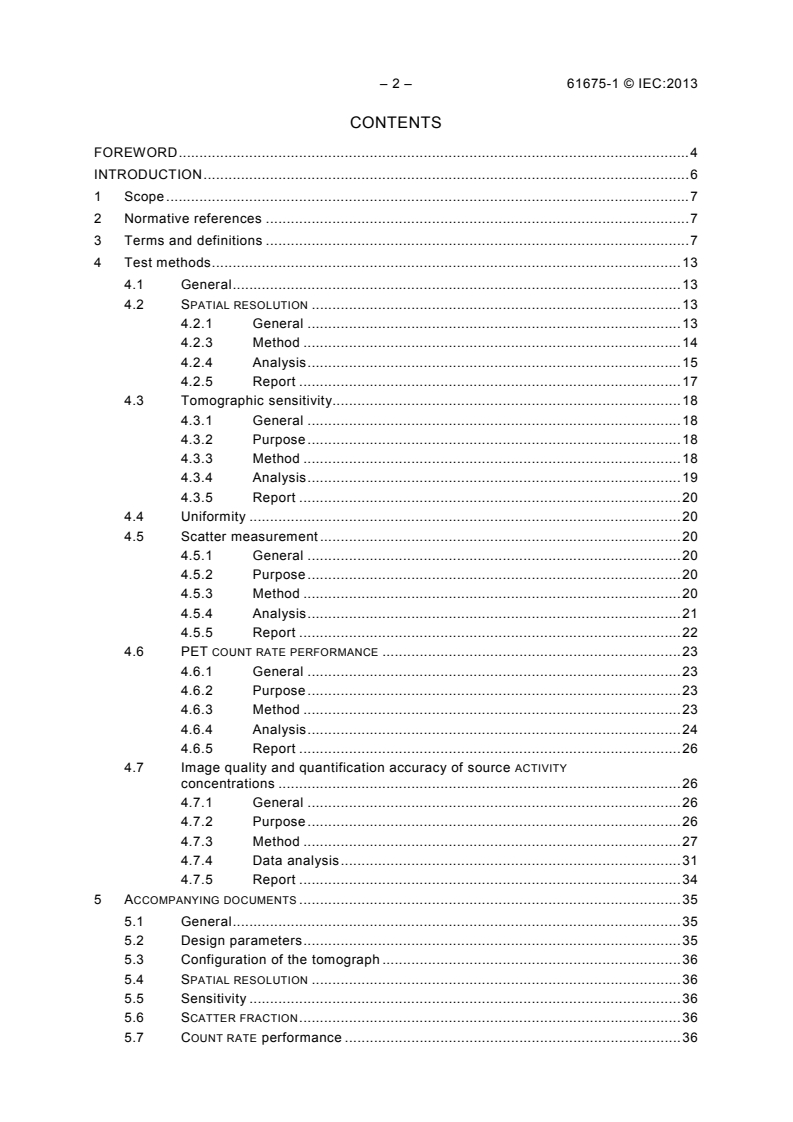
CONTENTS
FOREWORD . 4
INTRODUCTION . 6
1 Scope . 7
2 Normative references . 7
3 Terms and definitions . 7
4 Test methods . 13
4.1 General . 13
4.2 SPATIAL RESOLUTION . 13
4.2.1 General . 13
4.2.3 Method . 14
4.2.4 Analysis . 15
4.2.5 Report . 17
4.3 Tomographic sensitivity. 18
4.3.1 General . 18
4.3.2 Purpose . 18
4.3.3 Method . 18
4.3.4 Analysis . 19
4.3.5 Report . 20
4.4 Uniformity . 20
4.5 Scatter measurement . 20
4.5.1 General . 20
4.5.2 Purpose . 20
4.5.3 Method . 20
4.5.4 Analysis . 21
4.5.5 Report . 22
4.6 PET COUNT RATE PERFORMANCE . 23
4.6.1 General . 23
4.6.2 Purpose . 23
4.6.3 Method . 23
4.6.4 Analysis . 24
4.6.5 Report . 26
4.7 Image quality and quantification accuracy of source ACTIVITY
concentrations . 26
4.7.1 General . 26
4.7.2 Purpose . 26
4.7.3 Method . 27
4.7.4 Data analysis . 31
4.7.5 Report . 34
5 ACCOMPANYING DOCUMENTS . 35
5.1 General . 35
5.2 Design parameters . 35
5.3 Configuration of the tomograph . 36
5.4 SPATIAL RESOLUTION . 36
5.5 Sensitivity . 36
5.6 SCATTER FRACTION . 36
5.7 COUNT RATE performance . 36
61675-1 © IEC:2013 – 3 –
5.8 Image quality and quantification accuracy of source ACTIVITY
concentrations . 36
Bibliography . 37
Index of defined terms . 38
Figure 1 – Evaluation of FWHM . 16
Figure 2 – Evaluation of EQUIVALENT WIDTH (EW) . 17
Figure 3 – Scatter phantom configuration and position on the imaging bed . 19
Figure 4 – Evaluation of SCATTER FRACTION . 22
Figure 5 – Cross-section of body phantom . 27
Figure 6 – Phantom insert with hollow spheres . 28
Figure 7 – Image quality phantom and scatter phantom position for whole body scan
acquisition . 29
Figure 8 – Placement of ROIs in the phantom background . 32
– 4 – 61675-1 © IEC:2013
INTERNATIONAL ELECTROTECHNICAL COMMISSION
____________
RADIONUCLIDE IMAGING DEVICES –
CHARACTERISTICS AND TEST CONDITIONS –
Part 1: Positron emission tomographs
FOREWORD
1) The International Electrotechnical Commission (IEC) is a worldwide organization for standardization comprising
all national electrotechnical committees (IEC National Committees). The object of IEC is to promote
international co-operation on all questions concerning standardization in the electrical and electronic fields. To
this end and in addition to other activities, IEC publishes International Standards, Technical Specifications,
Technical Reports, Publicly Available Specifications (PAS) and Guides (hereafter referred to as “IEC
Publication(s)”). Their preparation is entrusted to technical committees; any IEC National Committee interested
in the subject dealt with may participate in this preparatory work. International, governmental and non-
governmental organizations liaising with the IEC also participate in this preparation. IEC collaborates closely
with the International Organization for Standardization (ISO) in accordance with conditions determined by
agreement between the two organizations.
2) The formal decisions or agreements of IEC on technical matters express, as nearly as possible, an international
consensus of opinion on the relevant subjects since each technical committee has representation from all
interested IEC National Committees.
3) IEC Publications have the form of recommendations for international use and are accepted by IEC National
Committees in that sense. While all reasonable efforts are made to ensure that the technical content of IEC
Publications is accurate, IEC cannot be held responsible for the way in which they are used or for any
misinterpretation by any end user.
4) In order to promote international uniformity, IEC National Committees undertake to apply IEC Publications
transparently to the maximum extent possible in their national and regional publications. Any divergence
between any IEC Publication and the corresponding national or regional publication shall be clearly indicated in
the latter.
5) IEC itself does not provide any attestation of conformity. Independent certification bodies provide conformity
assessment services and, in some areas, access to IEC marks of conformity. IEC is not responsible for any
services carried out by independent certification bodies.
6) All users should ensure that they have the latest edition of this publication.
7) No liability shall attach to IEC or its directors, employees, servants or agents including individual experts and
members of its technical committees and IEC National Committees for any personal injury, property damage or
other damage of any nature whatsoever, whether direct or indirect, or for costs (including legal fees) and
expenses arising out of the publication, use of, or reliance upon, this IEC Publication or any other IEC
Publications.
8) Attention is drawn to the Normative references cited in this publication. Use of the referenced publications is
indispensable for the correct application of this publication.
9) Attention is drawn to the possibility that some of the elements of this IEC Publication may be the subject of
patent rights. IEC shall not be held responsible for identifying any or all such patent rights.
International Standard IEC 61675-1 has been prepared by subcommittee 62C: Equipment for
radiotherapy, nuclear medicine and radiation dosimetry, of IEC technical committee 62:
Electrical equipment in medical practice.
This second edition replaces the first edition of IEC 61675-1, published in 1998. This edition
constitutes a technical revision. Requirements have been changed regarding the following
technical aspects:
– SPATIAL RESOLUTION;
– sensitivity measurement;
– SCATTER FRACTION;
– COUNT RATE performance;
– image quality.
61675-1 © IEC:2013 – 5 –
The text of this standard is based on the following documents:
CDV Report on voting
62C/550/CDV 62C/561/RVC
Full information on the voting for the approval of this standard can be found in the report on
voting indicated in the above table.
This publication has been drafted in accordance with the ISO/IEC Directives, Part 2.
In this standard, the following print types are used:
– Requirements and definitions: roman type.
– Test specifications: italic type.
– Informative material appearing outside of tables, such as notes, examples and references: in smaller type.
Normative text of tables is also in a smaller type.
– TERMS DEFINED IN CLAUSE 3 OF IEC 60601-1, IN THIS PARTICULAR STANDARD OR AS NOTED:
SMALL CAPITALS.
References to clauses within this standard are preceded by the term “clause” followed by the
clause number. References to subclauses within this particular standard are by number only.
In this standard, the conjunctive “or” is used as an “inclusive or” so a statement is true if any
combination of the conditions is true.
The verbal forms used in this standard conform to usage described in Annex H of the ISO/IEC
Directives, Part 2. For the purposes of this standard, the auxiliary verb:
– “shall” means that compliance with a requirement or a test is mandatory for compliance
with this standard;
– “should” means that compliance with a requirement or a test is recommended but is not
mandatory for compliance with this standard;
– “may” is used to describe a permissible way to achieve compliance with a requirement or
test.
The committee has decided that the contents of this publication will remain unchanged until
the stability date indicated on the IEC web site under "http://webstore.iec.ch" in the data
related to the specific publication. At this date, the publication will be
• reconfirmed,
• withdrawn,
• replaced by a revised edition, or
• amended.
– 6 – 61675-1 © IEC:2013
INTRODUCTION
Further developments of POSITRON EMISSION TOMOGRAPHS allow most of the tomographs to be
operated in fully 3D acquisition mode. To comply with this trend, this standard describes test
conditions in accordance with this acquisition characteristic. In addition, today a POSITRON
EMISSION TOMOGRAPH often includes X-RAY EQUIPMENT for COMPUTED TOMOGRAPHY (CT). For
this standard PET-CT hybrid devices are considered to be state of the art, dedicated
POSITRON EMISSION TOMOGRAPHS not including the X-ray component being special cases only.
The test methods specified in this part of IEC 61675 have been selected to reflect as much as
possible the clinical use of POSITRON EMISSION TOMOGRAPHS. It is intended that the tests be
carried out by MANUFACTURERS, thereby enabling them to declare the characteristics of
POSITRON EMISSION TOMOGRAPHS in the ACCOMPANYING DOCUMENTS. This standard does not
indicate which tests will be performed by the MANUFACTURER on an individual tomograph.
61675-1 © IEC:2013 – 7 –
RADIONUCLIDE IMAGING DEVICES –
CHARACTERISTICS AND TEST CONDITIONS –
Part 1: Positron emission tomographs
1 Scope
This part of IEC 61675 specifies terminology and test methods for declaring the
characteristics of POSITRON EMISSION TOMOGRAPHS. POSITRON EMISSION TOMOGRAPHS detect the
ANNIHILATION RADIATION of positron emitting RADIONUCLIDEs by COINCIDENCE DETECTION.
No test has been specified to characterize the uniformity of reconstructed images, because all
methods known so far will mostly reflect the noise in the image.
2 Normative references
The following documents, in whole or in part, are normatively referenced in this document and
are indispensable for its application. For dated references, only the edition cited applies. For
undated references, the latest edition of the referenced document (including any
amendments) applies.
IEC 60788:2004, Medical electrical equipment – Glossary of defined terms
3 Terms and definitions
For the purposes of this document, the terms and definitions given in IEC 60788:2004 and the
following apply.
3.1
tomography
radiography of one or more layers within an object
[SOURCE: IEC 60788:2004, rm-41-15]
3.1.1
transverse tomography
TOMOGRAPHY that slices a three-dimensional object into a stack of OBJECT SLICES which are
considered as being two-dimensional and independent from each other and at which the
IMAGE PLANES are perpendicular to the SYSTEM AXIS
3.1.2
emission computed tomography
ECT
imaging method for the representation of the spatial distribution of incorporated
RADIONUCLIDES in selected two-dimensional slices through the object
3.1.2.1
projection
transformation of a three-dimensional object into its two-dimensional image or of a two-
dimensional object into its one-dimensional image, by integrating the physical property which
determines the image along the direction of the PROJECTION BEAM
– 8 – 61675-1 © IEC:2013
Note 1 to entry: This process is mathematically described by line integrals in the direction of PROJECTION (along
the LINE OF RESPONSE) and called radon-transform.
3.1.2.2
projection beam
beam that determines the smallest possible volume in which the physical property which
determines the image is integrated during the measurement process
Note 1 to entry: Its shape is limited by SPATIAL RESOLUTION in all three dimensions.
Note 2 to entry: The PROJECTION BEAM mostly has the shape of a long thin cylinder or cone. In POSITRON EMISSION
TOMOGRAPHY, it is the sensitive volume between two detector elements operated in coincidence.
3.1.2.3
projection angle
angle at which the PROJECTION is measured or acquired
3.1.2.4
sinogram
two-dimensional display of all one-dimensional PROJECTIONs of an OBJECT SLICE, as a function
of the PROJECTION ANGLE
Note 1 to entry: The PROJECTION ANGLE is displayed on the ordinate, the linear projection coordinate is displayed
on the abscissa.
3.1.2.5
object slice
physical property that correspondes to a slice in the object and that determines the measured
information and which is displayed in the tomographic image
3.1.2.6
image plane
a plane assigned to a plane in the OBJECT SLICE
Note 1 to entry: Usually the IMAGE PLANE is the midplane of the corresponding OBJECT SLICE.
3.1.2.7
system axis
axis of symmetry, characterized by geometrical and physical properties of the arrangement of
the system
Note 1 to entry: For a circular POSITRON EMISSION TOMOGRAPH, the SYSTEM AXIS is the axis through the centre of
the detector ring. For tomographs with rotating detectors it is the axis of rotation.
3.1.2.8
tomographic volume
juxtaposition of all volume elements which contribute to the measured PROJECTIONs for all
PROJECTION ANGLES
3.1.2.8.1
transverse field of view
dimensions of a slice through the TOMOGRAPHIC VOLUME, perpendicular to the SYSTEM AXIS
Note 1 to entry: For a circular TRANSVERSE FIELD OF VIEW, it is described by its diameter.
Note 2 to entry: For non-cylindrical TOMOGRAPHIC VOLUMES the TRANSVERSE FIELD OF VIEW may depend on the
axial position of the slice.
3.1.2.8.2
axial field of view
AFOV
field which is characterized by dimensions of a slice through the TOMOGRAPHIC VOLUME,
parallel to and including the SYSTEM AXIS
61675-1 © IEC:2013 – 9 –
Note 1 to entry: In practice, it is specified only by its axial dimension, given by the distance between the centre of
the outmost defined IMAGE PLANEs plus the average of the measured AXIAL RESOLUTION.
3.1.2.8.3
total field of view
field which is characterized by dimensions (three-dimensional) of the TOMOGRAPHIC VOLUME
3.1.3
positron emission tomography
PET
EMISSION COMPUTED TOMOGRAPHY utilizing the ANNIHILATION RADIATION of positron emitting
RADIONUCLIDES by COINCIDENCE DETECTION
3.1.3.1
positron emission tomograph
tomographic device, which detects the ANNIHILATION RADIATION of positron emitting
RADIONUCLIDES by COINCIDENCE DETECTION
3.1.3.2
annihilation radiation
ionizing radiation that is produced when a particle and its antiparticle interact and cease to
exist
3.1.3.3
coincidence detection
method which checks whether two opposing detectors have detected one photon each
simultaneously
Note 1 to entry: By this method the two photons are concatenated into one event.
Note 2 to entry: The COINCIDENCE DETECTION between two opposing detector elements serves as an electronic
collimation to define the corresponding PROJECTION BEAM or LINE OF RESPONSE (LOR), respectively.
3.1.3.4
coincidence window
time interval during which two detected photons are considered as being simultaneous
3.1.3.5
line of response
LOR
axis of the PROJECTION BEAM
Note 1 to entry: In PET, it is the line connecting the centres of two opposing detector elements operated in
coincidence.
3.1.3.6
total coincidences
sum of all coincidences detected
3.1.3.6.1
true coincidence
result of COINCIDENCE DETECTION of two gamma events originating from the same positron
annihilation
3.1.3.6.2
scattered true coincidence
TRUE COINCIDENCE where at least one participating photon was scattered before the
COINCIDENCE DETECTION
– 10 – 61675-1 © IEC:2013
3.1.3.6.3
unscattered true coincidence
difference between TRUE COINCIDENCES and SCATTERED TRUE COINCIDENCES
3.1.3.6.4
random coincidence
result of a COINCIDENCE DETECTION in which participating photons do not originate from the
same positron annihilation.
3.1.3.7
singles rate
COUNT RATE measured without COINCIDENCE DETECTION, but with energy discrimination
3.1.4
two-dimensional reconstruction
image reconstruction at which data are rebinned prior to reconstruction into SINOGRAMS, which
are the PROJECTION data of transverse slices which are considered as being independent of
each other and being perpendicular to the SYSTEM AXIS
3.1.5
three-dimensional reconstruction
image reconstruction at which the LINES OF RESPONSE are not restricted to being perpendicular
to the SYSTEM AXIS so that a LINE OF RESPONSE may pass several transverse slices
3.2
image matrix
matrix in which each element corresponds to the measured or calculated
physical property of the object at the location described by the coordinates of this MATRIX
ELEMENT
3.2.1
matrix element
smallest unit of an IMAGE MATRIX, which is assigned in location and size to a certain volume
element of the object (VOXEL)
3.2.1.1
pixel
MATRIX ELEMENT in a two-dimensional IMAGE MATRIX
3.2.1.2
trixel
MATRIX ELEMENT in a three-dimensional IMAGE MATRIX
3.2.2
voxel
volume element in the object which is assigned to a MATRIX ELEMENT in a two- or three-
dimensional IMAGE MATRIX
Note 1 to entry: The dimensions of the VOXEL are determined by the dimensions of the corresponding MATRIX
ELEMENT via the appropriate scale factors and by the systems SPATIAL RESOLUTION in all three dimensions.
3.3
point spread function
PSF
scintigraphic image of a POINT SOURCE
61675-1 © IEC:2013 – 11 –
3.3.1
physical point spread function
two-dimensional POINT SPREAD FUNCTION in planes perpendicular to the
PROJECTION BEAM at specified distances from the detector
Note 1 to entry: The PHYSICAL POINT SPREAD FUNCTION characterizes the purely physical (intrinsic) imaging
performance of the tomographic device and is independent of for example sampling, image reconstruction and
image processing. A PROJECTION BEAM is characterized by the entirety of all PHYSICAL POINT SPREAD FUNCTIONs as a
function of distance along its axis.
3.3.2
axial point spread function
profile passing through the peak of the PHYSICAL POINT SPREAD FUNCTION in a plane parallel to
the sYSTEM AXIS
3.3.3
transverse point spread function
POINT SPREAD FUNCTION in a tomographic IMAGE PLANE
reconstructed two-dimensional
Note 1 to entry: In TOMOGRAPHY, the TRANSVERSE POINT SPREAD FUNCTION can also be obtained from a LINE
SOURCE located parallel to the SYSTEM AXIS.
3.4
spatial resolution
ability to concentrate the count density distribution in the image of a POINT
SOURCE to a point
3.4.1
transverse resolution
SPATIAL RESOLUTION in a reconstructed plane perpendicular to the SYSTEM AXIS
3.4.1.1
radial resolution
TRANSVERSE RESOLUTION along a line passing through the position of the source and the
SYSTEM AXIS
3.4.1.2
tangential resolution
TRANSVERSE RESOLUTION in the direction orthogonal to the direction of RADIAL RESOLUTION
3.4.2
axial resolution
SPATIAL RESOLUTION along a line parallel to the SYSTEM AXIS
Note 1 to entry: AXIAL RESOLUTION only applies for tomographs with sufficiently fine axial sampling fulfilling the
sampling theorem.
3.4.3
equivalent width
EW
width of the rectangle that has the same area and the same height as the response function
3.4.4
full width at half maximum
FWHM
for a bell shaped curve, distance parallel to the abscissa axis between the points where the
ordinate has half of its maximum value
[SOURCE: IEC 60788:2004, rm-73-02
– 12 – 61675-1 © IEC:2013
3.5
recovery coefficient
measured (image) ACTIVITY concentration of an active volume divided by the true ACTIVITY
concentration of that volume, neglecting ACTIVITY calibration factors
Note 1 to entry: For the actual measurement, the true ACTIVITY concentration is replaced by the measured
ACTIVITY concentration in a large volume.
3.6
slice sensitivity
ratio of COUNT RATE as measured on the SINOGRAM to the ACTIVITY concentration in the
phantom
Note 1 to entry: In PET, the measured counts are numerically corrected for scatter by subtracting the SCATTER
FRACTION.
3.7
volume sensitivity
sum of the individual SLICE SENSITIVITIES
3.8
count rate characteristic
function giving the relationship between observed COUNT RATE and TRUE COUNT RATE
[SOURCE: IEC 60788:2004, rm-34-21
3.8.1
count loss
difference between measured COUNT RATE and TRUE COUNT RATE, which is caused by the finite
RESOLVING TIME of the instrument
3.8.2
count rate
number of counts per unit of time
3.8.3
true count rate
COUNT RATE that would be observed if the RESOLVING TIME of the device were zero
[SOURCE: IEC 60788:2004, rm-34-20]
3.9
scatter fraction
SF
ratio between SCATTERED TRUE COINCIDENCES and the sum of SCATTERED plus UNSCATTERED
TRUE COINCIDENCES for a given experimental set-up
3.10
point source
RADIOACTIVE SOURCE approximating a δ-function in all three dimensions
3.11
line source
straight RADIOACTIVE SOURCE approximating a δ-function in two dimensions and being constant
(uniform) in the third dimension
61675-1 © IEC:2013 – 13 –
3.12
calibration
the process to establish the relation between COUNT RATE
per volume element locally in the image and the corresponding ACTIVITY concentration in the
object for object sizes not requiring RECOVERY CORRECTION
Note 1 to entry: In order to have this CALIBRATION fairly independent of the object under study, the application of
proper corrections to the data, e.g. ATTENUATION, scatter, COUNT LOSS, radioactive decay, detector normalization,
RANDOM COINCIDENCES (PET), and branching ratio (PET) is mandatory. The independency of the object is required
to scale clinical images in terms of kBq/ml or standardized uptake values (SUV).
3.13
PET count rate performance
relationship between the measured COUNT RATE of TRUE COINCIDENCES, RANDOM COINCIDENCES,
TOTAL COINCIDENCES, and noise equivalent count rate versus ACTIVITY
4 Test methods
4.1 General
For all measurements, the tomograph shall be set up according to its normal mode of
operation, i.e. it shall not be adjusted specially for the measurement of specific parameters. If
the tomograph is specified to operate in different modes influencing the performance
parameters, for example with different axial acceptance angles, with and without septa, with
TWO-DIMENSIONAL RECONSTRUCTION and THREE-DIMENSIONAL RECONSTRUCTION, the test results
shall be reported for every mode of operation. The tomograph configuration (e.g. energy
thresholds, axial acceptance angle, reconstruction algorithm) shall be chosen according to the
MANUFACTURER’s recommendation and clearly stated. If any test cannot be carried out exactly
as specified in this standard, the reason for the deviation and the exact conditions under
which the test was performed shall be stated clearly.
It is postulated that a POSITRON EMISSION TOMOGRAPH is capable of measuring RANDOM
COINCIDENCES and performing the appropriate correction. In addition, a POSITRON EMISSION
TOMOGRAPH shall provide corrections for scatter, ATTENUATION, COUNT LOSS, branching ratio,
radioactive decay, and CALIBRATION.
The test phantoms shall be centred within the tomograph’s AXIAL FIELD OF VIEW, if not specified
otherwise.
4.2 SPATIAL RESOLUTION
4.2.1 General
SPATIAL RESOLUTION measurements describe partly the ability of a tomograph to reproduce the
spatial distribution of a tracer in an object in a reconstructed image. The measurement is
performed by imaging POINT SOURCES in air and reconstructing images, using a sharp
reconstruction filter. Although this does not represent the condition of imaging a PATIENT,
where tissue scatter is present and limited statistics require the use of a smooth
SPATIAL
reconstruction filter and/or iterative reconstruction methods, the measured
RESOLUTION provides an objective comparison between tomographs.
4.2.2 Purpose
The purpose of this measurement is to characterize the ability of the tomograph to recover
small objects.
The TRANSVERSE RESOLUTION is characterized by the width of the reconstructed TRANSVERSE
POINT SPREAD FUNCTIONS of radioactive POINT SOURCES. The width of the spread function is
measured by the FULL WIDTH AT HALF MAXIMUM (FWHM) and the EQUIVALENT WIDTH (EW).
– 14 – 61675-1 © IEC:2013
The AXIAL RESOLUTION is defined for tomographs with sufficiently fine axial sampling (volume
detectors) and could be measured with a stationary POINT SOURCE. These systems (fulfilling
the sampling theorem in the axial direction) are characterized by the fact that the AXIAL POINT
SPREAD FUNCTION of a stationary POINT SOURCE would not vary if the position of the source is
varied in the axial direction for half the axial sampling distance.
4.2.3 Method
4.2.3.1 General
For all systems, the SPATIAL RESOLUTION shall be measured in the transverse IMAGE PLANE in
two directions (i.e. radially and tangentially). In addition, for those systems having sufficiently
AXIAL RESOLUTION also shall be measured.
fine axial sampling, the
The TRANSVERSE FIELD OF VIEW and the IMAGE MATRIX size determine the PIXEL size in the
transverse IMAGE PLANE. In order to measure accurately the width of the spread function, its
FWHM should span at least 5 PIXELs.
For volume imaging systems, the TRIXEL size, in both the transverse and axial dimensions,
should be made close to one fifth of the expected FWHM,
4.2.3.2 RADIONUCLIDE
The RADIONUCLIDE for the measurement shall be F, with an ACTIVITY such that the percent
COUNT LOSS is less than 5 % or the RANDOM COINCIDENCE rate is less than 5 % of the TOTAL
COINCIDENCE rate.
4.2.3.3 RADIOACTIVE SOURCE distribution
4.2.3.3.1 General
POINT SOURCES shall be used.
4.2.3.3.2 Source positioning
Tomographs shall use POINT SOURCES, suspended in air to minimize scatter, for
measurements of TRANSVERSE RESOLUTION. Resolution measurements shall be made on two
planes perpendicular to the LONG AXIS of the tomograph, one at the centre of the AXIAL FIELD
OF VIEW and the second on a plane offset from the central plane by 3/8 of the AXIAL FIELD OF
VIEW (i.e., one-eighth of the AXIAL FIELD OF VIEW from the end of the tomograph). On each
plane sources shall be positioned at 1 cm, 10 cm, and 20 cm from the SYSTEM AXIS (the 20 cm
location shall be omitted if it is not covered by the TRANSVERSE FIELD OF VIEW). The sources
shall be positioned on either the horizontal or vertical line intersecting the SYSTEM AXIS, so
that the radial and tangential directions are aligned with the image grid
4.2.3.4 Data collection
Data shall be collected for all sources in all of the six positions specified in 4.2.3.3.2, either
singly or in groups of multiple sources, to minimize the data acquisition time. At least one
hundred thousand counts for each POINT SOURCE shall be acquired.
4.2.3.5 Data processing
Filtered backprojection reconstruction using a ramp filter with the cutoff at the Nyquist
frequency of the PROJECTION data or its 3D equivalent shall be employed for all SPATIAL
data. No resolution enhancement methods shall be used.
RESOLUTION
Results obtained using alternate reconstruction algorithms may be reported in addition to the
filtered backprojection results, provided that the alternate reconstruction methods and their
parameters are described in sufficient detail to reproduce the study results.
61675-1 © IEC:2013 – 15 –
4.2.4 Analysis
The RADIAL RESOLUTION and the TANGENTIAL RESOLUTION shall be determined by forming one-
dimensional response functions. These response functions are created by taking profiles from
the TRANSVERSE POINT SPREAD FUNCTION through the reconstructed 3D-image of each POINT
SOURCE in radial and tangential directions passing through the peak of the distribution. The
width of each profile shall be two times the expected FWHM in both directions perpendicular
to the direction of the analysis.
The AXIAL RESOLUTION of the POINT SOURCE measurements is determined by forming one-
dimensional response functions (AXIAL POINT SPREAD FUNCTIONs), which result from taking
profiles through the reconstructed 3D-image in the axial direction passing through the peak of
the distribution. The width of each profile shall be two times the expected FWHM in both
directions perpendicular to the direction of the analysis.
Each FWHM shall be determined by linear interpolation between adjacent PIXELS at half the
maximum PIXEL value, which is the peak of the response function (see Figure 1). The
maximum PIXEL value C shall be determined by a parabolic fit using the peak point and its
m
two nearest neighbours. Values shall be converted to millimetre units by multiplication with
the appropriate PIXEL width.
– 16 – 61675-1 © IEC:2013
A B
Maximum value
FWHM
Half-maximum value
C
C
i+1i+1
C
i
X XX X X
i ii++11 A B
IEC 2407/13
NOTE A and B are the points where the interpolation count curve cuts the line of half-maximum value. Then
FWHM = X – X .
B A
Figure 1 – Evaluation of FWHM
Each EQUIVALENT WIDTH (EW) shall be measured from the corresponding response function.
EW is calculated from Equation (1):
C xPW
i
(1)
EW =
∑
C
m
i
where
C is the sum of the counts in the profile between the limits defined by 1/20 C on either
∑ i m
side of the peak;
C is the maximum PIXEL value;
m
61675-1 © IEC:2013 – 17 –
PW is the PIXEL width in millimetres (see Figure 2).
Maximum value C
Maximum value C
mm
C
Ci+1
i+1
C
i
X XX
i ii++11
IEC 2408/13
EW
NOTE EW is given by the width of that rectangle having the area of the LINESPREAD FUNCTION and its maximum
value C .
m
EW = ∑ (C × PW ) C
m
i
The PIXEL width PW is x – x .
i+1 i
The areas shaded differently are equal.
Figure 2 – Evaluation of EQUIVALENT WIDTH (EW)
4.2.5 Report
RADIAL RESOLUTION, TANGENTIAL RESOLUTION, and AXIAL RESOLUTION (FWHM and EW) for each
POINT SOURCE position shall be calculated and reported. Transverse and axial PIXEL
dimensions shall be reported.
If special reconstruction methods were used, the results of the tests should be reported
together with the exact description of the methodology.
– 18 – 61675-1 © IEC:2013
4.3 Tomographic sensitivity
4.3.1 General
Tomographic sensitivity is a parameter that characterizes the rate at which coincidence
events are detected in the presence of a RADIOACTIVE SOURCE in the limit of low ACTIVITY
where COUNT LOSSES and RANDOM COINCIDENCES are negligible. The measured rate of TRUE
COINCIDENCES for a given distribution of the RADIOACTIVE SOURCE depends upon many factors,
including the detector material, size and packing fraction, tomograph ring diameter, axial
acceptance window and septa geometry, ATTENUATION, scatter, dead-time, and energy
thresholds.
4.3.2 Purpose
The purpose of this measurement is to determine the detected rate of UNSCATTERED TRUE
COINCIDENCES per unit of ACTIVITY concentration for a standard volume source, i.e. a
cylindrical phantom of given dimensions.
4.3.3 Method
4.3.3.1 General
The tomographic sensitivity test places a specified volume of radioactive solution of known
ACTIVITY concentration in the TOTAL FIELD OF VIEW of the POSITRON EMISSION TOMOGRAPH and
observes the resulting COUNT RATE. The system’s sensitivity is calculated from these values.
The test is critically dependent upon accurate assays of ACTIVITY as measured in a dose
calibrator or well counter. It is difficult to maintain an absolute CALIBRATION with such devices
to accuracies finer than 10 %. Absolute reference standards using positron emitters should be
considered if higher degrees of accuracy are required.
The last frame of the PET COUNT RATE PERFORMANCE test (4.6) can also be used to determine
the SLICE SENSITIVITY and VOLUME SENSITIVITY.
4.3.3.2 RADIONUCLIDE
The RADIONUCLIDE used for these measurements shall be F. The amount of ACTIVITY used
shall be such that the percentage of COUNT LOSSES is less than 2 %.
4.3.3.3 RADIOACTIVE SOURCE distribution
The test phantom is a solid right circular cylinder composed of polyethylene with a specific
density of (0,96 ± 0,01) g/cm , with an outside diameter of (203 ± 3) mm, and with an overall
length of (700 ± 5) mm. A (6,5 ± 0,3) mm hole is drilled parallel to the central axis of the
cylinder, at a radial distance of (45 ± 1) mm. For ease of fabrication and handling, the cylinder
may consist of several segments that are assembled together during testing. However, in both
design and assembly of the completed phantom one must insure a tight fit between adjacent
segments, as even very small gaps will allow narrow axial regions of scatter-free radiation.
The test phantom LINE SOURCE insert is a clear polyethylene or polyethylene coated plastic
tube (800 ± 5) mm in length, with an inside diameter of (3,2 ± 0,2) mm and an outside
diameter of (4,8 ± 0,2) mm.
The test phantom LINE SOURCE insert shall be filled with water well mixed with the measured
amount of ACTIVITY to a length of (700 ± 5) mm and sealed at both ends. This LINE SOURCE
shall be inserted into the hole of the test phantom such that the ACTIVITY of the LINE SOURCE
matches the length of the polyethylene phantom. The test phantom with LINE SOURCE is
mounted on the standard patient bed supplied by the MANUFACTURER and rotated such that the
LINE SOURCE insert is positioned nearest to the patient bed (see Figure 3). The phantom shall
be centred in the TRANSVERSE FIELD OF VIEW and to within 5 mm or if the phantom cannot be
centred in the TRANSVERSE FIELD OF VIEW by elevation of the patient bed alone, additional
61675-1 © IEC:2013 – 19 –
mounting means as foam blocks placed outside the AXIAL FIELD OF VIEW can be used. In this
case the actual mounting means and the actual table elevation shall be reported.
Centre
6,5 mm hole
Bed top
IEC 2409/13
The 6,5 mm hole is for insertion of the LINE SOURCE.
Figure 3 – Scatter phanto
...