


ETSI ES 203 199 V1.4.1 (2024-11)
Environmental Engineering (EE); Methodology for environmental Life Cycle Assessment (LCA) of Information and Communication Technology (ICT) goods, networks and services
Environmental Engineering (EE); Methodology for environmental Life Cycle Assessment (LCA) of Information and Communication Technology (ICT) goods, networks and services
RES/EE-EEPS57
Okoljski inženiring (EE) - Metodologija za okoljsko oceno življenjskega cikla (LCA) opreme informacijske in komunikacijske tehnologije (IKT), omrežij in storitev
Ta dokument zagotavlja metodologijo za objektivno in pregledno vrednotenje vpliva informacijske in komunikacijske tehnologije (ICT) na okolje ter temelji na metodologiji ocene življenjskega cikla (LCA), standardizirani v standardih ISO 14040 [1] in ISO 14044 [2].
Ta dokument lahko prebere vsakdo, ki želi bolje razumeti posebne pogoje in zahteve, ki veljajo za oceno življenjskega cikla blaga, omrežij in storitev informacijske in komunikacijske tehnologije. Vendar ta dokument je namenjen predvsem izvajalcem ocen življenjskega cikla s predhodnim poznavanjem standardov na tem področju, tj. ISO 14040 [1] in ISO 14044 [2].
Namen tega dokumenta je:
• določiti dodatne posebne zahteve za informacijsko in komunikacijsko tehnologijo poleg zahtev iz standardov ISO 14040 [1] in ISO 14044 [2], da se zagotovi ustrezna kakovost študij ocen življenjskega cikla blaga, omrežij in storitev informacijske in komunikacijske tehnologije, ter s tem povečati kakovost ocen življenjskega cikla;
• uskladiti ocene življenjskega cikla blaga, omrežij in storitev informacijske in komunikacijske tehnologije;
• povečati verodostojnost ocen življenjskega cikla blaga, omrežij in storitev informacijske in komunikacijske tehnologije;
• povečati preglednost in olajšati interpretacijo ocen življenjskega cikla študij blaga, omrežij in storitev informacijske in komunikacijske tehnologije;
• olajšati obveščanje o študijah ocen življenjskega cikla blaga, omrežij in storitev informacijske in komunikacijske tehnologije; ter
• operaterjem in ponudnikom telekomunikacijskih storitev zagotoviti metodologijo za oceno okoljske obremenitve ene ali več storitev, ki se izvajajo v njihovih omrežjih informacijske in komunikacijske tehnologije.
Kljub zvezi s standardoma ISO 14040 [1] in ISO 14044 [2], vključno z dodatkom A standarda ISO 14040 [1] z naslovom »Uporaba ocene življenjskega cikla«, ta dokument podaja tako splošne kot posebne zahteve za oceno življenjskega cikla blaga, omrežij in storitev informacijske in komunikacijske tehnologije. Ta dokument se uporablja za vse vrste blaga informacijske in komunikacijske tehnologije, vključno z blagom za končne uporabnike, ter tudi za omrežja in storitve informacijske in komunikacijske tehnologije. Ta dokument podaja tudi smernice za ocenjevanje programske opreme. Strokovnjakom za oceno življenjskega cikla se priporoča, da upoštevajo tudi druge okoljske vidike v skladu s standardoma ISO 14040 [1] in ISO 14044 [2].
Ta dokument opredeljuje nabor zahtev, ki odražajo kakovost, za katero naj bi si prizadevali izvajalci ocen življenjskega cikla. Na tej stopnji se nekatere zahteve v tem dokumentu štejejo za zahtevne zaradi omejitev orodja za izvajanje ocene življenjskega cikla, pomanjkanja podatkov, omejitev razdrobljenosti podatkov itd. Zato je treba upoštevati, da morda ne bo mogoča skladnost z vsemi zahtevami v tem dokumentu v času njegove objave. Vendar pa ta dokument opredeljuje zahteve, ki so opisane na naslednjih straneh, z namenom spodbujati preglednost rezultatov ocen življenjskega cikla ter sčasoma izboljšati kakovost podatkov in orodij za izvajanje ocen življenjskega cikla. Ta dokument zahteva, da se odstopanja od zahtev natančno utemeljijo in poročajo. Za več podrobnosti glede skladnosti glej točko 5.2.
Primerjave rezultatov okoljskih ocen blaga, omrežij in storitev informacijske in komunikacijske tehnologije, ki jih izvedejo različne organizacije, ne spadajo na področje uporabe tega dokumenta, saj bi bilo treba v tem primeru zagotoviti enakovrednost predpostavk in konteksta posameznih študij.
General Information
- Status
- Not Published
- Technical Committee
- EE EEPS - EE Eco Environmental Product Standards
- Current Stage
- 12 - Citation in the OJ (auto-insert)
- Due Date
- 14-Jan-2025
- Completion Date
- 07-Jan-2025
- Mandate
- M/462
Overview
ETSI ES 203 199 V1.4.1 (2024-11) specifies a methodology for conducting environmental Life Cycle Assessment (LCA) of Information and Communication Technology (ICT) goods, networks and services. It aligns with and adds ICT‑specific requirements to ISO 14040 and ISO 14044 to improve the quality, transparency and harmonization of LCA studies in the ICT sector. The standard is identical to ETSI ES 203 199 V1.4.1 (2025‑01) and is intended primarily for LCA practitioners with prior knowledge of ISO 14040/14044, while remaining readable for anyone seeking to understand ICT LCA conditions and requirements.
Key topics and technical requirements
- Methodological framework: Defines life cycle stages, product system boundaries and handling of ICT‑specific features (e.g., multiple lifecycles, extended lifetimes).
- Goal & scope: Requirements for defining the functional unit for ICT goods, networks and services, and explicit system boundary setting.
- Handling of software: Guidance for incorporating software impacts and interactions with hardware and networks.
- Use‑stage energy: Specific data expectations and procedures to quantify energy consumption during operation, including electricity mixes and LCI handling.
- Life Cycle Inventory (LCI): Data collection, calculation methods, allocation rules (transport, recycling, facility data) and cut‑off rules tailored to ICT.
- Data quality & transparency: Minimum data quality requirements, reporting of deviations, and motivation for assumptions where tool/data limitations exist.
- Life Cycle Impact Assessment (LCIA) & interpretation: Recommended impact categories, uncertainty and sensitivity analysis methods.
- Reporting: Structured reporting requirements for total results, system boundaries, unit processes and assumptions to facilitate comparability and credibility.
Practical applications - who uses this standard
- LCA practitioners conducting product or service LCAs for ICT hardware, software, telecom networks and cloud services.
- Telecommunication operators & service providers assessing environmental loads of services carried by their networks.
- ICT manufacturers and suppliers evaluating design choices, material selection and end‑of‑life strategies.
- Sustainability teams, procurement and policy makers seeking consistent, transparent environmental evidence for ecolabels, green procurement or regulatory compliance.
- Researchers and consultants harmonizing methodologies across studies to improve comparability and stakeholder trust.
Benefits & limitations
- Benefits: Improved credibility, harmonization and transparency of ICT LCA studies; clearer guidance for software and network assessments.
- Limitations: Some requirements are challenging due to current LCA tool or data granularity limits; the standard requires explicit reporting of any deviations.
Related standards and references
- ISO 14040 - Environmental management - LCA: principles and framework
- ISO 14044 - Environmental management - LCA: requirements and guidelines
- ETSI ES 203 199 - Source ETSI deliverable (identical content)
- SIST - National adoption and publication body
Keywords: LCA, ICT, life cycle assessment, ISO 14040, ISO 14044, environmental impact, telecom operators, software assessment, networks, ICT goods, sustainability reporting.
Buy Documents
ETSI ES 203 199 V1.4.0 (2024-07) - Environmental Engineering (EE); Methodology for environmental Life Cycle Assessment (LCA) of Information and Communication Technology (ICT) goods, networks and services
ETSI ES 203 199 V1.4.1 (2024-11) - Environmental Engineering (EE); Methodology for environmental Life Cycle Assessment (LCA) of Information and Communication Technology (ICT) goods, networks and services
ETSI ES 203 199 V1.4.1 (2025-01) - Environmental Engineering (EE); Methodology for environmental Life Cycle Assessment (LCA) of Information and Communication Technology (ICT) goods, networks and services

Frequently Asked Questions
ETSI ES 203 199 V1.4.1 (2024-11) is a standard published by the European Telecommunications Standards Institute (ETSI). Its full title is "Environmental Engineering (EE); Methodology for environmental Life Cycle Assessment (LCA) of Information and Communication Technology (ICT) goods, networks and services". This standard covers: RES/EE-EEPS57
RES/EE-EEPS57
ETSI ES 203 199 V1.4.1 (2024-11) is associated with the following European legislation: Standardization Mandates: M/462. When a standard is cited in the Official Journal of the European Union, products manufactured in conformity with it benefit from a presumption of conformity with the essential requirements of the corresponding EU directive or regulation.
ETSI ES 203 199 V1.4.1 (2024-11) is available in PDF format for immediate download after purchase. The document can be added to your cart and obtained through the secure checkout process. Digital delivery ensures instant access to the complete standard document.
Standards Content (Sample)
Final draft ETSI ES 203 199 V1.4.0 (2024-07)
ETSI STANDARD
Environmental Engineering (EE);
Methodology for environmental Life Cycle Assessment (LCA)
of Information and Communication Technology (ICT)
goods, networks and services
2 Final draft ETSI ES 203 199 V1.4.0 (2024-07)
Reference
RES/EE-EEPS57
Keywords
LCA
ETSI
650 Route des Lucioles
F-06921 Sophia Antipolis Cedex - FRANCE
Tel.: +33 4 92 94 42 00 Fax: +33 4 93 65 47 16
Siret N° 348 623 562 00017 - APE 7112B
Association à but non lucratif enregistrée à la
Sous-Préfecture de Grasse (06) N° w061004871
Important notice
The present document can be downloaded from:
https://www.etsi.org/standards-search
The present document may be made available in electronic versions and/or in print. The content of any electronic and/or
print versions of the present document shall not be modified without the prior written authorization of ETSI. In case of any
existing or perceived difference in contents between such versions and/or in print, the prevailing version of an ETSI
deliverable is the one made publicly available in PDF format at www.etsi.org/deliver.
Users of the present document should be aware that the document may be subject to revision or change of status.
Information on the current status of this and other ETSI documents is available at
https://portal.etsi.org/TB/ETSIDeliverableStatus.aspx
If you find errors in the present document, please send your comment to one of the following services:
https://portal.etsi.org/People/CommiteeSupportStaff.aspx
If you find a security vulnerability in the present document, please report it through our
Coordinated Vulnerability Disclosure Program:
https://www.etsi.org/standards/coordinated-vulnerability-disclosure
Notice of disclaimer & limitation of liability
The information provided in the present deliverable is directed solely to professionals who have the appropriate degree of
experience to understand and interpret its content in accordance with generally accepted engineering or
other professional standard and applicable regulations.
No recommendation as to products and services or vendors is made or should be implied.
No representation or warranty is made that this deliverable is technically accurate or sufficient or conforms to any law
and/or governmental rule and/or regulation and further, no representation or warranty is made of merchantability or fitness
for any particular purpose or against infringement of intellectual property rights.
In no event shall ETSI be held liable for loss of profits or any other incidental or consequential damages.
Any software contained in this deliverable is provided "AS IS" with no warranties, express or implied, including but not
limited to, the warranties of merchantability, fitness for a particular purpose and non-infringement of intellectual property
rights and ETSI shall not be held liable in any event for any damages whatsoever (including, without limitation, damages
for loss of profits, business interruption, loss of information, or any other pecuniary loss) arising out of or related to the use
of or inability to use the software.
Copyright Notification
No part may be reproduced or utilized in any form or by any means, electronic or mechanical, including photocopying and
microfilm except as authorized by written permission of ETSI.
The content of the PDF version shall not be modified without the written authorization of ETSI.
The copyright and the foregoing restriction extend to reproduction in all media.
© ETSI 2024.
All rights reserved.
ETSI
3 Final draft ETSI ES 203 199 V1.4.0 (2024-07)
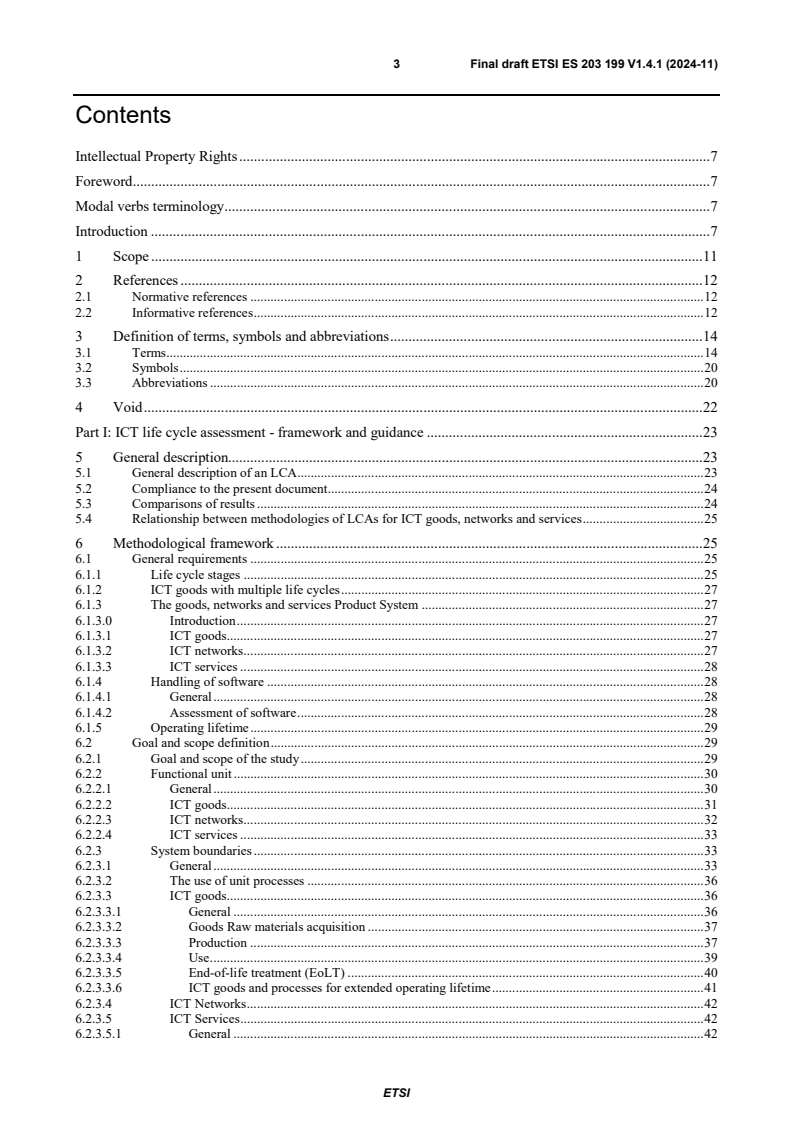
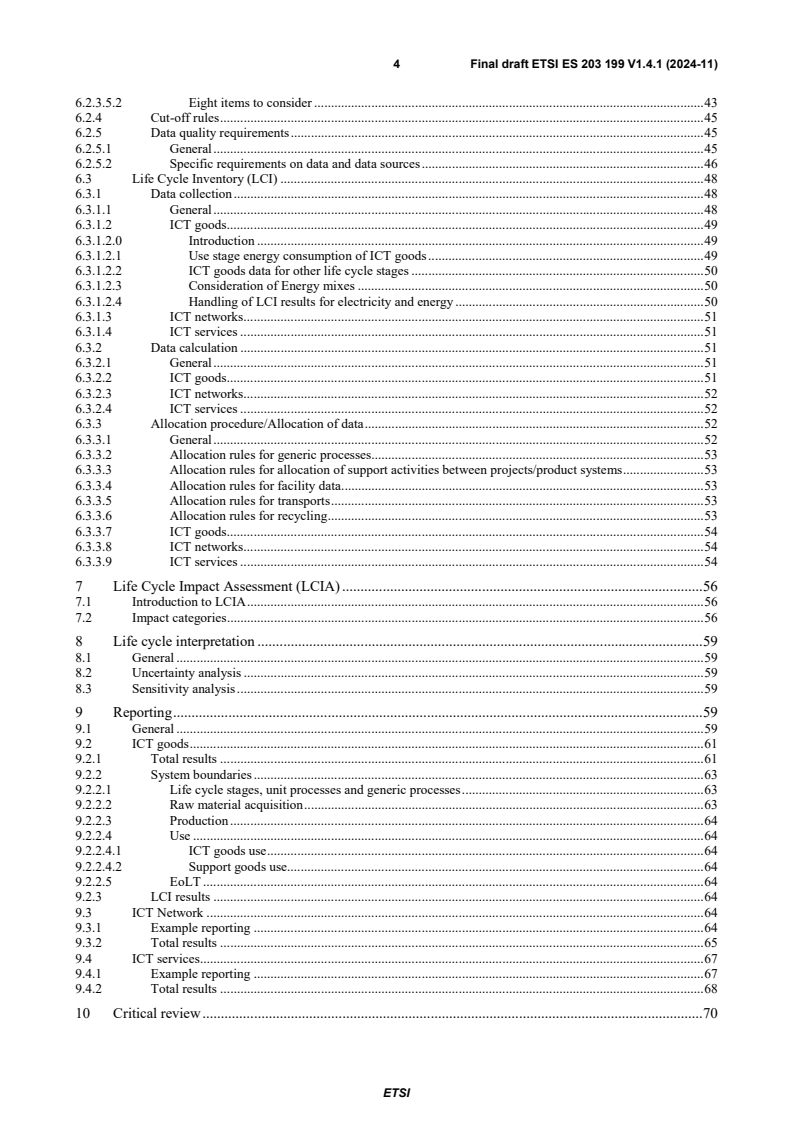
Contents
Intellectual Property Rights . 7
Foreword . 7
Modal verbs terminology . 7
Introduction . 7
1 Scope . 11
2 References . 12
2.1 Normative references . 12
2.2 Informative references . 12
3 Definition of terms, symbols and abbreviations . 14
3.1 Terms . 14
3.2 Symbols . 20
3.3 Abbreviations . 20
4 Void . 23
Part I: ICT life cycle assessment - framework and guidance . 23
5 General description. 23
5.1 General description of an LCA . 23
5.2 Compliance to the present document. 24
5.3 Comparisons of results . 24
5.4 Relationship between methodologies of LCAs for ICT goods, networks and services . 25
6 Methodological framework . 25
6.1 General requirements . 25
6.1.1 Life cycle stages . 25
6.1.2 ICT goods with multiple life cycles . 27
6.1.3 The goods, networks and services Product System . 27
6.1.3.0 Introduction . 27
6.1.3.1 ICT goods . 27
6.1.3.2 ICT networks. 27
6.1.3.3 ICT services . 28
6.1.4 Handling of software . 28
6.1.4.1 General . 28
6.1.4.2 Assessment of software . 28
6.1.5 Operating lifetime . 29
6.2 Goal and scope definition . 29
6.2.1 Goal and scope of the study . 29
6.2.2 Functional unit . 30
6.2.2.1 General . 30
6.2.2.2 ICT goods . 31
6.2.2.3 ICT networks. 32
6.2.2.4 ICT services . 33
6.2.3 System boundaries . 33
6.2.3.1 General . 33
6.2.3.2 The use of unit processes . 36
6.2.3.3 ICT goods . 36
6.2.3.3.1 General . 36
6.2.3.3.2 Goods Raw materials acquisition . 37
6.2.3.3.3 Production . 37
6.2.3.3.4 Use . 39
6.2.3.3.5 End-of-life treatment (EoLT) . 40
6.2.3.3.6 ICT goods and processes for extended operating lifetime . 41
6.2.3.4 ICT Networks . 42
6.2.3.5 ICT Services . 42
6.2.3.5.1 General . 42
ETSI
4 Final draft ETSI ES 203 199 V1.4.0 (2024-07)
6.2.3.5.2 Eight items to consider . 43
6.2.4 Cut-off rules . 45
6.2.5 Data quality requirements . 45
6.2.5.1 General . 45
6.2.5.2 Specific requirements on data and data sources . 46
6.3 Life Cycle Inventory (LCI) . 48
6.3.1 Data collection . 48
6.3.1.1 General . 48
6.3.1.2 ICT goods . 49
6.3.1.2.0 Introduction . 49
6.3.1.2.1 Use stage energy consumption of ICT goods . 49
6.3.1.2.2 ICT goods data for other life cycle stages . 50
6.3.1.2.3 Consideration of Energy mixes . 50
6.3.1.2.4 Handling of LCI results for electricity and energy . 50
6.3.1.3 ICT networks. 51
6.3.1.4 ICT services . 51
6.3.2 Data calculation . 51
6.3.2.1 General . 51
6.3.2.2 ICT goods . 51
6.3.2.3 ICT networks. 52
6.3.2.4 ICT services . 52
6.3.3 Allocation procedure/Allocation of data . 52
6.3.3.1 General . 52
6.3.3.2 Allocation rules for generic processes. 53
6.3.3.3 Allocation rules for allocation of support activities between projects/product systems . 53
6.3.3.4 Allocation rules for facility data . 53
6.3.3.5 Allocation rules for transports . 53
6.3.3.6 Allocation rules for recycling . 53
6.3.3.7 ICT goods . 54
6.3.3.8 ICT networks. 54
6.3.3.9 ICT services . 54
7 Life Cycle Impact Assessment (LCIA) . . 56
7.1 Introduction to LCIA . 56
7.2 Impact categories . 56
8 Life cycle interpretation . 59
8.1 General . 59
8.2 Uncertainty analysis . 59
8.3 Sensitivity analysis . 59
9 Reporting . 59
9.1 General . 59
9.2 ICT goods . 61
9.2.1 Total results . 61
9.2.2 System boundaries . 63
9.2.2.1 Life cycle stages, unit processes and generic processes . 63
9.2.2.2 Raw material acquisition . 63
9.2.2.3 Production . 64
9.2.2.4 Use . 64
9.2.2.4.1 ICT goods use . 64
9.2.2.4.2 Support goods use. 64
9.2.2.5 EoLT . 64
9.2.3 LCI results . 64
9.3 ICT Network . 64
9.3.1 Example reporting . 64
9.3.2 Total results . 65
9.4 ICT services . 67
9.4.1 Example reporting . 67
9.4.2 Total results . 68
10 Critical review . 70
ETSI
5 Final draft ETSI ES 203 199 V1.4.0 (2024-07)
Part II: . Comparative analysis/LCA between ICT and reference product system (baseline scenario):
framework and guidance . 70
11 General description of comparative analysis . 70
11.1 Need for comparative analysis . 70
11.2 Target systems for comparative analysis . 71
11.3 Principles of comparisons between systems (comparative analysis) . 72
11.3.1 First case: comparison between a reference product system (non-ICT) and an ICT good, network or
service product system . 72
11.3.2 Second case: comparison between two ICT goods or two ICT networks or two ICT services . 72
11.3.3 Common principles . 72
11.4 Procedures of comparisons between systems (comparative analysis) . 73
12 Methodological framework of comparative analysis . 73
12.1 General requirements . 73
12.2 Goal and scope definition . 73
12.2.0 Introduction. 73
12.2.1 Functional unit . 74
12.2.2 System boundaries . 74
12.2.3 Cut-off . 74
12.2.3.1 General . 74
12.2.3.2 Identification of life cycle stages and items important for comparison . 74
12.2.4 Allocation . 74
12.2.5 Data quality requirements . 75
12.3 Life cycle inventory. 75
12.4 Life cycle impact assessment . 75
12.5 Life cycle interpretation . 75
12.5.1 General . 75
12.5.2 Sensitivity analysis . 76
12.5.3 Uncertainty analysis . 76
13 Reporting . 76
14 Critical review . 77
Annex A (normative): Details regarding the handling of software . 78
Annex B (normative): Modelling of unit processes . 80
Annex C (normative): Support activities . 82
Annex D (normative): Generic processes . 83
Annex E (normative): Part types of ICT goods . 85
Annex F (normative): EoLT processes . 88
Annex G (normative): Elementary flows (emissions and resources) . 89
Annex H (normative): List of Raw materials . 92
Annex I: Void . 94
Annex J (normative): ICT network overview . 95
Annex K (normative): A method for assessing the environmental load of the working
environment . 97
K.0 Introduction to environmental load of the working environment. 97
K.1 Purpose of targeting the working environment in the assessment of ICT goods, networks and
services . 97
K.2 Functional unit . 97
K.3 System boundary . 97
ETSI
6 Final draft ETSI ES 203 199 V1.4.0 (2024-07)
K.4 Life Cycle Inventory (LCI) . 98
K.4.1 Data collection . 98
K.4.2 Data calculation . 98
K.4.3 Allocation procedure . 99
Annex L (normative): Reporting formats . 100
Annex M (informative): Examples of Allocation Procedures . 107
M.1 Allocation examples for Recycling of Materials . 107
M.1.1 Introduction . 107
M.1.2 Example of the 100/0 and 0/100 methods . 107
M.1.3 Example of the 50/50, 20/80 and 80/20 methods . 108
Annex N (informative): Life cycle stages overview . 110
Annex O (informative): Examples of goods and black box modules . 111
O.0 Introduction to examples of goods and black box modules . 111
O.1 End-user goods . 111
O.2 CPE. 111
O.3 Network site goods (from base station sites to data centres) . 111
O.4 Examples of ICT specific black box modules . 112
O.5 Site support goods . 112
Annex P (informative): Examples of Networks and Network goods . 113
Annex Q (informative): Energy mix . 114
Annex R (informative): Example of data quality indicators . 115
Annex S (informative): Uncertainties of life cycle assessments for ICT goods, networks and
services . 117
Annex T (informative): Opportunities and limitations in the use of LCAs for ICT goods,
networks and services . 119
Annex U (informative): Examples for calculating second order effects . 121
Annex V (informative): GWP values 100 year time frame (informative) . 124
Annex W (informative): Summary of requirements . 125
Annex X (informative): The relation between LCA and Circular Economy for ICT . 137
Annex Y (informative): Application scenarios for LCA of ICT goods with extended operating
lifetime and multiple life cycles . 138
Y.1 Introduction . 138
Y.2 LCA covering cradle-to-grave of a ICT goods with extended operating lifetime . 138
Y.3 LCA of first life cycle of a ICT goods with multiple life cycles . 138
Y.4 LCA of second life cycle of a ICT goods with multiple life cycles . 139
Y.5 Comparative LCA of a ICT goods with extended operating lifetime . 139
Annex Z (informative): Example analysis of different refurbishment configurations . 140
Annex AA (informative): Bibliography . 142
History . 143
ETSI
7 Final draft ETSI ES 203 199 V1.4.0 (2024-07)
Intellectual Property Rights
Essential patents
IPRs essential or potentially essential to normative deliverables may have been declared to ETSI. The declarations
pertaining to these essential IPRs, if any, are publicly available for ETSI members and non-members, and can be
found in ETSI SR 000 314: "Intellectual Property Rights (IPRs); Essential, or potentially Essential, IPRs notified to
ETSI in respect of ETSI standards", which is available from the ETSI Secretariat. Latest updates are available on the
ETSI Web server (https://ipr.etsi.org/).
Pursuant to the ETSI Directives including the ETSI IPR Policy, no investigation regarding the essentiality of IPRs,
including IPR searches, has been carried out by ETSI. No guarantee can be given as to the existence of other IPRs not
referenced in ETSI SR 000 314 (or the updates on the ETSI Web server) which are, or may be, or may become,
essential to the present document.
Trademarks
The present document may include trademarks and/or tradenames which are asserted and/or registered by their owners.
ETSI claims no ownership of these except for any which are indicated as being the property of ETSI, and conveys no
right to use or reproduce any trademark and/or tradename. Mention of those trademarks in the present document does
not constitute an endorsement by ETSI of products, services or organizations associated with those trademarks.
DECT™, PLUGTESTS™, UMTS™ and the ETSI logo are trademarks of ETSI registered for the benefit of its
Members. 3GPP™ and LTE™ are trademarks of ETSI registered for the benefit of its Members and of the 3GPP
Organizational Partners. oneM2M™ logo is a trademark of ETSI registered for the benefit of its Members and of the ®
oneM2M Partners. GSM and the GSM logo are trademarks registered and owned by the GSM Association.
Foreword
This final draft ETSI Standard (ES) has been produced by ETSI Technical Committee Environmental Engineering (EE),
and is now submitted for the ETSI Membership Approval Procedure.
The present document was developed jointly by ETSI TC EE and ITU-T Study Group 5. It will be published
respectively by ITU and ETSI as Recommendation ITU-T L.1410 [i.28] and ETSI Standard ETSI ES 203 199 (the
present document), which are technically-equivalent.
Modal verbs terminology
In the present document "shall", "shall not", "should", "should not", "may", "need not", "will", "will not", "can" and
"cannot" are to be interpreted as described in clause 3.2 of the ETSI Drafting Rules (Verbal forms for the expression of
provisions).
"must" and "must not" are NOT allowed in ETSI deliverables except when used in direct citation.
Introduction
The present document has been developed to complement ISO 14040 [1] and ISO 14044 [2] for the environmental
assessment of the life cycle impact of ICT goods, networks and services.
ETSI
8 Final draft ETSI ES 203 199 V1.4.0 (2024-07)
The present document defines a set of requirements to reflect the quality that LCA practitioners should strive for. At
this stage some of the requirements put forward here are considered as challenging due to Life Cycle Assessment
(LCA) tool limitations, a lack of data, limitations in data granularity, etc. It is thus recognized that compliance to all
requirements in the present document may not be possible at the time the present document is published. However, to
foster results of LCAs becoming more transparent and, for the quality of data and LCA tools to improve over time, the
present document is defining the requirements outlined in the following pages. The present document requires that
deviation(s) from the requirements are clearly motivated and reported. For further details regarding compliance refer to
clause 5.2.
The development of Information and Communication Technologies (ICTs) has led to concerns regarding its
environmental impact. Taking into consideration the ongoing efforts within the United Nations Framework Convention
on Climate Change [b-UNFCCC] to combat climate change, ITU-T and ETSI decided to enhance their previous work
by jointly developing an internationally agreed methodology to help the ICT sector to assess the environmental impact
of ICT goods, networks and services. The present document also gives guidance to the assessment of software.
Unlike many products and services sold in the world today, ICT distinguishes itself by its double-edged nature. On the
one hand, ICTs have an environmental impact at each stage of its life cycle, e.g. from energy and natural resource
consumption to e-waste. On the other hand, ICTs can enable vast efficiencies in lifestyle and in all sectors of the
economy by the provision of digital solutions that can improve energy efficiency, inventory management and business
efficiency by reducing travel and transportation, e.g. tele-working and video conferencing and by substituting physical
products for digital information, e.g. e-commerce.
These different levels of impact are acknowledged in some academic literature as the three order effects of ICTs:
• First order effects (or the environmental load of ICTs): the impacts created by the physical existence of ICTs
and the processes involved, e.g. energy consumption and GHG emissions, e-waste, use of hazardous
substances and use of scarce, non-renewable resources.
• Second order effects (or the environmental load reduction achieved by ICTs): the impacts and opportunities
created by the use and application of ICTs. This includes environmental load reduction effects which can be
either actual or potential, such as travel substitution, transportation optimization, working environment
changes, use of environmental control systems, use of e-business, e-government, etc.
NOTE: E.g. if an ICT service offers a reduced need for transport, the travel substitution replacing transportation
by car is actual - the car does not run - whereas the reduced need for travel by public transport is
potential - the plane, train or metro is still running if the timetable has not changed. However, the large
scale deployment of video conferencing and tele-working (telecommuting) in the future will likely change
lifestyles and impact on social structure and while it is expected to substantially reduce traffic volume,
further research is required to assess what the full impact (including rebound effects) will be.
Higher order effects:
• include the impacts and opportunities created by the aggregated effects on societal structural changes by using
ICTs;
• particularly include, for some ICT services such as tele-working or video conferencing, the time gained by an
end user using an ICT service which then may cause additional impact e.g. a leisurely drive and economic
activities, which are difficult to track. Such additional impacts are often defined as "rebound effects".
Most of the benefits of ICTs lie in the second order effects via increased efficiency, transparency, speed of transactions,
rapid market-clearing, long-tail effects and so on. There are environmental impacts associated with the first order:
environmental impact of ICT goods, networks and services such as resource consumption and carbon emissions during
manufacturing and the disposal of hardware. Thus, the present document focuses on the first and second order effects.
Recommendation ITU-T L.1480 [i.25] provides further guidance on the second order effects and higher order effects as
well as the impacts and opportunities created by the aggregated effects on societal structural changes by using ICTs.
In constructing a sustainable society from an environmental viewpoint, the negative aspects of ICTs should be
minimized and the positive ones should be maximized, as summarized in Figure 1.
ETSI
9 Final draft ETSI ES 203 199 V1.4.0 (2024-07)
Figure 1: Schematic model for the environmental assessment
of ICT goods, networks and services
The first order effect (or environmental load caused by ICT) can be quantified by performing a Life Cycle Assessment
(LCA). The second order effect (or environmental load reduction achieved by ICT) can be quantified by the comparison
of LCA results between the ICT goods, networks and services product system and the reference product system
performing the same function.
To reflect the first two order effects, the present document describes environmental assessments through Life Cycle
Assessment (LCA) which is a systematic analytical method and model by which the potential environmental effects
related to ICT goods, Networks and Services can be estimated. The present document also gives guidance to the
assessment of software. LCAs have a cradle-to-grave scope where the life cycle stages, i.e. raw material acquisition,
production, use and end-of-life are included. Transports and energy supply are moreover included in each life-cycle
stage.
ISO has standardized the LCA methodology. In the present document, ICT specific additions to the ISO 14040 [1] and
ISO 14044 [2] standards will be described. As addition to the ISO 14040 [1] and ISO 14044 [2] standards, the European
Commission has published a handbook that gives detailed guidance on all the steps required to conduct an LCA [i.16].
This handbook will also be referred to with special ICT considerations in mind.
The present document is divided into two parts:
• Part I (clauses 5 to 10) - ICT life cycle assessment: framework and guidance. This part deals with the LCA
methodology applied to ICT goods, networks and services.
• Part II (clauses 11 to 14) - Comparative analysis between an ICT product system and a reference product
system (baseline scenario): framework and guidance. This part deals with comparative analysis based on LCA
results of the ICT goods, networks and services product system and the reference product system.
The structure of this LCA methodology specification for ICT goods, Networks and Services is shown in Figure 2.
Figure 2 indicates where specific requirements and considerations apply for ICT goods, networks and services
respectively and where the same requirements and considerations apply for all of those product systems.
ETSI
Reporting
Comparative assertion between
ICT and non-ICT services
Life Cycle Interpretation
Life Cycle Impact Assessment (LCIA)
Life Cycle Inventory (LCI)
Goal and scope definition
General requirements
10 Final draft ETSI ES 203 199 V1.4.0 (2024-07)
Services
Network
Equipment
Figure 2: Structure of LCA methodology specification
for ICT goods, Networks and Services
The structure of part I and part II is based on ISO 14040 [1] and ISO 14044 [2] in order to support the LCA practitioner
and thus each part is structured in accordance with:
• General requirements: high level requirements of assessment.
• Goal and scope definition: requirements of the functional unit, system boundaries and data qualit
...
Final draft ETSI ES 203 199 V1.4.1 (2024-11)
ETSI STANDARD
Environmental Engineering (EE);
Methodology for environmental Life Cycle Assessment (LCA)
of Information and Communication Technology (ICT)
goods, networks and services
2 Final draft ETSI ES 203 199 V1.4.1 (2024-11)
Reference
RES/EE-EEPS57
Keywords
LCA
ETSI
650 Route des Lucioles
F-06921 Sophia Antipolis Cedex - FRANCE
Tel.: +33 4 92 94 42 00 Fax: +33 4 93 65 47 16
Siret N° 348 623 562 00017 - APE 7112B
Association à but non lucratif enregistrée à la
Sous-Préfecture de Grasse (06) N° w061004871
Important notice
The present document can be downloaded from the
ETSI Search & Browse Standards application.
The present document may be made available in electronic versions and/or in print. The content of any electronic and/or
print versions of the present document shall not be modified without the prior written authorization of ETSI. In case of any
existing or perceived difference in contents between such versions and/or in print, the prevailing version of an ETSI
deliverable is the one made publicly available in PDF format on ETSI deliver repository.
Users should be aware that the present document may be revised or have its status changed,
this information is available in the Milestones listing.
If you find errors in the present document, please send your comments to
the relevant service listed under Committee Support Staff.
If you find a security vulnerability in the present document, please report it through our
Coordinated Vulnerability Disclosure (CVD) program.
Notice of disclaimer & limitation of liability
The information provided in the present deliverable is directed solely to professionals who have the appropriate degree of
experience to understand and interpret its content in accordance with generally accepted engineering or
other professional standard and applicable regulations.
No recommendation as to products and services or vendors is made or should be implied.
No representation or warranty is made that this deliverable is technically accurate or sufficient or conforms to any law
and/or governmental rule and/or regulation and further, no representation or warranty is made of merchantability or fitness
for any particular purpose or against infringement of intellectual property rights.
In no event shall ETSI be held liable for loss of profits or any other incidental or consequential damages.
Any software contained in this deliverable is provided "AS IS" with no warranties, express or implied, including but not
limited to, the warranties of merchantability, fitness for a particular purpose and non-infringement of intellectual property
rights and ETSI shall not be held liable in any event for any damages whatsoever (including, without limitation, damages
for loss of profits, business interruption, loss of information, or any other pecuniary loss) arising out of or related to the use
of or inability to use the software.
Copyright Notification
No part may be reproduced or utilized in any form or by any means, electronic or mechanical, including photocopying and
microfilm except as authorized by written permission of ETSI.
The content of the PDF version shall not be modified without the written authorization of ETSI.
The copyright and the foregoing restriction extend to reproduction in all media.
© ETSI 2024.
All rights reserved.
ETSI
3 Final draft ETSI ES 203 199 V1.4.1 (2024-11)
Contents
Intellectual Property Rights . 7
Foreword . 7
Modal verbs terminology . 7
Introduction . 7
1 Scope . 11
2 References . 12
2.1 Normative references . 12
2.2 Informative references . 12
3 Definition of terms, symbols and abbreviations . 14
3.1 Terms . 14
3.2 Symbols . 20
3.3 Abbreviations . 20
4 Void . 22
Part I: ICT life cycle assessment - framework and guidance . 23
5 General description. 23
5.1 General description of an LCA . 23
5.2 Compliance to the present document. 24
5.3 Comparisons of results . 24
5.4 Relationship between methodologies of LCAs for ICT goods, networks and services . 25
6 Methodological framework . 25
6.1 General requirements . 25
6.1.1 Life cycle stages . 25
6.1.2 ICT goods with multiple life cycles . 27
6.1.3 The goods, networks and services Product System . 27
6.1.3.0 Introduction . 27
6.1.3.1 ICT goods . 27
6.1.3.2 ICT networks. 27
6.1.3.3 ICT services . 28
6.1.4 Handling of software . 28
6.1.4.1 General . 28
6.1.4.2 Assessment of software . 28
6.1.5 Operating lifetime . 29
6.2 Goal and scope definition . 29
6.2.1 Goal and scope of the study . 29
6.2.2 Functional unit . 30
6.2.2.1 General . 30
6.2.2.2 ICT goods . 31
6.2.2.3 ICT networks. 32
6.2.2.4 ICT services . 33
6.2.3 System boundaries . 33
6.2.3.1 General . 33
6.2.3.2 The use of unit processes . 36
6.2.3.3 ICT goods . 36
6.2.3.3.1 General . 36
6.2.3.3.2 Goods Raw materials acquisition . 37
6.2.3.3.3 Production . 37
6.2.3.3.4 Use . 39
6.2.3.3.5 End-of-life treatment (EoLT) . 40
6.2.3.3.6 ICT goods and processes for extended operating lifetime . 41
6.2.3.4 ICT Networks . 42
6.2.3.5 ICT Services . 42
6.2.3.5.1 General . 42
ETSI
4 Final draft ETSI ES 203 199 V1.4.1 (2024-11)
6.2.3.5.2 Eight items to consider . 43
6.2.4 Cut-off rules . 45
6.2.5 Data quality requirements . 45
6.2.5.1 General . 45
6.2.5.2 Specific requirements on data and data sources . 46
6.3 Life Cycle Inventory (LCI) . 48
6.3.1 Data collection . 48
6.3.1.1 General . 48
6.3.1.2 ICT goods . 49
6.3.1.2.0 Introduction . 49
6.3.1.2.1 Use stage energy consumption of ICT goods . 49
6.3.1.2.2 ICT goods data for other life cycle stages . 50
6.3.1.2.3 Consideration of Energy mixes . 50
6.3.1.2.4 Handling of LCI results for electricity and energy . 50
6.3.1.3 ICT networks. 51
6.3.1.4 ICT services . 51
6.3.2 Data calculation . 51
6.3.2.1 General . 51
6.3.2.2 ICT goods . 51
6.3.2.3 ICT networks. 52
6.3.2.4 ICT services . 52
6.3.3 Allocation procedure/Allocation of data . 52
6.3.3.1 General . 52
6.3.3.2 Allocation rules for generic processes. 53
6.3.3.3 Allocation rules for allocation of support activities between projects/product systems . 53
6.3.3.4 Allocation rules for facility data . 53
6.3.3.5 Allocation rules for transports . 53
6.3.3.6 Allocation rules for recycling . 53
6.3.3.7 ICT goods . 54
6.3.3.8 ICT networks. 54
6.3.3.9 ICT services . 54
7 Life Cycle Impact Assessment (LCIA) . . 56
7.1 Introduction to LCIA . 56
7.2 Impact categories . 56
8 Life cycle interpretation . 59
8.1 General . 59
8.2 Uncertainty analysis . 59
8.3 Sensitivity analysis . 59
9 Reporting . 59
9.1 General . 59
9.2 ICT goods . 61
9.2.1 Total results . 61
9.2.2 System boundaries . 63
9.2.2.1 Life cycle stages, unit processes and generic processes . 63
9.2.2.2 Raw material acquisition . 63
9.2.2.3 Production . 64
9.2.2.4 Use . 64
9.2.2.4.1 ICT goods use . 64
9.2.2.4.2 Support goods use. 64
9.2.2.5 EoLT . 64
9.2.3 LCI results . 64
9.3 ICT Network . 64
9.3.1 Example reporting . 64
9.3.2 Total results . 65
9.4 ICT services . 67
9.4.1 Example reporting . 67
9.4.2 Total results . 68
10 Critical review . 70
ETSI
5 Final draft ETSI ES 203 199 V1.4.1 (2024-11)
Part II: . Comparative analysis/LCA between ICT and reference product system (baseline scenario):
framework and guidance . 71
11 General description of comparative analysis . 71
11.1 Need for comparative analysis . 71
11.2 Target systems for comparative analysis . 72
11.3 Principles of comparisons between systems (comparative analysis) . 72
11.3.1 First case: comparison between a reference product system (non-ICT) and an ICT good, network or
service product system . 72
11.3.2 Second case: comparison between two ICT goods or two ICT networks or two ICT services . 73
11.3.3 Common principles . 73
11.4 Procedures of comparisons between systems (comparative analysis) . 74
12 Methodological framework of comparative analysis . 74
12.1 General requirements . 74
12.2 Goal and scope definition . 74
12.2.0 Introduction. 74
12.2.1 Functional unit . 75
12.2.2 System boundaries . 75
12.2.3 Cut-off . 75
12.2.3.1 General . 75
12.2.3.2 Identification of life cycle stages and items important for comparison . 75
12.2.4 Allocation . 75
12.2.5 Data quality requirements . 76
12.3 Life cycle inventory. 76
12.4 Life cycle impact assessment . 76
12.5 Life cycle interpretation . 76
12.5.1 General . 76
12.5.2 Sensitivity analysis . 77
12.5.3 Uncertainty analysis . 77
13 Reporting . 77
14 Critical review . 78
Annex A (normative): Details regarding the handling of software . 79
Annex B (normative): Modelling of unit processes . 81
Annex C (normative): Support activities . 83
Annex D (normative): Generic processes . 84
Annex E (normative): Part types of ICT goods . 86
Annex F (normative): EoLT processes . 89
Annex G (normative): Elementary flows (emissions and resources) . 90
Annex H (normative): List of Raw materials . 93
Annex I: Void . 95
Annex J (normative): ICT network overview . 96
Annex K (normative): A method for assessing the environmental load of the working
environment . 98
K.0 Introduction to environmental load of the working environment. 98
K.1 Purpose of targeting the working environment in the assessment of ICT goods, networks and
services . 98
K.2 Functional unit . 98
K.3 System boundary . 98
ETSI
6 Final draft ETSI ES 203 199 V1.4.1 (2024-11)
K.4 Life Cycle Inventory (LCI) . 99
K.4.1 Data collection . 99
K.4.2 Data calculation . 99
K.4.3 Allocation procedure . 100
Annex L (normative): Reporting formats . 101
Annex M (informative): Examples of Allocation Procedures . 108
M.1 Allocation examples for Recycling of Materials . 108
M.1.1 Introduction . 108
M.1.2 Example of the 100/0 and 0/100 methods . 108
M.1.3 Example of the 50/50, 20/80 and 80/20 methods . 109
Annex N (informative): Life cycle stages overview . 111
Annex O (informative): Examples of goods and black box modules . 112
O.0 Introduction to examples of goods and black box modules . 112
O.1 End-user goods . 112
O.2 CPE. 112
O.3 Network site goods (from base station sites to data centres) . 112
O.4 Examples of ICT specific black box modules . 113
O.5 Site support goods . 113
Annex P (informative): Examples of Networks and Network goods . 114
Annex Q (informative): Energy mix . 115
Annex R (informative): Example of data quality indicators . 116
Annex S (informative): Uncertainties of life cycle assessments for ICT goods, networks and
services . 118
Annex T (informative): Opportunities and limitations in the use of LCAs for ICT goods,
networks and services . 120
Annex U (informative): Examples for calculating second order effects . 122
Annex V (informative): GWP values 100 year time frame (informative) . 125
Annex W (informative): Summary of requirements . 126
Annex X (informative): The relation between LCA and Circular Economy for ICT . 138
Annex Y (informative): Application scenarios for LCA of ICT goods with extended operating
lifetime and multiple life cycles . 139
Y.1 Introduction . 139
Y.2 LCA covering cradle-to-grave of a ICT goods with extended operating lifetime . 139
Y.3 LCA of first life cycle of a ICT goods with multiple life cycles . 139
Y.4 LCA of second life cycle of a ICT goods with multiple life cycles . 140
Y.5 Comparative LCA of a ICT goods with extended operating lifetime . 140
Annex Z (informative): Example analysis of different refurbishment configurations . 141
Annex AA (informative): Bibliography . 143
History . 144
ETSI
7 Final draft ETSI ES 203 199 V1.4.1 (2024-11)
Intellectual Property Rights
Essential patents
IPRs essential or potentially essential to normative deliverables may have been declared to ETSI. The declarations
pertaining to these essential IPRs, if any, are publicly available for ETSI members and non-members, and can be
found in ETSI SR 000 314: "Intellectual Property Rights (IPRs); Essential, or potentially Essential, IPRs notified to
ETSI in respect of ETSI standards", which is available from the ETSI Secretariat. Latest updates are available on the
ETSI IPR online database.
Pursuant to the ETSI Directives including the ETSI IPR Policy, no investigation regarding the essentiality of IPRs,
including IPR searches, has been carried out by ETSI. No guarantee can be given as to the existence of other IPRs not
referenced in ETSI SR 000 314 (or the updates on the ETSI Web server) which are, or may be, or may become,
essential to the present document.
Trademarks
The present document may include trademarks and/or tradenames which are asserted and/or registered by their owners.
ETSI claims no ownership of these except for any which are indicated as being the property of ETSI, and conveys no
right to use or reproduce any trademark and/or tradename. Mention of those trademarks in the present document does
not constitute an endorsement by ETSI of products, services or organizations associated with those trademarks.
DECT™, PLUGTESTS™, UMTS™ and the ETSI logo are trademarks of ETSI registered for the benefit of its
Members. 3GPP™, LTE™ and 5G logo are trademarks of ETSI registered for the benefit of its Members and of the
3GPP Organizational Partners. oneM2M™ logo is a trademark of ETSI registered for the benefit of its Members and of ®
the oneM2M Partners. GSM and the GSM logo are trademarks registered and owned by the GSM Association.
Foreword
This final draft ETSI Standard (ES) has been produced by ETSI Technical Committee Environmental Engineering (EE),
and is now submitted for the ETSI Membership Approval Procedure.
The present document was developed jointly by ETSI TC EE and ITU-T Study Group 5. It will be published
respectively by ITU and ETSI as Recommendation ITU-T L.1410 [i.28] and ETSI Standard ETSI ES 203 199 (the
present document), which are technically-equivalent.
Modal verbs terminology
In the present document "shall", "shall not", "should", "should not", "may", "need not", "will", "will not", "can" and
"cannot" are to be interpreted as described in clause 3.2 of the ETSI Drafting Rules (Verbal forms for the expression of
provisions).
"must" and "must not" are NOT allowed in ETSI deliverables except when used in direct citation.
Introduction
The present document has been developed to complement ISO 14040 [1] and ISO 14044 [2] for the environmental
assessment of the life cycle impact of ICT goods, networks and services.
ETSI
8 Final draft ETSI ES 203 199 V1.4.1 (2024-11)
The present document defines a set of requirements to reflect the quality that LCA practitioners should strive for. At
this stage some of the requirements put forward here are considered as challenging due to Life Cycle Assessment
(LCA) tool limitations, a lack of data, limitations in data granularity, etc. It is thus recognized that compliance to all
requirements in the present document may not be possible at the time the present document is published. However, to
foster results of LCAs becoming more transparent and, for the quality of data and LCA tools to improve over time, the
present document is defining the requirements outlined in the following pages. The present document requires that
deviation(s) from the requirements are clearly motivated and reported. For further details regarding compliance refer to
clause 5.2.
The development of Information and Communication Technologies (ICTs) has led to concerns regarding its
environmental impact. Taking into consideration the ongoing efforts within the United Nations Framework Convention
on Climate Change [b-UNFCCC] to combat climate change, ITU-T and ETSI decided to enhance their previous work
by jointly developing an internationally agreed methodology to help the ICT sector to assess the environmental impact
of ICT goods, networks and services. The present document also gives guidance to the assessment of software.
Unlike many products and services sold in the world today, ICT distinguishes itself by its double-edged nature. On the
one hand, ICTs have an environmental impact at each stage of its life cycle, e.g. from energy and natural resource
consumption to e-waste. On the other hand, ICTs can enable vast efficiencies in lifestyle and in all sectors of the
economy by the provision of digital solutions that can improve energy efficiency, inventory management and business
efficiency by reducing travel and transportation, e.g. tele-working and video conferencing and by substituting physical
products for digital information, e.g. e-commerce.
These different levels of impact are acknowledged in some academic literature as the three order effects of ICTs:
• First order effects (or the environmental load of ICTs): the impacts created by the physical existence of ICTs
and the processes involved, e.g. energy consumption and GHG emissions, e-waste, use of hazardous
substances and use of scarce, non-renewable resources.
• Second order effects (or the environmental load reduction achieved by ICTs): the impacts and opportunities
created by the use and application of ICTs. This includes environmental load reduction effects which can be
either actual or potential, such as travel substitution, transportation optimization, working environment
changes, use of environmental control systems, use of e-business, e-government, etc.
Higher order effects:
• particularly include, for some ICT services such as tele-working or video conferencing, the time gained by an
end user using an ICT service which then may cause additional impact e.g. a leisurely drive and economic
activities, which are difficult to track. Such additional impacts are often defined as "rebound effects".
Most of the benefits of ICTs lie in the second order effects via increased efficiency, transparency, speed of transactions,
rapid market-clearing, long-tail effects and so on. There are environmental impacts associated with the first order:
environmental impact of ICT goods, networks and services such as resource consumption and carbon emissions during
manufacturing and the disposal of hardware. Thus, the present document focuses on the first and second order effects.
Recommendation ITU-T L.1480 [i.25] provides further guidance on the second order effects and higher order effects as
well as the impacts and opportunities created by the aggregated effects on societal structural changes by using ICTs.
In constructing a sustainable society from an environmental viewpoint, the negative aspects of ICTs should be
minimized and the positive ones should be maximized, as summarized in Figure 1.
ETSI
9 Final draft ETSI ES 203 199 V1.4.1 (2024-11)
Figure 1: Schematic model for the environmental assessment
of ICT goods, networks and services
The first order effect (or environmental load caused by ICT) can be quantified by performing a Life Cycle Assessment
(LCA). The second order effect (or environmental load reduction achieved by ICT) can be quantified by the comparison
of LCA results between the ICT goods, networks and services product system and the reference product system
performing the same function.
To reflect the first two order effects, the present document describes environmental assessments through Life Cycle
Assessment (LCA) which is a systematic analytical method and model by which the potential environmental effects
related to ICT goods, Networks and Services can be estimated. The present document also gives guidance to the
assessment of software. LCAs have a cradle-to-grave scope where the life cycle stages, i.e. raw material acquisition,
production, use and end-of-life are included. Transports and energy supply are moreover included in each life-cycle
stage.
ISO has standardized the LCA methodology. In the present document, ICT specific additions to the ISO 14040 [1] and
ISO 14044 [2] standards will be described. As addition to the ISO 14040 [1] and ISO 14044 [2] standards, the European
Commission has published a handbook that gives detailed guidance on all the steps required to conduct an LCA [i.16].
This handbook will also be referred to with special ICT considerations in mind.
The present document is divided into two parts:
• Part I (clauses 5 to 10) - ICT life cycle assessment: framework and guidance. This part deals with the LCA
methodology applied to ICT goods, networks and services.
• Part II (clauses 11 to 14) - Comparative analysis between an ICT product system and a reference product
system (baseline scenario): framework and guidance. This part deals with comparative analysis based on LCA
results of the ICT goods, networks and services product system and the reference product system.
The structure of this LCA methodology specification for ICT goods, Networks and Services is shown in Figure 2.
Figure 2 indicates where specific requirements and considerations apply for ICT goods, networks and services
respectively and where the same requirements and considerations apply for all of those product systems.
ETSI
Reporting
Comparative assertion between
ICT and non-ICT services
Life Cycle Interpretation
Life Cycle Impact Assessment (LCIA)
Life Cycle Inventory (LCI)
Goal and scope definition
General requirements
10 Final draft ETSI ES 203 199 V1.4.1 (2024-11)
Services
Network
Equipment
Figure 2: Structure of LCA methodology specification
for ICT goods, Networks and Services
The structure of part I and part II is based on ISO 14040 [1] and ISO 14044 [2] in order to support the LCA practitioner
and thus each part is structured in accordance with:
• General requirements: high level requirements of assessment.
• Goal and scope definition: requirements of the functional unit, system boundaries and data quality.
• Life Cycle Inventory (LCI): requirements for data collection, calculation and allocation.
• Life Cycle Impact Assessment (LCIA): requirements for impact assessment.
• Life cycle interpretation: requirements for the interpretation of results and calculation of second order effects.
• Reporting: requirements for reporting.
Both parts are then divided into applicable clauses and Part I is additionally structured into the three product system
types, i.e. ICT goods, networks and services as appropriate.
The present document is intended for LCA practitioners wanting to assess ICT goods, networks and services impacts
and it will help them to perform and report their LCAs of ICT goods, Networks and Services in a uniform and
transparent manner. It is possible to use the present document to get guidance on what to consider in an LCA on three
levels: ICT goods, Networks and Services.
The following uses of ICT LCA applications are t
...
ETSI ES 203 199 V1.4.1 (2025-01)
ETSI STANDARD
Environmental Engineering (EE);
Methodology for environmental Life Cycle Assessment (LCA)
of Information and Communication Technology (ICT)
goods, networks and services
2 ETSI ES 203 199 V1.4.1 (2025-01)
Reference
RES/EE-EEPS57
Keywords
LCA
ETSI
650 Route des Lucioles
F-06921 Sophia Antipolis Cedex - FRANCE
Tel.: +33 4 92 94 42 00 Fax: +33 4 93 65 47 16
Siret N° 348 623 562 00017 - APE 7112B
Association à but non lucratif enregistrée à la
Sous-Préfecture de Grasse (06) N° w061004871
Important notice
The present document can be downloaded from the
ETSI Search & Browse Standards application.
The present document may be made available in electronic versions and/or in print. The content of any electronic and/or
print versions of the present document shall not be modified without the prior written authorization of ETSI. In case of any
existing or perceived difference in contents between such versions and/or in print, the prevailing version of an ETSI
deliverable is the one made publicly available in PDF format on ETSI deliver repository.
Users should be aware that the present document may be revised or have its status changed,
this information is available in the Milestones listing.
If you find errors in the present document, please send your comments to
the relevant service listed under Committee Support Staff.
If you find a security vulnerability in the present document, please report it through our
Coordinated Vulnerability Disclosure (CVD) program.
Notice of disclaimer & limitation of liability
The information provided in the present deliverable is directed solely to professionals who have the appropriate degree of
experience to understand and interpret its content in accordance with generally accepted engineering or
other professional standard and applicable regulations.
No recommendation as to products and services or vendors is made or should be implied.
No representation or warranty is made that this deliverable is technically accurate or sufficient or conforms to any law
and/or governmental rule and/or regulation and further, no representation or warranty is made of merchantability or fitness
for any particular purpose or against infringement of intellectual property rights.
In no event shall ETSI be held liable for loss of profits or any other incidental or consequential damages.
Any software contained in this deliverable is provided "AS IS" with no warranties, express or implied, including but not
limited to, the warranties of merchantability, fitness for a particular purpose and non-infringement of intellectual property
rights and ETSI shall not be held liable in any event for any damages whatsoever (including, without limitation, damages
for loss of profits, business interruption, loss of information, or any other pecuniary loss) arising out of or related to the use
of or inability to use the software.
Copyright Notification
No part may be reproduced or utilized in any form or by any means, electronic or mechanical, including photocopying and
microfilm except as authorized by written permission of ETSI.
The content of the PDF version shall not be modified without the written authorization of ETSI.
The copyright and the foregoing restriction extend to reproduction in all media.
© ETSI 2025.
All rights reserved.
ETSI
3 ETSI ES 203 199 V1.4.1 (2025-01)
Contents
Intellectual Property Rights . 7
Foreword . 7
Modal verbs terminology . 7
Introduction . 7
1 Scope . 11
2 References . 12
2.1 Normative references . 12
2.2 Informative references . 12
3 Definition of terms, symbols and abbreviations . 14
3.1 Terms . 14
3.2 Symbols . 20
3.3 Abbreviations . 20
4 Void . 22
Part I: ICT life cycle assessment - framework and guidance . 23
5 General description. 23
5.1 General description of an LCA . 23
5.2 Compliance to the present document. 24
5.3 Comparisons of results . 24
5.4 Relationship between methodologies of LCAs for ICT goods, networks and services . 25
6 Methodological framework . 25
6.1 General requirements . 25
6.1.1 Life cycle stages . 25
6.1.2 ICT goods with multiple life cycles . 27
6.1.3 The goods, networks and services Product System . 27
6.1.3.0 Introduction . 27
6.1.3.1 ICT goods . 27
6.1.3.2 ICT networks. 27
6.1.3.3 ICT services . 28
6.1.4 Handling of software . 28
6.1.4.1 General . 28
6.1.4.2 Assessment of software . 28
6.1.5 Operating lifetime . 29
6.2 Goal and scope definition . 29
6.2.1 Goal and scope of the study . 29
6.2.2 Functional unit . 30
6.2.2.1 General . 30
6.2.2.2 ICT goods . 31
6.2.2.3 ICT networks. 32
6.2.2.4 ICT services . 33
6.2.3 System boundaries . 33
6.2.3.1 General . 33
6.2.3.2 The use of unit processes . 36
6.2.3.3 ICT goods . 36
6.2.3.3.1 General . 36
6.2.3.3.2 Goods Raw materials acquisition . 37
6.2.3.3.3 Production . 37
6.2.3.3.4 Use . 39
6.2.3.3.5 End-of-life treatment (EoLT) . 40
6.2.3.3.6 ICT goods and processes for extended operating lifetime . 41
6.2.3.4 ICT Networks . 42
6.2.3.5 ICT Services . 42
6.2.3.5.1 General . 42
ETSI
4 ETSI ES 203 199 V1.4.1 (2025-01)
6.2.3.5.2 Eight items to consider . 43
6.2.4 Cut-off rules . 45
6.2.5 Data quality requirements . 45
6.2.5.1 General . 45
6.2.5.2 Specific requirements on data and data sources . 46
6.3 Life Cycle Inventory (LCI) . 48
6.3.1 Data collection . 48
6.3.1.1 General . 48
6.3.1.2 ICT goods . 49
6.3.1.2.0 Introduction . 49
6.3.1.2.1 Use stage energy consumption of ICT goods . 49
6.3.1.2.2 ICT goods data for other life cycle stages . 50
6.3.1.2.3 Consideration of Energy mixes . 50
6.3.1.2.4 Handling of LCI results for electricity and energy . 50
6.3.1.3 ICT networks. 51
6.3.1.4 ICT services . 51
6.3.2 Data calculation . 51
6.3.2.1 General . 51
6.3.2.2 ICT goods . 51
6.3.2.3 ICT networks. 52
6.3.2.4 ICT services . 52
6.3.3 Allocation procedure/Allocation of data . 52
6.3.3.1 General . 52
6.3.3.2 Allocation rules for generic processes. 53
6.3.3.3 Allocation rules for allocation of support activities between projects/product systems . 53
6.3.3.4 Allocation rules for facility data . 53
6.3.3.5 Allocation rules for transports . 53
6.3.3.6 Allocation rules for recycling . 53
6.3.3.7 ICT goods . 54
6.3.3.8 ICT networks. 54
6.3.3.9 ICT services . 54
7 Life Cycle Impact Assessment (LCIA) . . 56
7.1 Introduction to LCIA . 56
7.2 Impact categories . 56
8 Life cycle interpretation . 59
8.1 General . 59
8.2 Uncertainty analysis . 59
8.3 Sensitivity analysis . 59
9 Reporting . 59
9.1 General . 59
9.2 ICT goods . 61
9.2.1 Total results . 61
9.2.2 System boundaries . 63
9.2.2.1 Life cycle stages, unit processes and generic processes . 63
9.2.2.2 Raw material acquisition . 63
9.2.2.3 Production . 64
9.2.2.4 Use . 64
9.2.2.4.1 ICT goods use . 64
9.2.2.4.2 Support goods use. 64
9.2.2.5 EoLT . 64
9.2.3 LCI results . 64
9.3 ICT Network . 64
9.3.1 Example reporting . 64
9.3.2 Total results . 65
9.4 ICT services . 67
9.4.1 Example reporting . 67
9.4.2 Total results . 68
10 Critical review . 70
ETSI
5 ETSI ES 203 199 V1.4.1 (2025-01)
Part II: . Comparative analysis/LCA between ICT and reference product system (baseline scenario):
framework and guidance . 71
11 General description of comparative analysis . 71
11.1 Need for comparative analysis . 71
11.2 Target systems for comparative analysis . 72
11.3 Principles of comparisons between systems (comparative analysis) . 72
11.3.1 First case: comparison between a reference product system (non-ICT) and an ICT good, network or
service product system . 72
11.3.2 Second case: comparison between two ICT goods or two ICT networks or two ICT services . 73
11.3.3 Common principles . 73
11.4 Procedures of comparisons between systems (comparative analysis) . 74
12 Methodological framework of comparative analysis . 74
12.1 General requirements . 74
12.2 Goal and scope definition . 74
12.2.0 Introduction. 74
12.2.1 Functional unit . 75
12.2.2 System boundaries . 75
12.2.3 Cut-off . 75
12.2.3.1 General . 75
12.2.3.2 Identification of life cycle stages and items important for comparison . 75
12.2.4 Allocation . 75
12.2.5 Data quality requirements . 76
12.3 Life cycle inventory. 76
12.4 Life cycle impact assessment . 76
12.5 Life cycle interpretation . 76
12.5.1 General . 76
12.5.2 Sensitivity analysis . 77
12.5.3 Uncertainty analysis . 77
13 Reporting . 77
14 Critical review . 78
Annex A (normative): Details regarding the handling of software . 79
Annex B (normative): Modelling of unit processes . 81
Annex C (normative): Support activities . 83
Annex D (normative): Generic processes . 84
Annex E (normative): Part types of ICT goods . 86
Annex F (normative): EoLT processes . 89
Annex G (normative): Elementary flows (emissions and resources) . 90
Annex H (normative): List of Raw materials . 93
Annex I: Void . 95
Annex J (normative): ICT network overview . 96
Annex K (normative): A method for assessing the environmental load of the working
environment . 98
K.0 Introduction to environmental load of the working environment. 98
K.1 Purpose of targeting the working environment in the assessment of ICT goods, networks and
services . 98
K.2 Functional unit . 98
K.3 System boundary . 98
ETSI
6 ETSI ES 203 199 V1.4.1 (2025-01)
K.4 Life Cycle Inventory (LCI) . 99
K.4.1 Data collection . 99
K.4.2 Data calculation . 99
K.4.3 Allocation procedure . 100
Annex L (normative): Reporting formats . 101
Annex M (informative): Examples of Allocation Procedures . 108
M.1 Allocation examples for Recycling of Materials . 108
M.1.1 Introduction . 108
M.1.2 Example of the 100/0 and 0/100 methods . 108
M.1.3 Example of the 50/50, 20/80 and 80/20 methods . 109
Annex N (informative): Life cycle stages overview . 111
Annex O (informative): Examples of goods and black box modules . 112
O.0 Introduction to examples of goods and black box modules . 112
O.1 End-user goods . 112
O.2 CPE. 112
O.3 Network site goods (from base station sites to data centres) . 112
O.4 Examples of ICT specific black box modules . 113
O.5 Site support goods . 113
Annex P (informative): Examples of Networks and Network goods . 114
Annex Q (informative): Energy mix . 115
Annex R (informative): Example of data quality indicators . 116
Annex S (informative): Uncertainties of life cycle assessments for ICT goods, networks and
services . 118
Annex T (informative): Opportunities and limitations in the use of LCAs for ICT goods,
networks and services . 120
Annex U (informative): Examples for calculating second order effects . 122
Annex V (informative): GWP values 100 year time frame (informative) . 125
Annex W (informative): Summary of requirements . 126
Annex X (informative): The relation between LCA and Circular Economy for ICT . 138
Annex Y (informative): Application scenarios for LCA of ICT goods with extended operating
lifetime and multiple life cycles . 139
Y.1 Introduction . 139
Y.2 LCA covering cradle-to-grave of a ICT goods with extended operating lifetime . 139
Y.3 LCA of first life cycle of a ICT goods with multiple life cycles . 139
Y.4 LCA of second life cycle of a ICT goods with multiple life cycles . 140
Y.5 Comparative LCA of a ICT goods with extended operating lifetime . 140
Annex Z (informative): Example analysis of different refurbishment configurations . 141
Annex AA (informative): Bibliography . 143
History . 144
ETSI
7 ETSI ES 203 199 V1.4.1 (2025-01)
Intellectual Property Rights
Essential patents
IPRs essential or potentially essential to normative deliverables may have been declared to ETSI. The declarations
pertaining to these essential IPRs, if any, are publicly available for ETSI members and non-members, and can be
found in ETSI SR 000 314: "Intellectual Property Rights (IPRs); Essential, or potentially Essential, IPRs notified to
ETSI in respect of ETSI standards", which is available from the ETSI Secretariat. Latest updates are available on the
ETSI IPR online database.
Pursuant to the ETSI Directives including the ETSI IPR Policy, no investigation regarding the essentiality of IPRs,
including IPR searches, has been carried out by ETSI. No guarantee can be given as to the existence of other IPRs not
referenced in ETSI SR 000 314 (or the updates on the ETSI Web server) which are, or may be, or may become,
essential to the present document.
Trademarks
The present document may include trademarks and/or tradenames which are asserted and/or registered by their owners.
ETSI claims no ownership of these except for any which are indicated as being the property of ETSI, and conveys no
right to use or reproduce any trademark and/or tradename. Mention of those trademarks in the present document does
not constitute an endorsement by ETSI of products, services or organizations associated with those trademarks.
DECT™, PLUGTESTS™, UMTS™ and the ETSI logo are trademarks of ETSI registered for the benefit of its
Members. 3GPP™, LTE™ and 5G™ logo are trademarks of ETSI registered for the benefit of its Members and of the
3GPP Organizational Partners. oneM2M™ logo is a trademark of ETSI registered for the benefit of its Members and of ®
the oneM2M Partners. GSM and the GSM logo are trademarks registered and owned by the GSM Association.
Foreword
This ETSI Standard (ES) has been produced by ETSI Technical Committee Environmental Engineering (EE).
The present document was developed jointly by ETSI TC EE and ITU-T Study Group 5. It will be published
respectively by ITU and ETSI as Recommendation ITU-T L.1410 [i.28] and ETSI Standard ETSI ES 203 199 (the
present document), which are technically-equivalent.
Modal verbs terminology
In the present document "shall", "shall not", "should", "should not", "may", "need not", "will", "will not", "can" and
"cannot" are to be interpreted as described in clause 3.2 of the ETSI Drafting Rules (Verbal forms for the expression of
provisions).
"must" and "must not" are NOT allowed in ETSI deliverables except when used in direct citation.
Introduction
The present document has been developed to complement ISO 14040 [1] and ISO 14044 [2] for the environmental
assessment of the life cycle impact of ICT goods, networks and services.
ETSI
8 ETSI ES 203 199 V1.4.1 (2025-01)
The present document defines a set of requirements to reflect the quality that LCA practitioners should strive for. At
this stage some of the requirements put forward here are considered as challenging due to Life Cycle Assessment
(LCA) tool limitations, a lack of data, limitations in data granularity, etc. It is thus recognized that compliance to all
requirements in the present document may not be possible at the time the present document is published. However, to
foster results of LCAs becoming more transparent and, for the quality of data and LCA tools to improve over time, the
present document is defining the requirements outlined in the following pages. The present document requires that
deviation(s) from the requirements are clearly motivated and reported. For further details regarding compliance refer to
clause 5.2.
The development of Information and Communication Technologies (ICTs) has led to concerns regarding its
environmental impact. Taking into consideration the ongoing efforts within the United Nations Framework Convention
on Climate Change [b-UNFCCC] to combat climate change, ITU-T and ETSI decided to enhance their previous work
by jointly developing an internationally agreed methodology to help the ICT sector to assess the environmental impact
of ICT goods, networks and services. The present document also gives guidance to the assessment of software.
Unlike many products and services sold in the world today, ICT distinguishes itself by its double-edged nature. On the
one hand, ICTs have an environmental impact at each stage of its life cycle, e.g. from energy and natural resource
consumption to e-waste. On the other hand, ICTs can enable vast efficiencies in lifestyle and in all sectors of the
economy by the provision of digital solutions that can improve energy efficiency, inventory management and business
efficiency by reducing travel and transportation, e.g. tele-working and video conferencing and by substituting physical
products for digital information, e.g. e-commerce.
These different levels of impact are acknowledged in some academic literature as the three order effects of ICTs:
• First order effects (or the environmental load of ICTs): the impacts created by the physical existence of ICTs
and the processes involved, e.g. energy consumption and GHG emissions, e-waste, use of hazardous
substances and use of scarce, non-renewable resources.
• Second order effects (or the environmental load reduction achieved by ICTs): the impacts and opportunities
created by the use and application of ICTs. This includes environmental load reduction effects which can be
either actual or potential, such as travel substitution, transportation optimization, working environment
changes, use of environmental control systems, use of e-business, e-government, etc.
Higher order effects:
• particularly include, for some ICT services such as tele-working or video conferencing, the time gained by an
end user using an ICT service which then may cause additional impact e.g. a leisurely drive and economic
activities, which are difficult to track. Such additional impacts are often defined as "rebound effects".
Most of the benefits of ICTs lie in the second order effects via increased efficiency, transparency, speed of transactions,
rapid market-clearing, long-tail effects and so on. There are environmental impacts associated with the first order:
environmental impact of ICT goods, networks and services such as resource consumption and carbon emissions during
manufacturing and the disposal of hardware. Thus, the present document focuses on the first and second order effects.
Recommendation ITU-T L.1480 [i.25] provides further guidance on the second order effects and higher order effects as
well as the impacts and opportunities created by the aggregated effects on societal structural changes by using ICTs.
In constructing a sustainable society from an environmental viewpoint, the negative aspects of ICTs should be
minimized and the positive ones should be maximized, as summarized in Figure 1.
ETSI
9 ETSI ES 203 199 V1.4.1 (2025-01)
Figure 1: Schematic model for the environmental assessment
of ICT goods, networks and services
The first order effect (or environmental load caused by ICT) can be quantified by performing a Life Cycle Assessment
(LCA). The second order effect (or environmental load reduction achieved by ICT) can be quantified by the comparison
of LCA results between the ICT goods, networks and services product system and the reference product system
performing the same function.
To reflect the first two order effects, the present document describes environmental assessments through Life Cycle
Assessment (LCA) which is a systematic analytical method and model by which the potential environmental effects
related to ICT goods, Networks and Services can be estimated. The present document also gives guidance to the
assessment of software. LCAs have a cradle-to-grave scope where the life cycle stages, i.e. raw material acquisition,
production, use and end-of-life are included. Transports and energy supply are moreover included in each life-cycle
stage.
ISO has standardized the LCA methodology. In the present document, ICT specific additions to the ISO 14040 [1] and
ISO 14044 [2] standards will be described. As addition to the ISO 14040 [1] and ISO 14044 [2] standards, the European
Commission has published a handbook that gives detailed guidance on all the steps required to conduct an LCA [i.16].
This handbook will also be referred to with special ICT considerations in mind.
The present document is divided into two parts:
• Part I (clauses 5 to 10) - ICT life cycle assessment: framework and guidance. This part deals with the LCA
methodology applied to ICT goods, networks and services.
• Part II (clauses 11 to 14) - Comparative analysis between an ICT product system and a reference product
system (baseline scenario): framework and guidance. This part deals with comparative analysis based on LCA
results of the ICT goods, networks and services product system and the reference product system.
The structure of this LCA methodology specification for ICT goods, Networks and Services is shown in Figure 2.
Figure 2 indicates where specific requirements and considerations apply for ICT goods, networks and services
respectively and where the same requirements and considerations apply for all of those product systems.
ETSI
Reporting
Comparative assertion between
ICT and non-ICT services
Life Cycle Interpretation
Life Cycle Impact Assessment (LCIA)
Life Cycle Inventory (LCI)
Goal and scope definition
General requirements
10 ETSI ES 203 199 V1.4.1 (2025-01)
Services
Network
Equipment
Figure 2: Structure of LCA methodology specification
for ICT goods, Networks and Services
The structure of part I and part II is based on ISO 14040 [1] and ISO 14044 [2] in order to support the LCA practitioner
and thus each part is structured in accordance with:
• General requirements: high level requirements of assessment.
• Goal and scope definition: requirements of the functional unit, system boundaries and data quality.
• Life Cycle Inventory (LCI): requirements for data collection, calculation and allocation.
• Life Cycle Impact Assessment (LCIA): requirements for impact assessment.
• Life cycle interpretation: requirements for the interpretation of results and calculation of second order effects.
• Reporting: requirements for reporting.
Both parts are then divided into applicable clauses and Part I is additionally structured into the three product system
types, i.e. ICT goods, networks and services as appropriate.
The present document is intended for LCA practitioners wanting to assess ICT goods, networks and services impacts
and it will help them to perform and report their LCAs of ICT goods, Networks and Services in a uniform and
transparent manner. It is possible to use the present document to get guidance on what to consider in an LCA on three
levels: ICT goods, Networks and Services.
The following uses of ICT LCA applications are the most frequently used ones, but others may be identified and used as
well:
• Evaluation of product system environmental impact, such as climate change.
• Assessment of primary energy
...
SLOVENSKI STANDARD
01-april-2025
Okoljski inženiring (EE) - Metodologija za okoljsko oceno življenjskega cikla (LCA)
opreme informacijske in komunikacijske tehnologije (IKT), omrežij in storitev
Environmental Engineering (EE) - Methodology for environmental Life Cycle Assessment
(LCA) of Information and Communication Technology (ICT) goods, networks and
services
Ta slovenski standard je istoveten z: ETSI ES 203 199 V1.4.1 (2025-01)
ICS:
13.020.60 Življenjski ciklusi izdelkov Product life-cycles
2003-01.Slovenski inštitut za standardizacijo. Razmnoževanje celote ali delov tega standarda ni dovoljeno.
ETSI ES 203 199 V1.4.1 (2025-01)
ETSI STANDARD
Environmental Engineering (EE);
Methodology for environmental Life Cycle Assessment (LCA)
of Information and Communication Technology (ICT)
goods, networks and services
2 ETSI ES 203 199 V1.4.1 (2025-01)
Reference
RES/EE-EEPS57
Keywords
LCA
ETSI
650 Route des Lucioles
F-06921 Sophia Antipolis Cedex - FRANCE
Tel.: +33 4 92 94 42 00 Fax: +33 4 93 65 47 16
Siret N° 348 623 562 00017 - APE 7112B
Association à but non lucratif enregistrée à la
Sous-Préfecture de Grasse (06) N° w061004871
Important notice
The present document can be downloaded from the
ETSI Search & Browse Standards application.
The present document may be made available in electronic versions and/or in print. The content of any electronic and/or
print versions of the present document shall not be modified without the prior written authorization of ETSI. In case of any
existing or perceived difference in contents between such versions and/or in print, the prevailing version of an ETSI
deliverable is the one made publicly available in PDF format on ETSI deliver repository.
Users should be aware that the present document may be revised or have its status changed,
this information is available in the Milestones listing.
If you find errors in the present document, please send your comments to
the relevant service listed under Committee Support Staff.
If you find a security vulnerability in the present document, please report it through our
Coordinated Vulnerability Disclosure (CVD) program.
Notice of disclaimer & limitation of liability
The information provided in the present deliverable is directed solely to professionals who have the appropriate degree of
experience to understand and interpret its content in accordance with generally accepted engineering or
other professional standard and applicable regulations.
No recommendation as to products and services or vendors is made or should be implied.
No representation or warranty is made that this deliverable is technically accurate or sufficient or conforms to any law
and/or governmental rule and/or regulation and further, no representation or warranty is made of merchantability or fitness
for any particular purpose or against infringement of intellectual property rights.
In no event shall ETSI be held liable for loss of profits or any other incidental or consequential damages.
Any software contained in this deliverable is provided "AS IS" with no warranties, express or implied, including but not
limited to, the warranties of merchantability, fitness for a particular purpose and non-infringement of intellectual property
rights and ETSI shall not be held liable in any event for any damages whatsoever (including, without limitation, damages
for loss of profits, business interruption, loss of information, or any other pecuniary loss) arising out of or related to the use
of or inability to use the software.
Copyright Notification
No part may be reproduced or utilized in any form or by any means, electronic or mechanical, including photocopying and
microfilm except as authorized by written permission of ETSI.
The content of the PDF version shall not be modified without the written authorization of ETSI.
The copyright and the foregoing restriction extend to reproduction in all media.
© ETSI 2025.
All rights reserved.
ETSI
3 ETSI ES 203 199 V1.4.1 (2025-01)
Contents
Intellectual Property Rights . 7
Foreword . 7
Modal verbs terminology . 7
Introduction . 7
1 Scope . 11
2 References . 12
2.1 Normative references . 12
2.2 Informative references . 12
3 Definition of terms, symbols and abbreviations . 14
3.1 Terms . 14
3.2 Symbols . 20
3.3 Abbreviations . 20
4 Void . 22
Part I: ICT life cycle assessment - framework and guidance . 23
5 General description. 23
5.1 General description of an LCA . 23
5.2 Compliance to the present document. 24
5.3 Comparisons of results . 24
5.4 Relationship between methodologies of LCAs for ICT goods, networks and services . 25
6 Methodological framework . 25
6.1 General requirements . 25
6.1.1 Life cycle stages . 25
6.1.2 ICT goods with multiple life cycles . 27
6.1.3 The goods, networks and services Product System . 27
6.1.3.0 Introduction . 27
6.1.3.1 ICT goods . 27
6.1.3.2 ICT networks. 27
6.1.3.3 ICT services . 28
6.1.4 Handling of software . 28
6.1.4.1 General . 28
6.1.4.2 Assessment of software . 28
6.1.5 Operating lifetime . 29
6.2 Goal and scope definition . 29
6.2.1 Goal and scope of the study . 29
6.2.2 Functional unit . 30
6.2.2.1 General . 30
6.2.2.2 ICT goods . 31
6.2.2.3 ICT networks. 32
6.2.2.4 ICT services . 33
6.2.3 System boundaries . 33
6.2.3.1 General . 33
6.2.3.2 The use of unit processes . 36
6.2.3.3 ICT goods . 36
6.2.3.3.1 General . 36
6.2.3.3.2 Goods Raw materials acquisition . 37
6.2.3.3.3 Production . 37
6.2.3.3.4 Use . 39
6.2.3.3.5 End-of-life treatment (EoLT) . 40
6.2.3.3.6 ICT goods and processes for extended operating lifetime . 41
6.2.3.4 ICT Networks . 42
6.2.3.5 ICT Services . 42
6.2.3.5.1 General . 42
ETSI
4 ETSI ES 203 199 V1.4.1 (2025-01)
6.2.3.5.2 Eight items to consider . 43
6.2.4 Cut-off rules . 45
6.2.5 Data quality requirements . 45
6.2.5.1 General . 45
6.2.5.2 Specific requirements on data and data sources . 46
6.3 Life Cycle Inventory (LCI) . 48
6.3.1 Data collection . 48
6.3.1.1 General . 48
6.3.1.2 ICT goods . 49
6.3.1.2.0 Introduction . 49
6.3.1.2.1 Use stage energy consumption of ICT goods . 49
6.3.1.2.2 ICT goods data for other life cycle stages . 50
6.3.1.2.3 Consideration of Energy mixes . 50
6.3.1.2.4 Handling of LCI results for electricity and energy . 50
6.3.1.3 ICT networks. 51
6.3.1.4 ICT services . 51
6.3.2 Data calculation . 51
6.3.2.1 General . 51
6.3.2.2 ICT goods . 51
6.3.2.3 ICT networks. 52
6.3.2.4 ICT services . 52
6.3.3 Allocation procedure/Allocation of data . 52
6.3.3.1 General . 52
6.3.3.2 Allocation rules for generic processes. 53
6.3.3.3 Allocation rules for allocation of support activities between projects/product systems . 53
6.3.3.4 Allocation rules for facility data . 53
6.3.3.5 Allocation rules for transports . 53
6.3.3.6 Allocation rules for recycling . 53
6.3.3.7 ICT goods . 54
6.3.3.8 ICT networks. 54
6.3.3.9 ICT services . 54
7 Life Cycle Impact Assessment (LCIA) . . 56
7.1 Introduction to LCIA . 56
7.2 Impact categories . 56
8 Life cycle interpretation . 59
8.1 General . 59
8.2 Uncertainty analysis . 59
8.3 Sensitivity analysis . 59
9 Reporting . 59
9.1 General . 59
9.2 ICT goods . 61
9.2.1 Total results . 61
9.2.2 System boundaries . 63
9.2.2.1 Life cycle stages, unit processes and generic processes . 63
9.2.2.2 Raw material acquisition . 63
9.2.2.3 Production . 64
9.2.2.4 Use . 64
9.2.2.4.1 ICT goods use . 64
9.2.2.4.2 Support goods use. 64
9.2.2.5 EoLT . 64
9.2.3 LCI results . 64
9.3 ICT Network . 64
9.3.1 Example reporting . 64
9.3.2 Total results . 65
9.4 ICT services . 67
9.4.1 Example reporting . 67
9.4.2 Total results . 68
10 Critical review . 70
ETSI
5 ETSI ES 203 199 V1.4.1 (2025-01)
Part II: . Comparative analysis/LCA between ICT and reference product system (baseline scenario):
framework and guidance . 71
11 General description of comparative analysis . 71
11.1 Need for comparative analysis . 71
11.2 Target systems for comparative analysis . 72
11.3 Principles of comparisons between systems (comparative analysis) . 72
11.3.1 First case: comparison between a reference product system (non-ICT) and an ICT good, network or
service product system . 72
11.3.2 Second case: comparison between two ICT goods or two ICT networks or two ICT services . 73
11.3.3 Common principles . 73
11.4 Procedures of comparisons between systems (comparative analysis) . 74
12 Methodological framework of comparative analysis . 74
12.1 General requirements . 74
12.2 Goal and scope definition . 74
12.2.0 Introduction. 74
12.2.1 Functional unit . 75
12.2.2 System boundaries . 75
12.2.3 Cut-off . 75
12.2.3.1 General . 75
12.2.3.2 Identification of life cycle stages and items important for comparison . 75
12.2.4 Allocation . 75
12.2.5 Data quality requirements . 76
12.3 Life cycle inventory. 76
12.4 Life cycle impact assessment . 76
12.5 Life cycle interpretation . 76
12.5.1 General . 76
12.5.2 Sensitivity analysis . 77
12.5.3 Uncertainty analysis . 77
13 Reporting . 77
14 Critical review . 78
Annex A (normative): Details regarding the handling of software . 79
Annex B (normative): Modelling of unit processes . 81
Annex C (normative): Support activities . 83
Annex D (normative): Generic processes . 84
Annex E (normative): Part types of ICT goods . 86
Annex F (normative): EoLT processes . 89
Annex G (normative): Elementary flows (emissions and resources) . 90
Annex H (normative): List of Raw materials . 93
Annex I: Void . 95
Annex J (normative): ICT network overview . 96
Annex K (normative): A method for assessing the environmental load of the working
environment . 98
K.0 Introduction to environmental load of the working environment. 98
K.1 Purpose of targeting the working environment in the assessment of ICT goods, networks and
services . 98
K.2 Functional unit . 98
K.3 System boundary . 98
ETSI
6 ETSI ES 203 199 V1.4.1 (2025-01)
K.4 Life Cycle Inventory (LCI) . 99
K.4.1 Data collection . 99
K.4.2 Data calculation . 99
K.4.3 Allocation procedure . 100
Annex L (normative): Reporting formats . 101
Annex M (informative): Examples of Allocation Procedures . 108
M.1 Allocation examples for Recycling of Materials . 108
M.1.1 Introduction . 108
M.1.2 Example of the 100/0 and 0/100 methods . 108
M.1.3 Example of the 50/50, 20/80 and 80/20 methods . 109
Annex N (informative): Life cycle stages overview . 111
Annex O (informative): Examples of goods and black box modules . 112
O.0 Introduction to examples of goods and black box modules . 112
O.1 End-user goods . 112
O.2 CPE. 112
O.3 Network site goods (from base station sites to data centres) . 112
O.4 Examples of ICT specific black box modules . 113
O.5 Site support goods . 113
Annex P (informative): Examples of Networks and Network goods . 114
Annex Q (informative): Energy mix . 115
Annex R (informative): Example of data quality indicators . 116
Annex S (informative): Uncertainties of life cycle assessments for ICT goods, networks and
services . 118
Annex T (informative): Opportunities and limitations in the use of LCAs for ICT goods,
networks and services . 120
Annex U (informative): Examples for calculating second order effects . 122
Annex V (informative): GWP values 100 year time frame (informative) . 125
Annex W (informative): Summary of requirements . 126
Annex X (informative): The relation between LCA and Circular Economy for ICT . 138
Annex Y (informative): Application scenarios for LCA of ICT goods with extended operating
lifetime and multiple life cycles . 139
Y.1 Introduction . 139
Y.2 LCA covering cradle-to-grave of a ICT goods with extended operating lifetime . 139
Y.3 LCA of first life cycle of a ICT goods with multiple life cycles . 139
Y.4 LCA of second life cycle of a ICT goods with multiple life cycles . 140
Y.5 Comparative LCA of a ICT goods with extended operating lifetime . 140
Annex Z (informative): Example analysis of different refurbishment configurations . 141
Annex AA (informative): Bibliography . 143
History . 144
ETSI
7 ETSI ES 203 199 V1.4.1 (2025-01)
Intellectual Property Rights
Essential patents
IPRs essential or potentially essential to normative deliverables may have been declared to ETSI. The declarations
pertaining to these essential IPRs, if any, are publicly available for ETSI members and non-members, and can be
found in ETSI SR 000 314: "Intellectual Property Rights (IPRs); Essential, or potentially Essential, IPRs notified to
ETSI in respect of ETSI standards", which is available from the ETSI Secretariat. Latest updates are available on the
ETSI IPR online database.
Pursuant to the ETSI Directives including the ETSI IPR Policy, no investigation regarding the essentiality of IPRs,
including IPR searches, has been carried out by ETSI. No guarantee can be given as to the existence of other IPRs not
referenced in ETSI SR 000 314 (or the updates on the ETSI Web server) which are, or may be, or may become,
essential to the present document.
Trademarks
The present document may include trademarks and/or tradenames which are asserted and/or registered by their owners.
ETSI claims no ownership of these except for any which are indicated as being the property of ETSI, and conveys no
right to use or reproduce any trademark and/or tradename. Mention of those trademarks in the present document does
not constitute an endorsement by ETSI of products, services or organizations associated with those trademarks.
DECT™, PLUGTESTS™, UMTS™ and the ETSI logo are trademarks of ETSI registered for the benefit of its
Members. 3GPP™, LTE™ and 5G™ logo are trademarks of ETSI registered for the benefit of its Members and of the
3GPP Organizational Partners. oneM2M™ logo is a trademark of ETSI registered for the benefit of its Members and of ®
the oneM2M Partners. GSM and the GSM logo are trademarks registered and owned by the GSM Association.
Foreword
This ETSI Standard (ES) has been produced by ETSI Technical Committee Environmental Engineering (EE).
The present document was developed jointly by ETSI TC EE and ITU-T Study Group 5. It will be published
respectively by ITU and ETSI as Recommendation ITU-T L.1410 [i.28] and ETSI Standard ETSI ES 203 199 (the
present document), which are technically-equivalent.
Modal verbs terminology
In the present document "shall", "shall not", "should", "should not", "may", "need not", "will", "will not", "can" and
"cannot" are to be interpreted as described in clause 3.2 of the ETSI Drafting Rules (Verbal forms for the expression of
provisions).
"must" and "must not" are NOT allowed in ETSI deliverables except when used in direct citation.
Introduction
The present document has been developed to complement ISO 14040 [1] and ISO 14044 [2] for the environmental
assessment of the life cycle impact of ICT goods, networks and services.
ETSI
8 ETSI ES 203 199 V1.4.1 (2025-01)
The present document defines a set of requirements to reflect the quality that LCA practitioners should strive for. At
this stage some of the requirements put forward here are considered as challenging due to Life Cycle Assessment
(LCA) tool limitations, a lack of data, limitations in data granularity, etc. It is thus recognized that compliance to all
requirements in the present document may not be possible at the time the present document is published. However, to
foster results of LCAs becoming more transparent and, for the quality of data and LCA tools to improve over time, the
present document is defining the requirements outlined in the following pages. The present document requires that
deviation(s) from the requirements are clearly motivated and reported. For further details regarding compliance refer to
clause 5.2.
The development of Information and Communication Technologies (ICTs) has led to concerns regarding its
environmental impact. Taking into consideration the ongoing efforts within the United Nations Framework Convention
on Climate Change [b-UNFCCC] to combat climate change, ITU-T and ETSI decided to enhance their previous work
by jointly developing an internationally agreed methodology to help the ICT sector to assess the environmental impact
of ICT goods, networks and services. The present document also gives guidance to the assessment of software.
Unlike many products and services sold in the world today, ICT distinguishes itself by its double-edged nature. On the
one hand, ICTs have an environmental impact at each stage of its life cycle, e.g. from energy and natural resource
consumption to e-waste. On the other hand, ICTs can enable vast efficiencies in lifestyle and in all sectors of the
economy by the provision of digital solutions that can improve energy efficiency, inventory management and business
efficiency by reducing travel and transportation, e.g. tele-working and video conferencing and by substituting physical
products for digital information, e.g. e-commerce.
These different levels of impact are acknowledged in some academic literature as the three order effects of ICTs:
• First order effects (or the environmental load of ICTs): the impacts created by the physical existence of ICTs
and the processes involved, e.g. energy consumption and GHG emissions, e-waste, use of hazardous
substances and use of scarce, non-renewable resources.
• Second order effects (or the environmental load reduction achieved by ICTs): the impacts and opportunities
created by the use and application of ICTs. This includes environmental load reduction effects which can be
either actual or potential, such as travel substitution, transportation optimization, working environment
changes, use of environmental control systems, use of e-business, e-government, etc.
Higher order effects:
• particularly include, for some ICT services such as tele-working or video conferencing, the time gained by an
end user using an ICT service which then may cause additional impact e.g. a leisurely drive and economic
activities, which are difficult to track. Such additional impacts are often defined as "rebound effects".
Most of the benefits of ICTs lie in the second order effects via increased efficiency, transparency, speed of transactions,
rapid market-clearing, long-tail effects and so on. There are environmental impacts associated with the first order:
environmental impact of ICT goods, networks and services such as resource consumption and carbon emissions during
manufacturing and the disposal of hardware. Thus, the present document focuses on the first and second order effects.
Recommendation ITU-T L.1480 [i.25] provides further guidance on the second order effects and higher order effects as
well as the impacts and opportunities created by the aggregated effects on societal structural changes by using ICTs.
In constructing a sustainable society from an environmental viewpoint, the negative aspects of ICTs should be
minimized and the positive ones should be maximized, as summarized in Figure 1.
ETSI
9 ETSI ES 203 199 V1.4.1 (2025-01)
Figure 1: Schematic model for the environmental assessment
of ICT goods, networks and services
The first order effect (or environmental load caused by ICT) can be quantified by performing a Life Cycle Assessment
(LCA). The second order effect (or environmental load reduction achieved by ICT) can be quantified by the comparison
of LCA results between the ICT goods, networks and services product system and the reference product system
performing the same function.
To reflect the first two order effects, the present document describes environmental assessments through Life Cycle
Assessment (LCA) which is a systematic analytical method and model by which the potential environmental effects
related to ICT goods, Networks and Services can be estimated. The present document also gives guidance to the
assessment of software. LCAs have a cradle-to-grave scope where the life cycle stages, i.e. raw material acquisition,
production, use and end-of-life are included. Transports and energy supply are moreover included in each life-cycle
stage.
ISO has standardized the LCA methodology. In the present document, ICT specific additions to the ISO 14040 [1] and
ISO 14044 [2] standards will be described. As addition to the ISO 14040 [1] and ISO 14044 [2] standards, the European
Commission has published a handbook that gives detailed guidance on all the steps required to conduct an LCA [i.16].
This handbook will also be referred to with special ICT considerations in mind.
The present document is divided into two parts:
• Part I (clauses 5 to 10) - ICT life cycle assessment: framework and guidance. This part deals with the LCA
methodology applied to ICT goods, networks and services.
• Part II (clauses 11 to 14) - Comparative analysis between an ICT product system and a reference product
system (baseline scenario): framework and guidance. This part deals with comparative analysis based on LCA
results of the ICT goods, networks and services product system and the reference product system.
The structure of this LCA methodology specification for ICT goods, Networks and Services is shown in Figure 2.
Figure 2 indicates where specific requirements and considerations apply for ICT goods, networks and services
respectively and where the same requirements and considerations apply for all of those product systems.
ETSI
Reporting
Comparative assertion between
ICT and non-ICT services
Life Cycle Interpretation
Life Cycle Impact Assessment (LCIA)
Life Cycle Inventory (LCI)
Goal and scope definition
General requirements
10 ETSI ES 203 199 V1.4.1 (2025-01)
Services
Network
Equipment
Figure 2: Structure of LCA methodology specification
for ICT goods, Networks and Services
The structure of part I and part II is based on ISO 14040 [1] and ISO 14044 [2] in order to support the LCA practitioner
and thus each part is structured in accordance with:
• General requirements: high level requirements of assessment.
• Goal and scope definition: requirements of the functional unit, system boundaries and data quality.
• Life Cycle Inventor
...
Questions, Comments and Discussion
Ask us and Technical Secretary will try to provide an answer. You can facilitate discussion about the standard in here.
Loading comments...