


EN IEC 63580:2026
(Main)Measuring equipment for electrical and electromagnetic quantities - Environmental aspects
General Information
- Abstract
- Status
- Published
- Publication Date
- 10-Sep-2026
- Current Stage
- 6060 - Document made available - Publishing
- Start Date
- 11-Sep-2026
- Due Date
- 04-Dec-2026
- Completion Date
- 11-Sep-2026

Overview
EN IEC 63580:2026 - Measuring Equipment for Electrical and Electromagnetic Quantities - Environmental Aspects, published by CLC, establishes guidelines for the environmental evaluation and improvement of measuring equipment for electrical and electromagnetic quantities (ME3Q). The standard helps manufacturers and stakeholders reduce and communicate the environmental impact of products throughout their lifecycle. With global regulatory focus and increasing customer demand for sustainability, EN IEC 63580:2026 offers a standardized framework for Life Cycle Assessment (LCA), transparent environmental declarations, and environmentally conscious design (ECD) in the electrical and electronics industry.
Key Topics
Life Cycle Assessment (LCA) Methodologies
Provides product-specific rules (PSR) for LCA, aligning with recognized international standards (ISO 14040, ISO 14044), and covers impact categories such as carbon footprint and ozone depletion, supporting transparent quantification and reduction of environmental impacts.Environmentally Conscious Design (ECD) Offers guidance on integrating ECD principles in product development, including considerations for minimizing hazardous substances, optimizing material and energy use, and designing for recyclability and resource efficiency.
Standardized Environmental Communication Recommends best practices for environmental claims and declarations (Type II and Type III), enabling manufacturers to meet regulatory and market requirements for environmental information throughout the supply chain.
End-of-Life and Material Declarations Details standardized approaches for material declarations and communication regarding end-of-life (EoL) treatment, including dismantling, recycling, recovery, and the handling of hazardous components.
Product Categories Covered
- Power metering and monitoring devices (PMD, IEC 61557-12)
- Power quality instruments (PQI, IEC 62586-1)
- Electrical measuring transducers (TRD, IEC 60688)
- Data collection devices (DDM, IEC 62974-1)
Applications
Adoption of EN IEC 63580:2026 delivers practical value to:
- Manufacturers: Enables consistent product design, LCA evaluation, and communication of environmental impact, ensuring compliance with procurement (e.g., Green Public Procurement, GPP) and regulatory expectations such as the EU Ecodesign Directive.
- Stakeholders & Supply Chain Partners: Provides standardized, comparable information regarding environmental performance, supporting specification, installation, and responsible sourcing decisions.
- Authorities & Certification Bodies: Facilitates auditing and verification of environmental claims, supporting environmental certifications (e.g., ISO 14001).
- Sustainability Programs & EPDs: Underpins quantitative environmental product declarations (EPDs), aiding transparency and differentiation in the marketplace.
- System Designers & Integrators: When incorporated into larger electrical or building systems, ensures environmental impacts are assessed up to the system level, reflecting real-world integration.
- End Users: Offers accessible information on responsible choices, product durability, energy consumption, and guidance for appropriate EoL handling.
Related Standards
EN IEC 63580:2026 references and aligns with globally recognized standards and frameworks to ensure consistency and interoperability:
- LCA and Environmental Management
- ISO 14040, ISO 14044 (Life Cycle Assessment)
- ISO 14067 (Product carbon footprint)
- ISO 14068-1 (Net-zero transition)
- IEC 63366 (Product category rules for LCA)
- Environmental Communication and Declarations
- ISO 14020, ISO 14021, ISO 14024, ISO 14025 (Labels and declarations)
- ISO 14026 (Environmental footprint communication)
- Product-Specific Standards
- IEC 60688, IEC 61557-12, IEC 62586-1, IEC 62974-1
- Material and Recycling
- IEC 62474 (Material declaration)
- IEC TR 62635 (End-of-life and recyclability)
- ECD Principles
- ISO/IEC 62430 (Environmentally conscious design)
- Related Assessment for Construction
- EN 15978, EN 15804 (Environmental performance of buildings)
Following EN IEC 63580:2026 ensures harmonized environmental management practices for measuring equipment, addressing both regulatory demands and the growing market emphasis on sustainable product development.
Relations
- Effective Date
- 25-Aug-2026
- Effective Date
- 25-Aug-2026
- Effective Date
- 25-Aug-2026
- Effective Date
- 25-Aug-2026
- Effective Date
- 25-Aug-2026
- Effective Date
- 25-Aug-2026
- Effective Date
- 25-Aug-2026
- Effective Date
- 25-Aug-2026
- Effective Date
- 25-Aug-2026
- Effective Date
- 25-Aug-2026
- Refers
EN IEC 62430:2019 - Environmentally conscious design (ECD) - Principles, requirements and guidance - Effective Date
- 25-Aug-2026
Get Certified
Connect with accredited certification bodies for this standard

BSMI (Bureau of Standards, Metrology and Inspection)
Taiwan's standards and inspection authority.
Sponsored listings
Frequently Asked Questions
EN IEC 63580:2026 is a draft published by CLC. Its full title is "Measuring equipment for electrical and electromagnetic quantities - Environmental aspects". This standard covers: Measuring equipment for electrical and electromagnetic quantities - Environmental aspects
Measuring equipment for electrical and electromagnetic quantities - Environmental aspects
EN IEC 63580:2026 is classified under the following ICS (International Classification for Standards) categories: 17.220.20 - Measurement of electrical and magnetic quantities. The ICS classification helps identify the subject area and facilitates finding related standards.
EN IEC 63580:2026 has the following relationships with other standards: It is inter standard links to EN IEC 63366:2025, EN IEC 62974-1:2024, EN ISO 14021:2016, EN IEC 61557-12:2022, EN ISO 14044:2006, EN IEC 60688:2024, EN ISO 14040:2006, EN ISO 14025:2010, IEC 60050-904:2014, EN 62586-1:2017, EN IEC 62430:2019. Understanding these relationships helps ensure you are using the most current and applicable version of the standard.
EN IEC 63580:2026 is available in PDF format for immediate download after purchase. The document can be added to your cart and obtained through the secure checkout process. Digital delivery ensures instant access to the complete standard document.
Standards Content (Sample)
SLOVENSKI STANDARD
oSIST prEN IEC 63580:2025
01-oktober-2025
Merilna oprema za merjenje električnih in elektromagnetnih veličin - Okoljski vidiki
Measuring equipment for electrical and electromagnetic quantities - Environmental
aspects
Équipement de mesure des grandeurs électriques et électromagnétiques – Aspects
environnementaux
Ta slovenski standard je istoveten z: prEN IEC 63580:2025
ICS:
17.220.20 Merjenje električnih in Measurement of electrical
magnetnih veličin and magnetic quantities
oSIST prEN IEC 63580:2025 en,fr,de
2003-01.Slovenski inštitut za standardizacijo. Razmnoževanje celote ali delov tega standarda ni dovoljeno.
oSIST prEN IEC 63580:2025
oSIST prEN IEC 63580:2025
85/963/CDV
COMMITTEE DRAFT FOR VOTE (CDV)
PROJECT NUMBER:
IEC 63580 ED1
DATE OF CIRCULATION: CLOSING DATE FOR VOTING:
2025-08-08 2025-10-31
SUPERSEDES DOCUMENTS:
85/952/CD, 85/961/CC
IEC TC 85 : MEASURING EQUIPMENT FOR ELECTRICAL AND ELECTROMAGNETIC QUANTITIES
SECRETARIAT: SECRETARY:
China Ms Guiju HAN
OF INTEREST TO THE FOLLOWING COMMITTEES: HORIZONTAL FUNCTION(S):
TC 111,TC 121
ASPECTS CONCERNED:
Environment
SUBMITTED FOR CENELEC PARALLEL VOTING NOT SUBMITTED FOR CENELEC PARALLEL VOTING
Attention IEC-CENELEC parallel voting
The attention of IEC National Committees, members of
CENELEC, is drawn to the fact that this Committee Draft for
Vote (CDV) is submitted for parallel voting.
The CENELEC members are invited to vote through the
CENELEC online voting system.
This document is still under study and subject to change. It should not be used for reference purposes.
Recipients of this document are invited to submit, with their comments, notification of any relevant patent rights of which they
are aware and to provide supporting documentation.
Recipients of this document are invited to submit, with their comments, notification of any relevant “In Some Countries”
clauses to be included should this proposal proceed. Recipients are reminded that the CDV stage is the final stage for
submitting ISC clauses. (SEE AC/22/2007 OR NEW GUIDANCE DOC).
TITLE:
Measuring equipment for electrical and electromagnetic quantities - Environmental aspects
PROPOSED STABILITY DATE: 2029
NOTE FROM TC/SC OFFICERS:
electronic file, to make a copy and to print out the content for the sole purpose of preparing National Committee positions.
You may not copy or "mirror" the file or printed version of the document, or any part of it, for any other purpose without
permission in writing from IEC.
oSIST prEN IEC 63580:2025
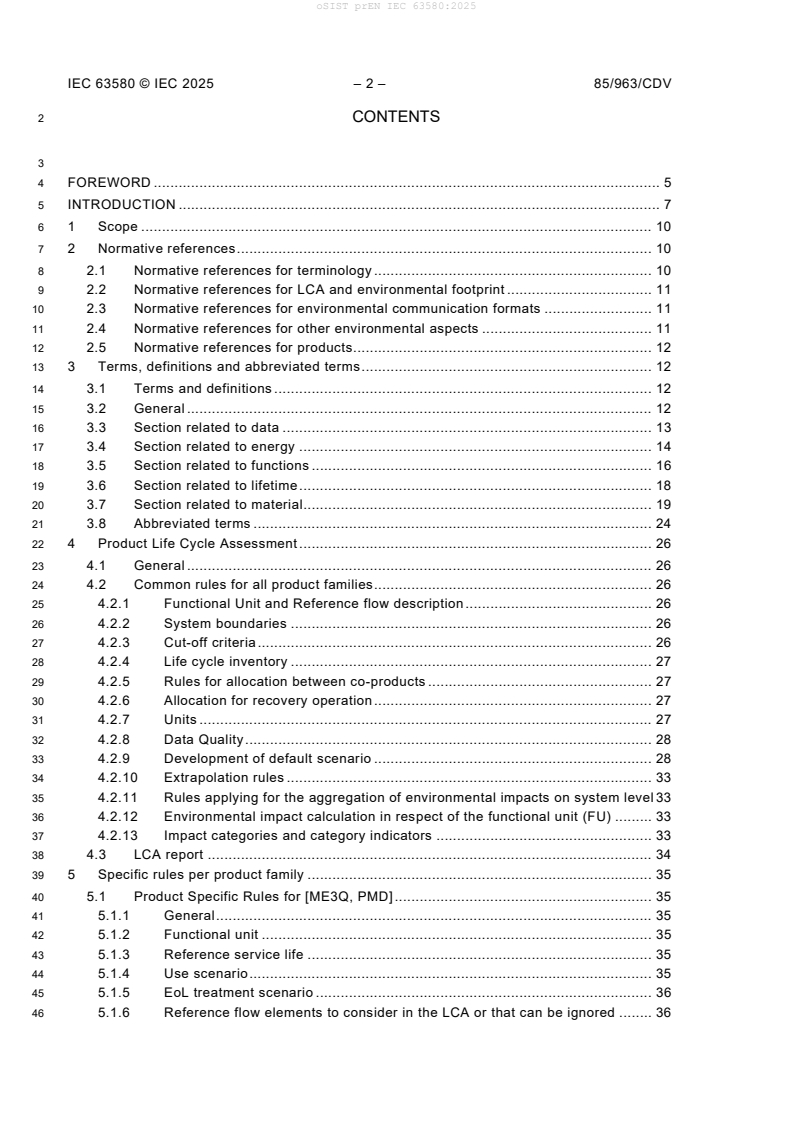
IEC 63580 © IEC 2025 – 2 – 85/963/CDV
2 CONTENTS
4 FOREWORD . 5
5 INTRODUCTION . 7
6 1 Scope . 10
7 2 Normative references . 10
8 2.1 Normative references for terminology . 10
9 2.2 Normative references for LCA and environmental footprint . 11
10 2.3 Normative references for environmental communication formats . 11
11 2.4 Normative references for other environmental aspects . 11
12 2.5 Normative references for products . 12
13 3 Terms, definitions and abbreviated terms . 12
14 3.1 Terms and definitions . 12
15 3.2 General . 12
16 3.3 Section related to data . 13
17 3.4 Section related to energy . 14
18 3.5 Section related to functions . 16
19 3.6 Section related to lifetime . 18
20 3.7 Section related to material. 19
21 3.8 Abbreviated terms . 24
22 4 Product Life Cycle Assessment . 26
23 4.1 General . 26
24 4.2 Common rules for all product families . 26
25 4.2.1 Functional Unit and Reference flow description . 26
26 4.2.2 System boundaries . 26
27 4.2.3 Cut-off criteria . 26
28 4.2.4 Life cycle inventory . 27
29 4.2.5 Rules for allocation between co-products . 27
30 4.2.6 Allocation for recovery operation . 27
31 4.2.7 Units . 27
32 4.2.8 Data Quality . 28
33 4.2.9 Development of default scenario . 28
34 4.2.10 Extrapolation rules . 33
35 4.2.11 Rules applying for the aggregation of environmental impacts on system level 33
36 4.2.12 Environmental impact calculation in respect of the functional unit (FU) . 33
37 4.2.13 Impact categories and category indicators . 33
38 4.3 LCA report . 34
39 5 Specific rules per product family . 35
40 5.1 Product Specific Rules for [ME3Q, PMD] . 35
41 5.1.1 General . 35
42 5.1.2 Functional unit . 35
43 5.1.3 Reference service life . 35
44 5.1.4 Use scenario . 35
45 5.1.5 EoL treatment scenario . 36
46 5.1.6 Reference flow elements to consider in the LCA or that can be ignored . 36
oSIST prEN IEC 63580:2025
IEC 63580 © IEC 2025 – 3 – 85/963/CDV
47 5.1.7 List of impact categories and category indicators to consider in the LCA or that
48 can be ignored . 36
49 5.1.8 Allocation rules . 36
50 5.2 Specific rules for [ME3Q, PQI] . 37
51 5.2.1 General . 37
52 5.2.2 Functional unit . 37
53 5.2.3 Reference service life . 37
54 5.2.4 Use scenario . 37
55 5.2.5 EoL treatment scenario . 38
56 5.2.6 Reference flow elements to consider in the LCA or that can be ignored . 38
57 5.2.7 List of impact categories and category indicators to consider in the LCA or that
58 can be ignored . 38
59 5.2.8 Allocation rules . 38
60 5.3 Specific rules for [ME3Q, DDM] . 39
61 5.3.1 General . 39
62 5.3.2 Functional unit . 39
63 5.3.3 Reference service life . 39
64 5.3.4 Use scenario . 39
65 5.3.5 EoL treatment scenario . 40
66 5.3.6 Reference flow elements to consider in the LCA or that can be ignored . 40
67 5.3.7 List of impact categories and category indicators to consider in the LCA or that
68 can be ignored . 40
69 5.3.8 Allocation rules . 40
70 5.4 Specific rules for [ME3Q, TRD] . 41
71 5.4.1 General . 41
72 5.4.2 Functional unit . 41
73 5.4.3 Reference service life . 41
74 5.4.4 Use scenario . 41
75 5.4.5 EoL treatment scenario . 42
76 5.4.6 Reference flow elements to consider in the LCA or that can be ignored . 42
77 5.4.7 List of impact categories and category indicators to consider in the LCA or that
78 can be ignored . 42
79 5.4.8 Allocation rules . 42
80 6 Drawing up the product environmental profile . 43
81 6.1 General . 43
82 6.2 Constitutive materials and substances. 43
83 6.3 Environmental impact . 43
84 6.4 Additional environmental information . 43
85 7 Environmentally conscious design. 46
86 7.1 General . 46
87 7.2 "Cradle to grave" approach . 46
88 7.3 Inputs . 48
89 7.4 Outputs . 48
90 7.5 Qualitative and quantitative assessments . 48
91 8 Material Efficiency . 49
92 8.1.1 General . 49
93 8.1.2 Durability . 49
94 9 Material declaration . 49
oSIST prEN IEC 63580:2025
IEC 63580 © IEC 2025 – 4 – 85/963/CDV
95 10 EOL information . 50
96 Annex A (informative) Description of ME3Q devices covered by TC85 . 51
97 Bibliography . 52
100 Figure 1 – Standard family for life cycle assessment (LCA) . 7
101 Figure 2 – Standard family for environmental communication . 7
102 Figure 3 – Standard family for interoperability with Building LCA . 8
103 Figure 4 – Copy of Figure 1 of guide 109 “Conceptual relationship between provisions in
104 product standards and the environmental impacts associated with the product during its life
105 cycle” . 47
106 Figure A.1 –Overview of the ME3Q product families . 51
108 Table 1 – Mandatory modelled materials . 26
109 Table 2 – Mandatory components . 27
110 Table 3 – Default scrap rates to be used in the absence of specific data . 29
111 Table 4 – List of default values for use stage . 31
112 Table 5 – Key parameters per operations . 32
113 Table 6 – Functional unit (FU) for PMD . 35
114 Table 7 – Reference service life (RSL) for PMD . 35
115 Table 8 – List of default values for use stage for PMD . 35
116 Table 9 – Functional unit (FU) for PQI . 37
117 Table 10 – Reference service life (RSL) for PQI . 37
118 Table 11 – List of default values for use stage for fixed-installed PQI . 37
119 Table 12 – List of default values for use stage for portable PQI . 38
120 Table 13 – Functional unit (FU) for DDM . 39
121 Table 14 – Reference service life (RSL) for DDM . 39
122 Table 15 – List of default values for use stage for DDM . 39
123 Table 16 – Functional unit (FU) for TRD2 . 41
124 Table 17 – Reference service life (RSL) for TRD2 . 41
125 Table 18 – List of default values for use stage for TRD2 . 41
126 Table 19 – Temperature for devices covered by this standard . 49
oSIST prEN IEC 63580:2025
IEC 63580 © IEC 2025 – 5 – 85/963/CDV
128 INTERNATIONAL ELECTROTECHNICAL COMMISSION
129 ____________
131 MEASURING EQUIPMENT FOR ELECTRICAL AND ELECTROMAGNETIC
132 QUANTITIES – ENVIRONMENTAL ASPECTS
133 FOREWORD
134 1) The International Electrotechnical Commission (IEC) is a worldwide organization for standardization comprising all national
135 electrotechnical committees (IEC National Committees). The object of IEC is to promote international co-operation on all
136 questions concerning standardization in the electrical and electronic fields. To this end and in addition to other activities,
137 IEC publishes International Standards, Technical Specifications, Technical Reports, Publicly Available Specifications (PAS)
138 and Guides (hereafter referred to as "IEC Publication(s)"). Their preparation is entrusted to technical committees; any IEC
139 National Committee interested in the subject dealt with may participate in this preparatory work. International, governmental
140 and non-governmental organizations liaising with the IEC also participate in this preparation. IEC collaborates closely with
141 the International Organization for Standardization (ISO) in accordance with conditions determined by agreement between
142 the two organizations.
143 2) The formal decisions or agreements of IEC on technical matters express, as nearly as possible, an international consensus
144 of opinion on the relevant subjects since each technical committee has representation from all interested IEC National
145 Committees.
146 3) IEC Publications have the form of recommendations for international use and are accepted by IEC National Committees in
147 that sense. While all reasonable efforts are made to ensure that the technical content of IEC Publications is accurate, IEC
148 cannot be held responsible for the way in which they are used or for any misinterpretation by any end user.
149 4) In order to promote international uniformity, IEC National Committees undertake to apply IEC Publications transparently to
150 the maximum extent possible in their national and regional publications. Any divergence between any IEC Publication and
151 the corresponding national or regional publication shall be clearly indicated in the latter.
152 5) IEC itself does not provide any attestation of conformity. Independent certification bodies provide conformity assessment
153 services and, in some areas, access to IEC marks of conformity. IEC is not responsible for any services carried out by
154 independent certification bodies.
155 6) All users should ensure that they have the latest edition of this publication.
156 7) No liability shall attach to IEC or its directors, employees, servants or agents including individual experts and members of
157 its technical committees and IEC National Committees for any personal injury, property damage or other damage of any
158 nature whatsoever, whether direct or indirect, or for costs (including legal fees) and expenses arising out of the publication,
159 use of, or reliance upon, this IEC Publication or any other IEC Publications.
160 8) Attention is drawn to the Normative references cited in this publication. Use of the referenced publications is indispensable
161 for the correct application of this publication.
162 9) Attention is drawn to the possibility that some of the elements of this IEC Publication may be the subject of patent rights.
163 IEC shall not be held responsible for identifying any or all such patent rights.
164 IEC 63850 has been prepared by IEC technical committee 85: Measuring equipment for electrical and
165 electromagnetic quantities. It is an International Standard.
166 This edition constitutes a new edition.
167 The text of this International Standard is based on the following documents:
Draft Report on voting
85/XX/FDIS 85/XX/RVD
169 Full information on the voting for its approval can be found in the report on voting indicated in the above
170 table.
171 The language used for the development of this International Standard is English.
172 This document was drafted in accordance with ISO/IEC Directives, Part 2, and developed in accordance
173 with ISO/IEC Directives, Part 1 and ISO/IEC Directives, IEC Supplement, available at
174 www.iec.ch/members_experts/refdocs. The main document types developed by IEC are described in
175 greater detail at www.iec.ch/standardsdev/publications.
oSIST prEN IEC 63580:2025
IEC 63580 © IEC 2025 – 6 – 85/963/CDV
176 In this document, the following print types are used:
177 – requirements and definitions: in roman type;
178 – NOTES: in smaller roman type;
179 – compliance: in italic type.
180 The committee has decided that the contents of this document will remain unchanged until the stability
181 date indicated on the IEC website under webstore.iec.ch in the data related to the specific document.
182 At this date, the document will be
183 • reconfirmed,
184 • withdrawn,
185 • replaced by a revised edition, or
186 • amended.
IMPORTANT – The "colour inside" logo on the cover page of this document indicates that it
contains colours which are considered to be useful for the correct understanding of its
contents. Users should therefore print this document using a colour printer.
oSIST prEN IEC 63580:2025
IEC 63580 © IEC 2025 – 7 – 85/963/CDV
190 INTRODUCTION
191 Increasingly, there is a focus on preserving the natural environment for the good of future generations.
192 This results in the publication of various regulations that require environmental data, whether at the
193 local or national level. Product manufacturers are also faced by requests from their stakeholders’
194 customers (wholesalers, installers, specifiers, authorities…) for environmental data. In addition to
195 reduce product environmental impact, manufacturers need a standardized methodology to quantify and
196 to consequently reduce the environmental impact of the product.
197 It is necessary to establish product specific rules (PSR) to have standardized science-based
198 methodologies for the data to be evaluated and transmitted.
199 Specific rules for assessing the environmental impacts and providing appropriate data for ME3Q are
200 among the purposes of this document. These rules establish a common evaluation scheme of their
201 environmental impacts in terms of characterized impact indicators (e.g. CO2-equivalents, ozone
202 depletion) over their whole life cycle.
204 Figure 1 – Standard family for life cycle assessment (LCA)
205 This document is to be used by manufacturers, customers, authorities, program operators, LCA
206 practitioners and verifiers, whatever the type of environmental data related to life cycle assessment,
207 including extract for one specific impact (carbon footprint).
209 Figure 2 – Standard family for environmental communication
oSIST prEN IEC 63580:2025
IEC 63580 © IEC 2025 – 8 – 85/963/CDV
210 Even though ME3Q have a relatively minor impact on the environment, there is a market need for
211 appropriate methods for managing these environmental matters. A simplified means of estimating the
212 environmental impacts is required together with readily available data to make the stakeholders, for
213 example contractor's, installer's and end user's, task of assessing environmental impacts at system
214 level easier.
215 Generally, the environmental impact of ME3Q is very low compared with that of the overall system into
216 which they are incorporated and the processes to which they contribute. The lifetime impact of
217 processes such as the air-conditioning of a building, the manufacture of steel or shipping far exceed
218 that of the manufacture and use of any associated ME3Q.
219 Figure 3 – Standard family for interoperability with Building LCA
220 In addition,
221 release of substances and materials that might be harmful for the environment or induce climatic
222 changes are to be avoided or minimized. From conception to end of life of a product, the environmental
223 impact of all the relevant processes should be considered, including how materials are disposed of or
224 recovered for future use.
225 In order to contribute to conserving natural resources, manufacturers of measuring equipment for
226 electrical and electromagnetic quantities (ME3Q) should ensure an environmentally conscious design
227 (ECD) involving:
228 • phasing-out or minimizing use of hazardous substances or materials;
229 • efficient use of energy and materials in the manufacture of products;
230 • ensuring the lowest practical energy consumption by the products while they are in use;
231 • at the end of product life, the possibility, as far as practical, of recycling materials for future use, and
232 sorting hazardous components requiring a specific treatment.
233 Declarations and ECD are increasingly required and in some instances mandated. These can take
234 several forms, for example, Type II or Type III environmental declaration, material declaration (MD). In
235 some business, Green Public Procurement (GPP) is applicable and/or ECD is part of the ISO 14001
236 certification. Some countries and regions are also actively pushing for environmental conservation, for
237 example, the European Union through its Ecodesign Directive and China through Ecodesign Initiative.
238 Systematic demands for ECD will be required by most, if not all customers, in the medium term.
oSIST prEN IEC 63580:2025
IEC 63580 © IEC 2025 – 9 – 85/963/CDV
239 Assessing the environmental impact of ME3Q is part of an ECD process. ECD requires the
240 identification, measurement and reporting of particular impacts. ISO/IEC 62430 describes the basic
241 principles of ECD, with the goal of reducing the potential environmental impacts of products.
oSIST prEN IEC 63580:2025
IEC 63580 © IEC 2025 – 10 – 85/963/CDV
243 MEASURING EQUIPMENT FOR ELECTRICAL AND ELECTROMAGNETIC
244 QUANTITIES – ENVIRONMENTAL ASPECTS
245 1 Scope
246 This document provides guidance to manufacturers of measuring equipment for electrical and
247 electromagnetic quantities (ME3Q) in evaluating and improving the environmental impact of their
248 products, and in enabling effective communication using common references for environmental
249 information throughout the supply chain.
250 NOTE - ME3Q devices are described in Annex A.
251 This standard covers only the below fixed installed measuring equipment:
252 - IEC 61557-12 (PMD)
253 - IEC 62586-1 (PQI)
254 - IEC 60688 (TRD)
255 - IEC 62974-1 (DDM)
256 This document provides:
257 – guidance on the process and general aspects to implement environmentally-conscious product
258 design principles, as given in ISO/IEC 62430;
259 – the Product Specific Rules (PSR) for Life Cycle Assessment (LCA);
260 NOTE 1 The general methods and the process to execute the LCA are in accordance with ISO 14040 and ISO 14044 but
261 not addressed in this document.
262 NOTE 2 PSR and LCA can be used for quantitative ECD and also apply for some environmental declarations, for example
263 Type III.
264 – standard environmental impact data derived from case studies and a means of using them;
265 NOTE 3 This is to encourage manufacturers to apply more effective quantitative methods in the ECD process to improve
266 the environmental efficiency of their products.
267 – common rules for communicating information about the presence of regulated substances and the
268 materials contained in the product;
269 – guidance on communicating information about the end-of-life treatment of the product.
270 2 Normative references
271 The following documents are referred to in the text in such a way that some or all of their content
272 constitutes requirements of this document. For dated references, only the edition cited applies. For
273 undated references, the latest edition of the referenced document (including any amendments) applies.
274 2.1 Normative references for terminology
275 IEC 60050-904, International Electrotechnical Vocabulary (IEV) – Part 904: Environmental
276 standardization for electrical and electronic products and systems (available at www.electropedia.org)
oSIST prEN IEC 63580:2025
IEC 63580 © IEC 2025 – 11 – 85/963/CDV
277 2.2 Normative references for LCA and environmental footprint
278 IEC 63366:2025, Product category rules for life cycle assessments of electrical and electronic products
279 and systems
280 ISO 14040:2006, Environmental management – Life cycle assessment – Principles and framework
281 ISO 14044:2006, Environmental management – Life cycle assessment – Requirements and guidelines
282 ISO 14044:2006/AMD1:2017
283 ISO 14044:2006/AMD2:2020
284 ISO 14067:2018: Greenhouse gases — Carbon footprint of products — Requirements and guidelines
285 for quantification
286 ISO 14068-1:2023: Climate change management — Transition to net zero – Carbon neutrality
287 IEC 63372 (111/757/CDV) Quantification and communication of GHG emissions and emission
288 reductions/avoided emissions from electric and electronic products, services and systems - Principles,
289 methodologies and guidance
290 2.3 Normative references for environmental communication formats
291 ISO 14020:2022, Environmental statements and programmes for products - Principles and general
292 requirements
293 ISO 14021:2016, Environmental labels and declarations – Self-declared environmental claims (Type II
294 environmental labelling)
295 ISO 14024:2018, Environmental labels and declarations: Type I environmental labelling. Principles and
296 procedures.
297 ISO 14025:2006, Environmental labels and declarations – Type III environmental declarations –
298 Principles and procedures
299 ISO 14026:2017, Environmental labels and declarations: Principles, requirements and guidelines for
300 communication of footprint information
301 ISO 21930:2017, Sustainability in buildings and civil engineering works - Core rules for environmental
302 product declarations of construction products and services
303 EN 15978:2012, Sustainability of construction works - Assessment of environmental performance of
304 buildings - Calculation method
305 EN15804:2019+A2, Sustainability of construction works - Environmental product declarations - Core
306 rules for the product category of construction products
307 IEC 63058 CD (121/168/CD), Switchgear and controlgear and their assemblies for low voltage –
308 Environmental aspects
309 2.4 Normative references for other environmental aspects
310 ISO/IEC 62430:2019, Environmentally conscious design (ECD) – Principles, requirements and guidance
311 IEC 62474:2018, Material declaration for products of and for the electrotechnical industry
oSIST prEN IEC 63580:2025
IEC 63580 © IEC 2025 – 12 – 85/963/CDV
312 IEC 62474 DB, Material declaration for products of and for the electrotechnical industry (available at
313 http://std.iec.ch/iec62474)
314 IEC TR 62635:2012, Guidelines for end-of-life information provided by manufacturers and recyclers and
315 for recyclability rate calculation of electrical and electronic equipment
316 2.5 Normative references for products
317 IEC 60688:2024, Electrical measuring transducers for converting AC and DC electrical quantities to
318 analogue or digital signals
319 IEC 61557-12:2018, Electrical safety in low voltage distribution systems up to 1 000 V AC and
320 1 500 V DC – Equipment for testing, measuring or monitoring of protective measures – Part 12: Power
321 metering and monitoring devices (PMD)
322 IEC 61557-12:2018/AMD1:2021
323 IEC 62586-1:2017, Power quality measurement in power supply systems – Part 1: Power quality
324 instruments (PQI)
325 IEC 62586-2:2017, Power quality measurement in power supply systems – Part 2: Functional tests and
326 uncertainty requirements
327 IEC 62974-1:2024, Monitoring and measuring systems used for data collection, gathering and analysis
328 – Part 1: Device requirements
329 3 Terms, definitions and abbreviated terms
330 3.1 Terms and definitions
331 For the purposes of this document, the terms and definitions given in IEC 60050-904 and the following
332 apply.
333 ISO and IEC maintain terminological databases for use in standardization at the following addresses:
334 • ISO Online browsing platform: available at http://www.iso.org/obp
335 • IEC Electropedia: available at http://www.electropedia.org/
336 3.2 General
337 3.2.1
338 Greenhouse gas
339 GHG
340 gaseous constituent of the atmosphere, both natural and anthropogenic, that absorbs and emits
341 radiation at specific wavelengths within the spectrum of infrared radiation emitted by the earth’s surface,
342 the atmosphere, and clouds
343 Note 1 to entry: For a list of GHGs, see the latest IPCC Assessment Report.
344 Note 2 to entry: Water vapour and ozone, which are anthropogenic as well as natural GHGs, are not included in the CFP and
345 partial CFP.
346 Note 3 to entry: The focus of this document is limited to long-lived GHGs, it therefore excludes climate effects due to changes
347 in surface reflectivity (albedo) and short-lived radiative forcing agents (e.g., black carbon and aerosols).
348 [SOURCE: ISO 14067:2018, 3.1.2.1]
oSIST prEN IEC 63580:2025
IEC 63580 © IEC 2025 – 13 – 85/963/CDV
349 3.2.2
350 co-product
351 any of two or more products coming from the same unit process or product system
352 Note 1 to entry: Co-product, by-product and product have the same status and are used for identification of several
353 distinguished flows of products from the same unit process. From co-product, by-product and product, waste is the only output
354 to be distinguished as a non-product.
355 [SOURCE: ISO 14040:2006, 3.10, modified, a note to entry has been added]
356 3.2.3
357 cut-off criteria
358 Specification of the amount of material or energy flow or the level of environmental significance
359 associated with unit processes or product system to be excluded from a study.
360 [SOURCE: ISO 14040:2006, 3.18]
361 3.3 Section related to data
362 3.3.1
363 primary data
364 quantified value of a unit process or an activity obtained from a direct measurement or a calculation
365 based on direct measurements at the original source
366 [SOURCE: ISO 14050:2020, 3.6.34]
367 3.3.2
368 secondary data
369 data that do not fulfil the requirements for primary data
370 [SOURCE: ISO 14050:2020, 3.6.35]
371 3.3.3
372 Data quality
373 Characteristics of data that relate to their ability to satisfy stated requirements.
374 [SOURCE: ISO 14044:2006, 3.19]
375 3.3.4
376 declared unit
377 quantity of the product used as a reference unit in a Type III environmental declaration or footprint
378 communication, based on one or more information modules
Note 1 to entry: Information module is a compilation of data covering a unit process or a combination of unit processes that
are part of the life cycle of a product.
[SOURCE: ISO 14040:2006, 3.7.11, modified, note 1 to entry had been added]
379 3.3.5
380 Disposal
381 Any operation which is not recovery even where this operation has a reclamation of substances or
382 energy secondary consequences.
[SOURCE: IEC/TR 62635:2012, 3.1]
oSIST prEN IEC 63580:2025
IEC 63580 © IEC 2025 – 14 – 85/963/CDV
383 3.3.6
384 durability
385
386 ability to function as required, under defined conditions of use, maintenance and repair, until a limiting
387 state is reached
388 Note 1 to entry: The degree to which maintenance and repair are within the scope of durability will vary by product or product-
389 group.
390 Note 2 to entry: Durability can be expressed in units appropriate to the part or product concerned, e.g. calendar time, operating
391 cycles, distance run, etc. The units should always be clearly stated.
392 [SOURCE: EN 45550:2020; 4.2.1.1, modified: Note 2 deleted]
393 3.3.7
394 end of life
395 life cycle stage of a product starting when it is removed from its intended use phase
396 [SOURCE: IEC TR 62635:2012, 3.2, modified – Hyphens deleted in term, alternate term deleted, "use-
397 stage" replaced with "use phase".]
398 3.3.8
399 end of life treatment
400 operation after a waste has been handed over to a facility for product and product part reuse, material
401 recycling, energy recovery and residue disposal
402 Note 1 to entry: This includes dismantling, material separation and disposal.
403 [SOURCE: IEC TR 62635:2012, 3.3, modified – Hyphens in term deleted, insertion of Note 1 to entry.]
404 3.4 Section related to energy
405 3.4.1
406 energy recovery
407 production of useful energy through direct and controlled combustion or other processing of waste
408 Note 1 to entry: Waste incinerators producing hot water, steam and/or electricity are common means for energy recovery.
409 [SOURCE: IEC 60050-904:2014, 904-04-03]
410 3.4.2
411 environment
412 surroundings in which a product or system exists, including air, water, land, natural resources, flora,
413 fauna, humans and their interrelation
414 [SOURCE: IEC Guide 109:2012, 3.3]
415 3.4.3
416 environmental aspect
417 element of an organization's activities or products that interacts or can interact with the environment
418 Note 1 to entry: An environmental aspect can cause (an) environmental impact(s). A significant environmental aspect is one
419 that has or can have one or more significant environmental impact(s).
420 Note 2 to entry: Significant environmental aspects are determined by the organization applying one or more criteria.
421 [SOURCE: ISO 14001:2015, 3.2.2, modified – "or services" deleted in the definition.]
oSIST prEN IEC 63580:2025
IEC 63580 © IEC 2025 – 15 – 85/963/CDV
422 3.4.4
423 environmental claim
424 statement, symbol or graphic that indicates an environmental aspect of a product, including any
425 associated components and packaging
426 [SOURCE: ISO 14050:2020, 3.7.3]
427 3.4.5
428 environmentally conscious design
429 systematic approach which considers environmental aspects in the design and development with the
430 aim to reduce adverse environmental impacts throughout the life cycle of a product
431 Note 1 to entry: Other terminology used worldwide with the same meaning includes ecodesign, design for environment (DFE),
432 green design and environmentally sustainable design.
433 [SOURCE: ISO/IEC 62430:2019, 3.1.1, modified – Abbreviated term "ECD" and Note 2 to entry deleted.]
434 3.4.6
435 environmental declaration
436 Claim which indicates the environmental aspects of a product or service.
437 [SOURCE: ISO 14020:2000, 2.1]
438 3.4.7
439 environmental declaration program
440 voluntary program for the development and use of Type III environmental declarations, based on a set
441 of operating rules (program instructions)
442 [SOURCE: ISO 14025:2006, 3.3, modified – "Type III" removed from the term and "(program
443 instructions)" added to the definition.]
444 3.4.8
445 environmental impact
446 change to the environment, whether adverse or beneficial, wholly or partly resulting from environmental
447 aspects.
448 [SOURCE: IEC Guide 109:2012, 3.5, modified, In the definition, "an organization's" has been omitted.]
449 3.4.9
450 Environmental product declaration, Type III environmental declaration
451 EPD
452 Environmental declaration (ISO 14025:2006, 3.1) providing quantified environmental data using
453 predetermined parameters and, where relevant, additional environmental information
454 [SOURCE: ISO21930:2017]
455 3.4.10
456 Extrapolated
457 Qualifies a predicted value based on observed or estimated values for one or a set of conditions,
458 intended to apply to other conditions such as time, maintenance and environmental conditions
459 [SOURCE: IEC 62059-31-1:2008]
oSIST prEN IEC 63580:2025
IEC 63580 © IEC 2025 – 16 – 85/963/CDV
460 3.5 Section related to functions
461 3.5.1
462 Functional Unit (LCA)
463 FU
464 quantified performance of a product system for use as a reference unit in life cycle assessment
465 [SOURCE: ISO 14040:2006, 3.20, modified – The abbreviated term "FU" and "in life cycle assessment"
466 have been added.]
467 3.5.2
468 primary function
469 function fulfilling the intended use
470 Note 1 to entry: There can be more than one primary function.
471 Note 2 to entry: examples of primary function for circuit breakers are: conducting the current, breaking normal and fault currents,
472 providing isolation, ….
473 [SOURCE: EN 45550:2020; 4.2.2.1, modified: Note 2 added]
474 3.5.3
475 secondary function
476 function that enables the primary function(s)
477 Note 1 to entry: examples of secondary function are: current and voltage measurement, …,
478 [SOURCE: EN 62542:2017; 5.14, modified: “supplements or enhances” deleted, Note 1 added]
479 3.5.4
480 Hazardous substance
481 substance that has, according to defined classification criteria, the potential for adversely impacting
482 human health and/or the environment.
483 Note 1 to entry: The criteria for determining whether a substance is classified as hazardous are defined by law or regulation.
484 [SOURCE: IEC Guide109:2012, 3.6]
485 3.5.5
486 Homogenous product family
487 subgroup of a product family based on the underlying technology or build where the environmental
488 impacts can reasonably be expected to be similar and therefore scalable over the group through a
489 function of certain physical characteristics, for example, power or weight
490 [SOURCE: IEC 63366:2025, 3.1.15]
491 3.5.6
492 Input
493 product, material or energy flow that enters a unit process
494 Note 1 to entry: Products and materials include raw materials, intermediate products and co-products.
495 [SOURCE: ISO 14040:2006, 3.21]
496 3.5.7
497 Landfill
site used for the disposal of waste onto or into land (i.e. underground), including onsite waste disposal
sites and storage site used to store waste for more than one year
oSIST prEN IEC 63580:2025
IEC 63580 © IEC 2025 – 17 – 85/963/CDV
Note 1 to entry: Onsite waste disposal sites refer to sites where a producer of waste is carrying out its own waste disposal
at the place of production.
Note 2 to entry: Excluded are facilities where waste is unloaded in order to permit its preparation for further transport for
recovery, treatment or disposal elsewhere, and storage of waste prior to recovery or treatment for a period less than three
years as a general rule, or storage of waste prior to disposal for a period
...