


prEN IEC 62561-8:2025
(Main)Lightning protection system components (LPSC) - Part 8: Requirements for components for electrically insulated LPS
Lightning protection system components (LPSC) - Part 8: Requirements for components for electrically insulated LPS
Composants des systèmes de protection contre la foudre (CSPF) - Partie 8: Exigences pour les composants de système électriquement isolé de protection contre la foudre
Elementi za zaščito pred strelo (LPSC) - 8. del: Elementi za zaščito pred strelo (LPSC) - 8. del: Zahteve za elemente električno izoliranega sistema LPS
General Information
- Status
- Not Published
- Publication Date
- 22-Feb-2027
- Technical Committee
- CLC/TC 81X - Lightning protection
- Drafting Committee
- IEC/TC 81 - IEC_TC_81
- Current Stage
- 4060 - Enquiry results established and sent to TC, SR, BTTF - Enquiry
- Start Date
- 24-Oct-2025
- Completion Date
- 24-Oct-2025
Overview
The prEN IEC 62561-8:2025 standard, developed by the CLC (European Committee for Electrotechnical Standardization), defines the requirements for components of electrically insulated lightning protection systems (LPS). As Part 8 of the IEC 62561 series on lightning protection system components (LPSC), it establishes technical criteria to ensure safety, reliability, and effectiveness in lightning protection designs incorporating electrical insulation.
This standard focuses on the design, testing, classification, and installation of critical insulating components such as insulating stand-offs and insulating down-conductors. Its adoption aims to harmonize international practices around electrically insulated LPS components, addressing mechanical strength, electrical performance, environmental resilience, and electromagnetic compatibility (EMC).
Key Topics
Insulating Stand-Offs
- Classification based on conductor clamping arrangement and mounting configuration.
- Construction guidelines ensuring mechanical robustness and electrical insulation.
- Rigorous testing procedures including mechanical tests (bending, pull-out, pendulum hammer), electrical tests (high voltage impulse), environmental influence tests (corrosion, ultraviolet resistance), and EMC.
- Documentation and marking requirements to enable clear identification and proper installation.
Insulating Down-Conductors
- Classification by electrical and mechanical characteristics.
- Lightning current carrying capability and criteria for acceptable equivalent separation distances.
- Comprehensive requirements covering environmental durability, mechanical integrity, electrical insulation, and proper documentation.
- Testing regimes similar to insulating stand-offs including high voltage impulse tests and mechanical impact resilience.
Testing and Verification
- Standardized test setups and conditions to validate component performance.
- Environmental resistance tests (salt mist, humid sulphurous atmosphere, ammonia atmosphere).
- Evaluation of electromagnetic compatibility to prevent interference with nearby equipment.
- Detailed structure and content requirements for test reports to support conformity assessment.
Applications
The prEN IEC 62561-8:2025 standard is essential for manufacturers, installers, and inspectors involved in lightning protection systems that require electrical insulation to prevent unintended grounding or current flow paths. Its practical applications include:
- Designing electrically insulated LPS components in industrial facilities, residential buildings, and critical infrastructure to enhance safety and minimize risk of damage.
- Specifying insulating stand-offs and down-conductors that withstand harsh environmental conditions such as UV exposure, humidity, and corrosive atmospheres.
- Assisting conformity assessment bodies and certification authorities in verifying compliance of LPSC components with internationally recognized benchmarks.
- Guiding installation professionals on correct mounting and spacing of electrically insulated LPS components to ensure optimal performance without compromising structural integrity or electrical safety.
- Supporting suppliers with clear product marking and comprehensive documentation facilitating traceability and compliance verification.
Related Standards
prEN IEC 62561-8:2025 is part of the broader IEC 62561 series on lightning protection system components and is linked to other key standards and technical specifications, including:
- IEC 62561-1 to IEC 62561-7 – Covering different LPSC components like air termination devices, conductors, earth electrodes, and connection components.
- IEC TC 81 – The primary technical committee responsible for lightning protection standardization.
- Standards addressing electrical safety, EMC, and environmental testing methodologies relevant to LPS components.
- National and regional standards adapting IEC requirements for local conditions and regulatory frameworks.
By adhering to prEN IEC 62561-8:2025, stakeholders ensure that electrically insulated lightning protection components meet stringent international safety and performance criteria, enhancing protection against lightning risks while complying with best practices in design, testing, and installation. This fosters improved safety, reliability, and interoperability across the lightning protection industry worldwide.
Get Certified
Connect with accredited certification bodies for this standard

ICC Evaluation Service
Building products evaluation and certification.

Intertek Testing Services NA Inc.
Intertek certification services in North America.

QAI Laboratories
Building and construction product testing and certification.
Sponsored listings
Frequently Asked Questions
prEN IEC 62561-8:2025 is a draft published by CLC. Its full title is "Lightning protection system components (LPSC) - Part 8: Requirements for components for electrically insulated LPS". This standard covers: Lightning protection system components (LPSC) - Part 8: Requirements for components for electrically insulated LPS
Lightning protection system components (LPSC) - Part 8: Requirements for components for electrically insulated LPS
prEN IEC 62561-8:2025 is classified under the following ICS (International Classification for Standards) categories: 29.020 - Electrical engineering in general; 91.120.40 - Lightning protection. The ICS classification helps identify the subject area and facilitates finding related standards.
prEN IEC 62561-8:2025 is available in PDF format for immediate download after purchase. The document can be added to your cart and obtained through the secure checkout process. Digital delivery ensures instant access to the complete standard document.
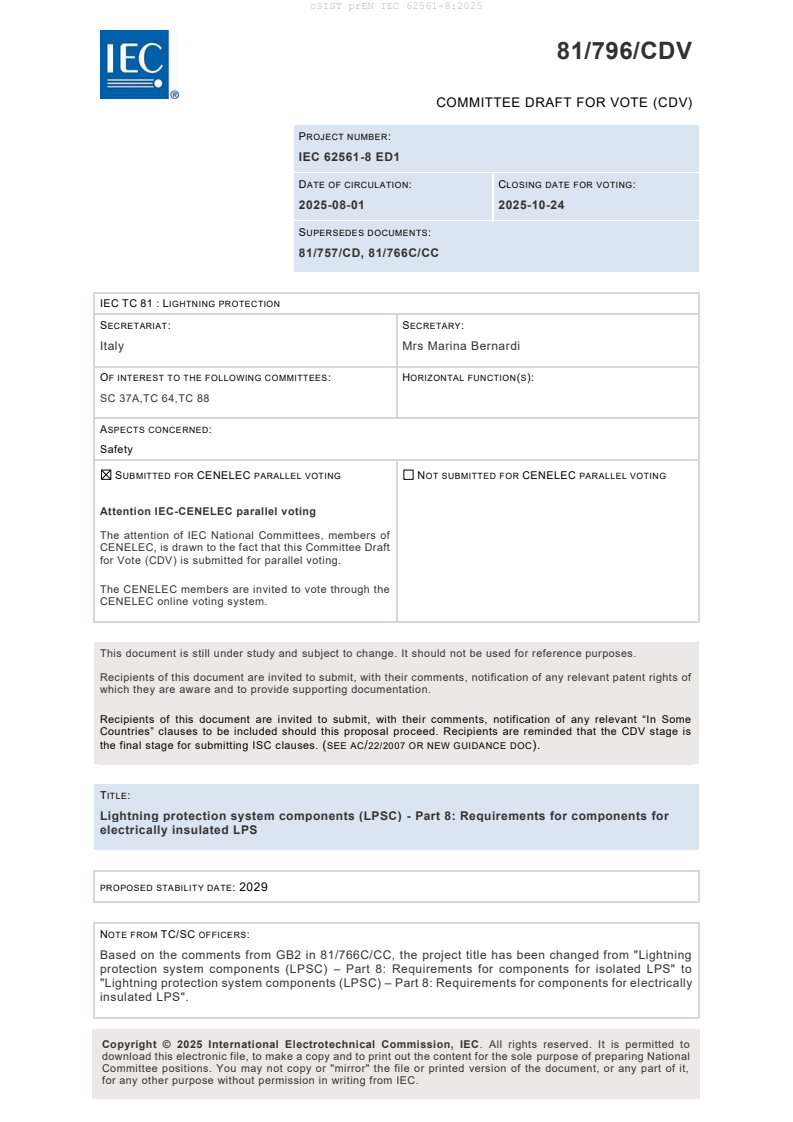
Standards Content (Sample)
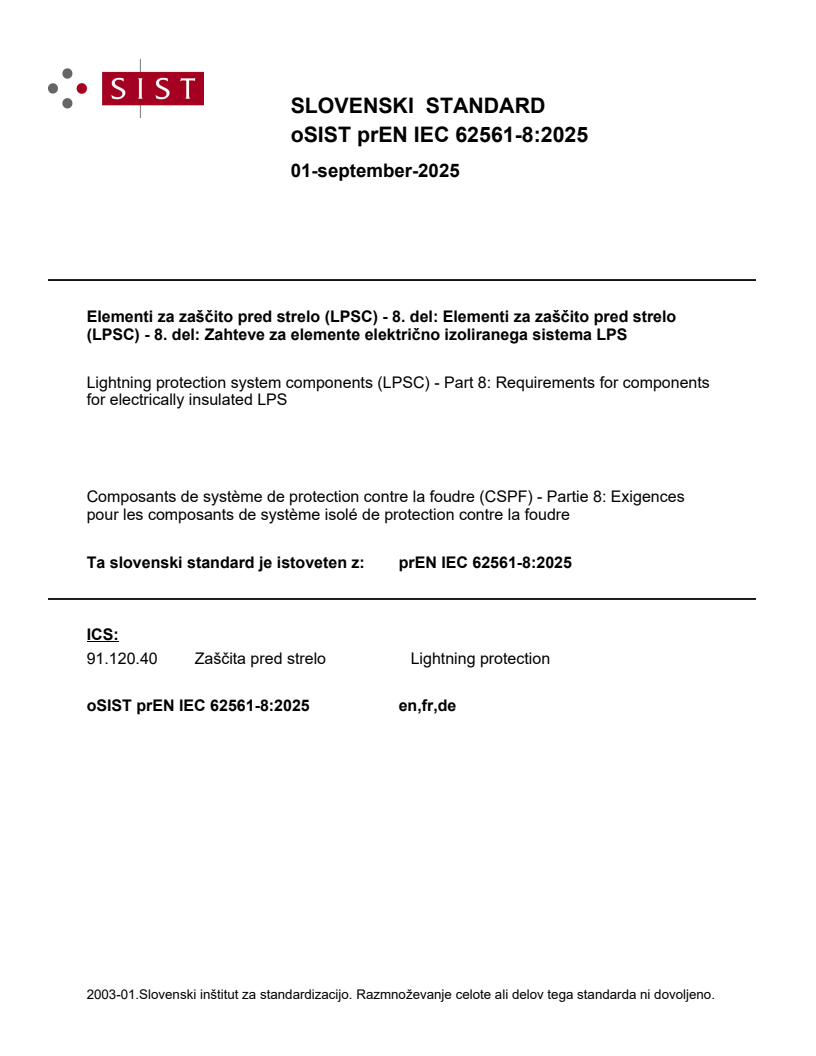
SLOVENSKI STANDARD
01-september-2025
Elementi za zaščito pred strelo (LPSC) - 8. del: Elementi za zaščito pred strelo
(LPSC) - 8. del: Zahteve za elemente električno izoliranega sistema LPS
Lightning protection system components (LPSC) - Part 8: Requirements for components
for electrically insulated LPS
Composants de système de protection contre la foudre (CSPF) - Partie 8: Exigences
pour les composants de système isolé de protection contre la foudre
Ta slovenski standard je istoveten z: prEN IEC 62561-8:2025
ICS:
91.120.40 Zaščita pred strelo Lightning protection
2003-01.Slovenski inštitut za standardizacijo. Razmnoževanje celote ali delov tega standarda ni dovoljeno.
81/796/CDV
COMMITTEE DRAFT FOR VOTE (CDV)
PROJECT NUMBER:
IEC 62561-8 ED1
DATE OF CIRCULATION: CLOSING DATE FOR VOTING:
2025-08-01 2025-10-24
SUPERSEDES DOCUMENTS:
81/757/CD, 81/766C/CC
IEC TC 81 : LIGHTNING PROTECTION
SECRETARIAT: SECRETARY:
Italy Mrs Marina Bernardi
OF INTEREST TO THE FOLLOWING COMMITTEES: HORIZONTAL FUNCTION(S):
SC 37A,TC 64,TC 88
ASPECTS CONCERNED:
Safety
SUBMITTED FOR CENELEC PARALLEL VOTING NOT SUBMITTED FOR CENELEC PARALLEL VOTING
Attention IEC-CENELEC parallel voting
The attention of IEC National Committees, members of
CENELEC, is drawn to the fact that this Committee Draft
for Vote (CDV) is submitted for parallel voting.
The CENELEC members are invited to vote through the
CENELEC online voting system.
This document is still under study and subject to change. It should not be used for reference purposes.
Recipients of this document are invited to submit, with their comments, notification of any relevant patent rights of
which they are aware and to provide supporting documentation.
Recipients of this document are invited to submit, with their comments, notification of any relevant “In Some
Countries” clauses to be included should this proposal proceed. Recipients are reminded that the CDV stage is
the final stage for submitting ISC clauses. (SEE AC/22/2007 OR NEW GUIDANCE DOC).
TITLE:
Lightning protection system components (LPSC) - Part 8: Requirements for components for
electrically insulated LPS
PROPOSED STABILITY DATE: 2029
NOTE FROM TC/SC OFFICERS:
Based on the comments from GB2 in 81/766C/CC, the project title has been changed from "Lightning
protection system components (LPSC) – Part 8: Requirements for components for isolated LPS" to
"Lightning protection system components (LPSC) – Part 8: Requirements for components for electrically
insulated LPS".
download this electronic file, to make a copy and to print out the content for the sole purpose of preparing National
Committee positions. You may not copy or "mirror" the file or printed version of the document, or any part of it,
for any other purpose without permission in writing from IEC.
IEC CDV 62561-8 Ed1 © IEC 2025
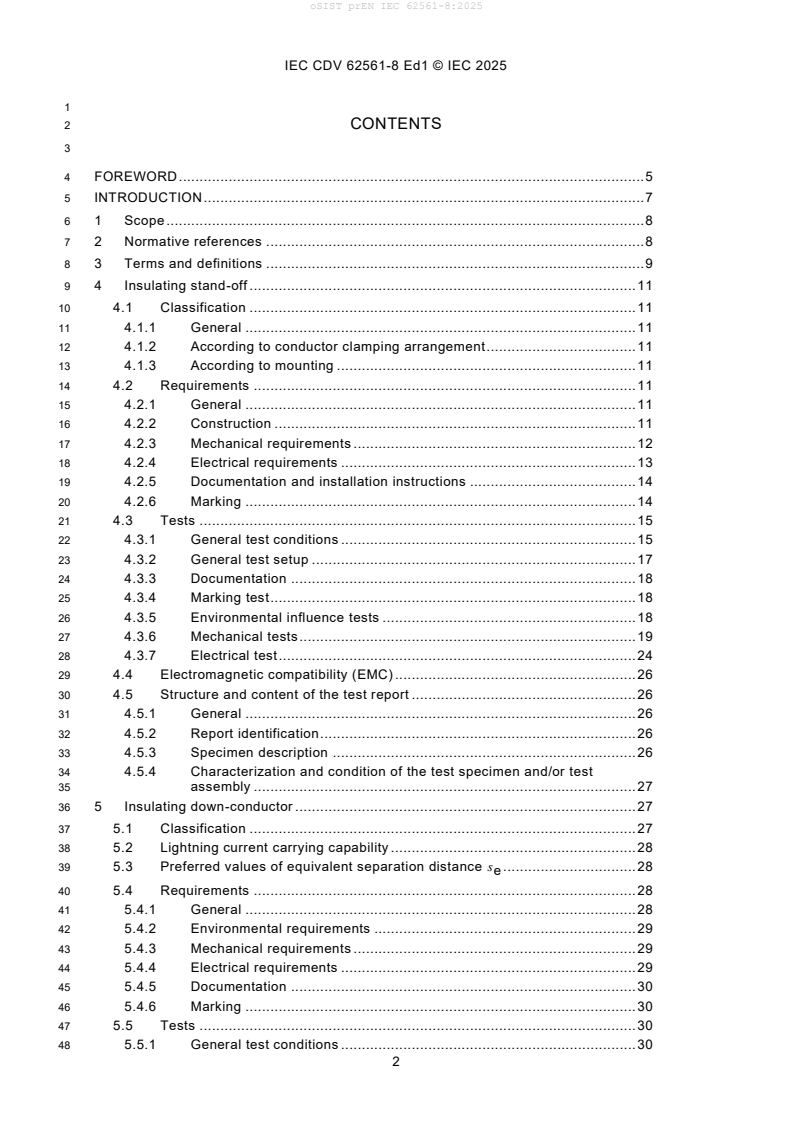
2 CONTENTS
4 FOREWORD . 5
5 INTRODUCTION . 7
6 1 Scope . 8
7 2 Normative references . 8
8 3 Terms and definitions . 9
9 4 Insulating stand-off . 11
10 4.1 Classification . 11
11 4.1.1 General . 11
12 4.1.2 According to conductor clamping arrangement . 11
13 4.1.3 According to mounting . 11
14 4.2 Requirements . 11
15 4.2.1 General . 11
16 4.2.2 Construction . 11
17 4.2.3 Mechanical requirements . 12
18 4.2.4 Electrical requirements . 13
19 4.2.5 Documentation and installation instructions . 14
20 4.2.6 Marking . 14
21 4.3 Tests . 15
22 4.3.1 General test conditions . 15
23 4.3.2 General test setup . 17
24 4.3.3 Documentation . 18
25 4.3.4 Marking test . 18
26 4.3.5 Environmental influence tests . 18
27 4.3.6 Mechanical tests . 19
28 4.3.7 Electrical test . 24
29 4.4 Electromagnetic compatibility (EMC) . 26
30 4.5 Structure and content of the test report . 26
31 4.5.1 General . 26
32 4.5.2 Report identification . 26
33 4.5.3 Specimen description . 26
34 4.5.4 Characterization and condition of the test specimen and/or test
35 assembly . 27
36 5 Insulating down-conductor . 27
37 5.1 Classification . 27
38 5.2 Lightning current carrying capability . 28
39 5.3 Preferred values of equivalent separation distance s . 28
e
40 5.4 Requirements . 28
41 5.4.1 General . 28
42 5.4.2 Environmental requirements . 29
43 5.4.3 Mechanical requirements . 29
44 5.4.4 Electrical requirements . 29
45 5.4.5 Documentation . 30
46 5.4.6 Marking . 30
47 5.5 Tests . 30
48 5.5.1 General test conditions . 30
IEC CDV 62561-8 Ed1 © IEC 2025
49 5.5.2 General test setup . 32
50 5.5.3 Documentation . 32
51 5.5.4 Marking test . 32
52 5.5.5 Environmental influence tests . 32
53 5.5.6 Mechanical tests . 34
54 5.5.7 Electrical tests . 35
55 5.6 Electromagnetic compatibility (EMC) . 39
56 5.7 Structure and content of the test report . 39
57 5.7.1 General . 39
58 5.7.2 Report identification . 40
59 5.7.3 Specimen description . 40
60 5.7.4 Characterization and condition of the test specimen and/or test
61 assembly . 40
62 5.7.5 Insulating Down-Conductor . 40
63 5.7.6 Standards and references . 40
64 5.7.7 Test procedure . 41
65 5.7.8 Testing equipment description . 41
66 5.7.9 Measuring instruments description . 41
67 5.7.10 Results and parameters recorded . 41
68 Annex A (normative) Environmental test – corrosion resistance . 42
69 A.1 General . 42
70 A.2 Salt mist test . 42
71 A.3 Humid sulphurous atmosphere test . 42
72 A.4 Ammonia atmosphere test . 42
73 Annex B (normative) Environmental test – resistance to ultraviolet light . 43
74 B.1 General . 43
75 B.2 Test . 43
76 B.3 First alternative test to clause B.2 . 43
77 B.4 Second alternative test to clause B.2 . 43
78 Annex C (normative) Flow chart of tests for insulating stand-offs . 44
79 Annex D (normative) Flow chart of tests for insulating down-conductors . 45
80 Annex E (informative) High voltage impulse test to determine the actual correction
81 factor k for insulating stand-offs . 46
x
82 E.1 Specimen preparation . 46
83 E.2 Test setup . 46
84 E.3 Test procedure . 46
85 Annex F (informative) Installation arrangement test to determine the influence of
86 supporting structures on the separation distance . 48
87 F.1 General . 48
88 F.2 Specimen preparation for the high voltage installation arrangement test . 48
89 F.3 Test procedure . 49
90 Annex G (normative) Alternate test arrangement for high voltage impulse test . 50
91 Annex H (normative) Applicability of previous tests . 52
92 Bibliography . 53
IEC CDV 62561-8 Ed1 © IEC 2025
95 Figure 1 - Typical insulating stand-off with a metallic fastener . 12
96 Figure 2 - Typical insulating stand-off with a non-metallic fastener . 13
97 Figure 3 - Typical insulating stand-off with a metallic fastener prepared for testing . 15
98 Figure 4 - Typical insulating stand-off with a non-metallic fastener prepared for testing
99 16
100 Figure 5 - Basic arrangement for bending test . 20
101 Figure 6 - Pendulum hammer test apparatus . 21
102 Figure 7 - Basic arrangements for pull out test on rigidly fixed insulating stand-off . 22
103 Figure 8 - Basic arrangements for pull out test on free standing insulating stand-off . 23
104 Figure 9 - Typical test arrangement for the high voltage impulse test of an insulating
105 stand-off . 24
106 Figure 10 - Specimen preparation for UV light test . 34
107 Figure 11 - Basic arrangement for the lightning current carrying capability test . 35
108 Figure 12 a - Test arrangement I for the high voltage impulse test of the insulating
109 down-conductor . 37
110 Figure 12 b - Alternate test arrangement II for the high voltage impulse test of the
111 insulating down-conductor . 37
112 Figure 13 a - Test arrangement I for insulating down-conductors . 38
113 Figure 13 b - Alternate test arrangement II for insulating down-conductors . 38
114 Figure C.1 - Tests for insulating stand-offs . 44
115 Figure D.1 - Tests for insulating down-conductors. 45
116 Figure F.1 - Example for installation arrangement test – specimen under test . 48
117 Figure F.2 - Alternate example for installation arrangement test – specimen under test
118 49
119 Figure G.1 - Typical test arrangement for the high voltage impulse test of an insulating
120 stand-off – alternate test arrangement to Figure 9 . 50
121 Figure G.2 - General description of the test setup for the high voltage impulse test of
122 the insulating down-conductor – alternate test set-up to Figure 12 a . 50
124 TABLES
125 Table 1 - Type test requirements for an insulating stand-off . 17
126 Table 2 - Lightning impulse current (I ) parameters . 28
imp
127 Table 3 - Type test requirements for an insulating down-conductor . 32
128 Table H.1 - Differences in the requirements for conductors and earth electrodes
129 complying with IEC TS 62561-8:2018 . 52
IEC CDV 62561-8 Ed1 © IEC 2025
131 INTERNATIONAL ELECTROTECHNICAL COMMISSION
132 ____________
134 LIGHTNING PROTECTION SYSTEM COMPONENTS (LPSC) –
136 Part 8: Requirements for components for electrically insulated LPS
138 FOREWORD
139 1) The International Electrotechnical Commission (IEC) is a worldwide organization for standardization comprising
140 all national electrotechnical committees (IEC National Committees). The object of IEC is to promote international
141 co-operation on all questions concerning standardization in the electrical and electronic fields. To this end and
142 in addition to other activities, IEC publishes International Standards, Technical Specifications, Technical Reports,
143 Publicly Available Specifications (PAS) and Guides (hereafter referred to as “IEC Publication(s)”). Their
144 preparation is entrusted to technical committees; any IEC National Committee interested in the subject dealt with
145 may participate in this preparatory work. International, governmental and non-governmental organizations liaising
146 with the IEC also participate in this preparation. IEC collaborates closely with the International Organization for
147 Standardization (ISO) in accordance with conditions determined by agreement between the two organizations.
148 2) The formal decisions or agreements of IEC on technical matters express, as nearly as possible, an international
149 consensus of opinion on the relevant subjects since each technical committee has representation from all
150 interested IEC National Committees.
151 3) IEC Publications have the form of recommendations for international use and are accepted by IEC National
152 Committees in that sense. While all reasonable efforts are made to ensure that the technical content of IEC
153 Publications is accurate, IEC cannot be held responsible for the way in which they are used or for any
154 misinterpretation by any end user.
155 4) In order to promote international uniformity, IEC National Committees undertake to apply IEC Publications
156 transparently to the maximum extent possible in their national and regional publications. Any divergence between
157 any IEC Publication and the corresponding national or regional publication shall be clearly indicated in the latter.
158 5) IEC itself does not provide any attestation of conformity. Independent certification bodies provide conformity
159 assessment services and, in some areas, access to IEC marks of conformity. IEC is not responsible for any
160 services carried out by independent certification bodies.
161 6) All users should ensure that they have the latest edition of this publication.
162 7) No liability shall attach to IEC or its directors, employees, servants or agents including individual experts and
163 members of its technical committees and IEC National Committees for any personal injury, property damage or
164 other damage of any nature whatsoever, whether direct or indirect, or for costs (including legal fees) and
165 expenses arising out of the publication, use of, or reliance upon, this IEC Publication or any other IEC
166 Publications.
167 8) Attention is drawn to the Normative references cited in this publication. Use of the referenced publications is
168 indispensable for the correct application of this publication.
169 9) Attention is drawn to the possibility that some of the elements of this IEC Publication may be the subject of patent
170 rights. IEC shall not be held responsible for identifying any or all such patent rights.
171 IEC 62561 is a family of Standards and consists of the following parts under the generic title
172 Lightning Protection System Components (LPSC):
173 Part 1 Requirements for connection components
174 Part 2 Requirements for conductors and earth electrodes
175 Part 3 Requirements for isolating spark gaps (ISG)
176 Part 4 Requirements for conductor fasteners
177 Part 5 Requirements for earth electrode inspection housings and earth electrode seals
178 Part 6 Requirements for lightning strike counters (LSC)
179 Part 7 Requirements for earthing enhancing compounds
180 Part 8 Requirements for components for electrically insulated LPS
IEC CDV 62561-8 Ed1 © IEC 2025
182 IEC 62561-8 has been prepared by IEC technical committee 81: Lightning protection. It is an
183 International Standard.
184 This first edition cancels and replaces the IEC TS 62561-8 ED1 published in 2018. This edition
185 constitutes a technical revision.
186 This edition includes the following significant technical changes with respect to the previous
187 IEC Technical Specification IEC TC 62561-8:2018:
188 a) title and scope of the standard has been adjusted
189 b) the document has been updated in line with IEC 60068-2-52:2017 on salt mist treatment.
190 c) the document has been updated in line with ISO 22479:2019 on humid sulphureous
191 atmosphere treatment.
192 d) two different possible example configurations for pull out tests have been introduced
193 e) additional information on pollution has been included.
194 f) an alternate test arrangement for high voltage impulse test has been included
195 g) a new normative Annex H for applicability of previous tests has been introduced.
196 h) pass criteria for high-voltage impulse testing updated
197 i) explanation on high voltage impulse testing with negative polarity has been added
Enquiry draft Report on voting
81/XX/DTS 81/XX/RVC
199 This document has been drafted in accordance with the ISO/IEC Directives, Part 2.
200 The committee has decided that the contents of this publication will remain unchanged until the
201 stability date indicated on the IEC website under "http://webstore.iec.ch" in the data related to
202 the specific publication. At this date, the publication will be
203 •
204 • reconfirmed,
205 • withdrawn,
206 • replaced by a revised edition, or
207 • amended.
208 A bilingual version of this publication may be issued at a later date.
209 The National Committees are requested to note that for this publication the stability date
210 is 2026.
211 THIS TEXT IS INCLUDED FOR THE INFORMATION OF THE NATIONAL COMMITTEES AND WILL BE DELETED
212 AT THE PUBLICATION STAGE.
IEC CDV 62561-8 Ed1 © IEC 2025
214 INTRODUCTION
215 This part of IEC 62561 deals with the requirements and tests for lightning protection system
216 components (LPSC), specifically components for electrically insulated LPS, used for the
217 installation of a lightning protection system (LPS) designed and implemented according to IEC
218 62305 (all parts).
IEC CDV 62561-8 Ed1 © IEC 2025
219 LIGHTNING PROTECTION SYSTEM COMPONENTS (LPSC) –
221 Part 8: Requirements for components for electrically insulated LPS
225 1 Scope
226 This document specifies the requirements and tests for components used for electrically
227 insulated LPS. These components are:
228 • insulating stand-offs, used in conjunction with an air-termination system and down-
229 conductors with the aim of maintaining the proper separation distance,
230 • insulating down-conductors, including their specific fasteners,
231 able to reduce the separation distance.
232 Testing of insulating stand-off and insulating down-conductor components for an explosive
233 atmosphere is not covered by this Standard.
234 2 Normative references
235 The following documents are referred to in the text in such a way that some or all of their content
236 constitutes requirements of this document. For dated references, only the edition cited applies.
237 For undated references, the latest edition of the referenced document (including any
238 amendments) applies.
239 IEC 60060-2, High-voltage test techniques - Part 2: Measuring systems
240 IEC 60068-2-52:2017, Environmental testing - Part 2: Tests - Test Kb: Salt mist, cyclic (sodium,
241 chloride solution)
242 IEC 60068-2-75, Environmental testing –Part 2: Tests – Test Eh: Hammer tests
243 IEC 61083-1, Instruments and software used for measurement in high-voltage impulse tests –
244 Part 1: Requirements for instruments
245 IEC 61083-2, Digital recorders for measurements in high-voltage impulse tests – Part 2:
246 Evaluation of software used for the determination of the parameters of impulse waveforms
247 IEC 62305-3, Protection against lightning - Part 3: Physical damage to structures and life hazard
248 IEC 62561-1, Lightning protection system components (LPSC) - Part 1: Requirements for
249 connection components
250 IEC 62561-2, Lightning protection system components (LPSC) - Part 2: Requirements for
251 conductors and earth electrodes
252 IEC 62561-4, Lightning protection system components (LPSC) - Part 4: Requirements for
253 conductor fasteners
IEC CDV 62561-8 Ed1 © IEC 2025
254 ISO 4892-2, Plastics – Methods of exposure to laboratory light sources – Part 2: Xenon – arc
255 lamps
256 ISO 4892-3, Plastics – Methods of exposure to laboratory light sources – Part 3: Fluorescent UV
257 lamps
258 ISO 4892-4, Plastics – Methods of Exposure to laboratory light sources – Part 4: Open – flame
259 carbon – arc lamps
260 ISO 22479:2019, Corrosion of metals and alloys sulfur dioxide test in a humid atmosphere (fixed
261 gas method)
262 ISO 6957:1988, Copper alloys – Ammonia test for stress corrosion resistance
263 3 Terms and definitions
264 For the purposes of this document, the following terms and definitions apply.
265 ISO and IEC maintain terminological databases for use in standardization at the following
266 addresses:
267 • IEC Electropedia: available at http://www.electropedia.org/
268 • ISO Online browsing platform: available at http://www.iso.org/obp
269 3.1
270 insulating stand-off
271 non-metallic or composite component, consisting of the insulator and fixation parts, designed
272 to retain, support and insulate the air-termination system and/or down-conductors at a required
273 separation distance
274 3.2
275 effective length correction factor
276 k
x
277 factor evaluating the different withstand voltage of air gaps and insulators under test voltages
278 3.3
279 steepness correction factor for insulating stand-offs
280 c
is_st
281 factor considering the effect of higher steepness and the probability of occurrence of
282 subsequent negative short strokes on the flashover voltage of an insulating stand-off
283 Note 1 to entry: The value is defined in the test procedure.
284 3.4
285 effective length of an insulating stand-off
286 l
eff
287 length (distance) of an air gap with equivalent break down behaviour to an insulating stand -off
288 3.5
289 corrected distance value of an insulating stand-off
290 l
st
291 the shortest measured clearance distance between two conductive elements of different
292 electrical potential, e.g. between a metallic conductor fastener and a mounting assembly
IEC CDV 62561-8 Ed1 © IEC 2025
293 3.6
294 equivalent separation distance
295 s
e
296 corrected distance value to be used instead of the insulating length of a stand-off distance value
297 equivalent to the separation distance of conventional down-conductors required in IEC 62305-
298 3
299 3.7
300 down-conductor
301 part of the down-conductor system intended to conduct lightning current from the air-termination
302 system to the earth-termination system of the LPS
303 [Source IEC 62561-2]
304 3.8
305 insulating down-conductor
306 conductor provided with a layer of electric insulation with the purpose to reduce the separation
307 distance
308 3.9
309 steepness correction factor for insulating down-conductors
310 c
dc_st
311 factor considering the effect of higher steepness and the probability of occurrence of
312 subsequent negative short strokes on the withstand voltage of insulating down -conductors
313 during testing
314 Note 1 to entry: The value is defined in the test procedure.
315 3.10
316 clearance of the comparison arrangement
317 s
c
318 gap distance of the comparison arrangement used for verification of the effective length
319 correction factor k and separation distance s
x e
320 3.11
321 time to chopping
322 T
c
323 virtual parameter defined as the interval between the virtual origin and the instant of chopping
324 3.12
325 effective material insulating factor
326 k
m
327 the coefficient of material, which is depending on the electrical insulation material
328 see IEC 62305-3
329 3.13
330 installation arrangement
331 installation containing one or more insulating down-conductors and additional installation
332 means (according to the manufacturer’s instruction) to keep the defined separation distance
333 and to support the insulating down-conductor mechanically
334 Note 1 to entry: One example is given in Figure F.1.
335 3.14
336 fasteners for insulating down-conductors
337 metallic, non-metallic or composite component designed to retain and support down-conductor
338 installed at intervals along the length of the conductors
IEC CDV 62561-8 Ed1 © IEC 2025
339 4 Insulating stand-off
340 4.1 Classification
341 4.1.1 General
342 Classification of the product depends on the withstand capability of mechanical forces .
343 4.1.2 According to conductor clamping arrangement
344 a) Conductor fasteners that are designed to clamp the conductor;
345 b) Conductor fasteners that are designed to clamp but allow axial movement of the conductor .
346 4.1.3 According to mounting
347 a) Free standing;
348 b) Rigidly fixed on a structure.
349 4.2 Requirements
350 4.2.1 General
351 An insulating stand-off shall retain, support and insulate the conductor when subjected to the
352 stress of a lightning discharge under high impulse voltage and shall withstand the mechanical
353 and environmental influences such as perpendicular and axial compression loads caused by
354 the weight of the supported conductor along with snow, ice, wind and thermal
355 expansion/contraction of the conductor.
356 An insulating stand-off shall be compatible with the conductor it is supporting and the surface
357 to which it is fixed.
358 4.2.2 Construction
359 4.2.2.1 General
360 An insulating stand-off shall be so designed and constructed that:
361 – the surface is free from burrs, flash moulding, deformation and similar inconsistencies which
362 are likely to inflict injury to the installer or user.
363 Compliance is checked by visual inspection.
364 – it carries the perpendicular and axial compression loads caused by the weight of the
365 supported conductor along with snow, ice, wind and thermal expansion/contraction of the
366 conductor.
367 Compliance is checked in accordance with 4.3.6.2 and 4.3.6.4.
368 4.2.2.2 Corrosion resistance
369 An insulating stand-off shall withstand the effects of corrosion typical of the environment to
370 which it is exposed.
371 Compliance is checked by testing in accordance with 4.3.5.1.
372 4.2.2.3 UV light resistance
373 An insulating stand-off shall withstand the effects of UV exposure typical of the environment to
374 which it is exposed.
375 Compliance is checked by testing in accordance with 4.3.5.2.
IEC CDV 62561-8 Ed1 © IEC 2025
376 4.2.3 Mechanical requirements
377 4.2.3.1 General
378 An insulating stand-off may consist of a mounting assembly, an insulator and a conductor
379 fastener as shown in Figure 1 and/or Figure 2. The manufacturer of the insulating stand-off
380 shall guarantee with appropriate mechanical tests or calculations that the stand -off fulfills the
381 requirements stated in his documentation.
382 Compliance is checked by testing in accordance with 4.3.
384 Key
385 1 mounting assembly
386 2 insulator
387 3 metallic conductor fastener
388 4 conductor
389 l insulating length
st
391 Figure 1 - Typical insulating stand-off with a metallic fastener
IEC CDV 62561-8 Ed1 © IEC 2025
395 Key
396 1 mounting assembly
397 2 insulator
398 3 non metallic conductor fastener
399 4 conductor
400 l insulating length
st
401 Figure 2 - Typical insulating stand-off with a non-metallic fastener
402 4.2.3.2 Mounting assembly
403 The mounting assembly which holds the insulator in position on the structure shall withstand
404 mechanical stress.
405 Compliance is checked by testing in accordance with 4.3.6.
406 4.2.3.3 Insulator
407 The insulator shall withstand mechanical stress e.g. pull out force, impact strength, bending
408 load.
409 Compliance is checked by testing in accordance with 4.3.6.
410 4.2.3.4 Conductor fastener
411 The conductor fastener which is part of the insulating stand-off shall comply with the
412 requirements and tests of IEC 62561-4.
413 4.2.4 Electrical requirements
414 An insulating stand-off shall be capable to withstand the very high impulse voltages generated
415 by a lightning strike.
IEC CDV 62561-8 Ed1 © IEC 2025
416 An insulating stand-off has an insulating length l which is different from its effective length l .
st eff
417 The isolating capability of an insulating stand-off may be provided by either:
418 a) Its effective length l or;
eff
419 c) its effective length correction factor k .
x
420 The effective length correction factor k is determined from the effective length l and the
x eff
421 insulating length l as follows:
st
l
eff
422 k =
x
l
st
423 The effective length l is the value which shall be compared to the required separation distance
eff
424 s according to IEC 62305-3. This effective length of the insulating stand-off shall be equal to or
425 greater than the required separation distance s.
426 Compliance is checked by testing in accordance with 4.3.1, 4.3.2 and 4.3.7.
427 For the purpose of calculating the separation distance as used in IEC 62305-3, the value k
m
428 can be set equal to the value k .
x
429 NOTE A value of k = 0,7 for GFRP, PE and PVC insulating stand-offs under normal operating conditions can be
x
430 used, based on laboratory test results [1] .
431 4.2.5 Documentation and installation instructions
432 The manufacturer or supplier of the insulating stand-off shall provide adequate information in
433 the installation instructions to ensure that the installer can select and install the component in
434 a suitable and safe manner in accordance with the requirements of IEC 62305-3.
435 Compliance is checked by inspection in accordance with 4.3.3.
436 4.2.6 Marking
437 4.2.6.1 Content of marking
438 An insulating stand-off shall be marked with:
439 a) The manufacturer’s or responsible vendor’s name, logo or trademark;
440 d) product identification or type.
441 Where it is not possible to make these marks directly onto the product, they shall be provided
442 on the smallest supplied packaging.
443 4.2.6.2 Durability and legibility
444 Marking on the product shall be durable and easily legible.
445 NOTE Marking can be applied for example by moulding, pressing, engraving, printing, adhesive labels or water
446 slide transfers.
447 Compliance is checked by testing in accordance with 4.3.4.
—————————
Figures in square brackets refer to the Bibliography.
IEC CDV 62561-8 Ed1 © IEC 2025
448 4.3 Tests
449 4.3.1 General test conditions
450 Tests according to this document are type tests. These tests are of such a nature that, after
451 they have been performed, they need not be repeated unless changes are made to the
452 materials, design or type of manufacturing process, which might change the performance
453 characteristics of the insulating stand-off.
454 Unless otherwise specified, all tests are carried out with the specimens assembled and installed
455 as in normal use according to the manufacturer's or supplier's instructions, using the
456 recommended conductor materials, sizes and tightening torques.
457 The insulating length l of all specimens shall be 500 mm ( 5 mm) unless otherwise specified
st
458 in the relevant test procedure. The manufacturer shall prepare the test specimens according to
459 Figure 3 and /or Figure 4.
460 Dimension in millimetres
462 Key
463 1 mounting assembly
464 2 insulator
465 3 metallic conductor fastener
466 4 conductor
467 l insulating length
st
469 Figure 3 - Typical insulating stand-off with a metallic fastener prepared for testing
IEC CDV 62561-8 Ed1 © IEC 2025
472 Dimension in millimetres
476 Key
477 1 mounting assembly
478 2 insulator
479 3 non metallic conductor fastener
480 4 conductorl insulating length
st
482 Figure 4 - Typical insulating stand-off with a non-metallic fastener
483 prepared for testing
484 This standard cannot cover all possible types of insulating stand-offs and the way of fixing them
485 on various surfaces of different materials. When required for these applications, agreement
486 should be obtained between the test engineer and manufacturer on the specific testing regime.
487 An insulating stand-off classified by the manufacturer in more than one of the classifications in
488 4.1 shall be tested for each applicable category.
489 Type tests are carried out on three specimens according to the test sequence indicated in Table
490 1. Within any test sequence, the tests shall be carried out in the order given in Annex C.
491 A specimen has passed a test sequence of Table 1 if all the requirements of the relevant test
492 clauses and the relevant pass criteria have been fulfilled.
493 If the required number of specimens pass a test sequence, the design of the insulating stand -off
494 is acceptable for that test sequence. If two or more test specimens fail a test sequence, the
495 insulating stand-off does not comply with this Standard.
496 In the event that a single specimen does not pass a test, this test, and those preceding in the
497 same test sequence that may have influenced the result of this test, shall be repeated with three
498 new specimens. No failure of any specimen is allowed in the second sequence of tests. One
IEC CDV 62561-8 Ed1 © IEC 2025
499 set of three specimens may be used for more than one test sequence if agreed by the
500 manufacturer.
501 The applicants, when submitting the first set of specimens may also submit an additional set of
502 specimens that may be necessary should one specimen fail. The test house shall then, without
503 further request, test the additional set of specimens and shall only reject if a further failure
504 occurs. If the additional set of specimens is not submitted at the same time, a failure of one
505 specimen shall entail rejection.
506 Tests on non-metallic specimens shall not commence earlier than 168 h from the time of
507 manufacture.
508 NOTE The value of 168h is a curing time and is a typical value based on experience.
509 When not otherwise specified, the test shall be performed in free air, with an ambient
510 temperature between +15 °C and +40 °C and relative humidity between 25 % and 75 %.
511 A torque meter having a resolution of at least 0,5 Nm and an accuracy of at least 4 % shall be
512 used for all tightening operations.
513 Table 1 - Type test requirements for an insulating stand-off
Identification of
Test sets (one set
Test description Sub-clause Number of specimens
sequence consists of 3
specimens)
1 Documentation 4.3.3 A 1
Marking test 4.3.44.3.4 A 3
Construction 4.3.6.14.3.6.1 A 3
Corrosion test 4.3.5.1 E 3
Pull out test 4.3.6.4 E 3
3 9 or more due to surface
UV light test 4.3.5.2 B,C,D deterioration during high voltage
test.
a
Bending test 4.3.6.2 B 3
a
Impact test of the insulator 4.3.6.3 C 3
3 or more due to surface
a
Electrical test 4.3.7 D deterioration during high voltage
test.
a
Upon the agreement between the manufacturer and test house, a set of specimens previously tested may also be
suitable for use in other tests of this same standard as well.
515 4.3.2 General test setup
516 Unless otherwise specified by the manufacturer, the conductors and specimens shall be
517 cleaned by using a suitable degreasing agent followed by cleaning in demineralized water and
518 drying. They shall then be assembled according to the manufacturer’s installation instructions,
519 e.g. with the recommended conductors and tightening torques.
520 The tightening torque should be applied in a steady and uniform manner.
IEC CDV 62561-8 Ed1 © IEC 2025
521 Any insulating stand-off accommodating a range of conductor’s variance in diameter shall be
522 tested on the minimum conductor size recommended.
523 4.3.3 Documentation
524 The manufacturer or responsible vendor shall provide in his literature:
525 a) The classifications according to 4.1.
526 b) the maximum and minimum conductor dimensions;
527 c) conductor materials to be used;
528 d) the type of mounting surface to be fixed;
529 e) the recommended method of assembly, installation and fixing to the mounting surface;
530 f) the pull out force;
531 g) bending force;
532 h) the mechanical strength (e.g. load torque, support load);
533 i) the k coefficient.
x
534 Compliance is checked by inspection.
535 4.3.4 Marking test
536 The durability of marking shall be tested by easy rubbing for ten times with a piece of cloth
537 soaked with water.
538 Markings made by moulding, pressing or engraving are not subjected to this test.
539 Pass criteria:
540 The specimen is deemed to have passed the test if the marking remains legible.
541 Marking may be applied, for example, by moulding, pressing, engraving, printing, adhesive
542 labels, etc.
543 4.3.5 Environmental influence tests
544 4.3.5.1 Corrosion test
545 An insulating stand-off with metallic components, including its conductor fastener and mounting
546 assembly shall be subjected to environmental influence tests consisting of a salt mist test as
547 specified in A.2 followed by a humid sulphurous atmosphere test as specified in A.3. An
548 additional test by an ammonia atmosphere as specified in A.4 shall be carried out on an
549 insulating stand-off having parts made of copper alloy with a copper content less than 80 %.
550 Pass criteria:
551 The specimens are deemed to have passed the test if no base metals of the metallic
552 components show any corrosive deterioration visible to normal or corrected vision.
553 NOTE White rust, patina and surface oxidation are not considered as corrosive deterioration.
554 4.3.5.2 UV light test
555 The insulating part (insulator) of the insulating stand-off shall be subjected to an environmental
556 test consisting of an ultraviolet light test as specified in Annex B.
IEC CDV 62561-8 Ed1 © IEC 2025
557 The length of the test specimen shall be sufficient so that after the UV light test, a complete
558 insulating stand-off can be assembled for further tests requi
...
Questions, Comments and Discussion
Ask us and Technical Secretary will try to provide an answer. You can facilitate discussion about the standard in here.
Loading comments...