


FprEN IEC 63372:2025
(Main)Quantification and communication of carbon footprint, GHG emission reductions and avoided emissions from electric and electronic products and systems - Principles, methodologies, requirements and guidance
Quantification and communication of carbon footprint, GHG emission reductions and avoided emissions from electric and electronic products and systems - Principles, methodologies, requirements and guidance
IEC 63372:2026 describes principles and methodologies, specifies requirements and provides guidance for quantification and communication of carbon footprint a product (CFP), emission reductions and avoided emissions from electric and electronic (EE) products and systems. This document is also applicable to product-related GHG projects. The GHG quantification such as CFP is based on life cycle assessment (LCA) methods. This document is a basic environment horizontal publication focusing on essential requirements and is primarily intended for use by committees in the preparation of publications within the area of environment in accordance with the principles laid down in IEC Guide 123. Wherever applicable, it is the responsibility of committees to make use of environment basic publications in the preparation of their environment group and product publications. Committees can apply this document directly to products when they do not develop a product publication in the area of environment. This first edition of IEC 63372 cancels and replaces IEC TR 62725:2013 and IEC TR 62726:2014, which have been technically revised. This edition includes the following significant technical changes with respect to the previous edition: a) updating and enhancing content related to carbon footprint of a product to align with new or updated reference standards; b) including product and system in quantification of GHG emission reductions; c) adding the content related to avoided emissions including use cases in Annex D.
Quantifizierung und Kommunikation des Carbon FootPRINT, der Reduzierung und Vermeidung von THG-Emissionen durch elektrische und elektronische Produkte und Systeme – Grundsätze, Methoden, Anforderungen und Leitlinien
Quantification et communication de l'empreinte carbone, des reductions d'émissions de GES et des émissions évitées des produits et systems électriques et électroniques - Principes, méthodologies, exigences et recommandations
L'IEC 63372:2026 décrit les principes et les méthodologies, spécifie les exigences et fournit des recommandations pour la quantification et la communication de l'empreinte carbone d'un produit (ECP), des réductions d'émissions et des émissions évitées des produits et systèmes électriques et électroniques (EE). Le présent document s'applique également aux projets de réduction d'émissions de GES liées à des produits. La quantification des GES, comme l'ECP, est fondée sur des méthodes d'analyse du cycle de vie (ACV). Le présent document est une publication horizontale environnementale fondamentale qui met l'accent sur les exigences essentielles et est principalement destiné à être utilisé par les comités pour l'élaboration de publications relevant du domaine de l'environnement, conformément aux principes énoncés dans le Guide 123 de l'IEC. Le cas échéant, il incombe aux comités d'utiliser les publications environnementales fondamentales dans le cadre de l'élaboration de leurs publications environnementales et leurs publications de produits. Les comités peuvent appliquer le présent document directement aux produits lorsqu'ils n'élaborent pas de publication de produit dans le domaine de l'environnement. Cette première édition de l'IEC 63372 annule et remplace l'IEC TR 62725:2013 et l'IEC TR 62726:2014, qui ont fait l'objet d'une révision technique. Cette édition inclut les modifications techniques majeures suivantes par rapport à l'édition précédente: a) mise à jour et amélioration du contenu relatif à l'empreinte carbone d'un produit pour des raisons d'homogénéité avec les normes de référence nouvelles ou mises à jour; b) intégration du produit et du système dans la quantification des réductions d'émissions de GES; c) ajout du contenu relatif aux émissions évitées, y compris les cas d'utilisation, à l'Annex D.
Merjenje in sporočanje ogljičnega odtisa in emisij toplogrednih plinov iz električnih in elektronskih proizvodov in sistemov - Principi, metode, zahteve in vodila
General Information
- Status
- Not Published
- Publication Date
- 05-Mar-2026
- Technical Committee
- CLC/TC 111X - Environment
- Current Stage
- 5060 - Voting results sent to TC, SR - Formal Approval
- Start Date
- 28-Nov-2025
- Completion Date
- 28-Nov-2025
Overview
The FprEN IEC 63372:2025 standard provides comprehensive principles, methodologies, requirements, and guidance for the quantification and communication of carbon footprints, greenhouse gas (GHG) emission reductions, and avoided emissions specifically related to electric and electronic products and systems. Developed by the International Electrotechnical Commission (IEC) under Technical Committee 111, this proposed horizontal publication aims to support stakeholders in consistent environmental reporting and management aligned with global sustainability goals.
The standard addresses key challenges in measuring and communicating the environmental impacts of electrical and electronic equipment throughout their life cycles. It integrates life cycle thinking and scientific rigor to ensure accuracy, transparency, and avoidance of double counting in GHG reporting. Expected to be stable until 2030, this document is relevant to manufacturers, regulators, certification bodies, and environmental professionals.
Key Topics
Principles of Carbon Footprint Quantification
Principles such as relevance, completeness, consistency, accuracy, transparency, and conservativeness form the foundation of the standard. Life Cycle Thinking (LCT) is a core methodology applied to assess GHG emissions holistically from product manufacturing, use, and disposal.Terminology and Definitions
Clear definitions related to carbon footprint, GHG emission reductions, avoided emissions, life cycle assessment, verification, and more are detailed to ensure a common understanding across industries.Quantification Methodologies
The standard defines step-by-step processes for:- Carbon Footprint of Product (CFP) calculation, including goal and scope definition, system boundaries, data collection, allocation, and impact assessment.
- Determination of GHG emission reductions through baseline setting, identifying emission sources, and estimating reductions.
- Calculation of avoided emissions with guidelines for defining target products, functional units, baseline scenarios, and data quality assessment.
Verification and Validation
Specific instructions guide the monitoring and validation of GHG emission reductions and avoided emissions, enhancing credibility and trust in sustainability claims.Communication and Disclosure
Guidance on disclosing carbon footprint and GHG reduction data, including managing double counting and adhering to transparency requirements, supports effective environmental communication.Annexes Providing Practical Examples
Multiple informative annexes present calculation examples, functional unit definitions, avoided emission scenarios, and correspondence with GHG protocol scopes-offering practical tools for implementation.
Applications
FprEN IEC 63372:2025 is crucial for various stakeholders aiming to reduce environmental impact and comply with sustainability standards:
Manufacturers and Designers
Supports product development teams in designing low-carbon electric and electronic products by quantifying environmental impacts and emission reductions accurately.Environmental and Compliance Officers
Provides methodologies for reporting carbon footprints and GHG benefits in corporate sustainability reports, ensuring alignment with international protocols.Certification and Verification Bodies
Serves as a reference standard for assessing and verifying environmental claims related to carbon footprint, emission reductions, and avoided emissions.Policy Makers and Regulators
Offers scientific principles and reporting frameworks to inform regulations aimed at carbon reduction targets in the electronics sector.Supply Chain Managers
Enables comprehensive evaluation of environmental footprints across suppliers and product life cycles, facilitating decisions for sustainable sourcing.
Related Standards
ISO 14040 / 14044: Standards covering Life Cycle Assessment (LCA) methodologies, which are complementary to this IEC standard’s approach to life cycle thinking.
GHG Protocol: Provides widely accepted frameworks for measuring and managing greenhouse gas emissions that align with the IEC standard’s terminology and scope definitions.
IEC 62430: Environmental management for electrical and electronic products, complementing the FprEN IEC 63372 by focusing on environmental design principles.
ISO 14067: Specific to carbon footprint quantification of products, providing additional methodological support alongside IEC 63372.
Conclusion
FprEN IEC 63372:2025 establishes a robust, science-based framework for accurately quantifying and communicating carbon footprints, GHG emission reductions, and avoided emissions related to electric and electronic products and systems. By following this standard, organizations can enhance transparency, improve environmental performance, and meet increasing demands for credible GHG data in the global market. This standard is a critical tool for advancing sustainable development and achieving net-zero emission goals in the electrical and electronic industries.


Get Certified
Connect with accredited certification bodies for this standard

BSI Group
BSI (British Standards Institution) is the business standards company that helps organizations make excellence a habit.

Bureau Veritas
Bureau Veritas is a world leader in laboratory testing, inspection and certification services.

DNV
DNV is an independent assurance and risk management provider.
Sponsored listings
Frequently Asked Questions
FprEN IEC 63372:2025 is a draft published by CLC. Its full title is "Quantification and communication of carbon footprint, GHG emission reductions and avoided emissions from electric and electronic products and systems - Principles, methodologies, requirements and guidance". This standard covers: IEC 63372:2026 describes principles and methodologies, specifies requirements and provides guidance for quantification and communication of carbon footprint a product (CFP), emission reductions and avoided emissions from electric and electronic (EE) products and systems. This document is also applicable to product-related GHG projects. The GHG quantification such as CFP is based on life cycle assessment (LCA) methods. This document is a basic environment horizontal publication focusing on essential requirements and is primarily intended for use by committees in the preparation of publications within the area of environment in accordance with the principles laid down in IEC Guide 123. Wherever applicable, it is the responsibility of committees to make use of environment basic publications in the preparation of their environment group and product publications. Committees can apply this document directly to products when they do not develop a product publication in the area of environment. This first edition of IEC 63372 cancels and replaces IEC TR 62725:2013 and IEC TR 62726:2014, which have been technically revised. This edition includes the following significant technical changes with respect to the previous edition: a) updating and enhancing content related to carbon footprint of a product to align with new or updated reference standards; b) including product and system in quantification of GHG emission reductions; c) adding the content related to avoided emissions including use cases in Annex D.
IEC 63372:2026 describes principles and methodologies, specifies requirements and provides guidance for quantification and communication of carbon footprint a product (CFP), emission reductions and avoided emissions from electric and electronic (EE) products and systems. This document is also applicable to product-related GHG projects. The GHG quantification such as CFP is based on life cycle assessment (LCA) methods. This document is a basic environment horizontal publication focusing on essential requirements and is primarily intended for use by committees in the preparation of publications within the area of environment in accordance with the principles laid down in IEC Guide 123. Wherever applicable, it is the responsibility of committees to make use of environment basic publications in the preparation of their environment group and product publications. Committees can apply this document directly to products when they do not develop a product publication in the area of environment. This first edition of IEC 63372 cancels and replaces IEC TR 62725:2013 and IEC TR 62726:2014, which have been technically revised. This edition includes the following significant technical changes with respect to the previous edition: a) updating and enhancing content related to carbon footprint of a product to align with new or updated reference standards; b) including product and system in quantification of GHG emission reductions; c) adding the content related to avoided emissions including use cases in Annex D.
FprEN IEC 63372:2025 is classified under the following ICS (International Classification for Standards) categories: 13.020.01 - Environment and environmental protection in general; 29.100 - Components for electrical equipment. The ICS classification helps identify the subject area and facilitates finding related standards.
FprEN IEC 63372:2025 is available in PDF format for immediate download after purchase. The document can be added to your cart and obtained through the secure checkout process. Digital delivery ensures instant access to the complete standard document.
Standards Content (Sample)
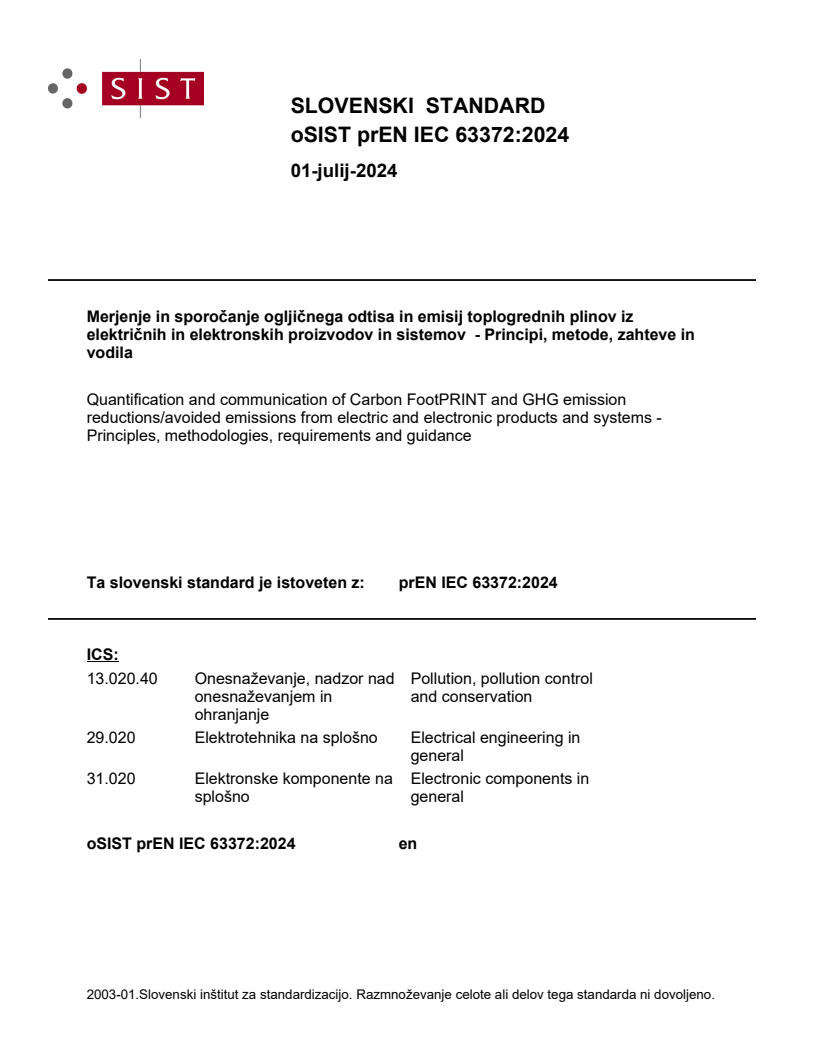
SLOVENSKI STANDARD
oSIST prEN IEC 63372:2024
01-julij-2024
Merjenje in sporočanje ogljičnega odtisa in emisij toplogrednih plinov iz
električnih in elektronskih proizvodov in sistemov - Principi, metode, zahteve in
vodila
Quantification and communication of Carbon FootPRINT and GHG emission
reductions/avoided emissions from electric and electronic products and systems -
Principles, methodologies, requirements and guidance
Ta slovenski standard je istoveten z: prEN IEC 63372:2024
ICS:
13.020.40 Onesnaževanje, nadzor nad Pollution, pollution control
onesnaževanjem in and conservation
ohranjanje
29.020 Elektrotehnika na splošno Electrical engineering in
general
31.020 Elektronske komponente na Electronic components in
splošno general
oSIST prEN IEC 63372:2024 en
2003-01.Slovenski inštitut za standardizacijo. Razmnoževanje celote ali delov tega standarda ni dovoljeno.
oSIST prEN IEC 63372:2024
oSIST prEN IEC 63372:2024
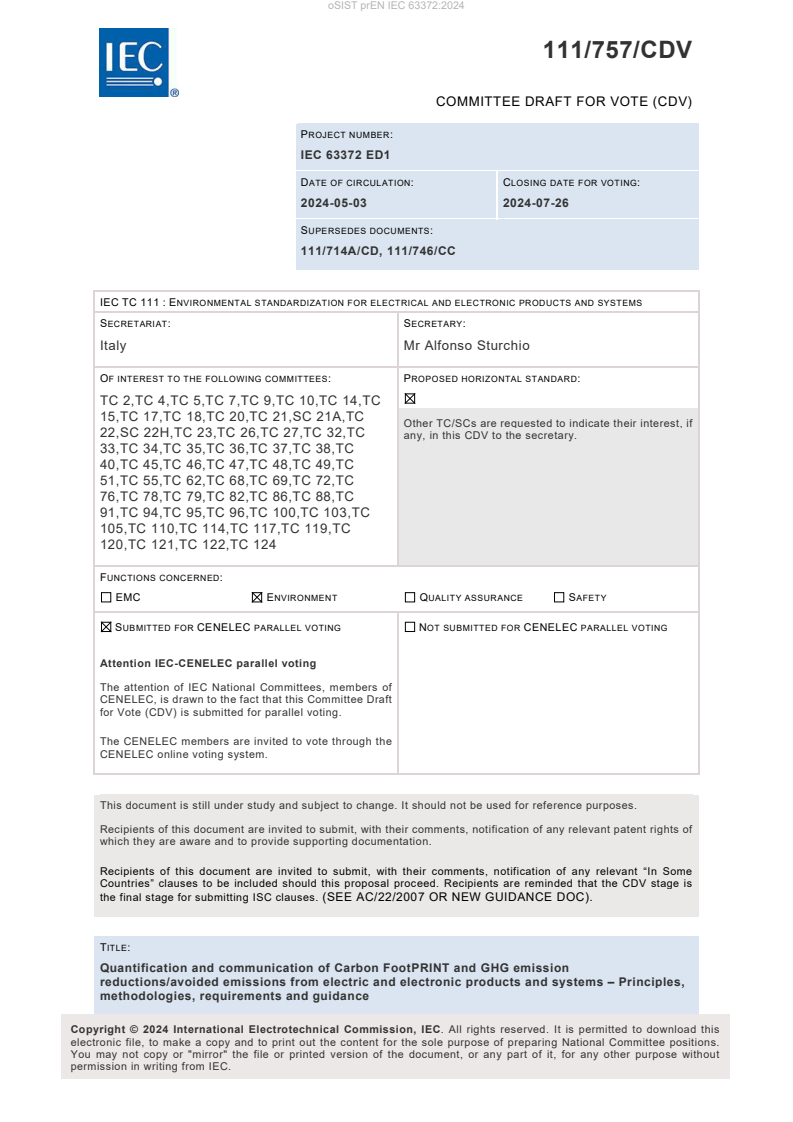
111/757/CDV
COMMITTEE DRAFT FOR VOTE (CDV)
PROJECT NUMBER:
IEC 63372 ED1
DATE OF CIRCULATION: CLOSING DATE FOR VOTING:
2024-05-03 2024-07-26
SUPERSEDES DOCUMENTS:
111/714A/CD, 111/746/CC
IEC TC 111 : ENVIRONMENTAL STANDARDIZATION FOR ELECTRICAL AND ELECTRONIC PRODUCTS AND SYSTEMS
SECRETARIAT: SECRETARY:
Italy Mr Alfonso Sturchio
OF INTEREST TO THE FOLLOWING COMMITTEES: PROPOSED HORIZONTAL STANDARD:
TC 2,TC 4,TC 5,TC 7,TC 9,TC 10,TC 14,TC
15,TC 17,TC 18,TC 20,TC 21,SC 21A,TC
Other TC/SCs are requested to indicate their interest, if
22,SC 22H,TC 23,TC 26,TC 27,TC 32,TC
any, in this CDV to the secretary.
33,TC 34,TC 35,TC 36,TC 37,TC 38,TC
40,TC 45,TC 46,TC 47,TC 48,TC 49,TC
51,TC 55,TC 62,TC 68,TC 69,TC 72,TC
76,TC 78,TC 79,TC 82,TC 86,TC 88,TC
91,TC 94,TC 95,TC 96,TC 100,TC 103,TC
105,TC 110,TC 114,TC 117,TC 119,TC
120,TC 121,TC 122,TC 124
FUNCTIONS CONCERNED:
EMC ENVIRONMENT QUALITY ASSURANCE SAFETY
SUBMITTED FOR CENELEC PARALLEL VOTING NOT SUBMITTED FOR CENELEC PARALLEL VOTING
Attention IEC-CENELEC parallel voting
The attention of IEC National Committees, members of
CENELEC, is drawn to the fact that this Committee Draft
for Vote (CDV) is submitted for parallel voting.
The CENELEC members are invited to vote through the
CENELEC online voting system.
This document is still under study and subject to change. It should not be used for reference purposes.
Recipients of this document are invited to submit, with their comments, notification of any relevant patent rights of
which they are aware and to provide supporting documentation.
Recipients of this document are invited to submit, with their comments, notification of any relevant “In Some
Countries” clauses to be included should this proposal proceed. Recipients are reminded that the CDV stage is
the final stage for submitting ISC clauses. (SEE AC/22/2007 OR NEW GUIDANCE DOC).
TITLE:
Quantification and communication of Carbon FootPRINT and GHG emission
reductions/avoided emissions from electric and electronic products and systems – Principles,
methodologies, requirements and guidance
electronic file, to make a copy and to print out the content for the sole purpose of preparing National Committee positions.
You may not copy or "mirror" the file or printed version of the document, or any part of it, for any other purpose without
permission in writing from IEC.
oSIST prEN IEC 63372:2024
– 2 – IEC CDV 63372 © IEC 2024
PROPOSED STABILITY DATE: 2030
NOTE FROM TC/SC OFFICERS:
Internal
oSIST prEN IEC 63372:2024
IEC CDV 63372 © IEC 2024 – 3 –
2 CONTENTS
3 FOREWORD . 6
4 INTRODUCTION . 8
5 1 Scope . 9
6 2 Normative references . 9
7 3 Terms, definitions, and abbreviated terms . 9
8 3.1 Terms related to greenhouse gas . 9
9 3.2 Terms related to the GHG quantification process . 11
10 3.2.1 Quantification of Carbon footprint (GHG emissions and GHG removals) . 11
11 3.2.2 Quantification of GHG emission reductions and avoided emissions . 16
12 3.2.3 Terms related to life cycle assessment . 19
13 3.3 Terms related to organizations and interested parties . 20
14 3.4 Terms related to verification and validation . 21
15 3.5 Abbreviated Terms . 21
16 4 Principles . 21
17 4.1 General . 21
18 4.2 Life Cycle Thinking (LCT). 21
19 4.3 Relevance . 21
20 4.4 Completeness . 22
21 4.5 Consistency . 22
22 4.6 Accuracy . 22
23 4.7 Transparency . 22
24 4.8 Conservativeness . 22
25 4.9 Priority of scientific approach . 22
26 4.10 Avoidance of double counting . 22
27 5 Strategy . 23
28 5.1 General . 23
29 5.2 View and pathway to low carbon society . 24
30 5.3 Strategy for application to system . 26
31 6 Quantification . 26
32 6.1 Carbon footprint of Product (CFP-PCR) . 26
33 6.1.1 General . 26
34 6.1.2 Goal and scope definition of quantification of CFP . 27
35 6.1.3 Functional or declared unit . 29
36 6.1.4 System boundary . 29
37 6.1.5 Trial estimation and decision on boundary setting . 32
38 6.1.6 Data collection and quality assessment . 33
39 6.1.7 Development of scenarios . 35
40 6.1.8 Allocation . 38
41 6.1.9 Calculating GHG emissions . 38
42 6.1.10 Impact assessment for CFP or partial CFP . 41
43 6.1.11 Interpretation of CFP or partial CFP . 42
44 6.1.12 Extrapolations rules, data identifications . 42
45 6.2 GHG emission reductions . 43
46 6.2.1 General . 43
47 6.2.2 Basic steps of GHG reduction study . 43
Internal
oSIST prEN IEC 63372:2024
– 4 – IEC CDV 63372 © IEC 2024
48 6.2.3 Defining the goal and scope . 44
49 6.2.4 Defining the EE product or the system related to GHG reductions . 44
50 6.2.5 Determining the baseline . 46
51 6.2.6 Selecting relevant GHG sources, sinks and reservoirs (SSRs) . 47
52 6.2.7 Trial estimation and decision on relevant GHG SSRs. 50
53 6.2.8 Estimating baseline emissions . 50
54 6.2.9 Data collection and quality assessment . 51
55 6.2.10 Estimating GHG reduction . 52
56 6.3 Avoided emissions . 53
57 6.3.1 General . 53
58 6.3.2 Defining the goal and scope . 54
59 6.3.3 Defining the target product . 55
60 6.3.4 Functional Unit . 55
61 6.3.5 Estimating baseline scenario . 55
62 6.3.6 Determining system boundary . 57
63 6.3.7 Data collection and quality assessment . 58
64 6.3.8 Calculating avoided emissions . 59
65 6.3.9 Sold Amount (Organization) . 59
66 6.3.10 Contribution ratio . 61
67 6.4 Performance tracking . 62
68 6.4.1 CFP performance tracking . 62
69 6.4.2 Tracking emission reductions and avoided emissions . 62
70 6.5 Documentation . 63
71 7 Verification and validation. 63
72 7.1 Specific guidance of monitoring for GHG emission reductions or avoided
73 emissions . 64
74 7.2 Validation of avoided emissions . 65
75 8 Communication and Disclosure . 65
76 8.1 General . 65
77 8.2 Managing double counting . 66
78 8.3 Special guidance for communication of CFP . 66
79 Annex A (informative) . 67
80 A.1 Examples of function and performance related to function . 67
81 A.2 Examples of functional requirements defining functional unit(s) . 67
82 Annex B (informative) Examples of calculation of GHG emissions . 70
83 B.1 Example of emission factory . 70
84 B.2 Examples of CFP calculation . 71
85 B.3 Example of equivalent energy mix for the manufacturing phase . 71
86 B.4 Example of equivalent energy mix for the use phase . 72
87 B.5 Example of GHG quantification due to leakage rate with or without refilling. Error!
88 Bookmark not defined.
89 Annex C (informative) General process for quantification of GHG emission reductions
90 and avoided emissions . 74
91 Annex D (informative) Examples of Avoided emissions . 75
92 D.1 Electrical equipment (General) . 75
93 D.2 Electrical equipment in a system (General) . 77
94 D.3 Final product - Heat pump . 78
95 D.4 Intermediate product in a product – DC-DC Converter for EV . 79
Internal
oSIST prEN IEC 63372:2024
IEC CDV 63372 © IEC 2024 – 5 –
96 D.5 Intermediate product in a product – Electric Vehicle (EV) battery in an EV . 81
97 D.6 System – Insulation products . 83
98 D.7 System – Storage hybrid cloud solution . 85
99 D.8 System in a bigger system . 87
100 D.9 System – Cooling technology system . 89
101 D.10 System – Energy Management System (EMS) of buildings. 90
102 D.11 Service – Image-based infrastructure inspection services . 92
103 D.12 Service – Virtual Desktop Services for telework . 94
104 D.13 Service – Health consultation . 96
105 D.14 Service – Virtual Power Purchase Agreements (VPPAs) . 97
106 Annex E (informative) Correspondence to GHG protocol’s Scope 1, 2 and 3 . 98
107 Annex F (informative) Rebound effect . 99
108 Annex G (informative) Example of calculation of contribution ratio . 100
109 Bibliography . 101
Internal
oSIST prEN IEC 63372:2024
– 6 – IEC CDV 63372 © IEC 2024
111 INTERNATIONAL ELECTROTECHNICAL COMMISSION
112 ____________
114 QUANTIFICATION AND COMMUNICATION OF CARBON FOOTPRINT AND
115 GHG EMISSION REDUCTIONS/AVOIDED EMISSIONS FROM ELECTRIC
116 AND ELECTRONIC PRODUCTS AND SYSTEMS – PRINCIPLES,
117 METHODOLOGIES, REQUIREMENTS AND GUIDANCE
119 FOREWORD
120 1) The International Electrotechnical Commission (IEC) is a worldwide organization for standardization comprising
121 all national electrotechnical committees (IEC National Committees). The object of IEC is to promote international
122 co-operation on all questions concerning standardization in the electrical and electronic fields. To this end and
123 in addition to other activities, IEC publishes International Standards, Technical Specifications, Technical Reports,
124 Publicly Available Specifications (PAS) and Guides (hereafter referred to as “IEC Publication(s)”). Their
125 preparation is entrusted to technical committees; any IEC National Committee interested in the subject dealt with
126 may participate in this preparatory work. International, governmental and non-governmental organizations liaising
127 with the IEC also participate in this preparation. IEC collaborates closely with the International Organization for
128 Standardization (ISO) in accordance with conditions determined by agreement between the two organizations.
129 2) The formal decisions or agreements of IEC on technical matters express, as nearly as possible, an international
130 consensus of opinion on the relevant subjects since each technical committee has representation from all
131 interested IEC National Committees.
132 3) IEC Publications have the form of recommendations for international use and are accepted by IEC National
133 Committees in that sense. While all reasonable efforts are made to ensure that the technical content of IEC
134 Publications is accurate, IEC cannot be held responsible for the way in which they are used or for any
135 misinterpretation by any end user.
136 4) In order to promote international uniformity, IEC National Committees undertake to apply IEC Publications
137 transparently to the maximum extent possible in their national and regional publications. Any divergence between
138 any IEC Publication and the corresponding national or regional publication shall be clearly indicated in the latter.
139 5) IEC itself does not provide any attestation of conformity. Independent certification bodies provide conformity
140 assessment services and, in some areas, access to IEC marks of conformity. IEC is not responsible for any
141 services carried out by independent certification bodies.
142 6) All users should ensure that they have the latest edition of this publication.
143 7) No liability shall attach to IEC or its directors, employees, servants or agents including individual experts and
144 members of its technical committees and IEC National Committees for any personal injury, property damage or
145 other damage of any nature whatsoever, whether direct or indirect, or for costs (including legal fees) and
146 expenses arising out of the publication, use of, or reliance upon, this IEC Publication or any other IEC
147 Publications.
148 8) Attention is drawn to the Normative references cited in this publication. Use of the referenced publications is
149 indispensable for the correct application of this publication.
150 9) Attention is drawn to the possibility that some of the elements of this IEC Publication may be the subject of patent
151 rights. IEC shall not be held responsible for identifying any or all such patent rights.
152 International Standard IEC 63372 has been prepared by IEC technical committee 111:
153 Environmental standardization for electrical and electronic products and systems.
154 The text of this International Standard is based on the following documents:
Draft Report on voting
XX/XX/FDIS XX/XX/RVD
155 Full information on the voting for its approval can be found in the report on voting indicated in
156 the above table.
157 The language used for the development of this International Standard is English].
158 This document was drafted in accordance with ISO/IEC Directives, Part 2, and developed in
159 accordance with ISO/IEC Directives, Part 1 and ISO/IEC Directives, IEC Supplement, available
160 at www.iec.ch/members_experts/refdocs. The main document types developed by IEC are
161 described in greater detail at http://www.iec.ch/standardsdev/publications.
Internal
oSIST prEN IEC 63372:2024
IEC CDV 63372 © IEC 2024 – 7 –
162 The committee has decided that the contents of this document will remain unchanged until the
163 stability date indicated on the IEC website under webstore.iec.ch in the data related to the
164 specific document. At this date, the document will be
165 • reconfirmed,
166 • withdrawn,
167 • replaced by a revised edition, or
168 • amended.
Internal
oSIST prEN IEC 63372:2024
– 8 – IEC CDV 63372 © IEC 2024
169 INTRODUCTION
170 Based on IPCC reports regarding global warming, there is broad understanding that greenhouse
171 gas (GHG) emissions must be significantly reduced in the coming 10 or more years. Products
172 and systems including ones called as solution composed of electric and electronic (EE) products,
173 operated and controlled by new digital technologies and methods such as AI, digital twins and
174 IoT can significantly change patterns of energy usage for energy intensive activities, although
175 having by themselves an environmental impact.
176 Such a change of the pattern of energy usage by adding a digital technology has the potential
177 to avoid GHG emissions represented by CO emission for energy intensive activities. Although
178 the EE products themselves lead to GHG emissions, the GHG emission of the complete activity
179 is significantly lowered, so that the net effect is a reduction of GHG emissions. As a
180 consequence of them expanding to meet future decarbonization needs, many EE businesses
181 will increase their total emissions (in contrast to e.g., a fossil fuel business that is scaling down
182 and showing reduced emissions) and many new products will be manufactured, creating
183 emissions that didn’t exist before. The concept of avoided emissions provides a way of showing
184 that they are still contributing a net improvement to society.
185 The necessity of a sector specific approach applicable to EE products and systems is
186 recognized by considering the specific characteristics of EE products which could include a
187 large quantity of components/materials in a product, dynamic, long, and complicated supply
188 chains, rapidly evolving technology, the complexity of production processes, and use/end-of-
189 life scenarios, etc., which can lead to considerable challenges in performing CFP, emission
190 reductions and avoided emissions.
191 Furthermore, manufacturers of products, systems composed of EE products need robust and
192 reliable calculation methods to establish the amount of avoided emissions caused by their
193 products, systems and solutions. One of important purpose for this standard is to define
194 methodologies which assess avoided emissions from the use of new technologies in an
195 unambiguous and transparent manner.
196 Use of this GHG standard allows the EE industry to declare or disclose the information about
197 GHG emissions, emission reductions and avoided emissions from any EE products, systems
198 on the basis of an international standard, linking social needs for GHG emission reductions.
199 Through the information disclosure based on this IEC standard, EE industry can claim fairly that
200 the products, services and systems can reduce/avoid users’ emissions and contribute to solving
201 societal issues directly linked with UN-SDG13 Climate Action.
202 This document refers to established methodologies stipulated by international standards such
203 as Life Cycle Assessment (LCA) methods covered by existing product specific rules (PSR) when
204 defined or to product category rules (PCR) when defined. See IEC 63336 CDV (Current status)
205 for EE products or ITU 1410 for ICT products and services or to ISO 14040 for any other
206 products and services.
207 The PCRs and PSRs address the climate change impact category within GHG emissions
208 quantification. The methodologies in this document are based on ISO 14064 series and
209 ISO 14067 which might be completed by GHG protocol methodologies if any.
Internal
oSIST prEN IEC 63372:2024
IEC CDV 63372 © IEC 2024 – 9 –
210 QUANTIFICATION AND COMMUNICATION OF CARBON FOOTPRINT AND
211 GHG EMISSION REDUCTIONS/AVOIDED EMISSIONS FROM ELECTRIC
212 AND ELECTRONIC PRODUCTS AND SYSTEMS – PRINCIPLES,
213 METHODOLOGIES, REQUIREMENTS AND GUIDANCE
215 1 Scope
216 This document describes principles and methodologies, specifies requirements and provides
217 guidance for GHG quantification and communication of Carbon footprint, emission reductions
218 and avoided emissions from electric and electronic (EE) products and systems. The GHG
219 quantification such as carbon footprint of product (CFP) is based on life cycle assessment (LCA)
220 methods.
221 This document is applicable to EE products, systems and EE product-related GHG project.
222 In accordance with IEC Guide 108, this basic essential horizontal standard is intended for use
223 by product committees as a starting point in preparing GHG quantification and communication
224 standards for their own product families. Specific requirements developed by product
225 committees in their standards take precedence over requirements in this standard.
226 When there is no specified standard available in a product committee, this generic essential
227 horizontal standard could be applied by GHG quantification and communication practitioners
228 with recorded complementary specifications.
229 2 Normative references
230 The following documents are referred to in the text in such a way that some or all of their content
231 constitutes requirements of this document. For dated references, only the edition cited applies.
232 For undated references, the latest edition of the referenced document (including any
233 amendments) applies.
234 IEC 63366, Product category rules for life cycle assessment of electrical and electronic products
235 and systems (CDV stage)
236 ISO14067:2018, Greenhouse gases — Carbon footprint of products — Requirements and
237 guidelines for quantification
238 3 Terms, definitions, and abbreviated terms
239 For the purposes of this document, the following terms and definitions apply.
240 ISO and IEC maintain terminological databases for use in standardization at the following
241 addresses:
242 IEC Electropedia: available at http://www.electropedia.org/
243 ISO Online browsing platform: available at http://www.iso.org/obp
244 3.1 Terms related to greenhouse gas
245 3.1.1
246 carbon dioxide equivalent
247 CO equivalent
Internal
oSIST prEN IEC 63372:2024
– 10 – IEC CDV 63372 © IEC 2024
248 CO e
249 unit for comparing the radiative forcing of a GHG to that of carbon dioxide
250 Note 1 to entry: Mass of a GHG is converted into CO equivalents by multiplying the mass of the GHG by the
251 corresponding GWP or GTP of that gas.
252 Note 2 to entry: In the case of GTP, CO equivalent is the unit for comparing the change in global mean surface
253 temperature caused by a GHG to the temperature change caused by CO .
254 [SOURCE: ISO 14067:2018, 3.1.2.2]
255 3.1.2
256 global warming potential
257 GWP
258 index, based on radiative properties of GHGs, measuring the radiative forcing following a pulse
259 emission of a unit mass of a given GHG in the present-day atmosphere integrated over a chosen
260 time horizon, relative to that of carbon dioxide (CO )
261 Note 1 to entry: “Index” as used in this document is a “characterization factor” as defined in ISO 14040:2006, 3.37.
262 Note 2 to entry: A “pulse emission” is an emission at one point in time.
263 Note 3 to entry: Always following “global warming potential values relative CO for greenhouse gas” IPCC latest
264 assessment report.
265 [SOURCE: ISO14067:2018, 3.1.2.4, modified — Note 3 to entry has been added.]
266 3.1.3
267 greenhouse gas
268 GHG
269 gaseous constituent of the atmosphere, both natural and anthropogenic, that absorbs and emits
270 radiation at specific wavelengths within the spectrum of infrared radiation emitted by the earth’s
271 surface, the atmosphere, and clouds
272 Note 1 to entry: For a list of GHGs, see the latest IPCC Assessment Report.
273 Note 2 to entry: Water vapour and ozone, which are anthropogenic as well as natural GHGs, are not included in the
274 CFP and partial CFP.
275 Note 3 to entry: The focus of this document is limited to long-lived GHGs, it therefore excludes climate effects due
276 to changes in surface reflectivity (albedo) and short-lived radiative forcing agents (e.g., black carbon and aerosols).
277 [SOURCE: ISO 14067:2018, 3.1.2.1]
278 3.1.4
279 greenhouse gas emission
280 GHG emission
281 release of a GHG into the atmosphere
282 [SOURCE: ISO 14067:2018, 3.1.2.5]
283 3.1.5
284 greenhouse gas emission factor
285 GHG emission factor
286 coefficient relating activity data with the GHG emission
287 [SOURCE: ISO 14067: 2018, 3.1.2.7]
Internal
oSIST prEN IEC 63372:2024
IEC CDV 63372 © IEC 2024 – 11 –
288 3.1.6
289 greenhouse gas removal
290 GHG removal
291 withdrawal of a GHG from the atmosphere
292 Note to entry: Examples of ways in which GHG removals can be achieved include carbon sequestration in soils,
293 direct air capture, carbon capture and storage.
294 [SOURCE: ISO 14067:2018, 3.1.2.6]
295 3.2 Terms related to the GHG quantification process
296 3.2.1 Quantification of Carbon footprint (GHG emissions and GHG removals)
297 3.2.1.1
298 allocation
299 partitioning the input or output flows of a process or a product system, correlating the product
300 system under study with one or more other product systems
301 [SOURCE: IEC TR 62725:2013, 3.1]
302 3.2.1.2
303 carbon emission intensity
304 CO emission intensity
305 carbon intensity
306 carbon metric expressed in relation to a specific reference unit related to the function of the
307 activity or to a location
308 Note to entry: carbon intensity of energy use can be electricity generation (renewable energy production such as
309 photovoltaic, wind turbine) or consumption (electrical loads).
310 3.2.1.3
311 carbon footprint of a product
312 CFP
313 sum of GHG emissions and GHG removals in a product system, expressed as CO equivalents
314 and based on a life cycle assessment using the single impact category of climate change
315 Note 1 to entry: A CFP can be disaggregated into a set of figures identifying specific GHG emissions and GHG
316 removals. A CFP can also be disaggregated into the stages of the life cycle.
317 Note 2 to entry: The results of the quantification of the CFP are documented in the CFP study report expressed in
318 mass of CO e per functional unit.
319 [SOURCE: ISO 14067:2018, 3.1.1.1]
320 3.2.1.4
321 carbon footprint of a product – product category rules
322 CFP-PCR
323 set of specific rules, requirements and guidelines for CFP or partial CFP quantification and
324 communication for one or more product categories
325 Note 1 to entry: CFP–PCR include quantification rules conforming to ISO 14044.
326 Note 2 to entry: ISO/TS 14027 describes the development of PCR applicable to this document.
Internal
oSIST prEN IEC 63372:2024
– 12 – IEC CDV 63372 © IEC 2024
327 [SOURCE: ISO 14067:2018, 3.1.1.10]
328 3.2.1.5
329 carbon footprint of a product study
330 CFP study
331 all activities that are necessary to quantify and report a CFP or a partial CFP
332 [SOURCE: ISO 14067:2018, 3.1.1.4]
333 3.2.1.6
334 carbon footprint of a product study report
335 CFP study report
336 report that documents the CFP study, presents the CFP or partial CFP, and shows the decisions
337 taken within the study
338 Note to entry: The CFP study report demonstrates that the provisions of this document are met.
339 [SOURCE: ISO14067:2018, 3.1.1.5]
340 3.2.1.7
341 declared unit
342 quantity of a product for use as a reference unit in the quantification of a partial CFP
343 EXAMPLE Mass (1 kg of primary steel), volume (1 m of crude oil).
344 [SOURCE: ISO 14067, 3.1.3.8]
345 3.2.1.8
346 direct greenhouse gas emission
347 direct GHG emission
348 greenhouse gas emission from greenhouse gas sources owned or controlled by an organization
349 [SOURCE: ISO 14050:2020, 3.9.9]
350 3.2.1.9
351 energy indirect greenhouse gas emission
352 energy indirect GHG emission
353 greenhouse gas emission from the generation of imported electricity, heat, or steam consumed
354 by an organization
355 [SOURCE: ISO 14050:2020, 3.9.11]
356 3.2.1.10
357 functional unit
358 LCA functional unit
359 main function(s) description and associated quantified performance of a product system for use
360 as a reference unit
361 Note 1 to entry: As the CFP treats information on a product basis, an additional calculation based on a declared unit
362 can be presented.
Internal
oSIST prEN IEC 63372:2024
IEC CDV 63372 © IEC 2024 – 13 –
363 [SOURCE: ISO 14067:2018, 3.1.3.7 modified — “main function(s) description and associated”
364 has been added.]
365 3.2.1.11
366 other indirect greenhouse gas emission
367 other indirect GHG emission
368 greenhouse gas emission, other than energy indirect GHG emissions, that is a consequence of
369 an organization’s activities, but arises from greenhouse gas sources that are owned or
370 controlled by other organizations
371 [SOURCE: ISO 14050:2020, 3.9.12]
372 3.2.1.12
373 partial carbon footprint of a product
374 partial CFP
375 sum of GHG emissions and GHG removals of one or more selected process(es) in a product
376 system, expressed as CO equivalents and based on the selected stages or processes within
377 the life cycle
378 Note 1 to entry: A partial CFP is based on or compiled from data related to (a) specific process(es) or footprint
379 information modules, which is (are) part of a product system and can form the basis for quantification of a CFP. More
380 detailed information on information modules is given in ISO 14025:2006, 5.4.
381 Note 2 to entry: “Footprint information modules” is defined in ISO 14026:2017, 3.1.4. Note 3 to entry: The results of
382 the quantification of the partial CFP are documented in the CFP study report expressed in mass of CO e per declared
383 unit.
384 [SOURCE: ISO 14067:2018, 3.1.1.2]
385 3.2.1.13
386 primary data
387 quantified value of a process or an activity obtained from a direct measurement or a calculation
388 based on direct measurements
389 Note 1 to entry: Primary data need not necessarily originate from the product system under study because primary
390 data might relate to a different but comparable product system to that being studied.
391 Note 2 to entry: Primary data can include GHG emission factors and/or GHG activity data (defined in ISO 14064-
392 1:2006, 2.11).
393 [SOURCE: ISO 14067:2018, 3.1.6.1]
394 3.2.1.14
395 process
396 set of interrelated or interacting activities that transforms inputs into outputs
397 [SOURCE: ISO 14067:2018, 3.1.3.5]
398 3.2.1.15
399 product
400 goods or service
401 Note 1 to entry: The product can be categorized as follows:
402 — service (e.g., transport, implementation of events);
403 — software (e.g., computer program);
Internal
oSIST prEN IEC 63372:2024
– 14 – IEC CDV 63372 © IEC 2024
404 — hardware (e.g., engine mechanical part);
405 — processed material (e.g., lubricant, ore, fuel);
406 — unprocessed material (e.g., agricultural product).
407 Note 2 to entry: Services have tangible and intangible elements. Provision of a service can involve, for example, the
408 following:
409 — an activity performed on a customer-supplied tangible product (e.g., automobile to be repaired);
410 — an activity performed on a customer-supplied intangible product (e.g., the income statement needed to prepare a
411 tax return);
412 — the delivery of an intangible product (e.g., the delivery of information in the context of knowledge transmission);
413 — the creation of ambience for the customer (e.g., in hotels and restaurants).
414 [SOURCE: ISO 14067:2018, 3.1.3.1]
415 3.2.1.16
416 intermediate product
417 goods, semi-finished product, system or software product of the development process that is
418 used as inputs to other stages of the development process or in the production of other product
419 including final products
420 [SOURCE: ISO/IEC 25041:2012, 4.10, modified — “goods, semi-finished product” and “or in
421 the production of other product including final products” have been added.]
422 3.2.1.17
423 product category
424 group of products that can fulfil equivalent functions
425 Note to entry: “Product category” is defined by a set of product families.
426 [SOURCE: ISO 14067:2018, 3.1.1.8, modified — note to entry has been added.]
427 3.2.1.18
428 product category rules
429 PCR
430 set of specific rules, requirements, and guidelines for developing Type III environmental
431 declarations and footprint communications for one or more product categories
432 Note 1 to entry: PCR include quantification rules conforming to ISO 14044.
433 Note 2 to entry: ISO/TS 14027 describes the development of PCR applicable to this document.
434 Note 3 to entry: “Footprint communication” is defined in ISO 14026:2017, 3.1.1.
435 [SOURCE: ISO 14067:2018, 3.1.1.9]
436 3.2.1.19
437 product family
438 set of products or services sharing explicitly defined and managed common and variable features and
439 relying on the same domain architecture to meet the common and variable needs of specific markets
440 Note to entry: “Product families” are defined by product standards and could need product specific rules (PSRs),
441 “product range” are defined by manufacturers.
Internal
oSIST prEN IEC 63372:2024
IEC CDV 63372 © IEC 2024 – 15 –
442 [SOURCE: ISO/IEC 26550:2015 Software and systems engineering — Reference model for
443 product line engineering and management, 3.16 modified — note to entry has been added.]
444 3.2.1.20
445 product specific rules
446 PSR
447 set of specific rules, requirements and guidelines, based upon and complementing the PCR, for
448 a specific product family
449 Note to entry: PCR and PSR are comparative concepts. To ensure consistency in IEC community, PCR refer to rules
450 at EE products and systems level, and PSR refer to rules at product committee level.
451 [SOURCE: IEC CDV 63366:202X, 3.32]
452 3.2.1.21
453 product system
454 collection of unit processes with elementary flows and product flows, performing one or more
455 defined functions and which models the life cycle of a product
456 Note to entry: “Product flow” is defined in ISO 14040:2006, 3.27.
457 [SOURCE: ISO 14067:2018, 3.1.3.2]
458 3.2.1.22
459 reference service life
460 RSL
461 representative time period where a product in use meets or exceeds the performance
462 requirements
463 [SOURCE: ISO 14067:2018, 3.1.3.11 modified — “reference” and “representative” have been
464 added.]
465 3.2.1.23
466 secondary data
467 data which do not fulfil the requirements for primary data
468 Note 1 to entry: Secondary data can include data from databases and published literature, default emission factors
469 from national inventories, calculated data, estimates or other representative data, validated by competent authorities.
470 Note 2 to entry: Secondary data can include data obtained from proxy processes or estimates.
471 [SOURCE: ISO14067:2018, 3.1.6.3]
472 3.2.1.24
473 system boundary
474 boundary based on a set of criteria representing which unit processes are a part of the system
475 under study
476 Note 1 to entry: The system boundary is closely related to the product system and cut-off. The system boundary defines the
477 wider system (e.g., the Internet) in which the studied product system (e.g., a specific radio access network) exist. The cut-off is
478 made from the studied product system.
479 Note 2 to entry: The system boundary enables identifying operational boundary, so respective emissions associated with its
480 operations, categorizing them as direct GHG emissions and indirect GHG emissions.
Internal
oSIST prEN IEC 63372:2024
– 16 – IEC CDV 63372 © IEC 2024
481 [SOURCE: ISO 14067:2018, 3.1.3.4, modified — Note 1 to entry and Note 2 to entry have
482 been added.]
483 3.2.1.25
484 uncertainty
485 parameter associated with the result of quantification that characterizes the dispersion of the
486 values that could be reasonably attributed to the quantified amount
487 Note 1 to entry: Uncertainty can include, for example:
488 — parameter uncertainty, e.g. GHG emission factors, activity data;
489 — scenario uncertainty, e.g. use stage scenario, end-of-life stage scenario;
490 — model uncertainty.
491 Note 2 to entry: Uncertainty information typically specifies quantitative estimates of the likely dispersion of values
492 and a qualitative description of the likely causes of the dispersion.
493 [SOURCE: ISO14067:2018, 3.1.6.4]
494 3.2.2 Quantification of GHG emission reductions and avoided emissions
495 3.2.2.1
496 assessed product
497 product or system that the related GHG emissions are assessed in a study of the GHG emission
498 reductions or avoided emissions
499 [SOURCE: IEC TR 62726:2014, 3.1, modified — “system that the related GHG emission" and
500 “in a study of GHG emissions reductions or avoided emissions” have been added. “whose
501 related GHG emissions are” and “for a product-related project” has been deleted.]
502 3.2.2.2
503 avoided emissions
504 avoided greenhouse gas emissions
505 greenhouse gas emission reduction that occurs outside the organization boundaries of the
506 reporting organization as a quantifiable consequence to a situation of the use of its product,
507 system or project compared to a baseline scenario
508 Note to entry: Avoided emissions cover the user value of GHG emissions reductions compared to a reference situation. It does
509 not cover the GHG emission reductions related to direct GHG emissions, energy indirect GHG emissions and other indirect
510 GHG emissions of reporting organization.
511 [SOURCE: ISO 14050:2020 3.9.16 modified — “direct” has been changed to “quantifiable”. “to
512 a situation”, “system, or project or project compared to a baseline scenario” and “Note to
513 entry” have been added.]
514 3.2.2.3
515 baseline
516 current or future state relative to which the assessment is performed
517 3.2.2.4
518 baseline scenario
519 estimated reference situation that best represents the conditions most likely to occur in the
520 absence of a target product or assessed product, system or project
Internal
oSIST prEN IEC 63372:2024
IEC CDV 63372 © IEC 2024 – 17 –
521 [SOURCE: IEC TR 62726:2014, 3.2 modified — “hypothetical” has been changed to
522 “estimated”, “proposed greenhouse gas project” has been changed to “target product or
523 assessed product, system or project
...
Questions, Comments and Discussion
Ask us and Technical Secretary will try to provide an answer. You can facilitate discussion about the standard in here.
Loading comments...