


EN 50286:2025
(Main)Electrical insulating protective clothing for low-voltage installations
General Information
- Abstract
This document is applicable to electrical insulating protective clothing used by skilled persons when they are working on or near live parts of low-voltage installations at nominal voltages up to 500 V AC. The purpose of this clothing is to prevent dangerous current from passing through persons when there is a risk of unintentional contact with several live parts located in and around the working area. This document does not deal with protection against the effects of an electric arc, DC applications and voltages higher than 500 AC. The products designed and manufactured according to this document contribute to the safety of the users provided they are used by skilled persons, in accordance with safe methods of work and the instructions for use.
- Status
- Published
- Publication Date
- 16-Oct-2025
- Technical Committee
- CLC/TC 78 - Equipment and tools for live working
- Drafting Committee
- CLC/TC 78/WG 7 - Revision of EN 50365
- Current Stage
- 6060 - Document made available - Publishing
- Start Date
- 17-Oct-2025
- Due Date
- 01-Nov-2020
- Completion Date
- 17-Oct-2025
- Mandate
- M/PPE - PPE

Overview
EN 50286:2025 - published by CLC/CENELEC - specifies requirements for electrical insulating protective clothing for low‑voltage installations. It applies to garments used by skilled persons working on or near live parts at nominal voltages up to 500 V AC. The standard aims to prevent dangerous current passing through the wearer in cases of unintentional contact with multiple live parts. It supersedes EN 50286:1999 and is recognized as PPE under Regulation 2016/425. The document does not cover protection against electric-arc effects, DC applications or voltages above 500 V AC.
Key topics and technical requirements
- Scope and definitions: clear terms for electrical insulating protective clothing, seams, tests (type, routine, proof, sampling, acceptance).
- Design requirements:
- Full-body protection via a jacket with hood + trousers or an overall with hood.
- No metal parts on the outside; bright colours recommended (red suggested).
- Size and fit to be worn over normal work clothing; overlap between jacket and trousers required for two-piece suits.
- Limited pockets (one jacket, one trouser; or two on overall) with flaps and hook-and-loop fasteners.
- Insulating zip fasteners or covered metal components; closure flaps and cuff closures.
- Securely attached hood compatible with face shields and insulating helmets; trousers with braces.
- Performance requirements:
- Non-electrical: tensile strength, tear resistance, limited flame spread, laundering/cleaning effects, dimensional stability.
- Electrical: proof tests, electrical type tests and periodic electrical inspections (no single withstand test for unintentional contact currently defined).
- Testing and conformity:
- Type tests, routine tests, acceptance and sampling tests, methods for assessing defects and verification.
- New additions include classification and rationale for defects, updated testing conditions and pre‑conditioning.
- Marking and instructions: requirements for labelling, user instructions, inspection and maintenance guidance.
Applications and users
- Intended for live working on low‑voltage installations (e.g., overhead lines, distribution equipment) by electricians and skilled live‑line workers.
- Useful to: PPE manufacturers, safety managers, conformity assessors, procurement teams, and occupational health & safety professionals specifying compliant insulating clothing.
- Practical benefits: reduces risk of dangerous body currents during unintentional contact, supports regulatory compliance, and provides requirements for manufacturing, testing and user instructions.
Related standards
Key referenced documents include:
- EN ISO 13688 (protective clothing - general requirements)
- EN 60060-1 / EN 60060-2 (high‑voltage test techniques)
- EN IEC 61318 (methods for assessment of defects and verification)
- Textile and test standards: EN ISO 811, EN ISO 13934‑1, EN ISO 4674‑1, among others.
For organisations specifying or supplying insulating protective clothing, EN 50286:2025 is the essential European standard for design, testing and safe use on low‑voltage live working up to 500 V AC.
Relations
- Effective Date
- 23-Jan-2023
- Effective Date
- 09-Feb-2026
- Effective Date
- 09-Feb-2026
- Effective Date
- 09-Feb-2026
- Effective Date
- 09-Feb-2026
- Effective Date
- 09-Feb-2026
- Effective Date
- 09-Feb-2026
- Effective Date
- 09-Feb-2026
- Effective Date
- 09-Feb-2026
- Effective Date
- 09-Feb-2026
- Effective Date
- 09-Feb-2026
- Refers
EN 60060-1:2010 - High-voltage test techniques - Part 1: General definitions and test requirements - Effective Date
- 03-Feb-2026
- Effective Date
- 03-Feb-2026
- Effective Date
- 03-Feb-2026
- Effective Date
- 03-Feb-2026
Get Certified
Connect with accredited certification bodies for this standard

CIS Institut d.o.o.
Personal Protective Equipment (PPE) certification body. Notified Body NB-2890 for EU Regulation 2016/425 PPE.

Kiwa BDA Testing
Building and construction product certification.
Kmetijski inštitut Slovenije
Agricultural Institute of Slovenia. Soil testing, plant health, agricultural product analysis.
Sponsored listings
Frequently Asked Questions
EN 50286:2025 is a standard published by CLC. Its full title is "Electrical insulating protective clothing for low-voltage installations". This standard covers: This document is applicable to electrical insulating protective clothing used by skilled persons when they are working on or near live parts of low-voltage installations at nominal voltages up to 500 V AC. The purpose of this clothing is to prevent dangerous current from passing through persons when there is a risk of unintentional contact with several live parts located in and around the working area. This document does not deal with protection against the effects of an electric arc, DC applications and voltages higher than 500 AC. The products designed and manufactured according to this document contribute to the safety of the users provided they are used by skilled persons, in accordance with safe methods of work and the instructions for use.
This document is applicable to electrical insulating protective clothing used by skilled persons when they are working on or near live parts of low-voltage installations at nominal voltages up to 500 V AC. The purpose of this clothing is to prevent dangerous current from passing through persons when there is a risk of unintentional contact with several live parts located in and around the working area. This document does not deal with protection against the effects of an electric arc, DC applications and voltages higher than 500 AC. The products designed and manufactured according to this document contribute to the safety of the users provided they are used by skilled persons, in accordance with safe methods of work and the instructions for use.
EN 50286:2025 is classified under the following ICS (International Classification for Standards) categories: 13.260 - Protection against electric shock. Live working; 13.340.10 - Protective clothing. The ICS classification helps identify the subject area and facilitates finding related standards.
EN 50286:2025 has the following relationships with other standards: It is inter standard links to EN 50286:1999, EN ISO 13688:2013, EN 343:2019, EN ISO 13688:2013/A1:2021, EN ISO 5077:2008, EN ISO 15025:2016, EN ISO 811:2018, EN ISO 11092:2014, EN ISO 4674-1:2016, EN ISO 13937-2:2000, EN ISO 13934-1:2013, EN 60060-1:2010, EN 60060-2:2011, EN IEC 61318:2021, EN 60529:1991. Understanding these relationships helps ensure you are using the most current and applicable version of the standard.
EN 50286:2025 is associated with the following European legislation: EU Directives/Regulations: 2016/425; Standardization Mandates: M/571, M/571 Amd 1, M/571 Amd 1, M/PPE. When a standard is cited in the Official Journal of the European Union, products manufactured in conformity with it benefit from a presumption of conformity with the essential requirements of the corresponding EU directive or regulation.
EN 50286:2025 is available in PDF format for immediate download after purchase. The document can be added to your cart and obtained through the secure checkout process. Digital delivery ensures instant access to the complete standard document.
Standards Content (Sample)
SLOVENSKI STANDARD
01-december-2025
Nadomešča:
SIST EN 50286:2000
Električno izolacijska zaščitna oblačila za delo na nizkonapetostnih inštalacijah
Electrical insulating protective clothing for low-voltage installations
Elektrisch isolierende Schutzkleidung für Arbeiten an Niederspannungsanlagen
Vêtements de protection isolants pour installations basse tension
Ta slovenski standard je istoveten z: EN 50286:2025
ICS:
13.260 Varstvo pred električnim Protection against electric
udarom. Delo pod napetostjo shock. Live working
13.340.10 Varovalna obleka Protective clothing
2003-01.Slovenski inštitut za standardizacijo. Razmnoževanje celote ali delov tega standarda ni dovoljeno.
EUROPEAN STANDARD EN 50286
NORME EUROPÉENNE
EUROPÄISCHE NORM October 2025
ICS 13.260; 13.340.10 Supersedes EN 50286:1999
English Version
Electrical insulating protective clothing for low-voltage
installations
Vêtements de protection isolants électriques pour Elektrisch isolierende Schutzkleidung für Arbeiten an
installations basse tension Niederspannungsanlagen
This European Standard was approved by CENELEC on 2025-08-18. CENELEC members are bound to comply with the CEN/CENELEC
Internal Regulations which stipulate the conditions for giving this European Standard the status of a national standard without any alteration.
Up-to-date lists and bibliographical references concerning such national standards may be obtained on application to the CEN-CENELEC
Management Centre or to any CENELEC member.
This European Standard exists in three official versions (English, French, German). A version in any other language made by translation
under the responsibility of a CENELEC member into its own language and notified to the CEN-CENELEC Management Centre has the
same status as the official versions.
CENELEC members are the national electrotechnical committees of Austria, Belgium, Bulgaria, Croatia, Cyprus, the Czech Republic,
Denmark, Estonia, Finland, France, Germany, Greece, Hungary, Iceland, Ireland, Italy, Latvia, Lithuania, Luxembourg, Malta, the
Netherlands, Norway, Poland, Portugal, Republic of North Macedonia, Romania, Serbia, Slovakia, Slovenia, Spain, Sweden, Switzerland,
Türkiye and the United Kingdom.
European Committee for Electrotechnical Standardization
Comité Européen de Normalisation Electrotechnique
Europäisches Komitee für Elektrotechnische Normung
CEN-CENELEC Management Centre: Rue de la Science 23, B-1040 Brussels
© 2025 CENELEC All rights of exploitation in any form and by any means reserved worldwide for CENELEC Members.
Ref. No. EN 50286:2025 E
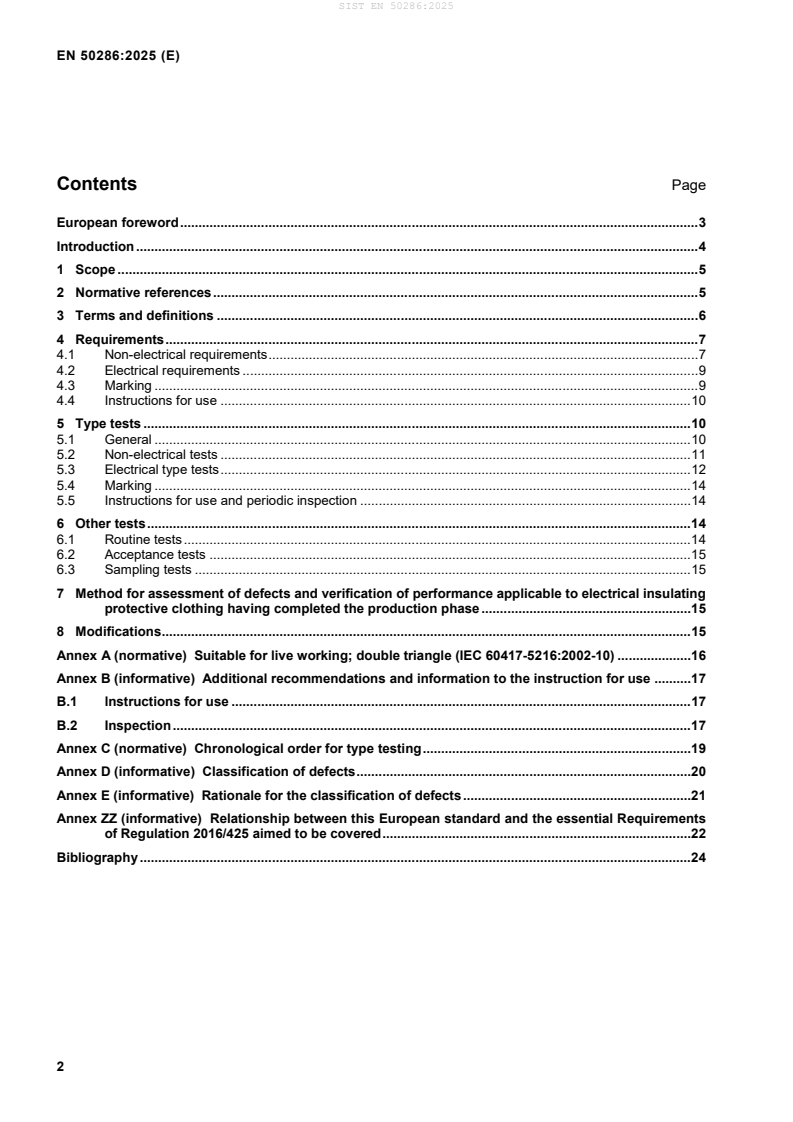
Contents Page
European foreword . 3
Introduction . 4
1 Scope . 5
2 Normative references . 5
3 Terms and definitions . 6
4 Requirements . 7
4.1 Non-electrical requirements . 7
4.2 Electrical requirements . 9
4.3 Marking . 9
4.4 Instructions for use . 10
5 Type tests . 10
5.1 General . 10
5.2 Non-electrical tests . 11
5.3 Electrical type tests . 12
5.4 Marking . 14
5.5 Instructions for use and periodic inspection . 14
6 Other tests . 14
6.1 Routine tests . 14
6.2 Acceptance tests . 15
6.3 Sampling tests . 15
7 Method for assessment of defects and verification of performance applicable to electrical insulating
protective clothing having completed the production phase . 15
8 Modifications . 15
Annex A (normative) Suitable for live working; double triangle (IEC 60417-5216:2002-10) . 16
Annex B (informative) Additional recommendations and information to the instruction for use . 17
B.1 lnstructions for use . 17
B.2 Inspection . 17
Annex C (normative) Chronological order for type testing . 19
Annex D (informative) Classification of defects . 20
Annex E (informative) Rationale for the classification of defects . 21
Annex ZZ (informative) Relationship between this European standard and the essential Requirements
of Regulation 2016/425 aimed to be covered . 22
Bibliography . 24
European foreword
This document (EN 50286:2025) has been prepared by CLC/TC 78, “Equipment and tools for live working”.
The following dates are fixed:
• latest date by which this document has to be (dop) 2026-10-31
implemented at national level by publication of
an identical national standard or by
endorsement
• latest date by which the national standards (dow) 2028-10-31
conflicting with this document have to be
withdrawn
This document supersedes EN 50286:1999 and all of its amendments and corrigenda (if any).
— update of referenced documents;
— update definitions and terms;
— addition of tear resistance and tensile strength;
— addition of change due to laundering and cleaning;
— up-date of marking and instruction for use;
— up-date on testing conditions;
— update on pre-conditioning;
— up-date of conformity assessment;
— addition of Annex D on classification of defects;
— addition of Annex E on rationale of classification of defects;
— addition of Annex ZZ.
Attention is drawn to the possibility that some of the elements of this document may be the subject of patent
rights. CENELEC shall not be held responsible for identifying any or all such patent rights.
This document has been prepared under a standardization request addressed to CENELEC by the European
Commission. The Standing Committee of the EFTA States subsequently approves these requests for its
Member States.
For the relationship with EU Legislation, see informative Annex ZZ, which is an integral part of this document.
Any feedback and questions on this document should be directed to the users’ national committee. A complete
listing of these bodies can be found on the CENELEC website.
Introduction
This document complies with the electrical insulating requirements set out by CLC/TC 78 and with the non-
electrical requirements set out by CEN/TC 162. This insulating clothing is recognized as a PPE according to
PPE Regulation 2016-425.
Electrical insulating protective clothing was developed primarily for use by workers for work on low-voltage
overhead lines.
For the moment, there is no withstand test applicable to products where the principle risk is of unintentional
contact with live parts, and such a test is not included in the present document. However, despite this Iack, it is
considered that a satisfactory Ievel of electrical protection is provided by compliance with this document for both
the proof tests and the periodic electrical inspections.
For the moment, no test is available in relation to the risk of workers exposure to an electrical arc generated by
Iow-voltage installations. This task is presently under study by CLC/TC 78 WG 7.
This document has been drafted in accordance with the ISO/IEC Directives, Part 2.
Terms and definitions defined in Clause 3 are given in italic print throughout this document.
1 Scope
This document is applicable to electrical insulating protective clothing used by skilled persons when they are
working on or near live parts of low-voltage installations at nominal voltages up to 500 V AC.
The purpose of this clothing is to prevent dangerous current from passing through persons when there is a risk
of unintentional contact with several live parts located in and around the working area.
This document does not deal with protection against the effects of an electric arc, DC applications and voltages
higher than 500 AC.
The products designed and manufactured according to this document contribute to the safety of the users
provided they are used by skilled persons, in accordance with safe methods of work and the instructions for
use.
2 Normative references
The following documents are referred to in the text in such a way that some or all of their content constitutes
requirements of this document. For dated references, only the edition cited applies. For undated references, the
latest edition of the referenced document (including any amendments) applies.
EN 343:2019, Protective clothing - Protection against rain
EN 60060-1:2010, High-voltage test techniques - Part 1: General definitions and test requirements
EN 60060-2:2011, High-voltage test techniques - Part 2: Measuring systems
EN 60529:1991, Degrees of protection provided by enclosures (IP Code)
EN IEC 61318:2021, Live working - Methods for assessment of defects and verification of performance
applicable to tools, devices and equipment
EN ISO 811:2018, Textiles - Determination of resistance to water penetration - Hydrostatic pressure test (ISO
811:2018)
EN ISO 4674-1:2016, Rubber- or plastics-coated fabrics - Determination of tear resistance - Part 1: Constant
rate of tear methods (ISO 4674-1:2016)
EN ISO 5077:2008, Textiles - Determination of dimensional change in washing and drying (ISO 5077:2007)
EN ISO 11092:2014, Textiles - Physiological effects - Measurement of thermal and water-vapour resistance
under steady-state conditions (sweating guarded-hotplate test) (ISO 11092:2014)
EN ISO 13688:2013 , Protective clothing - General requirements (ISO 13688:2013)
EN ISO 13934-1:2013, Textiles - Tensile properties of fabrics - Part 1: Determination of maximum force and
elongation at maximum force using the strip method (ISO 13934-1:2013)
EN ISO 13937-2:2000, Textiles - Tear properties of fabrics - Part 2: Determination of tear force of trouser-
shaped test specimens (Single tear method) (ISO 13937-2:2000)
EN ISO 15025:2016, Protective clothing - Protection against flame - Method of test for limited flame spread (ISO
15025:2016)
As impacted by EN ISO 13688:2013/A1:2021.
3 Terms and definitions
For the purposes of this document, the following terms and definitions apply.
ISO and IEC maintain terminology databases for use in standardization at the following addresses:
— IEC Electropedia: available at https://www.electropedia.org/
— ISO Online browsing platform: available at https://www.iso.org/obp
3.1
electrical insulating protective clothing
protective clothing which prevents dangerous current from passing through the human body
Note 1 to entry: Jacket with hood, trousers and overall are articles of the protective clothing.
3.2
seam
junction of two edges of material which are permanently joined by sewing or any other method
3.3
tests
3.3.1
acceptance test
contractual test to prove to the customer that the article of clothing meets certain conditions of its specification
[SOURCE: IEC 60050-151:2020, 151-16-23, modified – “item” is replaced by “article of clothing”]
3.3.2
proof test
test to demonstrate the safety of the equipment for work by evaluating of the capability of
the insulating material or product under prescribed test conditions to conform with applicable rating
Note 1 to entry: An AC proof test typically involves applying a voltage corresponding to a temporary overvoltage higher than
the equipment's nominal operating voltage for a specified period.
3.3.3
routine test
conformity test made on each article of clothing during or after manufacture
[SOURCE: IEC 60050-151:2020, 151-16-17, modified – “item” is replaced by “article of clothing”]
3.3.4
sampling test
test performed on a number of articles of clothing taken at random from a batch
3.3.5
type test
conformity test made on one or more articles of clothing representative of the production
[SOURCE: IEC 60050-151: 2020, 151-16-16, modified – “items” is replaced by “articles of clothing]”
4 Requirements
4.1 Non-electrical requirements
4.1.1 General
General requirements for electrical insulating protective clothing for low-voltage installations which are not
specifically covered in this this document shall be in accordance with EN ISO 13688:2013 .
4.1.2 Design requirements
The electrical insulating protective clothing shall consist the full protection of the body by using a jacket with
hood and trousers or an overall with a hood.
No metal parts shall be on the outside of the electrical insulating protective clothing.
The colour of the electrical insulating protective clothing shall be bright.
A red colour is recommended. This colour may differ from colour code marking of the label (If used, the IEC
code for Class 00 is beige).
4.1.3 Size designation and fit
The design of the electrical insulating protective clothing shall be in accordance with the requirements of
EN ISO 13688:2013 , Clause 6.
The dimensions of the electrical insulating protective clothing shall be selected in such a way that this clothing
can be worn over the normal working clothing. The bottoms of the trousers or overall legs shall be wide enough
to be worn over footwear.
Where protection is provided by a two-piece suit, sufficient overlap shall be ensured. It shall be determined, that
when correctly sized for the wearer, an overlap between the jacket and trousers remains when one standing
wearer firstly fully extends both arms above the head and then bends over until the fingertips touch the ground
when tested according to 5.2.1
4.1.4 Pockets and flaps
The number of pockets in the protective clothing shall be limited to two. The protective suit shall have one pocket
for the jacket and one for the trousers. The protective overall shall have two pockets located in similar positions.
One pocket shall be placed at the chest Ievel to the jacket or the overall. One pocket shall be placed laterally to
the thigh to the trousers. The pockets shall be equipped with flaps which shall have hook and loop fasteners.
All flaps shall be at least 20 mm wider than the opening (at least 10 mm on each side) to prevent the flap from
being tucked into the pocket.
4.1.5 Closures and seams
All seams, except hem-seams, shall be made in such a way that they do not impair the electrical properties.
Cuffs shall be provided with closures to reduce their width.
Any zip-fasteners necessary to close the jacket, the trousers or the overall shall be made from insulating
material. However, if metal parts are used for the slider or for the terminal pieces of the zip-fastener, they shall
be covered with insulating material.
The closures shall be designed with a protective cover flap on the outside of the clothing.
The length of the zip-fastener shall correspond to the design of the jacket or the overall. The slide fastener of
the zipper shall be designed to lock when completely closed. The flap shall be equipped with a hook and loop
fastener, which covers at least the whole length of the zip-fastener.
The trousers shall be equipped with a fly which is closed over its length by a zip-fastener. The fly shall be
covered by a flap which shall have a hook and loop fastener over the whole length.
4.1.6 Additional requirements
The hood shall be securely attached to the jacket or overall.
The hood front edge shall be designed to fit closely to the face, face shields and/or to the insulating helmets. If
a cord is used, it shall be made of electrical insulating material, shall be flame retardant and shall be taken into
a cord tunnel.
The trousers shall be equipped with braces which shall be securely connected to the trousers and shall be
adjustable or elasticated.
4.1.7 Limited flame spread
To prevent the risk of increase of injury if the clothing becomes inflamed the following requirements for the
limited flame spread shall be applied.
All outer layer and innermost layer materials except for an intermediate layer that is used for specific protection
other than heat protection, for example electrical insulation, shall fulfil the requirements listed in Table 1 (testing
in accordance with 5.2.2):
Table 1 — Outer and innermost layer materials
Property Requirement
Flame spread No test specimen shall permit any part of the lowest boundary of any flame to
reach the upper or either vertical edge.
Flaming debris No test specimen shall give flaming or molten debris.
Hole formation No test specimen shall give hole formation of 5 mm or greater in any direction,
except for an interlining that is used for specific protection other than heat and
flame protection.
Afterglow Afterglow time shall be ≤ 2 s.
A glowing inside the charred area is defined in EN ISO 15025:2016 as
afterglow without combustion and for the purpose of this clause is not regarded
as afterglow.
After-flame After-flame time shall be ≤ 2 s.
4.1.8 Tear resistance
Woven and laminated outer material shall have a tear resistance of at least 15 N for weight higher than 220 g/m
or at least 10 N for weight of 220 g/m or below in the machine and the cross directions when tested according
to 5.2.3.
4.1.9 Tensile strength
Woven and laminated outer material shall have a tensile strength of at least 400 N for weight higher than
2 2
220 g/m or at least 250 N for weight of 220 g/m or below in the machine and the cross directions when tested
according to 5.2.4.
4.1.10 Water-vapour resistance
The textile material water-vapour resistance R value shall not exceed 25 Pa*m /W according class 3 of Table 3
et
of EN 343:2019 (testing in accordance with 5.2.5).
4.1.11 Water penetration
The first water-drop on the textile material as well as the seams shall not penetrate below 13 000 Pa according
class 3 of EN 343:2019 (testing in accordance with 5.2.6).
4.1.12 Dimensional change due to laundering and/or cleaning
Woven and laminated outermost and innermost material shall have a dimensional change not exceeding ± 3 %
in either length or width direction when tested according to 5.2.7.
Knitted outermost and innermost material shall have a dimensional change not exceeding ± 5 % when tested
according to 5.2.7.
NOTE To verify the shrinkage of each single layer in a multi-layer assembly, it can be helpful to test the assembly
closed by sewing around the edges.
4.2 Electrical requirements
The protective clothing material shall pass a dielectrical proof test, in accordance with 5.3.2, of:
— 2,5 kV under dry conditions;
— 2,0 kV under moisture conditions;
— 1,5 kV after rain.
4.3 Marking
The marking shall meet the general requirements of marking in EN ISO 13688:2013 , 7.1.
The outer side of each of the flaps of the pockets on the jacket, trousers and overall shall be marked with the
symbol double triangle with the height of the Figure X = 16 mm or 25 mm (see Figure A.1) assigned with “500
V” for the whole Iabel and the number of the relevant EN standard immediately adjacent to the symbol
(EN 50286) followed by the date of publication (2025).
Each article of protective clothing shall be marked on the inner side of the clothing.
Additional marking for electrical use shall be the following:
— postal address to which they can be contacted;
— symbol IEC 60417-5216:2002-10 – Suitable for live working; double triangle (see Annex A, Figure A.1);
NOTE The exact ratio of the height of the figure to the base of the triangle is 1,43. For the purpose of convenience,
this ratio can be between the values of 1,4 and 1,5.
— “500 V” and number of the relevant EN standard immediately adjacent to the symbol (EN 50286) followed
by the date of publication (2025);
— marking of the date of entry into service
— Serial or production number
— date of manufacture.
The marking or label shall not impair the quality of the protective clothing.
It shall be durable and shall remain visible after being subjected to a durability test according 5.4.
The suitable panel consists of, e.g. a linen strip of at least 60 mm x 80 mm on which marking shall be applied
to indicate date of periodic inspections.
The panel may be combined with the marking Iabel.
Any additional marking or label shall be subject to agreement between the manufacturer and the customer. This
should not affect the understanding or interpretation of the mandatory markings.
4.4 Instructions for use
Each electrical insulating protective clothing shall be accompanied by the instructions for use, which contain the
information necessary for use, maintenance and the potential risk of limited effectiveness of electrical insulation
according to conditions of use (i.e. mechanical or chemical attack/damage).
Instructions for use shall be given in the language of the user. All information should be unambiguous.
Instructions for use shall be in accordance with EN ISO 13688:2013 , Clause 8 (except 8 a)) for general purpose
and shall contain additional instructions for electrical use as a minimum:
— explanation of the symbol “double triangle” (see Annex A);
— information that working on or near live parts of overhead lines shall cease if thunderstorms or rain showers
are perceptible at the working site;
— instruction for use and maintenance in respect of potential risk of loss of protection due to ageing, limited
effectiveness of insulation according to the conditions of use;
— information that the electrical protective clothing shall only be used for working on or near live parts of low
voltage installations at nominal voltage up to 500 V AC;
— information about examination before use and periodic inspection and in which manner they shall be
marked on the marking panel.
Additional information and guidance for the use of electrical insulating protective clothing is given in Annex B.
5 Type tests
5.1 General
5.1.1 Overview
Type tests shall be performed according to Annex C and in the given sequence. The number of samples and
the size of the test specimens of garment materials or garments presented to the different test methods, shall
be in accordance with the respective test standards or in the
...