


prEN IEC 60071-14:2026
(Main)Insulation co-ordination - Part 14: Application procedures for AC/DC filters
General Information
- Abstract
- Status
- Not Published
- Publication Date
- 27-Sep-2027
- Technical Committee
- CLC/TC 99X - Power installations exceeding 1 kV a.c. (1,5 kV d.c.)
- Current Stage
- 4060 - Enquiry results established and sent to TC, SR, BTTF - Enquiry
- Start Date
- 29-May-2026
- Completion Date
- 29-May-2026

Overview
prEN IEC 60071-14:2026 - Insulation co-ordination – Part 14: Application procedures for AC/DC filters is a draft international standard developed by the International Electrotechnical Commission (IEC) Technical Committee 99 and the European Committee for Electrotechnical Standardization (CLC). This standard outlines guidelines and recommended procedures for insulation co-ordination of AC and DC filters used in high-voltage direct current (HVDC) converter stations. The standard focuses on the evaluation of overvoltage stresses, transient currents, and energies affecting AC/DC filter subsystems, with the aim of reliably determining the specified withstand voltages required for the safe and robust operation of filter components.
Key Topics
Insulation Co-ordination Principles:
The document establishes methodologies to identify maximum steady-state, temporary, and transient overvoltage stresses that AC/DC filters and their components may encounter. It details how equipment insulation levels and protective devices, such as metal-oxide surge arresters without gaps, should be selected for safety and reliability.Filter Schemes and Configurations:
Various typical filter circuit configurations are covered, including single-tuned, double-tuned, triple-tuned, and C-type filters. Both AC and DC filter arrangements and their protective schemes are addressed, including the optimal placement of surge arresters.Operating and Overvoltage Conditions:
The standard describes how to evaluate continuous operating voltages and crest continuous operating voltage (CCOV) at different filter locations, taking into account both fundamental and harmonic voltages. It enumerates sources and types of overvoltage events-fast-front, slow-front, switching impulses, earth faults, and harmonics-essential for proper filter insulation design.Arrester Characteristics and Stresses:
Guidance is provided on selecting arrester ratings and determining the required protection levels (such as Lightning Impulse Protective Level - LIPL and Switching Impulse Protective Level - SIPL) based on analyzed stress scenarios during operation and fault conditions.Protection Strategies:
The document discusses direct and indirect protection of filter components-reactors, resistors, and capacitors-using gapless metal-oxide surge arresters. Strategies are provided for both air-core reactors and resistors to ensure effective coordination and insulation selection.
Applications
HVDC Converter Stations:
The standard is specifically applicable to AC/DC filters in HVDC converter stations, where insulation co-ordination is critical for safety, equipment protection, and system reliability.Component Selection and System Design:
Engineers and technical personnel can use the procedures to evaluate system overvoltages, determine insulation withstand levels, and select appropriate arresters and filter components. This is essential for minimizing risks of insulation failure and downtime in high-voltage electrical installations.Harmonic Management:
With the increasing complexity of HVDC transmission systems and the prevalence of harmonic currents and voltages, the procedures help in designing filters that ensure compliance with overall insulation requirements and operational standards.International Harmonization:
By following prEN IEC 60071-14:2026, organizations can align their practices with international best practices and facilitate regulatory approval, certification, and interoperability between equipment suppliers and operators worldwide.
Related Standards
- IEC 60071-1: Insulation co-ordination – Part 1: Definitions, principles and rules
- IEC 60071-2: Insulation co-ordination – Part 2: Application guidelines
- IEC 60071-11: Insulation co-ordination – Definitions, principles and rules for HVDC systems
- IEC 60071-12: Application guidelines for LCC HVDC converter stations
- IEC 60099-4: Surge arresters – Part 4: Metal-oxide surge arresters without gaps for AC systems
- IEC 60060-1: High-voltage test techniques – General terminology and test requirements
- IEC 60633: High-voltage direct current (HVDC) transmission – Vocabulary
Summary
prEN IEC 60071-14:2026 equips engineers and system designers with comprehensive procedures for insulation co-ordination of AC/DC filters in HVDC converter stations. By referring to this standard, stakeholders can ensure robust insulation system design, effective surge and overvoltage protection, and compliance with global safety and performance requirements.
Get Certified
Connect with accredited certification bodies for this standard

IMQ S.p.A. (Certification)
Italian electrical product certification.

SLG Prüf- und Zertifizierungs GmbH
German testing and certification body.

UL Solutions
Global safety science company with testing, inspection and certification.
Sponsored listings
Frequently Asked Questions
prEN IEC 60071-14:2026 is a draft published by CLC. Its full title is "Insulation co-ordination - Part 14: Application procedures for AC/DC filters". This standard covers: Insulation co-ordination - Part 14: Application procedures for AC/DC filters
Insulation co-ordination - Part 14: Application procedures for AC/DC filters
prEN IEC 60071-14:2026 is classified under the following ICS (International Classification for Standards) categories: 29.080.30 - Insulation systems; 29.240.99 - Other equipment related to power transmission and distribution networks. The ICS classification helps identify the subject area and facilitates finding related standards.
prEN IEC 60071-14:2026 is available in PDF format for immediate download after purchase. The document can be added to your cart and obtained through the secure checkout process. Digital delivery ensures instant access to the complete standard document.
Standards Content (Sample)
SLOVENSKI STANDARD
01-maj-2026
Koordinacija izolacije - 14. del: Postopki za uporabo filtrov AC/DC
Insulation co-ordination - Part 14: Application procedures for AC/DC filters
Ta slovenski standard je istoveten z: prEN IEC 60071-14:2026
ICS:
29.080.30 Izolacijski sistemi Insulation systems
2003-01.Slovenski inštitut za standardizacijo. Razmnoževanje celote ali delov tega standarda ni dovoljeno.
99/526/CDV
COMMITTEE DRAFT FOR VOTE (CDV)
PROJECT NUMBER:
IEC 60071-14 ED1
DATE OF CIRCULATION: CLOSING DATE FOR VOTING:
2026-03-06 2026-05-29
SUPERSEDES DOCUMENTS:
99/501/CD, 99/513A/CC
IEC TC 99 : INSULATION CO-ORDINATION AND SYSTEM ENGINEERING OF HIGH VOLTAGE ELECTRICAL POWER INSTALLATIONS ABOVE
1,0 KV AC AND 1,5 KV DC
SECRETARIAT: SECRETARY:
Australia Ms Erandi Chandrasekare
OF INTEREST TO THE FOLLOWING COMMITTEES: HORIZONTAL FUNCTION(S):
TC 8,TC 14,SC 22F,SC 22G,TC 33,TC 37,TC 115
ASPECTS CONCERNED:
Safety
SUBMITTED FOR CENELEC PARALLEL VOTING NOT SUBMITTED FOR CENELEC PARALLEL VOTING
Attention IEC-CENELEC parallel voting
The attention of IEC National Committees, members of
CENELEC, is drawn to the fact that this Committee Draft for
Vote (CDV) is submitted for parallel voting.
The CENELEC members are invited to vote through the
CENELEC online voting system.
This document is still under study and subject to change. It should not be used for reference purposes.
Recipients of this document are invited to submit, with their comments, notification of any relevant patent rights of which
they are aware and to provide supporting documentation.
Recipients of this document are invited to submit, with their comments, notification of any relevant “In Some Countries”
clauses to be included should this proposal proceed. Recipients are reminded that the CDV stage is the final stage for
submitting ISC clauses. (SEE AC/22/2007 OR NEW GUIDANCE DOC).
TITLE:
Insulation co-ordination - Part 14: Application procedures for AC/DC filters
PROPOSED STABILITY DATE: 2032
NOTE FROM TC/SC OFFICERS:
electronic file, to make a copy and to print out the content for the sole purpose of preparing National Committee positions.
You may not copy or "mirror" the file or printed version of the document, or any part of it, for any other purpose without
permission in writing from IEC.
IEC CDV 60071-14 © IEC 2026
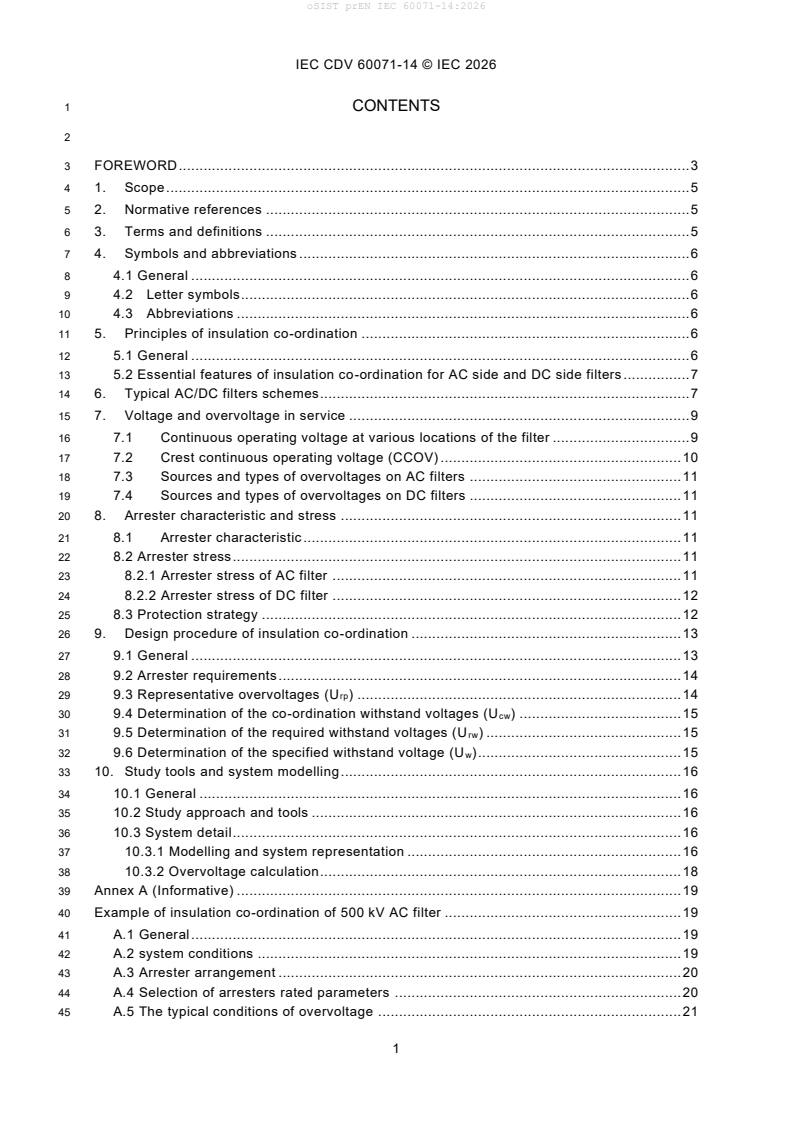
1 CONTENTS
3 FOREWORD . 3
4 1. Scope . 5
5 2. Normative references . 5
6 3. Terms and definitions . 5
7 4. Symbols and abbreviations . 6
8 4.1 General . 6
9 4.2 Letter symbols . 6
10 4.3 Abbreviations . 6
11 5. Principles of insulation co-ordination . 6
12 5.1 General . 6
13 5.2 Essential features of insulation co-ordination for AC side and DC side filters . 7
14 6. Typical AC/DC filters schemes. 7
15 7. Voltage and overvoltage in service . 9
16 7.1 Continuous operating voltage at various locations of the filter . 9
17 7.2 Crest continuous operating voltage (CCOV) . 10
18 7.3 Sources and types of overvoltages on AC filters . 11
19 7.4 Sources and types of overvoltages on DC filters . 11
20 8. Arrester characteristic and stress . 11
21 8.1 Arrester characteristic . 11
22 8.2 Arrester stress . 11
23 8.2.1 Arrester stress of AC filter . 11
24 8.2.2 Arrester stress of DC filter . 12
25 8.3 Protection strategy . 12
26 9. Design procedure of insulation co-ordination . 13
27 9.1 General . 13
28 9.2 Arrester requirements . 14
29 9.3 Representative overvoltages (Urp) . 14
30 9.4 Determination of the co-ordination withstand voltages (U ) . 15
cw
31 9.5 Determination of the required withstand voltages (Urw) . 15
32 9.6 Determination of the specified withstand voltage (U w) . 15
33 10. Study tools and system modelling . 16
34 10.1 General . 16
35 10.2 Study approach and tools . 16
36 10.3 System detail . 16
37 10.3.1 Modelling and system representation . 16
38 10.3.2 Overvoltage calculation . 18
39 Annex A (Informative) . 19
40 Example of insulation co-ordination of 500 kV AC filter . 19
41 A.1 General . 19
42 A.2 system conditions . 19
43 A.3 Arrester arrangement . 20
44 A.4 Selection of arresters rated parameters . 20
45 A.5 The typical conditions of overvoltage . 21
IEC CDV 60071-14 © IEC 2026
46 A.6 Selection of insulation level at each point of the AC filter . 21
47 Annex B (Informative) Example of insulation co-ordination of ±800 kV DC filter . 23
48 B.1 General . 23
49 B.2 Example system input conditions . 23
50 B.3 Arresters arrangement . 24
51 B.4 Selection of arresters rated parameters . 24
52 B.5 The typical conditions of overvoltage . 26
53 B.6 Selection of insulation level of each point of DC filter . 26
54 Bibliography . 28
56 Figure 1 – Various possible AC and DC filter configurations . 8
57 Figure 2 – Schematic diagram of node position in AC filter . 9
58 Figure 3 – Schematic diagram of node position in DC filter . 10
59 Figure 4 – Example of operating voltage waveform at different point in AC filter
60 (referring to Figure 2) . 10
61 Figure 5 – Example of operating voltage waveform at different point in DC filter
62 (referring to Figure 3) . 10
63 Figure 6–Example of simulation model for single-phase earth fault . 17
64 The different type AC filter bank . 17
65 Figure 7 – Example of model for fault recovery after three-phase short circuit . 17
66 Figure A.1– double-tuned Filter . 19
67 Figure A.2 – AC filter arresters configuration . 20
68 Figure–B.1 DC filter configuration . 23
69 Figure–B.2 DC filter arresters configuration . 24
71 Table 1 – Symbol description . 8
72 Table 2 – Sources and types of overvoltages on AC filter . 11
73 Table 3 – Sources and types of overvoltages on DC filter . 11
74 Table 4 – Arrester protection of AC filter . 13
75 Table 5 – Arrester protection of DC filter . 13
76 Table 6 – Arrester data template . 14
77 Table 7 – Representative overvoltages and required withstand voltages data template . 14
78 Table 8 – Indicative values of ratios of required impulse withstand voltage to impulse
79 protective level . 15
80 Table A.1- AC filter parameters . 19
81 Table A.2 - Main harmonic current of the AC filter reactors . 20
82 Table A.3 - Arrester parameters . 21
83 Table A.4 - AC filter transient voltage results . 21
84 Table A.5 - AC filter insulation levels . 22
85 Table B.1 - DC filter parameters . 23
86 Table B.2 - DC filter reactor harmonic current spectrum . 24
87 Table B.3 - Arrester parameters . 26
88 Table B.4 - Transient rating of DC filter . 26
89 Table B.5 - DC filter insulation level . 27
IEC CDV 60071-14 © IEC 2026
91 INTERNATIONAL ELECTROTECHNICAL COMMISSION
92 ——————
93 INSULATION CO-ORDINATION –
94 Part 14: Application procedures for AC/DC filters
95 FOREWORD
96 1) The International Electrotechnical Commission (IEC) is a worldwide organization for standardization comprising
97 all national electrotechnical committees (IEC National Committees). The objective of IEC is to promote
98 international co-operation on all questions concerning standardization in the electrical and electronic fields. To
99 this end and in addition to other activities, IEC publishes International Standards, Technical Specifications,
100 Technical Reports, Publicly Available Specifications (PAS) and Guides (hereafter referred to as “IEC
101 Publication(s)”). Their preparation is entrusted to technical committees; any IEC National Committee interested
102 in the subject dealt with may participate in this preparatory work. International, governmental and non -
103 governmental organizations liaising with the IEC also participate in this preparation. IEC collaborates closely with
104 the International Organization for Standardization (ISO) in accordance with conditions determined by agreement
105 between the two organizations.
106 2) The formal decisions or agreements of IEC on technical matters express, as nearly as possible, an international
107 consensus of opinion on the relevant subjects since each technical committee has representation from all
108 interested IEC National Committees.
109 3) IEC Publications have the form of recommendations for international use and are accepted by IEC National
110 Committees in that sense. While all reasonable efforts are made to ensure that the technical content of IEC
111 Publications is accurate, IEC cannot be held responsible for the way in which they are used or for any
112 misinterpretation by any end user.
113 4) In order to promote international uniformity, IEC National Committees undertake to apply IEC Publications
114 transparently to the maximum extent possible in their national and regional publications. Any divergence between
115 any IEC Publication and the corresponding national or regional publication shall be clearly indicated in the latter.
116 5) IEC itself does not provide any attestation of conformity. Independent certification bodies provide conformity
117 assessment services and, in some areas, access to IEC marks of conformity. IEC is not responsible for any
118 services carried out by independent certification bodies.
119 6) All users should ensure that they have the latest edition of this publication.
120 7) No liability shall attach to IEC or its directors, employees, servants or agents including individual experts and
121 members of its technical committees and IEC National Committees for any personal injury, property damage or
122 other damage of any nature whatsoever, whether direct or indirect, or for costs (including legal fees) and
123 expenses arising out of the publication, use of, or reliance upon, this IEC Publication or any other IEC
124 Publications.
125 8) Attention is drawn to the Normative references cited in this publication. Use of the referenced publications is
126 indispensable for the correct application of this publication.
127 9) IEC draws attention to the possibility that the implementation of this document may involve the use of (a)
128 patent(s). IEC takes no position concerning the evidence, validity or applicability of any claimed patent rights in
129 respect thereof. As of the date of publication of this document, IEC had not received notice of (a) patent(s), which
130 may be required to implement this document. However, implementers are cautioned that this may not represent
131 the latest information, which may be obtained from the patent database available at https://patents.iec.ch. IEC
132 shall not be held responsible for identifying any or all such patent rights.
133 IEC 60071-14 has been prepared by IEC technical committee 99: Insulation co-ordination and
134 system engineering of high voltage electrical power installations above 1,0 kV AC and 1,5 kV
135 DC. It is an International Standard.
136 On the basis of technical experience gained and the development of HVDC, sufficient
137 consensus has emerged for establish a series insulation co-ordination standard for HVDC
138 system. The series standard for HVDC system belongs to IEC 60071 series standard, and
139 consists of the following parts:
140 Part 11: Definitions, principles and rules for HVDC system
141 Part 12: Application guidelines for LCC HVDC converter stations
142 Part 13: Application guidelines for VSC HVDC converter stations
143 Part 14: Application procedures for AC/DC filters.
IEC CDV 60071-14 © IEC 2026
144 Pert 15: Insulation co-ordination for DC transmission lines
145 The aim of this part is evaluating the overvoltage stresses on AC/DC filters sub-system and
146 their components, and determining the specified withstand voltages for equipment.
147 The text of this document is based on the following documents:
Draft Report on voting
99/XX/FDIS 99/XX/RVD
148 Full information on the voting for the approval of this document can be found in the report on
149 voting indicated in the above table.
150 The language used for the development of this document is English.
151 This document was drafted in accordance with ISO/IEC Directives, Part 2, and developed in
152 accordance with ISO/IEC Directives, Part 1 and ISO/IEC Directives, IEC Supplement,
153 available at www.iec.ch/members_experts/refdocs. The main document types developed by
154 IEC are described in greater detail at www.iec.ch/publications.
155 The committee has decided that the contents of this document will remain unchanged until the
156 stability date indicated on the IEC website under webstore.iec.ch in the data related to the
157 specific document. At this date, the document will be
158 • reconfirmed,
159 • withdrawn, or
160 • revised.
IEC CDV 60071-14 © IEC 2026
161 INSULATION CO-ORDINATION –
162 Part 14: Application procedures for AC/DC filters
164 1. Scope
165 This part of IEC 60071 applies guidelines on the procedures for insulation co-ordination of AC filters
166 and DC filters for high-voltage direct current (HVDC) converter stations, whose aim is evaluating the
167 overvoltage stresses,transient currents and energies on AC /DC filters sub-system, and determining
168 the specified withstand voltages for their components.
169 This document applies only to metal-oxide surge arresters without gaps, which are used in AC /DC
170 filters. This document involves the criteria for determining the protective levels of series and/or parallel
171 combinations of surge arresters used to ensure optimal protection, typical arrester protection schemes
172 and stresses of arresters.
173 This document only apply to AC/DC filters for HVDC converter stations.
174 2. Normative references
175 The following documents are referred to in the text in such a way that some or all of their
176 content constitutes requirements of this document. For dated references, only the edition
177 cited applies. For undated references, the latest edition of the referenced (including any
178 amendments) applies.
179 IEC 60060-1:2025 High-voltage test techniques - Part 1: General terminology and test
180 requirements.
181 IEC 60071-1:2019, Insulation co-ordination – Part 1: Definitions, principles and rules
182 IEC 60071-2:2023, Insulation co-ordination – Part 2: Application guidelines
183 IEC 60071-11:2022, Insulation co-ordination – Part 11:Definitions, principles and rules for
184 HVDC system
185 IEC 60071-12:2022, Insulation co-ordination – Part 12:Application guidelines for LCC HVDC
186 converter stations
187 IEC 60099-4:2014, Surge arresters – Part 4: Metal-oxide surge arresters without gaps for AC
188 system
189 IEC 60633, High-voltage direct current (HVDC) transmission – Vocabulary
190 3. Terms and definitions
191 For the purposes of this document, the terms and definitions given in IEC 60071-11, IEC 60071-
192 12 apply.
193 ISO and IEC maintain terminological databases for use in standardization at the following
194 addresses:
195 ⚫ IEC Electropedia: available at http://www.electropedia.org/
196 ⚫ ISO Online browsing platform: available at http://www.iso.org/obp
IEC CDV 60071-14 © IEC 2026
197 4. Symbols and abbreviations
198 4.1 General
199 The list provided in 4.2 and 4.3 below covers only the most frequently used symbols and
200 abbreviations, some of which are illustrated graphically in the single-line diagram of Error!
201 Reference source not found. and Error! Reference source not found. For a more complete
202 list of symbols which has been adopted for LCC-HVDC converter stations, and also for
203 insulation co-ordination, refer to the standards listed in the normative references (Clause 2)
204 and to the Bibliography.
205 4.2 Letter symbols
K altitude correction factor
a
Kc co-ordination factor
K safety factor
s
Urp representative overvoltage
U co-ordination withstand voltage
cw
Urw required withstand voltage
U specified withstand voltage
w
Uref reference voltage of arresters
206 4.3 Abbreviations
AC alternating current
CCOV crest value of continuous operating voltage
DC direct current
HV high voltage
HVDC high voltage direct current
LV low voltage
LIPL lightning impulse protective level
LIWV specified lightning impulse withstand voltage
RFFO representative fast-front overvoltage (maximum voltage stress
value)
RSFO representative slow-front overvoltage (maximum voltage stress
value)
SIPL switching impulse protective level
SIWV specified switching impulse withstand voltage
VSC voltage source converter
207 5. Principles of insulation co-ordination
208 5.1 General
209 The insulation coordination objective for AC and DC filters is:
210 – to determine the maximum steady state, temporary and transient overvoltage levels to which
211 the various components of a system may be subjected in practice;
212 – to select the insulation strength and characteristics of equipment, including the protective
213 devices, used to ensure a safe, economic and reliable installation in the event of overvoltages.
IEC CDV 60071-14 © IEC 2026
214 The above objective shall be in accordance with the insulation requirements of the busbar to
215 which the filter is connected.
216 In addition, to achieve an optimized insulation design, the calculation of the transient currents
217 and energies in the protective devices and the protected equipment is an integral part of the
218 design process.
219 Although the configurations and typical sizes of filter used for LCC and VSC HVDC applications
220 may differ, there is no essential difference in the procedure for insulation co -ordination.
221 5.2 Essential features of insulation co-ordination for AC side and DC side filters
222 There are several essential features of insulation co-ordination for HVDC filters which justify a
223 separate standard:
224 – The operating voltage normally has a high and often dominant harmonic content which must
225 be correctly taken into account in the selection of the arrester.
226 – The selection of arrester characteristics is normally made in co-ordination with selection of
227 equipment withstand levels, current and energy stresses to achieve an overall optimized design.
228 – The types of critical fault for filter insulation co-ordination take into account that the filter
229 contains resonant circuits whose stresses depend on the impedance and therefore overall
230 resonant frequency of the fault circuit.
231 As the insulation co-ordination for HVDC filters is concerned with the components on the low-
232 voltage side of the high-voltage capacitor (see Figure 1) there is little difference in the
233 calculation and design procedures between AC side and DC side filters. For DC side filters
234 there is no direct voltage stress on any of the protected components or arresters.
235 6. Typical AC/DC filters schemes
236 AC filters are connected to the AC bus of the converter station. There are various possible
237 circuit configuration for AC side filter in HVDC converter stations shown in Figure 1. The AC
238 filters can usually be classified to triple-tuned filter, double-tuned filter, single-tuned filter, C-
239 type filter, et al. The AC filter may be equipped with damping resistors.
240 There are various possible circuit configuration for DC side filters in HVDC converter stations
241 shown in Figure 1, examples primarily connected to earth,but DC filters are connected between
242 the DC pole bus and the DC neutral bus or earth. The DC filters may be equipped with damping
243 resistors. All possible locations for arresters are shown in Figure 1. In practice, some of them
244 may be omitted.
245 Refer to Figure 2, The F arresters typically provide protection to low voltage side of C , and
ac4 1
246 in general separate phase-phase and phase-earth arresters are not provided. The Fac1 arresters
247 typically provide protection to L , and in general separate phase-phase and phase-earth
248 arresters are not provided. The Fac2 arresters typically provide protection to L2, and in general
249 separate phase-phase and phase-earth arresters are not provided.
250 Refer to Figure 3, The Fdc4 arresters typically provide protection to low voltage side of C1. The
251 F arresters typically provide protection to L1. The F arresters typically provide protection
dc1 dc2
252 to L2. The Fdc3 arresters typically provide protection to L3.
IEC CDV 60071-14 © IEC 2026
C C C
1 1 1
C
F
F F
1 1
L
F 1
L L
1 1
F F
4 4
C L
2 2
C L C
2 2 2
R
L 2
1 L
R F
F
1 F F R
2 2
C
3 L
F R
3 3
single-tuned filter double- tuned filter triple-tuned filter
C
C 1
C C
1 1
C
R
F 1
L
F 1
C
R
C
R
L 1 L L
1 1 1 L
R
F F F 2
1 1 1 F
R
2nd order damped filter
3rd order damped filter C-type filter double- tuned damped filters
(high pass filter)
255 key
C capacitor
x
Lx reactor
R resistor
x
Fx AC filter or DC filter arrester
256 Figure 1 – Various possible AC and DC filter configurations
257 Table 1 – Symbol description
Symbol Description
Capacitor
Reactor
Resistor
Arrester
Earth
IEC CDV 60071-14 © IEC 2026
259 7. Voltage and overvoltage in service
260 7.1 Continuous operating voltage at various locations of the filter
261 The continuous operating voltages of AC filters in HVDC converter station are composed of a
262 combination of fundamental frequency voltage and harmonic voltages, depending on their
263 specific location.
264 The continuous operating voltages of DC filters in HVDC converter station are composed of a
265 combination of direct voltage and harmonic voltages, depending on their specific location.
266 The position of relevant filter nodes in the waveform diagram are shown in Figure 2 and
267 Figure 3, The typical operating voltage waveform on AC and DC filter are shown in Figure 4
268 and Figure 5.
C
F
ac1
R
L
F 1 1
ac4
C L R
2 2 2
F
ac2
C
3 L
F
ac3
G
270 key
F AC filter arrester
acx
G Earth
271 Figure 2 – Schematic diagram of node position in AC filter
C
F
dc1
L
F
dc4
C
L
F
dc2
C
F
dc3 L
G
N
Electrode line
273 key
IEC CDV 60071-14 © IEC 2026
Fdcx DC filter arrester
N Neutral Bus
274 Figure 3 – Schematic diagram of node position in DC filter
Loc.(2-G),(3-G),(4-G),(2-3),(3-4)
275 Figure 4 – Example of operating voltage waveform at different point in AC filter
276 (referring to Figure 2)
277 The harmonics generated on the AC side are assumed to be filtered by the connected filters
278 and thus the voltage at Loc. (1-G) and Loc. (1-2) of AC filter is considered as a sine wave of
279 fundamental frequency and with superimposed harmonics, and the voltage at Loc. (2-G), Loc.
280 (3-G), Loc. (4-G), Loc. (2-3) and Loc. (3-4) of AC filter is considered to be mainly harmonics.
N
N N
N Loc.(2-G)
281 Figure 5 – Example of operating voltage waveform at different point in DC filter
282 (referring to Error! Reference source not found.3)
283 The harmonics generated on the DC side are assumed to be filtered by the filters and thus the
284 voltage at Loc. (1-N) and Loc. (1-2) of DC filter is considered as DC voltage with harmonics,
285 and the voltage at Loc. (2-N),Loc. (2-G), Loc. (3-N), Loc. (4-N), Loc. (2-3) and Loc. (3-4) of DC
286 filter is considered to be mainly harmonics.
287 7.2 Crest continuous operating voltage (CCOV)
288 The voltage of AC and DC filters contains a large number of harmonic components. The AC
289 filter usually contains fundamental and characteristic harmonics, as well as a small amount of
290 non-characteristic harmonics. The DC filter typically includes characteristic harmonics and a
291 small amount of non-characteristic harmonics.
292 The CCOV calculation formula for the AC filter and DC filter arrester is shown in Equation (1).
n-max
293 U =U + 2U + 2 U ··································· (1)
ccov dc ac n
n=2
IEC CDV 60071-14 © IEC 2026
294 Where
295 U -the DC voltage for 2-G of the DC filter,for the AC filter the U is zero, kV.
dc dc
296 U -the power frequency RMS voltage, for the DC filter the U is zero,kV.
ac ac
297 Un - n order harmonic RMS voltage,kV.
298 n-max - maximum harmonic order considered.
299 7.3 Source
...