


prEN IEC 61851-23-3:2025
(Main)Conductive power and energy transfer systems for electric vehicles - Part 23-3: DC electric vehicle supply equipment for megawatt charging systems
Conductive power and energy transfer systems for electric vehicles - Part 23-3: DC electric vehicle supply equipment for megawatt charging systems
Konduktive Ladesysteme für Elektrofahrzeuge - Teil 23-3: Gleichstromversorgungseinrichtungen für Elektrofahrzeuge für Megawatt-Ladesysteme
Système de charge par conduction pour véhicules électriques - Partie 23-3: Système d’alimentation en courant continu pour véhicules électriques pour les systèmes de recharge mégawatt
Sistem kabelskega napajanja električnih vozil - 23-3. del: Postaja za kabelsko napajanje električnega vozila z enosmernim tokom za megavatne napajalne sisteme
General Information
- Status
- Not Published
- Publication Date
- 10-Aug-2026
- Technical Committee
- CLC/TC 69X - Electrical systems for electric road vehicles
- Drafting Committee
- IEC/TC 69 - IEC_TC_69
- Current Stage
- 4060 - Enquiry results established and sent to TC, SR, BTTF - Enquiry
- Start Date
- 11-Apr-2025
- Completion Date
- 11-Apr-2025
Overview
prEN IEC 61851-23-3:2025 specifies requirements for conductive DC electric vehicle supply equipment (EVSE) for Megawatt Charging Systems (MCS). Published as a Committee Draft for Vote by IEC TC 69 and submitted in parallel for CENELEC consideration, the standard addresses safety, performance, communications and test methods specific to high-power DC charging well above typical fast-charge levels. It targets the design, construction, operation and testing of EVSE intended for megawatt-class conductive charging of electrically propelled road vehicles and industrial trucks.
Key Topics and Requirements
The document covers a comprehensive set of technical topics relevant to megawatt charging systems, including:
- General requirements and classification of EV supply equipment and system architectures (A, B, MCS).
- Charging modes and functions (Mode 4 mandatory and optional functions) and detailed energy transfer processes.
- Digital communications between EVSE and vehicle, including references to ISO 15118-20 protocols for session management, renegotiation and pause/restart.
- Protection against electric shock and safety-related provisions (touch current, insulation barriers, equipotential bonding, protective conductor sizing).
- Conductive electrical interface and cable assembly requirements (functional descriptions of DC and combined interfaces, cable management and storage).
- Thermal management and temperature-controlled energy transfer, including monitoring, self-diagnostics and test methods.
- Overload, short-circuit protection, automatic reclosing and emergency disconnect requirements for high-power DC circuits.
- Constructional requirements and tests, dielectric withstand, transient overvoltage protection and component bridging insulation.
- Annexes that define system-level circuit diagrams and processes (Annex CC for MCS), multi-side B configurations, bidirectional control (informative), and test-load verification.
Applications and Who Uses It
This standard is intended for:
- EVSE manufacturers and system integrators designing megawatt DC charging stations and cable systems.
- Automotive OEMs and EV designers developing vehicle-side interfaces compatible with MCS.
- Charging infrastructure planners, utilities and fleet operators deploying high-power charging for heavy-duty vehicles, buses, trucks and special industrial applications.
- Testing laboratories and certification bodies validating compliance, safety and interoperability.
- Standards committees and safety engineers aligning national regulations and procurement specifications with international practice.
Practical uses include specifying EVSE hardware, developing communication and safety features, defining test procedures for performance and protection, and ensuring interoperability with ISO 15118-based vehicle communications.
Related Standards
- IEC 61851 series (conductive charging standards)
- ISO 15118-20 (digital communication for EV charging)
- IEC/TC 69 work items and relevant national CENELEC procedures
Keywords: megawatt charging, DC electric vehicle supply equipment, EVSE, conductive charging, ISO 15118-20, IEC 61851, MCS, high-power EV charging, safety, communications.

Get Certified
Connect with accredited certification bodies for this standard

TÜV Rheinland
TÜV Rheinland is a leading international provider of technical services.

TÜV SÜD
TÜV SÜD is a trusted partner of choice for safety, security and sustainability solutions.

AIAG (Automotive Industry Action Group)
American automotive industry standards and training.
Sponsored listings
Frequently Asked Questions
prEN IEC 61851-23-3:2025 is a draft published by CLC. Its full title is "Conductive power and energy transfer systems for electric vehicles - Part 23-3: DC electric vehicle supply equipment for megawatt charging systems". This standard covers: Conductive power and energy transfer systems for electric vehicles - Part 23-3: DC electric vehicle supply equipment for megawatt charging systems
Conductive power and energy transfer systems for electric vehicles - Part 23-3: DC electric vehicle supply equipment for megawatt charging systems
prEN IEC 61851-23-3:2025 is classified under the following ICS (International Classification for Standards) categories: 43.120 - Electric road vehicles. The ICS classification helps identify the subject area and facilitates finding related standards.
prEN IEC 61851-23-3:2025 is associated with the following European legislation: EU Directives/Regulations: 2014/94/EU, 2023/1804, 2023/1804-1, 2023/1804-2; Standardization Mandates: M/581. When a standard is cited in the Official Journal of the European Union, products manufactured in conformity with it benefit from a presumption of conformity with the essential requirements of the corresponding EU directive or regulation.
prEN IEC 61851-23-3:2025 is available in PDF format for immediate download after purchase. The document can be added to your cart and obtained through the secure checkout process. Digital delivery ensures instant access to the complete standard document.
Standards Content (Sample)
SLOVENSKI STANDARD
01-marec-2025
Sistem kabelskega napajanja električnih vozil - 23-3. del: Postaja za kabelsko
napajanje električnega vozila z enosmernim tokom za megavatne napajalne
sisteme
Electric vehicle conductive charging system - Part 23-3: DC electric vehicle supply
equipment for Megawatt charging systems
Système de charge par conduction pour véhicules électriques - Partie 23-3: Système
d’alimentation en courant continu pour véhicules électriques pour les systèmes de
recharge mégawatt
Ta slovenski standard je istoveten z: prEN IEC 61851-23-3:2025
ICS:
43.120 Električna cestna vozila Electric road vehicles
2003-01.Slovenski inštitut za standardizacijo. Razmnoževanje celote ali delov tega standarda ni dovoljeno.
69/1025/CDV
COMMITTEE DRAFT FOR VOTE (CDV)
PROJECT NUMBER:
IEC 61851-23-3 ED1
DATE OF CIRCULATION: CLOSING DATE FOR VOTING:
2025-01-17 2025-04-11
SUPERSEDES DOCUMENTS:
69/912/CD, 69/1017/CC
IEC TC 69 : ELECTRICAL POWER/ENERGY TRANSFER SYSTEMS FOR ELECTRICALLY PROPELLED ROAD VEHICLES AND INDUSTRIAL
TRUCKS
SECRETARIAT: SECRETARY:
Belgium Mr Peter Van den Bossche
OF INTEREST TO THE FOLLOWING COMMITTEES: HORIZONTAL FUNCTION(S):
SC 23H
ASPECTS CONCERNED:
Safety
SUBMITTED FOR CENELEC PARALLEL VOTING NOT SUBMITTED FOR CENELEC PARALLEL VOTING
Attention IEC-CENELEC parallel voting
The attention of IEC National Committees, members of
CENELEC, is drawn to the fact that this Committee Draft
for Vote (CDV) is submitted for parallel voting.
The CENELEC members are invited to vote through the
CENELEC online voting system.
This document is still under study and subject to change. It should not be used for reference purposes.
Recipients of this document are invited to submit, with their comments, notification of any relevant patent rights of which
they are aware and to provide supporting documentation.
Recipients of this document are invited to submit, with their comments, notification of any relevant “In Some Countries”
clauses to be included should this proposal proceed. Recipients are reminded that the CDV stage is the final stage for
submitting ISC clauses. (SEE AC/22/2007 OR NEW GUIDANCE DOC).
TITLE:
Electric vehicle conductive charging system - Part 23-3: DC electric vehicle supply equipment for
Megawatt charging systems
PROPOSED STABILITY DATE: 2027
NOTE FROM TC/SC OFFICERS:
electronic file, to make a copy and to print out the content for the sole purpose of preparing National Committee positions.
You may not copy or "mirror" the file or printed version of the document, or any part of it, for any other purpose without
permission in writing from IEC.
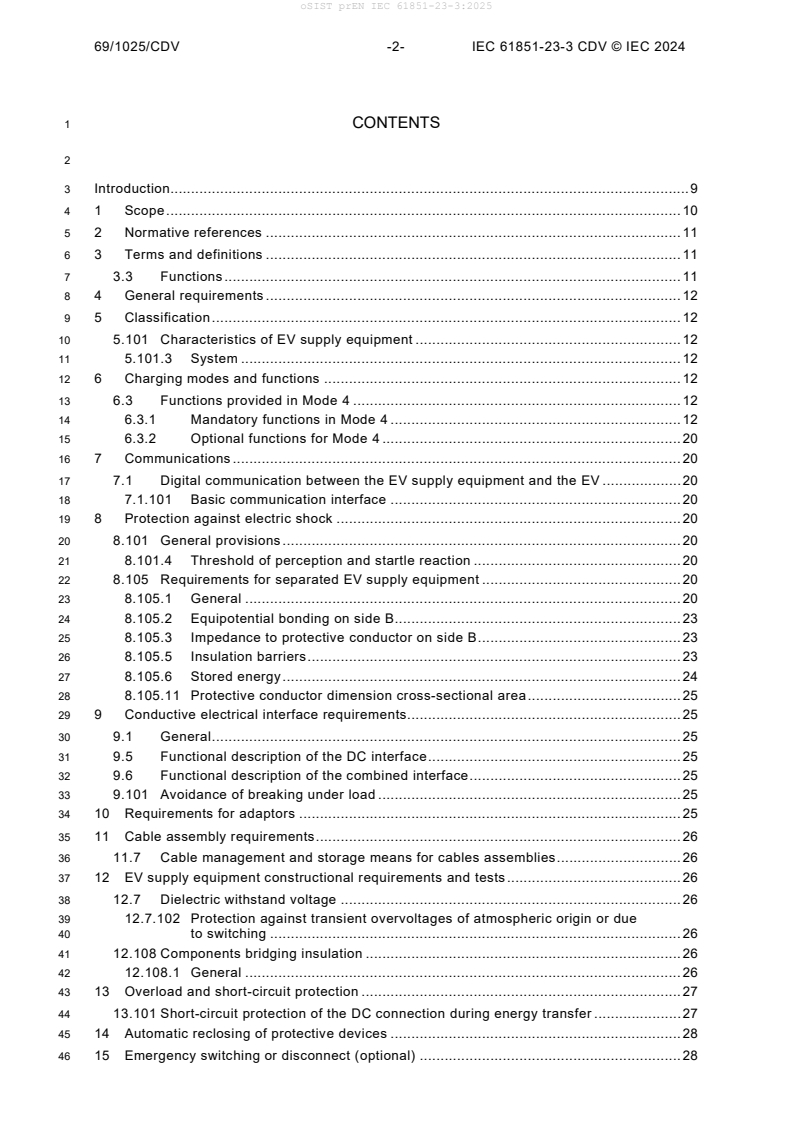
69/1025/CDV -2- IEC 61851-23-3 CDV © IEC 2024
1 CONTENTS
3 Introduction. 9
4 1 Scope . 10
5 2 Normative references . 11
6 3 Terms and definitions . 11
7 3.3 Functions . 11
8 4 General requirements . 12
9 5 Classification . 12
10 5.101 Characteristics of EV supply equipment . 12
11 5.101.3 System . 12
12 6 Charging modes and functions . 12
13 6.3 Functions provided in Mode 4 . 12
14 6.3.1 Mandatory functions in Mode 4 . 12
15 6.3.2 Optional functions for Mode 4 . 20
16 7 Communications . 20
17 7.1 Digital communication between the EV supply equipment and the EV . 20
18 7.1.101 Basic communication interface . 20
19 8 Protection against electric shock . 20
20 8.101 General provisions . 20
21 8.101.4 Threshold of perception and startle reaction . 20
22 8.105 Requirements for separated EV supply equipment . 20
23 8.105.1 General . 20
24 8.105.2 Equipotential bonding on side B . 23
25 8.105.3 Impedance to protective conductor on side B . 23
26 8.105.5 Insulation barriers . 23
27 8.105.6 Stored energy . 24
28 8.105.11 Protective conductor dimension cross-sectional area . 25
29 9 Conductive electrical interface requirements. 25
30 9.1 General . 25
31 9.5 Functional description of the DC interface . 25
32 9.6 Functional description of the combined interface . 25
33 9.101 Avoidance of breaking under load . 25
34 10 Requirements for adaptors . 25
35 11 Cable assembly requirements . 26
36 11.7 Cable management and storage means for cables assemblies . 26
37 12 EV supply equipment constructional requirements and tests . 26
38 12.7 Dielectric withstand voltage . 26
39 12.7.102 Protection against transient overvoltages of atmospheric origin or due
40 to switching . 26
41 12.108 Components bridging insulation . 26
42 12.108.1 General . 26
43 13 Overload and short-circuit protection . 27
44 13.101 Short-circuit protection of the DC connection during energy transfer . 27
45 14 Automatic reclosing of protective devices . 28
46 15 Emergency switching or disconnect (optional) . 28
IEC 61851-23-3 CDV © IEC 2024 -3- 69/1025/CDV
47 16 Marking and instructions . 28
48 101 Specific requirements for EV supply equipment . 28
49 101.1 Specific requirements for separated EV supply equipment . 28
50 101.1.1 Operating ranges for voltage, current, and power at side B. 28
51 101.1.2 Voltage and current tolerance at side B . 28
52 101.1.3 Control delay of present current at side B in CCM . 28
53 101.1.4 Descending rate of present current at side B . 28
54 101.1.5 Periodic and random deviation (current ripple at side B during CCM) . 29
55 101.1.8 Side B inductance . 29
56 101.2 Specific requirement for energy transfer with a thermal management system
57 or thermal sensing only . 29
58 101.2.1 General . 29
59 101.2.2 Temperature limits and self-diagnostics . 29
60 101.2.3 Temperature monitoring . 30
61 101.2.4 Tests for thermal management system performance of the EV supply
62 equipment . 30
63 101.3 Specific requirements for temperature-controlled energy transfer . 33
64 102 Test methods . 33
65 102.2.3 Test setups . 33
66 102.2.4 Test load . 34
67 Annex AA (normative) EV supply equipment of System A . 37
68 Annex BB (normative) EV supply equipment of System B . 38
69 Annex CC (normative) EV supply equipment of system MCS . 39
70 CC.1 General . 39
71 CC.2 Circuit diagram . 39
72 CC.2.1 General . 39
73 CC.2.2 Circuit diagram for configuration HH . 39
74 CC.2.3 Circuit diagram for configuration FF . 46
75 CC.2.4 Disabled side B . 46
76 CC.2.5 Requirements for digital communication channel . 48
77 CC.3 Process of energy transfer . 49
78 CC.3.1 General . 49
79 CC.3.2 Normal start up . 50
80 CC.3.3 Normal shutdown during energy transfer. 55
81 CC.3.4 Error and emergency handling . 58
82 CC.3.5 Pause by EV supply equipment using ISO 15118-20:2022 and ISO
83 15118-20:2022/AMD1:202X . 69
84 CC.3.6 Renegotiation initiated by EV or EV supply equipment using ISO 15118-
85 20:2022 . 78
86 CC.4 Safety related functions . 78
87 CC.4.1 Safety measures for side B . 78
88 CC.4.2 Vehicle coupler latching function . 81
89 CC.4.3 Loss of electrical continuity of the charge enable conductor. 81
90 CC.4.4 Loss of electrical continuity of the insertion detection conductor . 82
91 CC.4.5 Voltage check at initialization . 82
92 CC.4.6 Minimum cross-sectional area of the protective conductor . 82
93 CC.4.7 Loss of electrical continuity of the protective conductor . 82
94 CC.5 Additional functions. 82
95 CC.5.1 Pre-charge . 82
69/1025/CDV -4- IEC 61851-23-3 CDV © IEC 2024
96 CC.5.2 Sleep mode and communication session restart methods . 84
97 CC.5.3 Configuration EE vehicle connector latch position switch (S 3)
S
98 activation . 88
99 CC.5.4 Configuration EE vehicle connector latch position switch (S 3)
S
100 verification . 88
101 CC.5.5 Handling of operating ranges . 88
102 CC.5.6 Compatibility check . 90
103 CC.5.7 Considerations for CCM, CVM and CPM (informative) . 92
104 CC.6 Specific requirements . 92
105 CC.6.1 Requirements for load dump . 92
106 CC.6.2 Side B current regulation . 92
107 CC.6.3 Measuring current and voltage at side B . 92
108 CC.6.4 Overcurrent protection of side B . 92
109 CC.7 General test conditions . 93
110 CC.7.1 Operating points – Definitions . 93
111 CC.7.2 Standard test setup . 93
112 CC.7.3 Definition of measured values at side B . 93
113 CC.7.4 Exemplary approach to set a test point in CCM . 93
114 CC.7.5 Test cases . 96
115 Annex DD (informative) Bidirectional power transfer control . 125
116 Annex EE (informative) Test load impedance verification . 126
117 EE.2 Response curve verification . 126
118 EE.4 Result . 127
119 Annex FF (normative) Multi-side B separated EV supply equipment . 128
120 FF.1 Classification and use case of multi-side B EV supply equipment . 128
121 FF.1.2 Side B system . 128
122 FF.2 Constructional requirements for a side B system . 128
123 FF.2.4 Constructional requirements of a side B system according to system
124 MCS . 128
125 FF.3 Side B system performance . 128
126 FF.3.1 General performance requirements . 128
127 FF.4 Safety requirements . 129
128 FF.4.2 Short-circuit protection . 129
129 FF.4.8 Y-capacitance limitation . 129
130 Annex GG (informative) Communication and energy transfer process between the EV
131 supply equipment and EV . 130
132 Annex HH (informative) Touch current and touch impulse current . 131
133 HH.201 Maximum working voltage requirements . 131
134 HH.202 Transient voltages . 131
135 HH.203 Energy limitation between side B live parts (DC+/DC-) and PE . 132
136 HH.204 Recommended blocking voltage for 1 700 V semiconductor devices . 133
137 Bibliography . 134
139 Figure 201 – Typical voltages between side B live parts (DC+/DC-) and protective
140 conductor under normal operation . 16
141 Figure 202 – Examples of a fault between the secondary circuit and the protective
142 conductor . 18
143 Figure 203 – Overview of the maximum Y-capacitance . 22
IEC 61851-23-3 CDV © IEC 2024 -5- 69/1025/CDV
144 Figure 204 – Example of the voltage range for active and passive voltage balancing
145 with a system Y-capacitance according to Table 203 . 22
146 Figure 205 – Insulation barriers . 23
147 Figure 206 – Test arrangement MCS_0 (to be redrawn) . 31
148 Figure 207 – General test setup for system MCS . 34
149 Figure 208 – Test load example . 35
150 Figure CC.101 – Circuit diagram for an EV supply equipment of configuration HH . 41
151 Figure CC.102 – Equivalent disabled side B of the EV supply equipment . 47
152 Figure CC.103 – Sequence diagram for normal start up . 51
153 Figure CC.104 – Sequence diagram for normal shutdown during energy transfer by EV
154 or EV supply equipment . 56
155 Figure CC.105 – Sequence diagram for EV supply equipment and EV initiated error
156 shutdown . 60
157 Figure CC.106 – Sequence diagram for an emergency shutdown executed by the EV . 64
158 Figure CC.107 – Sequence diagram for an emergency shutdown executed by the EV
159 supply equipment . 67
160 Figure CC.108 – Sequence diagram for pause before cable-check phase by EV supply
161 equipment using ISO 15118-20:2022 and ISO 15118-20:2022/AMD1:202X . 70
162 Figure CC.109 – Sequence diagram for pause after pre-charge phase and before
163 energy transfer stage by the EV supply equipment using ISO 15118-20:2022 and ISO
164 15118-20:2022/AMD1:202X . 74
165 Figure CC.110 – Worst case equivalent circuit during pre-charge . 83
166 Figure CC.111 – Restart methods sequence for the EV supply equipment . 85
167 Figure CC.112 – Restart method verification on the EV supply equipment . 86
168 Figure CC.113 – Example of a CE state B0 – B transition . 86
169 Figure CC.114 – Restart methods sequence for the EV . 87
170 Figure CC.115 – Example of a B0 – EC – B0 toggle . 88
171 Figure CC.116 – Approaching a single test point TP in CCM (example 1) . 95
172 Figure CC.117 – Approaching multiple test points TP CCM (example 2) . 96
n
173 Figure CC.118 – Test setup for IMD measurement connections . 123
174 Figure EE.101 – Magnitude of the impedance of the test load between DC+ and DC–
175 for system MCS . 127
176 Figure HH.201 – C1 limit: Y-capacitance considering a human body resistance of 575
177 Ω 133
179 Table 201 – Comparison between IEC 61851-23 and IEC 61851-23-3 . 9
180 Table 202 – Voltage threshold for emergency shutdown reaction . 14
181 Table 203 – Maximum Y-capacitance of the EV supply equipment at side B . 21
182 Table 204 – Minimum protective measures . 24
183 Table 205 – Current ripple limit of the EV supply equipment . 29
184 Table 206 – Recommended circuit parameters of the test load . 36
185 Table CC.101 – EV supply equipment component values and tolerances for
186 configuration HH . 42
187 Table CC.102 – EV component values and tolerances for configuration HH . 43
188 Table CC.103 – System states of configuration HH based on the CE voltage . 44
189 Table CC.104 – Charge Enable states and voltage ranges for the EV supply equipment . 44
69/1025/CDV -6- IEC 61851-23-3 CDV © IEC 2024
190 Table CC.105 – Charge Enable states and voltage ranges for the EV . 45
191 Table CC.106 – Insertion Detection states and voltage ranges for the EV supply
192 equipment . 45
193 Table CC.107 – Insertion Detection states and voltage ranges for the EV . 46
194 Table CC.108 – Component limits for the disabled side B of the EV supply equipment . 47
195 Table CC.109 – Message code mapping for sequence diagram . 50
196 Table CC.110 – Sequence description for normal start up . 52
197 Table CC.111 – Sequence description for normal shutdown during energy transfer by
198 EV or EV supply equipment . 57
199 Table CC.112 – Overview of error and emergency shutdown cases . 59
200 Table CC.113 – Sequence description for EV supply equipment and EV initiated error
201 shutdown . 61
202 Table CC.114 – Sequence diagram an emergency shutdown executed by the EV . 65
203 Table CC.115 – Sequence diagram an emergency shutdown executed by the EV
204 supply equipment . 68
205 Table CC.116 – Sequence description for pause before cable-check phase by EV
206 supply equipment using ISO 15118-20:2022 and ISO 15118-20:2022/AMD1:202X . 71
207 Table CC.117 – Sequence description for pause after pre-charge phase and before
208 energy transfer stage by the EV supply equipment using ISO 15118-20:2022 and ISO
209 15118-20:2022/AMD1:202X . 75
210 Table CC.118 – Insulation states and EV supply equipment reaction based on the
211 insulation resistance . 81
212 Table CC.119 – Values to design the EV supply equipment during pre-charge based on
213 Figure CC.111 . 83
214 Table CC.120 – Current ripple limits . 102
215 Table CC.121 – Component valued for the inrush current limit test . 104
216 Table CC.122 – Current ripple limits . 107
217 Table CC.123 – Test setup values to measure side B voltage regulation in CVM during
218 pre-charge . 108
219 Table CC.124 – Current ripple limits . 109
220 Table CC.125 – EV simulator characteristics . 118
221 Table EE.101 – Test load parameters for system MCS . 126
IEC 61851-23-3 CDV © IEC 2024 -7- 69/1025/CDV
224 INTERNATIONAL ELECTROTECHNICAL COMMISSION
225 ____________
227 ELECTRIC VEHICLE CONDUCTIVE CHARGING SYSTEM –
229 Part 23-3: DC electric vehicle supply equipment for Megawatt charging systems
231 FOREWORD
232 1) The International Electrotechnical Commission (IEC) is a worldwide organization for standardization comprising all national
233 electrotechnical committees (IEC National Committees). The object of IEC is to promote international co-operation on all
234 questions concerning standardization in the electrical and electronic fields. To this end and in addition to other activities, IEC
235 publishes International Standards, Technical Specifications, Technical Reports, Publicly Available Specifications (PAS) and
236 Guides (hereafter referred to as “IEC Publication(s)”). Their preparation is entrusted to technical committees; any IEC
237 National Committee interested in the subject dealt with may participate in this preparatory work. International, governmental
238 and non-governmental organizations liaising with the IEC also participate in this preparation. IEC collaborates closely with
239 the International Organization for Standardization (ISO) in accordance with conditions determined by agreement between
240 the two organizations.
241 2) The formal decisions or agreements of IEC on technical matters express, as nearly as possible, an international consensus
242 of opinion on the relevant subjects since each technical committee has representation from all interested IEC National
243 Committees.
244 3) IEC Publications have the form of recommendations for international use and are accepted by IEC National Committees in
245 that sense. While all reasonable efforts are made to ensure that the technical content of IEC Publications is accurate, IEC
246 cannot be held responsible for the way in which they are used or for any misinterpretation by any end user.
247 4) In order to promote international uniformity, IEC National Committees undertake to apply IEC Publications transparently to
248 the maximum extent possible in their national and regional publications. Any divergence between any IEC Publication and
249 the corresponding national or regional publication shall be clearly indicated in the latter.
250 5) IEC itself does not provide any attestation of conformity. Independent certification bodies provide conformity assessment
251 services and, in some areas, access to IEC marks of conformity. IEC is not responsible for any services carried out by
252 independent certification bodies.
253 6) All users should ensure that they have the latest edition of this publication.
254 7) No liability shall attach to IEC or its directors, employees, servants or agents including individual experts and members of its
255 technical committees and IEC National Committees for any personal injury, property damage or other damage of any nature
256 whatsoever, whether direct or indirect, or for costs (including legal fees) and expenses arising out of the publication, use of,
257 or reliance upon, this IEC Publication or any other IEC Publications.
258 8) Attention is drawn to the Normative references cited in this publication. Use of the referenced publications is indispensable
259 for the correct application of this publication.
260 9) Attention is drawn to the possibility that some of the elements of this IEC Publication may be the subject of patent rights.
261 IEC shall not be held responsible for identifying any or all such patent rights.
262 International Standard IEC 61851-23-3 has been prepared by IEC technical committee 69:
263 Electric power/energy transfer systems for electrically propelled road vehicles and industrial
264 trucks.
69/1025/CDV -8- IEC 61851-23-3 CDV © IEC 2024
265 The text of this document is based on the following documents:
XXX Report on voting
69/XX/XXX 69/XX/RVD
267 Full information on the voting for the approval of this document can be found in the report on
268 voting indicated in the above table.
269 This publication has been drafted in accordance with the ISO/IEC Directives, Part 2.
270 This document is to be read in conjunction with IEC 61851-1:2017 and IEC 61851-23:2023.
271 The clauses of particular requirements in this document supplement or modify the
272 corresponding clauses in IEC 61851-23:2023. Where the text of subsequent clauses indicates
273 an "addition" to or a "replacement" of the relevant requirement, test specification or explanation
274 of IEC 61851-23:2023, these changes are made to the relevant text of IEC 61851-23:2023,
275 which then becomes part of this document. Where no change is necessary, the words "IEC
276 61851-23:2023, [clause] is applicable" are used, where [clause] indicated the relevant clause.
277 The new clauses, which are not included in IEC 61851-23:2023, have a clause number starting
278 from 201, for example 3.201, 201.1, etc. The new annexes of this document are numbered
279 using triple-alphabet, for example Annex III, to avoid confusion with the annexes in IEC 61851-
280 1:2017 and IEC 61851-23:2023.
281 In this document, the following print types are used:
282 – test specifications: italic type.
283 – notes: smaller roman type.
284 A list of all parts in the IEC 61851 series, published under the general title Electric vehicle
285 conductive charging system, can be found on the IEC website.
286 The committee has decided that the contents of this publication will remain unchanged until the
287 stability date indicated on the IEC web site under "http://webstore.iec.ch" in the data related to
288 the specific publication. At this date, the publication will be
289 – reconfirmed,
290 – withdrawn,
291 – replaced by a revised edition, or
292 – amended.
IMPORTANT – The 'colour inside' logo on the cover page of this publication indicates that it
contains colours which are considered to be useful for the correct understanding of its
contents. Users should therefore print this document using a colour printer.
IEC 61851-23-3 CDV © IEC 2024 -9- 69/1025/CDV
298 Introduction
300 Responding to the global challenges of CO reduction and energy safety, the automobile
301 industry has started the development and commercialization of heavy duty electric vehicles
302 (EV). These heavy duty EVs are equipped with significantly larger batteries than passenger
303 cars or light commercial vehicles. The charging power provided by standards published before
304 the publication of this standard, does not allow recharging of these batteries within the time
305 needed for a commercial application of heavy duty EVs – especially considering long routes
306 with limited time for intermediate charging. Consequently, this standard allows for superior
307 charging power up to several megawatts and describes the related safety and interoperability
308 requirements. Table 201 shows the comparison between IEC 61851-23 and this document.
309 Table 201 – Comparison between IEC 61851-23 and IEC 61851-23-3
Topic IEC 61851-23 IEC 61851-23-3
Rated maximum voltage of the EV 1 000 V 1 250 V
supply equipment at side B (EV
side)
Rated continuous current of the EV maximum as defined in IEC as defined in IEC TS 63379:202X
supply equipment at side B (EV 62196-3:2022
side)
Basic signalling CP and PP (Annex CC) CE and ID
Digital communication HomePlug GreenPHY (Annex CC) Ethernet 10BASE-T1S with ISO
with ISO 15118-2, ISO 15118-20 15118-20 as application layer
or DIN 70121 as application layer
311 Although the system described in this standard has been developed for heavy duty EVs, its
312 application is not limited to these in principle.
313 The standard at hand for the EV supply equipment is accompanied by standards for the coupler
314 interface and the vehicle side.
69/1025/CDV -10- IEC 61851-23-3 CDV © IEC 2024
316 ELECTRIC VEHICLE CONDUCTIVE CHARGING SYSTEM –
318 Part 23-3: DC electric vehicle supply equipment for Megawatt charging systems
320 1 Scope
321 Replacement:
322 This part of the IEC 61851 series, together with [IEC 61851-1 Ed. 3] and [IEC 61851-23, Ed.
323 2.0], applies to the EV supply equipment to provide energy transfer between the supply network
324 and electric vehicles (EVs), with a rated maximum voltage at side A (supply network side) up
325 to 1 000 V AC or up to 1 500 V DC and a rated maximum voltage at side B (EV side) up to 1
326 250 V DC.
327 NOTE 1 A rated maximum voltage of the EV supply equipment at side B of 1 500 V DC is under consideration.
328 This document specifies the EV supply equipment of Megawatt Charging System (MCS)
329 equipped with a coupler according to IEC TS 63379. Systems different to system MCS using a
330 coupler specified in IEC TS 63379 are under consideration.
331 Requirements for bidirectional power flow systems are under consideration.
332 This document does not cover all safety aspects related to maintenance.
333 Requirements for systems not providing protective separation between side A (supply network
334 side) and side B (EV side) are under consideration.
335 The requirements for digital communication between the EV supply equipment and the EV for
336 control of energy transfer are defined in ISO 15118-10 and ISO 15118-20.
337 The specific requirements for EV supply equipment with multiple side Bs (EV sides) are
338 provided in Annex FF.
339 General information of communication and the energy transfer process is described in
340 Annex GG.
341 General information on the touch current and touch impulse current is provided in Annex HH.
342 EV supply equipment in compliance with this document is not intended to provide energy
343 transfer to a single EV using:
344 – multiple vehicle connectors of the same EV supply equipment; or
345 – multiple EV supply equipments.
346 Requirements for such use case are not specified in this document, but are under consideration.
347 NOTE 2 The safety requirements of vehicle during charging are specified in ISO 5474 series.
Under preparation. Stage at the time of publication: ISO/DIS 15118-10:2024
IEC 61851-23-3 CDV © IEC 2024 -11- 69/1025/CDV
348 NOTE 3 Requirements for an optional automated connection of system MCS are under preparation in IEC 61851-
349 27.
350 Requirements for EVs mated to an EV supply equipment according to this document are
351 specified in ISO 5474-3:2023, Annex B.
352 2 Normative references
353 IEC 61851-23:2023, Clause 2 is applicable, except as follows:
354 Addition:
355 IEC TS 63379:202X, Vehicle connector, vehicle inlet and cable assembly for megawatt DC
356 charging
357 ISO 15118-10:202X, Road vehicles – Vehicle-to-grid communication interface – Part 10:
358 Physical layer and data link layer requirements for wired ethernet communication
359 ISO 15118-20:2022, Road vehicles – Vehicle-to-grid communication interface – Part 2: 2nd
360 generation network layer and application layer requirements
361 ISO 15118-20:2022/AMD1:202X, Road vehicles – Vehicle-to-grid communication interface –
362 Part 2: 2nd generation network layer and application layer requirements
363 IEEE 802.3-2022, IEEE Standard for Ethernet
364 Open Alliance Inc., Channel and components - Requirements for 10BASE-T1S link segments
365 [online], version x.x, 2024. Available at: https://opensig.org/ (TBD)
366 3 Terms and definitions
367 IEC 61851-23:2023, Clause 3, is applicable except as follows:
368 3.3 Functions
369 3.3.1
370 Replacement:
371 charge enable conductor (identification: CE)
372 conductor incorporated in a cable assembly, which, together with the protective conductor, is
373 part of the charge enable circuit
374 3.3.5
375 Replacement:
376 insertion detection function (identification: ID)
377 electrical or mechanical means to indicate the insertion state of the vehicle connector in the
378 vehicle inlet of the EV and/or to indicate the insertion state of the EV plug in the EV socket-
379 outlet of the EV supply equipment
Document under development.
69/1025/CDV -12- IEC 61851-23-3 CDV © IEC 2024
380 4 General requirements
381 IEC 61851-23:2023, Clause 4 is applicable, except as follows:
382 Addition:
383 Unless otherwise specified in this document:
384 – the requirements and tests for system C in IEC 61851-23:2023 apply for system MCS, and
385 – all references in IEC 61851-23:2023 to “Annex CC” are replaced by “Annex CC of IEC
386 61851-23-3:202X”.
387 EV supply equipment with a rated continuous current at side B ≥ 500 A:
388 – in the voltage range: 500 V DC ≤ voltage at side B ≤ 1 250 V, the EV supply equipment shall
389 provide the rated continuous current at side B or rated continuous power at side B, and
390 – in the voltage range: 400 V DC ≤ voltage at side B < 500 V DC, the EV supply equipment
391 shall be capable of continuously providing a current at side B ≥ 500 A.
392 EV supply equipment with a rated continuous current at side B < 500 A shall provide:
393 – the rated continuous current at side B or rated continuous power at side B in the voltage
394 range: 400 V DC ≤ voltage at side B ≤ 1 250 V.
395 5 Classification
396 IEC 61851-23:2023, Clause 5 is applicable, except as follows:
397 Replacement:
398 5.101 Characteristics of EV supply equipment
399 5.101.3 System
400 The EV supply equipment shall be classified according to the system:
401 – System MCS (see Annex CC).
402 6 Charging modes and functions
403 IEC 61851-23:2023, Clause 6, is applicable, except as follows:
404 6.3 Functions provided in Mode 4
405 6.3.1 Mandatory functions in Mode 4
406 6.3.1.1 General
407 Replacement:
408 The EV supply equipment shall supply a DC current and voltage to the EV battery system
409 according to an EVCC request.
410 The following functions shall be provided by EV supply equipment as given below:
411 – continuous continuity checking of the protective conductor according to 6.3.1.2;
IEC 61851-23-3 CDV © IEC 2024 -13- 69/1025/CDV
412 – verification that the EV is properly connected to the EV supply equipment according to
413 6.3.1.3;
414 – energization of the power supply to the EV according to 6.3.1.4;
415 – de-energization of the power supply to the EV according to 6.3.1.5;
416 – maximum allowable current according to 6.3.1.6;
417 – DC supply for the EV according to 6.3.1.101;
418 – measuring current and voltage according to 6.3.1.102;
419 – latching of the vehicle connector according to 6.3.1.103;
420 – compatibility check according to 6.3.1.104;
421 – insulation resistance check before energy transfer according to 6.3.1.105;
422 – protection against overvoltage between DC+ and DC- according to 6.3.1.106;
423 – verification of vehicle connector latching according to 6.3.1.107;
424 – control circuit supply integrity according to 6.3.1.108;
425 – short-circuit check before energy transfer according to 6.3.1.109;
426 – user initiated shutdown according to 6.3.1.110;
427 – overload protection for parallel conductors (conditional function) according to 6.3.1.111;
428 – voltage limitation between side B live parts (DC+ and DC-) and protective conductor
429 according to 6.3.1.112;
430 – shutdown of EV supply equipment according to 6.3.1.113.
431 The vehicle manufacturer should consider the requirements for overvoltage and overcurrent
432 according to this document and ISO 5474-3.
433 If the EV supply equipment can supply more than one vehicle simultaneously, the EV supply
434 equipment shall provide all functions listed above indepen
...
Questions, Comments and Discussion
Ask us and Technical Secretary will try to provide an answer. You can facilitate discussion about the standard in here.
Loading comments...