


prEN 50131-3:2025
(Main)Alarm systems - Intrusion and hold-up systems - Part 3: Control and indicating equipment
Alarm systems - Intrusion and hold-up systems - Part 3: Control and indicating equipment
This document specifies the requirements, performance criteria and testing procedures for control and indicating equipment (CIE) intended for use in intrusion and hold-up alarm systems (I&HAS) installed in buildings. This document also applies to CIE to be used in IAS or HAS. The CIE can incorporate processing functions of other I&HAS components or its processing requirements can be distributed among such components. This document specifies the requirements for CIE installed in buildings using specific or non-specific wired interconnections or wire-free interconnections. These requirements also apply to basic DCC which can be installed outside of the supervised premises and mounted in indoor or outdoor environments. Where CIE shares means of detection, interconnection, control, communication, processing and/or power supplies with other applications, these requirements apply to I&HAS functions only. This document specifies performance requirements for CIE at each of the four security grades identified in EN 50131 1. Requirements are also specified for four environmental classes covering applications for indoor and outdoor locations. This document includes mandatory functions for all CIE for the appropriate security grade, as well as optional functions that can additionally be provided. This document does not cover requirements for compliance with EU regulatory Directives, such as the EMC Directive, Low Voltage Directive, etc. except in that it specifies the equipment operating conditions for EMC susceptibility testing as required by EN 50130 4. NOTE 1 In this document reference to the term “I&HAS” is used throughout, except where there is specific need to differentiate between the IAS and HAS portions of a system. The term is intended to include IAS and HAS when such systems are installed separately. NOTE 2 For products which integrate functions from, and which the manufacturer is claiming compliance to, several EN 50131 standards, the requirements of this document apply as well as any additional requirements from other relevant EN 50131 standards (e.g. a CIE with integral Warning Device is expected to meet the requirements of EN 50131 3 and EN 50131 4).
Alarmanlagen - Einbruch- und Überfallmeldeanlagen - Teil 3: Befehls- und Meldegeräte
Systèmes d’alarme - Systèmes d’alarme contre l’intrusion et les hold-up - Partie 3: Équipement de contrôle et de signalisation
Le présent document spécifie les exigences, les critères de performance et les procédures d’essai pour les équipements de contrôle et de signalisation (CIE) destinés à être utilisés dans les systèmes d’alarme contre l’intrusion et les hold-up (I&HAS) installés dans les bâtiments. Le présent document s’applique également aux CIE destinés à être utilisés dans les systèmes IAS ou HAS. Les CIE peuvent incorporer des fonctions de traitement d’autres composants I&HAS ou leurs besoins de traitement peuvent être répartis entre ces composants. Le présent document spécifie les exigences relatives aux CIE installés dans des bâtiments qui utilisent des liaisons filaires spécifiques ou non spécifiques ou des liaisons radio. Ces exigences s’appliquent également aux DCC de base qui peuvent être installés à l’extérieur des bâtiments surveillés et montés dans un environnement intérieur ou extérieur. Lorsque le CIE partage des moyens de détection, de liaison, de commande, de communication, de traitement et/ou des alimentations avec d’autres applications, ces exigences ne s’appliquent qu’aux fonctions I&HAS. Le présent document spécifie les exigences de performance applicables aux CIE à chacun des quatre grades de sécurité identifiés dans l’EN 50131 1. Des exigences sont également spécifiées pour quatre classes d’environnement couvrant des applications pour des emplacements intérieurs et extérieurs. Le présent document inclut des fonctions obligatoires pour tous les CIE pour le grade approprié de sécurité, ainsi que des fonctions facultatives complémentaires. Le présent document ne couvre pas les exigences de conformité aux directives réglementaires de l’UE, telles que la Directive CEM, la Directive basse tension, etc., mais il spécifie les conditions de fonctionnement des équipements pour les essais de susceptibilité CEM, comme cela est exigé par l’EN 50130 4. NOTE 1 Dans la totalité du présent document, il est fait référence au terme “I&HAS”, sauf lorsqu’il est spécifiquement nécessaire de différencier les parties IAS et HAS d’un système. Ce terme est destiné à inclure les systèmes IAS et HAS lorsque ces systèmes sont installés séparément. NOTE 2 Pour les produits qui intègrent des fonctions relatives, et pour lesquels le fabricant revendique la conformité, à plusieurs normes EN 50131, les exigences du présent document s’appliquent ainsi que toutes les exigences supplémentaires des autres normes EN 50131 pertinentes (par exemple, il est attendu qu’un CIE équipé d’un dispositif d’avertissement interne respectent les exigences de l’EN 50131 3 et de l’EN 50131 4).
Alarmni sistemi - Sistemi za javljanje vloma in ropa - 3. del: Kontrolna in indikacijska oprema
General Information
Relations
Standards Content (Sample)
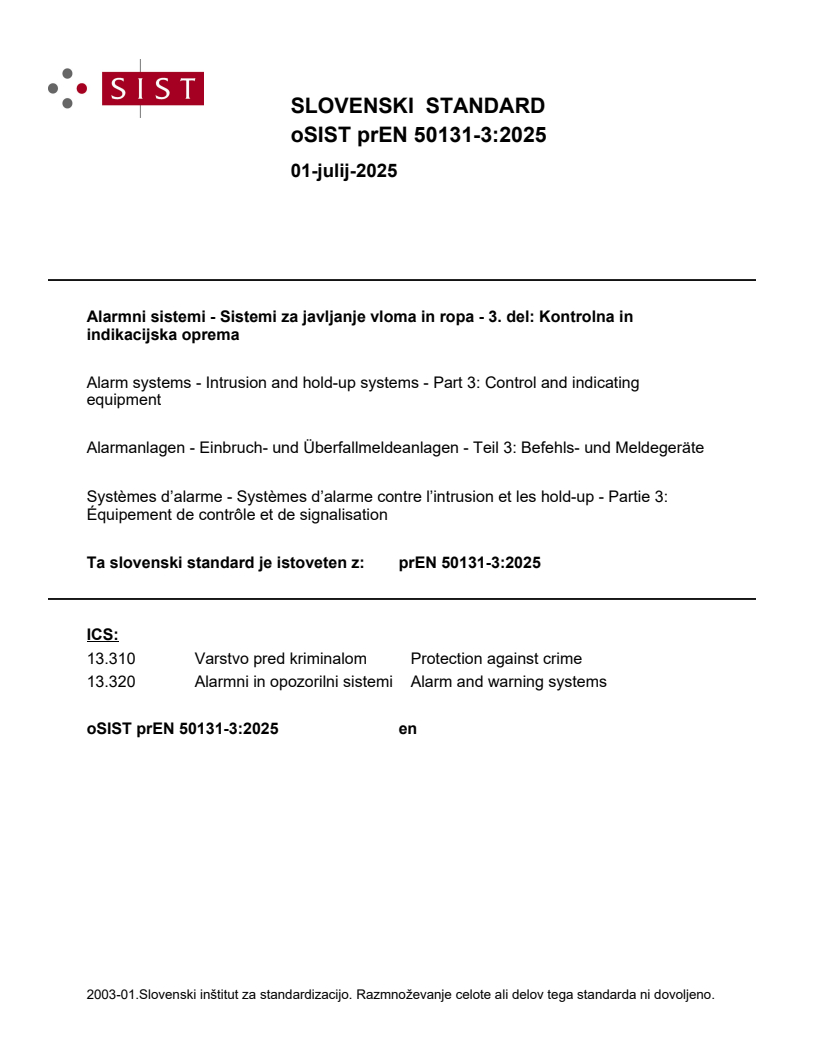
SLOVENSKI STANDARD
01-julij-2025
Alarmni sistemi - Sistemi za javljanje vloma in ropa - 3. del: Kontrolna in
indikacijska oprema
Alarm systems - Intrusion and hold-up systems - Part 3: Control and indicating
equipment
Alarmanlagen - Einbruch- und Überfallmeldeanlagen - Teil 3: Befehls- und Meldegeräte
Systèmes d’alarme - Systèmes d’alarme contre l’intrusion et les hold-up - Partie 3:
Équipement de contrôle et de signalisation
Ta slovenski standard je istoveten z: prEN 50131-3:2025
ICS:
13.310 Varstvo pred kriminalom Protection against crime
13.320 Alarmni in opozorilni sistemi Alarm and warning systems
2003-01.Slovenski inštitut za standardizacijo. Razmnoževanje celote ali delov tega standarda ni dovoljeno.
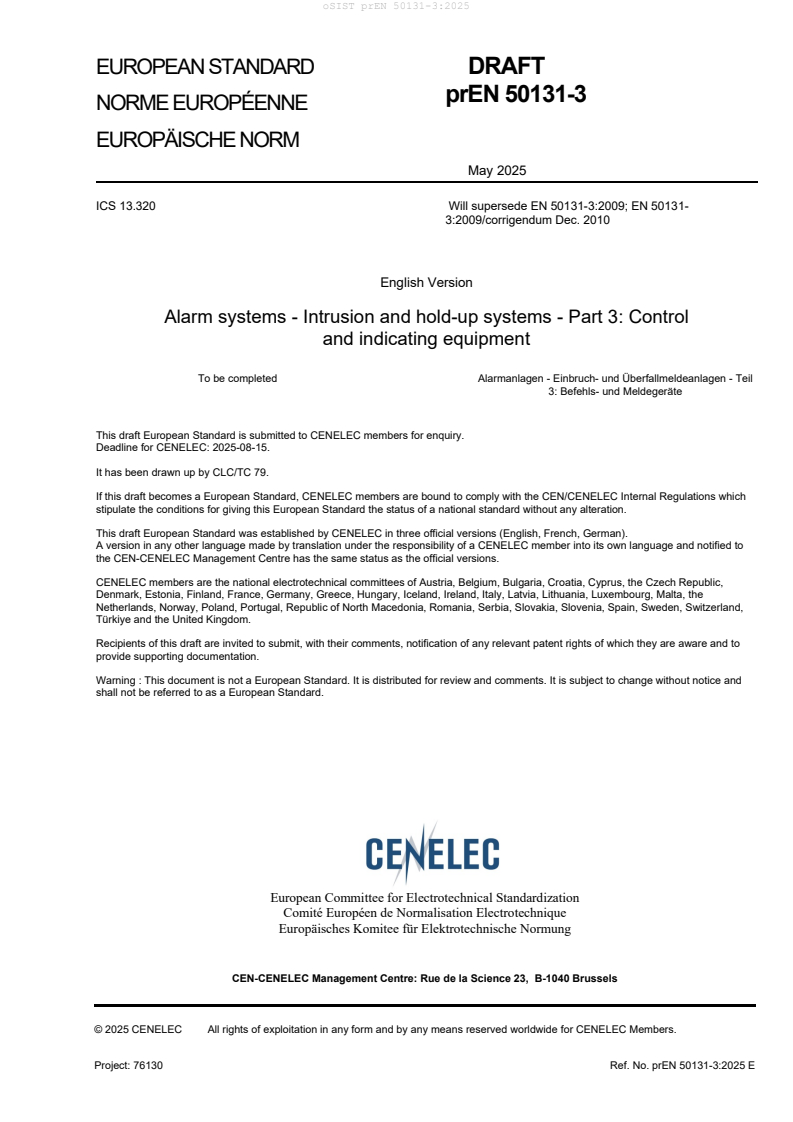
EUROPEAN STANDARD DRAFT
prEN 50131-3
NORME EUROPÉENNE
EUROPÄISCHE NORM
May 2025
ICS 13.320 Will supersede EN 50131-3:2009; EN 50131-
3:2009/corrigendum Dec. 2010
English Version
Alarm systems - Intrusion and hold-up systems - Part 3: Control
and indicating equipment
To be completed Alarmanlagen - Einbruch- und Überfallmeldeanlagen - Teil
3: Befehls- und Meldegeräte
This draft European Standard is submitted to CENELEC members for enquiry.
Deadline for CENELEC: 2025-08-15.
It has been drawn up by CLC/TC 79.
If this draft becomes a European Standard, CENELEC members are bound to comply with the CEN/CENELEC Internal Regulations which
stipulate the conditions for giving this European Standard the status of a national standard without any alteration.
This draft European Standard was established by CENELEC in three official versions (English, French, German).
A version in any other language made by translation under the responsibility of a CENELEC member into its own language and notified to
the CEN-CENELEC Management Centre has the same status as the official versions.
CENELEC members are the national electrotechnical committees of Austria, Belgium, Bulgaria, Croatia, Cyprus, the Czech Republic,
Denmark, Estonia, Finland, France, Germany, Greece, Hungary, Iceland, Ireland, Italy, Latvia, Lithuania, Luxembourg, Malta, the
Netherlands, Norway, Poland, Portugal, Republic of North Macedonia, Romania, Serbia, Slovakia, Slovenia, Spain, Sweden, Switzerland,
Türkiye and the United Kingdom.
Recipients of this draft are invited to submit, with their comments, notification of any relevant patent rights of which they are aware and to
provide supporting documentation.
Warning : This document is not a European Standard. It is distributed for review and comments. It is subject to change without notice and
shall not be referred to as a European Standard.
European Committee for Electrotechnical Standardization
Comité Européen de Normalisation Electrotechnique
Europäisches Komitee für Elektrotechnische Normung
CEN-CENELEC Management Centre: Rue de la Science 23, B-1040 Brussels
© 2025 CENELEC All rights of exploitation in any form and by any means reserved worldwide for CENELEC Members.
Project: 76130 Ref. No. prEN 50131-3:2025 E
Contents Page
1 European foreword . 5
2 Introduction . 6
3 1 Scope . 7
4 2 Normative references . 7
5 3 Terms, definitions and abbreviations . 8
6 3.1 Terms and definitions . 8
7 3.2 Abbreviations .11
8 4 Equipment attributes .12
9 4.1 General .12
10 4.2 Functionality .12
11 5 CIE topology .12
12 6 Security grade .13
13 7 Environmental performance .13
14 7.1 Requirements .13
15 7.2 Environmental and EMC tests .13
16 8 Functional requirements .13
17 8.1 Inputs .13
18 8.1.1 Intruder detection .13
19 8.1.2 Hold-up device .13
20 8.1.3 Tamper .13
21 8.1.4 Fault .13
22 8.1.5 User input .14
23 8.1.6 Masking .14
24 8.1.7 Non-I&HAS inputs .14
25 8.2 Outputs .14
26 8.3 Operation .15
27 8.3.1 Access levels .15
28 8.3.2 Authorization .15
29 8.3.3 Setting procedures .18
30 8.3.4 Unsetting procedure .18
31 8.3.5 Restore function .19
32 8.3.6 Inhibit function .19
33 8.3.7 Isolate operation .19
34 8.3.8 Verification of I&HAS functions .19
35 8.3.9 Soak test function .19
36 8.3.10 Other functions .19
37 8.4 Processing.20
38 8.4.1 Processing of input signals or messages .20
39 8.4.2 Processing of user inputs .20
40 8.4.3 Monitoring of CIE processing.20
41 8.5 Indication .21
42 8.5.1 General .21
43 8.5.2 Priority of indications .22
44 8.6 Notification outputs .22
45 8.6.1 Other notification .22
46 8.7 Tamper security (detection/protection) .22
47 8.7.1 Tamper protection .22
48 8.7.2 Tamper detection .23
49 8.7.3 Monitoring of substitution . 24
50 8.8 Interconnections . 24
51 8.9 Timing . 25
52 8.10 Event recording . 25
53 8.10.1 Event recording at the CIE . 25
54 8.10.2 Event recording at the ARC or other remote location . 26
55 8.11 Power supply . 26
56 9 Product documentation . 26
57 9.1 Installation and maintenance . 26
58 9.2 Operating instructions . 27
59 10 Marking and labelling . 28
60 11 Tests . 28
61 11.1 Test conditions . 28
62 11.1.1 Laboratory conditions and tolerance . 28
63 11.1.2 Mounting . 28
64 11.1.3 CIE test configuration . 29
65 11.1.4 Power supply . 29
66 11.1.5 Event log checks . 29
67 11.1.6 Documentation . 30
68 11.2 Test procedures . 30
69 11.2.1 Tolerances . 30
70 11.2.2 Wire-free devices . 30
71 11.3 Reduced functional test . 30
72 11.4 Functional tests . 31
73 11.4.1 Processing intruder alarm signals or messages . 31
74 11.4.2 Processing of hold-up signals or messages . 33
75 11.4.3 Processing of tamper signals or messages . 35
76 11.4.4 Processing of fault signals or messages. 37
77 11.4.5 Processing masking signals or messages . 39
78 11.4.6 CIE Processing in the presence of non-I&HAS inputs . 41
79 11.5 Access level . 42
80 11.5.1 Access to the functions and controls . 42
81 11.6 Authorization requirements . 43
82 11.6.1 Key tests . 43
83 11.6.2 Additional key tests based on key type . 44
84 11.6.3 Invalid authorization attempts . 46
85 11.7 Operational tests . 48
86 11.7.1 Setting procedures . 48
87 11.7.2 Prevention of setting and overriding of prevention of setting procedures . 50
88 11.7.3 The set state . 52
89 11.7.4 Unsetting procedures . 52
90 11.7.5 Setting and/or unsetting automatically at pre-determined times . 54
91 11.7.6 Inhibit and isolate functions . 56
92 11.7.7 Test functions . 57
93 11.7.8 Other functions . 58
94 11.7.9 Monitoring of CIE processing . 58
95 11.7.10 Availability of Indications . 59
96 11.8 Tamper security tests . 60
97 11.8.1 Verification of a basic DCC . 60
98 11.8.2 Tamper protection . 60
99 11.8.3 Tamper detection – Access to the inside of the housing. 60
100 11.8.4 Tamper detection – Removal from mounting . 61
101 11.8.5 Tamper detection – Penetration of the housing . 62
102 11.9 Substitution tests . 62
103 11.9.1 Tests for monitoring of substitution of components . 62
104 11.9.2 Tests for monitoring of substitution – Timing requirements. 62
105 11.10 Testing of I&HAS timing performance . 62
106 11.11 Testing for interconnections . 63
107 11.11.1 Monitoring of interconnections .63
108 11.11.2 Testing of monitoring of periodic communication.63
109 11.11.3 Testing of verification during setting procedure.64
110 11.11.4 Test for security of communication .65
111 11.12 Event log .65
112 11.13 Marking and documentation .66
113 11.14 Environmental and EMC tests .67
114 Annex A (informative) CIE topology .68
115 Annex B (informative) Summary of timing requirements .69
116 Annex C (normative) Use of non-I&HAS interface (Indirect connection).70
117 Annex D (normative) Use of non-I&HAS interface (Direct connection) .72
118 Annex E (informative) Summary of function cross-references .75
119 Bibliography .79
120 European foreword
121 This document (prEN 50131-3:2025) has been prepared by CLC/TC 79 “Alarm systems”.
122 This document is currently submitted to the Enquiry.
123 The following dates are proposed:
• latest date by which the existence of this (doa) dav + 6 months
document has to be announced at national
level
• latest date by which this document has to be (dop) dav + 12 months
implemented at national level by publication of
an identical national standard or by
endorsement
• latest date by which the national standards (dow) dav + 36 months
conflicting with this document have to be (to be confirmed or
withdrawn modified when voting)
124 This document will supersede EN 50131-3:2009 and all of its amendments and corrigenda (if any).
125 prEN 50131-3:2025 includes the following significant technical changes with respect to EN 50131-3:2009:
126 — refined and aligned requirements to EN 50131-1:2006 ;
127 — refinement and clarification of test section;
128 — clarified and refined the use of distributed components with a CIE;
129 — Annex A has been expanded to include the topology of the CIE;
130 — Annex C has been re-written to expand on the use of non-I&HAS interfaces over an indirect connection;
131 — Annex D has been added to cover the use of non-I&HAS interfaces over a direct connection.
As impacted by EN 50131-1:2006/A1:2009, EN 50131-1:2006/A2:2017 and EN 50131-1:2006/A3:2020.
132 Introduction
133 Repetition of definitions and requirements contained in EN 50131-1 have been eliminated from this EN 50131-3,
134 in order to minimize conflict in the event of changes to EN 50131-1, except where repetition is deemed essential
135 for the clarity of this document.
136 Reference has been included to various implications arising from the detector standards. Full detail of the
137 interconnection requirements could be the subject of a future standard.
138 A number of requirements are contained in this document for which a formal test procedure can only be written
139 by defining (and hence restricting) the technology by which the requirement is achieved. Accordingly, it has
140 been recognized that such functions can be tested only by agreement between manufacturer and test house,
141 according to documented information relating to how the required functionality has been achieved.
142 In Annex E a table has been included to cross reference EN 50131-1 requirements against this document and
143 tests.
144 1 Scope
145 This document specifies the requirements, performance criteria and testing procedures for control and indicating
146 equipment (CIE) intended for use in intrusion and hold-up alarm systems (I&HAS) installed in buildings. This
147 document also applies to CIE to be used in IAS or HAS.
148 The CIE can incorporate processing functions of other I&HAS components or its processing requirements can
149 be distributed among such components.
150 This document specifies the requirements for CIE installed in buildings using specific or non-specific wired
151 interconnections or wire-free interconnections. These requirements also apply to basic DCC which can be
152 installed outside of the supervised premises and mounted in indoor or outdoor environments.
153 Where CIE shares means of detection, interconnection, control, communication, processing and/or power
154 supplies with other applications, these requirements apply to I&HAS functions only.
155 This document specifies performance requirements for CIE at each of the four security grades identified in
156 EN 50131-1. Requirements are also specified for four environmental classes covering applications for indoor
157 and outdoor locations.
158 This document includes mandatory functions for all CIE for the appropriate security grade, as well as optional
159 functions that can additionally be provided.
160 This document does not cover requirements for compliance with EU regulatory Directives, such as the EMC
161 Directive, Low Voltage Directive, etc. except in that it specifies the equipment operating conditions for EMC
162 susceptibility testing as required by EN 50130-4.
163 NOTE 1 In this document reference to the term “I&HAS” is used throughout, except where there is specific need to
164 differentiate between the IAS and HAS portions of a system. The term is intended to include IAS and HAS when such
165 systems are installed separately.
166 NOTE 2 For products which integrate functions from, and which the manufacturer is claiming compliance to, several
167 EN 50131 standards, the requirements of this document apply as well as any additional requirements from other relevant
168 EN 50131 standards (e.g. a CIE with integral Warning Device is expected to meet the requirements of EN 50131-3 and
169 EN 50131-4).
170 2 Normative references
171 The following documents are referred to in the text in such a way that some or all of their content constitutes
172 requirements of this document. For dated references, only the edition cited applies. For undated references, the
173 latest edition of the referenced document (including any amendments) applies.
174 EN 50130-5, Alarm systems - Part 5: Environmental test methods
175 EN 50131-1:2006, Alarm systems - Intrusion and hold-up systems - Part 1: System requirements
176 EN 50131-5-3, Alarm systems - Intrusion systems - Part 5-3: Requirements for interconnections equipment
177 using radio frequency techniques
178 EN 50131-6, Alarm systems - Intrusion and hold-up systems - Part 6: Power supplies
179 EN 60068-2-75, Environmental testing - Part 2-75: Tests - Test Eh: Hammer tests
180 EN 60529, Degrees of protection provided by enclosures (IP Code) (IEC 60529)
181 CLC/TS 50136-10, Alarm systems - Alarm transmission systems and equipment - Part 10: Requirements for
182 remote access
As impacted by EN 50131-1:2006/A1:2009, EN 50131-1:2006/A2:2017 and EN 50131-1:2006/A3:2020.
183 3 Terms, definitions and abbreviations
184 3.1 Terms and definitions
185 For the purposes of this document, the terms and definitions given in EN 50131-1 and the following apply.
186 ISO and IEC maintain terminology databases for use in standardization at the following addresses:
187 — ISO Online browsing platform: available at https://www.iso.org/obp/
188 — IEC Electropedia: available at https://www.electropedia.org/
189 3.1.1
190 acknowledge
191 action of a user to accept an indication
192 3.1.2
193 alarm point
194 one or more detector(s) providing a common signal or message, at the CIE or at the DCC for the purpose of
195 indication or processing
196 3.1.3
197 alarm signal or message
198 signal or message generated by an alarm point
199 3.1.4
200 distributed component of the CIE
201 DCC
202 individual component of the CIE which provides one or more mandatory functions of the CIE
203 EXAMPLES keypads, expanders and control panels
204 Note 1 to entry: The CIE may be formed by multiple DCC that are distributed within different housings.
205 Note 2 to entry: When viewing EN 50131-1, Ancillary Control Equipment should be interpreted as DCC.
206 3.1.5
207 basic DCC
208 DCC which is only used for indication, or used as a user input device that does not authenticate a user, and
209 access to internal elements resulting from damage to the housing could not enable the status of any part of the
210 I&HAS to be changed or prevent the initiation of mandatory notification
211 EXAMPLES:
212 That do meet the basic DCC criteria:
213 — A prox reader which passes the details of the prox tag to the CIE or DCC for user authentication
214 — A keypad which passes the key presses to the CIE or DCC for user authentication
215 — A biometric reader which passes biometric information to the CIE or DCC for user authentication
216 That do NOT meet the basic DCC criteria:
217 — A mechanical keyswitch
218 — A device with inputs for connection to detectors
219 — A standalone biometric reader which authenticates the user directly.
220 Note 1 to entry: It is permited for a basic DCC user input device to also provide indication.
221 Note 2 to entry: Unless stated otherwise, the requirements for DCC apply to basic DCC.
222 3.1.6
223 biometric key
224 biometric characteristic of an authorized user
225 EXAMPLE finger print or iris recognition
226 3.1.7
227 conditioning
228 exposure of the Equipment Under Test (EUT) to environmental conditions in order to determine the effect of
229 such conditions on the EUT
230 3.1.8
231 detector
232 device designed to generate an alarm signal or message in response to the sensing of an abnormal condition
233 indicating the presence of a hazard
234 3.1.9
235 digital key
236 portable device containing digitally coded information used by an authorized user
237 EXAMPLE magnetic card, electronic token, radio fob
238 3.1.10
239 entry route facility
240 means to ignore signals or messages from specified detectors during unsetting for a specified time period
241 3.1.11
242 entry time
243 time permitted for unsetting procedure where entry route is used
244 3.1.12
245 exit route facility
246 means to ignore signals or messages from specified detectors during setting for a specified period
247 3.1.13
248 external power source
249 EPS
250 energy supply external to the I&HAS which may be non-continuous
251 EXAMPLE main power supply
252 Note 1 to entry: For Type A and Type B PS only. The EPS is derived as described in EN 50131-6.
253 3.1.14
254 fail to set
255 condition when defined setting procedure has not been completed within a specific time so that I&HAS is left in
256 the “setting mode”
257 3.1.15
258 false acceptance rate
259 FAR
260 proportion of biometric verification transactions with wrongful claims of identity that are incorrectly accepted
261 when 1:1 comparison is performed
262 3.1.16
263 false rejection rate
264 FRR
265 proportion of biometric verification transactions with truthful claims of identity that are incorrectly denied when
266 1:1 comparison is performed
267 3.1.17
268 intrusion
269 entry into the supervised premises by an unauthorised person(s)
270 3.1.18
271 logical key
272 logical information used by an authorized user to gain access to restricted functions or parts of an I&HAS
273 EXAMPLE PIN code, or information held on magnetic card or similar, biometric key
274 3.1.19
275 mechanical key
276 implement relying solely on physical shape to determine its uniqueness, used by an authorized user to gain
277 access to restricted functions or parts of an I&HAS
278 EXAMPLE Metal door key
279 Note 1 to entry: physical item used by an authorized user
280 3.1.20
281 non-I&HAS interface
282 user interface which is not necessarily dedicated to the I&HAS
283 EXAMPLES computer, mobile device and/or application, BMS, indicator (mimic) panel
284 3.1.21
285 operating mode
286 one of four operating modes, i.e. set, unset, setting and unsetting
287 3.1.22
288 open by normal means
289 open the equipment housing following the procedure defined by the manufacturer
290 3.1.23
291 Personal Identification Number code
292 PIN code
293 code used by an authorized user (example, numeric or alphanumeric)
294 3.1.24
295 portable ACE
296 ACE designed to be in operation while being carried
297 Note 1 to entry: The concept of portable ACE is not used within this document and where EN 50131-1 refers to portable
298 ACE this shall be read as a Digital key and is not a DCC.
299 3.1.25
300 storage device
301 SD
302 device which stores energy
303 EXAMPLE a battery
304 3.1.26
305 supervised premises transceiver
306 SPT
307 ATE at the supervised premises including the interface to the AS and the interface to one or more transmission
308 networks and being part of one or more ATPs
309 [SOURCE: EN 50136-1]
310 3.1.27
311 test condition
312 condition of an alarm system in which the normal functions are modified for test purposes
313 3.1.28
314 user input
315 command generated by a deliberate user action
316 3.1.29
317 user input device
318 device used for user input
319 EXAMPLES Keypad, Prox reader, physical lock with electrical contacts
320 3.1.30
321 non-dedicated self-powered digital key
322 device or piece of equipment with an internal power source and with primary functions unrelated to an I&HAS,
323 but which nevertheless may be used to provide user authorisation via a direct communication link to an I&HAS
324 EXAMPLE Mobile phone (using NFC, Bluetooth)
325 3.1.31
326 dedicated self-powered digital key
327 device or piece of equipment with an internal power source and with functions only related to an I&HAS, which
328 is used to provide user authorisation via a direct communication link to an I&HAS
329 3.2 Abbreviations
330 For the purposes of this document the following abbreviations apply:
APS Alternative power source
ARC Alarm receiving centre
ATS Alarm transmission system
CIE Control and indicating equipment
DCC Distributed Component of a CIE
EPS External power source
EUT Equipment under test
FAR False acceptance rate
FRR False rejection rate
HAS Hold-up alarm system
IAS Intrusion alarm system
I&HAS Intrusion and hold-up alarm system
PIN Personal identification number
PS Power supply
SD Storage device
SPT Supervised premises transceiver
WD Warning device
331 4 Equipment attributes
332 4.1 General
333 CIE shall include attributes for the reception of signals and/or messages, processing the information, notification
334 and indication as appropriate. The detailed requirements are provided in Clause 8.
335 If a function is provided that is optional for a particular grade and a claim of compliance is made, it shall meet
336 the applicable requirements for the grade for which compliance is claimed (if any are given). If there are no
337 specifications for the function at the grade in question, the requirements for any higher grade (as identified by
338 the manufacturer) shall apply.
339 Compliance with this document shall be demonstrated by assessment of Clause 4 through to Clause 10 and
340 the application of the tests of Clause 11.
341 Annex D provides a cross reference between the requirements of EN 50131-1 and the requirements and tests
342 of this document.
343 CIE which include the coerciveness principle in accordance with EN 50131-1:2006, 8.8.2.2 shall comply with
344 the requirements, and meet the tests, of CLC/TS 50131-12.
345 4.2 Functionality
346 Functions additional to the mandatory functions specified in this document may be included in I&HAS providing
347 they do not influence the correct operation of the mandatory functions.
348 Where provided, these additional functions shall not affect compliance with the requirements of this document,
349 except as permitted by EN 50131-1:2006, 8.3.13.
350 If use of a function(s) or combination of functions within the CIE would result in the installed I&HAS not being
351 compliant with EN 50131-1 or being compliant at a lower security grade (e.g. function(s) reducing the security
352 of the I&HAS) the manufacturer shall, either:
353 a) detail the configuration(s) which are compliant with EN 50131-1;
354 or
355 b) detail the function(s) or combination of functions that would result in the installed I&HAS not being compliant
356 with EN 50131-1.
357 A non-I&HAS interface may be used to carry out CIE functions if the conditions specified in Annex C or D are
358 met. A non-I&HAS interface shall not be the only means of providing mandatory functions of the CIE.
359 5 CIE topology
360 The CIE may be in a single housing or be distributed across multiple DCCs.
361 If the CIE is distributed in multiple DCCs, these collectively achieve the CIE functions described in this
362 document.
363 NOTE Annex A shows an example of how DCCs combine to form the CIE.
364 CIE or DCC may be combined with other I&HAS components.
365 6 Security grade
366 Any CIE or DCC shall meet the relevant requirements for one of four security grades for which it is declared to
367 comply. The grade of a CIE shall be that of the lowest graded component. The CIE shall meet all the
368 requirements of that grade.
369 The requirements for the performance of the CIE will vary depending upon its grade. Any testing will be carried
370 out according to the grade declared in the CIE documentation and marking.
371 7 Environmental performance
372 7.1 Requirements
373 Any CIE or DCC shall be suitable for use in at least one of the environmental classes defined in EN 50131-1.
374 When the requirements of the four environmental classes are inadequate, due to the extreme conditions
375 experienced in certain geographic locations, special national conditions are given in EN 50131-1:2006,
376 Annex A.
377 7.2 Environmental and EMC tests
378 EN 50130-4 specifies EMC susceptibility tests relevant to I&HAS components. The operating conditions for
379 these tests are specified in Table 32.
380 EN 50130-5 describes environmental test methods relevant to I&HAS components. The tests applicable are
381 specified in Table 32.
382 NOTE Other environmental aspects, covered by EU regulatory Directives, are outside the scope of this document.
383 8 Functional requirements
384 8.1 Inputs
385 Depending on the grade of the CIE means shall be provided to receive signals or messages from detectors,
386 hold-up trigger devices and information from user input devices as specified in the following subclauses.
387 NOTE 1 This document does not specify details of interconnections or the format of these signals or messages. Details
388 of possible means of transfer of the information are included in some of the component standards within the EN 50131
389 series.
390 NOTE 2 Some system components can require up to 180 s to initialise before normal functionality is available, (e.g.
391 detectors).
392 8.1.1 Intruder detection
393 The CIE shall provide the means to receive signals or messages from intruder detectors.
394 8.1.2 Hold-up device
395 When a CIE provides hold-up facilities, means shall be provided to receive signals or messages from hold-up
396 devices.
397 8.1.3 Tamper
398 The CIE shall provide the means to receive tamper signals or messages.
399 8.1.4 Fault
400 Dependent on the grade, CIE shall include means to recognize the fault conditions as specified in
401 EN 50131-1:2006, Table 1 and in addition those faults shown in Table 1.
402 Table 1 — Recognition of additional fault conditions
Faults Grade 1 Grade 2 Grade 3 Grade 4
a
Battery change required M M M M
b
Power output fault Op Op M M
Monitoring of processing Op Op M M
M = Mandatory Op = Optional
a
= applies to type “C” PS only as defined in EN 50131-6.
b
= see EN 50131-6
403 8.1.5 User input
404 The CIE shall provide the means for user input in order to operate the I&HAS.
405 EXAMPLE a keypad
406 8.1.6 Masking
407 The CIE shall provide the means to receive masking signals or messages, according to grade.
408 8.1.7 Non-I&HAS inputs
409 When a CIE receives signals or messages or other information not necessary to meet the requirements of this
410 document (e.g. monitoring of non-I&HAS equipment) this shall not affect the ability of the CIE to meet the
411 requirements of this document.
412 8.2 Outputs
413 Notification output requirements are detailed in 8.6
414 The CIE may need to provide output signals or messages to interface with other I&HAS components, as required
415 by other relevant component standards. The installation documentation shall identify which configurations are
416 available.
417 EXAMPLES
418 a) indication enable for detector or other component;
419 b) set/unset status information for detector, security fog device, etc.;
420 c) to trigger audible or visual alarm confirmation equipment;
421 d) to trigger security fog devices, etc.;
422 e) to enable functional test mode of detector;
423 f) to trigger remote self-test of detector or other component;
424 g) to restore detectors or other devices.
425 If the restore involves removal of power from detectors, up to 180 s should be allowed for the detector to resume
426 normal operation (see EN 50131-2-series).
427 Output signals or messages may additionally be provided to interface to equipment outside of the I&HAS.
428 EXAMPLE lighting
429 8.3 Operation
430 The CIE shall provide the means necessary to enable authorized users to access the functions of the CIE.
431 Access to these functions shall be restricted by access levels and corresponding authorisations according to
432 8.3.1 and 8.3.2.
433 EXAMPLE by using a keypad or lock
434 8.3.1 Access levels
435 Access to the functions of a CIE shall be restricted according to the requirements of EN 50131-1:2006, 8.3.1. If
436 the CIE includes security functions additional to those identified in EN 50131-1:2006, Table 2 the access levels
437 necessary to operate those functions shall be specified by the manufacturer. Access levels for any non-security
438 functions shall be specified in the manufacturer’s documentation.
439 Access at level 3 shall be authorized by access level 2 such that:
440 a) access remains authorized until manually removed,
441 or
442 b) access requires authorization for each occasion it is used.
443 Access at level 4 shall be authorized by access level 2 and 3 for each occasion it is used.
444 If level 3 access is granted without level 2 authorization, as permitted by EN 50131-1:2006, 8.3.1, the internal
445 warning device shall be time limited, either to a fixed time quoted by the manufacturer or until silenced by the
446 level 3 user.
447 8.3.2 Authorization
448 8.3.2.1 Access to functions
449 Access to the functions of a CIE at levels 2, 3 and 4 shall be restricted as required by EN 50131-1:2006, 8.3.2.
450 Authorization is not required for access at level 1.
451 At least one of the methods in 8.3.2.2 or 8.3.2.3 shall be provided by the CIE.
452 Authorization shall be validated by the CIE.
453 If means to provide temporary authorization is provided (e.g. a PIN code valid for a limited time or valid for use
454 a specified number of times), details should be included in the manufacturer’s documentation.
455 8.3.2.2 Use of mechanical key
456 Where mechanical keys are used, the manufacturer shall supply sufficient information to establish the number
457 of differs available.
458 8.3.2.3 Use of logical keys
459 Where logical keys are used, the manufacturer shall supply sufficient information to establish the number of
460 differs available.
461 Additionally, the following apply to specific types of logical key. This does NOT res
...
Questions, Comments and Discussion
Ask us and Technical Secretary will try to provide an answer. You can facilitate discussion about the standard in here.