

prEN 50763:2026
(Main)Assessment of electrical flexibility services from power network perspective
- Abstract
This document aims at standardizing concepts, terms and definitions relating to electrical flexibility as well as methodology to assess electrical flexibility services. The purpose of this document is to define a standardized characterization of electrical flexible services, so that data collected by transmission system operators or distribution system operators can be used and compared in an interoperable manner. In addition to the development of relevant use cases, the project will focus on the following normative aspects: — definition and characterization of the different types of electrical flexibilities depending, in particular, on the flexibility needs and the response time; — activation or control mode of the flexibility services; — measurement provisions: e.g. consistency with the data of the electricity smart meters and the metrology requirements and the use of dedicated measurement devices; — information exchanges between concerned parties; — verification of delivery of service.
- Status
- Not Published
- Publication Date
- 03-Nov-2026
- Technical Committee
- CLC/TC 8X - System aspects of electrical energy supply
- Drafting Committee
- WG 8 - Electrical Flexibility Services
- Current Stage
- 4020 - Enquiry circulated - Enquiry
- Start Date
- 09-Oct-2026
- Due Date
- 23-Jul-2025
- Completion Date
- 09-Oct-2026

Get Certified
Connect with accredited certification bodies for this standard

IMQ S.p.A. (Certification)
Italian electrical product certification.

SLG Prüf- und Zertifizierungs GmbH
German testing and certification body.

UL Solutions
Global safety science company with testing, inspection and certification.
Sponsored listings
Frequently Asked Questions
prEN 50763:2026 is a draft published by CLC. Its full title is "Assessment of electrical flexibility services from power network perspective". This standard covers: This document aims at standardizing concepts, terms and definitions relating to electrical flexibility as well as methodology to assess electrical flexibility services. The purpose of this document is to define a standardized characterization of electrical flexible services, so that data collected by transmission system operators or distribution system operators can be used and compared in an interoperable manner. In addition to the development of relevant use cases, the project will focus on the following normative aspects: — definition and characterization of the different types of electrical flexibilities depending, in particular, on the flexibility needs and the response time; — activation or control mode of the flexibility services; — measurement provisions: e.g. consistency with the data of the electricity smart meters and the metrology requirements and the use of dedicated measurement devices; — information exchanges between concerned parties; — verification of delivery of service.
This document aims at standardizing concepts, terms and definitions relating to electrical flexibility as well as methodology to assess electrical flexibility services. The purpose of this document is to define a standardized characterization of electrical flexible services, so that data collected by transmission system operators or distribution system operators can be used and compared in an interoperable manner. In addition to the development of relevant use cases, the project will focus on the following normative aspects: — definition and characterization of the different types of electrical flexibilities depending, in particular, on the flexibility needs and the response time; — activation or control mode of the flexibility services; — measurement provisions: e.g. consistency with the data of the electricity smart meters and the metrology requirements and the use of dedicated measurement devices; — information exchanges between concerned parties; — verification of delivery of service.
prEN 50763:2026 is classified under the following ICS (International Classification for Standards) categories: 03.080.99 - Other services; 29.240.01 - Power transmission and distribution networks in general. The ICS classification helps identify the subject area and facilitates finding related standards.
prEN 50763:2026 is available in PDF format for immediate download after purchase. The document can be added to your cart and obtained through the secure checkout process. Digital delivery ensures instant access to the complete standard document.
Standards Content (Sample)
SLOVENSKI STANDARD
01-november-2026
Ocena storitev električne prilagodljivosti z vidika elektroenergetskega omrežja
Assessment of electrical flexibility services from power network perspective
Bewertung der Stromflexibilitätsdiensten aus Sicht der Stromnetzbetreiber
Évaluation des services de flexibilité électrique pour la gestion des réseaux électriques
Ta slovenski standard je istoveten z: prEN 50763:2026
ICS:
03.080.99 Druge storitve Other services
29.240.01 Omrežja za prenos in Power transmission and
distribucijo električne energije distribution networks in
na splošno general
2003-01.Slovenski inštitut za standardizacijo. Razmnoževanje celote ali delov tega standarda ni dovoljeno.
EUROPEAN STANDARD DRAFT
prEN 50763
NORME EUROPÉENNE
EUROPÄISCHE NORM
September 2026
ICS 03.080.99; 29.240.01 -
English Version
Assessment of electrical flexibility services from power network
perspective
Evaluation des services de flexibilité électrique pour la Bewertung der Stromflexibilitätsdiensten aus Sicht der
gestion des réseaux électriques Stromnetzbetreiber
This draft European Standard is submitted to CENELEC members for enquiry.
Deadline for CENELEC: 2026-12-18.
It has been drawn up by CLC/TC 8X.
If this draft becomes a European Standard, CENELEC members are bound to comply with the CEN/CENELEC Internal Regulations which
stipulate the conditions for giving this European Standard the status of a national standard without any alteration.
This draft European Standard was established by CENELEC in three official versions (English, French, German).
A version in any other language made by translation under the responsibility of a CENELEC member into its own language and notified to
the CEN-CENELEC Management Centre has the same status as the official versions.
CENELEC members are the national electrotechnical committees of Austria, Belgium, Bulgaria, Croatia, Cyprus, the Czech Republic,
Denmark, Estonia, Finland, France, Germany, Greece, Hungary, Iceland, Ireland, Italy, Latvia, Lithuania, Luxembourg, Malta, the
Netherlands, Norway, Poland, Portugal, Republic of North Macedonia, Romania, Serbia, Slovakia, Slovenia, Spain, Sweden, Switzerland,
Türkiye and the United Kingdom.
Recipients of this draft are invited to submit, with their comments, notification of any relevant patent rights of which they are aware and to
provide supporting documentation.
Warning : This document is not a European Standard. It is distributed for review and comments. It is subject to change without notice and
shall not be referred to as a European Standard.
European Committee for Electrotechnical Standardization
Comité Européen de Normalisation Electrotechnique
Europäisches Komitee für Elektrotechnische Normung
CEN-CENELEC Management Centre: Rue de la Science 23, B-1040 Brussels
© 2026 CENELEC All rights of exploitation in any form and by any means reserved worldwide for CENELEC Members.
Project: 80729 Ref. No. prEN 50763:2026 E
prEN 50763 (E)
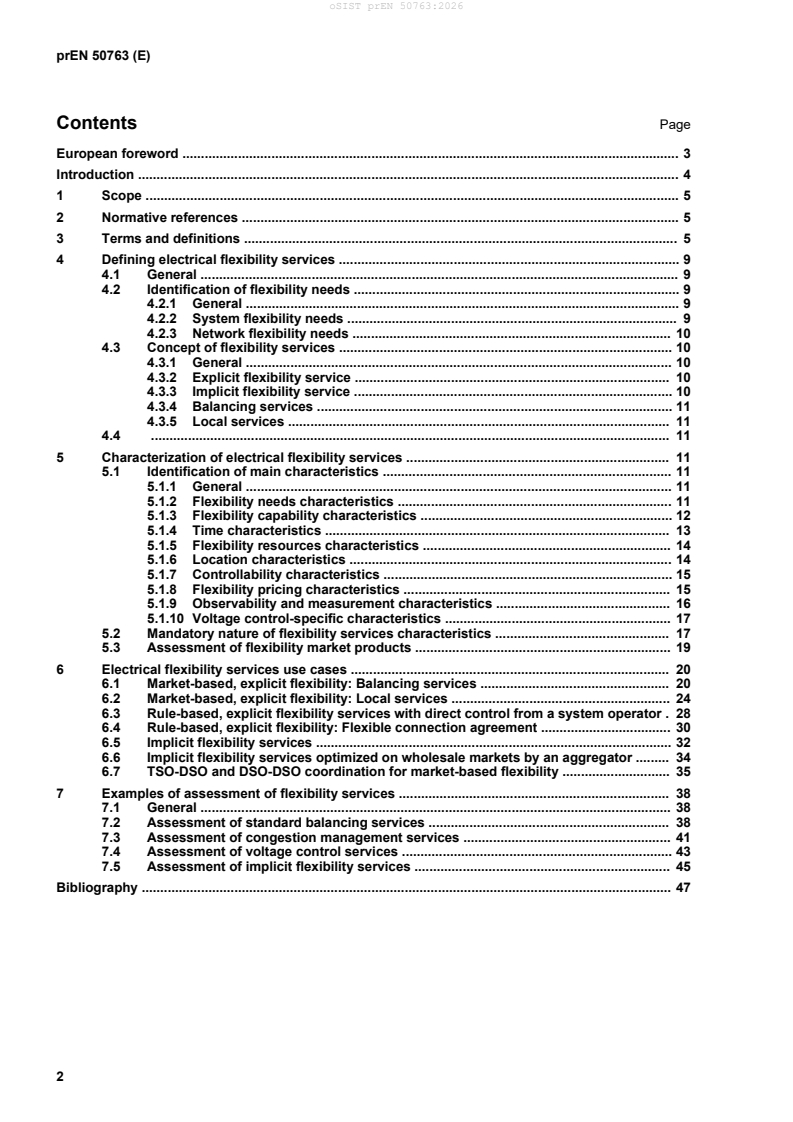
Contents Page
European foreword . 3
Introduction . 4
1 Scope . 5
2 Normative references . 5
3 Terms and definitions . 5
4 Defining electrical flexibility services . 9
4.1 General . 9
4.2 Identification of flexibility needs . 9
4.2.1 General . 9
4.2.2 System flexibility needs . 9
4.2.3 Network flexibility needs . 10
4.3 Concept of flexibility services . 10
4.3.1 General . 10
4.3.2 Explicit flexibility service . 10
4.3.3 Implicit flexibility service . 10
4.3.4 Balancing services . 11
4.3.5 Local services . 11
4.4 . 11
5 Characterization of electrical flexibility services . 11
5.1 Identification of main characteristics . 11
5.1.1 General . 11
5.1.2 Flexibility needs characteristics . 11
5.1.3 Flexibility capability characteristics . 12
5.1.4 Time characteristics . 13
5.1.5 Flexibility resources characteristics . 14
5.1.6 Location characteristics . 14
5.1.7 Controllability characteristics . 15
5.1.8 Flexibility pricing characteristics . 15
5.1.9 Observability and measurement characteristics . 16
5.1.10 Voltage control-specific characteristics . 17
5.2 Mandatory nature of flexibility services characteristics . 17
5.3 Assessment of flexibility market products . 19
6 Electrical flexibility services use cases . 20
6.1 Market-based, explicit flexibility: Balancing services . 20
6.2 Market-based, explicit flexibility: Local services . 24
6.3 Rule-based, explicit flexibility services with direct control from a system operator . 28
6.4 Rule-based, explicit flexibility: Flexible connection agreement . 30
6.5 Implicit flexibility services . 32
6.6 Implicit flexibility services optimized on wholesale markets by an aggregator . 34
6.7 TSO-DSO and DSO-DSO coordination for market-based flexibility . 35
7 Examples of assessment of flexibility services . 38
7.1 General . 38
7.2 Assessment of standard balancing services . 38
7.3 Assessment of congestion management services . 41
7.4 Assessment of voltage control services . 43
7.5 Assessment of implicit flexibility services . 45
Bibliography . 47
prEN 50763 (E)
European foreword
This document (prEN 50763:2026) has been prepared by Technical Committee CLC/TC 8X "System aspects
of electrical energy supply".
This document is currently submitted to the CENELEC Enquiry.
The following dates are proposed:
— latest date by which the existence of this (doa) dav + 6 months
document has to be announced at national
level
— latest date by which this document has to be (dop) dav + 12 months
implemented at national level by publication of
an identical national standard or by
endorsement
— latest date by which the national standards (dow) dav + 36 months (to be confirmed or
conflicting with this document have to be modified when voting)
withdrawn
prEN 50763 (E)
Introduction
Due to the energy transition, European power systems are facing several new challenges: increasing levels
of renewable generation on the transmission and on distribution networks, acceleration of electrification of
industry, heat and transportation, emergence of new electricity usages such as electric vehicles and battery
energy storage systems, phase-out of fossil-fuel generation, increase in power electronics equipments,
constraint national network development and needs for new interconnections.
System operators must ensure the reliability and quality of the electricity supply while addressing several
challenges such as :
— the increasing volatility of power flows (both generation and consumption),
— the increasing constraints on grid availability,
— and the growing complexity of the system.
The transformation of European power system involves the transformation of system operation and the
evolution of European energy markets: system operators can be required to be able to request and procure
electrical flexibility services in order to balance demand and supply or to solve their congestion or voltage
control issues, provided that these services offer reliability and competitiveness.
The definition and characterization of flexibility services is a cornerstone for the design of future European
flexibility markets, flexibility schemes or flexibility market products.
The present standard is intended to cover all of these aspects and to describe the main use cases for flexibility
services from the perspective of system operators.
It is intended to be used by the many stakeholders of electrical flexibility services: TSOs, DSOs, flexibility
service operators, market operators, manufacturers, system engineers.
prEN 50763 (E)
1 Scope
This document aims at standardizing concepts, terms and definitions relating to electrical flexibility as well as
methodology to assess electrical flexibility services.
The purpose of this document is to define a standardized characterization of electrical flexible services, so
that data collected by transmission system operators or distribution system operators can be used and
compared in an interoperable manner.
In addition to the development of relevant use cases, the project will focus on the following normative aspects:
— definition and characterization of the different types of electrical flexibilities depending, in particular, on
the flexibility needs and the response time;
— activation or control mode of the flexibility services;
— measurement provisions: e.g. consistency with the data of the electricity smart meters and the metrology
requirements and the use of dedicated measurement devices;
— information exchanges between concerned parties;
— verification of delivery of service.
2 Normative references
There are no normative references in this document.
3 Terms and definitions
For the purposes of this document the following terms and definitions apply.
— IEC Electropedia: available at http://www.electropedia.org/
— ISO Online browsing platform: available at http://www.iso.org/obp
3.1
flexibility service
capability to set the level of injection and/or consumption of an individual asset or a set of aggregated assets
belonging to grid users at a chosen value, in response to the flexibility needs of a system operator
3.1.1
explicit flexibility service
flexibility service provided as a reaction to a request or a signal
Note 1 to entry: A explicit flexibility service can be market-based services (local services, balancing services), rule-based
services, or flexibility connection agreements.
3.1.2
implicit flexibility service
flexibility service provided as a reaction to market price signals, or incentive signals (e.g. grid warning
signal, CO footprint signal)
3.2
network flexibility need
flexibility needed to adjust for grid availability, by means of preventing or solving congestion or voltage issues,
across relevant timeframe
3.3
system flexibility need
flexibility needed by the electricity system to adjust to the variability of generation and consumption patterns,
across relevant market timeframe
3.4
disturbance
unplanned event that can cause the transmission or distribution system to divert from the normal state
prEN 50763 (E)
3.5
congestion issue
situation when the electric current flow through a physical asset exceeds operational limits applied by systems
operators in line with their national framework
[SOURCE: Flexibility Needs Assessment Methodology [1] - Article 2(c)]
3.6
voltage issue
situation when voltage is above or below operational limits or when steady state voltage levels are not within
operational security limits
[SOURCE: Flexibility Needs Assessment Methodology [1] - Article 2(ll) and Network Code on Demand
Response [2] - Article 2(4)]
3.7
residual load
total demand minus non-dispatchable generation (as individual units or as aggregated units) such as from
wind or solar as well as generation, subject to must-run conditions per market time unit.
[SOURCE: Flexibility Needs Assessment Methodology [1] - Article 2(dd)]
3.8
voltage control
manual or automatic control actions at the generation node, at the end nodes of the AC lines or HVDC systems,
on transformers, or other means, designed to maintain the set voltage level or the set value of reactive power
[SOURCE: Regulation (EU) 2017/1485[3] - Article 3(21)]
3.9
normal state
situation in which the system is within operational security limits in the N-situation and after the occurrence of
any contingency from the contingency list, taking into account the effect of the available remedial actions
[SOURCE: Regulation (EU) 2017/1485 [3] - Article 3(5)]
3.10
emergency state
system state in which one or more operational security limits are violated
[SOURCE: Regulation (EU) 2017/1485 [3] - Article 3(37)]
3.11
restoration state
system state in which the objective of all activities in the transmission system is to re-establish the system
operation and maintain operational security after the blackout state or the emergency state
[SOURCE: Regulation (EU) 2017/1485 [3] - Article 3(38)]
3.12
controllable unit
CU
power-generating module and/or demand unit
Note 1 to entry: A controllable unit for the purposes of this document can be in accordance with Article 2(5) of Network
Code on requirements for grid connection of generators[4] and Article 2(4) of Network Code on demand connection[5].
[SOURCE: Network Code on Demand Response [2] - Article 2(18)]
3.13
service providing unit
SPU
controllable unit or an ensemble of controllable units connected to a single connection point
Note 1 to entry: SPU is defined by the service provider to provide balancing or local services.
[SOURCE: Network Code on Demand Response[2] - Article 2(22)]
prEN 50763 (E)
3.14
service providing group
SPG
aggregation of controllable units or service providing units connected to more than one connection point within
the same scheduling area
Note 1 to entry: SPG is defined by the service provider to provide balancing or local services.
[SOURCE: Network Code on Demand Response[2]- Article 2(23)]
3.15
distributed energy resource
DER
generators (with their auxiliaries, protection and connection equipment), including loads having a generating
mode (such as electrical energy storage systems), connected to a low-voltage or a medium-voltage network
[SOURCE: IEC 60050-617:2009 [6] - [617-04-20]]
3.16
service provider
SP
market participant with service providing units or service providing groups able to provide system operator
services in a balancing or local market
[SOURCE: Network Code on Demand Response[2] - Article 2 (20)]
3.17
balancing service provider
BSP
party with reserve-providing units or reserve-providing groups able to provide balancing services to TSOs
Note 1 to entry: A balancing service provider is a type of service provider.
Note 2 to entry: Balancing services can be balancing energy and/or balancing capacity.
[SOURCE: Regulation (EU) 2017/2195 [7] - Article 2(6)]
3.18
balance responsible party
BRP
party financially accountable for its imbalances
Note 1 to entry: A balance responsibility requires a contract proving financial security with the imbalance settlement
responsible of the scheduling area entitling the party to operate in the market. Imbalance means an energy volume
calculated for a balance responsible party and representing the difference between the allocated volume attributed to that
balance responsible party and the final position of that balance responsible party, including any imbalance adjustment
applied to that balance responsible party, within a given imbalance settlement period.
[SOURCE: Regulation (EU) 2017/2195 [7] - Article 2(7)]
3.19
prosumer
entity or party which can be both a producer and a consumer of electrical energy
[SOURCE: IEC 60050-617:2009 [6] - [617-02-16]]
3.20
final customer
customer who purchases electricity for own use
[SOURCE: Directive (EU) 2019/944 [8] - Article 2(3)]
3.21
market-based
mechanism or a procurement process for a service provision where either the selection of the service providers
or the activation of the service is based on a bidding process
prEN 50763 (E)
3.22
flexibility market product
set of technical and commercial characteristics defined a flexibility service that can be traded or procured by
a procuring system operator through market-based procedures
3.23
flexible connection agreement
FCA
set of agreed conditions for connecting electrical capacity to the grid that includes conditions to limit and control
the electricity injection to and withdrawal from the transmission network or distribution network
[SOURCE: Directive (EU) 2019/944 [8] - Article 2(24c)]
3.24
ancillary services
service necessary for the operation of an electric power system provided by the system operator or by power
system users
Note 1 to entry: System ancillary services may include the participation in frequency regulation, reactive power regulation,
active power reserve, etc.
[SOURCE: IEC 60050-617:2009 [6] - [617-03-09]]
3.25
non-frequency ancillary services
service used by a system operator or distribution system operator for steady state voltage control, fast reactive
current injections, inertia for local grid stability, short-circuit current, black start capability and island
operation capability
3.26
flexible information system
FIS
system to record at least the qualification of service providers, the product prequalification, product verification
and grid prequalification of SPUs and SPGs and the switch of controllable units for the provision of balancing
and local services and to exchange data for such processes
[SOURCE: Network Code on Demand Response [2] - Article 2 (15)]
3.27
energy management system
EMS
solution for monitoring, operating, controlling and optimizing energy resources and loads at premises level
(home, commercial, industrial building or industrial plant)
Note 1 to entry: An energy management system is a local system for monitoring and control of energy resources and loads
belonging to the same grid use.
Note 2 to entry: An energy management system acts as the execution layer for flexibility services by receiving activation
or incentive signals, executing control actions, and providing measurement and forecasting data.
Note 3 to entry: An energy management system can also be called a home energy management system (HEMS), a building
energy management system (BEMS), a customer energy management system (CEMS), or an electrical energy
management system (EEMS).
Note 4 to entry: The EMS is the primary interface for explicit and implicit flexibility services as specified in EN IEC 62746-4
[9] andEN IEC 63402-1 [10].
[SOURCE: IEC 60050-617:2009 [6] [826-19-04] and ISO 17800:2017 [11].]
3.28
connection point
interface at which the power-generating module, demand facility, distribution system or MVDC or HVDC
system is connected to a transmission system, offshore network, distribution system, including closed
distribution systems, or HVDC system, as identified in the connection agreement
prEN 50763 (E)
3.29
dynamic electricity price contract
electricity supply contract between a supplier and a final customer that reflects the price variation in the spot
markets, including in the day-ahead and intra-day markets, at intervals at least equal to the market
settlement frequency
[SOURCE: Directive (EU) 2019/944 [8] - Article 2(15)]
4 Defining electrical flexibility services
4.1 General
The European power system is undergoing significant changes motivated by the European Union's ambition
to achieve climate neutrality and to accelerate the transition to a fully carbon-neutral system. These ambitions
are driving the rapid integration of large amounts of variable renewable resources into the transmission and
distribution networks and the phase-out of fossil-fuel generation.
Furthermore, the European power system must face the increasing electrification of end uses such as
transportation, heating, cooling and industrial processes, the ongoing significant growth in electricity demand
induced by artificial intelligence and datacenters but also the proliferation of distributed energy resources.
Amid this rapid energy transition and the ever-growing complexity of the power system where system
operators must safeguard balance between supply and demand, flexibility has become a key factor to ensure
the reliability, resilience and stability of the grid.
Flexibility refers to the ability of an electricity system to adapt to variability and uncertainty in generation and
consumption patterns, and to adjust to network availability over relevant market timeframes.
Flexibility services shall be proposed in order to fulfill, prevent or solve the flexibility needs identified by system
operators.
4.2 Identification of flexibility needs
4.2.1 General
From a system operator's perspective, flexibility needs arise from the power flows variability and the availability
of the grid. They are caused by the volatility / growth of demand and injection flows, involving increased peak
loads and changing electrical flows patterns. Flexibility needs are amplified by the growing adoption of
renewable generation which is inherently intermittent and weather-dependent.
NOTE In accordance with Article 19e(4)(b) of Regulation (EU) 2019/943 [12], ENTSO-E and DSO Entity have set out
a methodology for the analysis by TSOs and DSOs of their flexibility needs[1].
The flexibility need assessment methodology distinguishes between two types of flexibility needs: system
flexibility needs and network flexibility needs.
4.2.2 System flexibility needs
"System flexibility need" refers to the flexibility needed by the electric system to adapt to the variability of
generation and consumption patterns, across relevant market time frame.
System flexibility needs are classified into the following subcategories :
— Renewable energy source (RES) integration needs, which refer to the quantity of flexibility required
to achieve annual RES integration targets or maximum acceptable level RES curtailment at the national
level;
— Ramping needs, which refer to flexibility needs associated with variations of the residual load (defined
as the difference between total demand and RES generation) assuming perfect forecast conditions;
— Short-term needs, which refer to flexibility needs associated with unexpected variations of the residual
load or forced outage of assets during the intra-day or balancing time frame.
— Adequacy flexibility needs, which refer to the type of flexibility resources and the amount of flexibility
required to reliably balance demand and supply at all time frames and under all expected operating
conditions, especially during peak or critical hours.
prEN 50763 (E)
— Restoration needs, which refer to the type of flexibility resources and the amount of flexibility required
to safely re-establish the system operation and efficiently maintain operational security after an
emergency state or a blackout state.
— Inertia needs, which refer to the amount of inertia (rotational or synthetic inertia) required in the power
system to efficiently maintain the frequency stability after a disturbance. The growth of inertia needs will
be amplified by the increase in RES energy, the phase-out of fuel-based power plants (and consequently
of synchronous rotating machines) and the growth of power-electronics based generation.
The flexibility needs assessment methodology addresses more specifically the RES integration needs, the
ramping needs and the short-term needs, which refer to balancing needs.
4.2.3 Network flexibility needs
"Network flexibility need" refers to the flexibility needed to adjust for grid availability, by means of preventing
or solving congestion or voltage issues, across relevant time frame.
Network flexibility needs include both upward and downward flexibility needs, and can apply to transmission
or distribution network.
Network flexibility needs are classified into two subcategories:
— Congestion management needs, which refer to flexibility required to prevent or solve congestion issues
by maintaining power flows within operational limits across the transmission or distribution network,
across relevant time frame. Congestion management is critical for preventing overload or power outages,
guaranteeing system security (maintaining margins for contingencies) and preserving stable system
operation.
— Voltage control needs, which refer to flexibility required to enable system operators maintain voltage
level within operational limits across the transmission or distribution network, across relevant time frame.
Voltage control is crucial for maintaining the stability and the reliability of the grid (avoiding voltage
collapse or blackout conditions) and guaranteeing the efficiency of the grid (ensuring an efficient power
delivery and the protection of grid and grid users’ equipments).
4.3 Concept of flexibility services
4.3.1 General
From the perspective of system operators, flexibility services consist of solutions aimed at adapting energy
flows to ensure a reliable, stable, efficient and balanced energy system.
"Flexibility service" shall refer to the capability to set the level of injection and/or consumption of an individual
asset or a set of aggregated assets at a chosen value, in response to the flexibility needs (network or system
flexibility needs) of a system operator.
A flexibility service can be explicit or implicit.
4.3.2 Explicit flexibility service
"Explicit flexibility service" shall refer to a flexibility service provided directly by a grid user or a service provider,
as a reaction to a direct request or to an explicit signal. The user commitment depends on an obligation coming
from market-based services, rule-based services or flexible connection agreements.
Grid user participating to an explicit flexibility service must comply to the received signal, according to its
contracts or formal obligations (rules, laws, emergency).
Grid user participating to an explicit flexibility service may receive direct payments or financial rewards for
changing its consumption or generation patterns.
4.3.3 Implicit flexibility service
"Implicit flexibility service" shall refer to a flexibility service provided as a reaction to market price signals
(reflecting variations in supply, demand, grid availability or grid state) or as a reaction to incentive signals (e.g.
grid emergency/warning signal, CO2 footprint signal).
prEN 50763 (E)
The grid user participating to an implicit flexibility service is incentivized to adjust its energy use, but can decide
to comply or not to the price signal or incentive signal.
4.3.4 Balancing services
"Balancing services" refers to balancing energy or balancing capacity or both. Balancing services are offered
in response to a system flexibility need (identified by a transmission system operator).
NOTE This definition is adopted from Regulation (EU) 2017/2195 [7].
4.3.5 Local services
As defined in the Network Code on Demand Response [2], "local service" refers to energy or capacity offered
in response to a network flexibility need (identified by a transmission system operator or a distribution system
operator).
Local services can be used to alleviate or postpone the need to reinforce or expand the grid in order to solve
congestion or voltage issues, or to provide a solution until a decided grid reinforcement project is completed,
enabling a more efficient use of the system as well as the connection of additional generation and/or demand
capacity.
4.4
5 Characterization of electrical flexibility services
5.1 Identification of main characteristics
5.1.1 General
The characteristics defining electrical flexibility services can be grouped by category as below:
— flexibility needs characteristics;
— flexibility capabilities characteristics;
— time characteristics;
— flexibility resources characteristics;
— locational characteristics;
— controllability characteristics;
— flexibility pricing characteristics;
— observability and measurement characteristics;
— voltage control-specific characteristics.
5.1.2 Flexibility needs characteristics
5.1.2.1 General
This category of characteristics provides information regarding the flexibility needs that the flexibility service
is designed to meet.
5.1.2.2 Flexibility need category
Indicates the category of flexibility need that is fulfilled, prevented or solved by the flexibility service.
prEN 50763 (E)
It can be system needs (balancing, inertia, restoration) or network needs (congestion management, voltage
control)
5.1.2.3 Time frame of flexibility need
Indicates the time frame or market horizon of the flexibility need covered by the flexibility service.
It can be long term (years or seasonal), medium term (months to weeks), short-term (day-ahead, intra-day),
close to real time (minutes to seconds), real-time (seconds to milliseconds).
5.1.2.4 Flexibility service type
Distinguishes between the two types of flexibility service: explicit flexibility service or implicit flexibility service.
5.1.2.5 Flexibility service procurement process
Specifies the procurement process of the flexibility service: Market-based, rule-based, tariff-based, flexible
connection agreement.
— Market-based procurement allows service providers and final customers to provide flexibility services
through a market mechanism, which ensures competitive and non-discriminatory access of all market
participants and resources, individually or through aggregation. In a market-based procurement process,
selection of the service providers or the activation of the flexibility service is based on a bidding process.
— Rule-based means that the flexibility service is activated automatically, according to predefined
regulatory rules such as technical thresholds, limits or deviations, control logics and algorithms, but also
contractual conditions.
— Tariff-based refers to using electricity price signals. There are different kind of tariffs: fixed-price tariffs,
time-of-use tariffs, dynamic tariffs, etc.
— Flexible connection agreement relates to a set of agreed conditions for connecting new user's capacity
to the grid that includes conditions to limit and control the electricity injection to and withdrawal from the
transmission network or distribution network.
5.1.2.6 Actor procuring the flexibility service
Specifies the actor procuring or benefiting from the flexibility service: TSO, DSO, market participant.
5.1.2.7 Actor offering the flexibility service
Indicates the actor offering the flexibility service: service provider, DER aggregator, final customer/prosumer.
5.1.2.8 Identification of flexibility service
Indicates the name and identifier of the flexibility service.
5.1.2.9 Value stacking allowed
Indicates whether value stacking is permitted for a service provider, by placing bids in other flexibility markets
or by forwarding bids to other markets.
Value stacking is the strategy by which a service provider maximizes the value of its portfolio by combining
several flexibility services in order to generate multiple revenue streams from the same flexibility resources.
Market coordination shall ensure the integrity of flexibility markets and prevent the double activation of bids.
5.1.3 Flexibility capability characteristics
5.1.3.1 General
This category of characteristics provides information regarding the capability of the flexibility service.
5.1.3.2 Electrical commodity
Specify the commodity concerned by the flexibility service: active energy, reactive energy, active power.
prEN 50763 (E)
5.1.3.3 Minimum and maximum volume
Indicates the minimum and maximum volume offered by the flexibility service (e.g. the minimum quantity
requested for a flexibility bid size).
5.1.3.4 Direction
Indicates the direction of the delivery of flexibility. It can be:
— Upward: increase in generation or decrease in consumption;
— Downward: decrease in generation or increase in power consumption;
— Bidirectional.
5.1.3.5 Capability symmetry
Indicates if the resource can provide upward and downward flexibility with the same capacity.
5.1.4 Time characteristics
5.1.4.1 General
This category of characteristics provides time and duration information of the flexibility service.
5.1.4.2 Availability window
Indicates the time period required when the resource shall be available to provide a flexibility service.
5.1.4.3 Validity period of the bid
Determines the period when the flexibility service bid can be activated.
5.1.4.4 Delivery period
Specifies the period of delivery during which the service provider delivers the full requested change of power
in-feed to, or the full requested change of withdrawals from the system.
5.1.4.5 Minimum and maximum duration of the delivery
Indicates the minimum and maximum duration of the flexibility service delivery.
5.1.4.6 Full delivery time or response time
Specifies the period between the activation request by the procuring system operator, or the reception of the
signal, and the corresponding full delivery of the concerned flexibility service.
The full delivery time can be divided into a preparation period and a ramping period.
5.1.4.7 Preparation period
Specifies the period between the activation request of the flexibility service and the start of the ramping period.
5.1.4.8 Ramping period
Specifies the period during which the input and/or output of power will be increased or decreased until the
requested amount of power is reached.
5.1.4.9 Deactivation period
Specifies the period for ramping from full delivery to a set point, or from full withdrawal back to a set point.
5.1.4.10 Recovery time
Specifies the recovery time or the minimum duration between the end of the deactivation period and the
following activation.
prEN 50763 (E)
5.1.5 Flexibility resources characteristics
5.1.5.1 General
This category of characteristics provides information regarding the flexibility resources providing the flexibility
service.
5.1.5.2 Flexible resource type
Indicates the type of the flexibility resource.
Three main types of flexibility resource are identified:
— Demand-side flexibility (load), which involves adapting electricity consumption. This includes time-
shifting energy usage or reducing consumption during peak times.
— Supply-side flexibility (generation), which involves adapting electricity production. Power plants can ramp
up or down production based on demand.
— Storage flexibility, which involves technologies like stationary batteries, mobile electric vehicle batteries
or thermal storage solutions allowing the grid user to consume energy at one moment and to use it or
reinject it into the grid at a later moment.
5.1.5.3 Flexible resource technology
Specifies the technology of the resource providing the flexibility service:
— Load: commercial (smart buildings), industrial or residential (heat pump, boilers, electric vehicle charging,
smart devices etc.): they can reduce their consumption during peak hours through load-shifting or peak-
shaving, and they can increase their consumption in case of RES generation surplus. Their capability
can be limited by the customer behaviour or by comfort constraints.
— Conventional energy (gas turbines, hydro-power plants, nuclear plants): they can adjust their output
levels upwards or downwards, with a ramp rate depending on their technology. They can provide voltage
support and reactive power regulation.
— Renewable energy sources (wind turbines, photovoltaic solar): can curtail their generation and also
provide reactive power control.
— Battery energy storage systems: can provide bidirectional services (charge and discharge) with fast-
response and fast ramping rate such as dynamic voltage support or frequency regulation, and are useful
to cope with renewable generation variability.
— Inverter-based resources (like photovoltaic, battery energy storage systems, EV chargers, etc.): can
react rapidly to a signal, and can provide reactive power support, voltage regulation or synthetic inertia.
5.1.5.4 Aggregation of resources allowed
Determines whether the flexibility service can be provided by aggregated resources or not (Boolean).
5.1.5.5 Rebound effect
Indicates the amount of energy needed to recover the flexible resource's normal activity after (or before) the
delivery of flexibility service.
5.1.6 Location characteristics
5.1.6.1 General
This category of characteristics provides location information of the flexibility service.
prEN 50763 (E)
5.1.6.2 Location information
Specifies the location information where the flexibility service is to be delivered (e.g. at a grid connection point,
at a point of common coupling).
5.1.6.3 Geographical resolution
Specifies the spatial availability of the flexibility service. Depending on the flexibility service concerned, it can
be zonal, nodal (e.g. at a substation or a feeder level) or system wide.
5.1.6.4 Connecting system operator
Identifies the system operator (TSO or DSO) to which the flexibility resource is connected to.
5.1.7 Controllability characteristics
5.1.7.1 General
This category of characteristics provides information regarding the controllability of the flexibility service.
5.1.7.2 Control mode
Defines the control mode of the flexibility service.
The flexibility service can be controlled directly:
— by a system operator (through a control signal or an activation signal sent automatically or manually);
— or by a market operator (through a market signal or the activation of a bid);
— or automatically in a closed-loop manner (based on droop control).
The flexibility service can be controlled indirectly by a tariff signal (supplier tariff, grid tariff), or by a customer
awareness/engagement signal (e.g. CO2 footprint signal, grid emergency signal).
Where applicable, the local EMS installed at prosumer's premises interprets activation signals, optimizes
resource schedules, and automates the delivery of flexibility.
5.1.7.3 Maximum number of activations allowed per time period
Indicates the maximum number of times the service can be activated during a period of time.
5.1.7.4 Divisibility
Means the possibility for the procuring system operator or market operator to use only part of the bids offered
by the service provider, either in terms of power activation or time duration
5.1.7.5 Granularity
The smallest increment in volume of a bid (relevant only in case of divisible bids).
5.1.7.6 Maximum rebound avoidance time
Means the maximum time to which a demand reduction or increase can be shifted before or after the delivery
of the service.
5.1.8 Flexibility pricing characteristics
5.1.8.1 General
This category of characteristics provides pricing information of the flexibility service.
5.1.8.2 Maximum and minimum price
Maximum and minimum price that can be accepted by the procuring system operator.
prEN 50763 (E)
5.1.8.3 Remuneration structure
Indicates the mode of determination of the price: pay-as-bid, pay-as-cleared, and specifies whether
performance penalties can apply.
5.1.8.4 Activation price
Price that is for the flexibility actually activated and delivered (mostly expressed in EUR/MWh).
5.1.8.5 Price signal
Specifies the type of price signal that is used to trigger the flexibility delivery.
5.1.8.6 Availability (capacity) price
Price for keeping the flexibility available (mostly expressed in EUR/MW/hour of availability).
5.1.9 Observability and measurement characteristics
5.1.9.1 General
This category of characteristics provides information regarding the observability and the measurement of the
flexibility service.
5.1.9.2 Telemetry required
Specifies if telemetry shall be available for TSO or DSO monitoring and controlling the delivery of the flexibility
service (e.g. a SCADA monitoring current and voltage data, or a smart-meter gateway (DE) or an EMS).
When an EMS is present at prosumer's level, measuring and forecasted data can be securely transmitted to
the system operator.
5.1.9.3 Measurement equipment available
Indicates the type of measurement equipment that is available for the observability of flexibility service:
traditional meter, smart meter, sub-meter, dedicated measurement device and EMS (where applicable).
5.1.9.4 Measurement equipment requirements
Specifies the technical requirements for the measurement equipment, e.g. MID-compliance, metrological
provisions and accuracy classes.
NOTE Directive (EU) 2014/32 [13] can apply.
5.1.9.5 Resolution of observability
Specifies the granularity of the measurement (e.g. A 15-minute resolution).
5.1.9.6 Baselining method
Specifies the methodology used to calculates the baseline, which is the counterfactual reference about the
electrical quantities that would have been withdrawn or injected if there had been no activation of flexibility
service.
Several baselining methods can be proposed, among which:
— Me
...