


EN 10274:1999
(Main)Metallic materials - Drop weight tear test
General Information
- Abstract
This European Standard specifies the drop weight tear test for meatallic materials and includes a method for assessing the fracture appearance of ferritic steels. Assessment can also be based on the energy absorbed in fracturing the test piece, particularly for materials other than ferritic steels.
- Status
- Published
- Publication Date
- 18-May-1999
- Withdrawal Date
- 29-Nov-1999
- Technical Committee
- ECISS/TC 110 - Steel tubes, and iron and steel fittings
- Drafting Committee
- ECISS/TC 29/SC 9 - Mechanical testing of tubes
- Current Stage
- 9093 - Decision to confirm - Review Enquiry
- Start Date
- 05-Jun-2026
- Completion Date
- 23-Sep-2026
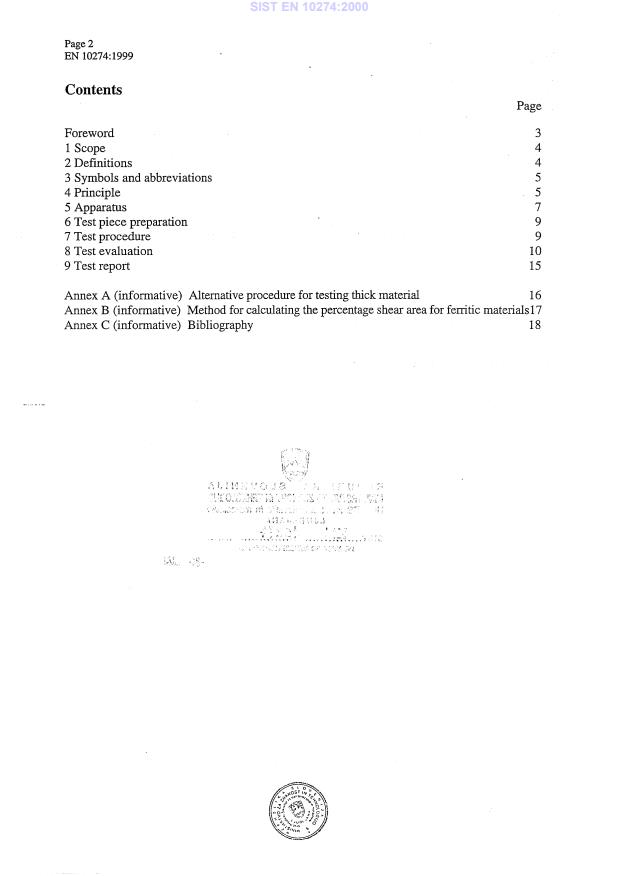
Overview - EN 10274:1999 (Metallic materials - Drop weight tear test)
EN 10274:1999 is a European Standard published by CEN that specifies the drop weight tear test (DWTT) for metallic materials. The standard provides a method for assessing the fracture appearance of ferritic steels and allows assessment based on the energy absorbed during fracture for materials other than ferritic steels. The document was transposed into national editions (e.g., SIST EN 10274:2000) and falls under mechanical testing of metals (ICS 77.040.10).
Key topics and requirements
- Scope and applicability: Defines the DWTT as a dynamic test to evaluate fracture behaviour of metallic materials, with an emphasis on ferritic steels.
- Fracture appearance assessment: Prescribes a method for visual and/or microscopic evaluation of the fracture surface to quantify brittle vs. ductile fracture modes for ferritic steels.
- Energy-based assessment: For non-ferritic materials, the standard permits evaluation based on the energy absorbed while fracturing the test piece in the drop weight apparatus.
- Test intent: Designed to detect lamellar tearing, shear fracture, and other through-thickness fracture characteristics under impact loading.
- Compatibility: Integrates with broader mechanical testing practices for metals and complements other impact and fracture toughness tests used in quality control and material specification.
Practical applications
EN 10274 (drop weight tear test) is used where through-thickness fracture behaviour and brittle fracture susceptibility must be controlled:
- Steel producers and mills - for product qualification and material characterization during development and production.
- Quality control laboratories - to verify material toughness and fracture appearance as part of acceptance testing.
- Design and integrity engineers - to assess suitability of materials for welded structures, pressure vessels, pipelines, rail components and other applications where fracture control is critical.
- Certification bodies and inspectors - to confirm compliance with contractual or regulatory toughness requirements.
Benefits and SEO keywords
Using EN 10274 helps organizations demonstrate resistance to brittle fracture and provides reproducible DWTT results for specifications. Relevant keywords: EN 10274, drop weight tear test, metallic materials, ferritic steels, fracture appearance, energy absorbed, mechanical testing of metals, DWTT.
Related standards
EN 10274 complements other impact and fracture testing methods used in material qualification and mechanical testing programs, and is typically referenced alongside general impact testing and fracture mechanics standards.
Relations
- Effective Date
- 28-Jan-2026
- Effective Date
- 28-Jan-2026
Get Certified
Connect with accredited certification bodies for this standard

Element Materials Technology
Materials testing and product certification.

Inštitut za kovinske materiale in tehnologije
Institute of Metals and Technology. Materials testing, metallurgical analysis, NDT.
Sponsored listings
Frequently Asked Questions
EN 10274:1999 is a standard published by the European Committee for Standardization (CEN). Its full title is "Metallic materials - Drop weight tear test". This standard covers: This European Standard specifies the drop weight tear test for meatallic materials and includes a method for assessing the fracture appearance of ferritic steels. Assessment can also be based on the energy absorbed in fracturing the test piece, particularly for materials other than ferritic steels.
This European Standard specifies the drop weight tear test for meatallic materials and includes a method for assessing the fracture appearance of ferritic steels. Assessment can also be based on the energy absorbed in fracturing the test piece, particularly for materials other than ferritic steels.
EN 10274:1999 is classified under the following ICS (International Classification for Standards) categories: 77.040.10 - Mechanical testing of metals. The ICS classification helps identify the subject area and facilitates finding related standards.
EN 10274:1999 has the following relationships with other standards: It is inter standard links to EN 13480-2:2017, EN 13445-2:2014. Understanding these relationships helps ensure you are using the most current and applicable version of the standard.
EN 10274:1999 is associated with the following European legislation: Standardization Mandates: M/005. When a standard is cited in the Official Journal of the European Union, products manufactured in conformity with it benefit from a presumption of conformity with the essential requirements of the corresponding EU directive or regulation.
EN 10274:1999 is available in PDF format for immediate download after purchase. The document can be added to your cart and obtained through the secure checkout process. Digital delivery ensures instant access to the complete standard document.
Standards Content (Sample)
2003-01.Slovenski inštitut za standardizacijo. Razmnoževanje celote ali delov tega standarda ni dovoljeno.Kovinski materiali - Udarni pregibni preskusMetallische Werkstoffe - FallgewichtsversuchMatériaux métalliques - Essai de chute de masseMetallic materials - Drop weight tear test77.040.10Mehansko preskušanje kovinMechanical testing of metalsICS:Ta slovenski standard je istoveten z:EN 10274:19
...