


EN 15755-1:2014
(Main)Glass in building - Adhesive backed polymeric filmed glass - Part 1: Definitions and requirements
General Information
- Abstract
This European Standard defines the characteristics, properties and classification of adhesive backed polymeric filmed glass, i.e. glass product that has had an adhesive backed polymeric film applied, for use in buildings. The adhesive backed polymeric film is based on biaxially oriented polyester film as defined in
FprEN 15752-1. This applies to both site and factory applications.
This European Standard does not apply to adhesive backed polymeric films manufactured using polyvinylchloride (PVC).
Other requirements, not specified in this standard, may apply to adhesive backed polymeric filmed glass that is incorporated into assemblies, e.g. laminated glass or insulating glass units. The additional requirements are specified in the appropriate product standard. Adhesive backed polymeric filmed glass, in this case, does not lose its mechanical or thermal characteristics.
- Status
- Published
- Publication Date
- 12-Aug-2014
- Withdrawal Date
- 27-Feb-2015
- Technical Committee
- CEN/TC 129 - Glass in building
- Drafting Committee
- CEN/TC 129/WG 18 - Filmed glass
- Current Stage
- 9060 - Closure of 2 Year Review Enquiry - Review Enquiry
- Start Date
- 03-Mar-2020
- Completion Date
- 03-Mar-2020

Overview
EN 15755-1:2014 - "Glass in building - Adhesive backed polymeric filmed glass - Part 1: Definitions and requirements" is a European (CEN) standard that defines the characteristics, properties and classification of glass products that have an adhesive backed polymeric film applied. The film covered is based on biaxially oriented polyester (see EN 15752-1). The standard applies to both site and factory applications and explicitly excludes films manufactured from PVC. It covers terminology, product definitions, durability and appearance criteria, and provides installation guidance.
Key Topics and Requirements
- Scope & Definitions
- Precise terms (e.g., release liner, dry lamination, wet lamination, filmed glass) to ensure consistent specification and testing.
- Product classifications
- Functional types described include solar control, safety, security (manual, explosive, ballistic), RFI/EMI shielding, anti‑graffiti, decorative, low emissivity, UV reduction, and privacy films.
- Durability & testing
- Procedures for assessing durability (humidity exposure, conditioning) and adhesion (peel testing, e.g., ISO/EN peel methods).
- Visual inspection requirements and acceptance criteria for defects such as spots, pinholes, gels, bubbles, scratches, distortion and clusters.
- Appearance & inspection
- Defined methods and conditions for detecting appearance defects (artificial sky and daylight conditions) and criteria for assessing uniformity and acceptability.
- Installation guidance
- Annex provides practical guidelines for wet lamination and dry lamination, preparation, cleaning, squeegeeing, trimming and safety-related considerations.
- Compatibility & thermal stress
- Annex material on film-to-glass compatibility and managing thermal stresses when films are applied to glazing.
- Limitations
- Does not cover PVC films; additional requirements may apply when filmed glass is incorporated into assemblies (laminated glass, insulating glass units) - consult product-specific standards.
Applications and Who Uses This Standard
- Architects, façade engineers and specifiers using filmed glass for solar control, privacy or aesthetic effects.
- Glass processors, laminators and film manufacturers for product classification, quality control and labelling.
- Installers (site and factory) following wet or dry lamination best practice to meet performance and appearance criteria.
- Test laboratories and certification bodies assessing adhesion, durability and visual conformity.
- Building owners and façade maintenance teams selecting films for retrofit or protection (anti‑graffiti, UV reduction, security).
Related Standards (select)
- EN 15752-1 (adhesive backed polymeric film definitions)
- EN 410 (luminous and solar characteristics)
- EN 356 / EN 1063 (security glazing tests)
- EN 12600 (impact/pedulum test)
- EN 12898 (emissivity)
- ISO/EN 8510-2 (peel test)
- ISO 16933 (explosion-resistant glazing)
EN 15755-1:2014 provides essential definitions, test expectations and practical installation guidance for anyone specifying, manufacturing, testing or installing adhesive backed polymeric filmed glass in building applications.
Relations
- Effective Date
- 25-Aug-2026
- Effective Date
- 09-Feb-2026
- Effective Date
- 28-Jan-2026
- Effective Date
- 28-Jan-2026
- Effective Date
- 28-Jan-2026
- Effective Date
- 28-Jan-2026
- Effective Date
- 28-Jan-2026
- Refers
EN 410:2011 - Glass in building - Determination of luminous and solar characteristics of glazing - Effective Date
- 28-Jan-2026
- Effective Date
- 28-Jan-2026
- Effective Date
- 28-Jan-2026
- Effective Date
- 28-Jan-2026
- Effective Date
- 28-Jan-2026
- Effective Date
- 28-Jan-2026
- Refers
EN 572-2:2012 - Glass in building - Basic soda lime silicate glass products - Part 2: Float glass - Effective Date
- 28-Jan-2026
- Effective Date
- 28-Jan-2026
Get Certified
Connect with accredited certification bodies for this standard

DIN CERTCO
DIN Group product certification.

Smithers Quality Assessments
US management systems and product certification.
Sponsored listings
Frequently Asked Questions
EN 15755-1:2014 is a standard published by the European Committee for Standardization (CEN). Its full title is "Glass in building - Adhesive backed polymeric filmed glass - Part 1: Definitions and requirements". This standard covers: This European Standard defines the characteristics, properties and classification of adhesive backed polymeric filmed glass, i.e. glass product that has had an adhesive backed polymeric film applied, for use in buildings. The adhesive backed polymeric film is based on biaxially oriented polyester film as defined in FprEN 15752-1. This applies to both site and factory applications. This European Standard does not apply to adhesive backed polymeric films manufactured using polyvinylchloride (PVC). Other requirements, not specified in this standard, may apply to adhesive backed polymeric filmed glass that is incorporated into assemblies, e.g. laminated glass or insulating glass units. The additional requirements are specified in the appropriate product standard. Adhesive backed polymeric filmed glass, in this case, does not lose its mechanical or thermal characteristics.
This European Standard defines the characteristics, properties and classification of adhesive backed polymeric filmed glass, i.e. glass product that has had an adhesive backed polymeric film applied, for use in buildings. The adhesive backed polymeric film is based on biaxially oriented polyester film as defined in FprEN 15752-1. This applies to both site and factory applications. This European Standard does not apply to adhesive backed polymeric films manufactured using polyvinylchloride (PVC). Other requirements, not specified in this standard, may apply to adhesive backed polymeric filmed glass that is incorporated into assemblies, e.g. laminated glass or insulating glass units. The additional requirements are specified in the appropriate product standard. Adhesive backed polymeric filmed glass, in this case, does not lose its mechanical or thermal characteristics.
EN 15755-1:2014 is classified under the following ICS (International Classification for Standards) categories: 81.040.20 - Glass in building; 83.140.10 - Films and sheets. The ICS classification helps identify the subject area and facilitates finding related standards.
EN 15755-1:2014 has the following relationships with other standards: It is inter standard links to ISO 16933:2007, EN 50147-1:1996, EN 1063:1999, EN ISO 14554-2:2013, EN 572-1:2012+A1:2016, EN 12600:2002, EN 673:2024, EN 410:2011, EN 572-7:2012, EN 356:1999, EN 12898:2019, EN ISO 8510-2:2010, EN 15752-1:2014, EN 572-2:2012, EN ISO 22374:2005. Understanding these relationships helps ensure you are using the most current and applicable version of the standard.
EN 15755-1:2014 is associated with the following European legislation: EU Directives/Regulations: 88/609/EEC; Standardization Mandates: M/135_Am1. When a standard is cited in the Official Journal of the European Union, products manufactured in conformity with it benefit from a presumption of conformity with the essential requirements of the corresponding EU directive or regulation.
EN 15755-1:2014 is available in PDF format for immediate download after purchase. The document can be added to your cart and obtained through the secure checkout process. Digital delivery ensures instant access to the complete standard document.
Standards Content (Sample)
2003-01.Slovenski inštitut za standardizacijo. Razmnoževanje celote ali delov tega standarda ni dovoljeno.Steklo v gradbeništvu - Steklo s samolepljivo polimerno folijo - 1. del: Definicije in zahteveGlas im Bauwesen - Glas mit selbstklebender Polymerfolie - Teil 1: Begriffe und AnforderungenVerre dans la construction - Verre avec film polymère adhésif - Partie 1: Définitions et exigencesGlass in building - Adhesive backed polymeric filmed glass - Part 1: Definitions and requirements83.140.10Filmi in folijeFilms and sheets81.040.20Steklo v gradbeništvuGlass in buildingICS:Ta slovenski standard je istoveten z:EN 15755-1:2014SIST EN 15755-1:2014en,fr,de01-september-2014SIST EN 15755-1:2014SLOVENSKI
STANDARD
EUROPEAN STANDARD NORME EUROPÉENNE EUROPÄISCHE NORM
EN 15755-1
August 2014 ICS 81.040.20; 83.140.10 English Version
Glass in building - Adhesive backed polymeric filmed glass - Part 1: Definitions and requirements
Verre dans la construction - Verre avec film polymère adhésif - Partie 1: Définitions et exigences
Glas im Bauwesen - Glas mit selbstklebender Polymerfolie -Teil 1: Begriffe und Anforderungen This European Standard was approved by CEN on 15 May 2014.
CEN members are bound to comply with the CEN/CENELEC Internal Regulations which stipulate the conditions for giving this European Standard the status of a national standard without any alteration. Up-to-date lists and bibliographical references concerning such national standards may be obtained on application to the CEN-CENELEC Management Centre or to any CEN member.
This European Standard exists in three official versions (English, French, German). A version in any other language made by translation under the responsibility of a CEN member into its own language and notified to the CEN-CENELEC Management Centre has the same status as the official versions.
CEN members are the national standards bodies of Austria, Belgium, Bulgaria, Croatia, Cyprus, Czech Republic, Denmark, Estonia, Finland, Former Yugoslav Republic of Macedonia, France, Germany, Greece, Hungary, Iceland, Ireland, Italy, Latvia, Lithuania, Luxembourg, Malta, Netherlands, Norway, Poland, Portugal, Romania, Slovakia, Slovenia, Spain, Sweden, Switzerland, Turkey and United Kingdom.
EUROPEAN COMMITTEE FOR STANDARDIZATION
COMITÉ EUROPÉEN DE NORMALISATION EUROPÄISCHES KOMITEE FÜR NORMUNG
CEN-CENELEC Management Centre:
Avenue Marnix 17,
B-1000 Brussels © 2014 CEN All rights of exploitation in any form and by any means reserved worldwide for CEN national Members. Ref. No. EN 15755-1:2014 ESIST EN 15755-1:2014
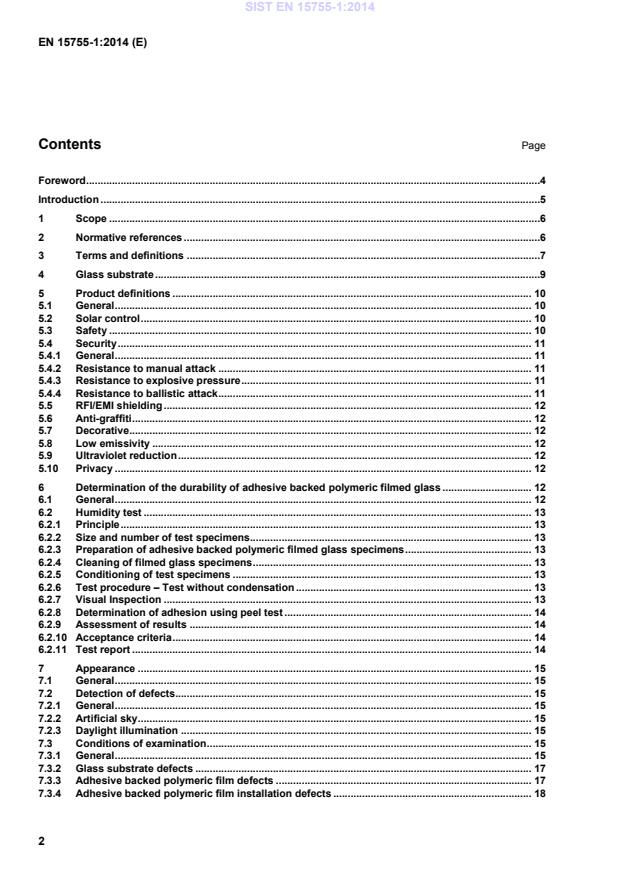
Guidelines for installation of adhesive backed polymeric film . 22 A.1 General . 22 A.2 Wet lamination . 22 A.2.1 General . 22 A.2.2 General Points . 22 A.2.3 Installation . 22 A.2.3.1 Prepare for the installation . 22 A.2.3.2 Clean the glazing . 23 A.2.3.3 Install the adhesive backed polymeric film to the glazing . 23 A.2.3.4 Squeegee the film – first procedure . 24 A.2.3.5 Trim the film . 25 A.2.3.6 Finish the squeegee process – second procedure . 25 A.2.3.7 Housekeeping . 25 A.2.3.8 Safety films ≥
.............................................................................................................................. 26 A.3 Dry installation ..................................................................................................................................... 26 Annex B (informative)
Film to glass compatibility and thermal stress . 27 Bibliography . 28
EN 15752-1. This applies to both site and factory applications. This European Standard does not apply to adhesive backed polymeric films manufactured using polyvinylchloride (PVC). Other requirements, not specified in this standard, may apply to adhesive backed polymeric filmed glass that is incorporated into assemblies, e.g. laminated glass or insulating glass units. The additional requirements are specified in the appropriate product standard. Adhesive backed polymeric filmed glass, in this case, does not lose its mechanical or thermal characteristics. 2 Normative references The following documents, in whole or in part, are normatively referenced in this document and are indispensable for its application. For dated references, only the edition cited applies. For undated references, the latest edition of the referenced document (including any amendments) applies. EN 356, Glass in building - Security glazing - Testing and classification of resistance against manual attack EN 410, Glass in building - Determination of luminous and solar characteristics of glazing EN 572-1, Glass in building - Basic soda lime silicate glass products - Part 1: Definitions and general physical and mechanical properties EN 572-2, Glass in building - Basic soda lime silicate glass products - Part 2: Float glass EN 572-7, Glass in building - Basic soda lime silicate glass products - Part 7: Wired or unwired channel shaped glass EN 673, Glass in building - Determination of thermal transmittance (U value) - Calculation method EN 1063, Glass in building - Security glazing - Testing and classification of resistance against bullet attack EN 12600, Glass in building - Pendulum test - Impact test method and classification for flat glass EN 12898, Glass in building - Determination of the emissivity EN 15752-1:2014, Adhesive backed polymeric film – Definitions and description EN 50147-1, Anechoic chambers - Part 1: Shield attenuation measurement EN ISO 8510-2, Adhesives - Peel test for a flexible-bonded-to-rigid test specimen assembly - Part 2: 180 degree peel (ISO 8510-2) ISO 16933, Glass in building — Explosion-resistant security glazing — Test and classification for arena air-blast loading CIE 13.3:1995, Method of Measuring and Specifying Colour Rendering Properties of Light Sources SIST EN 15755-1:2014
Spots, pinholes, gels and particulates are types of punctual defect. 3.5.3.1 spot defect that commonly looks dark against the surrounding film area, when viewed in transmission 3.5.3.2 pinhole punctual void in one or more film layers that normally contrasts clear relative to the surrounding film area when viewed in transmission SIST EN 15755-1:2014
Slight colour differences may exist when joining two or more pieces of film on a large pane of glass. 3.5.13 peeling separation of the adhesive backed polymeric film from the glass 3.5.14 delamination separation of the polymeric layers in the adhesive backed polymeric film SIST EN 15755-1:2014
EN 14179–1 Thermally toughened borosilicate safety glass EN 13024–1 Thermally toughened alkaline earth silicate safety glass EN 14321–1 Laminated and laminated safety glass EN ISO 12543-2, −3 Coated glass EN 1096–1 Basic alumino silicate glass products prEN 15681–1 Heat soaked thermally toughened alkaline earth silicate safety glass prEN 15682–1 Thermally toughened U channel soda lime silicate safety glass prEN 15683–1 NOTE Application of adhesive backed polymeric film to the coated surface of coated glass is not recommended. SIST EN 15755-1:2014
The short wave shading coefficient and the long wave shading coefficient may be determined from the calculated EN 410 data. NOTE 2 The contribution of the rear side of the pane of adhesive backed polymeric filmed glass is included. 5.3 Safety The purpose of applying adhesive backed polymeric safety film to a glass substrate is the modification of the breakage characteristics of the glass substrate to which it has been applied. The testing and classification shall be in accordance with EN 12600. NOTE 1 The application of adhesive backed polymeric safety film to a glass substrate that has a mode of breakage (A), i.e. annealed glass, as defined in EN 12600, will be the modification of the mode of breakage to (B), i.e. laminated glass, as defined in EN 12600. NOTE 2 The application of adhesive backed polymeric safety film to a glass substrate that has a mode of breakage (B), i.e. laminated glass, as defined in EN 12600, will not change the existing mode of breakage. NOTE 3 The application of adhesive backed polymeric safety film to a glass substrate that has a mode of breakage (C), i.e. toughened glass, as defined in EN 12600, will be the modification of the mode of breakage to (B), i.e. laminated glass, as defined in EN 12600. SIST EN 15755-1:2014
This modification could be the transformation of a glass substrate with no resistance to explosive pressure into one with resistance to explosive pressure. NOTE 2 This modification could be the transformation of a glass substrate with a level of resistance to explosive pressure into one with a higher performance. Other hazard ranking test standards that are essentially identical to ISO 16933 in test procedure may be used, but care should be taken to ensure that the appropriate number of test pieces is used to allow comparison of test results with ISO 16933. 5.4.4 Resistance to ballistic attack The purpose of applying adhesive backed polymeric security film to a glass substrate is to modify the resistance to ballistic attack of the glass substrate. The testing and classification shall be in accordance with EN 1063. NOTE 1 This modification could be the transformation of a glass substrate that exhibits splintering, i.e. class S in accordance with EN 1063, to one that does not exhibit splintering, i.e. class NS in accordance with EN 1063. NOTE 2 This modification could enable a glass substrate with a level of resistance to ballistic attack to be transformed into one with a higher performance. In some circumstances other substrates than 4 mm monolithic float glass may be used, for example adhesive backed polymeric security film applied to a glass substrate that exhibits splintering, i.e. class S, to modify it to class NS. SIST EN 15755-1:2014
EN 410. EN 410 requires values to be given as decimals to two places. However, the UV transmittance shall be given to four decimal places in order to distinguish between these products and non-specialist films. 5.10 Privacy The purpose of applying an adhesive backed polymeric privacy film to a glass substrate is to reduce vision through the glass substrate. 6 Determination of the durability of adhesive backed polymeric filmed glass 6.1 General The durability of adhesive backed polymeric filmed glass is a combination of the durability of the adhesive backed polymeric film (as defined in EN 15752-1), the glass substrate surface, and the application of the adhesive backed polymeric film (see Annex A). NOTE The durability of the adhesive backed polymeric film (see EN 15752–1) will have been determined on applicable glass substrates. SIST EN 15755-1:2014
...