


EN 12016:2004+A1:2008
(Main + Amendment)Electromagnetic compatibility - Product family standard for lifts, escalators and moving walks - Immunity
General Information
- Abstract
This European Standard specifies the immunity performance criteria and test levels for apparatus used in lifts, escalators and moving walks which are intended to be permanently installed in buildings including the basic safety requirements in regard to their EMC environment. These levels represent essential EMC requirements.
The standard refers to normal EMC conditions as existing in residential, office and industrial buildings, but does not cover more severe EMC environments such as:
- radio transmitter stations;
- railways and metros;
- heavy industrial plant;
- electricity power stations
which need additional investigations.
This standard addresses commonly known EMC related hazards and hazardous situations relevant to lifts, escalators and moving walks when they are used as intended and under the conditions foreseen by the lift installer or escalator and/or moving walk manufacturer.
This standard addresses the environmental conditions stated in the EN 81 series of standards and EN 115 (humidity, temperature, etc.), so far as they are related to EMC performance.
However:
- performance criteria and test levels for apparatus/assembly of apparatus used in general function circuits do not cover situations with an extremely low probability of occurrence;
- this standard does not apply to other apparatus already proven to be in conformity to the EMC Directive, and not related to the safety of the lift, escalator or moving walk, such as lighting apparatus, communication apparatus, etc.
This standard is not applicable to lifts, escalators, moving walks and related safety components manufactured before the date of publication of this standard by CEN.
- Status
- Withdrawn
- Publication Date
- 09-Sep-2008
- Withdrawal Date
- 20-Aug-2013
- Technical Committee
- CEN/TC 10 - Passenger, goods and service lifts
- Drafting Committee
- CEN/TC 10/WG 4 - Data logging and remote control
- Current Stage
- 9960 - Withdrawal effective - Withdrawal
- Start Date
- 21-Aug-2013
- Completion Date
- 21-Aug-2013
- Directive
- Not Harmonized2004/108/EC - Directive 2004/108/EC of the European Parliament and of the Council of 15 December 2004 on the approximation of the laws of the Member States relating to electromagnetic compatibility and repealing Directive 89/336/EECOJ Ref: C, C 280 OJ Date: 04-Nov-2008
Not Harmonized2004/108/EU - DIRECTIVE 2004/108/EC OF THE EUROPEAN PARLIAMENT AND OF THE COUNCIL of 15 December 2004 on the approximation of the laws of the Member States relating to electromagnetic compatibility and repealing Directive 89/336/EECOJ Ref: C, C 280 OJ Date: 04-Nov-2008
Harmonized Standard2006/42/EC - Directive 2006/42/EC of the European Parliament and of the Council of 17 May 2006 on machinery, and amending Directive 95/16/EC (recast)OJ Ref: C, C 214 OJ Date: 08-Sep-2009
Not Harmonized95/16/EC - LiftsOJ Ref: C, C 273 OJ Date: 28-Oct-2008
Not Harmonized98/37/EC - MachineryOJ Ref: C, C 22 OJ Date: 28-Jan-2009

Relations
- Effective Date
- 19-Jan-2023
- Effective Date
- 26-Dec-2009
- Effective Date
- 24-Jun-2026
- Effective Date
- 09-Feb-2026
- Effective Date
- 09-Feb-2026
- Effective Date
- 09-Feb-2026
- Effective Date
- 09-Feb-2026
- Effective Date
- 09-Feb-2026
- Effective Date
- 09-Feb-2026
- Effective Date
- 09-Feb-2026
- Effective Date
- 28-Jan-2026
- Effective Date
- 28-Jan-2026
- Effective Date
- 28-Jan-2026
Get Certified
Connect with accredited certification bodies for this standard

DIBt (Deutsches Institut für Bautechnik)
German Institute for Building Technology.
DIN CERTCO
DIN Group product certification.

Aboma Certification B.V.
Specialized in construction, metal, and transport sectors.
Sponsored listings
Frequently Asked Questions
EN 12016:2004+A1:2008 is a standard published by the European Committee for Standardization (CEN). Its full title is "Electromagnetic compatibility - Product family standard for lifts, escalators and moving walks - Immunity". This standard covers: This European Standard specifies the immunity performance criteria and test levels for apparatus used in lifts, escalators and moving walks which are intended to be permanently installed in buildings including the basic safety requirements in regard to their EMC environment. These levels represent essential EMC requirements. The standard refers to normal EMC conditions as existing in residential, office and industrial buildings, but does not cover more severe EMC environments such as: - radio transmitter stations; - railways and metros; - heavy industrial plant; - electricity power stations which need additional investigations. This standard addresses commonly known EMC related hazards and hazardous situations relevant to lifts, escalators and moving walks when they are used as intended and under the conditions foreseen by the lift installer or escalator and/or moving walk manufacturer. This standard addresses the environmental conditions stated in the EN 81 series of standards and EN 115 (humidity, temperature, etc.), so far as they are related to EMC performance. However: - performance criteria and test levels for apparatus/assembly of apparatus used in general function circuits do not cover situations with an extremely low probability of occurrence; - this standard does not apply to other apparatus already proven to be in conformity to the EMC Directive, and not related to the safety of the lift, escalator or moving walk, such as lighting apparatus, communication apparatus, etc. This standard is not applicable to lifts, escalators, moving walks and related safety components manufactured before the date of publication of this standard by CEN.
This European Standard specifies the immunity performance criteria and test levels for apparatus used in lifts, escalators and moving walks which are intended to be permanently installed in buildings including the basic safety requirements in regard to their EMC environment. These levels represent essential EMC requirements. The standard refers to normal EMC conditions as existing in residential, office and industrial buildings, but does not cover more severe EMC environments such as: - radio transmitter stations; - railways and metros; - heavy industrial plant; - electricity power stations which need additional investigations. This standard addresses commonly known EMC related hazards and hazardous situations relevant to lifts, escalators and moving walks when they are used as intended and under the conditions foreseen by the lift installer or escalator and/or moving walk manufacturer. This standard addresses the environmental conditions stated in the EN 81 series of standards and EN 115 (humidity, temperature, etc.), so far as they are related to EMC performance. However: - performance criteria and test levels for apparatus/assembly of apparatus used in general function circuits do not cover situations with an extremely low probability of occurrence; - this standard does not apply to other apparatus already proven to be in conformity to the EMC Directive, and not related to the safety of the lift, escalator or moving walk, such as lighting apparatus, communication apparatus, etc. This standard is not applicable to lifts, escalators, moving walks and related safety components manufactured before the date of publication of this standard by CEN.
EN 12016:2004+A1:2008 is classified under the following ICS (International Classification for Standards) categories: 33.100.20 - Immunity; 91.140.90 - Lifts. Escalators. The ICS classification helps identify the subject area and facilitates finding related standards.
EN 12016:2004+A1:2008 has the following relationships with other standards: It is inter standard links to EN 12016:2004, EN 12016:2013, EN ISO 8100-2:2026, ISO 8986-1:1993, EN IEC 61000-6-2:2019, EN 61000-4-5:2014, EN IEC 61000-6-1:2019, EN 61000-4-4:2012, EN IEC 61000-4-6:2023, EN IEC 61000-4-11:2020, EN 115-1:2017, EN 81-50:2020, EN 13589:2003. Understanding these relationships helps ensure you are using the most current and applicable version of the standard.
EN 12016:2004+A1:2008 is associated with the following European legislation: EU Directives/Regulations: 2004/108/EC, 2004/108/EU, 2006/42/EC, 95/16/EC, 98/37/EC; Standardization Mandates: M/079, M/396, M/404, M/BC/CEN/92/3. When a standard is cited in the Official Journal of the European Union, products manufactured in conformity with it benefit from a presumption of conformity with the essential requirements of the corresponding EU directive or regulation.
EN 12016:2004+A1:2008 is available in PDF format for immediate download after purchase. The document can be added to your cart and obtained through the secure checkout process. Digital delivery ensures instant access to the complete standard document.
Standards Content (Sample)
2003-01.Slovenski inštitut za standardizacijo. Razmnoževanje celote ali delov tega standarda ni dovoljeno.Elektromagnetische Verträglichkeit - Produktfamilie-Norm für Aufzüge, Fahrtreppen und Fahrsteige - StörfestigkeitCompatibilité électromagnétique - Norme famille de produits pour ascenseurs, escaliers mécaniques et trottoirs roulants - ImmunitéElectromagnetic compatibility - Product family standard for lifts, escalators and moving walks - Immunity91.140.90Lifts. Escalators33.100.20ImunostImmunityICS:Ta slovenski standard je istoveten z:EN 12016:2004+A1:2008SIST EN 12016:2005+A1:2008en01-december-2008SIST EN 12016:2005+A1:2008SLOVENSKI
STANDARD
EUROPEAN STANDARD NORME EUROPÉENNE EUROPÄISCHE NORM
EN 12016:2004+A1
September 2008 ICS 33.100.20; 91.140.90 Supersedes EN 12016:2004 English Version
Electromagnetic compatibility - Product family standard for lifts, escalators and moving walks - Immunity
Compatibilité électromagnétique - Norme famille de produits pour ascenseurs, escaliers mécaniques et trottoirs roulants - Immunité
Elektromagnetische Verträglichkeit - Produktfamilie-Norm für Aufzüge, Fahrtreppen und Fahrsteige - Störfestigkeit This European Standard was approved by CEN on 28 November 2003 and includes Amendment 1 approved by CEN on 9 July 2008.
CEN members are bound to comply with the CEN/CENELEC Internal Regulations which stipulate the conditions for giving this European Standard the status of a national standard without any alteration. Up-to-date lists and bibliographical references concerning such national standards may be obtained on application to the CEN Management Centre or to any CEN member.
This European Standard exists in three official versions (English, French, German). A version in any other language made by translation under the responsibility of a CEN member into its own language and notified to the CEN Management Centre has the same status as the official versions.
CEN members are the national standards bodies of Austria, Belgium, Bulgaria, Cyprus, Czech Republic, Denmark, Estonia, Finland, France, Germany, Greece, Hungary, Iceland, Ireland, Italy, Latvia, Lithuania, Luxembourg, Malta, Netherlands, Norway, Poland, Portugal, Romania, Slovakia, Slovenia, Spain, Sweden, Switzerland and United Kingdom.
EUROPEAN COMMITTEE FOR STANDARDIZATION
COMITÉ EUROPÉEN DE NORMALISATION EUROPÄISCHES KOMITEE FÜR NORMUNG
Management Centre: rue de Stassart, 36
B-1050 Brussels © 2008 CEN All rights of exploitation in any form and by any means reserved worldwide for CEN national Members. Ref. No. EN 12016:2004+A1:2008: ESIST EN 12016:2005+A1:2008
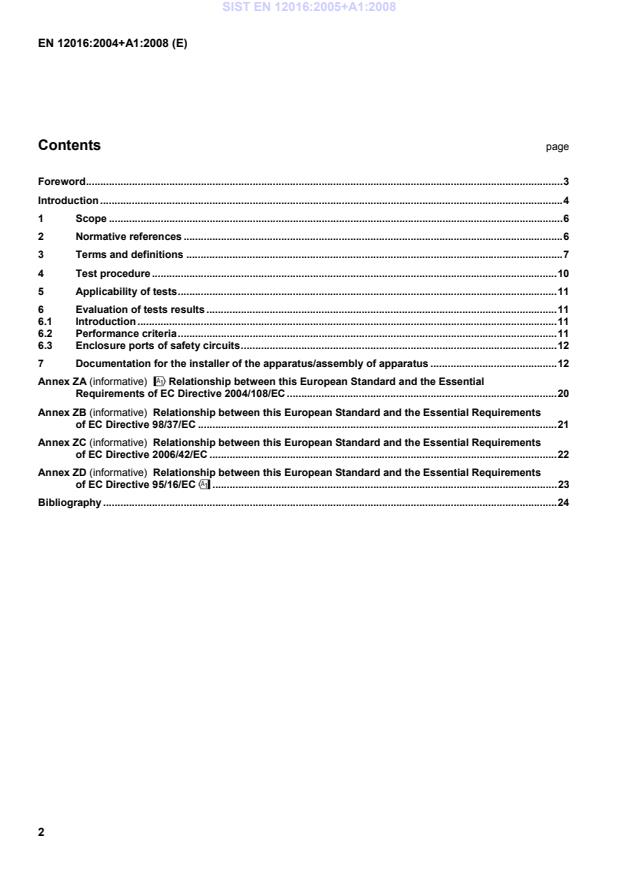
!Relationship between this European Standard and the Essential Requirements of EC Directive 2004/108/EC.20 Annex ZB (informative)
Relationship between this European Standard and the Essential Requirements of EC Directive 98/37/EC.21 Annex ZC (informative)
Relationship between this European Standard and the Essential Requirements of EC Directive 2006/42/EC.22 Annex ZD (informative)
Relationship between this European Standard and the Essential Requirements of EC Directive 95/16/EC".23 Bibliography.24
Electrostatic discharge immunity test (IEC 61000-4-2:1995). EN 61000-4-3, Electromagnetic compatibility (EMC) — Part 4-3: Testing and measurement techniques; Radiated, radio-frequency, electromagnetic field immunity test (IEC 61000-4-3:2002). SIST EN 12016:2005+A1:2008
Key
Assembly of apparatus
1 Machinery space 7 Landings 2 Main control / control cabinet 8 System boundary 3 Machine 9 AC – and/or DC power ports 4 Door control 10 Main switch 5 Lift car 11 Output power port 6 Apparatus installed at the landing (e.g. push
buttons, indicators) 12 Ports for monitoring and remote alarm systems
(Signal and control ports) Figure 1 — EMC example (immunity) for lift systems SIST EN 12016:2005+A1:2008
Key
Assembly of apparatus
1 Control panels 6 Machine 2 Machinery space (see 4 to 10) NOTE The machinery space can also be an external room. 7 AC – and/or DC power ports 3 System boundary 8 Main switch 4 Machinery space 9 Output power port 5 Main control/control cabinet 10 Ports for monitoring (Signal and control ports) Figure 2 — EMC example (immunity) for escalator and moving walk systems
Key 1 AC power port 2 DC power port 3 enclosure port 4 apparatus/assembly of apparatus 5 ground port 6 signal/control port 7 machine/motor port Figure 3 — Examples of ports 4 Test procedure 4.1 The tests shall be carried out as stated in EN 61000-4-2, EN 61000-4-3, EN 61000-4-4, EN 61000-4-5, EN 61000-4-6, EN 61000-4-11, as appropriate (see Tables 1 to 7). An attempt shall be made to maximise the susceptibility by varying the position of the test sample in the test facility. 4.2 Travelling cables or any other cables likely to be more than 5 m long shall be represented by a sample of at least 5m long connected to the relevant port for the purpose of testing for susceptibility. 4.3 It is not always possible to measure the immunity levels for every function of the apparatus/assembly of apparatus. In such cases the most critical period of operation shall be selected. 4.4 The test shall be carried out at a single set of environmental conditions within the specified operating range of temperature, humidity, air pressure and supply voltage, unless other
...