


EN 12111:2014
(Main)Tunnelling machines - Road headers and continuous miners - Safety requirements
General Information
- Abstract
This European Standard deals with all significant hazards, hazardous situations and events relevant to road headers and continuous miners as defined in Clause 3 (here in after called machines) when they are used as intended and under conditions of misuse which are reasonably foreseeable by the manufacturer (see Clause 4).
NOTE 1 Within the intended use, overturning of the road header or continuous miner is not a significant hazard.
Excavators are out of the scope of this standard and are covered by EN 474 1:2006+A4:2013 and EN 474 5:2006+A3:2013.
The following items and applications are not covered by this European Standard:
— the supply of electricity up to the switch box;
— use of the machine in potentially explosive atmospheres;
— use of the machine under hyperbaric conditions;
— loading and transport equipment which is not an integral part of the machine.
This European Standard covers incorporation of monitoring devices for hazardous atmospheres.
This European Standard is not applicable to machines manufactured before the date of publication of this European Standard by CEN.
NOTE 2 Directive 94/9/EC concerning equipment and protective systems intended for use in potentially explosive atmospheres can be applicable to the type of machine or equipment covered by this European Standard. The present standard is not intended to provide means of complying with the essential health and safety requirements of Directive 94/9/EC. For the application in potentially explosive atmospheres see EN 1710:2005+A1:2008.
- Status
- Published
- Publication Date
- 06-May-2014
- Technical Committee
- CEN/TC 196 - Machines for undergroung mines - Safety
- Drafting Committee
- CEN/TC 151/WG 4 - Tunnelling machines - Safety
- Current Stage
- 9093 - Decision to confirm - Review Enquiry
- Start Date
- 09-Mar-2026
- Completion Date
- 23-Sep-2026
- Directive
- Harmonized Standard2006/42/EC - Directive 2006/42/EC of the European Parliament and of the Council of 17 May 2006 on machinery, and amending Directive 95/16/EC (recast)OJ Ref: C, C 054, C 92 OJ Date: 13-Feb-2015
Not Harmonized98/37/EC - Machinery


Overview
EN 12111:2014 - Tunnelling machines: Road headers and continuous miners - Safety requirements is a CEN European Standard that addresses the significant hazards, hazardous situations and events relevant to road headers and continuous miners when used as intended or under reasonably foreseeable misuse. It updates and replaces EN 12111:2002+A1:2009 and supports essential requirements of EU machinery legislation (see Annex ZA).
The standard applies to machine design, construction and documentation for safe operation underground, and includes provisions for atmosphere monitoring. It explicitly excludes excavators, supply of electricity up to the switch box, use in potentially explosive atmospheres, hyperbaric conditions, non‑integral loading/transport equipment and machines built before publication.
Key topics and technical requirements
EN 12111:2014 covers a broad set of safety topics relevant to tunnelling machines, including:
- Hazard identification and list of significant hazards applicable to road headers and continuous miners
- Control stations and operator cabins - protection against falling objects, visibility and ergonomic considerations
- Guards and access systems - ladders, platforms and safe access requirements
- Control devices and safety systems - reliability, design, warning systems, remote control and automatic guidance/profiling
- Electrical and EMC requirements - power supply control, cable protection, portable equipment and circuit monitoring
- Dust, exhaust and gas control - dust suppression, exhaust gas measures and gas monitoring systems (including requirements for incorporation of monitoring devices)
- Noise - noise reduction at design stage and noise test code (Annex A)
- Hydraulic/pneumatic systems, fire protection and fuel storage - fixed and portable extinguishing systems, fuel system safety
- Ground support equipment and drilling - safe installation practices for bolting/drilling
- Maintenance, verification and information for use - testing, inspection, operating and maintenance instructions, marking and documentation
The standard also specifies verification methods and required information to be supplied with the machine (operating/maintenance instructions, signals and warnings).
Applications and practical value
EN 12111:2014 is used to ensure the safe design, manufacture, testing and documentation of road headers and continuous miners used in tunnel construction and underground mining. Practical uses include:
- Designing and validating safe tunnelling machinery
- Producing compliant operator manuals and maintenance instructions
- Performing risk assessments, verification and type testing
- Preparing technical dossiers for conformity assessment under EU Machinery Directive
Who should use this standard
- Machine manufacturers and designers of tunnelling equipment
- Safety engineers, certification bodies and conformity assessors
- Project owners, contractors and procurement teams specifying safe machinery requirements
- Maintenance planners and site safety officers for underground works
Related standards
- EN 474 series (excavators) - excluded from scope
- EN 1710 / ATEX Directive (Directive 94/9/EC) - for use in potentially explosive atmospheres
- Annex ZA of EN 12111:2014 clarifies relationships with EU Directive 2006/42/EC
Keywords: EN 12111:2014, tunnelling machines, road headers, continuous miners, safety requirements, CEN, dust control, gas monitoring, noise test code, machine safety.
Relations
- Effective Date
- 13-May-2014
- Effective Date
- 11-Mar-2026
- Effective Date
- 11-Mar-2026
- Effective Date
- 11-Mar-2026
- Effective Date
- 11-Mar-2026
- Effective Date
- 11-Mar-2026
- Effective Date
- 11-Mar-2026
- Refers
ISO 15817:2012 - Earth-moving machinery — Safety requirements for remote operator control systems - Effective Date
- 09-Feb-2026
- Effective Date
- 09-Feb-2026
- Effective Date
- 09-Feb-2026
- Effective Date
- 09-Feb-2026
- Effective Date
- 09-Feb-2026
- Effective Date
- 09-Feb-2026
- Effective Date
- 09-Feb-2026
- Effective Date
- 09-Feb-2026
Get Certified
Connect with accredited certification bodies for this standard

DIBt (Deutsches Institut für Bautechnik)
German Institute for Building Technology.
DIN CERTCO
DIN Group product certification.
Zavod za gradbeništvo Slovenije (ZAG) - Inšpekcija
ZAG inspection body for construction products, structures, and materials.
Sponsored listings
Frequently Asked Questions
EN 12111:2014 is a standard published by the European Committee for Standardization (CEN). Its full title is "Tunnelling machines - Road headers and continuous miners - Safety requirements". This standard covers: This European Standard deals with all significant hazards, hazardous situations and events relevant to road headers and continuous miners as defined in Clause 3 (here in after called machines) when they are used as intended and under conditions of misuse which are reasonably foreseeable by the manufacturer (see Clause 4). NOTE 1 Within the intended use, overturning of the road header or continuous miner is not a significant hazard. Excavators are out of the scope of this standard and are covered by EN 474 1:2006+A4:2013 and EN 474 5:2006+A3:2013. The following items and applications are not covered by this European Standard: — the supply of electricity up to the switch box; — use of the machine in potentially explosive atmospheres; — use of the machine under hyperbaric conditions; — loading and transport equipment which is not an integral part of the machine. This European Standard covers incorporation of monitoring devices for hazardous atmospheres. This European Standard is not applicable to machines manufactured before the date of publication of this European Standard by CEN. NOTE 2 Directive 94/9/EC concerning equipment and protective systems intended for use in potentially explosive atmospheres can be applicable to the type of machine or equipment covered by this European Standard. The present standard is not intended to provide means of complying with the essential health and safety requirements of Directive 94/9/EC. For the application in potentially explosive atmospheres see EN 1710:2005+A1:2008.
This European Standard deals with all significant hazards, hazardous situations and events relevant to road headers and continuous miners as defined in Clause 3 (here in after called machines) when they are used as intended and under conditions of misuse which are reasonably foreseeable by the manufacturer (see Clause 4). NOTE 1 Within the intended use, overturning of the road header or continuous miner is not a significant hazard. Excavators are out of the scope of this standard and are covered by EN 474 1:2006+A4:2013 and EN 474 5:2006+A3:2013. The following items and applications are not covered by this European Standard: — the supply of electricity up to the switch box; — use of the machine in potentially explosive atmospheres; — use of the machine under hyperbaric conditions; — loading and transport equipment which is not an integral part of the machine. This European Standard covers incorporation of monitoring devices for hazardous atmospheres. This European Standard is not applicable to machines manufactured before the date of publication of this European Standard by CEN. NOTE 2 Directive 94/9/EC concerning equipment and protective systems intended for use in potentially explosive atmospheres can be applicable to the type of machine or equipment covered by this European Standard. The present standard is not intended to provide means of complying with the essential health and safety requirements of Directive 94/9/EC. For the application in potentially explosive atmospheres see EN 1710:2005+A1:2008.
EN 12111:2014 is classified under the following ICS (International Classification for Standards) categories: 91.220 - Construction equipment; 93.060 - Tunnel construction. The ICS classification helps identify the subject area and facilitates finding related standards.
EN 12111:2014 has the following relationships with other standards: It is inter standard links to EN 12111:2002+A1:2009, ISO 6405-1:2004, ISO 3864-2:2004, ISO 3795:1989, ISO 5006:2006, ISO 6805:1994, ISO 8598:1996, ISO 15817:2012, EN 60439-4:2004, EN 61439-1:2011, ISO 3864-1:2011, ISO 11112:1995, EN 61310-1:2008, ISO 8178-1:2006, EN 60439-2:2000. Understanding these relationships helps ensure you are using the most current and applicable version of the standard.
EN 12111:2014 is associated with the following European legislation: EU Directives/Regulations: 2006/42/EC, 98/37/EC; Standardization Mandates: M/079, M/396. When a standard is cited in the Official Journal of the European Union, products manufactured in conformity with it benefit from a presumption of conformity with the essential requirements of the corresponding EU directive or regulation.
EN 12111:2014 is available in PDF format for immediate download after purchase. The document can be added to your cart and obtained through the secure checkout process. Digital delivery ensures instant access to the complete standard document.
Standards Content (Sample)
2003-01.Slovenski inštitut za standardizacijo. Razmnoževanje celote ali delov tega standarda ni dovoljeno.Stroji za gradnjo predorov - Odkopne naprave - Varnostne zahteveTunnelbaumaschinen - Teilschnittmaschinen und Continuous miners - Sicherheitstechnische AnforderungenMachines pour la construction de tunnels - Machines à attaque ponctuelle et mineurs continus - Prescriptions de sécuritéTunnelling machines - Road headers and continuous miners - Safety requirements93.060Gradnja predorovTunnel construction91.220Gradbena opremaConstruction equipmentICS:Ta slovenski standard je istoveten z:EN 12111:2014SIST EN 12111:2014en,fr01-julij-2014SIST EN 12111:2014SLOVENSKI
STANDARDSIST EN 12111:2003+A1:20091DGRPHãþD
EUROPEAN STANDARD NORME EUROPÉENNE EUROPÄISCHE NORM
EN 12111
May 2014 ICS 91.220; 93.060 Supersedes EN 12111:2002+A1:2009English Version
Tunnelling machines - Road headers and continuous miners - Safety requirements
Machines pour la construction de tunnels - Machines à attaque ponctuelle et mineurs continus - Prescriptions de sécurité
Tunnelbaumaschinen - Teilschnittmaschinen und Continuous miners - Sicherheitstechnische AnforderungenThis European Standard was approved by CEN on 20 March 2014.
CEN members are bound to comply with the CEN/CENELEC Internal Regulations which stipulate the conditions for giving this European Standard the status of a national standard without any alteration. Up-to-date lists and bibliographical references concerning such national standards may be obtained on application to the CEN-CENELEC Management Centre or to any CEN member.
This European Standard exists in three official versions (English, French, German). A version in any other language made by translation under the responsibility of a CEN member into its own language and notified to the CEN-CENELEC Management Centre has the same status as the official versions.
CEN members are the national standards bodies of Austria, Belgium, Bulgaria, Croatia, Cyprus, Czech Republic, Denmark, Estonia, Finland, Former Yugoslav Republic of Macedonia, France, Germany, Greece, Hungary, Iceland, Ireland, Italy, Latvia, Lithuania, Luxembourg, Malta, Netherlands, Norway, Poland, Portugal, Romania, Slovakia, Slovenia, Spain, Sweden, Switzerland, Turkey and United Kingdom.
EUROPEAN COMMITTEE FOR STANDARDIZATION
COMITÉ EUROPÉEN DE NORMALISATION EUROPÄISCHES KOMITEE FÜR NORMUNG
CEN-CENELEC Management Centre:
Avenue Marnix 17,
B-1000 Brussels © 2014 CEN All rights of exploitation in any form and by any means reserved worldwide for CEN national Members. Ref. No. EN 12111:2014 ESIST EN 12111:2014
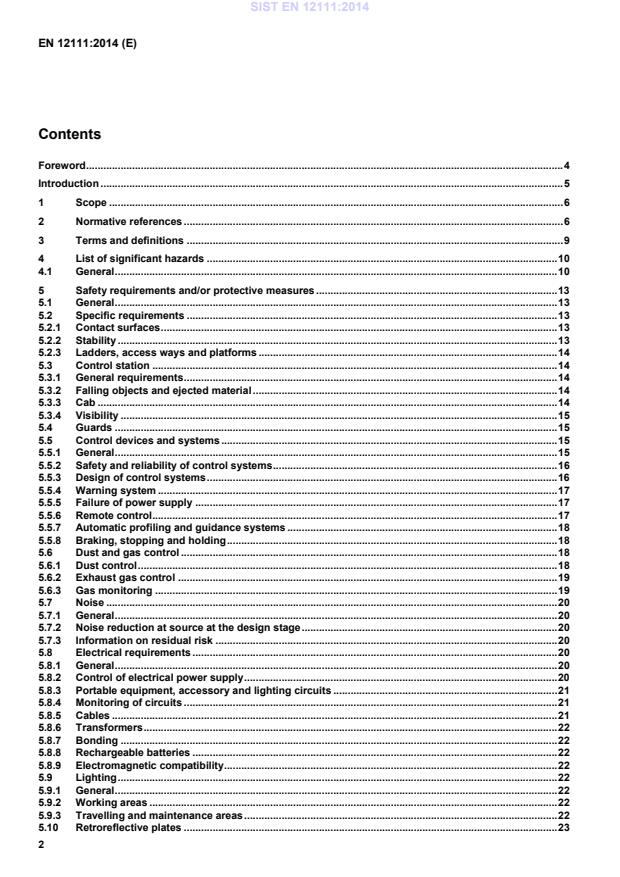
2 Contents Foreword . 4 Introduction . 5 1 Scope . 6 2 Normative references . 6 3 Terms and definitions . 9 4 List of significant hazards . 10 4.1 General . 10 5 Safety requirements and/or protective measures . 13 5.1 General . 13 5.2 Specific requirements . 13 5.2.1 Contact surfaces . 13 5.2.2 Stability . 13 5.2.3 Ladders, access ways and platforms . 14 5.3 Control station . 14 5.3.1 General requirements . 14 5.3.2 Falling objects and ejected material . 14 5.3.3 Cab . 14 5.3.4 Visibility . 15 5.4 Guards . 15 5.5 Control devices and systems . 15 5.5.1 General . 15 5.5.2 Safety and reliability of control systems . 16 5.5.3 Design of control systems . 16 5.5.4 Warning system . 17 5.5.5 Failure of power supply . 17 5.5.6 Remote control . 17 5.5.7 Automatic profiling and guidance systems . 18 5.5.8 Braking, stopping and holding . 18 5.6 Dust and gas control . 18 5.6.1 Dust control . 18 5.6.2 Exhaust gas control . 19 5.6.3 Gas monitoring . 19 5.7 Noise . 20 5.7.1 General . 20 5.7.2 Noise reduction at source at the design stage . 20 5.7.3 Information on residual risk . 20 5.8 Electrical requirements . 20 5.8.1 General . 20 5.8.2 Control of electrical power supply . 20 5.8.3 Portable equipment, accessory and lighting circuits . 21 5.8.4 Monitoring of circuits . 21 5.8.5 Cables . 21 5.8.6 Transformers . 22 5.8.7 Bonding . 22 5.8.8 Rechargeable batteries . 22 5.8.9 Electromagnetic compatibility . 22 5.9 Lighting . 22 5.9.1 General . 22 5.9.2 Working areas . 22 5.9.3 Travelling and maintenance areas . 22 5.10 Retroreflective plates . 23 SIST EN 12111:2014
Noise test code . 35 A.1 Scope . 35 A.2 A-weighted emission sound pressure levels at workstations . 35 A.3 A-weighted sound power level determination . 36 A.3.1 A-weighted sound power levels . 36 A.3.2 Measurement procedure for large machines . 36 A.4 Installation and mounting conditions of the machines . 36 A.5 Test conditions of the machine . 36 A.5.1 General. 36 A.5.2 Operating conditions at the place of manufacturer . 37 A.5.3 Operating conditions in a tunnel environment . 37 A.6 Information to be recorded and reported . 37 A.7 Declaration and verification of noise emission values . 38 Annex B (informative)
Figures . 39 Annex ZA (informative)
Relationship between this European Standard and the Essential Requirements of EU Directive 2006/42/EC . 42 Bibliography . 43
4 Foreword This document (EN 12111:2014) has been prepared by Technical Committee CEN/TC 151 “Construction equipment and building material machines - Safety”, the secretariat of which is held by DIN. This European Standard shall be given the status of a national standard, either by publication of an identical text or by endorsement, at the latest by November 2014 and conflicting national standards shall be withdrawn at the latest by November 2014. Attention is drawn to the possibility that some of the elements of this document may be the subject of patent rights. CEN [and/or CENELEC] shall not be held responsible for identifying any or all such patent rights. This document supersedes EN 12111:2002+A1:2009. The main technical changes compared to EN 12111:2002+A1:2009 are the following: — modification of the scope, “impact rippers” deleted; — update of normative references; — improvement of requirements on access systems; — requirements on control systems improved; — revision of requirements on audible and visual warning signs; — improvement of noise test code. This document has been prepared under a mandate given to CEN by the European Commission and the European Free Trade Association, and supports essential requirements of EU Directive(s). For relationship with EU Directive, see informative Annex ZA, which is an integral part of this document. According to the CEN-CENELEC Internal Regulations, the national standards organizations of the following countries are bound to implement this European Standard: Austria, Belgium, Bulgaria, Croatia, Cyprus, Czech Republic, Denmark, Estonia, Finland, Former Yugoslav Republic of Macedonia, France, Germany, Greece, Hungary, Iceland, Ireland, Italy, Latvia, Lithuania, Luxembourg, Malta, Netherlands, Norway, Poland, Portugal, Romania, Slovakia, Slovenia, Spain, Sweden, Switzerland, Turkey and the United Kingdom. SIST EN 12111:2014
1 Scope This European Standard deals with all significant hazards, hazardous situations and events relevant to road headers and continuous miners as defined in Clause 3 (hereinafter called machines) when they are used as intended and under conditions of misuse which are reasonably foreseeable by the manufacturer (see Clause 4). NOTE 1 Within the intended use, overturning of the road header or continuous miner is not a significant hazard. Excavators are out of the scope of this standard and are covered by EN 474-1:2006+A4:2013 and EN 474-5:2006+A3:2013. The following items and applications are not covered by this European Standard: — the supply of electricity up to the switch box; — use of the machine in potentially explosive atmospheres; — use of the machine under hyperbaric conditions; — loading and transport equipment which is not an integral part of the machine. This European Standard covers incorporation of monitoring devices for hazardous atmospheres. This European Standard is not applicable to machines manufactured before the date of publication of this European Standard by CEN. NOTE 2 Directive 94/9/EC concerning equipment and protective systems intended for use in potentially explosive atmospheres can be applicable to the type of machine or equipment covered by this European Standard. The present standard is not intended to provide means of complying with the essential health and safety requirements of Directive 94/9/EC. For the application in potentially explosive atmospheres see EN 1710:2005+A1:2008. 2 Normative references The following documents, in whole or in part, are normatively referenced in this document and are indispensable for its application. For dated references, only the edition cited applies. For undated references, the latest edition of the referenced document (including any amendments) applies. EN 3-7:2004+A1:2007, Portable fire extinguishers - Part 7: Characteristics, performance requirements and test methods EN 474-1:2006+A4:2013, Earth-moving machinery - Safety - Part 1: General requirements EN 617:2001+A1:2010, Continuous handling equipment and systems - Safety and EMC requirements for the equipment for the storage of bulk materials in silos, bunkers, bins and hoppers EN 618:2002+A1:2010, Continuous handling equipment and systems - Safety and EMC requirements for equipment for mechanical handling of bulk materials except fixed belt conveyors EN 620:2002+A1:2010, Continuous handling equipment and systems - Safety and EMC requirements for fixed belt conveyors for bulk materials EN 894-1:1997+A1:2008, Safety of machinery - Ergonomics requirements for the design of displays and control actuators - Part 1: General principles for human interactions with displays and control actuators EN 953:1997+A1:2009, Safety of machinery - Guards - General requirements for the design and construction of fixed and movable guards EN 981:1996+A1:2008, Safety of machinery - System of auditory and visual danger and information signals SIST EN 12111:2014
(IEC 60076-2:2011) EN 60204-1:2006, Safety of machinery — Electrical equipment of machines — Part 1: General requirements (IEC 60204-1:2005, modified) EN 60204-11:2000, Safety of machinery — Electrical equipment of machines — Part 11: Requirements for HV equipment for voltages above 1000 V a.c. or 1500 V d.c. and not exceeding 36 kV (IEC 60204-11:2000) EN 60439-2:2000, Low-voltage switchgear and controlgear assemblies — Part 2: Particular requirements for busbar trunking systems (busways) (IEC 60439-2:2000) EN 60439-4:2004, Low-voltage switchgear and controlgear assemblies — Part 4: Particular requirements for assemblies for construction sites (ACS) (IEC 60439-4: 2004) EN 60529:1991, Degrees of protection provided by enclosures (IP code) (IEC 60529:1989) EN 60947-1:2007, Low-voltage switchgear and controlgear — Part 1: General rules
(IEC 60947-1:2007) EN 61310-1:2008, Safety of machinery — Indication, marking and actuation — Part 1: Requirements for visual, acoustic and tactile signals (IEC 61310-1:2007) EN 61439-1:2011, Low-voltage switchgear and controlgear assemblies — Part 1: General rules
(IEC 61439-1:2011) EN ISO 3411:2007, Earth-moving machinery - Physical dimensions of operators and minimum operator space envelope (ISO 3411:2007) EN ISO 3449:2008, Earth-moving machinery - Falling-object protective structures - Laboratory tests and performance requirements (ISO 3449:2005) EN ISO 3457:2008, Earth-moving machinery - Guards - Definitions and requirements (ISO 3457:2003) EN ISO 3744:2010, Acoustics - Determination of sound power levels and sound energy levels of noise sources using sound pressure - Engineering methods for an essentially free field over a reflecting plane (ISO 3744:2010) EN ISO 3746:2010, Acoustics - Determination of sound power levels and sound energy levels of noise sources using sound pressure - Survey method using an enveloping measurement surface over a reflecting plane (ISO 3746:2010) EN ISO 3747:2010, Acoustics - Determination of sound power levels and sound energy levels of noise sources using sound pressure - Engineering/survey methods for use in situ in a reverberant environment (ISO 3747:2010) EN ISO 4413:2010, Hydraulic fluid power - General rules and safety requirements for systems and their components (ISO 4413:2010) EN ISO 4414:2010, Pneumatic fluid power - General rules and safety requirements for systems and their components (ISO 4414:2010) EN ISO 4871:2009, Acoustics - Declaration and verification of noise emission values of machinery and equipment (ISO 4871:1996) SIST EN 12111:2014
8 EN ISO 7096:2008, Earth-moving machinery - Laboratory evaluation of operator seat vibration (ISO 7096:2000) EN ISO 11201:2010, Acoustics - Noise emitted by machinery and equipment - Determination of emission sound pressure levels at a work station and at other specified positions in an essentially free field over a reflecting plane with negligible environmental corrections (ISO 11201:2010) EN ISO 11202:2010, Acoustics - Noise emitted by machinery and equipment - Determination of emission sound pressure levels at a work station and at other specified positions applying approximate environmental corrections (ISO 11202:2010) EN ISO 11204:2010, Acoustics - Noise emitted by machinery and equipment - Determination of emission sound pressure levels at a work station and at other specified positions applying accurate environmental corrections (ISO 11204:2010) EN ISO 11688-1:2009, Acoustics - Recommended practice for the design of low-noise machinery and equipment - Part 1: Planning (ISO/TR 11688-1:1995) EN ISO 12100:2010, Safety of machinery - General principles for design - Risk assessment and risk reduction (ISO 12100:2010) EN ISO 12922:2012, Lubricants, industrial oils and related products (class L) - Family H (Hydraulic systems) - Specifications for hydraulic fluids in categories HFAE, HFAS, HFB, HFC, HFDR and HFDU (ISO 12922:2012) EN ISO 13732-1:2008, Ergonomics of the thermal environment - Methods for the assessment of human responses to contact with surfaces - Part 1: Hot surfaces (ISO 13732-1:2006) EN ISO 13849-1:2008, Safety of machinery - Safety-related parts of control systems - Part 1: General principles for design (ISO 13849-1:2006) EN ISO 13850:2008, Safety of machinery - Emergency stop - Principles for design (ISO 13850:2006) EN ISO 14122-1:2001, Safety of machinery - Permanent means of access to machinery - Part 1: Choice of fixed means of access between two levels (ISO 14122-1:2001) EN ISO 14122-2:2001, Safety of machinery - Permanent means of access to machinery - Part 2: Working platforms and walkways (ISO 14122-2:2001) EN ISO 14122-3:2001, Safety of machinery - Permanent means of access to machinery - Part 3: Stairs, stepladders and guard-rails (ISO 14122-3:2001) EN ISO 14122-4:2004, Safety of machinery - Permanent means of access to machinery - Part 4: Fixed ladders (ISO 14122-4:2004) ISO 3795:1989, Road vehicles, and tractors and machinery for agriculture and forestry — Determination of burning behaviour of interior materials ISO 3864-1:2011, Graphical symbols — Safety colours and safety signs — Part 1: Design principles for safety signs and safety markings ISO 3864-2:2004, Graphical symbols — Safety colours and safety signs — Part 2: Design principles for product safety labels ISO 3864-3:2012, Graphical symbols — Safety colours and safety signs — Part 3: Design principles for graphical symbols for use in safety signs ISO 5006:2006, Earth-moving machinery — Operator's field of view — Test method and performance criteria ISO 6405-1:2004, Earth-moving machinery — Symbols for operator controls and other displays — Part 1: Common symbols SIST EN 12111:2014
10 3.7 trailing cable cable attached to the machine which can be extended or retracted as the machine trams and which connects it to the tunnel or mine power supply Note 1 to entry: The trailing cable is part of the machine if there is a cable reel integrated in the machine. 3.8 main switch gear device at which all power to the machine can be cut off Note 1 to entry: This is normally provided by the user. 4 List of significant hazards 4.1 General This clause contains all significant hazards, hazardous situations and events identified by risk assessment as significant for this type of machinery and which require action to eliminate or reduce the risk. Table 1 — List of significant hazards No. Hazards Concerned subclauses 4.1 Mechanical hazards due to
a) Machine parts or work pieces, e.g.: - shape
- mass and stability (potential energy of elements which may move under the effect of gravity);
- mass and velocity (kinetic energy of elements in controlled or uncontrolled motion);
- accumulation of energy inside the machinery, e.g.: liquids and gases under pressure.
5.2.1.1
5.5.8, 5.13
5.5.8
5.11, 5.16 b) Crushing hazard 5.4, 5.5.8.2 c) Shearing hazard 5.4 d) Cutting or severing hazard 5.2.1.1, 5.4 e) Entanglement hazard 5.4 f) Drawing-in or trapping hazard 5.4 g) Friction or abrasion hazard 5.2.1.1 h) High pressure fluid injection or ejection hazard 5.11, 5.16 4.2 Electrical hazards due to
a) Contact of persons with live parts (direct contact) 5.8.1 b) Contact of persons with parts which have become live under faulty conditions (indirect contact) 5.8.2, 5.8.3, 5.17 c) Approach to live parts under high voltage 5.8.4.2, 5.17 d) Electrostatic phenomena 5.8.7, 5.17 e) Thermal radiation or other phenomena such as the 5.12.1 SIST EN 12111:2014
a) Burns, scalds and other injuries by a possible contact of persons with objects or materials with an extreme high or low temperature, by flames or explosions and also by the radiation of heat sources 5.2.1.2 5.12 b) damage to health by hot or cold working environment 5.3.3.1 4.4 Hazards generated by noise
a) resulting in hearing loss (deafness), other physiological disorders (e.g. loss of balance, loss of awareness) 5.5.4, 5.7 b) resulting in interference with speech communication, acoustic signals, etc. 5.5.4, 5.7 4.5 Hazards generated by vibration 5.3.1, 5.3.2.3, 7.3.2 4.6 Radiation
Low-frequency, radio-frequency radiation; microwaves 5.8.9 4.7 Hazards arising from materials and substances (and their constituent elements) processed or used by the machinery
a) Hazards from contact with or inhalation of harmful fluids, gases, mists, fumes, and dusts 5.6, 5.8.6, 5.11, 5.16 b) Fire or explosion hazard 5.5.8.1, 5.6.3, 5.16, 5.8.4, 5.8.5.1, 5.11.1, 5.12, 5.8.8 4.8 Hazards arising from neglect of ergonomic principles in machinery design
a) unhealthy postures or excessive effort 5.3.1, 5.17 b) inadequate consideration of hand-arm or foot-leg anatomy 5.3.1 c) neglected use of personal protection equipment 5.3.1, 5.17 d) inadequate local lighting 5.9 e) human error, human behaviour 5.5.2, 5.15 f) inadequate design, location or identification of manual Controls 5.5 g) inadequate design or location of visual display units 5.5 4.9 Unexpected start-up, unexpected overrun/overspeed (or any similar malfunction)
a) failure/disorder of the control system 5.5.2, 5.17 b) Restoration of energy supply after an interruption 5.5.2 c) external influences on electrical equipment 5.8.9 d) errors in the software 5.5.2 e) errors made by the operator (due to mismatch of Machinery with human characteristics and abilities) 5.5.2 4.10 Impossibility of stopping the machine in the best possible conditions 5.5.3, 5.5.6, 5.5.7, 5.5.8 SIST EN 12111:2014
12 No. Hazards Concerned subclauses 4.11 Failure of the power supply 5.5.2, 5.5.5, 5.8.2, 7.3.4 4.12 Failure of the control circuit 5.5.2, 5.5.3, 5.5.5, 5.5.8 4.13 Falling or ejected objects or fluids 5.3.2 4.14 Loss of stability/overturning of machinery 5.2.2, 5.13 4.15 Slip, trip and fall of persons 5.2.3 4.16 Additional hazards due to mobility relating to the travelling function
a) Movement when starting the engine 5.5.2 b) Movement without a driver at the driving position 5.5.6 c) Insufficient ability of machinery to be slowed down, stopped and immobilized 5.5.8 4.17 Additional hazards due to mobility linked to the work position (including driving station) on the machine
a) Fall of persons during access to (or at/from) the work position 5.2.3 b) Exhaust gases/lack of oxygen at the work position 5.6.2, 5.6.3. c) Fire (flammability of the cab, lack of extinguishing means) 5.12 d)
Mechanical hazards at the work position fall of objects, penetration by objects; contact of persons with machine parts or tools 5.3.1, 5.3.2, 5.4, 5.5.2, 5.13, 5.17 e) Insufficient visibility from the work positions 5.3.2, 5.3.3, 5.3.4 f) Inadequate lighting 5.9 g) Inadequate seating
h) Noise at the work position
i) Vibration at the work position 5.3.1 4.18 Additional hazards due to mobility linked to the control system
a) Inadequate location of manual controls 5.3.1, 5.5.6 b) Inadequate design of manual controls and their mode of operation 5.5 4.19 Additional hazards due to mobility and handling the machine (lack of stability) 5.2.2, 5.13 4.20 Additional hazards due to mobility linked to the power source and to the transmission of power
a) Hazards from the engine and the batteries 5.8.9, 5.8.8 b) Hazards from coupling and towing 5.14, 5.8.5.2 4.21 Additional hazards due to mobility related from/to third persons
a) Unauthorized start-up/use 5.5.3.2 SIST EN 12111:2014
a) Fire and explosion 5.6.3.1; 5.12, 5.8.6, 5.8.8, 5.15, 5.16 b) Emission of dust, gases, etc. 5.3.1, 5.6, 5.15 5 Safety requirements and/or protective measures 5.1 General Road headers and continuous miners shall comply with the safety requirements and/or protective measures of this clause. In addition, they shall be designed according to the principles of EN ISO 12100 for hazards relevant but not significant which are not dealt with by this European Standard. 5.2 Specific requirements 5.2.1 Contact surfaces 5.2.1.1 Sharp corners and edges Accessible parts of machines shall be designed and manufactured to minimize sharp edges, angles or rough surfaces which are likely to cause injury, see ISO 12508. 5.2.1.2 Hot surfaces Where there is a risk of contact with hot surfaces in accessible areas, suitable measures shall be taken: — to limit the temperature of hot surfaces, see EN ISO 13732-1; — where this is not possible, to prevent contact with those surfaces/parts by screens or guards; — to provide warning signs against residual risks, see 5.12. This requirement does not apply to the excavation tools. 5.2.2 Stability The manufacturer shall ensure the machine does not undergo any uncontrolled movements when operated in accordance with the conditions intended by the manufacturer. The limits of controlled movement shall be stated in the instruction handbook. This shall be achieved by having a sufficiently heavy machine or by the use of grippers. The maximum permissible longitudinal and transverse slopes on which the machine can be operated shall be defined in the instruction handbook (see 7.3.1). To ensure stability during assembly, the manufacturer shall provide information on assembly sequence in the instruction handbook. SIST EN 12111:2014
14 5.2.3 Ladders, access ways and platforms The manufacturer shall define in the instruction handbook the areas of the machine to which access is required to operate, service and maintain the machine (see 7.3.1). Access to these areas of machine shall be provided in accordance with EN ISO 14122-1, EN ISO
14122-2, EN ISO
14122-3 and EN ISO 14122-4. Ladderways or stairways shall be provided to give access to control stations, servicing points and working platforms. Where not directly accessible from the ground, working platforms shall be provided at servicing points including filters, pumps, motors, lubricating points, battery compartments and fluid storage tanks. Where this requirement cannot reasonably be applied to the discharge conveyor, a temporary means of access, e.g. hydraulic access platform or ladder, will be required and the manufacturer shall record this in the instruction handbook – see 7.3.1. 5.3 Control station 5.3.1 General requirements The machine shall be controlled from a control station on the machine or by remote control (see 5.5.8). Where it is always intended to control the machine remotely, a control station on the machine is not required. Where a machine has more than one starting control for any function, key switches shall be fitted to ensure only one starting control is active at any time. The control station shall be dimensioned in accordance with EN ISO 3411. When there is a control station on the machine it shall be ergonomically designed in order to minimise operator fatigue and stress. Consideration shall be given to the fact that operators may wear personal protective equipment. The control station if provided shall have a seat for the operator. It shall comply with the requirements of
EN 474-1:2006+A4:2013, be adjustable, retain the operator in a stable position and allow the operator to control the machine under all expected operating conditions. For seat dimensions see ISO 11112. Arm rests or other means shall be provided to ensure safe operation of sensitive controls (e.g. hold-to-run controls). The seat shall be designed to minimise transmission of vibration to the operator. See EN ISO 7096. 5.3.2 Falling objects and ejected material The control station shall be protected by location or guarding e.g. by deflector plates, against spoil rolling down the cutter arm, boom or conveyor. The control station shall be protected against falling objects and materials ejected from the cutter head. Protection against falling objects shall be by falling object protective structure (FOPS). The FOPS shall comply with level II of EN ISO 3449. NOTE The scope of EN ISO 3449 excludes road headers and continuous miners. However for road headers and continuous miners the requirements of EN ISO 3449 are equally applicable as for earth-moving equipment. Protection against ejection of materials shall be by guarding of the cutter head or the provision of a protective structure or the use of reinforced glass or similar transparent material at the control station. The means of protection shall not reduce the operator’s visibility. 5.3.3 Cab 5.3.3.1 General A cab shall be provided fulfilling the following requirements: — ventilation with adequate dust filtration and where applicable, heating and/or cooling; — isolation from airborne noise and structure-borne noise; SIST EN 12111:2014
...