

prEN 17821
(Main)Building valves - Frost resistant taps for outdoor use (FRT) - General technical specification
- Abstract
This document specifies application, general construction, performance and material requirements for frost resistant taps for outdoor use (FRT), PN 10.
This document is applicable to potable water installations with a static pressure of maximum 1,0 MPa (10 bar) and a distribution temperature of maximum 25 °C (PWC).
NOTE See Annex A for a general overview of this document’s organization and test sequence.
- Status
- Not Published
- Publication Date
- 18-Aug-2027
- Technical Committee
- CEN/TC 164 - Water supply
- Current Stage
- 4020 - Submission to enquiry - Enquiry
- Start Date
- 10-Sep-2026
- Due Date
- 07-May-2026
- Completion Date
- 10-Sep-2026

prEN 17821 is a draft European Standard from CEN for frost resistant taps for outdoor use (FRT). It specifies application limits, construction, materials, test methods, marking and technical product information for PN 10 taps used in potable water installations with cold potable water (PWC) up to 25 °C and a static pressure up to 1.0 MPa. It is written for people who need to specify, make, test or buy outdoor building valves that must resist frost and remain leak tight.
What does prEN 17821 specify?
prEN 17821 specifies the general technical requirements for frost resistant taps for outdoor use (FRT), PN 10. It covers how the tap is built, what materials are acceptable, how performance is checked, and what information has to be marked on the product and supplied with it.
The document applies to potable water installations within the stated pressure and temperature limits. Its structure is straightforward: clauses 1 to 7 cover scope, references, terms, materials, characteristics, test methods and marking, and Annex A gives an informative overview of tests and sampling.
What are the key requirements of prEN 17821?
prEN 17821 is mainly about three things: safe use with potable water, resistance to frost and mechanical damage, and verifiable performance in tests. For a manufacturer or buyer, the important point is that the tap has to work as a complete product, not only as a collection of parts.
Use limits and construction
Clause 1 limits the document to FRT for potable water installations with static pressure up to 1.0 MPa and distribution temperature up to 25 °C. Clause 5.1 divides the tap into indoor area, wall area and outdoor area, and sets the basis for the product geometry and installation clearances.
In practice, this means the tap is meant for outdoor use on building services with cold water only within the specified operating envelope. Designers and installers need to choose a tap size and arrangement that fits the wall installation and the intended service pressure.
Materials and corrosion resistance
Clause 4 requires the end connection in the indoor area and the body in front of the wall to be metallic. Materials that touch water intended for human consumption must not create a health risk or alter water quality, appearance, smell or taste.
Clause 4.2 addresses dezincification resistant copper alloy when such material is required. Clause 4.3 requires corrosion resistance or corrosion protection, and the external part of the FRT is checked with a neutral salt-spray test.
For practice, this means material selection is not only a strength issue. It also affects water safety, corrosion life and whether the product can be accepted for specified installations.
Backflow protection and connections
Clause 5.2 requires a protection against backflow unit to be integrated in the complete product. If the outlet can be connected to a fitting or pipe, the backflow prevention has to comply with the relevant anti-pollution product standard referenced through EN 1717.
Clause 5.4 links inlet connections to the EN 1254 series as applicable, allows other connection types when they comply with EN 1213, and requires threaded ends to be usable with commercially available tools.
In practice, this is important for compatibility and hygiene. The tap must connect correctly to the installation and must not create a pollution risk to the potable water system.
Frost resistance and leak tightness
Clause 5.3 allows two frost-protection concepts: automatic drainage and controlled expansion without drainage. Clause 6.1 checks automatic drainage by measuring how much water remains after closing, and clause 6.2 checks controlled expansion by freezing the assembled tap and then confirming leak tightness.
Clause 6.3 checks leak tightness upstream and downstream of the obturator. Clause 6.7 adds resistance under internal pressure, including checks for permanent deformation and leak tightness under pressure.
For users, this is the core of the standard. The product has to survive freezing conditions without bursting, and it still has to seal properly afterwards.
Mechanical strength and endurance
Clause 6.4 subjects the tap to bending loads, including a simulated hanging load and a pipe load. Clause 6.5 checks torsional strength of the control elements, and clause 6.6 runs 15 000 opening and closing cycles under water pressure and flow conditions.
In practice, these tests show whether the tap can withstand normal misuse, installation stress and repeated operation over time. Buyers and quality teams can use these requirements to compare products on durability, not just on appearance.
Flow and acoustic performance
Clause 6.8 measures flow rate at the reference pressure given in the clause and its table, with minimum values set by nominal size. Clause 6.9 classifies the tap into acoustic group I, II or not classified using the EN ISO 3822 measurement method.
For the reader, this means the tap is not only tested for survival but also for service performance and sound emission. That matters where water flow noise is a concern in occupied buildings.
Marking and product information
Clause 7 requires permanent visible marking on the tap or a fixed identification plate. The marking includes the manufacturer identification, nominal size and safety equipment, and products meeting the dezincification-resistant marking conditions may carry the DR marking.
Clause 7.3 requires technical product information with installation, maintenance and material information, maximum operating temperature, acoustic group if applicable, and PN. This helps installers and buyers check that the supplied product matches the planned use.
What terms does prEN 17821 define?
- FRT - Frost resistant tap for outdoor use. The document treats FRT as a tap that can be designed with drainage or with controlled expansion, and it can be pre-assembled, assembled on site, fixed length or adjustable length.
- PWC - Cold potable water. In this document, PWC means cold potable water below 25 °C.
- Indoor area - The area inside the walls of a building. The note says this area has air temperature above 0 °C.
- Wall area - The interior area of the walls of a building. The note points out that this zone can locally be below 0 °C.
- Outdoor area - The area outside the walls of a building. This is the exposed part of the FRT that must tolerate outdoor conditions.
Who uses prEN 17821?
prEN 17821 is used by manufacturers of building valves, test laboratories, conformity assessment teams, specifiers, installers and buyers working with potable water systems. It is especially relevant when the product must be installed outdoors but still remain part of a drinking-water installation.
In practice, manufacturers use it to design the product and plan testing, labs use it for type tests, and purchasers use it to check that a proposed tap matches the required pressure, temperature, connection and marking conditions.
What changed in prEN 17821 from the previous edition?
prEN 17821 is the draft document that will supersede EN 17821:2023.
Which standards are used with prEN 17821?
- EN 1717 - Provides the backflow pollution prevention framework and the terminology used for the protection against pollution of potable water installations.
- EN 248:2002 - Gives the coating requirements used for the corrosion-related acceptance check.
- EN 1254-2 / -3 / -4 / -6 / -7 / -8 - Cover the permitted inlet connection types for copper, plastics and multilayer pipe systems, threaded fittings, push-fit fittings and press fittings.
- EN 1213 - Supports other permitted connection ends when they comply with the building valve connection standard.
- EN ISO 3822-1 and EN ISO 3822-3 - Provide the acoustic test method and mounting or operating conditions for noise measurement.
- EN ISO 6509-1 - Gives the test method for dezincification resistance of copper alloys.
- EN ISO 9227 - Provides the neutral salt-spray corrosion test.
- ISO 228-1 and ISO 7-1 - Define pipe thread dimensions, tolerances and designation for the threaded connections used on the tap.
What does the prEN 17821 document contain?
prEN 17821 contains figures that show the three tap areas, outlet arrangements, the freezing zone used in the frost test, and the bending test set-ups. It also includes formulas for calculating the amount of water remaining after the automatic drainage test.
The document includes tables for use conditions, wall clearances, flow rate requirements, acoustic grouping and the test-and-sampling plan in Annex A. Annex A is informative and gives the sequence and specimen allocation for type testing.
Relations
- Effective Date
- 30-Sep-2026
- Effective Date
- 18-Jun-2025
Get Certified
Connect with accredited certification bodies for this standard

DIBt (Deutsches Institut für Bautechnik)
German Institute for Building Technology.

DIN CERTCO
DIN Group product certification.

Aboma Certification B.V.
Specialized in construction, metal, and transport sectors.
Sponsored listings
Frequently Asked Questions
prEN 17821 is a draft published by the European Committee for Standardization (CEN). Its full title is "Building valves - Frost resistant taps for outdoor use (FRT) - General technical specification". This standard covers: This document specifies application, general construction, performance and material requirements for frost resistant taps for outdoor use (FRT), PN 10. This document is applicable to potable water installations with a static pressure of maximum 1,0 MPa (10 bar) and a distribution temperature of maximum 25 °C (PWC). NOTE See Annex A for a general overview of this document’s organization and test sequence.
This document specifies application, general construction, performance and material requirements for frost resistant taps for outdoor use (FRT), PN 10. This document is applicable to potable water installations with a static pressure of maximum 1,0 MPa (10 bar) and a distribution temperature of maximum 25 °C (PWC). NOTE See Annex A for a general overview of this document’s organization and test sequence.
prEN 17821 is classified under the following ICS (International Classification for Standards) categories: 23.060.01 - Valves in general; 91.140.60 - Water supply systems. The ICS classification helps identify the subject area and facilitates finding related standards.
prEN 17821 has the following relationships with other standards: It is inter standard links to EN 17821:2023/AC:2024, EN 17821:2023. Understanding these relationships helps ensure you are using the most current and applicable version of the standard.
prEN 17821 is available in PDF format for immediate download after purchase. The document can be added to your cart and obtained through the secure checkout process. Digital delivery ensures instant access to the complete standard document.
Standards Content (Sample)
SLOVENSKI STANDARD
01-november-2026
Ventili v stavbah - Proti zmrzali odporne pipe za zunanjo uporabo (FRT) - Splošna
tehnična specifikacija
Building valves - Frost resistant taps for outdoor use (FRT) - General technical
specification
Gebäudearmaturen - Frostbeständige Armaturen für den Außenbereich (FRT) -
Allgemeine technische Spezifikation
Robinetterie de bâtiment - Robinets résistant au gel pour une utilisation en extérieur
(FRT) - Spécifications techniques générales
Ta slovenski standard je istoveten z: prEN 17821
ICS:
23.060.01 Ventili na splošno Valves in general
91.140.60 Sistemi za oskrbo z vodo Water supply systems
2003-01.Slovenski inštitut za standardizacijo. Razmnoževanje celote ali delov tega standarda ni dovoljeno.
DRAFT
EUROPEAN STANDARD
NORME EUROPÉENNE
EUROPÄISCHE NORM
September 2026
ICS 23.060.01; 91.140.60 Will supersede EN 17821:2023
English Version
Building valves - Frost resistant taps for outdoor use (FRT)
- General technical specification
Robinetterie de bâtiment - Robinets résistant au gel Gebäudearmaturen - Frostbeständige Armaturen für
pour une utilisation en extérieur (FRT) - Spécifications den Außenbereich (FRT) - Allgemeine technische
techniques générales Spezifikation
This draft European Standard is submitted to CEN members for enquiry. It has been drawn up by the Technical Committee
CEN/TC 164.
If this draft becomes a European Standard, CEN members are bound to comply with the CEN/CENELEC Internal Regulations
which stipulate the conditions for giving this European Standard the status of a national standard without any alteration.
This draft European Standard was established by CEN in three official versions (English, French, German). A version in any other
language made by translation under the responsibility of a CEN member into its own language and notified to the CEN-CENELEC
Management Centre has the same status as the official versions.
CEN members are the national standards bodies of Austria, Belgium, Bulgaria, Croatia, Cyprus, Czech Republic, Denmark, Estonia,
Finland, France, Germany, Greece, Hungary, Iceland, Ireland, Italy, Latvia, Lithuania, Luxembourg, Malta, Netherlands, Norway,
Poland, Portugal, Republic of North Macedonia, Romania, Serbia, Slovakia, Slovenia, Spain, Sweden, Switzerland, Türkiye and
United Kingdom.
Recipients of this draft are invited to submit, with their comments, notification of any relevant patent rights of which they are
aware and to provide supporting documentation.
Warning : This document is not a European Standard. It is distributed for review and comments. It is subject to change without
notice and shall not be referred to as a European Standard.
EUROPEAN COMMITTEE FOR STANDARDIZATION
COMITÉ EUROPÉEN DE NORMALISATION
EUROPÄISCHES KOMITEE FÜR NORMUNG
CEN-CENELEC Management Centre: Rue de la Science 23, B-1040 Brussels
© 2026 CEN All rights of exploitation in any form and by any means reserved Ref. No. prEN 17821:2026 E
worldwide for CEN national Members.
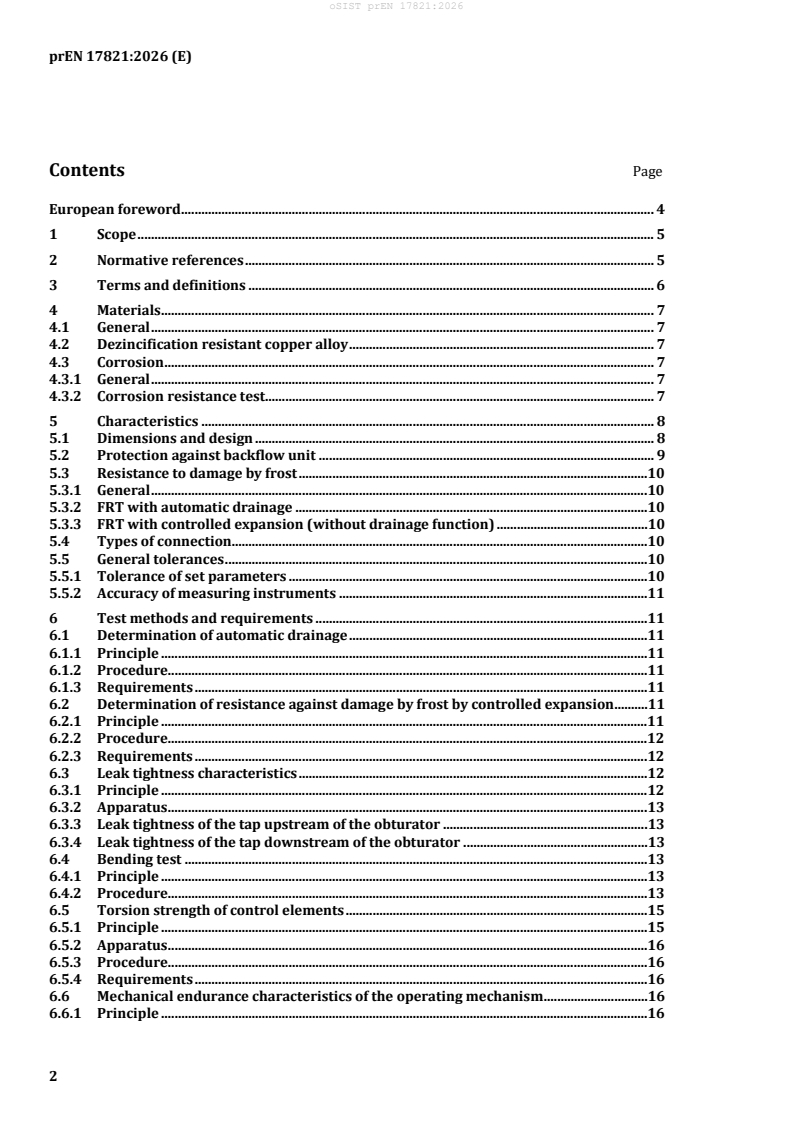
Contents Page
European foreword . 4
1 Scope . 5
2 Normative references . 5
3 Terms and definitions . 6
4 Materials . 7
4.1 General . 7
4.2 Dezincification resistant copper alloy . 7
4.3 Corrosion . 7
4.3.1 General . 7
4.3.2 Corrosion resistance test . 7
5 Characteristics . 8
5.1 Dimensions and design . 8
5.2 Protection against backflow unit . 9
5.3 Resistance to damage by frost .10
5.3.1 General .10
5.3.2 FRT with automatic drainage .10
5.3.3 FRT with controlled expansion (without drainage function) .10
5.4 Types of connection.10
5.5 General tolerances .10
5.5.1 Tolerance of set parameters .10
5.5.2 Accuracy of measuring instruments .11
6 Test methods and requirements .11
6.1 Determination of automatic drainage .11
6.1.1 Principle .11
6.1.2 Procedure.11
6.1.3 Requirements .11
6.2 Determination of resistance against damage by frost by controlled expansion .11
6.2.1 Principle .11
6.2.2 Procedure.12
6.2.3 Requirements .12
6.3 Leak tightness characteristics .12
6.3.1 Principle .12
6.3.2 Apparatus .13
6.3.3 Leak tightness of the tap upstream of the obturator .13
6.3.4 Leak tightness of the tap downstream of the obturator .13
6.4 Bending test .13
6.4.1 Principle .13
6.4.2 Procedure.13
6.5 Torsion strength of control elements .15
6.5.1 Principle .15
6.5.2 Apparatus .16
6.5.3 Procedure.16
6.5.4 Requirements .16
6.6 Mechanical endurance characteristics of the operating mechanism .16
6.6.1 Principle .16
6.6.2 Apparatus . 16
6.6.3 Procedure . 17
6.6.4 Requirements . 17
6.7 Resistance under internal pressure . 17
6.7.1 Principle . 17
6.7.2 Apparatus . 18
6.7.3 Mechanical behaviour upstream of the obturator — Obturator in closed position . 18
6.7.4 Mechanical behaviour downstream of the obturator — Obturator in open position
(leaktightness) . 18
6.8 Flow rate . 19
6.8.1 General . 19
6.8.2 Principle . 19
6.8.3 Procedure . 19
6.8.4 Requirements . 19
6.9 Acoustic behaviour . 19
6.9.1 General . 19
6.9.2 Procedure . 19
6.9.3 Expression of results . 19
6.9.4 Determination of acoustic group . 19
7 Marking and technical product information . 20
7.1 General . 20
7.2 Marking . 20
7.3 Technical product information. 20
Annex A (informative) Tests and sampling . 22
Bibliography . 23
European foreword
This document (prEN 17821:2026) has been prepared by Technical Committee CEN/TC 164 “Water
supply”, the secretariat of which is held by AFNOR.
This document is currently submitted to the CEN Enquiry.
This document will supersede EN 17821:2023.
1 Scope
This document specifies application, general construction, performance and material requirements for
frost resistant taps for outdoor use (FRT), PN 10.
This document is applicable to potable water installations with a static pressure of maximum 1,0 MPa
(10 bar) and a distribution temperature of maximum 25 °C (PWC).
NOTE See Annex A for a general overview of this document’s organization and test sequence.
2 Normative references
The following documents are referred to in the text in such a way that some or all of their content
constitutes requirements of this document. For dated references, only the edition cited applies. For
undated references, the latest edition of the referenced document (including any amendments) applies.
EN 248:2002, Sanitary tapware — General specification for electrodeposited coatings of Ni-Cr
EN 1254-2, Copper and copper alloys — Plumbing fittings — Part 2: Compression fittings for use with
copper tubes
EN 1254-3, Copper and copper alloys — Plumbing fittings — Part 3: Compression fittings for use with
plastics and multilayer pipes
EN 1254-4, Copper and copper alloys — Plumbing fittings — Part 4: Threaded fittings
EN 1254-6, Copper and copper alloys — Plumbing fittings — Part 6: Push-fit fittings for use with metallic
tubes, plastics and multilayer pipes
EN 1254-7, Copper and copper alloys — Plumbing fittings — Part 7: Press fittings for use with metallic
tubes
EN 1254-8, Copper and copper alloys — Plumbing fittings — Part 8: Press fittings for use with plastics and
multilayer pipes
EN 1717, Protection against pollution of water intended for human consumption in potable water
installations and general requirements for devices to prevent pollution by backflow
EN ISO 3822-1, Acoustics — Laboratory tests on noise emission from appliances and equipment used in
water supply installations — Part 1: Method of measurement (ISO 3822-1)
EN ISO 3822-3, Acoustics — Laboratory tests on noise emission from appliances and equipment used in
water supply installations — Part 3: Mounting and operating conditions for in-line valves and appliances
(ISO 3822-3)
EN ISO 6509-1, Corrosion of metals and alloys — Determination of dezincification resistance of copper
alloys with zinc — Part 1: Test method (ISO 6509-1)
EN ISO 9227, Corrosion tests in artificial atmospheres — Salt spray tests (ISO 9227)
ISO 228-1, Pipe threads where pressure-tight joints are not made on the threads — Part 1: Dimensions,
tolerances and designation
ISO 7-1, Pipe threads where pressure-tight joints are made on the threads — Part 1: Dimensions, tolerances
and designation
3 Terms and definitions
For the purposes of this document, the terms and definitions given in EN 1717 and the following apply.
ISO and IEC maintain terminology databases for use in standardization at the following addresses:
— ISO Online browsing platform: available at https://www.iso.org/obp
— IEC Electropedia: available at https://www.electropedia.org/
3.1
FRT
frost resistant tap for outdoor use
Note 1 to entry: FRTs can be categorized in the following ways:
— method of achieving frost resistance (for example by drainage or by controlled expansion);
— pre-assembled or assembled on-site;
— fixed and adjustable length;
— one or two outlets (if FRTs use multiple outlets, the FRT shall be safe for every outlet used).
3.2
PWC
cold potable water
Note 1 to entry: The temperature of cold potable water shall be less than 25 °C. This definition is in line with the
European Drinking Water Directive, Directive (EU) 2020/2184.
3.3
indoor area
area inside the walls of a building
Note 1 to entry: The air temperature of the indoor area shall be higher than 0 °C.
3.4
wall area
interior area of the walls of a building
Note 1 to entry: Locally, the temperature of the wall area can be lower than 0 °C.
3.5
outdoor area
area outside the walls of a building
3.6
M
weight of a completely empty tap
3.7
M
1A
weight of a tap including water between closing-part and the backflow part
3.8
M
weight of a tap filled with water
3.9
M
weight of an empty tap
4 Materials
4.1 General
The end connection in the indoor area (1) and the body in front of the wall (3), as indicated in Figure 1,
shall be made of metallic materials.
All materials which come into contact with water intended for human consumption shall present no
health risk nor cause any change to the water in terms of quality, appearance, smell or taste.
NOTE It is noted that while awaiting the adoption of verifiable European criteria for testing materials in contact
with water intended for human consumption, existing national regulations concerning the use and/or the
characteristics of these products remain in force.
4.2 Dezincification resistant copper alloy
Copper-zinc alloys containing more than 15 % zinc are subject to dezincification when submitted to
water capable of dezincification. When the use of products made of dezincification resistant materials is
required, the materials used shall guarantee a dezincification depth less than 200 µm in any direction.
For this purpose, materials shall be tested in accordance with EN ISO 6509-1 and the product shall be
marked in accordance with Clause 7.
4.3 Corrosion
4.3.1 General
The applied materials shall be corrosion resistant or protected against corrosion. The materials used shall
not have an adverse effect on other materials being used.
4.3.2 Corrosion resistance test
4.3.2.1 Principle
The corrosion resistance test tests the materials used in the external part of the FRT (Figure 1, area 3),
especially when the intended use is in a humid atmosphere where condensation can occur. The FRT under
test shall be fully assembled, and not only include the parts intended to be in contact with potable water,
e.g. springs, spring caps.
4.3.2.2 Procedure
The test shall be conducted in accordance with the neutral saline-spray test of EN ISO 9227.
Conduct the test in accordance with the following:
a) Subject the device to spraying for at least 100 h.
b) Halt the spraying treatment for (48 ± 1) h while maintaining the heat in the tank.
c) Resume the spraying treatment for another (100 ± 1) h.
For the duration of the test, the tank should only be opened to check and maintain the conditions, rest
periods from spraying should be no longer than 30 minutes per day, heating should not be interrupted,
and samples under test should not be handled, washed or checked.
After treatment and before visual examination, rinse the test samples with water to remove any salt
residue.
4.3.2.3 Requirements
The FRT shall comply with the requirements given in EN 248:2002, 5.1.
5 Characteristics
5.1 Dimensions and design
FRT valves consist of the 3 areas shown in Figure 1.
Key
1 indoor area
2 wall area
3 outdoor area
Figure 1 — The different areas of FRT
The conditions of use shall be in accordance with Table 1.
Table 1 — Conditions of use
Supply Dimension Operating range
Pressure recommended limits
DN 15
Pressure static — max. ≤ 1,0 MPa (10,0 bar)
to
Pressure dynamic 0,1 to 0,5 MPa (1 to 5 bar) ≥ 0,05 MPa (0,5 bar)
DN 20
Temperature cold — PWC ≤ 25 °C
Internal or external threads at the inlet and outlet of the FRT shall comply with ISO 228-1 or ISO 7-1.
The
...