


EN 18052:2025
(Main)Intelligent transport systems - ESafety - ECall end to end conformance testing for eCall HLAP in hybrid circuit switched/packet switched network environments
General Information
- Abstract
This document describes the key actors in the eCall chain of service provision in hybrid circuit switched/packet switched network
environments as:
1) In-Vehicle System (IVS)/vehicle,
2) Mobile Network Operator (MNO),
3) Public Safety Answering Point (PSAP),
and to provide conformance tests for actor groups 1) – 3).
NOTE 1 Conformance tests are not appropriate nor required for vehicle occupants, although they are the recipient of the service.
NOTE 2 Third party eCall systems (TPS-eCall) are not within the scope of this deliverable. This is because the core TPS-eCall
standard (EN 16102) does not specify the communications link between the vehicle and the TPS service provider.
NOTE 3 These conformance tests are partly based on the appropriate conformance tests from EN 16454 and CEN/prEN 17240.
This deliverable therefore adapts and revises Conformance Test Protocols (CTP) from EN 16454 and CEN/prEN 17240 for hybrid circuit switched/packet switched network environments.
This document complements EN 16454 and CEN/prEN 17240 and provides a suite of conformance tests for IVS equipment, MNOs and PSAPs, required to ensure and demonstrate compliance with CEN/prEN 17905.
The scope covers conformance testing of new engineering developments, products and systems, and does not imply testing associated with individual installations in vehicles or locations.
- Status
- Published
- Publication Date
- 28-Oct-2025
- Technical Committee
- CEN/TC 278 - Road transport and traffic telematics
- Drafting Committee
- CEN/TC 278/WG 15 - eSafety
- Current Stage
- 6060 - Definitive text made available (DAV) - Publishing
- Start Date
- 29-Oct-2025
- Due Date
- 22-Sep-2025
- Completion Date
- 29-Oct-2025

Overview
EN 18052:2025 - published by CEN - defines end‑to‑end conformance testing for eCall HLAP (Higher Level Application Profile) operating in hybrid circuit switched / packet switched network environments. The standard describes the key actors in the eCall service chain - In‑Vehicle System (IVS) / vehicle, Mobile Network Operator (MNO) and Public Safety Answering Point (PSAP) - and provides Conformance Test Protocols (CTPs) to verify equipment, network functions and PSAP components. It is intended for conformance testing of new engineering developments, products and systems (not individual vehicle installations). TPS‑eCall (third‑party eCall) communications are explicitly out of scope.
Key topics and technical requirements
- Scope and actors: Defines roles and responsibilities for IVS, MNO and PSAP in hybrid CS/PS environments.
- Conformance Test Protocols (CTPs): A structured suite of tests adapted from EN 16454 and CEN/prEN 17240 to validate HLAP behaviour in mixed CS/PS networks.
- Functional areas covered:
- Domain selection and eCall initiation in CS and PS domains
- Fallback strategies between CS and PS (including immediate and conditional fallback)
- In‑call domain handover and post‑handover MSD (Minimum Set of Data) handling
- MSD transfer methods (e.g., in‑band modem vs. packet delivery) and logging
- AL‑ACK (acknowledgement) handling, negative/missing ACK cases and re‑attempt logic
- Timers, state transitions and registration persistence requirements
- Call‑back procedures and PSAP logging/requests
- Test taxonomy & naming conventions: Specifies how tests are categorized and named (CTP stage, actor group), supporting repeatable, auditable conformance verification.
- Intended outputs: Demonstrable evidence that IVS, MNO systems and PSAPs comply with CEN/prEN 17905 requirements when operating across hybrid networks.
Applications and who uses this standard
- Automotive OEMs and IVS suppliers - validate eCall devices and HLAP implementations against pan‑European conformance tests.
- Mobile Network Operators - verify network behaviour for emergency call handling, handover and MSD delivery in mixed CS/PS scenarios.
- PSAP vendors and emergency services - ensure PSAP systems properly receive, log and request MSDs and handle call‑back and handover events.
- Test laboratories and certification bodies - apply CTPs to certify products and systems for regulatory and market acceptance.
Practical benefits include reduced interoperability risk, clearer compliance evidence and improved reliability of emergency communications across evolving mobile networks.
Related standards
- EN 16454 (CTPs referenced and adapted)
- CEN/prEN 17240 (CTPs referenced and adapted)
- CEN/prEN 17905 (requirements that EN 18052 supports demonstrating compliance)
- EN 16102 (TPS‑eCall core standard - out of scope for EN 18052)
Keywords: EN 18052:2025, eCall HLAP, hybrid circuit switched/packet switched network, conformance testing, IVS, MNO, PSAP, CTP, CEN.
Relations
- Refers
EN 16072:2025 - Intelligent transport systems - ESafety - Pan-European eCall operating requirements - Effective Date
- 28-Jan-2026
- Effective Date
- 28-Jan-2026
- Effective Date
- 28-Jan-2026
- Effective Date
- 28-Jan-2026
- Effective Date
- 28-Jan-2026
- Effective Date
- 28-Jan-2026
- Effective Date
- 28-Jan-2026
- Effective Date
- 28-Jan-2026
- Referred By
EN ISO 9466:2025 - Railway Applications - Coating of passenger rail vehicle (ISO 9466:2025) - Effective Date
- 28-Jan-2026
- Effective Date
- 28-Jan-2026
- Effective Date
- 28-Jan-2026
- Effective Date
- 28-Jan-2026
- Effective Date
- 28-Jan-2026
Get Certified
Connect with accredited certification bodies for this standard

BSI Group
BSI (British Standards Institution) is the business standards company that helps organizations make excellence a habit.

NYCE
Mexican standards and certification body.
Sponsored listings
Frequently Asked Questions
EN 18052:2025 is a standard published by the European Committee for Standardization (CEN). Its full title is "Intelligent transport systems - ESafety - ECall end to end conformance testing for eCall HLAP in hybrid circuit switched/packet switched network environments". This standard covers: This document describes the key actors in the eCall chain of service provision in hybrid circuit switched/packet switched network environments as: 1) In-Vehicle System (IVS)/vehicle, 2) Mobile Network Operator (MNO), 3) Public Safety Answering Point (PSAP), and to provide conformance tests for actor groups 1) – 3). NOTE 1 Conformance tests are not appropriate nor required for vehicle occupants, although they are the recipient of the service. NOTE 2 Third party eCall systems (TPS-eCall) are not within the scope of this deliverable. This is because the core TPS-eCall standard (EN 16102) does not specify the communications link between the vehicle and the TPS service provider. NOTE 3 These conformance tests are partly based on the appropriate conformance tests from EN 16454 and CEN/prEN 17240. This deliverable therefore adapts and revises Conformance Test Protocols (CTP) from EN 16454 and CEN/prEN 17240 for hybrid circuit switched/packet switched network environments. This document complements EN 16454 and CEN/prEN 17240 and provides a suite of conformance tests for IVS equipment, MNOs and PSAPs, required to ensure and demonstrate compliance with CEN/prEN 17905. The scope covers conformance testing of new engineering developments, products and systems, and does not imply testing associated with individual installations in vehicles or locations.
This document describes the key actors in the eCall chain of service provision in hybrid circuit switched/packet switched network environments as: 1) In-Vehicle System (IVS)/vehicle, 2) Mobile Network Operator (MNO), 3) Public Safety Answering Point (PSAP), and to provide conformance tests for actor groups 1) – 3). NOTE 1 Conformance tests are not appropriate nor required for vehicle occupants, although they are the recipient of the service. NOTE 2 Third party eCall systems (TPS-eCall) are not within the scope of this deliverable. This is because the core TPS-eCall standard (EN 16102) does not specify the communications link between the vehicle and the TPS service provider. NOTE 3 These conformance tests are partly based on the appropriate conformance tests from EN 16454 and CEN/prEN 17240. This deliverable therefore adapts and revises Conformance Test Protocols (CTP) from EN 16454 and CEN/prEN 17240 for hybrid circuit switched/packet switched network environments. This document complements EN 16454 and CEN/prEN 17240 and provides a suite of conformance tests for IVS equipment, MNOs and PSAPs, required to ensure and demonstrate compliance with CEN/prEN 17905. The scope covers conformance testing of new engineering developments, products and systems, and does not imply testing associated with individual installations in vehicles or locations.
EN 18052:2025 is classified under the following ICS (International Classification for Standards) categories: 35.240.60 - IT applications in transport. The ICS classification helps identify the subject area and facilitates finding related standards.
EN 18052:2025 has the following relationships with other standards: It is inter standard links to EN 16072:2025, EN 16062:2023, EN 17184:2024, EN 15722:2020, EN ISO 22674:2022, EN ISO 20749:2023, EN ISO 5139:2023, EN ISO 23401-1:2023, EN ISO 9466:2025, EN ISO 7405:2025, EN 17905:2023, EN ISO 3990:2023, EN ISO 9333:2022. Understanding these relationships helps ensure you are using the most current and applicable version of the standard.
EN 18052:2025 is associated with the following European legislation: EU Directives/Regulations: 2010/40/EU. When a standard is cited in the Official Journal of the European Union, products manufactured in conformity with it benefit from a presumption of conformity with the essential requirements of the corresponding EU directive or regulation.
EN 18052:2025 is available in PDF format for immediate download after purchase. The document can be added to your cart and obtained through the secure checkout process. Digital delivery ensures instant access to the complete standard document.
Standards Content (Sample)
SLOVENSKI STANDARD
01-februar-2026
Inteligentni transportni sistemi - e-Varnost - Preskušanje skladnosti e-klica HLAP v
hibridnih omrežnih okoljih s komutiranim vezjem/paketno komutiranim omrežjem
Intelligent transport systems - ESafety - ECall end to end conformance testing for eCall
HLAP in hybrid circuit switched/packet switched network environments
Intelligente Verkehrssysteme - eSicherheit - eCall-Ende-zu-Ende Konformitätsprüfungen
für übergeordnete eCall-Anwendungen in hybriden leitungs-/paketvermittelnden
Netzwerkumgebungen
Systèmes de transport intelligents - eSafety - Essais de conformité du système eCall de
bout en bout pour le HLAP d'eCall dans les environnements réseaux hybrides à
commutation de circuits et de paquets
Ta slovenski standard je istoveten z: EN 18052:2025
ICS:
03.220.20 Cestni transport Road transport
13.200 Preprečevanje nesreč in Accident and disaster control
katastrof
35.240.60 Uporabniške rešitve IT v IT applications in transport
prometu
2003-01.Slovenski inštitut za standardizacijo. Razmnoževanje celote ali delov tega standarda ni dovoljeno.
EN 18052
EUROPEAN STANDARD
NORME EUROPÉENNE
October 2025
EUROPÄISCHE NORM
ICS 35.240.60
English Version
Intelligent transport systems - ESafety - ECall end to end
conformance testing for eCall HLAP in hybrid circuit
switched/packet switched network environments
Systèmes de transport intelligents - eSafety - Essais de Intelligente Verkehrssysteme - eSicherheit - eCall-
conformité du système eCall de bout en bout pour le Ende-zu-Ende Konformitätsprüfungen für
HLAP d'eCall dans les environnements réseaux übergeordnete eCall-Anwendungen in hybriden
hybrides à commutation de circuits et de paquets leitungs-/paketvermittelnden Netzwerkumgebungen
This European Standard was approved by CEN on 6 July 2025.
CEN members are bound to comply with the CEN/CENELEC Internal Regulations which stipulate the conditions for giving this
European Standard the status of a national standard without any alteration. Up-to-date lists and bibliographical references
concerning such national standards may be obtained on application to the CEN-CENELEC Management Centre or to any CEN
member.
This European Standard exists in three official versions (English, French, German). A version in any other language made by
translation under the responsibility of a CEN member into its own language and notified to the CEN-CENELEC Management
Centre has the same status as the official versions.
CEN members are the national standards bodies of Austria, Belgium, Bulgaria, Croatia, Cyprus, Czech Republic, Denmark, Estonia,
Finland, France, Germany, Greece, Hungary, Iceland, Ireland, Italy, Latvia, Lithuania, Luxembourg, Malta, Netherlands, Norway,
Poland, Portugal, Republic of North Macedonia, Romania, Serbia, Slovakia, Slovenia, Spain, Sweden, Switzerland, Türkiye and
United Kingdom.
EUROPEAN COMMITTEE FOR STANDARDIZATION
COMITÉ EUROPÉEN DE NORMALISATION
EUROPÄISCHES KOMITEE FÜR NORMUNG
CEN-CENELEC Management Centre: Rue de la Science 23, B-1040 Brussels
© 2025 CEN All rights of exploitation in any form and by any means reserved Ref. No. EN 18052:2025 E
worldwide for CEN national Members.
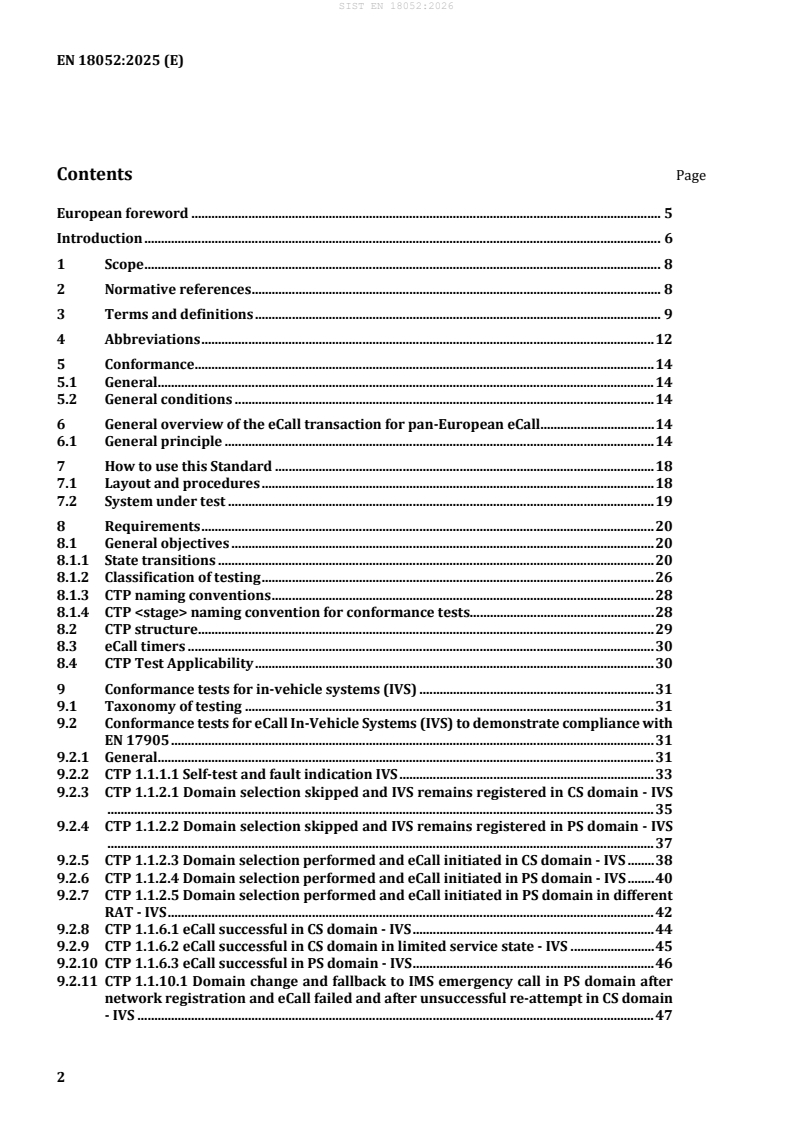
Contents Page
European foreword . 5
Introduction . 6
1 Scope . 8
2 Normative references . 8
3 Terms and definitions . 9
4 Abbreviations . 12
5 Conformance . 14
5.1 General. 14
5.2 General conditions . 14
6 General overview of the eCall transaction for pan-European eCall . 14
6.1 General principle . 14
7 How to use this Standard . 18
7.1 Layout and procedures . 18
7.2 System under test . 19
8 Requirements . 20
8.1 General objectives . 20
8.1.1 State transitions . 20
8.1.2 Classification of testing . 26
8.1.3 CTP naming conventions . 28
8.1.4 CTP naming convention for conformance tests. 28
8.2 CTP structure . 29
8.3 eCall timers . 30
8.4 CTP Test Applicability . 30
9 Conformance tests for in-vehicle systems (IVS) . 31
9.1 Taxonomy of testing . 31
9.2 Conformance tests for eCall In-Vehicle Systems (IVS) to demonstrate compliance with
EN 17905 . 31
9.2.1 General. 31
9.2.2 CTP 1.1.1.1 Self-test and fault indication IVS . 33
9.2.3 CTP 1.1.2.1 Domain selection skipped and IVS remains registered in CS domain - IVS
................................................................................................................................................................... 35
9.2.4 CTP 1.1.2.2 Domain selection skipped and IVS remains registered in PS domain - IVS
................................................................................................................................................................... 37
9.2.5 CTP 1.1.2.3 Domain selection performed and eCall initiated in CS domain - IVS . 38
9.2.6 CTP 1.1.2.4 Domain selection performed and eCall initiated in PS domain - IVS . 40
9.2.7 CTP 1.1.2.5 Domain selection performed and eCall initiated in PS domain in different
RAT - IVS . 42
9.2.8 CTP 1.1.6.1 eCall successful in CS domain - IVS . 44
9.2.9 CTP 1.1.6.2 eCall successful in CS domain in limited service state - IVS . 45
9.2.10 CTP 1.1.6.3 eCall successful in PS domain - IVS . 46
9.2.11 CTP 1.1.10.1 Domain change and fallback to IMS emergency call in PS domain after
network registration and eCall failed and after unsuccessful re-attempt in CS domain
- IVS . 47
9.2.12 CTP 1.1.10.2 Domain change and fallback to IMS emergency call in PS domain after
eCall failed and after unsuccessful re-attempt in CS domain - IVS. 49
9.2.13 CTP 1.1.10.3 Fallback to IMS emergency call in PS domain after missing AL-ACK for
initial MSD - IVS . 51
9.2.14 CTP 1.1.10.4 Domain change and fallback to IMS emergency call in PS domain after
eCall is dropped before the MSD is acknowledged and after unsuccessful re-attempt
in CS domain - IVS . 53
9.2.15 CTP 1.1.10.5 Fallback to emergency call in CS domain - IVS . 55
9.2.16 CTP 1.1.10.6 Domain change to PS domain after network registration and eCall failed
in CS domain - IVS . 57
9.2.17 CTP 1.1.10.7 Domain change to PS domain after eCall failed in CS domain - IVS . 59
9.2.18 CTP 1.1.10.8 Domain change to CS domain after eCall failed in PS domain - IVS . 61
9.2.19 CTP 1.1.10.9 Domain change to CS domain after eCall failed and after unsuccessful re-
attempt in PS domain - IVS . 63
9.2.20 CTP 1.1.10.10 Domain change and fallback to eCall (emergency call) in CS domain
after eCall failed in PS domain - IVS . 65
9.2.21 CTP 1.1.10.11 Domain change and fallback to eCall (emergency call) in CS domain
after eCall failed and after unsuccessful re-attempt in PS domain - IVS . 67
9.2.22 CTP 1.1.10.12 Domain change to PS domain after eCall is dropped before the MSD is
acknowledged and after unsuccessful re-attempt in CS domain - IVS . 69
9.2.23 CTP 1.1.10.13 Domain change to PS domain and MSD transfer using in-band modem
after eCall is dropped before the MSD is acknowledged and after unsuccessful re-
attempt in CS domain - IVS . 71
9.2.24 CTP 1.1.10.14 Domain change to CS domain after eCall is rejected and MSD
acknowledged in PS domain - IVS . 73
9.2.25 CTP 1.1.10.15 No Call reattempt or domain change to CS domain after eCall is rejected
and MSD acknowledged in PS domain - IVS . 75
9.2.26 CTP 1.1.10.16 Domain change to CS domain after eCall is rejected and negative AL-
ACK and unsuccessful re-attempt in PS domain - IVS . 77
9.2.27 CTP 1.1.10.17 Domain change to CS domain after eCall is rejected and negative AL-
ACK in PS domain - IVS . 79
9.2.28 CTP 1.1.10.18 Domain change to CS domain after eCall is rejected and missing AL-ACK
and unsuccessful re-attempt in PS domain - IVS . 81
9.2.29 CTP 1.1.10.19 Domain change to CS domain after eCall is rejected and missing AL-ACK
in PS domain - IVS . 83
9.2.30 CTP 1.1.10.20 Domain change to CS domain after eCall is not answered and
unsuccessful re-attempt in PS domain - IVS . 85
9.2.31 CTP 1.1.10.21 Domain change to CS domain after eCall is not answered in PS domain
- IVS . 87
9.2.32 CTP 1.1.10.22 Domain change to CS domain after eCall is dropped before the MSD is
acknowledged and after unsuccessful re-attempt in PS domain - IVS . 89
9.2.33 CTP 1.1.10.23 Domain change to CS domain after eCall is dropped before the MSD is
acknowledged in PS domain - IVS . 91
9.2.34 CTP 1.1.15.1 New/updated MSD after in-call domain handover - IVS . 93
9.2.35 CTP 1.1.17.1 Call-back allowed after domain change to CS domain - IVS . 95
9.2.36 CTP 1.1.17.2 Call-back allowed after domain change to PS domain - IVS . 97
9.2.37 CTP 1.1.17.3 Remain registered for ≥ 1 hr after in-call domain handover - IVS . 99
9.2.38 CTP 1.1.17.4 Remain registered for ≥ 1 hr after domain change to CS domain - IVS
................................................................................................................................................................ 101
9.2.39 CTP 1.1.17.5 Remain registered for ≥ 1 hr after domain change to PS domain - IVS
................................................................................................................................................................ 103
9.2.40 CTP 1.1.18.1 MSD transfer using in-band modem in PS domain after negative AL-ACK
for initial MSD - IVS . 105
9.2.41 CTP 1.1.18.2 MSD transfer using in-band modem in PS domain after missing AL-ACK
for initial MSD - IVS. 107
9.3 Additional conformance tests for eCall-only in-vehicle systems to demonstrate
compliance with EN 17905 . 109
9.3.1 General. 109
9.3.2 CTP 1.2.6.1 eCall successful in PS domain in limited service state - eCall-only IVS . 110
9.3.3 CTP 1.2.10.1 Domain change to CS domain after eCall is rejected and MSD
acknowledged in limited service state in PS domain - eCall-only IVS . 112
9.3.4 CTP 1.2.10.2 Domain change to CS domain after network registration and eCall failed
in PS domain - eCall-only IVS . 114
9.3.5 CTP 1.2.10.3 Domain change to CS domain after network registration and eCall failed
and after unsuccessful re-attempt in PS domain - eCall-only IVS . 116
9.3.6 CTP 1.2.17.1 Remain registered for ≥ 1 hr ≤ 12 hr after in-call domain handover -
eCall-only IVS . 118
10 Conformance tests for Mobile Network Operator (MNO) systems . 120
10.1 Taxonomy of testing . 120
10.2 Conformance tests for MNOs to demonstrate compliance with EN 17905 . 120
10.2.1 General. 120
10.2.2 CTP 2.1.3.1 New/updated MSD after in-call domain handover - MNO . 122
10.2.3 CTP 2.1.3.2 New/updated MSD after in-call domain handover - Roaming - MNO . 124
10.2.4 CTP 2.1.5.1 Call-back after in-call domain handover - MNO . 126
10.2.5 CTP 2.1.5.2 Call-back after in-call domain handover - Roaming - MNO . 128
10.2.6 CTP 2.1.5.3 Call-back after domain change to CS domain - MNO . 130
10.2.7 CTP 2.1.5.4 Call-back after domain change to PS domain - MNO . 131
11 Conformance tests for Public Safety Answering Point (PSAP) systems . 132
11.1 Taxonomy of testing . 132
11.2 Conformance tests for PSAPs to demonstrate compliance with EN 17905 . 132
11.2.1 General. 132
11.2.2 CTP 3.1.10.1 Logging of MSD transfer type of eCall in CS domain - PSAP . 134
11.2.3 CTP 3.1.10.2 Logging of MSD transfer type of eCall in PS domain - PSAP . 135
11.2.4 CTP 3.1.10.3 Logging of MSD transfer type (in-band modem) of eCall in PS domain -
PSAP . 136
11.2.5 CTP 3.1.13.1 Request new MSD after in-call domain handover before call clear-down
- PSAP . 138
11.2.6 CTP 3.1.15.1 Call-back to vehicle after in-call domain handover - PSAP . 140
11.2.7 CTP 3.1.15.2 Call-back to vehicle after domain change to CS domain - PSAP . 141
11.2.8 CTP 3.1.15.3 Call-back to vehicle after domain change to PS domain - PSAP . 142
11.2.9 CTP 3.1.16.1 Request new MSD failed after call clear-down and domain change to CS
domain - PSAP . 143
11.2.10 CTP 3.1.16.2 Request new MSD failed after call clear-down and domain change to
PS domain - PSAP . 145
11.2.11 CTP 3.1.16.3 Request new MSD after call clear-down and domain change to CS
domain - PSAP . 147
11.2.12 CTP 3.1.16.4 Request new MSD after call clear-down and domain change to PS
domain - PSAP . 149
12 Marking, labelling and packaging . 151
13 Declaration of patents and intellectual property . 151
Bibliography . 152
European foreword
This document (EN 18052:2025) has been prepared by Technical Committee CEN/TC 278 “Intelligent
transport systems”, the secretariat of which is held by NEN.
This European Standard shall be given the status of a national standard, either by publication of an
identical text or by endorsement, at the latest by April 2026, and conflicting national standards shall be
withdrawn at the latest by April 2026.
Attention is drawn to the possibility that some of the elements of this document may be the subject of
patent rights. CEN shall not be held responsible for identifying any or all such patent rights.
EN 17240 to exclusively describe end to end
This document is the result of narrowing down the scope of
conformance tests for the eCall High Level Application Protocols in packet switched networks.
This document complements EN 16454 and EN 17240.
Any feedback and questions on this document should be directed to the users’ national standards body.
A complete listing of these bodies can be found on the CEN website.
According to the CEN-CENELEC Internal Regulations, the national standards organisations of the
following countries are bound to implement this European Standard: Austria, Belgium, Bulgaria, Croatia,
Cyprus, Czech Republic, Denmark, Estonia, Finland, France, Germany, Greece, Hungary, Iceland, Ireland,
Italy, Latvia, Lithuania, Luxembourg, Malta, Netherlands, Norway, Poland, Portugal, Republic of North
Macedonia, Romania, Serbia, Slovakia, Slovenia, Spain, Sweden, Switzerland, Türkiye and the United
Kingdom
Introduction
An eCall is an emergency call generated either automatically via activation of in-vehicle sensors or
manually by the vehicle occupants; when activated, to provide notification and relevant location
information to the most appropriate Public Safety Answering Point (PSAP), by means of mobile wireless
communications networks and carries a defined standardized Minimum Set of Data, notifying that there
has been an incident that requires response from the emergency services and establishes an audio
channel between the occupants of the vehicle and the most appropriate PSAP.
NOTE 1 The term PSAP, which is most widely used in the eCall documentation, European Commission
documents, etc., is used throughout this document and equates to the term emergency call response centre used in
the ITS Implementation Directive.
EN 15722 specifies a standardized MSD for eCall, EN 16062 specifies high level application protocols for
eCall and EN 16072 specifies pan-European eCall operating requirements. For third party systems,
EN 16102 specifies third party services supporting eCall operating requirements.
The pan-European eCall are made using Public Land Mobile Networks (PLMN) for which operating
requirements are specified in a number of ETSI standards and technical specifications. In order to provide
the eCall service across a wireless network, high level application protocols are required as an important
essential element to affect this service provision. Originally PLMN were circuit switched networks for
which EN 16062 specifies High Level Application Protocols. In these networks eCall uses Teleservice No
12 (TS12) and in-band modem transfer of data.
Over time, new communication technologies have become available. These technologies use so called
‘packet switched’ technologies using Internet protocols (IP). Particularly, 3GPP have evolved a
communication management system called IMS (IP Multimedia Subsystem) which is suitable to operate
over a number of bearer technologies, including LTE, NR and their successors. It is anticipated that packet
switched networks (such as LTE, NR and their successors), which now co-exist with circuit switched
networks (like GSM/UMTS), will, over the course of time, replace circuit switched networks.
EN 17184 provides High Level Application Protocols (HLAP) for eCall using IMS over packet switched
networks. It provides the equivalent of EN 16062 for circuit switched networks and should be suitable
for all/any packet switched networks and wireless access such as LTE, NR and their successors. A new
Standards Deliverable EN 17905 has been developed for the provision of eCall HLAP in hybrid circuit
switched/packet switched network environments.
In some areas both circuit switched and packet switched networks will co-exist, but there will be areas
that only have packet switched network services. This document specifies the protocols in this hybrid
situation, in order to make sure that pan-European eCall will function as efficiently as possible.
NOTE 2 A (possibly) large number of vehicles support circuit switched in-band eCall only (and not eCall using
IMS over packet switched networks). For these to be able to continue using the eCall service either the onboard
equipment will need to be upgraded (to support eCall using IMS) or sufficient circuit switched networks need to
remain operational. This falls outside the scope of this document and is not addressed herein.
This document complements EN 16454 and EN 17240 and provides a set of end to end conformance tests
in order to verify the support of eCall HLAP in hybrid circuit switched/packet switched network
environments. This document provides tests to enable actors in the eCall chain to be able to claim
conformance with EN 17905, even though they are unable to control the behaviour of systems of other
actors in the eCall chain.
NOTE 3 Conformance tests in this document allow demonstration that a system complies with EN 17905 and is
a prerequisite to providing an interoperable compliant system, but do not by themselves demonstrate that a system
will function nor guarantee the quality of service.
The European Committee for Standardization (CEN) draws attention to the fact that it is claimed that
compliance with this document may involve the use of patents concerning eCall given in EN 16062 and
various ETSI standards for the network access device and cellular mobile networks.
CEN takes no position concerning the evidence, validity and scope of these patent rights.
1 Scope
This document describes the key actors in the eCall chain of service provision in hybrid circuit
switched/packet switched network environments as:
1) In-Vehicle System (IVS)/vehicle,
2) Mobile Network Operator (MNO),
3) Public Safety Answering Point (PSAP),
and to provide conformance tests for actor groups 1) – 3).
NOTE 1 Conformance tests are not appropriate nor required for vehicle occupants, although they are the
recipients of the service.
NOTE 2 Third party eCall systems (TPS-eCall) are not within the scope of this document. This is because the core
TPS-eCall standard (EN 16102) does not specify the communications link between the vehicle and the TPS service
provider.
NOTE 3 These conformance tests are partly based on the appropriate conformance tests from EN 16454 and
EN 17240. This deliverable therefore adapts and revises Conformance Test Procedures (CTPs) from EN 16454 and
EN 17240 for hybrid circuit switched/packet switched network environments.
This document complements EN 16454 and EN 17240 and provides a suite of conformance tests for IVS
equipment, MNOs and PSAPs, required to ensure and demonstrate compliance with EN 17905.
The scope covers conformance testing of new engineering developments, products and systems, and does
not imply testing associated with individual installations in vehicles or locations.
2 Normative references
The following documents are referred to in the text in such a way that some or all of their content
constitutes requirements of this document. For dated references, only the edition cited applies. For
undated references, the latest edition of the referenced document (including any amendments) applies.
EN 17905:2023, Intelligent transport systems - eSafety - eCall HLAP in hybrid circuit switched/packet
switched network environments
EN 17184:2024, Intelligent transport systems - eSafety - eCall High level application Protocols (HLAP) using
IMS packet switched networks
EN 16062:2023, Intelligent transport systems - ESafety - eCall high level application requirements (HLAP)
using GSM/UMTS circuit switched networks
EN 15722, Intelligent transport systems - ESafety - ECall minimum set of data
EN 16072:2025, Intelligent transport systems - ESafety - Pan-European eCall operating requirements
ETSI TS 124 229 (Release 16), Digital cellular telecommunications system (Phase 2+) (GSM); Universal
Mobile Telecommunications System (UMTS); LTE; 5G; IP multimedia call control protocol based on Session
Initiation Protocol (SIP) and Session Description Protocol (SDP); Stage 3 (3GPP TS 24.229 Release 16)
ETSI TS 123 167 (Release 16), Universal Mobile Telecommunications System (UMTS); LTE; IP Multimedia
Subsystem (IMS) emergency sessions (3GPP TS 23.167 Release 16)
3 Terms and definitions
For the purposes of this document, the following terms and definitions apply.
ISO and IEC maintain terminological databases for use in standardization at the following addresses:
• IEC Electropedia: available at http://www.electropedia.org/
• ISO Online browsing platform: available at http://www.iso.org/obp
3.1
clear-down
act of ending a call, following call completion, which is signalled e.g. in accordance with ISUP (ISDN User
Part) ‘Release Cause Codes’ (usually achieved by hanging up the receiver or pressing ‘end call’ or similar
on screen)
3.2
conformance test point
test point
point which can be an actual instantiation of equipment performing a conformance test process ‘live’,
using ‘live’ equipment or may be equipment/systems that simulate behaviour of equipment at the point
being tested in order to stimulate or observe the behaviour resultant from the stimulation and note the
result of that simulation
3.3
CS eCall
eCall making use of a circuit switched mobile network (e.g. GSM or UMTS)
3.4
data
representations of static or dynamic objects in a formalized manner suitable for communication,
interpretation, or processing by humans or by machines
3.5
data concept
concept of a group of data structures (i.e. object class, property, value domain, data elements, message,
interface dialogue, association) referring to abstractions or things in the natural world that can be
identified with explicit boundaries and meaning and whose properties and behaviour all follow the same
rules
3.6
eCall
emergency call generated either automatically via activation of in-vehicle sensors or manually by the
vehicle occupants, which, when activated, provides notification and relevant location information to the
most appropriate Public Safety Answering Point, by means of mobile wireless communications networks,
carries a standardized Minimum Set of Data (MSD) notifying that there has been an incident that requires
response from the emergency services, and establishes an audio channel between the occupants of the
vehicle and the most appropriate Public Safety Answering Point
3.7
eCall-capable
provision of eCall service with availability of wireless communication network to undertake other
application services
3.8
eCall-only
provision of eCall service without availability of wireless communication network to undertake other
application services
3.9
eCall generator
occupant of a vehicle or equipment within a vehicle that has cause to trigger an eCall transaction by
automatic or manual means
3.10
eCall service
end-to-end emergency service to connect occupants of an affected vehicle to the most appropriate PSAP
via an audio link across a PLMN together with the transfer of a minimum set of data to the PSAP
3.11
eCall transaction
establishment of a mobile wireless communications session across a public wireless communications
network and the transmission of a minimum set of data from a vehicle to a public safety answering point
and the establishment of an audio channel between the vehicle and the PSAP
3.12
emergency call response centre
term used in ITS Implementation Directive to mean public safety answering point (PSAP)
3.13
IMS-eCall
eCall making use of IMS over a packet switched network (e.g. LTE or NR)
3.14
IMS emergency call
IMS based emergency call in packet switched networks, which is the IMS equivalent to Teleservice 12
according to ETSI TS 122 003 in circuit switched networks
Note 1 to entry: In contrast to an IMS-eCall, an IMS emergency call does not include the MSD transfer
3.15
in progress
taking place
3.16
in-vehicle equipment
equipment within the vehicle that provides or has access to in-vehicle data required for the minimum set
of data and any other data that is to be sent as part of or complementary to the minimum set of data to
effect the eCall transaction via a public mobile wireless communications network providing a link between
the vehicle and a means of enacting the eCall service via a public mobile wireless communications network
3.17
in-vehicle system
IVS
in-vehicle equipment together with the means to trigger, manage and effect the eCall transaction
3.18
minimum set of data
MSD
standardized data concept comprising data elements of relevant vehicle generated data essential for the
performance of the eCall service
Note 1 to entry: See EN 15722.
3.19
mobile wireless communications network
wireless communications network with homogeneous handover between network access points
3.20
most appropriate PSAP
PSAP defined beforehand by responsible authorities to cover emergency calls from a certain area or for
emergency calls of a certain type
Note 1 to entry: See also PSAP (3.22).
Note 2 to entry: A number of different instantiations of PSAP service are supported within this European Standard.
A PSAP can be a Public Authority or a private service provider operating on behalf of the responsible authorities.
3.21
network access point
beacon, antenna or similar source of signal propagation and receipt together with equipment to manage
communication sessions with users operating within the operating reach of the network access point and
provide connectivity for the users within the operating reach of the single access point to a wider
communications network
Note 1 to entry: A network access point may, but does not need to provide homogeneous or heterogeneous
handover to another network access point.
3.22
public mobile wireless communications network
mobile wireless communications network with access to a public telecommunications network
3.23
public safety answering point
PSAP
physical location working on behalf of the national authorities where emergency calls are first received
under the responsibility of a public authority or a private organization recognized by the national
government
Note 1 to entry: See also most appropriate PSAP.
Note 2 to entry: A number of different instantiations of PSAP service are supported within this deliverable.
3.24
service provider
physical and functional component responsible for providing telematics-based services to its subscribers
3.25
TPS-eCall
eCall provided via a third-party service provider/operator
3.26
vehicle manufacturer
entity which first assembles the vehicle and provides eCall equipment as part of its specification and
subsequently sells the vehicle directly or via an agent
3.27
vehicle occupant(s)
person(s) inside the vehicle
3.28
wireless communications network
network operating using an air-interface capable of bi-directional transfer of data and voice
Note 1 to entry: There are different types of wireless communications such as PAN, LAN, cellular network, etc.
4 Abbreviations
rd
3G 3 Generation
3GPP Third Generation Partnership Project
th
5G 5 Generation
ACK ACKnowledgement
AL-ACK Application Layer ACKnowledgement
CLB CaLl-Back and post eCall
CLI Calling Line Identity
CLR CaLl cleaRdown
CS Circuit Switched
CTP Conformance Test Procedure
E-OFF Engine control off
E-ON Engine control activated
EC European Commission
ECI eCall Initiation
ECL eCall over IMS support indicator
ECP eCall in Progress
EHPLMN Equivalent Home Public Land Mobile Network
EPLMN Equivalent Public Land Mobile Network
ETSI European Telecommunications Standards Institute
GSM Global System for Mobile communications
HMI Human Machine Interface
HPLMN Home Public Land Mobile Network
IE Information Element
IMS IP-Multimedia Subsystem
IMSI International Mobile Subscriber Identity
IVS In-Vehicle System
LTE Long Term Evolution
MNO Mobile Network Operator
MSD Minimum Set of Data
NAD Network Access Device
NAS Non-Access Stratum
NR New Radio
P-CSCF Proxy Call Session Control Function
PE Pan-European
PLMN Public Land Mobile Network
PS Packet Switched
PSAP Public Safety Answering Point
RAT Radio Access Technology
SIM Subscriber Identity Module
SUT System Under Test
TPS Third Party Service
TRG Trigger
TS (i) Technical Specification
TS (ii) Teleservice
TS12 Teleservice 12
UMTS Universal Mobile Telecommunication System
USIM Universal Subscriber Identity Module
VPLMN Visited Public Land Mobile Network
5 Conformance
5.1 General
This document provides conformance tests for each of the key actor groups such that each actor group
may be able to ascertain if it is in conformance with the relevant eCall Standards deliverables, and to
demonstrate its conformance to eCall standards requirements relevant to that actor group.
Where a supplier elects to claim conformance that its product or service is in accordance with the
provisions of this document, it shall only do so if it can evidence that it has undertaken the test procedures
relevant to its product(s) and/or service(s) as specified herein and has met all of the PASS criteria
requirements specified in the tests appropriate to its product(s) and/or service(s) that are specified
herein.
5.2 General conditions
A CTP PASS condition is only confirmed if ALL individual pass conditions written in the “pass conditions”
column of a given Conformance Test Procedure (CTP) are observed.
A CTP FAIL condition occurs if one or more of the given individual pass conditions written in the “pass
conditions” column of a given CTP are not observed (failed).
To be explicitly clear, if a supplier has undertaken the test procedures relevant to its product(s) and/or
service(s) as specified herein and has NOT MET all of the PASS criteria requirements specified in the tests
appropriate to its product and/or service(s) that are specified herein, i.e. its product or service has failed
ANY of the tests relevant to its product or service according to the methods and criteria determined
herein, it SHALL NOT claim compliance to this document. A supplier shall not claim ‘partial compliance’
nor ‘compliance to selected tests’ of this document.
6 General overview of the eCall transaction for pan-European eCall
6.1 General principle
In the introduction to the document, EN 16072, eCall was described as an emergency call generated either
automatically via activation of in-vehicle sensors or manually by the vehicle occupants (the eCall
generator); when activated, it provides notification and relevant location information to the most
appropriate Public Safety Answering Point, by means of mobile wireless communications networks and
carries a defined standardized Minimum Set of Data, notifying that there has been an incident that
requires response from the emergency services and establishes an audio channel between the occupants
of the vehicle and the most appropriate Public Safety Answering Point.
Figure 1 shows an illustrative view of the pan-European eCall service, as defined in EN 16072.
Figure 1 — General overview: pan European eCall service using GSM/UMTS (CS domain)
(SOURCE: European Commission)
In circuit switched networks the eCall is identified as an emergency call and specifically an eCall in the
telecircuit switching (TS) process. The emergency number (112) is not dialled as the TS identifiers inform
the MNO that the call is an emergency call/eCall and the MNO has procedures to direct these calls to “the
most appropriate” PSAP. Having established a voice channel, the microphones and speakers are muted
and a modem is used to transfer the Minimum Set of Data (MSD) to the PSAP before opening up the line
to enable conversation between the PSAP operator and the occupants of the vehicle.
Technology advances and subsequently to the development of the eCall application suite EN 16072,
EN 16062 and EN 16454 standards, packet switched networks have become available. Over the course of
time, these packet switched networks (such as LTE, NR and their successors) are expected to provide
new PLMNs to complement and eventually replace the circuit switched GSM/UMTS networks.
The high level paradigm for eCall remains unchanged, but there are fundamental differences in packet
switched networks: the TS mechanism is not available and the switching paradigm is different, allowing
for a more robust way of data transfer. 3GPP has developed IMS (IP Multimedia Subsystem) which is an
all-IP (Internet Protocol) system designed to assist mobile operators deliver next generation interactive
and interoperable services, cost-effectively, over an architecture providing the flexibility of the Internet.
IMS is designed for packet switched networks and supports IP multimedia applications via IP multimedia
sessions over a multitude of IP Connectivity Access Networks, such as NG-RAN, E-UTRAN, UTRAN,
GERAN, LAN, DOCSIS®, WiMAX™, cdma2000® and DVB-RCS2 access. It is likely that all subsequent
IP based packet switched networks will therefore be able to support IMS, making migration to future, as
yet undeveloped technologies, a simpler and easier to achieve process.
It is therefore appropriate to require the availability of IMS on a packet switched network for eCall to
function, rather than any of the specific wireless technologies, as it provides greater flexibility and
migration potential.
In a packet switched environment where IMS is available, the eCall is established as an internet protocol-
based session with the exchange of packets of data (which in this case, are largely packets of voice data),
and the MSD is provided as part of the session establishment. This is completely different from the mode
of operation in circuit switched networks. It was therefore necessary to provide a separate set of
standards (EN 17184 and EN 17240) for “High Level Application Protocols” to manage eCall via packet
switched networks.
Figure 2 shows the IMS equivalent of Figure 1 and compares it to e
...