


EN 16091:2011
(Main)Liquid petroleum products - Middle distillates and fatty acid methyl ester (FAME) fuels and blends - Determination of oxidation stability by rapid small scale oxidation method
General Information
- Abstract
This European Standard specifies a method for the determination of the oxidation stability of middle distillate fuels, fatty acid methyl ester (FAME) fuel and blends thereof, under accelerated conditions, by measuring the induction period to the specified breakpoint in a reaction vessel charged with the sample and oxygen.
NOTE 1 For the purposes of this European Standard, the term “% (V/V)” is used to represent the volume fraction (φ).
NOTE 2 The induction period is used as an indication for the resistance of middle distillates, fatty acid methyl ester (FAME) fuels and blends thereof against oxidation. It should be recognized, however, that this correlation can vary markedly under different conditions with different FAMEs and diesel fuel blends.
NOTE 3 The presence of ignition improvers may lead to lower oxidation stability results determined by this method. It has for instance been observed that the addition of 2-ethyl hexyl nitrate (2EHN) can reduce the measured oxidation stability values.
- Status
- Withdrawn
- Publication Date
- 29-Nov-2011
- Withdrawal Date
- 22-Sep-2026
- Technical Committee
- CEN/TC 19 - Petroleum products, lubricants and related products
- Current Stage
- 9960 - Withdrawal effective - Withdrawal
- Start Date
- 19-Oct-2022
- Completion Date
- 23-Sep-2026

Relations
- Effective Date
- 11-May-2020
- Effective Date
- 28-Jan-2026
- Effective Date
- 28-Jan-2026
- Effective Date
- 28-Jan-2026
Get Certified
Connect with accredited certification bodies for this standard

Element Materials Technology
Materials testing and product certification.

ABS Group Brazil
ABS Group certification services in Brazil.

ABS Quality Evaluations Inc.
American Bureau of Shipping quality certification.
Sponsored listings
Frequently Asked Questions
EN 16091:2011 is a standard published by the European Committee for Standardization (CEN). Its full title is "Liquid petroleum products - Middle distillates and fatty acid methyl ester (FAME) fuels and blends - Determination of oxidation stability by rapid small scale oxidation method". This standard covers: This European Standard specifies a method for the determination of the oxidation stability of middle distillate fuels, fatty acid methyl ester (FAME) fuel and blends thereof, under accelerated conditions, by measuring the induction period to the specified breakpoint in a reaction vessel charged with the sample and oxygen. NOTE 1 For the purposes of this European Standard, the term “% (V/V)” is used to represent the volume fraction (φ). NOTE 2 The induction period is used as an indication for the resistance of middle distillates, fatty acid methyl ester (FAME) fuels and blends thereof against oxidation. It should be recognized, however, that this correlation can vary markedly under different conditions with different FAMEs and diesel fuel blends. NOTE 3 The presence of ignition improvers may lead to lower oxidation stability results determined by this method. It has for instance been observed that the addition of 2-ethyl hexyl nitrate (2EHN) can reduce the measured oxidation stability values.
This European Standard specifies a method for the determination of the oxidation stability of middle distillate fuels, fatty acid methyl ester (FAME) fuel and blends thereof, under accelerated conditions, by measuring the induction period to the specified breakpoint in a reaction vessel charged with the sample and oxygen. NOTE 1 For the purposes of this European Standard, the term “% (V/V)” is used to represent the volume fraction (φ). NOTE 2 The induction period is used as an indication for the resistance of middle distillates, fatty acid methyl ester (FAME) fuels and blends thereof against oxidation. It should be recognized, however, that this correlation can vary markedly under different conditions with different FAMEs and diesel fuel blends. NOTE 3 The presence of ignition improvers may lead to lower oxidation stability results determined by this method. It has for instance been observed that the addition of 2-ethyl hexyl nitrate (2EHN) can reduce the measured oxidation stability values.
EN 16091:2011 is classified under the following ICS (International Classification for Standards) categories: 75.160.20 - Liquid fuels. The ICS classification helps identify the subject area and facilitates finding related standards.
EN 16091:2011 has the following relationships with other standards: It is inter standard links to EN 16091:2022, EN ISO 3171:1999, EN ISO 3170:2025, CEN/TR 16557:2013. Understanding these relationships helps ensure you are using the most current and applicable version of the standard.
EN 16091:2011 is available in PDF format for immediate download after purchase. The document can be added to your cart and obtained through the secure checkout process. Digital delivery ensures instant access to the complete standard document.
Standards Content (Sample)
2003-01.Slovenski inštitut za standardizacijo. Razmnoževanje celote ali delov tega standarda ni dovoljeno.Flüssige Mineralölerzeugnisse - Mitteldestillat- und Fettsäuremethylesterkraftstoffe und Mischungen - Bestimmung der Oxidationsstabilität mit beschleunigtem Verfahren und kleiner ProbenmengeProduits pétroliers liquides - Carburants et mélanges des distillats moyens et des esters méthyliques d'acides gras (EMAG) - Détermination de la stabilité à l'oxydation par méthode d'oxydation accélérée petite échelleLiquid petroleum products - Middle distillates and fatty acid methyl ester (FAME) fuels and blends - Determination of oxidation stability by rapid small scale oxidation method75.160.20Liquid fuelsICS:Ta slovenski standard je istoveten z:EN 16091:2011SIST EN 16091:2012en,de01-februar-2012SIST EN 16091:2012SLOVENSKI
STANDARD
EUROPEAN STANDARD NORME EUROPÉENNE EUROPÄISCHE NORM
EN 16091
November 2011 ICS 75.160.20 English Version
Liquid petroleum products - Middle distillates and fatty acid methyl ester (FAME) fuels and blends - Determination of oxidation stability by rapid small scale oxidation method
Produits pétroliers liquides - Distillats moyens, esters méthyliques d'acides gras (EMAG) et leurs mélanges - Détermination de la stabilité à l'oxydation par méthode d'oxydation accélérée à petite échelle
Flüssige Mineralölerzeugnisse - Mitteldestillat- und Fettsäuremethylesterkraftstoffe und Mischungen - Bestimmung der Oxidationsstabilität mit beschleunigtem Verfahren und kleiner Probenmenge This European Standard was approved by CEN on 15 October 2011.
CEN members are bound to comply with the CEN/CENELEC Internal Regulations which stipulate the conditions for giving this European Standard the status of a national standard without any alteration. Up-to-date lists and bibliographical references concerning such national standards may be obtained on application to the CEN-CENELEC Management Centre or to any CEN member.
This European Standard exists in three official versions (English, French, German). A version in any other language made by translation under the responsibility of a CEN member into its own language and notified to the CEN-CENELEC Management Centre has the same status as the official versions.
CEN members are the national standards bodies of Austria, Belgium, Bulgaria, Croatia, Cyprus, Czech Republic, Denmark, Estonia, Finland, France, Germany, Greece, Hungary, Iceland, Ireland, Italy, Latvia, Lithuania, Luxembourg, Malta, Netherlands, Norway, Poland, Portugal, Romania, Slovakia, Slovenia, Spain, Sweden, Switzerland and United Kingdom.
EUROPEAN COMMITTEE FOR STANDARDIZATION
COMITÉ EUROPÉEN DE NORMALISATION EUROPÄISCHES KOMITEE FÜR NORMUNG
Management Centre:
Avenue Marnix 17,
B-1000 Brussels © 2011 CEN All rights of exploitation in any form and by any means reserved worldwide for CEN national Members. Ref. No. EN 16091:2011: ESIST EN 16091:2012
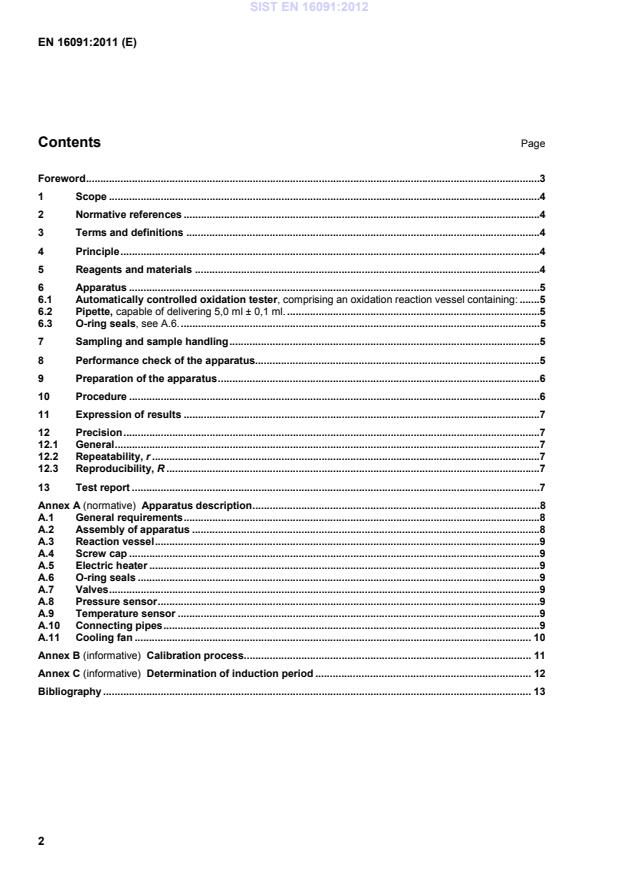
Apparatus description .8A.1General requirements .8A.2Assembly of apparatus .8A.3Reaction vessel .9A.4Screw cap .9A.5Electric heater .9A.6O-ring seals .9A.7Valves .9A.8Pressure sensor .9A.9Temperature sensor .9A.10Connecting pipes .9A.11Cooling fan . 10Annex B (informative)
Calibration process. 11Annex C (informative)
Determination of induction period . 12Bibliography . 13 SIST EN 16091:2012
...