


EN 14325:2018
(Main)Protective clothing against chemicals - Test methods and performance classification of chemical protective clothing materials, seams, joins and assemblages
General Information
- Abstract
This European Standard specifies the performance classification and test methods for materials used in chemical protective clothing, including gloves and footwear. The gloves and boots should have the same chemical protective barrier requirements as the fabric when an integral part of the clothing. This is a reference standard to which chemical protective clothing performance standards may refer in whole or in part, but this standard is not exhaustive in the sense that product standards may well require testing according to test method standards which are not included in this standard.
While these performance levels are intended to relate to the usage to which the chemical protective clothing is to be put, it is essential that the chemical protective clothing manufacturer or supplier indicate the intended use of the protective clothing and that the user (specifier) carries out a risk assessment in order to establish the correct performance level for the intended task.
- Status
- Withdrawn
- Publication Date
- 05-Jun-2018
- Withdrawal Date
- 22-Sep-2026
- Current Stage
- 9960 - Withdrawal effective - Withdrawal
- Start Date
- 15-May-2024
- Completion Date
- 23-Sep-2026
- Directive
- Harmonized Standard2016/425 - Regulation (EU) 2016/425 of the European Parliament and of the Council of 9 March 2016 on personal protective equipment and repealing Council Directive 89/686/EEC
Not Harmonized89/686/EEC - Personal protective equipment (PPE)

Relations
- Effective Date
- 01-Apr-2009
- Effective Date
- 18-Mar-2024
- Effective Date
- 09-Feb-2026
- Effective Date
- 28-Jan-2026
- Effective Date
- 28-Jan-2026
- Effective Date
- 28-Jan-2026
- Effective Date
- 28-Jan-2026
- Effective Date
- 28-Jan-2026
- Effective Date
- 28-Jan-2026
- Effective Date
- 28-Jan-2026
- Effective Date
- 28-Jan-2026
- Effective Date
- 28-Jan-2026
- Effective Date
- 28-Jan-2026
- Effective Date
- 28-Jan-2026
- Effective Date
- 28-Jan-2026
Get Certified
Connect with accredited certification bodies for this standard

CIS Institut d.o.o.
Personal Protective Equipment (PPE) certification body. Notified Body NB-2890 for EU Regulation 2016/425 PPE.

Kiwa BDA Testing
Building and construction product certification.
Kmetijski inštitut Slovenije
Agricultural Institute of Slovenia. Soil testing, plant health, agricultural product analysis.
Sponsored listings
Frequently Asked Questions
EN 14325:2018 is a standard published by the European Committee for Standardization (CEN). Its full title is "Protective clothing against chemicals - Test methods and performance classification of chemical protective clothing materials, seams, joins and assemblages". This standard covers: This European Standard specifies the performance classification and test methods for materials used in chemical protective clothing, including gloves and footwear. The gloves and boots should have the same chemical protective barrier requirements as the fabric when an integral part of the clothing. This is a reference standard to which chemical protective clothing performance standards may refer in whole or in part, but this standard is not exhaustive in the sense that product standards may well require testing according to test method standards which are not included in this standard. While these performance levels are intended to relate to the usage to which the chemical protective clothing is to be put, it is essential that the chemical protective clothing manufacturer or supplier indicate the intended use of the protective clothing and that the user (specifier) carries out a risk assessment in order to establish the correct performance level for the intended task.
This European Standard specifies the performance classification and test methods for materials used in chemical protective clothing, including gloves and footwear. The gloves and boots should have the same chemical protective barrier requirements as the fabric when an integral part of the clothing. This is a reference standard to which chemical protective clothing performance standards may refer in whole or in part, but this standard is not exhaustive in the sense that product standards may well require testing according to test method standards which are not included in this standard. While these performance levels are intended to relate to the usage to which the chemical protective clothing is to be put, it is essential that the chemical protective clothing manufacturer or supplier indicate the intended use of the protective clothing and that the user (specifier) carries out a risk assessment in order to establish the correct performance level for the intended task.
EN 14325:2018 is classified under the following ICS (International Classification for Standards) categories: 13.340.10 - Protective clothing. The ICS classification helps identify the subject area and facilitates finding related standards.
EN 14325:2018 has the following relationships with other standards: It is inter standard links to EN 14325:2004, EN 14325:2018+A1:2024, ISO 6529:2013, EN ISO 12947-2:2016, EN ISO 6530:2005, EN ISO 139:2005, EN ISO 7854:1997, EN ISO 9073-4:1997, EN 13274-4:2001, CEN ISO/TR 11610:2004, EN 863:1995, EN 20811:1992, EN ISO 13935-2:2014, EN ISO 13934-1:2013, EN 943-1:2015+A1:2019. Understanding these relationships helps ensure you are using the most current and applicable version of the standard.
EN 14325:2018 is associated with the following European legislation: EU Directives/Regulations: 2016/425, 89/686/EEC; Standardization Mandates: M/031. When a standard is cited in the Official Journal of the European Union, products manufactured in conformity with it benefit from a presumption of conformity with the essential requirements of the corresponding EU directive or regulation.
EN 14325:2018 is available in PDF format for immediate download after purchase. The document can be added to your cart and obtained through the secure checkout process. Digital delivery ensures instant access to the complete standard document.
Standards Content (Sample)
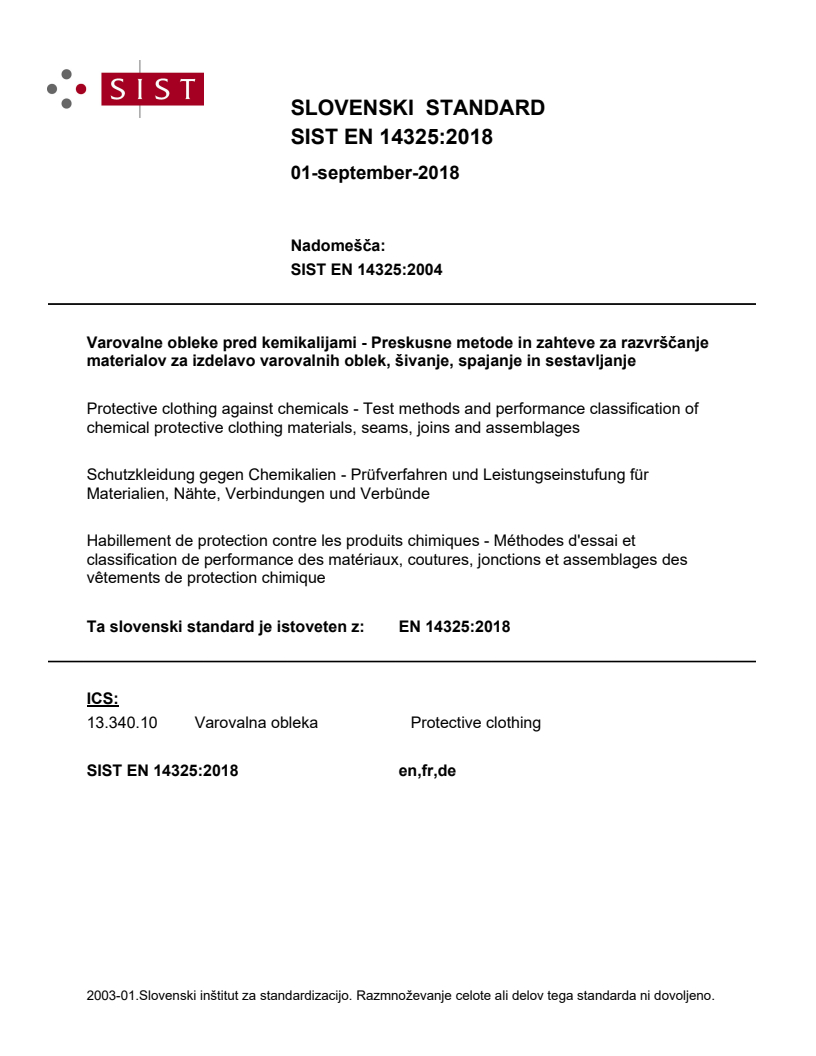
2003-01.Slovenski inštitut za standardizacijo. Razmnoževanje celote ali delov tega standarda ni dovoljeno.WDYOMDQMHSchutzkleidung gegen Chemikalien - Prüfverfahren und Leistungseinstufung für Materialien, Nähte, Verbindungen und VerbündeHabillement de protection contre les produits chimiques - Méthodes d'essai et classification de performance des matériaux, coutures, jonctions et assemblages des vêtements de protection chimiqueProtective clothing against chemicals - Test methods and performance classification of chemical protective clothing materials, seams, joins and assemblages13.340.10Varovalna oblekaProtective clothingICS:Ta slovenski standard je istoveten z:EN 14325:2018SIST EN 14325:2018en,fr,de01-september-2018SIST EN 14325:2018SLOVENSKI
STANDARDSIST EN 14325:20041DGRPHãþD
EUROPEAN STANDARD NORME EUROPÉENNE EUROPÄISCHE NORM
EN 14325
June
t r s z ICS
s uä u v rä s r Supersedes EN
s v u t wã t r r vEnglish Version
Protective clothing against chemicals æ Test methods and performance classification of chemical protective clothing materialsá seamsá joins and assemblages Habillement de protection contre les produits chimiques æ Méthodes d 5essai et classification de performance des matériauxá couturesá jonctions et assemblages des vêtements de protection chimique
Schutzkleidung gegen Chemikalien æ Prüfverfahren und Leistungseinstufung für Materialiená Nähteá Verbindungen und Verbünde This European Standard was approved by CEN on
s x October
t r s yä
egulations which stipulate the conditions for giving this European Standard the status of a national standard without any alterationä Upætoædate lists and bibliographical references concerning such national standards may be obtained on application to the CENæCENELEC Management Centre or to any CEN memberä
translation under the responsibility of a CEN member into its own language and notified to the CENæCENELEC Management Centre has the same status as the official versionsä
CEN members are the national standards bodies of Austriaá Belgiumá Bulgariaá Croatiaá Cyprusá Czech Republicá Denmarká Estoniaá Finlandá Former Yugoslav Republic of Macedoniaá Franceá Germanyá Greeceá Hungaryá Icelandá Irelandá Italyá Latviaá Lithuaniaá Luxembourgá Maltaá Netherlandsá Norwayá Polandá Portugalá Romaniaá Serbiaá Slovakiaá Sloveniaá Spainá Swedená Switzerlandá Turkey and United Kingdomä
EUROPEAN COMMITTEE FOR STANDARDIZATION COMITÉ EUROPÉEN DE NORMALISATION EUROPÄISCHES KOMITEE FÜR NORMUNG
CEN-CENELEC Management Centre:
Rue de la Science 23,
B-1040 Brussels
t r s z CEN All rights of exploitation in any form and by any means reserved worldwide for CEN national Membersä Refä Noä EN
s v u t wã t r s z ESIST EN 14325:2018
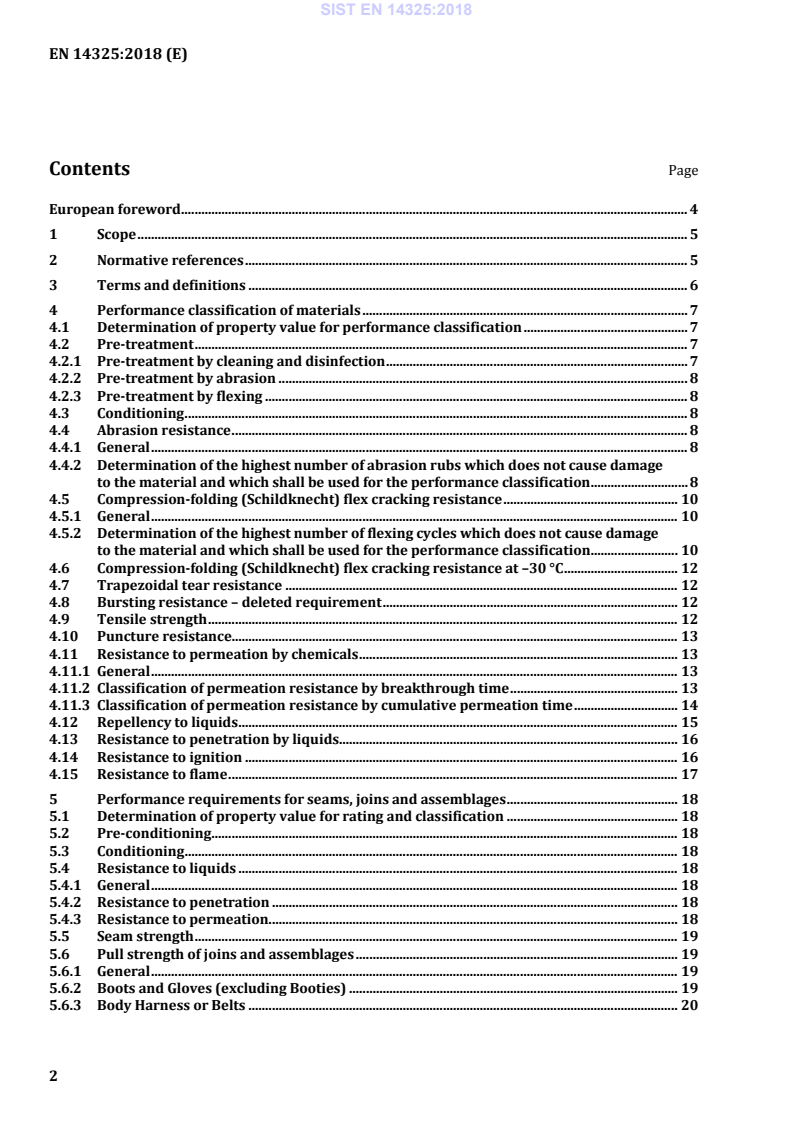
Significant technical changes between this document and EN 14325:2004 . 22 Annex B (normative)
Abrasive paper . 24 B.1 Quality of materials . 24 B.1.1 Abrasive . 24 B.1.2 Backing . 24 B.1.3 Adhesive . 24 Annex C (normative)
Assessment, evaluation and determination of the property values for rating and for performance classification . 25 C.1 Expression of results . 25 C.2 Outlying data . 25 C.3 Uncertainty of measurement . 26 C.4 Classification of results . 26 Annex D (normative)
Use of time to cumulative mass for reporting material permeation resistance. 27 D.1 Introduction. 27 D.2 General . 27 D.3 Basis for classification system . 28 D.4 Alternative cumulative permeated mass . 28 D.5 Conversion from permeation breakthrough time classification to classification by time to cumulative permeated mass . 28 D.6 Cumulative permeated mass values as function of toxicity . 29 Annex E (normative)
Specification for pressure pot and leak-tightness of equipment . 31 E.1 Equipment specification . 31 E.2 Volume of pressure pot and apparatus . 33 E.2.1 For flexcracking specimens . 33 E.2.2 For abrasion specimens . 33 E.3 Leak tightness test . 33 Bibliography . 34
— In woven fabrics, when two separate threads are completely broken; — in knitted fabrics, when one thread is broken down; — in pile fabrics, when the pile is fully worn off; SIST EN 14325:2018
Please see limitation to the performance classification and the requirements in the Instruction for Use in 4.5.2.1. SIST EN 14325:2018
480 min 5
240 min 4
120 min 3
60 min 2
30 min 1
10 min NOTE 1 It can be dangerous to base considerations of safe wear time of given chemical protective clothing only on the value of normalized breakthrough time for a specific tested chemical. NOTE 2 For example, in the case that the permeation rate for a given clothing material and tested chemical remains slightly below 1,0 µg/(cm2·min) for greater than or equal to 480 min, this material can be rated class 6 for this chemical according to Table 7, but the cumulative permeated mass during the 480 min will be only slightly below 480 µg/cm2. This level of permeation can be dangerous depending of the toxicity of the chemical. NOTE 3 Chemical protective clothing materials should thus be better evaluated with respect to cumulative permeation and classified by cumulative permeation time, i.e. by the time to the amount of cumulative permeated mass, to which the skin can be exposed with regard to the skin/dermal toxicity of the tested chemical/mixture. 4.11.3 Classification of permeation resistance by cumulative permeation time When tested in accordance with ISO 6529, Method A (liquids) or Method B (gases) the average time to reach the cumulative permeated mass determined based on the skin/dermal toxicity classification of the chemical (see Annex D, Table D.1), to be tested, shall be classified according to the levels of performance given in Table 8. The resultant average value for the time to cumulative permeation, determined according to ISO 6529 and in accordance with Annex C, shall be used for the purpose of performance rating and classification. SIST EN 14325:2018
480 min
480 min
480 min 5
240 min
240 min
240 min 4
120 min
120 min
120 min 3
60 min
60 min
60 min 2
30 min
30 min
30 min 1
10 min
10 min
10 min NOTE 1 Category of skin/dermal toxicity of chemicals/mixtures and the related cumulative permeated mass values are based on Regulation (EC) No 1272/2008 on classification, labelling and packaging of substances and mixtures. NOTE 2 Information on the use of cumulative permeated mass is provided in Annex D. NOTE 3 The above is based on skin/dermal toxicity only and does not take into account oral or inhalation toxicity. 4.12 Repellency to liquids When tested in accordance with EN ISO 6530 for repellency to the liquid chemicals given in Table 9, the material shall be classified according to the levels of performance given in Table 10 for each chemical t
...