


EN 1715-1:2008
(Main)Aluminium and aluminium alloys - Drawing stock - Part 1: General requirements and technical conditions for inspection and delivery
General Information
- Abstract
This European Standard specifies general requirements for drawing stock of aluminium and aluminium alloys delivered in the form of coils with a unit mass ranging between 1 t and 4 t and obtained by common industrial processes.
It also specifies the technical conditions for inspection and delivery of these products.
It applies to drawing stock intended for the following main fields of application:
wires for general electrical purposes;
wires for general mechanical uses;
wires for brazing and welding and metal spraying;
food packaging.
The specific requirements to drawing stock for these applications are specified in EN 1715-2, EN 1715-3 and EN 1715-4.
It does not apply to wires which are drawn, but only to drawing stock which is produced by hot-working.
NOTE Three main methods exist for the manufacture of drawing stock:
a) continuously cast rod (CCR):
a section is cast continuously in the groove of a wheel, the groove being closed by an endless strip;
the solid and still hot section is rolled in a multistand rolling mill to the required diameter;
the drawing stock rod thus produced is wound continuously to form coils up to 4 t in mass;
b) hot rolled rod (HRR):
a wirebar of diameter approximately 100 mm to 150 mm is heated and rolled to the required diameter;
the coils, weighing up to approximately 100 kg are butt welded together and wound to form coils with mass of 1 t to 4 t;
c) hot extruded rod (HER):
coils up to 100 kg can be produced in a single fibre without butt welds (depending on the size of the extrusion press);
coils over 100 kg are normally produced by block on block extrusion, generating "Zweiwachs"-joints. For mechanical applications (i.e fasteners) the "Zweiwachs" area should be marked.
- Status
- Published
- Publication Date
- 15-Apr-2008
- Technical Committee
- CEN/TC 132 - Aluminium and aluminium alloys
- Drafting Committee
- WG 35 - Extruded products
- Current Stage
- 9060 - Closure of 2 Year Review Enquiry - Review Enquiry
- Start Date
- 02-Dec-2024
- Completion Date
- 02-Dec-2024


Overview
EN 1715-1:2008 - "Aluminium and aluminium alloys - Drawing stock - Part 1" is a CEN European Standard that sets the general requirements and technical conditions for inspection and delivery of aluminium drawing stock supplied as coils with a unit mass normally between 1 t and 4 t. It covers drawing stock produced by hot-working (not drawn wire) and intended as feedstock for wire drawing used in electrical, mechanical, brazing/welding/metal spraying and food packaging applications.
Key topics and technical requirements
- Scope & product form: Drawing stock in coils (1–4 t), produced by common industrial hot-working processes (continuously cast rod - CCR, hot rolled rod - HRR, hot extruded rod - HER).
- Ordering information: Orders must specify alloy (per EN 573-3), nominal diameter, temper (per EN 515), coil mass, dimensions and any special requirements (winding, surface protection, certificates).
- Chemical composition: Compliance with EN 573-3 (or EN ISO 18273 for fusion-welding consumables); tighter limits may be agreed contractually.
- Temper & mechanical properties: Temper to be specified by purchaser; default is F (as fabricated) if not stated. Mechanical test methods referenced (e.g., EN 10002-1).
- Dimensional tolerances: Diameter and ovality tolerances are specified by nominal diameter ranges (example: 7–8 mm ±0.4 mm, ovality 0.3 mm). Example for 9.5 mm nominal diameter shows allowed and disallowed ranges to illustrate tolerance/ovality interaction.
- Coil dimensions & mass: Standard coil dimensions and recommended unit masses are given; mass tolerance is ±6% per coil with limited allowances for deviations.
- Surface & internal quality: Product must be free of defects harmful to drawing (no inclusions, cracks, lapping, abnormal oxidation, etc.).
- Inspection & documentation: Chemical analysis, thermal treatment control, mechanical testing and surface inspection rules plus delivery documents (certificate of mass and analysis, inspection certificate per EN 10204).
- Packaging, marking, storage and non-conformity/complaints procedures are specified.
Applications and users
Who uses EN 1715-1:2008:
- Aluminium producers and rolling/extrusion plants (manufacturers of CCR, HRR, HER drawing stock)
- Wire drawing mills and wire manufacturers
- Buyers and quality managers in electrical wiring, fasteners, brazing/welding wire, metal spraying and food packaging industries
- Inspectors and certification bodies ensuring traceability and conformity for supply chains
Practical value:
- Ensures consistent feedstock quality for downstream wire drawing and welding/packaging processes
- Defines minimum inspection, documentation and delivery rules to reduce supply risk and disputes
Related standards
- EN 1715 parts 2–5 (specific requirements for electrical, mechanical, welding, food packaging)
- EN 573-3, EN 515, EN ISO 18273, EN 12258-1, EN 14242, EN 14726, EN 10002-1, EN 10204
Keywords: EN 1715-1:2008, drawing stock, aluminium, aluminium alloys, coils, inspection and delivery, tolerances, temper, CCR, HRR, HER.
Relations
- Effective Date
- 22-Dec-2008
- Effective Date
- 25-Mar-2026
- Effective Date
- 28-Jan-2026
- Effective Date
- 28-Jan-2026
- Effective Date
- 28-Jan-2026
- Effective Date
- 28-Jan-2026
- Effective Date
- 28-Jan-2026
- Effective Date
- 28-Jan-2026
- Effective Date
- 28-Jan-2026
- Effective Date
- 28-Jan-2026
- Refers
EN 12258-1:1998 - Aluminium and aluminium alloys - Terms and definitions - Part 1: General terms - Effective Date
- 28-Jan-2026
- Effective Date
- 28-Jan-2026
- Effective Date
- 28-Jan-2026
- Effective Date
- 28-Jan-2026
Get Certified
Connect with accredited certification bodies for this standard

Element Materials Technology
Materials testing and product certification.

Inštitut za kovinske materiale in tehnologije
Institute of Metals and Technology. Materials testing, metallurgical analysis, NDT.
Sponsored listings
Frequently Asked Questions
EN 1715-1:2008 is a standard published by the European Committee for Standardization (CEN). Its full title is "Aluminium and aluminium alloys - Drawing stock - Part 1: General requirements and technical conditions for inspection and delivery". This standard covers: This European Standard specifies general requirements for drawing stock of aluminium and aluminium alloys delivered in the form of coils with a unit mass ranging between 1 t and 4 t and obtained by common industrial processes. It also specifies the technical conditions for inspection and delivery of these products. It applies to drawing stock intended for the following main fields of application: wires for general electrical purposes; wires for general mechanical uses; wires for brazing and welding and metal spraying; food packaging. The specific requirements to drawing stock for these applications are specified in EN 1715-2, EN 1715-3 and EN 1715-4. It does not apply to wires which are drawn, but only to drawing stock which is produced by hot-working. NOTE Three main methods exist for the manufacture of drawing stock: a) continuously cast rod (CCR): a section is cast continuously in the groove of a wheel, the groove being closed by an endless strip; the solid and still hot section is rolled in a multistand rolling mill to the required diameter; the drawing stock rod thus produced is wound continuously to form coils up to 4 t in mass; b) hot rolled rod (HRR): a wirebar of diameter approximately 100 mm to 150 mm is heated and rolled to the required diameter; the coils, weighing up to approximately 100 kg are butt welded together and wound to form coils with mass of 1 t to 4 t; c) hot extruded rod (HER): coils up to 100 kg can be produced in a single fibre without butt welds (depending on the size of the extrusion press); coils over 100 kg are normally produced by block on block extrusion, generating "Zweiwachs"-joints. For mechanical applications (i.e fasteners) the "Zweiwachs" area should be marked.
This European Standard specifies general requirements for drawing stock of aluminium and aluminium alloys delivered in the form of coils with a unit mass ranging between 1 t and 4 t and obtained by common industrial processes. It also specifies the technical conditions for inspection and delivery of these products. It applies to drawing stock intended for the following main fields of application: wires for general electrical purposes; wires for general mechanical uses; wires for brazing and welding and metal spraying; food packaging. The specific requirements to drawing stock for these applications are specified in EN 1715-2, EN 1715-3 and EN 1715-4. It does not apply to wires which are drawn, but only to drawing stock which is produced by hot-working. NOTE Three main methods exist for the manufacture of drawing stock: a) continuously cast rod (CCR): a section is cast continuously in the groove of a wheel, the groove being closed by an endless strip; the solid and still hot section is rolled in a multistand rolling mill to the required diameter; the drawing stock rod thus produced is wound continuously to form coils up to 4 t in mass; b) hot rolled rod (HRR): a wirebar of diameter approximately 100 mm to 150 mm is heated and rolled to the required diameter; the coils, weighing up to approximately 100 kg are butt welded together and wound to form coils with mass of 1 t to 4 t; c) hot extruded rod (HER): coils up to 100 kg can be produced in a single fibre without butt welds (depending on the size of the extrusion press); coils over 100 kg are normally produced by block on block extrusion, generating "Zweiwachs"-joints. For mechanical applications (i.e fasteners) the "Zweiwachs" area should be marked.
EN 1715-1:2008 is classified under the following ICS (International Classification for Standards) categories: 77.150.10 - Aluminium products. The ICS classification helps identify the subject area and facilitates finding related standards.
EN 1715-1:2008 has the following relationships with other standards: It is inter standard links to EN 1715-1:1997, EN 573-3:2026, EN ISO 6892-1:2019, EN 1715-4:2008, EN 10204:2004, EN 515:2017, EN 1715-2:2008, EN ISO 18273:2004, EN 14242:2023, EN 14726:2019, EN 12258-1:1998, EN 1715-3:2008, EN 573-3:2019+A2:2023, EN 13920-3:2003. Understanding these relationships helps ensure you are using the most current and applicable version of the standard.
EN 1715-1:2008 is available in PDF format for immediate download after purchase. The document can be added to your cart and obtained through the secure checkout process. Digital delivery ensures instant access to the complete standard document.
Standards Content (Sample)
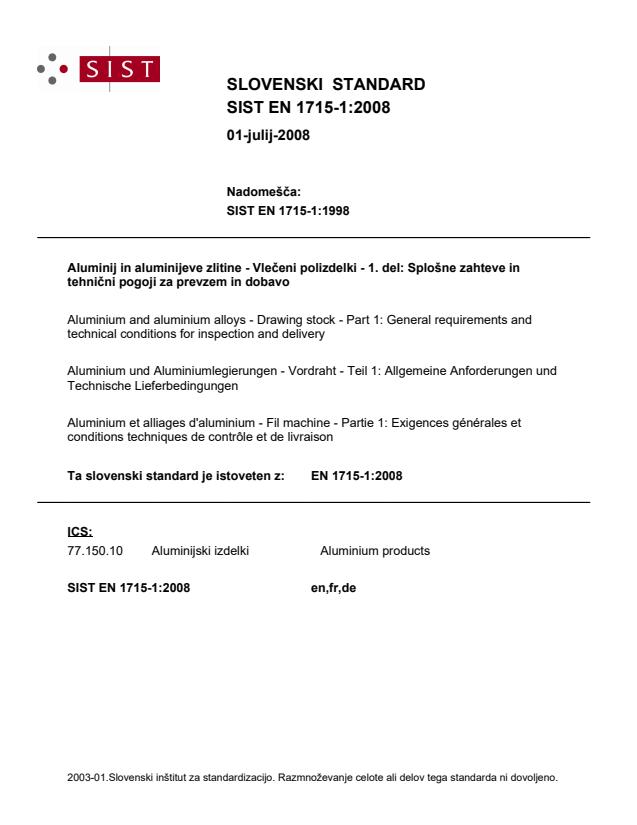
2003-01.Slovenski inštitut za standardizacijo. Razmnoževanje celote ali delov tega standarda ni dovoljeno.Aluminium and aluminium alloys - Drawing stock - Part 1: General requirements and technical conditions for inspection and deliveryAluminium et alliages d'aluminium - Fil machine - Partie 1: Exigences générales et conditions techniques de contrôle et de livraisonAluminium und Aluminiumlegierungen - Vordraht - Teil 1: Allgemeine Anforderungen und Technische Lieferbedingungen77.150.10Aluminijski izdelkiAluminium productsICS:SIST EN 1715-1:2008en,fr,deTa slovenski standard je istoveten z:EN 1715-1:200801-julij-2008SIST EN 1715-1:2008SLOVENSKI
STANDARDSIST EN 1715-1:19981DGRPHãþD
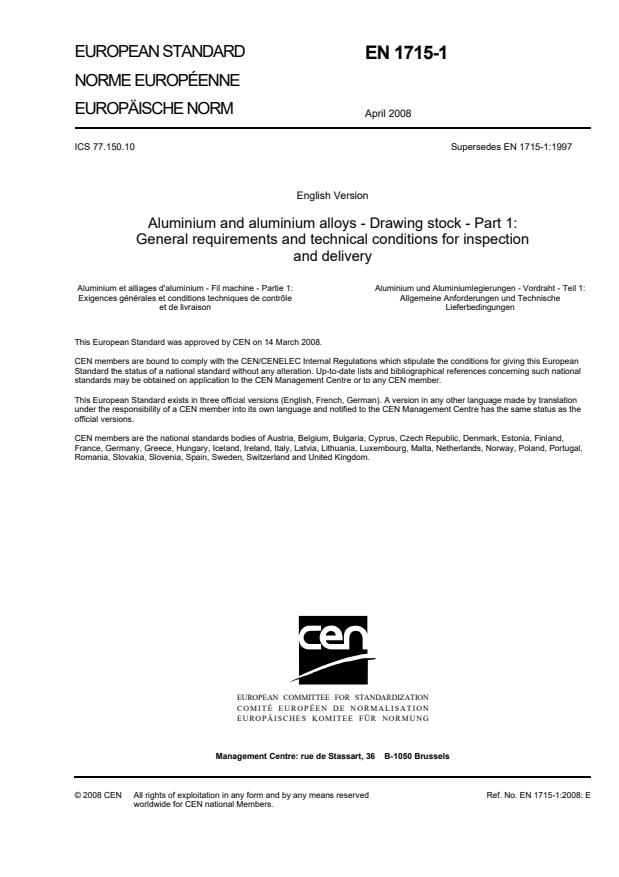
EUROPEAN STANDARDNORME EUROPÉENNEEUROPÄISCHE NORMEN 1715-1April 2008ICS 77.150.10Supersedes EN 1715-1:1997
English VersionAluminium and aluminium alloys - Drawing stock - Part 1:General requirements and technical conditions for inspectionand deliveryAluminium et alliages d'aluminium - Fil machine - Partie 1:Exigences générales et conditions techniques de contrôleet de livraisonAluminium und Aluminiumlegierungen - Vordraht - Teil 1:Allgemeine Anforderungen und TechnischeLieferbedingungenThis European Standard was approved by CEN on 14 March 2008.CEN members are bound to comply with the CEN/CENELEC Internal Regulations which stipulate the conditions for giving this EuropeanStandard the status of a national standard without any alteration. Up-to-date lists and bibliographical references concerning such nationalstandards may be obtained on application to the CEN Management Centre or to any CEN member.This European Standard exists in three official versions (English, French, German). A version in any other language made by translationunder the responsibility of a CEN member into its own language and notified to the CEN Management Centre has the same status as theofficial versions.CEN members are the national standards bodies of Austria, Belgium, Bulgaria, Cyprus, Czech Republic, Denmark, Estonia, Finland,France, Germany, Greece, Hungary, Iceland, Ireland, Italy, Latvia, Lithuania, Luxembourg, Malta, Netherlands, Norway, Poland, Portugal,Romania, Slovakia, Slovenia, Spain, Sweden, Switzerland and United Kingdom.EUROPEAN COMMITTEE FOR STANDARDIZATIONCOMITÉ EUROPÉEN DE NORMALISATIONEUROPÄISCHES KOMITEE FÜR NORMUNGManagement Centre: rue de Stassart, 36
B-1050 Brussels© 2008 CENAll rights of exploitation in any form and by any means reservedworldwide for CEN national Members.Ref. No. EN 1715-1:2008: E
Rules for rounding.14
1) Under preparation.
...