


EN 1555-5:2010
(Main)Plastics piping systems for the supply of gaseous fuels - Polyethylene (PE) - Part 5: Fitness for purpose of the system
General Information
- Abstract
This part of EN 1555 specifies requirements of fitness for purpose of the polyethylene (PE) piping system in the field of the supply of gaseous fuels.
It specifies the definitions of electrofusion, butt fusion and mechanical joints.
It specifies the method of preparation of test piece joints, and the tests to be carried out on these joints for assessing the fitness for purpose of the system under normal and extreme conditions.
It specifies the test parameters for the test methods referred to in this standard.
In conjunction with Parts 1 to 4 of EN 1555, it is applicable to PE pipes, fittings, valves, their joints and to joints with components of other materials intended to be used under the following conditions:
a) a maximum operating pressure, MOP, up to and including 10 bar );
b) an operating temperature of 20 °C as reference temperature.
NOTE 1 For other operating temperatures, derating coefficients should be used, see Annex A.
EN 1555 (all parts) covers a range of maximum operating pressures and gives requirements concerning colours and additives.
NOTE 2 It is the responsibility of the purchaser or specifier to make the appropriate selections from these aspects, taking into account their particular requirements and any relevant national regulations and installation practices or codes.
- Status
- Withdrawn
- Publication Date
- 07-Sep-2010
- Withdrawal Date
- 22-Sep-2026
- Technical Committee
- CEN/TC 155 - Plastics piping systems and ducting systems
- Current Stage
- 9960 - Withdrawal effective - Withdrawal
- Start Date
- 07-Jul-2021
- Completion Date
- 23-Sep-2026

Relations
- Effective Date
- 08-Jun-2022
- Effective Date
- 14-Jul-2021
- Effective Date
- 25-Aug-2026
- Effective Date
- 25-Aug-2026
- Effective Date
- 25-Aug-2026
- Effective Date
- 25-Aug-2026
- Effective Date
- 25-Aug-2026
- Effective Date
- 09-Feb-2026
- Effective Date
- 09-Feb-2026
- Effective Date
- 09-Feb-2026
- Effective Date
- 09-Feb-2026
- Effective Date
- 28-Jan-2026
- Effective Date
- 28-Jan-2026
- Effective Date
- 28-Jan-2026
- Effective Date
- 28-Jan-2026
Get Certified
Connect with accredited certification bodies for this standard

DIBt (Deutsches Institut für Bautechnik)
German Institute for Building Technology.
DIN CERTCO
DIN Group product certification.

Aboma Certification B.V.
Specialized in construction, metal, and transport sectors.
Sponsored listings
Frequently Asked Questions
EN 1555-5:2010 is a standard published by the European Committee for Standardization (CEN). Its full title is "Plastics piping systems for the supply of gaseous fuels - Polyethylene (PE) - Part 5: Fitness for purpose of the system". This standard covers: This part of EN 1555 specifies requirements of fitness for purpose of the polyethylene (PE) piping system in the field of the supply of gaseous fuels. It specifies the definitions of electrofusion, butt fusion and mechanical joints. It specifies the method of preparation of test piece joints, and the tests to be carried out on these joints for assessing the fitness for purpose of the system under normal and extreme conditions. It specifies the test parameters for the test methods referred to in this standard. In conjunction with Parts 1 to 4 of EN 1555, it is applicable to PE pipes, fittings, valves, their joints and to joints with components of other materials intended to be used under the following conditions: a) a maximum operating pressure, MOP, up to and including 10 bar ); b) an operating temperature of 20 °C as reference temperature. NOTE 1 For other operating temperatures, derating coefficients should be used, see Annex A. EN 1555 (all parts) covers a range of maximum operating pressures and gives requirements concerning colours and additives. NOTE 2 It is the responsibility of the purchaser or specifier to make the appropriate selections from these aspects, taking into account their particular requirements and any relevant national regulations and installation practices or codes.
This part of EN 1555 specifies requirements of fitness for purpose of the polyethylene (PE) piping system in the field of the supply of gaseous fuels. It specifies the definitions of electrofusion, butt fusion and mechanical joints. It specifies the method of preparation of test piece joints, and the tests to be carried out on these joints for assessing the fitness for purpose of the system under normal and extreme conditions. It specifies the test parameters for the test methods referred to in this standard. In conjunction with Parts 1 to 4 of EN 1555, it is applicable to PE pipes, fittings, valves, their joints and to joints with components of other materials intended to be used under the following conditions: a) a maximum operating pressure, MOP, up to and including 10 bar ); b) an operating temperature of 20 °C as reference temperature. NOTE 1 For other operating temperatures, derating coefficients should be used, see Annex A. EN 1555 (all parts) covers a range of maximum operating pressures and gives requirements concerning colours and additives. NOTE 2 It is the responsibility of the purchaser or specifier to make the appropriate selections from these aspects, taking into account their particular requirements and any relevant national regulations and installation practices or codes.
EN 1555-5:2010 is classified under the following ICS (International Classification for Standards) categories: 23.040.01 - Pipeline components and pipelines in general; 91.140.40 - Gas supply systems. The ICS classification helps identify the subject area and facilitates finding related standards.
EN 1555-5:2010 has the following relationships with other standards: It is inter standard links to EN 1555-5:2002, EN 1555-5:2021, ISO 13955:1997, ISO 10838-2:2000, ISO 10838-3:2001, ISO 10838-1:2000, ISO 13954:1997, ISO 13956:2010, ISO 13953:2001, ISO 11413:2008, ISO 11414:2009, EN ISO 8666:2002, EN ISO 1167-2:2006, EN 1555-3:2025, EN 1555-2:2010. Understanding these relationships helps ensure you are using the most current and applicable version of the standard.
EN 1555-5:2010 is available in PDF format for immediate download after purchase. The document can be added to your cart and obtained through the secure checkout process. Digital delivery ensures instant access to the complete standard document.
Standards Content (Sample)
2003-01.Slovenski inštitut za standardizacijo. Razmnoževanje celote ali delov tega standarda ni dovoljeno.Cevni sistemi iz polimernih materialov za oskrbo s plinastimi gorivi - Polietilen (PE) - 5. del: Ustreznost sistema namenuKunststoff-Rohrleitungssysteme für die Gasversorgung - Polyethylen (PE) - Teil 5: Gebrauchstauglichkeit des SystemsSystèmes de canalisations en plastique pour la distribution de combustibles gazeux - Polyéthylène (PE) - Partie 5: Aptitude à l'emploi du systèmePlastics piping systems for the supply of gaseous fuels - Polyethylene (PE) - Part 5: Fitness for purpose of the system91.140.40Sistemi za oskrbo s plinomGas supply systems83.140.30Cevi, fitingi in ventili iz polimernih materialovPlastics pipes, fittings and valvesICS:Ta slovenski standard je istoveten z:EN 1555-5:2010SIST EN 1555-5:2010en,fr,de01-december-2010SIST EN 1555-5:2010SLOVENSKI
STANDARDSIST EN 1555-5:20031DGRPHãþD
EUROPEAN STANDARD NORME EUROPÉENNE EUROPÄISCHE NORM
EN 1555-5
September 2010 ICS 23.040.01; 91.140.40 Supersedes EN 1555-5:2002English Version
Plastics piping systems for the supply of gaseous fuels - Polyethylene (PE) - Part 5: Fitness for purpose of the system
Systèmes de canalisations en plastique pour la distribution de combustibles gazeux - Polyéthylène (PE) - Partie 5: Aptitude à l'emploi du système
Kunststoff-Rohrleitungssysteme für die Gasversorgung - Polyethylen (PE) - Teil 5: Gebrauchstauglichkeit des Systems This European Standard was approved by CEN on 30 July 2010.
CEN members are bound to comply with the CEN/CENELEC Internal Regulations which stipulate the conditions for giving this European Standard the status of a national standard without any alteration. Up-to-date lists and bibliographical references concerning such national standards may be obtained on application to the CEN Management Centre or to any CEN member.
This European Standard exists in three official versions (English, French, German). A version in any other language made by translation under the responsibility of a CEN member into its own language and notified to the CEN Management Centre has the same status as the official versions.
CEN members are the national standards bodies of Austria, Belgium, Bulgaria, Croatia, Cyprus, Czech Republic, Denmark, Estonia, Finland, France, Germany, Greece, Hungary, Iceland, Ireland, Italy, Latvia, Lithuania, Luxembourg, Malta, Netherlands, Norway, Poland, Portugal, Romania, Slovakia, Slovenia, Spain, Sweden, Switzerland and United Kingdom.
EUROPEAN COMMITTEE FOR STANDARDIZATION
COMITÉ EUROPÉEN DE NORMALISATION EUROPÄISCHES KOMITEE FÜR NORMUNG
Management Centre:
Avenue Marnix 17,
B-1000 Brussels © 2010 CEN All rights of exploitation in any form and by any means reserved worldwide for CEN national Members. Ref. No. EN 1555-5:2010: ESIST EN 1555-5:2010
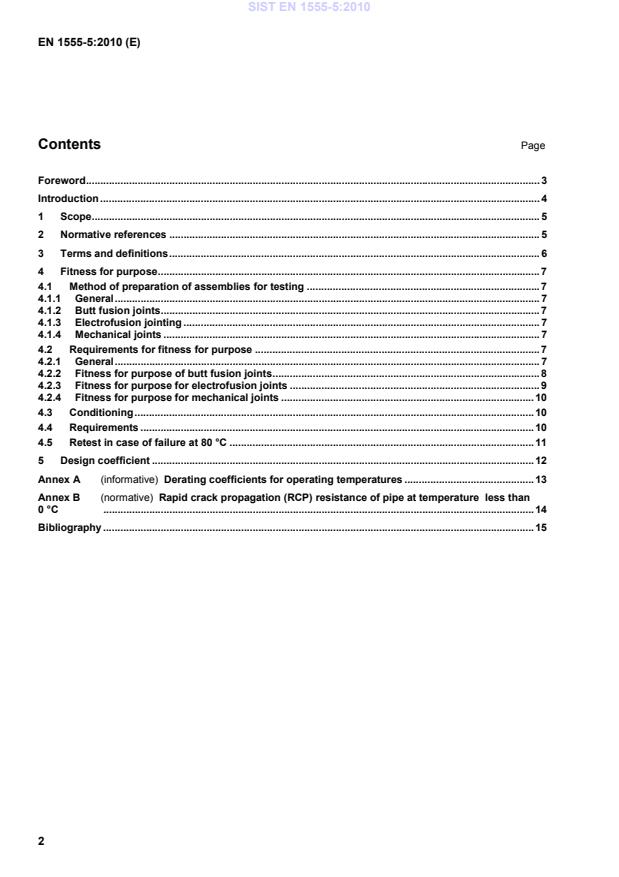
Derating coefficients for operating temperatures . 13Annex B(normative)
Rapid crack propagation (RCP) resistance of pipe at temperature
less than 0 °C
...................................................................................................................................................... 14Bibliography ...................................................................................................................................................... 15 SIST EN 1555-5:2010
EN 1555-3, Plastics piping systems for the supply of gaseous fuels Polyethylene (PE) Part 3: Fittings; prEN 1555-4, Plastics piping systems for the supply of gaseous fuels Polyethylene (PE) Part 4: Valves; EN 1555-5, Plastics piping systems for the supply of gaseous fuels Polyethylene (PE) Part 5: Fitness for purpose of the system (this standard); CEN/TS 1555-7, Plastics piping systems for the supply of gaseous fuels Polyethylene (PE) Part 7: Guidance for assessment of conformity. System Standards are supported by separate standards on test methods to which references are made throughout the System Standard. The System Standards are consistent with general standards on functional requirements and on recommended practice for installation. NOTE
EN 12007-2:2000 [1] prepared by CEN/TC 234 “Gas infrastructure” deals with the recommended practice for installation of plastics pipes system in accordance with EN 1555 (all parts). According to the CEN/CENELEC Internal Regulations, the national standards organizations of the following countries are bound to implement this European Standard: Austria, Belgium, Bulgaria, Croatia, Cyprus, Czech Republic, Denmark, Estonia, Finland, France, Germany, Greece, Hungary, Iceland, Ireland, Italy, Latvia, Lithuania, Luxembourg, Malta, Netherlands, Norway, Poland, Portugal, Romania, Slovakia, Slovenia, Spain, Sweden, Switzerland and the United Kingdom. SIST EN 1555-5:2010
CEN /TS 1555-7 [2] gives guidance for assessment of conformity. Recommended practice for installation is given in EN 12007-2:2000 [1] prepared by CEN /TC 234. This part of EN 1555 covers the characteristics of fitness for purpose of the system. SIST EN 1555-5:2010
Polyethylene (PE)
Part 1: General EN 1555-2:2010, Plastics piping systems for the supply of gaseous fuels — Polyethylene (PE) — Part 2: Pipes EN 1555-3, Plastics piping systems for the supply of gaseous fuels — Polyethylene (PE) — Part 3: Fittings prEN 1555-4, Plastics piping systems for the supply of gaseous fuels — Polyethylene (PE) — Part 4: Valves EN ISO 1167-1:2006, Thermoplastics pipes, fittings and assemblies for the conveyance of fluids — Determination of the resistance to internal pressure — Part 1: General method (ISO 1167-1:2006) EN ISO 1167-2, Thermoplastics pipes, fittings and assemblies for the conveyance of fluids — Determination of the resistance to internal pressure — Part 2: Preparation of pipe test pieces (ISO 1167-2:2006) EN ISO 1167-4, Thermoplastics pipes, fittings and assemblies for the conveyance of fluids — Determination of the resistance to internal pressure — Part 4: Preparation of assemblies (ISO 1167-4:2007)
1) 1 bar = 0,1 MPa. SIST EN 1555-5:2010
Determination of resistance to rapid crack propagation (RCP)
Small-scale steady-state test (S4 test) (ISO 13477:2008) EN ISO 13478, Thermoplastics pipes for the conveyance of fluids
Determination of resistance to rapid crack propagation (RCP)
Full scale test (FST) (ISO 13478:2007) ISO 10838-1 2), Mechanical fittings for polyethylene piping systems for the supply of gaseous fuels
Part 1: Metal fittings for pipes of nominal outside diameter less than or equal to 63 mm ISO 10838-2 2), Mechanical fittings for polyethylene piping systems for the supply of gaseous fuels
Part 2: Metal fittings for pipes of nominal outside diameter greater than 63 mm ISO 10838-3 2), Mechanical fittings for polyethylene piping systems for the supply of gaseous fuels
Part 3: Thermoplastics fittings for pipes of nominal outside diameter less than or equal to 63 mm ISO 11413:2008, Plastics pipes and fittings
Preparation of test piece assemblies between a polyethylene (PE) pipe and an electrofusion fitting ISO 11414:2009, Plastics pipes and fittings
Preparation of polyethylene (PE) pipe/pipe or pipe/fitting test piece assemblies by butt fusion ISO 13953, Polyethylene (PE) pipes and fittings
Determination of the tensile strength and failure mode of test pieces from a butt-fused joint ISO 13954, Plastics pipes and fittings
Peel decohesion test for polyethylene (PE) electrofusion assemblies of nominal outside diameter greater than or equal to 90 mm ISO 13955, Plastics pipes and fittings
Crushing decohesion test for polyethylene (PE) electrofusion assemblies ISO/FDIS 13956, Plastics pipes and fittings
Determination of cohesive strength
Evaluation of ductility of fusion joint interface by tear test 3 Terms and definitions For the purposes of this document, the terms and definitions, symbols and abbreviations given in
EN 1555-1:2010 and the following definition apply. 3.1 mechanical joint
joint made by assembling a PE pipe with a fitting that generally includes a compression part to provide for pressure integrity, leaktightness and resistance to end loads NOTE A support sleeve inserted into the pipe bore should
...