


EN ISO 11721-1:2001
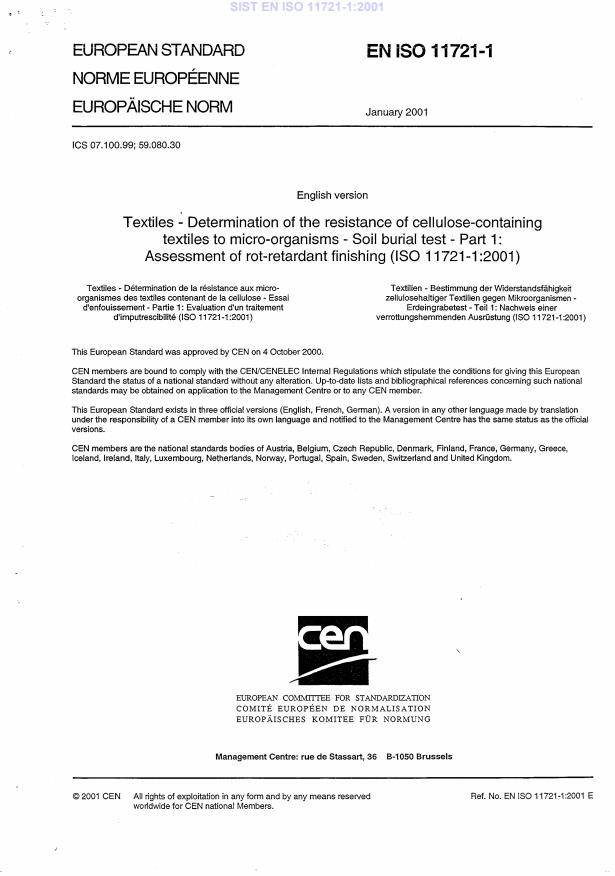
(Main)Textiles - Determination of the resistance of cellulose-containing textiles to micro-organisms - Soil burial test - Part 1: Assessment of rot-retardant finishing (ISO 11721-1:2001)
General Information
- Abstract
This Standard specifies a method for determination of the resistance of chemically-pretreated textiles to the action of micro-organisms present in soil in comparison with untreated textiles. This method is applicable to flat textiles made of cellulosic containing yarns (tentage, tarpaulins, webbing and tapes) that will typically come into contact with soil during use. Due to the inherent resistance of most synthetic fibres to attack by micro-organisms, fabrics containing a high proportion of synthetic fibres can only be judged by these methods for changes in structure and appearance.
- Status
- Published
- Publication Date
- 14-Jan-2001
- Technical Committee
- CEN/TC 248 - Textiles and textile products
- Current Stage
- 9093 - Decision to confirm - Review Enquiry
- Start Date
- 14-Jun-2006
- Completion Date
- 14-Jun-2006


Overview
EN ISO 11721-1:2001 - Textiles: Determination of the resistance of cellulose-containing textiles to micro-organisms - Soil burial test (Part 1: Assessment of rot-retardant finishing) - is a CEN-adopted method that specifies how to evaluate the effectiveness of rot-retardant (imputrescible) finishes on cellulosic textiles when exposed to micro-organisms present in soil. The standard defines a comparative test procedure for chemically pretreated (finished) textiles against untreated controls, focusing on products that typically contact soil during use.
Key topics and requirements
- Scope and applicability
- Applicable to flat textiles made from cellulose-containing yarns (examples: tentage, tarpaulins, webbing, tapes).
- Designed to assess resistance to micro-organisms in soil for chemically pretreated textiles.
- Comparative assessment
- Requires comparison between treated (rot-retardant finished) samples and untreated counterparts to determine treatment effectiveness.
- Limitations
- Acknowledges that synthetic fibres are inherently more resistant to microbial attack; where fabrics contain a high proportion of synthetics, this method is limited to assessing changes in structure and appearance rather than biological degradation.
- Test focus
- Concentrates on the soil burial test methodology - a practical simulation of real-world soil exposure to evaluate rot resistance and durability of finishing.
Applications
- Performance evaluation of rot-retardant finishes applied to cellulose-containing textiles intended for outdoor or ground-contact use (e.g., tents, tarpaulins, ropes, slings).
- Routine quality control and acceptance testing for textile manufacturers and finishers to validate preservative treatments.
- Product development and comparative studies when selecting finishing chemistries for enhanced microbial resistance.
- Compliance checks for procurement of durable textiles used by military, camping/outdoor equipment manufacturers, civil engineering, and industrial safety sectors.
Who should use this standard
- Textile manufacturers and finishers working with cellulosic fabrics
- Independent and in-house textile testing laboratories
- Product development teams and quality assurance professionals in the outdoor, industrial and technical textile sectors
- Procurement specialists and certification bodies requiring standardized evaluation of rot resistance
Related standards
- EN ISO 11721-1:2001 is part of a suite of standards addressing textile microbiological resistance. Users should consult the ISO/CEN catalogs for additional parts or related standards on micro-organism testing, textile durability, and finishing performance.
Keywords: EN ISO 11721-1:2001, soil burial test, rot-retardant finishing, cellulose-containing textiles, textile testing, resistance to micro-organisms, rot resistance.
Relations
- Effective Date
- 25-Aug-2026
- Effective Date
- 25-Aug-2026
- Effective Date
- 25-Aug-2026
- Effective Date
- 25-Aug-2026
- Effective Date
- 28-Jan-2026
- Effective Date
- 28-Jan-2026
- Effective Date
- 28-Jan-2026
- Effective Date
- 28-Jan-2026
- Effective Date
- 12-Feb-2026
- Effective Date
- 22-Dec-2008
- Effective Date
- 22-Dec-2008
Get Certified
Connect with accredited certification bodies for this standard

Control Union Certifications
Global certification for agriculture and sustainability.

Hohenstein Institut
Textile testing and certification.

Bureau Veritas Bangladesh
Bureau Veritas certification services in Bangladesh.
Sponsored listings
Frequently Asked Questions
EN ISO 11721-1:2001 is a standard published by the European Committee for Standardization (CEN). Its full title is "Textiles - Determination of the resistance of cellulose-containing textiles to micro-organisms - Soil burial test - Part 1: Assessment of rot-retardant finishing (ISO 11721-1:2001)". This standard covers: This Standard specifies a method for determination of the resistance of chemically-pretreated textiles to the action of micro-organisms present in soil in comparison with untreated textiles. This method is applicable to flat textiles made of cellulosic containing yarns (tentage, tarpaulins, webbing and tapes) that will typically come into contact with soil during use. Due to the inherent resistance of most synthetic fibres to attack by micro-organisms, fabrics containing a high proportion of synthetic fibres can only be judged by these methods for changes in structure and appearance.
This Standard specifies a method for determination of the resistance of chemically-pretreated textiles to the action of micro-organisms present in soil in comparison with untreated textiles. This method is applicable to flat textiles made of cellulosic containing yarns (tentage, tarpaulins, webbing and tapes) that will typically come into contact with soil during use. Due to the inherent resistance of most synthetic fibres to attack by micro-organisms, fabrics containing a high proportion of synthetic fibres can only be judged by these methods for changes in structure and appearance.
EN ISO 11721-1:2001 is classified under the following ICS (International Classification for Standards) categories: 07.100.99 - Other standards related to microbiology; 59.080.30 - Textile fabrics. The ICS classification helps identify the subject area and facilitates finding related standards.
EN ISO 11721-1:2001 has the following relationships with other standards: It is inter standard links to ISO 139:1973, ISO 8022:1990, ISO 13934-1:1999, ISO 7218:1985, CEN/TR 14742:2006, EN 12225:2020, EN 12225:2000, EN ISO 11721-2:2003, ISO 11721-1:2001; is excused to EN ISO 20645:2004, EN 14119:2003. Understanding these relationships helps ensure you are using the most current and applicable version of the standard.
EN ISO 11721-1:2001 is available in PDF format for immediate download after purchase. The document can be added to your cart and obtained through the secure checkout process. Digital delivery ensures instant access to the complete standard document.
Standards Content (Sample)
2003-01.Slovenski inštitut za standardizacijo. Razmnoževanje celote ali delov tega standarda ni dovoljeno.Tekstilije - Ugotavljanje odpornosti teksilij, ki vsebujejo celulozo, proti mikroorganizmom - Preskus z zemljo - 1. del: Ocena apreture zaviranja gnitja (ISO 11721-1:2001)Textilien - Bestimmung der Widerstandsfähigkeit zellulosehaltiger Textilien gegen Mikroorganismen - Erdeingrabetest - Teil 1: Nachweis einer verrottungshemmenden Ausrüstung (ISO 11721-1:2001)Textiles - Détermination de la résistance aux micro-organismes des textiles contenant de la cellulose - Essai d'enfouissement - Partie 1: Evaluation d'un traitement d'imputrescibilité (ISO 11721-1:2001)Textiles - Determination of the resistance of cellulose-containing textiles to mic
...