


EN 14043:2014
(Main)High rise aerial appliances for fire and rescue service use - Turntable ladders with combined movements - Safety and performance requirements and test methods
General Information
- Abstract
1.1 This European Standard specifies the safety and performance requirements and test methods applicable to turntable ladders with combined movements of classes 18, 24, 30 and > 30 to 56, as defined in 3.13, under the control of fire-fighters and intended for fire fighting and rescuing people.
NOTE This European Standard is intended to be used in conjunction with EN 1846–1, EN 1846–2 and EN 1846–3.
Turntable ladder vehicles comprise a chassis, bodywork and a powered extending structure unit in the form of a ladder with or without a rescue cage.
Turntable ladder vehicles covered by this European Standard have a self-propelled chassis, the motor of which supplies the power necessary for the operation of the ladder and permits all of the operational movements to be made simultaneously, with no restriction on the angle of the slewing movement.
1.2 This European Standard deals with the technical safety requirements to minimize the hazards listed in Clause 4 which can arise during commissioning, operational use, routine checking and maintenance of turntable ladders when carried out in accordance with the specifications given by the manufacturer or the manufacturer's authorized representative.
1.3 This European Standard deals with the use of turntable ladder vehicles within an ambient temperature range from −15 °C to +35 °C and with a wind velocity on the ladder set ≤ 12,5 m/s. Additional measures can be necessary for use outside this range. Special designs for use under special climatic conditions should be agreed between the manufacturer and the purchaser. Any additional requirements are outside the scope of the standard.
1.4 This European Standard does not deal with the design of a standard automotive chassis with regard to hazards resulting from or due to use as a road vehicle.
1.5 This European Standard is not applicable to turntable ladder vehicles with combined movements which are manufactured before the date of publication of this European Standard by CEN.
- Status
- Published
- Publication Date
- 14-Jan-2014
- Withdrawal Date
- 30-Jul-2014
- Technical Committee
- CEN/TC 192 - Fire service equipment
- Drafting Committee
- CEN/TC 192/WG 4 - High rise aerial appliances
- Current Stage
- 9092 - Decision on results of review/2YR ENQ - revise - Review Enquiry
- Start Date
- 06-Jan-2026
- Completion Date
- 23-Sep-2026
- Directive
- Harmonized Standard2006/42/EC - Directive 2006/42/EC of the European Parliament and of the Council of 17 May 2006 on machinery, and amending Directive 95/16/EC (recast)OJ Ref: C, C 220 OJ Date: 11-Jul-2014

Overview
EN 14043:2014 (EN 14043:2014) defines safety and performance requirements and test methods for high‑rise aerial appliances used by fire and rescue services - specifically turntable ladders with combined movements (ladder classes 18, 24, 30 and >30 to 56). The standard applies to self‑propelled turntable ladder vehicles where the vehicle motor supplies ladder power and allows simultaneous operational movements, with no restriction on slewing angle. It is intended to be used alongside EN 1846‑1, EN 1846‑2 and EN 1846‑3.
Key topics and technical requirements
- Scope and environmental limits: Intended for normal use between −15 °C and +35 °C and wind velocity on the ladder ≤ 12.5 m/s; special climates require agreement between manufacturer and purchaser.
- Safety risk control: Identifies significant hazards (Clause 4) and requires technical measures to minimize risks during commissioning, operation, routine checks and maintenance.
- Stability and jacking width: Static and dynamic stability requirements depend on jacking width; residual forces and verification tests are specified.
- Strength and load calculations: Working load and diverse force calculations, fatigue stress analysis and verification by functional testing.
- Functional requirements and controls: Safety‑related control systems assessed to Performance Level (PL) per EN ISO 13849‑1; main control console and rescue‑cage controls have defined functional criteria.
- Rescue cage & access: Requirements for rescue cages (rails, apertures, anchorage points), access from ground or deck, attachment/removable cage systems and load limits.
- Performance checks & tests: Procedures for verifying operational reach, movement limits, noise, electromagnetic compatibility, and reception/verification tests (Annex D).
- User documentation & marking: Instruction handbook, commissioning information, maintenance guidance and required markings are specified.
Practical applications
- Procurement specifications for fire authorities and municipalities seeking compliant turntable ladders.
- Design and manufacturing guidance for OEMs to meet European safety and performance requirements.
- Test houses and certification bodies performing type tests, stability and strength verification.
- Fleet managers, operators and maintenance teams using the standard as a reference for safe operation, periodic checks and training.
Who should use this standard
- Fire and rescue service procurement officers
- Turntable ladder designers and manufacturers
- Test laboratories and conformity assessment bodies
- Service, maintenance and training organizations
Related standards
- EN 1846‑1, EN 1846‑2, EN 1846‑3 (vehicle and equipment requirements for fire and rescue service appliances)
- EN ISO 13849‑1 (safety-related control systems / Performance Levels)
Keywords: EN 14043, EN 14043:2014, turntable ladders, high rise aerial appliances, fire service, safety requirements, performance requirements, test methods, stability tests, jacking width, rescue cage.
Relations
- Effective Date
- 22-Jan-2014
- Effective Date
- 25-Aug-2026
- Effective Date
- 09-Feb-2026
- Effective Date
- 09-Feb-2026
- Effective Date
- 28-Jan-2026
- Effective Date
- 28-Jan-2026
- Effective Date
- 28-Jan-2026
- Effective Date
- 28-Jan-2026
- Effective Date
- 28-Jan-2026
- Effective Date
- 28-Jan-2026
- Effective Date
- 28-Jan-2026
- Refers
EN 1846-1:2011 - Firefighting and rescue service vehicles - Part 1: Nomenclature and designation - Effective Date
- 28-Jan-2026
- Refers
EN ISO 13850:2008 - Safety of machinery - Emergency stop - Principles for design (ISO 13850:2006) - Effective Date
- 28-Jan-2026
- Effective Date
- 28-Jan-2026
- Effective Date
- 28-Jan-2026
Get Certified
Connect with accredited certification bodies for this standard

CIS Institut d.o.o.
Personal Protective Equipment (PPE) certification body. Notified Body NB-2890 for EU Regulation 2016/425 PPE.

Kiwa BDA Testing
Building and construction product certification.
Kmetijski inštitut Slovenije
Agricultural Institute of Slovenia. Soil testing, plant health, agricultural product analysis.
Sponsored listings
Frequently Asked Questions
EN 14043:2014 is a standard published by the European Committee for Standardization (CEN). Its full title is "High rise aerial appliances for fire and rescue service use - Turntable ladders with combined movements - Safety and performance requirements and test methods". This standard covers: 1.1 This European Standard specifies the safety and performance requirements and test methods applicable to turntable ladders with combined movements of classes 18, 24, 30 and > 30 to 56, as defined in 3.13, under the control of fire-fighters and intended for fire fighting and rescuing people. NOTE This European Standard is intended to be used in conjunction with EN 1846–1, EN 1846–2 and EN 1846–3. Turntable ladder vehicles comprise a chassis, bodywork and a powered extending structure unit in the form of a ladder with or without a rescue cage. Turntable ladder vehicles covered by this European Standard have a self-propelled chassis, the motor of which supplies the power necessary for the operation of the ladder and permits all of the operational movements to be made simultaneously, with no restriction on the angle of the slewing movement. 1.2 This European Standard deals with the technical safety requirements to minimize the hazards listed in Clause 4 which can arise during commissioning, operational use, routine checking and maintenance of turntable ladders when carried out in accordance with the specifications given by the manufacturer or the manufacturer's authorized representative. 1.3 This European Standard deals with the use of turntable ladder vehicles within an ambient temperature range from −15 °C to +35 °C and with a wind velocity on the ladder set ≤ 12,5 m/s. Additional measures can be necessary for use outside this range. Special designs for use under special climatic conditions should be agreed between the manufacturer and the purchaser. Any additional requirements are outside the scope of the standard. 1.4 This European Standard does not deal with the design of a standard automotive chassis with regard to hazards resulting from or due to use as a road vehicle. 1.5 This European Standard is not applicable to turntable ladder vehicles with combined movements which are manufactured before the date of publication of this European Standard by CEN.
1.1 This European Standard specifies the safety and performance requirements and test methods applicable to turntable ladders with combined movements of classes 18, 24, 30 and > 30 to 56, as defined in 3.13, under the control of fire-fighters and intended for fire fighting and rescuing people. NOTE This European Standard is intended to be used in conjunction with EN 1846–1, EN 1846–2 and EN 1846–3. Turntable ladder vehicles comprise a chassis, bodywork and a powered extending structure unit in the form of a ladder with or without a rescue cage. Turntable ladder vehicles covered by this European Standard have a self-propelled chassis, the motor of which supplies the power necessary for the operation of the ladder and permits all of the operational movements to be made simultaneously, with no restriction on the angle of the slewing movement. 1.2 This European Standard deals with the technical safety requirements to minimize the hazards listed in Clause 4 which can arise during commissioning, operational use, routine checking and maintenance of turntable ladders when carried out in accordance with the specifications given by the manufacturer or the manufacturer's authorized representative. 1.3 This European Standard deals with the use of turntable ladder vehicles within an ambient temperature range from −15 °C to +35 °C and with a wind velocity on the ladder set ≤ 12,5 m/s. Additional measures can be necessary for use outside this range. Special designs for use under special climatic conditions should be agreed between the manufacturer and the purchaser. Any additional requirements are outside the scope of the standard. 1.4 This European Standard does not deal with the design of a standard automotive chassis with regard to hazards resulting from or due to use as a road vehicle. 1.5 This European Standard is not applicable to turntable ladder vehicles with combined movements which are manufactured before the date of publication of this European Standard by CEN.
EN 14043:2014 is classified under the following ICS (International Classification for Standards) categories: 13.220.10 - Fire-fighting. The ICS classification helps identify the subject area and facilitates finding related standards.
EN 14043:2014 has the following relationships with other standards: It is inter standard links to EN 14043:2005+A1:2009, ISO 8598:1996, EN 60529:1991, EN 61310-1:2008, EN 1846-3:2013, EN ISO 13849-1:2023, EN ISO 7731:2008, EN 2286:1989, EN 1846-2:2009+A1:2013, EN ISO 12100:2010, EN ISO 4413:2010, EN 1846-1:2011, EN ISO 13850:2008, CEN/TS 15989:2015, EN 15609:2012. Understanding these relationships helps ensure you are using the most current and applicable version of the standard.
EN 14043:2014 is associated with the following European legislation: EU Directives/Regulations: 2006/42/EC; Standardization Mandates: M/396. When a standard is cited in the Official Journal of the European Union, products manufactured in conformity with it benefit from a presumption of conformity with the essential requirements of the corresponding EU directive or regulation.
EN 14043:2014 is available in PDF format for immediate download after purchase. The document can be added to your cart and obtained through the secure checkout process. Digital delivery ensures instant access to the complete standard document.
Standards Content (Sample)
2003-01.Slovenski inštitut za standardizacijo. Razmnoževanje celote ali delov tega standarda ni dovoljeno.Prevozne dvižne naprave za gasilske enote - Zglobne vrtljive gasilske avtolestve - Zahteve za varnost in obnašanje v uporabi in preskusne metodeHubrettungsfahrzeuge für die Feuerwehr - Drehleitern mit kombinierten Bewegungen (Automatik-Drehleitern) - Sicherheits- und Leistungsanforderungen sowie PrüfverfahrenMoyens élévateurs aériens pour la lutte contre l'incendie - Echelles pivotantes à mouvements combinés - Prescriptions de sécurité et de performance et méthodes d'essaisHigh rise aerial appliances for fire service use - Turntable ladders with combined movements - Safety and performance requirements and test methods97.145LestveLadders13.220.10Gašenje požaraFire-fightingICS:Ta slovenski standard je istoveten z:EN 14043:2014SIST EN 14043:2014en,fr,de01-marec-2014SIST EN 14043:2014SLOVENSKI
STANDARDSIST EN 14043:2005+A1:20091DGRPHãþD
EUROPEAN STANDARD NORME EUROPÉENNE EUROPÄISCHE NORM
EN 14043
January 2014 ICS 13.220.10 Supersedes EN 14043:2005+A1:2009English Version
High rise aerial appliances for fire and rescue service use - Turntable ladders with combined movements - Safety and performance requirements and test methods
Moyens élévateurs aériens à l'usage des services de secours et de lutte contre l'incendie - Echelles pivotantes à mouvements combinés - Prescriptions de sécurité et de performance et méthodes d'essais
Hubrettungsfahrzeuge für die Feuerwehr - Drehleitern mit kombinierten Bewegungen (Automatik-Drehleitern) - Sicherheits- und Leistungsanforderungen sowie Prüfverfahren This European Standard was approved by CEN on 26 October 2013.
CEN members are bound to comply with the CEN/CENELEC Internal Regulations which stipulate the conditions for giving this European Standard the status of a national standard without any alteration. Up-to-date lists and bibliographical references concerning such national standards may be obtained on application to the CEN-CENELEC Management Centre or to any CEN member.
This European Standard exists in three official versions (English, French, German). A version in any other language made by translation under the responsibility of a CEN member into its own language and notified to the CEN-CENELEC Management Centre has the same status as the official versions.
CEN members are the national standards bodies of Austria, Belgium, Bulgaria, Croatia, Cyprus, Czech Republic, Denmark, Estonia, Finland, Former Yugoslav Republic of Macedonia, France, Germany, Greece, Hungary, Iceland, Ireland, Italy, Latvia, Lithuania, Luxembourg, Malta, Netherlands, Norway, Poland, Portugal, Romania, Slovakia, Slovenia, Spain, Sweden, Switzerland, Turkey and United Kingdom.
EUROPEAN COMMITTEE FOR STANDARDIZATION
COMITÉ EUROPÉEN DE NORMALISATION EUROPÄISCHES KOMITEE FÜR NORMUNG
CEN-CENELEC Management Centre:
Avenue Marnix 17,
B-1000 Brussels © 2014 CEN All rights of exploitation in any form and by any means reserved worldwide for CEN national Members. Ref. No. EN 14043:2014 ESIST EN 14043:2014
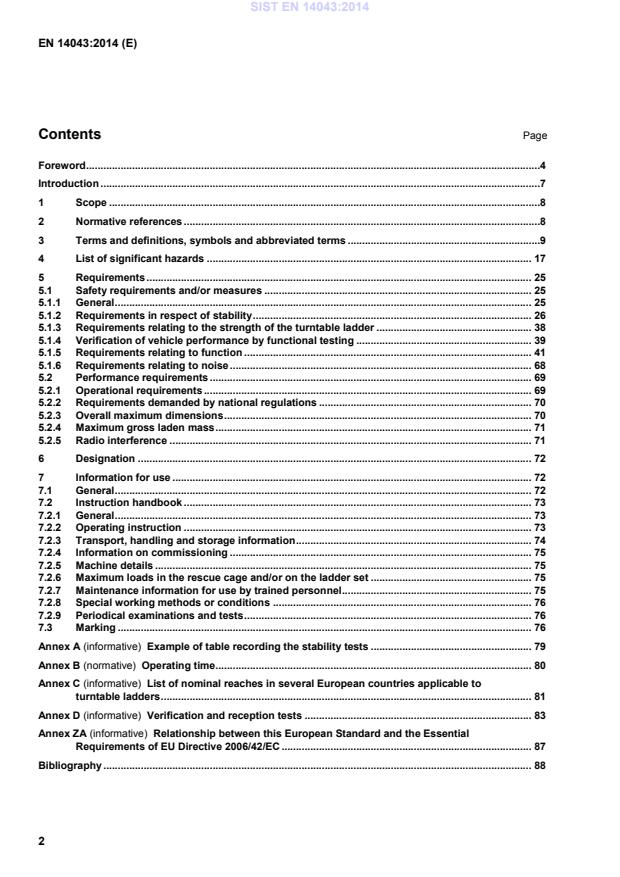
Example of table recording the stability tests . 79 Annex B (normative)
Operating time . 80 Annex C (informative)
List of nominal reaches in several European countries applicable to turntable ladders . 81 Annex D (informative)
Verification and reception tests . 83 Annex ZA (informative)
Relationship between this European Standard and the Essential Requirements of EU Directive 2006/42/EC . 87 Bibliography . 88 SIST EN 14043:2014
angle in the transverse direction to the longitudinal axis of the vehicle between the horizontal and the ground surface Note 1 to entry: The angle is expressed in degrees. 3.8 gradient angle
angle in the longitudinal axis of the vehicle between the horizontal and the ground surface Note 1 to entry: The angle is expressed in degrees. 3.9 slewing angle
angle determined cIockwise from the straight ahead position between the longitudinal axis of the vehicle and the longitudinal axis of the last ladder section projection Note 1 to entry: The angle is expressed in degrees. Note 2 to entry: The zero degrees position corresponds to the longitudinal axis of the vehicle facing towards the driver's cab. 3.10 rescue height h vertical height from the horizontal ground surface to the base floor of the rescue cage without loading and in the case of turntable ladders without rescue cage the height of the topmost ladder rung Note 1 to entry: The length is expressed in metres. 3.11 nominal rescue height hN specified rescue height at nominal reach Note 1 to entry: The length is expressed in metres. Note 2 to entry: Measured on level ground. 3.12 maximum rescue height hm rescue height at the maximum angle of elevation and the maximum extension distance Note 1 to entry: The length is expressed in metres. Note 2 to entry: Measured on level ground. 3.13 ladder's class identification of a turntable ladder which corresponds to the value equal or immediately less than the nominal rescue height Note 1 to entry: The value is expressed in metres. SIST EN 14043:2014
Key l horizontal projection h rescue height 1 to 3 free standing boundary (1 to 3 persons, with rescue cage) 4 supported boundary of use, with rescue cage and without load 5 free standing boundary with 1 person, without rescue cage 6 supported boundary of use, without load and without rescue cage Figure 1 — Example of boundary 3.24 jacking width b distance at right angles between two imaginary parallel lines to be drawn on either side of the central axis of the vehicle at the outer edges of the furthest extended and lowered jacks including base plates Note 1 to entry: See Figure 2.
a) SIST EN 14043:2014
b) Key b jacking width Figure 2 — Jacking width 3.25 operating time tR time to reach, from the travel position, the maximum rescue height (at 90° to the longitudinal axis of the chassis) Note 1 to entry: If appropriate the operating time tR includes the time for attaching the rescue cage and making it ready for use with the ladder stabilized at maximum jacking width by the vehicle. 3.26 static stability test verification of a turntable ladder’s ability to resist tipping or rolling over with the ladder set not being permitted to move under load Note 1 to entry: The static stability test is not an overload test. 3.27 dynamic stability test verification of a turntable ladder’s ability to resist tipping or rolling over with the ladder set being permitted to move under load 3.28 static overload test static test of the turntable ladder for permanent deformation Note 1 to entry: The static overload test is not a stability test. 3.29 test of fitness for purpose test to confirm the correct functioning of all the functions of a turntable ladder and its special equipment 3.30 forces and loads for calculations Note 1 to entry: Forces are expressed in newtons and are measured in the direction in which they act. Note 2 to entry: Loads are forces resulting from the mass of the components and are expressed in newtons. Their direction is the direction of the gravity. SIST EN 14043:2014
Key 1 to X+1 section number A first (upper) section B intermediate sections (second section, third section, etc.) C last (lower) section Figure 3 — Designation of ladder set sections SIST EN 14043:2014
Cradle/turret Crushing by the slewing drive mechanism • 5.1.5.7.1 Crushing by the turret in motion • 5.1.5.7.1 • 5.1.5.7.2 Crushing by the cradle in motion • 5.1.5.7.1 Ladder set Crushing between the rungs during extending and housing • 5.1.5.5.3 • 5.1.5.8.1 • Clause 7 Rescue cage Crushing by mobile parts during levelling correction • 5.1.5.4.8 Impact against an obstacle • 5.1.5.4.3 • 5.1.5.4.12 • 5.1.5.4.14 • 5.1.5.5.3 • 5.1.5.5.5 • 5.1.5.8.4 • Clause 7 Fitting/removal of the rescue cage • 5.1.5.4.6 Movement in the rescue cage • 5.1.5.4.13 Crushing a person outside the rescue cage • 5.1.5.4.12 • 5.1.5.5.3 • 5.1.5.5.4 • 5.1.5.8.1 • Clause 7 1.2 Shearing hazard Cradle/turret Crushing by the cradle in motion • 5.1.5.7.1 Ladder set Crushing between the rungs during extending and housing • 5.1.5.5.3 • 5.1.5.8.1 Rescue cage Crushing by mobile parts during levelling correction • 5.1.5.4.8 SIST EN 14043:2014
• EN 1846–2 Ladder set Damaged wire ropes • 5.1.5.8.2 1.4 Entanglement hazard General All moving parts • 5.1.5.7.1 • 5.1.5.8.2 • Clause 7 Jacks Movement of the jacks • 5.1.5.2.11 • 5.1.5.2.14 • 5.1.5.2.15 • 5.1.5.5.2 • Clause 7 Cradle/turret Entanglement by pinion/crown • 5.1.5.7.2 Entanglement by the moving turret • 5.1.5.5.3 • 5.1.5.7.1 • 5.1.5.7.2 Rescue cage Rescue cage deployment control • 5.1.5.5.4 Ladder set Entanglement by pulley and chains and entanglement by the winding drum • 5.1.5.8.2 1.5 Drawing-in or trapping hazard General Presence of a person in the working area • 5.1.5.5.6 1.6 Impact hazard Jacks Movement of the jacks • 5.1.5.5.2 • 5.1.5.2.14 • Clause 7 Put pressure on the ground • 5.1.5.5.2 • 5.1.5.2.14 • Clause 7 Neutralization suspension Re-establishing ground contact with the tyres during return to travel position • 5.1.5.2.15 Cradle/turret Crushing by the turret in motion • 5.1.5.5.3 • 5.1.5.7.1 • 5.1.5.7.2 • Clause 7 SIST EN 14043:2014
• 5.1.5.2.10 4 Hazard generated by noise 4.1 Interference with speech communication, acoustic signals, hearing loss, tinnitus, etc. Communications
• 5.1.5.8.4
Ladder Normal operation • 5.1.5.8.4 • 5.1.6 • EN 1846-2:2009+A1:2013, Annexes E and F 6 Hazards generated by radiation 6.1 Low frequency, radio frequency radiation, micro waves General Normal operation • 5.1.5.16 SIST EN 14043:2014
General
• Clause 7 8.4 Inadequate local lighting Control consoles Use of consoles • 5.1.5.5.1 Access to the main control console Use of consoles • 5.1.5.5.3 8.5 Mental overload and underload, stress All movements Use of controls without error • 5.1.5.5.1 • 5.1.5.5.2 • 5.1.5.5.3 • 5.1.5.5.5 8.6 Human error, human behaviour Control consoles Operating controls/reading of information • 5.1.5.5 • Clause 7 10 Unexpected start-up, unexpected overrun/overspeed (or any similar malfunction)
The whole ladder General operation • 5.1.5 Intentional stop or failure of the main power supply • 5.1.2.3.4 • 5.1.2.3.5 SIST EN 14043:2014
Electrical circuits and components General measures • 5.1.5.10 10.5 Errors in the software Software
• 5.1.5.12 13 Failure of the power supply
The whole ladder General operation • 5.1.2.3.4 Intentional stop or failure of the main power supply • 5.1.2.3.4 Jacks Rupture of the power supply of the components • 5.1.5.2.5 Suspension locking Rupture of the power supply of the components • 5.1.5.2.5 Cradle/turret Failure of the power supply of the components • 5.1.5.13.1 Ladder set Rupture of the power supply of the components • 5.1.5.13.1 Rescue cage Rupture of the power supply of the components • 5.1.5.13.1 Software Insufficient supply and/or failure • 5.1.5.12.3 • 5.1.5.12.8 14 Failure of the control circuit
Jacks Failure in the control software • 5.1.5.12 Restarting • 5.1.5.5.1
Suspension locking Failure in the control software • 5.1.5.12 Restarting • 5.1.5.5.1 Cradle/turret Failure in the control software • 5.1.5.12 Restarting • 5.1.5.5.1 Failure of a drive or load retaining element • 5.1.5.13.1 • 5.1.5.13.2 • 5.1.5.13.3 Ladder set Failure in the control software • 5.1.5.12 Restarting • 5.1.5.5.1 Failure of a drive or load retaining element • 5.1.2 • 5.1.5.13.1 • 5.1.5.13.2 • 5.1.5.13.3 Rescue cage Failure in the control software • 5.1.5.12 SIST EN 14043:2014
Logical detectors Normal operation • 5.1.5.12.3 • 5.1.5.12.5 • 5.1.5.12.7 • Clause 7 Management of the stability Normal operation • 5.1.2.3 Operation without safety measures • 5.1.2.3.5 15 Errors of fitting
Rescue cage Fitting of the rescue cage to the tip of the ladder set • 5.1.5.4.6 • 5.1.5.4.7 17 Falling or ejected objects or fluids
General
• 5.1.5.9 • Clause 7 Drive hydraulic systems Injury and/or contamination by leakage or rupture • 5.1.5.9 • Clause 7 Rescue cage Elements falling from the rescue cage • 5
...