


prEN 18111
(Main)Cash desk - Safety
General Information
- Abstract
This document specifies the security requirements for the design of checkout furniture in self-service stores, regardless of the size of the store. Safety requirements apply to both the operator and the public.
This document applies to all types of checkout furniture equipped with electrically powered conveyor(s). It does not deal with computer equipment related to cash register furniture.
This document covers all significant hazardous phenomena, situations or events, with the exception of..., which are relevant to cash registers when used normally and when they are subject to reasonably
foreseeable misuse by the manufacturer.
(Risks covered: mechanical, electrical (excluding IT, including controls), electromagnetic compatibility (EMC), ergonomics (refer to standard NF X 35-701 which must evolve into a European standard), hygiene (food contact, REACH, materials, cleaning products), recyclability, fire, noise).
- Status
- Not Published
- Publication Date
- 17-Feb-2027
- Technical Committee
- CEN/TC 148 - Continuous handling equipment and systems - Safety
- Drafting Committee
- CEN/TC 148/WG 6 - Safety for cash desks
- Current Stage
- 4599 - Dispatch of FV draft to CMC - Finalization for Vote
- Start Date
- 26-Aug-2026
- Due Date
- 08-Jan-2026
- Completion Date
- 26-Aug-2026
- Ref Project
oSIST prEN 18111:2024 - Cash desk - Safety

Overview
The draft European Standard prEN 18111:2024, developed by CEN/TC 148, addresses cash desk safety in retail environments. It specifies essential security and ergonomic requirements for the design of checkout furniture, particularly focusing on self-service stores with electrically powered conveyors. This standard ensures safety for both cashiers and the public by covering significant risks such as mechanical, electrical, electromagnetic compatibility, ergonomics, hygiene, recyclability, fire, and noise hazards.
prEN 18111 applies regardless of store size and caters to all types of cash desks, with or without conveyor belts, excluding computer equipment related to cash registers. It aims to minimize workplace stress and protect against reasonably foreseeable misuse.
Key Topics
Scope and Applicability
- Covers safety requirements for cash desk furniture in retail stores.
- Applies to electrically powered conveyor belts but excludes computer hardware.
- Designed for normal and foreseeable misuse by manufacturers.
- Does not apply to cash desks operated by disabled cashiers, but includes accessibility recommendations (Annex A).
Safety and Ergonomic Design Principles
- Incorporates guidelines per EN ISO 12100 (risk assessment) and EN ISO 14738 (ergonomics).
- Requires smooth edges, absence of harmful substances, and non-slip flooring.
- Ergonomic focus on minimizing musculoskeletal strain and mental stress for cashiers.
- Defines workspace dimensions for seated, stand-up, and height-adjustable cash desks.
- Emphasizes adjustable work surface heights:
- Seated workplaces: 750 mm to 825 mm.
- Seated/stand-up workplaces: 960 mm to 1010 mm.
- Specifies adequate legroom and foot space for comfort and safety.
Conveyor and Electrical Safety
- Covers safety of conveyor belts and housings.
- Specifies requirements for motor control boxes, sensor monitoring, and cable installation.
- Addresses hygiene standards for conveyor belt materials and cleaning methods.
Risk Mitigation & Verification
- The standard mandates verification of safety measures, including daily inspections.
- Encourages use of ergonomic chairs, footrests, and standing aids to reduce fatigue.
- Environmental aspects such as noise reduction, temperature, and hygienic shields are addressed in annexes.
Applications
prEN 18111 is applicable to:
- Retailers and supermarket chains installing or upgrading checkout systems.
- Manufacturers of checkout furniture, ensuring compliance with safety and ergonomic standards.
- Workplace safety officers and occupational health professionals aiming to reduce cashier fatigue and injury.
- Maintenance service providers ensuring the safety and functionality of checkout equipment.
- Designers integrating conveyor belts with cash desks to comply with electrical and mechanical safety regulations.
This standard benefits stakeholders by promoting safer, ergonomically optimized, and hygienic cashier environments, which leads to improved worker well-being and operational efficiency.
Related Standards
- EN ISO 12100:2010 – General principles for design and risk assessment of machinery.
- EN ISO 14738:2008 – Anthropometric requirements for workstation design.
- EN 60204-1:2018 – Safety of electrical machinery equipment.
- EN ISO 13850:2015 – Emergency stop function design principles.
- EN 1335-1:2020+A1:2022 – Office furniture – dimensions for office work chairs.
- NF X 35-701 – Ergonomics guidelines to be developed as a European standard.
Keywords: cash desk safety, checkout furniture, conveyor belt safety, ergonomics cashiers, retail checkout standards, machinery safety, occupational health, CEN standards, prEN 18111, electrical safety in retail, conveyor hygiene.
Get Certified
Connect with accredited certification bodies for this standard

CIS Institut d.o.o.
Personal Protective Equipment (PPE) certification body. Notified Body NB-2890 for EU Regulation 2016/425 PPE.

Kiwa BDA Testing
Building and construction product certification.
Kmetijski inštitut Slovenije
Agricultural Institute of Slovenia. Soil testing, plant health, agricultural product analysis.
Sponsored listings
Frequently Asked Questions
prEN 18111 is a draft published by the European Committee for Standardization (CEN). Its full title is "Cash desk - Safety". This standard covers: This document specifies the security requirements for the design of checkout furniture in self-service stores, regardless of the size of the store. Safety requirements apply to both the operator and the public. This document applies to all types of checkout furniture equipped with electrically powered conveyor(s). It does not deal with computer equipment related to cash register furniture. This document covers all significant hazardous phenomena, situations or events, with the exception of..., which are relevant to cash registers when used normally and when they are subject to reasonably foreseeable misuse by the manufacturer. (Risks covered: mechanical, electrical (excluding IT, including controls), electromagnetic compatibility (EMC), ergonomics (refer to standard NF X 35-701 which must evolve into a European standard), hygiene (food contact, REACH, materials, cleaning products), recyclability, fire, noise).
This document specifies the security requirements for the design of checkout furniture in self-service stores, regardless of the size of the store. Safety requirements apply to both the operator and the public. This document applies to all types of checkout furniture equipped with electrically powered conveyor(s). It does not deal with computer equipment related to cash register furniture. This document covers all significant hazardous phenomena, situations or events, with the exception of..., which are relevant to cash registers when used normally and when they are subject to reasonably foreseeable misuse by the manufacturer. (Risks covered: mechanical, electrical (excluding IT, including controls), electromagnetic compatibility (EMC), ergonomics (refer to standard NF X 35-701 which must evolve into a European standard), hygiene (food contact, REACH, materials, cleaning products), recyclability, fire, noise).
prEN 18111 is classified under the following ICS (International Classification for Standards) categories: 13.180 - Ergonomics. The ICS classification helps identify the subject area and facilitates finding related standards.
prEN 18111 is associated with the following European legislation: EU Directives/Regulations: 2006/42/EC, 2023/1230; Standardization Mandates: M/605. When a standard is cited in the Official Journal of the European Union, products manufactured in conformity with it benefit from a presumption of conformity with the essential requirements of the corresponding EU directive or regulation.
prEN 18111 is available in PDF format for immediate download after purchase. The document can be added to your cart and obtained through the secure checkout process. Digital delivery ensures instant access to the complete standard document.
Standards Content (Sample)
SLOVENSKI STANDARD
01-december-2024
Blagajne - Varnost
Cash desk - Safety
Kassentische - Sicherheit
Meuble de caisse - Sécurité
Ta slovenski standard je istoveten z: prEN 18111
ICS:
13.100 Varnost pri delu. Industrijska Occupational safety.
higiena Industrial hygiene
13.180 Ergonomija Ergonomics
2003-01.Slovenski inštitut za standardizacijo. Razmnoževanje celote ali delov tega standarda ni dovoljeno.
DRAFT
EUROPEAN STANDARD
NORME EUROPÉENNE
EUROPÄISCHE NORM
October 2024
ICS 13.180
English Version
Cash desk - Safety
Meuble de caisse - Sécurité Kassentische - Sicherheit
This draft European Standard is submitted to CEN members for enquiry. It has been drawn up by the Technical Committee
CEN/TC 148.
If this draft becomes a European Standard, CEN members are bound to comply with the CEN/CENELEC Internal Regulations
which stipulate the conditions for giving this European Standard the status of a national standard without any alteration.
This draft European Standard was established by CEN in three official versions (English, French, German). A version in any other
language made by translation under the responsibility of a CEN member into its own language and notified to the CEN-CENELEC
Management Centre has the same status as the official versions.
CEN members are the national standards bodies of Austria, Belgium, Bulgaria, Croatia, Cyprus, Czech Republic, Denmark, Estonia,
Finland, France, Germany, Greece, Hungary, Iceland, Ireland, Italy, Latvia, Lithuania, Luxembourg, Malta, Netherlands, Norway,
Poland, Portugal, Republic of North Macedonia, Romania, Serbia, Slovakia, Slovenia, Spain, Sweden, Switzerland, Türkiye and
United Kingdom.
Recipients of this draft are invited to submit, with their comments, notification of any relevant patent rights of which they are
aware and to provide supporting documentation.
Warning : This document is not a European Standard. It is distributed for review and comments. It is subject to change without
notice and shall not be referred to as a European Standard.
EUROPEAN COMMITTEE FOR STANDARDIZATION
COMITÉ EUROPÉEN DE NORMALISATIO N
EUROPÄISCHES KOMITEE FÜR NORMUN G
CEN-CENELEC Management Centre: Rue de la Science 23, B-1040 Brussels
© 2024 CEN All rights of exploitation in any form and by any means reserved Ref. No. prEN 18111:2024 E
worldwide for CEN national Members.
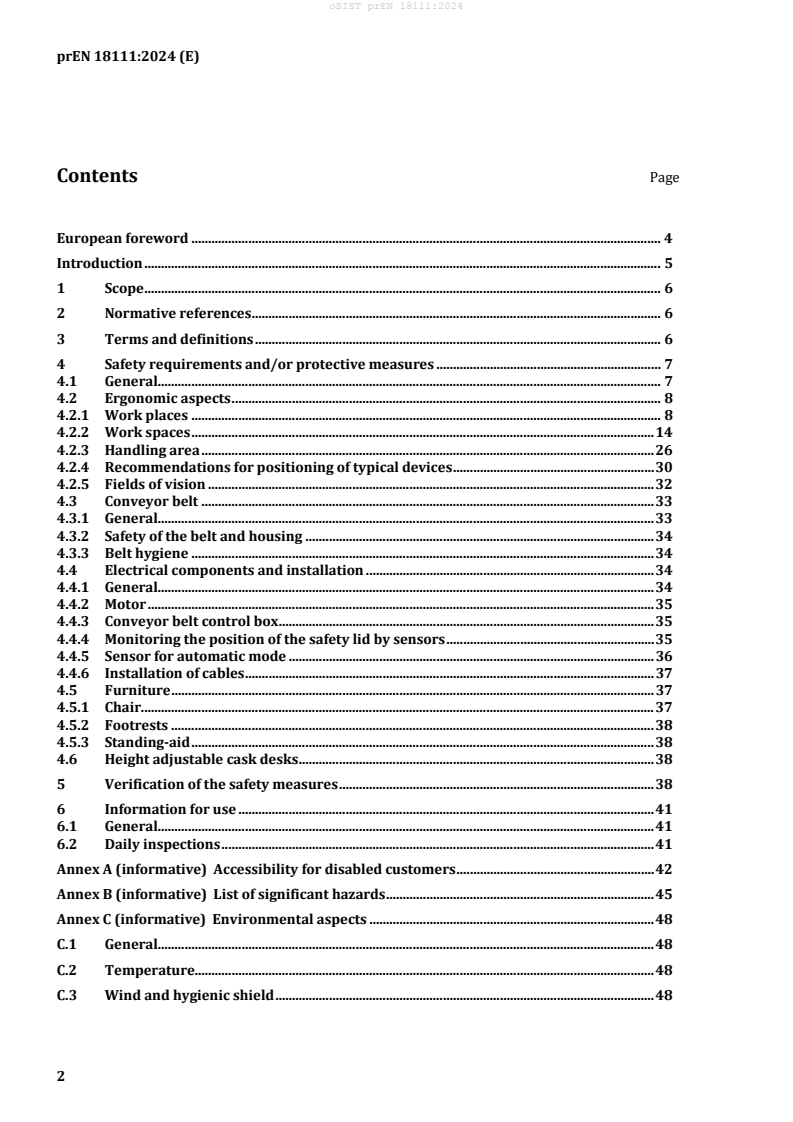
Contents Page
European foreword . 4
Introduction . 5
1 Scope . 6
2 Normative references . 6
3 Terms and definitions . 6
4 Safety requirements and/or protective measures . 7
4.1 General. 7
4.2 Ergonomic aspects . 8
4.2.1 Work places . 8
4.2.2 Work spaces . 14
4.2.3 Handling area . 26
4.2.4 Recommendations for positioning of typical devices . 30
4.2.5 Fields of vision . 32
4.3 Conveyor belt . 33
4.3.1 General. 33
4.3.2 Safety of the belt and housing . 34
4.3.3 Belt hygiene . 34
4.4 Electrical components and installation . 34
4.4.1 General. 34
4.4.2 Motor . 35
4.4.3 Conveyor belt control box . 35
4.4.4 Monitoring the position of the safety lid by sensors . 35
4.4.5 Sensor for automatic mode . 36
4.4.6 Installation of cables . 37
4.5 Furniture . 37
4.5.1 Chair. 37
4.5.2 Footrests . 38
4.5.3 Standing-aid . 38
4.6 Height adjustable cask desks . 38
5 Verification of the safety measures . 38
6 Information for use . 41
6.1 General. 41
6.2 Daily inspections . 41
Annex A (informative) Accessibility for disabled customers . 42
Annex B (informative) List of significant hazards . 45
Annex C (informative) Environmental aspects . 48
C.1 General. 48
C.2 Temperature. 48
C.3 Wind and hygienic shield . 48
C.4 Scanner . 48
C.5 Noise . 49
Annex ZA (informative) Relationship between this European Standard and the essential
requirements of Regulation (EU) 2023/1230 aimed to be covered . 51
Bibliography . 53
European foreword
This document (prEN 18111:2024) has been prepared by Technical Committee CEN/TC 148 “Continous
handling equipment and systems - Safety”, the secretariat of which is held by AFNOR.
This document is currently submitted to the CEN Enquiry.
This document has been prepared under a standardization request addressed to CEN by the European
Commission. The Standing Committee of the EFTA States subsequently approves these requests for its
Member States.
For the relationship with EU Legislation, see informative Annex ZA, which is an integral part of this
document.
Introduction
This document is a type-C standard as stated in EN ISO 12100.
This document is of relevance, in particular, for the following stakeholder groups representing the market
players with regard to machinery safety:
— machine manufacturers (small, medium and large enterprises);
— health and safety bodies (regulators, accident prevention organizations, market surveillance, etc.).
Others can be affected by the level of machinery safety achieved with the means of the document by the
above-mentioned stakeholder groups:
— machine users/cashier (small, medium and large enterprises);
— machine users/cashier (e.g. trade unions, organizations for people with special needs);
— service providers, e.g. for maintenance (small, medium and large enterprises);
— consumers (in the case of machinery intended for use by consumers)
The above-mentioned stakeholder groups have been given the possibility to participate at the drafting
process of this document.
The machinery concerned and the extent to which hazards, hazardous situations or hazardous events are
covered are indicated in the Scope of this document.
When requirements of this type-C standard are different from those which are stated in type-A or type-B
standards, the requirements of this type-C standard take precedence over the requirements of the other
standards for machines that have been designed and built according to the requirements of this type-C
standard.
1 Scope
This document deals with all significant hazards, hazardous situations or hazardous events relevant to
cash desks, when it is used as intended and under conditions of misuse which are reasonably foreseeable
by the manufacturer.
This document defines the requirements for the design of cash desks according to 3.1 in retail industries
irrespective of the sales area of the shop. This document is also applicable to cash desks without conveyor
belts.
This document does not consider the equipment for the registration and payment process (i.e. scanner,
printer, screens), except of recommendations of the placement for such equipment.
This document is not applicable to the machinery or machinery components manufactured before the
date of its publication.
This document does not consider cash desks operated by handicapped cashiers.
Information concerning cash desks for disabled customers could be find in Annex A.
2 Normative references
The following documents are referred to in the text in such a way that some or all of their content
constitutes requirements of this document. For dated references, only the edition cited applies. For
undated references, the latest edition of the referenced document (including any amendments) applies.
EN 1335-1:2020+A1:2022, Office furniture - Office work chair - Part 1: Dimensions - Determination of
dimensions
EN 60204-1:2018, Safety of machinery - Electrical equipment of machines - Part 1: General requirements
(IEC 60204-1:2016)
EN ISO 12100:2010, Safety of machinery - General principles for design - Risk assessment and risk reduction
(ISO 12100:2010)
EN ISO 13850:2015, Safety of machinery - Emergency stop function - Principles for design (ISO 13850:2015)
EN ISO 14738:2008, Safety of machinery - Anthropometric requirements for the design of workstations at
machinery (ISO 14738:2002, including Cor 1:2003 and Cor 2:2005)
3 Terms and definitions
For the purposes of this document, the terms and definitions given in EN ISO 12100:2010 and the
following apply.
ISO and IEC maintain terminological databases for use in standardization at the following addresses:
— IEC Electropedia: available at http://www.electropedia.org/
— ISO Online browsing platform: available at http://www.iso.org/obp
3.1
cash desk
cash desks are characterized in a way that goods are placed by the customer on a stationary or moving
surface (i.e. conveyor belt), separated by the cashier and fed into a registration process
Note 1 to entry: After registration the goods are placed again on a moving or stationary surface and finally seat for
and picked up by the customer.
3.2
small handling area
area within reach of both forearms in front and lateral of the body to manipulate goods (i.e. scanning)
and high frequency operation of equipment
Note 1 to entry: All strenuous movement of the upper body shall be avoided.
3.3
extended handling area
area within reach of both arm in front and lateral of the body to manipulate goods and low frequency
operation of equipment
3.4
conveyor belt control box
main element controlling the operation of the belt
3.5
detection tasks
tasks in which the cashier is alerted by the system
3.6
control tasks
tasks in which the cashier actively seeks information
3.7
small
small goods, are goods, which can be handled regularly within forearm’s reach (e. g. a bottle of milk, a
paperback book, a pair of shoes, a brush)
3.8
low weight
goods with a weight regularly below 5 kg (e. g. a bottle of milk, a paperback book, a pair of shoes, a brush)
3.9
heavy
goods with a regularly over 5 kg (e. g. a sixpack of 1,5 L beverage bottles, a 5 L bucket of paint)
3.10
large
goods which have to be handled within arm’s reach (e. g. a sixpack of 1,5 L beverage bottles, a A2 sheet
of craft paper, a coat, a cable drum)
4 Safety requirements and/or protective measures
4.1 General
Machinery shall comply with the safety requirements and/or protective/risk reduction measures of this
clause. In addition, the machine shall be designed according to the principles of EN 12100:2010 for
relevant but not significant hazards which are not dealt with by this document.
All parts of the cash desk shall not have sharp edges and corners and shall not contain harmful substances
(i.e. asbestos, critical plasticizer).
4.2 Ergonomic aspects
4.2.1 Work places
4.2.1.1 General
Staff at cash desks are exposed to high physical and mental stress. The most important stress factors are:
— Strain on the musculoskeletal system due to one-sided strain on the muscles as a result of
unfavourably and unfavourable arrangement of equipment and controls at the workplace e.g. lifting
and moving goods, large gripping distances, unfavourable operating heights and angles, etc.).
— Workplaces that are not designed for the body (lack of legroom, unfavourable working heights,
enforced postures etc.).
— Mental stress, especially at peak times, in connection with incorrect price entry.
— Customer behaviour.
Stress caused by environmental influences, see Annex C for measures to reduce stress.
Cash desks shall therefore be designed in such a way that they comply with the principles of work
physiology, according to EN ISO 14738:2008.
The floor in the checkout shall have a completely even surface and shall not be slippery.
The following principles for the design of cash desks are aimed at minimizing the strain on cashiers to a
minimum in order to prevent health hazards and impairments.
Only the instruction of the cashier staff enables the ergonomically correct use of the cashier workplace,
e.g. correct adjustment of the cashier's work chair, ergonomically correct operation of the equipment and
controls.
Figure 1 explains the principle to find the correct type of cash desk for its application. A height adjustable
cash desk can be used to accommodate different work loads by allowing different working postures.
Figure 1 — Scheme for determining the type of cash desk workplace
(Explanation of low-weight and heavy objects)
4.2.1.2 Seated cash desk workplaces
The work surface heights for seated cash desk workplaces shall be:
— For mostly small and light goods (regularly below 5 kg, rarely above): Top edge of work surface
750 mm to 825 mm above floor or platform (according to Figure 2).
The dimensions of the legroom for seated (and as well for stand-up/seated) cash desk workplaces
(according to Figure 2) shall be:
— Height at least 650 mm, for seated workplaces in relation to the floor (platform) and the lower edge
of the work surface;
— Width at least 800 mm;
— Footwell depth at least 600 mm at floor level (platform).
Depth of knee space below the lower edge of the work surface at least 450 mm.
A free space for the feet shall be ensured. For the feet there shall be a height of minimum 225 mm without
any equipment installed.
Figure 2 — Seated cash desk working place
4.2.1.3 Seated / stand-up cash desk workplaces
The work surface heights for seated / stand-up cash desks shall be:
— For mostly larger and/or heavier goods: Top edge of work surface 960 mm to 1010 mm as shown in
Figure 3a).
The dimensions of the legroom for seated / stand-up (and as well for seated) cash desks (according to
Figure 3a) and 3b)) shall be:
— Height at least 650 mm, for seated workplaces in relation to the floor (platform) and the lower edge
of the work surface;
— Width at least 800 mm;
— Footwell depth at least 600 mm at floor level.
Depth of knee space below the lower edge of the work surface at least 450 mm.
A free space for the feet shall be ensured. For the feet there shall be a height of minimum 225 mm without
any equipment installed.
a) Seated / Stand-up cash desk working place with cashier seated
b) Seated / Stand-up cash desk working place with cashier standing
Figure 3 — Seated / stand-up cash desk workplaces
4.2.1.4 Stand-up cash desk workplace (with or without standing seat)
The work surface heights for stand-up cash desk workplaces shall be:
— For mostly larger and/or heavier goods: Top edge of work surface between 880 mm and 960 mm.
The dimensions of the legroom for stand-up cash desk workplaces shall be:
— Standing cash desks without standing seat (Figure 4a)).
Footwell depth of 210 mm, footwell height of 225 mm over the width of the free unobstructed area when
standing: 800 mm.
— Standing cash desks with standing seat (Figure 4b)): Foot space depth at least 420 mm, knee space
depth at least 240 mm over the width of the free, unobstructed area when standing with standing
seat: 800 mm).
a) Stand up cash desk working place
b) Stand-up cash desk working place with standing-aid
Figure 4 — Stand-up cash desk workplace (with or without standing seat)
4.2.2 Work spaces
4.2.2.1 General
The procurement requirements (i.e. work spaces) shall be ensured over the entire service life and shall
not be restricted by obstacles.
In general, the entrance shall be designed in a way that a tripping of the cashier or blocking of the entrance
door cannot happen. All sides of the entrance shall be covered with corner protections or safety edges,
with a long usage and wear time in mind.
Sliding doors shall be designed in a way that the sliding part glides behind a cover so that a blocking of
the door is not possible, especially in emergency situations.
If there is a door lock installed, it shall be opened without a key from the inside.
Generally, on the bottom of the entrance there shall be no barrier or other tripping hazards. If a rolling
chair is used and after the exit is a step down higher than 30 mm a barrier not higher than 30 mm shall
be used. The inner side of the barrier shall be inclined an angle of more than 30° from the surface of the
cash desk floor, see Figure 5. The chair shall be equipped with such small castors that a pushless running
over this barrier with a weight of 70 kg and a speed of max 3 m/s is not possible.
Figure 5 — Barrier for bottom
4.2.2.2 Single cash desk (seated / seated and stand-up / stand-up workplaces)
The minimum workspace dimensions for a cash desk with a seated workplace are shown in Figure 6 a)
below.
Please note that for all cash desk types the clear passage width at the door shall be at least 600 mm.
a) Minimum workspace dimensions for a cash desk with a seated workplace
In case of seated / stand-up workplaces sufficient space is required to move the chair out of the
workspace. Figures 6 b) to 7 b) show examples how this can be achieved. The focus in these examples is
always to fulfil the minimum workspace dimensions of 800 x 600 mm.
b) Minimum dimensions for a cash desk with a seated / stand-up workplace (chair stowed
sideways from the cashier)
c) Minimum dimensions for a cash desk with a seated / stand-up workplace (chair stowed
behind the cashier)
d) Minimum dimensions for a cash desk with a seated / stand-up workplace (chair stowed
underneath the furniture)
Figure 6
a) Minimum dimensions for a cash desk with a stand-up workplace (no extra space for standing-
aid)
b) Minimum dimensions for a cash desk with a stand-up workplace (with extra space for placing
the standing-aid)
Key
A Values defined by the designer
Figure 7
4.2.2.3 Express cash desks (Stand-up workplaces with or without standing seat)
The minimum workspace dimensions for express are shown below in Figure 8 and Figure 9. Please note
that these cash desk types are typically designed for working postures with the cashier permanently
standing. In case that a standing seat is employed a strip of extra space (width 150 mm) for the standing
seat is required if the cashier would like to work standing upright without the standing seat. If the
standing seat can be stowed away without obstructing the minimum workspace of 600 × 600 mm that
extra space is not necessary.
Figure 8 — Minimum dimensions for an express / counter cash desk with a stand-up workplace
without standing-aid
Key
A Values defined by the designer
Figure 9 — Minimum dimensions for an express / counter cash desk with a stand-up workplace
with extra spaces for placing the standing-aid
4.2.2.4 Counter cash desks (Stand-up workplaces)
The minimum workspace dimensions for counter cash desks are shown below in Figure 10. Please note
that these cash desk types are typically designed for working postures with the cashier permanently
standing and there are goods behind the cashier.
Figure 10 — Minimum dimensions for counter cash desk with a stand-up workplace
with or without standing-aid
Sometimes the counter cash desks are combined with adjoining office rooms. In case that these rooms
can only be accessed through the cash desk door the minimum clear passage width is 800 mm and the
aisle width needs to be increased (minimum width 1 000 mm), if there are some shelves behind the
cashier, see Figure 11a).
Besides the scanning of goods there are many other tasks for the cashier like selling lottery tickets,
cigarettes and tobacco and other high-priced goods, parcel reception and delivery as well as return of
goods etc. To fulfil these tasks more workspace shall be required. If there are no shelves behind the
cashier, the aisle shall be reduced, see Figure 11b).
a) Minimum dimensions for counter cash desk with a stand-up workplace
with shelves and an adjoining office room
b) Minimum dimensions for counter cash desk with a stand-up workplace without shelves in the
counter cash
Figure 11 — Minimum dimensions for counter cash desk with a stand-up workplace with or
without shelves and an adjoining office room
4.2.2.5 Tandem workplace cash desks (seated / seated and stand-up / stand-up workplaces)
A so-called tandem cash desk is consisting of 2 separate work spaces for each cashier. The cashiers do
not share the workspaces. With tandem cash desks the workplaces are typically arranged one behind the
other (seen from the direction of customer flow). The width of the free unobstructed workspace for each
workplace shall be identical with the workspace for single workplace cash desks (i.e. 600 x 800 mm), see
Figure 13.
Please note that for all tandem cash desk types the clear passage width at the door shall be at least
600 mm, see Figure 12, Figure 13a) and Figure 13b).
Figure 12 — Minimum dimensions for tandem cash desk with seated workplaces
a) Minimum dimensions for tandem cash desk with storage place for chairs
b) Minimum dimensions for tandem cash desks with storage places for standing-aids (applies
only to stand-up work places)
Key
A Values defined by the designer
Figure 13 — Minimum dimensions for tandem cash desks with storage places for chairs or for
standing-aids
4.2.2.6 Double cash desks (seated / seated and stand-up / stand-up workplaces)
A so-called double cash desk is consisting of workplaces where both cashiers share the same workspaces.
The width of the free unobstructed workspace for each workplace shall be identical with the workspace
for single workplace cash desks (i.e. 800 mm). The depth needs to be increased to 740 mm so that one
cashier can pass by the other workplace when the other cashier is working at his/her workplace, see
Figure 14 a).
The centre lines of both workplaces shall at least 800 mm apart from each other.
Please note that for all double cash desk types the clear passage width at the door has to be at least
600 mm, see Figures 14 a) to 15 c).
a) Minimum dimensions for double cash desks with seated /stand-up workplaces arranged
laterally displaced and storage places for chairs
b) Minimum dimensions for double seated/stand-up cash desks with seated workplaces
c) Minimum dimensions for double cash desk’s with stand-up workplaces arranged laterally and
storage spaces for standing-aids
Key
A Values defined by the designer
Figure 14
a) Minimum dimensions for double cash desks with seated workplaces arranged
“back to back”
b) Minimum dimensions for double cash desk’s with seated/stand-up workplaces arranged
“back to back” and storage places for chairs
c) Minimum dimensions for double cash desks with stand-up workplaces arranged “back to
back” and storage places for standing-aids
Key
A Values defined by the designer
Figure 15
4.2.3 Handling area
4.2.3.1 Definition of handling areas for different working postures
4.2.3.1.1 General
The definition of recommended areas for the handling of goods as well as the operation of devices and
equipments is depending on:
— working posture (i.e. cashier is seated or standing-up);
— frequency operation (i.e. how often does the cashier manipulate goods or operate certain devices
(like table scanner, touch monitor, cash drawer, receipt printer, EFT terminal, etc.);
— weight of the goods that need to be manipulated (i.e. pushing, pulling, rotating, carrying, etc.).
The main task of the cashier is to handle and register goods, therefore it is helpful to use additional
equipment to direct these goods from the conveyor belt to the small handling area.
For both working postures (seated / stand-up) there is a differentiation between a so-called “small
handling area”, see Figure 16 and a “extended handling area”, see Figure 17. All areas are corresponding
with the cashier’s body centre axis. The geometric shape of both handling areas is defined by quarter
circles and rectangles for better useability.
Particularly frequent activities (operating frequency of 10 times per minute or more) as shall be carried
out exclusively within in the small handling area. This applies also to the manipulation of heavy goods.
The surface of the registration area shall be designed in such a way, that the smooth flow of goods from
the end of the conveyor belt to the beginning of the packing bay is not interfered by obstacles or steps.
Other activities (operating frequency of less than 10 times per minute) may be located in the extended
handling area.
In case of very low operating frequencies (less than 2 times per minute) the operation may take place
outside the extended handling area. In these cases it is tolerable that the cashier needs to bend or rotate
his trunk and/or displace his/her shoulder joints in order to reach the operation area.
Figure 16 — Dimension of the small handling area in case of a seated working posture
Figure 17 — Dimension of the extended handling area in case of a seated working posture
Logically the dimensions of both handling areas (small / extended) are larger with a cashier in a stand-
up working posture (see Figure 18 and Figure 19):
Figure 18 — Dimension of the small handling area in case of a stand-up working posture
Figure 19 — Dimension of the extended handling area in case of a stand-up working posture
4.2.3.1.2 Handling area at the cash desk for seated working posture
The Figure 20 illustrates how the “small” and the “extended” handling areas to look like for a cash desk
with the cashier in a seated working posture. The simplified geometry of both areas allow an easy
adaption to each cash desk either for practical evaluation of physical samples or for designers in the
development phase using modern CAD systems.
Please note that both handling areas start 30 mm in front of the cash desk’s front line (this is typically the
front edge of the cash drawer) and that the centre line of the handling areas need to be aligned with the
workplace’s centre line.
Figure 20 — Handling area for seated working postures
4.2.3.1.3 Handling areas at the cash desk for stand-up working posture
Figure 21 illustrates how the “small” and the “extended” handling areas to look like for a cash desk with
the cashier in a stand-up working posture. The simplified geometry of both areas allow an easy adaption
to each cash desk either for practical evaluation of physical samples or for designers in the development
phase using modern CAD systems.
Note, that in this case both handling areas start at the cash desk’s front line (this is typically the front edge
of the cash drawer) and that the centre line of the handling areas need to be aligned with the workplace’s
centre line.
Figure 21 — Handling area for stand-up working postures
4.2.4 Recommendations for positioning of typical devices
The placement of the devices is only a recommendation and can vary, depending of the type of peripheral
device/equipment. Table 1 describes the function and the position of the peripheral device/equipment
to avoid ergonomic impairments.
Table 1 — Placements of peripheral devices and functions
Peripheral Recommended
Function/way of operation
device/equipment position
Scanner A scanner is a device used in retail stores to Small handling area
scan barcodes or QR codes on products. It
transmit data to a computer or point-of-sale
system. This device is regularly in the top of
the cash desk.
Keyboard A keyboard can give additional information in Extended handling area
the scanning process. It transmit data to a
computer or point-of-sale system.
(unidirectional)
A keyboard is an input device that allows users
to enter characters, numbers, and other
symbols into a computer or other electronic
device.
Touchscreen A touchscreen can give additional information Extended handling area
in the scanner process Interaction with the
POS system. It shows and transmit data to a
computer or point-of-sale system.
(Bi-directional)
A touchscreen is a display device that allows
users to interact with a computer or electronic
device by touching the screen with their
fingers.
Handscanner A handscanner is a device used in retail stores Extended handling area
to scan barcodes or QR codes on products. It or outside of the defined
transmits data to a computer or point-of-sale handling area
system. The handscanner is operated by hand.
Cashier display Showing information of the point-of-sale Extended handling area
system (unidirectional). – in sight of cashier
Cash drawer A cash drawer is a type of drawer or Small handling area
compartment used in point-of-sale (POS)
systems to store cash and coins.
Bank note vault A bank note vault is a small and portable Extended handling area
container typically made of metal, used to
store and manage bank notes and other
valuable items. It usually has a lock to ensure
security and may also have a handle for easy
transportation.
Receipt Printer A receipt printer is a type of printer used to Extended handling area
generate paper receipts for transactions.
Peripheral Recommended
Function/way of operation
device/equipment position
Additional printer(s) Printers for coupons and vouchers, etc. Outside handling area
Authorization key reader An authorization key reader is a device used to Outside handling area
read and authenticate electronic authorization
keys, such as magnetic stripe cards, smart
cards, or RFID tags.
Alarm button An alarm button (also called a panic button or Small handling area but
emergency button) is a device used to quickly out of the customers
and easily signal an emergency situation. view
It is typically a button or switch that, when
pressed, triggers an alarm or alerts security
personnel or emergency services.
Heating device A heating device is any type of appliance or Outside handling area
system used to generate heat for a particular
purpose to enable descend temperature for
the cashier.
Instore communication Instore communication refers to the methods Extended handling area
and tools used by retailers to communicate (control panel)
with their customers and cashiers within their
physical stores or retail spaces. For example,
Signage, intercom system ect.
Shopping trolleys Surveillance is sometimes used in retail stores Extended handling area
surveillance to detect theft. This may include the use of – in sight of cashier
security cameras or other monitoring
technologies like mirrors.
EFT-Terminal An EFT (Electronic Funds Transfer) terminal In range of the customer,
is a device used to process electronic movable into the
payments, such as credit card, debit card, or extended handling area
mobile payments. of the cashier
Hard tag removable Hardtag deactivators use a magnetic field to Extended handling area
device disable the tag.
Conveyor belt control box See 3.4. Extended handling area
Emergency stop /Main A main switch is an electrical component that Extended handling area
switch is used to connect or disconnect the power
supply to a Checkout. Typically a part of the
conveyor control box.
Cash management system A cash management system is designed to Outside handling area
automate and optimize the cash handling (Cashier control)
process for businesses that handles cash. It
In range of the customer
works by allowing cashier and customers to
(Customer control)
deposit cash and coins directly into the
system, which then counts, sorts, and stores
the currency for future use
Peripheral Recommended
Function/way of operation
device/equipment position
Packing bay divider A packing bay divider is a physical barrier that Extended handling area
is used to separate products after scanning
inside the packing bay.
Next Customer bar rail Rail alongside the infeed conveyor belt in Extended handling area
which the cashier places and pushes the bars
back.
Coin tray This is a tray or plateau where customers Extended handling area
receive the change.
4.2.5 Fields of vision
In almost all checkouts and counter workstations, computer equipment with screens (POS) is used to
perform certain operations in an automated way. Besides screens as parts of the POS system, screens are
also used as surveillance monitors.
In monitor work, two different types of visual tasks can be distinguished:
Detection tasks and control tasks, see also Figure 22, Figure 23 and Figure 24.
Suitability Level Relevance
A Recommended This area shall be used whenever possible
B Acceptable This area can be used if the recommended area cannot be used
This extended area can be used if the recommended area cannot be used, the
B1 Acceptable
extended area is only valid for control tasks
C Unsuitable This area shall be avoided
Figure 22 — Horizontal field of view for detection tasks
Figure 23 — Vertical field of view for detection task (observation)
Figure 24 — Vertical field of view for control tasks (surveillance)
It is only permissible for visual information aids to be placed outside the “recommended” and
“acceptable” area if suitable aids are provided, e.g. auditory information aids. The “unsuitable” area shall
only be used for information aids that are not critical for safe operation.
4.3 Conveyor belt
4.3.1 General
Checkouts mostly provide a means of transportation helping to carry the goods in a singularized way
from the place where the customer is standing towards the cashier’s workplace in order to start the
scanning process.
There are many different technical solutions available for this transport function. Today typically
conveyor belts are in use.
The conveyer belt unit consists of frame carrying a motor on the far side of the cashier and a pulley on
the cashiers side. On both longitudinal sides the belt is covered by the housing or the cashier desk. The
reverse side of the belt is fully enclosed by the housing. The material of the belt is usually a fabric coated
with an elastomere rubber.
Regularly there are two ways of operation of conveyor belts:
— Manual mode (i.e. hold-to-run control);
— Automatic mode (i.e. belt running permanently), also see 4.4.4.
4.3.2 Safety of the belt and housing
The belt shall be enclosed in a way that it is not possible to get dragged into it. This means that all open
sides of the contact surface with the good shall be covered either by the housing or the cashier desk with
a gap not more than 5 mm, it is recommended to use a gap less than 3 mm.
Typically the speed range of a checkout conveyor belt is between 0,10 m/s to 0,20 m/s. If the belt is
moving not faster than 0,25 m/s the performance level of any switches or control shall be PL . If it is
b
faster a performance level of least PL shall be applied.
c
The longitudinal boundaries covering the belt inside the conveyor belt unit shall have a minimum height
of 10 mm to prevent goods from falling off. These boundaries may start in a distance of 0,5 m from the
beginning of the belt.
Following safety functions shall be installed:
a) Above the position of the idler pulley there shall be a safety lid. If the safety lid is lifted up more than
3 mm the conveyor belt shall stop instantly. This function usually is achieved by an electronic device.
It shall be not possible to remove the safety lid permanently from the conveyor belt unit. The safety
lid is required in all conveyor belts, which are installed in the cash desk;
b) Inside the conveyor belt motor there shall be a temperature switch to detect a potential overheating.
In case of overheating, the motor shall stop immediately;
c) If any of the devices mentioned in a) and b) have a malfunction, the conveyor belt as well shall stop
immediately.
In any of the safety functions above is activated the conveyor belt shall not restart automatically. An
authorized person has to resolve the cause of the emergency situation (e.g. remove obstacles, cool down
the motor), reset the control box (e.g. switching off/on or pressing reset button) before restarting the
operation of the conveyor belt.
4.3.3 Belt hygiene
The design of the belt and its housing shall be in a way that cleaning is possible and there shall be a
possibility to retrieve objects which have fallen inside (e.g. a flap on the cashier side and a drawer beneath
the idler pulley).
It shall be possible to clean the surface of the belt with standard cleaning detergents.
4.4 Electrical components and installation
4.4.1 General
Inside the checkout desk there are many electrical devices or power outlets to install such. There shall be
space for take up cables into the cable trays with dimensions of at least 8 cm x 10 cm. The cable trays
shall be sepa
...