


EN 12096:2026
(Main)Mechanical vibration - Declaration and verification of vibration emission values
General Information
- Abstract
This document specifies the requirements for declaration and verification of vibration emission values of continuous and repeated shock vibrations. It is applicable to hand-arm and whole-body vibration values achieved by measurements according to type-B and type-C standards for portable hand-held, hand-guided and mobile machinery.
This document
— gives guidance on the declaration of vibration emission values,
— describes vibration and product information to be given in the instructions for use supplied with the machinery, and
— specifies the method for verifying the declared vibration emission values stated in the instruction for use of the machinery.
NOTE Machines according to Machinery Regulation (EU) 2023/1230 Annex III Part B 2.2.1.1 and 3.6.3.1 are covered by this document.
- Status
- Published
- Publication Date
- 21-Jul-2026
- Technical Committee
- CEN/TC 231 - Mechanical vibration and shock
- Drafting Committee
- WG 12 - CEN/TC 231/WG 12
- Current Stage
- 6060 - Definitive text made available (DAV) - Publishing
- Start Date
- 22-Jul-2026
- Due Date
- 01-Jan-2027
- Completion Date
- 22-Jul-2026

Overview
EN 12096:2026, published by CEN, sets out the requirements for the declaration and verification of vibration emission values for machinery. This European standard applies to both continuous and repeated shock vibrations, covering both hand-arm vibration (HAV) and whole-body vibration (WBV). It specifically addresses vibration emission values determined via type-B and type-C standards for portable hand-held, hand-guided, and mobile machinery. The standard provides clear guidance for manufacturers on:
- How to declare vibration emission values
- What product and vibration information to include in instructions for use
- Methods for verifying declared vibration emission values
EN 12096:2026 is aligned with the requirements of the EU Machinery Regulation (EU) 2023/1230, ensuring legal compliance for machinery placed on the European market.
Key Topics
Declaration of Vibration Emission Values
- Requirements for measurement, calculation, and presentation of declared values
- Inclusion of equipment identification, measured values, and relevant test codes
- Reporting of uncertainty (K values) alongside emission data
Verification Methods
- Procedures for verifying emission values with statistical methods
- Guidance for sampling (using one or three machines) to ensure compliance and repeatability
- Reference to the calculation of standard deviation and uncertainty metrics
Information for Users
- Vibration emission values and uncertainties must be clearly communicated in machinery instructions for use
- Ensures end users, planners, and authorities receive consistent, comparable data
Alignment with EU Regulations
- Supports machine manufacturers in fulfilling obligations under Machinery Regulation (EU) 2023/1230
- Complements workplace vibration exposure directives, though it focuses specifically on emission rather than daily exposure values
Applications
EN 12096:2026 is essential for various stakeholders involved in machinery manufacturing, distribution, and usage:
- Machinery Manufacturers: Enables consistent and credible reporting of vibration emission values, supporting product development and market placement.
- Market Surveillance and Compliance: Provides standardized methods for verifying and cross-checking declared vibration values, ensuring machinery meets legal and safety requirements.
- Health and Safety Professionals: Assists buyers and employers in evaluating machinery based on standardized vibration emission data, contributing to the reduction of workplace risks due to vibration exposure.
- Test Laboratories and Certification Bodies: Offers clear methodologies for performing and validating vibration measurements on different machinery types.
Key machinery categories covered include:
- Portable hand-held and hand-guided tools
- Mobile industrial equipment (e.g., industrial trucks)
- Machines covered under type-B and type-C vibration standards
Related Standards
EN 12096:2026 references and builds upon several important international and European standards, which are crucial for comprehensive vibration measurement and safety:
- EN ISO 5349-1:2001 / EN ISO 5349-3:2025: Measurement and evaluation of human exposure to hand-transmitted vibration
- EN ISO 8041-1:2017: Human response to vibration - Measuring instrumentation
- ISO 2631-1:1997: Evaluation of human exposure to whole-body vibration
- EN ISO 20643: Principles for evaluation of vibration emission for hand-held and hand-guided machinery
- EN 13059: Methods for measuring vibration in industrial trucks
- EN ISO 12100: Risk assessment and risk reduction in machinery design
- EN ISO 28927: Vibration test methods for hand-held portable tools
- EN IEC 62841 Series: Safety requirements for electric machinery
By adopting EN 12096:2026, stakeholders ensure that vibration emission values are declared and verified consistently and transparently, supporting both legal compliance and practical workplace safety.
Relations
- Replaces
EN 12096:1997 - Mechanical vibration - Declaration and verification of vibration emission values - Effective Date
- 10-Jan-2024
- Referred By
EN 13059:2002+A1:2008 - Safety of industrial trucks - Test methods for measuring vibration - Effective Date
- 29-Jul-2026
- Effective Date
- 29-Jul-2026
- Effective Date
- 29-Jul-2026
- Effective Date
- 29-Jul-2026
- Referred By
EN 12733:2018 - Agricultural and forestry machinery - Pedestrian controlled motor mowers - Safety - Effective Date
- 29-Jul-2026
- Effective Date
- 29-Jul-2026
- Effective Date
- 29-Jul-2026
- Effective Date
- 29-Jul-2026
- Effective Date
- 29-Jul-2026
- Effective Date
- 29-Jul-2026
- Effective Date
- 29-Jul-2026
- Effective Date
- 29-Jul-2026
- Effective Date
- 29-Jul-2026
- Effective Date
- 29-Jul-2026
Get Certified
Connect with accredited certification bodies for this standard

BSMI (Bureau of Standards, Metrology and Inspection)
Taiwan's standards and inspection authority.
CIS Institut d.o.o.
Personal Protective Equipment (PPE) certification body. Notified Body NB-2890 for EU Regulation 2016/425 PPE.

Kiwa BDA Testing
Building and construction product certification.
Sponsored listings
Frequently Asked Questions
EN 12096:2026 is a standard published by the European Committee for Standardization (CEN). Its full title is "Mechanical vibration - Declaration and verification of vibration emission values". This standard covers: This document specifies the requirements for declaration and verification of vibration emission values of continuous and repeated shock vibrations. It is applicable to hand-arm and whole-body vibration values achieved by measurements according to type-B and type-C standards for portable hand-held, hand-guided and mobile machinery. This document — gives guidance on the declaration of vibration emission values, — describes vibration and product information to be given in the instructions for use supplied with the machinery, and — specifies the method for verifying the declared vibration emission values stated in the instruction for use of the machinery. NOTE Machines according to Machinery Regulation (EU) 2023/1230 Annex III Part B 2.2.1.1 and 3.6.3.1 are covered by this document.
This document specifies the requirements for declaration and verification of vibration emission values of continuous and repeated shock vibrations. It is applicable to hand-arm and whole-body vibration values achieved by measurements according to type-B and type-C standards for portable hand-held, hand-guided and mobile machinery. This document — gives guidance on the declaration of vibration emission values, — describes vibration and product information to be given in the instructions for use supplied with the machinery, and — specifies the method for verifying the declared vibration emission values stated in the instruction for use of the machinery. NOTE Machines according to Machinery Regulation (EU) 2023/1230 Annex III Part B 2.2.1.1 and 3.6.3.1 are covered by this document.
EN 12096:2026 is classified under the following ICS (International Classification for Standards) categories: 13.160 - Vibration and shock with respect to human beings; 17.160 - Vibrations, shock and vibration measurements. The ICS classification helps identify the subject area and facilitates finding related standards.
EN 12096:2026 has the following relationships with other standards: It is inter standard links to EN 12096:1997, EN 13059:2002+A1:2008, EN ISO 11148-4:2010, EN 13218:2002+A1:2008, EN ISO 28927-1:2019, EN 12733:2018, EN 12786:2013, EN 12348:2000+A1:2009, EN 1032:2003+A1:2008, CEN/TR 1030-2:2016, EN ISO 11148-6:2012, EN ISO 11148-1:2011, EN ISO 11148-5:2011, EN ISO 11148-11:2011, EN ISO 11148-6:2010. Understanding these relationships helps ensure you are using the most current and applicable version of the standard.
EN 12096:2026 is associated with the following European legislation: EU Directives/Regulations: 2023/1230, 2023/1230, 2023/1230, 2023/1230; Standardization Mandates: M/605. When a standard is cited in the Official Journal of the European Union, products manufactured in conformity with it benefit from a presumption of conformity with the essential requirements of the corresponding EU directive or regulation.
EN 12096:2026 is available in PDF format for immediate download after purchase. The document can be added to your cart and obtained through the secure checkout process. Digital delivery ensures instant access to the complete standard document.
Standards Content (Sample)
SLOVENSKI STANDARD
01-september-2026
Nadomešča:
SIST EN 12096:2000
Mehanske vibracije - Deklariranje in preverjanje vrednosti emisij vibracij
Mechanical vibration - Declaration and verification of vibration emission values
Mechanische Schwingungen - Angabe und Nachprüfung von Schwingungskennwerten
Vibrations mécaniques - Déclaration et vérification des valeurs d'émission vibratoire
Ta slovenski standard je istoveten z: EN 12096:2026
ICS:
13.160 Vpliv vibracij in udarcev na Vibration and shock with
ljudi respect to human beings
17.160 Vibracije, meritve udarcev in Vibrations, shock and
vibracij vibration measurements
2003-01.Slovenski inštitut za standardizacijo. Razmnoževanje celote ali delov tega standarda ni dovoljeno.
EN 12096
EUROPEAN STANDARD
NORME EUROPÉENNE
July 2026
EUROPÄISCHE NORM
ICS 17.160 Supersedes EN 12096:1997
English Version
Mechanical vibration - Declaration and verification of
vibration emission values
Vibrations mécaniques - Déclaration et vérification des Mechanische Schwingungen - Angabe und
valeurs d'émission vibratoire Nachprüfung von Schwingungskennwerten
This European Standard was approved by CEN on 13 April 2026.
CEN members are bound to comply with the CEN/CENELEC Internal Regulations which stipulate the conditions for giving this
European Standard the status of a national standard without any alteration. Up-to-date lists and bibliographical references
concerning such national standards may be obtained on application to the CEN-CENELEC Management Centre or to any CEN
member.
This European Standard exists in three official versions (English, French, German). A version in any other language made by
translation under the responsibility of a CEN member into its own language and notified to the CEN-CENELEC Management
Centre has the same status as the official versions.
CEN members are the national standards bodies of Austria, Belgium, Bulgaria, Croatia, Cyprus, Czech Republic, Denmark, Estonia,
Finland, France, Germany, Greece, Hungary, Iceland, Ireland, Italy, Latvia, Lithuania, Luxembourg, Malta, Netherlands, Norway,
Poland, Portugal, Republic of North Macedonia, Romania, Serbia, Slovakia, Slovenia, Spain, Sweden, Switzerland, Türkiye and
United Kingdom.
EUROPEAN COMMITTEE FOR STANDARDIZATION
COMITÉ EUROPÉEN DE NORMALISATION
EUROPÄISCHES KOMITEE FÜR NORMUNG
CEN-CENELEC Management Centre: Rue de la Science 23, B-1040 Brussels
© 2026 CEN All rights of exploitation in any form and by any means reserved Ref. No. EN 12096:2026 E
worldwide for CEN national Members.
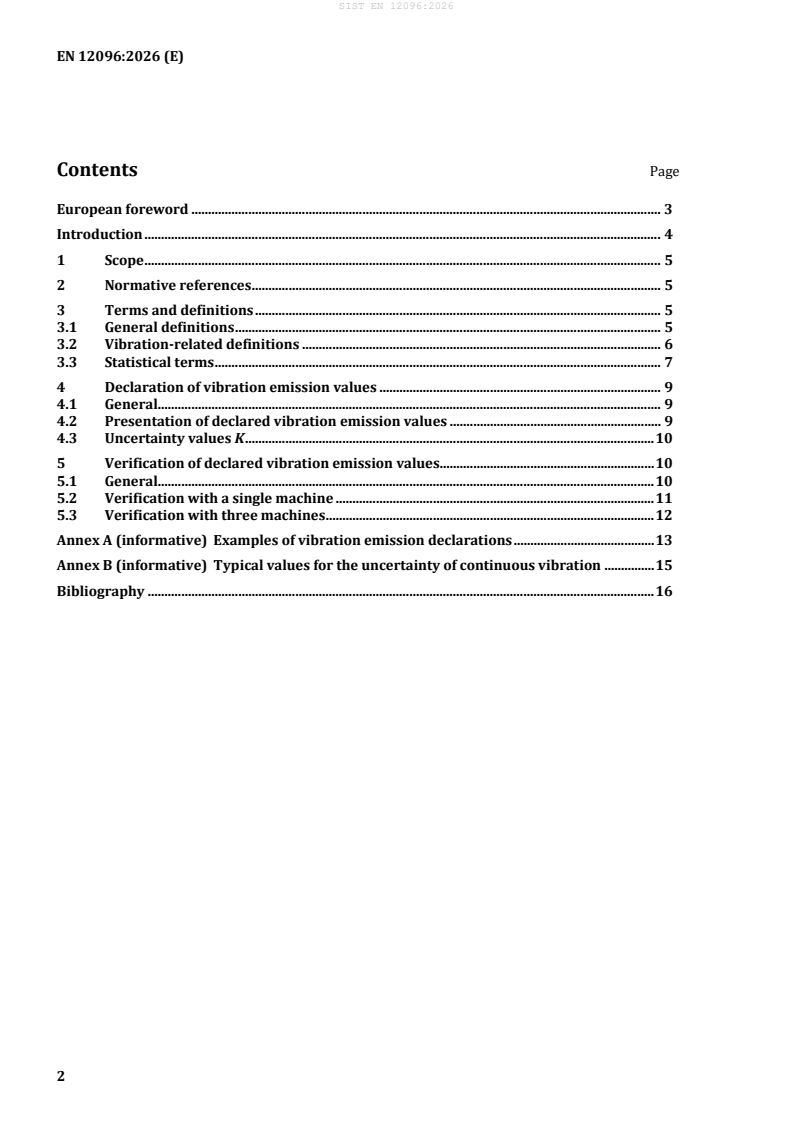
Contents Page
European foreword . 3
Introduction . 4
1 Scope . 5
2 Normative references . 5
3 Terms and definitions . 5
3.1 General definitions . 5
3.2 Vibration-related definitions . 6
3.3 Statistical terms . 7
4 Declaration of vibration emission values . 9
4.1 General. 9
4.2 Presentation of declared vibration emission values . 9
4.3 Uncertainty values K . 10
5 Verification of declared vibration emission values. 10
5.1 General. 10
5.2 Verification with a single machine . 11
5.3 Verification with three machines . 12
Annex A (informative) Examples of vibration emission declarations . 13
Annex B (informative) Typical values for the uncertainty of continuous vibration . 15
Bibliography . 16
European foreword
This document (EN 12096:2026) has been prepared by Technical Committee CEN/TC 231 “Mechanical
vibration and shock”, the secretariat of which is held by DIN.
This European Standard shall be given the status of a national standard, either by publication of an
identical text or by endorsement, at the latest by January 2027, and conflicting national standards shall
be withdrawn at the latest by January 2027.
Attention is drawn to the possibility that some of the elements of this document may be the subject of
patent rights. CEN shall not be held responsible for identifying any or all such patent rights.
This document supersedes EN 12096:1997.
— the document has been fundamentally adapted to the state of the art;
— repeated shock vibrations have been included;
— the structure has been revised so that a distinction can be made between declaration and verification.
Any feedback and questions on this document should be directed to the users’ national standards body.
A complete listing of these bodies can be found on the CEN website.
According to the CEN-CENELEC Internal Regulations, the national standards organisations of the
following countries are bound to implement this European Standard: Austria, Belgium, Bulgaria, Croatia,
Cyprus, Czech Republic, Denmark, Estonia, Finland, France, Germany, Greece, Hungary, Iceland, Ireland,
Italy, Latvia, Lithuania, Luxembourg, Malta, Netherlands, Norway, Poland, Portugal, Republic of North
Macedonia, Romania, Serbia, Slovakia, Slovenia, Spain, Sweden, Switzerland, Türkiye and the United
Kingdom.
Introduction
Information on vibration emission of vibrating machinery is needed by users, planners, manufacturers
and authorities, for example to comply with the obligations described in the EU Machinery Regulation
(EU) 2023/1230. This information is important for comparing the vibration emissions from different
products and for assessing the vibration against vibration requirements.
In order for vibration emission values to be useful, uniform methods are necessary for following
purposes:
— measurement of the vibration values;
— determination of the vibration emission values to be declared;
— presentation of the declared vibration emission values;
— verification of the declared vibration emission values.
The obligations to control risks arising from exposures to vibration are specified in Europe by Directive
2002/44/EC which uses a daily vibration exposure value A(8), that is not to be confused with the
vibration emission used in this document.
1 Scope
This document specifies the requirements for declaration and verification of vibration emission values of
continuous and repeated shock vibrations. It is applicable to hand-arm and whole-body vibration values
achieved by measurements according to type-B and type-C standards for portable hand-held, hand-
guided and mobile machinery.
This document
— gives guidance on the declaration of vibration emission values,
— describes vibration and product information to be given in the instructions for use supplied with the
machinery, and
— specifies the method for verifying the declared vibration emission values stated in the instruction for
use of the machinery.
NOTE Machines according to Machinery Regulation (EU) 2023/1230 Annex III Part B 2.2.1.1 and 3.6.3.1 are
covered by this document.
2 Normative references
There are no normative references in this document.
3 Terms and definitions
For the purposes of this document, the following terms and definitions apply.
ISO and IEC maintain terminology databases for use in standardization at the following addresses:
— ISO Online browsing platform: available at https://www.iso.org/obp/
— IEC Electropedia: available at https://www.electropedia.org/
3.1 General definitions
3.1.1
machinery
machine
assembly, fitted with or intended to be fitted with a drive system consisting of linked parts or
components, at least one of which moves, and which are joined together for a specific application
Note 1 to entry: The term machinery also covers an assembly of machines which, in order to achieve the same end,
are arranged and controlled so that they function as an integral whole.
[SOURCE: EN ISO 12100:2010, 3.1, modified – Note 2 to entry has been deleted.]
3.1.2
family of machinery
machinery (3.1.1) of similar design or type, intended to perform the same functions
3.1.3
batch of machinery
lot of machinery
number of units of machinery (3.1.1) intended to perform the same function, produced in quantity,
manufactured to the same technical specifications and characterized by the same declared vibration
emission value
Note 1 to entry: The batch may be an entire production series or a portion thereof.
3.1.4
operating mode
condition in which the machinery (3.1.1) is performing its intended function, which may be artificially
simulated, as specified in a relevant standard
3.1.5
vibration test code
type-C standard related to a specified family or sub-family or type of machinery (3.1.2), which gives all
the information necessary to efficiently carry out the determination of the vibration emission
characteristics needed for declaration and verification according to this document
Note 1 to entry: The test codes often exclude effects such as ageing or wear and tear.
3.2 Vibration-related definitions
3.2.1
hand-arm vibration
HAV
mechanical vibration directly applied or transmitted to the hand-arm system, commonly through the
palm of the hand or through the fingers gripping a tool or workpiece
[SOURCE: ISO 5805:1997, 5.9, modified – admitted term “hand-arm vibration” is changed to preferred
term; “hand-transmitted vibration”, its abbreviation “HTV” and “[shock]” deleted from definition]
3.2.2
whole-body vibration
WBV
mechanical vibration transmitted to the body as a whole, usually through areas of the body (e.g. buttocks,
soles of the feet, back) in contact with a supporting contact surface that is vibrating
[SOURCE: ISO 5805:1997, 5.7, modified – “[shock]” and “(or subject to shock motion)” deleted]
3.2.3
vibration total value to which the hand-arm system is subjected
a
hv
acceleration at the measuring point determined by measurement using a weighting filter according to
EN ISO 8041-1:2017 or by calculation as specified in EN ISO 5349-1:2001
Note 1 to entry: The hand-arm frequency-weighted acceleration is expressed in m/s .
3.2.4
weighted acceleration to which the whole-body is subjected
a , a , a
wx wy wz
acceleration at the measuring point determined by measurement using weighting filters according to
EN ISO 8041-1:2017
Note 1 to entry: The whole-body frequency-weighted acceleration is expressed in m/s .
Note 2 to entry: Indices x, y, z indicate the axes direction, see ISO 2631-1:1997.
3.2.5
vibration emission value for continuous vibration
a
variable representing the vibration emission value for continuous vibration with respect to a batch of
machinery (3.1.3) and a vibration test code (3.1.5)
Note 1 to entry: The vibration emission value is expressed in m/s .
Note 2 to entry: The vibration emission value, a, can be either one of the frequency-weighted values according to
definitions (3.2.3) or (3.2.4).
3.2.6
vibration emission value for repeated shock vibration
p
F
variable specified according to EN ISO 5349-3:2025, Clause 4, representing the vibration emission value
for repeated shock vibration with respect to a batch of machinery (3.1.3) and a vibration test code (3.1.5)
Note 1 to entry: The vibration emission value is expressed in m/s .
Note 2 to entry: pF is the specified parameter to represent the mean peak value of repeated shock vibrations
transmitted to the hand-arm system to be declared.
Note 3 to entry: p is the vibration peak magnitude (VPM) of the flat weighted acceleration according to
F h
EN ISO 5349-3:2025, Clause 4.
3.3 Statistical terms
3.3.1
estimate of the continuous vibration emission value
ˆ
a
estimate of the expected value of all possible measurement values for continuous vibration for a batch of
machinery (3.1.3) measured with a given vibration test code (3.1.5)
Note 1 to entry: Vibration test codes often estimate the expected value for assumed normal distributions with the
arithmetic mean of a sample.
3.3.2
estimate of the repeated shock vibration emission value
ˆ
p
F
estimate of the expected value of all possible measurement values for repeated shock vibration for a batch
of machinery (3.1.3) measured with a given vibration test code (3.1.5)
Note 1 to entry: Vibration test codes often estimate the expected value for assumed normal distributions with the
arithmetic mean of a sample.
3.3.3
uncertainty
K
value representing the uncertainty of the measured vibration emission value, a or p ,
F
and also, in the case of batches, production variations of machinery (3.1.1)
Note 1 to entry: The uncertainty is expressed in the same units as the declared emission values.
Note 2 to entry: Here the expanded uncertainty is indicated by the letter K. Its definition rests on the assumption
that all possible measurement values can be described by a normal distribution with expected values given by the
estimates of continuous or repeated shock vibration emission values and standard deviations given by the estimates
th
of the reference standard deviation (3.3.8). Its value is usually derived by an estimate of the 95 percentile of this
normal distribution.
3.3.4
sample
subset of values X from all possible measurement values for a batch of machinery (3.1.3) that result from
i
a vibration test code (3.1.5) (population)
3.3.5
reproducibi
...