


EN 13121-3:2008+A1:2010
(Main + Amendment)GRP tanks and vessels for use above ground - Part 3: Design and workmanship
General Information
- Abstract
This European Standard gives requirements for the design, fabrication, inspection, testing and verification of GRP tanks and vessels with or without Thermoplastics lining for storage or processing of fluids, factory made or site built, non pressurised or pressurised up to 10 bar, for use above ground.
The terms vessels and tanks as used in this European Standard include branches up to the point of connection to pipe work or other equipment by bolting and supports, brackets or other attachments bonded directly to the shell. In addition to the definitive requirements, this European Standard also requires the items in Clause 5 to be fully documented.
This European Standard covers vessels and tanks subject to temperatures between - 40 °C and + 120 °C.
NOTE It is possible that future advances in resin technology would allow tanks and vessels to be considered for operating temperatures above + 120 °C. Should such a situation arise and a manufacturer wishes to take advantage of such developments, then all other requirements of the standard shall be maintained and such tanks and vessels shall only be designed in accordance with the advanced design method given in 7.8.3.
Excluded from this European Standard are:
Tanks and vessels for the transport of fluids;
Underground storage tanks;
Spherical vessels;
Vessels and tanks of irregular shape;
Tanks and vessels with double containment;
Tanks and vessels which are subject to the risk of explosion, or failure of which may cause an emission of radioactivity;
Specification for fibre reinforced cisterns of one piece and sectional construction for the storage, above ground, of cold water (see EN 13280:2001).
- Status
- Withdrawn
- Publication Date
- 23-Feb-2010
- Withdrawal Date
- 22-Sep-2026
- Technical Committee
- CEN/TC 210 - GRP tanks and vessels
- Drafting Committee
- CEN/TC 210 - GRP tanks and vessels
- Current Stage
- 9960 - Withdrawal effective - Withdrawal
- Start Date
- 13-Apr-2016
- Completion Date
- 23-Sep-2026
- Directive
- Not Harmonized97/23/EC - Pressure equipmentOJ Ref: C, C 266 OJ Date: 09-Sep-2011

Relations
- Merged From
EN 13121-3:2008 - GRP tanks and vessels for use above ground - Part 3: Design and workmanship - Effective Date
- 18-Jan-2023
- Replaced By
EN 13121-3:2016 - GRP tanks and vessels for use above ground - Part 3: Design and workmanship - Effective Date
- 27-Feb-2013
- Effective Date
- 25-Aug-2026
- Effective Date
- 25-Aug-2026
- Refers
EN ISO 3915:2022 - Plastics - Measurement of resistivity of conductive plastics (ISO 3915:2022) - Effective Date
- 28-Jan-2026
- Effective Date
- 28-Jan-2026
- Effective Date
- 28-Jan-2026
- Effective Date
- 28-Jan-2026
- Effective Date
- 28-Jan-2026
- Refers
EN 13923:2005 - Filament-wound FRP pressure vessels - Materials, design, manufacturing and testing - Effective Date
- 28-Jan-2026
- Effective Date
- 28-Jan-2026
- Effective Date
- 28-Jan-2026
- Effective Date
- 28-Jan-2026
- Effective Date
- 28-Jan-2026
- Effective Date
- 28-Jan-2026
Get Certified
Connect with accredited certification bodies for this standard

Institut za varilstvo d.o.o. (Welding Institute)
Slovenia's leading welding institute since 1952. ISO 3834, EN 1090, pressure equipment certification, NDT personnel, welder qualification. Only IIW Au
Sponsored listings
Frequently Asked Questions
EN 13121-3:2008+A1:2010 is a standard published by the European Committee for Standardization (CEN). Its full title is "GRP tanks and vessels for use above ground - Part 3: Design and workmanship". This standard covers: This European Standard gives requirements for the design, fabrication, inspection, testing and verification of GRP tanks and vessels with or without Thermoplastics lining for storage or processing of fluids, factory made or site built, non pressurised or pressurised up to 10 bar, for use above ground. The terms vessels and tanks as used in this European Standard include branches up to the point of connection to pipe work or other equipment by bolting and supports, brackets or other attachments bonded directly to the shell. In addition to the definitive requirements, this European Standard also requires the items in Clause 5 to be fully documented. This European Standard covers vessels and tanks subject to temperatures between - 40 °C and + 120 °C. NOTE It is possible that future advances in resin technology would allow tanks and vessels to be considered for operating temperatures above + 120 °C. Should such a situation arise and a manufacturer wishes to take advantage of such developments, then all other requirements of the standard shall be maintained and such tanks and vessels shall only be designed in accordance with the advanced design method given in 7.8.3. Excluded from this European Standard are: Tanks and vessels for the transport of fluids; Underground storage tanks; Spherical vessels; Vessels and tanks of irregular shape; Tanks and vessels with double containment; Tanks and vessels which are subject to the risk of explosion, or failure of which may cause an emission of radioactivity; Specification for fibre reinforced cisterns of one piece and sectional construction for the storage, above ground, of cold water (see EN 13280:2001).
This European Standard gives requirements for the design, fabrication, inspection, testing and verification of GRP tanks and vessels with or without Thermoplastics lining for storage or processing of fluids, factory made or site built, non pressurised or pressurised up to 10 bar, for use above ground. The terms vessels and tanks as used in this European Standard include branches up to the point of connection to pipe work or other equipment by bolting and supports, brackets or other attachments bonded directly to the shell. In addition to the definitive requirements, this European Standard also requires the items in Clause 5 to be fully documented. This European Standard covers vessels and tanks subject to temperatures between - 40 °C and + 120 °C. NOTE It is possible that future advances in resin technology would allow tanks and vessels to be considered for operating temperatures above + 120 °C. Should such a situation arise and a manufacturer wishes to take advantage of such developments, then all other requirements of the standard shall be maintained and such tanks and vessels shall only be designed in accordance with the advanced design method given in 7.8.3. Excluded from this European Standard are: Tanks and vessels for the transport of fluids; Underground storage tanks; Spherical vessels; Vessels and tanks of irregular shape; Tanks and vessels with double containment; Tanks and vessels which are subject to the risk of explosion, or failure of which may cause an emission of radioactivity; Specification for fibre reinforced cisterns of one piece and sectional construction for the storage, above ground, of cold water (see EN 13280:2001).
EN 13121-3:2008+A1:2010 is classified under the following ICS (International Classification for Standards) categories: 23.020.10 - Stationary containers and tanks. The ICS classification helps identify the subject area and facilitates finding related standards.
EN 13121-3:2008+A1:2010 has the following relationships with other standards: It is inter standard links to EN 13121-3:2008, EN 13121-3:2016, ISO 4901:1985, ISO 48:2007, EN ISO 3915:2022, prEN ISO 7042, EN ISO 527-5:2021, EN ISO 75-2:2013, EN ISO 291:2008, EN 13923:2005, EN 13121-2:2003, EN 13121-4:2005, EN ISO 9513:2012, EN ISO 7500-1:2018, EN 1993-1-2:2024. Understanding these relationships helps ensure you are using the most current and applicable version of the standard.
EN 13121-3:2008+A1:2010 is associated with the following European legislation: EU Directives/Regulations: 97/23/EC; Standardization Mandates: M/071. When a standard is cited in the Official Journal of the European Union, products manufactured in conformity with it benefit from a presumption of conformity with the essential requirements of the corresponding EU directive or regulation.
EN 13121-3:2008+A1:2010 is available in PDF format for immediate download after purchase. The document can be added to your cart and obtained through the secure checkout process. Digital delivery ensures instant access to the complete standard document.
Standards Content (Sample)
2003-01.Slovenski inštitut za standardizacijo. Razmnoževanje celote ali delov tega standarda ni dovoljeno.Oberirdische GFK-Tanks und -Behälter - Teil 3: Auslegung und HerstellungRéservoirs et récipients en PRV pour applications hors sol - Partie 3: Conception et fabricationGRP tanks and vessels for use above ground - Part 3: Design and workmanship23.020.10UH]HUYRDUMLStationary containers and tanksICS:Ta slovenski standard je istoveten z:EN 13121-3:2008+A1:2010SIST EN 13121-3:2008+A1:2010en,fr,de01-julij-2010SIST EN 13121-3:2008+A1:2010SLOVENSKI
STANDARDSIST EN 13121-3:20081DGRPHãþD
EUROPEAN STANDARD NORME EUROPÉENNE EUROPÄISCHE NORM
EN 13121-3:2008+A1
February 2010 ICS 23.020.10 Supersedes EN 13121-3:2008English Version
GRP tanks and vessels for use above ground - Part 3: Design and workmanship
Réservoirs et récipients en PRV pour applications hors sol -Partie 3: Conception et fabrication
Oberirdische GFK-Tanks und -Behälter - Teil 3: Auslegung und Herstellung This European Standard was approved by CEN on 21 April 2008 and includes Amendment 1 approved by CEN on 11 January 2010.
CEN members are bound to comply with the CEN/CENELEC Internal Regulations which stipulate the conditions for giving this European Standard the status of a national standard without any alteration. Up-to-date lists and bibliographical references concerning such national standards may be obtained on application to the CEN Management Centre or to any CEN member.
This European Standard exists in three official versions (English, French, German). A version in any other language made by translation under the responsibility of a CEN member into its own language and notified to the CEN Management Centre has the same status as the official versions.
CEN members are the national standards bodies of Austria, Belgium, Bulgaria, Croatia, Cyprus, Czech Republic, Denmark, Estonia, Finland, France, Germany, Greece, Hungary, Iceland, Ireland, Italy, Latvia, Lithuania, Luxembourg, Malta, Netherlands, Norway, Poland, Portugal, Romania, Slovakia, Slovenia, Spain, Sweden, Switzerland and United Kingdom.
EUROPEAN COMMITTEE FOR STANDARDIZATION
COMITÉ EUROPÉEN DE NORMALISATION EUROPÄISCHES KOMITEE FÜR NORMUNG
Management Centre:
Avenue Marnix 17,
B-1000 Brussels © 2010 CEN All rights of exploitation in any form and by any means reserved worldwide for CEN national Members. Ref. No. EN 13121-3:2008+A1:2010: ESIST EN 13121-3:2008+A1:2010
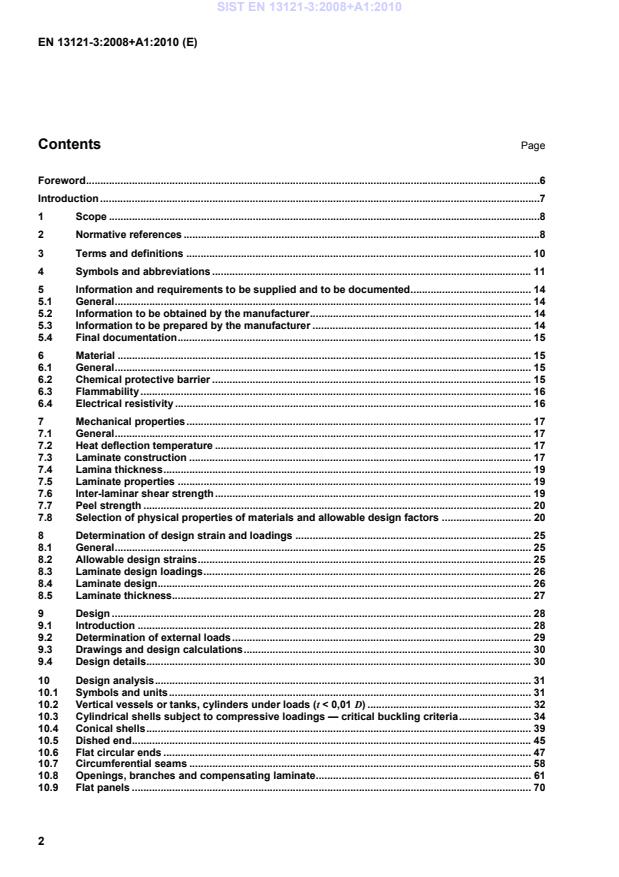
Product testing for volume or batch production process . 141 A.1 Initial type testing (ITT) . 141 A.2 Testing of samples . 141 A.3 Inspection and test records. 143 Annex B (informative)
Derivation of laminate properties from lamina properties . 144 B.1 General . 144 B.2 Lamina/laminate thickness . 144 B.3 Laminate modulus . 145 B.4 Determination of laminate flexural stiffness . 146 B.5 Determination of laminate strains from load resultants . 146 Annex C (normative)
Pressure and leak testing . 148 C.1 General . 148 C.2 Open top tanks and containers . 148 C.3 Closed tanks and vessels . 149 C.4 Hydraulic pressure test . 149 Annex D (normative)
Methods of tests . 150 SIST EN 13121-3:2008+A1:2010
Approval testing of laminators . 167 E.1 General . 167 E.2 Assessment of the laminator . 167 E.3 Procedure . 167 E.4 Test pieces . 168 E.5 Evaluation of test pieces . 168 E.6 Minimum requirements for acceptance . 169 E.7 Test certificate . 169 E.8 Validity and renewal . 169 E.9 Range of approval. 170 Annex F (normative)
Approval testing of welders . 171 F.1 General . 171 F.2 Test requirements . 172 F.3 Procedure . 172 F.4 Test pieces . 173 F.5 Evaluation of test pieces . 173 F.6 Minimum requirements for acceptance . 174 F.7 Test certificate . 174 F.8 Validity and renewal . 174 F.9 Range of approval. 174 Annex G (informative)
Loading from local loads - Methods of calculation . 176 G.1 General . 176 G.2 Local loads on pressure vessel shells . 176 Annex H (informative)
Design method for filament wound laminates . 203 H.1 General . 203 H.2 Filament wound laminate properties . 204 H.3 Design methods . 206 H.4 Axial instability . 209 Annex I (normative)
Pre-moulded flanges technical requirements . 215 I.1 General . 215 Annex J (informative)
Shells subjected to wind loading value from metallic codes . 217 J.1 Symbols . 217 Annex K (informative)
Horizontal vessel design . 222 K.1 General . 222 K.2 Strain modification for vessels on rigid saddle support . 222 SIST EN 13121-3:2008+A1:2010
Relationship between this European Standard and the Essential
Requirements of EU Directive 97/23/EC . 231 Bibliography . 232
(ISO 7500-1:2004) EN ISO 9513, Metallic materials — Calibration of extensometers used in uniaxial testing
(ISO 9513:1999) EN ISO 14125:1998, Fibre-reinforced plastic composites — Determination of flexural properties
(ISO 14125: 1998) ISO 48, Rubber, vulcanized or thermoplastic — Determination of hardness (hardness between 10 IRHD and 100 IRHD) ISO 4901, Reinforced plastics based on unsaturated polyester resins — Determination of residual styrene monomer content SIST EN 13121-3:2008+A1:2010
3.4 vessel a closed container subject to applied pressure or vacuum, with or without hydrostatic head, including branches up to the first flanged connection 3.5 tank a container for the storage of fluids subject only to the fluid hydrostatic head and freely vented to atmosphere, including branches up to the first flanged connection 3.6 laminate resin reinforced with glass fibre 3.7 gel coat a thin layer of resin on the surface of a laminate that may or not be reinforced with a glass or a synthetic fibre tissue 3.8 cure the chemical reaction resulting in the polymerised laminate 3.9 post cure the application of heat to take the polymerisation to a final stage 3.10 maximum allowable pressure (PS) the maximum pressure for which the equipment is designed, as decided by the manufacturer 3.11 differential pressure the difference of pressure on both sides of a component 3.12 design pressure (ρρρρD) the design pressure used in the calculations for a component SIST EN 13121-3:2008+A1:2010
(TS) the maximum or minimum temperature for which the equipment is designed, decided by the manufacturer 3.14 test temperature the temperature at which the pressure test of the equipment is carried out 3.15 test pressure (TP) the pressure to which the tank or vessel is tested 4 Symbols and abbreviations For the purposes of this standard, the symbols and abbreviations common to all clauses and annexes are given in Table 1. Further symbols are defined in the relevant clauses as required. Table 1 — Standard symbols and abbreviations Symbol Unit Definition A mm Distance a mm Dimension b mm Dimension d mm Diameter D mm Internal diameter of tank, vessel ∆<- Difference or additional E N/mm² Modulus of elasticity = tX ε<% Strain F - Buckling design factor φ<° Half the angle at the apex of the cone Θ<° Support saddle angle g m/s² Gravity h mm Height of dished end H mm Height of cone I mm4 Second moment of area k - Correction factor K - Overall design factor l mm Length L mm Overall length
ρ
q N/mm Applied unit load
FEP - Fluorinated ethylene-propylene copolymer FU - Furane FW - Filament winding HDT °C Heat deflection temperature IRHD ° International rubber hardness ln
Natural logarithm PF - Phenolic PFA - Perfluoro-alkoxy copolymer PP-B - Polypropylene, block polymer PP-H - Polypropylene, homopolymer PP-R - Polypropylene, random polymer PVC-U - Polyvinyl chloride, unplasticised PVDF - Polyvinylidene fluoride UP - Unsaturated polyester VE - Vinyl ester WR - Woven rovings CRL - Chemical Resistant Layer, see EN 13121-2 VL - Veil Layer, see EN 13121-2 TPL - Thermoplastics Liner, see EN 13121-2 Supp. - Support lam - Laminate S.G - Specific Gravity (Relative Density) O.D - Outside Diameter I.D - Inside Diameter
This specification document shall include but shall not be limited to the following: Dished ends: Lay-up details, crown radius, inside knuckle radius, torispherical shape plus minimum thickness. Shell barrel: Lay-up details, thickness, diameter. Flanges (including blind flanges): Type, standard and pressure rating as indicated in Tables 20 and 21 or for non-standard flanges: minimum thickness, drilling, inside and outside diameters, hub dimensions and facing details. Gaskets: Type, rating, material, thickness, inside and outside diameters and gasket seating data. Branches, nozzles, drains: The lay-up details, dimensions such as the wall thickness and outside diameter. Also the method of assembly, loads to be specified if applicable; location of openings relative to each other. Reinforcement: Details for nozzles, supports, lifting lugs, etc. SIST EN 13121-3:2008+A1:2010
The recommendations of the raw material suppliers for the usage of their materials shall be followed. Pigments shall not be used except when required for inclusion in the external resin flow coat, or to meet the requirements of 6.3 and 6.4. Limited use of thixotropic agents may be made provided their inclusion does not interfere with visual examination (see Table 23), or the chemical and mechanical properties of the cured resin system as required by EN 13121-2. 6.2 Chemical protective barrier 6.2.1 General The chemical protective barrier shall be selected in accordance with the requirements of EN 13121-2. The chemical barrier construction shall be ignored in any strength, or stability calculation. SIST EN 13121-3:2008+A1:2010
Table 2 — Thickness of thermoplastics
...