


prEN 1822-1
(Main)High efficiency air filters (EPA, HEPA and ULPA) - Part 1: Classification, performance testing, marking
General Information
- Abstract
This document is applicable to efficient particulate air filters (EPA), high efficiency particulate air filters (HEPA) and ultra-low penetration air filters (ULPA) used in the field of ventilation and air conditioning and for technical processes, e.g. for applications in clean room technology or pharmaceutical industry.
This document establishes a procedure for the determination of the efficiency on the basis of a particle counting method using a liquid (or alternatively a solid) test aerosol and allows a standardized classification of these filters in terms of their efficiency, both local and integral efficiency.
This document is based on particle counting methods which actually cover most needs of different applications.
- Status
- Not Published
- Publication Date
- 24-May-2027
- Technical Committee
- CEN/TC 195 - Air filters for general air cleaning
- Drafting Committee
- CEN/TC 195/WG 2 - HEPA and ULPA filters
- Current Stage
- 4020 - Submission to enquiry - Enquiry
- Start Date
- 06-Aug-2026
- Due Date
- 06-Jan-2026
- Completion Date
- 06-Aug-2026
Overview
prEN 1822-1: High Efficiency Air Filters (EPA, HEPA, and ULPA) - Part 1: Classification, Performance Testing, Marking is a European standard developed by CEN that specifies procedures for classifying, testing, and marking high efficiency particulate air filters. This standard applies to Efficient Particulate Air (EPA) filters, High Efficiency Particulate Air (HEPA) filters, and Ultra-Low Penetration Air (ULPA) filters used in ventilation, air conditioning, and technical applications such as cleanroom technology and the pharmaceutical industry.
prEN 1822-1 establishes a standardized procedure for determining filter efficiency using a particle counting method with liquid or solid test aerosols. It further defines criteria for both integral and local efficiency, enabling a harmonized classification of filters across various industries that require control of airborne particulate contamination.
Key Topics
Filter Types and Classification:
- EPA filters (Classes E10, E11, E12)
- HEPA filters (Classes H13, H14)
- ULPA filters (Classes U15, U16, U17)
- Filters are grouped and assigned classes based on defined efficiency requirements.
Test Procedures:
- Particle counting methods using test aerosols
- Determination of most penetrating particle size (MPPS)
- Three key steps: filter media efficiency testing, leak/local efficiency testing (for H and U groups), and integral efficiency testing
Performance Testing:
- Standardized test rigs and procedures (referencing EN ISO 29463 series)
- Use of both liquid and, where appropriate, solid aerosols for testing
- Data evaluation for both minimum and average filter efficiencies
Marking and Documentation:
- Mandatory filter labeling including filter class, manufacturer, nominal air flow, and standard reference
- Clear documentation and reporting, supporting traceability and quality assurance
Applications
High efficiency air filters classified and tested under prEN 1822-1 are critical in any environment where the quality of air cleanliness must be stringently controlled:
Cleanroom Technology:
- Filters ensure very low levels of particulate contamination essential for semiconductor manufacturing, biotechnology, and research laboratories.
Pharmaceutical Industry:
- Compliance with air cleanliness requirements in production areas to avoid product contamination.
Healthcare and Laboratories:
- Filtration for operation theatres, isolation rooms, and laboratories where airborne pathogens and particles pose serious risks.
Ventilation and Air Conditioning:
- High-performance HVAC systems in environments requiring enhanced indoor air quality.
Technical Processes:
- Industrial or scientific processes where product quality or personnel safety depends on low particulate counts.
Related Standards
For comprehensive filter performance evaluation and industry compliance, prEN 1822-1 references and aligns with several related standards, including:
- EN ISO 29463 series:
- Parts 2-5 cover test methods for aerosol production, sheet media testing, leak detection (scan method), and filter element testing
- EN ISO 29464:
- Vocabulary for cleaning of air and other gases
- EN ISO 5167-1:
- Fluid flow measurement in ducts
- ISO 2859-1:
- Sampling procedures for inspection by attributes
These standards support harmonization and international recognition of test methods and results, enabling precise communication of filter performance data and ensuring that users can confidently select the appropriate filter class for each critical application.
Keywords: high efficiency air filters, EPA, HEPA, ULPA, filter classification, particle counting, filter testing, cleanroom filters, pharmaceutical filtration, prEN 1822-1, CEN standard, air quality, ventilation standards, ISO 29463, air filter marking, quality assurance in air filtration.
Relations
- Effective Date
- 19-Feb-2025
Get Certified
Connect with accredited certification bodies for this standard

CIS Institut d.o.o.
Personal Protective Equipment (PPE) certification body. Notified Body NB-2890 for EU Regulation 2016/425 PPE.

Kiwa BDA Testing
Building and construction product certification.
Kmetijski inštitut Slovenije
Agricultural Institute of Slovenia. Soil testing, plant health, agricultural product analysis.
Sponsored listings
Frequently Asked Questions
prEN 1822-1 is a draft published by the European Committee for Standardization (CEN). Its full title is "High efficiency air filters (EPA, HEPA and ULPA) - Part 1: Classification, performance testing, marking". This standard covers: This document is applicable to efficient particulate air filters (EPA), high efficiency particulate air filters (HEPA) and ultra-low penetration air filters (ULPA) used in the field of ventilation and air conditioning and for technical processes, e.g. for applications in clean room technology or pharmaceutical industry. This document establishes a procedure for the determination of the efficiency on the basis of a particle counting method using a liquid (or alternatively a solid) test aerosol and allows a standardized classification of these filters in terms of their efficiency, both local and integral efficiency. This document is based on particle counting methods which actually cover most needs of different applications.
This document is applicable to efficient particulate air filters (EPA), high efficiency particulate air filters (HEPA) and ultra-low penetration air filters (ULPA) used in the field of ventilation and air conditioning and for technical processes, e.g. for applications in clean room technology or pharmaceutical industry. This document establishes a procedure for the determination of the efficiency on the basis of a particle counting method using a liquid (or alternatively a solid) test aerosol and allows a standardized classification of these filters in terms of their efficiency, both local and integral efficiency. This document is based on particle counting methods which actually cover most needs of different applications.
prEN 1822-1 is classified under the following ICS (International Classification for Standards) categories: 13.040.40 - Stationary source emissions. The ICS classification helps identify the subject area and facilitates finding related standards.
prEN 1822-1 has the following relationships with other standards: It is inter standard links to EN 1822-1:2019. Understanding these relationships helps ensure you are using the most current and applicable version of the standard.
prEN 1822-1 is available in PDF format for immediate download after purchase. The document can be added to your cart and obtained through the secure checkout process. Digital delivery ensures instant access to the complete standard document.
Standards Content (Sample)
SLOVENSKI STANDARD
01-oktober-2026
Visoko učinkoviti zračni filtri (EPA, HEPA in ULPA) - 1. del: Razvrščanje,
preskušanje lastnosti, označevanje
High efficiency air filters (EPA, HEPA and ULPA) - Part 1: Classification, performance
testing, marking
Schwebstofffilter (EPA, HEPA und ULPA) - Teil 1: Klassifikation, Leistungsprüfung,
Kennzeichnung
Filtres à air à haute efficacité (EPA, HEPA et ULPA) - Partie 1 : Classification, essais de
performance et marquage
Ta slovenski standard je istoveten z: prEN 1822-1
ICS:
13.040.40 Emisije nepremičnih virov Stationary source emissions
2003-01.Slovenski inštitut za standardizacijo. Razmnoževanje celote ali delov tega standarda ni dovoljeno.
DRAFT
EUROPEAN STANDARD
NORME EUROPÉENNE
EUROPÄISCHE NORM
August 2026
ICS 13.040.40 Will supersede EN 1822-1:2019
English Version
High efficiency air filters (EPA, HEPA and ULPA) - Part 1:
Classification, performance testing, marking
Filtres à air à haute efficacité (EPA, HEPA et ULPA) - Schwebstofffilter (EPA, HEPA und ULPA) - Teil 1:
Partie 1 : Classification, essais de performance et Klassifikation, Leistungsprüfung, Kennzeichnung
marquage
This draft European Standard is submitted to CEN members for enquiry. It has been drawn up by the Technical Committee
CEN/TC 195.
If this draft becomes a European Standard, CEN members are bound to comply with the CEN/CENELEC Internal Regulations
which stipulate the conditions for giving this European Standard the status of a national standard without any alteration.
This draft European Standard was established by CEN in three official versions (English, French, German). A version in any other
language made by translation under the responsibility of a CEN member into its own language and notified to the CEN-CENELEC
Management Centre has the same status as the official versions.
CEN members are the national standards bodies of Austria, Belgium, Bulgaria, Croatia, Cyprus, Czech Republic, Denmark, Estonia,
Finland, France, Germany, Greece, Hungary, Iceland, Ireland, Italy, Latvia, Lithuania, Luxembourg, Malta, Netherlands, Norway,
Poland, Portugal, Republic of North Macedonia, Romania, Serbia, Slovakia, Slovenia, Spain, Sweden, Switzerland, Türkiye and
United Kingdom.
Recipients of this draft are invited to submit, with their comments, notification of any relevant patent rights of which they are
aware and to provide supporting documentation.
Warning : This document is not a European Standard. It is distributed for review and comments. It is subject to change without
notice and shall not be referred to as a European Standard.
EUROPEAN COMMITTEE FOR STANDARDIZATION
COMITÉ EUROPÉEN DE NORMALISATION
EUROPÄISCHES KOMITEE FÜR NORMUNG
CEN-CENELEC Management Centre: Rue de la Science 23, B-1040 Brussels
© 2026 CEN All rights of exploitation in any form and by any means reserved Ref. No. prEN 1822-1:2026 E
worldwide for CEN national Members.
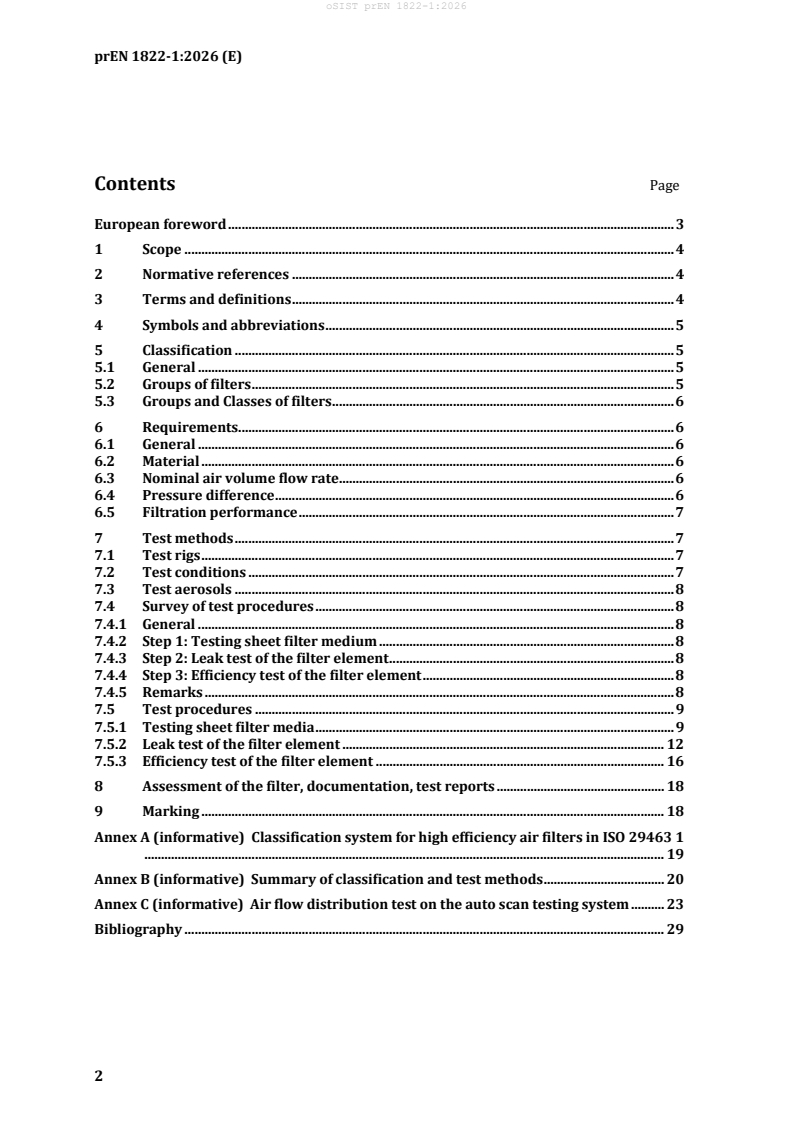
Contents Page
European foreword . 3
1 Scope . 4
2 Normative references . 4
3 Terms and definitions . 4
4 Symbols and abbreviations . 5
5 Classification . 5
5.1 General . 5
5.2 Groups of filters . 5
5.3 Groups and Classes of filters . 6
6 Requirements . 6
6.1 General . 6
6.2 Material . 6
6.3 Nominal air volume flow rate. 6
6.4 Pressure difference . 6
6.5 Filtration performance . 7
7 Test methods . 7
7.1 Test rigs . 7
7.2 Test conditions . 7
7.3 Test aerosols . 8
7.4 Survey of test procedures . 8
7.4.1 General . 8
7.4.2 Step 1: Testing sheet filter medium . 8
7.4.3 Step 2: Leak test of the filter element . 8
7.4.4 Step 3: Efficiency test of the filter element . 8
7.4.5 Remarks . 8
7.5 Test procedures . 9
7.5.1 Testing sheet filter media . 9
7.5.2 Leak test of the filter element . 12
7.5.3 Efficiency test of the filter element . 16
8 Assessment of the filter, documentation, test reports . 18
9 Marking . 18
Annex A (informative) Classification system for high efficiency air filters in ISO 29463 1
........................................................................................................................................................... 19
Annex B (informative) Summary of classification and test methods . 20
Annex C (informative) Air flow distribution test on the auto scan testing system . 23
Bibliography . 29
prEN 1822:2026 (E)
European foreword
This document (prEN 1822-1:2026) has been prepared by Technical Committee CEN/TC 195
“Cleaning equipment for air and other gases”, the secretariat of which is held by UNI.
This document is currently submitted to the CEN Enquiry.
This document will supersede EN 1822-1:2019.
EN 1822-1 :2026 includes the following significant technical changes with respect to
EN 1822-1:2019:
• Filter classes ISO05E and ISO10E from ISO 29463-1 added to Table A.1.
• New Annex B (informative) “Summary of classification and test methods” added.
• New Annex C (informative) “Air flow distribution test on the auto scan testing system” added
(Source: ISO 29463-1:2024 informative Annex C)
EN 1822, High efficiency air filters (EPA, HEPA and ULPA), currently consists of the following part:
• Part 1: Classification, performance testing, marking
In 2019, EN 1822 Part 2 to Part 5 have been replaced by the corresponding parts of EN ISO 29463.
This document is intended to be used in conjunction with:
• EN ISO 29463-2, High-efficiency filters and filter media for removing particles in air — Part 2:
Aerosol production, measuring equipment and particle-counting statistics
• EN ISO 29463-3, High-efficiency filters and filter media for removing particles in air — Part 3:
Testing flat sheet filter media
• EN ISO 29463-4, High-efficiency filters and filter media for removing particles in air — Part 4:
Test method for determining leakage of filter element — Scan method
• EN ISO 29463-5, High-efficiency filters and filter media for removing particles in air — Part 5:
Test method for filter elements
When reference is made to ISO 29463-1 in EN ISO 29463-2 to −5, at European level EN 1822-1
applies.
1 Scope
This document is applicable to efficient particulate air filters (EPA), high efficiency particulate air
filters (HEPA) and ultra-low penetration air filters (ULPA) used in the field of ventilation and air
conditioning and for technical processes, e.g. for applications in clean room technology or
pharmaceutical industry.
This document establishes a procedure for the determination of the efficiency on the basis of a
particle counting method using a liquid (or alternatively a solid) test aerosol and allows a
standardized classification of these filters in terms of their efficiency, both local and integral
efficiency.
This document is based on particle counting methods which actually cover most needs of different
applications.
2 Normative references
The following documents are referred to in the text in such a way that some or all of their content
constitutes requirements of this document. For dated references, only the edition cited applies. For
undated references, the latest edition of the referenced document (including any amendments)
applies.
EN ISO 29463-2:2018, High-efficiency filters and filter media for removing particles in air — Part 2:
Aerosol production, measuring equipment and particle-counting statistics (ISO 29463-2:2011)
EN ISO 29463-3, High-efficiency filters and filter media for removing particles in air — Part 3: Testing
flat sheet filter media (ISO 29463-3)
EN ISO 29463-4:2018, High-efficiency filters and filter media for removing particles in air — Part 4:
Test method for determining leakage of filter elements-Scan method (ISO 29463-4:2011)
EN ISO 29463-5:2022, High-efficiency filters and filter media for removing particles in air — Part 5:
Test method for filter elements (ISO 29463-5:2022)
EN ISO 29464, Cleaning of air and other gases - Vocabulary (ISO 29464)
EN ISO 5167-1, Measurement of fluid flow by means of pressure differential devices inserted in circular
cross-section conduits running full - Part 1: General principles and requirements (ISO 5167-1)
ISO 2859-1, Sampling procedures for inspection by attributes — Part 1: Sampling schemes indexed by
acceptance quality limit (AQL) for lot-by-lot inspection
3 Terms and definitions
For the purposes of this document, the terms and definitions given in EN ISO 29464 and the following
apply.
ISO and IEC maintain terminology databases for use in standardization at the following addresses:
— ISO Online browsing platform: available at https://www.iso.org/obp/
— IEC Electropedia: available at https://www.electropedia.org/
3.1
nominal air volume flow rate
air volume flow rate specified by the manufacturer, at which the filter element has to be tested
prEN 1822:2026 (E)
3.2
superficial face area
cross-sectional area of the filter element through which the air flow passed
[SOURCE: EN ISO 29464:2024, 3.2.38]
3.3
nominal filter medium face velocity
nominal air volume flow rate divided by the effective filter medium area
4 Symbols and abbreviations
For the purposes of this document, the following symbols and abbreviations apply:
d Particle diameter
p
E Efficiency
P Penetration
p Pressure
RH Relative humidity
T Temperature
σ Geometric standard deviation
g
CNC Condensation nucleus counter
DEHS Sebacic acid-bis (2 ethyl hexyl-) ester (trivial name: di-ethyl-hexyl-sebacate)
DMA Differential electric mobility analyser
DMPS Differential mobility particle sizer
DOP Phthalic acid-bis (2-ethyl hexyl-) ester (trivial name: di-octyl-phthalate)
MPPS Most penetrating particle size (= particle size, for which the filtration efficiency is a
minimum)
OPC Optical particle counter
PAO Polyalphaolefin
PSL Poly-Styrol Latex (solid spheres)
5 Classification
5.1 General
Filter elements are classified in groups and classes according to their filtration performance
(efficiency or penetration).
5.2 Groups of filters
According to this document, filter elements fall into one of the following Groups:
— Group E: EPA filters (Efficient Particulate Air filter);
— Group H: HEPA filters (High Efficiency Particulate Air filter);
— Group U: ULPA filters (Ultra Low Penetration Air filter).
5.3 Groups and Classes of filters
Filters are classified in Groups and Classes. For each group a slightly different test procedure applies.
All filters are classified according to their filtration performance (see 6.5).
Group E filters are subdivided in three classes:
— Class E10;
— Class E11;
— Class E12.
Group H filters are subdivided in two classes:
— Class H13;
— Class H14.
Group U filters are subdivided in three classes:
— Class U15;
— Class U16;
— Class U17.
6 Requirements
6.1 General
The filter element shall be designed or marked so as to prevent incorrect mounting.
The filter element shall be designed so that when correctly mounted in the ventilation duct, no leak
occurs along the sealing edge.
If, for any reason, dimensions do not allow testing of a filter under standard test conditions, assembly
of two or more filters of the same type or model is permitted, provided no leaks occur in the resulting
filter.
6.2 Material
The filter element shall be made of suitable material to withstand normal usage and exposures to
those temperatures, humidities and corrosive environments that are likely to be encountered.
The filter element shall be designed so that it will withstand mechanical constraints that are likely to
be encountered during normal use.
Dust or fibres released from the filter media by the air flow through the filter element shall not
constitute a hazard or nuisance for the people (or devices) exposed to filtered air.
6.3 Nominal air volume flow rate
The filter element shall be tested at its nominal air volume flow rate for which the filter has been
designed by the manufacturer.
6.4 Pressure difference
The pressure difference across the filter element is recorded at the nominal air volume flow rate.
prEN 1822:2026 (E)
6.5 Filtration performance
The filtration performance is expressed by the efficiency or the penetration of MPPS particles.
After testing in accordance with Clause 7, filter elements are classified according to Table 1, on the
bases of their integral (Group E) or their integral and local (Groups H and U) MPPS efficiency or
penetration.
Filters with filter media having an electrostatic charge are classified according to Table 1, on the
bases of their discharged efficiency or penetration according to EN ISO 29463-5:2022, Annex C.
Table 1 — Classification of EPA, HEPA and ULPA filters
a b
Filter Group Integral value
Local value
Filter Class Efficiency (%) Penetration (%) Efficiency (%) Penetration (%)
c c
E10 ≥ 85 ≤ 15 –- –-
c c
E11 ≥ 95 ≤ 5 –- –-
c c
E12 ≥ 99,5 ≤ 0,5 –- –-
H13 ≥ 99,95 ≤ 0,05 ≥ 99,75 ≤ 0,25
H14 ≥ 99,995 ≤ 0,005 ≥ 99,975 ≤ 0,025
U15 ≥ 99,999 5 ≤ 0,000 5 ≥ 99,997 5 ≤ 0,002 5
U16 ≥ 99,999 95 ≤ 0,000 05 ≥ 99,999 75 ≤ 0,000 25
U17 ≥ 99,999 995 ≤ 0,000 005 ≥ 99,999 9 ≤ 0,000 1
a
See 7.5.2 and EN ISO 29463-4.
b
Local penetration values lower than those given in the table may be agreed between supplier and
purchaser.
c
Group E filters (Classes E10, E11 and E12) cannot and shall not be leak tested for classification purposes.
NOTE ISO 29463-1:2024 developed by ISO/TC 142 includes a classification system for high efficiency air
filters according to their filtration performance (efficiency or penetration) similar to EN 1822-1. Table A.1 gives
a by-side comparison of the classification in EN 1822-1 and ISO 29463-1:2024.
7 Test methods
7.1 Test rigs
The test rigs are described in detail in EN ISO 29463-3, EN ISO 29463-4 and EN ISO 29463-5. The
individual methods of measurement and the measuring instruments are described in
EN ISO 29463-2.
7.2 Test conditions
The air in the test channel used for testing shall comply with the following requirements:
— Temperature: (23 ± 5) °C;
— Relative humidity < 75 %.
The temperature shall remain constant during the entire test procedure within ± 2 °C the relative
humidity within ± 5 %.
The cleanliness of the test air shall be ensured by appropriate pre-filtering, so that in operation
without addition of aerosol the particle number concentration measured with the particle counting
−3
method is less than 352 000 m . The test specimen shall have the same temperature as the test air.
7.3 Test aerosols
For the testing of EPA, HEPA and ULPA filters in accordance with this document, a liquid test aerosol
shall be used. Alternatively, a solid aerosol may be used for leak testing (see EN ISO 29463-4:2018,
Annex E). Possible aerosol substances include but are not limited to DEHS, PAO and PSL. For further
details, see EN ISO 29463-2:2018, 4.1.
The use of alternative materials for challenge aerosols can also be agreed between supplier and
purchaser when the materials specified in this document are unacceptable.
The concentration and the size distribution of the aerosol shall be constant over time. For the leak
testing and the efficiency test of the filter element the mean particle diameter of the test aerosol shall
correspond to the most penetrating particle size (MPPS) for the filter medium.
7.4 Survey of test procedures
7.4.1 General
The complete testing procedure for EPA, HEPA and ULPA filters in accordance with this document
consists of three steps, each of which may be implemented as an independent test.
7.4.2 Step 1: Testing sheet filter medium
The efficiency of flat sheet filter medium test samples shall be determined for a range of particle sizes
at the nominal filter medium velocity. From the efficiency versus particle size curve, generated this
way, the most penetrating particle size (MPPS) shall be determined.
See 7.5.1.
7.4.3 Step 2: Leak test of the filter element
Filter elements of Groups H and U shall be individually tested for absence of leaks at their nominal
air volume flow rate. Filter elements of Group H shall be leak tested using either the reference
scanning method or the Oil Thread Test (EN ISO 29463-4:2018, Annex A). H13 may also be tested
according to EN ISO 29463-4:2018, Annex F. Filter elements of Group U shall be leak tested using the
MPPS scanning method, described in EN ISO 29463-4, only.
See 7.5.2.
7.4.4 Step 3: Efficiency test of the filter element
Using the MPPS test aerosol (the same as used in step 2), the integral efficiency of the filter element
shall be determined at its nominal air volume flow rate.
For filters of Group E, this shall be done on statistical bases (see EN ISO 29463-5:2022, 4.2). For filters
of Groups H and U, this shall be done on each individual filter, except for filters tested as per
EN ISO 29463-4:2018, Annex A, where testing on statistical bases is acceptable.
See 7.5.3.
The use of the aerosol photometer filter scan leak test is not allowed.
7.4.5 Remarks
On the basis of the value(s) determined for integral efficiency and for filters of Groups H and U also
for local efficiency (= absence of relevant leaks), filter elements shall be assigned to a filter class as
specified in 6.5. This assignment is only valid if the fixed test conditions are met.
prEN 1822:2026 (E)
In all three procedural steps it is permissible to use either a monodisperse or a polydisperse test
aerosol. The particle counting method used may be a total count method (CNC) or a method involving
particle size analysis (OPC).
Since total count particle counting methods provide no information about the particle size, they may
only be used to determine the efficiency in procedural step 1 with monodisperse test aerosols of a
known particle size.
For the determination of the minimum efficiency of the flat sheet filter medium (step 1) the test
method using a monodisperse test aerosol shall be considered as the reference test method. Care
shall be taken for the correlation with the reference test method if using a polydisperse aerosol for
steps 2 and 3.
For production testing, filter manufacturers may use data of their filter medium supplier for
procedural step 1, instead of doing these tests themselves, as long as these data are fully traceable
and documented and the tests are done in full accordance with this document, and in particular with
EN ISO 29463-3.
However, it is necessary to be aware that, in any case, it remains the responsibility of the filter
manufacturer to ensure the correctness in accordance with this document, traceability and
documentation of the data. This can be accomplished by maintaining a quality management system,
e.g. EN ISO 9000, including supplier audits and regular cross-checking of the data provided by the
filter medium supplier or verified by third-party measurements. The cross-checking of the filter
medium data shall be done using an accepted statistical method, which can be the skip lot procedure
as described in ISO 2859-1 or any equivalent alternative method.
7.5 Test procedures
7.5.1 Testing sheet filter media
7.5.1.1 General
The fractional efficiency curve of flat sheets filter medium samples shall be determined in new
condition (material as supplied by the medium manufacturer) and in discharged condition (see
EN ISO 29463-5:2022, Annex C). If these measurements reveal that the filter medium is having a
significant charge, the filter elements shall be classified on the bases of the discharged flat sheet
efficiency or penetration measurements as per EN ISO 29463-5:2022, Annex C.
7.5.1.2 Test samples
The testing procedure requires at least five flat sheet samples of filter material of which the filter
elements will be made.
The test samples shall be free of folds, creases, holes and other irregularities. The test samples shall
have a minimum size of 200 mm x 200 mm.
7.5.1.3 Test apparatus
The arrangement of the test apparatus is shown in Figure 1. An aerosol is produced in the aerosol
generator, then passed through a conditioner (for example to evaporate a solvent) and neutralized,
before being brought together with the particle-free mixing air to the test filter mounting assembly.
Upstream and downstream from the test filter mounting assembly, there are sampling points from
which a part of the flow is led to the particle counter. The upstream sampling point is connected with
a dilution circuit to dilute the high particle concentration down to the actual measuring range of the
particle counter.
When using the total counting method (CNC) a differential electric mobility analyser (DMA) is
included before the aerosol neutralizer to separate out a (quasi-)monodisperse fraction of the
required particle size from the initial polydisperse aerosol.
If a counting method with particle size analysis (OPC) is used, the size distribution of a polydisperse
aerosol can be measured before and after the test specimen.
Instead of using a single particle counter, which measures the unfiltered and filtered air
consecutively, it is also permissible to use two particle counters of equal optical design (wavelength
of light source, light scattering angle, etc.) simultaneously for both measurements. When using two
particle counters, the two counters shall be correlated by measuring the same aerosol to correct for
any response differences. It is known that OPCs of the same model can give different responses.
After the downstream sampling point, the test aerosol is led through an exhaust filter and extracted
by a pump. The apparatus is completed by devices to measure (and regulate) the air volume flow rate
and the pressure drop across the test specimen.
The measurement data are recorded and evaluated by a computer.
The test apparatus can also be operated in an overpressure mode. In this case the extraction pump
is not required, and the mixing air is supplied from a compressed air line. If so desired, the
measurement and regulation of the air volume flow rate can then be carried out on the upstream
side.
The test rig is described in detail in EN ISO 29463-3. The individual methods of measurement are
described in EN ISO 29463-2.
7.5.1.4 Measurement procedure
The test sample shall be mounted in a test filter holding assembly with a cylindrical cross-section
giving an exposed area of 100 cm and subjected to a flow of test air at the nominal filter medium
face velocity.
The test aerosol shall be added to the test air volume flow at a uniform rate. In order to establish the
penetration versus p
...