


EN 16466-2:2013
(Main)Vinegar - Isotopic analysis of acetic acid and water - Part 2: 13C-IRMS analysis of acetic acid
General Information
- Abstract
This European standard specifies an isotopic method to control the authenticity of vinegar. This method is applicable on acetic acid of vinegar (from cider, alcohol, wine, etc.) in order to characterise the botanical origin of acetic acid and to detect adulterations of vinegar using synthetic acetic acid or acetic acid from not allowed origin (together with the method described in FprEN 16466-1).
The isotopic analysis of the extracted acetic acid by 13C-IRMS is based on a similar method already normalised for wine analysis [2].
- Status
- Published
- Publication Date
- 08-Jan-2013
- Technical Committee
- CEN/TC 460 - Food Authenticity
- Drafting Committee
- CEN/SS C01 - Food products
- Current Stage
- 9093 - Decision to confirm - Review Enquiry
- Start Date
- 28-Aug-2025
- Completion Date
- 23-Sep-2026

Overview
EN 16466-2:2013 sets out a European Standard method for the isotopic analysis of acetic acid in vinegar using 13C Isotope Ratio Mass Spectrometry (13C-IRMS). Developed and published by CEN, this standard supports authenticity and purity control for vinegars, particularly in detecting adulteration with synthetic acetic acid or acid from unauthorized sources. The method applies to vinegars from various origins, including wine, cider, and alcohol vinegar, and forms part of a series on verifying vinegar composition through isotopic techniques.
Key Topics
Isotopic Analysis for Vinegar Authenticity
The standard specifies how to determine the isotopic ratio of carbon (13C/12C) in the acetic acid extracted from vinegar, using Isotope Ratio Mass Spectrometry (IRMS). This ratio is key to characterizing the botanical origin of the acetic acid.Detection of Adulteration
By analyzing isotopic signatures, EN 16466-2:2013 can distinguish vinegar made via permitted biotechnological processes from vinegar adulterated with synthetic acetic acid or acetic acid from petrochemical or wood pyrolysis sources.Extraction and Preparation Procedures
Acetic acid is extracted from vinegar samples using solvents such as diethyl ether. Careful extraction and purification steps are followed before isotopic analysis.Measurement Principles
The extracted acetic acid undergoes combustion, converting it to CO2, and an IRMS instrument records the 13C/12C ratio. Accuracy, precision, and proper calibration using reference materials are emphasized.Reporting Requirements
The method mandates thorough reporting of sample identification, analysis results, and all deviations from the prescribed method, ensuring clear traceability and reproducibility.
Applications
Implementing EN 16466-2:2013 provides significant benefits to food quality control and industry compliance:
Food Authentication
Food control laboratories and vinegar producers use this method to verify the authenticity of vinegars, ensuring they derive from permitted agricultural processes rather than synthetic or unauthorized sources.Adulteration Prevention
Regulatory agencies utilize this standard to detect and prevent market fraud involving the substitution of natural vinegar with cheaper synthetic acetic acid.Quality Assurance in Production
Vinegar manufacturers apply the isotopic method to support label claims about origin (e.g., wine vinegar, cider vinegar) and maintain consumer trust.Compliance with European Regulations
EN 16466-2:2013 helps stakeholders meet EU regulations regarding the permitted origins and definitions of vinegar products, as outlined in EN 13188 and relevant European Commission regulations.
Related Standards
For comprehensive quality and authenticity evaluation of vinegar, reference may be made to the following standards:
- EN 16466-1: Vinegar - Isotopic analysis of acetic acid and water - Part 1: 2H-NMR analysis of acetic acid
- EN 16466-3: Vinegar - Isotopic analysis of acetic acid and water - Part 3: 18O-IRMS analysis of water
- EN 13188: Vinegar - Product made from liquids of agricultural origin - Definitions, requirements, marking
- EN 13189: Acetic acid food grade - Definitions, requirements, marking
- OIV-MA-AS312-06: Determination of 13C/12C in wine ethanol by IRMS
Keywords: vinegar authenticity, isotopic analysis, 13C-IRMS, acetic acid origin, EN 16466-2:2013, food fraud detection, vinegar adulteration, CEN standard, food additives, European regulations, mass spectrometry, vinegar quality control.
Get Certified
Connect with accredited certification bodies for this standard

BSI Group
BSI (British Standards Institution) is the business standards company that helps organizations make excellence a habit.

Bureau Veritas
Bureau Veritas is a world leader in laboratory testing, inspection and certification services.

DNV
DNV is an independent assurance and risk management provider.
Sponsored listings
Frequently Asked Questions
EN 16466-2:2013 is a standard published by the European Committee for Standardization (CEN). Its full title is "Vinegar - Isotopic analysis of acetic acid and water - Part 2: 13C-IRMS analysis of acetic acid". This standard covers: This European standard specifies an isotopic method to control the authenticity of vinegar. This method is applicable on acetic acid of vinegar (from cider, alcohol, wine, etc.) in order to characterise the botanical origin of acetic acid and to detect adulterations of vinegar using synthetic acetic acid or acetic acid from not allowed origin (together with the method described in FprEN 16466-1). The isotopic analysis of the extracted acetic acid by 13C-IRMS is based on a similar method already normalised for wine analysis [2].
This European standard specifies an isotopic method to control the authenticity of vinegar. This method is applicable on acetic acid of vinegar (from cider, alcohol, wine, etc.) in order to characterise the botanical origin of acetic acid and to detect adulterations of vinegar using synthetic acetic acid or acetic acid from not allowed origin (together with the method described in FprEN 16466-1). The isotopic analysis of the extracted acetic acid by 13C-IRMS is based on a similar method already normalised for wine analysis [2].
EN 16466-2:2013 is classified under the following ICS (International Classification for Standards) categories: 67.220.10 - Spices and condiments. The ICS classification helps identify the subject area and facilitates finding related standards.
EN 16466-2:2013 is available in PDF format for immediate download after purchase. The document can be added to your cart and obtained through the secure checkout process. Digital delivery ensures instant access to the complete standard document.
Standards Content (Sample)
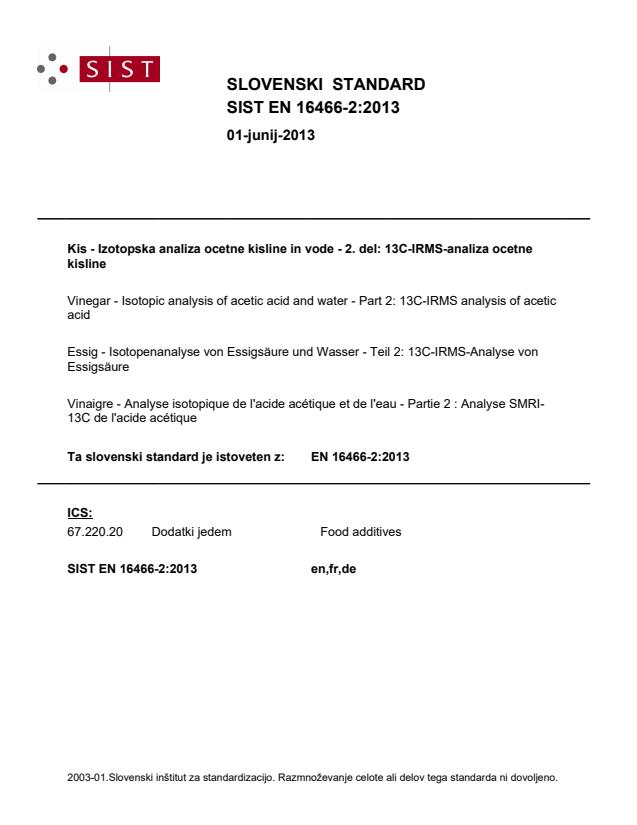
2003-01.Slovenski inštitut za standardizacijo. Razmnoževanje celote ali delov tega standarda ni dovoljeno.Kis - Izotopska analiza ocetne kisline in vode - 2. del: 13C-IRMS-analiza ocetne kislineEssig - Isotopenanalyse von Essigsäure und Wasser - Teil 2: 13C-IRMS-Analyse von EssigsäureVinaigre - Analyse isotopique de l'acide acétique et de l'eau - Partie 2 : Analyse SMRI-13C de l'acide acétiqueVinegar - Isotopic analysis of acetic acid and water - Part 2: 13C-IRMS analysis of acetic acid67.220.20Dodatki jedemFood additivesICS:Ta slovenski standard je istoveten z:EN 16466-2:2013SIST EN 16466-2:2013en,fr,de01-junij-2013SIST EN 16466-2:2013SLOVENSKI
STANDARD
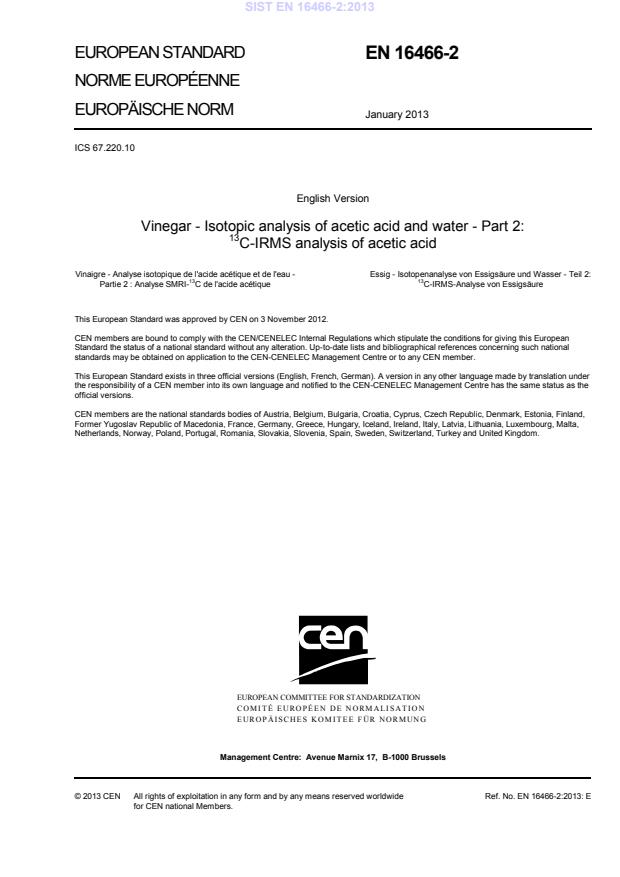
EUROPEAN STANDARD NORME EUROPÉENNE EUROPÄISCHE NORM
EN 16466-2
January 2013 ICS 67.220.10
English Version
Vinegar - Isotopic analysis of acetic acid and water - Part 2:
13C-IRMS analysis of acetic acid
Vinaigre - Analyse isotopique de l'acide acétique et de l'eau - Partie 2 : Analyse SMRI-13C de l'acide acétique
Essig - Isotopenanalyse von Essigsäure und Wasser - Teil 2: 13C-IRMS-Analyse von Essigsäure This European Standard was approved by CEN on 3 November 2012.
CEN members are bound to comply with the CEN/CENELEC Internal Regulations which stipulate the conditions for giving this European Standard the status of a national standard without any alteration. Up-to-date lists and bibliographical references concerning such national standards may be obtained on application to the CEN-CENELEC Management Centre or to any CEN member.
This European Standard exists in three official versions (English, French, German). A version in any other language made by translation under the responsibility of a CEN member into its own language and notified to the CEN-CENELEC Management Centre has the same status as the official versions.
CEN members are the national standards bodies of Austria, Belgium, Bulgaria, Croatia, Cyprus, Czech Republic, Denmark, Estonia, Finland, Former Yugoslav Republic of Macedonia, France, Germany, Greece, Hungary, Iceland, Ireland, Italy, Latvia, Lithuania, Luxembourg, Malta, Netherlands, Norway, Poland, Portugal, Romania, Slovakia, Slovenia, Spain, Sweden, Switzerland, Turkey and United Kingdom.
EUROPEAN COMMITTEE FOR STANDARDIZATION
COMITÉ EUROPÉEN DE NORMALISATION
EUROPÄISCHES KOMITEE FÜR NORMUNG
Management Centre:
Avenue Marnix 17,
B-1000 Brussels © 2013 CEN All rights of exploitation in any form and by any means reserved worldwide for CEN national Members. Ref. No. EN 16466-2:2013: E SIST EN 16466-2:2013
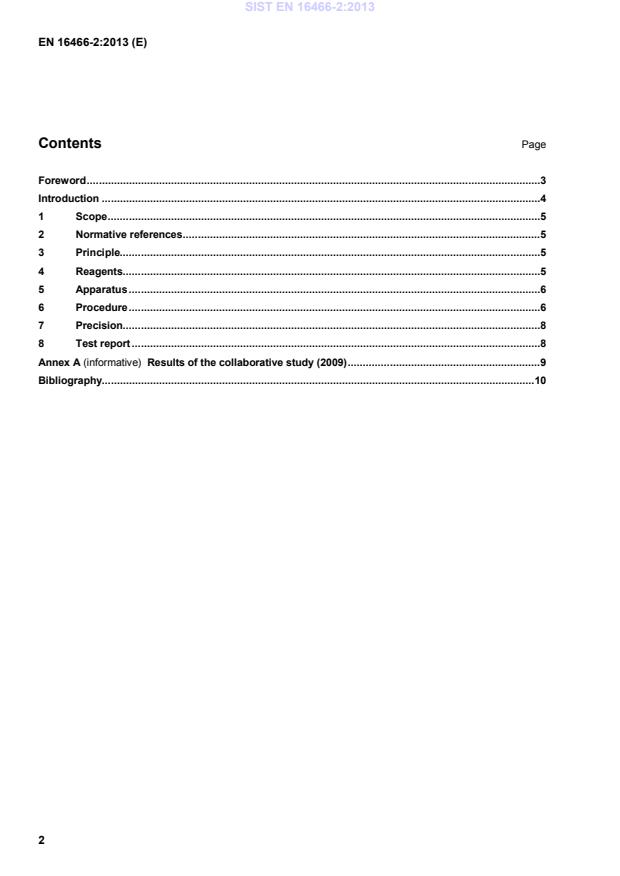
Results of the collaborative study (2009) . 9 Bibliography. 10
This European Standard shall be given the status of a national standard, either by publication of an identical text or by endorsement, at the latest by July 2013, and conflicting national standards shall be withdrawn at the latest by July 2013. Attention is drawn to the possibility that some of the elements of this document may be the subject of patent rights. CEN [and/or CENELEC] shall not be held responsible for identifying any or all such patent rights. The European standard, Vinegar — Isotopic analysis of acetic acid and water, consists of the following parts: Part 1: 2H-NMR analysis of acetic acid; Part 2: 13C-IRMS analysis of acetic acid; Part 3: 18O-IRMS analysis of water. According to the CEN/CENELEC Internal Regulations, the national standards organisations of the following countries are bound to implement this European Standard: Austria, Belgium, Bulgaria, Croatia, Cyprus, Czech Republic, Denmark, Estonia, Finland, Former Yugoslav Republic of Macedonia, France, Germany, Greece, Hungary, Iceland, Ireland, Italy, Latvia, Lithuania, Luxembourg, Malta, Netherlands, Norway, Poland, Portugal, Romania, Slovakia, Slovenia, Spain, Sweden, Switzerland, Turkey and the United Kingdom.
a) transformation of sugars to ethanol and
b) transformation of ethanol to acetic acid.
Conversely EN 13189 defines acetic acid as "Product made from materials of non-agricultural origin".
Wine vinegar is defined by the European Regulations 479/2008 and 491/2009 as the product obtained exclusively from the acetous fermentation of wine, which is in turn defined as the product exclusively obtained from the alcoholic fermentation of fresh grapes, whether crushed or not, or of grape must.
In all types of vinegar, both the ethanol and the acetic acid should be obtained by a biotechnological process, and the use of acetic acids obtained from either petroleum derivatives or the pyrolysis of wood is not permitted according to the above definitions.
The isotopic analysis of acetic acid extracted from vinegar by 2H-SNIF-NMR and 13C-IRMS enables the distinction of grape origin from other sources, such as beet, cane, malt, apple and synthesis [1].
4 Reagents All reagents and consumables used shall meet stated requirements of the used method/apparatus (as specified by the manufacturer). However, all reagents and consumables can be replaced by items with similar performance. 4.1 Diethyl ether For analysis. 4.2 Carbon dioxide For analysis, used as secondary reference gas for the determination of 13C/12C ratio. Purity 5.2 minimum. 4.3 Helium For analysis. Purity 5.6 minimum. 4.4 Oxygen For analysis. Purity 5.0 minimum. SIST EN 16466-2:2013
5.1.1 Liquid-liqui
...