


CEN/TS 18214:2025
(Main)ISO/IEC 39794-4 application profile for finger image data in machine-readable travel documents
General Information
- Abstract
The eighth edition of ICAO Doc 9303 progresses from using the first edition of the ISO/IEC 19794 series for encoding biometric reference data in electronic machine-readable travel documents to using the ISO/IEC 39794 series for this purpose. This document specifies how to use ISO/IEC 39794-4 for fingerprint image data stored in electronic machine-readable travel documents.
- Status
- Published
- Publication Date
- 23-Dec-2025
- Drafting Committee
- CEN/TC 224/WG 18 - Interoperability of biometric recorded data
- Current Stage
- 6060 - Definitive text made available (DAV) - Publishing
- Start Date
- 24-Dec-2025
- Due Date
- 25-Nov-2026
- Completion Date
- 24-Dec-2025

Overview
CEN/TS 18214:2025 defines a standardized application profile for the use of ISO/IEC 39794-4 in encoding finger image data within electronic machine-readable travel documents (eMRTDs). This technical specification supports the transition from the older ISO/IEC 19794 series to the extensible ISO/IEC 39794 series as mandated by the eighth edition of ICAO Doc 9303 for biometric reference data in travel documents. The document details constraints and required parameters for the interoperability, security, and quality of fingerprint image data stored in eMRTDs.
Keywords: biometric standards, finger image data, machine-readable travel documents, eMRTDs, ISO/IEC 39794-4, ICAO Doc 9303, CEN/TS 18214:2025, interoperability, data encoding.
Key Topics
- Biometric Data Interchange: Specifies the use of ISO/IEC 39794-4 for standardized and extensible biometric data exchange, focusing on fingerprints in travel documents.
- Data Structure: Defines how fingerprint images are stored under data group 3 (DG3) in accordance with ICAO Doc 9303, utilizing ASN.1 modules and encoded using distinguished encoding rules.
- Conformance and Constraints: Imposes application-specific restrictions to optional elements, such as position codes, impression types, image format, and quality score blocks, to maximize compatibility and security.
- Quality Requirements: References the mandatory use of quality metrics (e.g., NFIQ 2) for fingerprints under certain regulations to ensure reliable biometric performance.
- Regulatory Alignment: Aligns with European Union regulations related to biometric passports, stipulating the use of particular image formats and finger choices.
- Extensibility and Interoperability: Ensures that all encoded biometric data blocks conform to ISO/IEC 39794-4, but enforces stricter options for cross-system compatibility, crucial for border control and international identification processes.
Applications
CEN/TS 18214:2025 is essential for:
- National Passport Authorities: Ensures that electronic passports and other eMRTDs store fingerprint images in a format compliant with the latest international and European standards, supporting secure and interoperable border control.
- Identity Document Issuers: Provides guidance for public and private entities issuing travel or identity documents containing biometric data.
- System Integrators and Solution Providers: Assists technology vendors in developing eMRTD-compliant systems, capture devices, and biometric matching engines for use by governments and border agencies.
- Compliance and Auditing: Enables efficient auditing of passport and ID production systems for conformity to ICAO Doc 9303 and EU Council Regulations, reducing the risk of non-compliance.
Practical Benefits:
- Promotes cross-border interoperability by mandating a uniform encoding approach for fingerprint images.
- Enhances traveler verification speed and reliability at borders through high-quality, standardized fingerprint data.
- Facilitates the secure and structured extension of biometric information for future-proofing travel document systems.
Related Standards
- ISO/IEC 39794-1: Framework for extensible biometric data interchange formats, offering the base structure for all ISO/IEC 39794 standards.
- ISO/IEC 39794-4: Specifies extensible formats for finger image data.
- ICAO Doc 9303: Governs the specifications for machine-readable travel documents, including biometric data requirements.
- CEN/TS 17661: Provides guidance for enrolment practices and fingerprint image quality assessment in the context of EU regulations.
- ISO/IEC 19794 series: Predecessor standards for biometric data formats, now largely replaced in travel document applications.
- ISO/IEC 7816-11: Covers the use of biometric information templates in integrated circuit cards for identification.
By following CEN/TS 18214:2025, organizations ensure that their biometric eMRTDs meet the most up-to-date international requirements for security, interoperability, and quality of finger image data. This is critical for secure and trusted international travel and identification.
Relations
- Effective Date
- 25-Aug-2026
- Effective Date
- 09-Feb-2026
- Effective Date
- 09-Feb-2026
- Effective Date
- 28-Jan-2026
Get Certified
Connect with accredited certification bodies for this standard

BSI Group
BSI (British Standards Institution) is the business standards company that helps organizations make excellence a habit.

NYCE
Mexican standards and certification body.
Sponsored listings
Frequently Asked Questions
CEN/TS 18214:2025 is a technical specification published by the European Committee for Standardization (CEN). Its full title is "ISO/IEC 39794-4 application profile for finger image data in machine-readable travel documents". This standard covers: The eighth edition of ICAO Doc 9303 progresses from using the first edition of the ISO/IEC 19794 series for encoding biometric reference data in electronic machine-readable travel documents to using the ISO/IEC 39794 series for this purpose. This document specifies how to use ISO/IEC 39794-4 for fingerprint image data stored in electronic machine-readable travel documents.
The eighth edition of ICAO Doc 9303 progresses from using the first edition of the ISO/IEC 19794 series for encoding biometric reference data in electronic machine-readable travel documents to using the ISO/IEC 39794 series for this purpose. This document specifies how to use ISO/IEC 39794-4 for fingerprint image data stored in electronic machine-readable travel documents.
CEN/TS 18214:2025 is classified under the following ICS (International Classification for Standards) categories: 35.240.15 - Identification cards. Chip cards. Biometrics. The ICS classification helps identify the subject area and facilitates finding related standards.
CEN/TS 18214:2025 has the following relationships with other standards: It is inter standard links to ISO/IEC 39794-4:2019, ISO/IEC 39794-1:2019, ISO/IEC 39794-4:2019/Amd 1:2023, EN 17634:2023. Understanding these relationships helps ensure you are using the most current and applicable version of the standard.
CEN/TS 18214:2025 is available in PDF format for immediate download after purchase. The document can be added to your cart and obtained through the secure checkout process. Digital delivery ensures instant access to the complete standard document.
Standards Content (Sample)
SLOVENSKI STANDARD
01-marec-2026
Profil uporabe po ISO/IEC 39794-4 za podatke o slikah prstnih odtisov v strojno
berljivih potovalnih dokumentih
ISO/IEC 39794-4 application profile for finger image data in machine-readable travel
documents
Anwendungsprofil nach ISO/IEC 39794-4 für Fingerabdrucksbilder in maschinenlesbaren
Reisedokumenten
Profil d'application pour les données d’image du doigt dans les documents de voyage
lisibles par machine
Ta slovenski standard je istoveten z: CEN/TS 18214:2025
ICS:
35.240.15 Identifikacijske kartice. Čipne Identification cards. Chip
kartice. Biometrija cards. Biometrics
2003-01.Slovenski inštitut za standardizacijo. Razmnoževanje celote ali delov tega standarda ni dovoljeno.
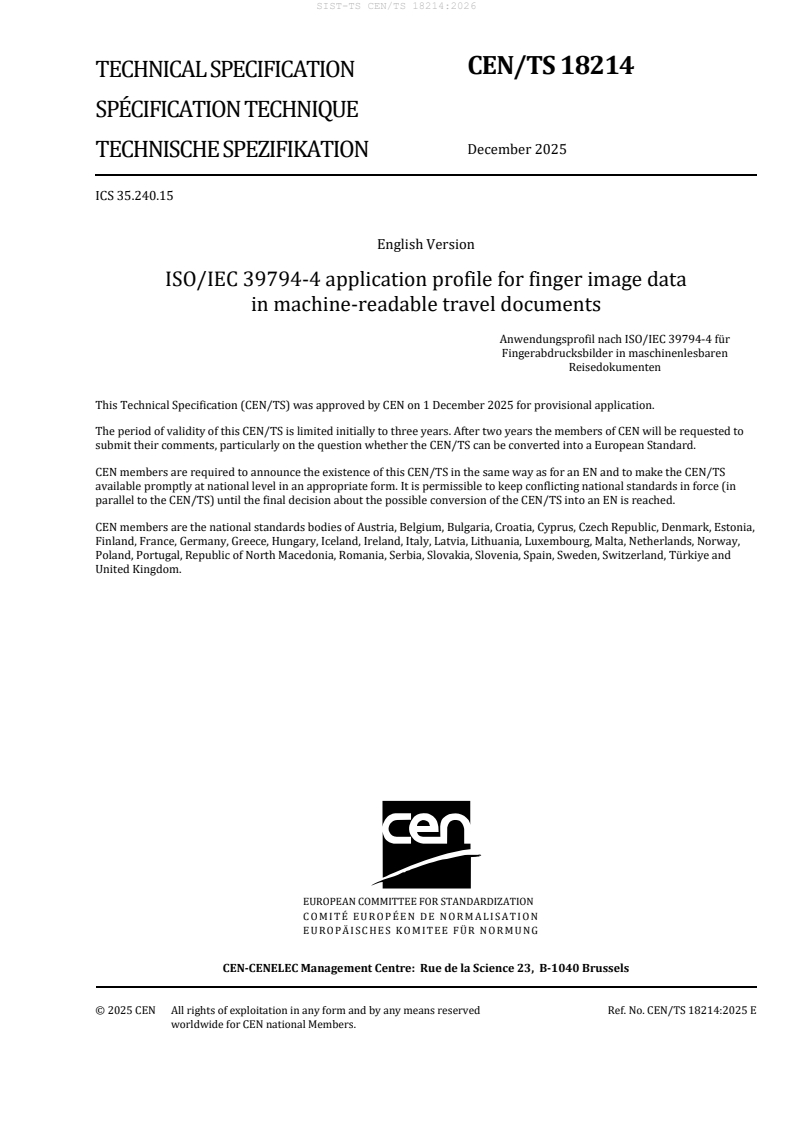
CEN/TS 18214
TECHNICAL SPECIFICATION
SPÉCIFICATION TECHNIQUE
December 2025
TECHNISCHE SPEZIFIKATION
ICS 35.240.15
English Version
ISO/IEC 39794-4 application profile for finger image data
in machine-readable travel documents
Anwendungsprofil nach ISO/IEC 39794-4 für
Fingerabdrucksbilder in maschinenlesbaren
Reisedokumenten
This Technical Specification (CEN/TS) was approved by CEN on 1 December 2025 for provisional application.
The period of validity of this CEN/TS is limited initially to three years. After two years the members of CEN will be requested to
submit their comments, particularly on the question whether the CEN/TS can be converted into a European Standard.
CEN members are required to announce the existence of this CEN/TS in the same way as for an EN and to make the CEN/TS
available promptly at national level in an appropriate form. It is permissible to keep conflicting national standards in force (in
parallel to the CEN/TS) until the final decision about the possible conversion of the CEN/TS into an EN is reached.
CEN members are the national standards bodies of Austria, Belgium, Bulgaria, Croatia, Cyprus, Czech Republic, Denmark, Estonia,
Finland, France, Germany, Greece, Hungary, Iceland, Ireland, Italy, Latvia, Lithuania, Luxembourg, Malta, Netherlands, Norway,
Poland, Portugal, Republic of North Macedonia, Romania, Serbia, Slovakia, Slovenia, Spain, Sweden, Switzerland, Türkiye and
United Kingdom.
EUROPEAN COMMITTEE FOR STANDARDIZATION
COMITÉ EUROPÉEN DE NORMALISATION
EUROPÄISCHES KOMITEE FÜR NORMUNG
CEN-CENELEC Management Centre: Rue de la Science 23, B-1040 Brussels
© 2025 CEN All rights of exploitation in any form and by any means reserved Ref. No. CEN/TS 18214:2025 E
worldwide for CEN national Members.
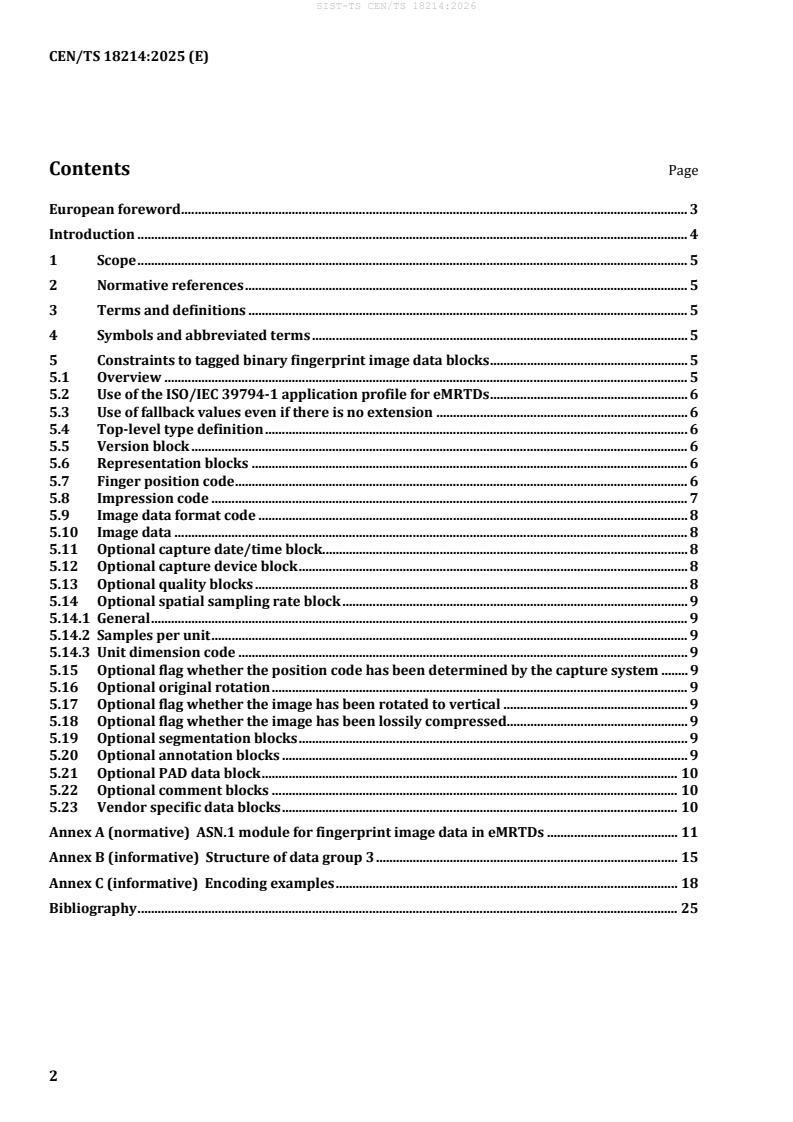
Contents Page
European foreword . 3
Introduction . 4
1 Scope . 5
2 Normative references . 5
3 Terms and definitions . 5
4 Symbols and abbreviated terms . 5
5 Constraints to tagged binary fingerprint image data blocks . 5
5.1 Overview . 5
5.2 Use of the ISO/IEC 39794-1 application profile for eMRTDs . 6
5.3 Use of fallback values even if there is no extension . 6
5.4 Top-level type definition . 6
5.5 Version block . 6
5.6 Representation blocks . 6
5.7 Finger position code . 6
5.8 Impression code . 7
5.9 Image data format code . 8
5.10 Image data . 8
5.11 Optional capture date/time block. 8
5.12 Optional capture device block . 8
5.13 Optional quality blocks . 8
5.14 Optional spatial sampling rate block . 9
5.14.1 General . 9
5.14.2 Samples per unit . 9
5.14.3 Unit dimension code . 9
5.15 Optional flag whether the position code has been determined by the capture system . 9
5.16 Optional original rotation . 9
5.17 Optional flag whether the image has been rotated to vertical . 9
5.18 Optional flag whether the image has been lossily compressed . 9
5.19 Optional segmentation blocks . 9
5.20 Optional annotation blocks . 9
5.21 Optional PAD data block . 10
5.22 Optional comment blocks . 10
5.23 Vendor specific data blocks . 10
Annex A (normative) ASN.1 module for fingerprint image data in eMRTDs . 11
Annex B (informative) Structure of data group 3 . 15
Annex C (informative) Encoding examples . 18
Bibliography . 25
European foreword
This document (CEN/TS 18214:2025) has been prepared by Technical Committee CEN/TC 224 “Personal
identification and related personal devices with secure elements, systems, operations and privacy in a
multi sectorial environment”, the secretariat of which is held by AFNOR.
Attention is drawn to the possibility that some of the elements of this document may be the subject of
patent rights. CEN shall not be held responsible for identifying any or all such patent rights.
Any feedback and questions on this document should be directed to the users’ national standards body.
A complete listing of these bodies can be found on the CEN website.
According to the CEN/CENELEC Internal Regulations, the national standards organisations of the
following countries are bound to announce this Technical Specification: Austria, Belgium, Bulgaria,
Croatia, Cyprus, Czech Republic, Denmark, Estonia, Finland, France, Germany, Greece, Hungary, Iceland,
Ireland, Italy, Latvia, Lithuania, Luxembourg, Malta, Netherlands, Norway, Poland, Portugal, Republic of
North Macedonia, Romania, Serbia, Slovakia, Slovenia, Spain, Sweden, Switzerland, Türkiye and the
United Kingdom.
Introduction
To meet newly emerging requirements and to avoid compatibility issues in future, ISO/IEC JTC 1/SC 37
developed the ISO/IEC 39794 series of standards defining extensible biometric data interchange formats
capable of including possible extensions in a structured manner. The eighth edition of ICAO Doc 9303
“Machine readable travel documents” (MRTDs) moves from using the first edition of the ISO/IEC 19794
series for encoding biometric reference data to using the ISO/IEC 39794 series for this purpose. To
support the transition to the extensible biometric data interchange format, ISO/IEC JTC 1/SC 17
developed an ICAO TR “ISO/IEC 39794-5 application profile for eMRTDs” [1] specifying how to use
ISO/IEC 39794-5 [2] for the mandatory face image data stored in electronic MRTDs (eMRTDs).
According to ICAO Doc 9303, storage of fingerprint and iris image data in eMRTDs is optional. In
electronic identity documents issued by several countries, however, fingerprint image data are
mandatory in addition to face image data [3] [4]. Therefore, this document specifies how to use
ISO/IEC 39794-4 for fingerprint image data stored in eMRTDs. This document follows the same approach
as the ICAO TR “ISO/IEC 39794-5 application profile for eMRTDs” by restricting optional elements and
permitted values. The encoding specified in this document takes precedence over the encoding examples
in ISO/IEC TR 49794:2022 [5].
1 Scope
The eighth edition of ICAO Doc 9303 progresses from using the first edition of the ISO/IEC 19794 series
for encoding biometric reference data in electronic machine-readable travel documents to using the
ISO/IEC 39794 series for this purpose. This document specifies how to use ISO/IEC 39794-4 for
fingerprint image data stored in electronic machine-readable travel documents.
2 Normative references
The following documents are referred to in the text in such a way that some or all of their content
constitutes requirements of this document. For dated references, only the edition cited applies. For
undated references, the latest edition of the referenced document (including any amendments) applies.
ISO/IEC 39794-1, Information technology — Extensible biometric data interchange formats — Part 1:
Framework
ISO/IEC 39794-4:2019, Information technology — Extensible biometric data interchange formats —
Part 4: Finger image data
3 Terms and definitions
For the purposes of this document, the terms and definitions given in ISO/IEC 39794-1 and
ISO/IEC 39794-4 apply.
ISO and IEC maintain terminology databases for use in standardization at the following addresses:
— ISO Online browsing platform: available at https://www.iso.org/obp
— IEC Electropedia: available at https://www.electropedia.org/
4 Symbols and abbreviated terms
For the purposes of this document, the following symbols and abbreviations apply:
ASN.1 Abstract Syntax Notation One
BCD binary-coded decimal
BDB biometric data block
eMRTD electronic MRTD
LDS logical data structure
MRTD machine-readable travel document
PAD presentation attack detection
5 Constraints to tagged binary fingerprint image data blocks
5.1 Overview
The ISO/IEC 39794 series uses extensible ASN.1 modules to specify biometric data blocks (BDBs). The
BDBs are encoded using the tagged binary encoding scheme, which results from application of the ASN.1
Distinguished Encoding Rules (DER) to the ASN.1 module.
As impacted by ISO/IEC 39794-4:2019/Amd.1:2023
The fingerprint image data block in eMRTDs shall follow ISO/IEC 39794-4 except for the changes that are
detailed in this clause and integrated into Annex A. Only restrictions of optional elements and of possible
values are permitted modifications. Every BDB that conforms to this application profile also conforms to
ISO/IEC 39794-4, but not every BDB that conforms to ISO/IEC 39794-4 conforms to this application
profile. Limiting the number of options can facilitate interoperability.
Annex A contains the modified ASN.1 module based on the ASN.1 module from ISO/IEC 39794-
4:2019/Amd.1:2023 (available at https://standards.iso.org/iso-iec/39794/-4/ed-1/en/amd/1). Future
extensions will be done as described in ISO/IEC 39794-1.
In eMRTDs, the finger image data block is part of data group 3 (DG3), which is specified in ICAO Doc 9303
Part 10 [6]. Annex B summarizes the structure of DG3 for convenience.
Annex C shows the encoding of fingerprint image data block examples and of full DG3 examples.
5.2 Use of the ISO/IEC 39794-1 application profile for eMRTDs
ISO/IEC 39794-1 contains an ASN.1 module that specifies common data types to be imported into the
ASN.1 modules in the other parts of the ISO/IEC 39794 series. The ICAO TR “ISO/IEC 39794-5 application
profile for eMRTDs” [1] removed some options from the ASN.1 module defined in ISO/IEC 39794-1. The
ASN.1 module in Annex A imports from the same ISO/IEC 39794-1 application profile (available at
https://github.com/ICAO-TRIP-ISO-WG3/39794-5-AP) that the ISO/IEC 39794-5 application profile for
face image data in eMRTDs imports from.
5.3 Use of fallback values even if there is no extension
According to ISO/IEC 39794-1, for extensible enumerated types with a fallback value, decoders can use a
fallback value defined in the original type. In that way, if an unknown value is received, the decoder can
revert to the fallback value. Like the ICAO TR “ISO/IEC 39794-5 application profile for eMRTDs” [1], this
document restricts the structure of extensible enumerated types with fallback value by always requiring
a fallback value, even if there is no extension.
5.4 Top-level type definition
No constraints.
5.5 Version block
The value of the “generation” element shall be 3.
For fingerprint image data blocks conforming to the first edition of this document, the value of the “year”
element shall be 2023, i.e. the year of publication of ISO/IEC 39794-4:2019/Amd.1:2023. For fingerprint
image data blocks conforming to a later edition of this document, the value of the “year” element shall be
the year of publication of the underlying edition, amendment or corrigendum of ISO/IEC 39794-4.
5.6 Representation blocks
ISO/IEC 39794-4 allows each fingerprint image data block to contain more than one fingerprint image
representation. ICAO Doc 9303 Part 10 [6], however, requires using the biometric information template
group template for encoding multiple fingerprint image instances. Therefore, fingerprint image data
blocks in eMRTDs shall contain only one representation.
5.7 Finger position code
ISO/IEC 39794-4 defines position codes for individual fingers, multi-finger groups, palms, toes and soles.
eMRTDs typically include two fingerprints: left and right index fingers which may be replaced by other
fingers such as thumb, middle finger or ring finger. Table 1 restricts the position codes to the values
permitted in eMRTDs.
Table 1 — Permitted position codes
Abstract value Meaning
rightThumbFinger Right thumb
rightIndexFinger Right index finger
rightMiddleFinger Right middle finger
rightRingFinger Right ring finger
rightLittleFinger Right little finger
leftThumbFinger Left thumb
leftIndexFinger Left index finger
leftMiddleFinger Left middle finger
leftRingFinger Left ring finger
leftLittleFinger Left little finger
If the EU Council Regulations [3] [4] apply, fingerprints of little fingers shall not be used [8] [9].
NOTE Council Regulation (EC) no. 2252/2004 [3] requires eMRTDs issued by EU Member States to include two
fingerprints, typically of the left and right index fingers. Where fingerprinting of the designated fingers is not
possible, attention is drawn to how CEN/TS 17661 [10] requires images of the thumb, middle finger or ring finger
of the capture subject to be included if possible.
5.8 Impression code
ISO/IEC 39794-4 defines impression codes for plain, rolled, latent and other fingerprints. Table 2
restricts the impression codes permitted in eMRTDs.
If the EU Council Regulations [3] [4] apply, only the impression code plainContact shall be used.
NOTE Council Regulation (EC) no. 2252/2004 [3] requires eMRTDs issued by EU Member States to include two
fingerprints taken flat.
Table 2 — Permitted impression code
Abstract value Meaning
plainContact A stationary subject’s friction ridge in contact with a fixed scanning surface
(or platen)
stationarySubjectContactlessPlain A subject’s friction ridge captured without contact in such a way that the
image is not representative of a roll or other 3D structure, and in which the
subject is expected to remain mostly motionless
movingSubjectContactlessPlain A subject’s friction ridge captured without contact in such a way that the
image is not representative of a roll or other 3D structure, and in which the
subject is expected to move to perform an effective capture. A contactless
“swipe” sensor in which the subject slides their fingers above a capture
system would fall into this category.
If the fallback value is movingSubjectContactlessPlain, then the ANSI/NIST-ITL impression code for
movingSubjectContactlessPlain shall be included next to the fallback value, as specified in
ISO/IEC 39794-4:2019/Amd.1:2023.
5.9 Image data format code
Table 3 shows the image data format codes that may be used in eMRTDs.
Table 3 — Permitted image data format codes
Abstract value Meaning
pgm Portable grayscale binary image format
wsq WSQ
jpeg2000Lossy JPEG 2000 (lossy)
jpeg2000Lossless JPEG 2000 (lossless)
png PNG
If the EU Council Regulations [3] [4] apply, only the image data format wsq shall be used.
NOTE For images captured with optical fingerprint capture devices with a spatial sampling rate of 500 pixels
per inch (i.e. 197 pixels per centimetre), CEN/TS 17661 [10] requires the image data format to be WSQ.
5.10 Image data
ISO/IEC 39794-4 allows inclusion of friction ridge images from individual fingers, multi-finger groups,
palms, toes and soles. In eMRTDs, each fingerprint image shall show only an individual finger.
5.11 Optional capture date/time block
If the biometric header template of the biometric information template in which the fingerprint image
data block is embedded contains the creation date and time, the optional capture date/time block shall
not be present in the fingerprint image data block.
5.12 Optional capture device block
The optional capture device block from ISO/IEC 39794-4 shall not be used in eMRTDs.
NOTE This avoids useless model identifier blocks that indicate vendor unknown/product unknown.
5.13 Optional quality blocks
Where NFIQ 2 (the reference implementation of ISO/IEC 29794-4 [7]) is applicable, i.e. for fingerprint
images with a spatial sampling rate of 197 pixels per centimetre (i.e. 500 pixels per inch) and a bit depth
of 8 bit captured using optical area sensors in direct contact with friction ridges, a quality block
containing the NFIQ 2 unified quality score of the fingerprint image should be stored in the eMRTD.
If the EU Council Regulations [3] [4] apply, for each fingerprint image where NFIQ 2 is applicable, a quality
block containing the NFIQ 2 unified quality score shall be stored in the eMRTD. If a new NFIQ version
becomes available, this document will be revised.
NOTE As far as eMRTDs issued by EU Member States are concerned, attention is drawn to how CEN/TS 17661
[10] requires assessing the fingerprint image quality during enrolment. Where NFIQ 2 is applicable, CEN/TS 17661
requires using NFIQ 2.
If present, a quality block shall contain a registered quality algorithm vendor identifier and a registered
quality algorithm identifier identifying the quality assessment algorithm used. Quality blocks indicating
vendor unknown/product unknown shall not be included in eMRTDs.
5.14 Optional spatial sampling rate block
5.14.1 General
Although ISO/IEC 39794-4 allows omission of the spatial sampling rate block if the fingerprint image’s
spatial sampling rate is 500 pixels per inch (i.e. 197 pixels per centimetre), the spatial sampling rate block
shall always be present in eMRTDs to avoid doubts.
NOTE As far as eMRTDs issued by EU Member States are concerned, attention is drawn to how CEN/TS 17661
[10] recommends a spatial sampling rate of 500 pixels per inch (i.e. 197 pixels per centimetre) for optical
fingerprint capture devices.
5.14.2 Samples per unit
No constraints.
5.14.3 Unit dimension code
Table 4 shows the unit dimension codes that may be used in eMRTDs.
Table 4 — Permitted unit dimension codes
Abstract value Meaning
inch The spatial sampling rate is measured in pixels per inch.
cm The spatial sampling rate is measured in pixels per centimetre.
If the EU Council Regulations [3] [4] apply, the spatial sampling rate shall be measured in pixels per
centimetre.
5.15 Optional flag whether the position code has been determined by the capture system
No constraints.
5.16 Optional original rotation
No constraints.
5.17 Optional flag whether the image has been rotated to vertical
No constraints.
5.18 Optional flag whether the image has been lossily compressed
No constraints.
5.19 Optional segmentation blocks
Segmentation blocks may specify segments of friction ridge image data in multi-finger images. As multi-
finger images are not to be stored in eMRTDs, the optional segmentation blocks shall not be used in
eMRTDs.
5.20 Optional annotation blocks
Annotation blocks may describe reasons why certain finger positions are missing. Table 5 restricts the
permitted annotation codes to avoid ambiguity.
Table 5 — Permitted annotation codes
Abstract value Meaning
unknown Annotation information was not captured or has been lost.
amputated The friction ridge region has been amputated or is anatomically missing.
unableToPrint The friction ridge region is unable to be captured for undescribed reasons.
bandaged The friction ridge region has a bandage on it rendering it not capturable.
If the EU Council Regulations [3] [4] apply, and the fingerprint of either index finger is absent, but a
fingerprint of the middle finger, ring finger or thumb of the same hand is recorded instead, an annotation
block shall be present indicating the reason for the absence of the index finger.
If the EU Council Regulations [3] [4] apply, and a fingerprint is recorded only from one hand, annotation
blocks shall be present indicating the reasons for the absence of the index finger, middle finger, ring finger
and thumb of the other hand.
5.21 Optional PAD data block
No constraints.
5.22 Optional comment blocks
No constraints.
5.23 Vendor specific data blocks
Fingerprint image data blocks in eMRTDs shall not contain any vendor-specific data blocks.
Annex A
(normative)
ASN.1 module for fingerprint image data in eMRTDs
The ASN.1 module from ISO/IEC 39794-4 that has been modified for application in machine-readable
travel documents is available at https://documentation.afnor.cloud-ed.fr/s/AEHRmQFX5eTHMFH. The
referenced ASN.1 module ID-ICAO-ISO-IEC-39794-1-ed-1-v1 is available at https://github.com/ICAO-
TRIP-ISO-WG3/39794-5-AP/.
CEN-TS-18214-ed-1-v1 {iso(1) identified-organization(3) cen(162) cen-ts-18214(18214) ed-
1(1) v1(1)}
-- This ASN.1 module makes use of the ASN.1 module from ISO/IEC 39794-4
-- within modifications permitted in the relevant ISO/IEC standard. Please
-- reproduce this note if possible.
--
-- Use of ISO/IEC copyright in this Schema is licensed for the purpose of
-- developing, implementing, and using software based on this Schema, subject
-- to the following conditions:
--
-- * Software developed from this Schema must retain the Copyright Notice,
-- this list of conditions and the disclaimer below ("Disclaimer").
--
-- * Neither the name or logo of ISO or of IEC, nor the names of specific
-- contributors, may be used to endorse or promote software derived from
-- this Schema without specific prior written permission.
--
-- * The software developer shall attribute the Schema to ISO/IEC and
-- identify the ISO/IEC standard from which it is taken. Such attribution
-- (e.g., "This software makes use of the Schema from ISO/IEC 39794-4
-- within modifications permitted in the relevant ISO/IEC standard.
-- Please reproduce this note if possible.") may be placed in the
-- software itself or any other reasonable location.
--
-- The Disclaimer is:
-- THE SCHEMA ON WHICH THIS SOFTWARE IS BASED IS PROVIDED BY THE COPYRIGHT
-- HOLDERS AND CONTRIBUTORS "AS IS" AND ANY EXPRESS OR IMPLIED WARRANTIES,
-- INCLUDING, BUT NOT LIMITED TO, THE IMPLIED WARRANTIES OF MERCHANTABILITY
-- AND FITNESS FOR A PARTICULAR PURPOSE ARE DISCLAIMED. IN NO EVENT SHALL
-- THE COPYRIGHT OWNER OR CONTRIBUTORS BE LIABLE FOR ANY DIRECT, INDIRECT,
-- INCIDENTAL, SPECIAL, EXEMPLARY, OR CONSEQUENTIAL DAMAGES (INCLUDING, BUT
-- NOT LIMITED TO, PROCUREMENT OF SUBSTITUTE GOODS OR SERVICES; LOSS OF USE,
-- DATA, OR PROFITS; OR BUSINESS INTERRUPTION) HOWEVER CAUSED AND ON ANY
-- THEORY OF LIABILITY, WHETHER IN CONTRACT, STRICT LIABILITY, OR TORT
-- (INCLUDING NEGLIGENCE OR OTHERWISE) ARISING IN ANY WAY OUT OF THE USE OF
-- THE CODE COMPONENTS, EVEN IF ADVISED OF THE PO
...