


EN 14362-3:2012
(Main)Textiles - Methods for determination of certain aromatic amines derived from azo colorants - Part 3: Detection of the use of certain azo colorants, which may release 4-aminoazobenzene
General Information
- Abstract
Azo colorants that are able to form 4-aminoazobenzene, generate under the conditions of EN 14362-1 the
amines aniline and 1,4-phenylenediamine. The presence of these 4-aminoazobenzene colorants cannot be
reliably ascertained without additional information (e.g. the chemical structure of the colorant used) or without
a special procedure.
This part of EN 14362 is supplementary to Part 1 and describes a special procedure to detect the use of
certain azo colorants in commodities, which may release 4-aminoazobenzene,
- accessible to reducing agent without extraction, particularly concerning textiles made of cellulose and
protein fibres (e.g. cotton, viscose, wool, silk);
- accessible by extracting the fibres (e.g. polyester or imitation leather).
For certain fibre blends both parts of this standard (without or with extraction) may need to be applied.
The procedure detects as well 4-aminoazobenzene (Solvent Yellow 1) which is already available as free
amine in commodities without reducing pre-treatment.
The use of certain azo colorants, which may release by reductive cleavage of their azo group(s) one or more
of the other aromatic amines listed in the Regulation (EC) No 1907/2006 of the European Parliament and of
the Council on the Registration, Evaluation, Authorisation and Restriction of Chemicals (REACH) as regards
Annex XVII, except 4-aminoazobenzene, cannot be determined quantitatively with this method.
- Status
- Withdrawn
- Publication Date
- 26-Jun-2012
- Withdrawal Date
- 22-Sep-2026
- Technical Committee
- CEN/TC 248 - Textiles and textile products
- Drafting Committee
- CEN/TC 248/WG 26 - Methods of test for phthalates
- Current Stage
- 9960 - Withdrawal effective - Withdrawal
- Start Date
- 08-Feb-2017
- Completion Date
- 23-Sep-2026

Relations
- Effective Date
- 08-Jun-2022
- Effective Date
- 28-Jan-2026
- Effective Date
- 28-Jan-2026
Get Certified
Connect with accredited certification bodies for this standard

Control Union Certifications
Global certification for agriculture and sustainability.

Hohenstein Institut
Textile testing and certification.

Bureau Veritas Bangladesh
Bureau Veritas certification services in Bangladesh.
Sponsored listings
Frequently Asked Questions
EN 14362-3:2012 is a standard published by the European Committee for Standardization (CEN). Its full title is "Textiles - Methods for determination of certain aromatic amines derived from azo colorants - Part 3: Detection of the use of certain azo colorants, which may release 4-aminoazobenzene". This standard covers: Azo colorants that are able to form 4-aminoazobenzene, generate under the conditions of EN 14362-1 the amines aniline and 1,4-phenylenediamine. The presence of these 4-aminoazobenzene colorants cannot be reliably ascertained without additional information (e.g. the chemical structure of the colorant used) or without a special procedure. This part of EN 14362 is supplementary to Part 1 and describes a special procedure to detect the use of certain azo colorants in commodities, which may release 4-aminoazobenzene, - accessible to reducing agent without extraction, particularly concerning textiles made of cellulose and protein fibres (e.g. cotton, viscose, wool, silk); - accessible by extracting the fibres (e.g. polyester or imitation leather). For certain fibre blends both parts of this standard (without or with extraction) may need to be applied. The procedure detects as well 4-aminoazobenzene (Solvent Yellow 1) which is already available as free amine in commodities without reducing pre-treatment. The use of certain azo colorants, which may release by reductive cleavage of their azo group(s) one or more of the other aromatic amines listed in the Regulation (EC) No 1907/2006 of the European Parliament and of the Council on the Registration, Evaluation, Authorisation and Restriction of Chemicals (REACH) as regards Annex XVII, except 4-aminoazobenzene, cannot be determined quantitatively with this method.
Azo colorants that are able to form 4-aminoazobenzene, generate under the conditions of EN 14362-1 the amines aniline and 1,4-phenylenediamine. The presence of these 4-aminoazobenzene colorants cannot be reliably ascertained without additional information (e.g. the chemical structure of the colorant used) or without a special procedure. This part of EN 14362 is supplementary to Part 1 and describes a special procedure to detect the use of certain azo colorants in commodities, which may release 4-aminoazobenzene, - accessible to reducing agent without extraction, particularly concerning textiles made of cellulose and protein fibres (e.g. cotton, viscose, wool, silk); - accessible by extracting the fibres (e.g. polyester or imitation leather). For certain fibre blends both parts of this standard (without or with extraction) may need to be applied. The procedure detects as well 4-aminoazobenzene (Solvent Yellow 1) which is already available as free amine in commodities without reducing pre-treatment. The use of certain azo colorants, which may release by reductive cleavage of their azo group(s) one or more of the other aromatic amines listed in the Regulation (EC) No 1907/2006 of the European Parliament and of the Council on the Registration, Evaluation, Authorisation and Restriction of Chemicals (REACH) as regards Annex XVII, except 4-aminoazobenzene, cannot be determined quantitatively with this method.
EN 14362-3:2012 is classified under the following ICS (International Classification for Standards) categories: 59.080.01 - Textiles in general. The ICS classification helps identify the subject area and facilitates finding related standards.
EN 14362-3:2012 has the following relationships with other standards: It is inter standard links to EN ISO 14362-3:2017, EN 14362-1:2012, EN ISO 3696:1995. Understanding these relationships helps ensure you are using the most current and applicable version of the standard.
EN 14362-3:2012 is associated with the following European legislation: EU Directives/Regulations: 1907/2006. When a standard is cited in the Official Journal of the European Union, products manufactured in conformity with it benefit from a presumption of conformity with the essential requirements of the corresponding EU directive or regulation.
EN 14362-3:2012 is available in PDF format for immediate download after purchase. The document can be added to your cart and obtained through the secure checkout process. Digital delivery ensures instant access to the complete standard document.
Standards Content (Sample)
2003-01.Slovenski inštitut za standardizacijo. Razmnoževanje celote ali delov tega standarda ni dovoljeno.DPLQRD]REHQ]HQTextilien - Verfahren für die Bestimmung bestimmter aromatischer Amine aus Azofarbstoffen - Teil 3: Nachweis der Verwendung gewisser Azofarbstoffe die 4-Aminoazobenzol freisetzen könnenTextiles - Méthodes de détermination de certaines amines aromatiques dérivées de colorants azoïques - Partie 3: Détection de l’utilisation de certains colorants azoïques susceptibles de libérer du 4-aminoazobenzèneTextiles - Methods for determination of certain aromatic amines derived from azo colorants - Part 3: Detection of the use of certain azo colorants which may release 4-aminoazobenzene59.080.01Tekstilije na splošnoTextiles in generalICS:Ta slovenski standard je istoveten z:EN 14362-3:2012SIST EN 14362-3:2012en,fr,de01-september-2012SIST EN 14362-3:2012SLOVENSKI
STANDARD
EUROPEAN STANDARD NORME EUROPÉENNE EUROPÄISCHE NORM
EN 14362-3
June 2012 ICS 59.080.01 English Version
Textiles - Methods for determination of certain aromatic amines derived from azo colorants - Part 3: Detection of the use of certain azo colorants, which may release 4-aminoazobenzene
Textiles - Méthodes de détermination de certaines amines aromatiques dérivées de colorants azoïques - Partie 3: Détection de l'utilisation de certains colorants azoïques susceptibles de libérer du 4-aminoazobenzène
Textilien - Verfahren für die Bestimmung bestimmter aromatischer Amine aus Azofarbstoffen - Teil 3: Nachweis der Verwendung gewisser Azofarbstoffe, die 4-Aminoazobenzol freisetzen können This European Standard was approved by CEN on 24 May 2012.
CEN members are bound to comply with the CEN/CENELEC Internal Regulations which stipulate the conditions for giving this European Standard the status of a national standard without any alteration. Up-to-date lists and bibliographical references concerning such national standards may be obtained on application to the CEN-CENELEC Management Centre or to any CEN member.
This European Standard exists in three official versions (English, French, German). A version in any other language made by translation under the responsibility of a CEN member into its own language and notified to the CEN-CENELEC Management Centre has the same status as the official versions.
CEN members are the national standards bodies of Austria, Belgium, Bulgaria, Croatia, Cyprus, Czech Republic, Denmark, Estonia, Finland, France, Germany, Greece, Hungary, Iceland, Ireland, Italy, Latvia, Lithuania, Luxembourg, Malta, Netherlands, Norway, Poland, Portugal, Romania, Slovakia, Slovenia, Spain, Sweden, Switzerland, Turkey and United Kingdom.
EUROPEAN COMMITTEE FOR STANDARDIZATION
COMITÉ EUROPÉEN DE NORMALISATION EUROPÄISCHES KOMITEE FÜR NORMUNG
Management Centre:
Avenue Marnix 17,
B-1000 Brussels © 2012 CEN All rights of exploitation in any form and by any means reserved worldwide for CEN national Members. Ref. No. EN 14362-3:2012: ESIST EN 14362-3:2012
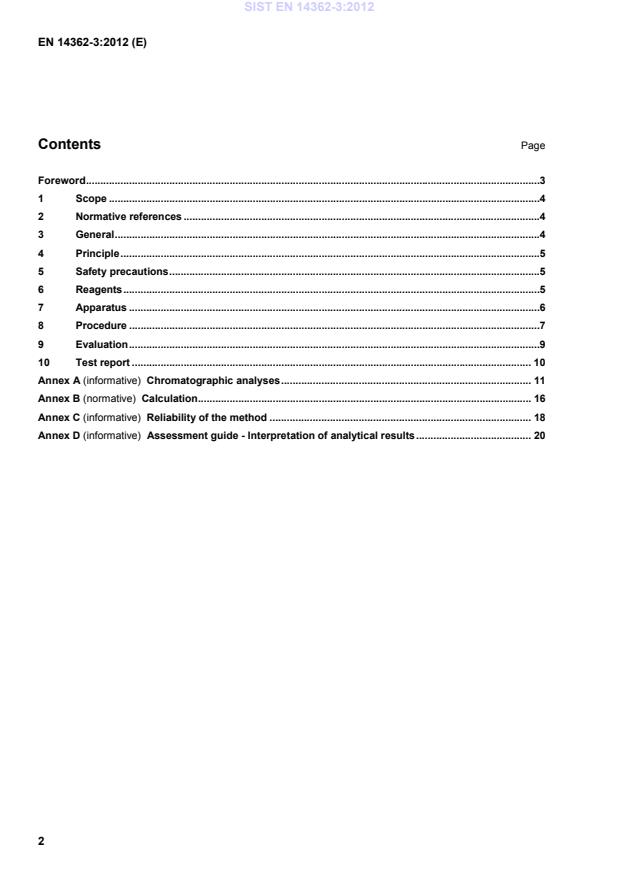
Chromatographic analyses . 11Annex B (normative)
Calculation . 16Annex C (informative)
Reliability of the method . 18Annex D (informative)
Assessment guide - Interpretation of analytical results . 20 SIST EN 14362-3:2012
accessible to reducing agent without extraction, particularly concerning textiles made of cellulose and protein fibres (e.g. cotton, viscose, wool, silk); accessible by extracting the fibres (e.g. polyester or imitation leather). For certain fibre blends both parts of this standard (without or with extraction) may need to be applied.
The procedure detects as well 4-aminoazobenzene (Solvent Yellow 1) which is already available as free amine in commodities without reducing pre-treatment. The use of certain azo colorants, which may release by reductive cleavage of their azo group(s) one or more of the other aromatic amines listed in the Regulation (EC) No 1907/2006 of the European Parliament and of the Council on the Registration, Evaluation, Authorisation and Restriction of Chemicals (REACH) as regards Annex XVII, except 4-aminoazobenzene, cannot be determined quantitatively with this method. 2 Normative references The following documents, in whole or in part, are normatively referenced in this document and are indispensable for its application. For dated references, only the edition cited applies. For undated references, the latest edition of the referenced document (including any amendments) applies. EN 14362-1:2012, Textiles — Methods for determination of certain aromatic amines derived from azo colorants — Part 1: Detection of the use of certain azo colorants accessible with and without extracting the fibres EN ISO 3696, Water for analytical laboratory use — Specification and test methods (ISO 3696) 3 General Certain azo colorants may release, by reductive cleavage of azo group(s), 4-aminoazobenzene, which is proscribed under Regulation (EC) No 1907/2006 of the European Parliament and of the Council on the Registration, Evaluation, Authorisation and Restriction of Chemicals (REACH) as regards Annex XVII. Table 1 — 4-aminoazobenzene proscribed under Regulation REACH 1907/2006/Annex XVII No. CAS number Index number EC number Substance 22 60-09-3 611-008-00-4 200-453-6 4-aminoazobenzene
5 Safety precautions 5.1
WARNING — 4-aminoazobenzene is classified as a substance known to be or suspected to be human carcinogen.
Any handling and disposal of these substances shall be in strict accordance with the appropriate national health and safety regulations. 5.2 It is the user’s responsibility to use safe and proper techniques in handling materials in this test method. Consult manufacturers for specific details such as material safety data sheets and other recommendations. 5.3 Good laboratory practice should be followed. Wear safety glasses in all laboratory areas and a single-use dust respirator while handling powder colorants. 5.4 Users should comply with any national and local safety regulations. 6 Reagents Unless otherwise specified, analytical grade chemicals shall be used.
6.1
aqueous sodium dithionite solution, ρ = 200 mg/ml1), freshly prepared, to use immediately after resting for one hour in a closed vessel 6.2 sodium hydroxide aqueous solution, ω = 2 %2) 6.3 n-pentane 6.4 methanol
6.5 chlorobenzene 6.6 t-butyl methyl ether 6.7 sodium chloride
1) ρ = mass concentration 2) ω = mass portion (% by weight) SIST EN 14362-3:2012
Figure 1 — Apparatus NOTE Similar apparatus can be used, if the same results are obtained. 7.3 heating source that generates a temperature of (40 ± 2) °C SIST EN 14362-3:2012
7.7 ultrasonic bath, at least ultrasonic power RMS 160 Watt, with controllable heating 7.8 horizontal shaker with sufficient frequency of 5 s-1, path length 2 cm to 5 cm 7.9 instrumental equipment 7.9.1 gas chromatography (GC) with mass selective detector (MS) 7.9.2 high performance liquid chromatography (HPLC) with gradient elution and diode array detector (DAD) or mass selective detector (MS) 7.9.3 thin layer chromatography (TLC) or high performance thin layer chromatography (HPTLC) equipment, including relevant detection
7.9.4 capillary electrophoresis (CE) with DAD NOTE A description of the equipment is given in Annex A. 8 Procedure 8.1 General Apply this standard to the test specimen that gave a positive result for aniline and 1,4-phenylenediamine or only aniline using EN 14362-1. Choose 8.3 or 8.4 depending of the sample composition. 8.2 Preparation of test specimens In the case of fabrics with multicoloured patterns, the various colours have to be taken into account separately as far as possible. For commodities consisting of various textile qualities, specimens of the various qualities (in terms of fibre and/or colour) shall be analyzed separately. Prepare the test specimen by cutting in order to obtain a total mass of 1 g. For specimens to be submitted to colorant extraction (8.3) cut into strips (if apparatus described in 7.2 is used) or cut into small pieces if other apparatus is used or for specimens to be submitted only to reductive cleavage (8.4). 8.3 Colorant extraction for disperse dyes 8.3.1 Extraction if disperse dyes with chlorobenzene The textile specimen dyed with disperse dyes (see Annex D from EN 14362-1:2012) is kept in the extractor (7.2) for 30 min above 25 ml boiling chlorobenzene. The chlorobenzene extract is allowed to cool down to room temperature before detaching it from the extractor. Concentrate the chlorobenzene extract in the evaporation apparatus (7.5) at a temperature of 45 °C to 60 °C to a small residual quantity. This residue is quantitatively transferred to the reaction vessel with 7 ml methanol (6.4) in total, using an ultrasonic bath to disperse the colorant.
NOTE 1 It is recommended to carry out the transfer in multiple steps; e. g. to add 4 ml of methanol and to dissolve the residue from the glass flask using an ultrasonic bath, then to transfer the suspension quantitatively into the reaction vessel using a pipette, subsequently to rinse three times with 1 ml of methanol and to transfer the solution quantitatively. SIST EN 14362-3:2012
...