


EN 16936:2017
(Main)Animal feeding stuffs: Methods of sampling and analysis - Screening on the antibiotics tylosin, virginiamycin, spiramycin, bacitracin-zinc and avoparcin at sub-additive levels in compound feed by a microbiological plate test
General Information
- Abstract
This European Standard presents a method describing the screening on the antibiotics tylosin, virginiamycin, spiramycin, bacitracin-zinc and avoparcin at sub-additive levels in complete feeding stuffs and milk replacers by a microbiological 3-plate test.
The limit of detection of the method is 1 mg/kg for avoparcin, tylosin, spiramycin and virginiamycin, and 5 mg/kg for zinc bacitracin. The presence of other (veterinary) antibiotics may interfere with the method.
Furthermore, high concentrations of metals (Cu, Zn) may interfere. The method should be used as a qualitative screening method. Positive results can be analysed further by TLC; for confirmatory purposes LC-MS is required [1].
A lower limit of detection for zinc bacitracin (3 mg/kg) is achievable (see Table 2), but should be established with an in house validation first.
- Status
- Published
- Publication Date
- 09-May-2017
- Withdrawal Date
- 29-Nov-2017
- Technical Committee
- CEN/TC 327 - Animal feeding stuffs - Methods of sampling and analysis
- Drafting Committee
- CEN/TC 327/WG 3 - Feed additives and drugs
- Current Stage
- 9093 - Decision to confirm - Review Enquiry
- Start Date
- 01-Jan-2024
- Completion Date
- 23-Sep-2026



Overview
EN 16936:2017 (CEN) specifies a microbiological 3‑plate screening method for detecting sub‑additive levels of the antibiotics tylosin, virginiamycin, spiramycin, bacitracin‑zinc and avoparcin in complete animal feeding stuffs and milk replacers. The method is designed as a qualitative screening test using an agar plate inhibition assay: extracts of feed samples are loaded into wells on three different indicator plates and incubated; zones of inhibition indicate the likely presence of one of the target antibiotics.
Key facts:
- Target analytes: tylosin, virginiamycin, spiramycin, bacitracin‑zinc, avoparcin
- Screening principle: microbiological plate test (3 plates with different media/indicator strains)
- Incubation: typically 16–18 h, followed by visual interpretation of inhibition zones
- Confirmation: positive screens can be followed by TLC; LC‑MS is required for confirmatory identification and quantification
Key topics and technical requirements
- Limit of detection (LOD): 1 mg/kg for avoparcin, tylosin, spiramycin and virginiamycin; 5 mg/kg for zinc bacitracin. A lower LOD of 3 mg/kg for zinc bacitracin is achievable but requires in‑house validation.
- Test organisms and media: Kocuria rhizophila (ATCC 9341), Micrococcus luteus (ATCC 10240) and Bacillus megaterium (ATCC 10778) on specified culture media and pH settings to create differential inhibition patterns.
- Sample extraction: acetone/hydrochloric acid/water mixture (475/25/500 v/v/v) is used for feed extraction prior to plate application.
- Interferences: other veterinary antibiotics can interfere with interpretation; high concentrations of metals (Cu, Zn) may also affect results.
- Scope of method: intended as a screening (qualitative) procedure - not a definitive quantitative assay. Use standard reference materials and positive controls as described; follow up positives with targeted chemical analysis (TLC → LC‑MS).
Applications and users
EN 16936:2017 is relevant to:
- Feed testing and quality control laboratories performing routine surveillance for antibiotic residues in compound feed and milk replacers
- Veterinary diagnostic labs screening for non‑authorized antibiotic inclusion at sub‑additive levels
- Feed manufacturers and formulators implementing internal control and HACCP procedures
- Regulatory authorities and enforcement laboratories conducting compliance monitoring and pre‑screening prior to confirmatory testing
Practical uses include screening suspect feed batches, monitoring supply chains, and prioritizing samples for LC‑MS confirmation.
Related standards
- EN ISO 13969 - Guidelines for standardized description of microbial inhibitor tests (normative reference in EN 16936:2017)
Keywords: EN 16936:2017, animal feeding stuffs, microbiological plate test, antibiotic screening, tylosin, virginiamycin, spiramycin, bacitracin‑zinc, avoparcin, feed testing, LC‑MS, TLC, limit of detection.
Relations
- Effective Date
- 28-Jan-2026
Get Certified
Connect with accredited certification bodies for this standard

Control Union Certifications
Global certification for agriculture and sustainability.

ECOCERT
Organic and sustainability certification.

FSC International
Forest Stewardship Council certification.
Sponsored listings
Frequently Asked Questions
EN 16936:2017 is a standard published by the European Committee for Standardization (CEN). Its full title is "Animal feeding stuffs: Methods of sampling and analysis - Screening on the antibiotics tylosin, virginiamycin, spiramycin, bacitracin-zinc and avoparcin at sub-additive levels in compound feed by a microbiological plate test". This standard covers: This European Standard presents a method describing the screening on the antibiotics tylosin, virginiamycin, spiramycin, bacitracin-zinc and avoparcin at sub-additive levels in complete feeding stuffs and milk replacers by a microbiological 3-plate test. The limit of detection of the method is 1 mg/kg for avoparcin, tylosin, spiramycin and virginiamycin, and 5 mg/kg for zinc bacitracin. The presence of other (veterinary) antibiotics may interfere with the method. Furthermore, high concentrations of metals (Cu, Zn) may interfere. The method should be used as a qualitative screening method. Positive results can be analysed further by TLC; for confirmatory purposes LC-MS is required [1]. A lower limit of detection for zinc bacitracin (3 mg/kg) is achievable (see Table 2), but should be established with an in house validation first.
This European Standard presents a method describing the screening on the antibiotics tylosin, virginiamycin, spiramycin, bacitracin-zinc and avoparcin at sub-additive levels in complete feeding stuffs and milk replacers by a microbiological 3-plate test. The limit of detection of the method is 1 mg/kg for avoparcin, tylosin, spiramycin and virginiamycin, and 5 mg/kg for zinc bacitracin. The presence of other (veterinary) antibiotics may interfere with the method. Furthermore, high concentrations of metals (Cu, Zn) may interfere. The method should be used as a qualitative screening method. Positive results can be analysed further by TLC; for confirmatory purposes LC-MS is required [1]. A lower limit of detection for zinc bacitracin (3 mg/kg) is achievable (see Table 2), but should be established with an in house validation first.
EN 16936:2017 is classified under the following ICS (International Classification for Standards) categories: 65.120 - Animal feeding stuffs. The ICS classification helps identify the subject area and facilitates finding related standards.
EN 16936:2017 has the following relationships with other standards: It is inter standard links to EN ISO 13969:2004. Understanding these relationships helps ensure you are using the most current and applicable version of the standard.
EN 16936:2017 is associated with the following European legislation: EU Directives/Regulations: 882/2004; Standardization Mandates: M/521. When a standard is cited in the Official Journal of the European Union, products manufactured in conformity with it benefit from a presumption of conformity with the essential requirements of the corresponding EU directive or regulation.
EN 16936:2017 is available in PDF format for immediate download after purchase. The document can be added to your cart and obtained through the secure checkout process. Digital delivery ensures instant access to the complete standard document.
Standards Content (Sample)
2003-01.Slovenski inštitut za standardizacijo. Razmnoževanje celote ali delov tega standarda ni dovoljeno.Futtermittel - Probenahme- und Untersuchungsverfahren - Screening auf die Antibiotika Tylosin, Virginiamycin, Spiramycin, Bacitracin-Zink und Avoparcin in Konzentrationen unterhalb von Zusatzstoffen in Mischfuttermitteln mittels mikrobiologischem PlattentestAliments pour animaux : Méthodes d’échantillonnage et d’analyse - Dépistage des antibiotiques tylosine, virginiamycine, spiramycine, bacitracine-zinc et avoparcine à des niveaux sous-additifs dans les aliments composés par essai sur plaque microbiologiqueAnimal feeding stuffs: Methods of sampling and analysis - Screening on the antibiotics tylosin, virginiamycin, spiramycin, bacitracin-zinc and avoparcin at sub-additive levels in compound feed by a microbiological plate test65.120KrmilaAnimal feeding stuffsICS:Ta slovenski standard je istoveten z:EN 16936:2017SIST EN 16936:2017en,fr,de01-september-2017SIST EN 16936:2017SLOVENSKI
STANDARD
EUROPEAN STANDARD NORME EUROPÉENNE EUROPÄISCHE NORM
EN 16936
May
t r s y ICS
x wä s t r English Version
Animal feeding stuffsã Methods of sampling and analysis æ Screening on the antibiotics tylosiná virginiamyciná spiramyciná bacitracinæzinc and avoparcin at subæadditive levels in compound feed by a microbiological plate test Aliments pour animaux ã Méthodes d 5échantillonnage et d 5analyse æ Dépistage des antibiotiques tylosineá virginiamycineá spiramycineá bacitracineæzinc et avoparcine à des niveaux sousæadditifs dans les aliments composés par essai sur plaque microbiologique
Futtermittel æ Probenahmeæ und Untersuchungsverfahren æ Screening auf die Antibiotika Tylosiná Virginiamyciná Spiramyciná BacitracinæZink und Avoparcin in Konzentrationen unterhalb von Zusatzstoffen in Mischfuttermitteln mittels mikrobiologischem Plattentest This European Standard was approved by CEN on
x February
t r s yä
egulations which stipulate the conditions for giving this European Standard the status of a national standard without any alterationä Upætoædate lists and bibliographical references concerning such national standards may be obtained on application to the CENæCENELEC Management Centre or to any CEN memberä
translation under the responsibility of a CEN member into its own language and notified to the CENæCENELEC Management Centre has the same status as the official versionsä
CEN members are the national standards bodies of Austriaá Belgiumá Bulgariaá Croatiaá Cyprusá Czech Republicá Denmarká Estoniaá Finlandá Former Yugoslav Republic of Macedoniaá Franceá Germanyá Greeceá Hungaryá Icelandá Irelandá Italyá Latviaá Lithuaniaá Luxembourgá Maltaá Netherlandsá Norwayá Polandá Portugalá Romaniaá Serbiaá Slovakiaá Sloveniaá Spainá Swedená Switzerlandá Turkey and United Kingdomä
EUROPEAN COMMITTEE FOR STANDARDIZATION COMITÉ EUROPÉEN DE NORMALISATION EUROPÄISCHES KOMITEE FÜR NORMUNG
CEN-CENELEC Management Centre:
Avenue Marnix 17,
B-1000 Brussels
t r s y CEN All rights of exploitation in any form and by any means reserved worldwide for CEN national Membersä Refä Noä EN
s x { u xã t r s y ESIST EN 16936:2017
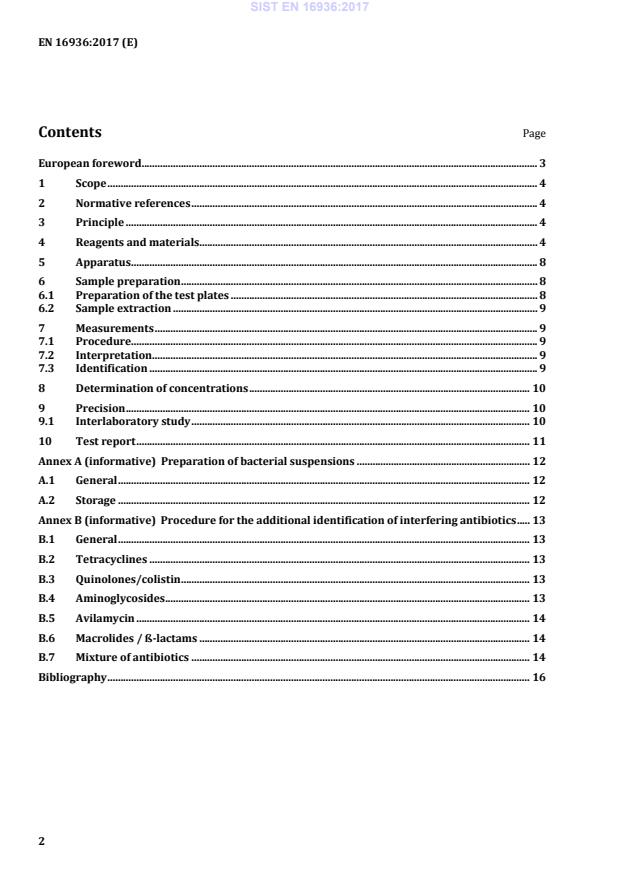
Preparation of bacterial suspensions . 12 A.1 General . 12 A.2 Storage . 12 Annex B (informative)
Procedure for the additional identification of interfering antibiotics . 13 B.1 General . 13 B.2 Tetracyclines . 13 B.3 Quinolones/colistin . 13 B.4 Aminoglycosides . 13 B.5 Avilamycin . 14 B.6 Macrolides / ß-lactams . 14 B.7 Mixture of antibiotics . 14 Bibliography . 16
...