


EN 1909:2004
(Main)Safety requirements for cableway installations designed to carry persons - Recovery and evacuation
General Information
- Abstract
The aim of this European Standard is to define the safety requirements which apply to the recovery of the carriers and to the evacuation of the passengers of cable ways. Its requirements shall be observed, taking into account the different installation systems and their environment. They do not apply to ski-tows. This standard establishes the requirements relating to the methods and equipment to be used to ensure the safety of passengers on cablewaysin the event of an extended stoppage of the installation.
- Status
- Withdrawn
- Publication Date
- 19-Oct-2004
- Withdrawal Date
- 22-Sep-2026
- Technical Committee
- CEN/TC 242 - Safety requirements for passenger transportation by rope
- Drafting Committee
- CEN/TC 242/WG 9 - Recovery and evacuation
- Current Stage
- 9960 - Withdrawal effective - Withdrawal
- Start Date
- 25-Jan-2017
- Completion Date
- 23-Sep-2026
- Directive
- Not Harmonized00/9/EC - Cableway installations designed to carry personsOJ Ref: C, C 100, C 230 OJ Date: 20-Sep-2005
Not Harmonized2000/9/EC - Cableway installations designed to carry personsOJ Ref: C, C 100, C 230 OJ Date: 26-Apr-2005

Relations
- Effective Date
- 08-Jun-2022
- Effective Date
- 09-Feb-2026
- Effective Date
- 28-Jan-2026
- Effective Date
- 28-Jan-2026
- Effective Date
- 28-Jan-2026
- Refers
EN 12927:2019 - Safety requirements for cableway installations designed to carry persons - Ropes - Effective Date
- 28-Jan-2026
- Effective Date
- 28-Jan-2026
- Effective Date
- 28-Jan-2026
- Effective Date
- 28-Jan-2026
- Effective Date
- 28-Jan-2026
- Refers
EN 12397:2017 - Safety requirements for cableway installations designed to carry persons - Operation - Effective Date
- 28-Jan-2026
- Effective Date
- 28-Jan-2026
- Effective Date
- 28-Jan-2026
- Effective Date
- 28-Jan-2026
- Effective Date
- 28-Jan-2026
Get Certified
Connect with accredited certification bodies for this standard

IRIS Certification (UNIFE)
International Railway Industry Standard certification.

TÜV SÜD Rail GmbH
TÜV SÜD railway certification services.

Bureau Veritas Railway Certification
Railway and transportation certification.
Sponsored listings
Frequently Asked Questions
EN 1909:2004 is a standard published by the European Committee for Standardization (CEN). Its full title is "Safety requirements for cableway installations designed to carry persons - Recovery and evacuation". This standard covers: The aim of this European Standard is to define the safety requirements which apply to the recovery of the carriers and to the evacuation of the passengers of cable ways. Its requirements shall be observed, taking into account the different installation systems and their environment. They do not apply to ski-tows. This standard establishes the requirements relating to the methods and equipment to be used to ensure the safety of passengers on cablewaysin the event of an extended stoppage of the installation.
The aim of this European Standard is to define the safety requirements which apply to the recovery of the carriers and to the evacuation of the passengers of cable ways. Its requirements shall be observed, taking into account the different installation systems and their environment. They do not apply to ski-tows. This standard establishes the requirements relating to the methods and equipment to be used to ensure the safety of passengers on cablewaysin the event of an extended stoppage of the installation.
EN 1909:2004 is classified under the following ICS (International Classification for Standards) categories: 45.100 - Cableway equipment. The ICS classification helps identify the subject area and facilitates finding related standards.
EN 1909:2004 has the following relationships with other standards: It is inter standard links to EN 1909:2017, EN 60268-5:2003, EN 13796-3:2017+A1:2022, EN 1907:2005, EN 13796-1:2017, EN 12927:2019, EN 13243:2015, EN 13223:2015+A1:2022, EN 12408:2004, EN 12929-2:2015+A1:2022, EN 12397:2017, EN 13796-2:2017+A1:2022, EN 1908:2015, EN 1709:2019, EN 13107:2015. Understanding these relationships helps ensure you are using the most current and applicable version of the standard.
EN 1909:2004 is associated with the following European legislation: EU Directives/Regulations: 00/9/EC, 2000/9/EC; Standardization Mandates: M/300. When a standard is cited in the Official Journal of the European Union, products manufactured in conformity with it benefit from a presumption of conformity with the essential requirements of the corresponding EU directive or regulation.
EN 1909:2004 is available in PDF format for immediate download after purchase. The document can be added to your cart and obtained through the secure checkout process. Digital delivery ensures instant access to the complete standard document.
Standards Content (Sample)
2003-01.Slovenski inštitut za standardizacijo. Razmnoževanje celote ali delov tega standarda ni dovoljeno.Safety requirements for cableway installations designed to carry persons - Recovery and evacuationPrescriptions de sécurité pour les installations a câbles transportant des personnes - Récupération et évacuationSicherheitsanforderungen für Seilbahnen für den Personenverkehr - Räumung und BergungTa slovenski standard je istoveten z:EN 1909:2004SIST EN 1909:2005en45.100Cableway equipmentICS:SLOVENSKI
STANDARDSIST EN 1909:200501-januar-2005
EUROPEAN STANDARDNORME EUROPÉENNEEUROPÄISCHE NORMEN 1909October 2004ICS 45.100 English versionSafety requirements for cableway installations designed to carrypersons - Recovery and evacuationPrescriptions de sécurité pour les installations à câblestransportant des personnes - Récupération et évacuationSicherheitsanforderungen für Seilbahnen für denPersonenverkehr - Räumung und BergungThis European Standard was approved by CEN on 23 August 2004.CEN members are bound to comply with the CEN/CENELEC Internal Regulations which stipulate the conditions for giving this EuropeanStandard the status of a national standard without any alteration. Up-to-date lists and bibliographical references concerning such nationalstandards may be obtained on application to the Central Secretariat or to any CEN member.This European Standard exists in three official versions (English, French, German). A version in any other language made by translationunder the responsibility of a CEN member into its own language and notified to the Central Secretariat has the same status as the officialversions.CEN members are the national standards bodies of Austria, Belgium, Cyprus, Czech Republic, Denmark, Estonia, Finland, France,Germany, Greece, Hungary, Iceland, Ireland, Italy, Latvia, Lithuania, Luxembourg, Malta, Netherlands, Norway, Poland, Portugal, Slovakia,Slovenia, Spain, Sweden, Switzerland and United Kingdom.EUROPEAN COMMITTEE FOR STANDARDIZATIONCOMITÉ EUROPÉEN DE NORMALISATIONEUROPÄISCHES KOMITEE FÜR NORMUNGManagement Centre: rue de Stassart, 36
B-1050 Brussels© 2004 CENAll rights of exploitation in any form and by any means reservedworldwide for CEN national Members.Ref. No. EN 1909:2004: E
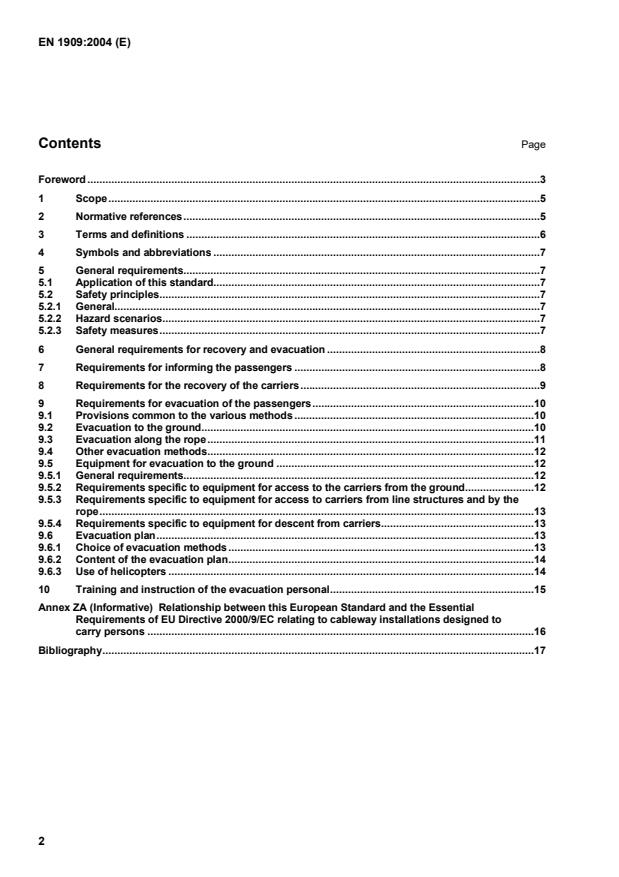
Relationship between this European Standard and the Essential Requirements of EU Directive 2000/9/EC relating to cableway installations designed to carry persons.16 Bibliography.17
.
For dated references, only the edition cited applies.
For undated references, the latest edition of the referenced document (including any amendments) applies. EN 1709, Safety requirements for cableway installations designed to carry persons - Pre-commissioning inspection, maintenance and operational inspection and checks. prEN 1907:2004, Safety requirements for passenger transportation by rope - Terminology. EN 1908, Safety requirements for cableway installations designed to carry persons -Tensioning devices. EN 12397, Safety requirements for cableway installations designed to carry persons – Operation. EN 12408, Safety requirements for cableway installations designed to carry persons - Quality assurance. EN 12927-1, Safety requirements for cableway installations designed to carry persons - Ropes - Part 1 : Selection criteria for ropes and their end fixings. EN 12927-2, Safety requirements for cableway installations designed to carry persons - Ropes - Part 2 : Safety factors. EN 12927-3, Safety requirements for cableway installations designed to carry persons - Ropes - Part 3 : Long splicing of 6 strand hauling, carrying-hauling and towing ropes. EN 12927-4, Safety requirements for cableway installations designed to carry persons - Ropes - Part 4 : End fixings. EN 12927-5, Safety requirements for cableway installations designed to carry persons - Ropes - Part 5 : Storage, transportation, installation and tensioning. EN 12927-6, Safety requirements for cableway installations designed to carry persons - Ropes - Part 6 : Discard criteria.
3 Terms and definitions For the purposes of this document, the terms and definitions given in prEN 1907:2004 and the following apply. 3.1 evacuation plan document containing all the provisions relating to the human and material resources and to the procedures to be implemented for the evacuation of the passengers 3.2 evacuation drive drive system for an evacuation installation or any other evacuation system 3.3 operations centre position from which the evacuation operations are directed 3.4 control centre position on the installation from which recovery of the carriers is controlled
prEN 13796-1, prEN 13796-2 and prEN 13796-3. 5.2 Safety principles 5.2.1 General The safety principles set out in EN 12929-1 apply. In addition, the following hazard scenarios and safety measures relative to the scope of this document are to be taken into consideration. 5.2.2 Hazard scenarios The following events many lead to hazardous situations which may be avoided or limited by the safety requirements of this document: prolonged exposure of persons to bad weather conditions as for example, wind, cold, etc.; prolonged immobilisation; incompetence, unfitness, carelessness or failure on the part of the evacuation personal; non-existence or inadequacy of organization; unsuitable, inadequate or improperly used equipment; unreasonable behaviour of the passengers; lack of self-sufficiency of the passengers. 5.2.3 Safety measures In order to meet the hazard scenarios mentioned in 5.2.2, the following safety measures shall be taken. All cableways shall be designed, constructed and operated in such a way that, in the event of extended stoppage, it is possible to inform the passengers quickly and to ensure their return to safety within a reasonable time, without compromising their safety or the safety of the evacuation personnel. In such circumstances, it is preferable to recover the carriers. Failing this, the passengers shall be evacuated in accordance with the provisions of a previously established evacuation plan.
...