


EN 81-20:2020
(Main)Safety rules for the construction and installation of lifts - Lifts for the transport of persons and goods - Part 20: Passenger and goods passenger lifts
Safety rules for the construction and installation of lifts - Lifts for the transport of persons and goods - Part 20: Passenger and goods passenger lifts
1.1 This document specifies the safety rules for permanently installed new passenger or goods passenger lifts, with traction, positive or hydraulic drive, serving defined landing levels, having a car designed for the transportation of persons or persons and goods, suspended by ropes or chains or jacks and moving between guide rails inclined not more than 15° to the vertical.
1.2 In addition to the requirements of this document, supplementary requirements shall be considered in special cases (use of lifts by persons with disabilities, in case of fire, potentially explosive atmosphere, extreme climate conditions, seismic conditions, transporting dangerous goods, etc.).
1.3 This document does not cover:
a) lifts with:
1) drive systems other than those stated in 1.1;
2) rated speed ≤ 0,15 m/s;
b) hydraulic lifts:
1) with a rated speed exceeding 1 m/s;
2) where the setting of the pressure relief valve exceeds 50 MPa (5.9.3.5.3);
c) new passenger or goods passenger lifts in existing buildings ) where in some circumstances due to limitations enforced by building constraints, some requirements of EN 81 20 cannot be met and EN 81 21 should be considered;
d) lifting appliances, such as paternosters, mine lifts, theatrical lifts, appliances with automatic caging, skips, lifts and hoists for building and public works sites, ships' hoists, platforms for exploration or drilling at sea, construction and maintenance appliances or lifts in wind turbines;
e) important modifications (see Annex C) to a lift installed before this standard is brought into application;
f) safety during operations of transport, erection, repairs, and dismantling of lifts.
However, this standard may usefully be taken as a basis.
Noise and vibrations are not dealt with in this standard as they are not found at levels which could be considered as harmful with regard to the safe use and maintenance of the lift (see also 0.4.1).
1.4 This document is not applicable to passenger and goods passenger lifts which are installed before the date of its publication as EN.
2) Existing building is a building which is used or was already used before the order for the lift was placed. A building whose internal structure is completely renewed is considered as a new building.
Sicherheitsregeln für die Konstruktion und den Einbau von Aufzügen - Aufzüge für den Personen- und Gütertransport - Teil 20: Personen- und Lastenaufzüge
1.1 Dieses Dokument legt die Sicherheitsregeln für dauerhaft eingebaute neue, elektrisch betriebene Personen- oder Lastenaufzüge fest, die einen Treibscheiben-, Trommel,-Ketten- oder hydraulischen Antrieb haben, festgelegte Ebenen bedienen und einen Fahrkorb besitzen, der, an Seilen oder Ketten aufgehängt oder von Hebern getragen, für den Transport von Personen oder Personen und Lasten bestimmt ist und der sich zwischen Führungen, die nicht mehr als 15° gegen die Vertikale geneigt sind, bewegt.
1.2 Zusätzlich zu den Anforderungen dieses Dokuments müssen in speziellen Fällen weitere Anforderungen (Nutzung der Aufzüge von Personen mit Behinderungen im Brandfall, explosionsgefährdete Atmosphäre, extreme klimatische Verhältnisse, Erdbebenbedin¬gungen, Transport gefährlicher Güter usw.) berücksichtigt werden.
1.3 Dieses Dokument gilt nicht für
a) Aufzüge mit
1) anderen als den in 1.1 genannten Antrieben,
2) Nenngeschwindigkeiten ≤ 0,15 m/s;
b) Hydraulikaufzüge
1) mit einer Nenngeschwindigkeit über 1 m/s,
2) bei der die Einstellung für Druckbegrenzungsventil (5.9.3.5.3) oberhalb von 50 MPa liegt;
c) neue Personen- oder Lastenaufzüge in bestehenden Gebäuden , bei denen unter Umständen infolge von Einschränkungen, die sich aus baulichen Zwängen ergebenen, einige Anforderungen von EN 81 20 nicht erfüllt werden können und bei denen EN 81 21 berücksichtigt werden sollte;
d) Hebezeuge, wie Umlaufaufzüge, Schachtförderanlagen, Bühnenaufzüge, Einrichtungen mit automa-tischer Beladung, Kübelaufzüge, Bauaufzüge, Schiffsaufzüge, Bohrplattformen auf See, Bau- und Instand¬haltungseinrichtungen oder Aufzüge in Windenergieanlagen;
e) wesentliche Änderungen (vergleiche Anhang C) an einem Aufzug, der vor dem Inkrafttreten dieser Norm errichtet wurde;
f) Sicherheit während des Transports, der Errichtung, einer Reparatur und beim Ausbau von Aufzügen.
Dafür kann jedoch sachdienlich von dieser Norm ausgegangen werden.
Lärm und Schwingungen werden in dieser Norm nicht behandelt, weil sie nicht in solchen Größenordnungen ermittelt werden, die in Bezug auf die sichere Benutzung und Wartung von Aufzügen als gefährdend eingestuft werden könnten (siehe auch 0.4.2).
1.4 Dieses Dokument gilt nicht für Personen- und Lastenaufzüge, die vor ihrer Veröffentlichung errichtet wurden.
Règles de sécurité pour la construction et l'installation des élévateurs - Élévateurs pour le transport de personnes et d'objets - Partie 20 : Ascenseurs et ascenseurs de charge
1.1 Le présent document précise les règles de sécurité pour les ascenseurs ou ascenseurs de charge neufs, installés à demeure, à entraînement par adhérence, à treuil attelé, ou hydraulique, desservant des niveaux définis, comportant une cabine aménagée en vue du transport de personnes, ou de personnes et d'objets, suspendue par des câbles, des chaînes ou des vérins et se déplaçant le long de guides inclinés dont l’angle avec la verticale n’excède pas 15°.
1.2 Outre les prescriptions du présent document, des prescriptions supplémentaires sont prises en compte dans des cas particuliers (utilisation des ascenseurs par des personnes avec handicap, en cas d'incendie, atmosphère explosible, conditions climatiques extrêmes, conditions sismiques, transport de produits dangereux, etc.).
1.3 Le présent document ne concerne pas :
a) les ascenseurs :
1) à systèmes d'entraînement autres que ceux indiqués en 1.1 ;
2) dont la vitesse nominale est ≤ 0,15 m/s ;
b) les ascenseurs hydrauliques :
1) dont la vitesse nominale dépasse 1 m/s ;
2) où le réglage du limiteur de pression dépasse 50 Mpa (5.9.3.5.3) ;
c) les ascenseurs ou ascenseurs de charge neufs dans les bâtiments existants 2) lorsque, dans certaines circonstances, en raison des limites imposées par les contraintes de construction, certaines exigences de l'EN 81-20 ne peuvent pas être satisfaites et qu'il convient de prendre en compte l'EN 81-21 ;
d) les appareils de levage, tels que pater-noster, ascenseurs de mines, élévateurs de machinerie théâtrale, appareils à encagement automatique, skips, ascenseurs et monte-matériaux de chantier du bâtiment et des travaux publics, appareils élévateurs destinés à l’équipement des navires, plates-formes de recherche ou de forage en mer, appareils de construction et d’entretien ou élévateurs dans les éoliennes ;
e) les transformations importantes d’un ascenseur (voir Annexe C) installé avant la mise en application de la présente norme ;
f) la sécurité lors des opérations de transport, d’installation, de réparation et de démontage des ascenseurs.
Toutefois, on pourra utilement s'inspirer de la présente norme.
La présente norme ne traite pas du bruit et des vibrations car ils n'atteignent pas des niveaux considérés comme dangereux au regard d'une utilisation et d'une maintenance en toute sécurité de l'ascenseur (voir aussi 0.4.1).
1.4 Le présent document n'est pas applicable aux ascenseurs et aux ascenseurs de charge installés avant sa date de publication en tant que Norme européenne.
2) Par bâtiment existant, on entend un bâtiment occupé ou précédemment occupé avant la commande de l’ascenseur. Un bâtiment dont le gros oeuvre est totalement remanié est considéré neuf.
Varnostna pravila za konstruiranje in vgradnjo dvigal (liftov) - Dvigala za prevoz oseb in blaga - 20. del: Osebna in tovorno-osebna dvigala
General Information
Relations

Standards Content (Sample)
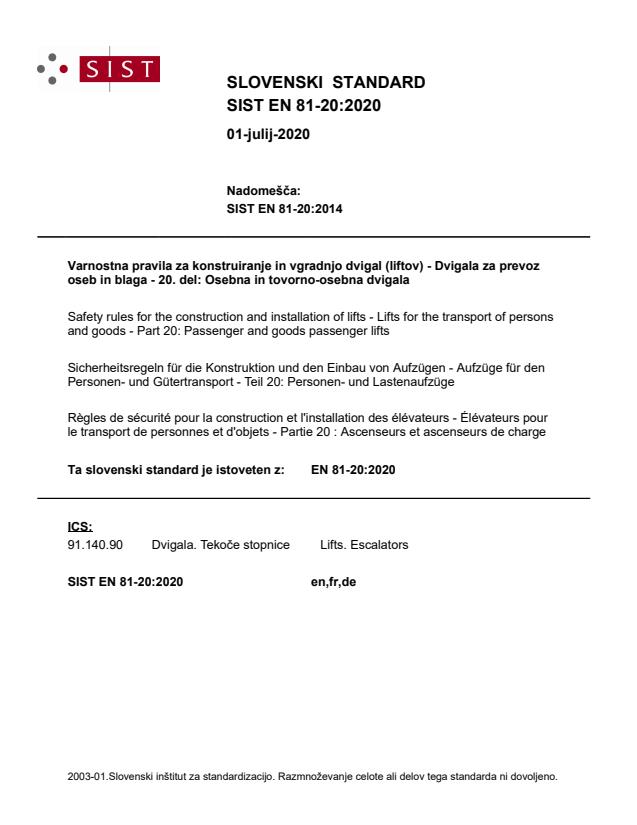
SLOVENSKI STANDARD
01-julij-2020
Nadomešča:
SIST EN 81-20:2014
Varnostna pravila za konstruiranje in vgradnjo dvigal (liftov) - Dvigala za prevoz
oseb in blaga - 20. del: Osebna in tovorno-osebna dvigala
Safety rules for the construction and installation of lifts - Lifts for the transport of persons
and goods - Part 20: Passenger and goods passenger lifts
Sicherheitsregeln für die Konstruktion und den Einbau von Aufzügen - Aufzüge für den
Personen- und Gütertransport - Teil 20: Personen- und Lastenaufzüge
Règles de sécurité pour la construction et l'installation des élévateurs - Élévateurs pour
le transport de personnes et d'objets - Partie 20 : Ascenseurs et ascenseurs de charge
Ta slovenski standard je istoveten z: EN 81-20:2020
ICS:
91.140.90 Dvigala. Tekoče stopnice Lifts. Escalators
2003-01.Slovenski inštitut za standardizacijo. Razmnoževanje celote ali delov tega standarda ni dovoljeno.
EN 81-20
EUROPEAN STANDARD
NORME EUROPÉENNE
February 2020
EUROPÄISCHE NORM
ICS 91.140.90 Supersedes EN 81-20:2014
English Version
Safety rules for the construction and installation of lifts -
Lifts for the transport of persons and goods - Part 20:
Passenger and goods passenger lifts
Règles de sécurité pour la construction et l'installation Sicherheitsregeln für die Konstruktion und den Einbau
des élévateurs - Élévateurs pour le transport de von Aufzügen - Aufzüge für den Personen- und
personnes et d'objets - Partie 20 : Ascenseurs et Gütertransport - Teil 20: Personen- und Lastenaufzüge
ascenseurs de charge
This European Standard was approved by CEN on 1 December 2019.
CEN members are bound to comply with the CEN/CENELEC Internal Regulations which stipulate the conditions for giving this
European Standard the status of a national standard without any alteration. Up-to-date lists and bibliographical references
concerning such national standards may be obtained on application to the CEN-CENELEC Management Centre or to any CEN
member.
This European Standard exists in three official versions (English, French, German). A version in any other language made by
translation under the responsibility of a CEN member into its own language and notified to the CEN-CENELEC Management
Centre has the same status as the official versions.
CEN members are the national standards bodies of Austria, Belgium, Bulgaria, Croatia, Cyprus, Czech Republic, Denmark, Estonia,
Finland, France, Germany, Greece, Hungary, Iceland, Ireland, Italy, Latvia, Lithuania, Luxembourg, Malta, Netherlands, Norway,
Poland, Portugal, Republic of North Macedonia, Romania, Serbia, Slovakia, Slovenia, Spain, Sweden, Switzerland, Turkey and
United Kingdom.
EUROPEAN COMMITTEE FOR STANDARDIZATION
COMITÉ EUROPÉEN DE NORMALISATION
EUROPÄISCHES KOMITEE FÜR NORMUNG
CEN-CENELEC Management Centre: Rue de la Science 23, B-1040 Brussels
© 2020 CEN All rights of exploitation in any form and by any means reserved Ref. No. EN 81-20:2020 E
worldwide for CEN national Members.
Contents Page
European foreword . 6
0 Introduction . 8
0.1 General . 8
0.2 General remarks . 8
0.3 Principles . 9
0.4 Assumptions . 9
1 Scope . 13
2 Normative references . 14
3 Terms and definitions . 16
4 List of significant hazards . 23
5 Safety requirements and/or protective measures . 25
5.1 General . 25
5.2 Well, machinery spaces and pulley rooms . 25
5.2.1 General provisions . 25
5.2.2 Access to well and to machinery spaces and pulley rooms . 30
5.2.3 Access and emergency doors - Access trap doors - Inspection doors . 31
5.2.4 Notices . 32
5.2.5 Well . 33
5.2.6 Machinery spaces and pulley rooms . 46
5.3 Landing doors and car doors . 54
5.3.1 General provisions . 54
5.3.2 Height and width of entrances . 54
5.3.3 Sills, guides, door suspension . 54
5.3.4 Horizontal door clearances . 55
5.3.5 Strength of landings and car doors . 56
5.3.6 Protection in relation to door operation . 60
5.3.7 Local landing lighting and “car here” signal lights . 62
5.3.8 Locking and closed landing door check . 63
5.3.9 Locking and emergency unlocking of landing and car doors . 63
5.3.10 Requirements common to devices for proving the locked condition and the closed
condition of the landing door . 66
5.3.11 Sliding landing doors with multiple, mechanically linked panels . 66
5.3.12 Closing of automatically operated landing doors . 67
5.3.13 Electric safety device for proving the car doors closed . 67
5.3.14 Sliding or folding car doors with multiple, mechanically linked panels . 67
5.3.15 Opening the car door . 68
5.4 Car, counterweight and balancing weight . 68
5.4.1 Height of car . 68
5.4.2 Available car area, rated load, number of passengers . 68
5.4.3 Walls, floor and roof of the car . 74
5.4.4 Car door, floor, wall, ceiling and decorative materials . 75
5.4.5 Apron . 76
5.4.6 Emergency trap doors and emergency doors . 76
5.4.7 Car roof . 77
5.4.8 Equipment on top of the car . 81
5.4.9 Ventilation . 81
5.4.10 Lighting . 81
5.4.11 Counterweight and balancing weight . 82
5.5 Suspension means, compensation means and related protection means . 82
5.5.1 Suspension means . 82
5.5.2 Sheave, pulley, drum and rope diameter ratios, rope/chain terminations. 82
5.5.3 Rope traction . 83
5.5.4 Winding up of ropes for positive drive lifts . 83
5.5.5 Distribution of load between the ropes or the chains . 84
5.5.6 Compensation means . 84
5.5.7 Protection for sheaves, pulleys and sprockets . 85
5.5.8 Traction sheaves, pulleys and sprockets in the well . 87
5.6 Precautions against free fall, excessive speed, unintended car movement and
creeping of the car . 87
5.6.1 General provisions . 87
5.6.2 Safety gear and its tripping means . 90
5.6.3 Rupture valve . 96
5.6.4 Restrictors . 97
5.6.5 Pawl device . 98
5.6.6 Ascending car overspeed protection means . 99
5.6.7 Protection against unintended car movement . 100
5.7 Guide rails . 103
5.7.1 Guiding of the car, counterweight or balancing weight . 103
5.7.2 Permissible stresses and deflections . 103
5.7.3 Combination of loads and forces . 107
5.7.4 Impact factors . 107
5.8 Buffers . 109
5.8.1 Car and counterweight buffers . 109
5.8.2 Stroke of car and counterweight buffers . 110
5.9 Lift machinery and associated equipment . 111
5.9.1 General provision . 111
5.9.2 Lift machine for traction lifts and positive drive lifts . 111
5.9.3 Lift machine for hydraulic lifts . 117
5.10 Electric installations and appliances . 126
5.10.1 General provisions . 126
5.10.2 Incoming supply conductor terminations . 128
5.10.3 Contactors, contactor relays, components of safety circuits . 128
5.10.4 Protection of electrical equipment . 129
5.10.5 Main switches . 130
5.10.6 Electric wiring . 131
5.10.7 Lighting and socket outlets . 132
5.10.8 Control of the supply for lighting and socket outlets. 132
5.10.9 Protective earthing . 133
5.10.10 Electrical identification. 133
5.11 Protection against electric faults; failure analysis; electric safety devices . 133
5.11.1 Protection against electric faults; failure analysis . 133
5.11.2 Electric safety devices . 134
5.12 Controls - Final limit switches - Priorities . 139
5.12.1 Control of lift operations . 139
5.12.2 Final limit switches . 146
5.12.3 Emergency alarm device and intercom system . 147
5.12.4 Priorities and signals . 148
6 Verification of the safety requirements and/or protective measures . 148
6.1 Technical compliance documentation. 148
6.2 Verification of design . 148
6.3 Examinations and tests before putting into service . 152
6.3.1 Braking system (5.9.2.2) . 152
6.3.2 Electric installation . 153
6.3.3 Checking of the traction (5.5.3) . 153
6.3.4 Car safety gear (5.6.2) . 153
6.3.5 Counterweight or balancing weight safety gear (5.6.2) . 154
6.3.6 Pawl device (5.6.5). 154
6.3.7 Buffers (5.8.1, 5.8.2) . 155
6.3.8 Rupture valve (5.6.3) . 155
6.3.9 Restrictor/one-way restrictor (5.6.4) . 155
6.3.10 Pressure test . 156
6.3.11 Ascending car overspeed protection means (5.6.6) . 156
6.3.12 Stopping of the car at landings and levelling accuracy (5.12.1.1.4) . 156
6.3.13 Protection against unintended car movement (5.6.7) . 156
6.3.14 Protection against falling/shearing (5.3.9.3.4) . 157
7 Information for use . 157
7.1 General . 157
7.2 Instruction manual . 157
7.2.1 General . 157
7.2.2 Normal use . 157
7.2.3 Maintenance . 157
7.2.4 Examinations and tests . 158
7.3 Logbook . 158
Annex A (normative) List of the electric safety devices . 160
Annex B (informative) Technical compliance documentation . 163
Annex C (informative) Periodic examinations and tests, examinations and tests after an
important modification or after an accident . 164
C.1 Periodic examinations and tests . 164
C.2 Examinations and tests after an important modification or after an accident . 164
Annex D (informative) Machinery spaces – Access . 166
Annex E (informative) Building interfaces . 167
E.1 General provisions . 167
E.2 Support of Guide Rails . 167
E.3 Ventilation of car, well and machine rooms . 167
E.3.1 General . 167
E.3.2 Ventilation of the well and car . 168
E.3.3 Ventilation of machine rooms . 169
Annex F (normative) Pit access ladder . 170
F.1 Types of pit access ladder . 170
F.2 General provisions . 170
F.3 Ladder uprights and rungs . 170
F.3.1 Ladder uprights . 170
F.3.2 Ladder rungs . 171
F.4 Specific provisions for non fixed type ladders . 171
F.5 Location of the ladder in the pit . 171
Annex ZA (informative) Relationship between this European Standard and the essential
requirements of Directive 2014/33/EU aimed to be covered . 173
Bibliography . 178
European foreword
This document (EN 81-20:2020) has been prepared by Technical Committee CEN/TC 10 “Lifts,
escalators and moving walks”, the secretariat of which is held by AFNOR.
This European Standard shall be given the status of a national standard, either by publication of an
identical text or by endorsement, at the latest by August 2020, and conflicting national standards shall
be withdrawn at the latest by February 2022.
Attention is drawn to the possibility that some of the elements of this document may be the subject of
patent rights. CEN shall not be held responsible for identifying any or all such patent rights.
This document supersedes EN 81-20:2014.
This document is a revision of EN 81-20:2014. Significant changes made are as follows:
— All externally referenced standards have now been dated.
— A new Annex ZA has been developed in order to be aligned with the requirements of the EU
Commission Standardization Request “M/549 C(2016) 5884 final”.
No technical changes have been made during this revision.
This standard is the culmination of the progressive development of the EN standards for lifts. Previous
versions of the EN 81-1 and EN 81-2 standards incorporated into EN 81-20:2020 and EN 81-50:2020
include:
— EN 81-1:1985, Safety rules for electric lifts
— EN 81-1:1998, Safety rules for electric lifts
— EN 81-1:1998, Corrigendum No 1:1999;
— EN 81-1:1998/A1:2005, incorporating programmable electronic system in safety related
applications for lifts;
— EN 81-1:1998/A2:2004, incorporating machine-room-less lifts;
— EN 81-1:1998+A3:2009, Incorporating unintended car movement with open doors;
— EN 81-2:1987, Safety rules for hydraulic lifts
— EN 81-2:1998, Safety rules for hydraulic lifts
— EN 81-2:1998, Corrigendum No 1:1999;
— EN 81-2:1998/A1:2005, incorporating programmable electronic system in safety related
applications for lifts;
— EN 81-2:1998/A2:2004, incorporating machine-room-less lifts;
— EN 81-2:1998+A3:2009, incorporating unintended car movement with open doors.
This document is part of a series of standards giving safety rules for the construction and installation of
lifts which are listed below.
Standard Use
EN 81-21 Provides alternative technical requirements to those given in EN 81-20 to overcome
certain specific problems encountered when installing lifts into existing buildings
EN 81-28 Provides the requirements for the alarm systems to be used on passenger carrying lifts
to enable trapped persons to contact a rescue service.
EN 81-50 Used in conjunction with EN 81-20 to provide rules for type testing of safety related
components and calculation methodology.
EN 81-58 Provides a unified method of testing the fire resistance of lift landing doors
EN 81-70 Provides additional requirements to EN 81-20 for accessible passenger lifts
EN 81-71 Provides additional requirements to EN 81-20 for vandal resistant lifts
EN 81-72 Provides additional requirements to EN 81-20 for lifts used by fire fighters
EN 81-73 Provides additional requirements to EN 81-20 for lifts used in the evacuation of
disabled persons from buildings.
EN 81-77 Provides additional requirements to EN 81-20 for lifts subject to seismic conditions
EN 12015 Provides additional requirements to EN 81-20 for electromagnetic compatibility
emissions
EN 12016 Provides additional requirements to EN 81-20 for electromagnetic compatibility
immunity
EN 13015 Gives rules for the drafting of maintenance manuals to accompany lifts.
In addition CEN TR 81-10 gives information with regard to the structure of the EN 81 series of
standards.
This document has been prepared under a mandate given to CEN by the European Commission and the
European Free Trade Association, and supports essential requirements of EU Directive(s).
For relationship with EU Directive(s), see informative Annex ZA, which is an integral part of this
document.
According to the CEN-CENELEC Internal Regulations, the national standards organisations of the
following countries are bound to implement this European Standard: Austria, Belgium, Bulgaria,
Croatia, Cyprus, Czech Republic, Denmark, Estonia, Finland, France, Germany, Greece, Hungary, Iceland,
Ireland, Italy, Latvia, Lithuania, Luxembourg, Malta, Netherlands, Norway, Poland, Portugal, Republic of
North Macedonia, Romania, Serbia, Slovakia, Slovenia, Spain, Sweden, Switzerland, Turkey and the
United Kingdom.
0 Introduction
0.1 General
This standard is a type C standard as stated in EN ISO 12100.
The machinery concerned and the extent to which hazards, hazardous situations and hazardous events
are covered are indicated in the scope of this standard.
When provisions of this type C standard are different from those which are stated in type A or B
standards, the provisions of this type C standard take precedence over the provisions of the other
standards, for machines that have been designed and built according to the provisions of this type C
standard.
0.2 General remarks
0.2.1 The object of this standard is to define safety rules related to passenger and goods passenger
lifts with a view to safeguarding persons and objects against the risk of accidents associated with the
normal use, maintenance and emergency operation of lifts.
0.2.2 A study has been made of the various possible hazards with lifts, see Clause 4.
0.2.2.1 Persons to be safeguarded:
a) users, including passengers and competent and authorized persons, e.g. maintenance and
inspection personnel (see EN 13015);
b) persons in the surrounding area of the well, or any machine room and pulley room, who may be
effected by the lift.
0.2.2.2 Property to be safeguarded:
a) loads in car;
b) components of the lift installation;
c) building in which the lift is installed;
d) the immediate surrounding area of the lift installation.
NOTE EN 81-71 gives additional requirements covering lifts resistant to acts of vandalism and EN 81-77
gives additional requirements covering lifts in seismic conditions.
0.2.3 When the weight, size and/or shape of components prevent them from being moved by hand,
they are:
a) either fitted with attachments for lifting gear; or
b) designed so that they can be fitted with such attachments (e.g. by means of threaded holes); or
c) shaped in such a way that standard lifting gear can easily be attached.
0.3 Principles
0.3.1 General
In drawing up this standard the following principles have been used:
0.3.2 This standard does not repeat all the general technical rules applicable to every electrical,
mechanical, or building construction including the protection of building elements against fire.
It has, however, been necessary to establish certain requirements of good construction, either because
they are peculiar to lift manufacture or because in the case of lift utilization the requirements may be
more stringent than elsewhere.
0.3.3 This standard states minimum rules for the installation of lifts into buildings/constructions.
There may be in some countries regulations for the construction of buildings etc. which cannot be
ignored.
Typical clauses affected by this are those defining minimum values for the height of the machine and
pulley rooms and for their access doors dimensions.
0.3.4 As far as possible the standard sets out only the requirements that materials and equipment
have to meet in the interests of safe operation of lifts.
0.3.5 Risk analysis, terminology and technical solutions have been considered taking into account the
methods of EN ISO 12100, EN ISO 14798 and the EN 61508 series of standards.
0.3.6 In order for EN 81-20 to be a widely applicable standard the average weight of a person has
been determined to be 75 kg.
This standard defines the maximum car area related to a specified design load in the car (rated load)
and the minimum car area to transport a corresponding number of persons, based on 75 kg per person,
in order to detect and discourage overloading.
0.4 Assumptions
0.4.1 General
In drawing up this standard the following assumptions have been made:
0.4.2 Negotiations have been made between the customer and the supplier and agreement reached
about:
a) the intended use of the lift;
b) the type and mass of the handling devices intended to be used to load and unload the car in the case
of goods passenger lifts;
c) environmental conditions such as temperature, humidity, exposure to sun or wind, snow, corrosive
atmosphere;
d) civil engineering problems (for example, building regulations);
e) other aspects related to the place of installation;
f) the dissipation of heat from the components / equipment of the lift which would require ventilation
of the well and/or the machinery space / location of equipment;
g) information concerning the aspects relating to noise and vibrations emitted by the equipment.
0.4.3 Relevant risks have been considered for each component that may be incorporated in a
complete lift installation and rules have been drawn up accordingly:
Components are:
a) designed in accordance with usual engineering practice (see CEN/TR 81-12) and calculation codes,
taking into account all failure modes;
b) of sound mechanical and electrical construction;
c) made of materials with adequate strength and of suitable quality;
d) free of defects;
e) free from harmful materials, e.g. asbestos.
0.4.4 Components are kept in good repair and working order, so that the required dimensions remain
fulfilled despite wear. All lift components are considered as requiring inspection to ensure safe
continued operation during their use.
The operational clearances specified in the standard should be maintained not only during the
examination and tests before the lift is put into service, but also throughout the life of the lift.
NOTE Components not requiring maintenance (e.g. maintenance free, sealed for life) are still required to be
available for inspection.
0.4.5 Components will be selected and installed so that foreseeable environmental influences and
special working conditions do not affect the safe operation of the lift.
0.4.6 By design of the load bearing elements, safe normal operation of the lift is ensured for loads
ranging from 0 % to 100 % of the rated load, plus any designed overload capacity (see 5.12.1.2).
0.4.7 The requirements of this standard are such that the possibility of a failure of an electric safety
device (see 5.11.2) or a type tested safety component complying with all the requirements of this
standard and EN 81-50 needs not to be taken into consideration.
0.4.8 Users have to be safeguarded against their own negligence and unwitting carelessness when
using the lift in the intended way.
0.4.9 A user may, in certain cases, make one imprudent act. The possibility of two simultaneous acts
of imprudence and/or the abuse of instructions for use is not considered.
0.4.10 If in the course of maintenance work a safety device, normally not accessible to the users, is
deliberately neutralized, safe operation of the lift is no longer ensured, but compensatory measures will
be taken to ensure users safety in conformity with maintenance instructions.
It is assumed that maintenance personnel are instructed and work according to the instructions.
0.4.11 Horizontal forces and/or energies to consider are indicated in the applicable clauses of the
standard. Typically, where not otherwise specified in this standard, the energy exerted by a person
results in an equivalent static force of:
a) 300 N;
b) 1000 N where impact can occur.
0.4.12 With the exception of the items listed below which have been given special consideration, a
mechanical device built according to good practice and the requirements of the standard, including
uncontrolled slipping of the ropes on the traction sheave will not deteriorate to a point of creating
hazard without the possibility of detection provided that all of the instructions given by the
manufacturer have been duly applied:
a) breakage of the suspension;
b) breakage and slackening of all linkage by auxiliary ropes, chains and belts;
c) failure of one of the mechanical components of the electromechanical brake which take part in the
application of the braking action on the drum or disk;
d) failure of a component associated with the main drive elements and the traction sheave;
e) rupture in the hydraulic system (jack excluded);
f) small leakage in the hydraulic system (jack included, see 6.3.10).
0.4.13 The possibility of the safety gear not engaging, should the car free fall from a stationary position
at the lowest landing, before the car strikes the buffer(s) is considered acceptable.
0.4.14 When the speed of the car is linked to the electrical frequency of the mains, the speed is
assumed not to exceed 115 % of the rated speed or a corresponding lesser speed where specified in this
standard for inspection control, levelling, etc.
0.4.15 Means of access are provided for the hoisting of heavy equipment (see 0.4.2 e)).
0.4.16 To ensure the correct functioning of the equipment in the well and machinery space(s), i.e.
taking into account the heat dissipated by the equipment, the ambient temperature in the well and the
machinery space(s) is assumed to be maintained between + 5 °C and + 40 °C.
NOTE See HD 60364-5-51, Code AA5.
0.4.17 The well is suitably ventilated, according to national building regulation, taking into
consideration the heat output as specified by the manufacturer, the environmental conditions of the lift
and the limits given in 0.4.16, e.g. ambient temperature, humidity, direct sunlight, air quality and air
tightness of buildings due to energy saving requirements.
NOTE See 0.4.2 and E.3 for further guidance.
0.4.18 Access ways to the working areas are adequately lit (see 0.4.2).
0.4.19 Minimum passageways, corridors, fire escapes, etc. are not obstructed by the open door/trap of
the lift and/or any protection means for working areas outside of the well, where fitted according to the
maintenance instructions (see 0.4.2).
0.4.20 Where more than one person is working at the same time on a lift, an adequate means of
communication between these persons is ensured.
0.4.21 The fixing system of guards, used specifically to provide protection against mechanical,
electrical or any other hazards by means of a physical barrier, which have to be removed during regular
maintenance and inspection, remains attached to the guard or to the equipment when the guard is
removed.
0.4.22 The fluids used for the operation of hydraulic lifts are according to EN ISO 6743-4.
1 Scope
1.1 This document specifies the safety rules for permanently installed new passenger or goods
passenger lifts, with traction, positive or hydraulic drive, serving defined landing levels, having a car
designed for the transportation of persons or persons and goods, suspended by ropes, chains or jacks
and moving between guide rails inclined not more than 15° to the vertical.
1.2 In addition to the requirements of this document, supplementary requirements have to be
considered in special cases (use of lifts by persons with disabilities, in case of fire, potentially explosive
atmosphere, extreme climate conditions, seismic conditions, transporting dangerous goods, etc.).
1.3 This standard does not cover:
a) lifts with:
1) drive systems other than those stated in 1.1;
2) rated speed ≤ 0,15 m/s;
b) hydraulic lifts:
1) with a rated speed exceeding 1 m/s;
2) where the setting of the pressure relief valve (5.9.3.5.3) exceeds 50 MPa;
1)
c) new passenger or goods passenger lifts in existing buildings where in some circumstances due to
limitations enforced by building constraints, some requirements of EN 81-20 cannot be met and
EN 81-21 should be considered;
d) lifting appliances, such as paternosters, mine lifts, theatrical lifts, appliances with automatic caging,
skips, lifts and hoists for building and public works sites, ships' hoists, platforms for exploration or
drilling at sea, construction and maintenance appliances or lifts in wind turbines;
e) important modifications (see Annex C) to a lift installed before this standard is brought into
application;
f) safety during operations of transport, erection, repairs, and dismantling of lifts.
However, this standard may usefully be taken as a basis.
Noise and vibrations are not dealt with in this standard as they are not found at levels which could be
considered as harmful with regard to the safe use and maintenance of the lift (see also 0.4.2).
1.4 This standard is not applicable to passenger and goods passenger lifts, which are installed before
the date of its publication.
1)
Existing building is a building which is used or was already used before the order for the lift was placed. A building whose
internal structure is completely renewed is considered as a new building.
2 Normative references
The following documents are referred to in the text in such a way that some or all of their content
constitutes requirements of this document. For dated references, only the edition cited applies. For
undated references, the latest edition of the referenced document (including any amendments) applies.
EN 81-28:2003, Safety rules for the construction and installation of lifts — Lifts for the transport of
persons and goods — Part 28: Remote alarm on passenger and goods passenger lifts
EN 81-50:2020, Safety rules for the construction and installation of lifts — Examinations and tests — Part
50: Design rules, calculations, examinations and tests of lift components
EN 81-58:2003, Safety rules for the construction and installation of lifts - Examination and tests - Part 58:
Landing doors fire resistance test
EN 131-2:2010+A1:2017, Ladders — Requirements, testing, marking
EN 1993-1-1:2002, Eurocode 3 — Design of steel structures — Part 1-1: General rules and rules for
buildings
EN 10305-1:2016, Steel tubes for precision applications - Technical delivery conditions - Part 1: Seamless
cold drawn tubes
EN 10305-2:2016, Steel tubes for precision applications - Technical delivery conditions - Part 2: Welded
cold drawn tubes
EN 10305-3:2016, Steel tubes for precision
...
Questions, Comments and Discussion
Ask us and Technical Secretary will try to provide an answer. You can facilitate discussion about the standard in here.
Loading comments...